
Practical Semantic Test Simplification Sai Zhang
Description: Practical Semantic Test Simplification Sai Zhang University of Washington A typical testing workflow 2 Software Test Test Result This paper How to help programmers understand a failed test? Test simplification Isolate only the
Related Topics
Download Presentation
"Practical Semantic Test Simplification Sai Zhang" is the property of its rightful owner. Permission is granted to download and print the materials on this website for personal, non-commercial use only, and to display it on your personal computer provided you do not modify the materials and that you retain all copyright notices contained in the materials. By downloading content from our website, you accept the terms of this agreement.
Presentation Transcript
slide1. Practical Semantic Test Simplification Sai Zhang
University of Washington<br>
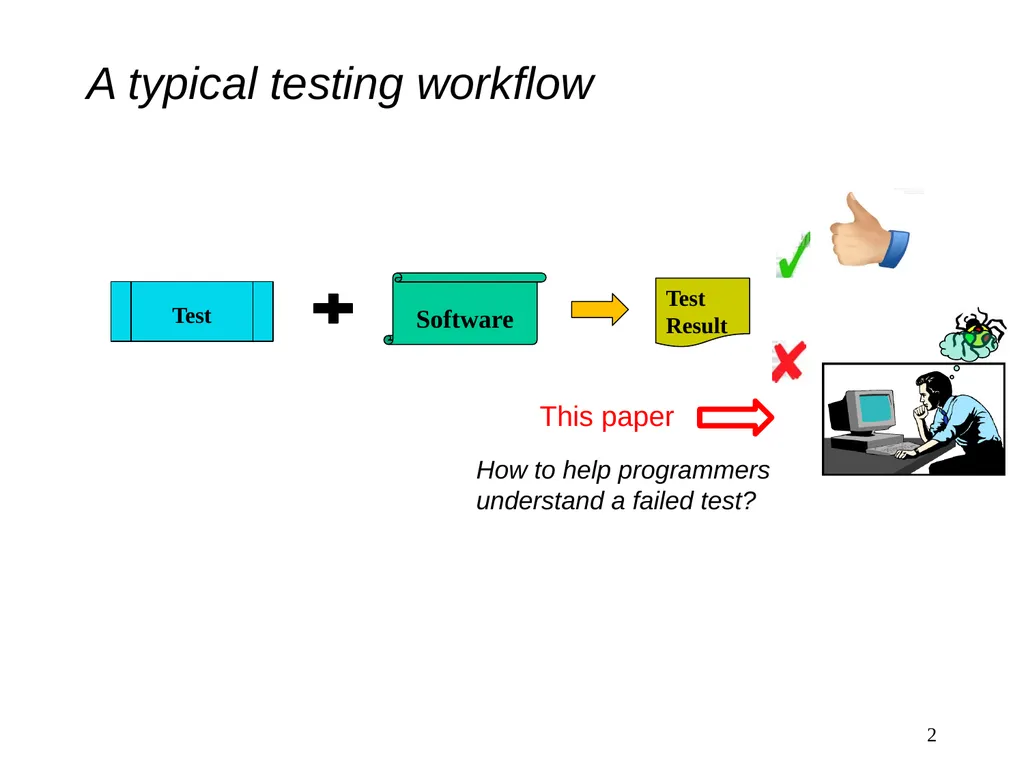
slide2. A typical testing workflow 2 Software Test Test
Result This paper How to help programmers understand a failed test?<br>
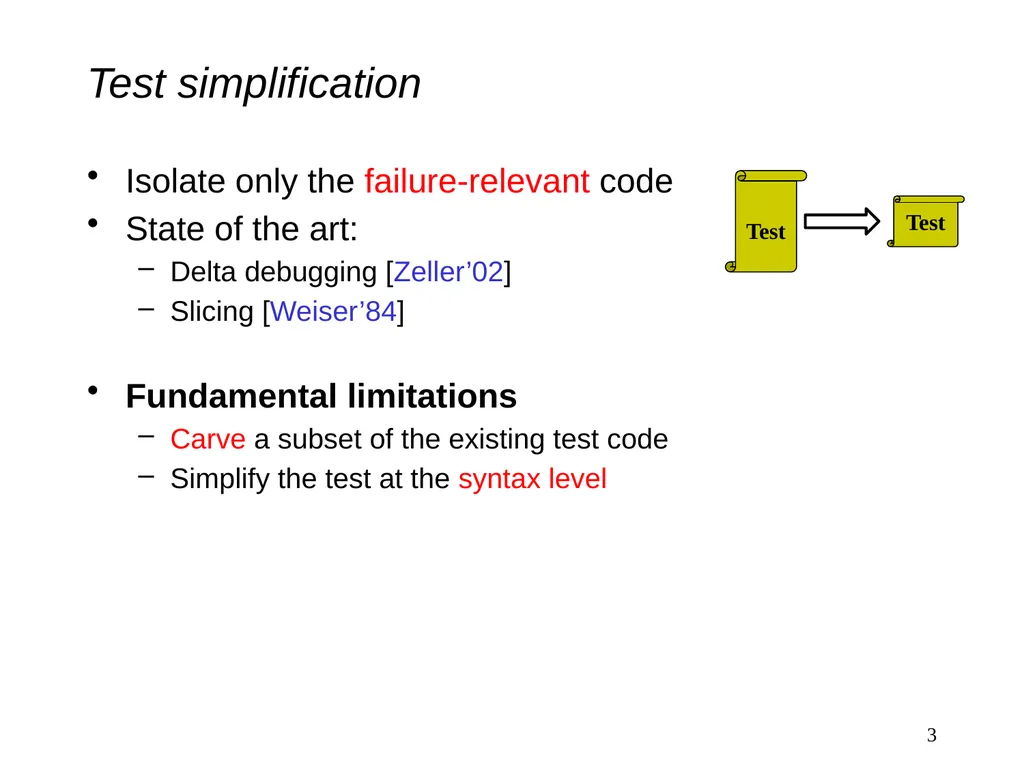
slide3. Test simplification Isolate only the failure-relevant code
State of the art:
Delta debugging [Zeller’02]
Slicing [Weiser’84]
Fundamental limitations
Carve a subset of the existing test code
Simplify the test at the syntax level 3<br>
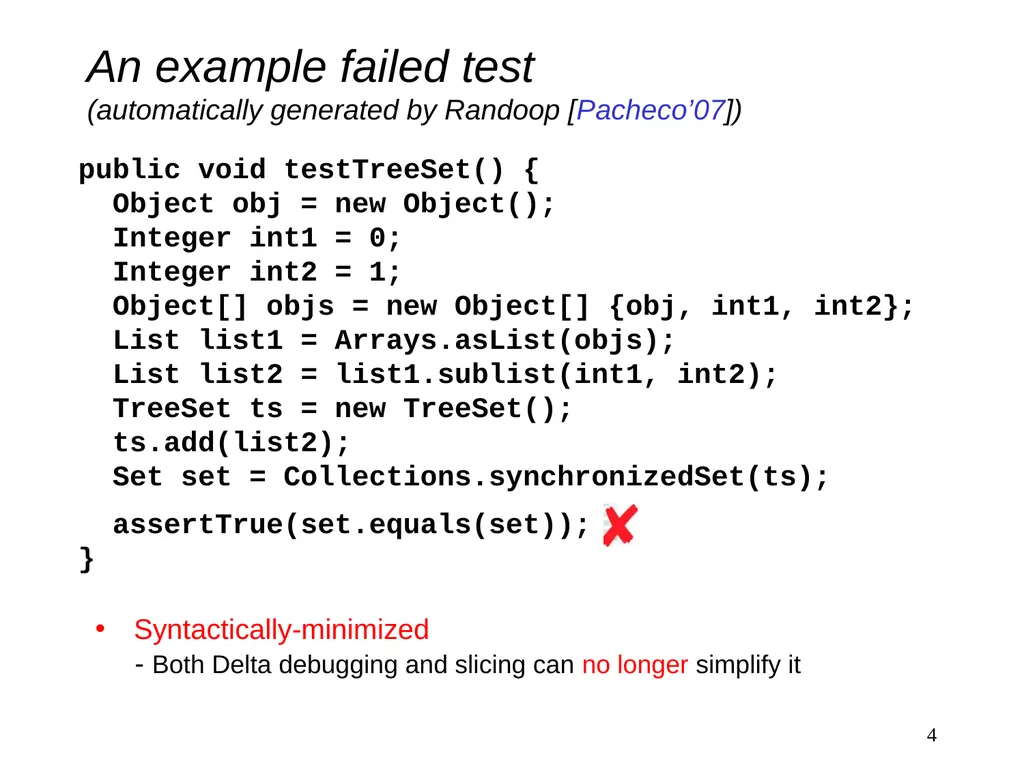
slide4. An example failed test (automatically generated by Randoop [Pacheco’07]) 4 public void testTreeSet() {
Object obj = new Object();
Integer int1 = 0;
Integer int2 = 1;
Object[] objs = new Object[] {obj, int1, int2};
List list1 = Arrays.asList(objs);
List list2 = list1.sublist(int1, int2);
TreeSet ts = new TreeSet();
ts.add(list2);
Set set = Collections.synchronizedSet(ts);
assertTrue(set.equals(set));
} Syntactically-minimized
- Both Delta debugging and slicing can no longer simplify it<br>
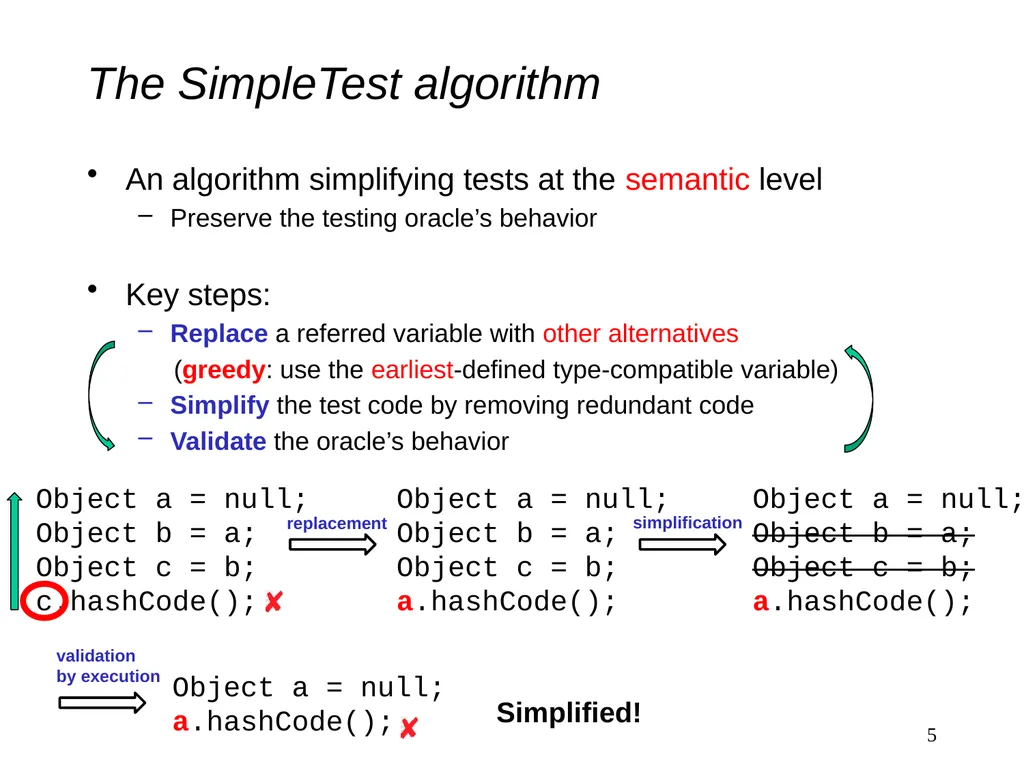
slide5. The SimpleTest algorithm An algorithm simplifying tests at the semantic level
Preserve the testing oracle’s behavior
Key steps:
Replace a referred variable with other alternatives
(greedy: use the earliest-defined type-compatible variable)
Simplify the test code by removing redundant code
Validate the oracle’s behavior 5 Object a = null;
Object b = a;
Object c = b;
c.hashCode(); Object a = null;
Object b = a;
Object c = b;
a.hashCode(); Object a = null;
Object b = a;
Object c = b;
a.hashCode(); Object a = null;
a.hashCode(); replacement simplification validation
by execution Simplified!<br>
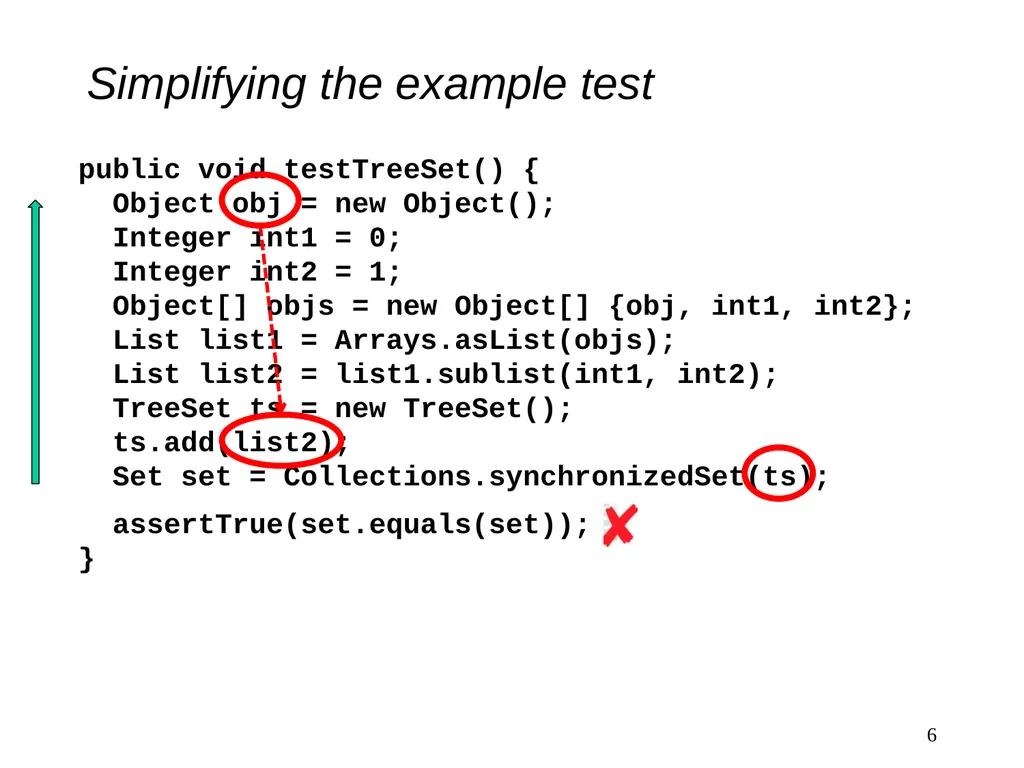
slide6. Simplifying the example test 6 public void testTreeSet() {
Object obj = new Object();
Integer int1 = 0;
Integer int2 = 1;
Object[] objs = new Object[] {obj, int1, int2};
List list1 = Arrays.asList(objs);
List list2 = list1.sublist(int1, int2);
TreeSet ts = new TreeSet();
ts.add(list2);
Set set = Collections.synchronizedSet(ts);
assertTrue(set.equals(set));
}<br>
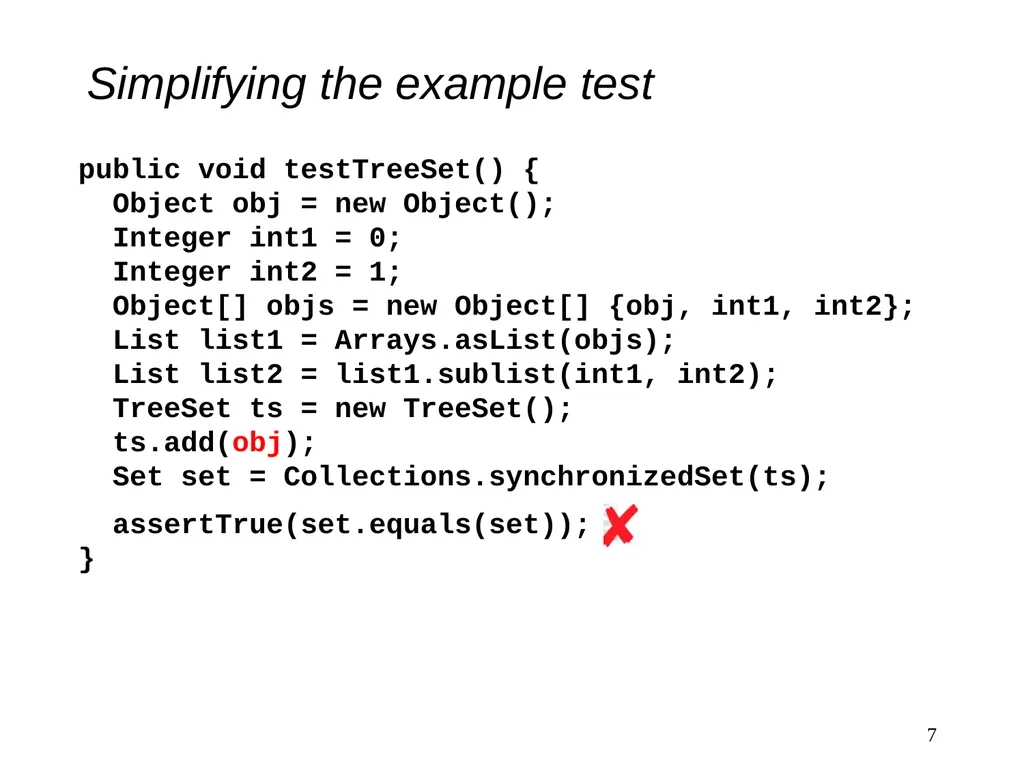
slide7. Simplifying the example test 7 public void testTreeSet() {
Object obj = new Object();
Integer int1 = 0;
Integer int2 = 1;
Object[] objs = new Object[] {obj, int1, int2};
List list1 = Arrays.asList(objs);
List list2 = list1.sublist(int1, int2);
TreeSet ts = new TreeSet();
ts.add(obj);
Set set = Collections.synchronizedSet(ts);
assertTrue(set.equals(set));
}<br>
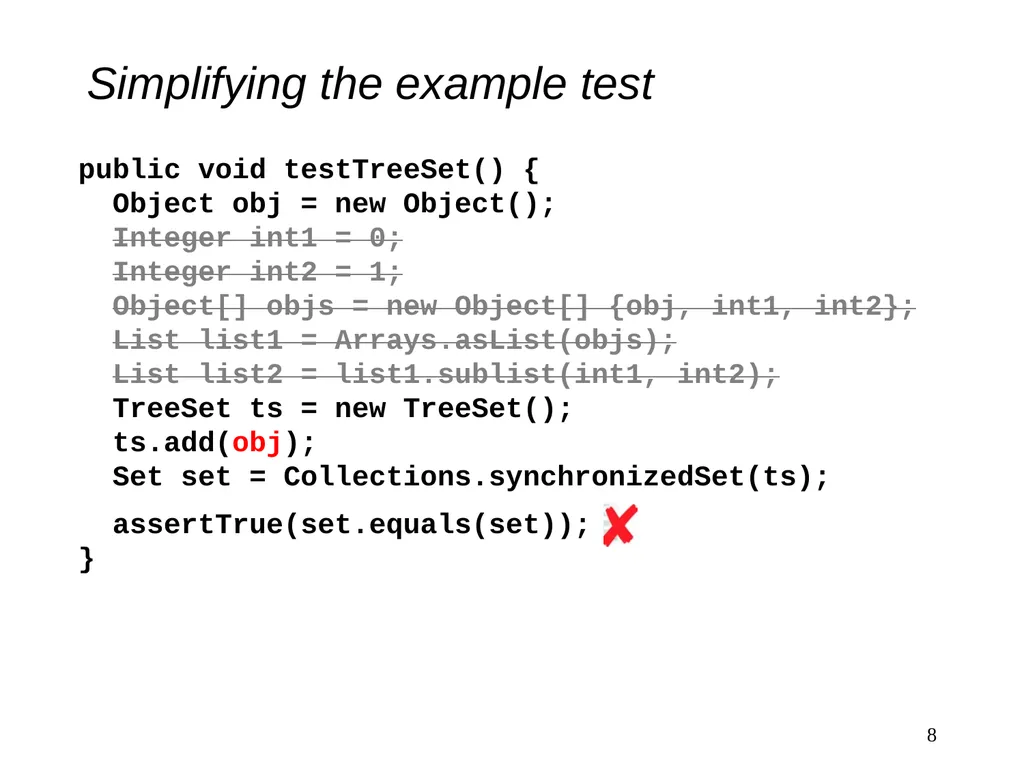
slide8. Simplifying the example test 8 public void testTreeSet() {
Object obj = new Object();
Integer int1 = 0;
Integer int2 = 1;
Object[] objs = new Object[] {obj, int1, int2};
List list1 = Arrays.asList(objs);
List list2 = list1.sublist(int1, int2);
TreeSet ts = new TreeSet();
ts.add(obj);
Set set = Collections.synchronizedSet(ts);
assertTrue(set.equals(set));
}<br>
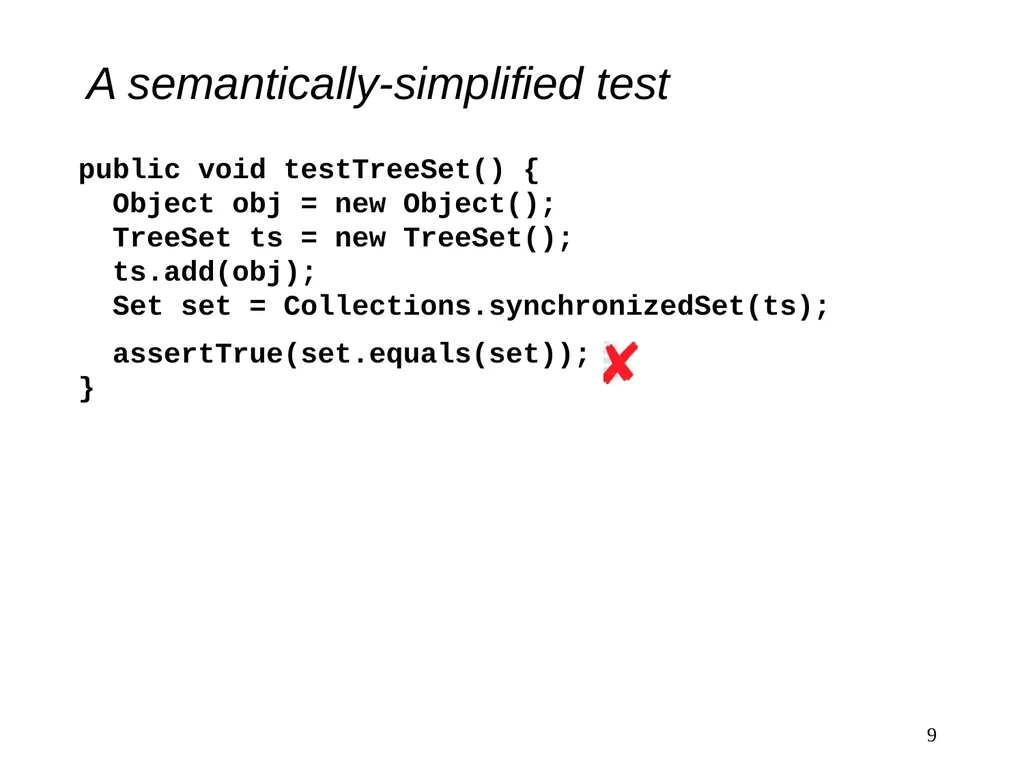
slide9. A semantically-simplified test 9 public void testTreeSet() {
Object obj = new Object();
TreeSet ts = new TreeSet();
ts.add(obj);
Set set = Collections.synchronizedSet(ts);
assertTrue(set.equals(set));
}<br>
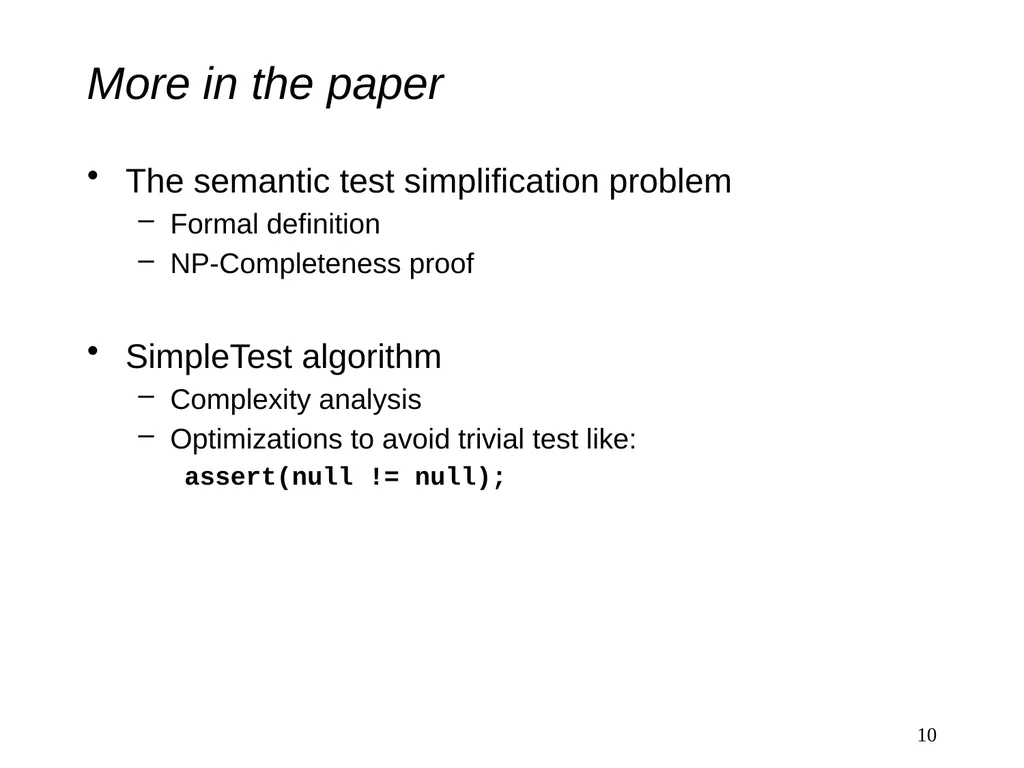
slide10. More in the paper The semantic test simplification problem
Formal definition
NP-Completeness proof
SimpleTest algorithm
Complexity analysis
Optimizations to avoid trivial test like:
assert(null != null); 10<br>
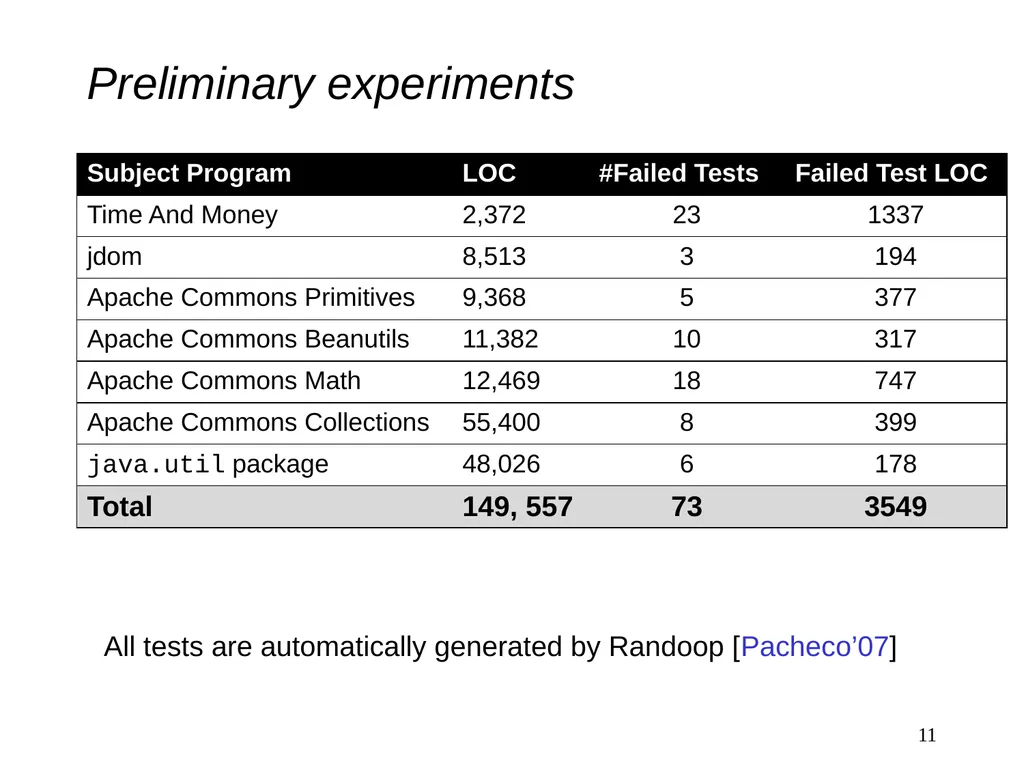
slide11. Preliminary experiments 11 All tests are automatically generated by Randoop [Pacheco’07]<br>
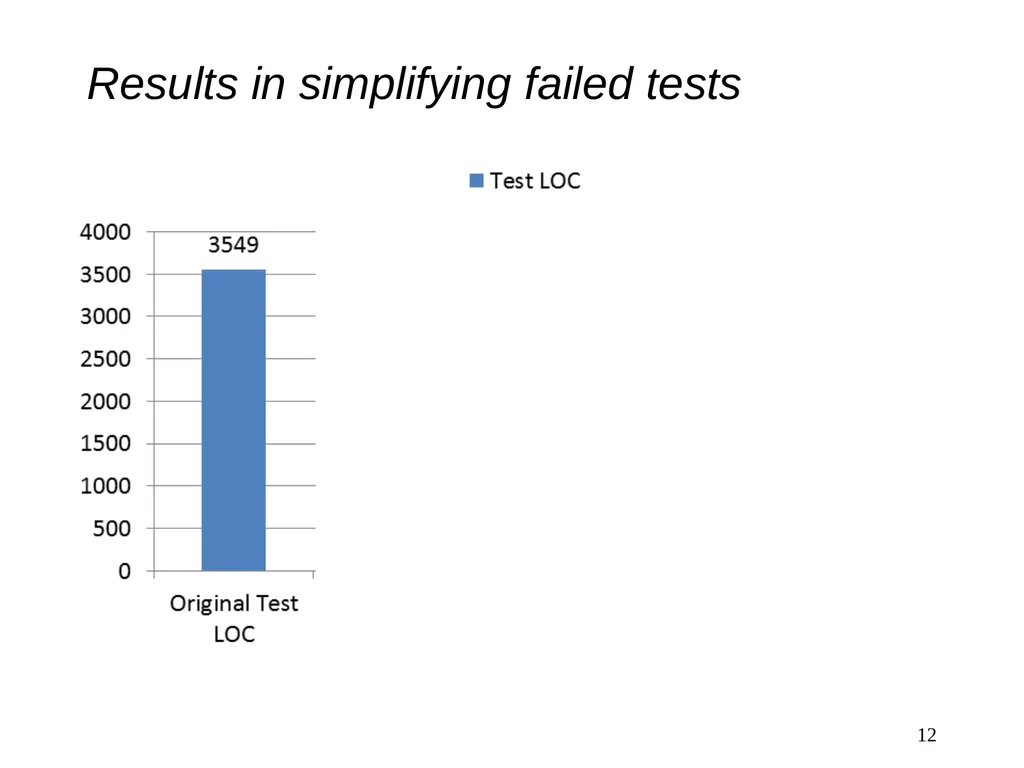
slide12. Results in simplifying failed tests 12<br>
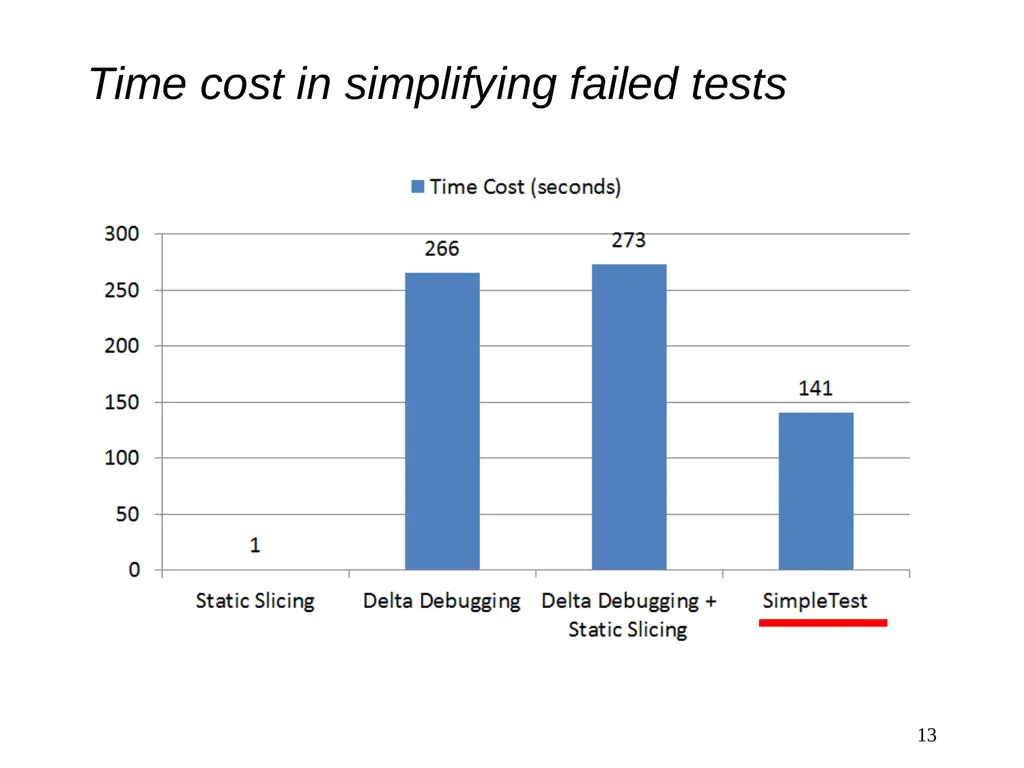
slide13. Time cost in simplifying failed tests 13<br>
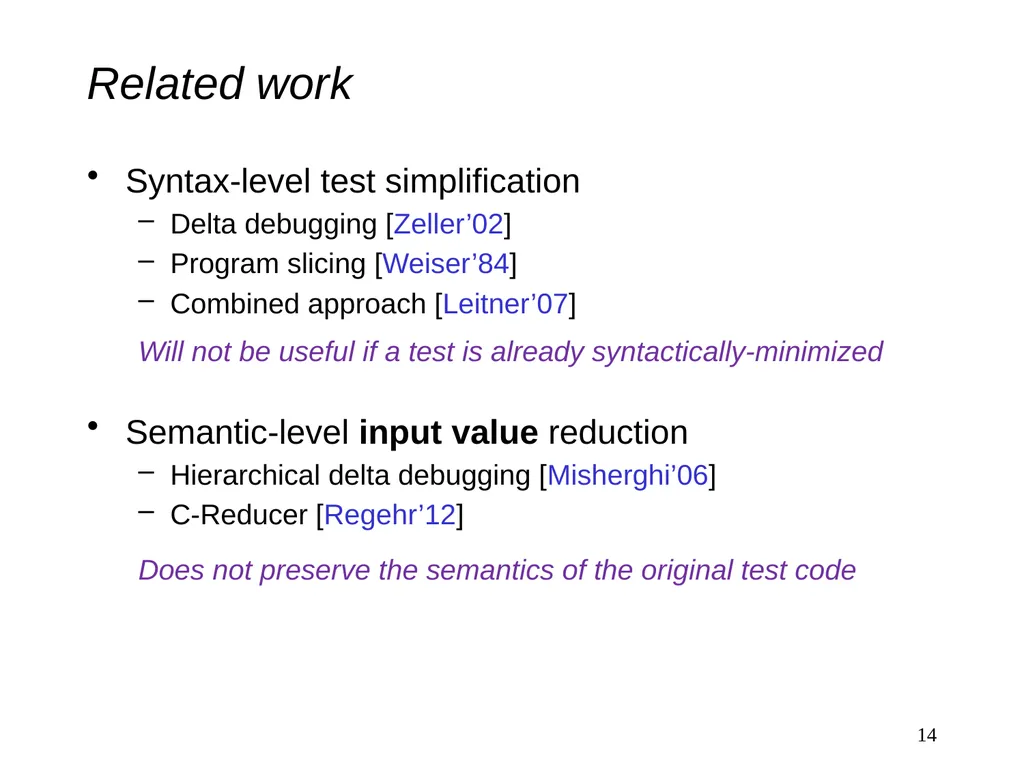
slide14. Related work Syntax-level test simplification
Delta debugging [Zeller’02]
Program slicing [Weiser’84]
Combined approach [Leitner’07]
Will not be useful if a test is already syntactically-minimized
Semantic-level input value reduction
Hierarchical delta debugging [Misherghi’06]
C-Reducer [Regehr’12]
Does not preserve the semantics of the original test code 14<br>
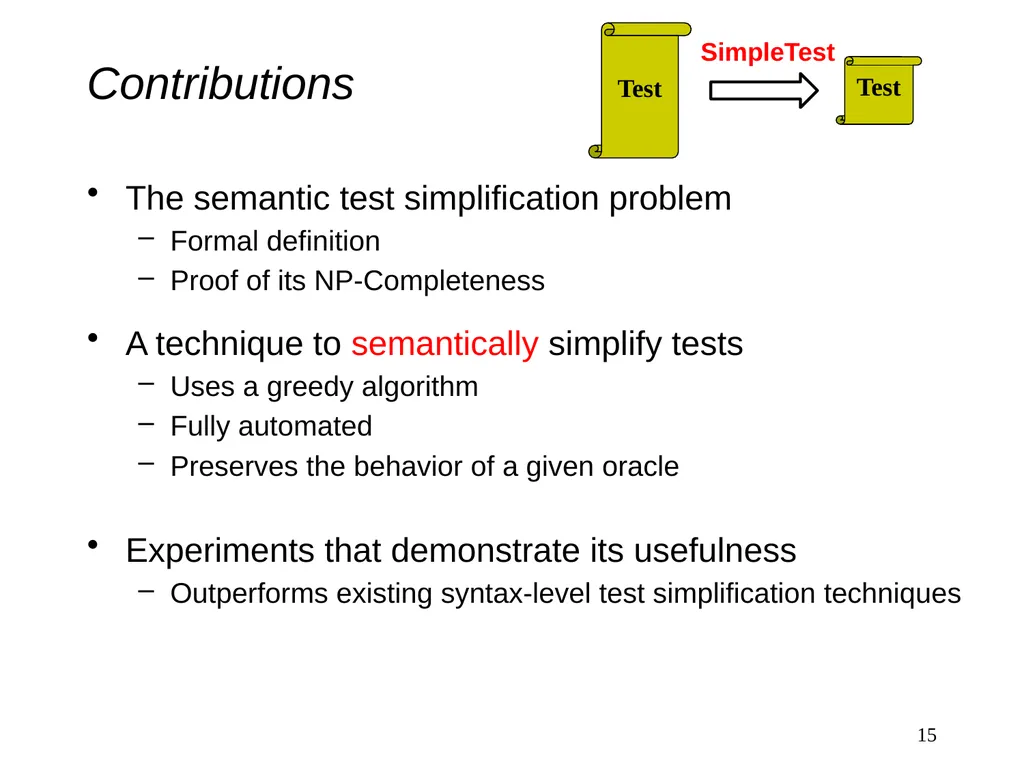
slide15. Contributions The semantic test simplification problem
Formal definition
Proof of its NP-Completeness
A technique to semantically simplify tests
Uses a greedy algorithm
Fully automated
Preserves the behavior of a given oracle
Experiments that demonstrate its usefulness
Outperforms existing syntax-level test simplification techniques 15 SimpleTest Test Test<br>
slide16. [Backup slides] 16<br>
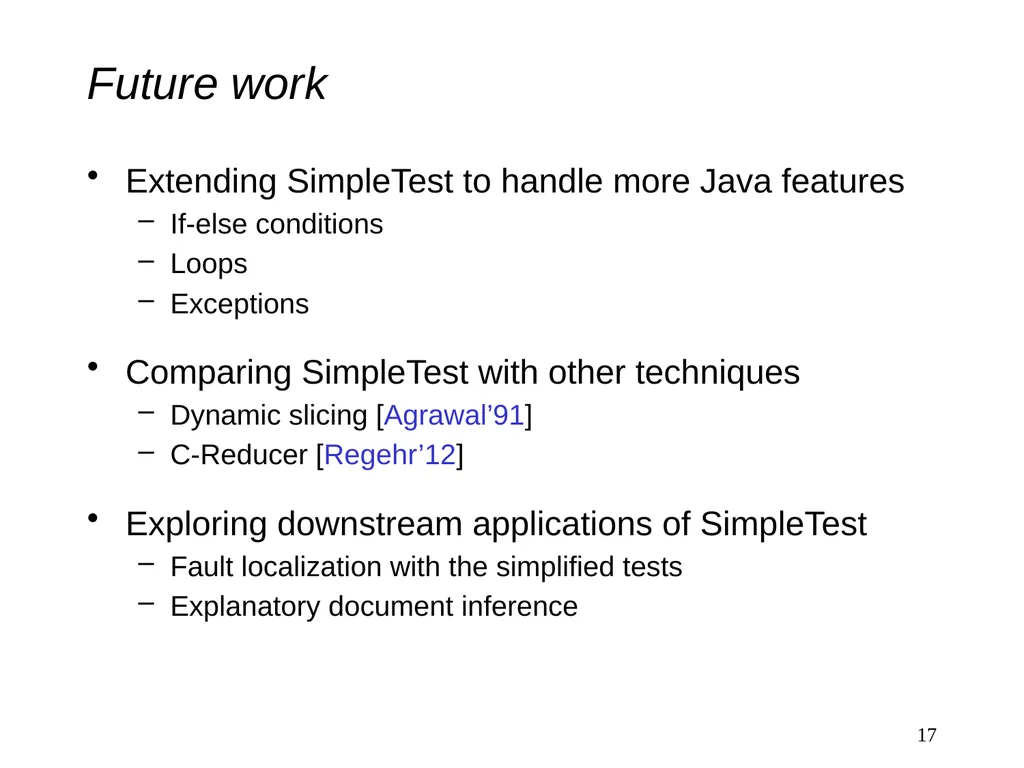
slide17. Future work Extending SimpleTest to handle more Java features
If-else conditions
Loops
Exceptions
Comparing SimpleTest with other techniques
Dynamic slicing [Agrawal’91]
C-Reducer [Regehr’12]
Exploring downstream applications of SimpleTest
Fault localization with the simplified tests
Explanatory document inference 17<br>
University of Washington<br>
slide2. A typical testing workflow 2 Software Test Test
Result This paper How to help programmers understand a failed test?<br>
slide3. Test simplification Isolate only the failure-relevant code
State of the art:
Delta debugging [Zeller’02]
Slicing [Weiser’84]
Fundamental limitations
Carve a subset of the existing test code
Simplify the test at the syntax level 3<br>
slide4. An example failed test (automatically generated by Randoop [Pacheco’07]) 4 public void testTreeSet() {
Object obj = new Object();
Integer int1 = 0;
Integer int2 = 1;
Object[] objs = new Object[] {obj, int1, int2};
List list1 = Arrays.asList(objs);
List list2 = list1.sublist(int1, int2);
TreeSet ts = new TreeSet();
ts.add(list2);
Set set = Collections.synchronizedSet(ts);
assertTrue(set.equals(set));
} Syntactically-minimized
- Both Delta debugging and slicing can no longer simplify it<br>
slide5. The SimpleTest algorithm An algorithm simplifying tests at the semantic level
Preserve the testing oracle’s behavior
Key steps:
Replace a referred variable with other alternatives
(greedy: use the earliest-defined type-compatible variable)
Simplify the test code by removing redundant code
Validate the oracle’s behavior 5 Object a = null;
Object b = a;
Object c = b;
c.hashCode(); Object a = null;
Object b = a;
Object c = b;
a.hashCode(); Object a = null;
Object b = a;
Object c = b;
a.hashCode(); Object a = null;
a.hashCode(); replacement simplification validation
by execution Simplified!<br>
slide6. Simplifying the example test 6 public void testTreeSet() {
Object obj = new Object();
Integer int1 = 0;
Integer int2 = 1;
Object[] objs = new Object[] {obj, int1, int2};
List list1 = Arrays.asList(objs);
List list2 = list1.sublist(int1, int2);
TreeSet ts = new TreeSet();
ts.add(list2);
Set set = Collections.synchronizedSet(ts);
assertTrue(set.equals(set));
}<br>
slide7. Simplifying the example test 7 public void testTreeSet() {
Object obj = new Object();
Integer int1 = 0;
Integer int2 = 1;
Object[] objs = new Object[] {obj, int1, int2};
List list1 = Arrays.asList(objs);
List list2 = list1.sublist(int1, int2);
TreeSet ts = new TreeSet();
ts.add(obj);
Set set = Collections.synchronizedSet(ts);
assertTrue(set.equals(set));
}<br>
slide8. Simplifying the example test 8 public void testTreeSet() {
Object obj = new Object();
Integer int1 = 0;
Integer int2 = 1;
Object[] objs = new Object[] {obj, int1, int2};
List list1 = Arrays.asList(objs);
List list2 = list1.sublist(int1, int2);
TreeSet ts = new TreeSet();
ts.add(obj);
Set set = Collections.synchronizedSet(ts);
assertTrue(set.equals(set));
}<br>
slide9. A semantically-simplified test 9 public void testTreeSet() {
Object obj = new Object();
TreeSet ts = new TreeSet();
ts.add(obj);
Set set = Collections.synchronizedSet(ts);
assertTrue(set.equals(set));
}<br>
slide10. More in the paper The semantic test simplification problem
Formal definition
NP-Completeness proof
SimpleTest algorithm
Complexity analysis
Optimizations to avoid trivial test like:
assert(null != null); 10<br>
slide11. Preliminary experiments 11 All tests are automatically generated by Randoop [Pacheco’07]<br>
slide12. Results in simplifying failed tests 12<br>
slide13. Time cost in simplifying failed tests 13<br>
slide14. Related work Syntax-level test simplification
Delta debugging [Zeller’02]
Program slicing [Weiser’84]
Combined approach [Leitner’07]
Will not be useful if a test is already syntactically-minimized
Semantic-level input value reduction
Hierarchical delta debugging [Misherghi’06]
C-Reducer [Regehr’12]
Does not preserve the semantics of the original test code 14<br>
slide15. Contributions The semantic test simplification problem
Formal definition
Proof of its NP-Completeness
A technique to semantically simplify tests
Uses a greedy algorithm
Fully automated
Preserves the behavior of a given oracle
Experiments that demonstrate its usefulness
Outperforms existing syntax-level test simplification techniques 15 SimpleTest Test Test<br>
slide16. [Backup slides] 16<br>
slide17. Future work Extending SimpleTest to handle more Java features
If-else conditions
Loops
Exceptions
Comparing SimpleTest with other techniques
Dynamic slicing [Agrawal’91]
C-Reducer [Regehr’12]
Exploring downstream applications of SimpleTest
Fault localization with the simplified tests
Explanatory document inference 17<br>