
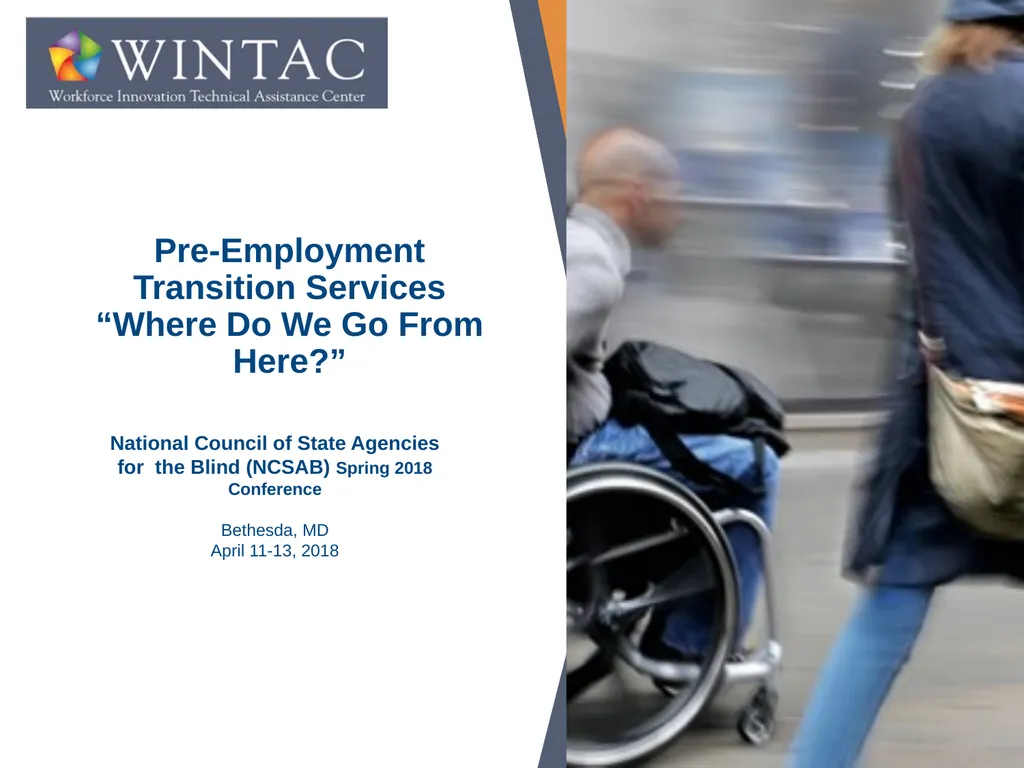
Pre-Employment Transition Services “Where Do We Go

Description: Pre-Employment Transition Services Where Do We Go From Here? National Council of State Agencies for the Blind (NCSAB) Spring 2018 Conference Bethesda, MD April 11-13, 2018 Roll up your sleeves! This interactive session will: Discuss the
Related Topics
Download Presentation
"Pre-Employment Transition Services “Where Do We Go" is the property of its rightful owner. Permission is granted to download and print the materials on this website for personal, non-commercial use only, and to display it on your personal computer provided you do not modify the materials and that you retain all copyright notices contained in the materials. By downloading content from our website, you accept the terms of this agreement.
Presentation Transcript
slide1. Pre-Employment
Transition Services
“Where Do We Go From Here?” National Council of State Agencies for the Blind (NCSAB) Spring 2018 Conference
Bethesda, MD
April 11-13, 2018<br>
slide2. Roll up your sleeves! This interactive session will:
Discuss the current status of Pre-employment transition services implementation,
Address common misconceptions,
Highlight innovative practices around the country, and
Discuss issues, Resources, and Strategies for successful implementation
Leave with one action item!<br>
slide3. Unique Challenges/Opportunities for Blind Agencies The number of students with disabilities who are blind in the state
How to spend the required reserve amount on a small group
The resources in the state to provide services to these students
The opportunity through authorized activities to increase capacity and improve outcomes for students who are blind or visually impaired.<br>
slide4. Let’s Go Today is organized differently than we have done before
First some level setting on “the what”
Table teams to brainstorm solutions that can be shared with the room
Notes will be taken, summarized, and emailed to the participants
Action!<br>
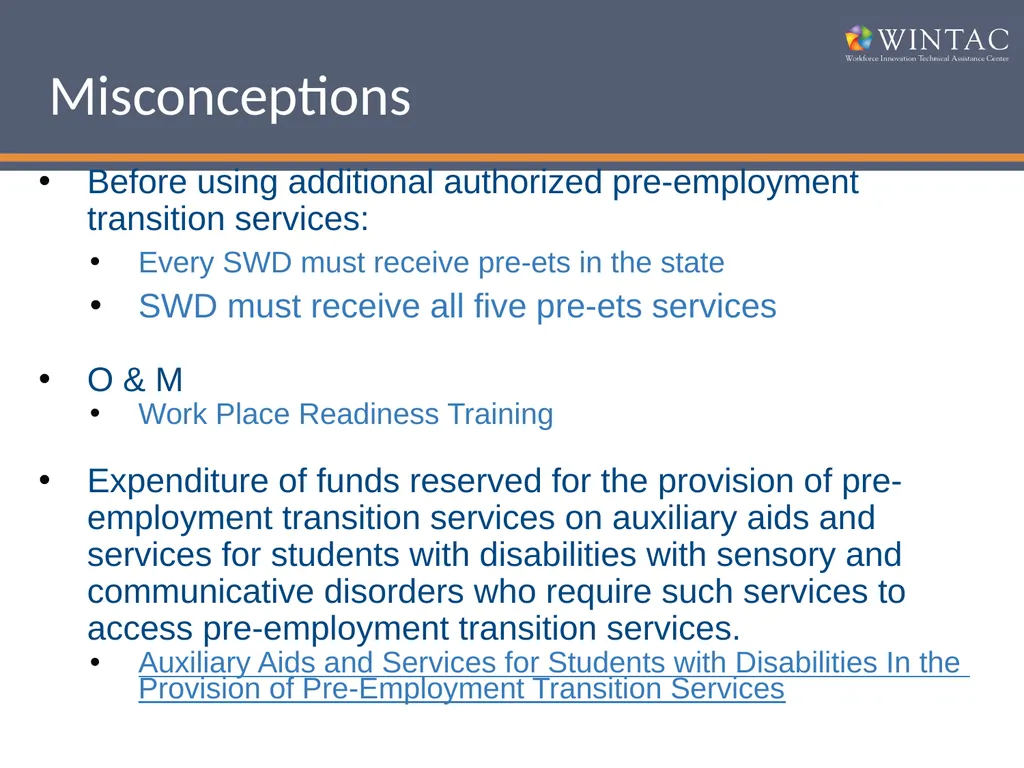
slide5. Misconceptions Before using additional authorized pre-employment transition services:
Every SWD must receive pre-ets in the state
SWD must receive all five pre-ets services
O & M
Work Place Readiness Training
Expenditure of funds reserved for the provision of pre-employment transition services on auxiliary aids and services for students with disabilities with sensory and communicative disorders who require such services to access pre-employment transition services.
Auxiliary Aids and Services for Students with Disabilities In the Provision of Pre-Employment Transition Services<br>
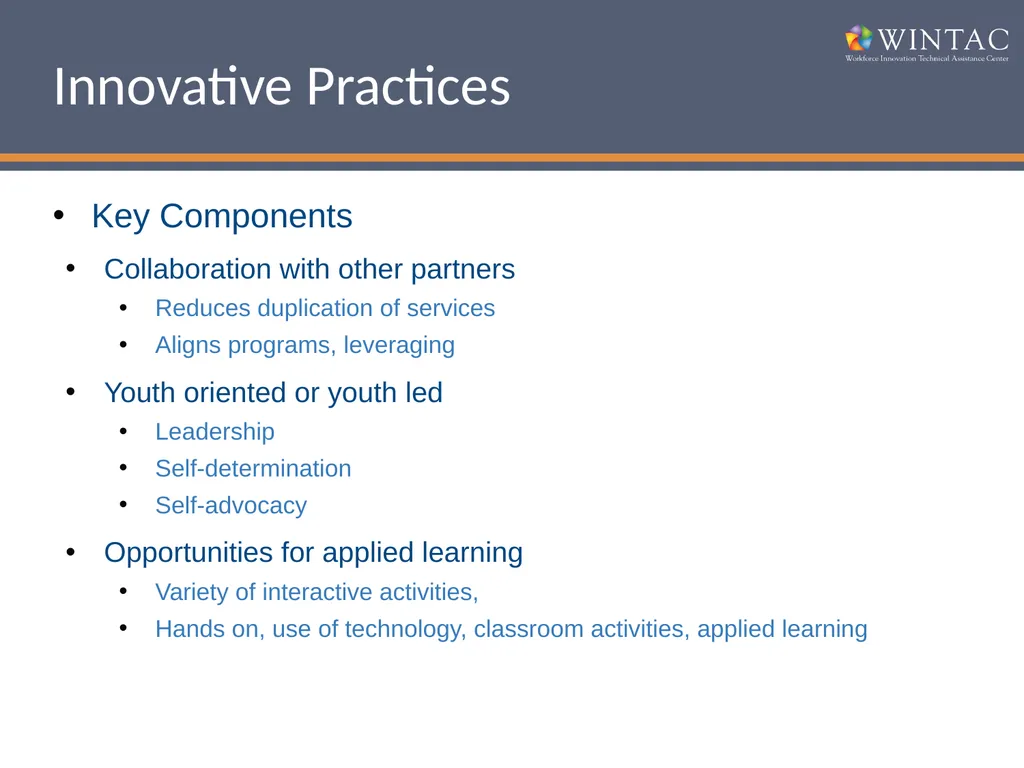
slide6. Innovative Practices Key Components
Collaboration with other partners
Reduces duplication of services
Aligns programs, leveraging
Youth oriented or youth led
Leadership
Self-determination
Self-advocacy
Opportunities for applied learning
Variety of interactive activities,
Hands on, use of technology, classroom activities, applied learning<br>
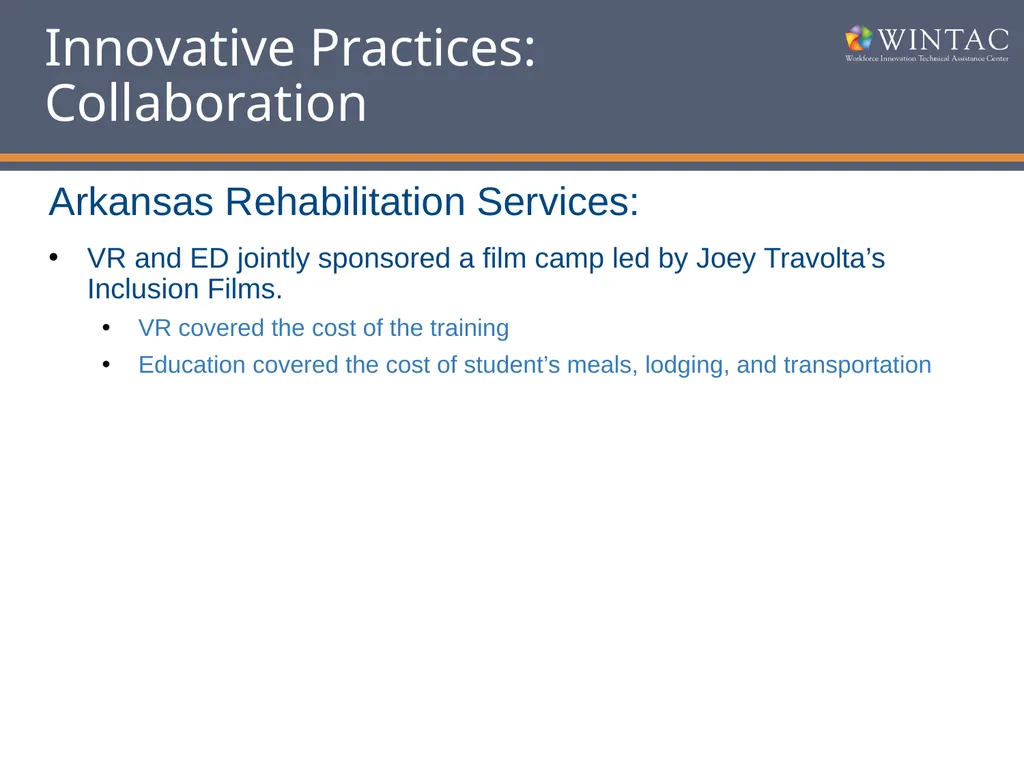
slide7. Innovative Practices: Collaboration Arkansas Rehabilitation Services:
VR and ED jointly sponsored a film camp led by Joey Travolta’s Inclusion Films.
VR covered the cost of the training
Education covered the cost of student’s meals, lodging, and transportation<br>
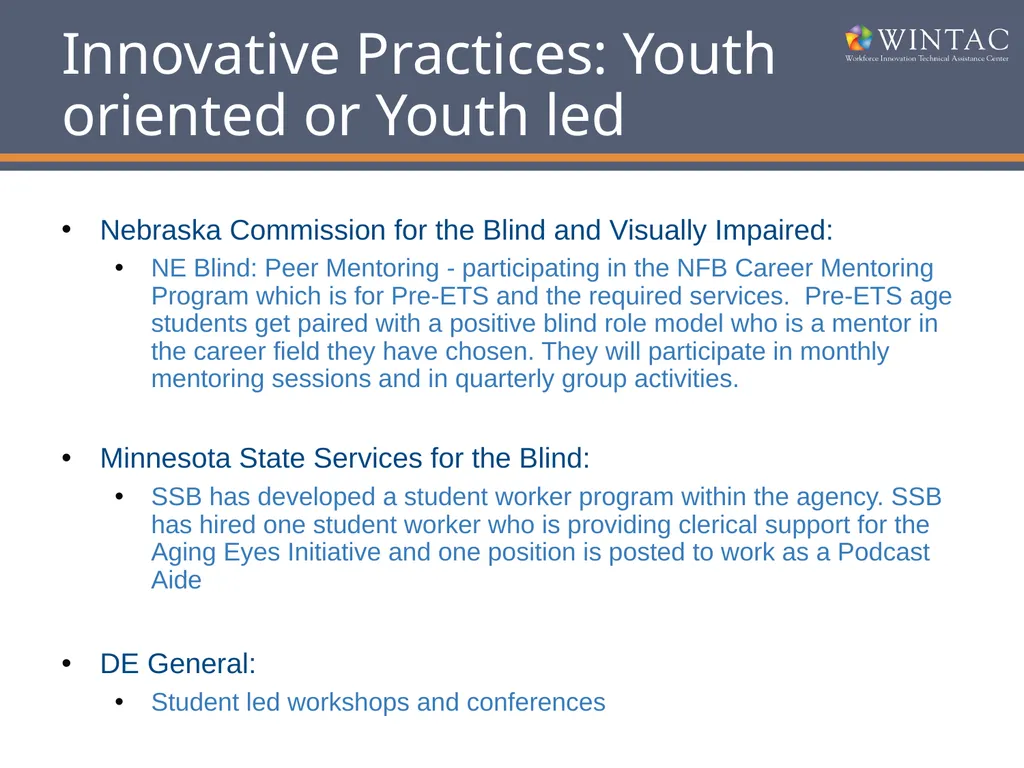
slide8. Innovative Practices: Youth oriented or Youth led Nebraska Commission for the Blind and Visually Impaired:
NE Blind: Peer Mentoring - participating in the NFB Career Mentoring Program which is for Pre-ETS and the required services. Pre-ETS age students get paired with a positive blind role model who is a mentor in the career field they have chosen. They will participate in monthly mentoring sessions and in quarterly group activities.
Minnesota State Services for the Blind:
SSB has developed a student worker program within the agency. SSB has hired one student worker who is providing clerical support for the Aging Eyes Initiative and one position is posted to work as a Podcast Aide
DE General:
Student led workshops and conferences<br>
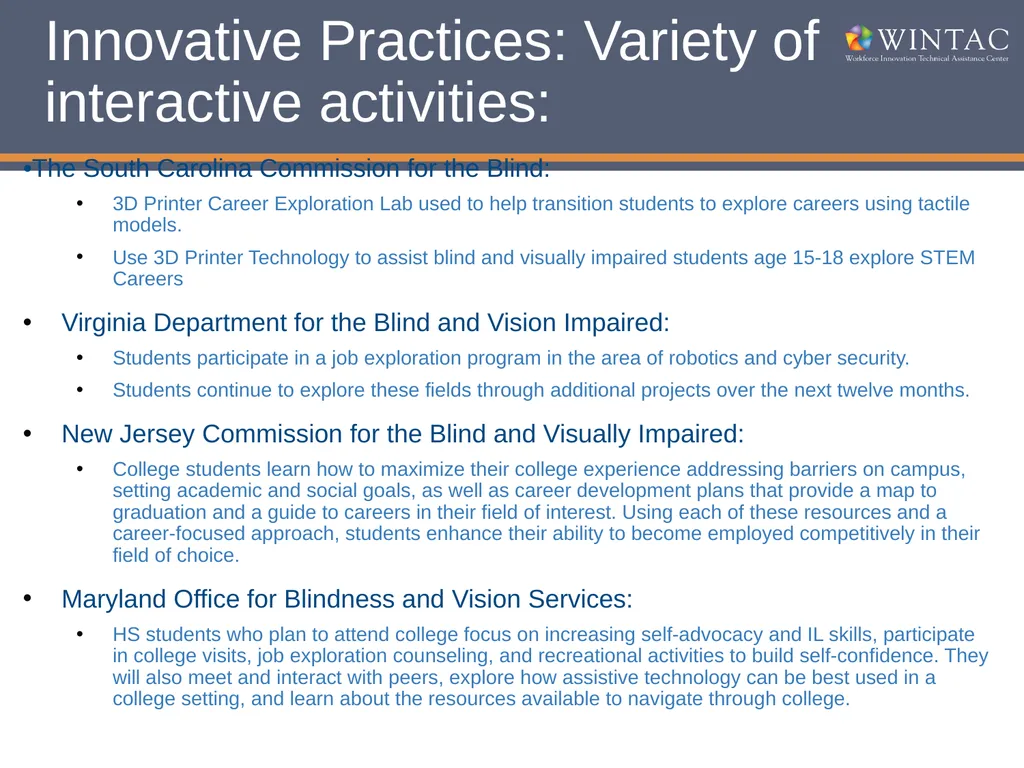
slide9. Innovative Practices: Variety of interactive activities: •The South Carolina Commission for the Blind:
3D Printer Career Exploration Lab used to help transition students to explore careers using tactile models.
Use 3D Printer Technology to assist blind and visually impaired students age 15-18 explore STEM Careers
Virginia Department for the Blind and Vision Impaired:
Students participate in a job exploration program in the area of robotics and cyber security.
Students continue to explore these fields through additional projects over the next twelve months.
New Jersey Commission for the Blind and Visually Impaired:
College students learn how to maximize their college experience addressing barriers on campus, setting academic and social goals, as well as career development plans that provide a map to graduation and a guide to careers in their field of interest. Using each of these resources and a career-focused approach, students enhance their ability to become employed competitively in their field of choice.
Maryland Office for Blindness and Vision Services:
HS students who plan to attend college focus on increasing self-advocacy and IL skills, participate in college visits, job exploration counseling, and recreational activities to build self-confidence. They will also meet and interact with peers, explore how assistive technology can be best used in a college setting, and learn about the resources available to navigate through college.<br>
slide10. Impact – Outcomes & Quality Assurance Evaluating Student Progress
Outcomes Measures for the 5 required
Case Review Indicators 10<br>
slide11. Evaluating Student Progress Pre/Post Test
Surveys
Outcome Instruments 11<br>
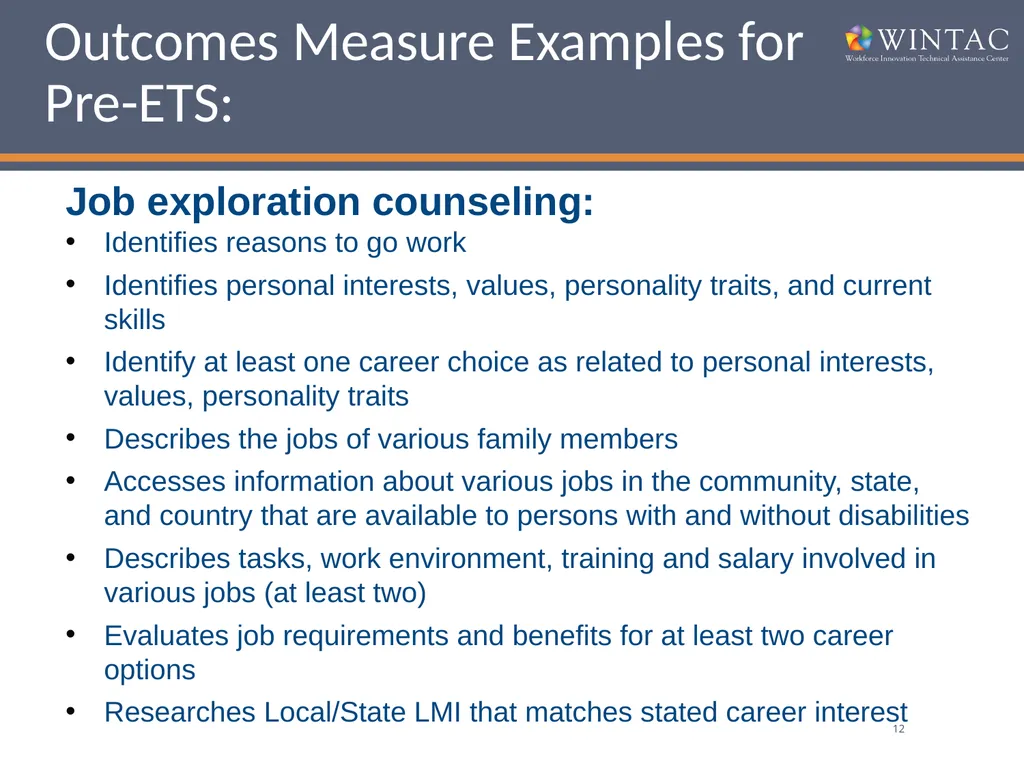
slide12. Outcomes Measure Examples for Pre-ETS: Job exploration counseling:
Identifies reasons to go work
Identifies personal interests, values, personality traits, and current skills
Identify at least one career choice as related to personal interests, values, personality traits
Describes the jobs of various family members
Accesses information about various jobs in the community, state, and country that are available to persons with and without disabilities
Describes tasks, work environment, training and salary involved in various jobs (at least two)
Evaluates job requirements and benefits for at least two career options
Researches Local/State LMI that matches stated career interest 12<br>
slide13. Outcomes Measure Examples for Pre-ETS: Work-based learning:
Conducts informational interviews with individuals to obtain information about employment
Participates (or has participated) in job shadowing experience(s)/job site visit(s)
Familiar with employers’ safety concerns and addresses them appropriately
Understands how to ask for assistance
Demonstrates understanding of workplace policies and procedures (i.e. work-related benefits, social security deductions, emergency procedures, etc.)
Understands how to follow up after job interview 13<br>
slide14. Outcomes Measure Examples for Pre-ETS: Workplace Readiness Training:
Understands basic money management concepts
Student is able to articulate the importance of timeliness and demonstrates time management skills
Can demonstrate appropriate social and interpersonal skills (teamwork, problem solving, conflict resolution, empathy, professionalism, good manners, etc.)
Student can identify their network of resources at home, school, and in their community.
Student can identify skills needed for communication in the workplace 14<br>
slide15. Outcomes Measure Examples for Pre-ETS: Self Advocacy
Describes disability clearly to others
Describes necessary accommodations for completing tasks
Requests appropriate accommodations when needed
Schedules own appointments (e.g. doctor, transportation, etc.)
Identifies and utilizes resources available to assist with goals
Demonstrates an understanding of their legal rights and responsibilities
Accesses and uses information in medium of choice
Student demonstrates the ability to communicate their goals, support needs, interests, skills and abilities. 15<br>
slide16. Outcomes Measure Examples for Pre-ETS: Counseling on opportunities for enrollment in comprehensive transition or postsecondary educational programs:
Understands academic & occupational training needed to succeed in the workplace
Identifies how to set up a college visit
Understands the application and admissions process for post secondary education and training.
Understands how to access and apply for financial aid
Student can identify supports and assistive technology used by students who are blind at college, such as where and how to get alternative formats and textbooks. 16<br>
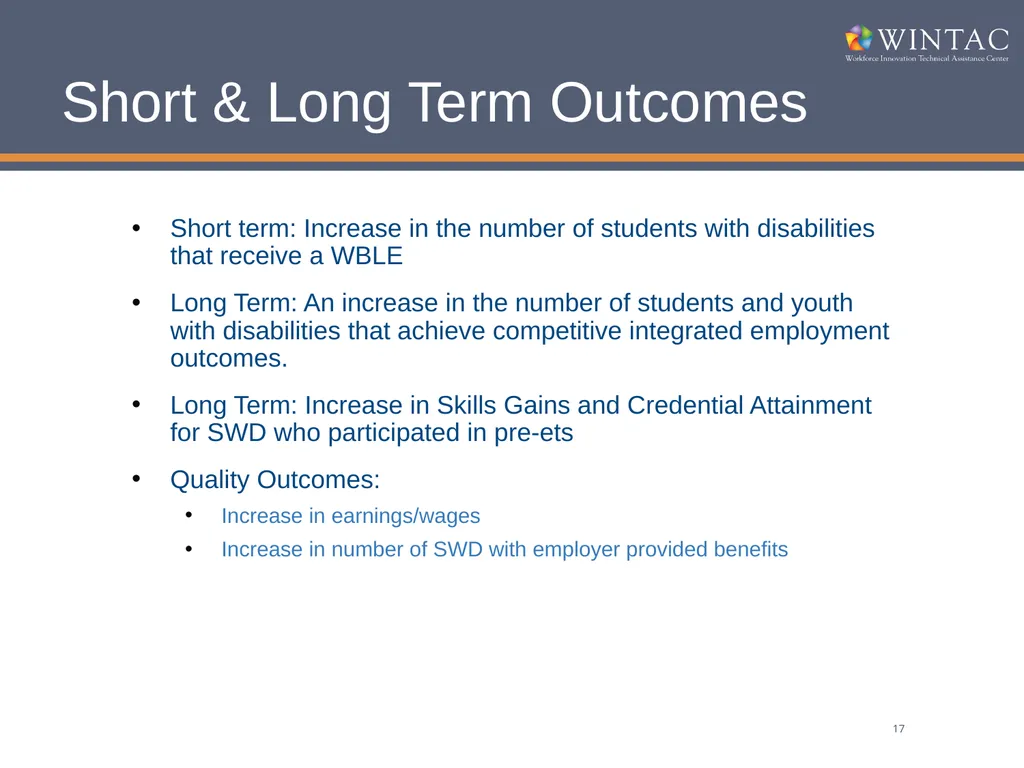
slide17. Short & Long Term Outcomes Short term: Increase in the number of students with disabilities that receive a WBLE
Long Term: An increase in the number of students and youth with disabilities that achieve competitive integrated employment outcomes.
Long Term: Increase in Skills Gains and Credential Attainment for SWD who participated in pre-ets
Quality Outcomes:
Increase in earnings/wages
Increase in number of SWD with employer provided benefits 17<br>
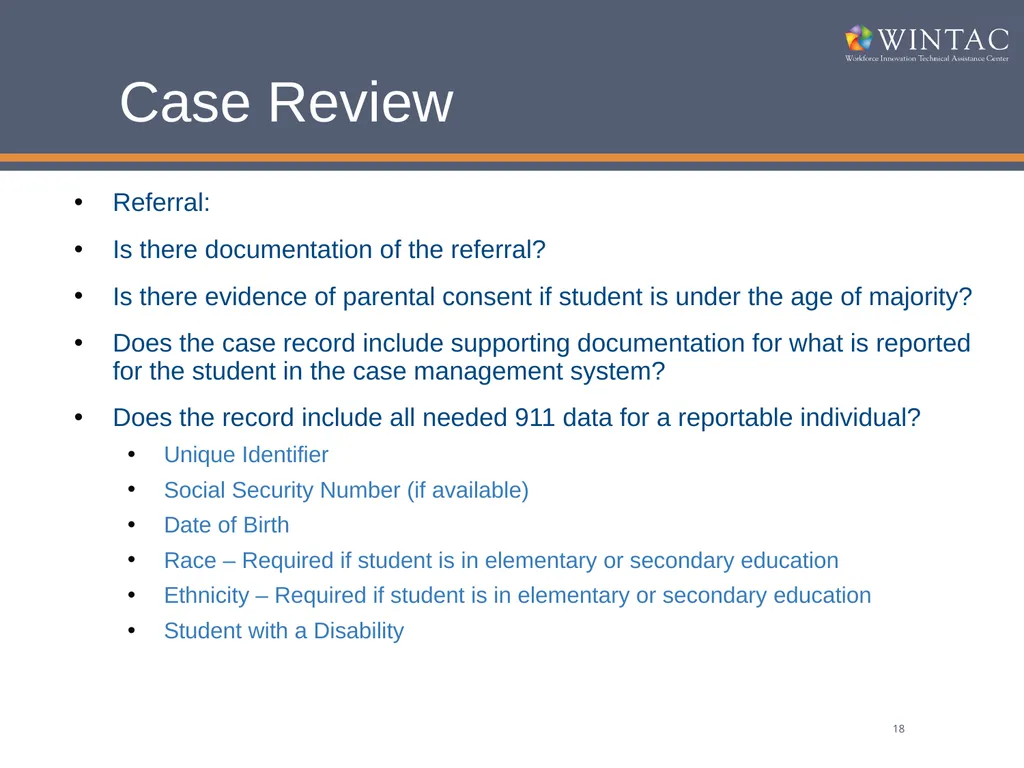
slide18. Case Review Referral:
Is there documentation of the referral?
Is there evidence of parental consent if student is under the age of majority?
Does the case record include supporting documentation for what is reported for the student in the case management system?
Does the record include all needed 911 data for a reportable individual?
Unique Identifier
Social Security Number (if available)
Date of Birth
Race – Required if student is in elementary or secondary education
Ethnicity – Required if student is in elementary or secondary education
Student with a Disability 18<br>
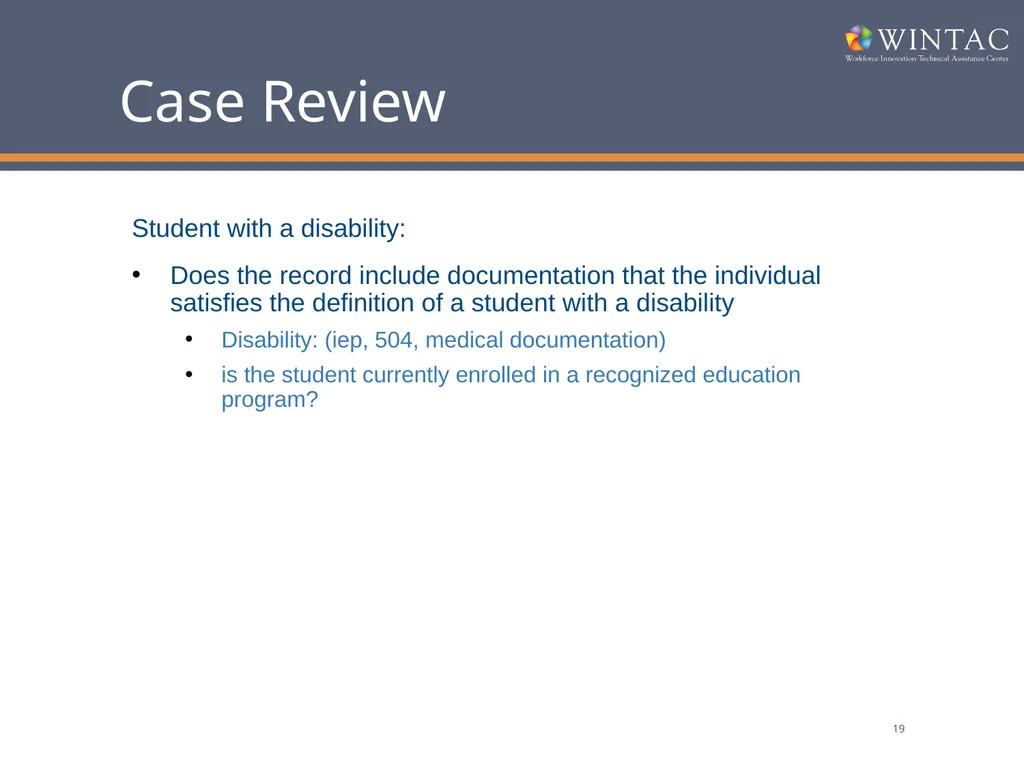
slide19. Case Review Student with a disability:
Does the record include documentation that the individual satisfies the definition of a student with a disability
Disability: (iep, 504, medical documentation)
is the student currently enrolled in a recognized education program? 19<br>
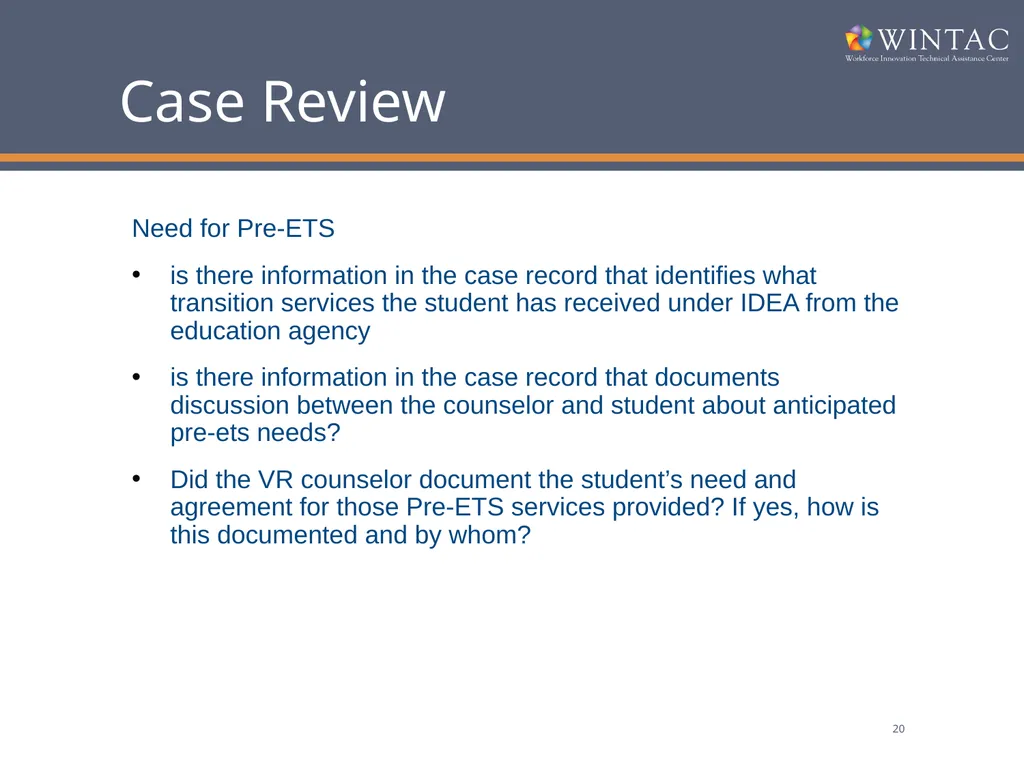
slide20. Case Review Need for Pre-ETS
is there information in the case record that identifies what transition services the student has received under IDEA from the education agency
is there information in the case record that documents discussion between the counselor and student about anticipated pre-ets needs?
Did the VR counselor document the student’s need and agreement for those Pre-ETS services provided? If yes, how is this documented and by whom? 20<br>
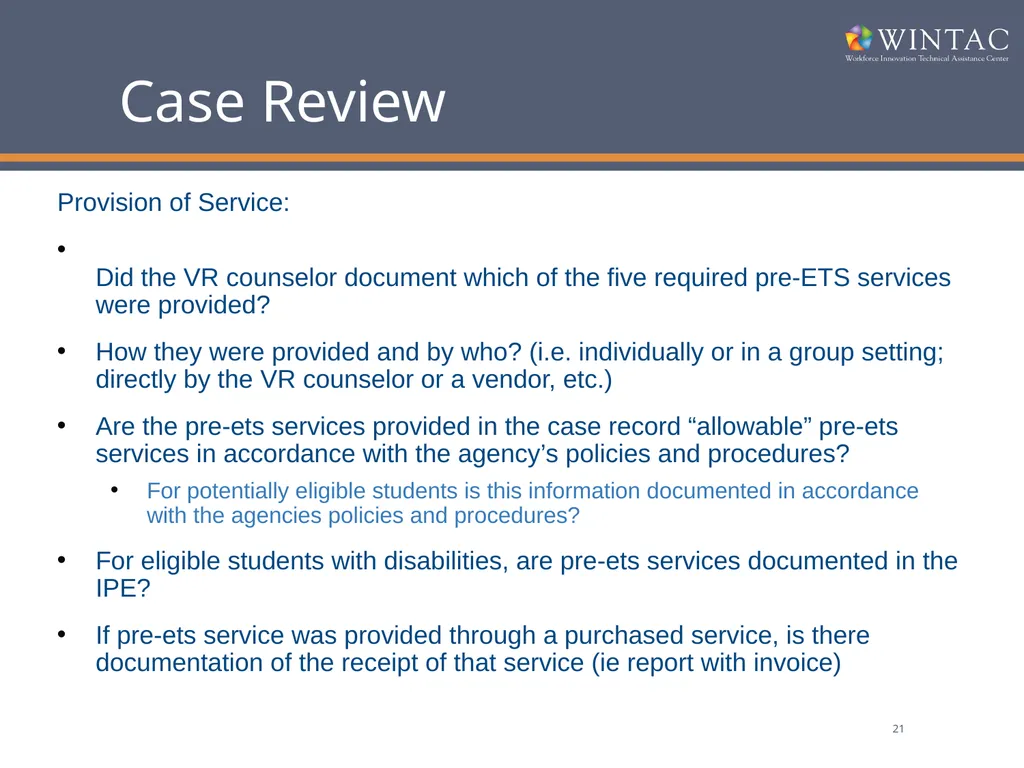
slide21. Case Review Provision of Service:
Did the VR counselor document which of the five required pre-ETS services were provided?
How they were provided and by who? (i.e. individually or in a group setting; directly by the VR counselor or a vendor, etc.)
Are the pre-ets services provided in the case record “allowable” pre-ets services in accordance with the agency’s policies and procedures?
For potentially eligible students is this information documented in accordance with the agencies policies and procedures?
For eligible students with disabilities, are pre-ets services documented in the IPE?
If pre-ets service was provided through a purchased service, is there documentation of the receipt of that service (ie report with invoice) 21<br>
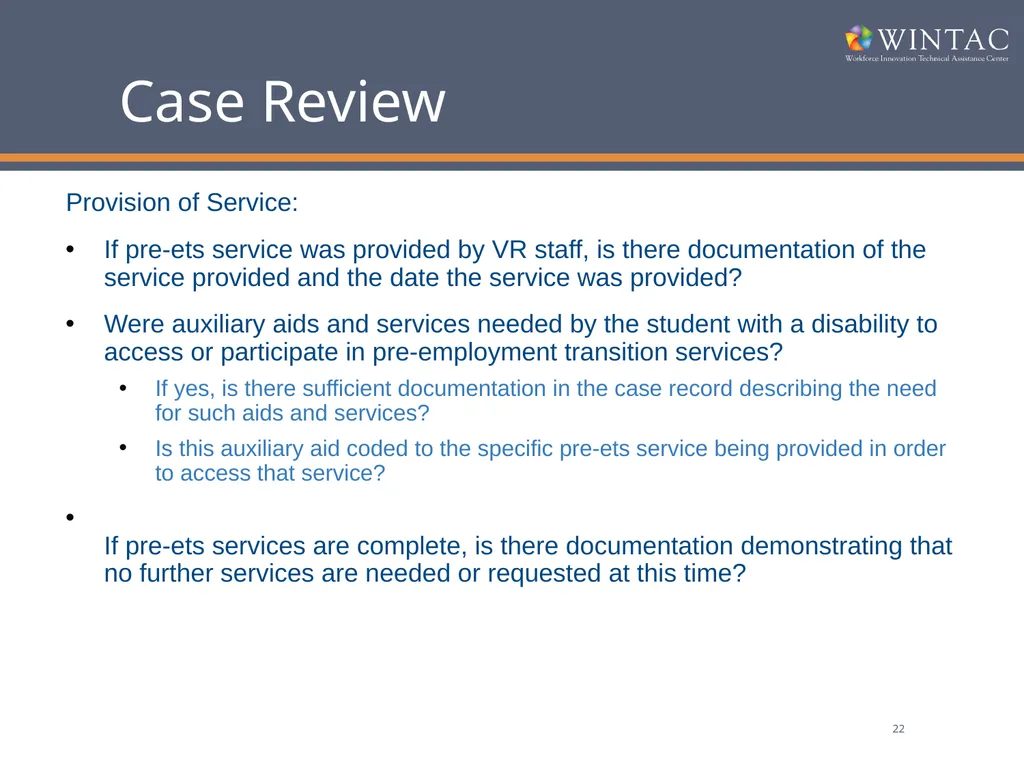
slide22. Case Review Provision of Service:
If pre-ets service was provided by VR staff, is there documentation of the service provided and the date the service was provided?
Were auxiliary aids and services needed by the student with a disability to access or participate in pre-employment transition services?
If yes, is there sufficient documentation in the case record describing the need for such aids and services?
Is this auxiliary aid coded to the specific pre-ets service being provided in order to access that service?
If pre-ets services are complete, is there documentation demonstrating that no further services are needed or requested at this time? 22<br>
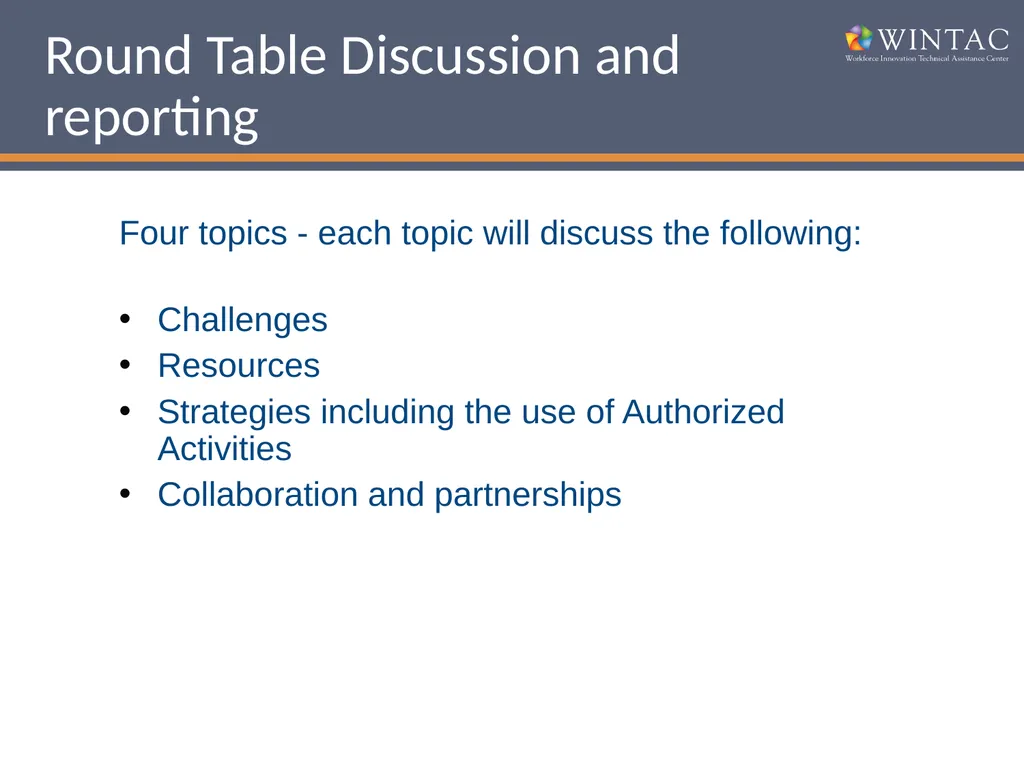
slide23. Round Table Discussion and reporting Four topics - each topic will discuss the following:
Challenges
Resources
Strategies including the use of Authorized Activities
Collaboration and partnerships<br>
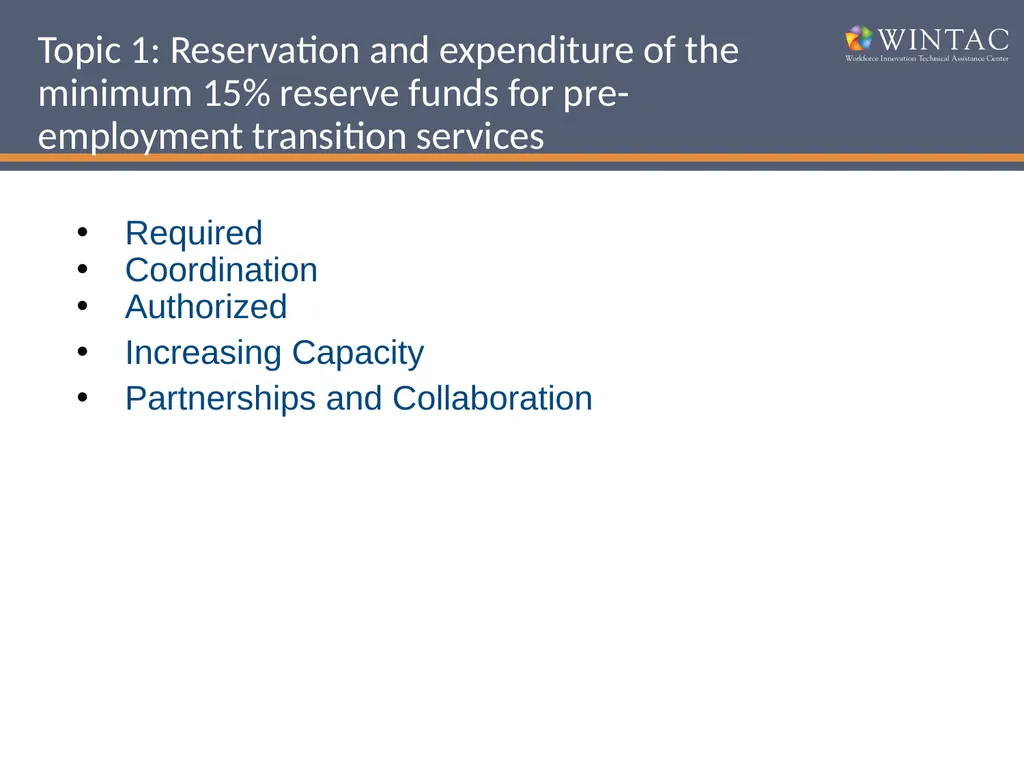
slide24. Topic 1: Reservation and expenditure of the minimum 15% reserve funds for pre-employment transition services Required
Coordination
Authorized
Increasing Capacity
Partnerships and Collaboration<br>
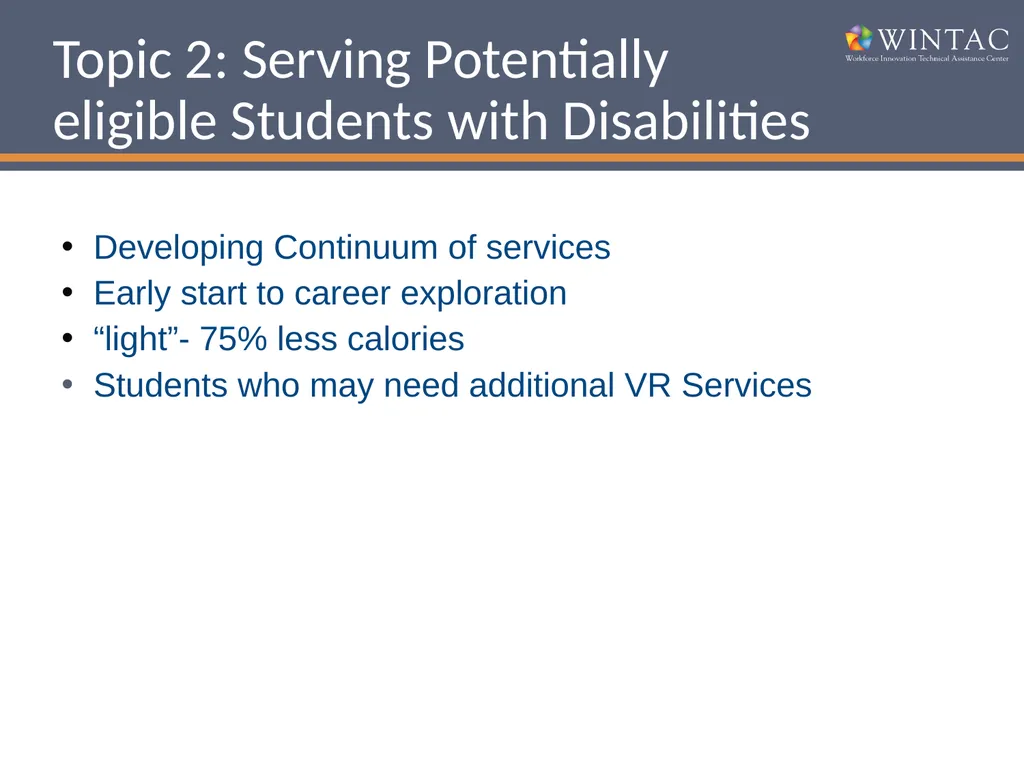
slide25. Topic 2: Serving Potentially eligible Students with Disabilities Developing Continuum of services
Early start to career exploration
“light”- 75% less calories
Students who may need additional VR Services<br>
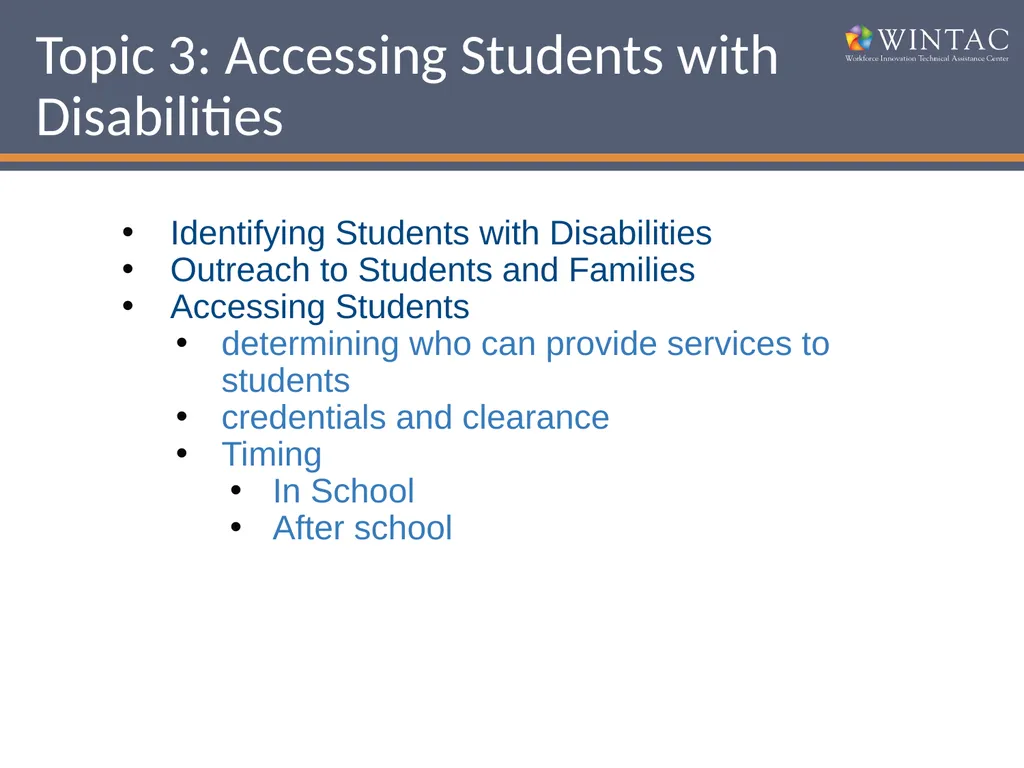
slide26. Topic 3: Accessing Students with Disabilities Identifying Students with Disabilities
Outreach to Students and Families
Accessing Students
determining who can provide services to students
credentials and clearance
Timing
In School
After school<br>
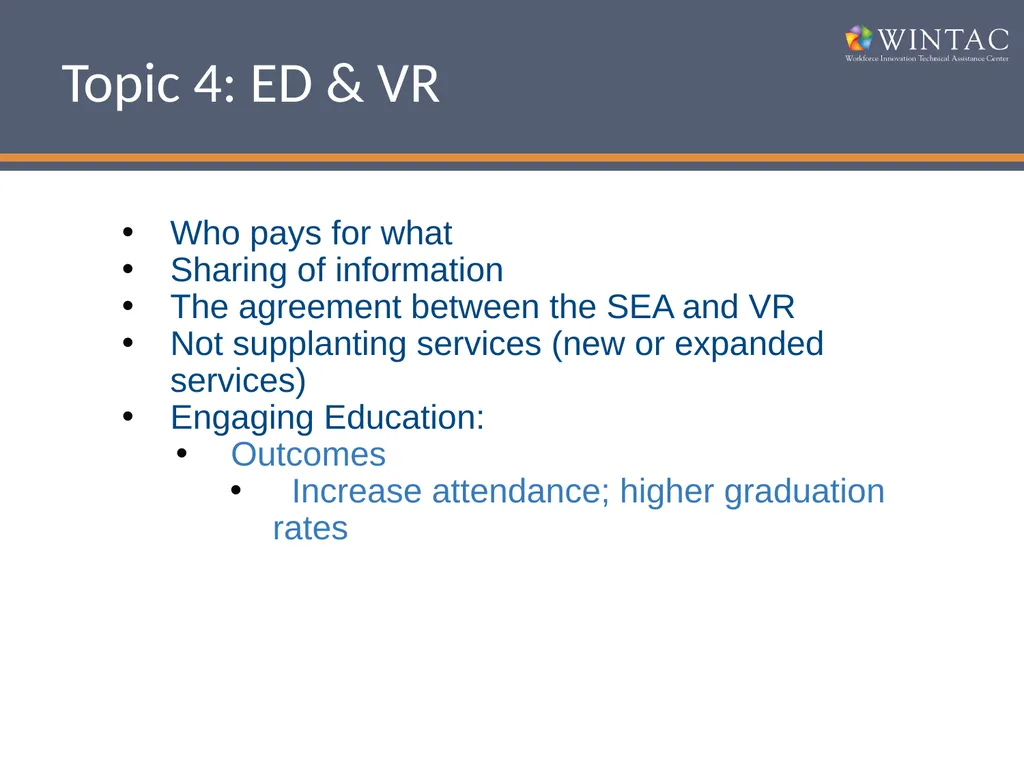
slide27. Topic 4: ED & VR Who pays for what
Sharing of information
The agreement between the SEA and VR
Not supplanting services (new or expanded services)
Engaging Education:
Outcomes
Increase attendance; higher graduation rates<br>
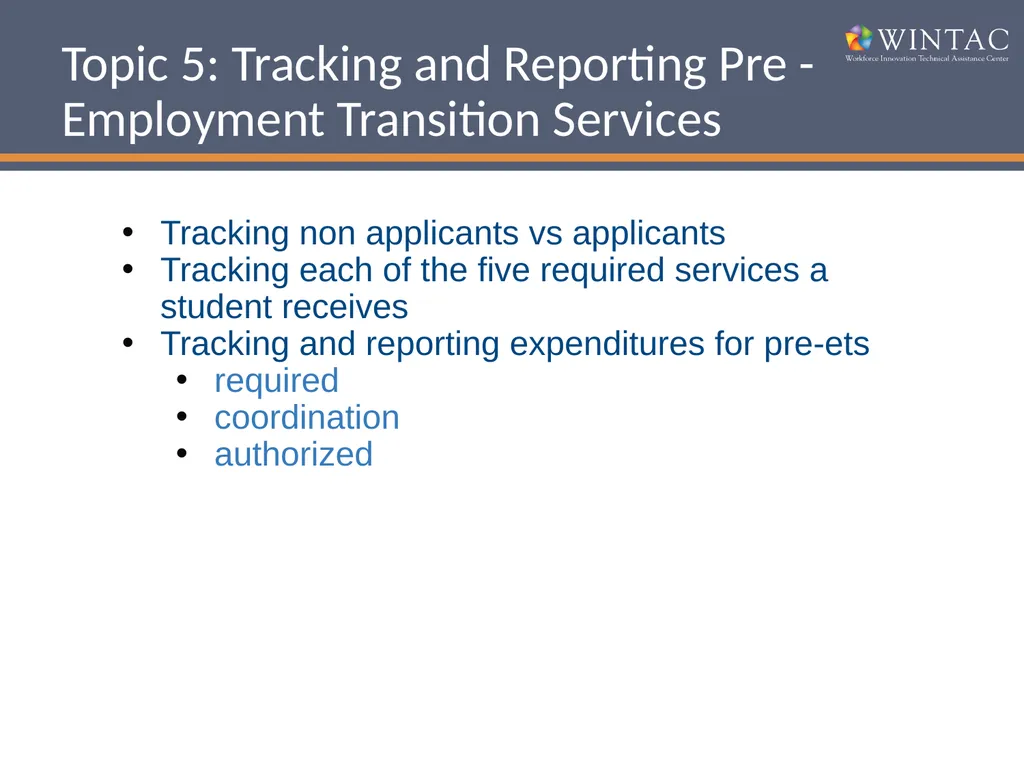
slide28. Topic 5: Tracking and Reporting Pre -Employment Transition Services Tracking non applicants vs applicants
Tracking each of the five required services a student receives
Tracking and reporting expenditures for pre-ets
required
coordination
authorized<br>
slide29. Wrap up, Report Out, & Next Steps<br>
slide30. Thank you! Carol Pankow, Director
Minnesota Department of Employment and Economic Development
State Services for the Blind
2200 University Avenue #240, St. Paul, MN 55114
Direct: 651-539-2272
Melissa P. Diehl, M.A. Ed. CRC WINTAC Pre-Employment Transition Services The George Washington University Center for Rehabilitation Counseling Research and Education (CRCRE) (410) 430-9244 mpdiehl@gwu.edu
Christine Johnson, M.A. Ed. CRC WINTAC Pre-Employment Transition Services The George Washington University Center for Rehabilitation Counseling Research and Education (CRCRE) (513) 882-3927 cj1957l@gwu.edu 30<br>
Bethesda, MD
April 11-13, 2018<br>
slide2. Roll up your sleeves! This interactive session will:
Discuss the current status of Pre-employment transition services implementation,
Address common misconceptions,
Highlight innovative practices around the country, and
Discuss issues, Resources, and Strategies for successful implementation
Leave with one action item!<br>
slide3. Unique Challenges/Opportunities for Blind Agencies The number of students with disabilities who are blind in the state
How to spend the required reserve amount on a small group
The resources in the state to provide services to these students
The opportunity through authorized activities to increase capacity and improve outcomes for students who are blind or visually impaired.<br>
slide4. Let’s Go Today is organized differently than we have done before
First some level setting on “the what”
Table teams to brainstorm solutions that can be shared with the room
Notes will be taken, summarized, and emailed to the participants
Action!<br>
slide5. Misconceptions Before using additional authorized pre-employment transition services:
Every SWD must receive pre-ets in the state
SWD must receive all five pre-ets services
O & M
Work Place Readiness Training
Expenditure of funds reserved for the provision of pre-employment transition services on auxiliary aids and services for students with disabilities with sensory and communicative disorders who require such services to access pre-employment transition services.
Auxiliary Aids and Services for Students with Disabilities In the Provision of Pre-Employment Transition Services<br>
slide6. Innovative Practices Key Components
Collaboration with other partners
Reduces duplication of services
Aligns programs, leveraging
Youth oriented or youth led
Leadership
Self-determination
Self-advocacy
Opportunities for applied learning
Variety of interactive activities,
Hands on, use of technology, classroom activities, applied learning<br>
slide7. Innovative Practices: Collaboration Arkansas Rehabilitation Services:
VR and ED jointly sponsored a film camp led by Joey Travolta’s Inclusion Films.
VR covered the cost of the training
Education covered the cost of student’s meals, lodging, and transportation<br>
slide8. Innovative Practices: Youth oriented or Youth led Nebraska Commission for the Blind and Visually Impaired:
NE Blind: Peer Mentoring - participating in the NFB Career Mentoring Program which is for Pre-ETS and the required services. Pre-ETS age students get paired with a positive blind role model who is a mentor in the career field they have chosen. They will participate in monthly mentoring sessions and in quarterly group activities.
Minnesota State Services for the Blind:
SSB has developed a student worker program within the agency. SSB has hired one student worker who is providing clerical support for the Aging Eyes Initiative and one position is posted to work as a Podcast Aide
DE General:
Student led workshops and conferences<br>
slide9. Innovative Practices: Variety of interactive activities: •The South Carolina Commission for the Blind:
3D Printer Career Exploration Lab used to help transition students to explore careers using tactile models.
Use 3D Printer Technology to assist blind and visually impaired students age 15-18 explore STEM Careers
Virginia Department for the Blind and Vision Impaired:
Students participate in a job exploration program in the area of robotics and cyber security.
Students continue to explore these fields through additional projects over the next twelve months.
New Jersey Commission for the Blind and Visually Impaired:
College students learn how to maximize their college experience addressing barriers on campus, setting academic and social goals, as well as career development plans that provide a map to graduation and a guide to careers in their field of interest. Using each of these resources and a career-focused approach, students enhance their ability to become employed competitively in their field of choice.
Maryland Office for Blindness and Vision Services:
HS students who plan to attend college focus on increasing self-advocacy and IL skills, participate in college visits, job exploration counseling, and recreational activities to build self-confidence. They will also meet and interact with peers, explore how assistive technology can be best used in a college setting, and learn about the resources available to navigate through college.<br>
slide10. Impact – Outcomes & Quality Assurance Evaluating Student Progress
Outcomes Measures for the 5 required
Case Review Indicators 10<br>
slide11. Evaluating Student Progress Pre/Post Test
Surveys
Outcome Instruments 11<br>
slide12. Outcomes Measure Examples for Pre-ETS: Job exploration counseling:
Identifies reasons to go work
Identifies personal interests, values, personality traits, and current skills
Identify at least one career choice as related to personal interests, values, personality traits
Describes the jobs of various family members
Accesses information about various jobs in the community, state, and country that are available to persons with and without disabilities
Describes tasks, work environment, training and salary involved in various jobs (at least two)
Evaluates job requirements and benefits for at least two career options
Researches Local/State LMI that matches stated career interest 12<br>
slide13. Outcomes Measure Examples for Pre-ETS: Work-based learning:
Conducts informational interviews with individuals to obtain information about employment
Participates (or has participated) in job shadowing experience(s)/job site visit(s)
Familiar with employers’ safety concerns and addresses them appropriately
Understands how to ask for assistance
Demonstrates understanding of workplace policies and procedures (i.e. work-related benefits, social security deductions, emergency procedures, etc.)
Understands how to follow up after job interview 13<br>
slide14. Outcomes Measure Examples for Pre-ETS: Workplace Readiness Training:
Understands basic money management concepts
Student is able to articulate the importance of timeliness and demonstrates time management skills
Can demonstrate appropriate social and interpersonal skills (teamwork, problem solving, conflict resolution, empathy, professionalism, good manners, etc.)
Student can identify their network of resources at home, school, and in their community.
Student can identify skills needed for communication in the workplace 14<br>
slide15. Outcomes Measure Examples for Pre-ETS: Self Advocacy
Describes disability clearly to others
Describes necessary accommodations for completing tasks
Requests appropriate accommodations when needed
Schedules own appointments (e.g. doctor, transportation, etc.)
Identifies and utilizes resources available to assist with goals
Demonstrates an understanding of their legal rights and responsibilities
Accesses and uses information in medium of choice
Student demonstrates the ability to communicate their goals, support needs, interests, skills and abilities. 15<br>
slide16. Outcomes Measure Examples for Pre-ETS: Counseling on opportunities for enrollment in comprehensive transition or postsecondary educational programs:
Understands academic & occupational training needed to succeed in the workplace
Identifies how to set up a college visit
Understands the application and admissions process for post secondary education and training.
Understands how to access and apply for financial aid
Student can identify supports and assistive technology used by students who are blind at college, such as where and how to get alternative formats and textbooks. 16<br>
slide17. Short & Long Term Outcomes Short term: Increase in the number of students with disabilities that receive a WBLE
Long Term: An increase in the number of students and youth with disabilities that achieve competitive integrated employment outcomes.
Long Term: Increase in Skills Gains and Credential Attainment for SWD who participated in pre-ets
Quality Outcomes:
Increase in earnings/wages
Increase in number of SWD with employer provided benefits 17<br>
slide18. Case Review Referral:
Is there documentation of the referral?
Is there evidence of parental consent if student is under the age of majority?
Does the case record include supporting documentation for what is reported for the student in the case management system?
Does the record include all needed 911 data for a reportable individual?
Unique Identifier
Social Security Number (if available)
Date of Birth
Race – Required if student is in elementary or secondary education
Ethnicity – Required if student is in elementary or secondary education
Student with a Disability 18<br>
slide19. Case Review Student with a disability:
Does the record include documentation that the individual satisfies the definition of a student with a disability
Disability: (iep, 504, medical documentation)
is the student currently enrolled in a recognized education program? 19<br>
slide20. Case Review Need for Pre-ETS
is there information in the case record that identifies what transition services the student has received under IDEA from the education agency
is there information in the case record that documents discussion between the counselor and student about anticipated pre-ets needs?
Did the VR counselor document the student’s need and agreement for those Pre-ETS services provided? If yes, how is this documented and by whom? 20<br>
slide21. Case Review Provision of Service:
Did the VR counselor document which of the five required pre-ETS services were provided?
How they were provided and by who? (i.e. individually or in a group setting; directly by the VR counselor or a vendor, etc.)
Are the pre-ets services provided in the case record “allowable” pre-ets services in accordance with the agency’s policies and procedures?
For potentially eligible students is this information documented in accordance with the agencies policies and procedures?
For eligible students with disabilities, are pre-ets services documented in the IPE?
If pre-ets service was provided through a purchased service, is there documentation of the receipt of that service (ie report with invoice) 21<br>
slide22. Case Review Provision of Service:
If pre-ets service was provided by VR staff, is there documentation of the service provided and the date the service was provided?
Were auxiliary aids and services needed by the student with a disability to access or participate in pre-employment transition services?
If yes, is there sufficient documentation in the case record describing the need for such aids and services?
Is this auxiliary aid coded to the specific pre-ets service being provided in order to access that service?
If pre-ets services are complete, is there documentation demonstrating that no further services are needed or requested at this time? 22<br>
slide23. Round Table Discussion and reporting Four topics - each topic will discuss the following:
Challenges
Resources
Strategies including the use of Authorized Activities
Collaboration and partnerships<br>
slide24. Topic 1: Reservation and expenditure of the minimum 15% reserve funds for pre-employment transition services Required
Coordination
Authorized
Increasing Capacity
Partnerships and Collaboration<br>
slide25. Topic 2: Serving Potentially eligible Students with Disabilities Developing Continuum of services
Early start to career exploration
“light”- 75% less calories
Students who may need additional VR Services<br>
slide26. Topic 3: Accessing Students with Disabilities Identifying Students with Disabilities
Outreach to Students and Families
Accessing Students
determining who can provide services to students
credentials and clearance
Timing
In School
After school<br>
slide27. Topic 4: ED & VR Who pays for what
Sharing of information
The agreement between the SEA and VR
Not supplanting services (new or expanded services)
Engaging Education:
Outcomes
Increase attendance; higher graduation rates<br>
slide28. Topic 5: Tracking and Reporting Pre -Employment Transition Services Tracking non applicants vs applicants
Tracking each of the five required services a student receives
Tracking and reporting expenditures for pre-ets
required
coordination
authorized<br>
slide29. Wrap up, Report Out, & Next Steps<br>
slide30. Thank you! Carol Pankow, Director
Minnesota Department of Employment and Economic Development
State Services for the Blind
2200 University Avenue #240, St. Paul, MN 55114
Direct: 651-539-2272
Melissa P. Diehl, M.A. Ed. CRC WINTAC Pre-Employment Transition Services The George Washington University Center for Rehabilitation Counseling Research and Education (CRCRE) (410) 430-9244 mpdiehl@gwu.edu
Christine Johnson, M.A. Ed. CRC WINTAC Pre-Employment Transition Services The George Washington University Center for Rehabilitation Counseling Research and Education (CRCRE) (513) 882-3927 cj1957l@gwu.edu 30<br>