Pre-Inspection Briefing Guidelines OCPF Regime Initial Disclosure The Pre-Inspection Briefing (PIB) is the first official activity at the inspected plant site, in a Chemical Weapons Convention (CWC) inspection. Therefore, it is critical
"Pre-Inspection Briefing Guidelines OCPF Regime" is the property of its rightful owner. Permission is granted to
download and print the materials on this website for personal, non-commercial use only, and to display it
on your personal computer provided you do not modify the materials and that you retain all copyright
notices contained in the materials. By downloading content from our website, you accept the terms of this
agreement.
Initial Disclosure The Pre-Inspection Briefing (PIB) is the first official activity at the inspected plant site, in a Chemical Weapons Convention (CWC) inspection. Therefore, it is critical that a cooperative atmosphere is created.
This PIB guideline is intended for use by industrial facilities subject to Article VI inspections under the CWC. It serves the Inspected State Party to prepare a thorough, relevant and accurate technical briefing about the facility. That information provided is instrumental to develop inspection plans, helping the Inspection Team fulfil the aims of the inspection mandate in an efficient and timely manner.
The guideline lays out basic requirements in PIB, including operational activities, safety measures, logistics, confidentiality, administration, and other site-specific information, among others.<br>
03
General requirement This guideline is recommended to the Inspected State Party as reference only
The PIB should be provided by facility representatives and conducted no more than 3 hours in length (as per CWC, VA, Part II, paragraph 37)
The PIB presentation can be provided in various forms (e.g., PPT, projection, hardcopy). Hand-outs of the material presented during the PIB are recommended to be provided to the Inspection Team prior to the PIB.
Any site and/or process diagrams could be handed as a separate print-out document from the PIB. This would provide the plant site and the host team better control over such documents during inspection activities.
The Inspection Team will return all the PIB material at the end of the inspection<br>
04
A. Introductions of participants Host team
Names and functions
Plant/Plant site personnel
Participants names and functions<br>
05
B. General Information Brief history of the company and basic information
Type of industry (e.g. fertilizers, pharmaceuticals, pesticides, plasticizers, paints, soaps, etc.)
Management, organization, operations, environment
Certificates of accreditations (e.g. ISO, FDA, etc.)
Security features (e.g. fence/wall, CCTV, patrols, others)<br>
06
B. General Information Any changes in the facility (operational, organizational) since the last inspection (if applicable)
Number of employees
Aerial view map indicating:
Location in relation to Point of entry (POE)
Distance from POE
Facility layout indicating:
Boundaries and gates
Total area of the plant site<br>
07
C. Plant Site Safety Measures Related to inspection conduct:
No operation/touching of equipment
Need for escort
Related to facility:
Safety hazards and safety procedures
Specific personal protective equipment
Emergency alarms and response procedures
Evacuation routes
Assembly points
Location of medical facilities<br>
08
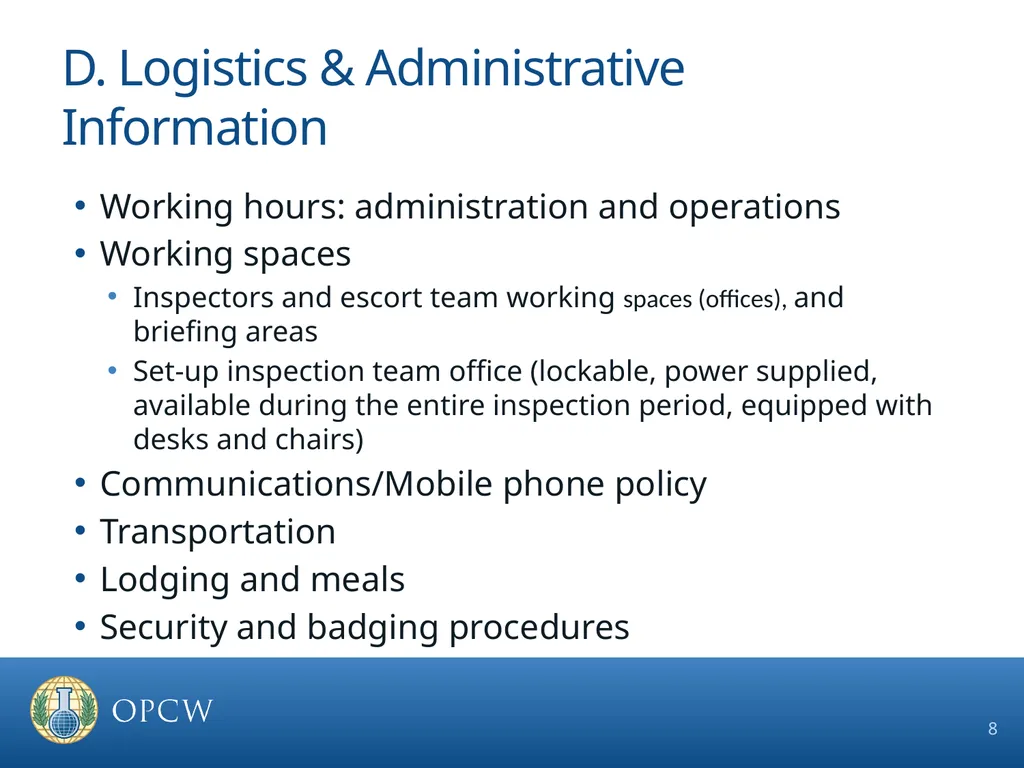
D. Logistics & Administrative Information Working hours: administration and operations
Working spaces
Inspectors and escort team working spaces (offices), and briefing areas
Set-up inspection team office (lockable, power supplied, available during the entire inspection period, equipped with desks and chairs)
Communications/Mobile phone policy
Transportation
Lodging and meals
Security and badging procedures<br>
09
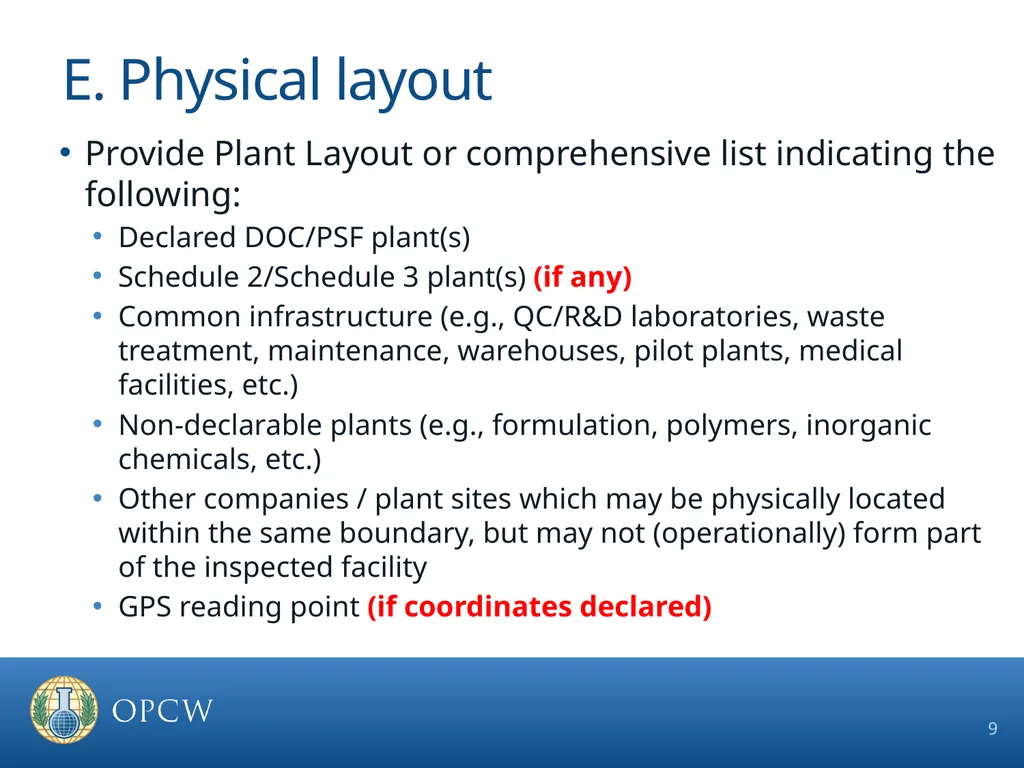
E. Physical layout Provide Plant Layout or comprehensive list indicating the following:
Declared DOC/PSF plant(s)
Schedule 2/Schedule 3 plant(s) (if any)
Common infrastructure (e.g., QC/R&D laboratories, waste treatment, maintenance, warehouses, pilot plants, medical facilities, etc.)
Non-declarable plants (e.g., formulation, polymers, inorganic chemicals, etc.)
Other companies / plant sites which may be physically located within the same boundary, but may not (operationally) form part of the inspected facility
GPS reading point (if coordinates declared)<br>
10
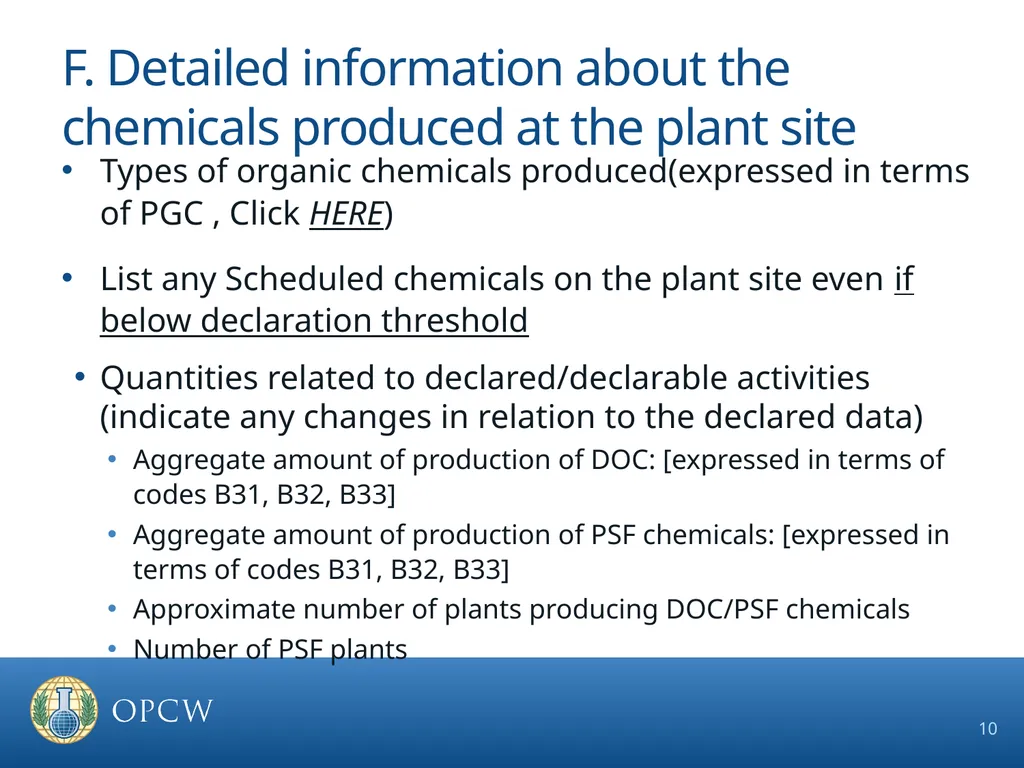
F. Detailed information about the chemicals produced at the plant site Types of organic chemicals produced(expressed in terms of PGC , Click HERE)
List any Scheduled chemicals on the plant site even if below declaration threshold
Quantities related to declared/declarable activities (indicate any changes in relation to the declared data)
Aggregate amount of production of DOC: [expressed in terms of codes B31, B32, B33]
Aggregate amount of production of PSF chemicals: [expressed in terms of codes B31, B32, B33]
Approximate number of plants producing DOC/PSF chemicals
Number of PSF plants<br>
11
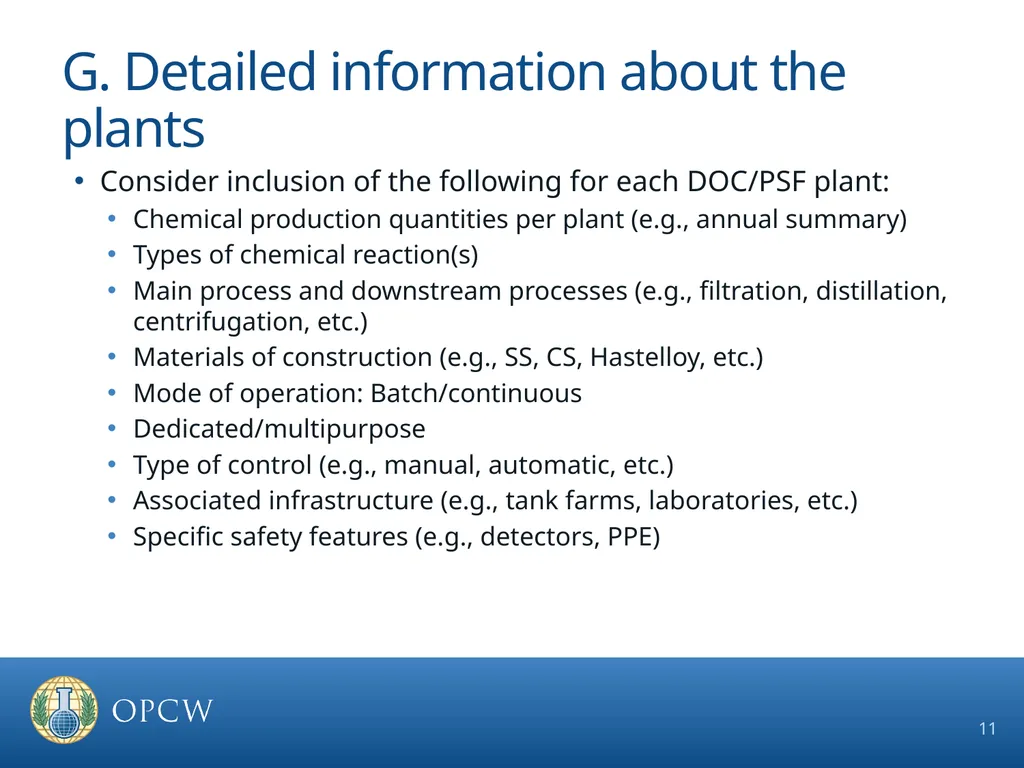
G. Detailed information about the plants Consider inclusion of the following for each DOC/PSF plant:
Chemical production quantities per plant (e.g., annual summary)
Types of chemical reaction(s)
Main process and downstream processes (e.g., filtration, distillation, centrifugation, etc.)
Materials of construction (e.g., SS, CS, Hastelloy, etc.)
Mode of operation: Batch/continuous
Dedicated/multipurpose
Type of control (e.g., manual, automatic, etc.)
Associated infrastructure (e.g., tank farms, laboratories, etc.)
Specific safety features (e.g., detectors, PPE)<br>
12
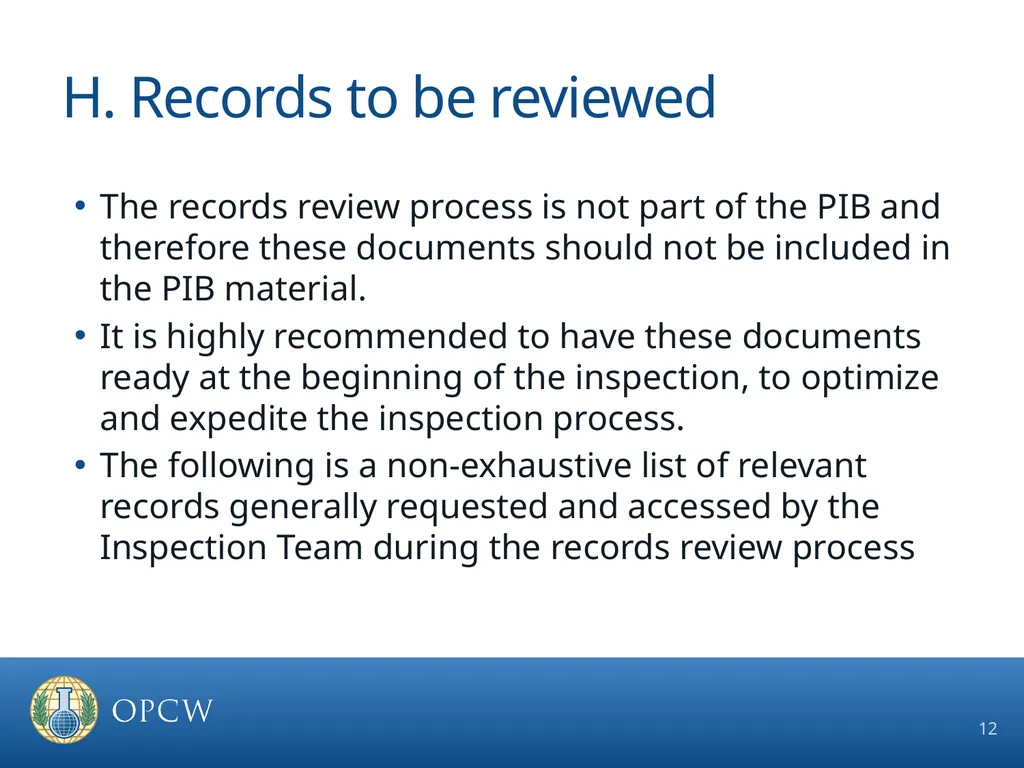
H. Records to be reviewed The records review process is not part of the PIB and therefore these documents should not be included in the PIB material.
It is highly recommended to have these documents ready at the beginning of the inspection, to optimize and expedite the inspection process.
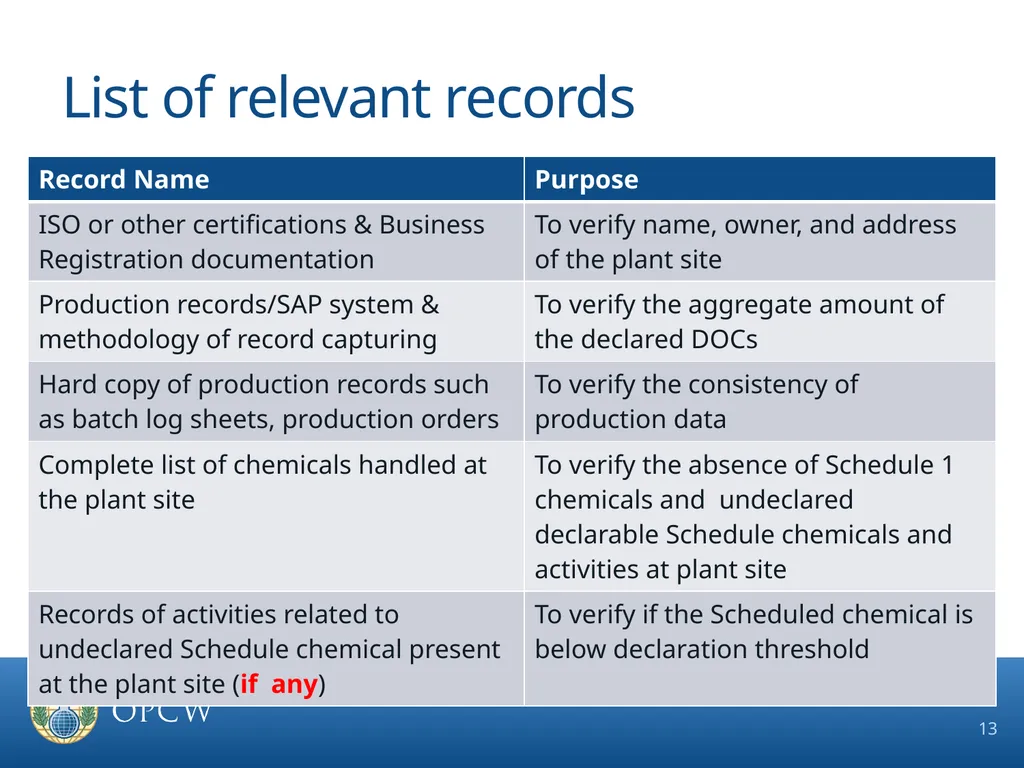
The following is a non-exhaustive list of relevant records generally requested and accessed by the Inspection Team during the records review process<br>
13
List of relevant records<br>
14
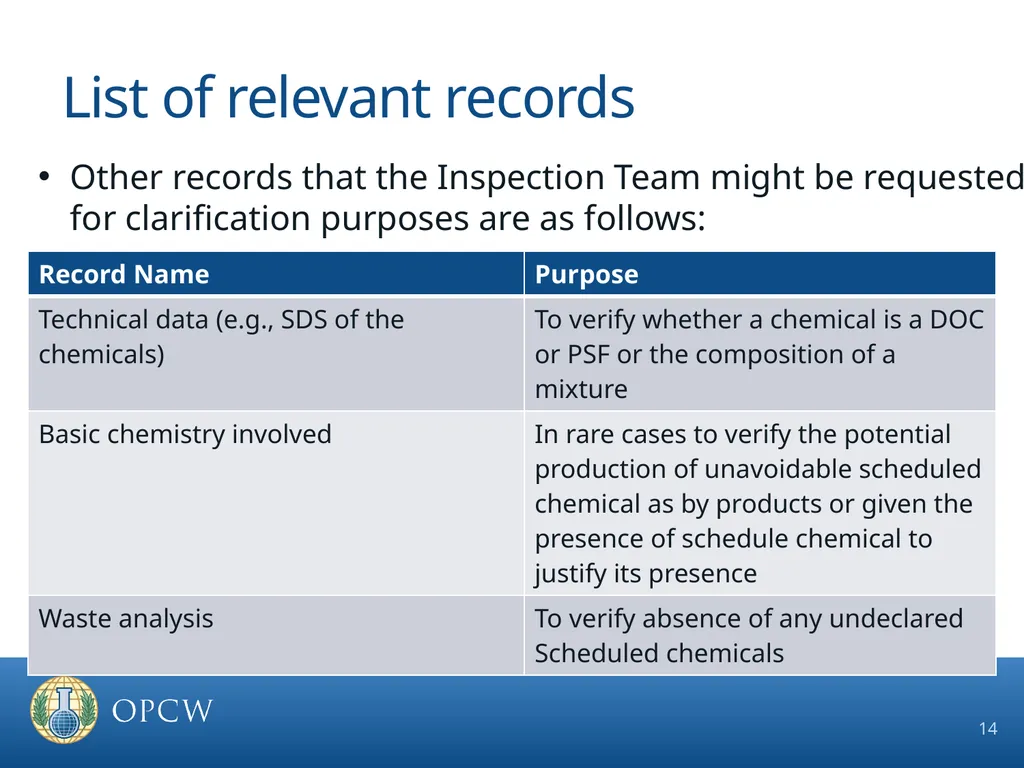
List of relevant records Other records that the Inspection Team might be requested for clarification purposes are as follows:<br>
15
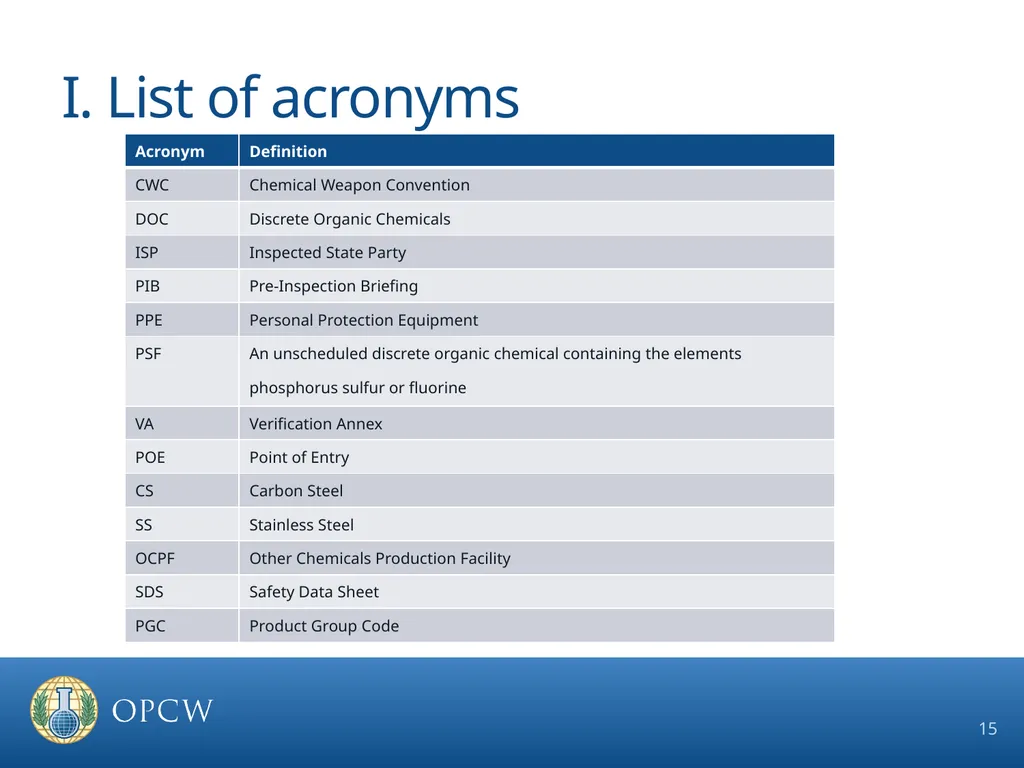
I. List of acronyms<br>
16
References Please refer to the links below for further examples and guidance on how to prepare a PIB
USA National Authority
https://www.cwc.gov/inspections_briefing_overview_text.html#topicFour
UK National Authority
https://assets.publishing.service.gov.uk/government/uploads/system/uploads/attachment_data/file/558885/OPCW_Inspection_Guidance__2016_.pdf<br>