
Precipitation Precipitation is the process of

Description: Precipitation Precipitation is the process of separating solid particles from a previously clear liquid i.e a solution, by physical or chemical changes. The separated solid is termed a precipitate; the cause of precipitation is the
Related Topics
Download Presentation
"Precipitation Precipitation is the process of" is the property of its rightful owner. Permission is granted to download and print the materials on this website for personal, non-commercial use only, and to display it on your personal computer provided you do not modify the materials and that you retain all copyright notices contained in the materials. By downloading content from our website, you accept the terms of this agreement.
Presentation Transcript
slide1. Precipitation
Precipitation is the process of separating solid particles from a previously clear liquid i.e a solution, by physical or chemical changes.
The separated solid is termed a precipitate;
the cause of precipitation is the precipitant;
and the liquid that remains in the vessel above the precipitate is called the supernatant liquid.<br>
slide2. Precipitation occurs when solutions of materials which react chemically are mixed to form a product which is but sparingly soluble in the liquid and therefore deposits out.<br>
slide3. In pharmacy, precipitation may be useful for many purposes.
To obtain fine particles: It provides a convenient method of obtaining solid substances in the form of fine particles (0.1µm in diameter or 100nm) i.e. precipitation of calcium carbonate (precipitated chalk).<br>
slide4. Purification: It is also widely used as a method of purifying powders.
The impure solid usually is dissolved in a suitable solvent at elevated temperatures.
On cooling, the bulk of the impurities remain solubilized while the purified solid product precipitates.
This procedure is repeated as many times as necessary, using a number of solvents if required.<br>
slide5. Examples of pharmaceutical substances commonly prepared by precipitation are
Calcium and magnesium carbonates made by treating the respective chlorides with sodium carbonate solution.
Ammoniated mercury made by adding a solution of mercuric chloride to a solution of ammonia.
Yellow mercuric oxide made by adding a warm solution of mercuric chloride to a solution of sodium hydroxide.<br>
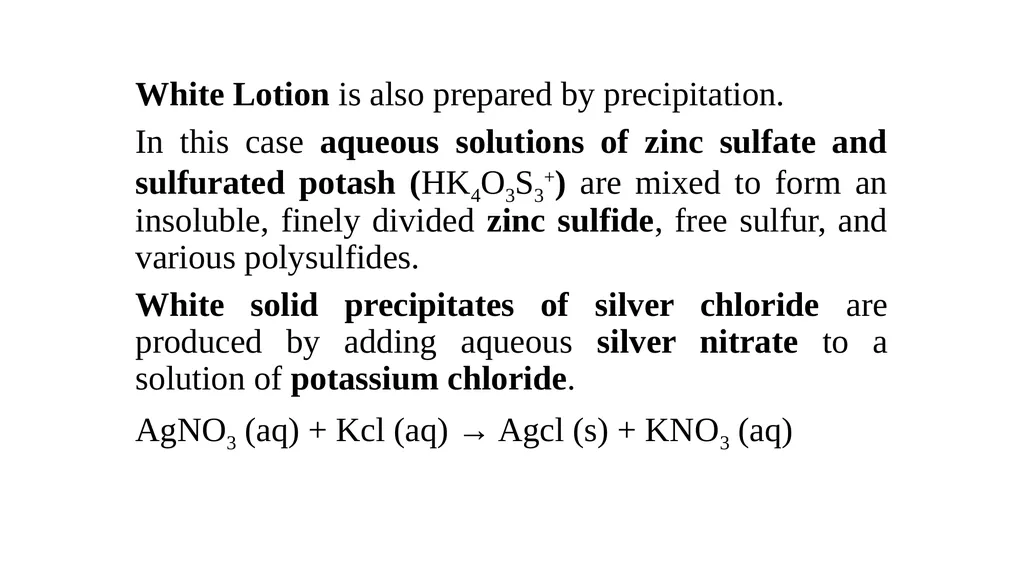
slide6. White Lotion is also prepared by precipitation.
In this case aqueous solutions of zinc sulfate and sulfurated potash (HK4O3S3+) are mixed to form an insoluble, finely divided zinc sulfide, free sulfur, and various polysulfides.
White solid precipitates of silver chloride are produced by adding aqueous silver nitrate to a solution of potassium chloride.
AgNO3 (aq) + Kcl (aq) → Agcl (s) + KNO3 (aq)<br>
slide7. Types of precipitate
The character of precipitate often depends upon the conditions under which it has been produced.
When the reacting substances are mixed at temperatures near to their boiling-point, the precipitate is usually granular and heavy, whereas;
a precipitate of the same substance produced by mixing cold solutions may be light, take a long time to settle and to wash, and will pass through a filter.<br>
slide8. Similarly, concentrated solutions produce larger precipitates than do dilute solutions.
Large, coarse precipitates can be readily freed from contaminating salts by washing.
While small, fine precipitates may be difficult to free from impurities adsorbed on their large surface area.<br>
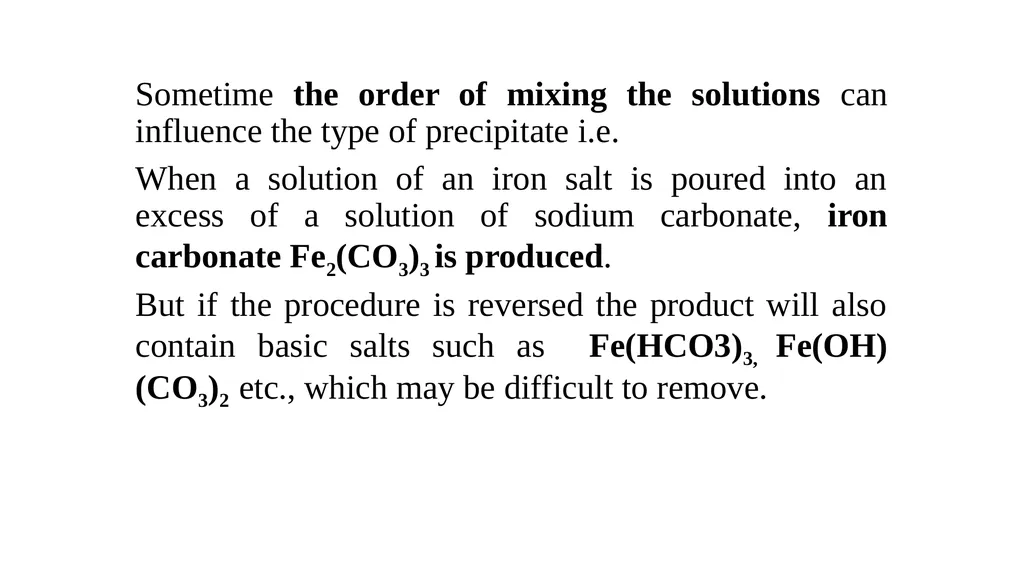
slide9. Sometime the order of mixing the solutions can influence the type of precipitate i.e.
When a solution of an iron salt is poured into an excess of a solution of sodium carbonate, iron carbonate Fe2(CO3)3 is produced.
But if the procedure is reversed the product will also contain basic salts such as Fe(HCO3)3, Fe(OH)(CO3)2 etc., which may be difficult to remove.<br>
slide10. Methods of separation
Precipitates can be separated by filtration, decantation and centrifugation.<br>
Precipitation is the process of separating solid particles from a previously clear liquid i.e a solution, by physical or chemical changes.
The separated solid is termed a precipitate;
the cause of precipitation is the precipitant;
and the liquid that remains in the vessel above the precipitate is called the supernatant liquid.<br>
slide2. Precipitation occurs when solutions of materials which react chemically are mixed to form a product which is but sparingly soluble in the liquid and therefore deposits out.<br>
slide3. In pharmacy, precipitation may be useful for many purposes.
To obtain fine particles: It provides a convenient method of obtaining solid substances in the form of fine particles (0.1µm in diameter or 100nm) i.e. precipitation of calcium carbonate (precipitated chalk).<br>
slide4. Purification: It is also widely used as a method of purifying powders.
The impure solid usually is dissolved in a suitable solvent at elevated temperatures.
On cooling, the bulk of the impurities remain solubilized while the purified solid product precipitates.
This procedure is repeated as many times as necessary, using a number of solvents if required.<br>
slide5. Examples of pharmaceutical substances commonly prepared by precipitation are
Calcium and magnesium carbonates made by treating the respective chlorides with sodium carbonate solution.
Ammoniated mercury made by adding a solution of mercuric chloride to a solution of ammonia.
Yellow mercuric oxide made by adding a warm solution of mercuric chloride to a solution of sodium hydroxide.<br>
slide6. White Lotion is also prepared by precipitation.
In this case aqueous solutions of zinc sulfate and sulfurated potash (HK4O3S3+) are mixed to form an insoluble, finely divided zinc sulfide, free sulfur, and various polysulfides.
White solid precipitates of silver chloride are produced by adding aqueous silver nitrate to a solution of potassium chloride.
AgNO3 (aq) + Kcl (aq) → Agcl (s) + KNO3 (aq)<br>
slide7. Types of precipitate
The character of precipitate often depends upon the conditions under which it has been produced.
When the reacting substances are mixed at temperatures near to their boiling-point, the precipitate is usually granular and heavy, whereas;
a precipitate of the same substance produced by mixing cold solutions may be light, take a long time to settle and to wash, and will pass through a filter.<br>
slide8. Similarly, concentrated solutions produce larger precipitates than do dilute solutions.
Large, coarse precipitates can be readily freed from contaminating salts by washing.
While small, fine precipitates may be difficult to free from impurities adsorbed on their large surface area.<br>
slide9. Sometime the order of mixing the solutions can influence the type of precipitate i.e.
When a solution of an iron salt is poured into an excess of a solution of sodium carbonate, iron carbonate Fe2(CO3)3 is produced.
But if the procedure is reversed the product will also contain basic salts such as Fe(HCO3)3, Fe(OH)(CO3)2 etc., which may be difficult to remove.<br>
slide10. Methods of separation
Precipitates can be separated by filtration, decantation and centrifugation.<br>