
Precision Medicine in Epilepsy Management GET:
OM
Published · 98 slides · 0 views
1 / 1
Description
Precision Medicine in Epilepsy Management GET: Gene, Epilepsy, Treatment Designed Developed by: Ali A. Asadi-Pooya, M.D., Professor of Epileptology Shiraz University of Medical Sciences, Shiraz, Iran Thomas Jefferson University,
Related Topics
Share
Embed code
Download this presentation From Below
"Precision Medicine in Epilepsy Management GET:" is the property of its rightful owner. Permission is granted to download and print the materials on this website for personal, non-commercial use only, and to display it on your personal computer provided you do not modify the materials and that you retain all copyright notices contained in the materials. By downloading content from our website, you accept the terms of this agreement.
Presentation Transcript
01
Precision Medicine in Epilepsy Management
GET: Gene, Epilepsy, Treatment Designed & Developed by:
Ali A. Asadi-Pooya, M.D., Professor of Epileptology
Shiraz University of Medical Sciences, Shiraz, Iran
Thomas Jefferson University, Philadelphia, PA, USA
aliasadipooya@yahoo.com<br>
Ali A. Asadi-Pooya, M.D., Professor of Epileptology
Shiraz University of Medical Sciences, Shiraz, Iran
Thomas Jefferson University, Philadelphia, PA, USA
aliasadipooya@yahoo.com<br>
02
Declarations Conflicts of interest: None.
Funding: None.
Acknowledgement: I thank Mr. Ali Safaeian for software development.<br>
Funding: None.
Acknowledgement: I thank Mr. Ali Safaeian for software development.<br>
03
LEGAL DISCLAIMER This application is designed for healthcare professionals. The app is based on available evidence. This app is not an official guideline and the recommendations do not replace standard health care practice. Interpretation of the content and the data presented are the responsibility of the user. This app is designed to aid the prescriber, but does not substitute for that person's clinical judgment. The final decision regarding prescription of medication is the responsibility of the user. Users should have knowledge about any drug or course of action they prescribe. The user understands that this app is not a medical device.
Data entry in the app will be saved anonymously so that the app performance can be analyzed and improved. The author may choose to publish about the use of the app, and no users will be identified in any way.<br>
Data entry in the app will be saved anonymously so that the app performance can be analyzed and improved. The author may choose to publish about the use of the app, and no users will be identified in any way.<br>
04
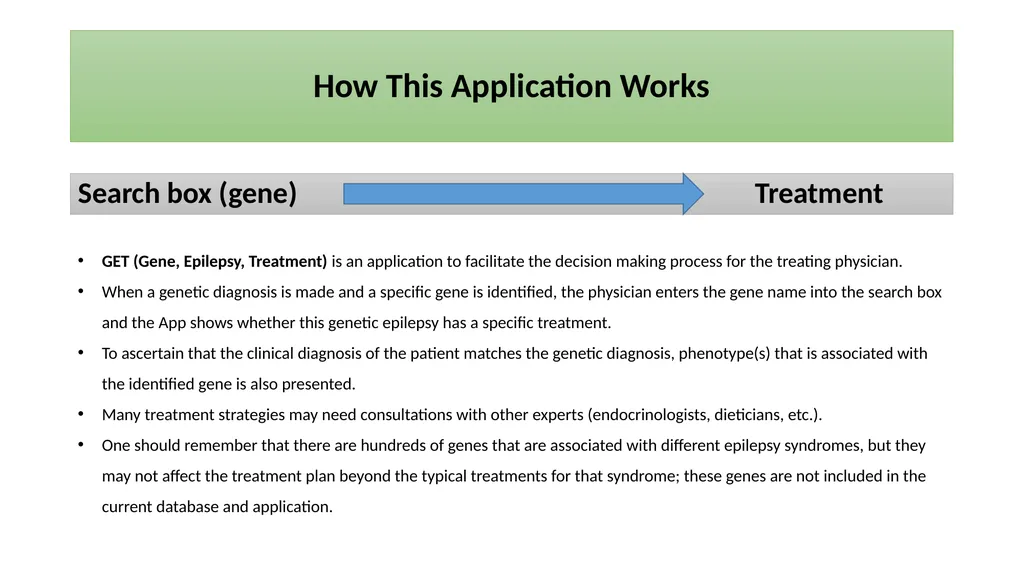
How This Application Works Search box (gene) Treatment GET (Gene, Epilepsy, Treatment) is an application to facilitate the decision making process for the treating physician.
When a genetic diagnosis is made and a specific gene is identified, the physician enters the gene name into the search box and the App shows whether this genetic epilepsy has a specific treatment.
To ascertain that the clinical diagnosis of the patient matches the genetic diagnosis, phenotype(s) that is associated with the identified gene is also presented.
Many treatment strategies may need consultations with other experts (endocrinologists, dieticians, etc.).
One should remember that there are hundreds of genes that are associated with different epilepsy syndromes, but they may not affect the treatment plan beyond the typical treatments for that syndrome; these genes are not included in the current database and application.<br>
When a genetic diagnosis is made and a specific gene is identified, the physician enters the gene name into the search box and the App shows whether this genetic epilepsy has a specific treatment.
To ascertain that the clinical diagnosis of the patient matches the genetic diagnosis, phenotype(s) that is associated with the identified gene is also presented.
Many treatment strategies may need consultations with other experts (endocrinologists, dieticians, etc.).
One should remember that there are hundreds of genes that are associated with different epilepsy syndromes, but they may not affect the treatment plan beyond the typical treatments for that syndrome; these genes are not included in the current database and application.<br>
05
ALDH4A1 Phenotype:
Hyperprolinemia
Vitamin-B6-dependent epilepsy
Treatment: Pyridoxine (B6 vitamin)<br>
Hyperprolinemia
Vitamin-B6-dependent epilepsy
Treatment: Pyridoxine (B6 vitamin)<br>
06
ALDHT7A1 Phenotype: Pyridoxine-dependent epilepsy
Treatment: Pyridoxine (B6 vitamin)<br>
Treatment: Pyridoxine (B6 vitamin)<br>
07
AMT Phenotype:
Glycine encephalopathy
Non-ketotic hyperglycinemia
Treatment:
Sodium benzoate
NMDA receptor site antagonists (ketamine, dextromethorphan, memantine, and amantadine)<br>
Glycine encephalopathy
Non-ketotic hyperglycinemia
Treatment:
Sodium benzoate
NMDA receptor site antagonists (ketamine, dextromethorphan, memantine, and amantadine)<br>
08
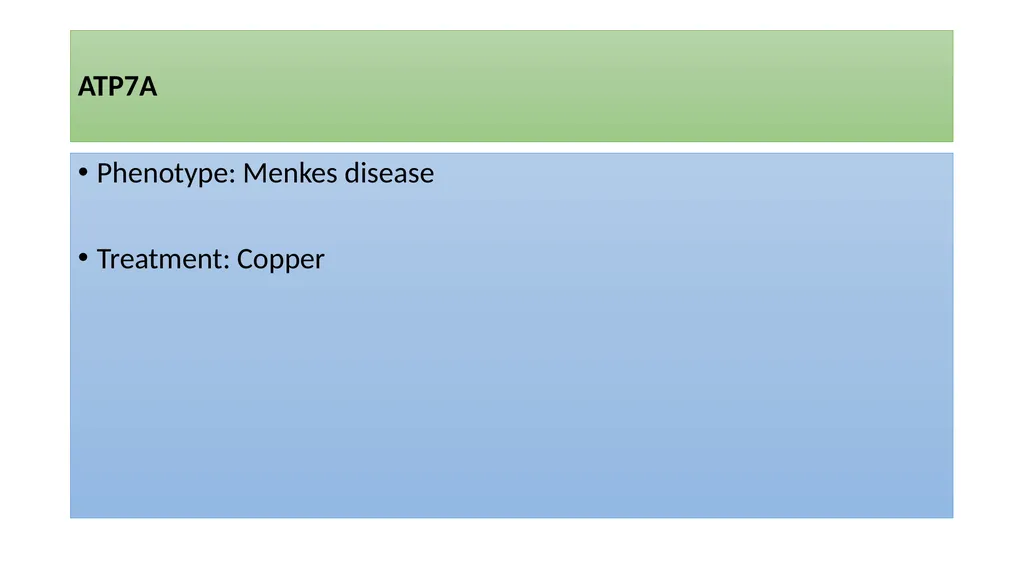
ATP7A Phenotype: Menkes disease
Treatment: Copper<br>
Treatment: Copper<br>
09
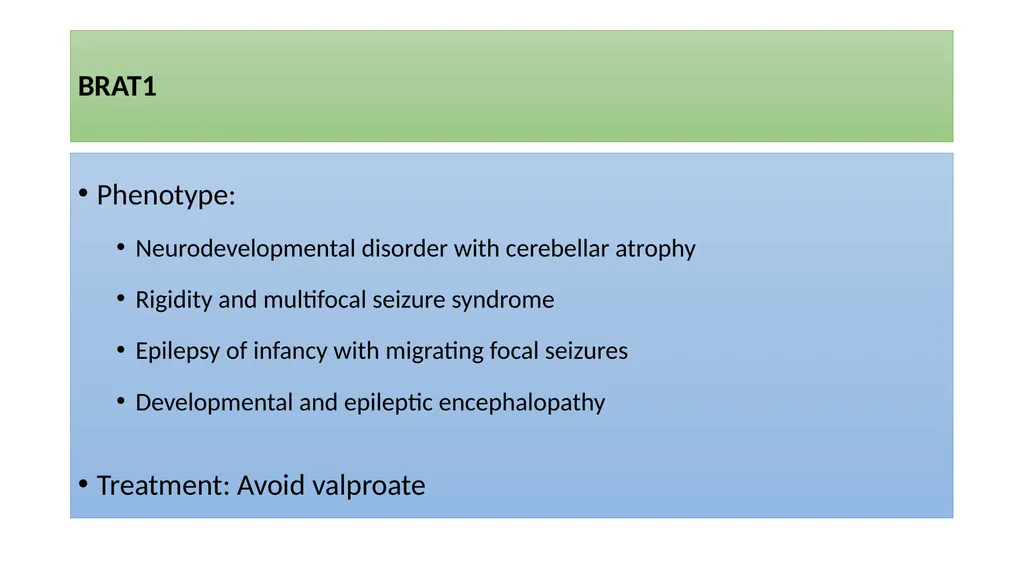
BRAT1 Phenotype:
Neurodevelopmental disorder with cerebellar atrophy
Rigidity and multifocal seizure syndrome
Epilepsy of infancy with migrating focal seizures
Developmental and epileptic encephalopathy
Treatment: Avoid valproate<br>
Neurodevelopmental disorder with cerebellar atrophy
Rigidity and multifocal seizure syndrome
Epilepsy of infancy with migrating focal seizures
Developmental and epileptic encephalopathy
Treatment: Avoid valproate<br>
10
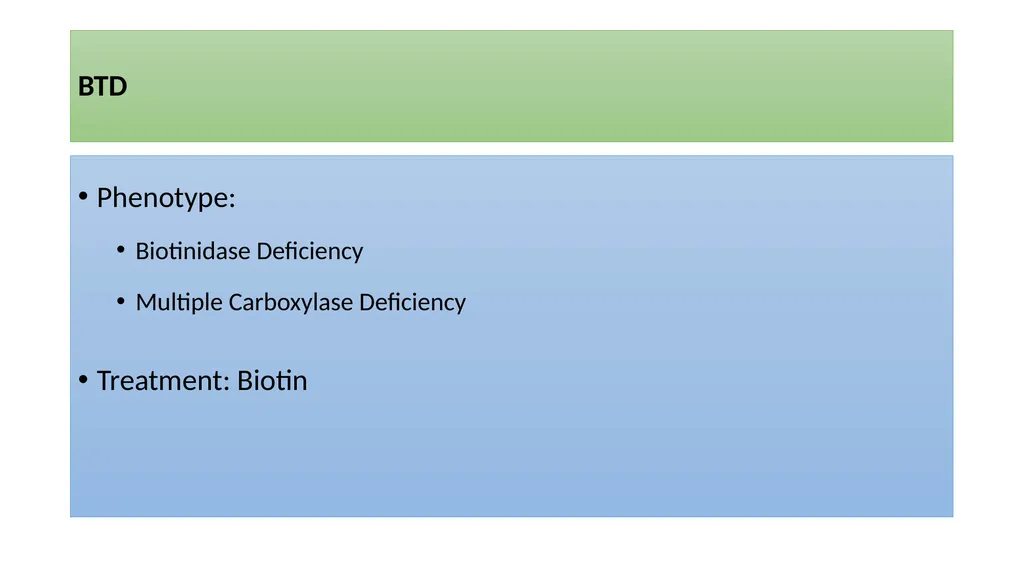
BTD Phenotype:
Biotinidase Deficiency
Multiple Carboxylase Deficiency
Treatment: Biotin<br>
Biotinidase Deficiency
Multiple Carboxylase Deficiency
Treatment: Biotin<br>
11
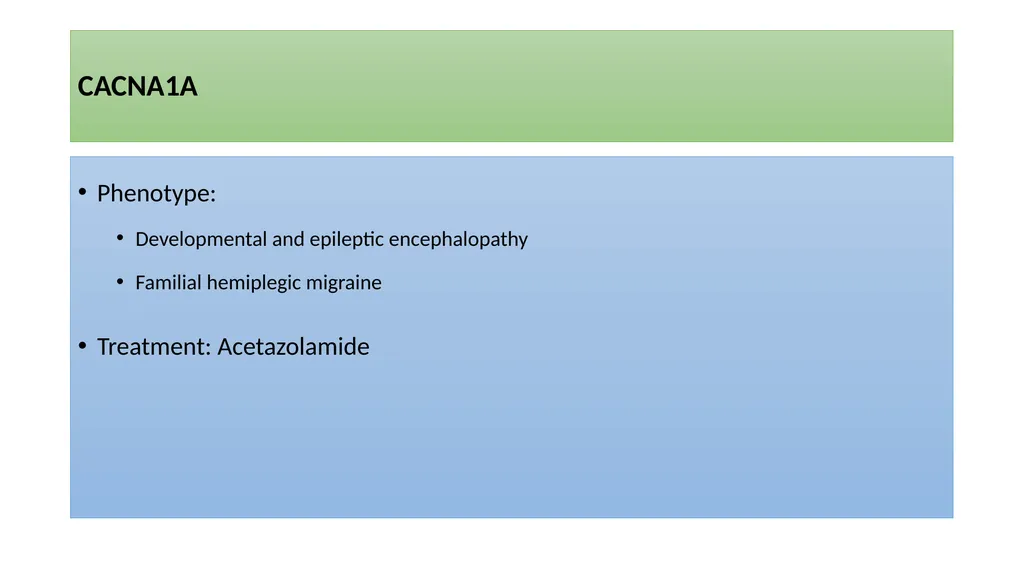
CACNA1A Phenotype:
Developmental and epileptic encephalopathy
Familial hemiplegic migraine
Treatment: Acetazolamide<br>
Developmental and epileptic encephalopathy
Familial hemiplegic migraine
Treatment: Acetazolamide<br>
12
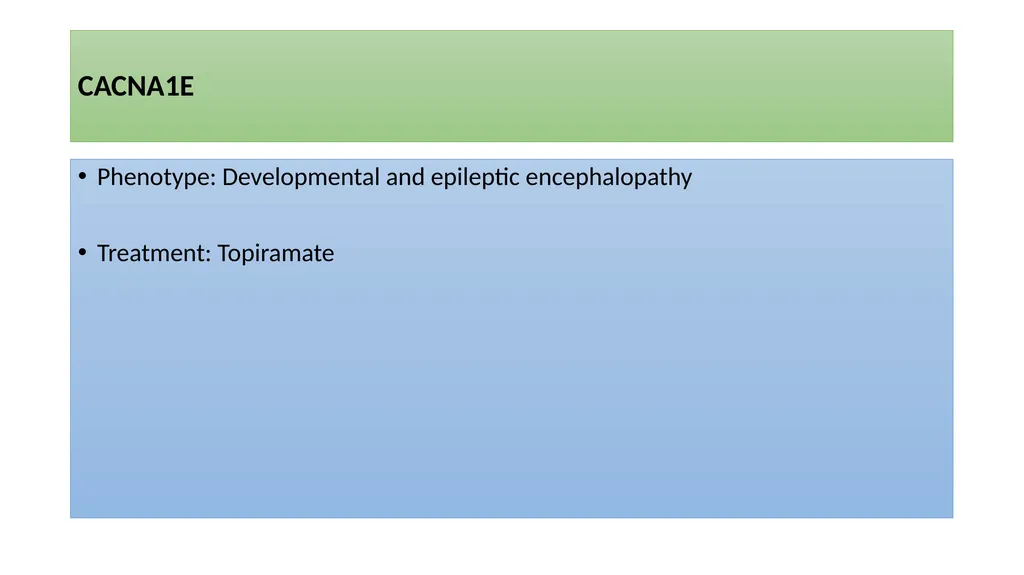
CACNA1E Phenotype: Developmental and epileptic encephalopathy
Treatment: Topiramate<br>
Treatment: Topiramate<br>
13
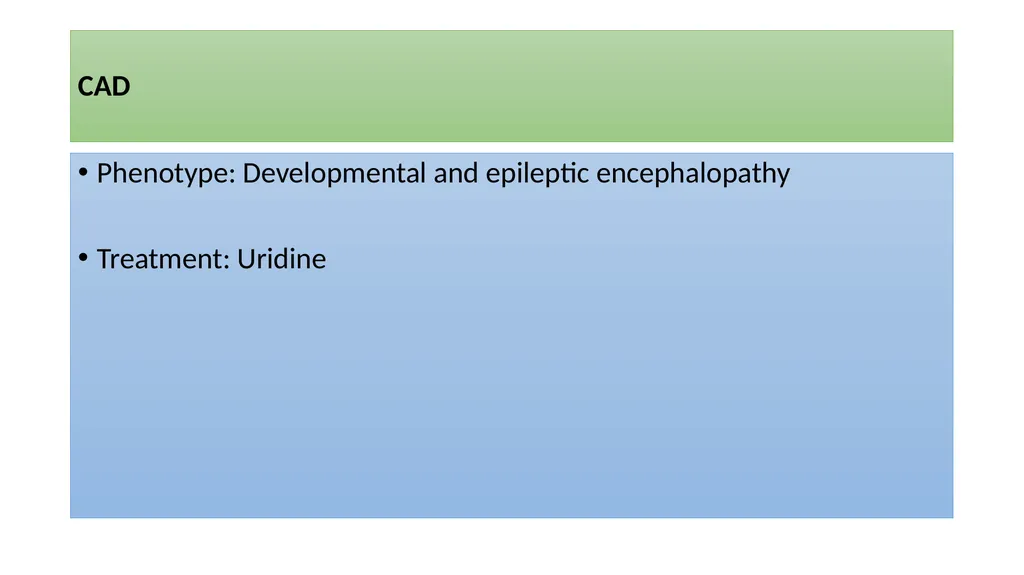
CAD Phenotype: Developmental and epileptic encephalopathy
Treatment: Uridine<br>
Treatment: Uridine<br>
14
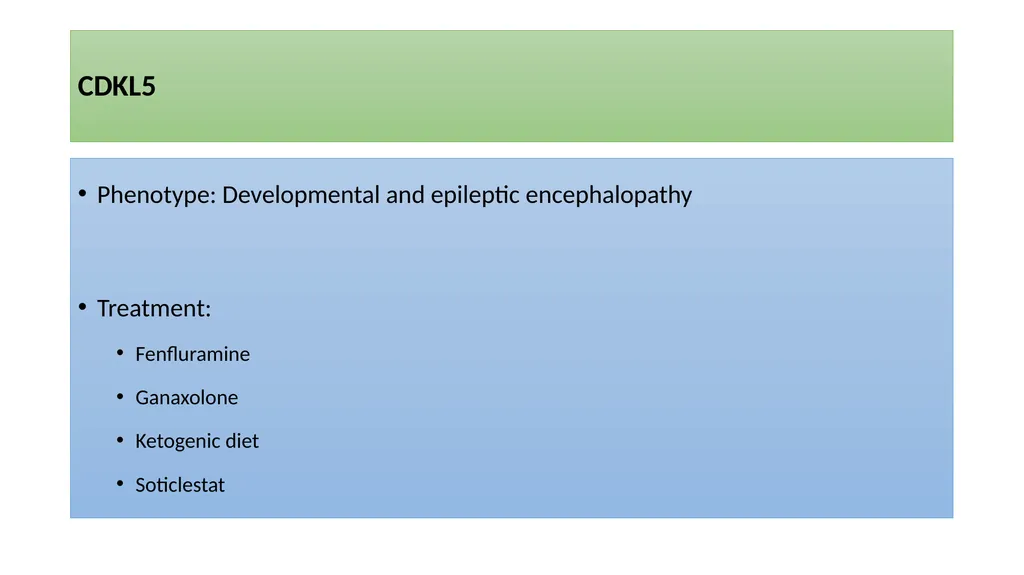
CDKL5 Phenotype: Developmental and epileptic encephalopathy
Treatment:
Fenfluramine
Ganaxolone
Ketogenic diet
Soticlestat<br>
Treatment:
Fenfluramine
Ganaxolone
Ketogenic diet
Soticlestat<br>
15
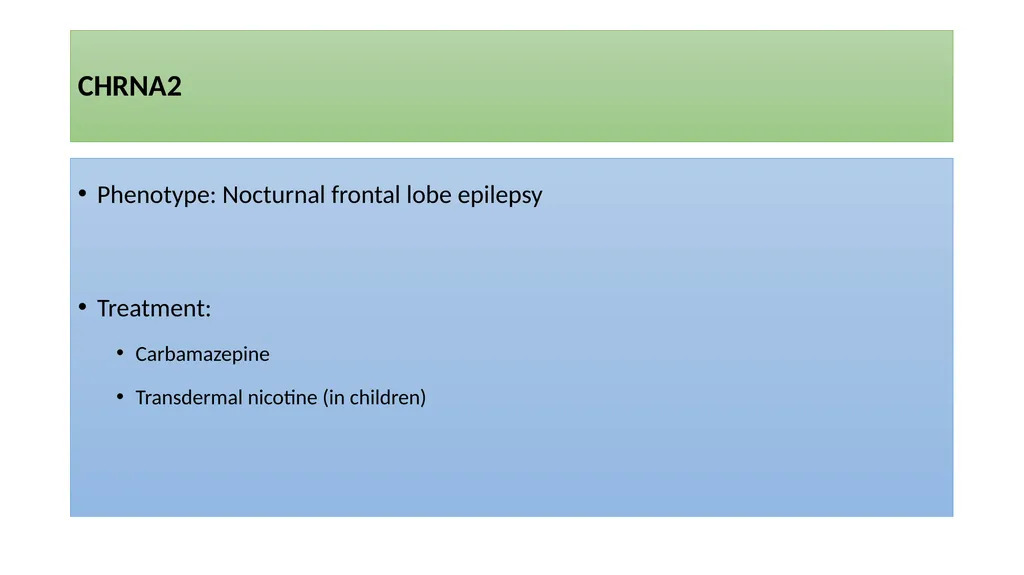
CHRNA2 Phenotype: Nocturnal frontal lobe epilepsy
Treatment:
Carbamazepine
Transdermal nicotine (in children)<br>
Treatment:
Carbamazepine
Transdermal nicotine (in children)<br>
16
CHRNA4 Phenotype: Nocturnal frontal lobe epilepsy
Treatment:
Carbamazepine
Transdermal nicotine (in children)<br>
Treatment:
Carbamazepine
Transdermal nicotine (in children)<br>
17
CHRNB2 Phenotype: Nocturnal frontal lobe epilepsy
Treatment:
Carbamazepine
Transdermal nicotine (in children)<br>
Treatment:
Carbamazepine
Transdermal nicotine (in children)<br>
18
CLN1 Phenotype: Neuronal ceroid lipofuscinosis
Treatment: Cysteamine bitartrate (Cystagon) and N-acetylcysteine<br>
Treatment: Cysteamine bitartrate (Cystagon) and N-acetylcysteine<br>
19
CLN2 Phenotype: Neuronal ceroid lipofuscinosis
Treatment: Cerliponase alfa<br>
Treatment: Cerliponase alfa<br>
20
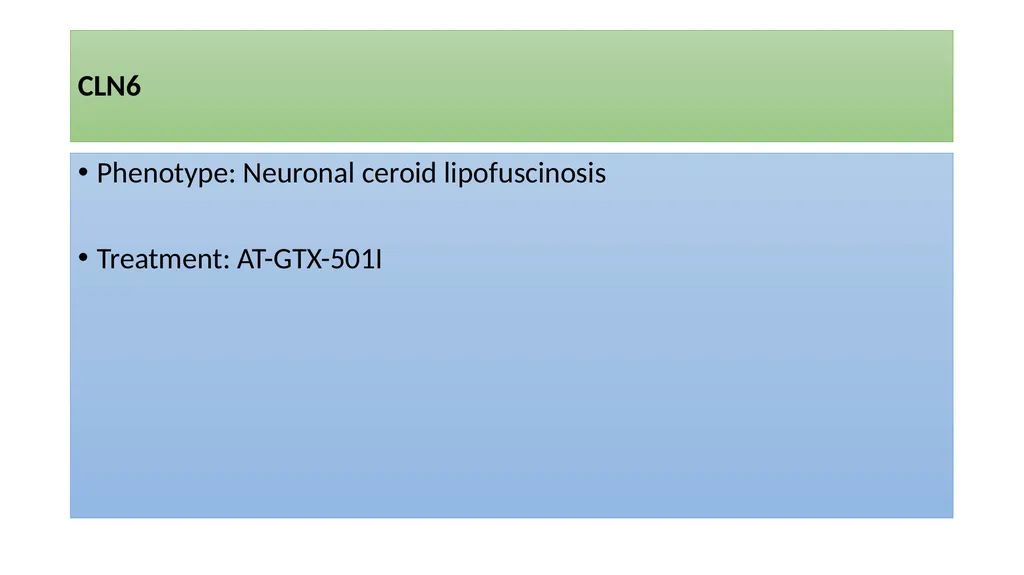
CLN6 Phenotype: Neuronal ceroid lipofuscinosis
Treatment: AT-GTX-501I<br>
Treatment: AT-GTX-501I<br>
21
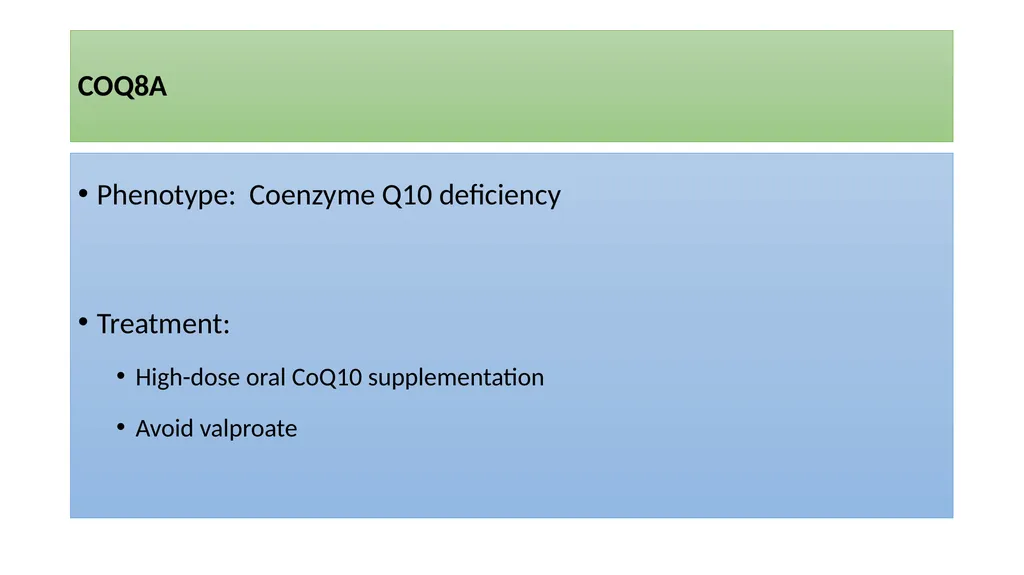
COQ8A Phenotype: Coenzyme Q10 deficiency
Treatment:
High-dose oral CoQ10 supplementation
Avoid valproate<br>
Treatment:
High-dose oral CoQ10 supplementation
Avoid valproate<br>
22
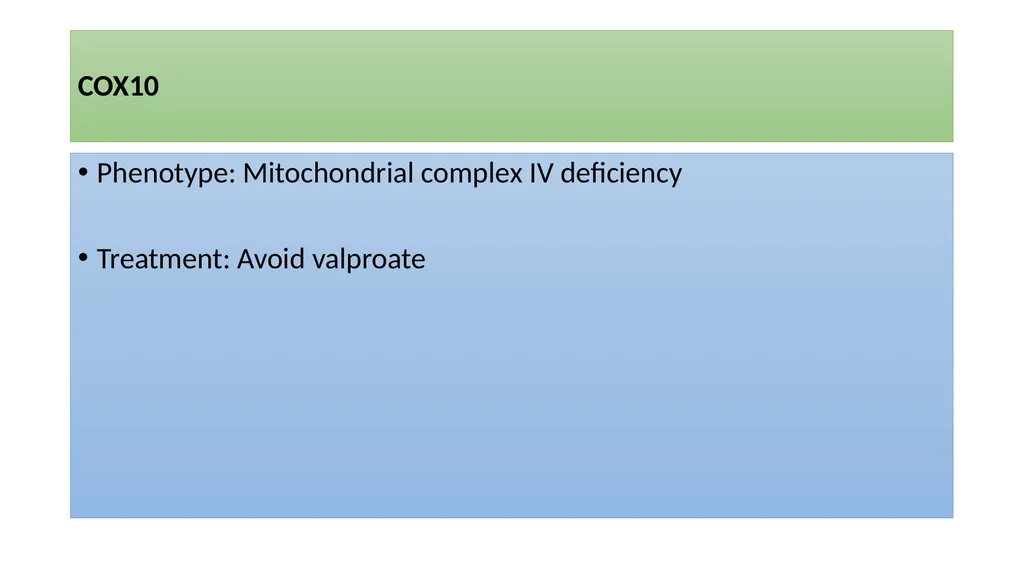
COX10 Phenotype: Mitochondrial complex IV deficiency
Treatment: Avoid valproate<br>
Treatment: Avoid valproate<br>
23
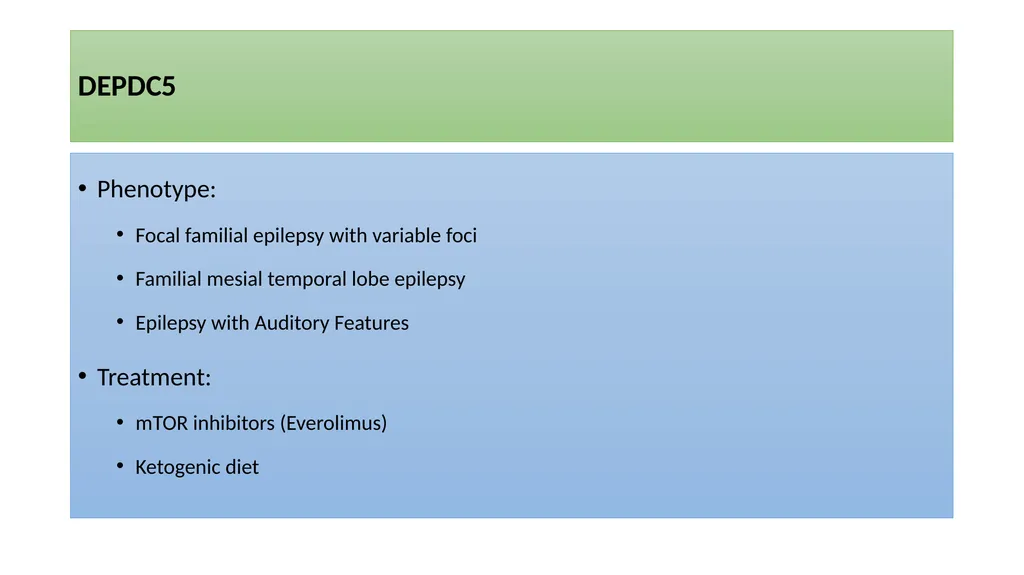
DEPDC5 Phenotype:
Focal familial epilepsy with variable foci
Familial mesial temporal lobe epilepsy
Epilepsy with Auditory Features
Treatment:
mTOR inhibitors (Everolimus)
Ketogenic diet<br>
Focal familial epilepsy with variable foci
Familial mesial temporal lobe epilepsy
Epilepsy with Auditory Features
Treatment:
mTOR inhibitors (Everolimus)
Ketogenic diet<br>
24
DHFR Phenotype: Neurodegeneration due to cerebral folate transport deficiency
Treatment: Folinic acid, 5-methyltetrahydrofolate<br>
Treatment: Folinic acid, 5-methyltetrahydrofolate<br>
25
DNM1L Phenotype: Encephalopathy, optic atrophy
Treatment: Avoid valproate<br>
Treatment: Avoid valproate<br>
26
EPM2A Phenotype: Lafora progressive myoclonus epilepsy
Treatment:
Metformin
Perampanel
Valproate, topiramate, ethosuximide, phenobarbital, zonisamide<br>
Treatment:
Metformin
Perampanel
Valproate, topiramate, ethosuximide, phenobarbital, zonisamide<br>
27
EPM2B Phenotype: Lafora progressive myoclonus epilepsy
Treatment:
Metformin
Perampanel
Valproate, topiramate, ethosuximide, phenobarbital, zonisamide<br>
Treatment:
Metformin
Perampanel
Valproate, topiramate, ethosuximide, phenobarbital, zonisamide<br>
28
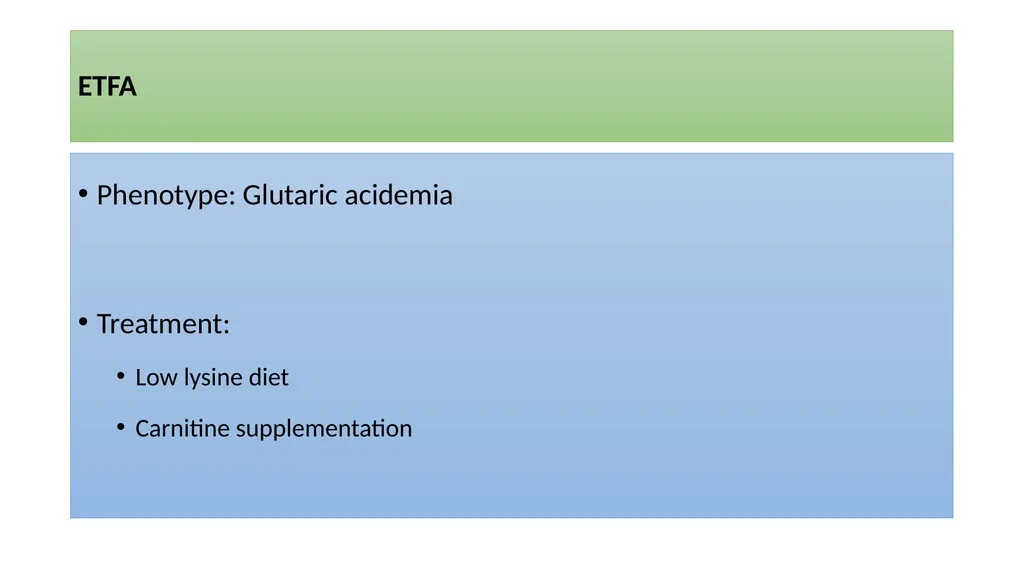
ETFA Phenotype: Glutaric acidemia
Treatment:
Low lysine diet
Carnitine supplementation<br>
Treatment:
Low lysine diet
Carnitine supplementation<br>
29
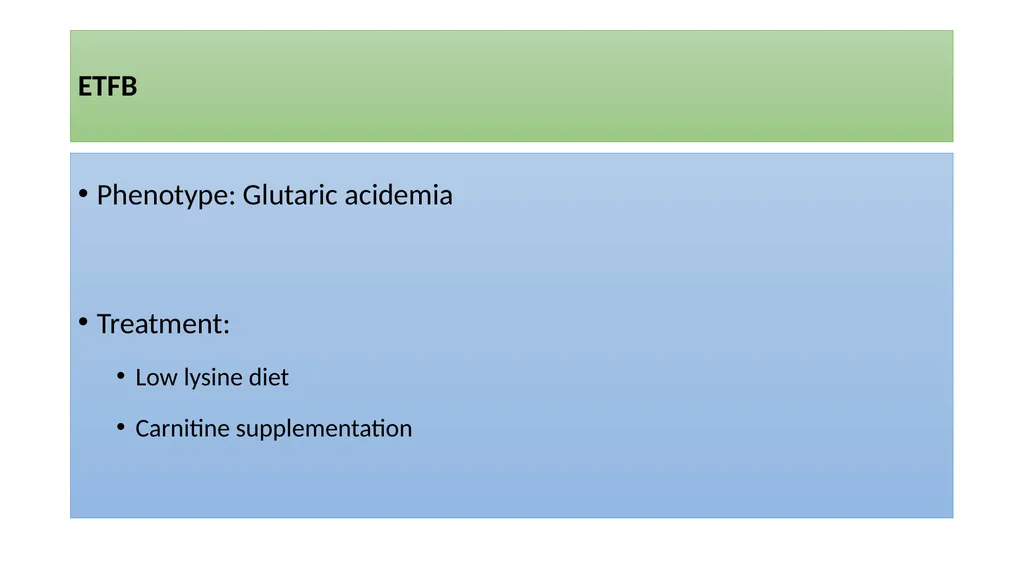
ETFB Phenotype: Glutaric acidemia
Treatment:
Low lysine diet
Carnitine supplementation<br>
Treatment:
Low lysine diet
Carnitine supplementation<br>
30
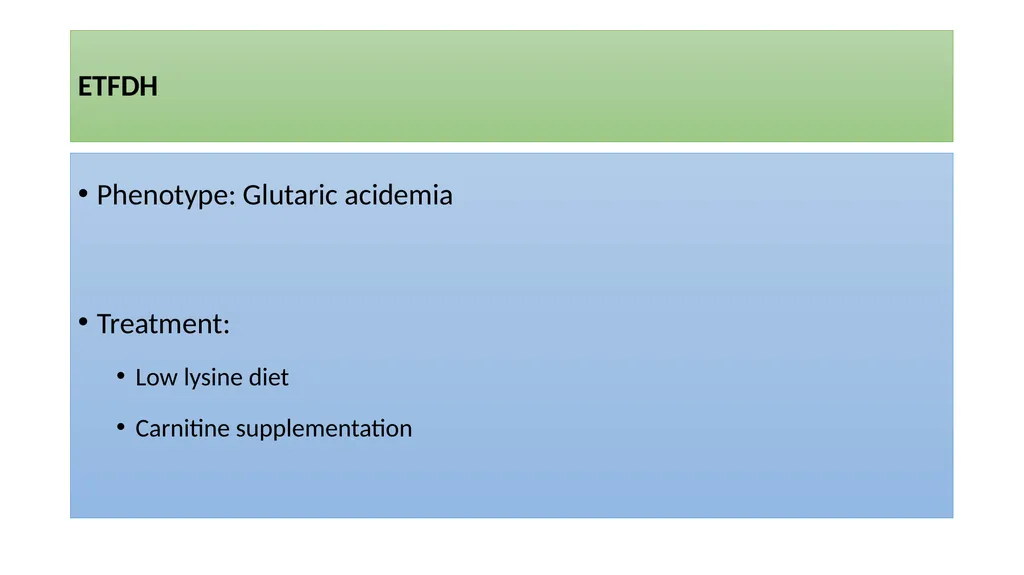
ETFDH Phenotype: Glutaric acidemia
Treatment:
Low lysine diet
Carnitine supplementation<br>
Treatment:
Low lysine diet
Carnitine supplementation<br>
31
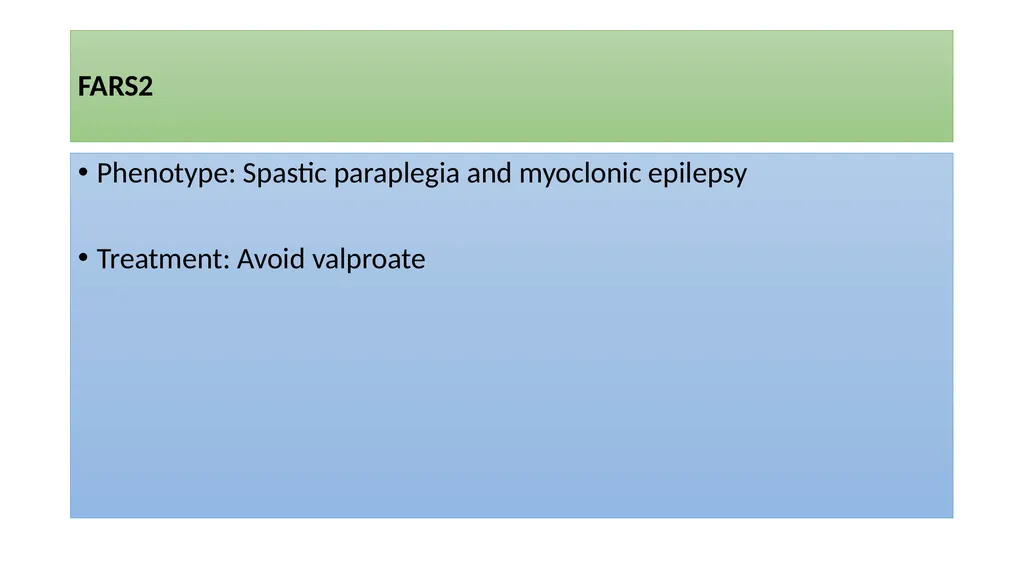
FARS2 Phenotype: Spastic paraplegia and myoclonic epilepsy
Treatment: Avoid valproate<br>
Treatment: Avoid valproate<br>
32
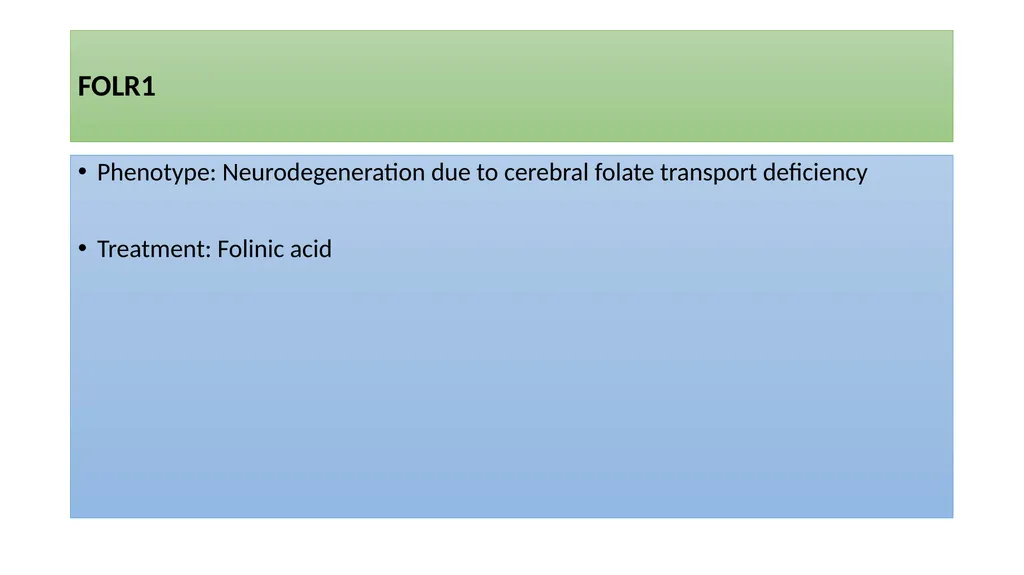
FOLR1 Phenotype: Neurodegeneration due to cerebral folate transport deficiency
Treatment: Folinic acid<br>
Treatment: Folinic acid<br>
33
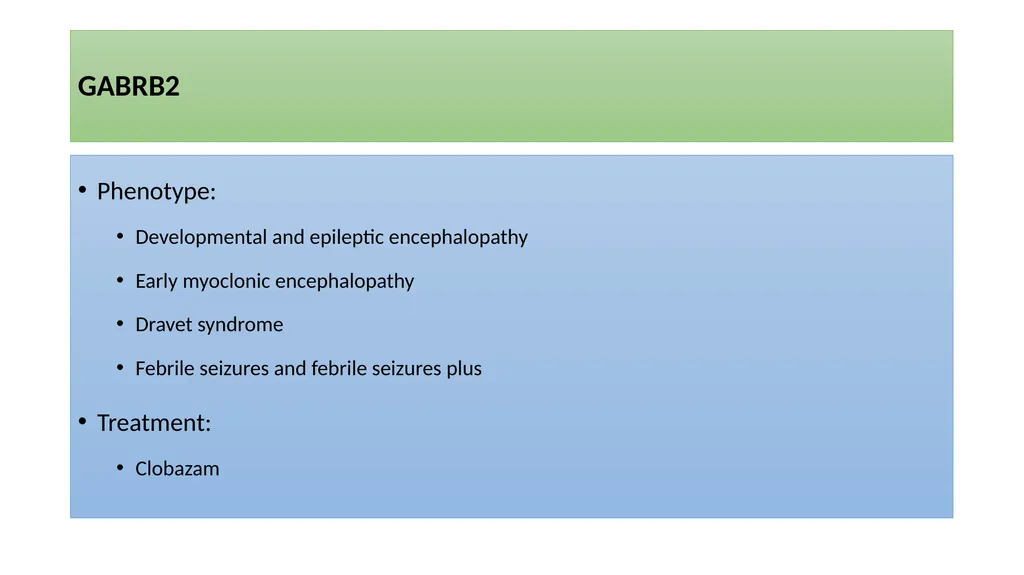
GABRB2 Phenotype:
Developmental and epileptic encephalopathy
Early myoclonic encephalopathy
Dravet syndrome
Febrile seizures and febrile seizures plus
Treatment:
Clobazam<br>
Developmental and epileptic encephalopathy
Early myoclonic encephalopathy
Dravet syndrome
Febrile seizures and febrile seizures plus
Treatment:
Clobazam<br>
34
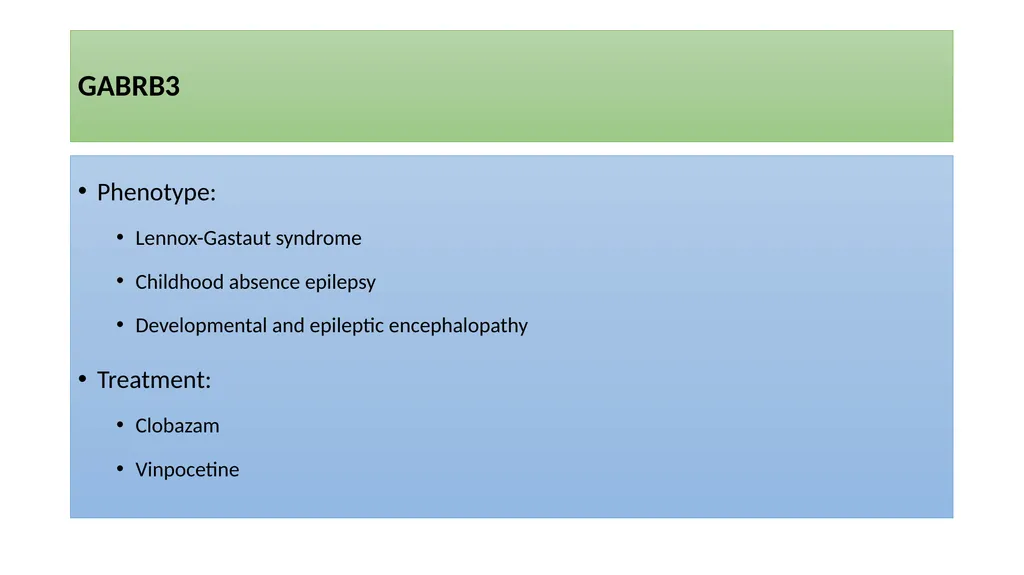
GABRB3 Phenotype:
Lennox-Gastaut syndrome
Childhood absence epilepsy
Developmental and epileptic encephalopathy
Treatment:
Clobazam
Vinpocetine<br>
Lennox-Gastaut syndrome
Childhood absence epilepsy
Developmental and epileptic encephalopathy
Treatment:
Clobazam
Vinpocetine<br>
35
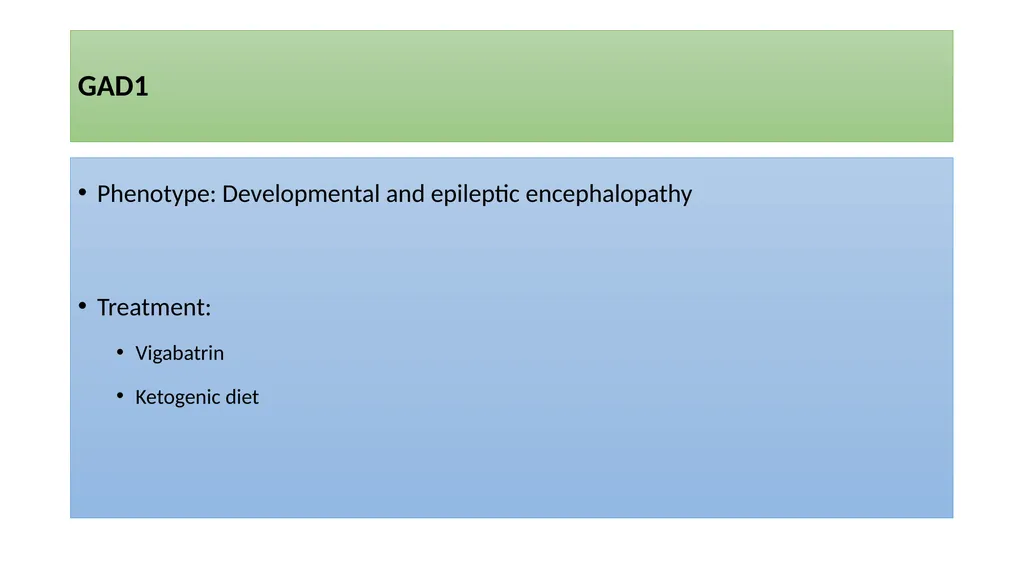
GAD1 Phenotype: Developmental and epileptic encephalopathy
Treatment:
Vigabatrin
Ketogenic diet<br>
Treatment:
Vigabatrin
Ketogenic diet<br>
36
GAMT Phenotype: Cerebral creatine deficiency syndrome
Treatment: Creatine<br>
Treatment: Creatine<br>
37
GLDC Phenotype: Glycine encephalopathy
Treatment:
Sodium benzoate
NMDA receptor site antagonists (ketamine, dextromethorphan, memantine, and amantadine)<br>
Treatment:
Sodium benzoate
NMDA receptor site antagonists (ketamine, dextromethorphan, memantine, and amantadine)<br>
38
GNAO1 Phenotype:
Ohtahara syndrome
Early-onset epileptic encephalopathy
Developmental and epileptic encephalopathy
Treatment: Ketogenic diet<br>
Ohtahara syndrome
Early-onset epileptic encephalopathy
Developmental and epileptic encephalopathy
Treatment: Ketogenic diet<br>
39
GOT2 Phenotype: Developmental and epileptic encephalopathy
Treatment: Avoid valproate<br>
Treatment: Avoid valproate<br>
40
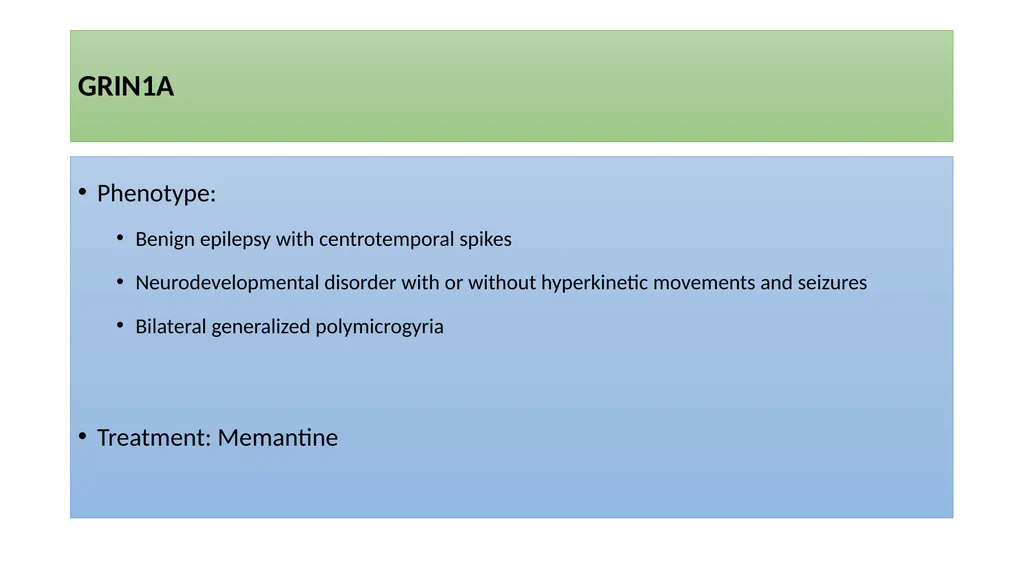
GRIN1A Phenotype:
Benign epilepsy with centrotemporal spikes
Neurodevelopmental disorder with or without hyperkinetic movements and seizures
Bilateral generalized polymicrogyria
Treatment: Memantine<br>
Benign epilepsy with centrotemporal spikes
Neurodevelopmental disorder with or without hyperkinetic movements and seizures
Bilateral generalized polymicrogyria
Treatment: Memantine<br>
41
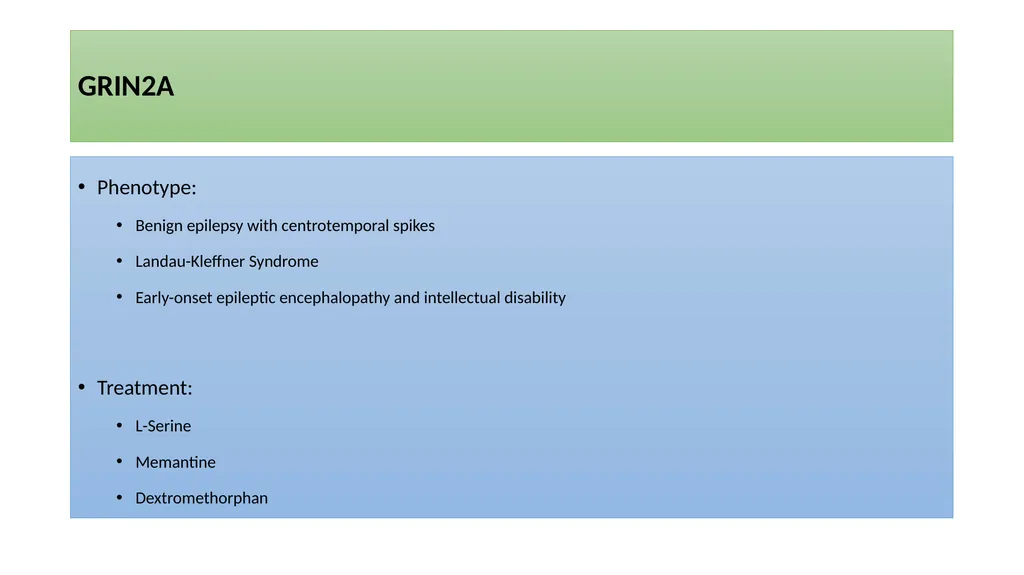
GRIN2A Phenotype:
Benign epilepsy with centrotemporal spikes
Landau-Kleffner Syndrome
Early-onset epileptic encephalopathy and intellectual disability
Treatment:
L-Serine
Memantine
Dextromethorphan<br>
Benign epilepsy with centrotemporal spikes
Landau-Kleffner Syndrome
Early-onset epileptic encephalopathy and intellectual disability
Treatment:
L-Serine
Memantine
Dextromethorphan<br>
42
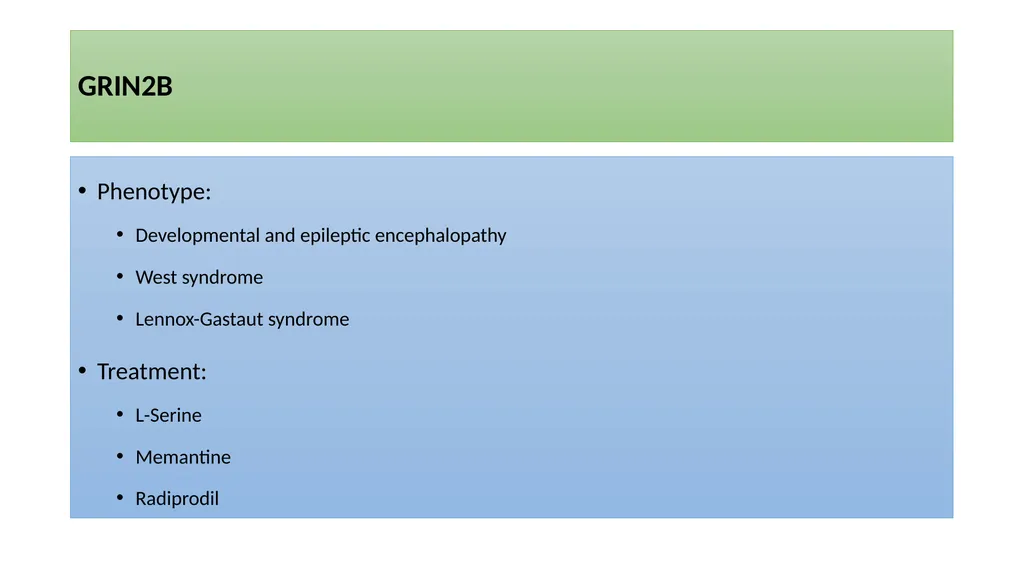
GRIN2B Phenotype:
Developmental and epileptic encephalopathy
West syndrome
Lennox-Gastaut syndrome
Treatment:
L-Serine
Memantine
Radiprodil<br>
Developmental and epileptic encephalopathy
West syndrome
Lennox-Gastaut syndrome
Treatment:
L-Serine
Memantine
Radiprodil<br>
43
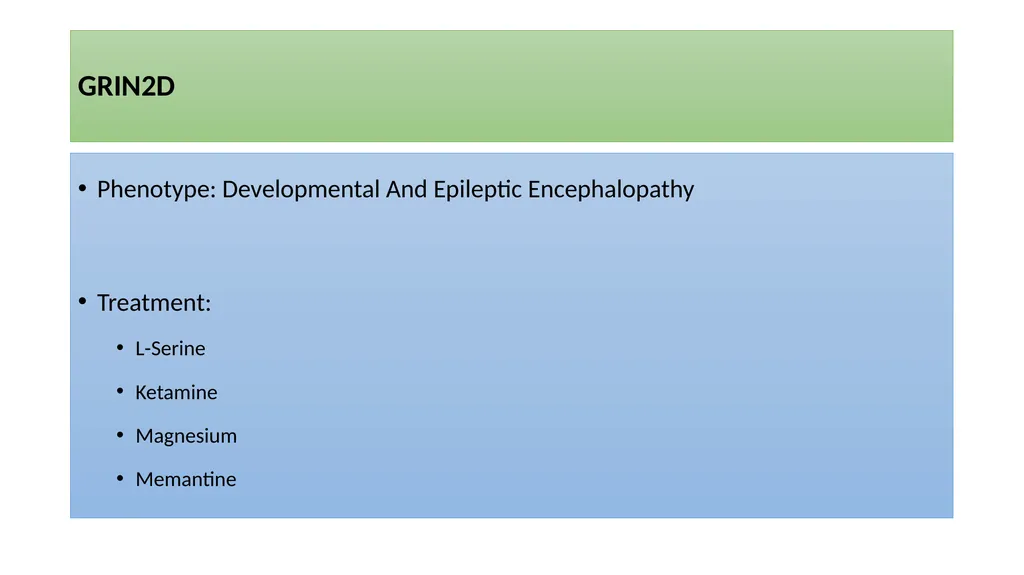
GRIN2D Phenotype: Developmental And Epileptic Encephalopathy
Treatment:
L-Serine
Ketamine
Magnesium
Memantine<br>
Treatment:
L-Serine
Ketamine
Magnesium
Memantine<br>
44
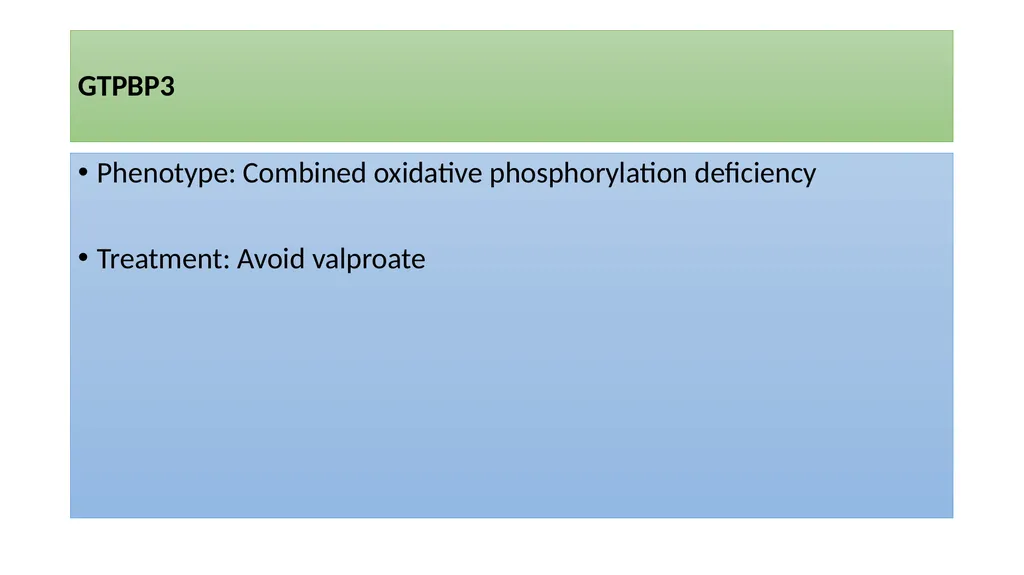
GTPBP3 Phenotype: Combined oxidative phosphorylation deficiency
Treatment: Avoid valproate<br>
Treatment: Avoid valproate<br>
45
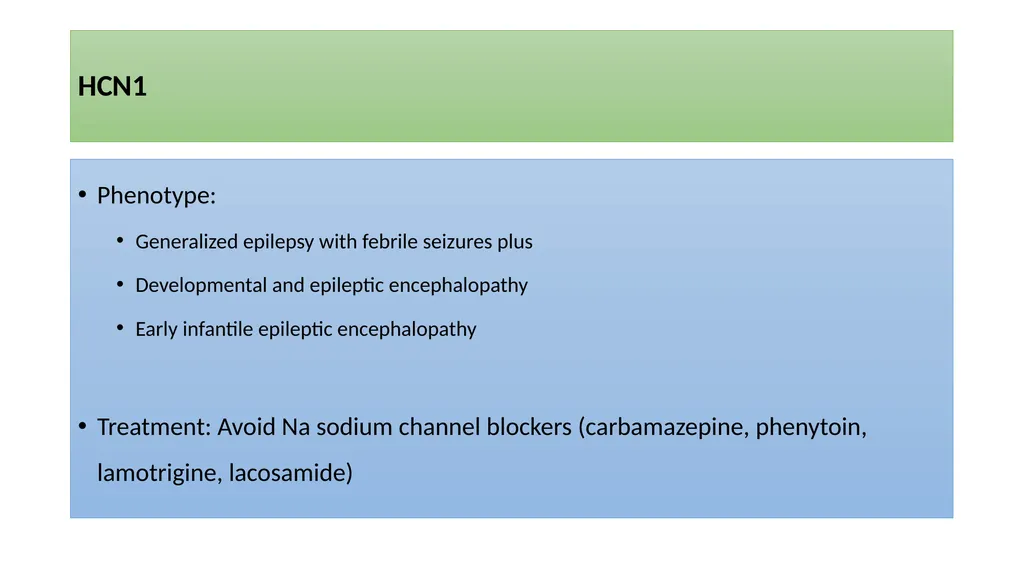
HCN1 Phenotype:
Generalized epilepsy with febrile seizures plus
Developmental and epileptic encephalopathy
Early infantile epileptic encephalopathy
Treatment: Avoid Na sodium channel blockers (carbamazepine, phenytoin, lamotrigine, lacosamide)<br>
Generalized epilepsy with febrile seizures plus
Developmental and epileptic encephalopathy
Early infantile epileptic encephalopathy
Treatment: Avoid Na sodium channel blockers (carbamazepine, phenytoin, lamotrigine, lacosamide)<br>
46
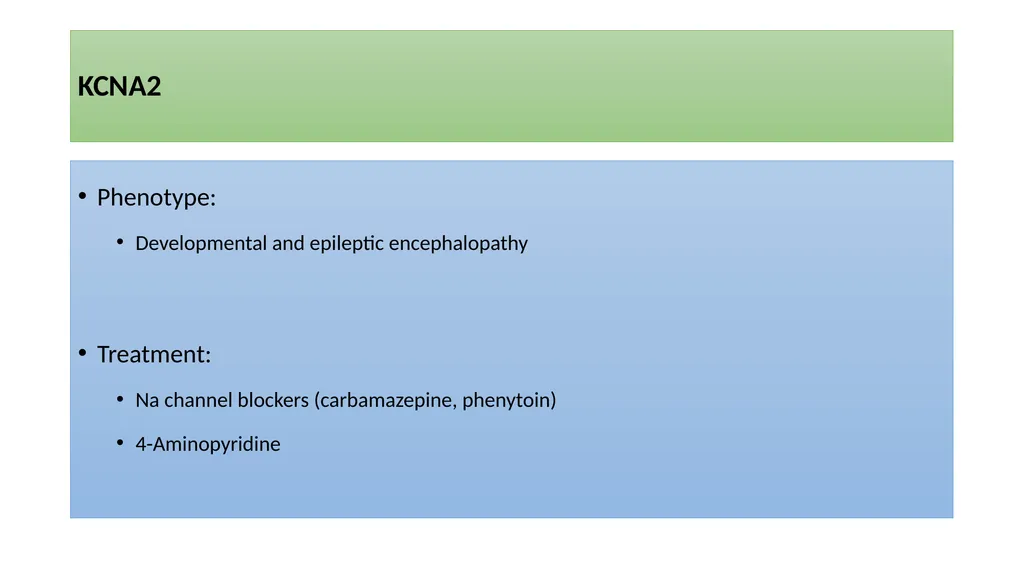
KCNA2 Phenotype:
Developmental and epileptic encephalopathy
Treatment:
Na channel blockers (carbamazepine, phenytoin)
4-Aminopyridine<br>
Developmental and epileptic encephalopathy
Treatment:
Na channel blockers (carbamazepine, phenytoin)
4-Aminopyridine<br>
47
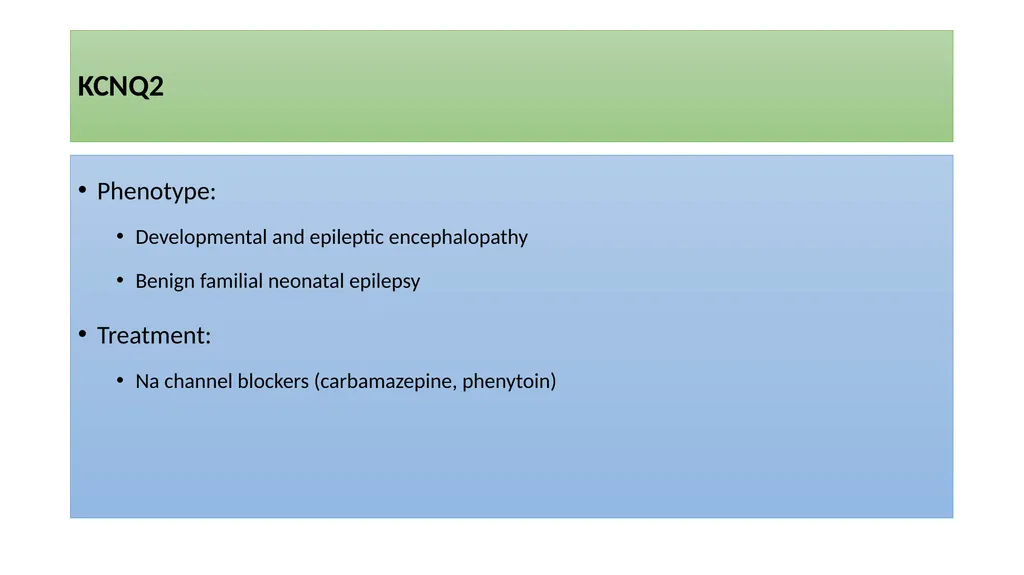
KCNQ2 Phenotype:
Developmental and epileptic encephalopathy
Benign familial neonatal epilepsy
Treatment:
Na channel blockers (carbamazepine, phenytoin)<br>
Developmental and epileptic encephalopathy
Benign familial neonatal epilepsy
Treatment:
Na channel blockers (carbamazepine, phenytoin)<br>
48
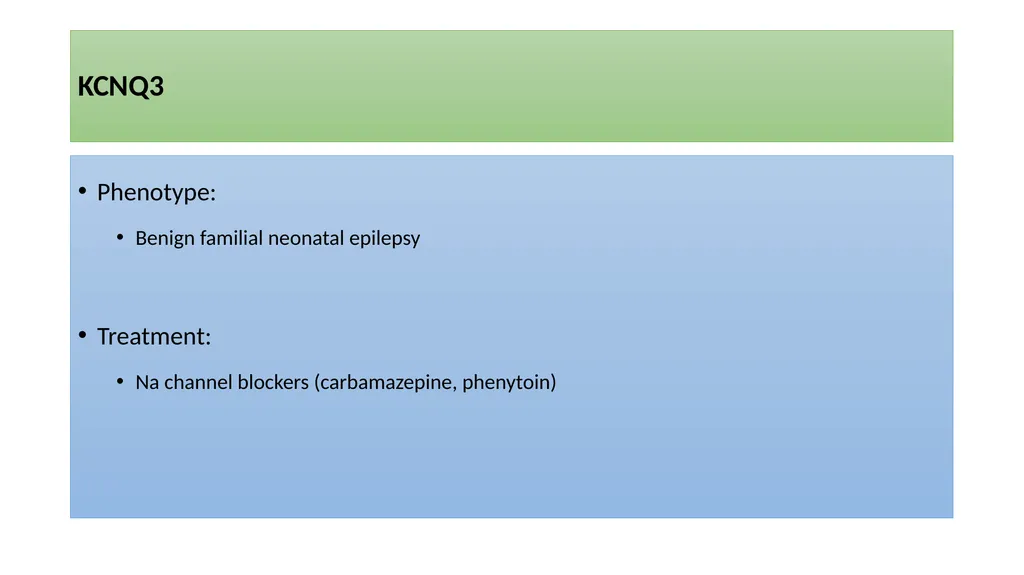
KCNQ3 Phenotype:
Benign familial neonatal epilepsy
Treatment:
Na channel blockers (carbamazepine, phenytoin)<br>
Benign familial neonatal epilepsy
Treatment:
Na channel blockers (carbamazepine, phenytoin)<br>
49
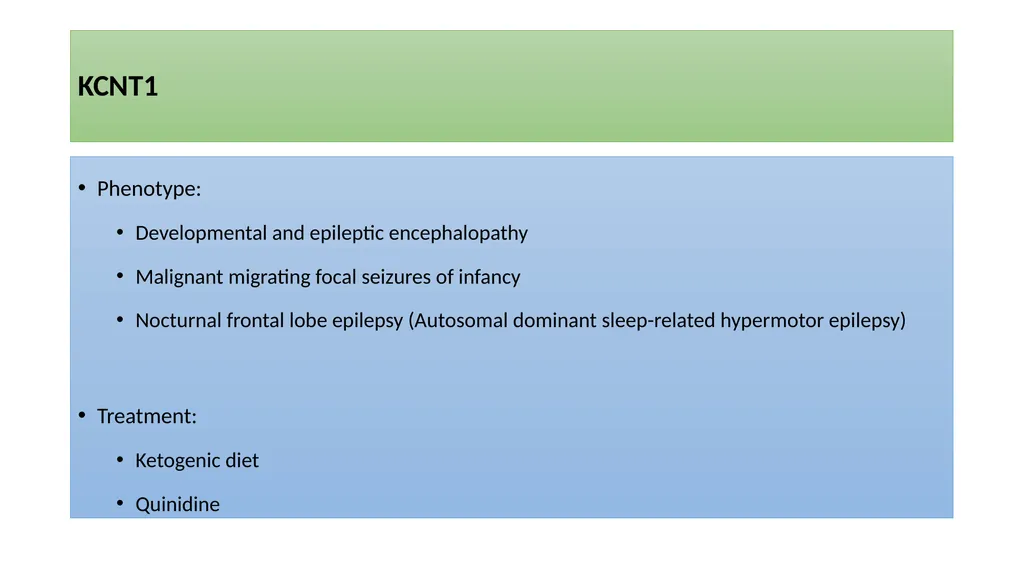
KCNT1 Phenotype:
Developmental and epileptic encephalopathy
Malignant migrating focal seizures of infancy
Nocturnal frontal lobe epilepsy (Autosomal dominant sleep-related hypermotor epilepsy)
Treatment:
Ketogenic diet
Quinidine<br>
Developmental and epileptic encephalopathy
Malignant migrating focal seizures of infancy
Nocturnal frontal lobe epilepsy (Autosomal dominant sleep-related hypermotor epilepsy)
Treatment:
Ketogenic diet
Quinidine<br>
50
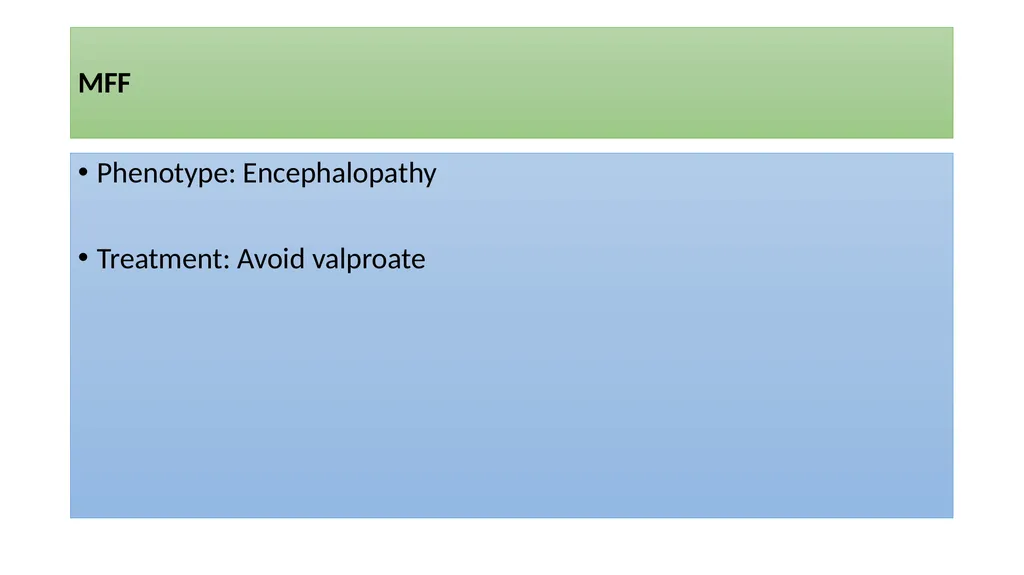
MFF Phenotype: Encephalopathy
Treatment: Avoid valproate<br>
Treatment: Avoid valproate<br>
51
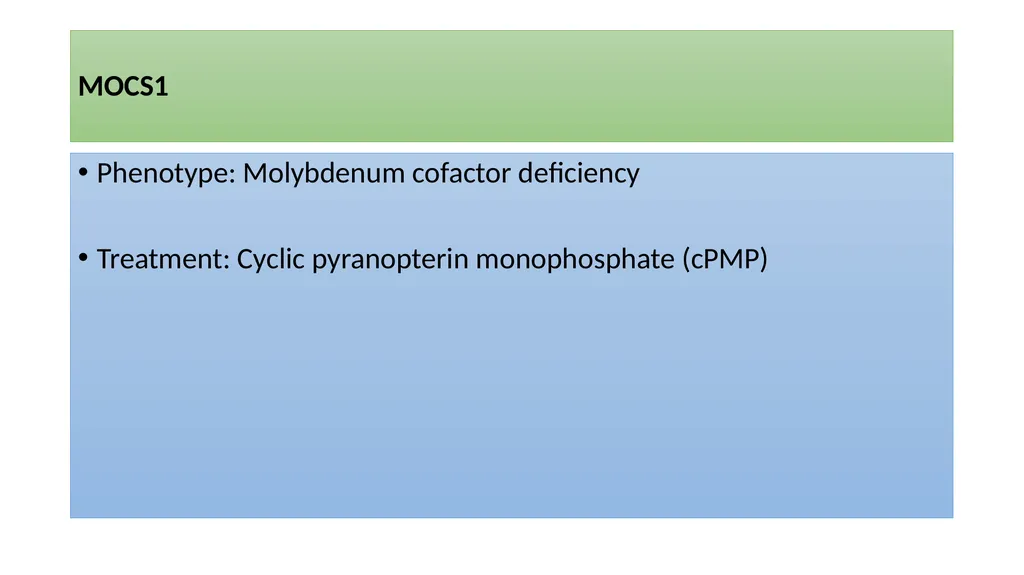
MOCS1 Phenotype: Molybdenum cofactor deficiency
Treatment: Cyclic pyranopterin monophosphate (cPMP)<br>
Treatment: Cyclic pyranopterin monophosphate (cPMP)<br>
52
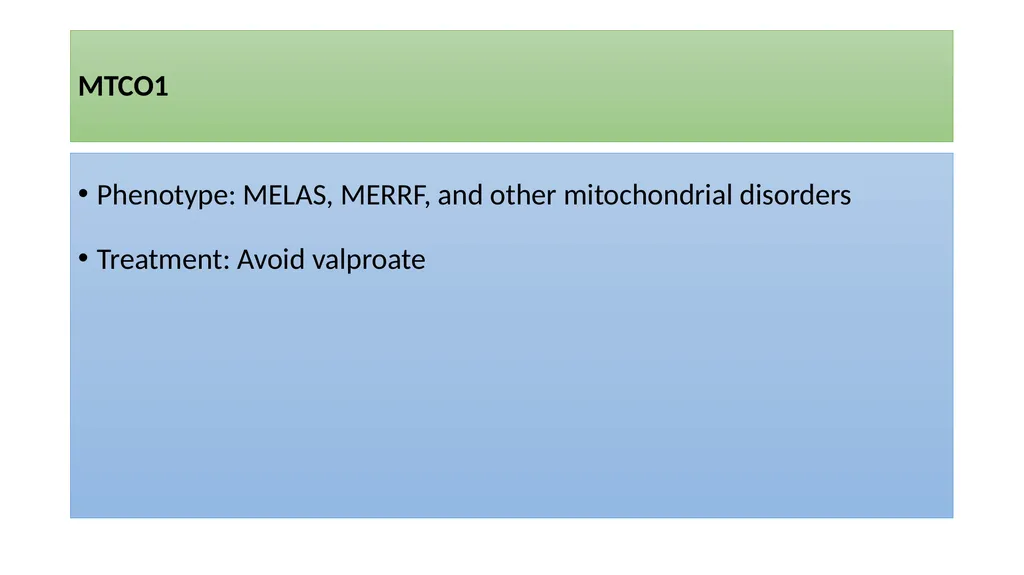
MTCO1 Phenotype: MELAS, MERRF, and other mitochondrial disorders
Treatment: Avoid valproate<br>
Treatment: Avoid valproate<br>
53
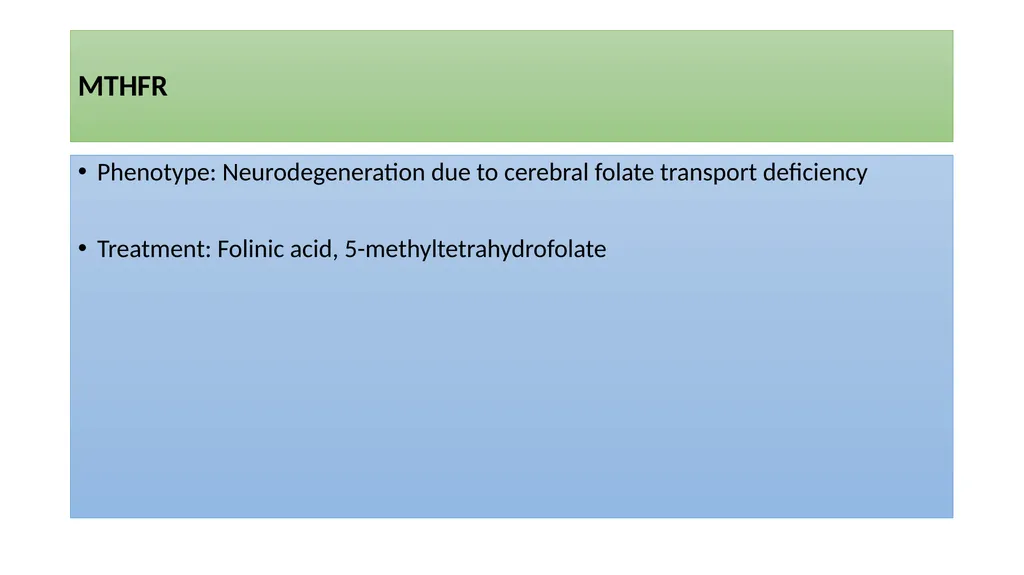
MTHFR Phenotype: Neurodegeneration due to cerebral folate transport deficiency
Treatment: Folinic acid, 5-methyltetrahydrofolate<br>
Treatment: Folinic acid, 5-methyltetrahydrofolate<br>
54
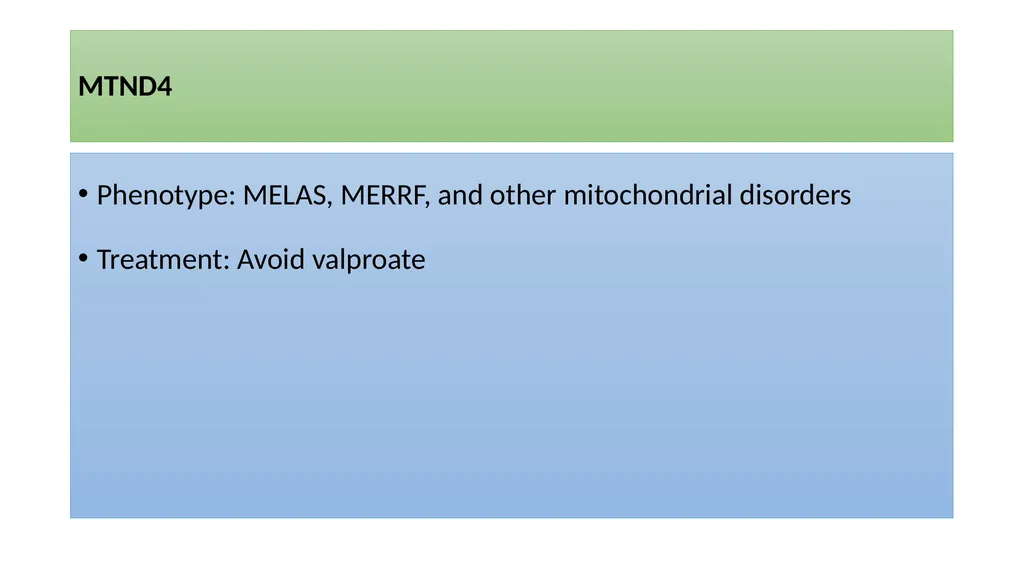
MTND4 Phenotype: MELAS, MERRF, and other mitochondrial disorders
Treatment: Avoid valproate<br>
Treatment: Avoid valproate<br>
55
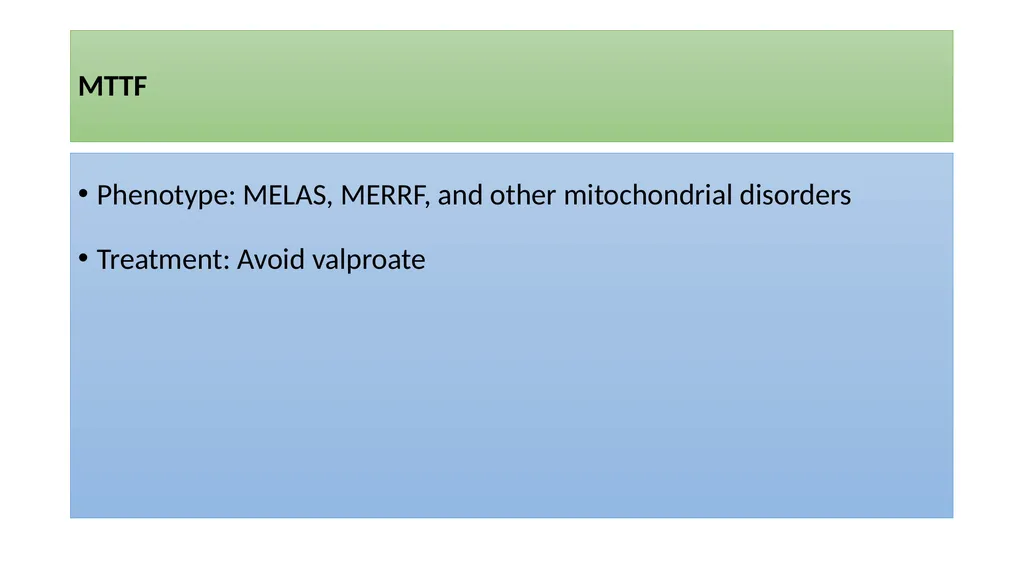
MTTF Phenotype: MELAS, MERRF, and other mitochondrial disorders
Treatment: Avoid valproate<br>
Treatment: Avoid valproate<br>
56
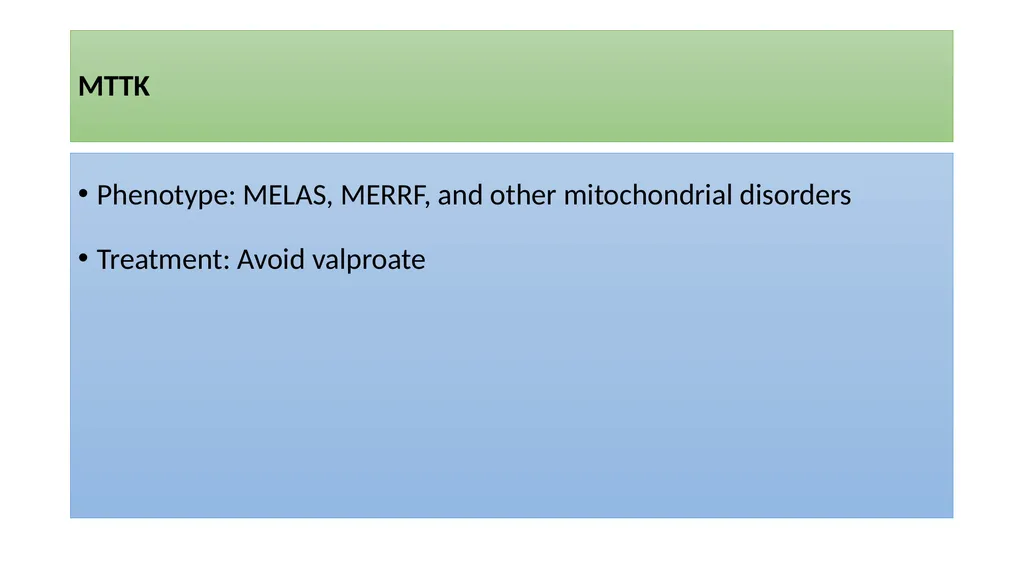
MTTK Phenotype: MELAS, MERRF, and other mitochondrial disorders
Treatment: Avoid valproate<br>
Treatment: Avoid valproate<br>
57
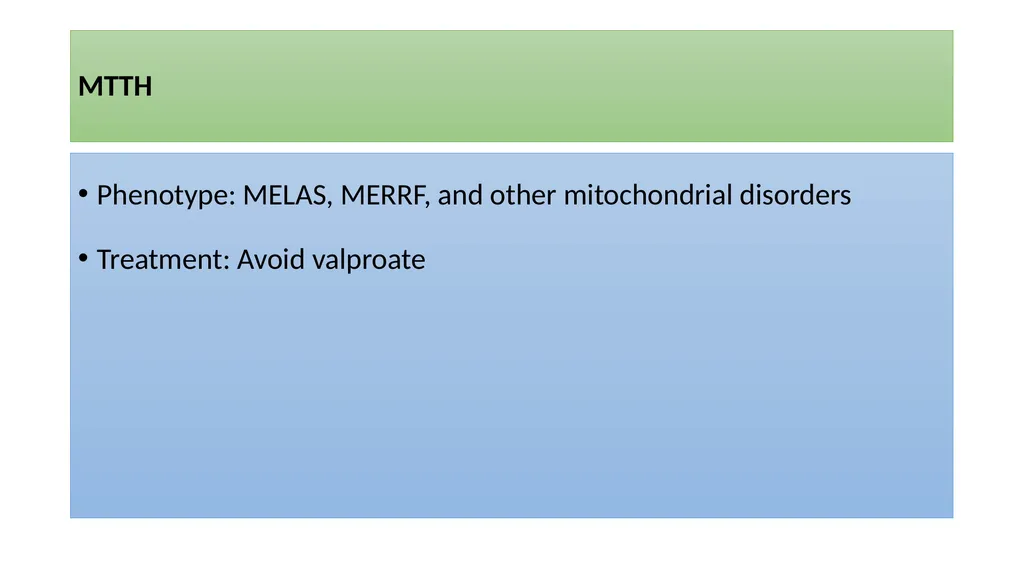
MTTH Phenotype: MELAS, MERRF, and other mitochondrial disorders
Treatment: Avoid valproate<br>
Treatment: Avoid valproate<br>
58
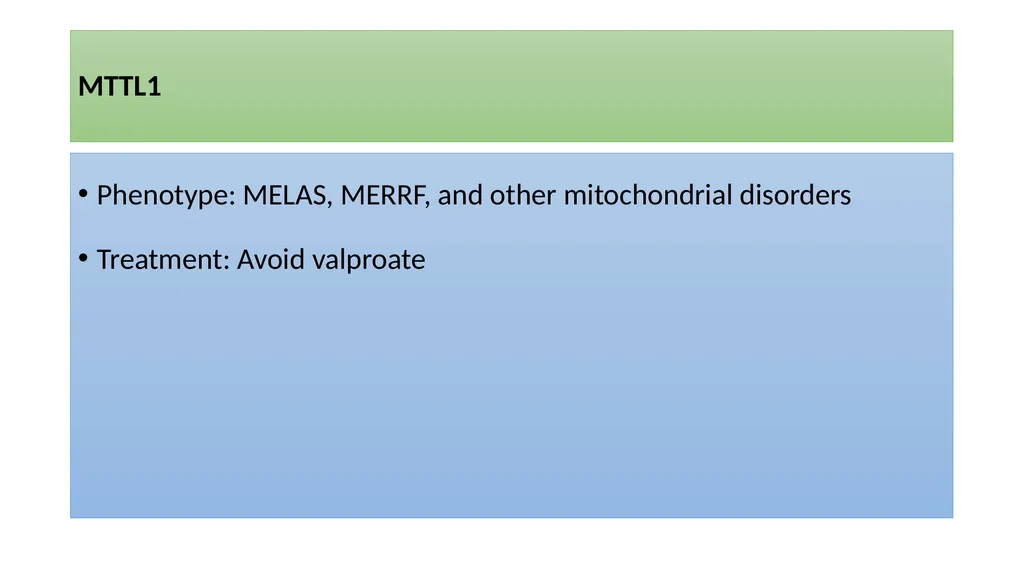
MTTL1 Phenotype: MELAS, MERRF, and other mitochondrial disorders
Treatment: Avoid valproate<br>
Treatment: Avoid valproate<br>
59
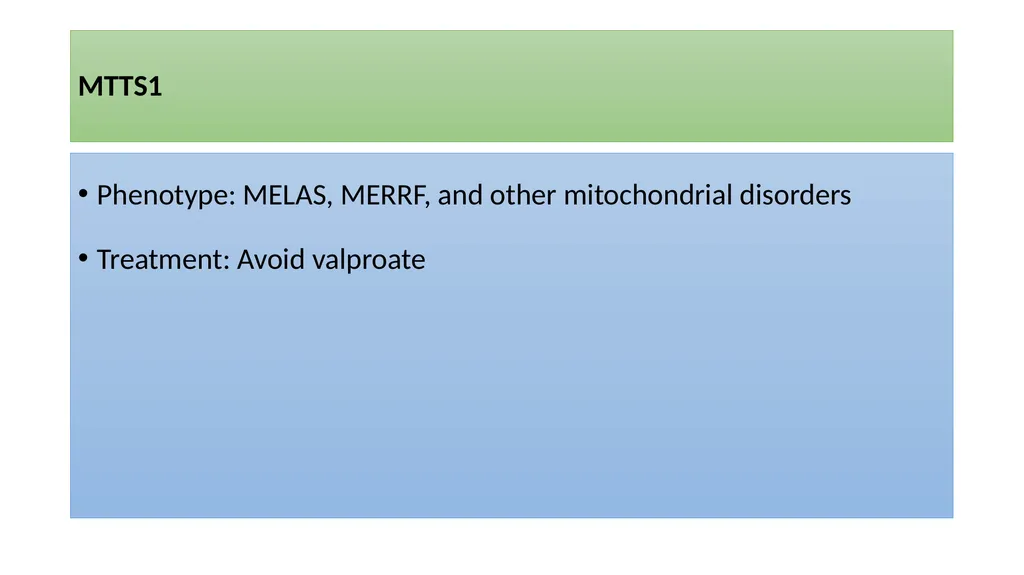
MTTS1 Phenotype: MELAS, MERRF, and other mitochondrial disorders
Treatment: Avoid valproate<br>
Treatment: Avoid valproate<br>
60
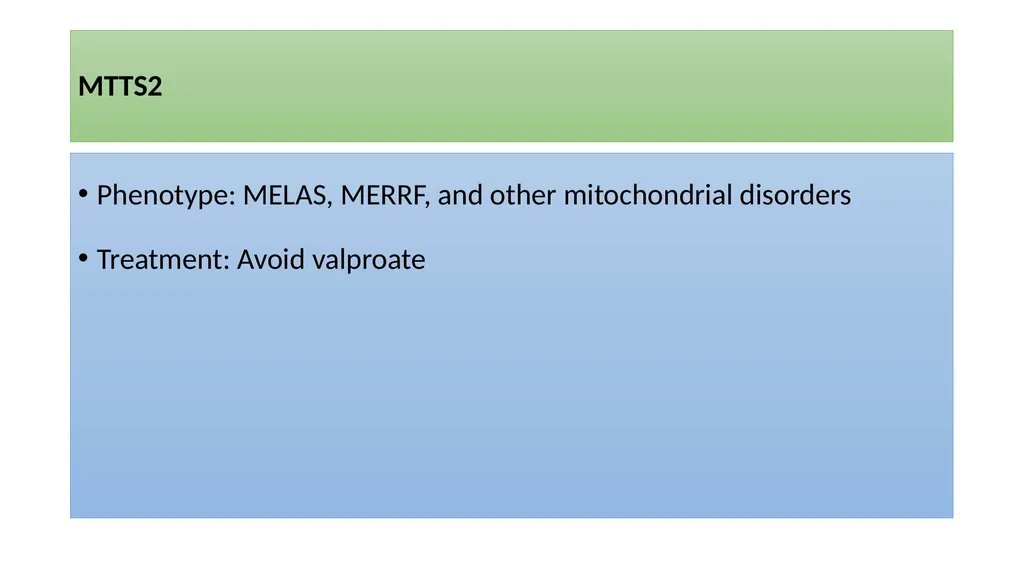
MTTS2 Phenotype: MELAS, MERRF, and other mitochondrial disorders
Treatment: Avoid valproate<br>
Treatment: Avoid valproate<br>
61
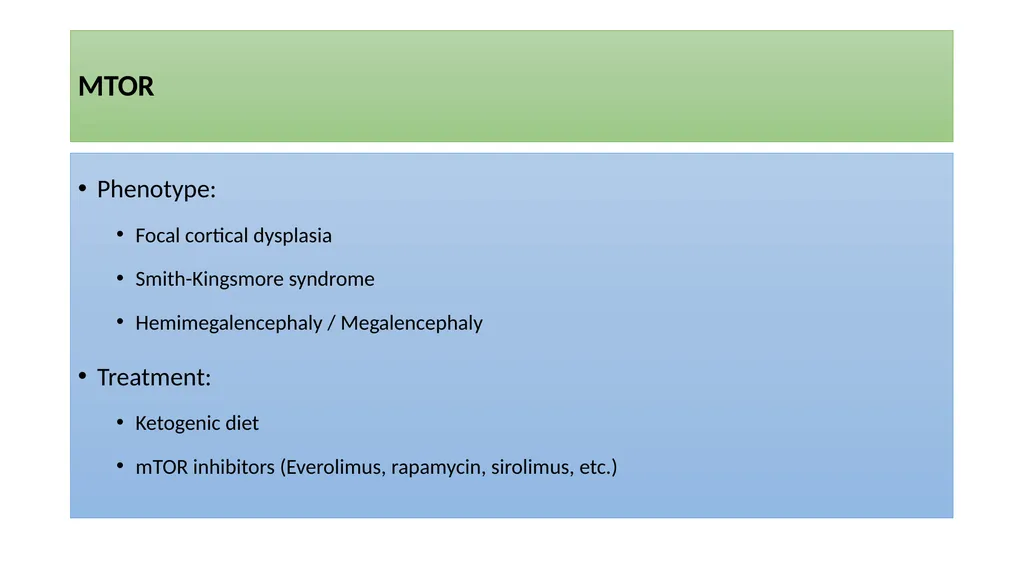
MTOR Phenotype:
Focal cortical dysplasia
Smith-Kingsmore syndrome
Hemimegalencephaly / Megalencephaly
Treatment:
Ketogenic diet
mTOR inhibitors (Everolimus, rapamycin, sirolimus, etc.)<br>
Focal cortical dysplasia
Smith-Kingsmore syndrome
Hemimegalencephaly / Megalencephaly
Treatment:
Ketogenic diet
mTOR inhibitors (Everolimus, rapamycin, sirolimus, etc.)<br>
62
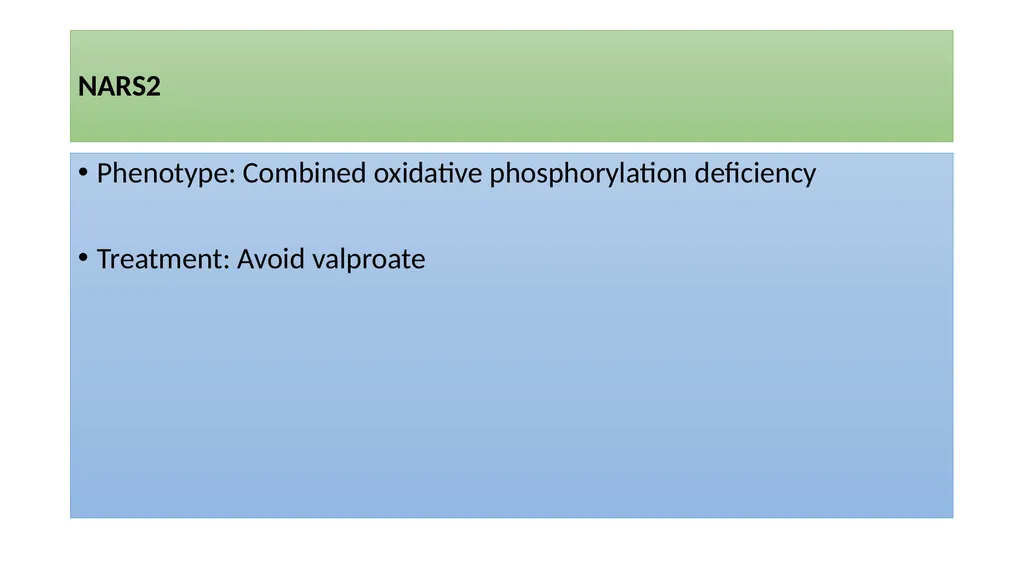
NARS2 Phenotype: Combined oxidative phosphorylation deficiency
Treatment: Avoid valproate<br>
Treatment: Avoid valproate<br>
63
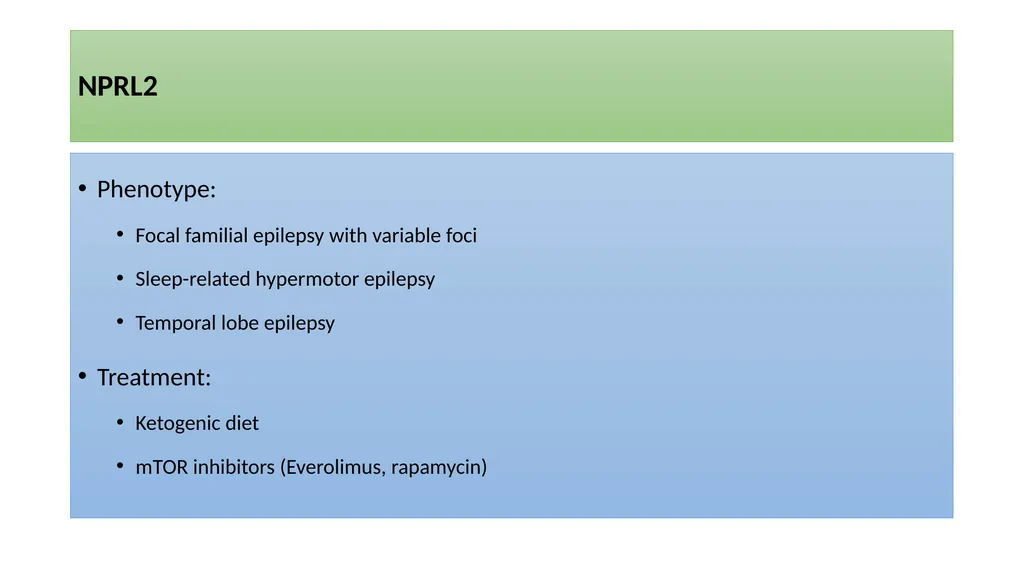
NPRL2 Phenotype:
Focal familial epilepsy with variable foci
Sleep-related hypermotor epilepsy
Temporal lobe epilepsy
Treatment:
Ketogenic diet
mTOR inhibitors (Everolimus, rapamycin)<br>
Focal familial epilepsy with variable foci
Sleep-related hypermotor epilepsy
Temporal lobe epilepsy
Treatment:
Ketogenic diet
mTOR inhibitors (Everolimus, rapamycin)<br>
64
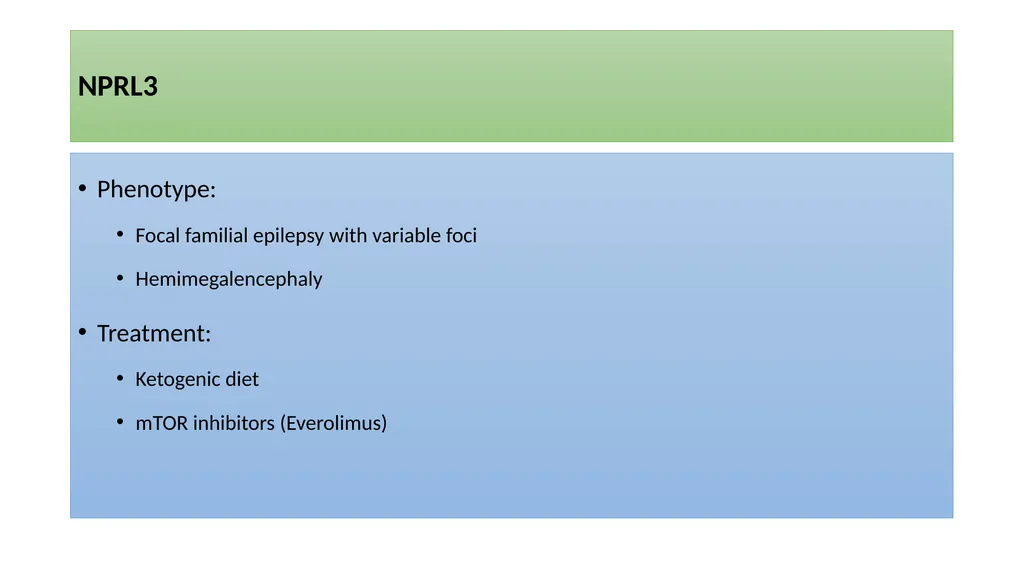
NPRL3 Phenotype:
Focal familial epilepsy with variable foci
Hemimegalencephaly
Treatment:
Ketogenic diet
mTOR inhibitors (Everolimus)<br>
Focal familial epilepsy with variable foci
Hemimegalencephaly
Treatment:
Ketogenic diet
mTOR inhibitors (Everolimus)<br>
65
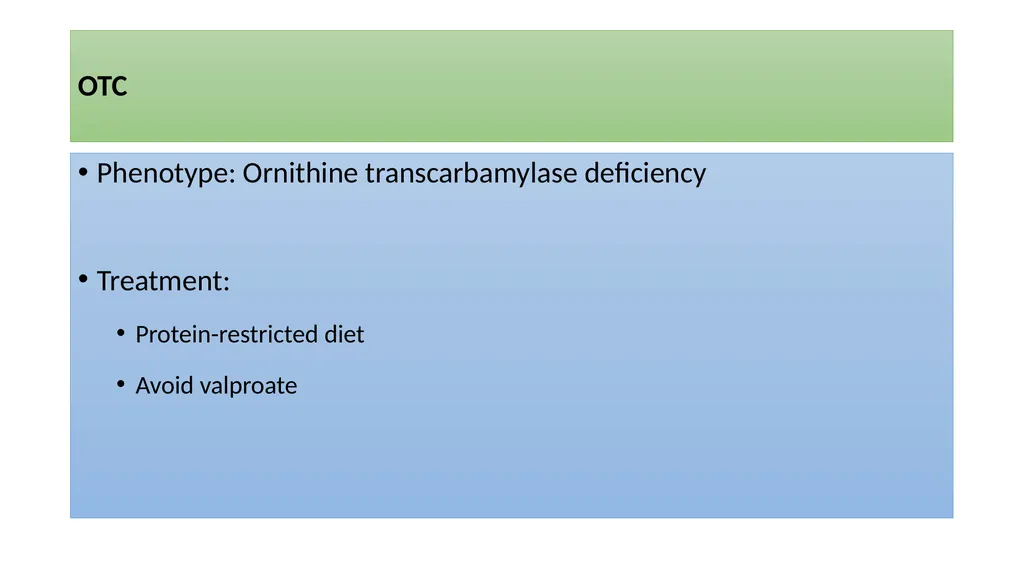
OTC Phenotype: Ornithine transcarbamylase deficiency
Treatment:
Protein-restricted diet
Avoid valproate<br>
Treatment:
Protein-restricted diet
Avoid valproate<br>
66
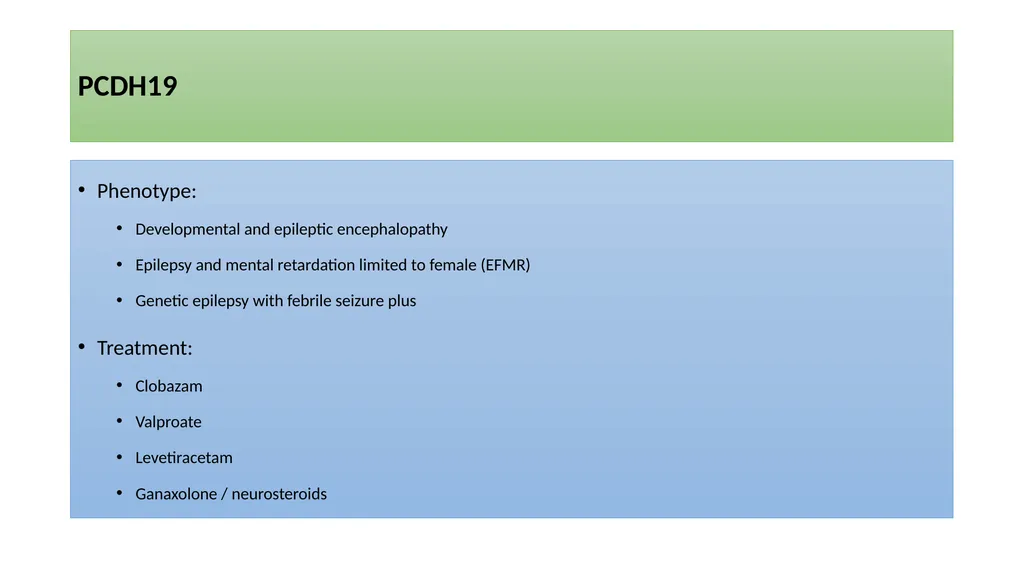
PCDH19 Phenotype:
Developmental and epileptic encephalopathy
Epilepsy and mental retardation limited to female (EFMR)
Genetic epilepsy with febrile seizure plus
Treatment:
Clobazam
Valproate
Levetiracetam
Ganaxolone / neurosteroids<br>
Developmental and epileptic encephalopathy
Epilepsy and mental retardation limited to female (EFMR)
Genetic epilepsy with febrile seizure plus
Treatment:
Clobazam
Valproate
Levetiracetam
Ganaxolone / neurosteroids<br>
67
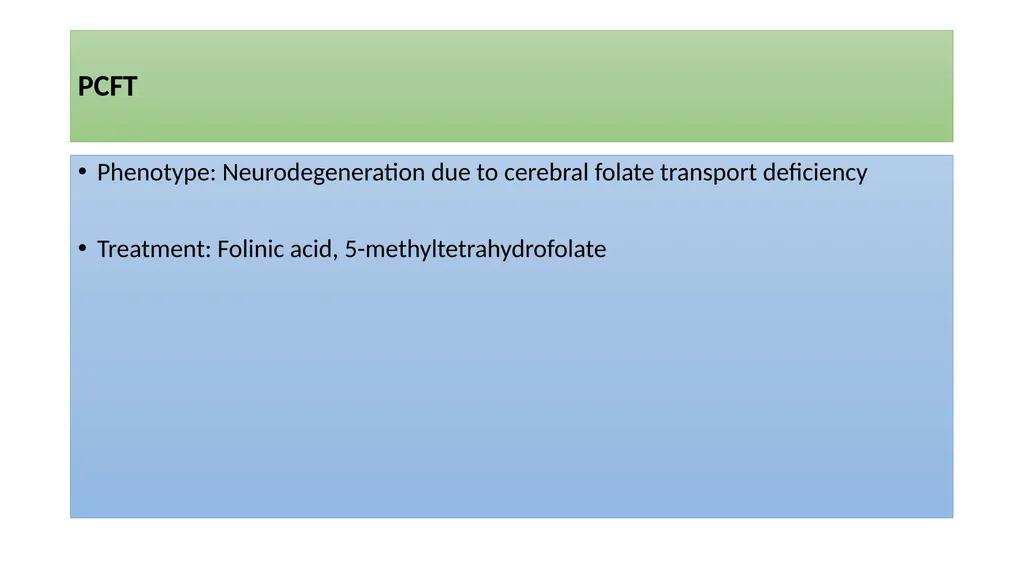
PCFT Phenotype: Neurodegeneration due to cerebral folate transport deficiency
Treatment: Folinic acid, 5-methyltetrahydrofolate<br>
Treatment: Folinic acid, 5-methyltetrahydrofolate<br>
68
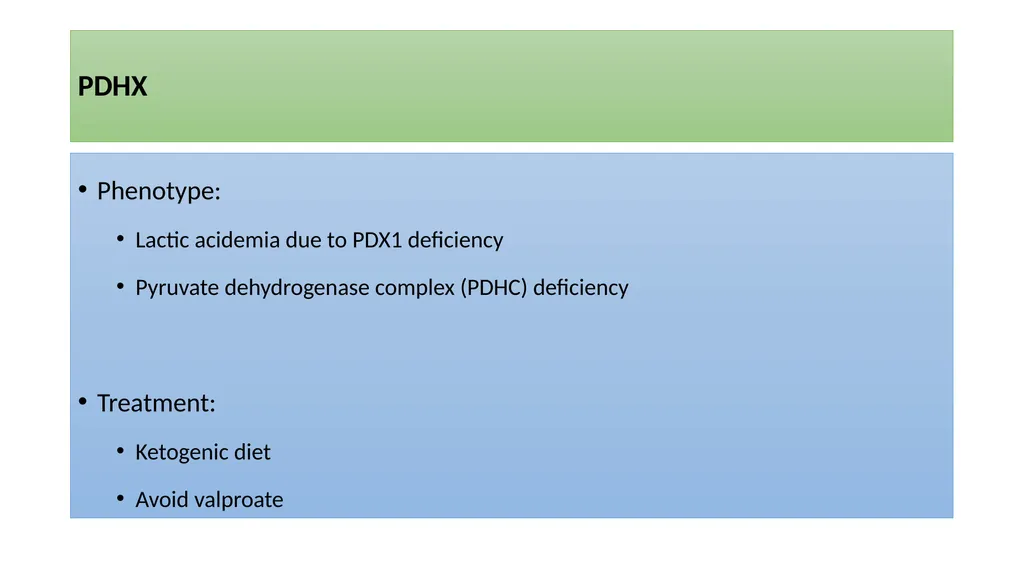
PDHX Phenotype:
Lactic acidemia due to PDX1 deficiency
Pyruvate dehydrogenase complex (PDHC) deficiency
Treatment:
Ketogenic diet
Avoid valproate<br>
Lactic acidemia due to PDX1 deficiency
Pyruvate dehydrogenase complex (PDHC) deficiency
Treatment:
Ketogenic diet
Avoid valproate<br>
69
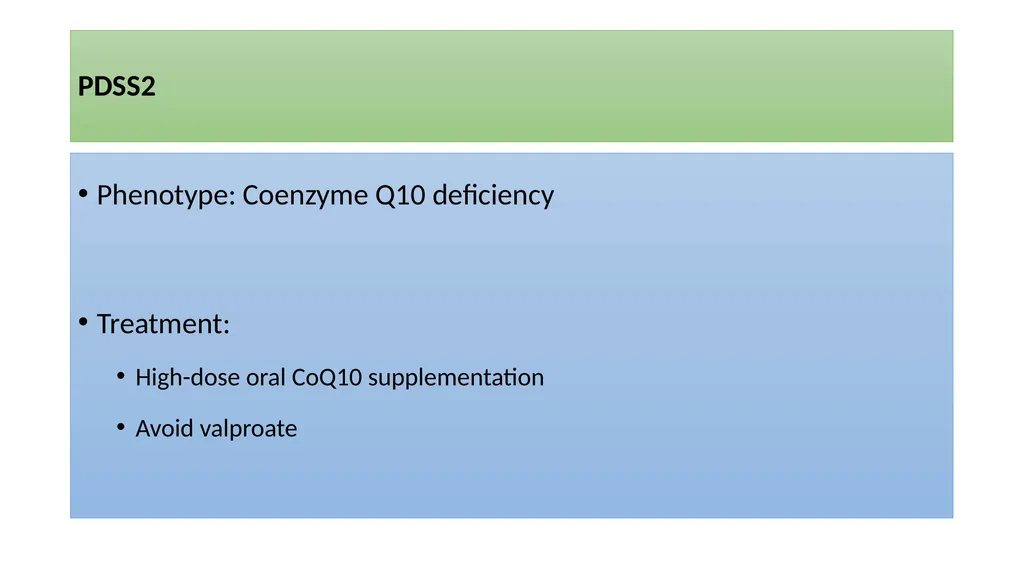
PDSS2 Phenotype: Coenzyme Q10 deficiency
Treatment:
High-dose oral CoQ10 supplementation
Avoid valproate<br>
Treatment:
High-dose oral CoQ10 supplementation
Avoid valproate<br>
70
PHGDH Phenotype: Serine synthesis defect
Treatment: Oral L-serine<br>
Treatment: Oral L-serine<br>
71
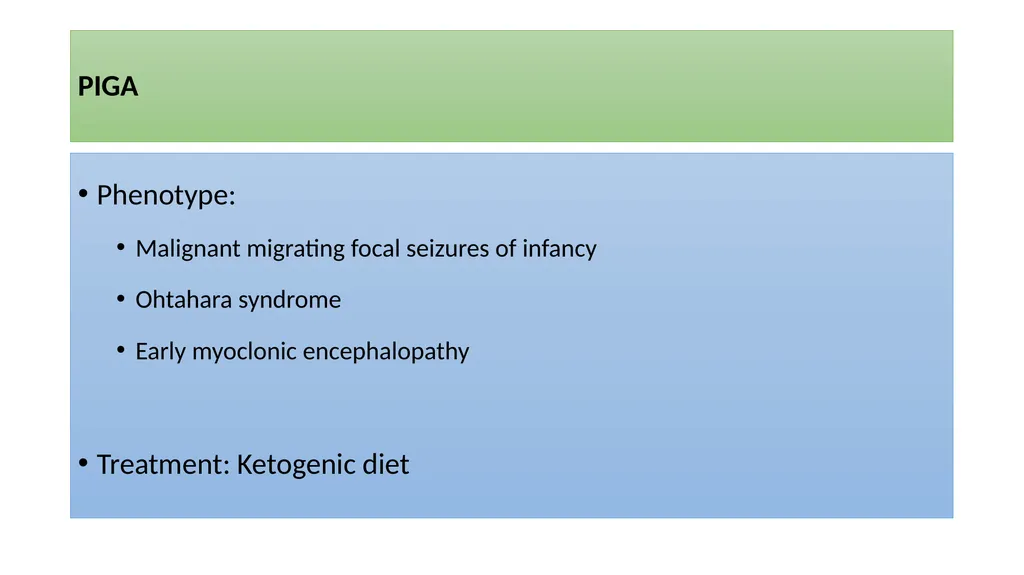
PIGA Phenotype:
Malignant migrating focal seizures of infancy
Ohtahara syndrome
Early myoclonic encephalopathy
Treatment: Ketogenic diet<br>
Malignant migrating focal seizures of infancy
Ohtahara syndrome
Early myoclonic encephalopathy
Treatment: Ketogenic diet<br>
72
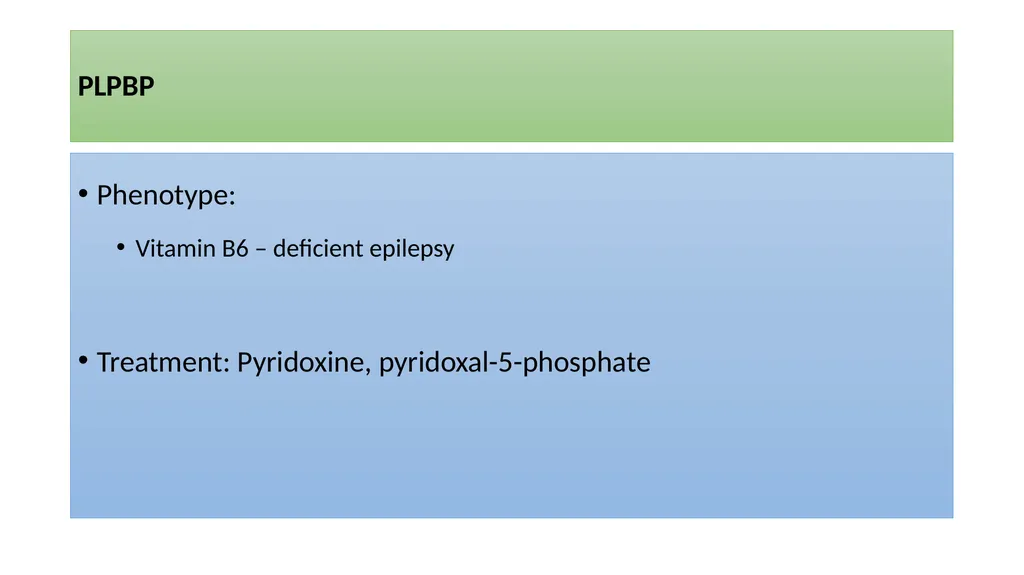
PLPBP Phenotype:
Vitamin B6 – deficient epilepsy
Treatment: Pyridoxine, pyridoxal-5-phosphate<br>
Vitamin B6 – deficient epilepsy
Treatment: Pyridoxine, pyridoxal-5-phosphate<br>
73
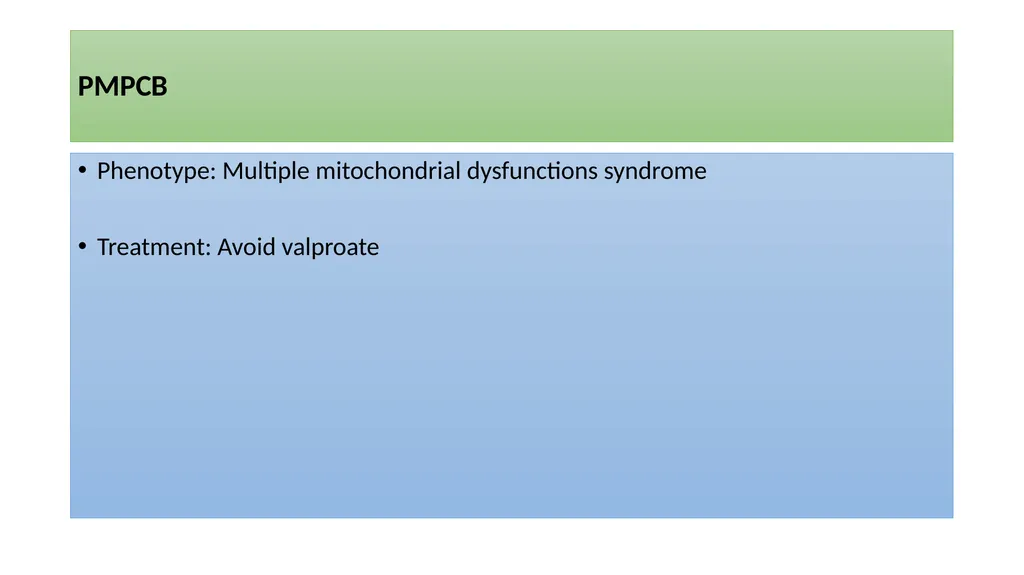
PMPCB Phenotype: Multiple mitochondrial dysfunctions syndrome
Treatment: Avoid valproate<br>
Treatment: Avoid valproate<br>
74
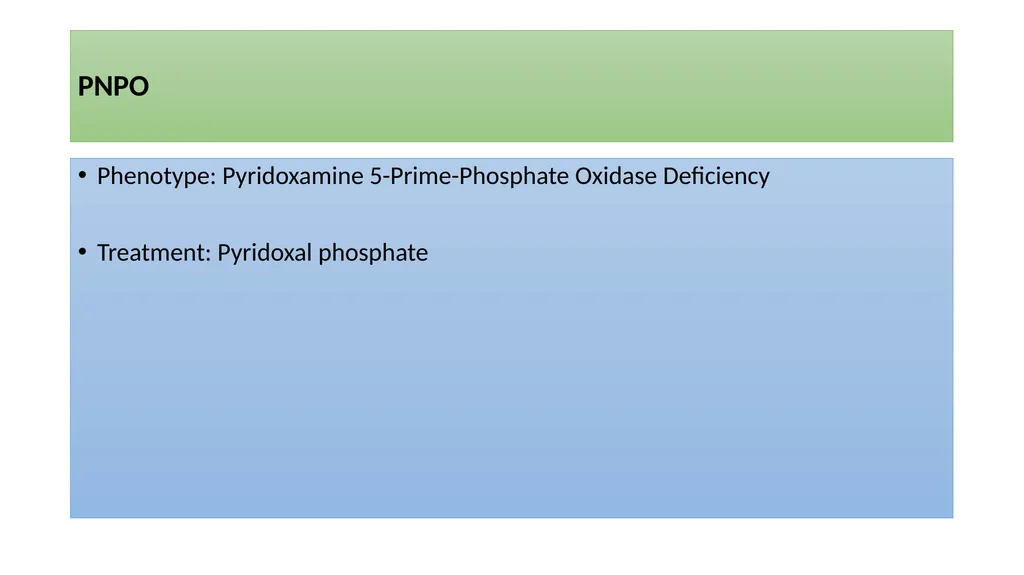
PNPO Phenotype: Pyridoxamine 5-Prime-Phosphate Oxidase Deficiency
Treatment: Pyridoxal phosphate<br>
Treatment: Pyridoxal phosphate<br>
75
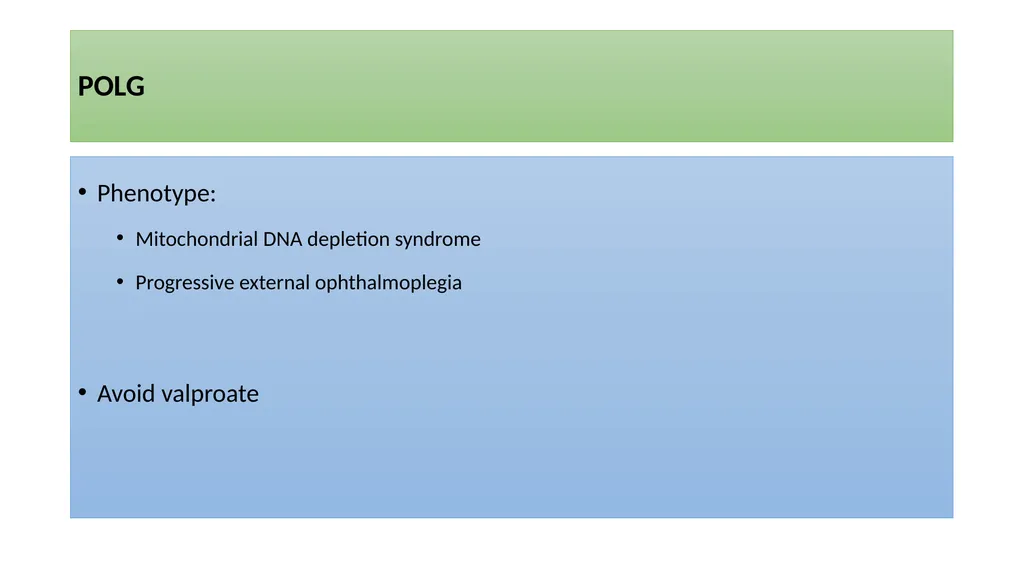
POLG Phenotype:
Mitochondrial DNA depletion syndrome
Progressive external ophthalmoplegia
Avoid valproate<br>
Mitochondrial DNA depletion syndrome
Progressive external ophthalmoplegia
Avoid valproate<br>
76
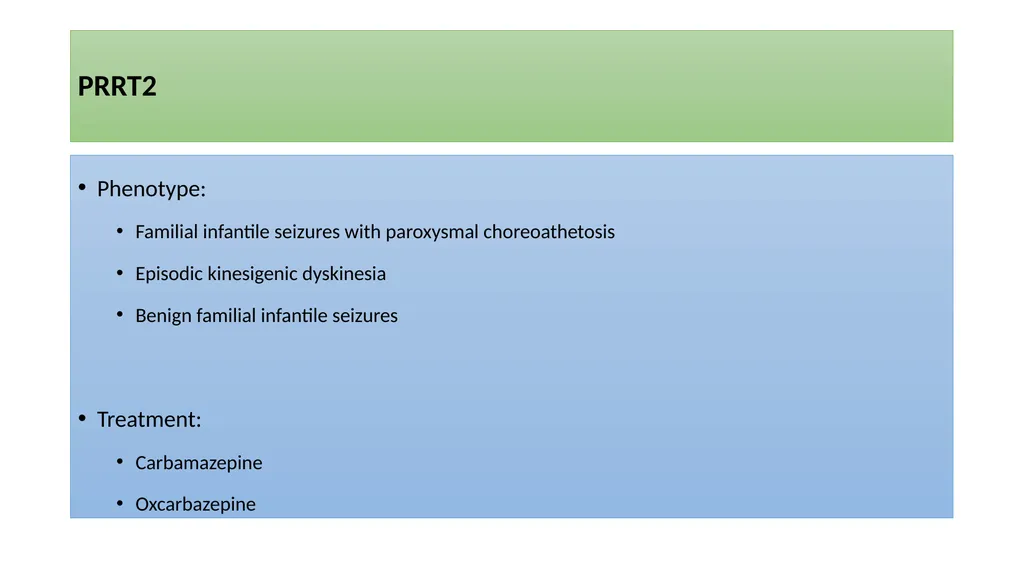
PRRT2 Phenotype:
Familial infantile seizures with paroxysmal choreoathetosis
Episodic kinesigenic dyskinesia
Benign familial infantile seizures
Treatment:
Carbamazepine
Oxcarbazepine<br>
Familial infantile seizures with paroxysmal choreoathetosis
Episodic kinesigenic dyskinesia
Benign familial infantile seizures
Treatment:
Carbamazepine
Oxcarbazepine<br>
77
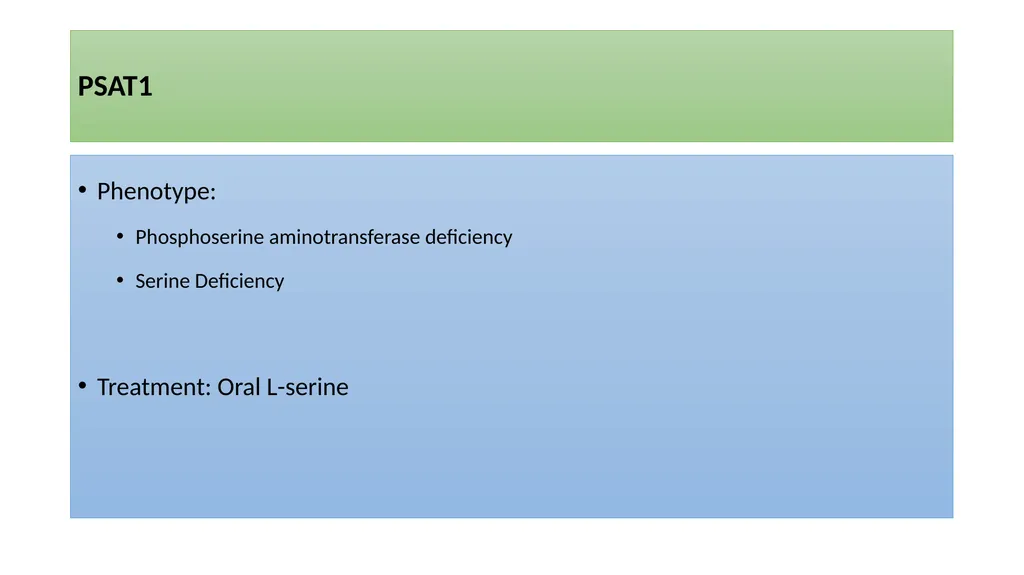
PSAT1 Phenotype:
Phosphoserine aminotransferase deficiency
Serine Deficiency
Treatment: Oral L-serine<br>
Phosphoserine aminotransferase deficiency
Serine Deficiency
Treatment: Oral L-serine<br>
78
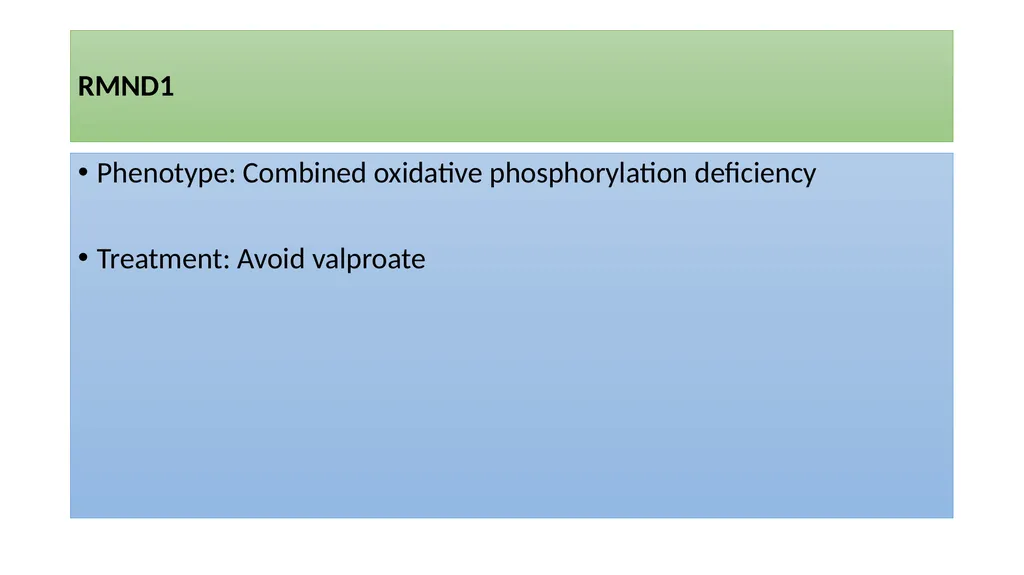
RMND1 Phenotype: Combined oxidative phosphorylation deficiency
Treatment: Avoid valproate<br>
Treatment: Avoid valproate<br>
79
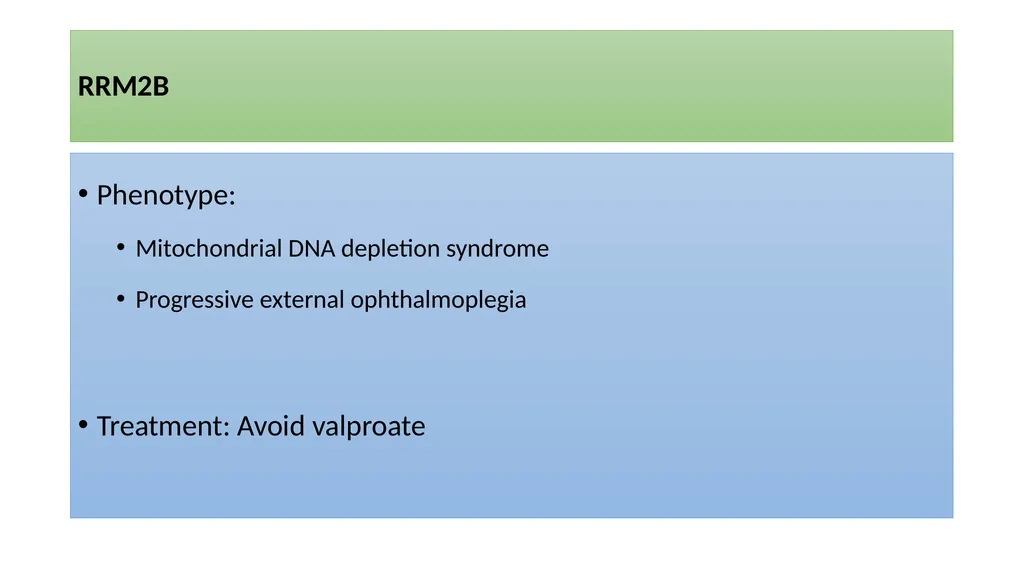
RRM2B Phenotype:
Mitochondrial DNA depletion syndrome
Progressive external ophthalmoplegia
Treatment: Avoid valproate<br>
Mitochondrial DNA depletion syndrome
Progressive external ophthalmoplegia
Treatment: Avoid valproate<br>
80
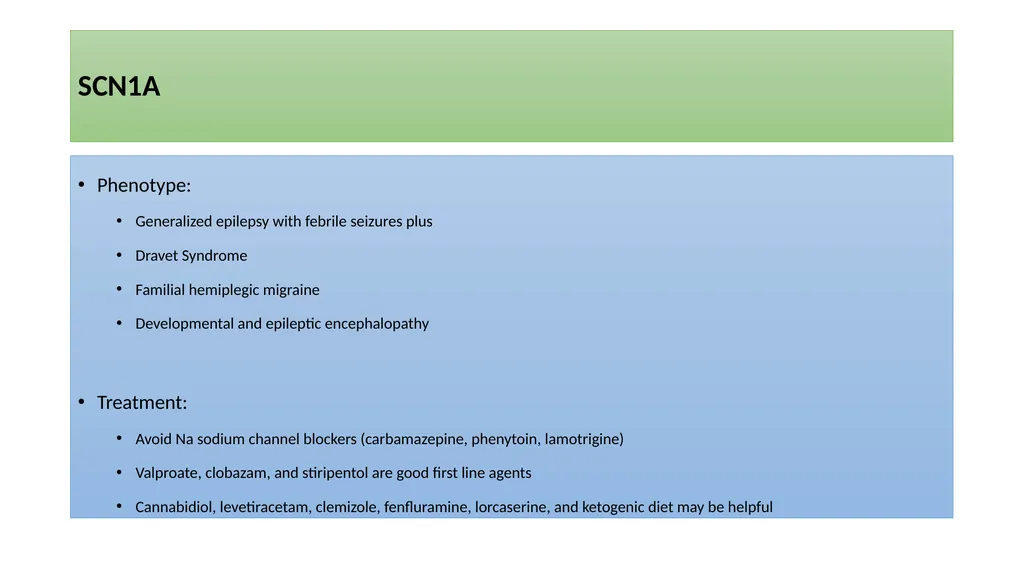
SCN1A Phenotype:
Generalized epilepsy with febrile seizures plus
Dravet Syndrome
Familial hemiplegic migraine
Developmental and epileptic encephalopathy
Treatment:
Avoid Na sodium channel blockers (carbamazepine, phenytoin, lamotrigine)
Valproate, clobazam, and stiripentol are good first line agents
Cannabidiol, levetiracetam, clemizole, fenfluramine, lorcaserine, and ketogenic diet may be helpful<br>
Generalized epilepsy with febrile seizures plus
Dravet Syndrome
Familial hemiplegic migraine
Developmental and epileptic encephalopathy
Treatment:
Avoid Na sodium channel blockers (carbamazepine, phenytoin, lamotrigine)
Valproate, clobazam, and stiripentol are good first line agents
Cannabidiol, levetiracetam, clemizole, fenfluramine, lorcaserine, and ketogenic diet may be helpful<br>
81
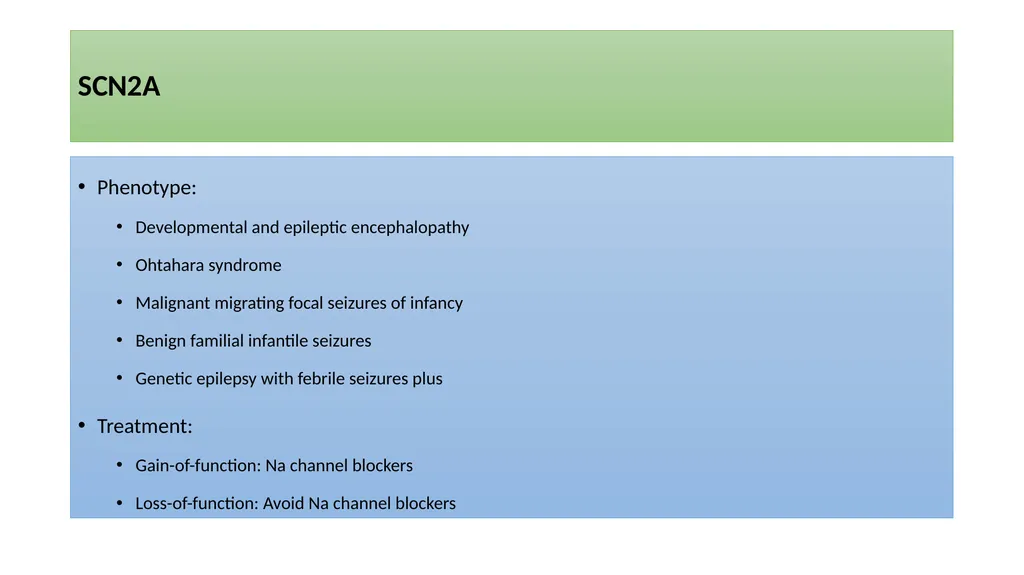
SCN2A Phenotype:
Developmental and epileptic encephalopathy
Ohtahara syndrome
Malignant migrating focal seizures of infancy
Benign familial infantile seizures
Genetic epilepsy with febrile seizures plus
Treatment:
Gain-of-function: Na channel blockers
Loss-of-function: Avoid Na channel blockers<br>
Developmental and epileptic encephalopathy
Ohtahara syndrome
Malignant migrating focal seizures of infancy
Benign familial infantile seizures
Genetic epilepsy with febrile seizures plus
Treatment:
Gain-of-function: Na channel blockers
Loss-of-function: Avoid Na channel blockers<br>
82
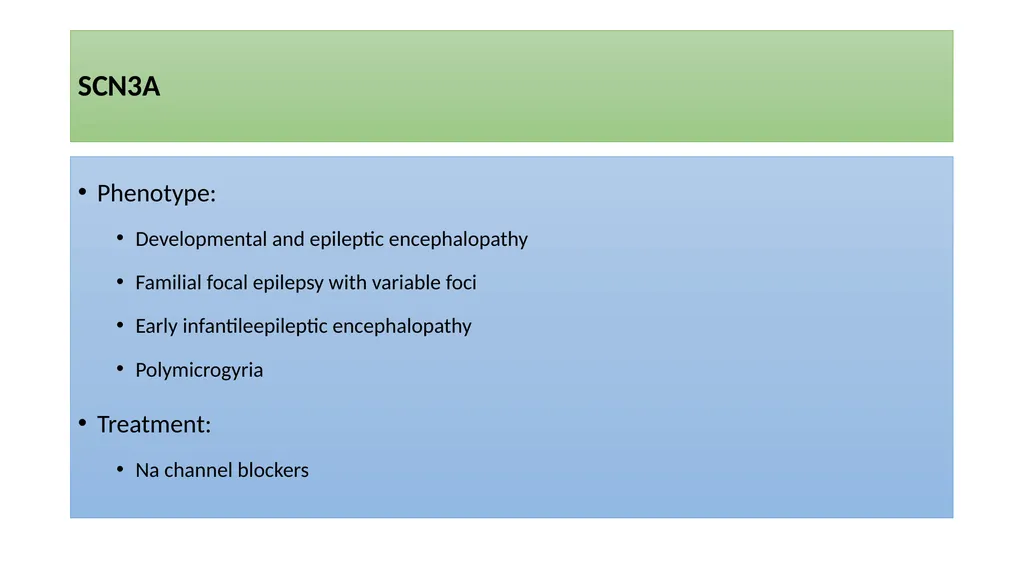
SCN3A Phenotype:
Developmental and epileptic encephalopathy
Familial focal epilepsy with variable foci
Early infantileepileptic encephalopathy
Polymicrogyria
Treatment:
Na channel blockers<br>
Developmental and epileptic encephalopathy
Familial focal epilepsy with variable foci
Early infantileepileptic encephalopathy
Polymicrogyria
Treatment:
Na channel blockers<br>
83
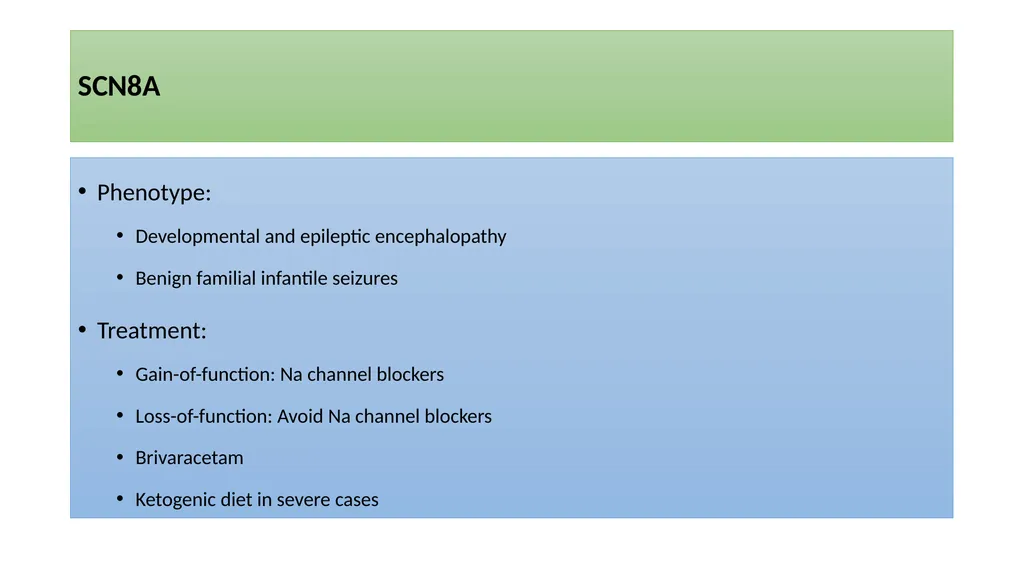
SCN8A Phenotype:
Developmental and epileptic encephalopathy
Benign familial infantile seizures
Treatment:
Gain-of-function: Na channel blockers
Loss-of-function: Avoid Na channel blockers
Brivaracetam
Ketogenic diet in severe cases<br>
Developmental and epileptic encephalopathy
Benign familial infantile seizures
Treatment:
Gain-of-function: Na channel blockers
Loss-of-function: Avoid Na channel blockers
Brivaracetam
Ketogenic diet in severe cases<br>
84
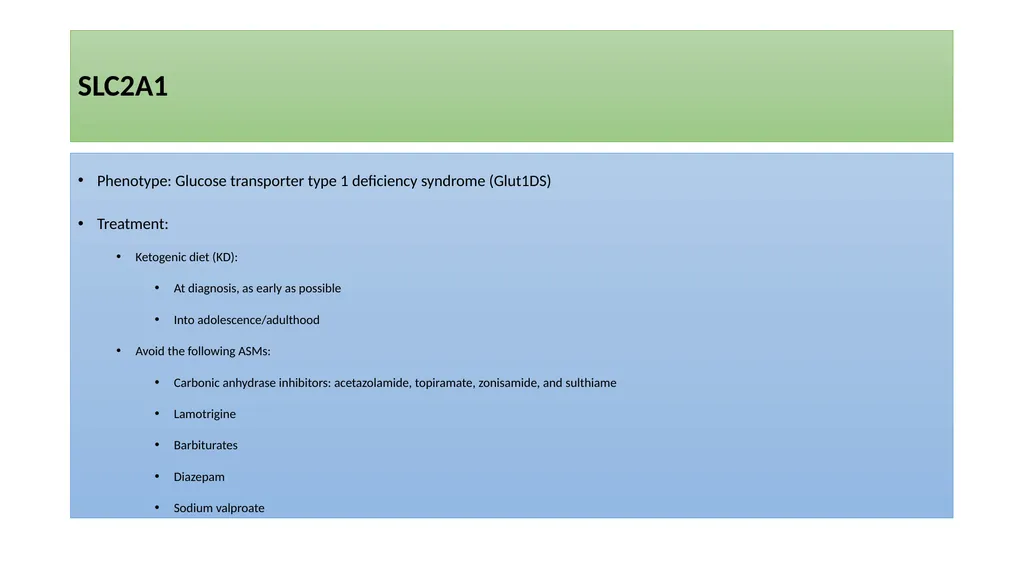
SLC2A1 Phenotype: Glucose transporter type 1 deficiency syndrome (Glut1DS)
Treatment:
Ketogenic diet (KD):
At diagnosis, as early as possible
Into adolescence/adulthood
Avoid the following ASMs:
Carbonic anhydrase inhibitors: acetazolamide, topiramate, zonisamide, and sulthiame
Lamotrigine
Barbiturates
Diazepam
Sodium valproate<br>
Treatment:
Ketogenic diet (KD):
At diagnosis, as early as possible
Into adolescence/adulthood
Avoid the following ASMs:
Carbonic anhydrase inhibitors: acetazolamide, topiramate, zonisamide, and sulthiame
Lamotrigine
Barbiturates
Diazepam
Sodium valproate<br>
85
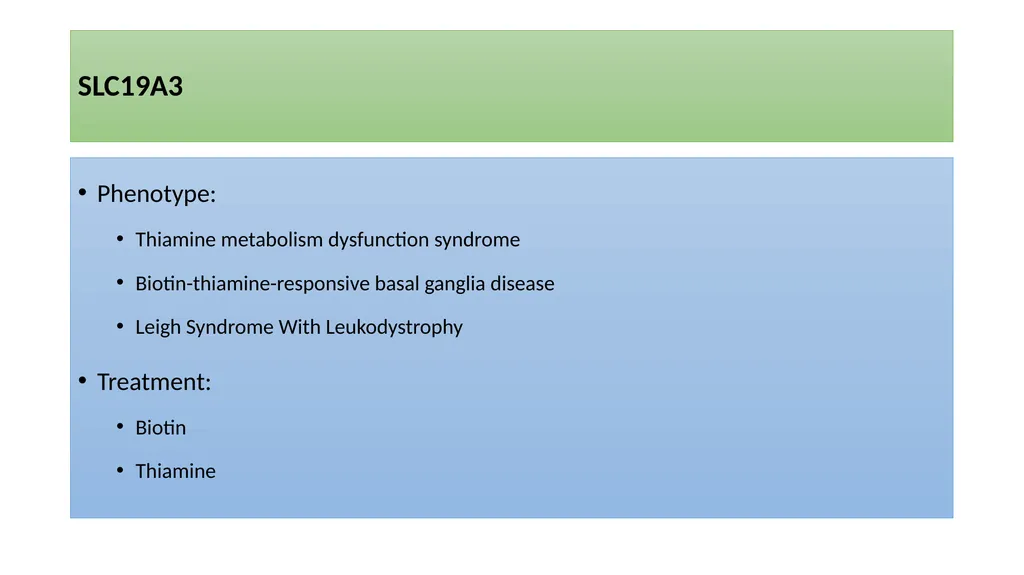
SLC19A3 Phenotype:
Thiamine metabolism dysfunction syndrome
Biotin-thiamine-responsive basal ganglia disease
Leigh Syndrome With Leukodystrophy
Treatment:
Biotin
Thiamine<br>
Thiamine metabolism dysfunction syndrome
Biotin-thiamine-responsive basal ganglia disease
Leigh Syndrome With Leukodystrophy
Treatment:
Biotin
Thiamine<br>
86
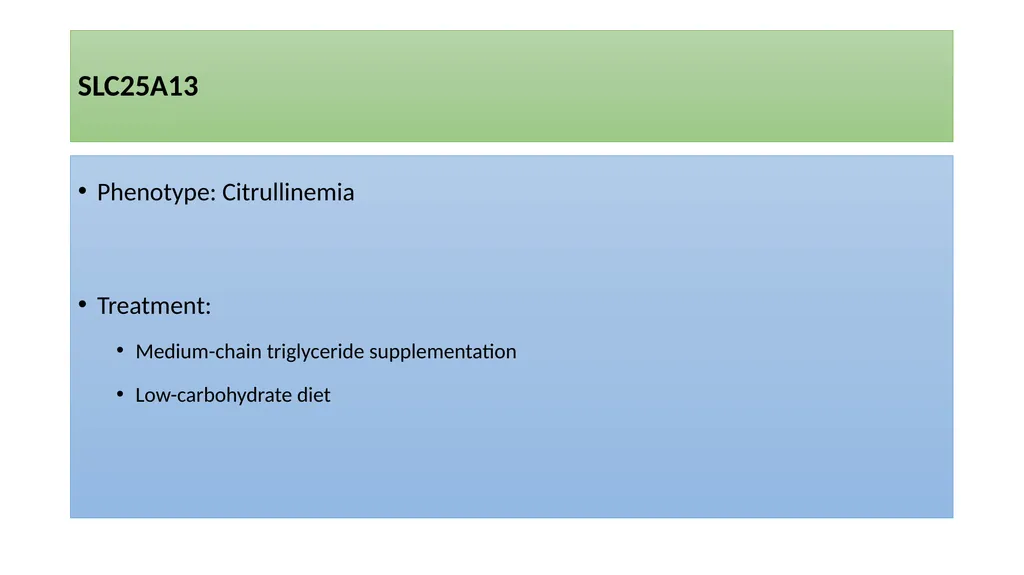
SLC25A13 Phenotype: Citrullinemia
Treatment:
Medium-chain triglyceride supplementation
Low-carbohydrate diet<br>
Treatment:
Medium-chain triglyceride supplementation
Low-carbohydrate diet<br>
87
SLC25A22 Phenotype: Developmental and epileptic encephalopathy
Treatment: Avoid valproate<br>
Treatment: Avoid valproate<br>
88
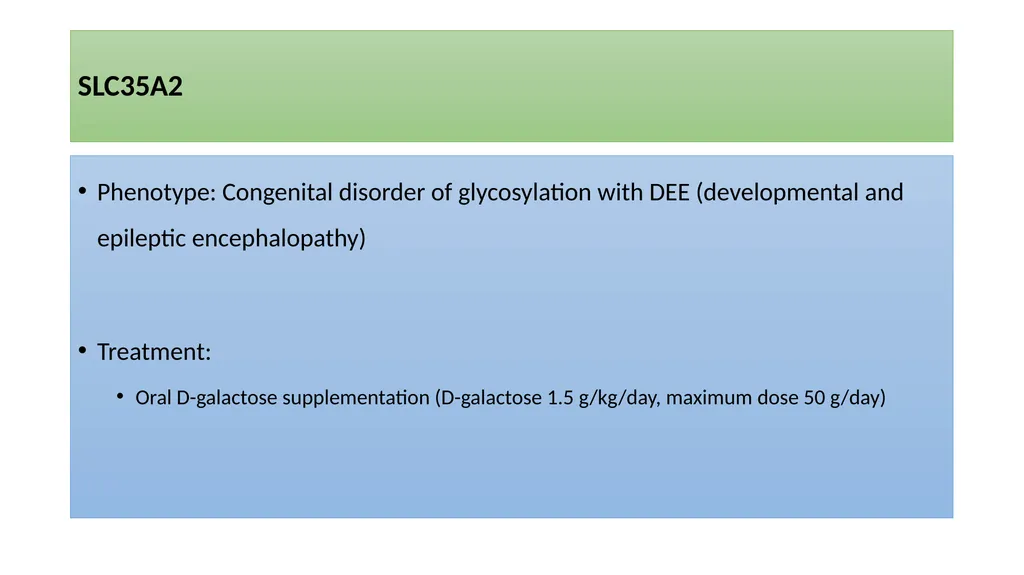
SLC35A2 Phenotype: Congenital disorder of glycosylation with DEE (developmental and epileptic encephalopathy)
Treatment:
Oral D-galactose supplementation (D-galactose 1.5 g/kg/day, maximum dose 50 g/day)<br>
Treatment:
Oral D-galactose supplementation (D-galactose 1.5 g/kg/day, maximum dose 50 g/day)<br>
89
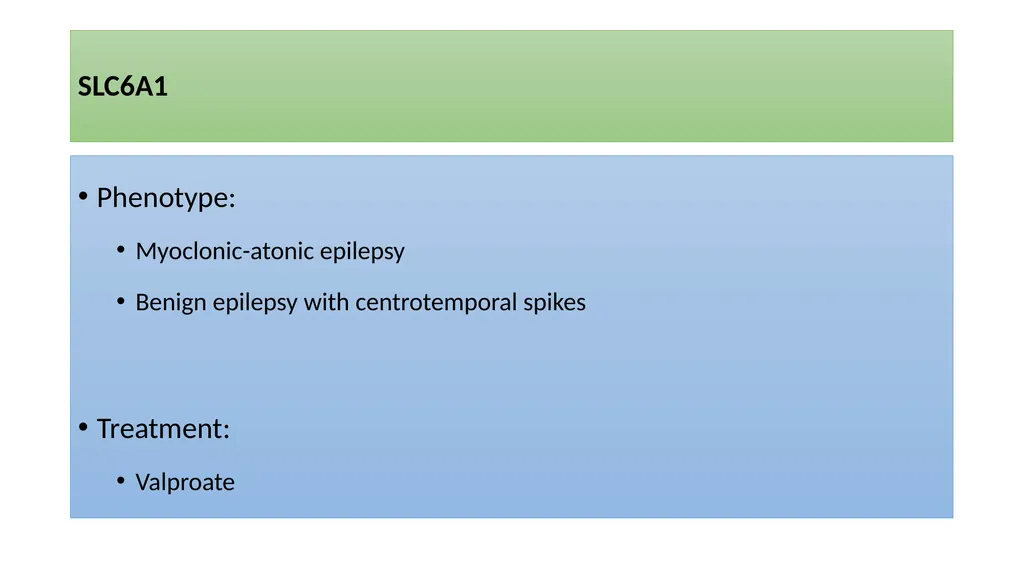
SLC6A1 Phenotype:
Myoclonic-atonic epilepsy
Benign epilepsy with centrotemporal spikes
Treatment:
Valproate<br>
Myoclonic-atonic epilepsy
Benign epilepsy with centrotemporal spikes
Treatment:
Valproate<br>
90
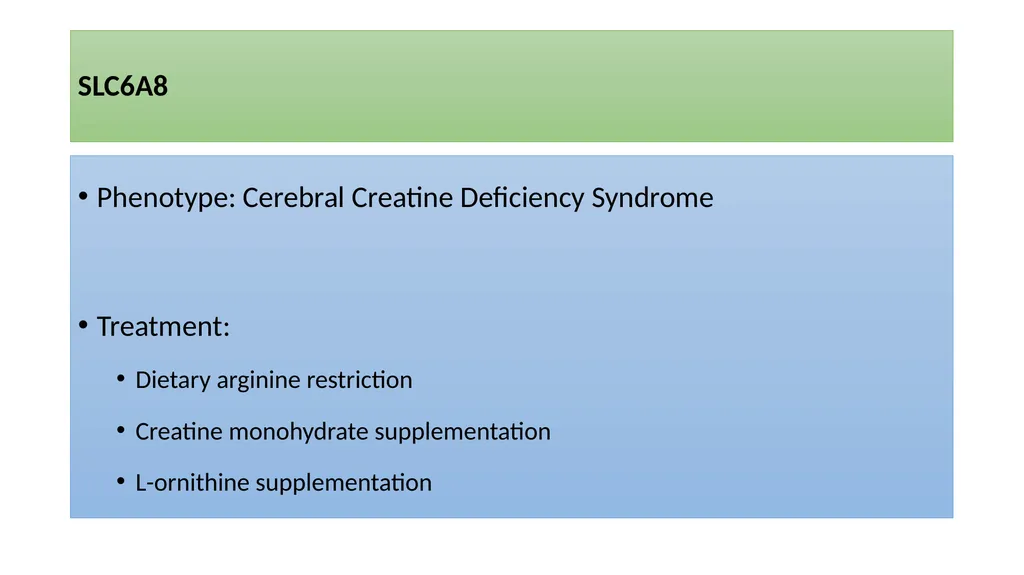
SLC6A8 Phenotype: Cerebral Creatine Deficiency Syndrome
Treatment:
Dietary arginine restriction
Creatine monohydrate supplementation
L-ornithine supplementation<br>
Treatment:
Dietary arginine restriction
Creatine monohydrate supplementation
L-ornithine supplementation<br>
91
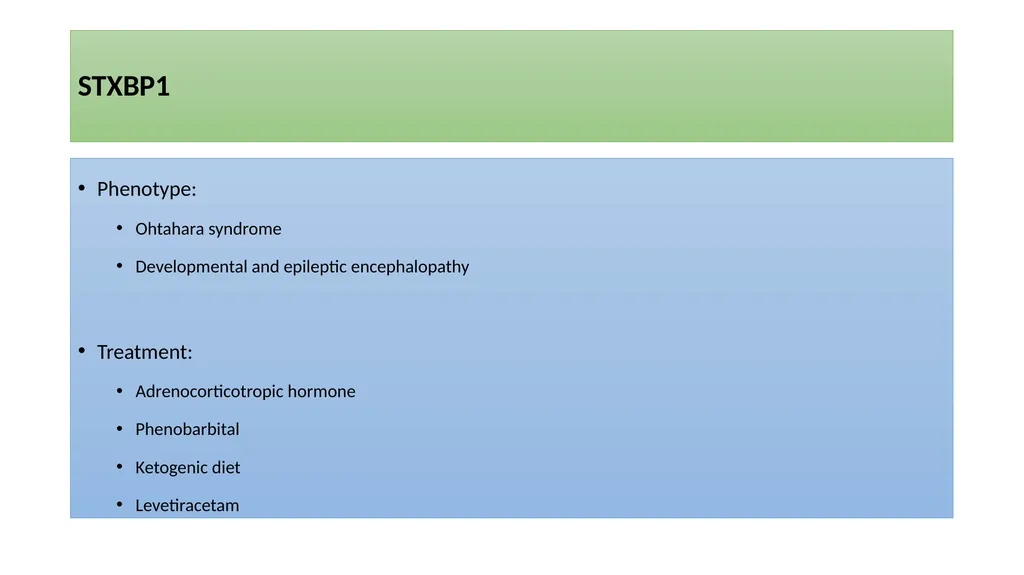
STXBP1 Phenotype:
Ohtahara syndrome
Developmental and epileptic encephalopathy
Treatment:
Adrenocorticotropic hormone
Phenobarbital
Ketogenic diet
Levetiracetam<br>
Ohtahara syndrome
Developmental and epileptic encephalopathy
Treatment:
Adrenocorticotropic hormone
Phenobarbital
Ketogenic diet
Levetiracetam<br>
92
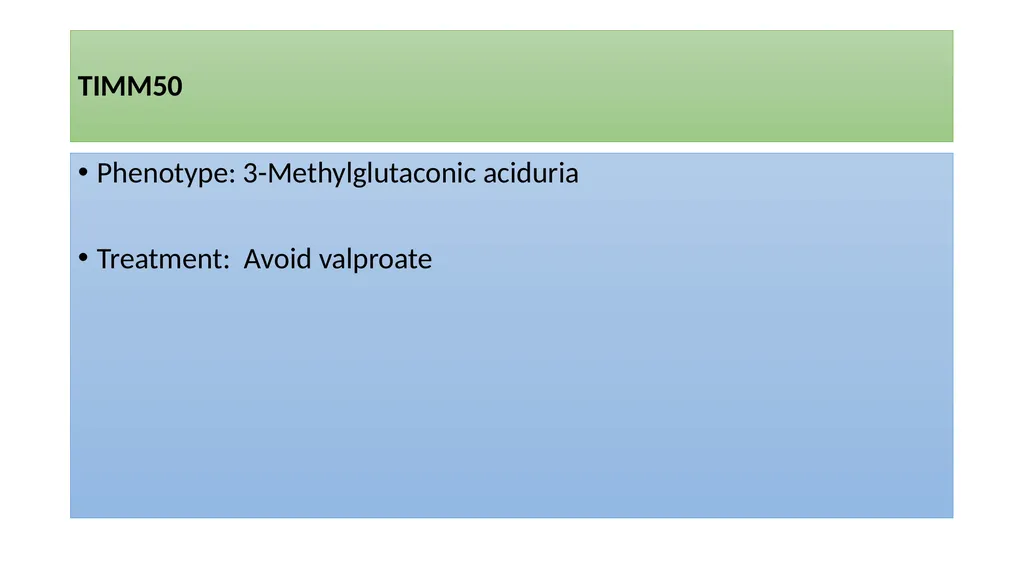
TIMM50 Phenotype: 3-Methylglutaconic aciduria
Treatment: Avoid valproate<br>
Treatment: Avoid valproate<br>
93
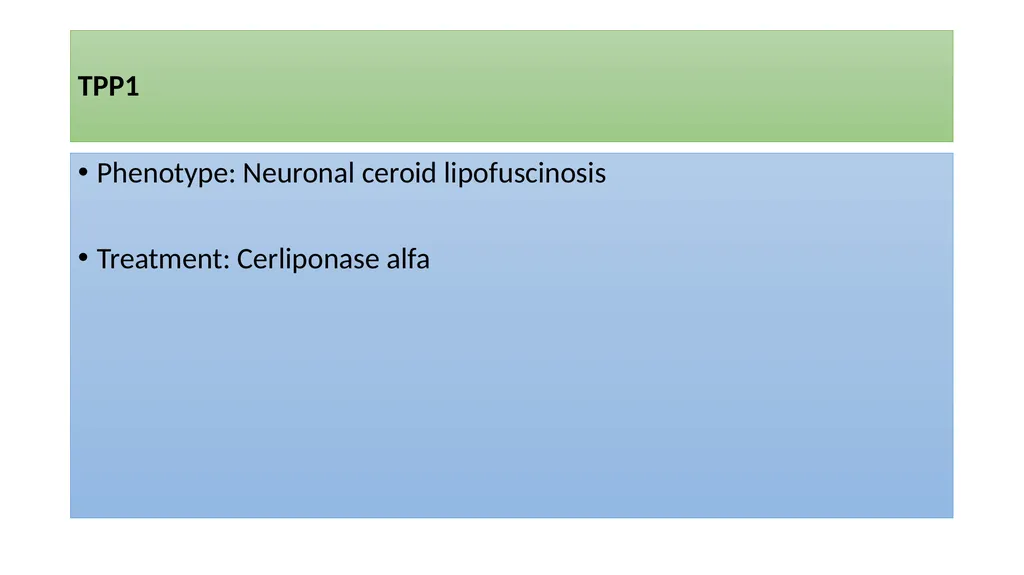
TPP1 Phenotype: Neuronal ceroid lipofuscinosis
Treatment: Cerliponase alfa<br>
Treatment: Cerliponase alfa<br>
94
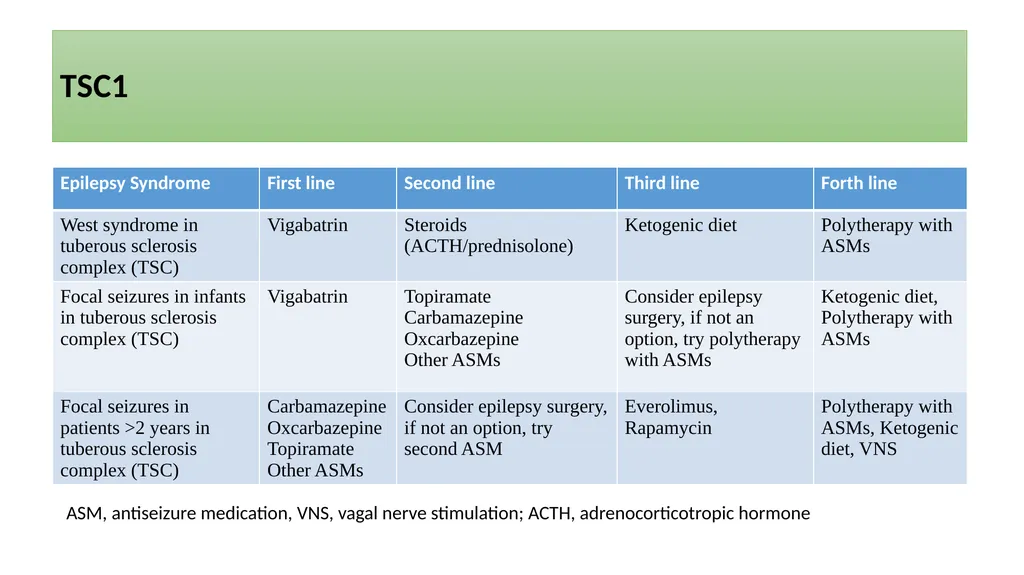
TSC1 ASM, antiseizure medication, VNS, vagal nerve stimulation; ACTH, adrenocorticotropic hormone<br>
95
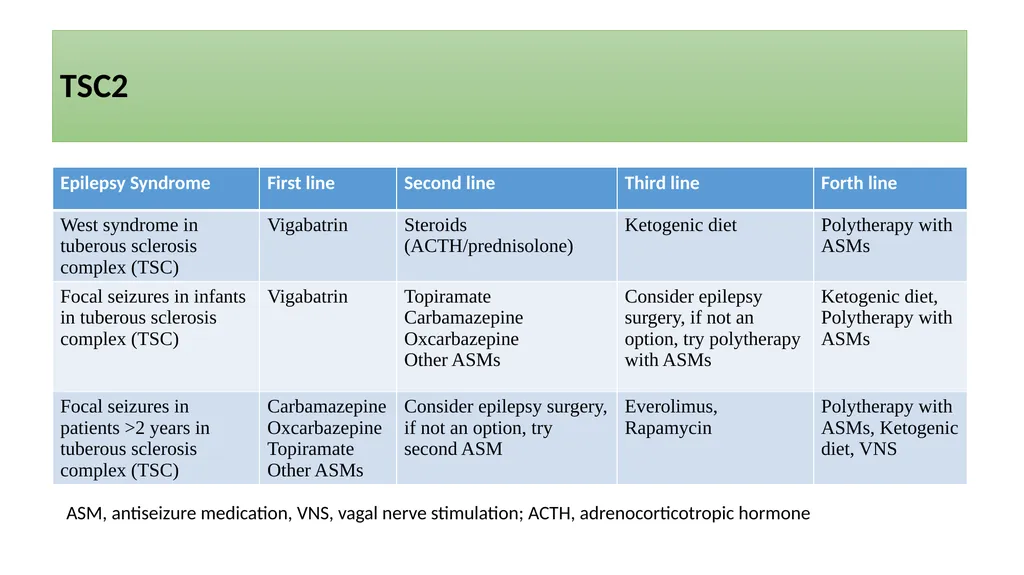
TSC2 ASM, antiseizure medication, VNS, vagal nerve stimulation; ACTH, adrenocorticotropic hormone<br>
96
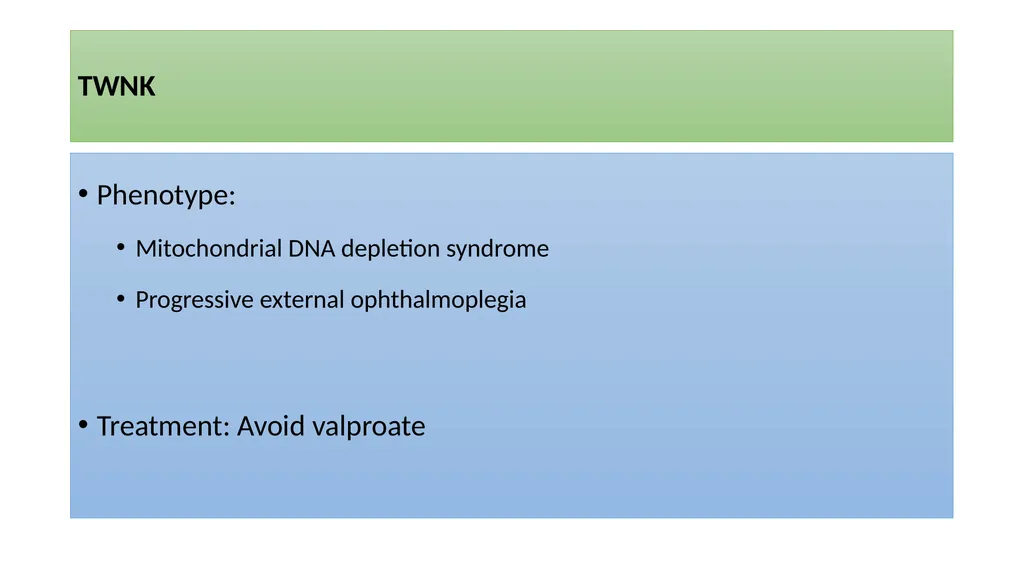
TWNK Phenotype:
Mitochondrial DNA depletion syndrome
Progressive external ophthalmoplegia
Treatment: Avoid valproate<br>
Mitochondrial DNA depletion syndrome
Progressive external ophthalmoplegia
Treatment: Avoid valproate<br>
97
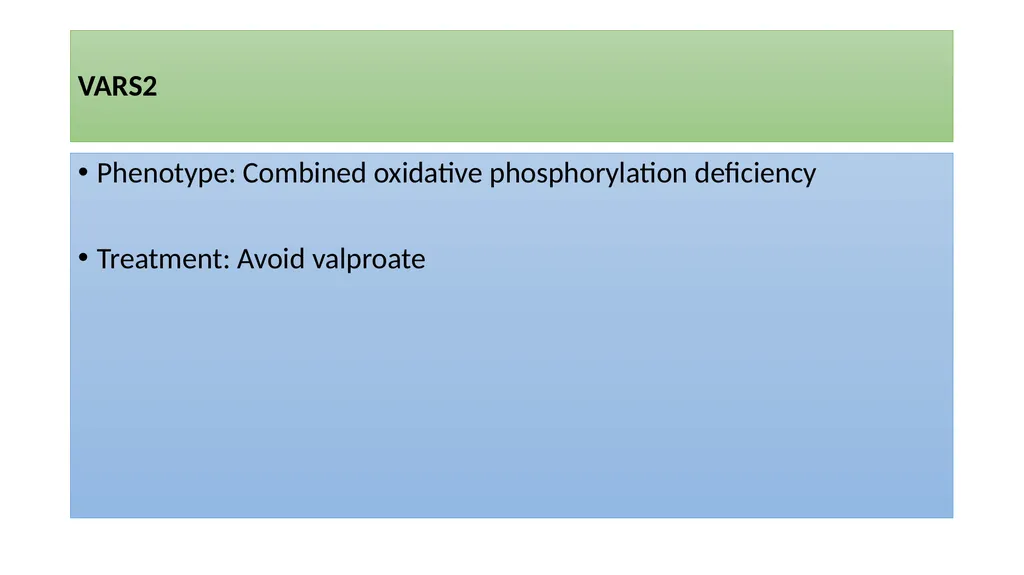
VARS2 Phenotype: Combined oxidative phosphorylation deficiency
Treatment: Avoid valproate<br>
Treatment: Avoid valproate<br>
98
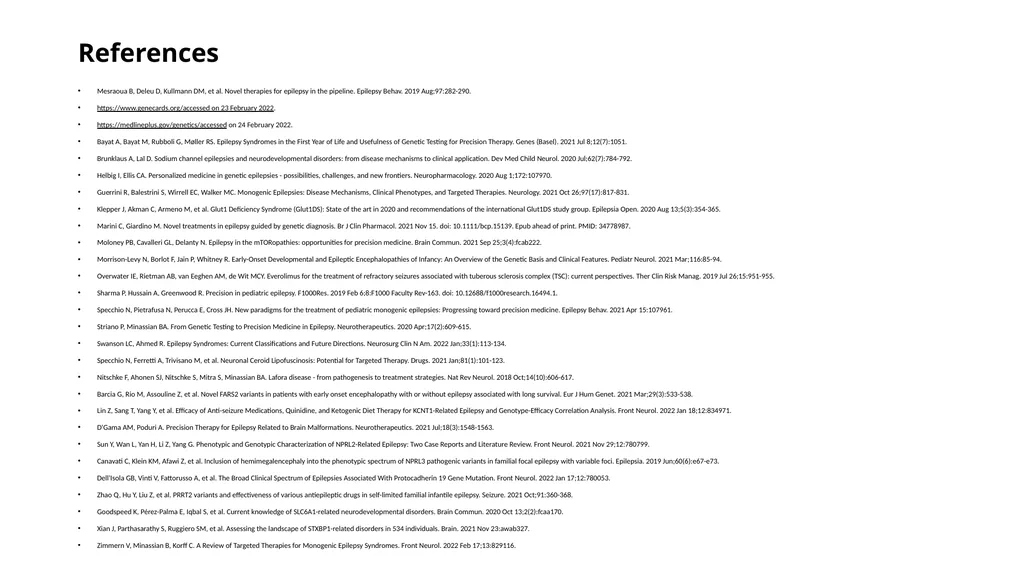
References Mesraoua B, Deleu D, Kullmann DM, et al. Novel therapies for epilepsy in the pipeline. Epilepsy Behav. 2019 Aug;97:282-290.
https://www.genecards.org/accessed on 23 February 2022.
https://medlineplus.gov/genetics/accessed on 24 February 2022.
Bayat A, Bayat M, Rubboli G, Møller RS. Epilepsy Syndromes in the First Year of Life and Usefulness of Genetic Testing for Precision Therapy. Genes (Basel). 2021 Jul 8;12(7):1051.
Brunklaus A, Lal D. Sodium channel epilepsies and neurodevelopmental disorders: from disease mechanisms to clinical application. Dev Med Child Neurol. 2020 Jul;62(7):784-792.
Helbig I, Ellis CA. Personalized medicine in genetic epilepsies - possibilities, challenges, and new frontiers. Neuropharmacology. 2020 Aug 1;172:107970.
Guerrini R, Balestrini S, Wirrell EC, Walker MC. Monogenic Epilepsies: Disease Mechanisms, Clinical Phenotypes, and Targeted Therapies. Neurology. 2021 Oct 26;97(17):817-831.
Klepper J, Akman C, Armeno M, et al. Glut1 Deficiency Syndrome (Glut1DS): State of the art in 2020 and recommendations of the international Glut1DS study group. Epilepsia Open. 2020 Aug 13;5(3):354-365.
Marini C, Giardino M. Novel treatments in epilepsy guided by genetic diagnosis. Br J Clin Pharmacol. 2021 Nov 15. doi: 10.1111/bcp.15139. Epub ahead of print. PMID: 34778987.
Moloney PB, Cavalleri GL, Delanty N. Epilepsy in the mTORopathies: opportunities for precision medicine. Brain Commun. 2021 Sep 25;3(4):fcab222.
Morrison-Levy N, Borlot F, Jain P, Whitney R. Early-Onset Developmental and Epileptic Encephalopathies of Infancy: An Overview of the Genetic Basis and Clinical Features. Pediatr Neurol. 2021 Mar;116:85-94.
Overwater IE, Rietman AB, van Eeghen AM, de Wit MCY. Everolimus for the treatment of refractory seizures associated with tuberous sclerosis complex (TSC): current perspectives. Ther Clin Risk Manag. 2019 Jul 26;15:951-955.
Sharma P, Hussain A, Greenwood R. Precision in pediatric epilepsy. F1000Res. 2019 Feb 6;8:F1000 Faculty Rev-163. doi: 10.12688/f1000research.16494.1.
Specchio N, Pietrafusa N, Perucca E, Cross JH. New paradigms for the treatment of pediatric monogenic epilepsies: Progressing toward precision medicine. Epilepsy Behav. 2021 Apr 15:107961.
Striano P, Minassian BA. From Genetic Testing to Precision Medicine in Epilepsy. Neurotherapeutics. 2020 Apr;17(2):609-615.
Swanson LC, Ahmed R. Epilepsy Syndromes: Current Classifications and Future Directions. Neurosurg Clin N Am. 2022 Jan;33(1):113-134.
Specchio N, Ferretti A, Trivisano M, et al. Neuronal Ceroid Lipofuscinosis: Potential for Targeted Therapy. Drugs. 2021 Jan;81(1):101-123.
Nitschke F, Ahonen SJ, Nitschke S, Mitra S, Minassian BA. Lafora disease - from pathogenesis to treatment strategies. Nat Rev Neurol. 2018 Oct;14(10):606-617.
Barcia G, Rio M, Assouline Z, et al. Novel FARS2 variants in patients with early onset encephalopathy with or without epilepsy associated with long survival. Eur J Hum Genet. 2021 Mar;29(3):533-538.
Lin Z, Sang T, Yang Y, et al. Efficacy of Anti-seizure Medications, Quinidine, and Ketogenic Diet Therapy for KCNT1-Related Epilepsy and Genotype-Efficacy Correlation Analysis. Front Neurol. 2022 Jan 18;12:834971.
D'Gama AM, Poduri A. Precision Therapy for Epilepsy Related to Brain Malformations. Neurotherapeutics. 2021 Jul;18(3):1548-1563.
Sun Y, Wan L, Yan H, Li Z, Yang G. Phenotypic and Genotypic Characterization of NPRL2-Related Epilepsy: Two Case Reports and Literature Review. Front Neurol. 2021 Nov 29;12:780799.
Canavati C, Klein KM, Afawi Z, et al. Inclusion of hemimegalencephaly into the phenotypic spectrum of NPRL3 pathogenic variants in familial focal epilepsy with variable foci. Epilepsia. 2019 Jun;60(6):e67-e73.
Dell'Isola GB, Vinti V, Fattorusso A, et al. The Broad Clinical Spectrum of Epilepsies Associated With Protocadherin 19 Gene Mutation. Front Neurol. 2022 Jan 17;12:780053.
Zhao Q, Hu Y, Liu Z, et al. PRRT2 variants and effectiveness of various antiepileptic drugs in self-limited familial infantile epilepsy. Seizure. 2021 Oct;91:360-368.
Goodspeed K, Pérez-Palma E, Iqbal S, et al. Current knowledge of SLC6A1-related neurodevelopmental disorders. Brain Commun. 2020 Oct 13;2(2):fcaa170.
Xian J, Parthasarathy S, Ruggiero SM, et al. Assessing the landscape of STXBP1-related disorders in 534 individuals. Brain. 2021 Nov 23:awab327.
Zimmern V, Minassian B, Korff C. A Review of Targeted Therapies for Monogenic Epilepsy Syndromes. Front Neurol. 2022 Feb 17;13:829116.<br>
https://www.genecards.org/accessed on 23 February 2022.
https://medlineplus.gov/genetics/accessed on 24 February 2022.
Bayat A, Bayat M, Rubboli G, Møller RS. Epilepsy Syndromes in the First Year of Life and Usefulness of Genetic Testing for Precision Therapy. Genes (Basel). 2021 Jul 8;12(7):1051.
Brunklaus A, Lal D. Sodium channel epilepsies and neurodevelopmental disorders: from disease mechanisms to clinical application. Dev Med Child Neurol. 2020 Jul;62(7):784-792.
Helbig I, Ellis CA. Personalized medicine in genetic epilepsies - possibilities, challenges, and new frontiers. Neuropharmacology. 2020 Aug 1;172:107970.
Guerrini R, Balestrini S, Wirrell EC, Walker MC. Monogenic Epilepsies: Disease Mechanisms, Clinical Phenotypes, and Targeted Therapies. Neurology. 2021 Oct 26;97(17):817-831.
Klepper J, Akman C, Armeno M, et al. Glut1 Deficiency Syndrome (Glut1DS): State of the art in 2020 and recommendations of the international Glut1DS study group. Epilepsia Open. 2020 Aug 13;5(3):354-365.
Marini C, Giardino M. Novel treatments in epilepsy guided by genetic diagnosis. Br J Clin Pharmacol. 2021 Nov 15. doi: 10.1111/bcp.15139. Epub ahead of print. PMID: 34778987.
Moloney PB, Cavalleri GL, Delanty N. Epilepsy in the mTORopathies: opportunities for precision medicine. Brain Commun. 2021 Sep 25;3(4):fcab222.
Morrison-Levy N, Borlot F, Jain P, Whitney R. Early-Onset Developmental and Epileptic Encephalopathies of Infancy: An Overview of the Genetic Basis and Clinical Features. Pediatr Neurol. 2021 Mar;116:85-94.
Overwater IE, Rietman AB, van Eeghen AM, de Wit MCY. Everolimus for the treatment of refractory seizures associated with tuberous sclerosis complex (TSC): current perspectives. Ther Clin Risk Manag. 2019 Jul 26;15:951-955.
Sharma P, Hussain A, Greenwood R. Precision in pediatric epilepsy. F1000Res. 2019 Feb 6;8:F1000 Faculty Rev-163. doi: 10.12688/f1000research.16494.1.
Specchio N, Pietrafusa N, Perucca E, Cross JH. New paradigms for the treatment of pediatric monogenic epilepsies: Progressing toward precision medicine. Epilepsy Behav. 2021 Apr 15:107961.
Striano P, Minassian BA. From Genetic Testing to Precision Medicine in Epilepsy. Neurotherapeutics. 2020 Apr;17(2):609-615.
Swanson LC, Ahmed R. Epilepsy Syndromes: Current Classifications and Future Directions. Neurosurg Clin N Am. 2022 Jan;33(1):113-134.
Specchio N, Ferretti A, Trivisano M, et al. Neuronal Ceroid Lipofuscinosis: Potential for Targeted Therapy. Drugs. 2021 Jan;81(1):101-123.
Nitschke F, Ahonen SJ, Nitschke S, Mitra S, Minassian BA. Lafora disease - from pathogenesis to treatment strategies. Nat Rev Neurol. 2018 Oct;14(10):606-617.
Barcia G, Rio M, Assouline Z, et al. Novel FARS2 variants in patients with early onset encephalopathy with or without epilepsy associated with long survival. Eur J Hum Genet. 2021 Mar;29(3):533-538.
Lin Z, Sang T, Yang Y, et al. Efficacy of Anti-seizure Medications, Quinidine, and Ketogenic Diet Therapy for KCNT1-Related Epilepsy and Genotype-Efficacy Correlation Analysis. Front Neurol. 2022 Jan 18;12:834971.
D'Gama AM, Poduri A. Precision Therapy for Epilepsy Related to Brain Malformations. Neurotherapeutics. 2021 Jul;18(3):1548-1563.
Sun Y, Wan L, Yan H, Li Z, Yang G. Phenotypic and Genotypic Characterization of NPRL2-Related Epilepsy: Two Case Reports and Literature Review. Front Neurol. 2021 Nov 29;12:780799.
Canavati C, Klein KM, Afawi Z, et al. Inclusion of hemimegalencephaly into the phenotypic spectrum of NPRL3 pathogenic variants in familial focal epilepsy with variable foci. Epilepsia. 2019 Jun;60(6):e67-e73.
Dell'Isola GB, Vinti V, Fattorusso A, et al. The Broad Clinical Spectrum of Epilepsies Associated With Protocadherin 19 Gene Mutation. Front Neurol. 2022 Jan 17;12:780053.
Zhao Q, Hu Y, Liu Z, et al. PRRT2 variants and effectiveness of various antiepileptic drugs in self-limited familial infantile epilepsy. Seizure. 2021 Oct;91:360-368.
Goodspeed K, Pérez-Palma E, Iqbal S, et al. Current knowledge of SLC6A1-related neurodevelopmental disorders. Brain Commun. 2020 Oct 13;2(2):fcaa170.
Xian J, Parthasarathy S, Ruggiero SM, et al. Assessing the landscape of STXBP1-related disorders in 534 individuals. Brain. 2021 Nov 23:awab327.
Zimmern V, Minassian B, Korff C. A Review of Targeted Therapies for Monogenic Epilepsy Syndromes. Front Neurol. 2022 Feb 17;13:829116.<br>