
PregnAncy Risk assessmenT aNd dEcision suppoRt
T
Published · 48 slides · 0 views

1 / 1

Description
PregnAncy Risk assessmenT aNd dEcision suppoRt (PARTNER): A Clinical Decision Support Tool To Reduce Placental Disorders and Preterm birth in Pregnancy Site Initiation Visit Bristol Trial Team Sponsor University of Bristol Coordinating
Related Topics
Share
Embed code
Download this presentation From Below
"PregnAncy Risk assessmenT aNd dEcision suppoRt" is the property of its rightful owner. Permission is granted to download and print the materials on this website for personal, non-commercial use only, and to display it on your personal computer provided you do not modify the materials and that you retain all copyright notices contained in the materials. By downloading content from our website, you accept the terms of this agreement.
Presentation Transcript
01
PregnAncy Risk assessmenT aNd dEcision suppoRt (PARTNER):
A Clinical Decision Support Tool To Reduce Placental Disorders and Preterm birth in Pregnancy Site Initiation Visit<br>
02
Bristol Trial Team Sponsor – University of Bristol
Coordinating Centre – Bristol Trial Centre (BTC)
Chief Investigators – Christy Burden and Andy Judge
Trial Statistician – Eleanor Gidman
Trial Manager – Stefan Lewandowski
Deputy Trial Coordinator – Ellen Clark
Trial Administrator – Naura Choy
Implementation Midwives – Jodi Carpenter First point of contact:
partner-trial@bristol.ac.uk<br>
Coordinating Centre – Bristol Trial Centre (BTC)
Chief Investigators – Christy Burden and Andy Judge
Trial Statistician – Eleanor Gidman
Trial Manager – Stefan Lewandowski
Deputy Trial Coordinator – Ellen Clark
Trial Administrator – Naura Choy
Implementation Midwives – Jodi Carpenter First point of contact:
partner-trial@bristol.ac.uk<br>
03
Purpose Train staff with an overview of the study design and systems that apply to both arms
Draw attention to key differences in the study design
Specific intervention and tool training will come post-randomisation.<br>
Draw attention to key differences in the study design
Specific intervention and tool training will come post-randomisation.<br>
04
Study Background and Rationale<br>
05
Study Background and Rationale Each year in the UK there are 25,000 pregnancies complicated by pre-eclampsia, 3,000 stillbirths and 60,000 preterm births1-4
The number of complications that occur vary from hospital to hospital, which may be due to differences in care provided for women and pregnant people
It is hard to identify which women are most likely to develop these complications, meaning that problems may develop unnoticed
Risk assessment is often based on previous pregnancy outcomes, meaning that many parents must experience complications before receiving specialist care
NHS maternity staff struggle with lack of resources and it is hard for them to ensure they are using the latest national guidelines to provide the best care<br>
The number of complications that occur vary from hospital to hospital, which may be due to differences in care provided for women and pregnant people
It is hard to identify which women are most likely to develop these complications, meaning that problems may develop unnoticed
Risk assessment is often based on previous pregnancy outcomes, meaning that many parents must experience complications before receiving specialist care
NHS maternity staff struggle with lack of resources and it is hard for them to ensure they are using the latest national guidelines to provide the best care<br>
06
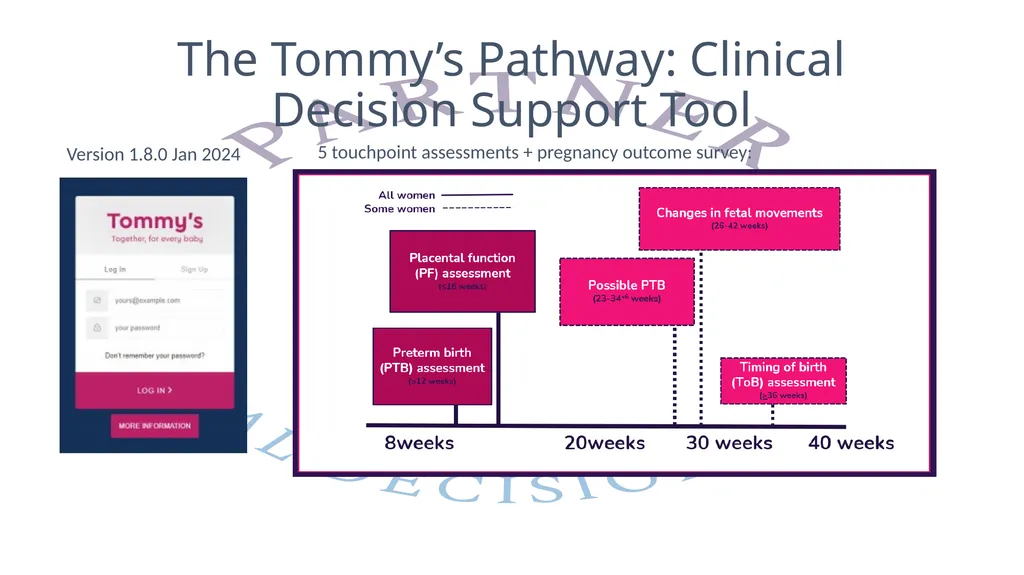
Tommy’s Pathway: a Clinical Decision Support Tool Developed by The Tommy’s National Centre for Maternity Improvement for use by women and pregnant people, midwives and doctors
Provided as a web application accessed via an internet browser, using either a desktop computer, laptop, smart phone or tablet (any device with access to the internet)
Incorporates three algorithms for risk assessment and clinical decision support;
Fetal Medicine Foundation Algorithm - produces a numerical risk which can be used to triage women and pregnant people, doubling the detection rate of preeclampsia, reducing perinatal death 5.
Preterm birth algorithm - women and pregnant people in socioeconomically deprived areas or from ethnic minority groups are half as likely to be referred to preterm birth services. This assessment produces a numeric risk which allows us to overcome this disparity 6
Threatened preterm birth algorithm (QUIPP) - Reduces unnecessary hospital admissions, inappropriate steroid use and reduces NICU bed blocking. But doesn't offer decision support.<br>
Provided as a web application accessed via an internet browser, using either a desktop computer, laptop, smart phone or tablet (any device with access to the internet)
Incorporates three algorithms for risk assessment and clinical decision support;
Fetal Medicine Foundation Algorithm - produces a numerical risk which can be used to triage women and pregnant people, doubling the detection rate of preeclampsia, reducing perinatal death 5.
Preterm birth algorithm - women and pregnant people in socioeconomically deprived areas or from ethnic minority groups are half as likely to be referred to preterm birth services. This assessment produces a numeric risk which allows us to overcome this disparity 6
Threatened preterm birth algorithm (QUIPP) - Reduces unnecessary hospital admissions, inappropriate steroid use and reduces NICU bed blocking. But doesn't offer decision support.<br>
07
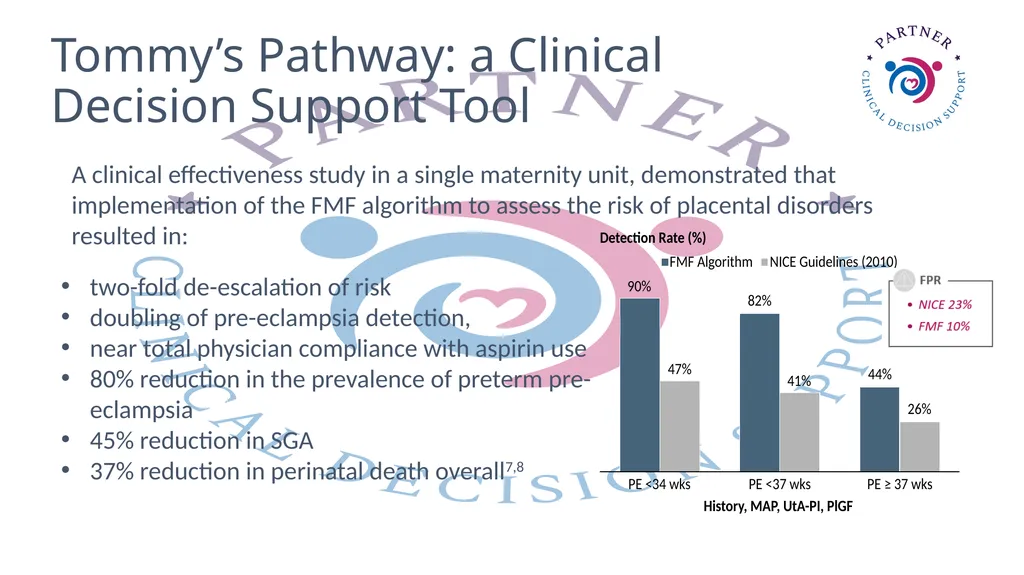
Tommy’s Pathway: a Clinical Decision Support Tool A clinical effectiveness study in a single maternity unit, demonstrated that implementation of the FMF algorithm to assess the risk of placental disorders resulted in: two-fold de-escalation of risk
doubling of pre-eclampsia detection,
near total physician compliance with aspirin use
80% reduction in the prevalence of preterm pre-eclampsia
45% reduction in SGA
37% reduction in perinatal death overall7,8<br>
doubling of pre-eclampsia detection,
near total physician compliance with aspirin use
80% reduction in the prevalence of preterm pre-eclampsia
45% reduction in SGA
37% reduction in perinatal death overall7,8<br>
08
Study Design<br>
09
Multi-centre, randomised controlled cluster trial with embedded implementation and health economic analysis
We hope to collect pregnancy data from ~62,400 women and pregnant people across 26-30 NHS sites in England
We will be comparing the incidence of hypertensive disorders in pregnancy between sites using our Clinical Decision Support Tool and those offering standard care Study Design PARTNER is involved in The Associate Principal Investigator scheme: https://www.nihr.ac.uk/health-and-care-professionals/career-development/associate-principal-investigator-scheme.htm<br>
We hope to collect pregnancy data from ~62,400 women and pregnant people across 26-30 NHS sites in England
We will be comparing the incidence of hypertensive disorders in pregnancy between sites using our Clinical Decision Support Tool and those offering standard care Study Design PARTNER is involved in The Associate Principal Investigator scheme: https://www.nihr.ac.uk/health-and-care-professionals/career-development/associate-principal-investigator-scheme.htm<br>
10
Study Design – Cluster Trials Cluster Randomised Trial – groups/clusters of participants are randomised to trial allocations rather than individual participants
In this study, randomisation will occur at a site/maternity unit level to offer either:
The Clinical Decision Support Tool (incorporates the 3 earlier mentioned algorithms)
Standard Care
We will not be obtaining consent at an individual level (section 251)
Randomisation will blocked and stratified by maternity unit size<br>
In this study, randomisation will occur at a site/maternity unit level to offer either:
The Clinical Decision Support Tool (incorporates the 3 earlier mentioned algorithms)
Standard Care
We will not be obtaining consent at an individual level (section 251)
Randomisation will blocked and stratified by maternity unit size<br>
11
Study Design – Medical Device Trials PARTNER is a Phase III Medical Device study – The Clinical Decision Support tool is a non-CE marked class 2b medical device
Key signed aspects:
Change of practice – sites randomised to intervention will be asked change their standard practices to include the device
Data collection – excluding baseline data we will not be using CRFs to collect data and there is no study database (see data collection)
Safety reporting – typical AEs are not reportable, but device deficiencies and certain SAE’s are (see safety reporting)<br>
Key signed aspects:
Change of practice – sites randomised to intervention will be asked change their standard practices to include the device
Data collection – excluding baseline data we will not be using CRFs to collect data and there is no study database (see data collection)
Safety reporting – typical AEs are not reportable, but device deficiencies and certain SAE’s are (see safety reporting)<br>
12
Opting-out and Withdrawals Participants will be automatically enrolled into the trial unless they opt-out
We will provide PARTNER specific posters which will explain the trial and provide instructions in how to opt-out
Women and pregnant people can still be risk assessed by the intervention without engaging with the tool if they allow HCPs to enter data. If a participant does not want the tool used at all, they should be managed per unit guidelines prior to implementing the tool
To opt-out:
Participants can notify site staff
Participants can notify NHS England (via the NHS app)
Participants who have already opted-out from NHS data sharing do not need to opt out again
*please make sure to remove data of participants who have opted out in the quarterly data extractions<br>
We will provide PARTNER specific posters which will explain the trial and provide instructions in how to opt-out
Women and pregnant people can still be risk assessed by the intervention without engaging with the tool if they allow HCPs to enter data. If a participant does not want the tool used at all, they should be managed per unit guidelines prior to implementing the tool
To opt-out:
Participants can notify site staff
Participants can notify NHS England (via the NHS app)
Participants who have already opted-out from NHS data sharing do not need to opt out again
*please make sure to remove data of participants who have opted out in the quarterly data extractions<br>
13
Study Aims<br>
14
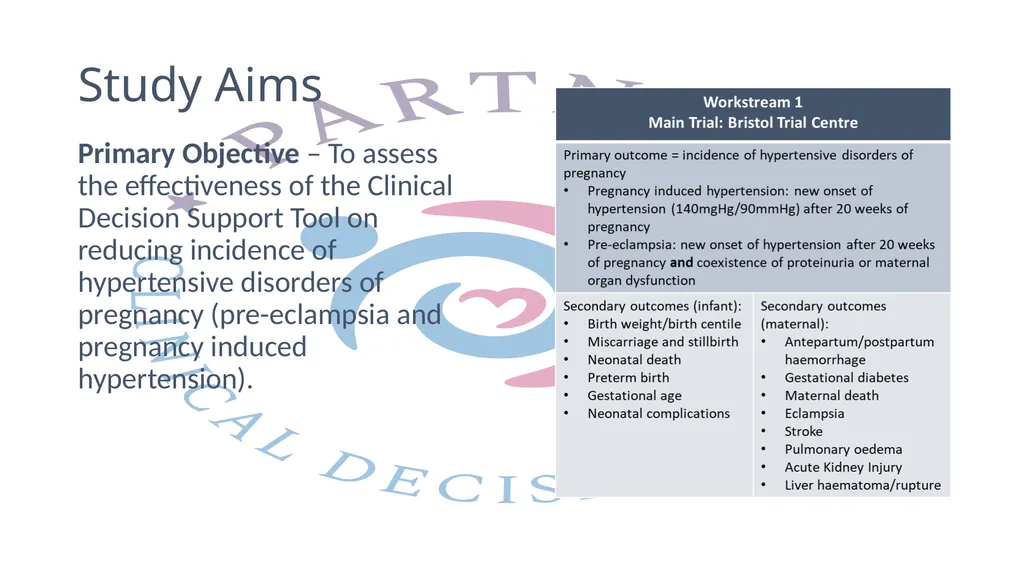
Study Aims Primary Objective – To assess the effectiveness of the Clinical Decision Support Tool on reducing incidence of hypertensive disorders of pregnancy (pre-eclampsia and pregnancy induced hypertension).<br>
15
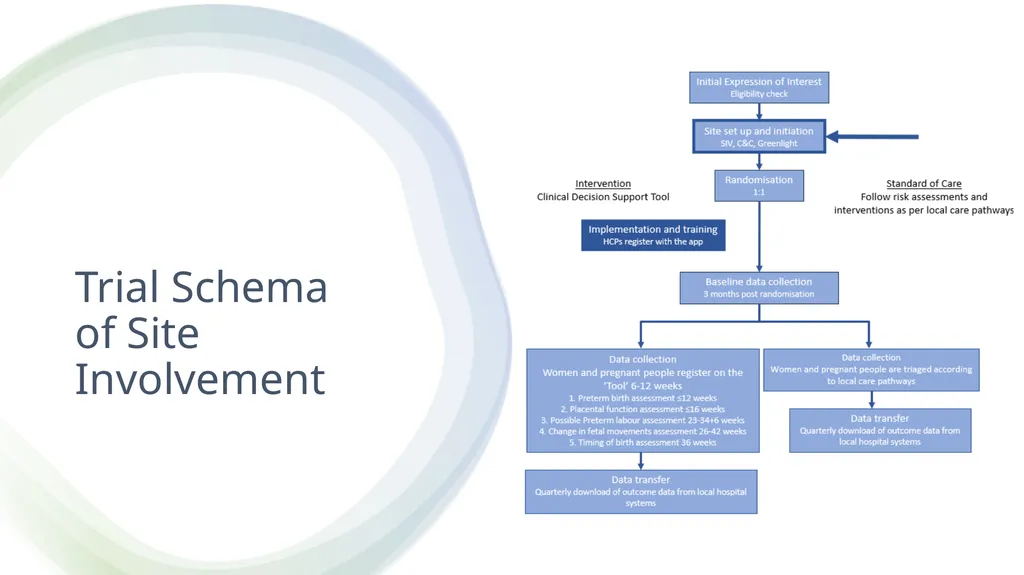
Trial Schema of Site Involvement<br>
16
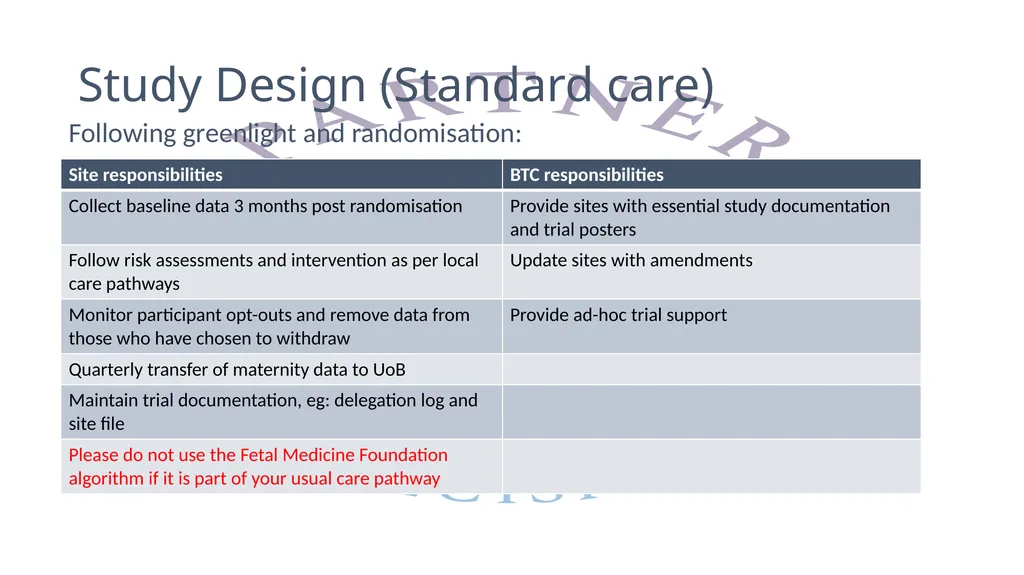
Study Design (Standard care) Following greenlight and randomisation:<br>
17
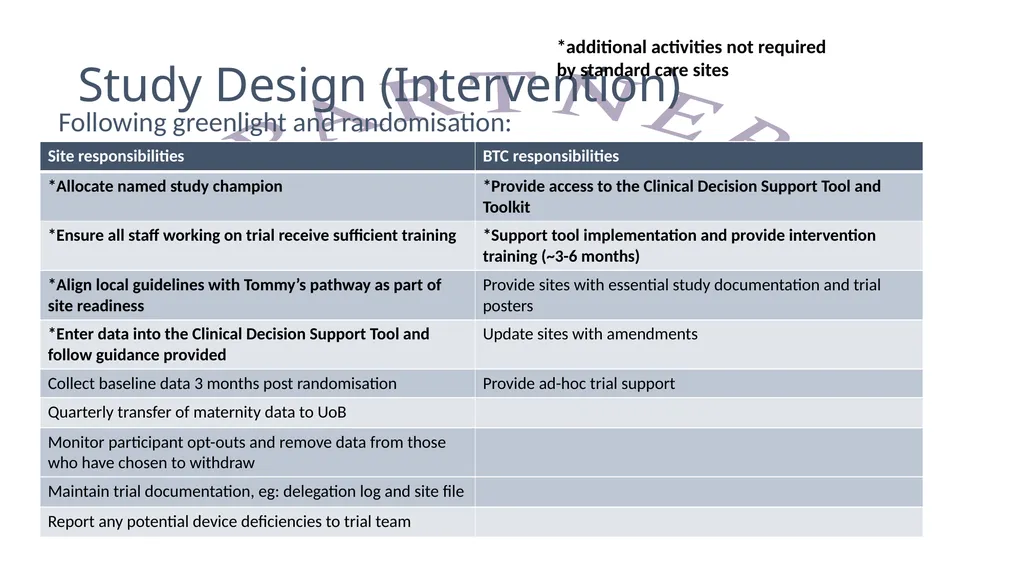
Study Design (Intervention) Following greenlight and randomisation: *additional activities not required by standard care sites<br>
18
The Tommy’s Pathway: Clinical Decision Support Tool Version 1.8.0 Jan 2024 5 touchpoint assessments + pregnancy outcome survey:<br>
19
Data Reporting<br>
20
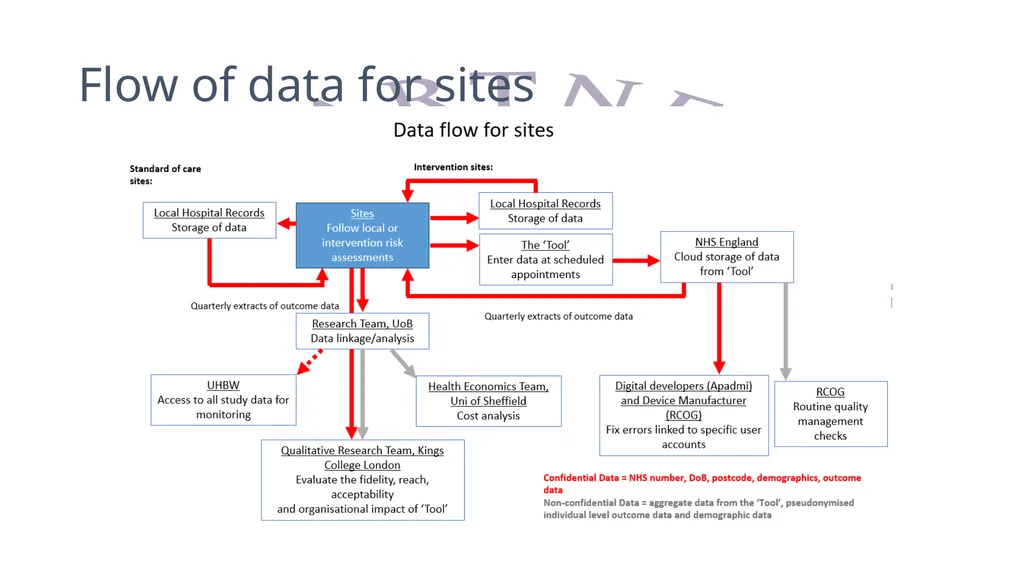
Flow of data for sites<br>
21
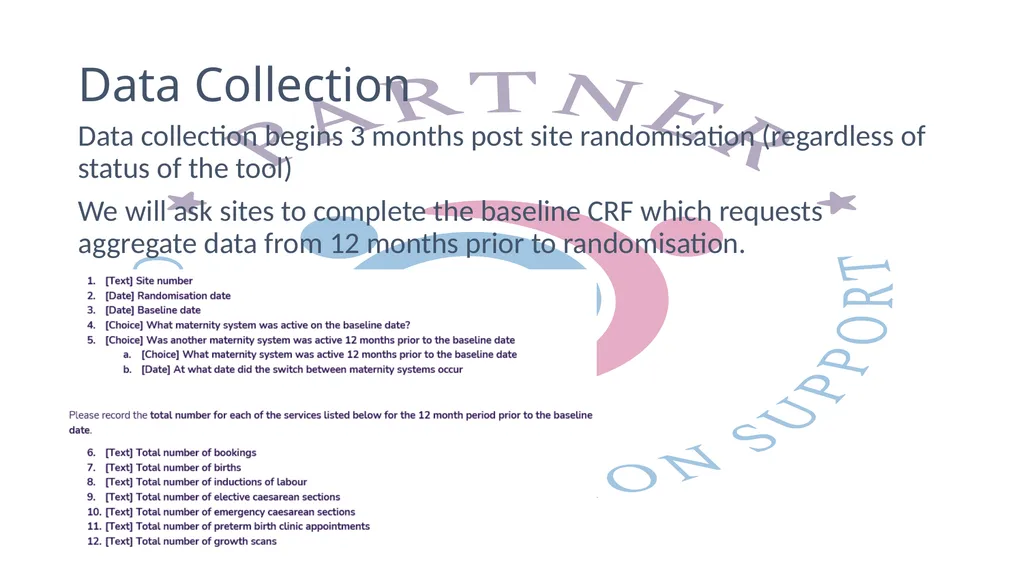
Data Collection Data collection begins 3 months post site randomisation (regardless of status of the tool)
We will ask sites to complete the baseline CRF which requests aggregate data from 12 months prior to randomisation.<br>
We will ask sites to complete the baseline CRF which requests aggregate data from 12 months prior to randomisation.<br>
22
Data Reporting Standard of care and intervention sites will be expected to download and transfer data from local hospital systems to the Trial Statistician every quarter
If a data extraction timepoint might be missed or delayed, please notify the trial team as soon as possible
Sites randomised to intervention will not need transfer data from the tool. This will be managed by NHS England and the trial team
Data sets should be extracted from your local maternity system, cleaned of any opt outs, and transferred through Egress. Process should be confirmed with local IT and IG teams prior to first transfer<br>
If a data extraction timepoint might be missed or delayed, please notify the trial team as soon as possible
Sites randomised to intervention will not need transfer data from the tool. This will be managed by NHS England and the trial team
Data sets should be extracted from your local maternity system, cleaned of any opt outs, and transferred through Egress. Process should be confirmed with local IT and IG teams prior to first transfer<br>
23
Safety Reporting<br>
24
Safety Reporting Device Deficiency = inadequacy related to device identity, quality, durability, reliability, safety or performance
Reportable DDs:
Performance issues
Diagnostic accuracy issues
Decision support software resulting in harm
Issue with connected software
Human-device interface problem
User error resulting in harm
Inadequate labelling and instructions for use
Computer system security problem
Guidance will be provided but if you are unsure whether a device deficiency has occurred<br>
Reportable DDs:
Performance issues
Diagnostic accuracy issues
Decision support software resulting in harm
Issue with connected software
Human-device interface problem
User error resulting in harm
Inadequate labelling and instructions for use
Computer system security problem
Guidance will be provided but if you are unsure whether a device deficiency has occurred<br>
25
Safety Reporting Serious Adverse Event (SAE): any untoward occurrence that
Results in death
Is life-threatening
Requires hospitalisation or prolongs existing hospitalisation
Results in persistent or significant disability or incapacity
Results in congenital abnormality or birth defect
Deemed medically significant by investigators
Site is only required to report SAEs deemed potentially related to a device deficiency by investigator<br>
Results in death
Is life-threatening
Requires hospitalisation or prolongs existing hospitalisation
Results in persistent or significant disability or incapacity
Results in congenital abnormality or birth defect
Deemed medically significant by investigators
Site is only required to report SAEs deemed potentially related to a device deficiency by investigator<br>
26
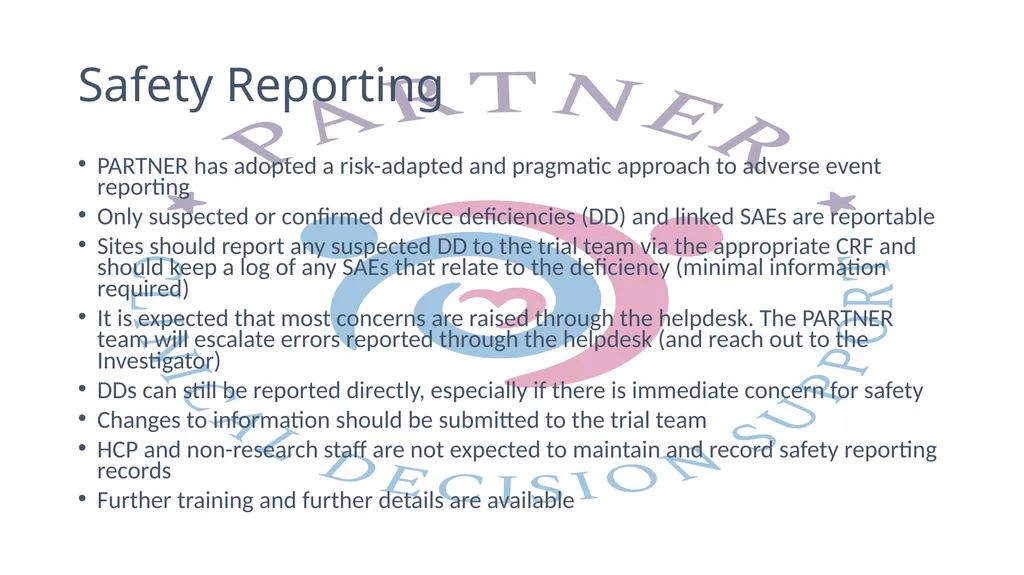
Safety Reporting PARTNER has adopted a risk-adapted and pragmatic approach to adverse event reporting
Only suspected or confirmed device deficiencies (DD) and linked SAEs are reportable
Sites should report any suspected DD to the trial team via the appropriate CRF and should keep a log of any SAEs that relate to the deficiency (minimal information required)
It is expected that most concerns are raised through the helpdesk. The PARTNER team will escalate errors reported through the helpdesk (and reach out to the Investigator)
DDs can still be reported directly, especially if there is immediate concern for safety
Changes to information should be submitted to the trial team
HCP and non-research staff are not expected to maintain and record safety reporting records
Further training and further details are available<br>
Only suspected or confirmed device deficiencies (DD) and linked SAEs are reportable
Sites should report any suspected DD to the trial team via the appropriate CRF and should keep a log of any SAEs that relate to the deficiency (minimal information required)
It is expected that most concerns are raised through the helpdesk. The PARTNER team will escalate errors reported through the helpdesk (and reach out to the Investigator)
DDs can still be reported directly, especially if there is immediate concern for safety
Changes to information should be submitted to the trial team
HCP and non-research staff are not expected to maintain and record safety reporting records
Further training and further details are available<br>
27
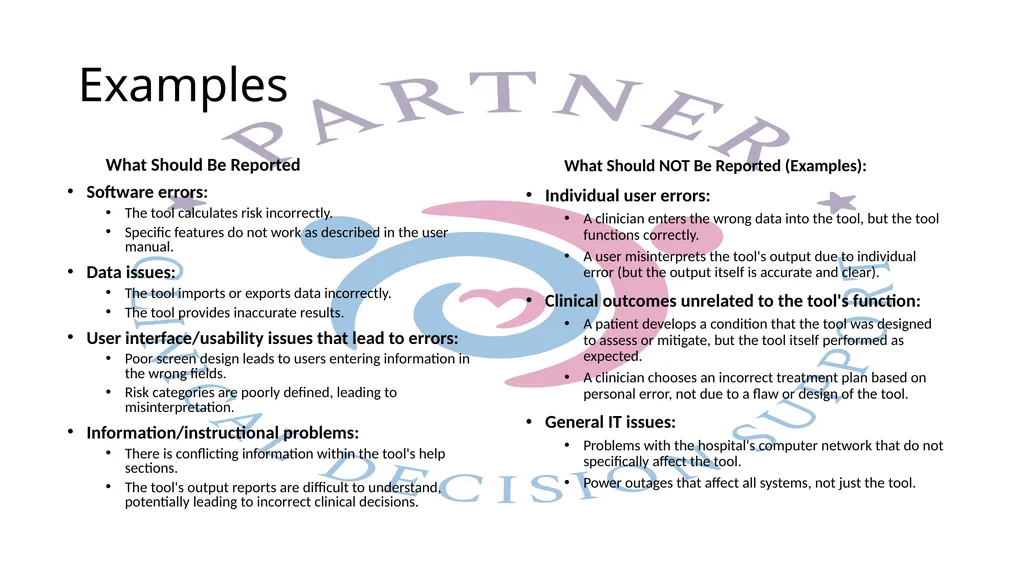
Examples What Should Be Reported
Software errors:
The tool calculates risk incorrectly.
Specific features do not work as described in the user manual.
Data issues:
The tool imports or exports data incorrectly.
The tool provides inaccurate results.
User interface/usability issues that lead to errors:
Poor screen design leads to users entering information in the wrong fields.
Risk categories are poorly defined, leading to misinterpretation.
Information/instructional problems:
There is conflicting information within the tool's help sections.
The tool's output reports are difficult to understand, potentially leading to incorrect clinical decisions. What Should NOT Be Reported (Examples):
Individual user errors:
A clinician enters the wrong data into the tool, but the tool functions correctly.
A user misinterprets the tool's output due to individual error (but the output itself is accurate and clear).
Clinical outcomes unrelated to the tool's function:
A patient develops a condition that the tool was designed to assess or mitigate, but the tool itself performed as expected.
A clinician chooses an incorrect treatment plan based on personal error, not due to a flaw or design of the tool.
General IT issues:
Problems with the hospital's computer network that do not specifically affect the tool.
Power outages that affect all systems, not just the tool.<br>
Software errors:
The tool calculates risk incorrectly.
Specific features do not work as described in the user manual.
Data issues:
The tool imports or exports data incorrectly.
The tool provides inaccurate results.
User interface/usability issues that lead to errors:
Poor screen design leads to users entering information in the wrong fields.
Risk categories are poorly defined, leading to misinterpretation.
Information/instructional problems:
There is conflicting information within the tool's help sections.
The tool's output reports are difficult to understand, potentially leading to incorrect clinical decisions. What Should NOT Be Reported (Examples):
Individual user errors:
A clinician enters the wrong data into the tool, but the tool functions correctly.
A user misinterprets the tool's output due to individual error (but the output itself is accurate and clear).
Clinical outcomes unrelated to the tool's function:
A patient develops a condition that the tool was designed to assess or mitigate, but the tool itself performed as expected.
A clinician chooses an incorrect treatment plan based on personal error, not due to a flaw or design of the tool.
General IT issues:
Problems with the hospital's computer network that do not specifically affect the tool.
Power outages that affect all systems, not just the tool.<br>
28
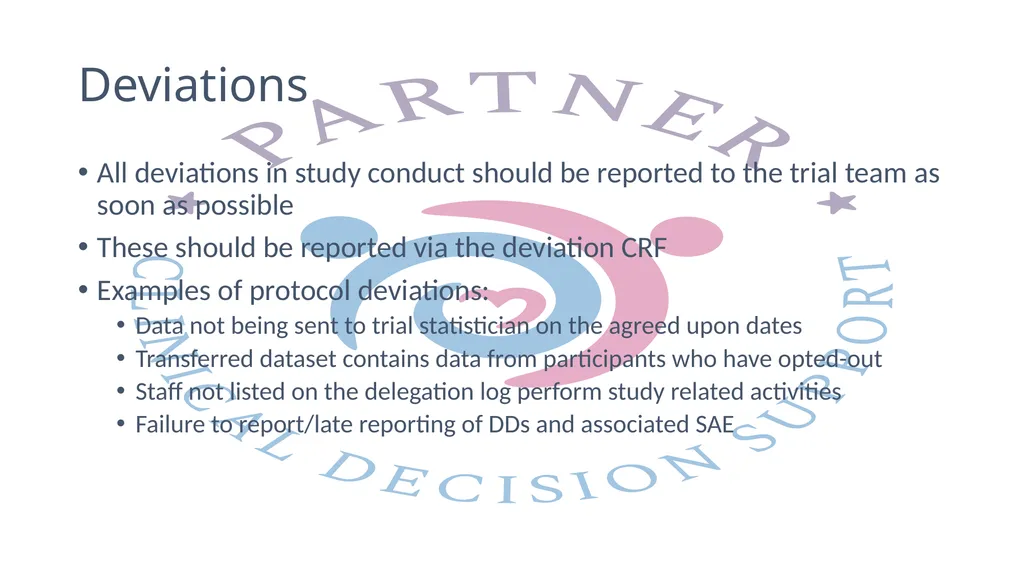
Deviations All deviations in study conduct should be reported to the trial team as soon as possible
These should be reported via the deviation CRF
Examples of protocol deviations:
Data not being sent to trial statistician on the agreed upon dates
Transferred dataset contains data from participants who have opted-out
Staff not listed on the delegation log perform study related activities
Failure to report/late reporting of DDs and associated SAE<br>
These should be reported via the deviation CRF
Examples of protocol deviations:
Data not being sent to trial statistician on the agreed upon dates
Transferred dataset contains data from participants who have opted-out
Staff not listed on the delegation log perform study related activities
Failure to report/late reporting of DDs and associated SAE<br>
29
Essential Study Documents<br>
30
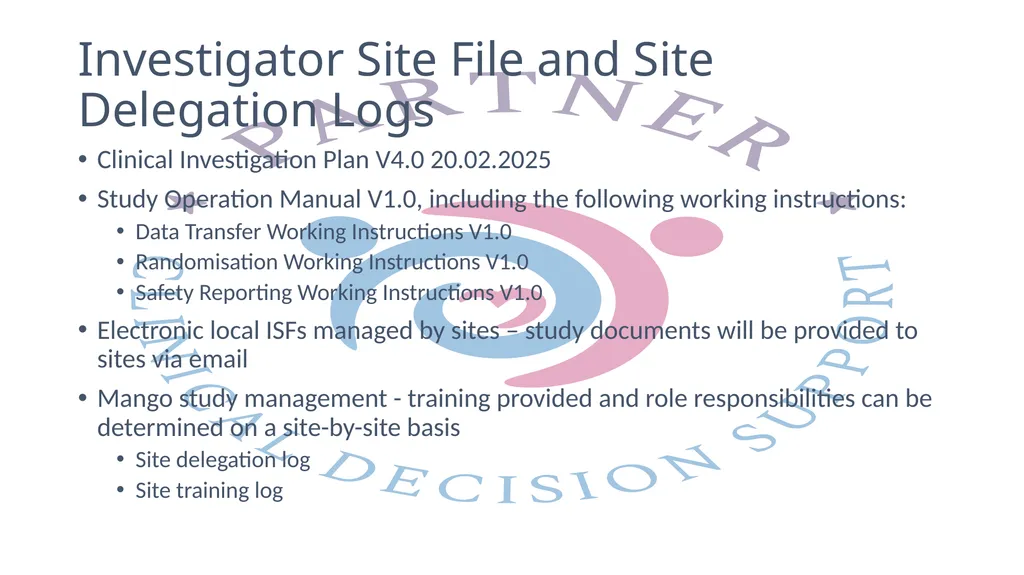
Investigator Site File and Site Delegation Logs Clinical Investigation Plan V4.0 20.02.2025
Study Operation Manual V1.0, including the following working instructions:
Data Transfer Working Instructions V1.0
Randomisation Working Instructions V1.0
Safety Reporting Working Instructions V1.0
Electronic local ISFs managed by sites – study documents will be provided to sites via email
Mango study management - training provided and role responsibilities can be determined on a site-by-site basis
Site delegation log
Site training log<br>
Study Operation Manual V1.0, including the following working instructions:
Data Transfer Working Instructions V1.0
Randomisation Working Instructions V1.0
Safety Reporting Working Instructions V1.0
Electronic local ISFs managed by sites – study documents will be provided to sites via email
Mango study management - training provided and role responsibilities can be determined on a site-by-site basis
Site delegation log
Site training log<br>
31
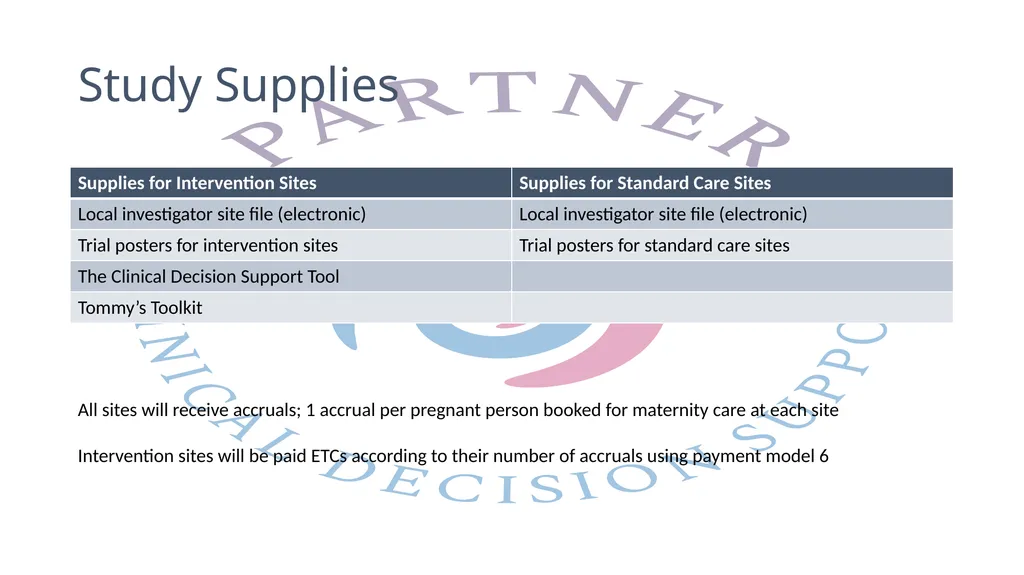
Study Supplies All sites will receive accruals; 1 accrual per pregnant person booked for maternity care at each site
Intervention sites will be paid ETCs according to their number of accruals using payment model 6<br>
Intervention sites will be paid ETCs according to their number of accruals using payment model 6<br>
32
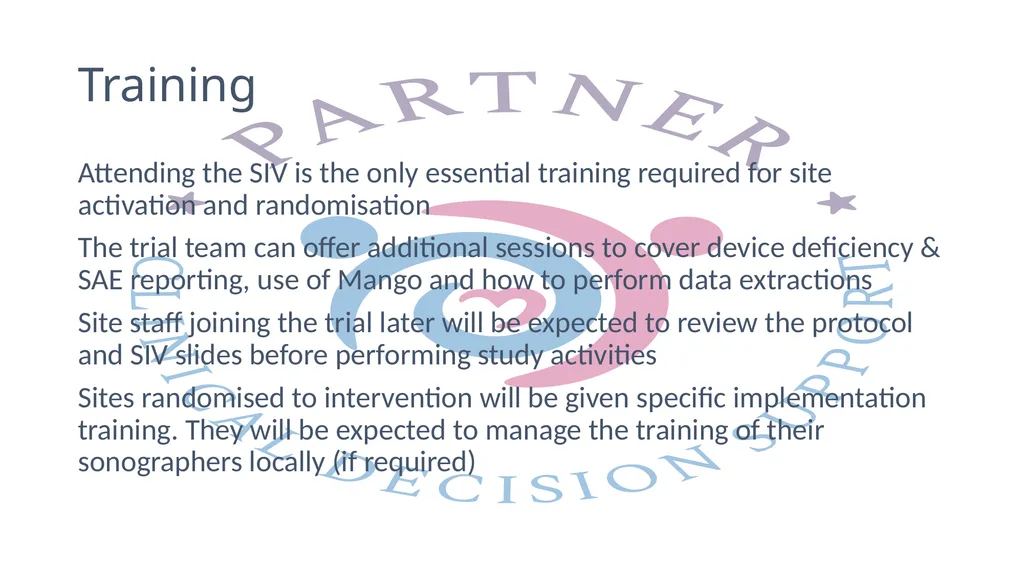
Training Attending the SIV is the only essential training required for site activation and randomisation
The trial team can offer additional sessions to cover device deficiency & SAE reporting, use of Mango and how to perform data extractions
Site staff joining the trial later will be expected to review the protocol and SIV slides before performing study activities
Sites randomised to intervention will be given specific implementation training. They will be expected to manage the training of their sonographers locally (if required)<br>
The trial team can offer additional sessions to cover device deficiency & SAE reporting, use of Mango and how to perform data extractions
Site staff joining the trial later will be expected to review the protocol and SIV slides before performing study activities
Sites randomised to intervention will be given specific implementation training. They will be expected to manage the training of their sonographers locally (if required)<br>
33
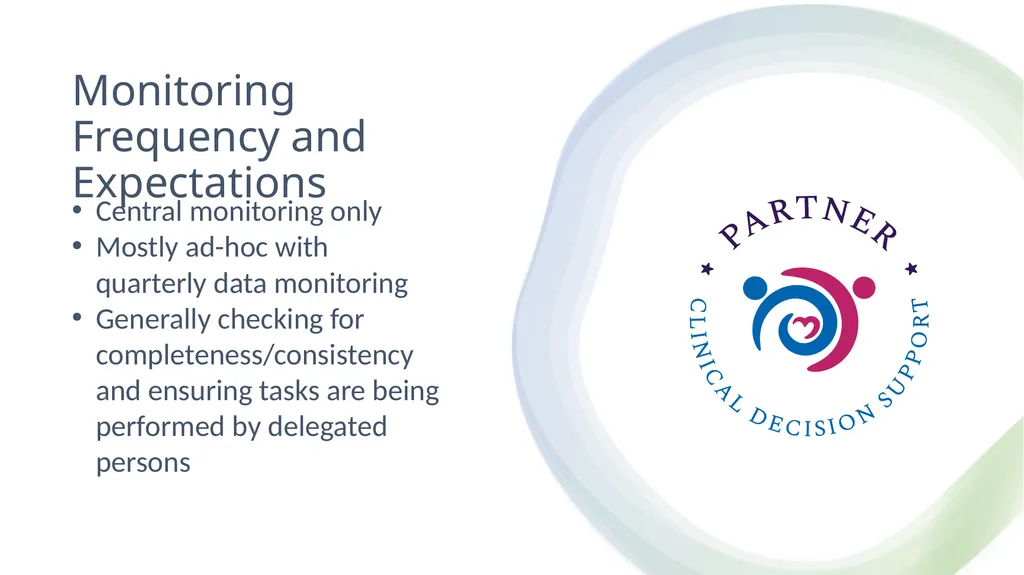
Monitoring Frequency and Expectations Central monitoring only
Mostly ad-hoc with quarterly data monitoring
Generally checking for completeness/consistency and ensuring tasks are being performed by delegated persons<br>
Mostly ad-hoc with quarterly data monitoring
Generally checking for completeness/consistency and ensuring tasks are being performed by delegated persons<br>
34
Patient and Public Involvement (PPI) We have a PPI advisory group with diverse members from various parts of England who are either Experts by Experience, have their own lived experiences or represent MNVPs.
We welcome MNVP representatives from trial sites to join this group to widen membership and ensure that the voices of women and pregnant people in the trial sites are well represented through the trial<br>
We welcome MNVP representatives from trial sites to join this group to widen membership and ensure that the voices of women and pregnant people in the trial sites are well represented through the trial<br>
35
Enrolment Targets and Study Timeline No specific recruitment targets but aim for each site to collect data from ~2,400 participants
Aim to have a minimum of 13 maternity units in each treatment allocation, 26-30 sites total
Current aim for participant recruitment to complete in May 2026 (subject to meeting the intended target)
There will then be a 9 month follow up period after recruitment ends where data will still be collected<br>
Aim to have a minimum of 13 maternity units in each treatment allocation, 26-30 sites total
Current aim for participant recruitment to complete in May 2026 (subject to meeting the intended target)
There will then be a 9 month follow up period after recruitment ends where data will still be collected<br>
36
Study Closure and Archiving Payment for the research activities listed in the mNCA will be provided at the end of site involvement
Study documents will be archived for 5 years following end of study
Identifiable data will only be stored until end of study
Results of the main trial and other work streams will be shared with participating sites and submitted for publication<br>
Study documents will be archived for 5 years following end of study
Identifiable data will only be stored until end of study
Results of the main trial and other work streams will be shared with participating sites and submitted for publication<br>
37
Frequently Asked Questions We have a list of frequently asked questions on our website:
FAQ – PARTNER (bristol.ac.uk)<br>
FAQ – PARTNER (bristol.ac.uk)<br>
38
Mango registration The PARTNER Trial will be using the Mango system for:
Electronic delegation log
CV and GCP certificate upload
Evidence of trial training *Instructions will be sent to sites.<br>
Electronic delegation log
CV and GCP certificate upload
Evidence of trial training *Instructions will be sent to sites.<br>
39
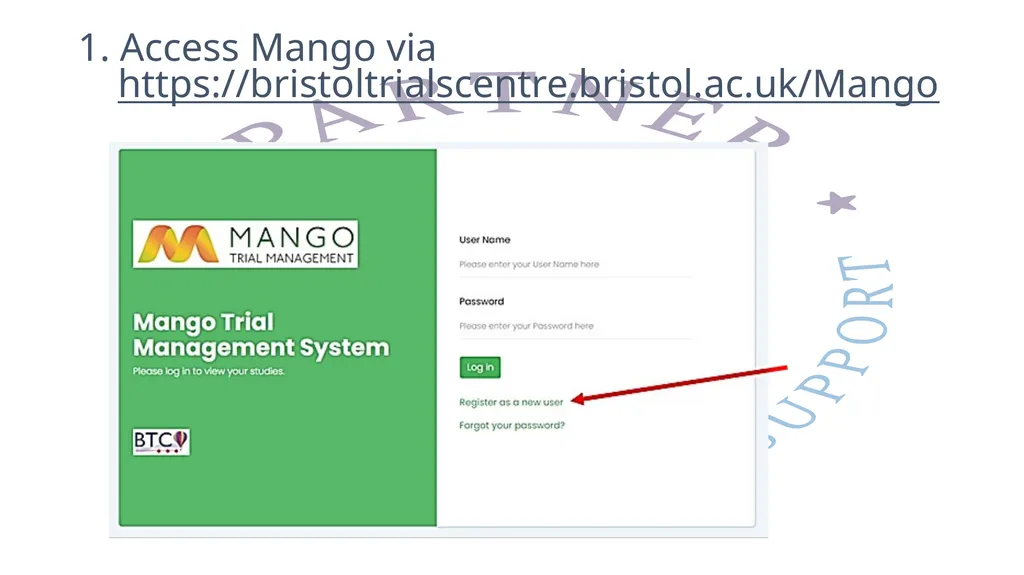
1. Access Mango via
https://bristoltrialscentre.bristol.ac.uk/Mango<br>
40
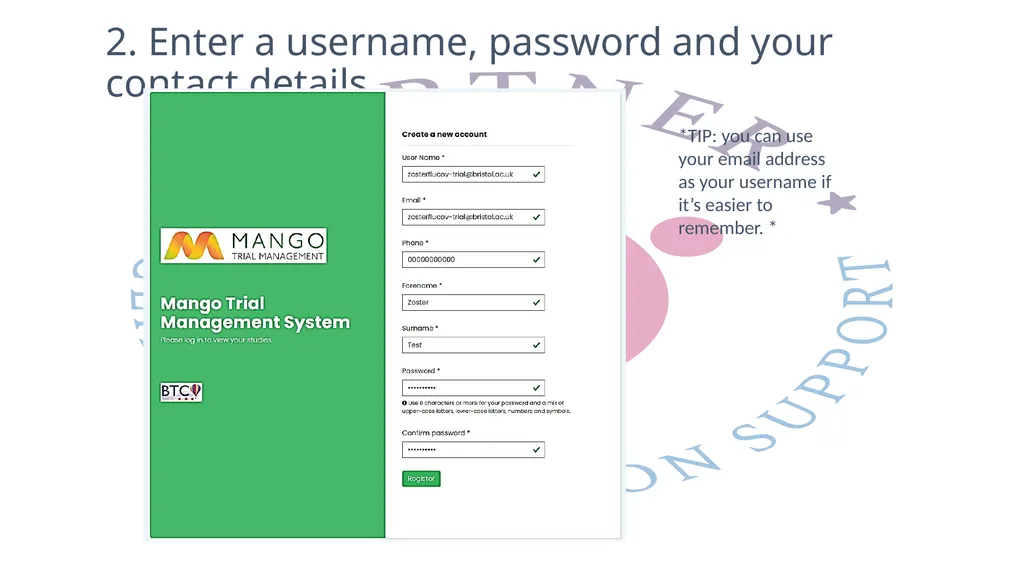
2. Enter a username, password and your contact details *TIP: you can use your email address as your username if it’s easier to remember. *<br>
41
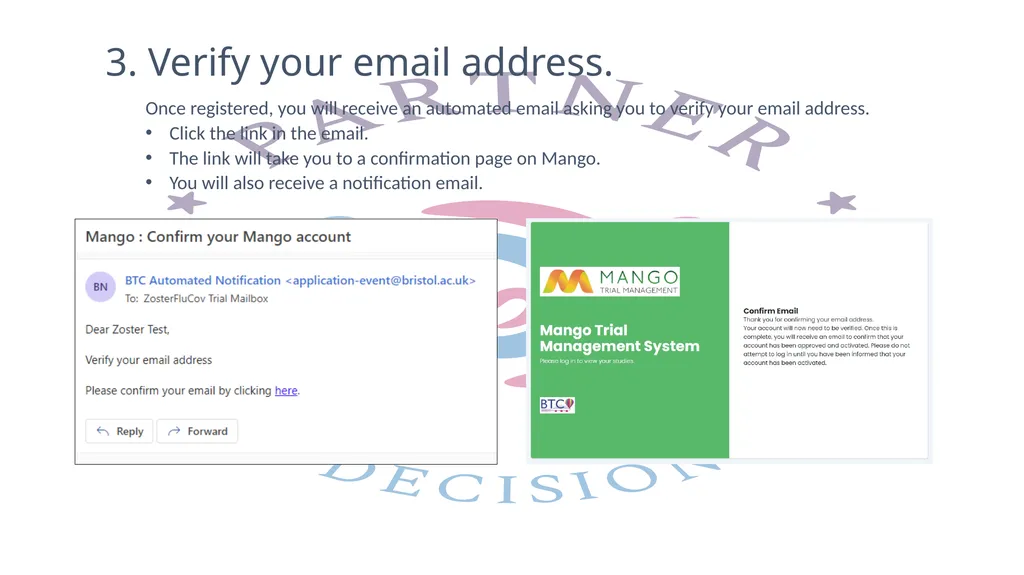
3. Verify your email address. Once registered, you will receive an automated email asking you to verify your email address.
Click the link in the email.
The link will take you to a confirmation page on Mango.
You will also receive a notification email.<br>
Click the link in the email.
The link will take you to a confirmation page on Mango.
You will also receive a notification email.<br>
42
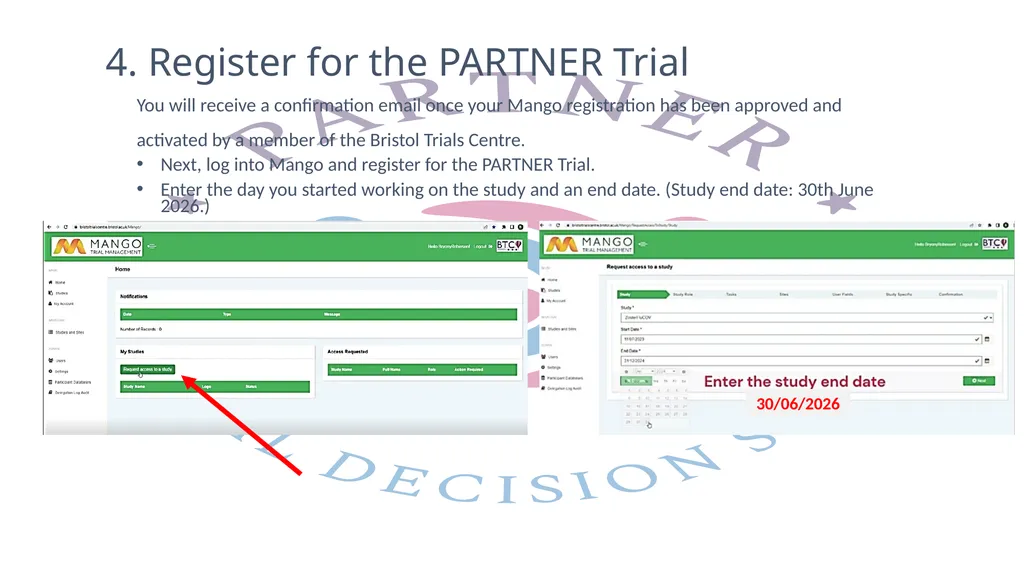
4. Register for the PARTNER Trial You will receive a confirmation email once your Mango registration has been approved and activated by a member of the Bristol Trials Centre.
Next, log into Mango and register for the PARTNER Trial.
Enter the day you started working on the study and an end date. (Study end date: 30th June 2026.) 30/06/2026<br>
Next, log into Mango and register for the PARTNER Trial.
Enter the day you started working on the study and an end date. (Study end date: 30th June 2026.) 30/06/2026<br>
43
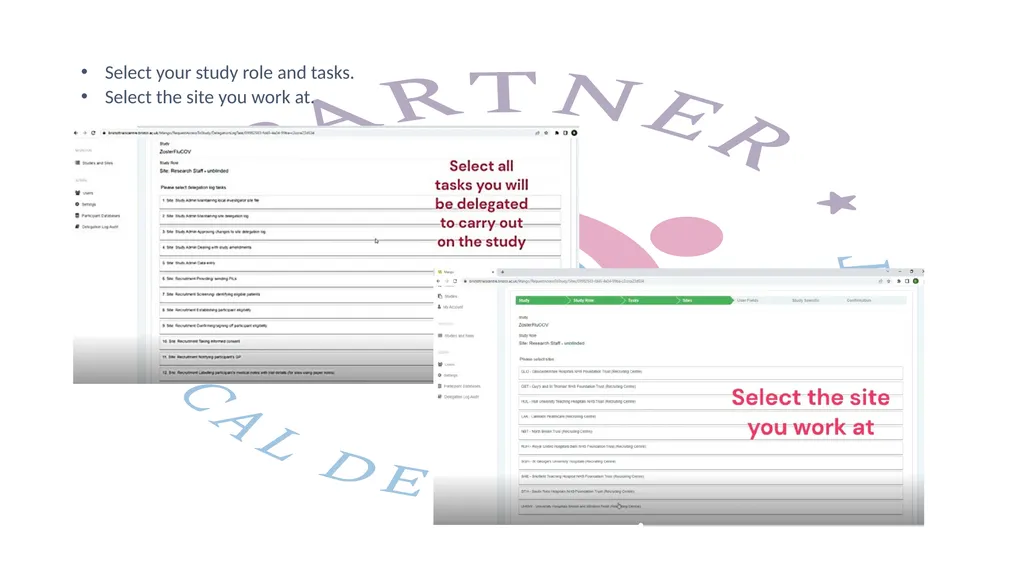
Select your study role and tasks.
Select the site you work at.<br>
Select the site you work at.<br>
44
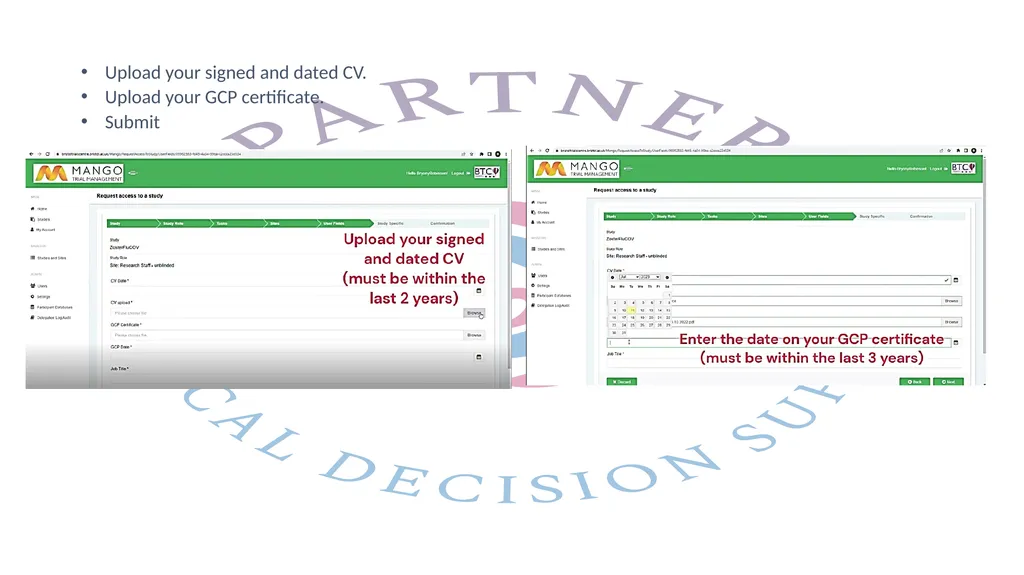
Upload your signed and dated CV.
Upload your GCP certificate.
Submit<br>
Upload your GCP certificate.
Submit<br>
45
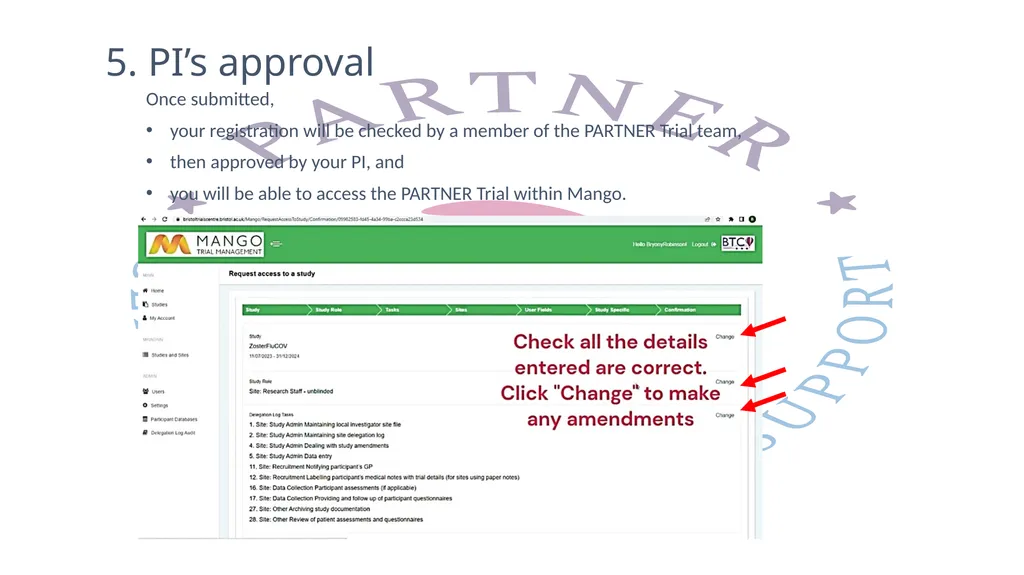
5. PI’s approval Once submitted,
your registration will be checked by a member of the PARTNER Trial team,
then approved by your PI, and
you will be able to access the PARTNER Trial within Mango.<br>
your registration will be checked by a member of the PARTNER Trial team,
then approved by your PI, and
you will be able to access the PARTNER Trial within Mango.<br>
46
Contact Details Thank you for your time!
Please contact the PARTNER coordination team if you have any queries
Email: partner-trial@bristol.ac.uk
Website: https://partnertrial.blogs.bristol.ac.uk/
Instagram: https://www.instagram.com/partner_trial/
Facebook: https://www.facebook.com/profile.php?id=61561106913430
X: https://x.com/PARTNER_Trial<br>
Please contact the PARTNER coordination team if you have any queries
Email: partner-trial@bristol.ac.uk
Website: https://partnertrial.blogs.bristol.ac.uk/
Instagram: https://www.instagram.com/partner_trial/
Facebook: https://www.facebook.com/profile.php?id=61561106913430
X: https://x.com/PARTNER_Trial<br>
47
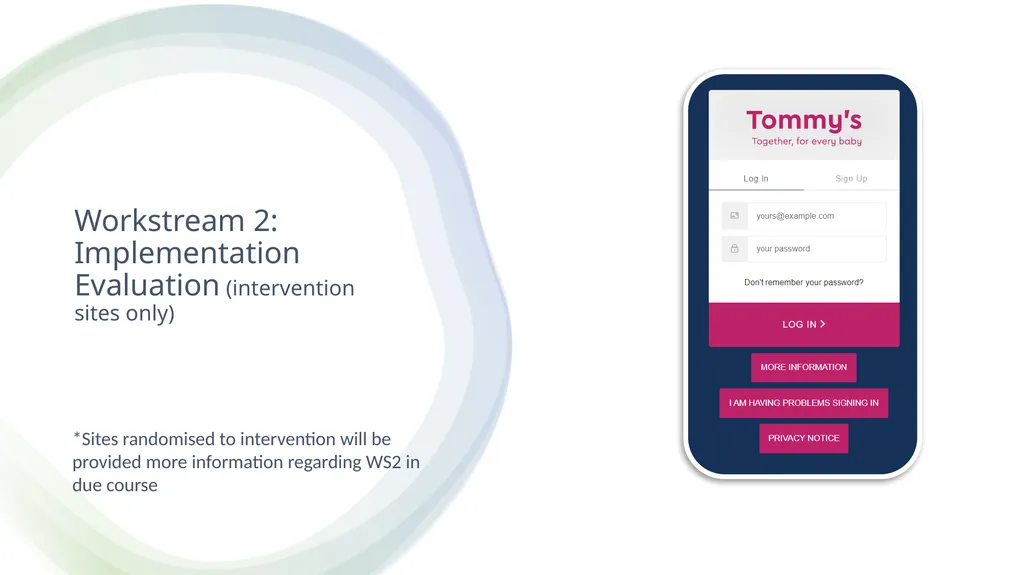
Workstream 2:
Implementation Evaluation (intervention sites only) *Sites randomised to intervention will be provided more information regarding WS2 in due course<br>
48
References Brown MA, Magee LA, Kenny LC, Karumanchi SA, McCarthy FP, Saito S, Hall DR, Warren CE, Adoyi G, Ishaku S; International Society for the Study of Hypertension in Pregnancy (ISSHP). The hypertensive disorders of pregnancy: ISSHP classification, diagnosis & management recommendations for international practice.Pregnancy Hypertens. 2018; 13:291–310.
Leon LJ, McCarthy FP, Direk K, Gonzalez-Izquierdo A, Prieto-Merino D, Casas JP, Chappell L. Preeclampsia and Cardiovascular Disease in a Large UK Pregnancy Cohort of Linked Electronic Health Records: A CALIBER Study. Circulation. 2019 Sep 24;140(13):1050-1060.
MBRRACE-UK Perinatal Mortality Surveillance: Report for births in 2021. https://www.npeu.ox.ac.uk/mbrrace-uk/reports#mbrrace-uk-perinatal-mortality-surveillance-reportfor-births-in-2021 (last accessed 19/10/2023)
World Health Organization. Preterm birth. 2018. https://www.who.int/news-room/factsheets/detail/preterm-birth#cms (accessed June 27 2022).
Poon LC, Wright D, Thornton S, et al. Mini-combined test compared with NICE guidelines for early risk-assessment for pre-eclampsia: the SPREE diagnostic accuracy study. Southampton (UK): NIHR Journals Library; 2020 Nov. (Efficacy and Mechanism Evaluation, No. 7.8.) https://www.ncbi.nlm.nih.gov/books/NBK564204/
Guy, G. P., Leslie, K., Diaz Gomez, D., Forenc, K., Buck, E., Khalil, A., & Thilaganathan, B. (2021). Implementation of routine first trimester combined screening for pre-eclampsia: a clinical effectiveness study. BJOG : an international journal of obstetrics and gynaecology, 128(2), 149–156. https://doi.org/10.1111/1471-0528.16361
Guy, G. P., Leslie, K., Diaz Gomez, D., Forenc, K., Buck, E., Bhide, A., & Thilaganathan, B. (2022). Effect of routine first-trimester combined screening for pre-eclampsia on small-for-gestational-age birth: secondary interrupted time series analysis. Ultrasound in obstetrics & gynecology : the official journal of the International Society of Ultrasound in Obstetrics and Gynecology, 59(1), 55–60. https://doi.org/10.1002/uog.23741
Liu, B., Nadeem, U., Frick, A., Alakaloko, M., Bhide, A., & Thilaganathan, B. (2022). Reducing health inequality in Black, Asian and other minority ethnic pregnant women: impact of first trimester combined screening for placental dysfunction on perinatal mortality. BJOG : an international journal of obstetrics and gynaecology, 129(10), 1750–1756. https://doi.org/10.1111/1471-0528.17109
Carlisle, N., Care, A., Anumba, D. O. C., Dalkin, S., Sandall, J., & Shennan, A. H. (2023). How are hospitals in England caring for women at risk of preterm birth in 2021? The influence of national guidance on preterm birth care in England: a national questionnaire. BMC pregnancy and childbirth, 23(1), 47. https://doi.org/10.1186/s12884-023-05388-w<br>
Leon LJ, McCarthy FP, Direk K, Gonzalez-Izquierdo A, Prieto-Merino D, Casas JP, Chappell L. Preeclampsia and Cardiovascular Disease in a Large UK Pregnancy Cohort of Linked Electronic Health Records: A CALIBER Study. Circulation. 2019 Sep 24;140(13):1050-1060.
MBRRACE-UK Perinatal Mortality Surveillance: Report for births in 2021. https://www.npeu.ox.ac.uk/mbrrace-uk/reports#mbrrace-uk-perinatal-mortality-surveillance-reportfor-births-in-2021 (last accessed 19/10/2023)
World Health Organization. Preterm birth. 2018. https://www.who.int/news-room/factsheets/detail/preterm-birth#cms (accessed June 27 2022).
Poon LC, Wright D, Thornton S, et al. Mini-combined test compared with NICE guidelines for early risk-assessment for pre-eclampsia: the SPREE diagnostic accuracy study. Southampton (UK): NIHR Journals Library; 2020 Nov. (Efficacy and Mechanism Evaluation, No. 7.8.) https://www.ncbi.nlm.nih.gov/books/NBK564204/
Guy, G. P., Leslie, K., Diaz Gomez, D., Forenc, K., Buck, E., Khalil, A., & Thilaganathan, B. (2021). Implementation of routine first trimester combined screening for pre-eclampsia: a clinical effectiveness study. BJOG : an international journal of obstetrics and gynaecology, 128(2), 149–156. https://doi.org/10.1111/1471-0528.16361
Guy, G. P., Leslie, K., Diaz Gomez, D., Forenc, K., Buck, E., Bhide, A., & Thilaganathan, B. (2022). Effect of routine first-trimester combined screening for pre-eclampsia on small-for-gestational-age birth: secondary interrupted time series analysis. Ultrasound in obstetrics & gynecology : the official journal of the International Society of Ultrasound in Obstetrics and Gynecology, 59(1), 55–60. https://doi.org/10.1002/uog.23741
Liu, B., Nadeem, U., Frick, A., Alakaloko, M., Bhide, A., & Thilaganathan, B. (2022). Reducing health inequality in Black, Asian and other minority ethnic pregnant women: impact of first trimester combined screening for placental dysfunction on perinatal mortality. BJOG : an international journal of obstetrics and gynaecology, 129(10), 1750–1756. https://doi.org/10.1111/1471-0528.17109
Carlisle, N., Care, A., Anumba, D. O. C., Dalkin, S., Sandall, J., & Shennan, A. H. (2023). How are hospitals in England caring for women at risk of preterm birth in 2021? The influence of national guidance on preterm birth care in England: a national questionnaire. BMC pregnancy and childbirth, 23(1), 47. https://doi.org/10.1186/s12884-023-05388-w<br>