
PRELIMINARY BUSINESS STUDIES Miss Vidler 2011
CB
Published · 89 slides · 0 views

1 / 1








Description
PRELIMINARY BUSINESS STUDIES Miss Vidler 2011 Preliminary Business Studies Syllabus 2011...outline.... NOTE FOR DIARIES Friday period 2 computer lab 1 Meet at the lab Please put in diaries! Preliminary Business Studies 2011 TERM 1: Nature
Related Topics
Share
Embed code
Download this presentation From Below
"PRELIMINARY BUSINESS STUDIES Miss Vidler 2011" is the property of its rightful owner. Permission is granted to download and print the materials on this website for personal, non-commercial use only, and to display it on your personal computer provided you do not modify the materials and that you retain all copyright notices contained in the materials. By downloading content from our website, you accept the terms of this agreement.
Presentation Transcript
01
PRELIMINARY BUSINESS STUDIES Miss Vidler 2011<br>
02
Preliminary Business Studies Syllabus 2011...outline....<br>
03
NOTE FOR DIARIES Friday period 2 computer lab #1
Meet at the lab
Please put in diaries!<br>
Meet at the lab
Please put in diaries!<br>
04
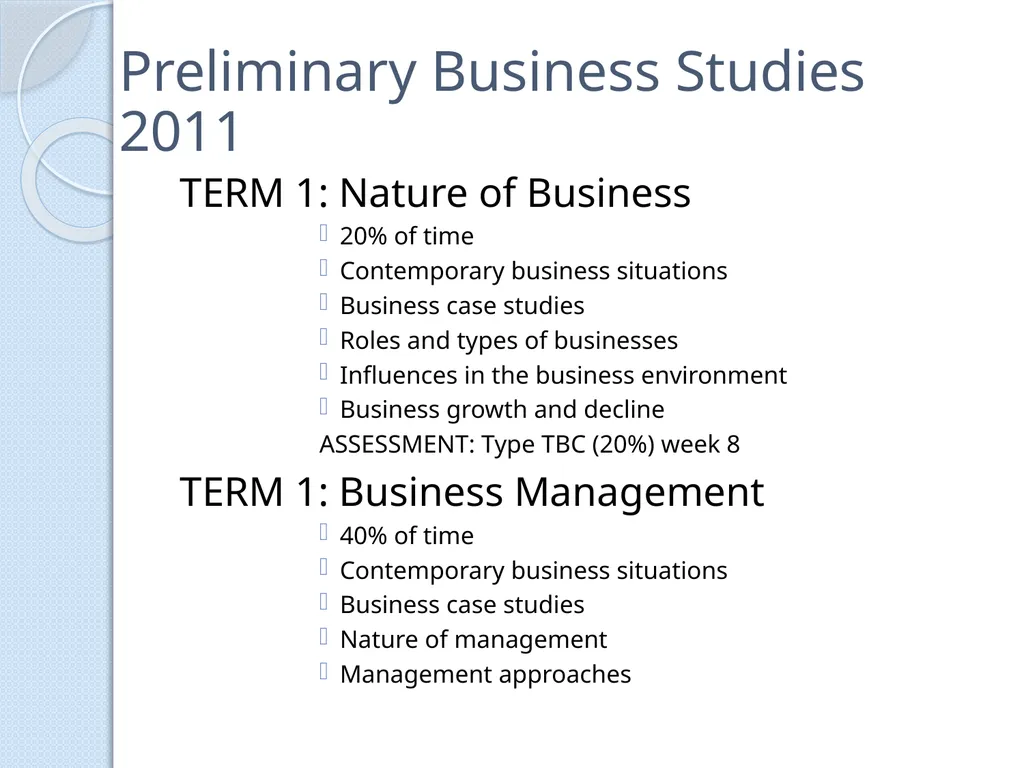
Preliminary Business Studies 2011 TERM 1: Nature of Business
20% of time
Contemporary business situations
Business case studies
Roles and types of businesses
Influences in the business environment
Business growth and decline
ASSESSMENT: Type TBC (20%) week 8
TERM 1: Business Management
40% of time
Contemporary business situations
Business case studies
Nature of management
Management approaches<br>
20% of time
Contemporary business situations
Business case studies
Roles and types of businesses
Influences in the business environment
Business growth and decline
ASSESSMENT: Type TBC (20%) week 8
TERM 1: Business Management
40% of time
Contemporary business situations
Business case studies
Nature of management
Management approaches<br>
05
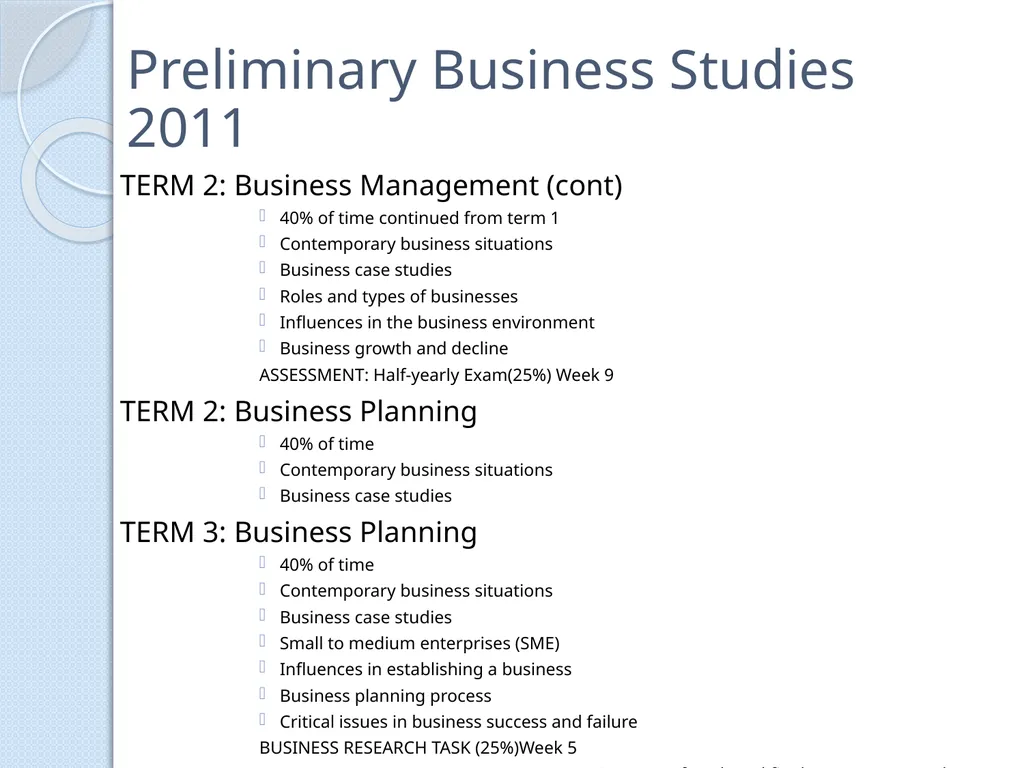
Preliminary Business Studies 2011 TERM 2: Business Management (cont)
40% of time continued from term 1
Contemporary business situations
Business case studies
Roles and types of businesses
Influences in the business environment
Business growth and decline
ASSESSMENT: Half-yearly Exam(25%) Week 9
TERM 2: Business Planning
40% of time
Contemporary business situations
Business case studies
TERM 3: Business Planning
40% of time
Contemporary business situations
Business case studies
Small to medium enterprises (SME)
Influences in establishing a business
Business planning process
Critical issues in business success and failure
BUSINESS RESEARCH TASK (25%)Week 5
PRELIMINARY COURSE YEARLY EXAMINATION (30%): fourth and final assessment Week 9<br>
40% of time continued from term 1
Contemporary business situations
Business case studies
Roles and types of businesses
Influences in the business environment
Business growth and decline
ASSESSMENT: Half-yearly Exam(25%) Week 9
TERM 2: Business Planning
40% of time
Contemporary business situations
Business case studies
TERM 3: Business Planning
40% of time
Contemporary business situations
Business case studies
Small to medium enterprises (SME)
Influences in establishing a business
Business planning process
Critical issues in business success and failure
BUSINESS RESEARCH TASK (25%)Week 5
PRELIMINARY COURSE YEARLY EXAMINATION (30%): fourth and final assessment Week 9<br>
06
TERM 4:
HSC Course begins! Preliminary Business Studies 2011<br>
HSC Course begins! Preliminary Business Studies 2011<br>
07
Prelim Business Studies Syllabus Outline
Assessment Outline
Media File instructions
Business Research Task
Homework Programme
"Continuous effort- not strength or intelligence is the key to unlocking our Potential.”
Churchill<br>
Assessment Outline
Media File instructions
Business Research Task
Homework Programme
"Continuous effort- not strength or intelligence is the key to unlocking our Potential.”
Churchill<br>
08
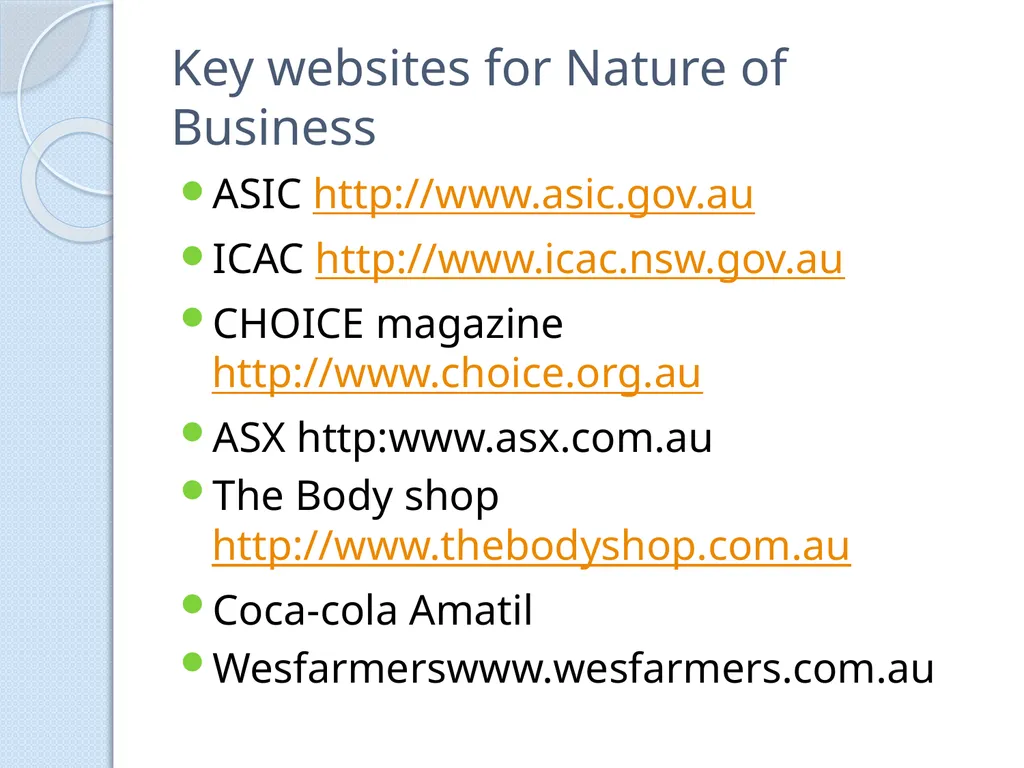
Key websites for Nature of Business ASIC http://www.asic.gov.au
ICAC http://www.icac.nsw.gov.au
CHOICE magazine http://www.choice.org.au
ASX http:www.asx.com.au
The Body shop http://www.thebodyshop.com.au
Coca-cola Amatil
Wesfarmerswww.wesfarmers.com.au<br>
ICAC http://www.icac.nsw.gov.au
CHOICE magazine http://www.choice.org.au
ASX http:www.asx.com.au
The Body shop http://www.thebodyshop.com.au
Coca-cola Amatil
Wesfarmerswww.wesfarmers.com.au<br>
09
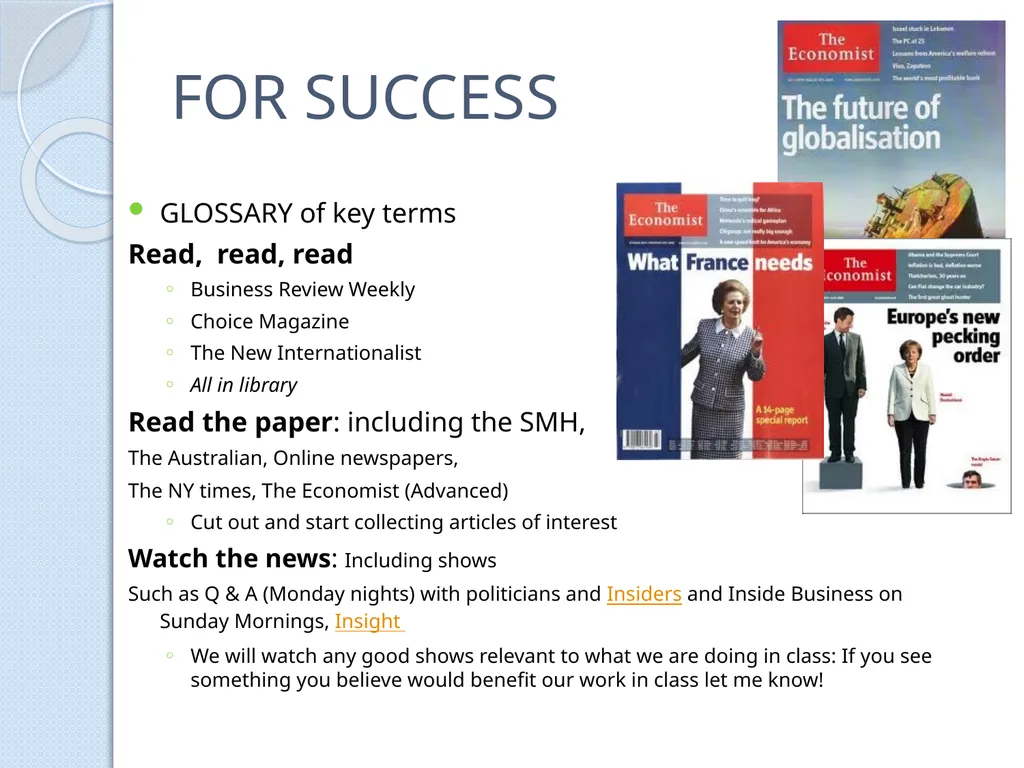
FOR SUCCESS GLOSSARY of key terms
Read, read, read
Business Review Weekly
Choice Magazine
The New Internationalist
All in library
Read the paper: including the SMH,
The Australian, Online newspapers,
The NY times, The Economist (Advanced)
Cut out and start collecting articles of interest
Watch the news: Including shows
Such as Q & A (Monday nights) with politicians and Insiders and Inside Business on Sunday Mornings, Insight
We will watch any good shows relevant to what we are doing in class: If you see something you believe would benefit our work in class let me know!<br>
Read, read, read
Business Review Weekly
Choice Magazine
The New Internationalist
All in library
Read the paper: including the SMH,
The Australian, Online newspapers,
The NY times, The Economist (Advanced)
Cut out and start collecting articles of interest
Watch the news: Including shows
Such as Q & A (Monday nights) with politicians and Insiders and Inside Business on Sunday Mornings, Insight
We will watch any good shows relevant to what we are doing in class: If you see something you believe would benefit our work in class let me know!<br>
10
FOR SUCCESS Business annual reports
Your connections with local entrepreneurs
Legal resources
Collect any business magazines
Get familiar with different websites: esp SMH business, The Australian Business<br>
Your connections with local entrepreneurs
Legal resources
Collect any business magazines
Get familiar with different websites: esp SMH business, The Australian Business<br>
11
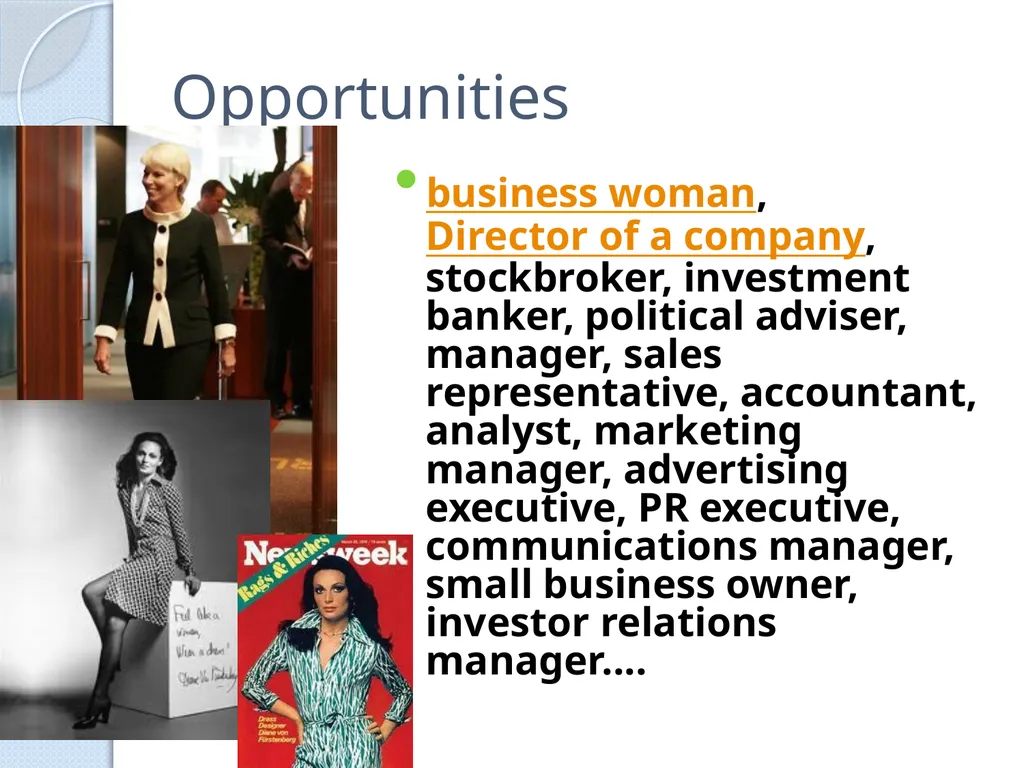
Opportunities business woman, Director of a company, stockbroker, investment banker, political adviser, manager, sales representative, accountant, analyst, marketing manager, advertising executive, PR executive, communications manager, small business owner, investor relations manager....<br>
12
The nature of business
The focus of this topic is the role and nature of business in a changing business environment.
Use your existing knowledge: you may know more than you think! Outcomes
The student:
P1 discusses the nature of business, its role in society and types of business structure
P2 explains the internal and external influences on businesses
P6 analyses the responsibilities of business to internal and external stakeholders
P7 plans and conducts investigations into contemporary business issues
P8 evaluates information for actual and hypothetical business situations
Content
Students learn to:
examine contemporary business issues to:
discuss the global expansion of one Australian business
discuss the expansion into Australia of one global business
explain how changes in external influences have contributed to the growth of the tertiary, quaternary and quinary industries in Australia
identify problems that arise for stakeholders when companies go into liquidation
investigate aspects of business using hypothetical situations and actual business case studies to:
distinguish between the different types of businesses
identify actual businesses at different stages in the business life cycle
outline possible business strategies appropriate for different stages in the business life cycle<br>
The student:
P1 discusses the nature of business, its role in society and types of business structure
P2 explains the internal and external influences on businesses
P6 analyses the responsibilities of business to internal and external stakeholders
P7 plans and conducts investigations into contemporary business issues
P8 evaluates information for actual and hypothetical business situations
Content
Students learn to:
examine contemporary business issues to:
discuss the global expansion of one Australian business
discuss the expansion into Australia of one global business
explain how changes in external influences have contributed to the growth of the tertiary, quaternary and quinary industries in Australia
identify problems that arise for stakeholders when companies go into liquidation
investigate aspects of business using hypothetical situations and actual business case studies to:
distinguish between the different types of businesses
identify actual businesses at different stages in the business life cycle
outline possible business strategies appropriate for different stages in the business life cycle<br>
13
The nature of business:
The Role of Business What is business?
Person’s occupation, behaviour when buying and selling, trade and commerce, firms activity. English word: ‘To do things’
BUYING AND SELLING
Sellers:
How to sell and receive income
Buyers
How to get what you want
All businesses offer something to the community; no matter how big or small, businesses are crucial to the successful functioning of society.
Business: Producing goods and services
Q: Where would Government without business?<br>
Person’s occupation, behaviour when buying and selling, trade and commerce, firms activity. English word: ‘To do things’
BUYING AND SELLING
Sellers:
How to sell and receive income
Buyers
How to get what you want
All businesses offer something to the community; no matter how big or small, businesses are crucial to the successful functioning of society.
Business: Producing goods and services
Q: Where would Government without business?<br>
14
Australia’s largest employers Figures in text.p.6
Woolworths largest employer 94 000 employees
Australia’s biggest company is BHP Billiton with over 33 000 employees.
Small business employ more Australians than big business overall (retail)
Businesses with fewer than 100 employees employ over 42% of the workforce<br>
Woolworths largest employer 94 000 employees
Australia’s biggest company is BHP Billiton with over 33 000 employees.
Small business employ more Australians than big business overall (retail)
Businesses with fewer than 100 employees employ over 42% of the workforce<br>
15
Activity: Australia’s top 10 employers List Australia’s top 10 employers and investigate their core activities
Woolworths
Coles Myer
Queensland Health
Telstra
National Australia Bank
Commonwealth Bank Group
Australia Post
Qantas
BHP Billiton
ANZ Banking Group
Which of these companies is in the ‘private sector’ and which in the ‘public sector’?<br>
Woolworths
Coles Myer
Queensland Health
Telstra
National Australia Bank
Commonwealth Bank Group
Australia Post
Qantas
BHP Billiton
ANZ Banking Group
Which of these companies is in the ‘private sector’ and which in the ‘public sector’?<br>
16
Nature of business Innovation:
Competitive edge always, constant ideas
R&D
Cochlear
Choice:
'It's choice – not chance – that determines your destiny.‘ – Jean Nidetch
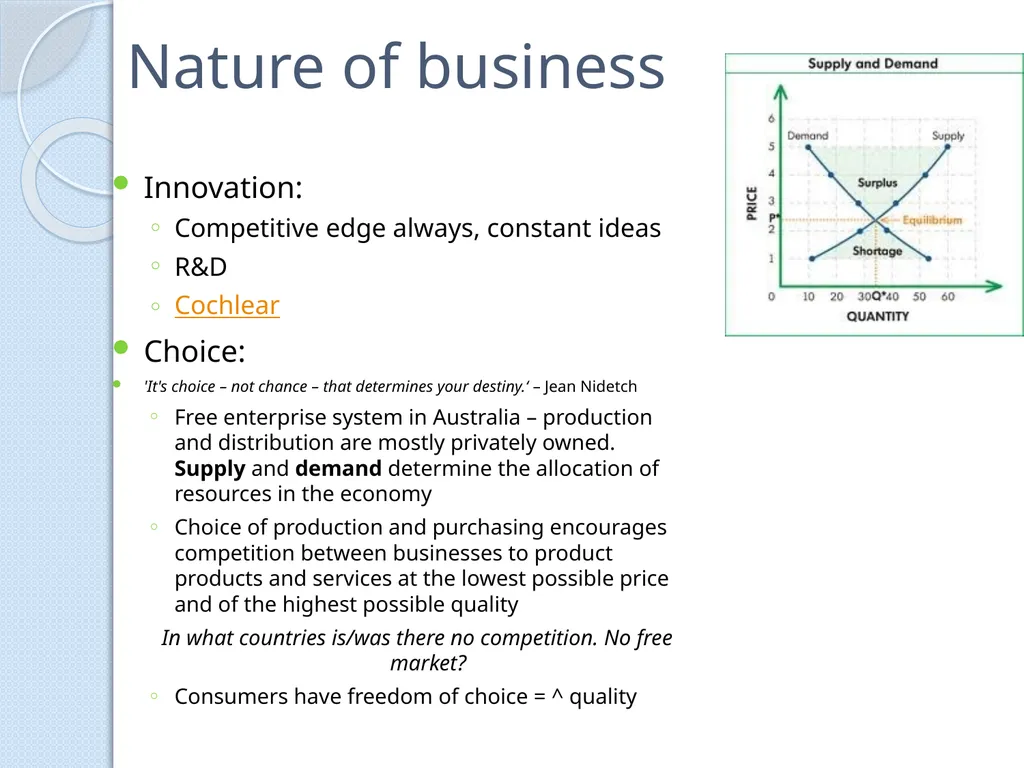
Free enterprise system in Australia – production and distribution are mostly privately owned. Supply and demand determine the allocation of resources in the economy
Choice of production and purchasing encourages competition between businesses to product products and services at the lowest possible price and of the highest possible quality
In what countries is/was there no competition. No free market?
Consumers have freedom of choice = ^ quality<br>
Competitive edge always, constant ideas
R&D
Cochlear
Choice:
'It's choice – not chance – that determines your destiny.‘ – Jean Nidetch
Free enterprise system in Australia – production and distribution are mostly privately owned. Supply and demand determine the allocation of resources in the economy
Choice of production and purchasing encourages competition between businesses to product products and services at the lowest possible price and of the highest possible quality
In what countries is/was there no competition. No free market?
Consumers have freedom of choice = ^ quality<br>
17
Nature of business Entrepreneurship
What defines an entrepreneur? Risk taker? Creativity? Determination? Energy? Passion? Contacts?
What entrepreneurs can you think of and what qualifications did they have?
Steve Jobs
Entrepreneurs must combine resources of land, labour and capital to produce a product
Quality of life
Products and services increase the quality of life for all Australians. Business provides us to a range of goods that we could not create ourselves<br>
What defines an entrepreneur? Risk taker? Creativity? Determination? Energy? Passion? Contacts?
What entrepreneurs can you think of and what qualifications did they have?
Steve Jobs
Entrepreneurs must combine resources of land, labour and capital to produce a product
Quality of life
Products and services increase the quality of life for all Australians. Business provides us to a range of goods that we could not create ourselves<br>
18
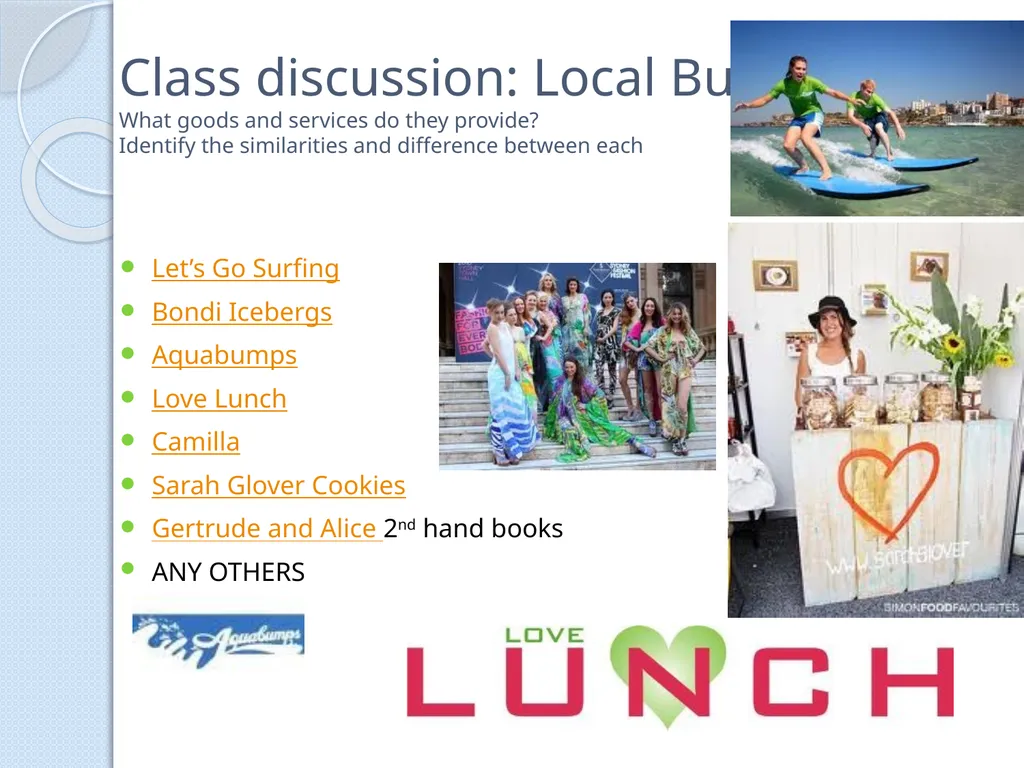
Class discussion: Local Businesses
What goods and services do they provide?
Identify the similarities and difference between each Let’s Go Surfing
Bondi Icebergs
Aquabumps
Love Lunch
Camilla
Sarah Glover Cookies
Gertrude and Alice 2nd hand books
ANY OTHERS<br>
Bondi Icebergs
Aquabumps
Love Lunch
Camilla
Sarah Glover Cookies
Gertrude and Alice 2nd hand books
ANY OTHERS<br>
19
Is a school a business? An example of the Strategic Plan of a School
Short paragraph on: Is school a business? short answer response<br>
Short paragraph on: Is school a business? short answer response<br>
20
The role and importance of business: recap Entrepreneurship
Innovation
Employment
Provider of goods and services
Source of government revenue
Wealth creation
Quality of life
Choice
Copy table on p. 9 and give examples of each one. EG. 1. Entrepreneurship, Camilla Franks, 2. Innovation, Bionic Ear.<br>
Innovation
Employment
Provider of goods and services
Source of government revenue
Wealth creation
Quality of life
Choice
Copy table on p. 9 and give examples of each one. EG. 1. Entrepreneurship, Camilla Franks, 2. Innovation, Bionic Ear.<br>
21
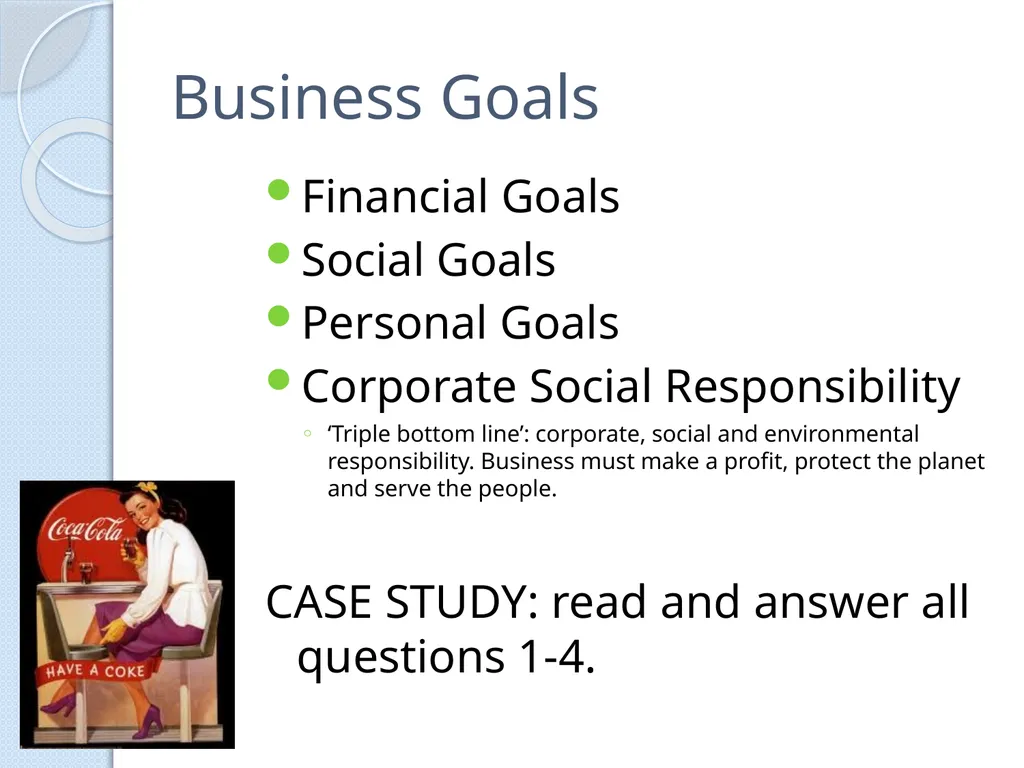
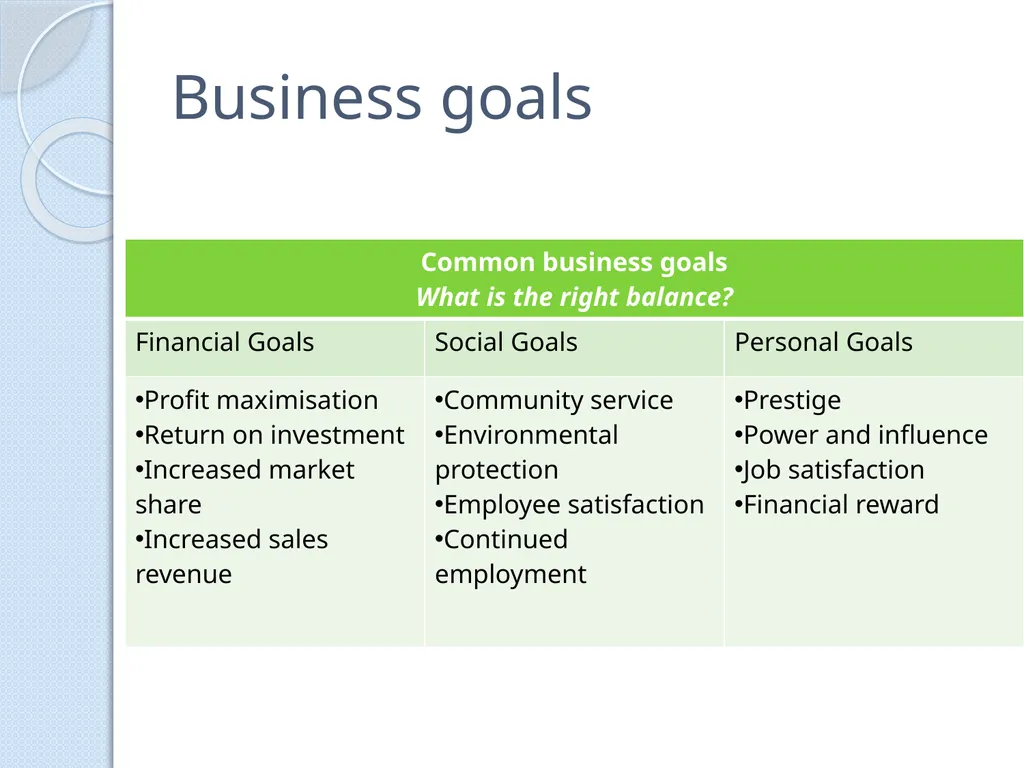
Business Goals Financial Goals
Social Goals
Personal Goals
Corporate Social Responsibility
‘Triple bottom line’: corporate, social and environmental responsibility. Business must make a profit, protect the planet and serve the people.
CASE STUDY: read and answer all questions 1-4.<br>
Social Goals
Personal Goals
Corporate Social Responsibility
‘Triple bottom line’: corporate, social and environmental responsibility. Business must make a profit, protect the planet and serve the people.
CASE STUDY: read and answer all questions 1-4.<br>
22
CASE STUDY Veuve Clicquot Award (p 11-12 txt)
Read together and answer questions 1-3 individually
Describe the qualities of a person who would be nominated for the Veuve Clicquot Award.
Research one of the finalist for the award and explain to the class why this woman deserves to win the award
Explain the qualities Sarina Bratton has that make her a good businesswoman<br>
Read together and answer questions 1-3 individually
Describe the qualities of a person who would be nominated for the Veuve Clicquot Award.
Research one of the finalist for the award and explain to the class why this woman deserves to win the award
Explain the qualities Sarina Bratton has that make her a good businesswoman<br>
23
Business Goals Financial Goals
Social Goals
Personal Goals
Corporate Social Responsibility
‘Triple bottom line’: corporate, social and environmental responsibility. Business must make a profit, protect the planet and serve the people.
CASE STUDY: read and answer all questions 1-4.<br>
Social Goals
Personal Goals
Corporate Social Responsibility
‘Triple bottom line’: corporate, social and environmental responsibility. Business must make a profit, protect the planet and serve the people.
CASE STUDY: read and answer all questions 1-4.<br>
24
Business goals<br>
25
Stakeholders Every business, through its range of functions or operations, serves the interest of customers, owners, employees, suppliers, creditors, governments, society and even competitors: STAKEHOLDERS as they have a stake in the continuing successful operation of the business
See figure 1.1.10 the importance of business to stakeholders<br>
See figure 1.1.10 the importance of business to stakeholders<br>
26
Wednesday 9 February Business reports!
1.1 review for homework tonight
Today introduce new topic: Types of business<br>
1.1 review for homework tonight
Today introduce new topic: Types of business<br>
27
Business Reports on companies: feedback Spelling! Capitals! Punctuation! Which Grammatical person?! Be consistent
Ensure you have only listed highlights. Is the information you are including in your report really vital? Make sure it is! Be fussy. Think don’t just copy.<br>
Ensure you have only listed highlights. Is the information you are including in your report really vital? Make sure it is! Be fussy. Think don’t just copy.<br>
28
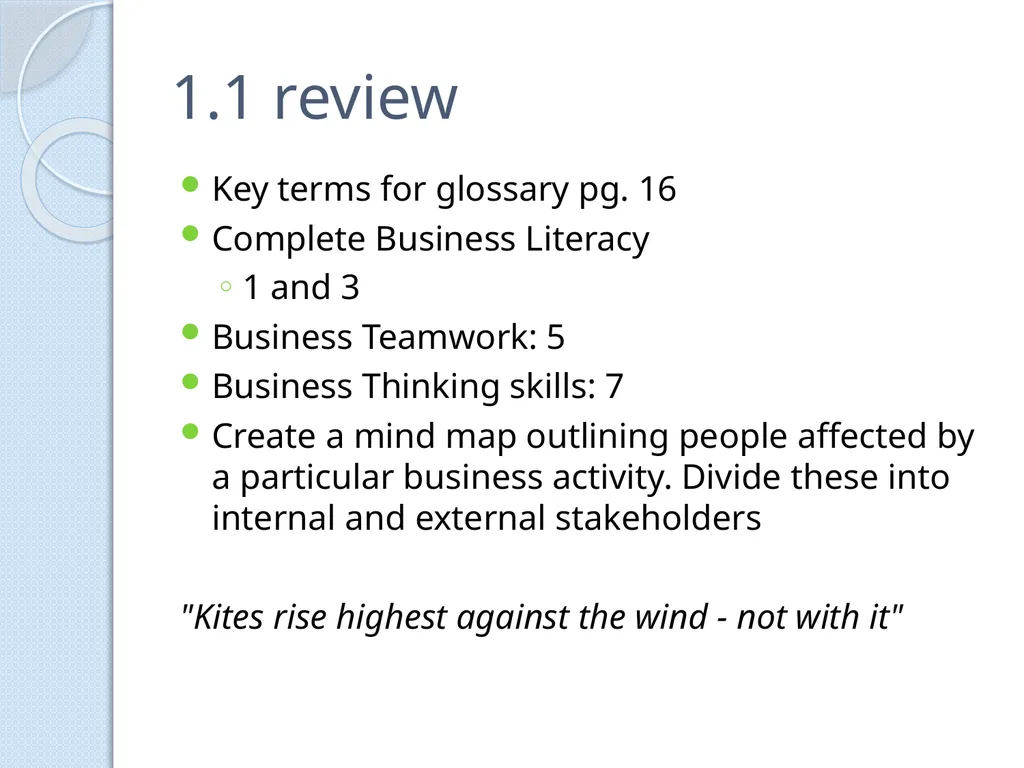
1.1 review Key terms for glossary pg. 16
Complete Business Literacy
1 and 3
Business Teamwork: 5
Business Thinking skills: 7
Create a mind map outlining people affected by a particular business activity. Divide these into internal and external stakeholders
"Kites rise highest against the wind - not with it"<br>
Complete Business Literacy
1 and 3
Business Teamwork: 5
Business Thinking skills: 7
Create a mind map outlining people affected by a particular business activity. Divide these into internal and external stakeholders
"Kites rise highest against the wind - not with it"<br>
29
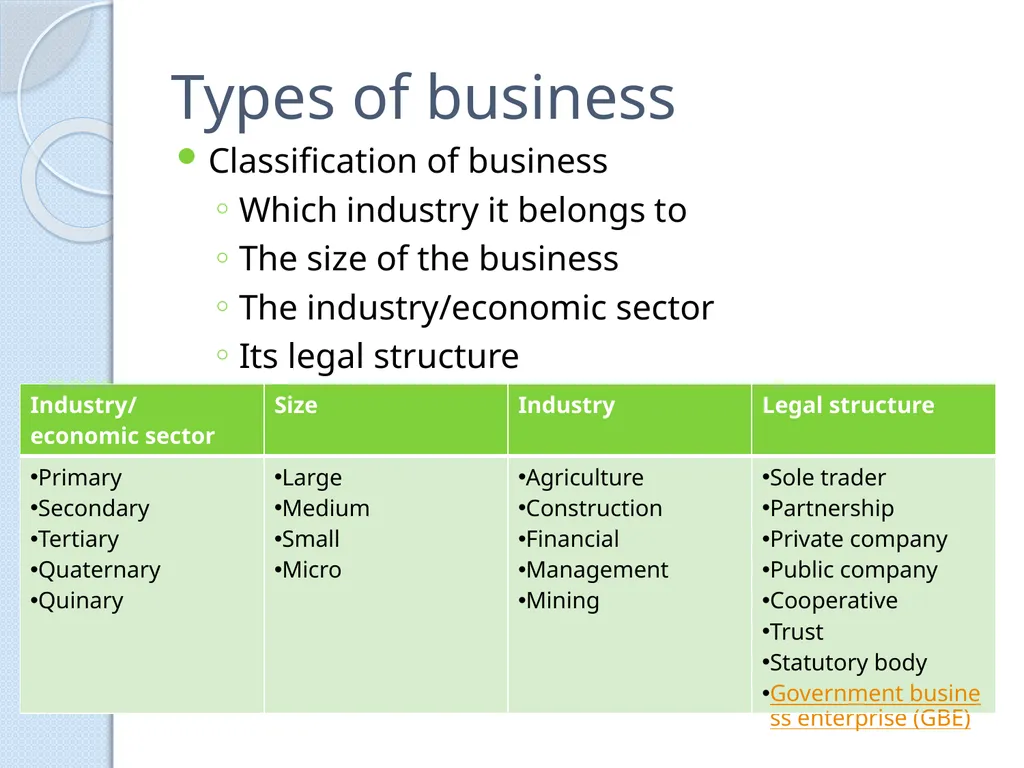
Types of business Classification of business
Which industry it belongs to
The size of the business
The industry/economic sector
Its legal structure<br>
Which industry it belongs to
The size of the business
The industry/economic sector
Its legal structure<br>
30
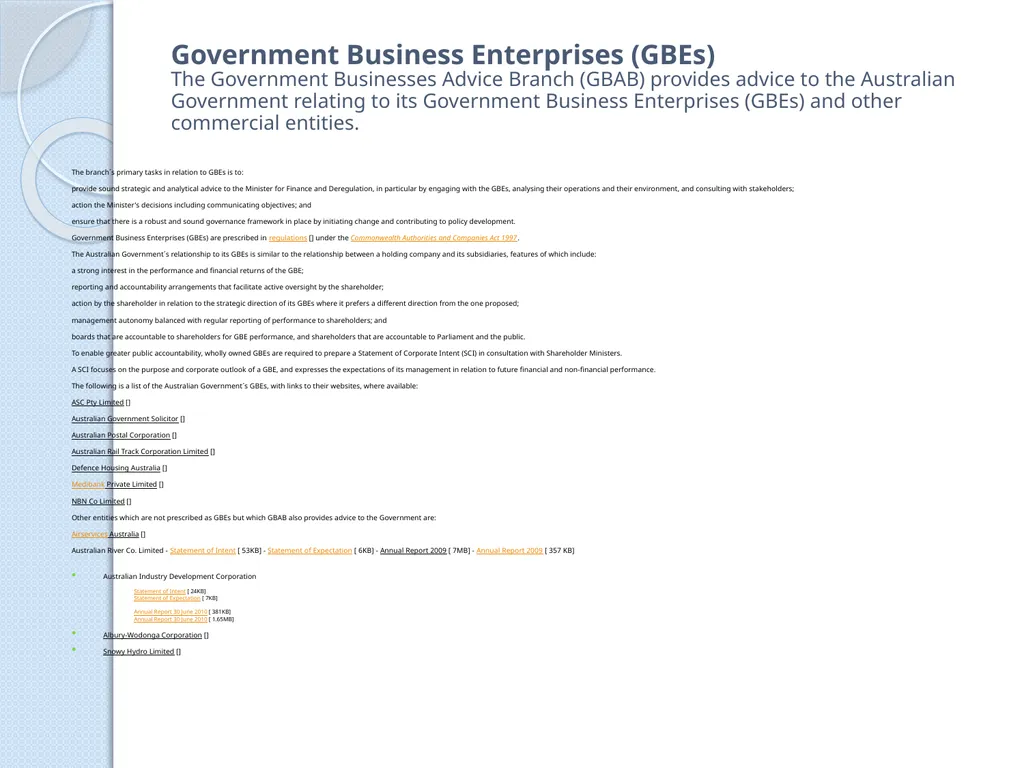
Government Business Enterprises (GBEs)
The Government Businesses Advice Branch (GBAB) provides advice to the Australian Government relating to its Government Business Enterprises (GBEs) and other commercial entities. The branch´s primary tasks in relation to GBEs is to:
provide sound strategic and analytical advice to the Minister for Finance and Deregulation, in particular by engaging with the GBEs, analysing their operations and their environment, and consulting with stakeholders;
action the Minister's decisions including communicating objectives; and
ensure that there is a robust and sound governance framework in place by initiating change and contributing to policy development.
Government Business Enterprises (GBEs) are prescribed in regulations [] under the Commonwealth Authorities and Companies Act 1997.
The Australian Government´s relationship to its GBEs is similar to the relationship between a holding company and its subsidiaries, features of which include:
a strong interest in the performance and financial returns of the GBE;
reporting and accountability arrangements that facilitate active oversight by the shareholder;
action by the shareholder in relation to the strategic direction of its GBEs where it prefers a different direction from the one proposed;
management autonomy balanced with regular reporting of performance to shareholders; and
boards that are accountable to shareholders for GBE performance, and shareholders that are accountable to Parliament and the public.
To enable greater public accountability, wholly owned GBEs are required to prepare a Statement of Corporate Intent (SCI) in consultation with Shareholder Ministers.
A SCI focuses on the purpose and corporate outlook of a GBE, and expresses the expectations of its management in relation to future financial and non-financial performance.
The following is a list of the Australian Government´s GBEs, with links to their websites, where available:
ASC Pty Limited []
Australian Government Solicitor []
Australian Postal Corporation []
Australian Rail Track Corporation Limited []
Defence Housing Australia []
Medibank Private Limited []
NBN Co Limited []
Other entities which are not prescribed as GBEs but which GBAB also provides advice to the Government are:
Airservices Australia []
Australian River Co. Limited - Statement of Intent [ 53KB] - Statement of Expectation [ 6KB] - Annual Report 2009 [ 7MB] - Annual Report 2009 [ 357 KB]
Australian Industry Development Corporation
Statement of Intent [ 24KB] Statement of Expectation [ 7KB]
Annual Report 30 June 2010 [ 381KB] Annual Report 30 June 2010 [ 1.65MB]
Albury-Wodonga Corporation []
Snowy Hydro Limited []<br>
provide sound strategic and analytical advice to the Minister for Finance and Deregulation, in particular by engaging with the GBEs, analysing their operations and their environment, and consulting with stakeholders;
action the Minister's decisions including communicating objectives; and
ensure that there is a robust and sound governance framework in place by initiating change and contributing to policy development.
Government Business Enterprises (GBEs) are prescribed in regulations [] under the Commonwealth Authorities and Companies Act 1997.
The Australian Government´s relationship to its GBEs is similar to the relationship between a holding company and its subsidiaries, features of which include:
a strong interest in the performance and financial returns of the GBE;
reporting and accountability arrangements that facilitate active oversight by the shareholder;
action by the shareholder in relation to the strategic direction of its GBEs where it prefers a different direction from the one proposed;
management autonomy balanced with regular reporting of performance to shareholders; and
boards that are accountable to shareholders for GBE performance, and shareholders that are accountable to Parliament and the public.
To enable greater public accountability, wholly owned GBEs are required to prepare a Statement of Corporate Intent (SCI) in consultation with Shareholder Ministers.
A SCI focuses on the purpose and corporate outlook of a GBE, and expresses the expectations of its management in relation to future financial and non-financial performance.
The following is a list of the Australian Government´s GBEs, with links to their websites, where available:
ASC Pty Limited []
Australian Government Solicitor []
Australian Postal Corporation []
Australian Rail Track Corporation Limited []
Defence Housing Australia []
Medibank Private Limited []
NBN Co Limited []
Other entities which are not prescribed as GBEs but which GBAB also provides advice to the Government are:
Airservices Australia []
Australian River Co. Limited - Statement of Intent [ 53KB] - Statement of Expectation [ 6KB] - Annual Report 2009 [ 7MB] - Annual Report 2009 [ 357 KB]
Australian Industry Development Corporation
Statement of Intent [ 24KB] Statement of Expectation [ 7KB]
Annual Report 30 June 2010 [ 381KB] Annual Report 30 June 2010 [ 1.65MB]
Albury-Wodonga Corporation []
Snowy Hydro Limited []<br>
31
SMEs http://thehub.ethics.org.au/sme/n<br>
32
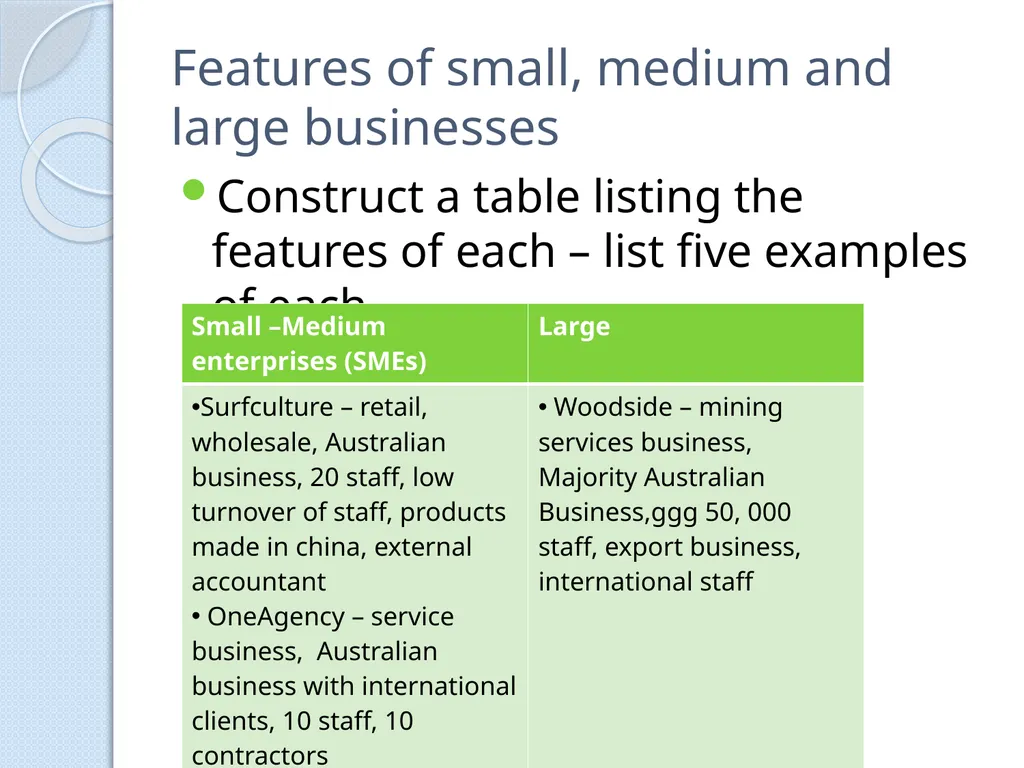
Features of small, medium and large businesses Construct a table listing the features of each – list five examples of each<br>
33
SMEs Suggest and justify the most likely growth areas for SMEs in the next ten years in Australia or Globally....
Ageing population to change business
Lema Samandar
September 22, 2008 from SMH<br>
Ageing population to change business
Lema Samandar
September 22, 2008 from SMH<br>
34
Local, national, global Examine local, national and global business reports and classify these businesses in relation to their output or service provided<br>
35
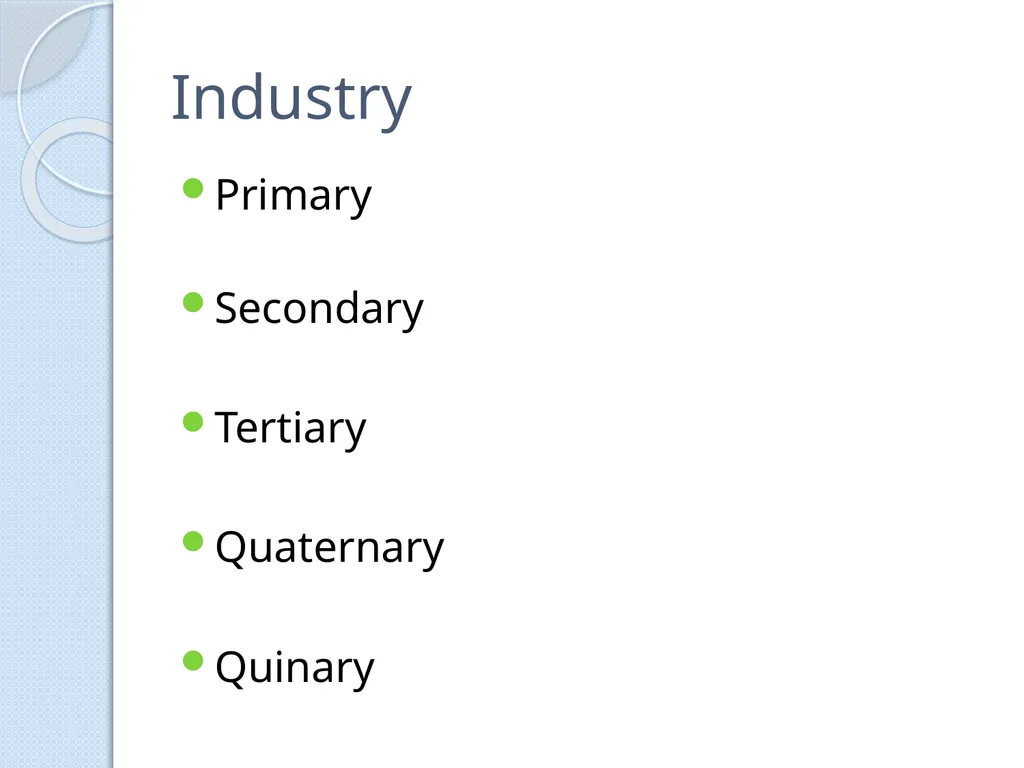
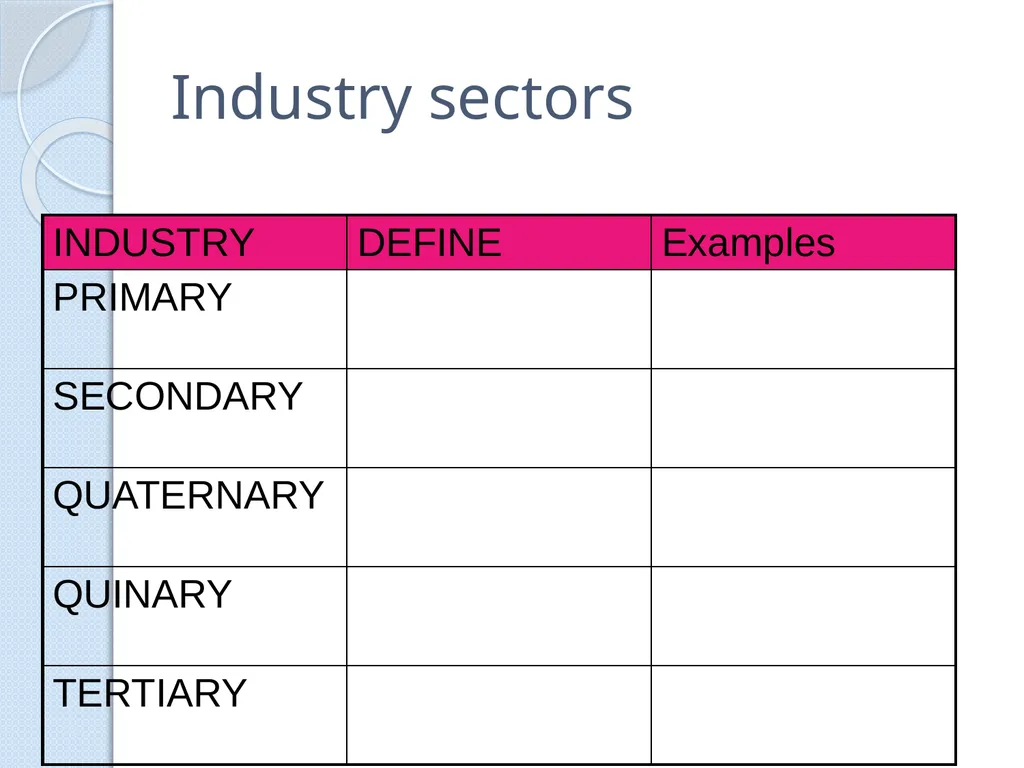
Industry Primary
Secondary
Tertiary
Quaternary
Quinary<br>
Secondary
Tertiary
Quaternary
Quinary<br>
36
THURSDAY 10 February Homework from Chapter 1: 1.1 and/or questions/mindmaps!
Who did not complete their industry sector breakdown?
Why do we break down sectors?
NEW TOPIC: Business Legal Structures
News articles homework!!<br>
Who did not complete their industry sector breakdown?
Why do we break down sectors?
NEW TOPIC: Business Legal Structures
News articles homework!!<br>
37
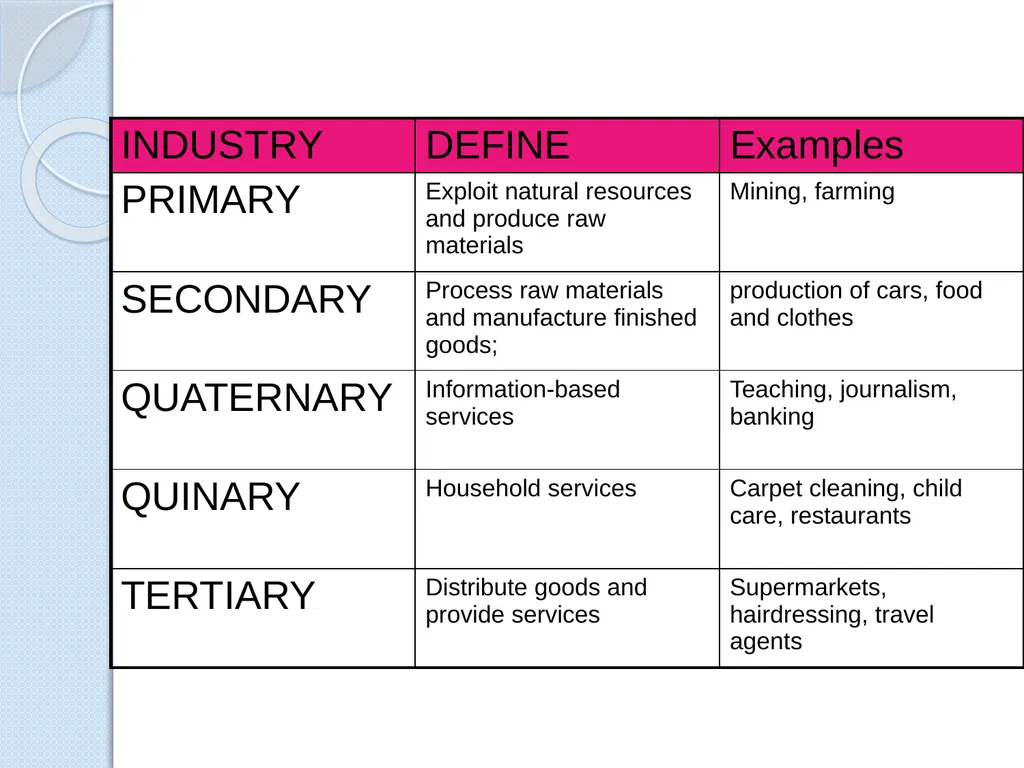
Industry sectors<br>
38
Industries contd ACTIVITY: Examine how government policy contributed to the development of the quaternary and quinary sectors
QUATERNARY
Information-based services
Teaching, journalism, banking
QUINARY
Household services
Carpet cleaning, child care, restaurants<br>
QUATERNARY
Information-based services
Teaching, journalism, banking
QUINARY
Household services
Carpet cleaning, child care, restaurants<br>
39
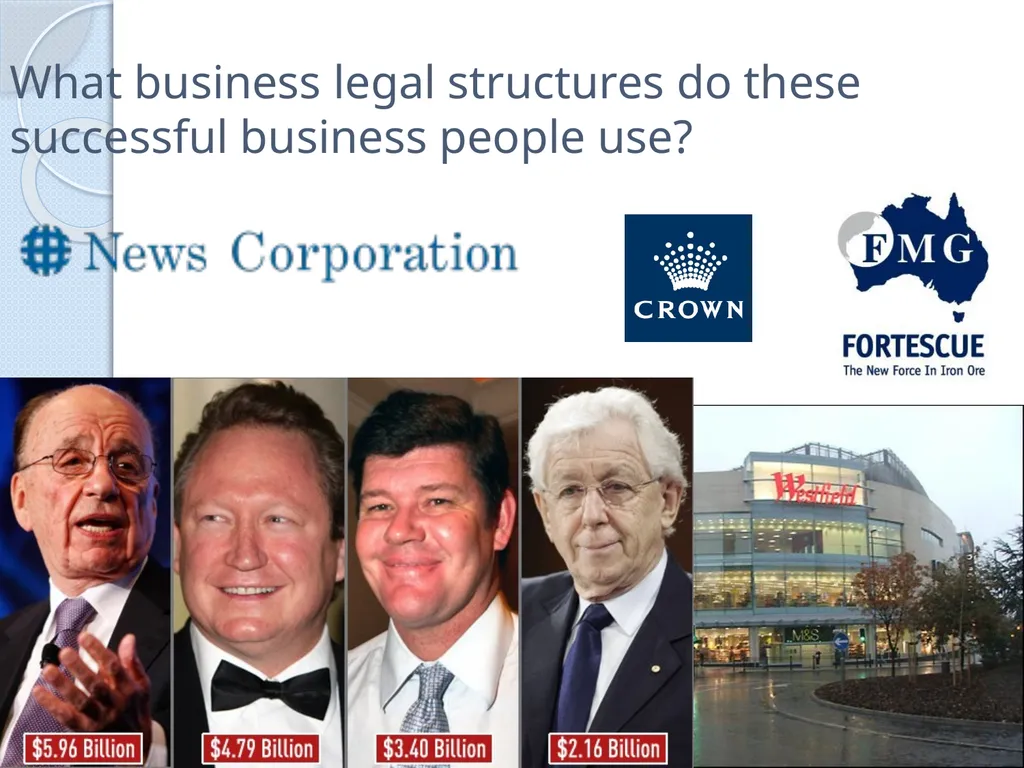
What business legal structures do these successful business people use?<br>
40
Tuesday 15th Business Legal Structures
Homework: Share news articles
Sass n Bide finish up
Continue and finish Business Legal Structures: complete handouts from last Thursday<br>
Homework: Share news articles
Sass n Bide finish up
Continue and finish Business Legal Structures: complete handouts from last Thursday<br>
41
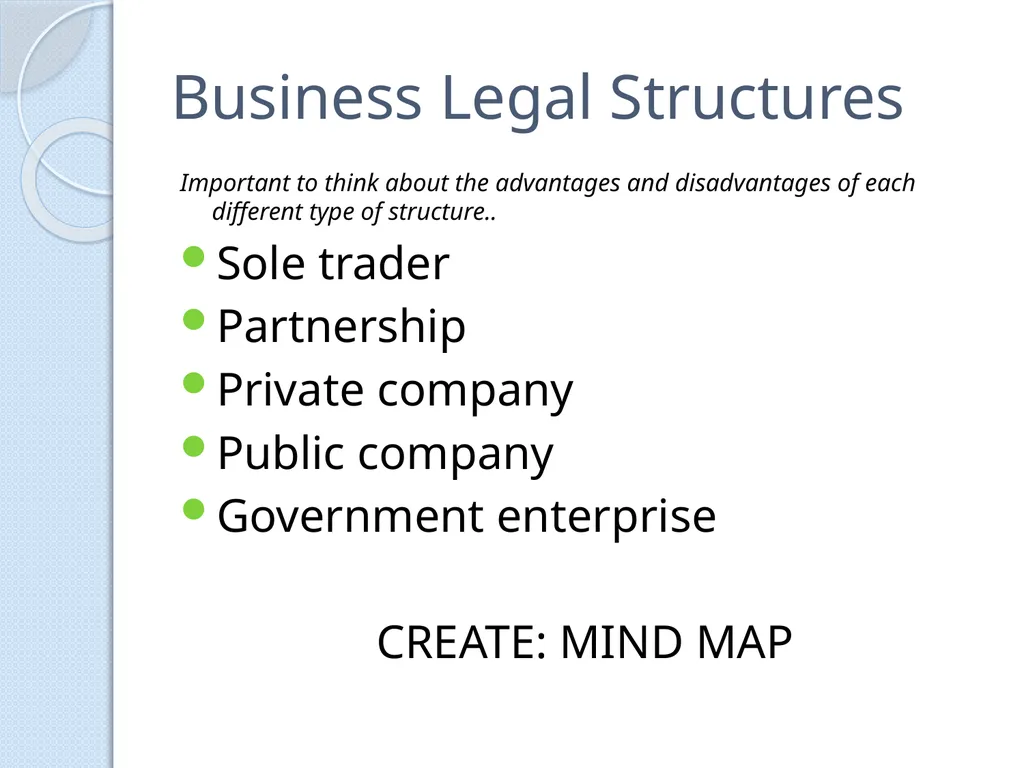
Business Legal Structures Important to think about the advantages and disadvantages of each different type of structure..
Sole trader
Partnership
Private company
Public company
Government enterprise
CREATE: MIND MAP<br>
Sole trader
Partnership
Private company
Public company
Government enterprise
CREATE: MIND MAP<br>
42
NEWS ARTICLES Homework for weekend:
You are to go to The Australian or SMH business websites or any other legitimate news website of newspaper! (try not make it the Daily Telegraph.. The Economist, BRW, New York Times etc all good)
You are to find an article about any business small or large and find out two things
Whether the business is a SME or a Large business and;
What type of legal structure this business has.
Finally you are to create a small summary of the article to share with the class.
EG: Boral
This is to be handed in on Tuesday 15 February<br>
You are to go to The Australian or SMH business websites or any other legitimate news website of newspaper! (try not make it the Daily Telegraph.. The Economist, BRW, New York Times etc all good)
You are to find an article about any business small or large and find out two things
Whether the business is a SME or a Large business and;
What type of legal structure this business has.
Finally you are to create a small summary of the article to share with the class.
EG: Boral
This is to be handed in on Tuesday 15 February<br>
43
Sole trader A “sole proprietorship” is the establishment of a business by an individual; there is no legal entity that owns ands operates the business
The owner is personally responsible for all debts ands contracts
Profits are disclosed on the owner’s personal income tax return and he or she can deduct business losses<br>
The owner is personally responsible for all debts ands contracts
Profits are disclosed on the owner’s personal income tax return and he or she can deduct business losses<br>
44
Partnership A “general partnership” is an agreement by two or more persons or entities to establish and operate a business
A written agreement should be prepared between the partners
Each partner discloses business profits in his or her personal tax return and deducts proportionate losses
A “joint venture” is a general partnership set up to make a profit on a one-time basis
A good example: Sass and Bide<br>
A written agreement should be prepared between the partners
Each partner discloses business profits in his or her personal tax return and deducts proportionate losses
A “joint venture” is a general partnership set up to make a profit on a one-time basis
A good example: Sass and Bide<br>
45
Positive Partnership:
Sass and Bide – 12 mins Why do you believe this partnership is successful?
What were the partners former careers?
What obstacles did they have to overcome?
What press “could you not buy” that Sass and Bide landed? What is this called?
Why do they believe they were successful?<br>
What were the partners former careers?
What obstacles did they have to overcome?
What press “could you not buy” that Sass and Bide landed? What is this called?
Why do they believe they were successful?<br>
46
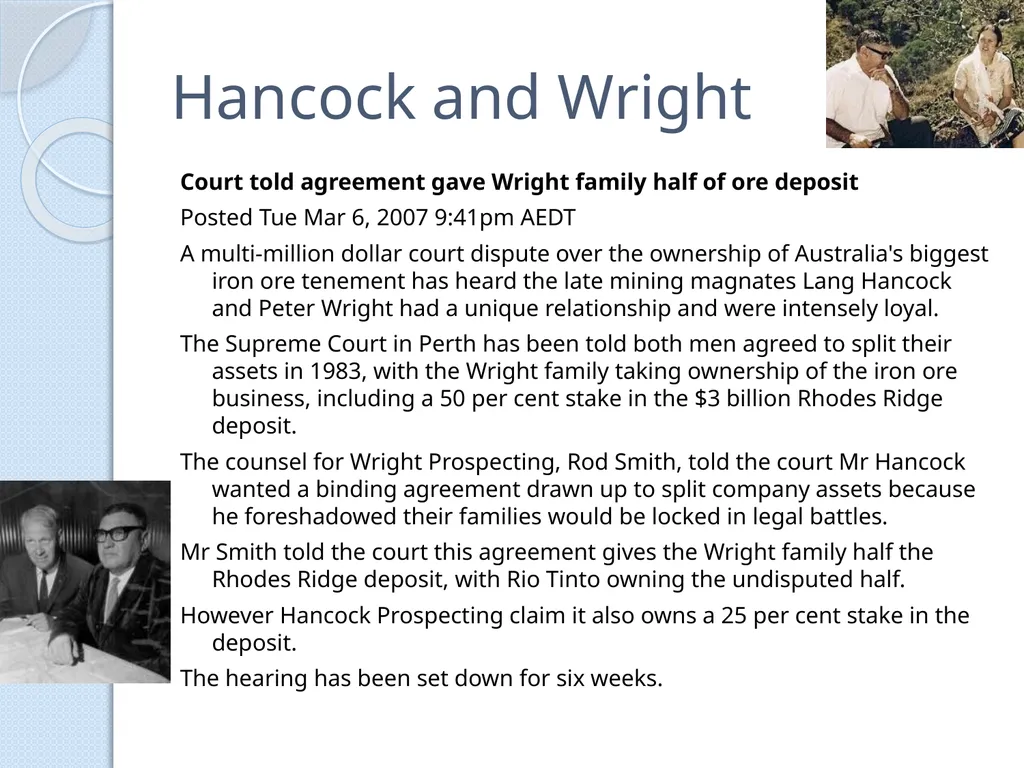
Hancock and Wright Court told agreement gave Wright family half of ore deposit
Posted Tue Mar 6, 2007 9:41pm AEDT
A multi-million dollar court dispute over the ownership of Australia's biggest iron ore tenement has heard the late mining magnates Lang Hancock and Peter Wright had a unique relationship and were intensely loyal.
The Supreme Court in Perth has been told both men agreed to split their assets in 1983, with the Wright family taking ownership of the iron ore business, including a 50 per cent stake in the $3 billion Rhodes Ridge deposit.
The counsel for Wright Prospecting, Rod Smith, told the court Mr Hancock wanted a binding agreement drawn up to split company assets because he foreshadowed their families would be locked in legal battles.
Mr Smith told the court this agreement gives the Wright family half the Rhodes Ridge deposit, with Rio Tinto owning the undisputed half.
However Hancock Prospecting claim it also owns a 25 per cent stake in the deposit.
The hearing has been set down for six weeks.<br>
Posted Tue Mar 6, 2007 9:41pm AEDT
A multi-million dollar court dispute over the ownership of Australia's biggest iron ore tenement has heard the late mining magnates Lang Hancock and Peter Wright had a unique relationship and were intensely loyal.
The Supreme Court in Perth has been told both men agreed to split their assets in 1983, with the Wright family taking ownership of the iron ore business, including a 50 per cent stake in the $3 billion Rhodes Ridge deposit.
The counsel for Wright Prospecting, Rod Smith, told the court Mr Hancock wanted a binding agreement drawn up to split company assets because he foreshadowed their families would be locked in legal battles.
Mr Smith told the court this agreement gives the Wright family half the Rhodes Ridge deposit, with Rio Tinto owning the undisputed half.
However Hancock Prospecting claim it also owns a 25 per cent stake in the deposit.
The hearing has been set down for six weeks.<br>
47
Activity:
Business structures (legal) Construct a profile of the ‘ideal business partner’ then devise a possible partnership agreement.
Debate the topic:’ Never go into business with a relative.’<br>
Debate the topic:’ Never go into business with a relative.’<br>
48
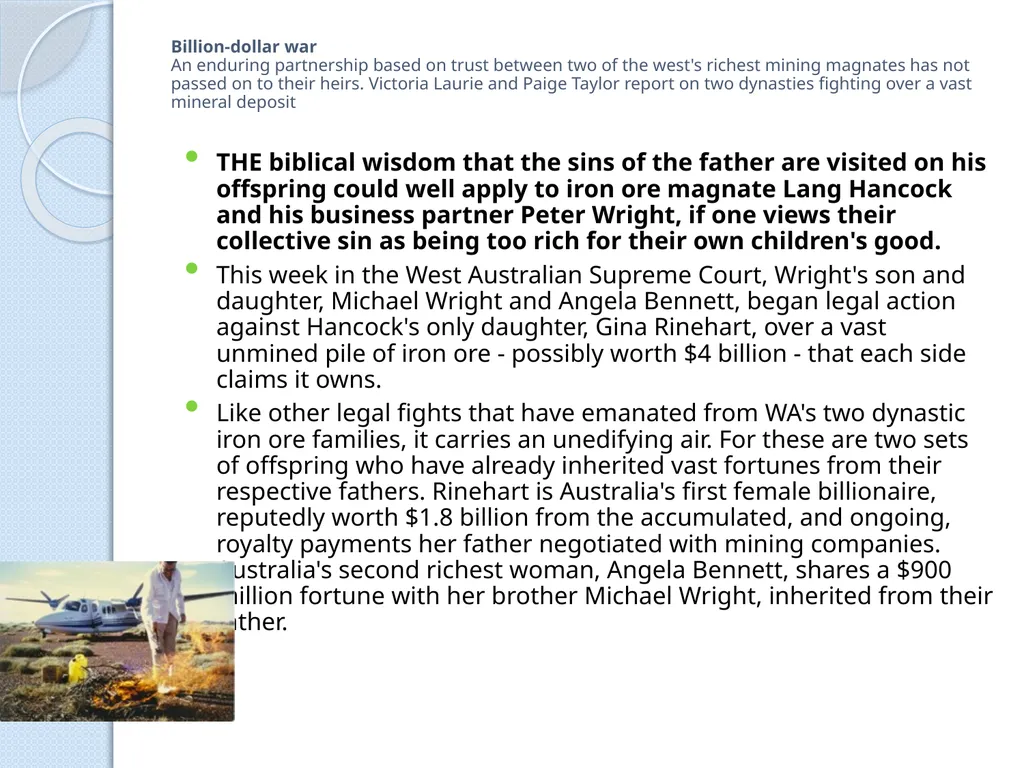
Billion-dollar war
An enduring partnership based on trust between two of the west's richest mining magnates has not passed on to their heirs. Victoria Laurie and Paige Taylor report on two dynasties fighting over a vast mineral deposit THE biblical wisdom that the sins of the father are visited on his offspring could well apply to iron ore magnate Lang Hancock and his business partner Peter Wright, if one views their collective sin as being too rich for their own children's good.
This week in the West Australian Supreme Court, Wright's son and daughter, Michael Wright and Angela Bennett, began legal action against Hancock's only daughter, Gina Rinehart, over a vast unmined pile of iron ore - possibly worth $4 billion - that each side claims it owns.
Like other legal fights that have emanated from WA's two dynastic iron ore families, it carries an unedifying air. For these are two sets of offspring who have already inherited vast fortunes from their respective fathers. Rinehart is Australia's first female billionaire, reputedly worth $1.8 billion from the accumulated, and ongoing, royalty payments her father negotiated with mining companies. Australia's second richest woman, Angela Bennett, shares a $900 million fortune with her brother Michael Wright, inherited from their father.<br>
This week in the West Australian Supreme Court, Wright's son and daughter, Michael Wright and Angela Bennett, began legal action against Hancock's only daughter, Gina Rinehart, over a vast unmined pile of iron ore - possibly worth $4 billion - that each side claims it owns.
Like other legal fights that have emanated from WA's two dynastic iron ore families, it carries an unedifying air. For these are two sets of offspring who have already inherited vast fortunes from their respective fathers. Rinehart is Australia's first female billionaire, reputedly worth $1.8 billion from the accumulated, and ongoing, royalty payments her father negotiated with mining companies. Australia's second richest woman, Angela Bennett, shares a $900 million fortune with her brother Michael Wright, inherited from their father.<br>
49
Companies: private Private company is limited to 50 shareholders. A board of directors is elected to run the company. If there are only a small number of shareholders they usually take on the role of directors
A private company has Pty Ltd short for Proprietary Limited: this means that liability is limited to the company, and does not extend to its owners.
Shares NOT sold to public.
A “limited liability company” (LLC) combines liability protection with the tax status of a general partnership
Owners of an interest in the LLC are called members
Members have no personal liability for the debts and obligations of the LLC
Members disclose profits and deduct losses on their individual tax returns<br>
A private company has Pty Ltd short for Proprietary Limited: this means that liability is limited to the company, and does not extend to its owners.
Shares NOT sold to public.
A “limited liability company” (LLC) combines liability protection with the tax status of a general partnership
Owners of an interest in the LLC are called members
Members have no personal liability for the debts and obligations of the LLC
Members disclose profits and deduct losses on their individual tax returns<br>
50
Public company There is no limit to the number of people who can own shares in a public company. Such companies must be listed on the ASX (Australian Stock Exchange) and are run by a board of directors elected by the shareholders.
The board then appoints executives to manage the daily affairs of the company. A public company usually has ‘Ltd’ after its name, meaning that the shareholders have limited liability.
Follow the process of floating a public company<br>
The board then appoints executives to manage the daily affairs of the company. A public company usually has ‘Ltd’ after its name, meaning that the shareholders have limited liability.
Follow the process of floating a public company<br>
51
WEDNESDAY 16 February FRIDAY: in Turnbull Centre: homework for tomorrow to come up with two good questions relating to the Business Studies syllabus that you can ask a small business owner. These are to be emailed to me.<br>
52
Government Enterprise A government sponsored/supported business activity
Government Business Enterprises (GBEs) The Government Businesses Advice Branch (GBAB) provides advice to the Australian Government relating to its Government Business Enterprises (GBEs) and other commercial entities.
Eg
ASC Pty Limited []
Australian Government Solicitor []
Australian Postal Corporation []
Australian Rail Track Corporation Limited []
Defence Housing Australia []
Medibank Private Limited []
NBN Co Limited []<br>
Government Business Enterprises (GBEs) The Government Businesses Advice Branch (GBAB) provides advice to the Australian Government relating to its Government Business Enterprises (GBEs) and other commercial entities.
Eg
ASC Pty Limited []
Australian Government Solicitor []
Australian Postal Corporation []
Australian Rail Track Corporation Limited []
Defence Housing Australia []
Medibank Private Limited []
NBN Co Limited []<br>
53
Government Business Enterprises (GBEs)
The Government Businesses Advice Branch (GBAB) provides advice to the Australian Government relating to its Government Business Enterprises (GBEs) and other commercial entities. The branch´s primary tasks in relation to GBEs is to:
provide sound strategic and analytical advice to the Minister for Finance and Deregulation, in particular by engaging with the GBEs, analysing their operations and their environment, and consulting with stakeholders;
action the Minister's decisions including communicating objectives; and
ensure that there is a robust and sound governance framework in place by initiating change and contributing to policy development.
Government Business Enterprises (GBEs) are prescribed in regulations [] under the Commonwealth Authorities and Companies Act 1997.
The Australian Government´s relationship to its GBEs is similar to the relationship between a holding company and its subsidiaries, features of which include:
a strong interest in the performance and financial returns of the GBE;
reporting and accountability arrangements that facilitate active oversight by the shareholder;
action by the shareholder in relation to the strategic direction of its GBEs where it prefers a different direction from the one proposed;
management autonomy balanced with regular reporting of performance to shareholders; and
boards that are accountable to shareholders for GBE performance, and shareholders that are accountable to Parliament and the public.
To enable greater public accountability, wholly owned GBEs are required to prepare a Statement of Corporate Intent (SCI) in consultation with Shareholder Ministers.
A SCI focuses on the purpose and corporate outlook of a GBE, and expresses the expectations of its management in relation to future financial and non-financial performance.
The following is a list of the Australian Government´s GBEs, with links to their websites, where available:
ASC Pty Limited []
Australian Government Solicitor []
Australian Postal Corporation []
Australian Rail Track Corporation Limited []
Defence Housing Australia []
Medibank Private Limited []
NBN Co Limited []
Other entities which are not prescribed as GBEs but which GBAB also provides advice to the Government are:
Airservices Australia []
Australian River Co. Limited - Statement of Intent [ 53KB] - Statement of Expectation [ 6KB] - Annual Report 2009 [ 7MB] - Annual Report 2009 [ 357 KB]
Australian Industry Development Corporation
Statement of Intent [ 24KB] Statement of Expectation [ 7KB]
Annual Report 30 June 2010 [ 381KB]<br>
provide sound strategic and analytical advice to the Minister for Finance and Deregulation, in particular by engaging with the GBEs, analysing their operations and their environment, and consulting with stakeholders;
action the Minister's decisions including communicating objectives; and
ensure that there is a robust and sound governance framework in place by initiating change and contributing to policy development.
Government Business Enterprises (GBEs) are prescribed in regulations [] under the Commonwealth Authorities and Companies Act 1997.
The Australian Government´s relationship to its GBEs is similar to the relationship between a holding company and its subsidiaries, features of which include:
a strong interest in the performance and financial returns of the GBE;
reporting and accountability arrangements that facilitate active oversight by the shareholder;
action by the shareholder in relation to the strategic direction of its GBEs where it prefers a different direction from the one proposed;
management autonomy balanced with regular reporting of performance to shareholders; and
boards that are accountable to shareholders for GBE performance, and shareholders that are accountable to Parliament and the public.
To enable greater public accountability, wholly owned GBEs are required to prepare a Statement of Corporate Intent (SCI) in consultation with Shareholder Ministers.
A SCI focuses on the purpose and corporate outlook of a GBE, and expresses the expectations of its management in relation to future financial and non-financial performance.
The following is a list of the Australian Government´s GBEs, with links to their websites, where available:
ASC Pty Limited []
Australian Government Solicitor []
Australian Postal Corporation []
Australian Rail Track Corporation Limited []
Defence Housing Australia []
Medibank Private Limited []
NBN Co Limited []
Other entities which are not prescribed as GBEs but which GBAB also provides advice to the Government are:
Airservices Australia []
Australian River Co. Limited - Statement of Intent [ 53KB] - Statement of Expectation [ 6KB] - Annual Report 2009 [ 7MB] - Annual Report 2009 [ 357 KB]
Australian Industry Development Corporation
Statement of Intent [ 24KB] Statement of Expectation [ 7KB]
Annual Report 30 June 2010 [ 381KB]<br>
54
Privatisation of government companies Debate the issue of privatisation of government companies in Australia. (Telstra, Cth Bank etc)
Watch video on Privatisation under Thatcher
http://www.youtube.com/watch?v=nEIR0aOLqXk&feature=related<br>
Watch video on Privatisation under Thatcher
http://www.youtube.com/watch?v=nEIR0aOLqXk&feature=related<br>
55
THURSDAY 17 February
Business structures short answers.. Each question a short paragraph..
1.Write a short paragraph outlining the advantages and disadvantages of being a sole trader.
2. List three disadvantages of a partnership.
3. What are the benefits of being a private company?
4. Define: public company?
HOMEWORK DUE
LOOK AT SYLLABUS
HOW TO CHOOSE LEGAL STRUCTURE
INTERNAL AND EXTERNAL FACTORS
QUIZ OVER WEND OR TOMORROW ON SYLLABUS THUS FAR<br>
1.Write a short paragraph outlining the advantages and disadvantages of being a sole trader.
2. List three disadvantages of a partnership.
3. What are the benefits of being a private company?
4. Define: public company?
HOMEWORK DUE
LOOK AT SYLLABUS
HOW TO CHOOSE LEGAL STRUCTURE
INTERNAL AND EXTERNAL FACTORS
QUIZ OVER WEND OR TOMORROW ON SYLLABUS THUS FAR<br>
56
YOUR TASK:IN PAIRS: You are to prepare arguments for or against a different business structure and then we are to have a class debate about the different types of business structures. Group 1: arguments for sole traders and an example of a successful sole trader
Group 2: arguments against sole traders and give an example of when a sole trader failed if possible
Group 3: arguments for partnerships and an example of a successful partnership
Group 4: arguments against partnerships and an example of a partnership that went wrong
Group 5: arguments for a private company and give an example of a successful private company
Group 6: arguments in favour of Public companies and give an example of one of Australia’s most successful public companies
IMAGES SHOULD BE INCLUDED WHERE POSSIBLE<br>
Group 2: arguments against sole traders and give an example of when a sole trader failed if possible
Group 3: arguments for partnerships and an example of a successful partnership
Group 4: arguments against partnerships and an example of a partnership that went wrong
Group 5: arguments for a private company and give an example of a successful private company
Group 6: arguments in favour of Public companies and give an example of one of Australia’s most successful public companies
IMAGES SHOULD BE INCLUDED WHERE POSSIBLE<br>
57
Factors influencing choice of legal structure Size
Ownership
Finance<br>
Ownership
Finance<br>
58
INFLUENCES IN THE BUSINESS ENVIRONMENT External influences
Geographic
Social
Legal
Political
Institutional
Technological
Competitive situation
markets
Internal influences
Products
Location
Resources
Management and business culture
Stakeholders
Stakeholders<br>
Geographic
Social
Legal
Political
Institutional
Technological
Competitive situation
markets
Internal influences
Products
Location
Resources
Management and business culture
Stakeholders
Stakeholders<br>
59
INSTITUTIONAL FACTORS
Institutions Institutions are according to North(1991) the game rules, in other words, the man-designed limits that determine the forms of social relationships.
The importance of these institutional elements in the regional level could be found in the contribution they have had in the reorganization of the production forms, through the reduction of transaction and production costs, the definition of the incentives structure and the changes of social participation.
a)the soft institutional factors that refers to individual habits, routines, customs, traditions, social norms and values, which show some of the characteristics of the networks of interpersonal relations;
b)the hard institutional factors are the long-lasting collective forces that shape the economy, such as rules, laws, constitutions, property rights, etc.
However institutional factor can not explain by itself high growth rate, but added to economic and social variables, it might contribute to create a dynamic processes with higher levels of growth.
An institution is any structure or mechanism of social order and cooperation governing the behavior of a set of individuals within a given human community. Institutions are identified with a social purpose and permanence, transcending individual human lives and intentions, and with the making and enforcing of rules governing cooperative human behavior.[1]
The term "institution" is commonly applied to customs and behavior patterns important to a society, as well as to particular formal organizations of government and public service. As structures and mechanisms of social order among humans, institutions are one of the principal objects of study in the social sciences, such as political science, anthropology, economics, and sociology (the latter being described by Durkheim as the "science of institutions, their genesis and their functioning").[2] Institutions are also a central concern for law, the formal mechanism for political rule-making and enforcement.<br>
The importance of these institutional elements in the regional level could be found in the contribution they have had in the reorganization of the production forms, through the reduction of transaction and production costs, the definition of the incentives structure and the changes of social participation.
a)the soft institutional factors that refers to individual habits, routines, customs, traditions, social norms and values, which show some of the characteristics of the networks of interpersonal relations;
b)the hard institutional factors are the long-lasting collective forces that shape the economy, such as rules, laws, constitutions, property rights, etc.
However institutional factor can not explain by itself high growth rate, but added to economic and social variables, it might contribute to create a dynamic processes with higher levels of growth.
An institution is any structure or mechanism of social order and cooperation governing the behavior of a set of individuals within a given human community. Institutions are identified with a social purpose and permanence, transcending individual human lives and intentions, and with the making and enforcing of rules governing cooperative human behavior.[1]
The term "institution" is commonly applied to customs and behavior patterns important to a society, as well as to particular formal organizations of government and public service. As structures and mechanisms of social order among humans, institutions are one of the principal objects of study in the social sciences, such as political science, anthropology, economics, and sociology (the latter being described by Durkheim as the "science of institutions, their genesis and their functioning").[2] Institutions are also a central concern for law, the formal mechanism for political rule-making and enforcement.<br>
60
Foreign takeovers? Argue the case for or against foreign takeovers
National interest
The WA Premier Colin Barnett says it is in the nation's best interest for Woodside to remain in Australian hands.
Mr Barnett was the WA Resources Minister in 2000 when Shell unsuccessfully tried to take over Woodside.
He says he is still opposed to any foreign takeover of the company.
"I would still have the view that it's important and in our national interest, certainly in our state's interest, for Woodside to remain an independent, national company," he said.
"Now, if some other company, whether it's a BHP or someone else, buys a share of Woodside, I don't have an objection to that so long as Woodside remains as an independent company."<br>
National interest
The WA Premier Colin Barnett says it is in the nation's best interest for Woodside to remain in Australian hands.
Mr Barnett was the WA Resources Minister in 2000 when Shell unsuccessfully tried to take over Woodside.
He says he is still opposed to any foreign takeover of the company.
"I would still have the view that it's important and in our national interest, certainly in our state's interest, for Woodside to remain an independent, national company," he said.
"Now, if some other company, whether it's a BHP or someone else, buys a share of Woodside, I don't have an objection to that so long as Woodside remains as an independent company."<br>
61
Influences in the business environment Writing task: 10mins
Are internal or external factors more influential? Provide reasons for your answer and use business examples where you can.<br>
Are internal or external factors more influential? Provide reasons for your answer and use business examples where you can.<br>
62
Influences in the business environment Select a small business and outline factors that impact upon its operation, distinguish between internal and external factors<br>
63
Business life cycle A business evolves through four major phases of development. The four phases are establishment, growth, maturity and post-maturity
Each phase characterised by a number of features that are common to most businesses and need to be carefully managed<br>
Each phase characterised by a number of features that are common to most businesses and need to be carefully managed<br>
64
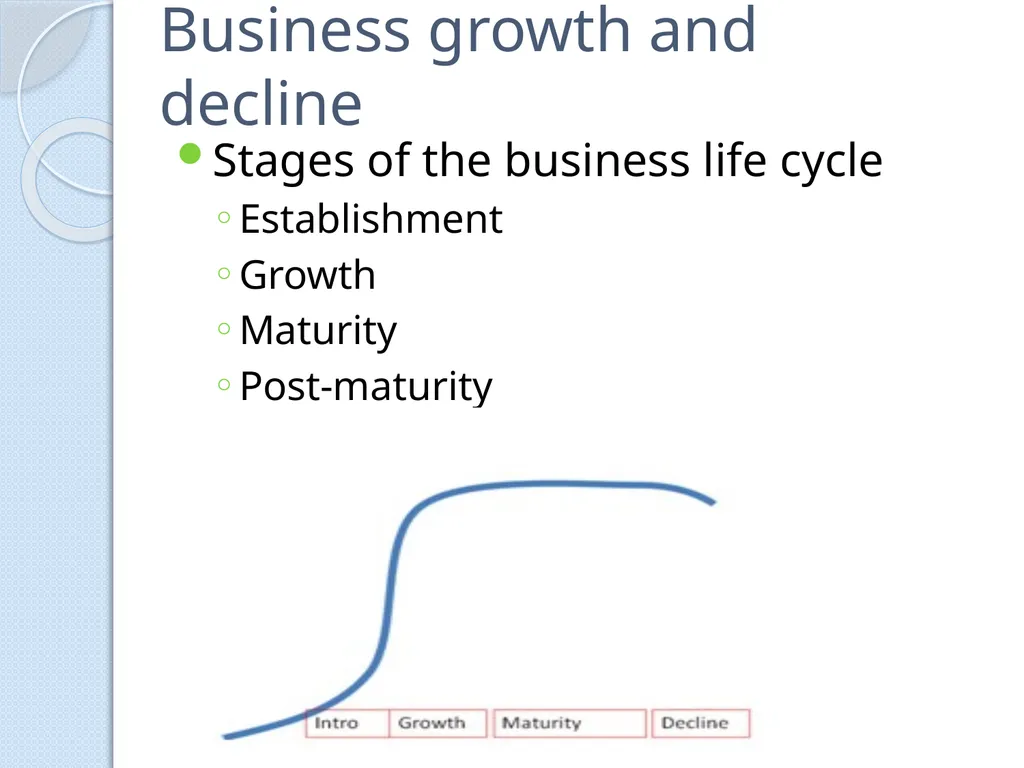
Business growth and decline Stages of the business life cycle
Establishment
Growth
Maturity
Post-maturity<br>
Establishment
Growth
Maturity
Post-maturity<br>
65
1. Establishment phase Business is launched
In pairs find out how much you already know about the difficulties associated with launching a business:
Financial costs, employing people
Unknown competition (direct competition)
Management team need realistic and sustainable ideas..needs to be original
Many key decisions about business need to be made e.g. Location, staffing, management structure etc<br>
In pairs find out how much you already know about the difficulties associated with launching a business:
Financial costs, employing people
Unknown competition (direct competition)
Management team need realistic and sustainable ideas..needs to be original
Many key decisions about business need to be made e.g. Location, staffing, management structure etc<br>
66
Establishment phase Retailers are reluctant to put a product without a track record on their shelves
Typically expenses are higher than sales revenue during the establishment phase
Establishment phase is often characterised by negative profits<br>
Typically expenses are higher than sales revenue during the establishment phase
Establishment phase is often characterised by negative profits<br>
67
The establishment of a company http://www.theaustralian.com.au/business/small-business
Create a flowchart of the steps that must be taken to establish a company<br>
Create a flowchart of the steps that must be taken to establish a company<br>
68
2. Growth Phase Rapid increase in sales during growth phase put pressure on resources
Cash problems may develop because of rapid expansion
Competitors will react to the rapid increase in sales and try to counter it<br>
Cash problems may develop because of rapid expansion
Competitors will react to the rapid increase in sales and try to counter it<br>
69
3. Maturity stage The growth in sales levels off as the business is selling the same value of products year after year
The market for the product is saturated
E.g. Everyone who wants a plasma TV has one after a certain time
In this phase it is usual to employ professional managers as they have the skills to grow the value of the business by making it more competitive
Cost cutting is the way to success in the maturity phase..how else?<br>
The market for the product is saturated
E.g. Everyone who wants a plasma TV has one after a certain time
In this phase it is usual to employ professional managers as they have the skills to grow the value of the business by making it more competitive
Cost cutting is the way to success in the maturity phase..how else?<br>
70
4. Post-maturity Final stage of the business life cycle
Often business has failed to respond to increased competition and is haemorrhaging market share
Characterised by falling sales and loss of market share
Business unprofitable and cash flow problems emerge/difficulty in paying bills on time
Cost cutting will ensure it maintains postition in marketplace
Renewal also possible where managers develop new products or more competitive ways of providing customer benefits<br>
Often business has failed to respond to increased competition and is haemorrhaging market share
Characterised by falling sales and loss of market share
Business unprofitable and cash flow problems emerge/difficulty in paying bills on time
Cost cutting will ensure it maintains postition in marketplace
Renewal also possible where managers develop new products or more competitive ways of providing customer benefits<br>
71
DIAGRAM FROM OTHER TEXT handouts<br>
72
Business growth and decline ACTIVITY: Using your laptops construct and annotate a graph showing the business life cycle.
**Try and also highlight and identify challenges at each stage in the business life cycle, plot where actually businesses may be on the graph!<br>
**Try and also highlight and identify challenges at each stage in the business life cycle, plot where actually businesses may be on the graph!<br>
73
Responding to challenges at each stage of business life cycle Using hypothetical scenarios of the business life cycle, evaluate strategies to respond to challenged
Select a range of local businesses and allocate a particular life cycle stage to each one. List the main problems facing owners/managers of each<br>
Select a range of local businesses and allocate a particular life cycle stage to each one. List the main problems facing owners/managers of each<br>
74
Business life cycle Study a business such as Rip Curl. Identify the stages it has gone through and discuss issues relevant to each stage<br>
75
Factors that can contribute to business decline BRAINSTORM:
What are some of the factors which contribute to business decline, find examples from the media
ABC Learning
Babcock and Brown<br>
What are some of the factors which contribute to business decline, find examples from the media
ABC Learning
Babcock and Brown<br>
76
CASE STUDY: business failure What factors led to the failure of this business...<br>
77
Reasons for voluntary and involuntary cessation Baskin Robbins<br>
78
DEBATE ‘Liquidation is an easy way out for businesses’
FOR AND AGAINST<br>
FOR AND AGAINST<br>
79
New topic: Business Management 40% of indicative time : The focus of this topic is the nature and responsibilities of management in the business environment.
Outcomes
The student:
P2 explains the internal and external influences on businesses
P4 assesses the processes and interdependence of key business functions
P5 examines the application of management theories and strategies
P6 analyses the responsibilities of business to internal and external stakeholders
P7 plans and conducts investigations into contemporary business issues
P8 evaluates information for actual and hypothetical business situations
P9 communicates business information and issues in appropriate formats
P10 applies mathematical concepts appropriately in business situations
Content
Students learn to:
examine contemporary business issues to:
discuss strategies that could reconcile the conflicting interests of stakeholders
compare and contrast approaches to management
explain the benefits of quality management practices
investigate aspects of business using hypothetical situations and actual business case studies to:
identify the qualities of managers who have exhibited high personal and ethical standards
analyse different ways of coordinating key business functions for an SME
examine effective cash flow management
assess the role of the income statement and the balance sheet when describing the financial performance of a business
explain how SMEs manage change effectively<br>
Outcomes
The student:
P2 explains the internal and external influences on businesses
P4 assesses the processes and interdependence of key business functions
P5 examines the application of management theories and strategies
P6 analyses the responsibilities of business to internal and external stakeholders
P7 plans and conducts investigations into contemporary business issues
P8 evaluates information for actual and hypothetical business situations
P9 communicates business information and issues in appropriate formats
P10 applies mathematical concepts appropriately in business situations
Content
Students learn to:
examine contemporary business issues to:
discuss strategies that could reconcile the conflicting interests of stakeholders
compare and contrast approaches to management
explain the benefits of quality management practices
investigate aspects of business using hypothetical situations and actual business case studies to:
identify the qualities of managers who have exhibited high personal and ethical standards
analyse different ways of coordinating key business functions for an SME
examine effective cash flow management
assess the role of the income statement and the balance sheet when describing the financial performance of a business
explain how SMEs manage change effectively<br>
80
Nature of Management Features of effective management<br>
81
Nature of Management Discussion:
What is effective management?
What are the skills that an effective manager needs?<br>
What is effective management?
What are the skills that an effective manager needs?<br>
82
Skills of management Interpersonal
Communication
Strategic thinking
Vision
Problem solving
Decision-making
Flexibility
Adaptability to change
Reconciling the conflicting interests of stakeholders
Which of the above skills is most important? Put the list in order of importance<br>
Communication
Strategic thinking
Vision
Problem solving
Decision-making
Flexibility
Adaptability to change
Reconciling the conflicting interests of stakeholders
Which of the above skills is most important? Put the list in order of importance<br>
83
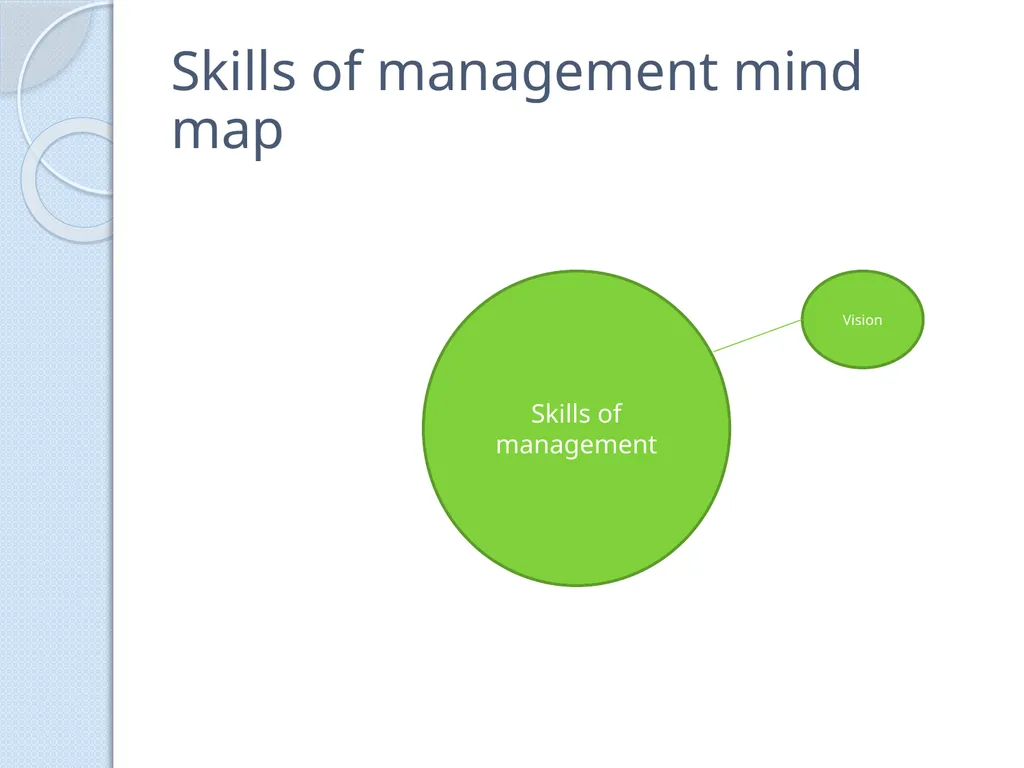
Skills of management mind map Skills of management Vision<br>
84
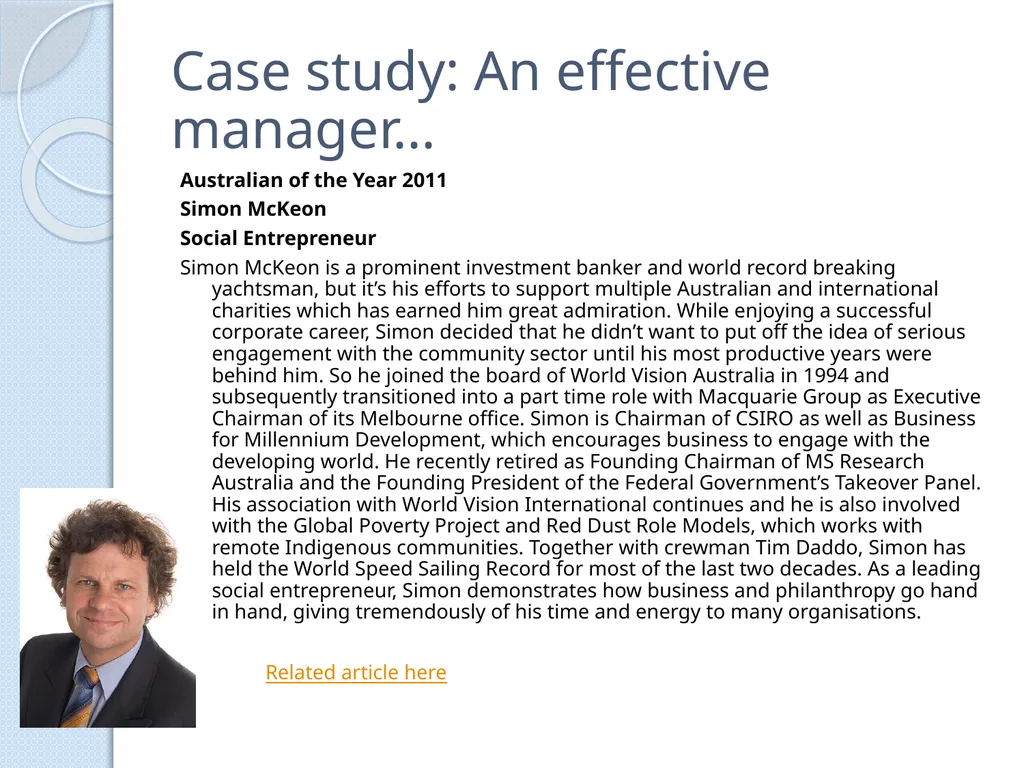
Case study: An effective manager... Australian of the Year 2011
Simon McKeon
Social Entrepreneur
Simon McKeon is a prominent investment banker and world record breaking yachtsman, but it’s his efforts to support multiple Australian and international charities which has earned him great admiration. While enjoying a successful corporate career, Simon decided that he didn’t want to put off the idea of serious engagement with the community sector until his most productive years were behind him. So he joined the board of World Vision Australia in 1994 and subsequently transitioned into a part time role with Macquarie Group as Executive Chairman of its Melbourne office. Simon is Chairman of CSIRO as well as Business for Millennium Development, which encourages business to engage with the developing world. He recently retired as Founding Chairman of MS Research Australia and the Founding President of the Federal Government’s Takeover Panel. His association with World Vision International continues and he is also involved with the Global Poverty Project and Red Dust Role Models, which works with remote Indigenous communities. Together with crewman Tim Daddo, Simon has held the World Speed Sailing Record for most of the last two decades. As a leading social entrepreneur, Simon demonstrates how business and philanthropy go hand in hand, giving tremendously of his time and energy to many organisations.
A Related article here<br>
Simon McKeon
Social Entrepreneur
Simon McKeon is a prominent investment banker and world record breaking yachtsman, but it’s his efforts to support multiple Australian and international charities which has earned him great admiration. While enjoying a successful corporate career, Simon decided that he didn’t want to put off the idea of serious engagement with the community sector until his most productive years were behind him. So he joined the board of World Vision Australia in 1994 and subsequently transitioned into a part time role with Macquarie Group as Executive Chairman of its Melbourne office. Simon is Chairman of CSIRO as well as Business for Millennium Development, which encourages business to engage with the developing world. He recently retired as Founding Chairman of MS Research Australia and the Founding President of the Federal Government’s Takeover Panel. His association with World Vision International continues and he is also involved with the Global Poverty Project and Red Dust Role Models, which works with remote Indigenous communities. Together with crewman Tim Daddo, Simon has held the World Speed Sailing Record for most of the last two decades. As a leading social entrepreneur, Simon demonstrates how business and philanthropy go hand in hand, giving tremendously of his time and energy to many organisations.
A Related article here<br>
85
DEBATE “Businesses are only interested in maximising profit”<br>
86
Achieving business goals Managers must seek to...
Maximise profits
Market share
Growth
Share price
Social
Environmental
Achieve a mix of the above goals
Staff involvement e.g. Google
What sort of incentives have management allowed staff to enjoy...?
Innovation
Motivation
Mentoring
Training<br>
Maximise profits
Market share
Growth
Share price
Social
Environmental
Achieve a mix of the above goals
Staff involvement e.g. Google
What sort of incentives have management allowed staff to enjoy...?
Innovation
Motivation
Mentoring
Training<br>
87
Google: a case study Management team
What common skills are there between the directors?
Staff involvement e.g. Google
What sort of incentives have management allowed staff to enjoy...?
What are the benefits of fostering staff involvement?
To what extent can staff contribute to the achievement of business goals at Google?<br>
What common skills are there between the directors?
Staff involvement e.g. Google
What sort of incentives have management allowed staff to enjoy...?
What are the benefits of fostering staff involvement?
To what extent can staff contribute to the achievement of business goals at Google?<br>