
Prepared by the AETC National Coordinating
AS
Published · 39 slides · 0 views
1 / 1



Description
Prepared by the AETC National Coordinating Resource Center based on recommendations from the CDC, National Institutes of Health, and HIV Medicine AssociationInfectious Diseases Society of America Guidelines for Prevention and Treatment of
Related Topics
Share
Embed code
Download this presentation From Below
"Prepared by the AETC National Coordinating" is the property of its rightful owner. Permission is granted to download and print the materials on this website for personal, non-commercial use only, and to display it on your personal computer provided you do not modify the materials and that you retain all copyright notices contained in the materials. By downloading content from our website, you accept the terms of this agreement.
Presentation Transcript
01
Prepared by the AETC National Coordinating Resource Center based on recommendations from the CDC,
National Institutes of Health, and HIV Medicine Association/Infectious Diseases Society of America Guidelines for Prevention and Treatment of Opportunistic Infections in HIV-Infected Adults and Adolescents
Syphilis Slide Set<br>
02
These slides were developed using recommendations published in May 2013. The intended audience is clinicians involved in the care of patients with HIV.
Users are cautioned that, because of the rapidly changing field of HIV care, this information could become out of date quickly. Finally, it is intended that these slides be used as prepared, without changes in either content or attribution. Users are asked to honor this intent.
– AETC National Resource Center
http://www.aidsetc.org About This Presentation June 2013 www.aidsetc.org 2<br>
Users are cautioned that, because of the rapidly changing field of HIV care, this information could become out of date quickly. Finally, it is intended that these slides be used as prepared, without changes in either content or attribution. Users are asked to honor this intent.
– AETC National Resource Center
http://www.aidsetc.org About This Presentation June 2013 www.aidsetc.org 2<br>
03
Epidemiology
Clinical Manifestations
Diagnosis
Prevention
Treatment
Considerations in Pregnancy Syphilis June 2013 www.aidsetc.org 3<br>
Clinical Manifestations
Diagnosis
Prevention
Treatment
Considerations in Pregnancy Syphilis June 2013 www.aidsetc.org 3<br>
04
Caused by Treponema pallidum
Associated with increased risk of HIV sexual acquisition and transmission
Increased incidence in men who have sex with men
HIV infection may somewhat alter diagnosis, natural history, and management of syphilis, but principles of management are the same with or without HIV infection Syphilis: Epidemiology June 2013 www.aidsetc.org 4<br>
Associated with increased risk of HIV sexual acquisition and transmission
Increased incidence in men who have sex with men
HIV infection may somewhat alter diagnosis, natural history, and management of syphilis, but principles of management are the same with or without HIV infection Syphilis: Epidemiology June 2013 www.aidsetc.org 4<br>
05
HIV may make clinical lesions more apparent and accelerate progression of syphilis
Primary syphilis
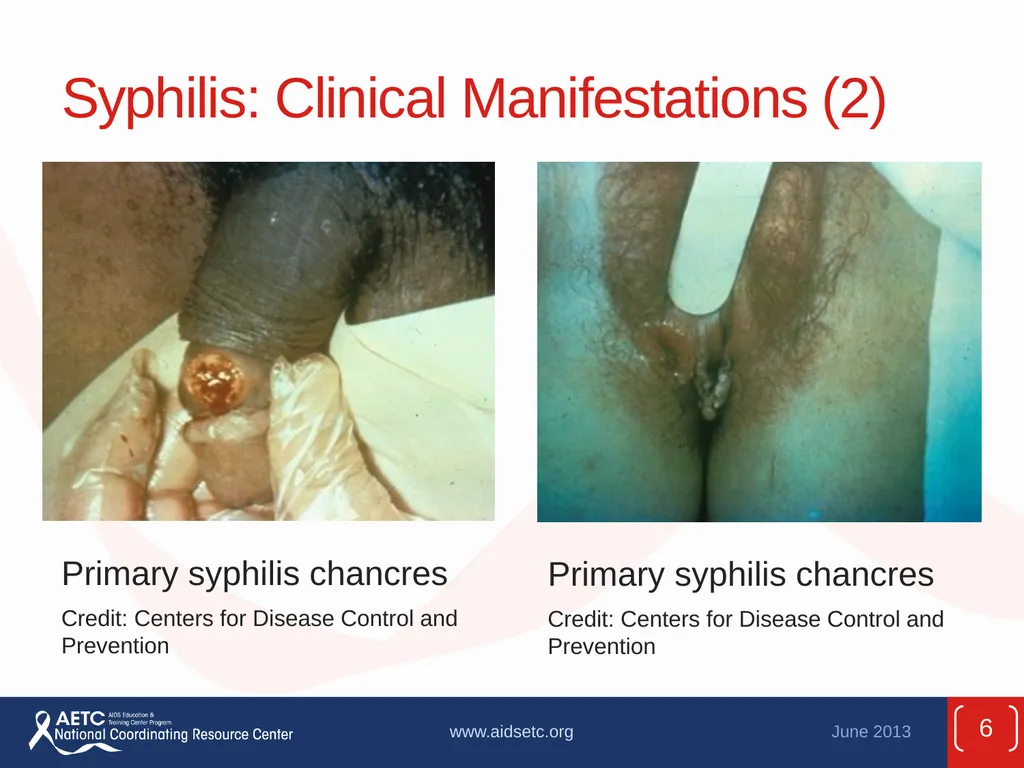
Painless nodule at site of contact, rapidly ulcerates (chancre)
In HIV-infected patients, may see multiple or atypical chancres, or no primary lesion Syphilis: Clinical Manifestations June 2013 www.aidsetc.org 5<br>
Primary syphilis
Painless nodule at site of contact, rapidly ulcerates (chancre)
In HIV-infected patients, may see multiple or atypical chancres, or no primary lesion Syphilis: Clinical Manifestations June 2013 www.aidsetc.org 5<br>
06
June 2013 www.aidsetc.org 6 Primary syphilis chancres
Credit: Centers for Disease Control and Prevention Primary syphilis chancres
Credit: Centers for Disease Control and Prevention Syphilis: Clinical Manifestations (2)<br>
Credit: Centers for Disease Control and Prevention Primary syphilis chancres
Credit: Centers for Disease Control and Prevention Syphilis: Clinical Manifestations (2)<br>
07
Secondary syphilis (2-8 weeks after primary inoculation)
Protean symptoms, may involve almost any organ system and include:
Rash (macular, maculopapular, papulosquamous, or pustular); or condyloma lata
Generalized lymphadenopathy
Constitutional symptoms (fever, malaise, anorexia, arthralgias, headache)
CNS symptoms
Symptoms last days-weeks
In advanced HIV infection, may be more severe or progress more rapidly
Distinguish from primary HIV infection Syphilis: Clinical Manifestations (3) June 2013 www.aidsetc.org 7<br>
Protean symptoms, may involve almost any organ system and include:
Rash (macular, maculopapular, papulosquamous, or pustular); or condyloma lata
Generalized lymphadenopathy
Constitutional symptoms (fever, malaise, anorexia, arthralgias, headache)
CNS symptoms
Symptoms last days-weeks
In advanced HIV infection, may be more severe or progress more rapidly
Distinguish from primary HIV infection Syphilis: Clinical Manifestations (3) June 2013 www.aidsetc.org 7<br>
08
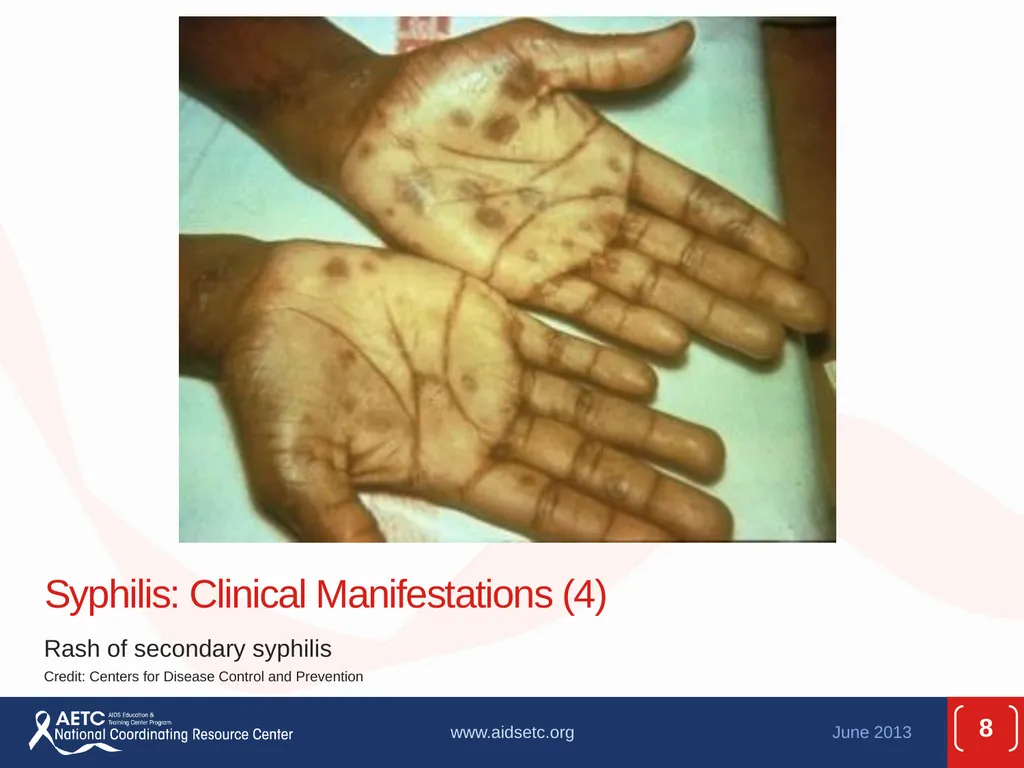
Rash of secondary syphilis
Credit: Centers for Disease Control and Prevention Syphilis: Clinical Manifestations (4) June 2013 www.aidsetc.org 8<br>
Credit: Centers for Disease Control and Prevention Syphilis: Clinical Manifestations (4) June 2013 www.aidsetc.org 8<br>
09
Latent syphilis: no overt signs/symptoms (but serologic evidence of syphilis), though relapse of manifestations of secondary syphilis may occur
Late syphilis: cardiovascular syphilis, gummatous syphilis; or slowly progressive disease in any organ system Syphilis: Clinical Manifestations (5) June 2013 www.aidsetc.org 9<br>
Late syphilis: cardiovascular syphilis, gummatous syphilis; or slowly progressive disease in any organ system Syphilis: Clinical Manifestations (5) June 2013 www.aidsetc.org 9<br>
10
Neurosyphilis: May occur at any stage of syphilis, with various symptoms
Cranial nerve dysfunction, stroke, meningitis, acute or chronic mental status change, loss of vibration sense, auditory or ophthalmic abnormalities, similar in HIV-uninfected patients
Concomitant uveitis and meningitis more common in HIV-positive patients Syphilis: Clinical Manifestations (6) June 2013 www.aidsetc.org 10<br>
Cranial nerve dysfunction, stroke, meningitis, acute or chronic mental status change, loss of vibration sense, auditory or ophthalmic abnormalities, similar in HIV-uninfected patients
Concomitant uveitis and meningitis more common in HIV-positive patients Syphilis: Clinical Manifestations (6) June 2013 www.aidsetc.org 10<br>
11
Direct detection of T pallidum
Darkfield microscopy of mucocutaneous lesion, DFA-TP, biopsy with silver stain
Presumptive serologic diagnosis tests
Nontreponemal serologic tests (VDRL, RPR)
Treponemal tests (eg, FTA-ABS, TP-PA, EIAs, chemiluminescence immunoassays) Syphilis: Diagnosis June 2013 www.aidsetc.org 11<br>
Darkfield microscopy of mucocutaneous lesion, DFA-TP, biopsy with silver stain
Presumptive serologic diagnosis tests
Nontreponemal serologic tests (VDRL, RPR)
Treponemal tests (eg, FTA-ABS, TP-PA, EIAs, chemiluminescence immunoassays) Syphilis: Diagnosis June 2013 www.aidsetc.org 11<br>
12
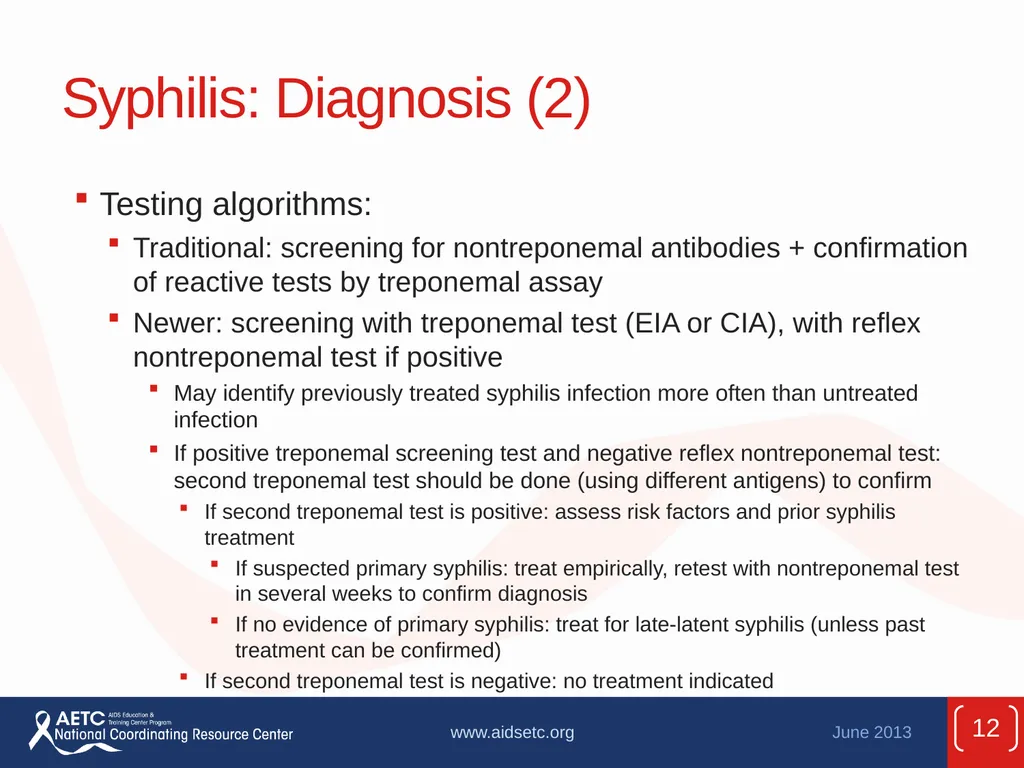
Testing algorithms:
Traditional: screening for nontreponemal antibodies + confirmation of reactive tests by treponemal assay
Newer: screening with treponemal test (EIA or CIA), with reflex nontreponemal test if positive
May identify previously treated syphilis infection more often than untreated infection
If positive treponemal screening test and negative reflex nontreponemal test: second treponemal test should be done (using different antigens) to confirm
If second treponemal test is positive: assess risk factors and prior syphilis treatment
If suspected primary syphilis: treat empirically, retest with nontreponemal test in several weeks to confirm diagnosis
If no evidence of primary syphilis: treat for late-latent syphilis (unless past treatment can be confirmed)
If second treponemal test is negative: no treatment indicated Syphilis: Diagnosis (2) June 2013 www.aidsetc.org 12<br>
Traditional: screening for nontreponemal antibodies + confirmation of reactive tests by treponemal assay
Newer: screening with treponemal test (EIA or CIA), with reflex nontreponemal test if positive
May identify previously treated syphilis infection more often than untreated infection
If positive treponemal screening test and negative reflex nontreponemal test: second treponemal test should be done (using different antigens) to confirm
If second treponemal test is positive: assess risk factors and prior syphilis treatment
If suspected primary syphilis: treat empirically, retest with nontreponemal test in several weeks to confirm diagnosis
If no evidence of primary syphilis: treat for late-latent syphilis (unless past treatment can be confirmed)
If second treponemal test is negative: no treatment indicated Syphilis: Diagnosis (2) June 2013 www.aidsetc.org 12<br>
13
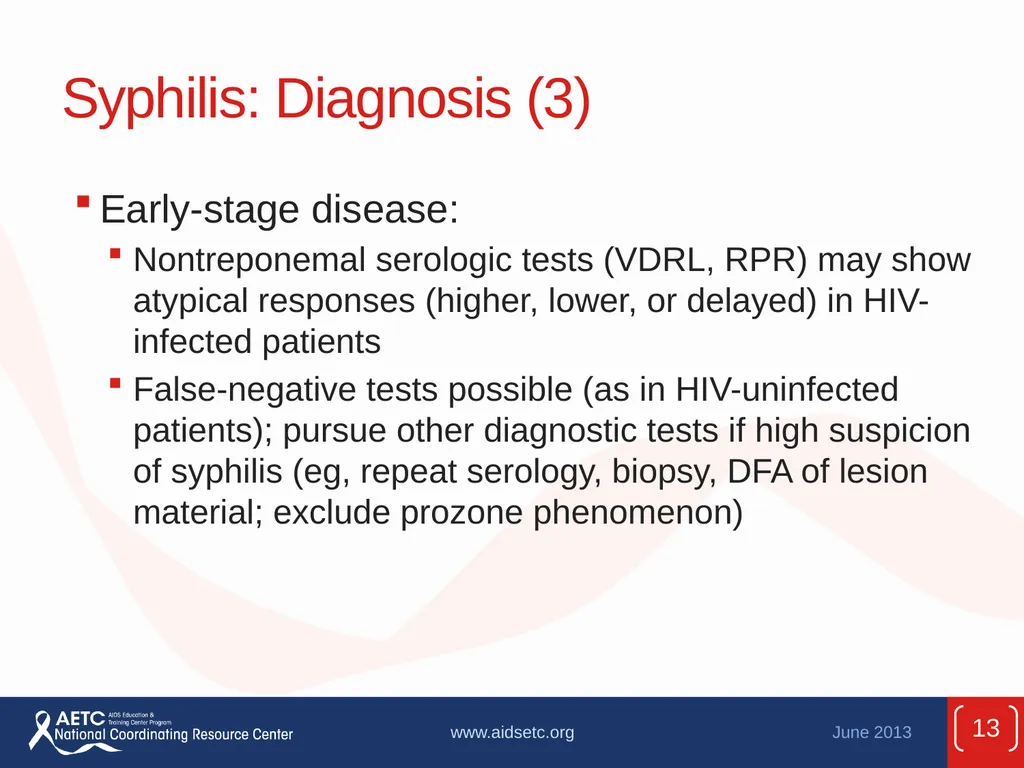
Early-stage disease:
Nontreponemal serologic tests (VDRL, RPR) may show atypical responses (higher, lower, or delayed) in HIV-infected patients
False-negative tests possible (as in HIV-uninfected patients); pursue other diagnostic tests if high suspicion of syphilis (eg, repeat serology, biopsy, DFA of lesion material; exclude prozone phenomenon) Syphilis: Diagnosis (3) June 2013 www.aidsetc.org 13<br>
Nontreponemal serologic tests (VDRL, RPR) may show atypical responses (higher, lower, or delayed) in HIV-infected patients
False-negative tests possible (as in HIV-uninfected patients); pursue other diagnostic tests if high suspicion of syphilis (eg, repeat serology, biopsy, DFA of lesion material; exclude prozone phenomenon) Syphilis: Diagnosis (3) June 2013 www.aidsetc.org 13<br>
14
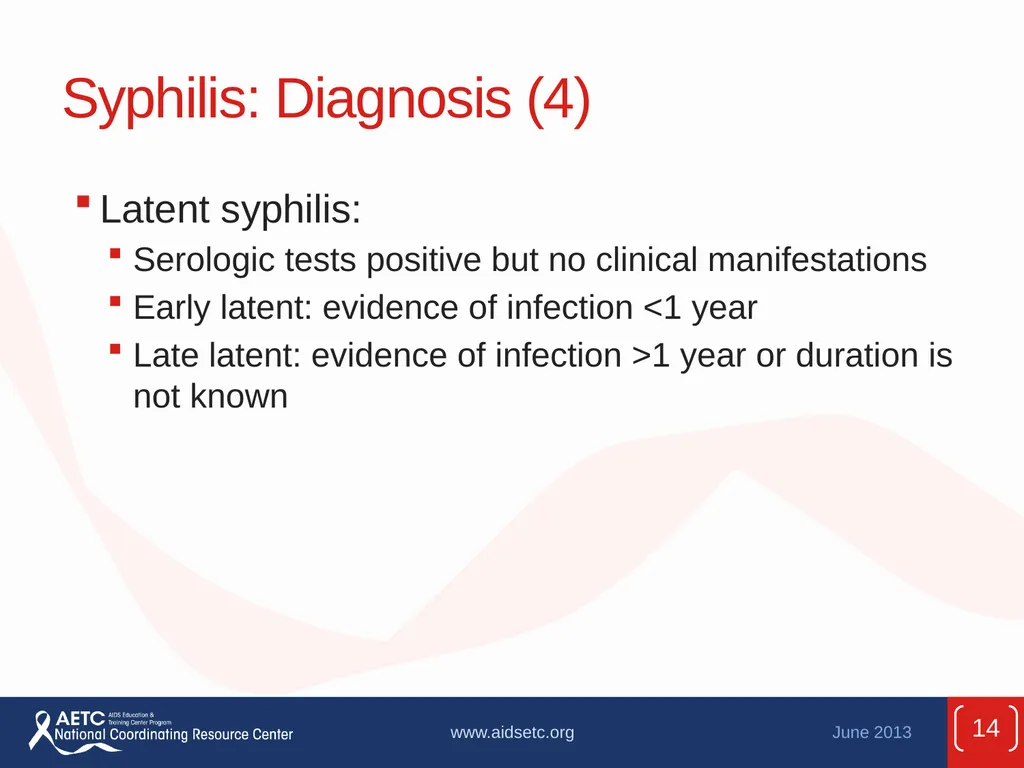
Latent syphilis:
Serologic tests positive but no clinical manifestations
Early latent: evidence of infection <1 year
Late latent: evidence of infection >1 year or duration is not known Syphilis: Diagnosis (4) June 2013 www.aidsetc.org 14<br>
Serologic tests positive but no clinical manifestations
Early latent: evidence of infection <1 year
Late latent: evidence of infection >1 year or duration is not known Syphilis: Diagnosis (4) June 2013 www.aidsetc.org 14<br>
15
Late-stage disease:
Cardiovascular and gummatous: same as for HIV-uninfected patients Syphilis: Diagnosis (5) June 2013 www.aidsetc.org 15<br>
Cardiovascular and gummatous: same as for HIV-uninfected patients Syphilis: Diagnosis (5) June 2013 www.aidsetc.org 15<br>
16
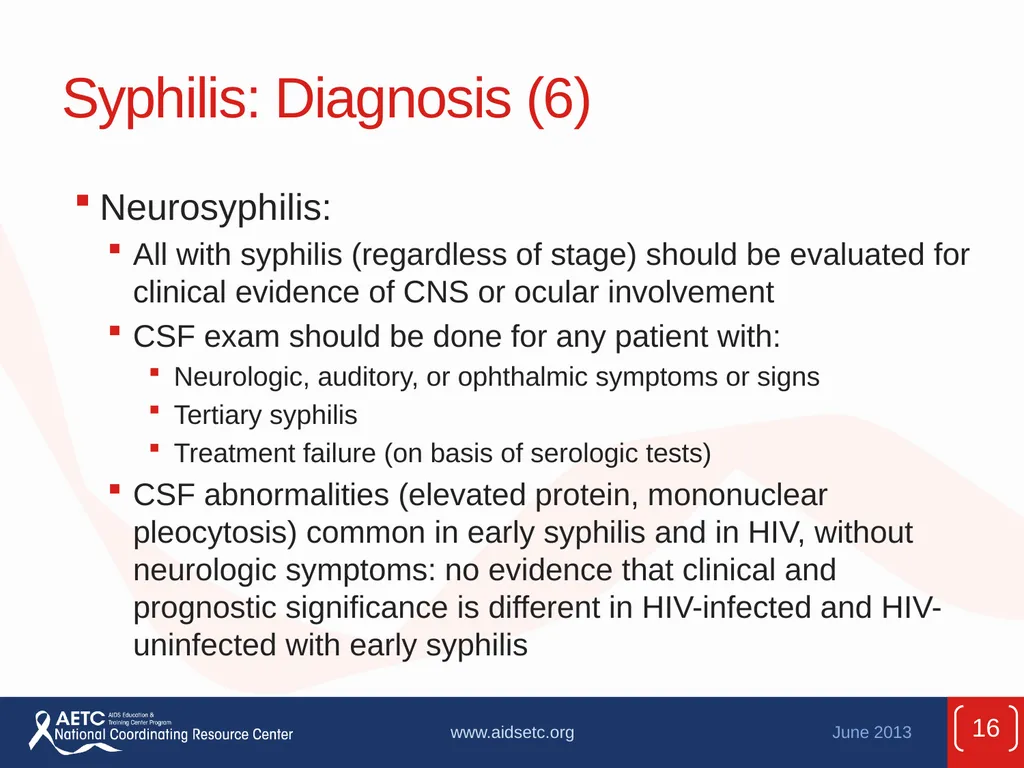
Neurosyphilis:
All with syphilis (regardless of stage) should be evaluated for clinical evidence of CNS or ocular involvement
CSF exam should be done for any patient with:
Neurologic, auditory, or ophthalmic symptoms or signs
Tertiary syphilis
Treatment failure (on basis of serologic tests)
CSF abnormalities (elevated protein, mononuclear pleocytosis) common in early syphilis and in HIV, without neurologic symptoms: no evidence that clinical and prognostic significance is different in HIV-infected and HIV-uninfected with early syphilis Syphilis: Diagnosis (6) June 2013 www.aidsetc.org 16<br>
All with syphilis (regardless of stage) should be evaluated for clinical evidence of CNS or ocular involvement
CSF exam should be done for any patient with:
Neurologic, auditory, or ophthalmic symptoms or signs
Tertiary syphilis
Treatment failure (on basis of serologic tests)
CSF abnormalities (elevated protein, mononuclear pleocytosis) common in early syphilis and in HIV, without neurologic symptoms: no evidence that clinical and prognostic significance is different in HIV-infected and HIV-uninfected with early syphilis Syphilis: Diagnosis (6) June 2013 www.aidsetc.org 16<br>
17
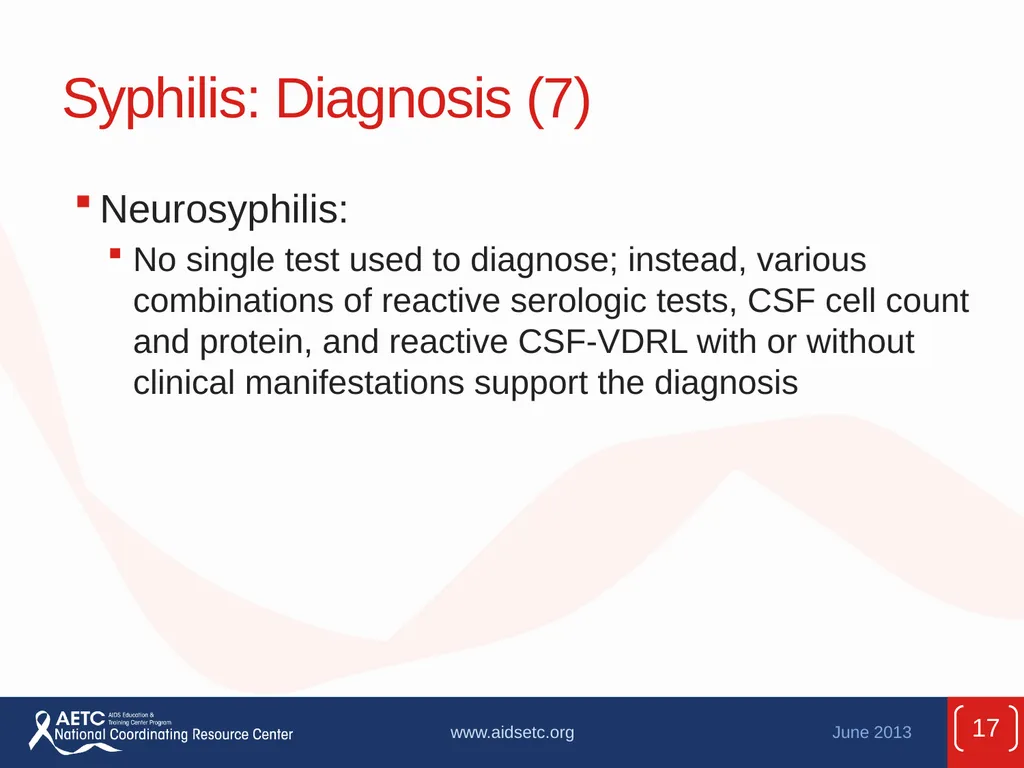
Neurosyphilis:
No single test used to diagnose; instead, various combinations of reactive serologic tests, CSF cell count and protein, and reactive CSF-VDRL with or without clinical manifestations support the diagnosis Syphilis: Diagnosis (7) June 2013 www.aidsetc.org 17<br>
No single test used to diagnose; instead, various combinations of reactive serologic tests, CSF cell count and protein, and reactive CSF-VDRL with or without clinical manifestations support the diagnosis Syphilis: Diagnosis (7) June 2013 www.aidsetc.org 17<br>
18
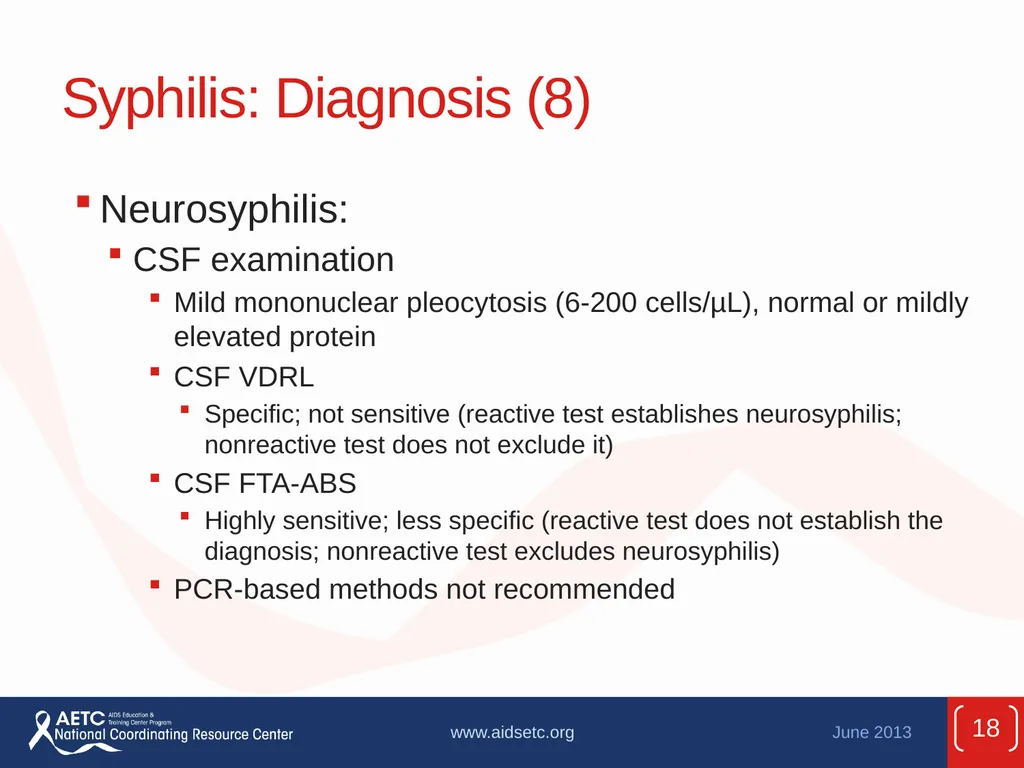
Neurosyphilis:
CSF examination
Mild mononuclear pleocytosis (6-200 cells/µL), normal or mildly elevated protein
CSF VDRL
Specific; not sensitive (reactive test establishes neurosyphilis; nonreactive test does not exclude it)
CSF FTA-ABS
Highly sensitive; less specific (reactive test does not establish the diagnosis; nonreactive test excludes neurosyphilis)
PCR-based methods not recommended Syphilis: Diagnosis (8) June 2013 www.aidsetc.org 18<br>
CSF examination
Mild mononuclear pleocytosis (6-200 cells/µL), normal or mildly elevated protein
CSF VDRL
Specific; not sensitive (reactive test establishes neurosyphilis; nonreactive test does not exclude it)
CSF FTA-ABS
Highly sensitive; less specific (reactive test does not establish the diagnosis; nonreactive test excludes neurosyphilis)
PCR-based methods not recommended Syphilis: Diagnosis (8) June 2013 www.aidsetc.org 18<br>
19
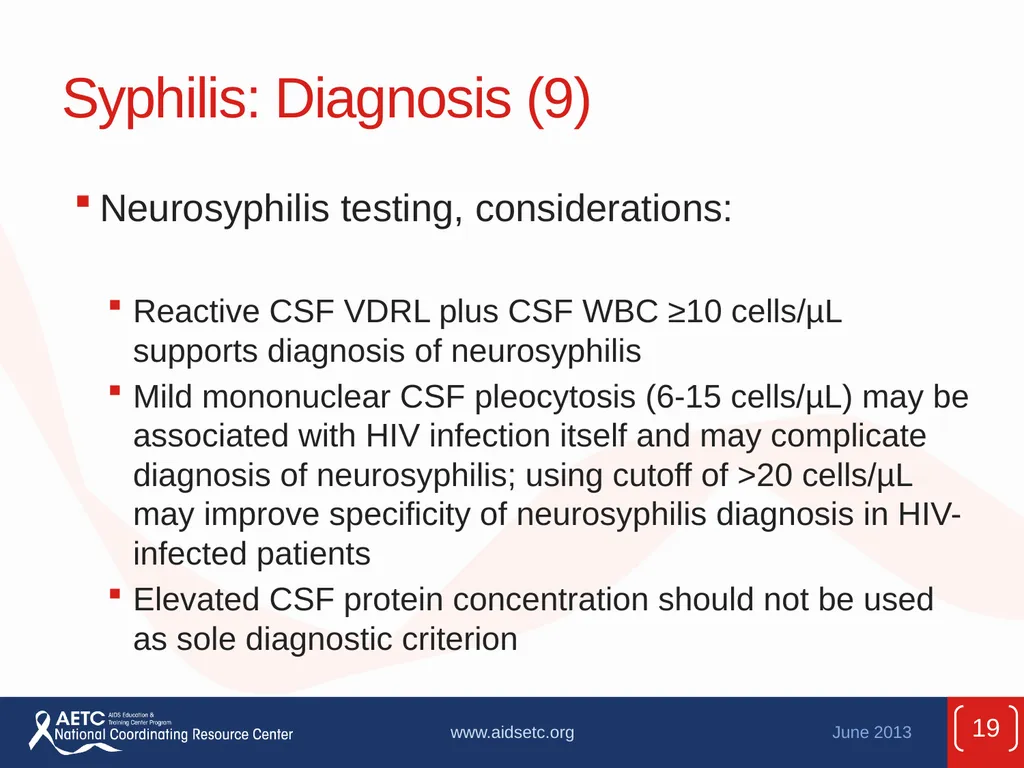
Neurosyphilis testing, considerations:
Reactive CSF VDRL plus CSF WBC ≥10 cells/µL supports diagnosis of neurosyphilis
Mild mononuclear CSF pleocytosis (6-15 cells/µL) may be associated with HIV infection itself and may complicate diagnosis of neurosyphilis; using cutoff of >20 cells/µL may improve specificity of neurosyphilis diagnosis in HIV-infected patients
Elevated CSF protein concentration should not be used as sole diagnostic criterion Syphilis: Diagnosis (9) June 2013 www.aidsetc.org 19<br>
Reactive CSF VDRL plus CSF WBC ≥10 cells/µL supports diagnosis of neurosyphilis
Mild mononuclear CSF pleocytosis (6-15 cells/µL) may be associated with HIV infection itself and may complicate diagnosis of neurosyphilis; using cutoff of >20 cells/µL may improve specificity of neurosyphilis diagnosis in HIV-infected patients
Elevated CSF protein concentration should not be used as sole diagnostic criterion Syphilis: Diagnosis (9) June 2013 www.aidsetc.org 19<br>
20
Risk screening should be routine
Client-centered risk-reduction messages; give specific actions to reduce risk of acquiring STIs and for transmitting HIV
Routine serologic testing for syphilis at least annually; Q 3-6 months if multiple partners, unprotected intercourse, injection drug or methamphetamine use, or partners with risks
Consider referral for behavioral intervention
Evaluate for other STIs Syphilis: Preventing Exposure June 2013 www.aidsetc.org 20<br>
Client-centered risk-reduction messages; give specific actions to reduce risk of acquiring STIs and for transmitting HIV
Routine serologic testing for syphilis at least annually; Q 3-6 months if multiple partners, unprotected intercourse, injection drug or methamphetamine use, or partners with risks
Consider referral for behavioral intervention
Evaluate for other STIs Syphilis: Preventing Exposure June 2013 www.aidsetc.org 20<br>
21
For persons exposed sexually to someone with syphilis: evaluate clinically and serologically and treat presumptively
Persons exposed within the 90 days preceding diagnosis of primary, secondary, or early-latent syphilis in a sex partner may be infected even if tests are seronegative: treat presumptively
Persons exposed >90 days before diagnosis of primary, secondary, or early-latent syphilis in a sex partner: treat presumptively if serologic test results are not available immediately and follow-up is uncertain Syphilis: Preventing Disease June 2013 www.aidsetc.org 21<br>
Persons exposed within the 90 days preceding diagnosis of primary, secondary, or early-latent syphilis in a sex partner may be infected even if tests are seronegative: treat presumptively
Persons exposed >90 days before diagnosis of primary, secondary, or early-latent syphilis in a sex partner: treat presumptively if serologic test results are not available immediately and follow-up is uncertain Syphilis: Preventing Disease June 2013 www.aidsetc.org 21<br>
22
Management similar to that for HIV-uninfected persons, but rates of serologic treatment failure and neurologic complications may be higher in HIV infection; closer follow-up is recommended
Penicillin is treatment of choice
Patients with penicillin allergy whose compliance or follow-up cannot be ensured: desensitize and treat with penicillin
Use alternatives to penicillin only with close clinical and serologic monitoring
Azithromycin resistance and treatment failure; especially in men who have sex with men (MSM) Syphilis: Treatment June 2013 www.aidsetc.org 22<br>
Penicillin is treatment of choice
Patients with penicillin allergy whose compliance or follow-up cannot be ensured: desensitize and treat with penicillin
Use alternatives to penicillin only with close clinical and serologic monitoring
Azithromycin resistance and treatment failure; especially in men who have sex with men (MSM) Syphilis: Treatment June 2013 www.aidsetc.org 22<br>
23
Early stage (primary, secondary, early-latent)
Preferred:
Benzathine penicillin G 2.4 million units IM, single dose
Alternative (for penicillin-allergic patients; monitor closely):
Doxycycline 100 mg PO BID for 14 days
Ceftriaxone 1 g IM or IV QD for 10-14 days
Azithromycin 2 g PO for 1 dose (note: reports of treatment failure and resistance; should not be used in MSM or pregnant women) Syphilis: Treatment (2) June 2013 www.aidsetc.org 23<br>
Preferred:
Benzathine penicillin G 2.4 million units IM, single dose
Alternative (for penicillin-allergic patients; monitor closely):
Doxycycline 100 mg PO BID for 14 days
Ceftriaxone 1 g IM or IV QD for 10-14 days
Azithromycin 2 g PO for 1 dose (note: reports of treatment failure and resistance; should not be used in MSM or pregnant women) Syphilis: Treatment (2) June 2013 www.aidsetc.org 23<br>
24
Late-latent (no signs of neurosyphilis)
Preferred:
Benzathine penicillin G 2.4 million units IM weekly for 3 weeks
Alternative (for penicillin-allergic patients):
Doxycycline 100 mg PO BID for 28 days (not thoroughly evaluated in HIV-infected patients; monitor closely)
Late-stage (cardiovascular or gummatous)
CSF examination; consult ID specialist
Preferred: Benzathine penicillin G 2.4 million units IM weekly for 3 weeks Syphilis: Treatment (3) June 2013 www.aidsetc.org 24<br>
Preferred:
Benzathine penicillin G 2.4 million units IM weekly for 3 weeks
Alternative (for penicillin-allergic patients):
Doxycycline 100 mg PO BID for 28 days (not thoroughly evaluated in HIV-infected patients; monitor closely)
Late-stage (cardiovascular or gummatous)
CSF examination; consult ID specialist
Preferred: Benzathine penicillin G 2.4 million units IM weekly for 3 weeks Syphilis: Treatment (3) June 2013 www.aidsetc.org 24<br>
25
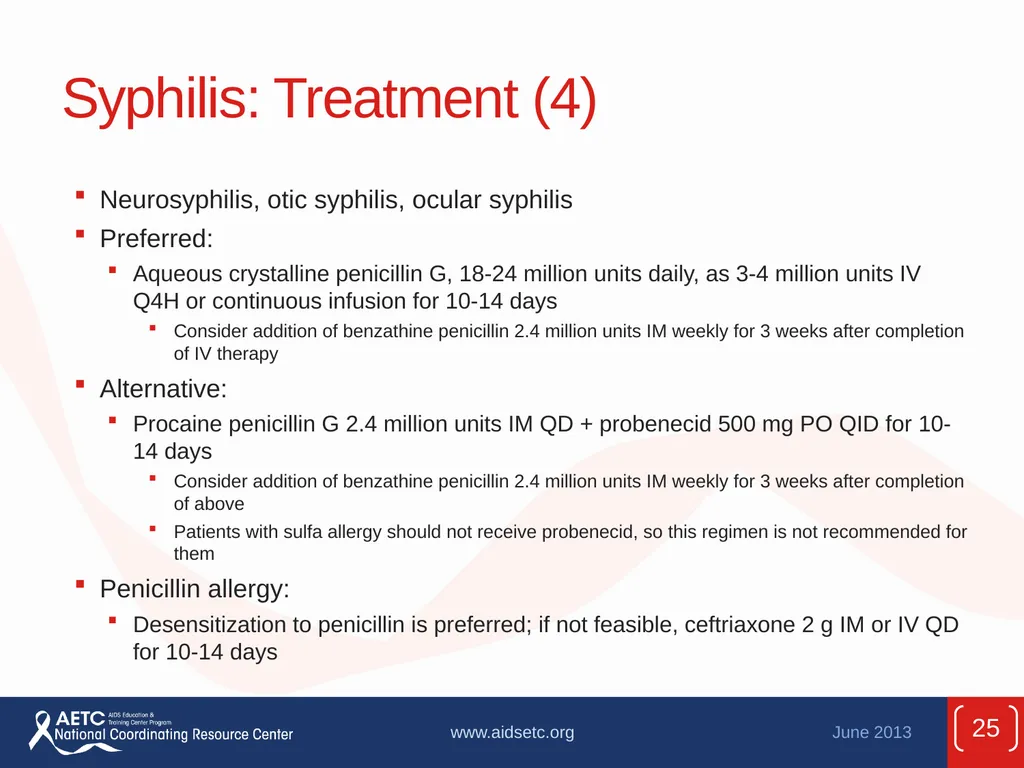
Neurosyphilis, otic syphilis, ocular syphilis
Preferred:
Aqueous crystalline penicillin G, 18-24 million units daily, as 3-4 million units IV Q4H or continuous infusion for 10-14 days
Consider addition of benzathine penicillin 2.4 million units IM weekly for 3 weeks after completion of IV therapy
Alternative:
Procaine penicillin G 2.4 million units IM QD + probenecid 500 mg PO QID for 10-14 days
Consider addition of benzathine penicillin 2.4 million units IM weekly for 3 weeks after completion of above
Patients with sulfa allergy should not receive probenecid, so this regimen is not recommended for them
Penicillin allergy:
Desensitization to penicillin is preferred; if not feasible, ceftriaxone 2 g IM or IV QD for 10-14 days Syphilis: Treatment (4) June 2013 www.aidsetc.org 25<br>
Preferred:
Aqueous crystalline penicillin G, 18-24 million units daily, as 3-4 million units IV Q4H or continuous infusion for 10-14 days
Consider addition of benzathine penicillin 2.4 million units IM weekly for 3 weeks after completion of IV therapy
Alternative:
Procaine penicillin G 2.4 million units IM QD + probenecid 500 mg PO QID for 10-14 days
Consider addition of benzathine penicillin 2.4 million units IM weekly for 3 weeks after completion of above
Patients with sulfa allergy should not receive probenecid, so this regimen is not recommended for them
Penicillin allergy:
Desensitization to penicillin is preferred; if not feasible, ceftriaxone 2 g IM or IV QD for 10-14 days Syphilis: Treatment (4) June 2013 www.aidsetc.org 25<br>
26
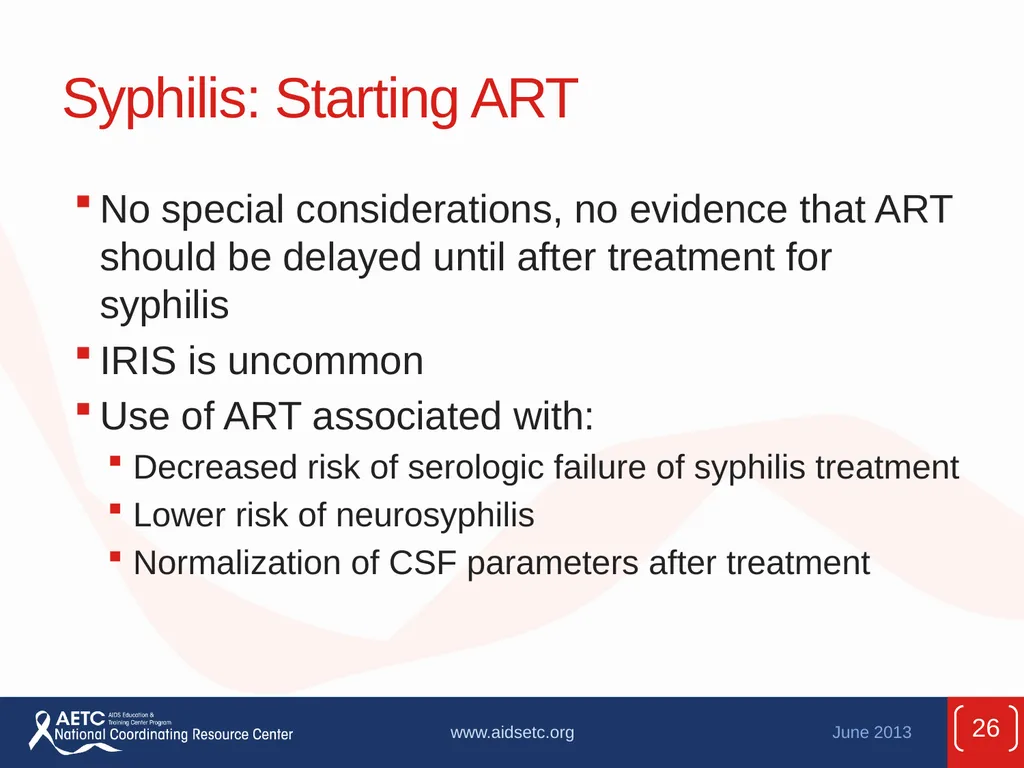
No special considerations, no evidence that ART should be delayed until after treatment for syphilis
IRIS is uncommon
Use of ART associated with:
Decreased risk of serologic failure of syphilis treatment
Lower risk of neurosyphilis
Normalization of CSF parameters after treatment Syphilis: Starting ART June 2013 www.aidsetc.org 26<br>
IRIS is uncommon
Use of ART associated with:
Decreased risk of serologic failure of syphilis treatment
Lower risk of neurosyphilis
Normalization of CSF parameters after treatment Syphilis: Starting ART June 2013 www.aidsetc.org 26<br>
27
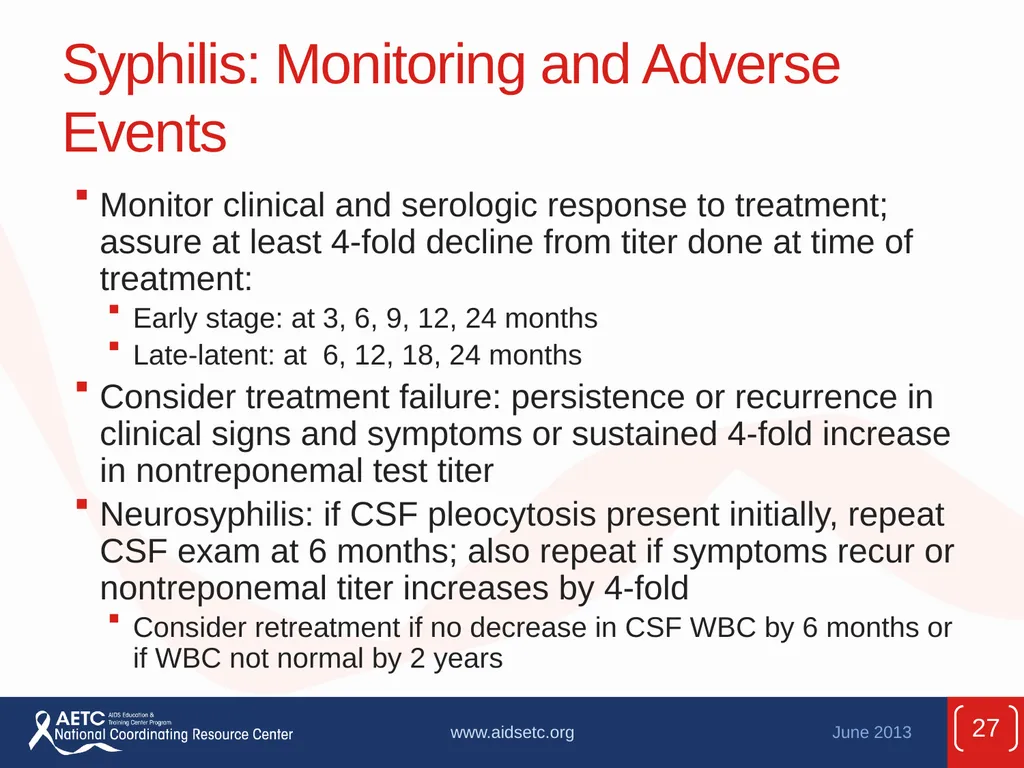
Monitor clinical and serologic response to treatment; assure at least 4-fold decline from titer done at time of treatment:
Early stage: at 3, 6, 9, 12, 24 months
Late-latent: at 6, 12, 18, 24 months
Consider treatment failure: persistence or recurrence in clinical signs and symptoms or sustained 4-fold increase in nontreponemal test titer
Neurosyphilis: if CSF pleocytosis present initially, repeat CSF exam at 6 months; also repeat if symptoms recur or nontreponemal titer increases by 4-fold
Consider retreatment if no decrease in CSF WBC by 6 months or if WBC not normal by 2 years Syphilis: Monitoring and Adverse Events June 2013 www.aidsetc.org 27<br>
Early stage: at 3, 6, 9, 12, 24 months
Late-latent: at 6, 12, 18, 24 months
Consider treatment failure: persistence or recurrence in clinical signs and symptoms or sustained 4-fold increase in nontreponemal test titer
Neurosyphilis: if CSF pleocytosis present initially, repeat CSF exam at 6 months; also repeat if symptoms recur or nontreponemal titer increases by 4-fold
Consider retreatment if no decrease in CSF WBC by 6 months or if WBC not normal by 2 years Syphilis: Monitoring and Adverse Events June 2013 www.aidsetc.org 27<br>
28
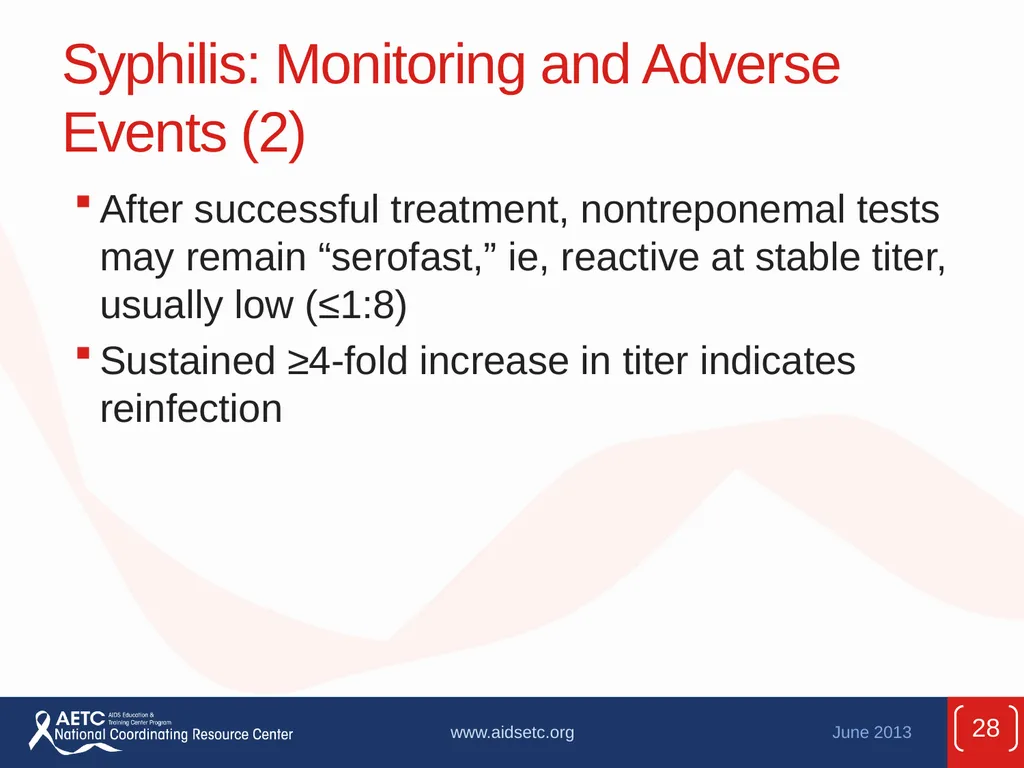
After successful treatment, nontreponemal tests may remain “serofast,” ie, reactive at stable titer, usually low (≤1:8)
Sustained ≥4-fold increase in titer indicates reinfection Syphilis: Monitoring and Adverse Events (2) June 2013 www.aidsetc.org 28<br>
Sustained ≥4-fold increase in titer indicates reinfection Syphilis: Monitoring and Adverse Events (2) June 2013 www.aidsetc.org 28<br>
29
Jarisch-Herxheimer reaction may occur in the first 24 hours after start of syphilis treatment
Fever, headache, myalgia
Manage symptoms with antipyretics
Most frequent in those with early syphilis, high nontreponemal titers, and prior penicillin treatment Syphilis: Monitoring and Adverse Events (3) June 2013 www.aidsetc.org 29<br>
Fever, headache, myalgia
Manage symptoms with antipyretics
Most frequent in those with early syphilis, high nontreponemal titers, and prior penicillin treatment Syphilis: Monitoring and Adverse Events (3) June 2013 www.aidsetc.org 29<br>
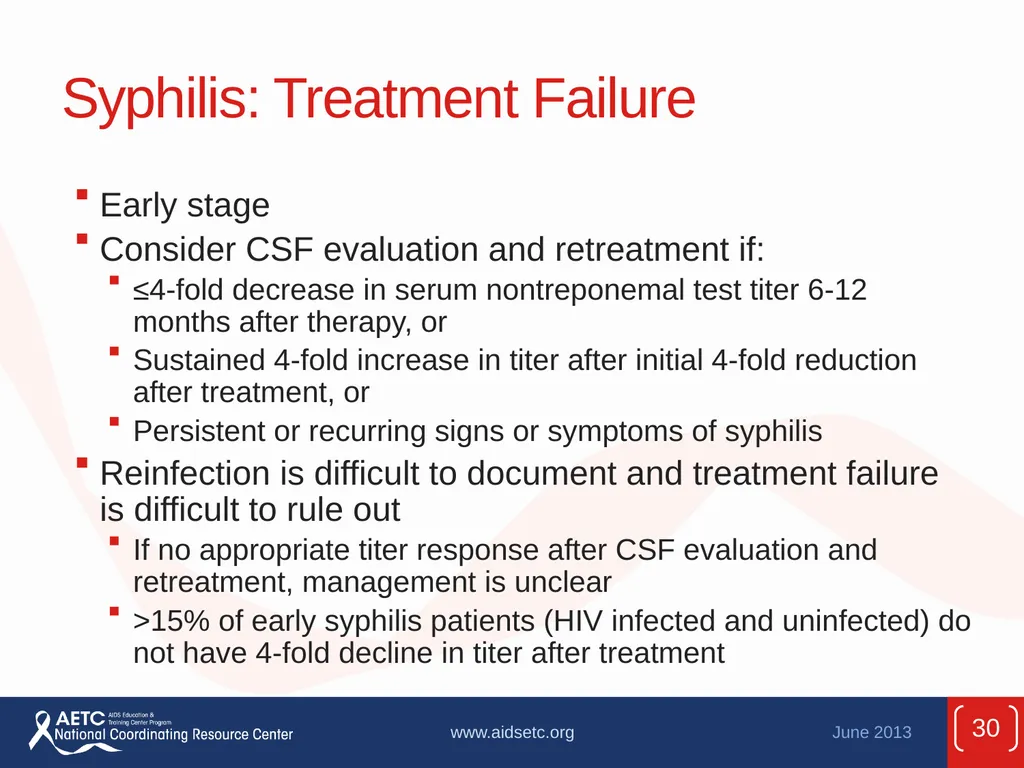
30
Early stage
Consider CSF evaluation and retreatment if:
≤4-fold decrease in serum nontreponemal test titer 6-12 months after therapy, or
Sustained 4-fold increase in titer after initial 4-fold reduction after treatment, or
Persistent or recurring signs or symptoms of syphilis
Reinfection is difficult to document and treatment failure is difficult to rule out
If no appropriate titer response after CSF evaluation and retreatment, management is unclear
>15% of early syphilis patients (HIV infected and uninfected) do not have 4-fold decline in titer after treatment Syphilis: Treatment Failure June 2013 www.aidsetc.org 30<br>
Consider CSF evaluation and retreatment if:
≤4-fold decrease in serum nontreponemal test titer 6-12 months after therapy, or
Sustained 4-fold increase in titer after initial 4-fold reduction after treatment, or
Persistent or recurring signs or symptoms of syphilis
Reinfection is difficult to document and treatment failure is difficult to rule out
If no appropriate titer response after CSF evaluation and retreatment, management is unclear
>15% of early syphilis patients (HIV infected and uninfected) do not have 4-fold decline in titer after treatment Syphilis: Treatment Failure June 2013 www.aidsetc.org 30<br>
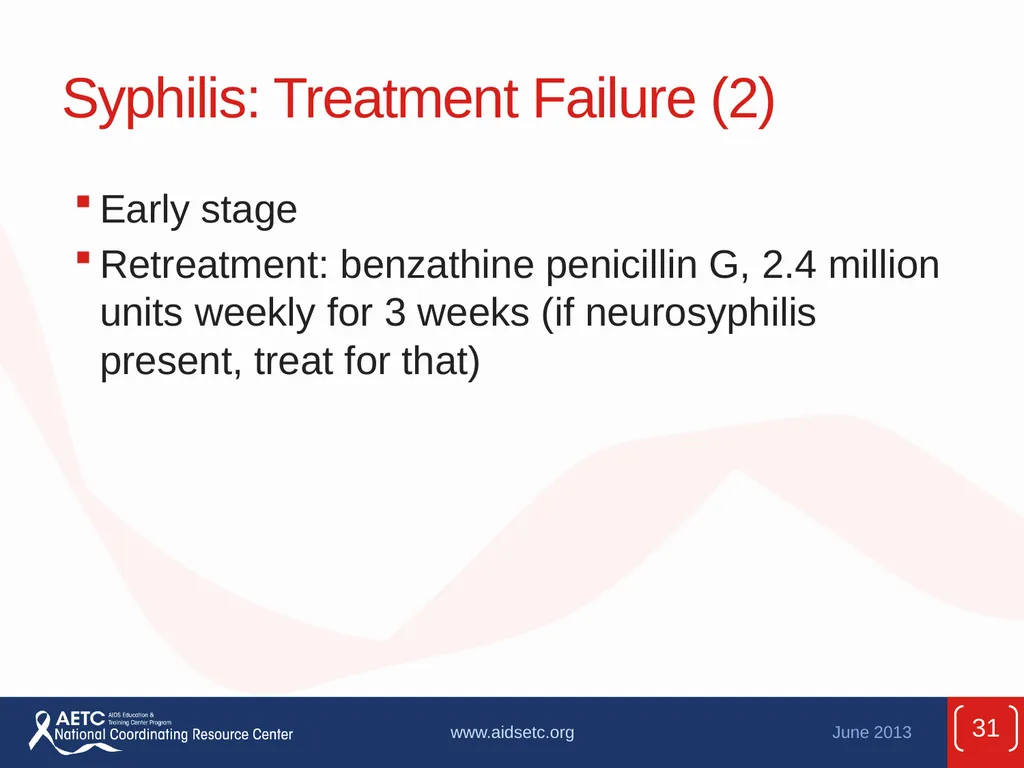
31
Early stage
Retreatment: benzathine penicillin G, 2.4 million units weekly for 3 weeks (if neurosyphilis present, treat for that) Syphilis: Treatment Failure (2) June 2013 www.aidsetc.org 31<br>
Retreatment: benzathine penicillin G, 2.4 million units weekly for 3 weeks (if neurosyphilis present, treat for that) Syphilis: Treatment Failure (2) June 2013 www.aidsetc.org 31<br>
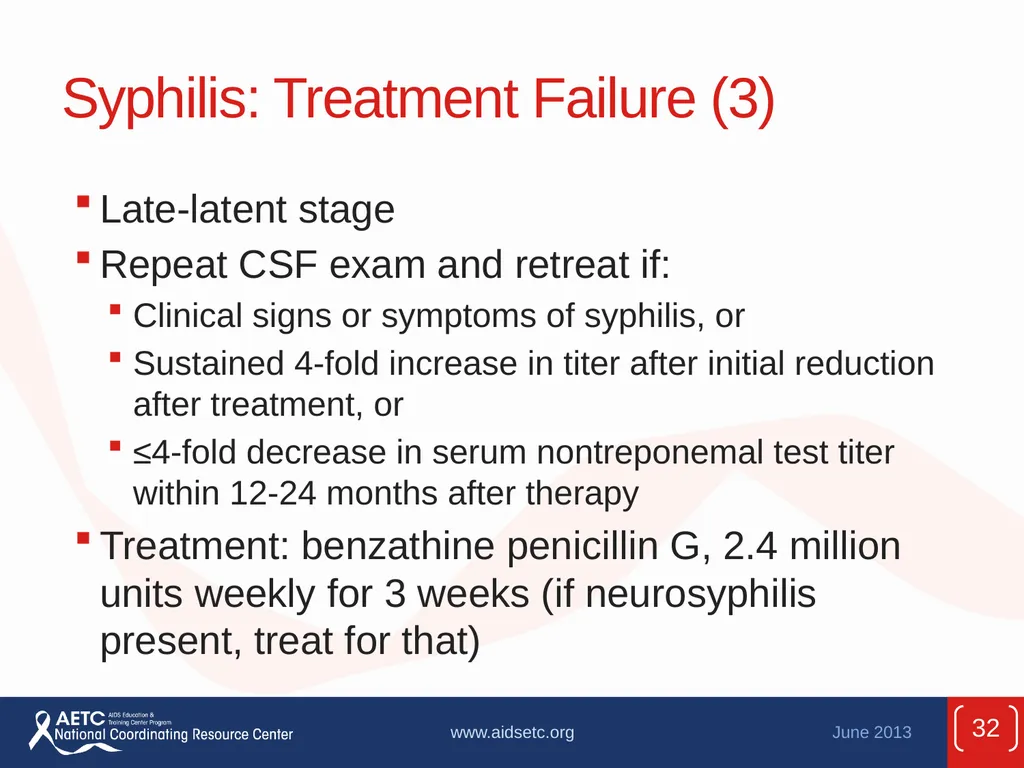
32
Late-latent stage
Repeat CSF exam and retreat if:
Clinical signs or symptoms of syphilis, or
Sustained 4-fold increase in titer after initial reduction after treatment, or
≤4-fold decrease in serum nontreponemal test titer within 12-24 months after therapy
Treatment: benzathine penicillin G, 2.4 million units weekly for 3 weeks (if neurosyphilis present, treat for that) Syphilis: Treatment Failure (3) June 2013 www.aidsetc.org 32<br>
Repeat CSF exam and retreat if:
Clinical signs or symptoms of syphilis, or
Sustained 4-fold increase in titer after initial reduction after treatment, or
≤4-fold decrease in serum nontreponemal test titer within 12-24 months after therapy
Treatment: benzathine penicillin G, 2.4 million units weekly for 3 weeks (if neurosyphilis present, treat for that) Syphilis: Treatment Failure (3) June 2013 www.aidsetc.org 32<br>
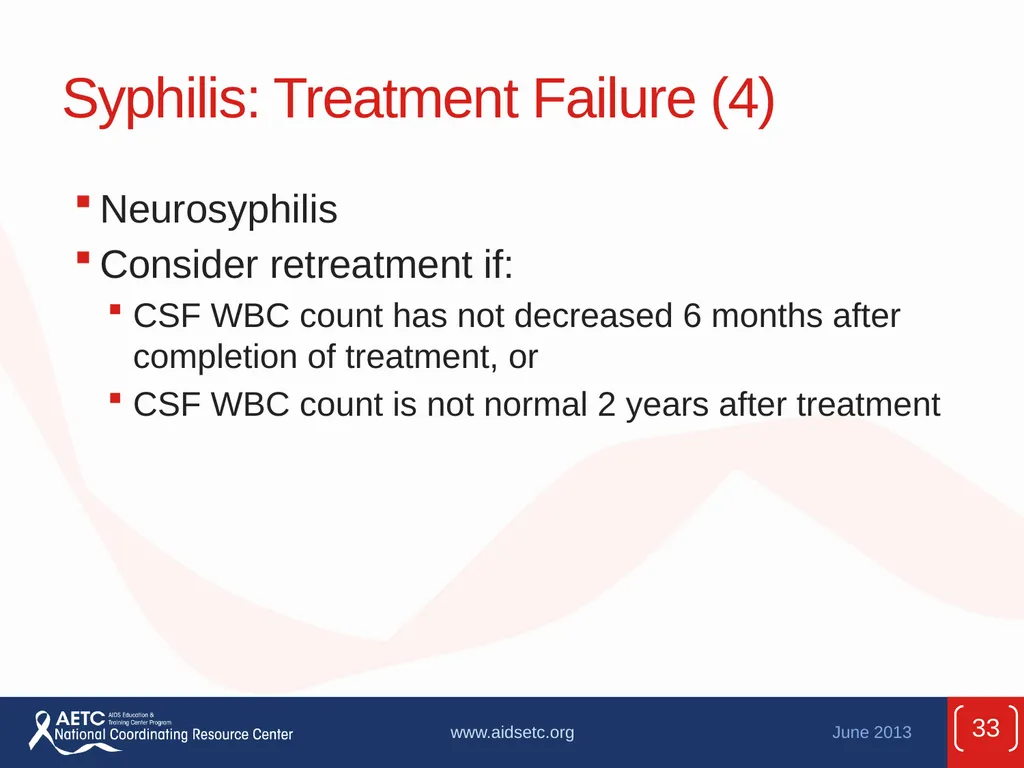
33
Neurosyphilis
Consider retreatment if:
CSF WBC count has not decreased 6 months after completion of treatment, or
CSF WBC count is not normal 2 years after treatment Syphilis: Treatment Failure (4) June 2013 www.aidsetc.org 33<br>
Consider retreatment if:
CSF WBC count has not decreased 6 months after completion of treatment, or
CSF WBC count is not normal 2 years after treatment Syphilis: Treatment Failure (4) June 2013 www.aidsetc.org 33<br>
34
Secondary prevention and maintenance therapy not indicated Syphilis: Preventing Recurrence June 2013 www.aidsetc.org 34<br>
35
Screening:
At 1st prenatal visit in all women; in high-prevalence areas or high-risk women, repeat early in 3rd trimester and at delivery
Transmission to the fetus and adverse pregnancy outcomes highest with early-stage syphilis
Pregnancy does not alter the clinical course or diagnostic test results of syphilis in adults
Syphilis associated with increased risk of perinatal HIV transmission to infants Syphilis: Considerations in Pregnancy June 2013 www.aidsetc.org 35<br>
At 1st prenatal visit in all women; in high-prevalence areas or high-risk women, repeat early in 3rd trimester and at delivery
Transmission to the fetus and adverse pregnancy outcomes highest with early-stage syphilis
Pregnancy does not alter the clinical course or diagnostic test results of syphilis in adults
Syphilis associated with increased risk of perinatal HIV transmission to infants Syphilis: Considerations in Pregnancy June 2013 www.aidsetc.org 35<br>
36
Use penicillin, if possible, as in nonpregnant HIV-infected adults
Penicillin is effective for preventing syphilis transmission to the fetus and for treatment of fetal infection
Optimal penicillin regimen is not clear
In early syphilis, consider second injection of benzathine penicillin G 1 week after first dose
No alternatives to penicillin proven effective and safe for treatment of syphilis during pregnancy or prevention of fetal infection
Pregnant women with syphilis and history of penicillin allergy should undergo desensitization and treatment with penicillin Syphilis: Considerations in Pregnancy (2) June 2013 www.aidsetc.org 36<br>
Penicillin is effective for preventing syphilis transmission to the fetus and for treatment of fetal infection
Optimal penicillin regimen is not clear
In early syphilis, consider second injection of benzathine penicillin G 1 week after first dose
No alternatives to penicillin proven effective and safe for treatment of syphilis during pregnancy or prevention of fetal infection
Pregnant women with syphilis and history of penicillin allergy should undergo desensitization and treatment with penicillin Syphilis: Considerations in Pregnancy (2) June 2013 www.aidsetc.org 36<br>
37
Jarisch-Herxheimer reaction in 2nd half of pregnancy may precipitate preterm labor or fetal distress
In 2nd half of pregnancy, sonographic evaluation for fetal or placental syphilis
Consult with OB specialists
After treatment, repeat serologic titers in 3rd trimester and at delivery
Insufficient data on serologic responses after therapy
Treatment likely inadequate if delivery ≤30 days of treatment, if woman has sign of infection at delivery, or if maternal titer is 4-fold higher than pretreatment titer Syphilis: Considerations in Pregnancy (3) June 2013 www.aidsetc.org 37<br>
In 2nd half of pregnancy, sonographic evaluation for fetal or placental syphilis
Consult with OB specialists
After treatment, repeat serologic titers in 3rd trimester and at delivery
Insufficient data on serologic responses after therapy
Treatment likely inadequate if delivery ≤30 days of treatment, if woman has sign of infection at delivery, or if maternal titer is 4-fold higher than pretreatment titer Syphilis: Considerations in Pregnancy (3) June 2013 www.aidsetc.org 37<br>
38
http://www.aidsetc.org
http://aidsinfo.nih.gov Websites to Access the Guidelines June 2013 www.aidsetc.org 38<br>
http://aidsinfo.nih.gov Websites to Access the Guidelines June 2013 www.aidsetc.org 38<br>
39
This presentation was prepared by Susa Coffey, MD, for the AETC National Resource Center in June 2013
See the AETC NRC website for the most current version of this presentation: http://www.aidsetc.org About This Slide Set June 2013 www.aidsetc.org 39<br>
See the AETC NRC website for the most current version of this presentation: http://www.aidsetc.org About This Slide Set June 2013 www.aidsetc.org 39<br>