
Preparing An Accounting Procedures Manual By John
Description: Preparing An Accounting Procedures Manual By John D. Daum, CPA, Partner James W. Gilson, CPA, Partner of Condon OMeara McGinty Donnelly LLP Table of contentsOverview 1) Introduction 2) General 3) Billing, cash receipts and accounts
Related Topics
Download Presentation
"Preparing An Accounting Procedures Manual By John" is the property of its rightful owner. Permission is granted to download and print the materials on this website for personal, non-commercial use only, and to display it on your personal computer provided you do not modify the materials and that you retain all copyright notices contained in the materials. By downloading content from our website, you accept the terms of this agreement.
Presentation Transcript
slide1. Preparing An Accounting Procedures Manual By
John D. Daum, CPA, Partner
James W. Gilson, CPA, Partner
of
Condon O’Meara McGinty & Donnelly LLP<br>
slide2. Table of contents/Overview 1) Introduction
2) General
3) Billing, cash receipts and accounts receivable
4) Payroll
5) Purchasing, cash disbursements and accounts payable
6) Receiving and inventory management
7) Asset management
8) Property and equipment
9) Club activities
10) Other items for consideration
11) Recent developments
12) In summary<br>
slide3. Introduction Major reasons for having an accounting procedures manual
Changes in the composition of the board, senior management and finance and accounting employees requires that appropriate accounting and internal control procedures be documented for future reference
Auditors are required to report to those charged with governance “other findings or issues, if any, arising from the audit that are, in the auditor’s professional judgment, significant and relevant to those charged with governance regarding their responsibility to oversee the financial reporting” (AU 260.12) Not having an internal control process accurately documented would in most cases fall under this requirement.<br>
slide4. Introduction The accounting procedures manual is a great road map to training new personnel or, in case of emergency, to help keep the accounting department running
Documentation of management’s assessment of risks of material misstatement of the financial statements
Committee of Sponsoring Organizations (“COSO”) 2013 Framework
Control environment
Risk assessment
Control activities
Information and communication
Monitoring activities<br>
slide5. Poll Question # 1 What is the main reason why you should have an accounting procedures manual for your entity?
It documents the internal control structure of your entity
Accounting standards require that you evaluate and document your internal controls formally
It’s a good road map to assist employees in doing their respective accounting functions
All of the above<br>
slide6. Poll Question # 1 D) All of the above<br>
slide7. General Organizational flow chart
Including detailed breakout of accounting department
Detailed job descriptions for accounting department positions
Accounting and computer system overview
Password/Control/Safeguard Protocols
Access
Data backup procedures - Disaster recovery plan
Vulnerability Assessment
Record retention policy/storage of old records/permanent documents
Reporting<br>
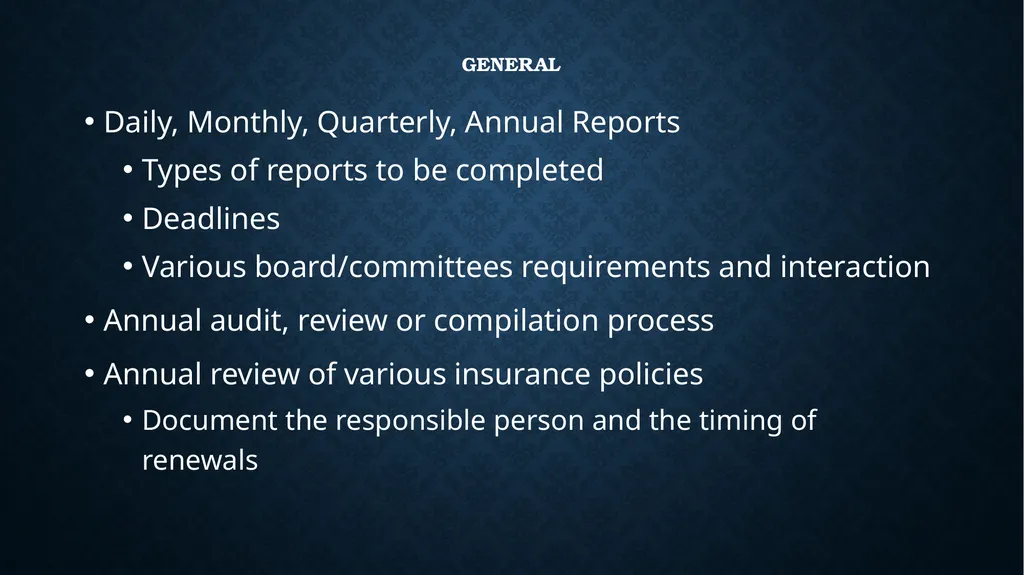
slide8. General Daily, Monthly, Quarterly, Annual Reports
Types of reports to be completed
Deadlines
Various board/committees requirements and interaction
Annual audit, review or compilation process
Annual review of various insurance policies
Document the responsible person and the timing of renewals<br>
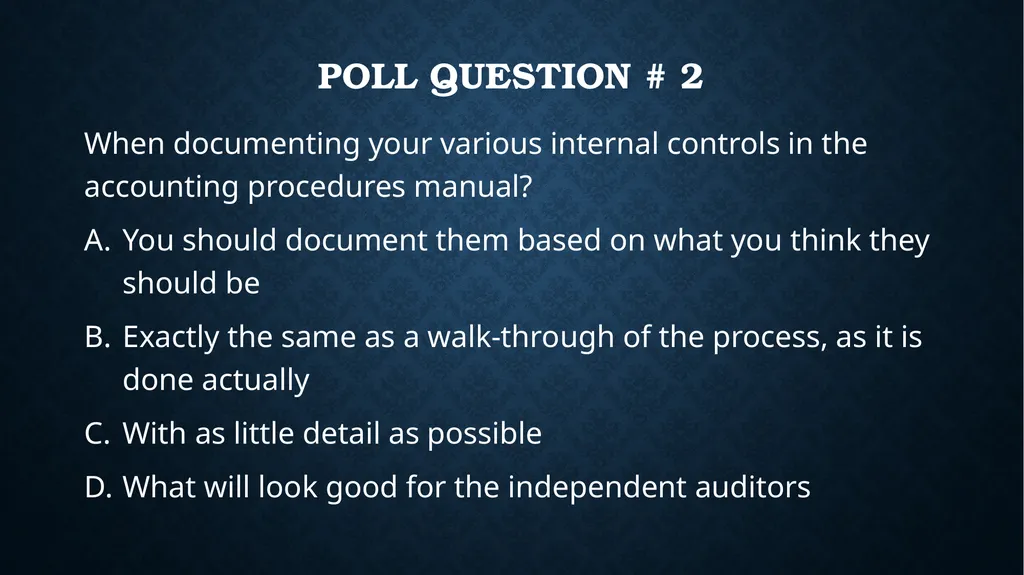
slide9. Poll Question # 2 When documenting your various internal controls in the accounting procedures manual?
You should document them based on what you think they should be
Exactly the same as a walk-through of the process, as it is done actually
With as little detail as possible
What will look good for the independent auditors<br>
slide10. Poll Question # 2 B) Exactly the same as a walk-thorough of the process, as it is performed<br>
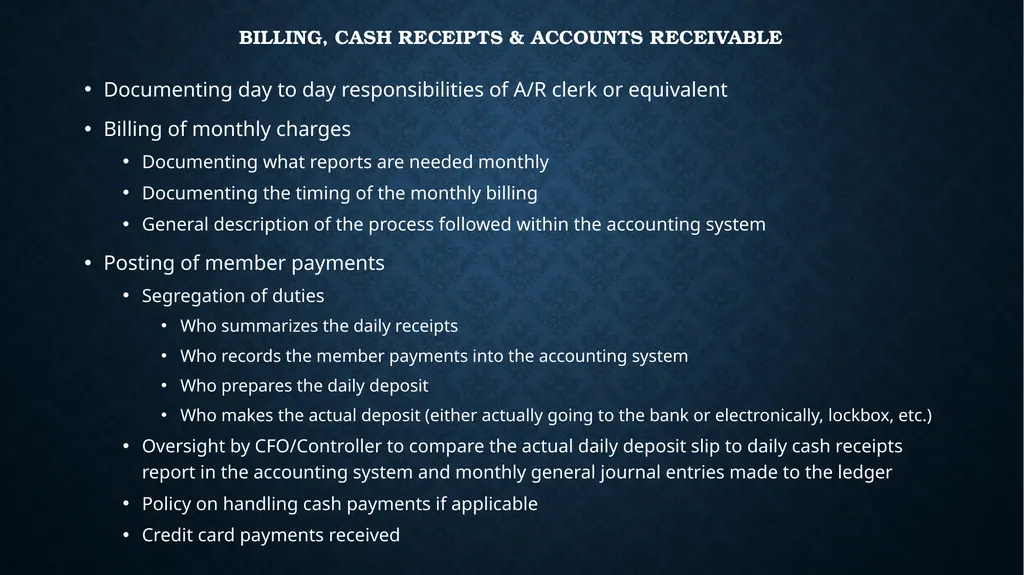
slide11. Billing, Cash Receipts & accounts receivable Documenting day to day responsibilities of A/R clerk or equivalent
Billing of monthly charges
Documenting what reports are needed monthly
Documenting the timing of the monthly billing
General description of the process followed within the accounting system
Posting of member payments
Segregation of duties
Who summarizes the daily receipts
Who records the member payments into the accounting system
Who prepares the daily deposit
Who makes the actual deposit (either actually going to the bank or electronically, lockbox, etc.)
Oversight by CFO/Controller to compare the actual daily deposit slip to daily cash receipts report in the accounting system and monthly general journal entries made to the ledger
Policy on handling cash payments if applicable
Credit card payments received<br>
slide12. Billing, Cash Receipts & accounts receivable CFO/Controller monthly review of aged trial balance report
Review of delinquent accounts and communication to delinquent members (30/60/90 day letters)
Process of how write-offs and other credits to members’ accounts are determined and approved by CFO/Controller, General Manager and Treasurer or Finance Committee<br>
slide13. Payroll Documenting payroll system controls, payroll period, access, employee time records and how it interfaces with the third party service provider that processes payroll
Documenting day to day responsibilities of the payroll clerk or equivalent
Documenting the human resources function
How new hires are processed, entered into payroll system and what forms need to be completed/interfacing with appropriate department heads
Documenting non participation in medical and retirement plans
How the discharging of employees is processed
Safeguards over personnel records/information
Direct deposit process
Process of recording employee hours/timecards/punching and related controls<br>
slide14. Payroll Process of the review of payroll period hours worked by department heads and how they get to the payroll clerk for processing
Processing of payroll and related approval process by CFO/Controller/GM
Review of the monthly payroll journal entries by CFO/Controller
Paycheck and direct deposit stub dispersal
Annual payroll payoff
Review of third party payroll service provider
Service auditor’s report (i.e. SOC-1 or SOC-2 Report)
Assess risks identified in SOC-1 or SOC-2 Report
Develop mitigating controls, as necessary<br>
slide15. Poll Question # 3 Once your accounting procedures manual is complete how often should you update it?
Never
Once every five years
Regularly, it is never complete, it’s a work in process
Once every 2 years<br>
slide16. Poll QUESTION # 3 C) Regularly, it is never complete, it’s a work in process<br>
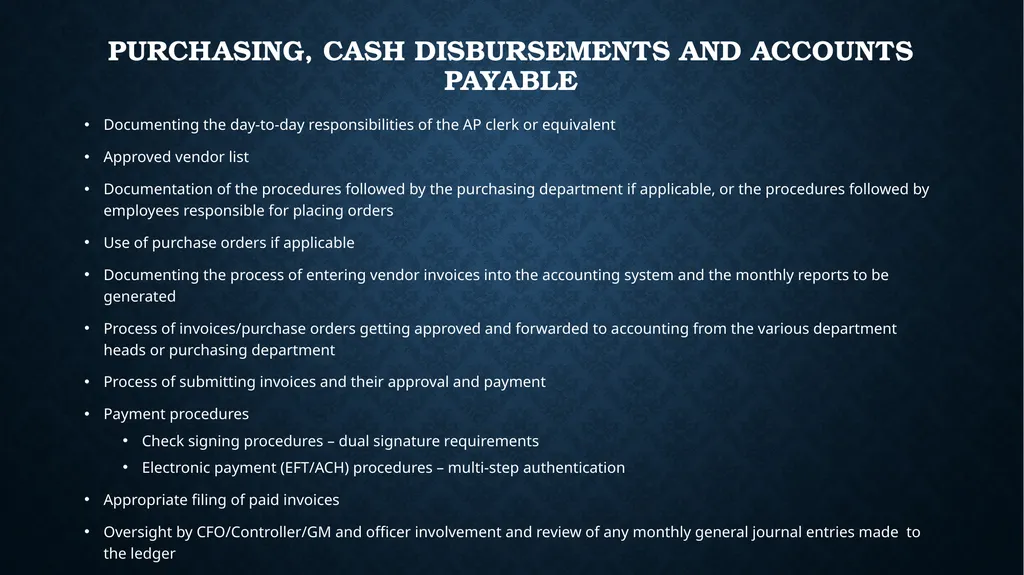
slide17. Purchasing, cash disbursements and accounts payable Documenting the day-to-day responsibilities of the AP clerk or equivalent
Approved vendor list
Documentation of the procedures followed by the purchasing department if applicable, or the procedures followed by employees responsible for placing orders
Use of purchase orders if applicable
Documenting the process of entering vendor invoices into the accounting system and the monthly reports to be generated
Process of invoices/purchase orders getting approved and forwarded to accounting from the various department heads or purchasing department
Process of submitting invoices and their approval and payment
Payment procedures
Check signing procedures – dual signature requirements
Electronic payment (EFT/ACH) procedures – multi-step authentication
Appropriate filing of paid invoices
Oversight by CFO/Controller/GM and officer involvement and review of any monthly general journal entries made to the ledger<br>
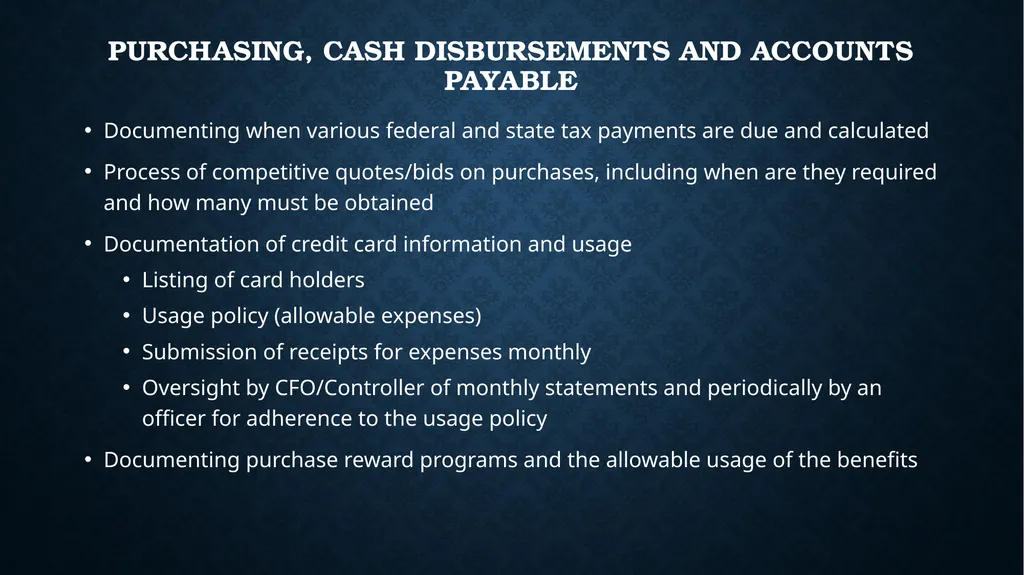
slide18. Purchasing, cash disbursements and accounts payable Documenting when various federal and state tax payments are due and calculated
Process of competitive quotes/bids on purchases, including when are they required and how many must be obtained
Documentation of credit card information and usage
Listing of card holders
Usage policy (allowable expenses)
Submission of receipts for expenses monthly
Oversight by CFO/Controller of monthly statements and periodically by an officer for adherence to the usage policy
Documenting purchase reward programs and the allowable usage of the benefits<br>
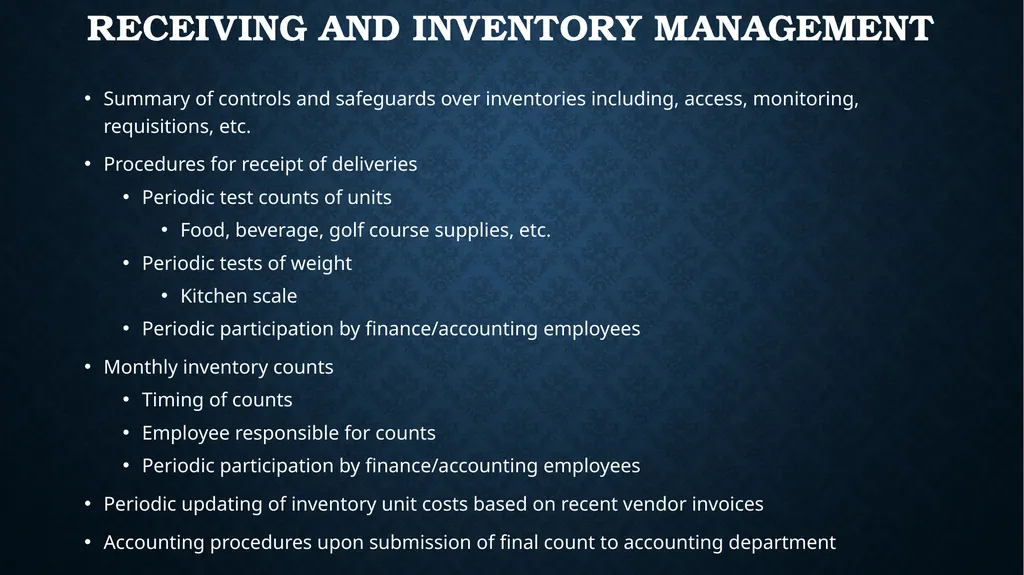
slide19. Receiving and inventory management Summary of controls and safeguards over inventories including, access, monitoring, requisitions, etc.
Procedures for receipt of deliveries
Periodic test counts of units
Food, beverage, golf course supplies, etc.
Periodic tests of weight
Kitchen scale
Periodic participation by finance/accounting employees
Monthly inventory counts
Timing of counts
Employee responsible for counts
Periodic participation by finance/accounting employees
Periodic updating of inventory unit costs based on recent vendor invoices
Accounting procedures upon submission of final count to accounting department<br>
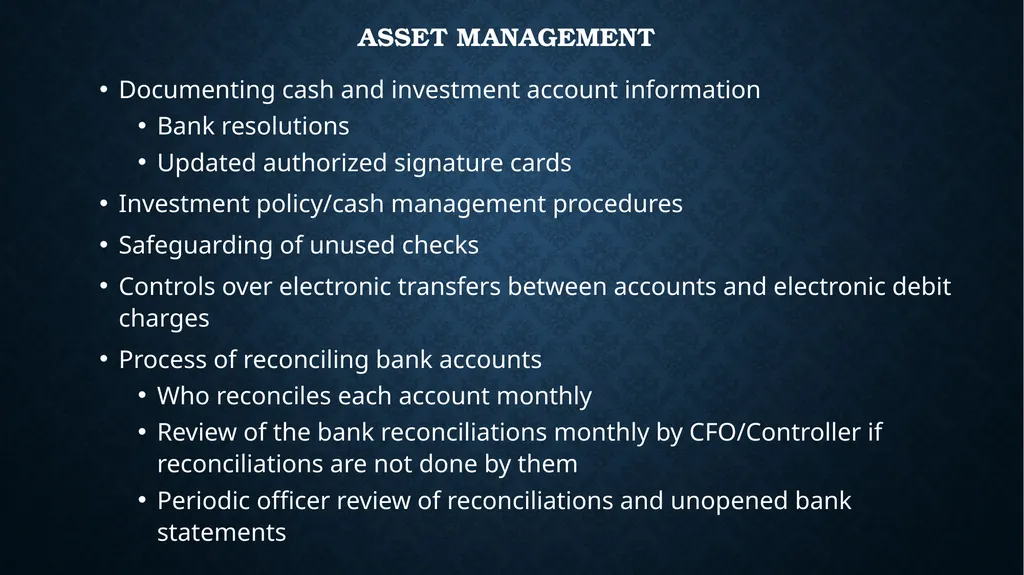
slide20. Asset Management Documenting cash and investment account information
Bank resolutions
Updated authorized signature cards
Investment policy/cash management procedures
Safeguarding of unused checks
Controls over electronic transfers between accounts and electronic debit charges
Process of reconciling bank accounts
Who reconciles each account monthly
Review of the bank reconciliations monthly by CFO/Controller if reconciliations are not done by them
Periodic officer review of reconciliations and unopened bank statements<br>
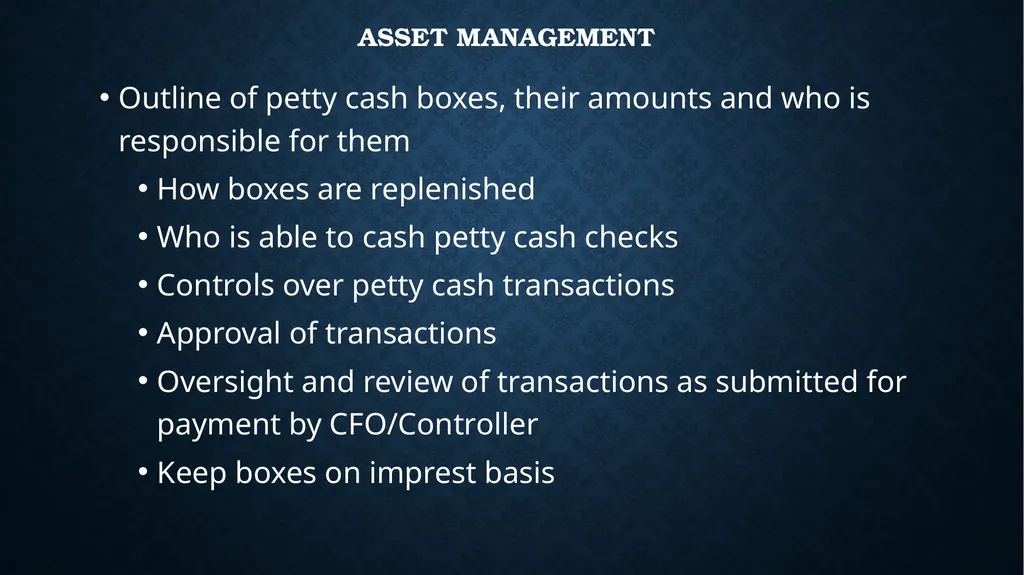
slide21. Asset Management Outline of petty cash boxes, their amounts and who is responsible for them
How boxes are replenished
Who is able to cash petty cash checks
Controls over petty cash transactions
Approval of transactions
Oversight and review of transactions as submitted for payment by CFO/Controller
Keep boxes on imprest basis<br>
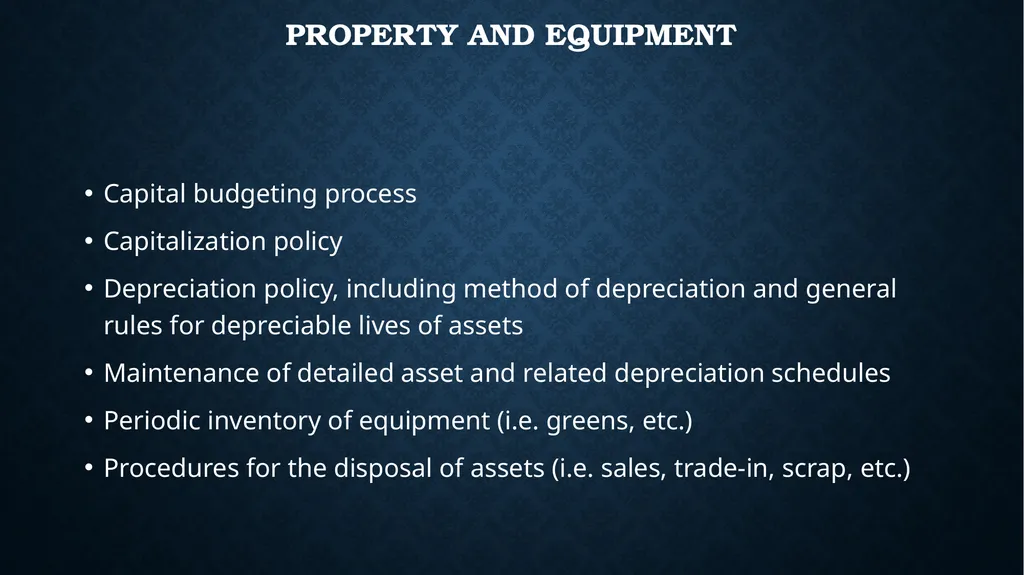
slide22. Property and equipment Capital budgeting process
Capitalization policy
Depreciation policy, including method of depreciation and general rules for depreciable lives of assets
Maintenance of detailed asset and related depreciation schedules
Periodic inventory of equipment (i.e. greens, etc.)
Procedures for the disposal of assets (i.e. sales, trade-in, scrap, etc.)<br>
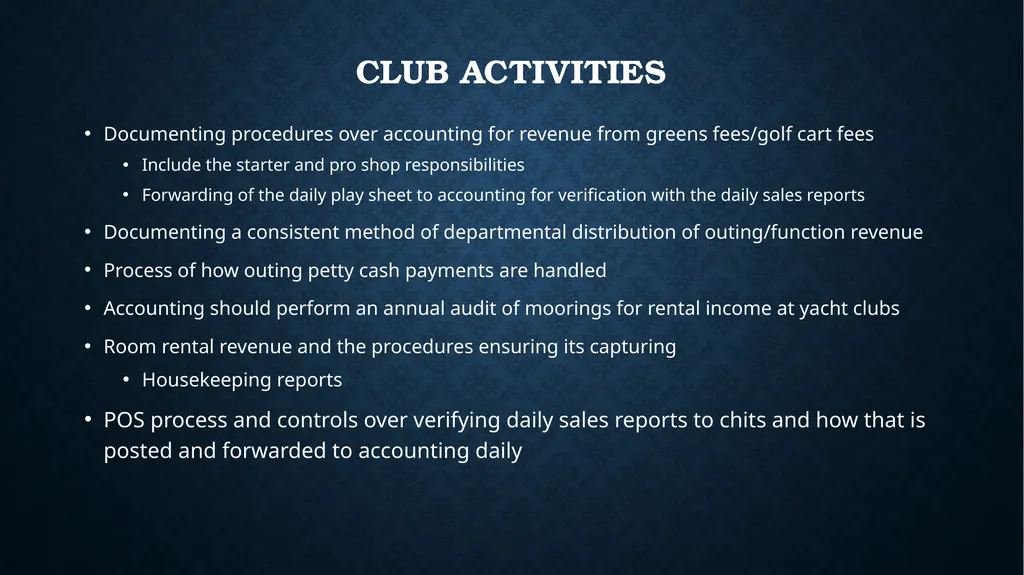
slide23. Club Activities Documenting procedures over accounting for revenue from greens fees/golf cart fees
Include the starter and pro shop responsibilities
Forwarding of the daily play sheet to accounting for verification with the daily sales reports
Documenting a consistent method of departmental distribution of outing/function revenue
Process of how outing petty cash payments are handled
Accounting should perform an annual audit of moorings for rental income at yacht clubs
Room rental revenue and the procedures ensuring its capturing
Housekeeping reports
POS process and controls over verifying daily sales reports to chits and how that is posted and forwarded to accounting daily<br>
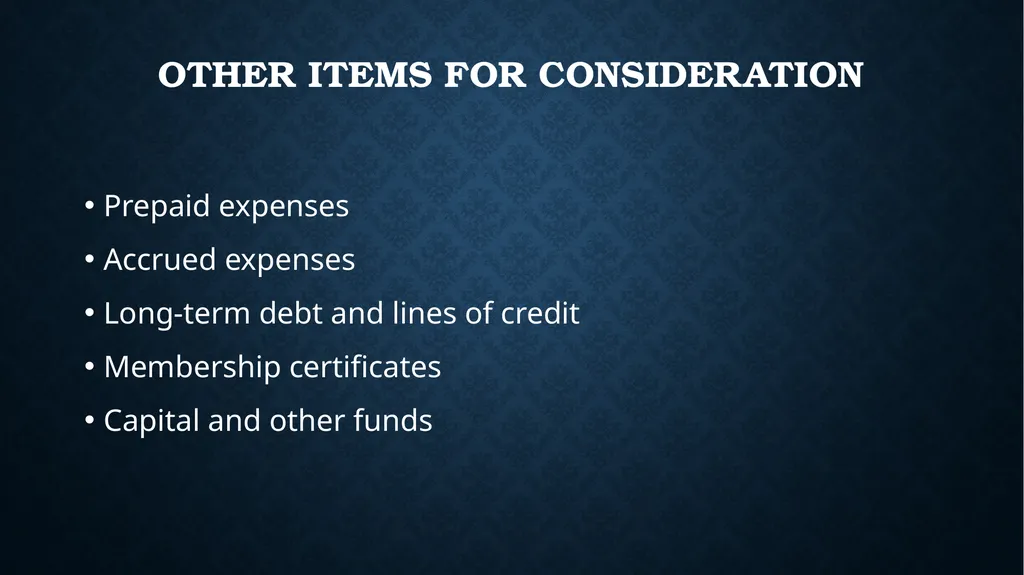
slide24. Other items for consideration Prepaid expenses
Accrued expenses
Long-term debt and lines of credit
Membership certificates
Capital and other funds<br>
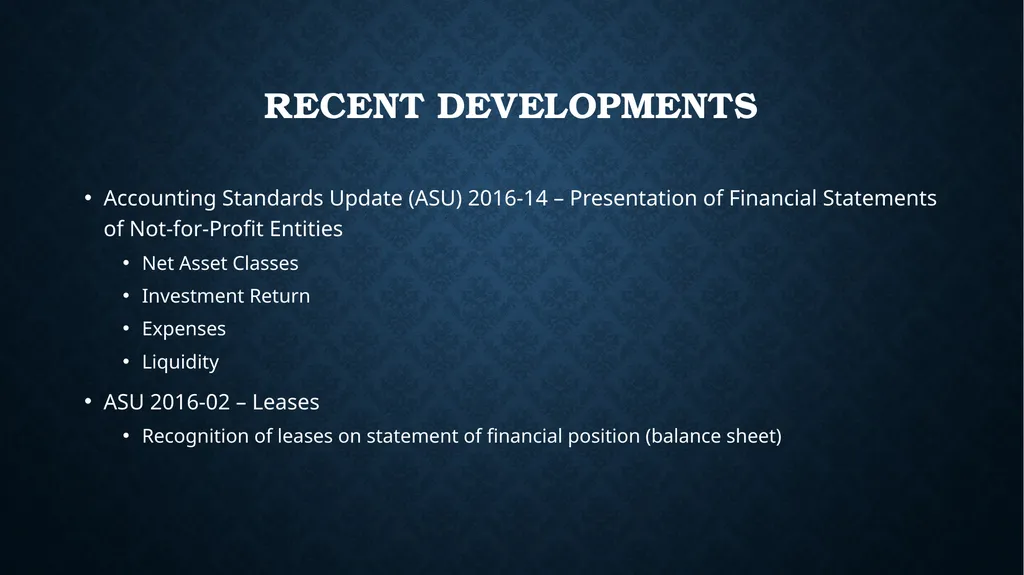
slide25. Recent developments Accounting Standards Update (ASU) 2016-14 – Presentation of Financial Statements of Not-for-Profit Entities
Net Asset Classes
Investment Return
Expenses
Liquidity
ASU 2016-02 – Leases
Recognition of leases on statement of financial position (balance sheet)<br>
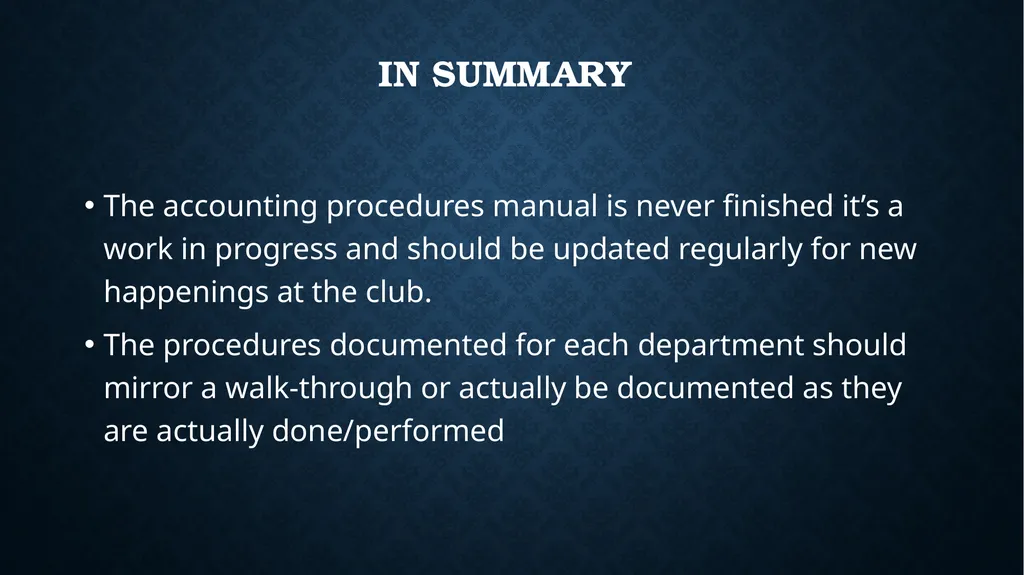
slide26. In Summary The accounting procedures manual is never finished it’s a work in progress and should be updated regularly for new happenings at the club.
The procedures documented for each department should mirror a walk-through or actually be documented as they are actually done/performed<br>
John D. Daum, CPA, Partner
James W. Gilson, CPA, Partner
of
Condon O’Meara McGinty & Donnelly LLP<br>
slide2. Table of contents/Overview 1) Introduction
2) General
3) Billing, cash receipts and accounts receivable
4) Payroll
5) Purchasing, cash disbursements and accounts payable
6) Receiving and inventory management
7) Asset management
8) Property and equipment
9) Club activities
10) Other items for consideration
11) Recent developments
12) In summary<br>
slide3. Introduction Major reasons for having an accounting procedures manual
Changes in the composition of the board, senior management and finance and accounting employees requires that appropriate accounting and internal control procedures be documented for future reference
Auditors are required to report to those charged with governance “other findings or issues, if any, arising from the audit that are, in the auditor’s professional judgment, significant and relevant to those charged with governance regarding their responsibility to oversee the financial reporting” (AU 260.12) Not having an internal control process accurately documented would in most cases fall under this requirement.<br>
slide4. Introduction The accounting procedures manual is a great road map to training new personnel or, in case of emergency, to help keep the accounting department running
Documentation of management’s assessment of risks of material misstatement of the financial statements
Committee of Sponsoring Organizations (“COSO”) 2013 Framework
Control environment
Risk assessment
Control activities
Information and communication
Monitoring activities<br>
slide5. Poll Question # 1 What is the main reason why you should have an accounting procedures manual for your entity?
It documents the internal control structure of your entity
Accounting standards require that you evaluate and document your internal controls formally
It’s a good road map to assist employees in doing their respective accounting functions
All of the above<br>
slide6. Poll Question # 1 D) All of the above<br>
slide7. General Organizational flow chart
Including detailed breakout of accounting department
Detailed job descriptions for accounting department positions
Accounting and computer system overview
Password/Control/Safeguard Protocols
Access
Data backup procedures - Disaster recovery plan
Vulnerability Assessment
Record retention policy/storage of old records/permanent documents
Reporting<br>
slide8. General Daily, Monthly, Quarterly, Annual Reports
Types of reports to be completed
Deadlines
Various board/committees requirements and interaction
Annual audit, review or compilation process
Annual review of various insurance policies
Document the responsible person and the timing of renewals<br>
slide9. Poll Question # 2 When documenting your various internal controls in the accounting procedures manual?
You should document them based on what you think they should be
Exactly the same as a walk-through of the process, as it is done actually
With as little detail as possible
What will look good for the independent auditors<br>
slide10. Poll Question # 2 B) Exactly the same as a walk-thorough of the process, as it is performed<br>
slide11. Billing, Cash Receipts & accounts receivable Documenting day to day responsibilities of A/R clerk or equivalent
Billing of monthly charges
Documenting what reports are needed monthly
Documenting the timing of the monthly billing
General description of the process followed within the accounting system
Posting of member payments
Segregation of duties
Who summarizes the daily receipts
Who records the member payments into the accounting system
Who prepares the daily deposit
Who makes the actual deposit (either actually going to the bank or electronically, lockbox, etc.)
Oversight by CFO/Controller to compare the actual daily deposit slip to daily cash receipts report in the accounting system and monthly general journal entries made to the ledger
Policy on handling cash payments if applicable
Credit card payments received<br>
slide12. Billing, Cash Receipts & accounts receivable CFO/Controller monthly review of aged trial balance report
Review of delinquent accounts and communication to delinquent members (30/60/90 day letters)
Process of how write-offs and other credits to members’ accounts are determined and approved by CFO/Controller, General Manager and Treasurer or Finance Committee<br>
slide13. Payroll Documenting payroll system controls, payroll period, access, employee time records and how it interfaces with the third party service provider that processes payroll
Documenting day to day responsibilities of the payroll clerk or equivalent
Documenting the human resources function
How new hires are processed, entered into payroll system and what forms need to be completed/interfacing with appropriate department heads
Documenting non participation in medical and retirement plans
How the discharging of employees is processed
Safeguards over personnel records/information
Direct deposit process
Process of recording employee hours/timecards/punching and related controls<br>
slide14. Payroll Process of the review of payroll period hours worked by department heads and how they get to the payroll clerk for processing
Processing of payroll and related approval process by CFO/Controller/GM
Review of the monthly payroll journal entries by CFO/Controller
Paycheck and direct deposit stub dispersal
Annual payroll payoff
Review of third party payroll service provider
Service auditor’s report (i.e. SOC-1 or SOC-2 Report)
Assess risks identified in SOC-1 or SOC-2 Report
Develop mitigating controls, as necessary<br>
slide15. Poll Question # 3 Once your accounting procedures manual is complete how often should you update it?
Never
Once every five years
Regularly, it is never complete, it’s a work in process
Once every 2 years<br>
slide16. Poll QUESTION # 3 C) Regularly, it is never complete, it’s a work in process<br>
slide17. Purchasing, cash disbursements and accounts payable Documenting the day-to-day responsibilities of the AP clerk or equivalent
Approved vendor list
Documentation of the procedures followed by the purchasing department if applicable, or the procedures followed by employees responsible for placing orders
Use of purchase orders if applicable
Documenting the process of entering vendor invoices into the accounting system and the monthly reports to be generated
Process of invoices/purchase orders getting approved and forwarded to accounting from the various department heads or purchasing department
Process of submitting invoices and their approval and payment
Payment procedures
Check signing procedures – dual signature requirements
Electronic payment (EFT/ACH) procedures – multi-step authentication
Appropriate filing of paid invoices
Oversight by CFO/Controller/GM and officer involvement and review of any monthly general journal entries made to the ledger<br>
slide18. Purchasing, cash disbursements and accounts payable Documenting when various federal and state tax payments are due and calculated
Process of competitive quotes/bids on purchases, including when are they required and how many must be obtained
Documentation of credit card information and usage
Listing of card holders
Usage policy (allowable expenses)
Submission of receipts for expenses monthly
Oversight by CFO/Controller of monthly statements and periodically by an officer for adherence to the usage policy
Documenting purchase reward programs and the allowable usage of the benefits<br>
slide19. Receiving and inventory management Summary of controls and safeguards over inventories including, access, monitoring, requisitions, etc.
Procedures for receipt of deliveries
Periodic test counts of units
Food, beverage, golf course supplies, etc.
Periodic tests of weight
Kitchen scale
Periodic participation by finance/accounting employees
Monthly inventory counts
Timing of counts
Employee responsible for counts
Periodic participation by finance/accounting employees
Periodic updating of inventory unit costs based on recent vendor invoices
Accounting procedures upon submission of final count to accounting department<br>
slide20. Asset Management Documenting cash and investment account information
Bank resolutions
Updated authorized signature cards
Investment policy/cash management procedures
Safeguarding of unused checks
Controls over electronic transfers between accounts and electronic debit charges
Process of reconciling bank accounts
Who reconciles each account monthly
Review of the bank reconciliations monthly by CFO/Controller if reconciliations are not done by them
Periodic officer review of reconciliations and unopened bank statements<br>
slide21. Asset Management Outline of petty cash boxes, their amounts and who is responsible for them
How boxes are replenished
Who is able to cash petty cash checks
Controls over petty cash transactions
Approval of transactions
Oversight and review of transactions as submitted for payment by CFO/Controller
Keep boxes on imprest basis<br>
slide22. Property and equipment Capital budgeting process
Capitalization policy
Depreciation policy, including method of depreciation and general rules for depreciable lives of assets
Maintenance of detailed asset and related depreciation schedules
Periodic inventory of equipment (i.e. greens, etc.)
Procedures for the disposal of assets (i.e. sales, trade-in, scrap, etc.)<br>
slide23. Club Activities Documenting procedures over accounting for revenue from greens fees/golf cart fees
Include the starter and pro shop responsibilities
Forwarding of the daily play sheet to accounting for verification with the daily sales reports
Documenting a consistent method of departmental distribution of outing/function revenue
Process of how outing petty cash payments are handled
Accounting should perform an annual audit of moorings for rental income at yacht clubs
Room rental revenue and the procedures ensuring its capturing
Housekeeping reports
POS process and controls over verifying daily sales reports to chits and how that is posted and forwarded to accounting daily<br>
slide24. Other items for consideration Prepaid expenses
Accrued expenses
Long-term debt and lines of credit
Membership certificates
Capital and other funds<br>
slide25. Recent developments Accounting Standards Update (ASU) 2016-14 – Presentation of Financial Statements of Not-for-Profit Entities
Net Asset Classes
Investment Return
Expenses
Liquidity
ASU 2016-02 – Leases
Recognition of leases on statement of financial position (balance sheet)<br>
slide26. In Summary The accounting procedures manual is never finished it’s a work in progress and should be updated regularly for new happenings at the club.
The procedures documented for each department should mirror a walk-through or actually be documented as they are actually done/performed<br>