
Preparing for the CPA Exam March 14, 2024 Slides
A
Published · 27 slides · 0 views

1 / 1
Description
Preparing for the CPA Exam March 14, 2024 Slides available on the Accounting Department Homepage Corbin Bernal, PwC Asset Wealth Management Boston, 2023 Alex Garner, PwC CIPS Boston, 2023 Reilly OShaughnessy, 2024 Matthew Restivo, PwC TST
Related Topics
Share
Embed code
Download this presentation From Below
"Preparing for the CPA Exam March 14, 2024 Slides" is the property of its rightful owner. Permission is granted to download and print the materials on this website for personal, non-commercial use only, and to display it on your personal computer provided you do not modify the materials and that you retain all copyright notices contained in the materials. By downloading content from our website, you accept the terms of this agreement.
Presentation Transcript
01
Preparing for the CPA Exam
March 14, 2024
Slides available on the Accounting Department Homepage Corbin Bernal, PwC Asset Wealth Management Boston, 2023
Alex Garner, PwC CIPS Boston, 2023
Reilly O’Shaughnessy, 2024
Matthew Restivo, PwC TST Boston, 2023
Mike Ceglie, Becker Account Manager
Professor Liz Quinn – Accounting Department
Professor Dianne Feldman - Accounting Department<br>
Alex Garner, PwC CIPS Boston, 2023
Reilly O’Shaughnessy, 2024
Matthew Restivo, PwC TST Boston, 2023
Mike Ceglie, Becker Account Manager
Professor Liz Quinn – Accounting Department
Professor Dianne Feldman - Accounting Department<br>
02
Agenda Panelist Introductions
CPA and Exam General Information
Requirements to take the CPA Exam
The CPA Exam Process and Application
CPA Evolution Exam Format
When to Register?
When to Take the Exam and What Order
Taking the Exam - Prometrics
Panelist Advice and Lessons Learned
Q&A<br>
CPA and Exam General Information
Requirements to take the CPA Exam
The CPA Exam Process and Application
CPA Evolution Exam Format
When to Register?
When to Take the Exam and What Order
Taking the Exam - Prometrics
Panelist Advice and Lessons Learned
Q&A<br>
03
Introductions & Contact Information Corbin Bernal: corbinbernal23@gmail.com
Alex Garner: alexgarner019@gmail.com
Reilly O’Shaughnessy: reilly.oshaughnessy@bc.edu
Matthew Restivo: msr7371@gmail.com<br>
Alex Garner: alexgarner019@gmail.com
Reilly O’Shaughnessy: reilly.oshaughnessy@bc.edu
Matthew Restivo: msr7371@gmail.com<br>
04
CPA Exam: Players The American Institute of Certified Public Accountants (AICPA): The AICPA is the largest national, professional organization for CPAs. The AICPA determines the content of the CPA examination, prepares the examination questions and determines the method of scoring.
State Boards of Accountancy: The CPA license is issued at the jurisdiction level. To become a CPA, you must be declared eligible for the examination, and subsequently licensed, by the Board of Accountancy in one of the 55 U.S. jurisdictions. The Constitution of the U.S. grants each state or territory the power to regulate the practice of the professions within that jurisdiction’s borders.
The National Association of State Boards of Accountancy (NASBA): The 55 U.S. and territorial Boards of Accountancy are the members of NASBA. NASBA exists to serve its members. NASBA takes on the role of a central clearinghouse where all jurisdictions submit information on eligible candidates. You may access the site here: NASBA
Prometric: Prometric is the only testing and assessment services for the Uniform CPA exam. Prometric operates test centers around the world. Prometric<br>
05
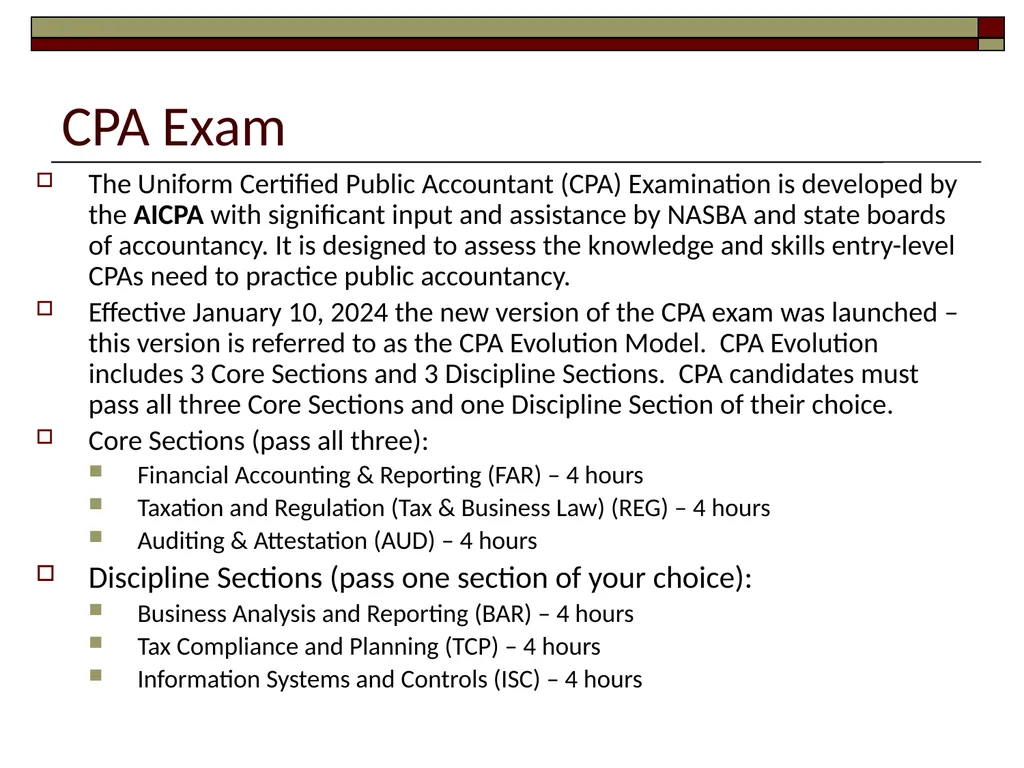
CPA Exam The Uniform Certified Public Accountant (CPA) Examination is developed by the AICPA with significant input and assistance by NASBA and state boards of accountancy. It is designed to assess the knowledge and skills entry-level CPAs need to practice public accountancy.
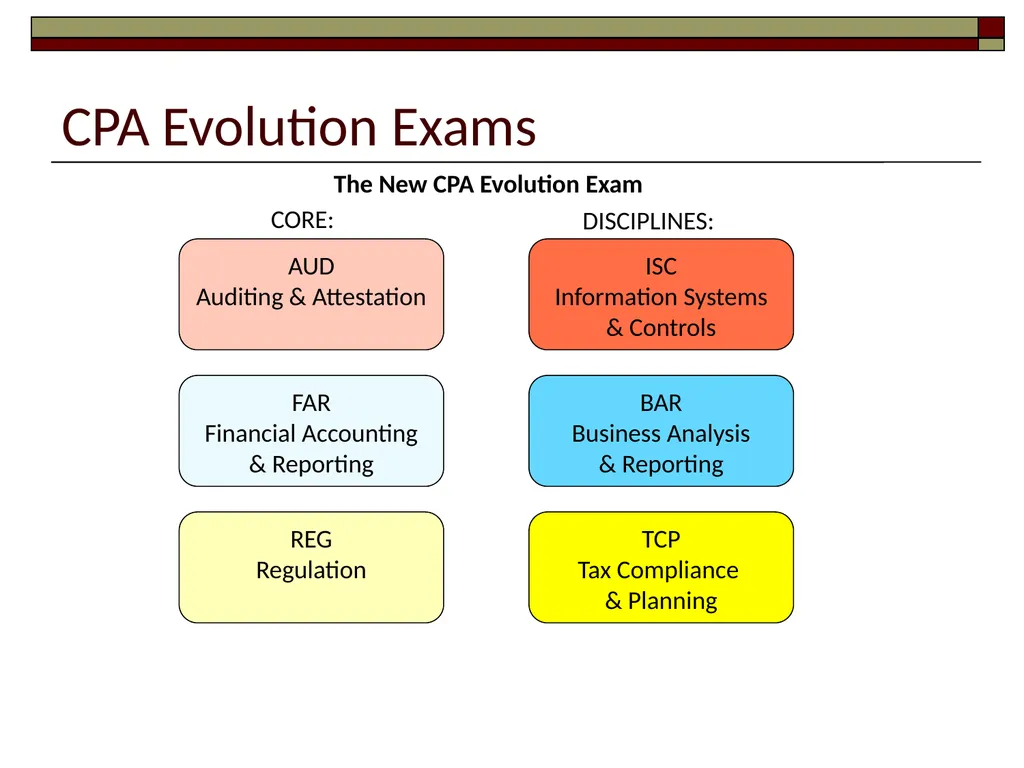
Effective January 10, 2024 the new version of the CPA exam was launched – this version is referred to as the CPA Evolution Model. CPA Evolution includes 3 Core Sections and 3 Discipline Sections. CPA candidates must pass all three Core Sections and one Discipline Section of their choice.
Core Sections (pass all three):
Financial Accounting & Reporting (FAR) – 4 hours
Taxation and Regulation (Tax & Business Law) (REG) – 4 hours
Auditing & Attestation (AUD) – 4 hours
Discipline Sections (pass one section of your choice):
Business Analysis and Reporting (BAR) – 4 hours
Tax Compliance and Planning (TCP) – 4 hours
Information Systems and Controls (ISC) – 4 hours<br>
06
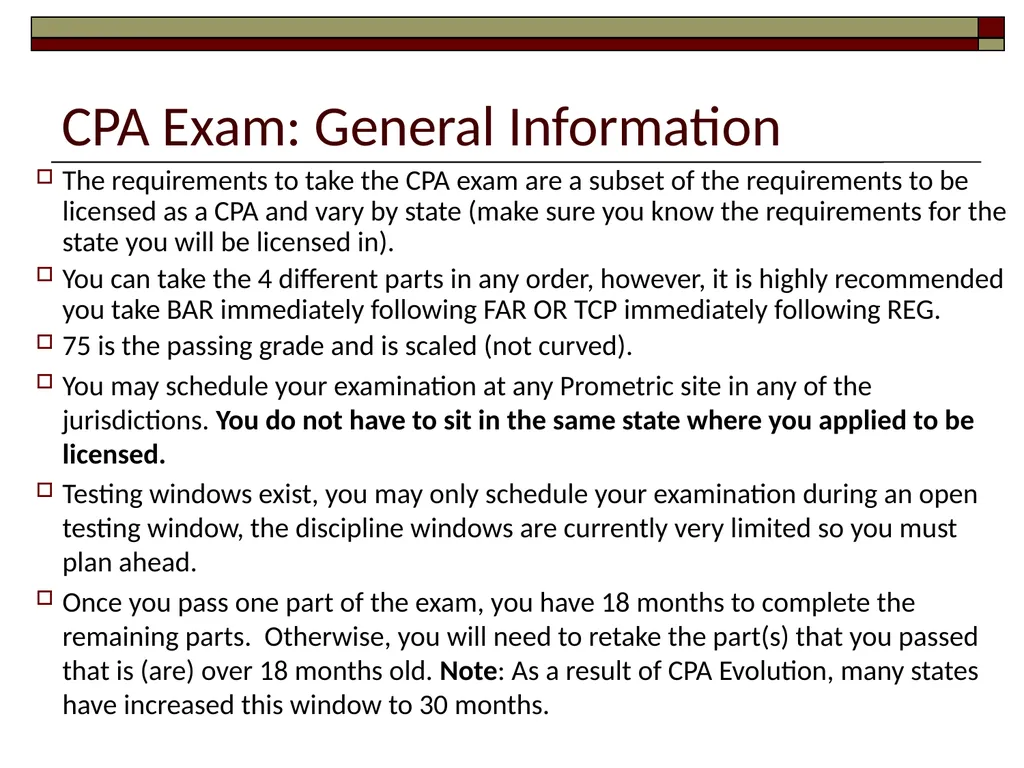
CPA Exam: General Information The requirements to take the CPA exam are a subset of the requirements to be licensed as a CPA and vary by state (make sure you know the requirements for the state you will be licensed in).
You can take the 4 different parts in any order, however, it is highly recommended you take BAR immediately following FAR OR TCP immediately following REG.
75 is the passing grade and is scaled (not curved).
You may schedule your examination at any Prometric site in any of the jurisdictions. You do not have to sit in the same state where you applied to be licensed.
Testing windows exist, you may only schedule your examination during an open testing window, the discipline windows are currently very limited so you must plan ahead.
Once you pass one part of the exam, you have 18 months to complete the remaining parts. Otherwise, you will need to retake the part(s) that you passed that is (are) over 18 months old. Note: As a result of CPA Evolution, many states have increased this window to 30 months.<br>
07
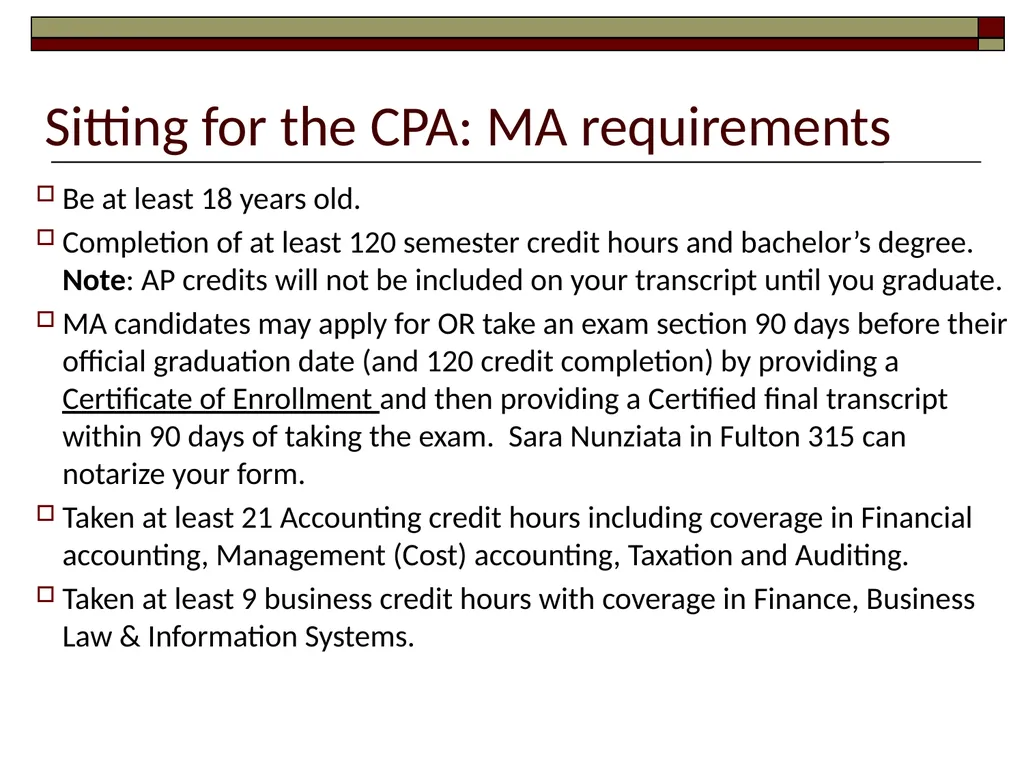
Sitting for the CPA: MA requirements Be at least 18 years old.
Completion of at least 120 semester credit hours and bachelor’s degree. Note: AP credits will not be included on your transcript until you graduate.
MA candidates may apply for OR take an exam section 90 days before their official graduation date (and 120 credit completion) by providing a Certificate of Enrollment and then providing a Certified final transcript within 90 days of taking the exam. Sara Nunziata in Fulton 315 can notarize your form.
Taken at least 21 Accounting credit hours including coverage in Financial accounting, Management (Cost) accounting, Taxation and Auditing.
Taken at least 9 business credit hours with coverage in Finance, Business Law & Information Systems.<br>
08
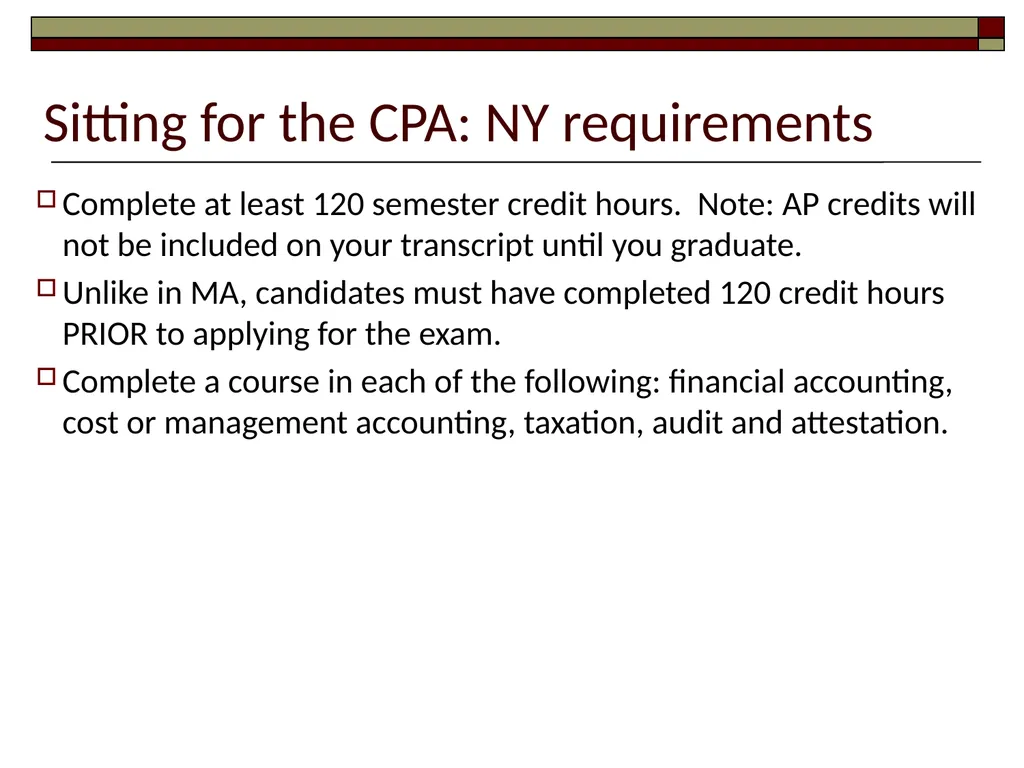
Sitting for the CPA: NY requirements Complete at least 120 semester credit hours. Note: AP credits will not be included on your transcript until you graduate.
Unlike in MA, candidates must have completed 120 credit hours PRIOR to applying for the exam.
Complete a course in each of the following: financial accounting, cost or management accounting, taxation, audit and attestation.<br>
Unlike in MA, candidates must have completed 120 credit hours PRIOR to applying for the exam.
Complete a course in each of the following: financial accounting, cost or management accounting, taxation, audit and attestation.<br>
09
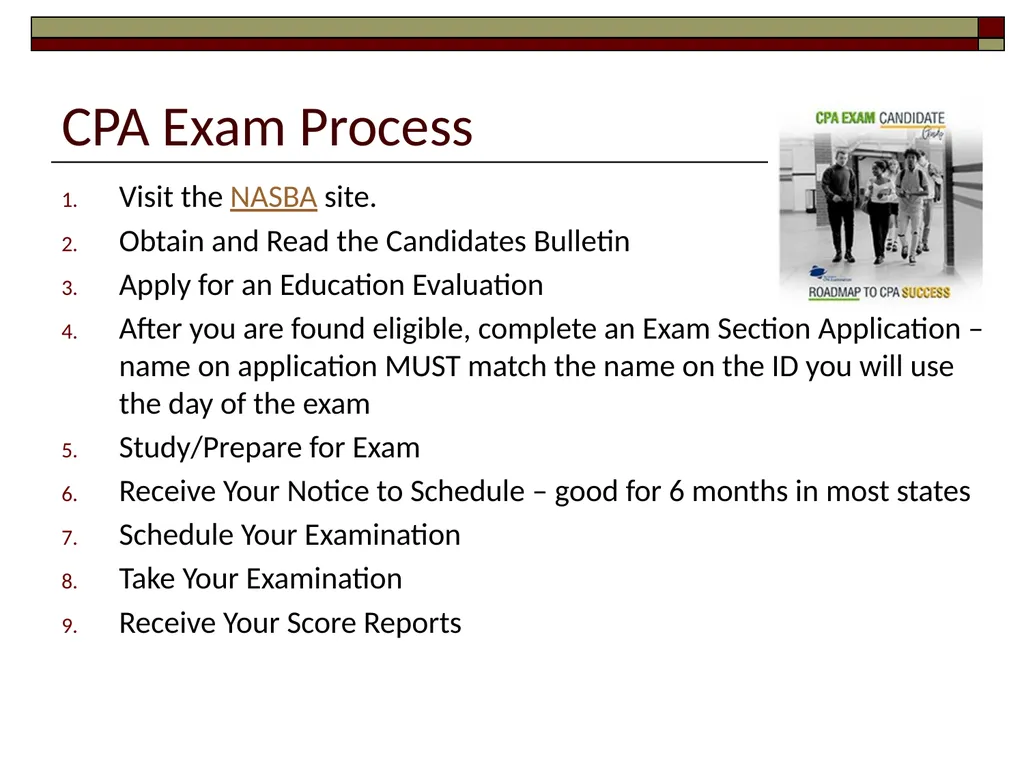
CPA Exam Process Visit the NASBA site.
Obtain and Read the Candidates Bulletin
Apply for an Education Evaluation
After you are found eligible, complete an Exam Section Application – name on application MUST match the name on the ID you will use the day of the exam
Study/Prepare for Exam
Receive Your Notice to Schedule – good for 6 months in most states
Schedule Your Examination
Take Your Examination
Receive Your Score Reports<br>
10
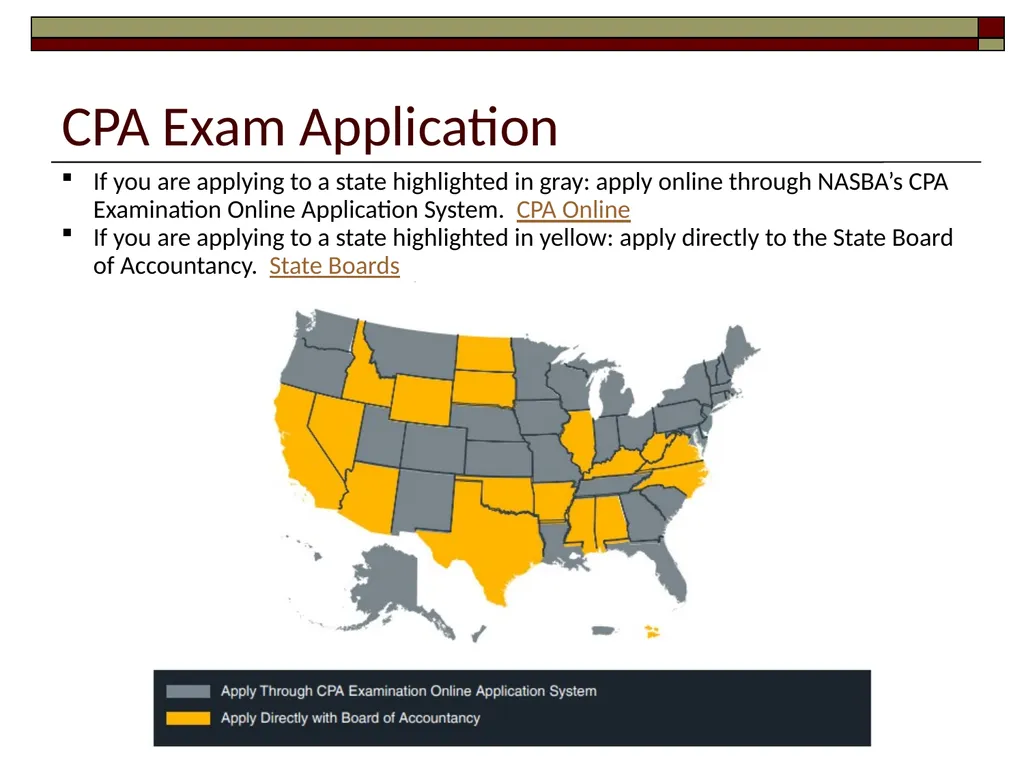
CPA Exam Application If you are applying to a state highlighted in gray: apply online through NASBA’s CPA Examination Online Application System. CPA Online
If you are applying to a state highlighted in yellow: apply directly to the State Board of Accountancy. State Boards<br>
If you are applying to a state highlighted in yellow: apply directly to the State Board of Accountancy. State Boards<br>
11
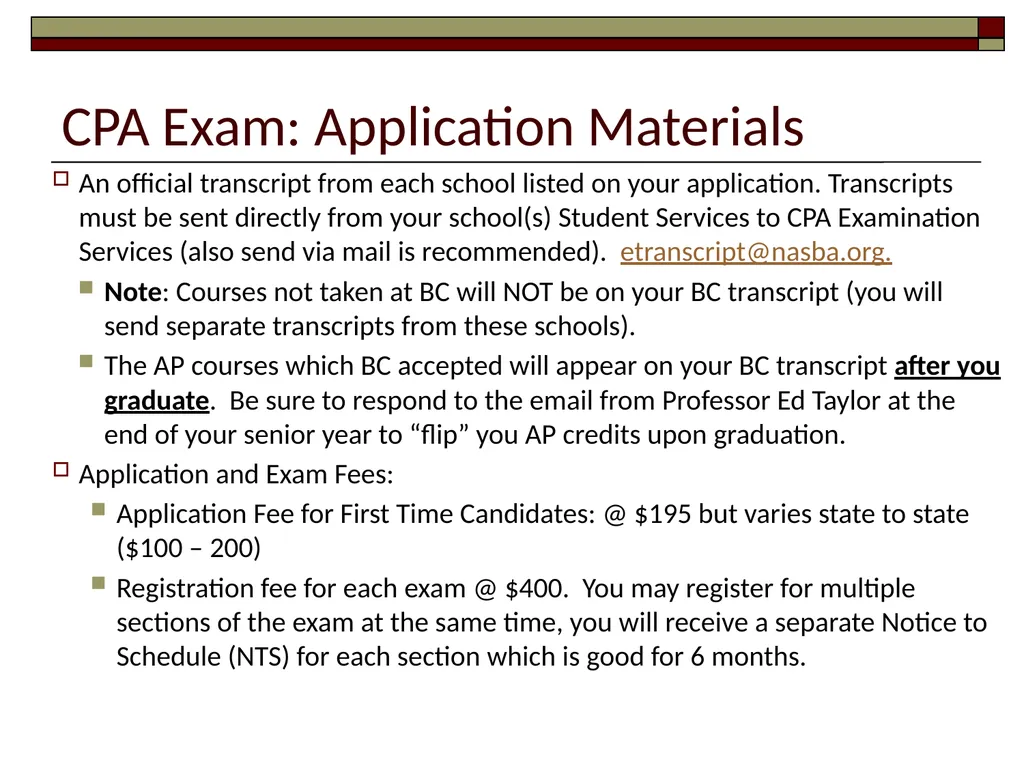
CPA Exam: Application Materials An official transcript from each school listed on your application. Transcripts must be sent directly from your school(s) Student Services to CPA Examination Services (also send via mail is recommended). etranscript@nasba.org.
Note: Courses not taken at BC will NOT be on your BC transcript (you will send separate transcripts from these schools).
The AP courses which BC accepted will appear on your BC transcript after you graduate. Be sure to respond to the email from Professor Ed Taylor at the end of your senior year to “flip” you AP credits upon graduation.
Application and Exam Fees:
Application Fee for First Time Candidates: @ $195 but varies state to state ($100 – 200)
Registration fee for each exam @ $400. You may register for multiple sections of the exam at the same time, you will receive a separate Notice to Schedule (NTS) for each section which is good for 6 months.<br>
12
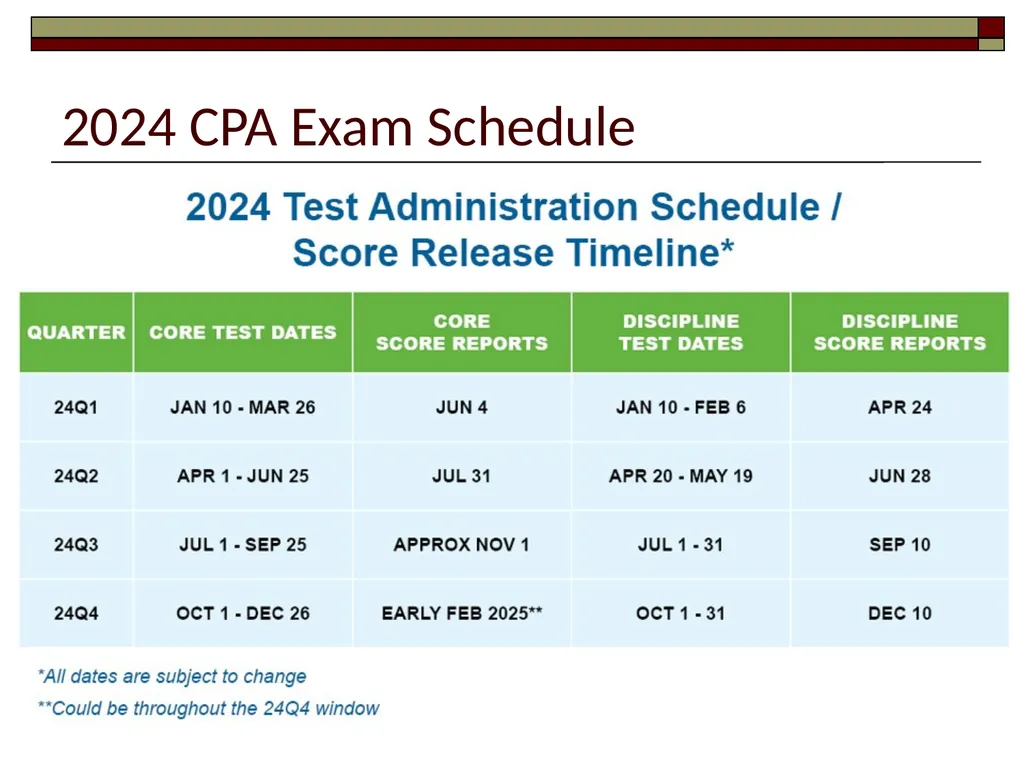
2024 CPA Exam Schedule<br>
13
CPA Evolution Exams AUD
Auditing & Attestation FAR
Financial Accounting & Reporting REG
Regulation ISC
Information Systems & Controls BAR
Business Analysis
& Reporting TCP
Tax Compliance
& Planning The New CPA Evolution Exam CORE: DISCIPLINES:<br>
Auditing & Attestation FAR
Financial Accounting & Reporting REG
Regulation ISC
Information Systems & Controls BAR
Business Analysis
& Reporting TCP
Tax Compliance
& Planning The New CPA Evolution Exam CORE: DISCIPLINES:<br>
14
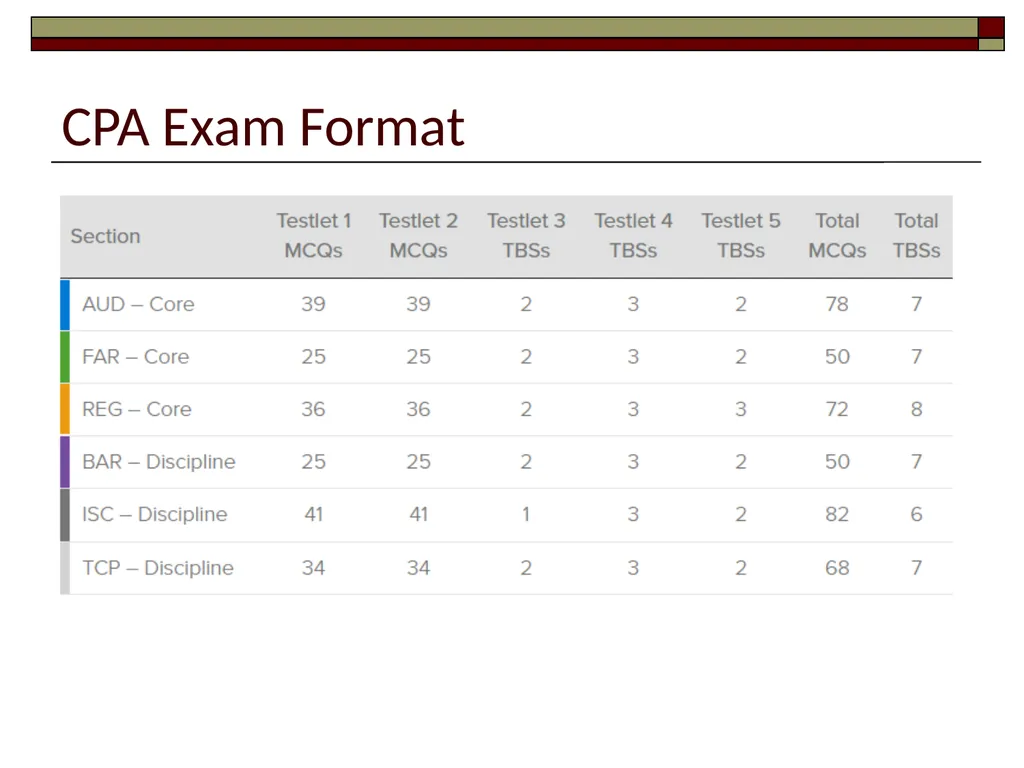
CPA Exam Format<br>
15
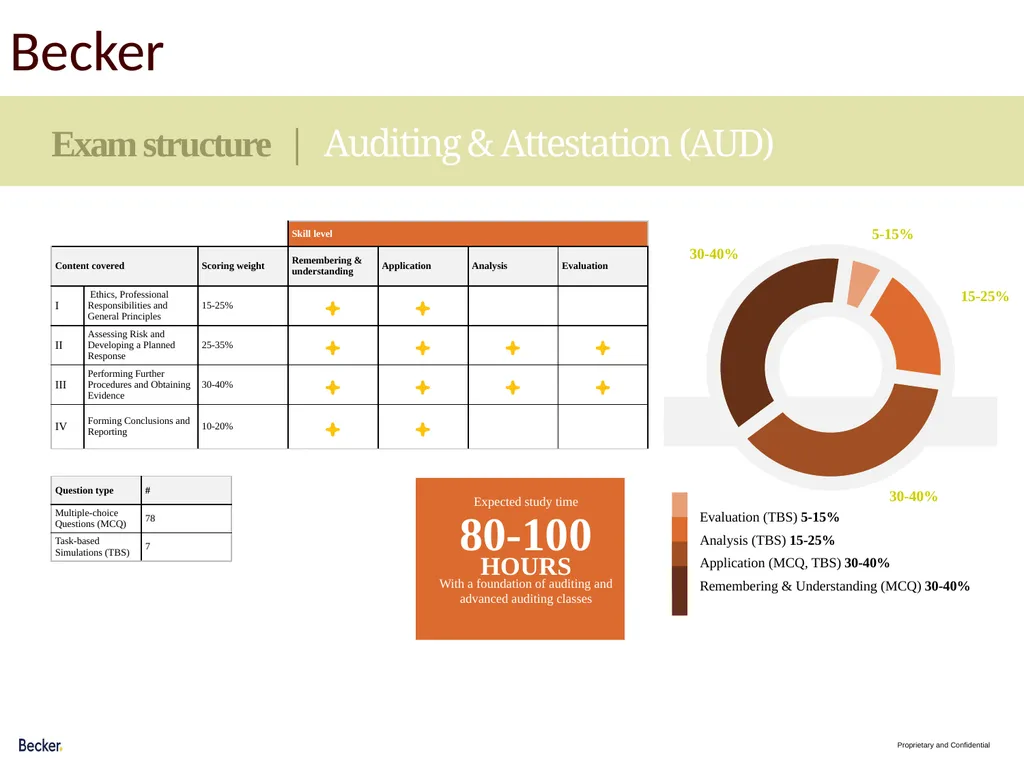
Exam structure | Auditing & Attestation (AUD) Expected study time 80-100 HOURS With a foundation of auditing and advanced auditing classes 5-15% 30-40% 15-25% 30-40% Becker<br>
16
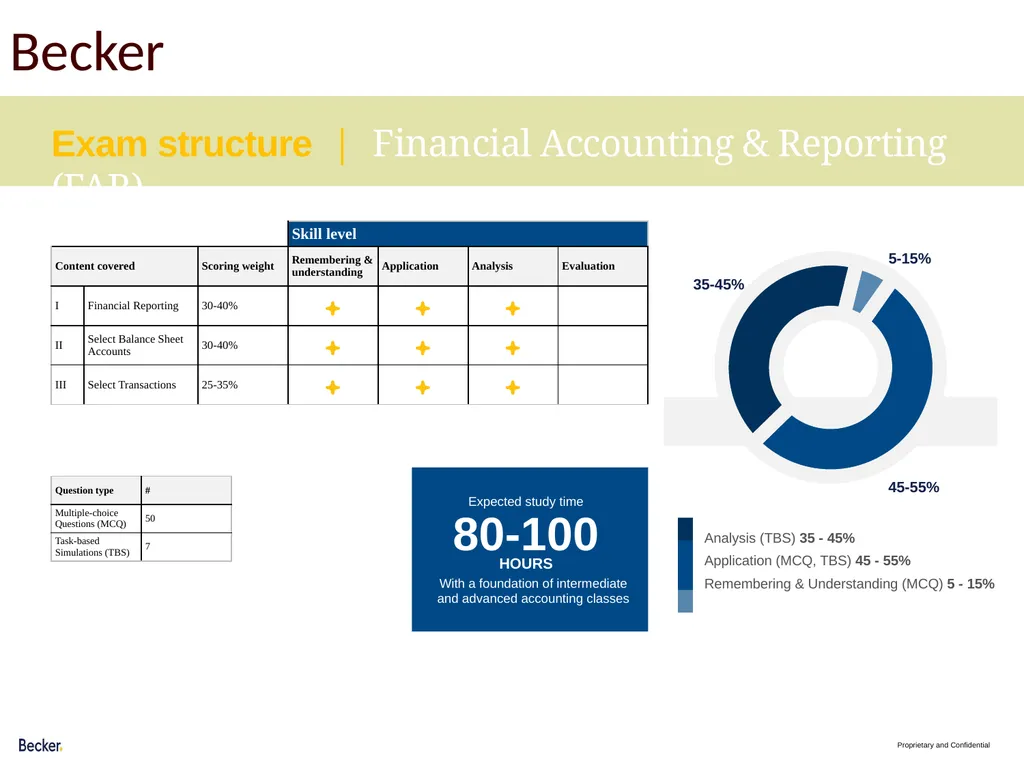
Exam structure | Financial Accounting & Reporting (FAR) 5-15% 45-55% 35-45% Expected study time 80-100 HOURS With a foundation of intermediate and advanced accounting classes Becker<br>
17
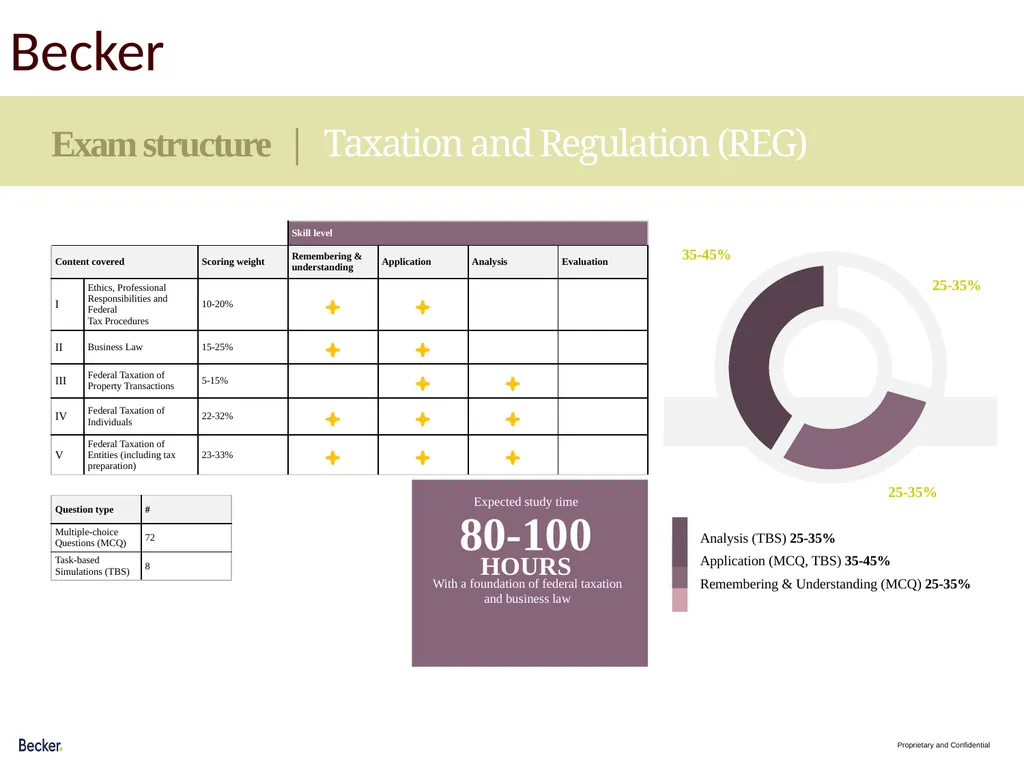
Exam structure | Taxation and Regulation (REG) 35-45% 25-35% 25-35% Becker<br>
18
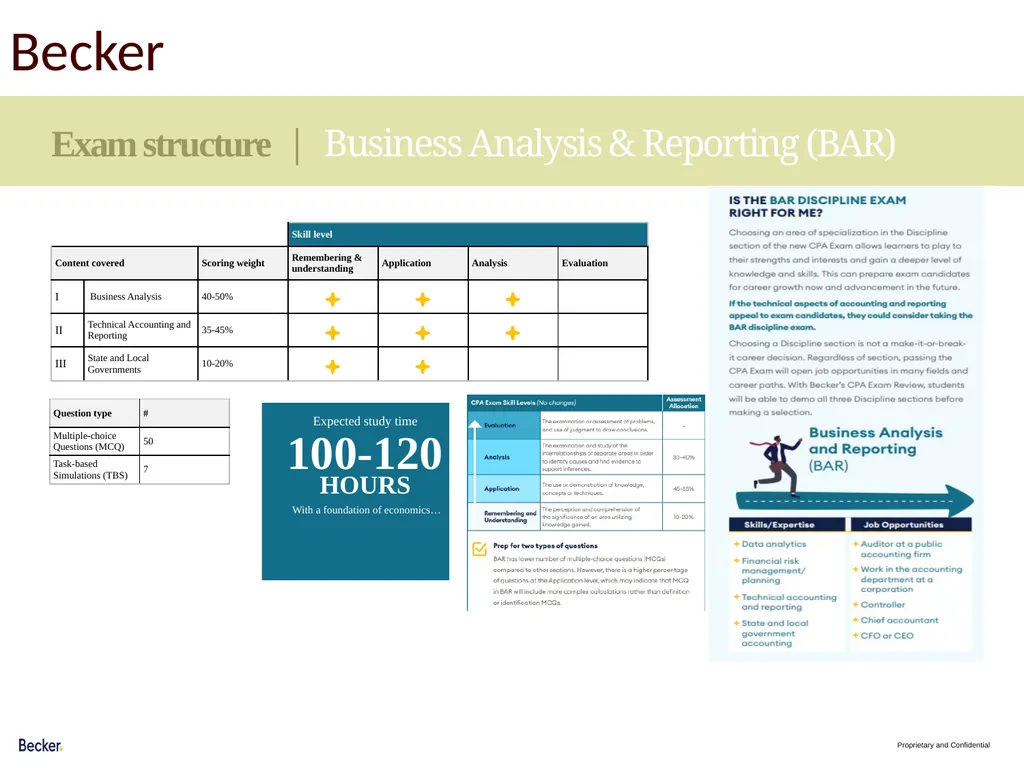
Exam structure | Business Analysis & Reporting (BAR) Becker<br>
19
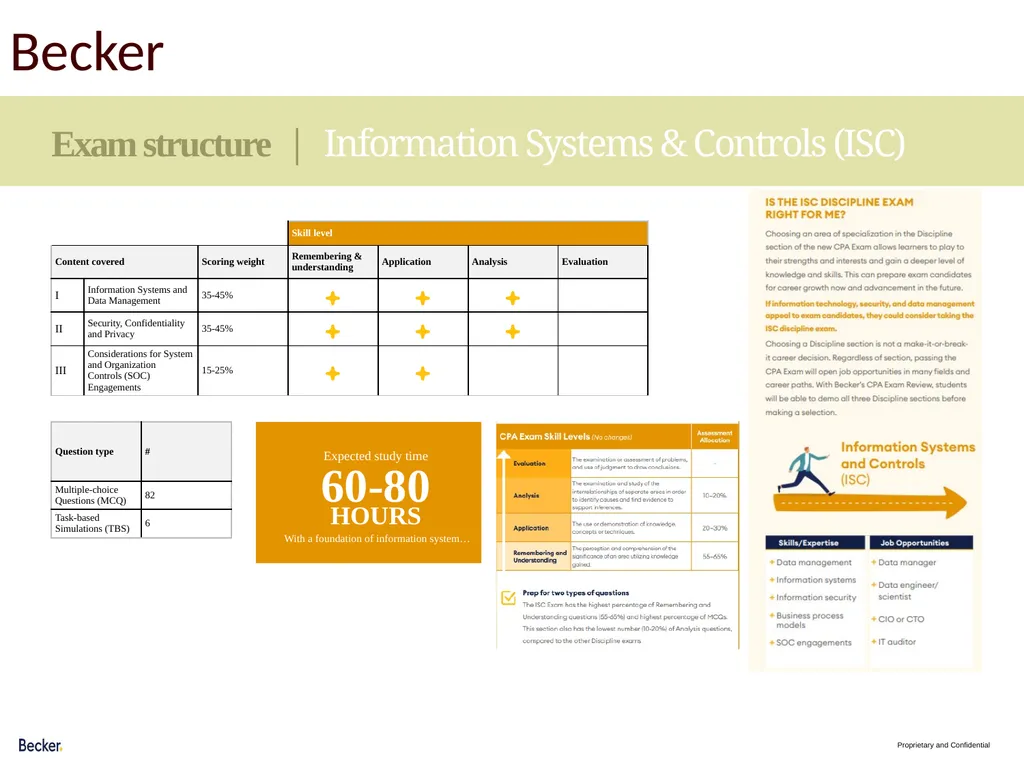
Exam structure | Information Systems & Controls (ISC) Becker<br>
20
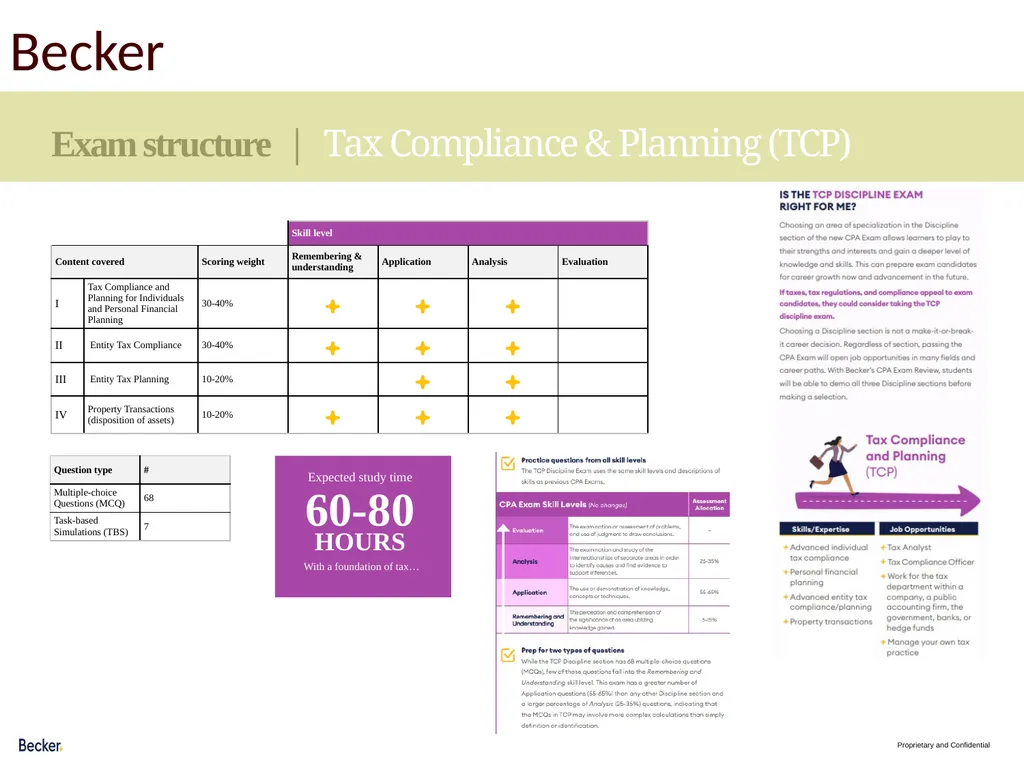
Exam structure | Tax Compliance & Planning (TCP) Becker<br>
21
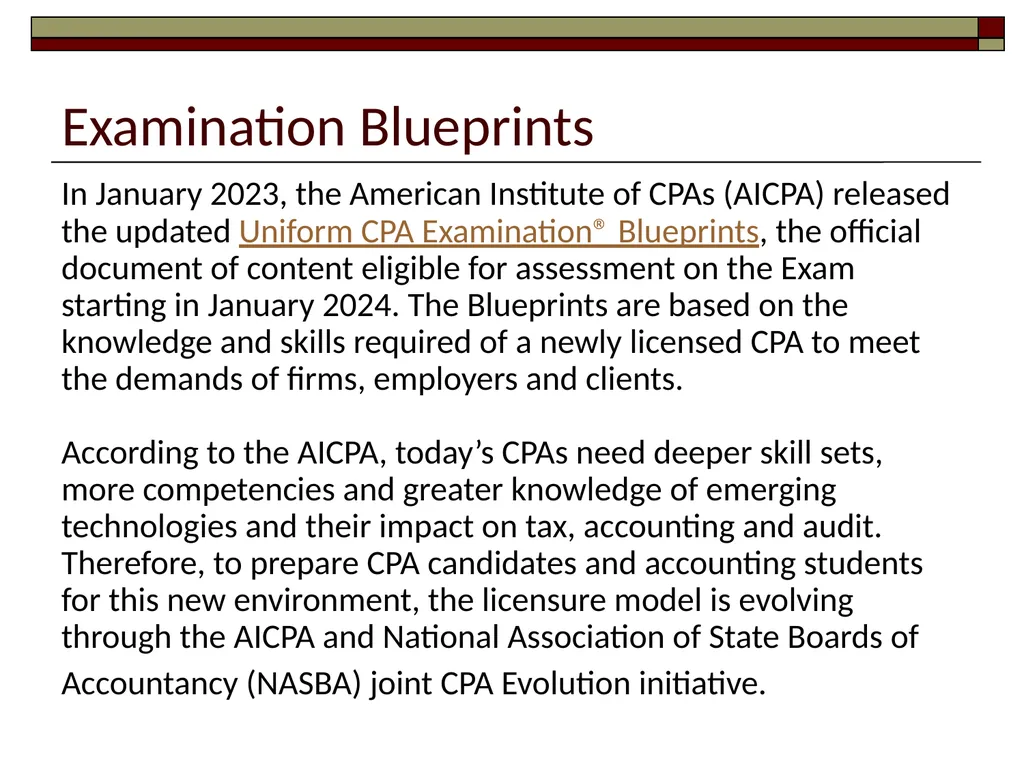
Examination Blueprints In January 2023, the American Institute of CPAs (AICPA) released the updated Uniform CPA Examination® Blueprints, the official document of content eligible for assessment on the Exam starting in January 2024. The Blueprints are based on the knowledge and skills required of a newly licensed CPA to meet the demands of firms, employers and clients.
According to the AICPA, today’s CPAs need deeper skill sets, more competencies and greater knowledge of emerging technologies and their impact on tax, accounting and audit. Therefore, to prepare CPA candidates and accounting students for this new environment, the licensure model is evolving through the AICPA and National Association of State Boards of Accountancy (NASBA) joint CPA Evolution initiative.<br>
According to the AICPA, today’s CPAs need deeper skill sets, more competencies and greater knowledge of emerging technologies and their impact on tax, accounting and audit. Therefore, to prepare CPA candidates and accounting students for this new environment, the licensure model is evolving through the AICPA and National Association of State Boards of Accountancy (NASBA) joint CPA Evolution initiative.<br>
22
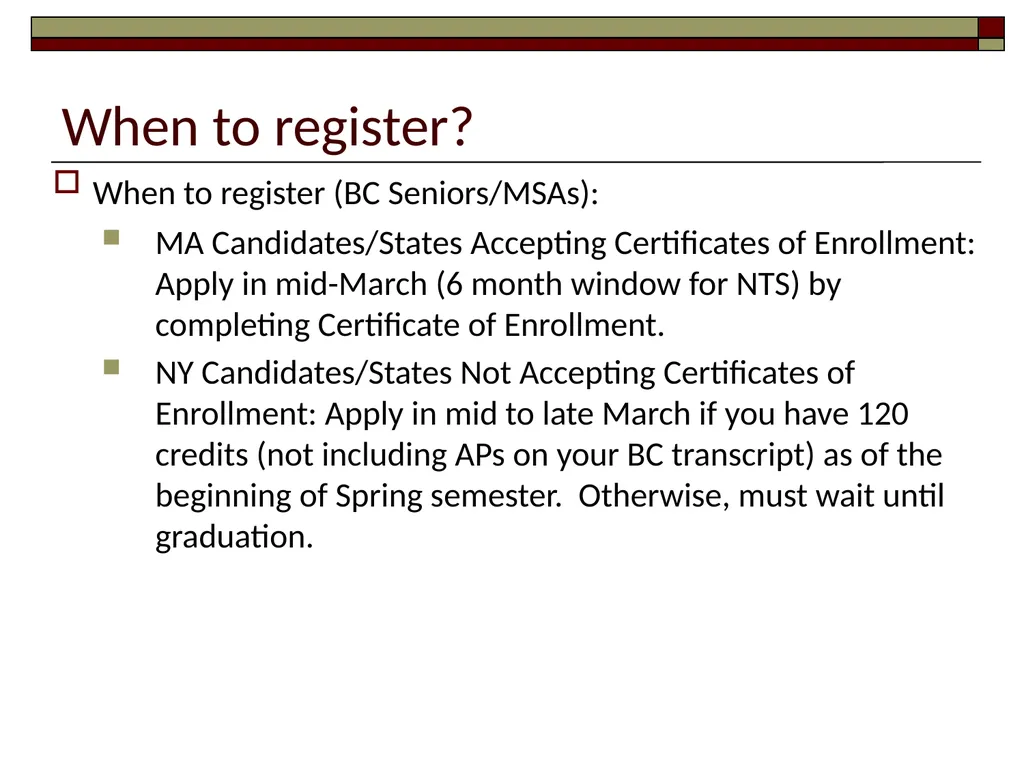
When to register? When to register (BC Seniors/MSAs):
MA Candidates/States Accepting Certificates of Enrollment: Apply in mid-March (6 month window for NTS) by completing Certificate of Enrollment.
NY Candidates/States Not Accepting Certificates of Enrollment: Apply in mid to late March if you have 120 credits (not including APs on your BC transcript) as of the beginning of Spring semester. Otherwise, must wait until graduation.<br>
23
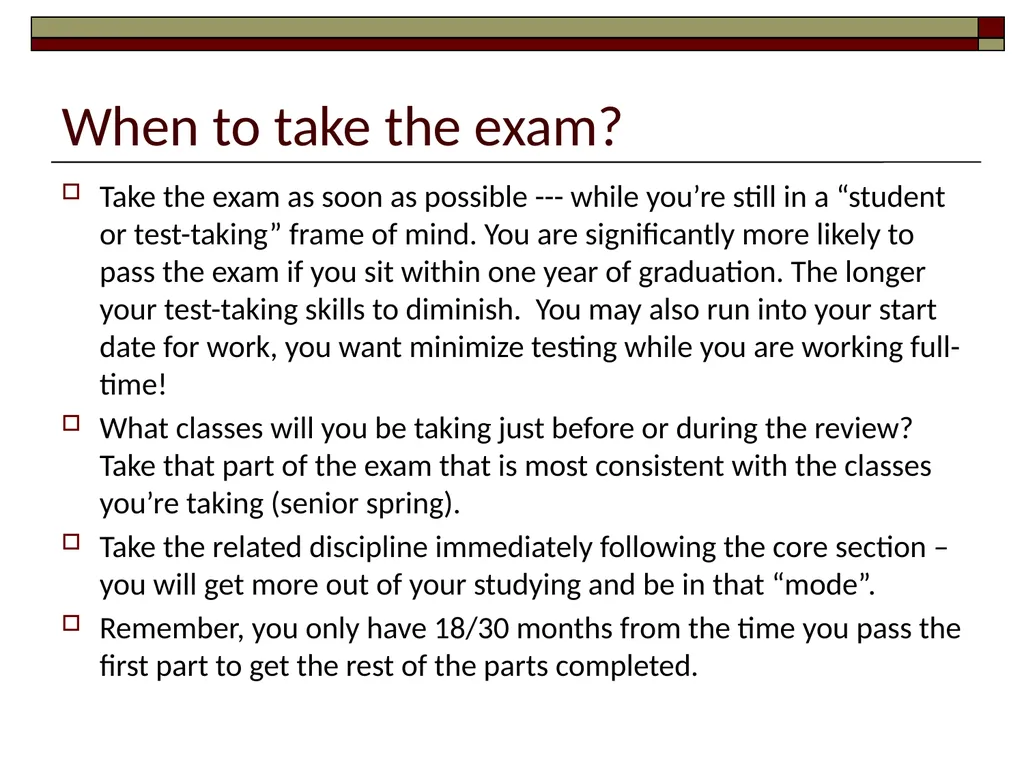
When to take the exam? Take the exam as soon as possible --- while you’re still in a “student or test-taking” frame of mind. You are significantly more likely to pass the exam if you sit within one year of graduation. The longer your test-taking skills to diminish. You may also run into your start date for work, you want minimize testing while you are working full-time!
What classes will you be taking just before or during the review? Take that part of the exam that is most consistent with the classes you’re taking (senior spring).
Take the related discipline immediately following the core section – you will get more out of your studying and be in that “mode”.
Remember, you only have 18/30 months from the time you pass the first part to get the rest of the parts completed.<br>
24
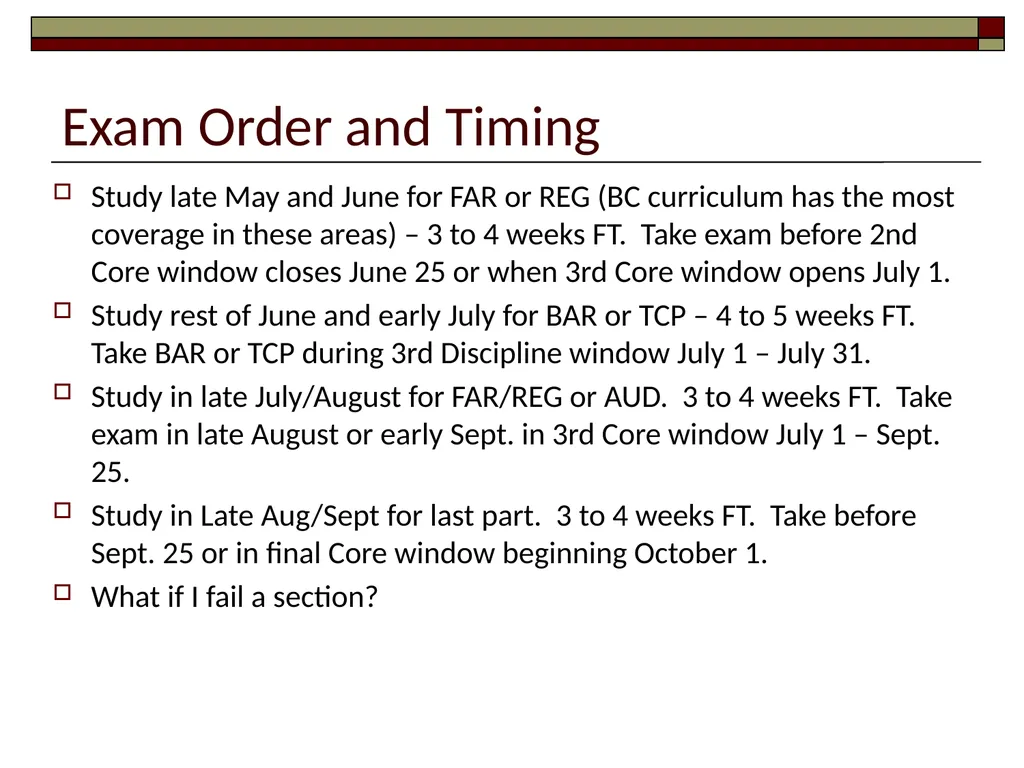
Exam Order and Timing Study late May and June for FAR or REG (BC curriculum has the most coverage in these areas) – 3 to 4 weeks FT. Take exam before 2nd Core window closes June 25 or when 3rd Core window opens July 1.
Study rest of June and early July for BAR or TCP – 4 to 5 weeks FT. Take BAR or TCP during 3rd Discipline window July 1 – July 31.
Study in late July/August for FAR/REG or AUD. 3 to 4 weeks FT. Take exam in late August or early Sept. in 3rd Core window July 1 – Sept. 25.
Study in Late Aug/Sept for last part. 3 to 4 weeks FT. Take before Sept. 25 or in final Core window beginning October 1.
What if I fail a section?<br>
25
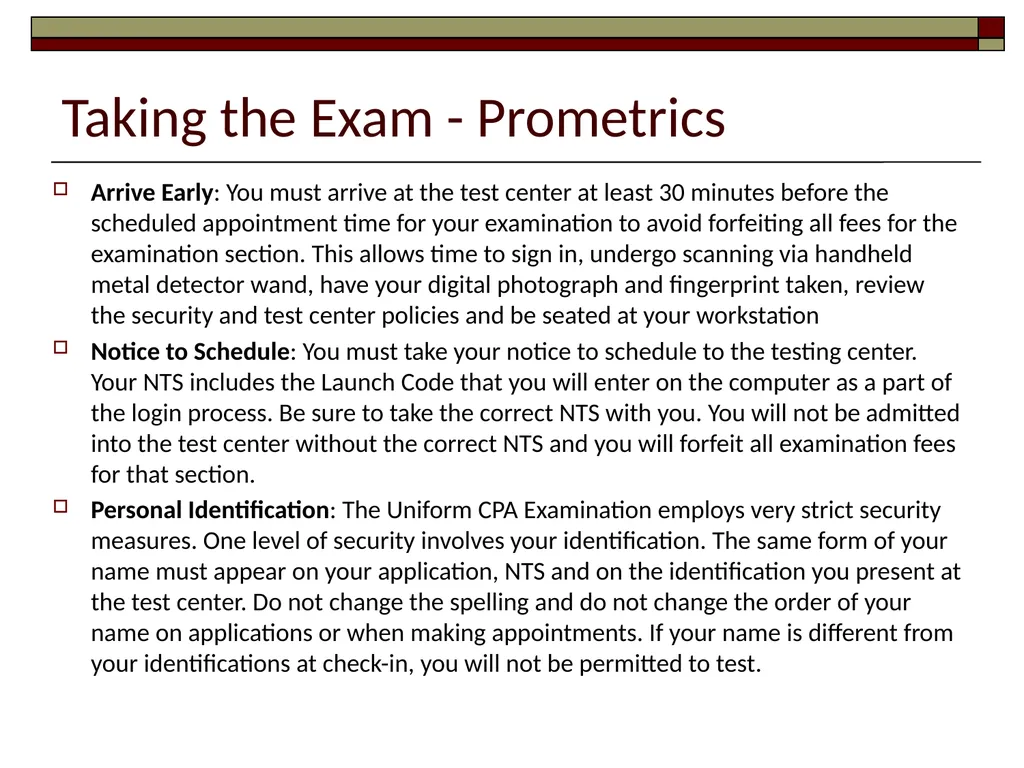
Taking the Exam - Prometrics Arrive Early: You must arrive at the test center at least 30 minutes before the scheduled appointment time for your examination to avoid forfeiting all fees for the examination section. This allows time to sign in, undergo scanning via handheld metal detector wand, have your digital photograph and fingerprint taken, review the security and test center policies and be seated at your workstation
Notice to Schedule: You must take your notice to schedule to the testing center. Your NTS includes the Launch Code that you will enter on the computer as a part of the login process. Be sure to take the correct NTS with you. You will not be admitted into the test center without the correct NTS and you will forfeit all examination fees for that section.
Personal Identification: The Uniform CPA Examination employs very strict security measures. One level of security involves your identification. The same form of your name must appear on your application, NTS and on the identification you present at the test center. Do not change the spelling and do not change the order of your name on applications or when making appointments. If your name is different from your identifications at check-in, you will not be permitted to test.<br>
26
Panelists – Lessons Learned Matthew
Alex
Corbin
Reilly<br>
Alex
Corbin
Reilly<br>
27
Questions???<br>