
Preparing to Design a Course Presented by: Cory
AM
Published · 29 slides · 0 views
1 / 1
Description
Preparing to Design a Course Presented by: Cory Bougher, Instructional Designer Pre-planning Policies Questions? Click the agenda segments to jump ahead! Course Content Planner tinyurl.comVCON23DesignCourse Curating Content Click here to
Related Topics
Share
Embed code
Download this presentation From Below
"Preparing to Design a Course Presented by: Cory" is the property of its rightful owner. Permission is granted to download and print the materials on this website for personal, non-commercial use only, and to display it on your personal computer provided you do not modify the materials and that you retain all copyright notices contained in the materials. By downloading content from our website, you accept the terms of this agreement.
Presentation Transcript
01
Preparing to Design a Course Presented by:
Cory Bougher, Instructional Designer Pre-planning Policies Questions? Click the agenda segments to jump ahead! Course Content Planner tinyurl.com/VCON23DesignCourse Curating Content Click here to make a copy for yourself.<br>
Cory Bougher, Instructional Designer Pre-planning Policies Questions? Click the agenda segments to jump ahead! Course Content Planner tinyurl.com/VCON23DesignCourse Curating Content Click here to make a copy for yourself.<br>
02
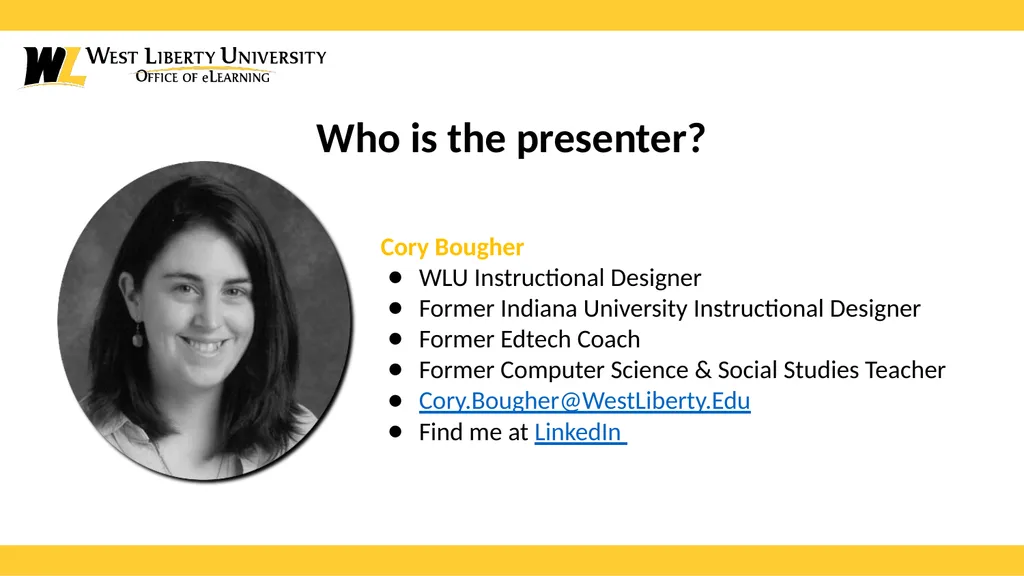
Cory Bougher
WLU Instructional Designer
Former Indiana University Instructional Designer
Former Edtech Coach
Former Computer Science & Social Studies Teacher
Cory.Bougher@WestLiberty.Edu
Find me at LinkedIn Who is the presenter?<br>
WLU Instructional Designer
Former Indiana University Instructional Designer
Former Edtech Coach
Former Computer Science & Social Studies Teacher
Cory.Bougher@WestLiberty.Edu
Find me at LinkedIn Who is the presenter?<br>
03
How will this session work? Access slides on own device, can make a copy at tinyurl.com/VCON23Prepare
Ask questions, make comments in chat
This is a 50 minute session, no breaks<br>
Ask questions, make comments in chat
This is a 50 minute session, no breaks<br>
04
What are this session’s learning objectives? Explain multiple reasons for thoroughly pre-planning a course
Explain the full course development cycle
Identify the purpose and write at least one strong CLO and MLO
State the Carnegie Unit formula for a credit hour
Explain the purpose of the Quality Matters rubric
Explain the purpose of a Course Content Planner
Select available instructional resources and copyright parameters<br>
Explain the full course development cycle
Identify the purpose and write at least one strong CLO and MLO
State the Carnegie Unit formula for a credit hour
Explain the purpose of the Quality Matters rubric
Explain the purpose of a Course Content Planner
Select available instructional resources and copyright parameters<br>
05
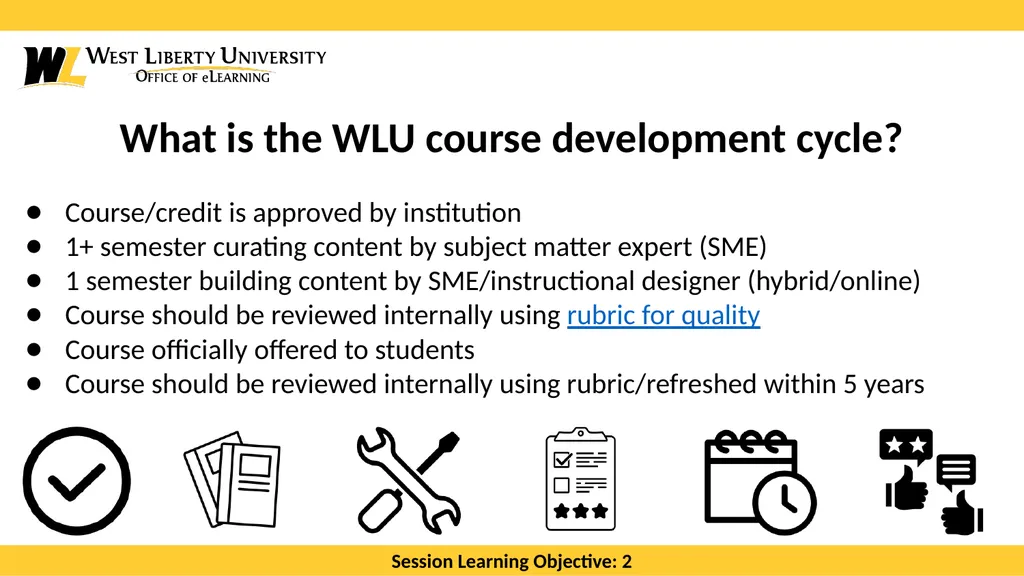
What is the WLU course development cycle? Course/credit is approved by institution
1+ semester curating content by subject matter expert (SME)
1 semester building content by SME/instructional designer (hybrid/online)
Course should be reviewed internally using rubric for quality
Course officially offered to students
Course should be reviewed internally using rubric/refreshed within 5 years Session Learning Objective: 2<br>
1+ semester curating content by subject matter expert (SME)
1 semester building content by SME/instructional designer (hybrid/online)
Course should be reviewed internally using rubric for quality
Course officially offered to students
Course should be reviewed internally using rubric/refreshed within 5 years Session Learning Objective: 2<br>
06
Pre-Planning Est: 10 min<br>
07
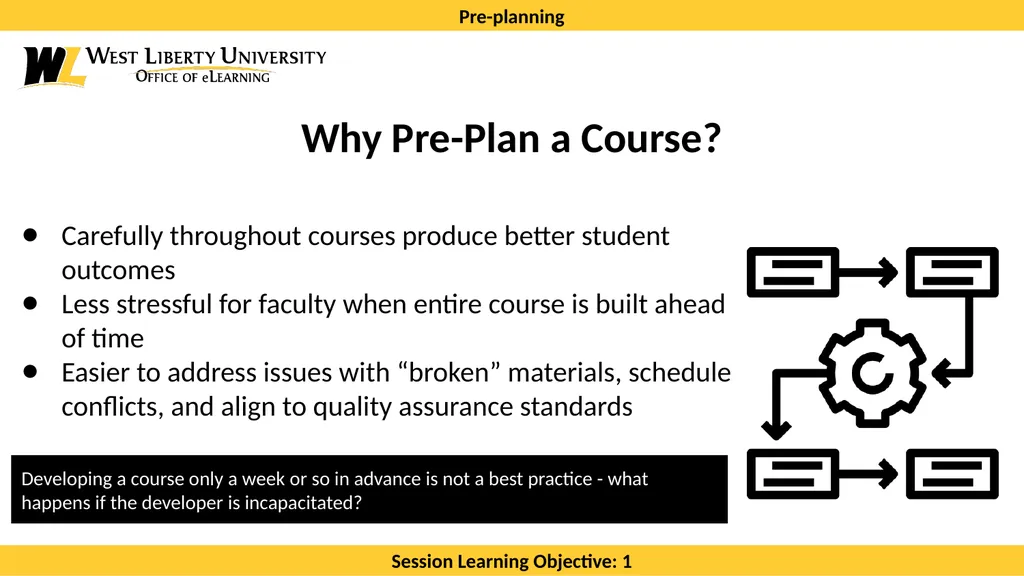
Why Pre-Plan a Course? Pre-planning Carefully throughout courses produce better student outcomes
Less stressful for faculty when entire course is built ahead of time
Easier to address issues with “broken” materials, schedule conflicts, and align to quality assurance standards Developing a course only a week or so in advance is not a best practice - what happens if the developer is incapacitated? Session Learning Objective: 1<br>
Less stressful for faculty when entire course is built ahead of time
Easier to address issues with “broken” materials, schedule conflicts, and align to quality assurance standards Developing a course only a week or so in advance is not a best practice - what happens if the developer is incapacitated? Session Learning Objective: 1<br>
08
What is the point of the course? Pre-planning Use official course description as guide
Program goals can also be used
Handful of goals become Course Learning Objectives (CLOs)
Use measurable verbs to describe objectives
Justifies why a student should take this course in their degree program Session Learning Objective: 1<br>
Program goals can also be used
Handful of goals become Course Learning Objectives (CLOs)
Use measurable verbs to describe objectives
Justifies why a student should take this course in their degree program Session Learning Objective: 1<br>
09
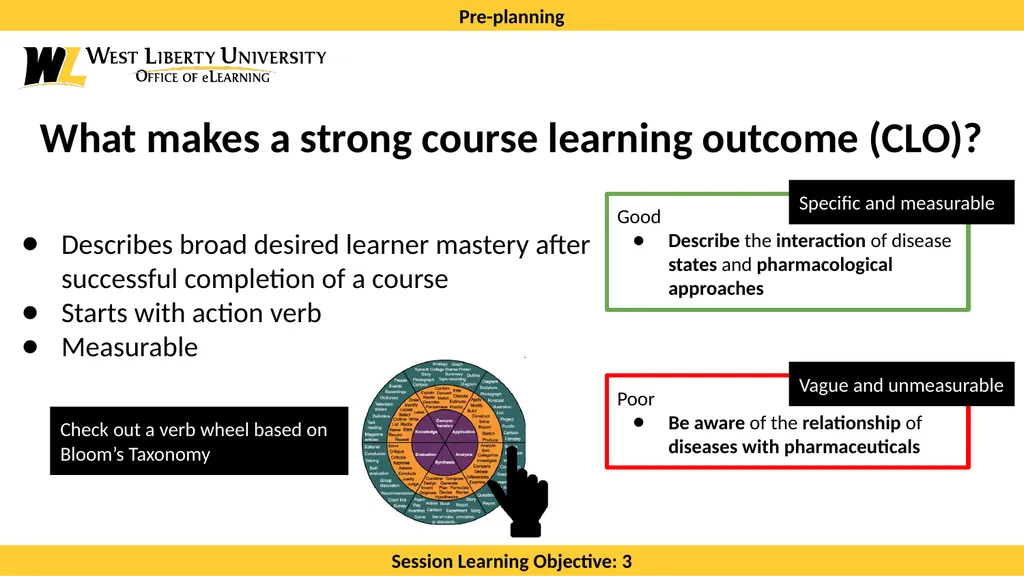
What makes a strong course learning outcome (CLO)? Pre-planning Describes broad desired learner mastery after successful completion of a course
Starts with action verb
Measurable Good
Describe the interaction of disease states and pharmacological approaches Poor
Be aware of the relationship of diseases with pharmaceuticals Specific and measurable Vague and unmeasurable Check out a verb wheel based on Bloom’s Taxonomy Session Learning Objective: 3<br>
Starts with action verb
Measurable Good
Describe the interaction of disease states and pharmacological approaches Poor
Be aware of the relationship of diseases with pharmaceuticals Specific and measurable Vague and unmeasurable Check out a verb wheel based on Bloom’s Taxonomy Session Learning Objective: 3<br>
10
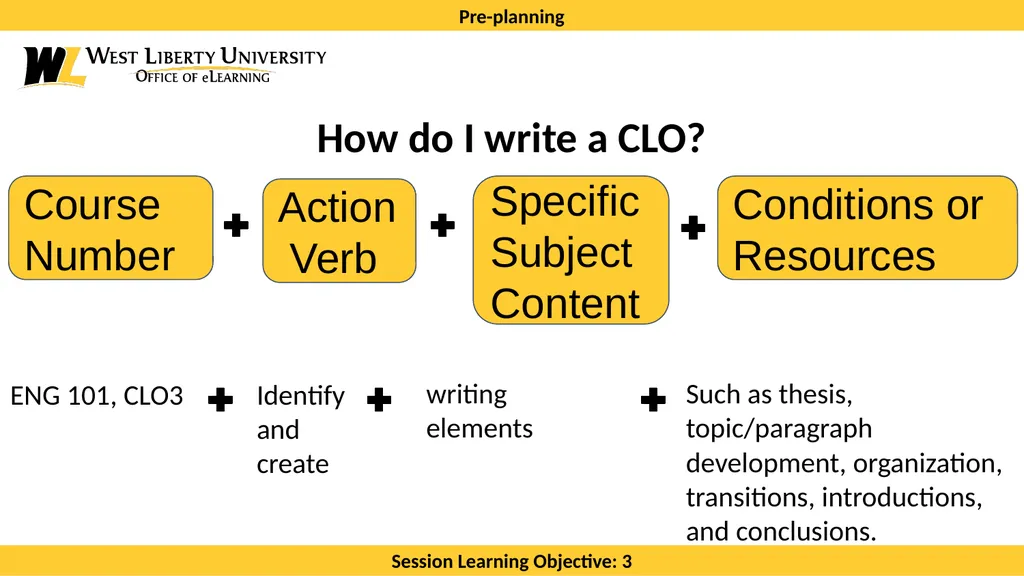
Pre-planning Action Verb Specific Subject Content How do I write a CLO? Conditions or Resources writing elements Such as thesis, topic/paragraph development, organization, transitions, introductions, and conclusions. Course Number ENG 101, CLO3 Identify and create Session Learning Objective: 3<br>
11
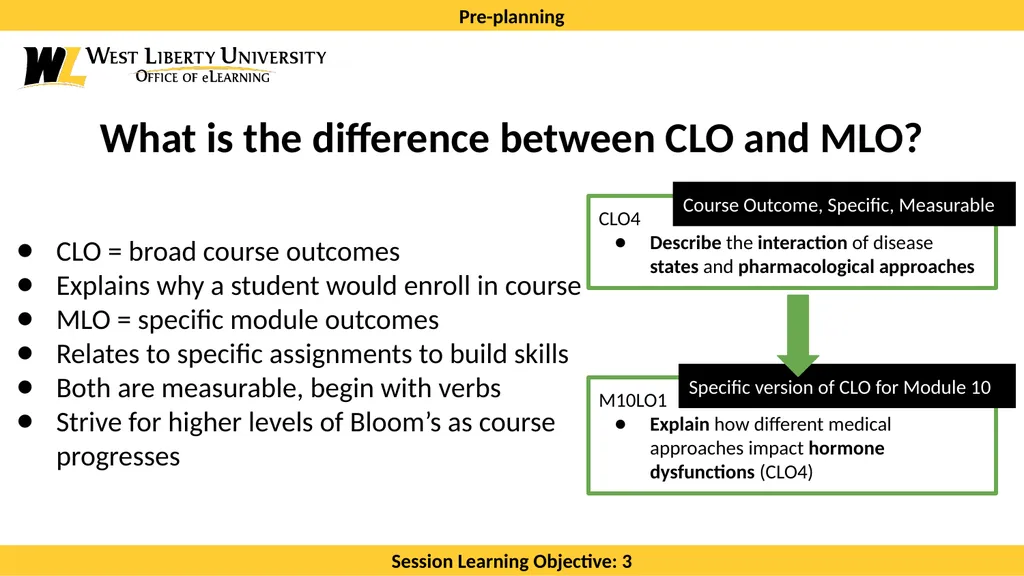
What is the difference between CLO and MLO? Pre-planning CLO = broad course outcomes
Explains why a student would enroll in course
MLO = specific module outcomes
Relates to specific assignments to build skills
Both are measurable, begin with verbs
Strive for higher levels of Bloom’s as course progresses CLO4
Describe the interaction of disease states and pharmacological approaches M10LO1
Explain how different medical approaches impact hormone dysfunctions (CLO4) Course Outcome, Specific, Measurable Specific version of CLO for Module 10 Session Learning Objective: 3<br>
Explains why a student would enroll in course
MLO = specific module outcomes
Relates to specific assignments to build skills
Both are measurable, begin with verbs
Strive for higher levels of Bloom’s as course progresses CLO4
Describe the interaction of disease states and pharmacological approaches M10LO1
Explain how different medical approaches impact hormone dysfunctions (CLO4) Course Outcome, Specific, Measurable Specific version of CLO for Module 10 Session Learning Objective: 3<br>
12
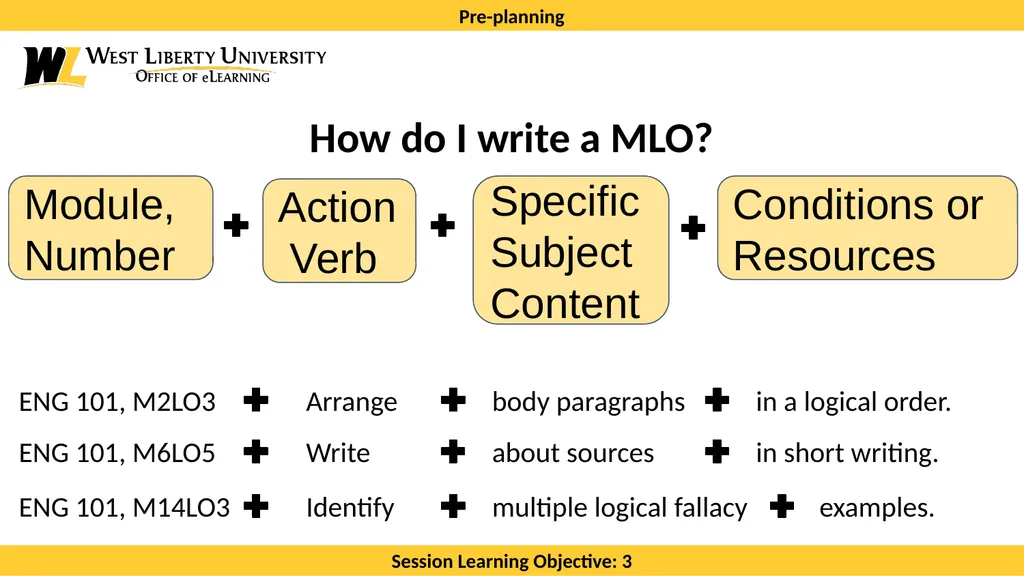
Pre-planning Action Verb Specific Subject Content How do I write a MLO? Conditions or Resources Arrange body paragraphs in a logical order. Module, Number ENG 101, M2LO3 Write about sources in short writing. ENG 101, M6LO5 Identify multiple logical fallacy examples. ENG 101, M14LO3 Session Learning Objective: 3<br>
13
Policies Est: 10 min<br>
14
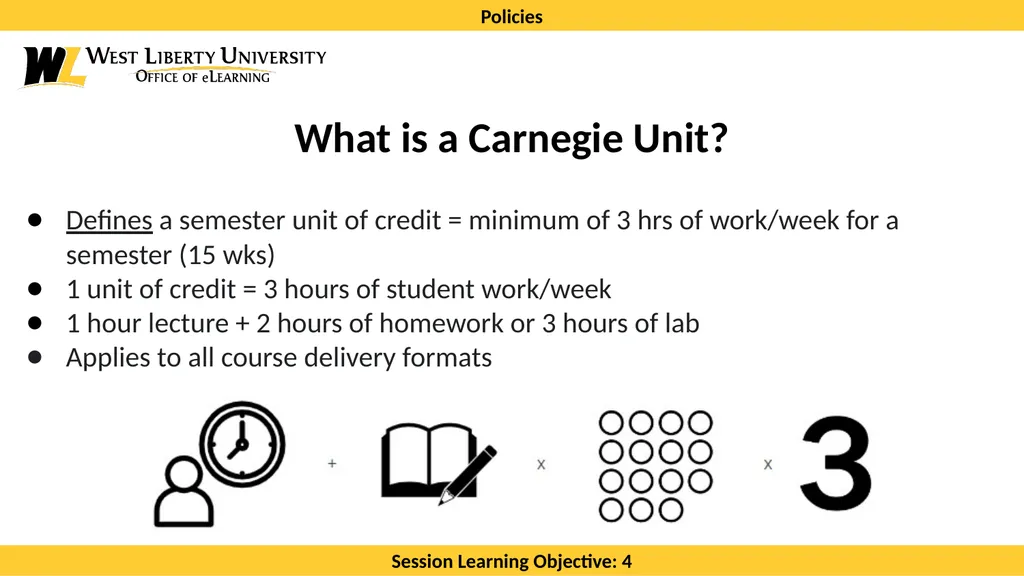
What is a Carnegie Unit? Policies Defines a semester unit of credit = minimum of 3 hrs of work/week for a semester (15 wks)
1 unit of credit = 3 hours of student work/week
1 hour lecture + 2 hours of homework or 3 hours of lab
Applies to all course delivery formats Session Learning Objective: 4<br>
1 unit of credit = 3 hours of student work/week
1 hour lecture + 2 hours of homework or 3 hours of lab
Applies to all course delivery formats Session Learning Objective: 4<br>
15
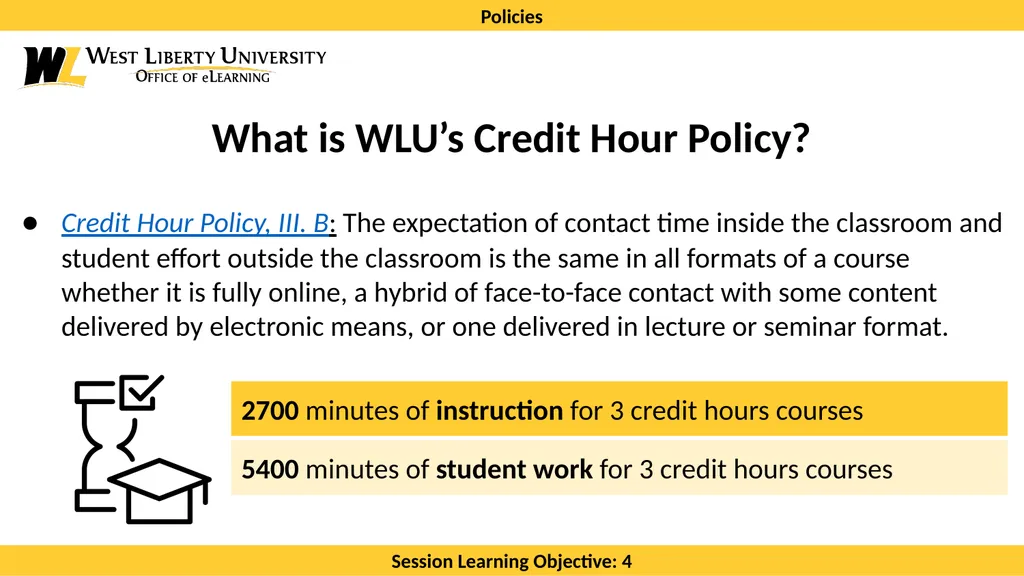
What is WLU’s Credit Hour Policy? Policies Credit Hour Policy, III. B: The expectation of contact time inside the classroom and student effort outside the classroom is the same in all formats of a course whether it is fully online, a hybrid of face-to-face contact with some content delivered by electronic means, or one delivered in lecture or seminar format. 2700 minutes of instruction for 3 credit hours courses 5400 minutes of student work for 3 credit hours courses Session Learning Objective: 4<br>
16
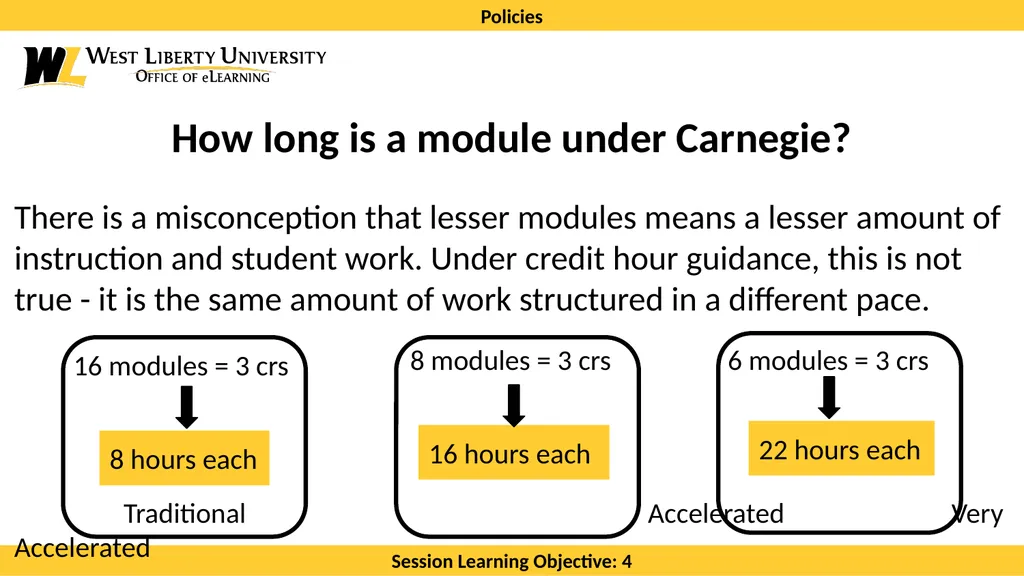
How long is a module under Carnegie? Policies 8 modules = 3 crs 16 hours each There is a misconception that lesser modules means a lesser amount of instruction and student work. Under credit hour guidance, this is not true - it is the same amount of work structured in a different pace. Traditional Accelerated Very Accelerated Session Learning Objective: 4<br>
17
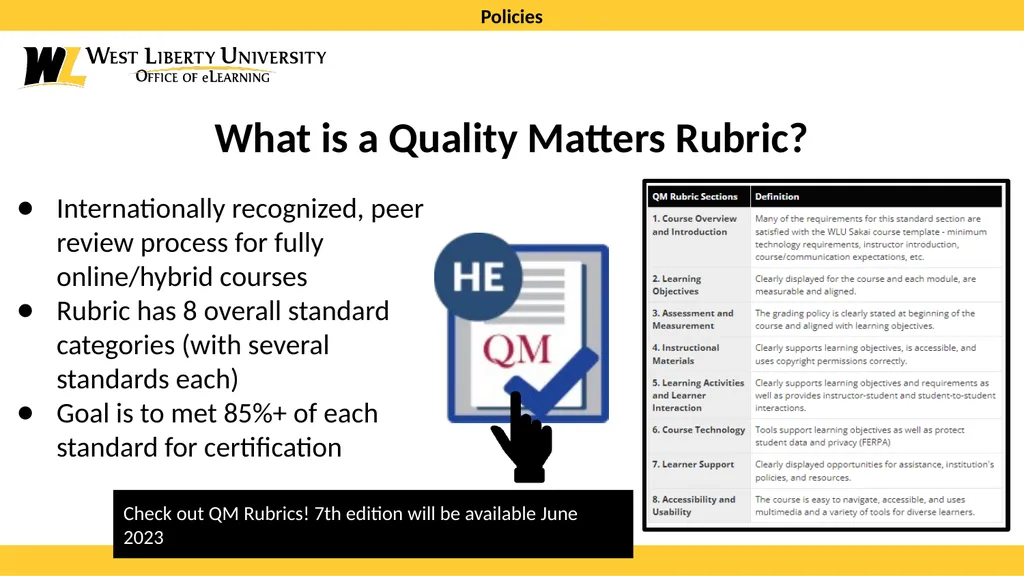
What is a Quality Matters Rubric? Policies Internationally recognized, peer review process for fully online/hybrid courses
Rubric has 8 overall standard categories (with several standards each)
Goal is to met 85%+ of each standard for certification Check out QM Rubrics! 7th edition will be available June 2023<br>
Rubric has 8 overall standard categories (with several standards each)
Goal is to met 85%+ of each standard for certification Check out QM Rubrics! 7th edition will be available June 2023<br>
18
Course Content Planner Est: 10 min<br>
19
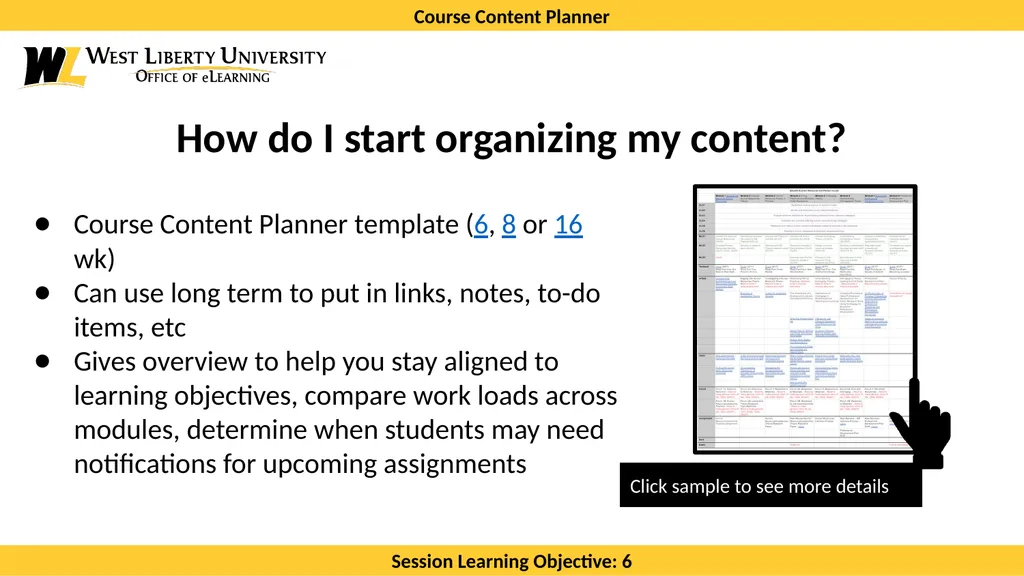
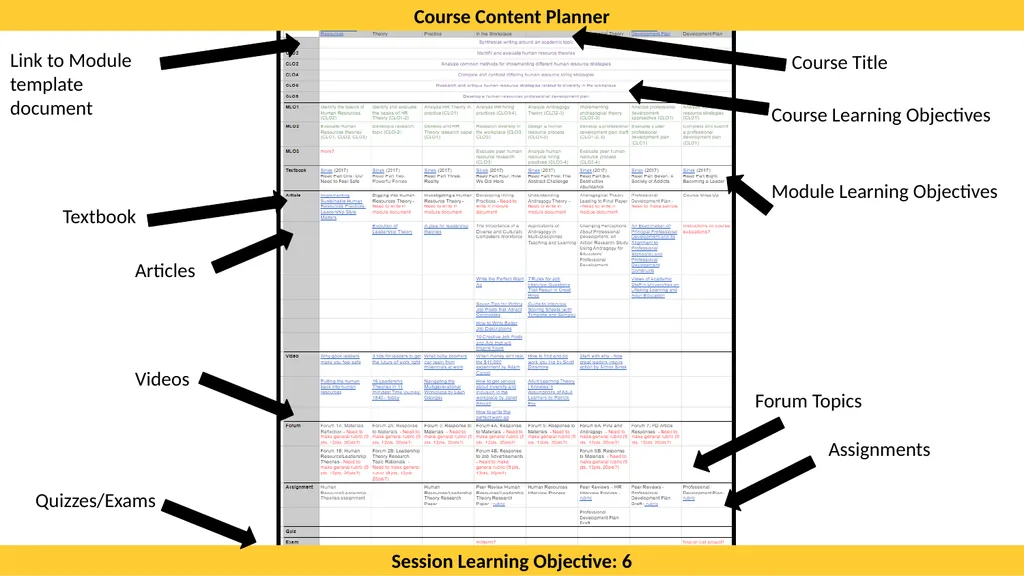
How do I start organizing my content? Course Content Planner Course Content Planner template (6, 8 or 16wk)
Can use long term to put in links, notes, to-do items, etc
Gives overview to help you stay aligned to learning objectives, compare work loads across modules, determine when students may need notifications for upcoming assignments Click sample to see more details Session Learning Objective: 6<br>
Can use long term to put in links, notes, to-do items, etc
Gives overview to help you stay aligned to learning objectives, compare work loads across modules, determine when students may need notifications for upcoming assignments Click sample to see more details Session Learning Objective: 6<br>
20
Course Content Planner Session Learning Objective: 6<br>
21
How do I pace the course? Course Content Planner Is course 6, 8, or 16 weeks?
Consider a module as a packaged lesson for the week
Start Module 1 with introductions, overviews, etc
End Module 8 (or Module 16) with final project, exam, etc
All other modules are content supporting CLOs Session Learning Objective: 6<br>
Consider a module as a packaged lesson for the week
Start Module 1 with introductions, overviews, etc
End Module 8 (or Module 16) with final project, exam, etc
All other modules are content supporting CLOs Session Learning Objective: 6<br>
22
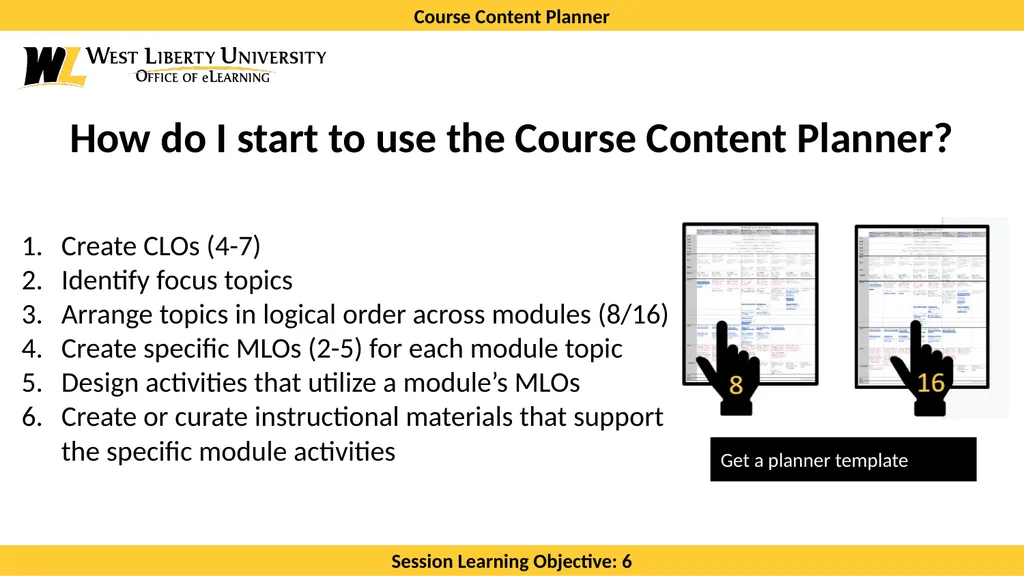
How do I start to use the Course Content Planner? Course Content Planner Create CLOs (4-7)
Identify focus topics
Arrange topics in logical order across modules (8/16)
Create specific MLOs (2-5) for each module topic
Design activities that utilize a module’s MLOs
Create or curate instructional materials that support the specific module activities Get a planner template Session Learning Objective: 6<br>
Identify focus topics
Arrange topics in logical order across modules (8/16)
Create specific MLOs (2-5) for each module topic
Design activities that utilize a module’s MLOs
Create or curate instructional materials that support the specific module activities Get a planner template Session Learning Objective: 6<br>
23
Curating Content Est: 10 min<br>
24
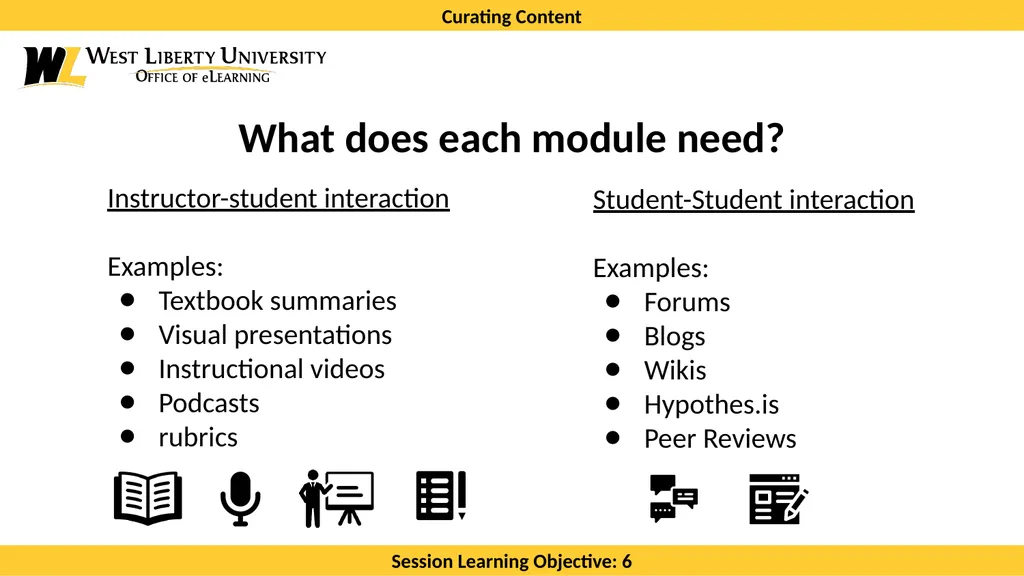
What does each module need? Curating Content Instructor-student interaction
Examples:
Textbook summaries
Visual presentations
Instructional videos
Podcasts
rubrics Student-Student interaction
Examples:
Forums
Blogs
Wikis
Hypothes.is
Peer Reviews Session Learning Objective: 6<br>
Examples:
Textbook summaries
Visual presentations
Instructional videos
Podcasts
rubrics Student-Student interaction
Examples:
Forums
Blogs
Wikis
Hypothes.is
Peer Reviews Session Learning Objective: 6<br>
25
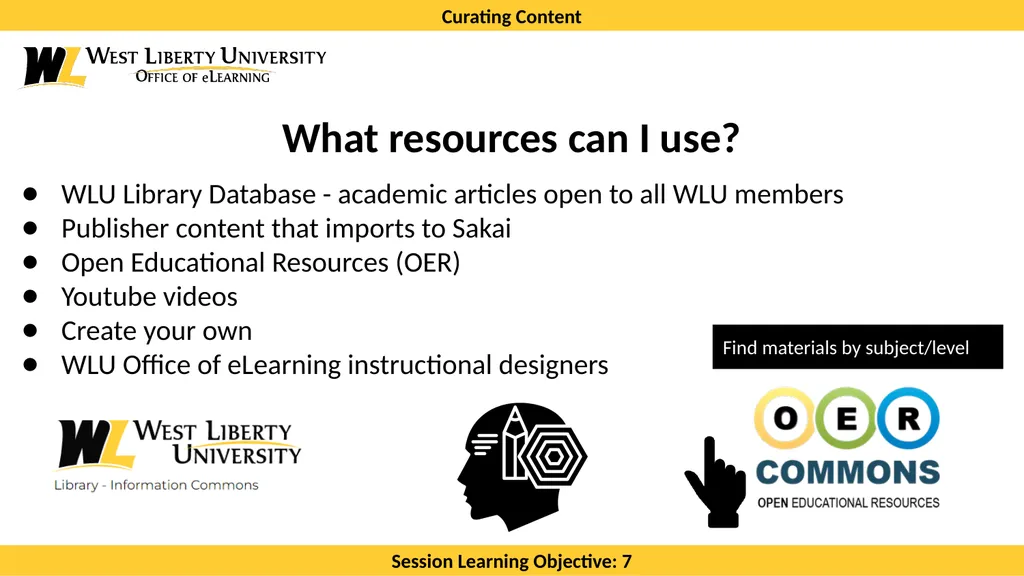
What resources can I use? Curating Content WLU Library Database - academic articles open to all WLU members
Publisher content that imports to Sakai
Open Educational Resources (OER)
Youtube videos
Create your own
WLU Office of eLearning instructional designers Find materials by subject/level Session Learning Objective: 7<br>
Publisher content that imports to Sakai
Open Educational Resources (OER)
Youtube videos
Create your own
WLU Office of eLearning instructional designers Find materials by subject/level Session Learning Objective: 7<br>
26
What is copyrighted? Curating Content All material created subject to copyright laws
Publishers may limit how instructors give material to students
Direct students to WLU Library Database link to access articles
If unavailable, contact author directly for permission
Keep response on file in Sakai Resources folder
Then PDF articles can be posted in Sakai Find copyright information and open sources Session Learning Objective: 7<br>
Publishers may limit how instructors give material to students
Direct students to WLU Library Database link to access articles
If unavailable, contact author directly for permission
Keep response on file in Sakai Resources folder
Then PDF articles can be posted in Sakai Find copyright information and open sources Session Learning Objective: 7<br>
27
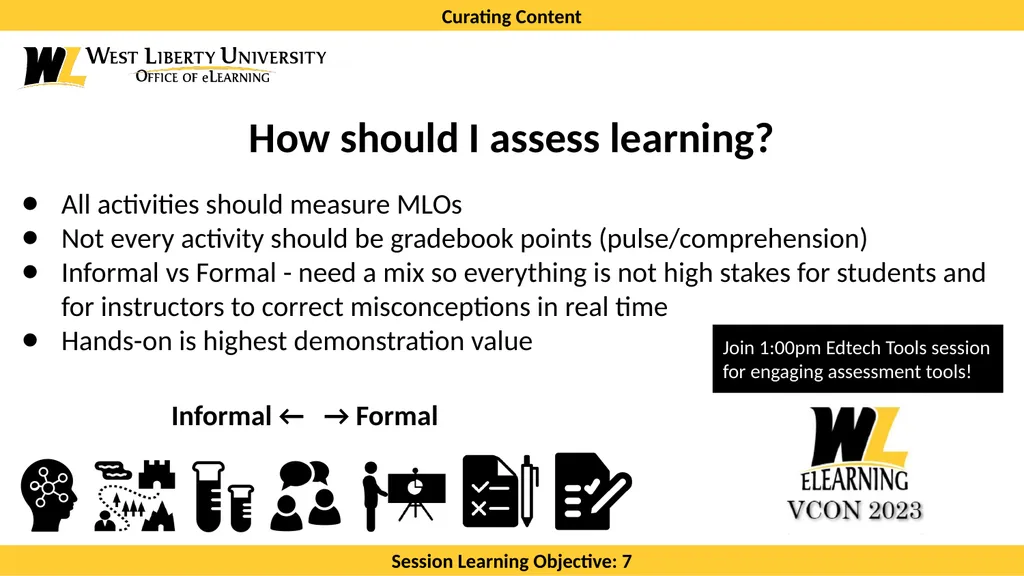
How should I assess learning? Curating Content All activities should measure MLOs
Not every activity should be gradebook points (pulse/comprehension)
Informal vs Formal - need a mix so everything is not high stakes for students and for instructors to correct misconceptions in real time
Hands-on is highest demonstration value Join 1:00pm Edtech Tools session for engaging assessment tools! Informal ← → Formal Session Learning Objective: 7<br>
Not every activity should be gradebook points (pulse/comprehension)
Informal vs Formal - need a mix so everything is not high stakes for students and for instructors to correct misconceptions in real time
Hands-on is highest demonstration value Join 1:00pm Edtech Tools session for engaging assessment tools! Informal ← → Formal Session Learning Objective: 7<br>
28
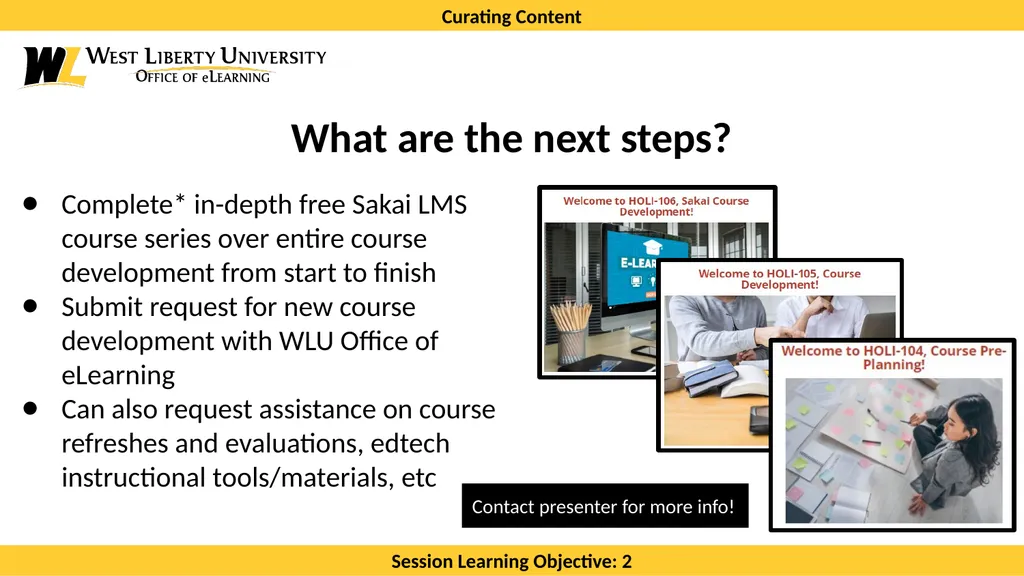
What are the next steps? Curating Content Complete* in-depth free Sakai LMS course series over entire course development from start to finish
Submit request for new course development with WLU Office of eLearning
Can also request assistance on course refreshes and evaluations, edtech instructional tools/materials, etc Contact presenter for more info! Session Learning Objective: 2<br>
Submit request for new course development with WLU Office of eLearning
Can also request assistance on course refreshes and evaluations, edtech instructional tools/materials, etc Contact presenter for more info! Session Learning Objective: 2<br>
29
Questions or Feedback? Questions How did I do? Please submit an evaluation for this session!<br>