
Preparing to Talk About Race Stephen Brookfield
CB
Published · 22 slides · 0 views

1 / 1

Description
Preparing to Talk About Race Stephen Brookfield http:www.stephenbrookfield.com sdbrookfield99gmail.com Adjunct Professor, Teachers College (Columbia University), Emeritus Professor, University of St. Thomas (Minneapolis-St. Paul),
Related Topics
Share
Embed code
Download this presentation From Below
"Preparing to Talk About Race Stephen Brookfield" is the property of its rightful owner. Permission is granted to download and print the materials on this website for personal, non-commercial use only, and to display it on your personal computer provided you do not modify the materials and that you retain all copyright notices contained in the materials. By downloading content from our website, you accept the terms of this agreement.
Presentation Transcript
01
Preparing to Talk About Race Stephen Brookfield
http://www.stephenbrookfield.com/
sdbrookfield99@gmail.com
Adjunct Professor, Teachers College (Columbia University), Emeritus Professor, University of St. Thomas (Minneapolis-St. Paul),
Distinguished Scholar, Antioch University<br>
http://www.stephenbrookfield.com/
sdbrookfield99@gmail.com
Adjunct Professor, Teachers College (Columbia University), Emeritus Professor, University of St. Thomas (Minneapolis-St. Paul),
Distinguished Scholar, Antioch University<br>
02
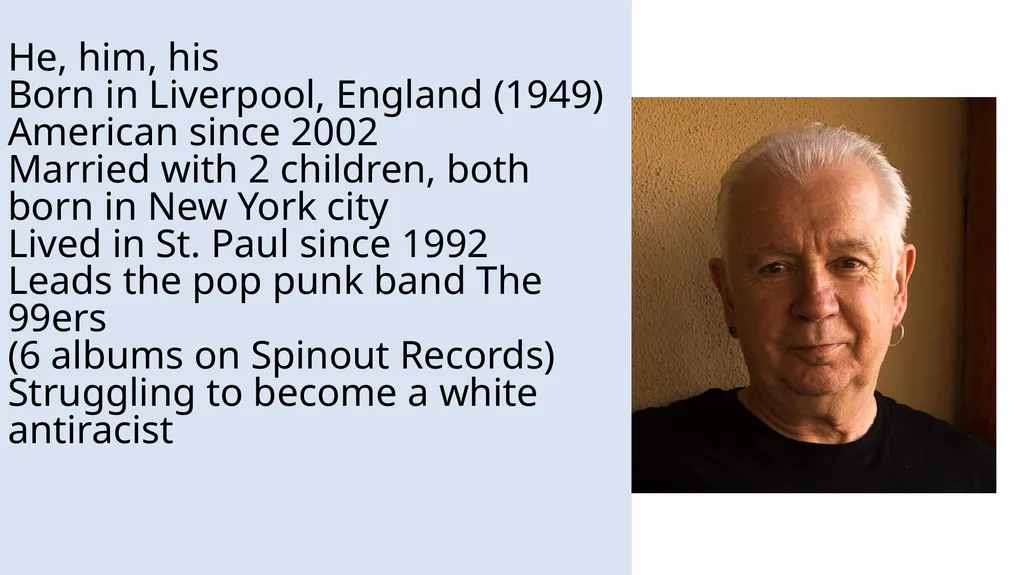
He, him, his
Born in Liverpool, England (1949)
American since 2002
Married with 2 children, both born in New York city
Lived in St. Paul since 1992
Leads the pop punk band The 99ers
(6 albums on Spinout Records)
Struggling to become a white antiracist<br>
03
How are we feeling about today? Go to: sli.do.com
Enter Code: 18760
Vote for as many responses as you like<br>
Enter Code: 18760
Vote for as many responses as you like<br>
04
Important for leaders to disclose 🤔😡🙂😟
Disclose your commitment but also your acknowledgment that this is complex & difficult work
Talk about what your own racial identity means for how you approach these conversations
Maybe use courageous conversations ground rules
Singleton, G. 2014. Courageous conversations about race: A field guide. Thousand Oaks, CA: Corwin (2nd. Ed.)<br>
Disclose your commitment but also your acknowledgment that this is complex & difficult work
Talk about what your own racial identity means for how you approach these conversations
Maybe use courageous conversations ground rules
Singleton, G. 2014. Courageous conversations about race: A field guide. Thousand Oaks, CA: Corwin (2nd. Ed.)<br>
05
Courageous Conversations Ground Rules Stay Engaged – be present, emotionally alert, listen carefully
Speak Your Truth – talk about what’s real for you, not what you think others want to hear
Accept & Expect Discomfort – after all, NOT talking about this is the fundamental problem in many settings. But admit that it will often be uncomfortable, that people won’t know the “right” thing to say, that the unfamiliarity of this kind of talk will make it intense
Accept & Expect a Lack of Closure – this conversation won’t solve racism, won’t bring about massive institutional transformation. But if we DON’T start with some honest conversation about where we all are, then change will be very difficult<br>
Speak Your Truth – talk about what’s real for you, not what you think others want to hear
Accept & Expect Discomfort – after all, NOT talking about this is the fundamental problem in many settings. But admit that it will often be uncomfortable, that people won’t know the “right” thing to say, that the unfamiliarity of this kind of talk will make it intense
Accept & Expect a Lack of Closure – this conversation won’t solve racism, won’t bring about massive institutional transformation. But if we DON’T start with some honest conversation about where we all are, then change will be very difficult<br>
06
Two Kinds of Preparation Technical (Content) – reading, viewing, thinking, reflecting on nature of racism, white identity, white supremacy, anti-blackness etc.
Technical (Process) – how to model disclosure, choose good narratives, build trust, scaffold learning from simple to complex
Emotional (EQ) – this is inherently emotional work in which people are laying bare their identities, experiences, convictions and feelings. It will sometimes be raw & contentious and people will become distressed, angry, and uncomfortable
Emotional (Mistakes) – this is inherently unpredictable work & you’ll constantly feel like you’ve screwed up, made mistakes, said or done the wrong thing, and mishandled situations
There are two ways do anti-racist work – IMPERFECTLY or NOT AT ALL!<br>
Technical (Process) – how to model disclosure, choose good narratives, build trust, scaffold learning from simple to complex
Emotional (EQ) – this is inherently emotional work in which people are laying bare their identities, experiences, convictions and feelings. It will sometimes be raw & contentious and people will become distressed, angry, and uncomfortable
Emotional (Mistakes) – this is inherently unpredictable work & you’ll constantly feel like you’ve screwed up, made mistakes, said or done the wrong thing, and mishandled situations
There are two ways do anti-racist work – IMPERFECTLY or NOT AT ALL!<br>
07
We’re Preparing for a BRAVE (not a Safe) Space Where we expect to experience discomfort
Where we expect the expression of strong feelings and emotions
Where we don’t expect to reach consensus
Where we will leave a conversation knowing others think very differently from us
Where silence is viewed as a necessary dynamic of conversation – not as ‘awkward’
Where we understand that making ‘mistakes’, feeling unprepared or unqualified, & ‘saying the wrong thing’ are the nature of the activity
Where we focus on racism as a learned behavior, not as evidence of essential evil or a moral flaw
(Pawlowski, L. 2019. Creating a brave space classroom. In, S.D. Brookfield and Associates, Teaching race: Helping students unmask and challenge racism. San Francisco: Jossey-Bass)<br>
Where we expect the expression of strong feelings and emotions
Where we don’t expect to reach consensus
Where we will leave a conversation knowing others think very differently from us
Where silence is viewed as a necessary dynamic of conversation – not as ‘awkward’
Where we understand that making ‘mistakes’, feeling unprepared or unqualified, & ‘saying the wrong thing’ are the nature of the activity
Where we focus on racism as a learned behavior, not as evidence of essential evil or a moral flaw
(Pawlowski, L. 2019. Creating a brave space classroom. In, S.D. Brookfield and Associates, Teaching race: Helping students unmask and challenge racism. San Francisco: Jossey-Bass)<br>
08
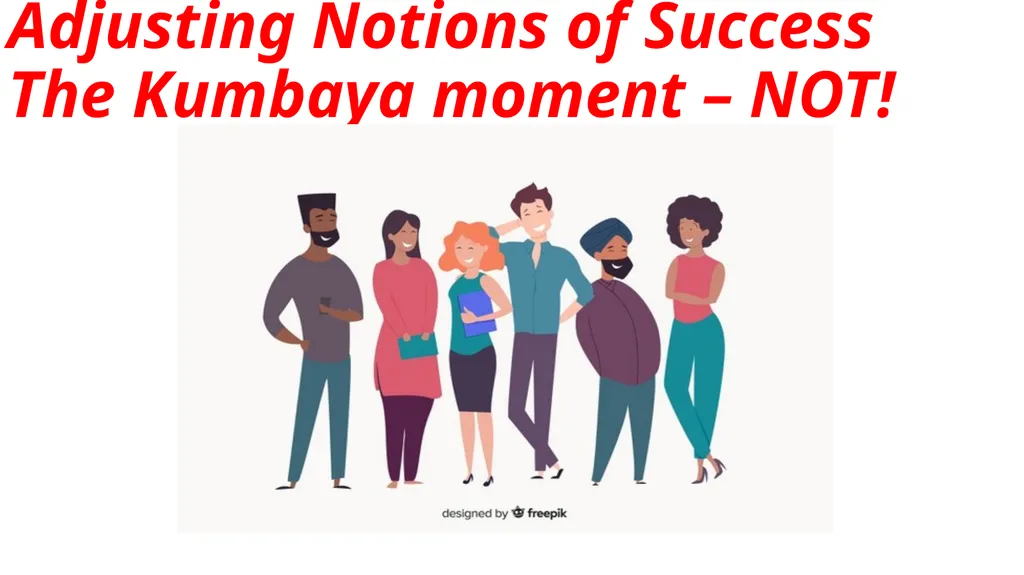
Adjusting Notions of Success
The Kumbaya moment – NOT!<br>
09
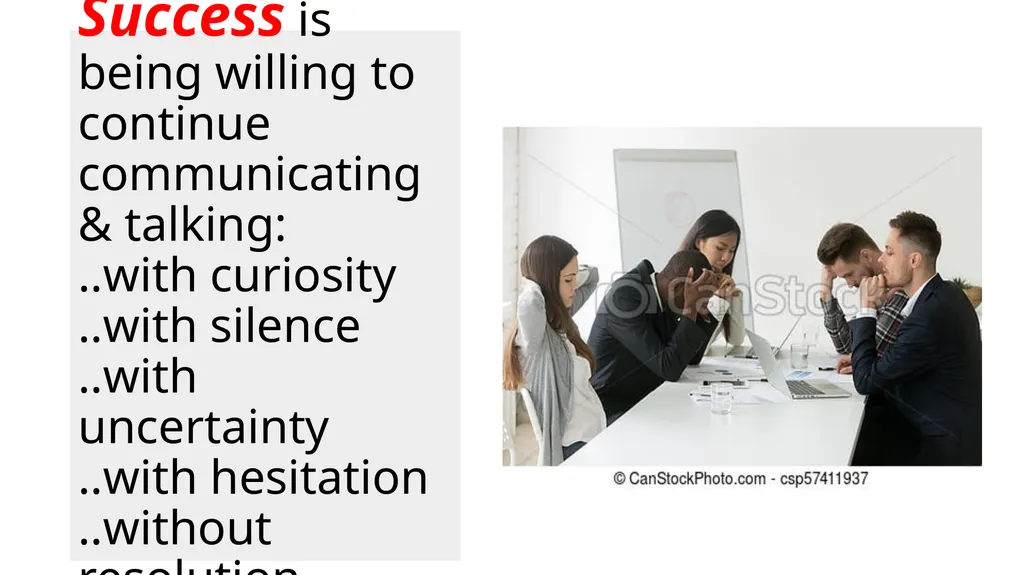
Success is being willing to continue communicating & talking:
..with curiosity
..with silence
..with uncertainty
..with hesitation
..without resolution<br>
10
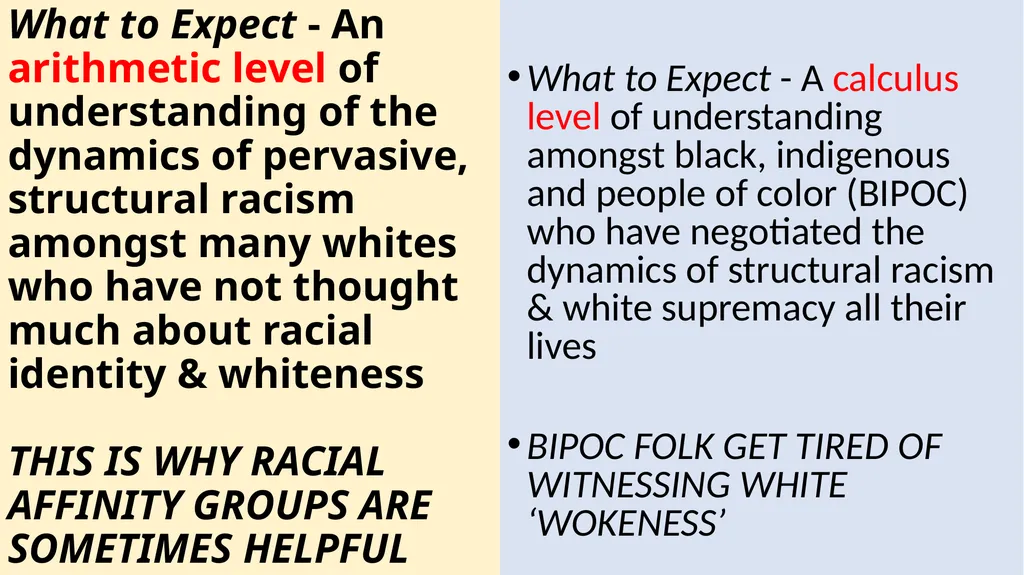
What to Expect - An arithmetic level of understanding of the dynamics of pervasive, structural racism amongst many whites who have not thought much about racial identity & whiteness
THIS IS WHY RACIAL AFFINITY GROUPS ARE SOMETIMES HELPFUL What to Expect - A calculus level of understanding amongst black, indigenous and people of color (BIPOC) who have negotiated the dynamics of structural racism & white supremacy all their lives
BIPOC FOLK GET TIRED OF WITNESSING WHITE ‘WOKENESS’<br>
BIPOC FOLK GET TIRED OF WITNESSING WHITE ‘WOKENESS’<br>
11
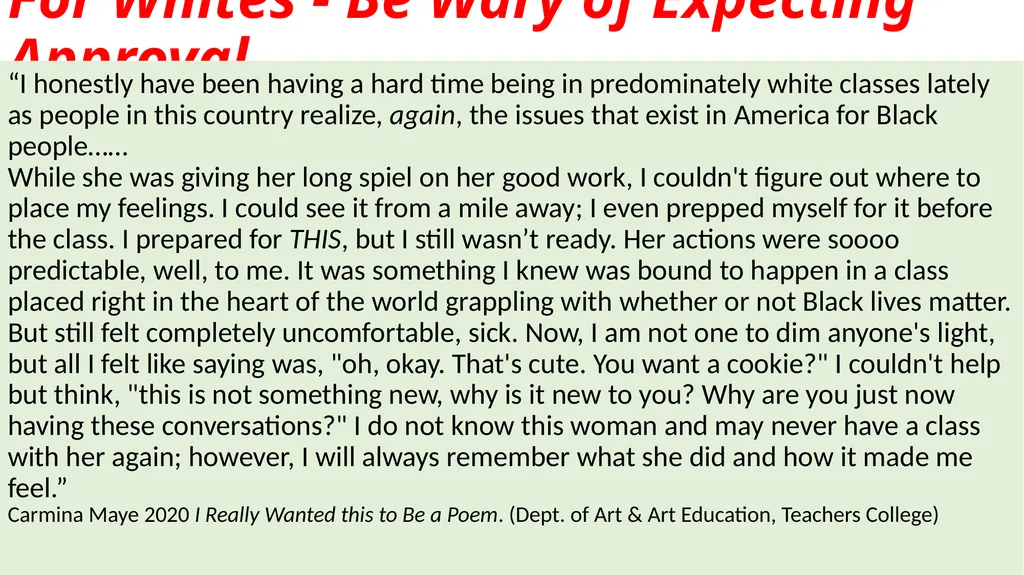
For Whites - Be Wary of Expecting Approval “I honestly have been having a hard time being in predominately white classes lately as people in this country realize, again, the issues that exist in America for Black people……
While she was giving her long spiel on her good work, I couldn't figure out where to place my feelings. I could see it from a mile away; I even prepped myself for it before the class. I prepared for THIS, but I still wasn’t ready. Her actions were soooo predictable, well, to me. It was something I knew was bound to happen in a class placed right in the heart of the world grappling with whether or not Black lives matter. But still felt completely uncomfortable, sick. Now, I am not one to dim anyone's light, but all I felt like saying was, "oh, okay. That's cute. You want a cookie?" I couldn't help but think, "this is not something new, why is it new to you? Why are you just now having these conversations?" I do not know this woman and may never have a class with her again; however, I will always remember what she did and how it made me feel.”
Carmina Maye 2020 I Really Wanted this to Be a Poem. (Dept. of Art & Art Education, Teachers College)<br>
While she was giving her long spiel on her good work, I couldn't figure out where to place my feelings. I could see it from a mile away; I even prepped myself for it before the class. I prepared for THIS, but I still wasn’t ready. Her actions were soooo predictable, well, to me. It was something I knew was bound to happen in a class placed right in the heart of the world grappling with whether or not Black lives matter. But still felt completely uncomfortable, sick. Now, I am not one to dim anyone's light, but all I felt like saying was, "oh, okay. That's cute. You want a cookie?" I couldn't help but think, "this is not something new, why is it new to you? Why are you just now having these conversations?" I do not know this woman and may never have a class with her again; however, I will always remember what she did and how it made me feel.”
Carmina Maye 2020 I Really Wanted this to Be a Poem. (Dept. of Art & Art Education, Teachers College)<br>
12
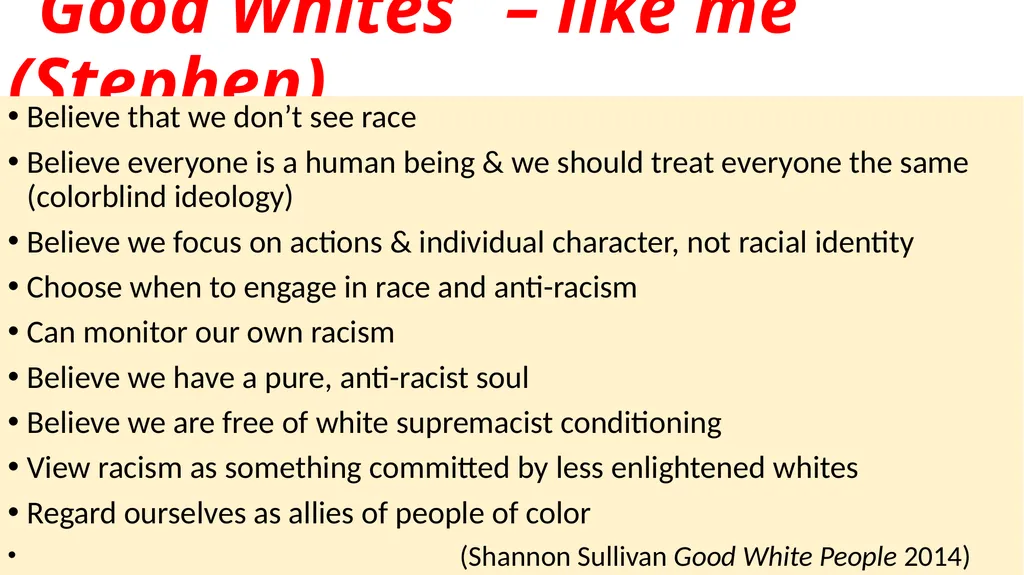
“Good Whites” – like me (Stephen) Believe that we don’t see race
Believe everyone is a human being & we should treat everyone the same (colorblind ideology)
Believe we focus on actions & individual character, not racial identity
Choose when to engage in race and anti-racism
Can monitor our own racism
Believe we have a pure, anti-racist soul
Believe we are free of white supremacist conditioning
View racism as something committed by less enlightened whites
Regard ourselves as allies of people of color
(Shannon Sullivan Good White People 2014)<br>
Believe everyone is a human being & we should treat everyone the same (colorblind ideology)
Believe we focus on actions & individual character, not racial identity
Choose when to engage in race and anti-racism
Can monitor our own racism
Believe we have a pure, anti-racist soul
Believe we are free of white supremacist conditioning
View racism as something committed by less enlightened whites
Regard ourselves as allies of people of color
(Shannon Sullivan Good White People 2014)<br>
13
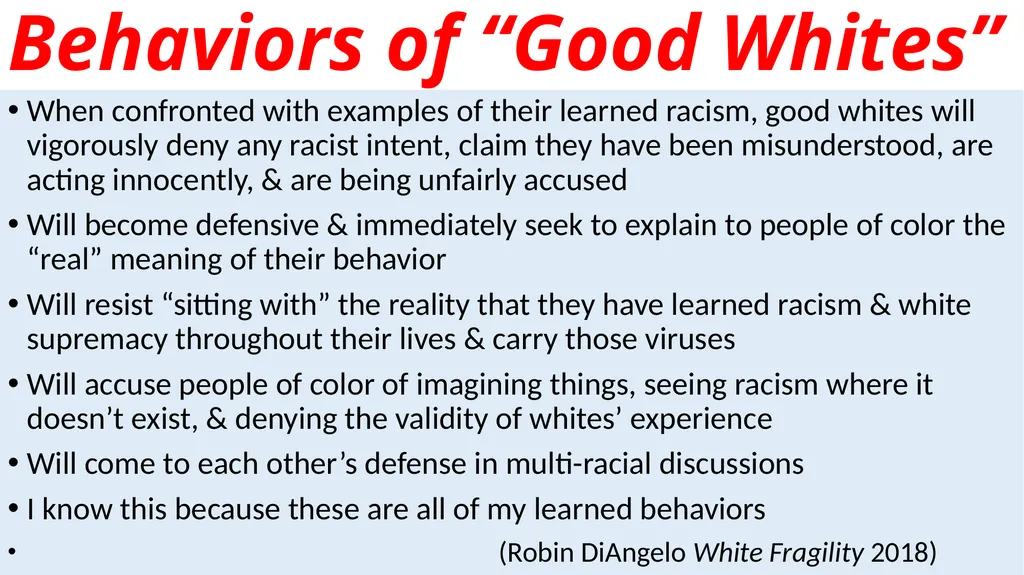
Behaviors of “Good Whites” When confronted with examples of their learned racism, good whites will vigorously deny any racist intent, claim they have been misunderstood, are acting innocently, & are being unfairly accused
Will become defensive & immediately seek to explain to people of color the “real” meaning of their behavior
Will resist “sitting with” the reality that they have learned racism & white supremacy throughout their lives & carry those viruses
Will accuse people of color of imagining things, seeing racism where it doesn’t exist, & denying the validity of whites’ experience
Will come to each other’s defense in multi-racial discussions
I know this because these are all of my learned behaviors
(Robin DiAngelo White Fragility 2018)<br>
Will become defensive & immediately seek to explain to people of color the “real” meaning of their behavior
Will resist “sitting with” the reality that they have learned racism & white supremacy throughout their lives & carry those viruses
Will accuse people of color of imagining things, seeing racism where it doesn’t exist, & denying the validity of whites’ experience
Will come to each other’s defense in multi-racial discussions
I know this because these are all of my learned behaviors
(Robin DiAngelo White Fragility 2018)<br>
14
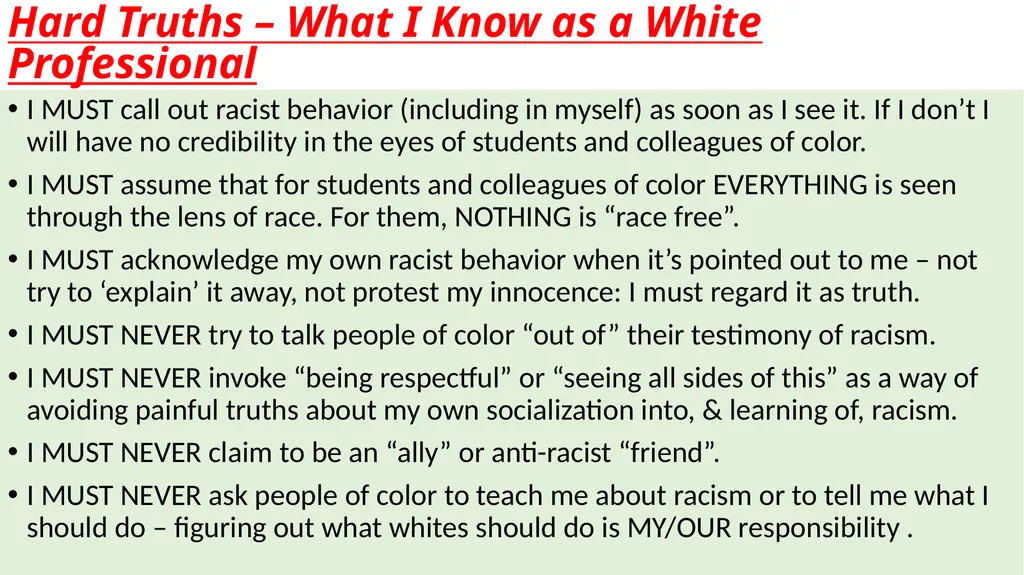
Hard Truths – What I Know as a White Professional I MUST call out racist behavior (including in myself) as soon as I see it. If I don’t I will have no credibility in the eyes of students and colleagues of color.
I MUST assume that for students and colleagues of color EVERYTHING is seen through the lens of race. For them, NOTHING is “race free”.
I MUST acknowledge my own racist behavior when it’s pointed out to me – not try to ‘explain’ it away, not protest my innocence: I must regard it as truth.
I MUST NEVER try to talk people of color “out of” their testimony of racism.
I MUST NEVER invoke “being respectful” or “seeing all sides of this” as a way of avoiding painful truths about my own socialization into, & learning of, racism.
I MUST NEVER claim to be an “ally” or anti-racist “friend”.
I MUST NEVER ask people of color to teach me about racism or to tell me what I should do – figuring out what whites should do is MY/OUR responsibility .<br>
I MUST assume that for students and colleagues of color EVERYTHING is seen through the lens of race. For them, NOTHING is “race free”.
I MUST acknowledge my own racist behavior when it’s pointed out to me – not try to ‘explain’ it away, not protest my innocence: I must regard it as truth.
I MUST NEVER try to talk people of color “out of” their testimony of racism.
I MUST NEVER invoke “being respectful” or “seeing all sides of this” as a way of avoiding painful truths about my own socialization into, & learning of, racism.
I MUST NEVER claim to be an “ally” or anti-racist “friend”.
I MUST NEVER ask people of color to teach me about racism or to tell me what I should do – figuring out what whites should do is MY/OUR responsibility .<br>
15
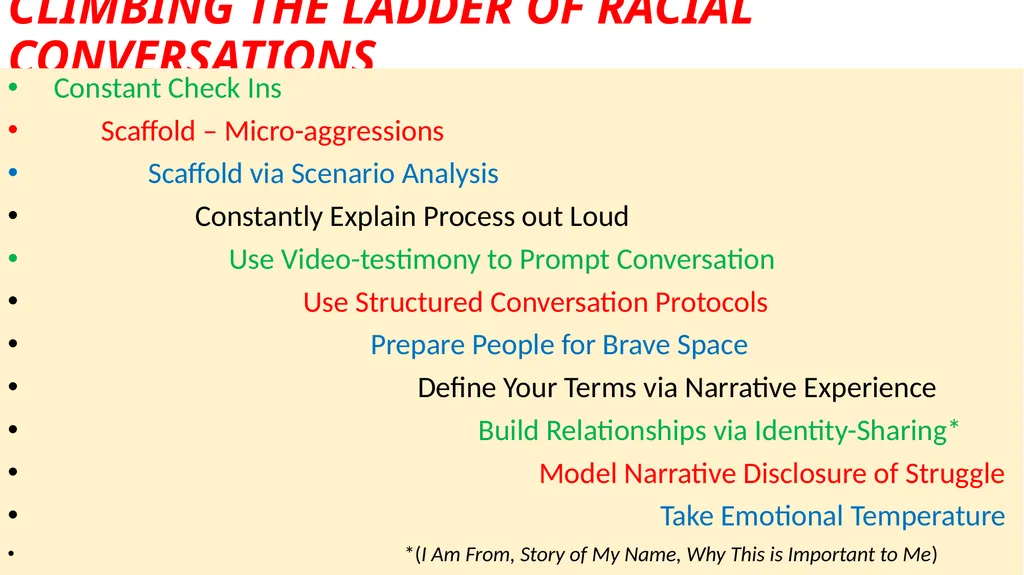
CLIMBING THE LADDER OF RACIAL CONVERSATIONS Constant Check Ins
Scaffold – Micro-aggressions
Scaffold via Scenario Analysis
Constantly Explain Process out Loud
Use Video-testimony to Prompt Conversation
Use Structured Conversation Protocols
Prepare People for Brave Space
Define Your Terms via Narrative Experience
Build Relationships via Identity-Sharing*
Model Narrative Disclosure of Struggle
Take Emotional Temperature
*(I Am From, Story of My Name, Why This is Important to Me)<br>
Scaffold – Micro-aggressions
Scaffold via Scenario Analysis
Constantly Explain Process out Loud
Use Video-testimony to Prompt Conversation
Use Structured Conversation Protocols
Prepare People for Brave Space
Define Your Terms via Narrative Experience
Build Relationships via Identity-Sharing*
Model Narrative Disclosure of Struggle
Take Emotional Temperature
*(I Am From, Story of My Name, Why This is Important to Me)<br>
16
Questions, Comments, Reactions Let’s Pause to See What We’re Thinking About Right Now
EITHER….
Post a question, reaction or comment on Zoom Chat
Use the ‘Raised Hand’ function on Zoom
(Click on ‘Participants’ link at bottom center of the screen, then click the ‘Raise Hand’ command)<br>
EITHER….
Post a question, reaction or comment on Zoom Chat
Use the ‘Raised Hand’ function on Zoom
(Click on ‘Participants’ link at bottom center of the screen, then click the ‘Raise Hand’ command)<br>
17
Circle of Voices Spend a minute silently thinking about your response to this question
How do I, or how have I seen others, try to model a willingness to address race for colleagues, peers and students?
Go round the circle in 1st name alphabetical order - each person has up to 1 minute of uninterrupted air time to give their response. No interruptions allowed.
After all have spoken, move into free discussion (anyone can speak) but make sure that every comment you offer somehow refers back to a comment made by someone else in the opening circle of voices. This need NOT be an agreement - it can be a disagreement, a question, an elaboration or extension, an illustration.<br>
How do I, or how have I seen others, try to model a willingness to address race for colleagues, peers and students?
Go round the circle in 1st name alphabetical order - each person has up to 1 minute of uninterrupted air time to give their response. No interruptions allowed.
After all have spoken, move into free discussion (anyone can speak) but make sure that every comment you offer somehow refers back to a comment made by someone else in the opening circle of voices. This need NOT be an agreement - it can be a disagreement, a question, an elaboration or extension, an illustration.<br>
18
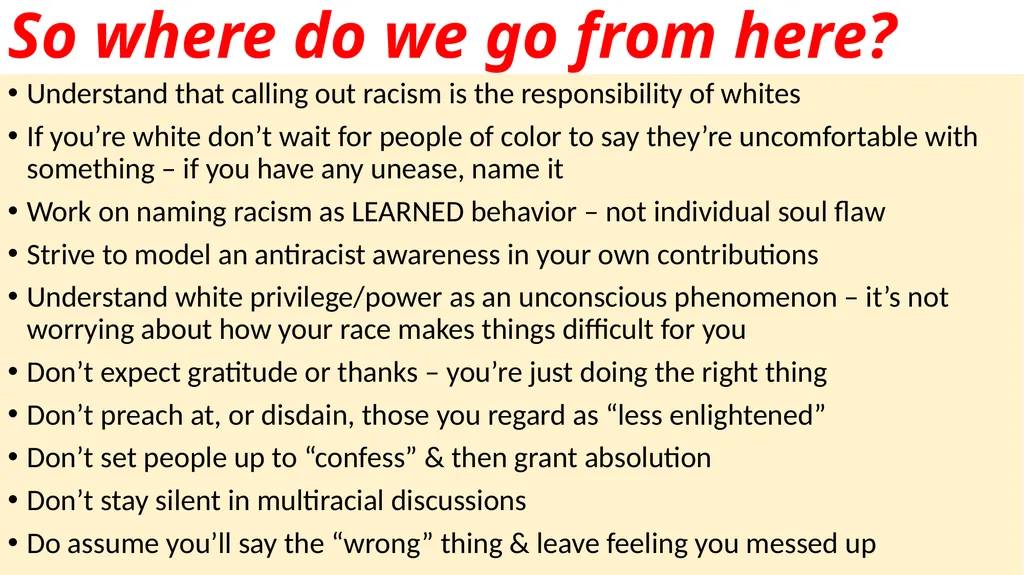
So where do we go from here? Understand that calling out racism is the responsibility of whites
If you’re white don’t wait for people of color to say they’re uncomfortable with something – if you have any unease, name it
Work on naming racism as LEARNED behavior – not individual soul flaw
Strive to model an antiracist awareness in your own contributions
Understand white privilege/power as an unconscious phenomenon – it’s not worrying about how your race makes things difficult for you
Don’t expect gratitude or thanks – you’re just doing the right thing
Don’t preach at, or disdain, those you regard as “less enlightened”
Don’t set people up to “confess” & then grant absolution
Don’t stay silent in multiracial discussions
Do assume you’ll say the “wrong” thing & leave feeling you messed up<br>
If you’re white don’t wait for people of color to say they’re uncomfortable with something – if you have any unease, name it
Work on naming racism as LEARNED behavior – not individual soul flaw
Strive to model an antiracist awareness in your own contributions
Understand white privilege/power as an unconscious phenomenon – it’s not worrying about how your race makes things difficult for you
Don’t expect gratitude or thanks – you’re just doing the right thing
Don’t preach at, or disdain, those you regard as “less enlightened”
Don’t set people up to “confess” & then grant absolution
Don’t stay silent in multiracial discussions
Do assume you’ll say the “wrong” thing & leave feeling you messed up<br>
19
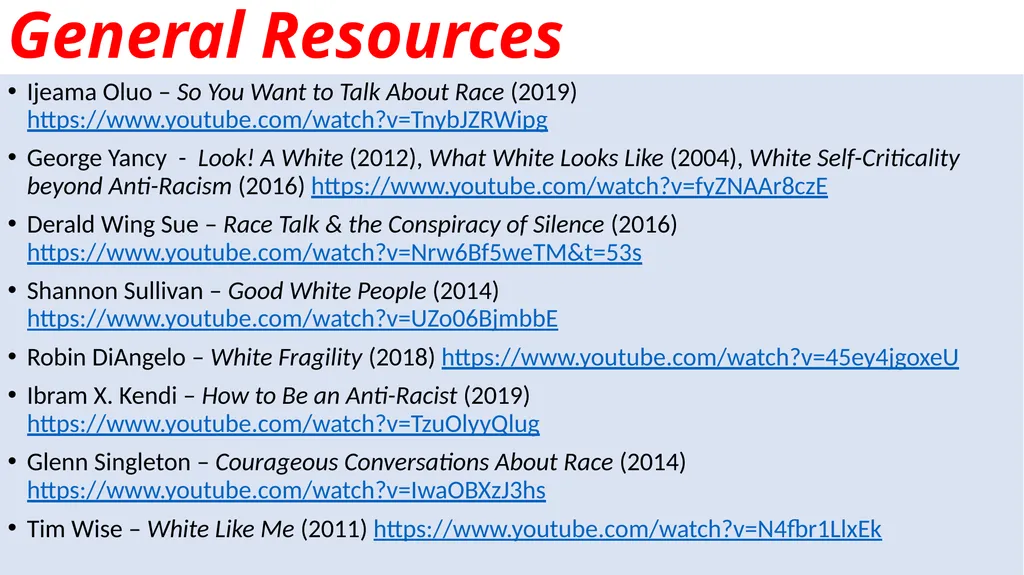
General Resources Ijeama Oluo – So You Want to Talk About Race (2019) https://www.youtube.com/watch?v=TnybJZRWipg
George Yancy - Look! A White (2012), What White Looks Like (2004), White Self-Criticality beyond Anti-Racism (2016) https://www.youtube.com/watch?v=fyZNAAr8czE
Derald Wing Sue – Race Talk & the Conspiracy of Silence (2016) https://www.youtube.com/watch?v=Nrw6Bf5weTM&t=53s
Shannon Sullivan – Good White People (2014) https://www.youtube.com/watch?v=UZo06BjmbbE
Robin DiAngelo – White Fragility (2018) https://www.youtube.com/watch?v=45ey4jgoxeU
Ibram X. Kendi – How to Be an Anti-Racist (2019) https://www.youtube.com/watch?v=TzuOlyyQlug
Glenn Singleton – Courageous Conversations About Race (2014) https://www.youtube.com/watch?v=IwaOBXzJ3hs
Tim Wise – White Like Me (2011) https://www.youtube.com/watch?v=N4fbr1LlxEk<br>
George Yancy - Look! A White (2012), What White Looks Like (2004), White Self-Criticality beyond Anti-Racism (2016) https://www.youtube.com/watch?v=fyZNAAr8czE
Derald Wing Sue – Race Talk & the Conspiracy of Silence (2016) https://www.youtube.com/watch?v=Nrw6Bf5weTM&t=53s
Shannon Sullivan – Good White People (2014) https://www.youtube.com/watch?v=UZo06BjmbbE
Robin DiAngelo – White Fragility (2018) https://www.youtube.com/watch?v=45ey4jgoxeU
Ibram X. Kendi – How to Be an Anti-Racist (2019) https://www.youtube.com/watch?v=TzuOlyyQlug
Glenn Singleton – Courageous Conversations About Race (2014) https://www.youtube.com/watch?v=IwaOBXzJ3hs
Tim Wise – White Like Me (2011) https://www.youtube.com/watch?v=N4fbr1LlxEk<br>
20
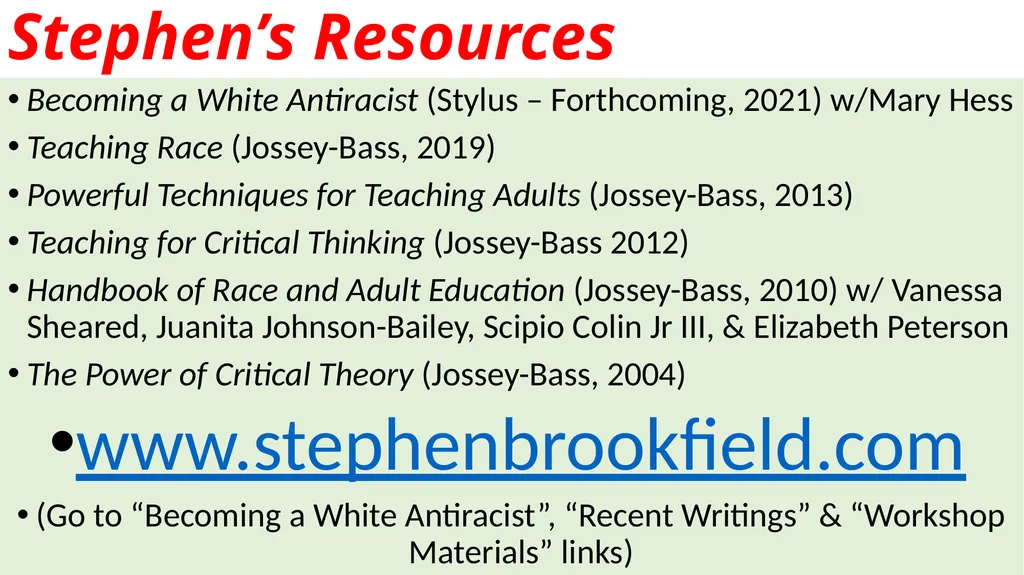
Stephen’s Resources Becoming a White Antiracist (Stylus – Forthcoming, 2021) w/Mary Hess
Teaching Race (Jossey-Bass, 2019)
Powerful Techniques for Teaching Adults (Jossey-Bass, 2013)
Teaching for Critical Thinking (Jossey-Bass 2012)
Handbook of Race and Adult Education (Jossey-Bass, 2010) w/ Vanessa Sheared, Juanita Johnson-Bailey, Scipio Colin Jr III, & Elizabeth Peterson
The Power of Critical Theory (Jossey-Bass, 2004)
www.stephenbrookfield.com
(Go to “Becoming a White Antiracist”, “Recent Writings” & “Workshop Materials” links)<br>
Teaching Race (Jossey-Bass, 2019)
Powerful Techniques for Teaching Adults (Jossey-Bass, 2013)
Teaching for Critical Thinking (Jossey-Bass 2012)
Handbook of Race and Adult Education (Jossey-Bass, 2010) w/ Vanessa Sheared, Juanita Johnson-Bailey, Scipio Colin Jr III, & Elizabeth Peterson
The Power of Critical Theory (Jossey-Bass, 2004)
www.stephenbrookfield.com
(Go to “Becoming a White Antiracist”, “Recent Writings” & “Workshop Materials” links)<br>
21
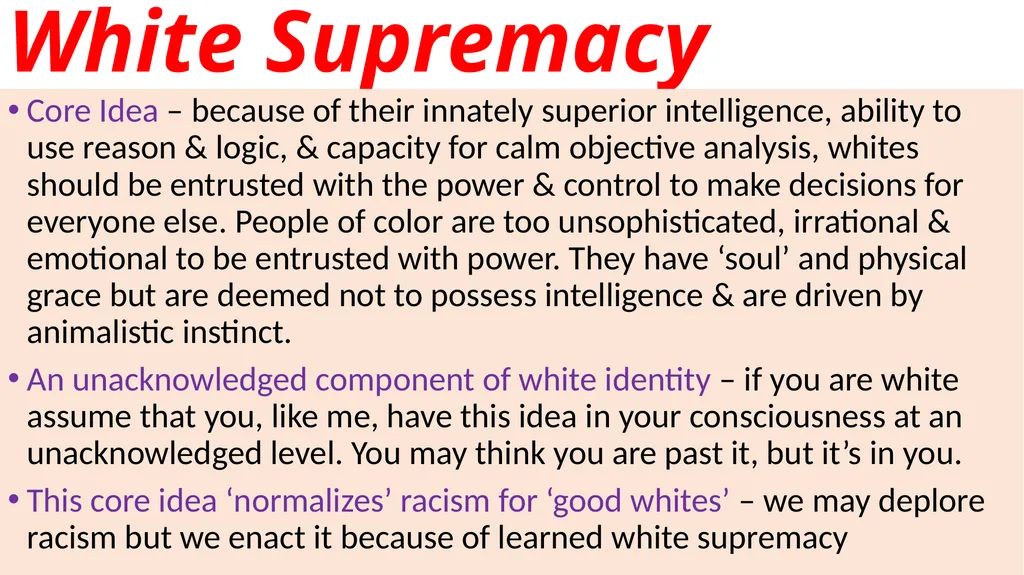
White Supremacy Core Idea – because of their innately superior intelligence, ability to use reason & logic, & capacity for calm objective analysis, whites should be entrusted with the power & control to make decisions for everyone else. People of color are too unsophisticated, irrational & emotional to be entrusted with power. They have ‘soul’ and physical grace but are deemed not to possess intelligence & are driven by animalistic instinct.
An unacknowledged component of white identity – if you are white assume that you, like me, have this idea in your consciousness at an unacknowledged level. You may think you are past it, but it’s in you.
This core idea ‘normalizes’ racism for ‘good whites’ – we may deplore racism but we enact it because of learned white supremacy<br>
An unacknowledged component of white identity – if you are white assume that you, like me, have this idea in your consciousness at an unacknowledged level. You may think you are past it, but it’s in you.
This core idea ‘normalizes’ racism for ‘good whites’ – we may deplore racism but we enact it because of learned white supremacy<br>
22
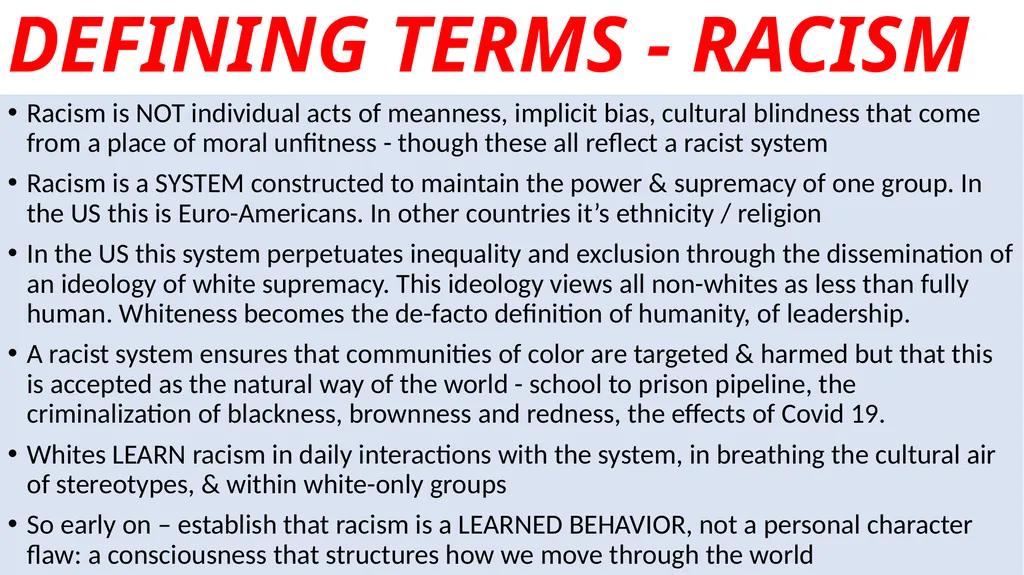
DEFINING TERMS - RACISM Racism is NOT individual acts of meanness, implicit bias, cultural blindness that come from a place of moral unfitness - though these all reflect a racist system
Racism is a SYSTEM constructed to maintain the power & supremacy of one group. In the US this is Euro-Americans. In other countries it’s ethnicity / religion
In the US this system perpetuates inequality and exclusion through the dissemination of an ideology of white supremacy. This ideology views all non-whites as less than fully human. Whiteness becomes the de-facto definition of humanity, of leadership.
A racist system ensures that communities of color are targeted & harmed but that this is accepted as the natural way of the world - school to prison pipeline, the criminalization of blackness, brownness and redness, the effects of Covid 19.
Whites LEARN racism in daily interactions with the system, in breathing the cultural air of stereotypes, & within white-only groups
So early on – establish that racism is a LEARNED BEHAVIOR, not a personal character flaw: a consciousness that structures how we move through the world<br>
Racism is a SYSTEM constructed to maintain the power & supremacy of one group. In the US this is Euro-Americans. In other countries it’s ethnicity / religion
In the US this system perpetuates inequality and exclusion through the dissemination of an ideology of white supremacy. This ideology views all non-whites as less than fully human. Whiteness becomes the de-facto definition of humanity, of leadership.
A racist system ensures that communities of color are targeted & harmed but that this is accepted as the natural way of the world - school to prison pipeline, the criminalization of blackness, brownness and redness, the effects of Covid 19.
Whites LEARN racism in daily interactions with the system, in breathing the cultural air of stereotypes, & within white-only groups
So early on – establish that racism is a LEARNED BEHAVIOR, not a personal character flaw: a consciousness that structures how we move through the world<br>