
Presentation by the Erie County Bar Association’s
CP
Published · 59 slides · 0 views

1 / 1

Description
Presentation by the Erie County Bar Associations Assigned Counsel Program to the Task Force on Erie County Indigent Defense Representation Erie County Bar Associations Aid To Indigent Prisoners Society Inc. Presentation on Erie County
Related Topics
Share
Embed code
Download this presentation From Below
"Presentation by the Erie County Bar Association’s" is the property of its rightful owner. Permission is granted to download and print the materials on this website for personal, non-commercial use only, and to display it on your personal computer provided you do not modify the materials and that you retain all copyright notices contained in the materials. By downloading content from our website, you accept the terms of this agreement.
Presentation Transcript
01
Presentation by the
Erie County Bar Association’s
Assigned Counsel Program
to the
Task Force on Erie County Indigent Defense Representation Erie County Bar Association’s Aid To Indigent Prisoners Society Inc.<br>
02
Presentation on Erie County
Indigent Defense Representation The ECBA ACP – Origin, History and Leadership
ILS – It’s History and Support to the ECBA ACP
The Services Provided by the ECBA ACP
How We Ensure High-Quality Representation
The Cost of the Program and Funding Sources
ILS Support to ACPs for Increased Voucher Costs
Trends in Erie County Spending
Erie County compared to Monroe County
Your Questions<br>
ILS – It’s History and Support to the ECBA ACP
The Services Provided by the ECBA ACP
How We Ensure High-Quality Representation
The Cost of the Program and Funding Sources
ILS Support to ACPs for Increased Voucher Costs
Trends in Erie County Spending
Erie County compared to Monroe County
Your Questions<br>
03
1. The ECBA ACP - Origin In 1962, the Bar Association of Erie County created the Assigned Counsel Program (ACP) to provide representation to indigent defendants who could not afford to pay for an attorney. The first administrator was Joseph D. Mintz, who served for 20 years and went on to serve three decades on the State Supreme Court bench.
In 1963, the U.S. Supreme Court issued its ruling in Gideon v. Wainwright holding that the Sixth Amendment right to counsel could not be effectively denied by a State by reason of a defendant’s inability to pay for a lawyer.<br>
In 1963, the U.S. Supreme Court issued its ruling in Gideon v. Wainwright holding that the Sixth Amendment right to counsel could not be effectively denied by a State by reason of a defendant’s inability to pay for a lawyer.<br>
04
1. The ECBA ACP - Its History As a Model Erie County was already ahead of the rest of the state and country. Following Gideon, the ECBA ACP became the model for similar programs throughout the state and across the nation.
Erie County hosted the 1964 National Legal Aid and Defender Association Conference, in recognition of the great contributions to public interest law made by Buffalo and WNY attorneys.
By 1967, both Rochester and Syracuse had developed programs modeled on the ECBA’s legal aid system for indigent people.<br>
Erie County hosted the 1964 National Legal Aid and Defender Association Conference, in recognition of the great contributions to public interest law made by Buffalo and WNY attorneys.
By 1967, both Rochester and Syracuse had developed programs modeled on the ECBA’s legal aid system for indigent people.<br>
05
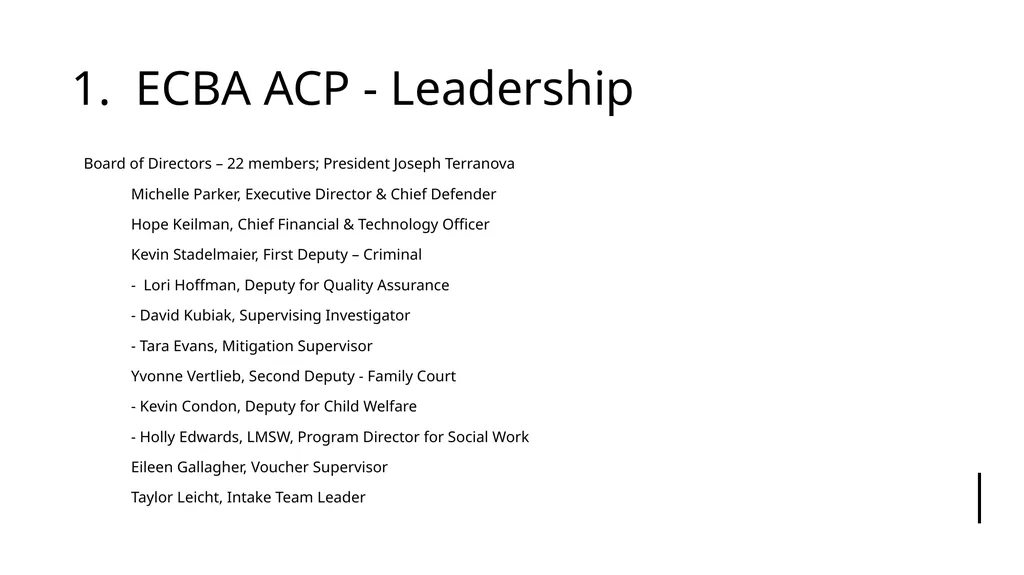
1. ECBA ACP - Leadership Board of Directors – 22 members; President Joseph Terranova
Michelle Parker, Executive Director & Chief Defender
Hope Keilman, Chief Financial & Technology Officer
Kevin Stadelmaier, First Deputy – Criminal
- Lori Hoffman, Deputy for Quality Assurance
- David Kubiak, Supervising Investigator
- Tara Evans, Mitigation Supervisor
Yvonne Vertlieb, Second Deputy - Family Court
- Kevin Condon, Deputy for Child Welfare
- Holly Edwards, LMSW, Program Director for Social Work
Eileen Gallagher, Voucher Supervisor
Taylor Leicht, Intake Team Leader<br>
Michelle Parker, Executive Director & Chief Defender
Hope Keilman, Chief Financial & Technology Officer
Kevin Stadelmaier, First Deputy – Criminal
- Lori Hoffman, Deputy for Quality Assurance
- David Kubiak, Supervising Investigator
- Tara Evans, Mitigation Supervisor
Yvonne Vertlieb, Second Deputy - Family Court
- Kevin Condon, Deputy for Child Welfare
- Holly Edwards, LMSW, Program Director for Social Work
Eileen Gallagher, Voucher Supervisor
Taylor Leicht, Intake Team Leader<br>
06
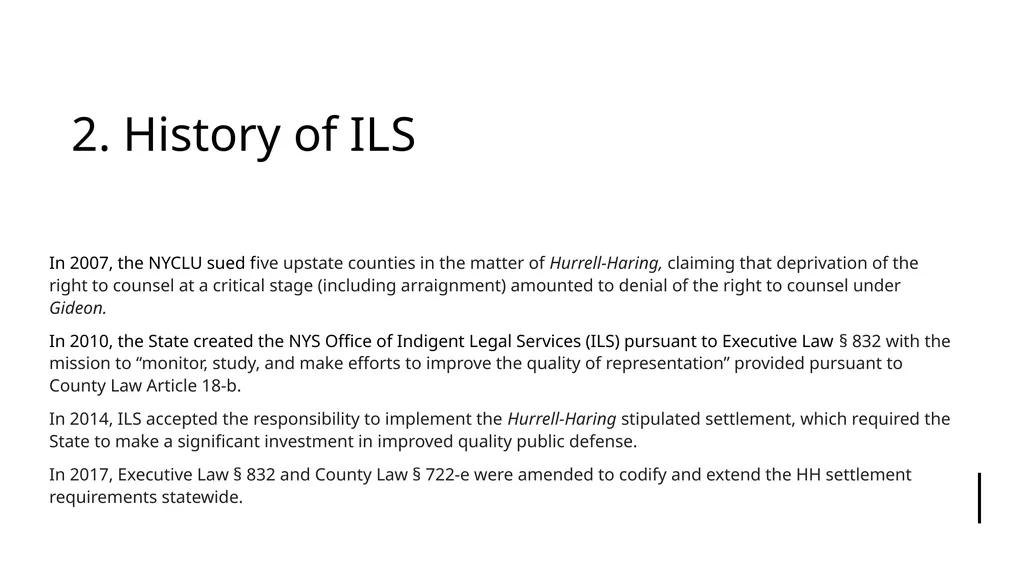
2. History of ILS In 2007, the NYCLU sued five upstate counties in the matter of Hurrell-Haring, claiming that deprivation of the right to counsel at a critical stage (including arraignment) amounted to denial of the right to counsel under Gideon.
In 2010, the State created the NYS Office of Indigent Legal Services (ILS) pursuant to Executive Law § 832 with the mission to “monitor, study, and make efforts to improve the quality of representation” provided pursuant to County Law Article 18-b.
In 2014, ILS accepted the responsibility to implement the Hurrell-Haring stipulated settlement, which required the State to make a significant investment in improved quality public defense.
In 2017, Executive Law § 832 and County Law § 722-e were amended to codify and extend the HH settlement requirements statewide.<br>
In 2010, the State created the NYS Office of Indigent Legal Services (ILS) pursuant to Executive Law § 832 with the mission to “monitor, study, and make efforts to improve the quality of representation” provided pursuant to County Law Article 18-b.
In 2014, ILS accepted the responsibility to implement the Hurrell-Haring stipulated settlement, which required the State to make a significant investment in improved quality public defense.
In 2017, Executive Law § 832 and County Law § 722-e were amended to codify and extend the HH settlement requirements statewide.<br>
07
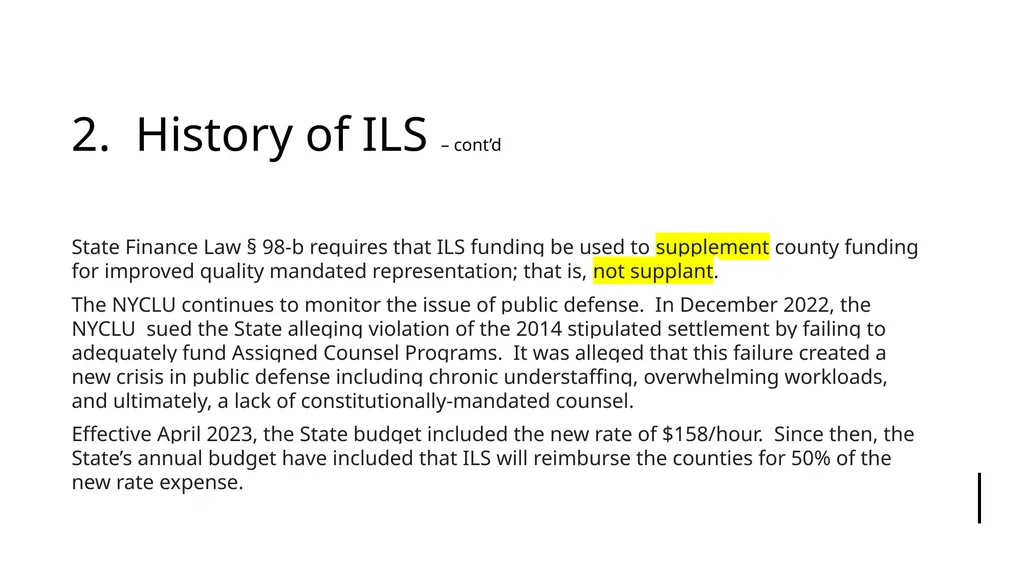
2. History of ILS – cont’d State Finance Law § 98-b requires that ILS funding be used to supplement county funding for improved quality mandated representation; that is, not supplant.
The NYCLU continues to monitor the issue of public defense. In December 2022, the NYCLU sued the State alleging violation of the 2014 stipulated settlement by failing to adequately fund Assigned Counsel Programs. It was alleged that this failure created a new crisis in public defense including chronic understaffing, overwhelming workloads, and ultimately, a lack of constitutionally-mandated counsel.
Effective April 2023, the State budget included the new rate of $158/hour. Since then, the State’s annual budget have included that ILS will reimburse the counties for 50% of the new rate expense.<br>
The NYCLU continues to monitor the issue of public defense. In December 2022, the NYCLU sued the State alleging violation of the 2014 stipulated settlement by failing to adequately fund Assigned Counsel Programs. It was alleged that this failure created a new crisis in public defense including chronic understaffing, overwhelming workloads, and ultimately, a lack of constitutionally-mandated counsel.
Effective April 2023, the State budget included the new rate of $158/hour. Since then, the State’s annual budget have included that ILS will reimburse the counties for 50% of the new rate expense.<br>
08
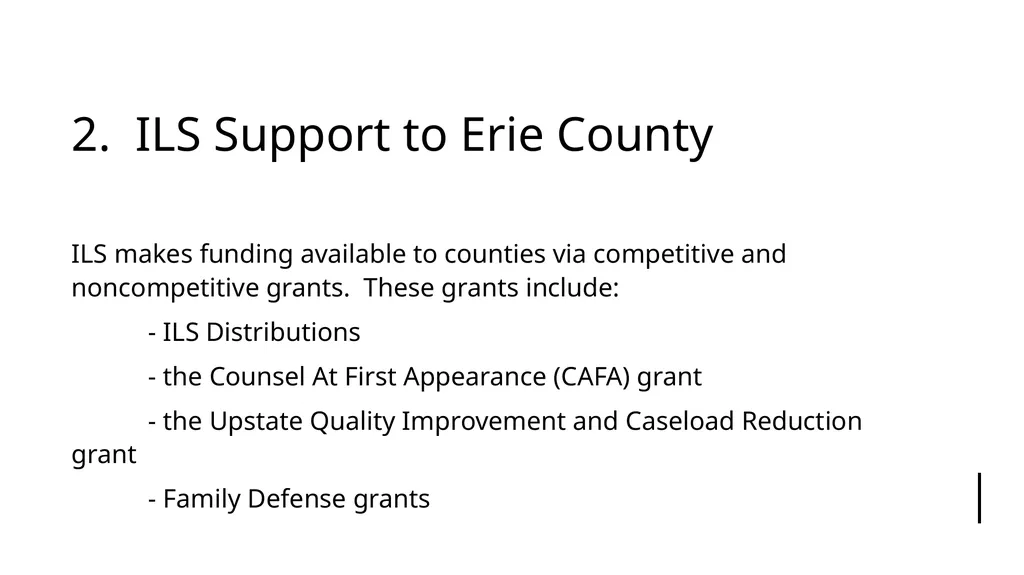
2. ILS Support to Erie County ILS makes funding available to counties via competitive and noncompetitive grants. These grants include:
- ILS Distributions
- the Counsel At First Appearance (CAFA) grant
- the Upstate Quality Improvement and Caseload Reduction grant
- Family Defense grants<br>
- ILS Distributions
- the Counsel At First Appearance (CAFA) grant
- the Upstate Quality Improvement and Caseload Reduction grant
- Family Defense grants<br>
09
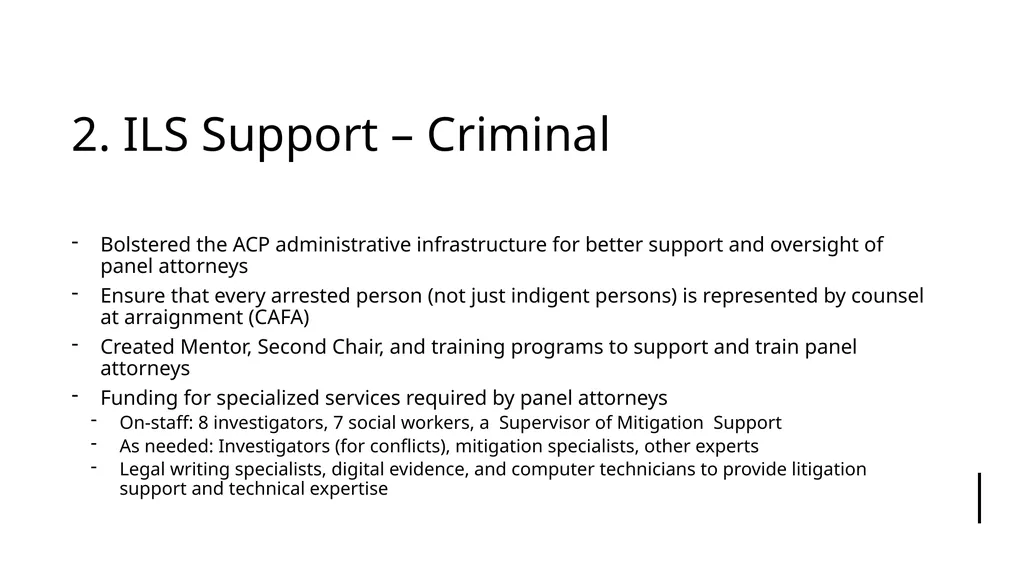
2. ILS Support – Criminal Bolstered the ACP administrative infrastructure for better support and oversight of panel attorneys
Ensure that every arrested person (not just indigent persons) is represented by counsel at arraignment (CAFA)
Created Mentor, Second Chair, and training programs to support and train panel attorneys
Funding for specialized services required by panel attorneys
On-staff: 8 investigators, 7 social workers, a Supervisor of Mitigation Support
As needed: Investigators (for conflicts), mitigation specialists, other experts
Legal writing specialists, digital evidence, and computer technicians to provide litigation support and technical expertise<br>
Ensure that every arrested person (not just indigent persons) is represented by counsel at arraignment (CAFA)
Created Mentor, Second Chair, and training programs to support and train panel attorneys
Funding for specialized services required by panel attorneys
On-staff: 8 investigators, 7 social workers, a Supervisor of Mitigation Support
As needed: Investigators (for conflicts), mitigation specialists, other experts
Legal writing specialists, digital evidence, and computer technicians to provide litigation support and technical expertise<br>
10
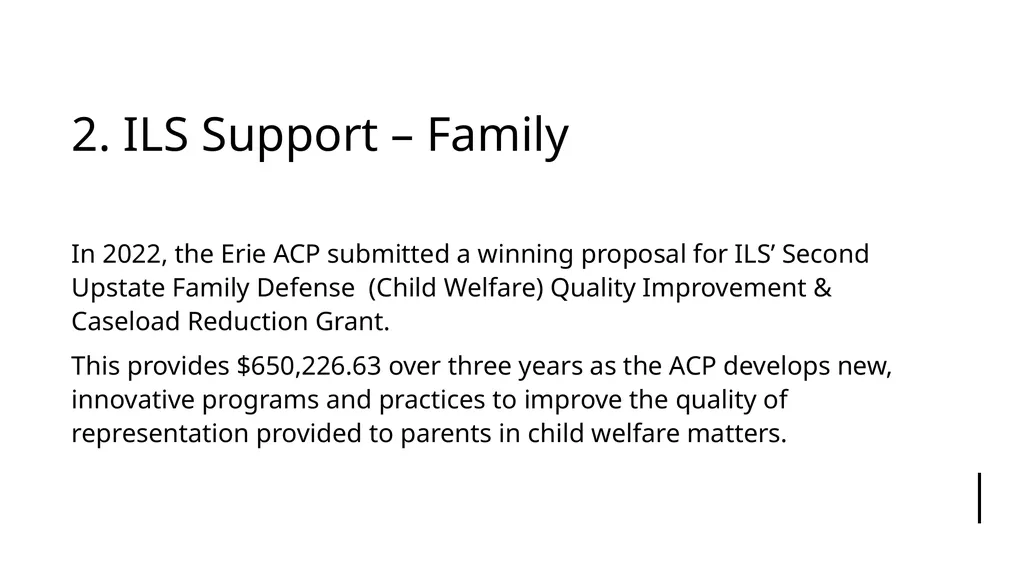
2. ILS Support – Family In 2022, the Erie ACP submitted a winning proposal for ILS’ Second Upstate Family Defense (Child Welfare) Quality Improvement & Caseload Reduction Grant.
This provides $650,226.63 over three years as the ACP develops new, innovative programs and practices to improve the quality of representation provided to parents in child welfare matters.<br>
This provides $650,226.63 over three years as the ACP develops new, innovative programs and practices to improve the quality of representation provided to parents in child welfare matters.<br>
11
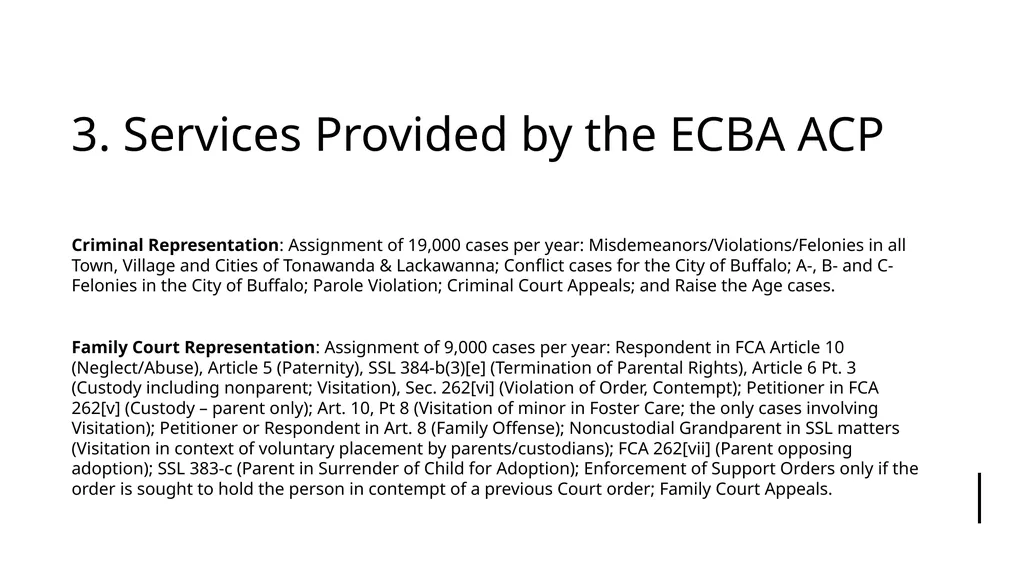
3. Services Provided by the ECBA ACP Criminal Representation: Assignment of 19,000 cases per year: Misdemeanors/Violations/Felonies in all Town, Village and Cities of Tonawanda & Lackawanna; Conflict cases for the City of Buffalo; A-, B- and C- Felonies in the City of Buffalo; Parole Violation; Criminal Court Appeals; and Raise the Age cases.
Family Court Representation: Assignment of 9,000 cases per year: Respondent in FCA Article 10 (Neglect/Abuse), Article 5 (Paternity), SSL 384-b(3)[e] (Termination of Parental Rights), Article 6 Pt. 3 (Custody including nonparent; Visitation), Sec. 262[vi] (Violation of Order, Contempt); Petitioner in FCA 262[v] (Custody – parent only); Art. 10, Pt 8 (Visitation of minor in Foster Care; the only cases involving Visitation); Petitioner or Respondent in Art. 8 (Family Offense); Noncustodial Grandparent in SSL matters (Visitation in context of voluntary placement by parents/custodians); FCA 262[vii] (Parent opposing adoption); SSL 383-c (Parent in Surrender of Child for Adoption); Enforcement of Support Orders only if the order is sought to hold the person in contempt of a previous Court order; Family Court Appeals.<br>
Family Court Representation: Assignment of 9,000 cases per year: Respondent in FCA Article 10 (Neglect/Abuse), Article 5 (Paternity), SSL 384-b(3)[e] (Termination of Parental Rights), Article 6 Pt. 3 (Custody including nonparent; Visitation), Sec. 262[vi] (Violation of Order, Contempt); Petitioner in FCA 262[v] (Custody – parent only); Art. 10, Pt 8 (Visitation of minor in Foster Care; the only cases involving Visitation); Petitioner or Respondent in Art. 8 (Family Offense); Noncustodial Grandparent in SSL matters (Visitation in context of voluntary placement by parents/custodians); FCA 262[vii] (Parent opposing adoption); SSL 383-c (Parent in Surrender of Child for Adoption); Enforcement of Support Orders only if the order is sought to hold the person in contempt of a previous Court order; Family Court Appeals.<br>
12
3. Services Provided by the ECBA ACP
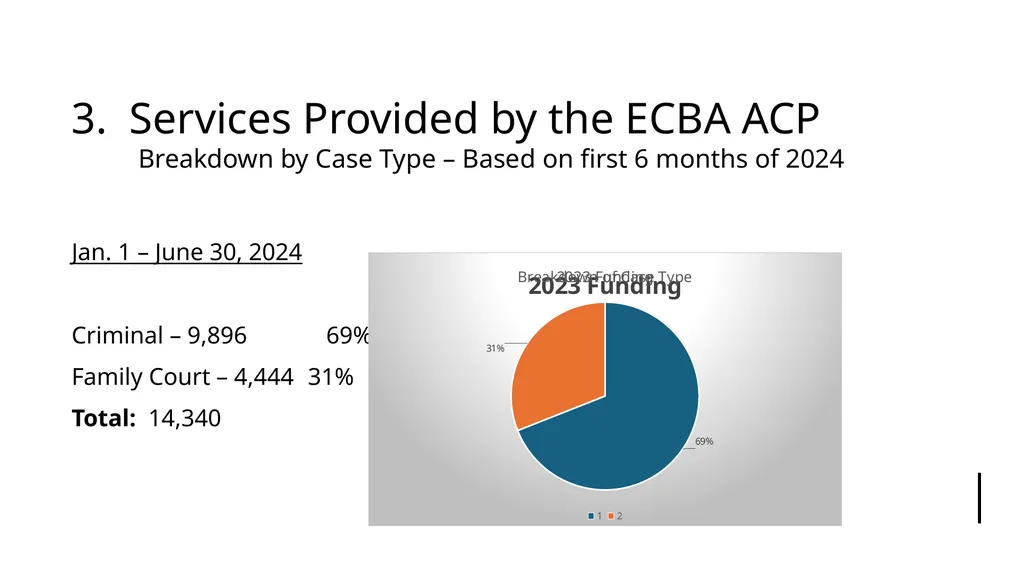
Breakdown by Case Type – Based on first 6 months of 2024 Jan. 1 – June 30, 2024
Criminal – 9,896 69%
Family Court – 4,444 31%
Total: 14,340<br>
Criminal – 9,896 69%
Family Court – 4,444 31%
Total: 14,340<br>
13
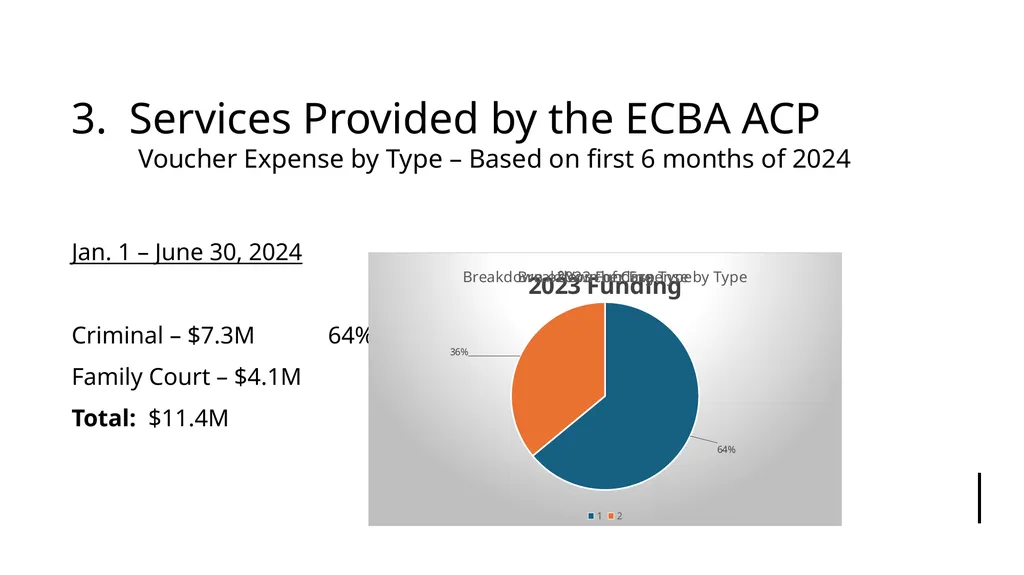
3. Services Provided by the ECBA ACP
Voucher Expense by Type – Based on first 6 months of 2024 Jan. 1 – June 30, 2024
Criminal – $7.3M 64%
Family Court – $4.1M 36%
Total: $11.4M<br>
Criminal – $7.3M 64%
Family Court – $4.1M 36%
Total: $11.4M<br>
14
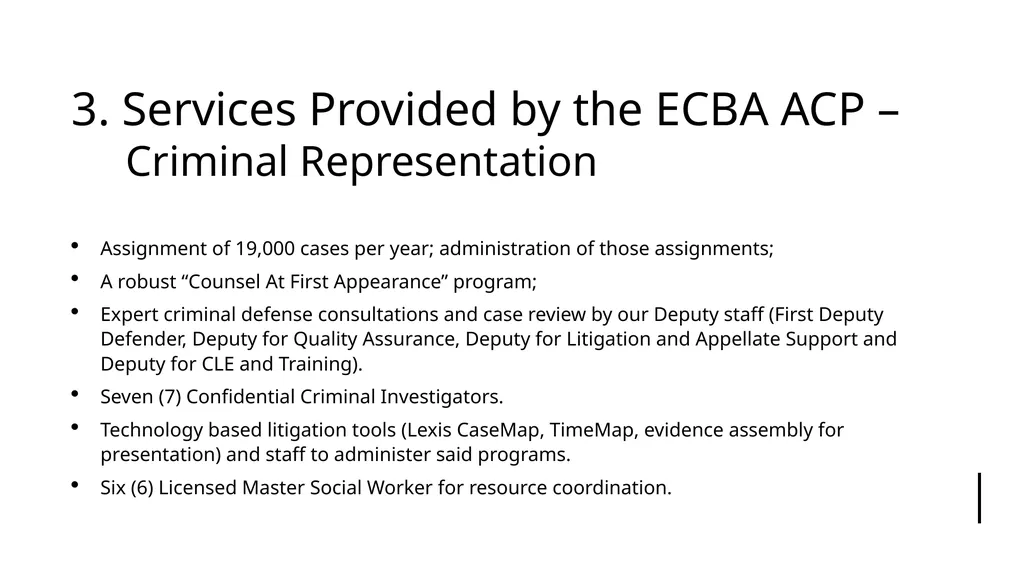
3. Services Provided by the ECBA ACP –
Criminal Representation Assignment of 19,000 cases per year; administration of those assignments;
A robust “Counsel At First Appearance” program;
Expert criminal defense consultations and case review by our Deputy staff (First Deputy Defender, Deputy for Quality Assurance, Deputy for Litigation and Appellate Support and Deputy for CLE and Training).
Seven (7) Confidential Criminal Investigators.
Technology based litigation tools (Lexis CaseMap, TimeMap, evidence assembly for presentation) and staff to administer said programs.
Six (6) Licensed Master Social Worker for resource coordination.<br>
A robust “Counsel At First Appearance” program;
Expert criminal defense consultations and case review by our Deputy staff (First Deputy Defender, Deputy for Quality Assurance, Deputy for Litigation and Appellate Support and Deputy for CLE and Training).
Seven (7) Confidential Criminal Investigators.
Technology based litigation tools (Lexis CaseMap, TimeMap, evidence assembly for presentation) and staff to administer said programs.
Six (6) Licensed Master Social Worker for resource coordination.<br>
15
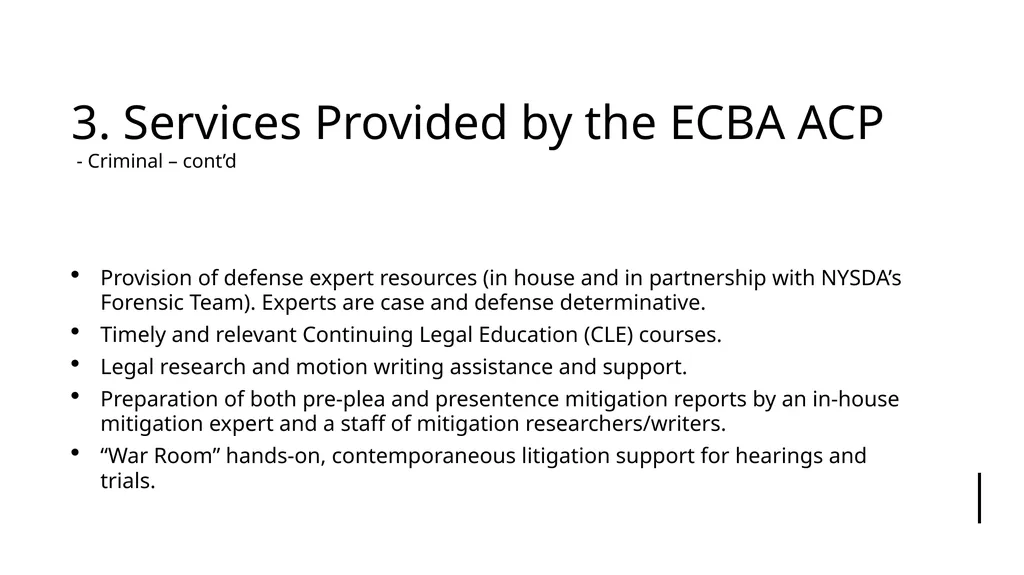
3. Services Provided by the ECBA ACP
- Criminal – cont’d Provision of defense expert resources (in house and in partnership with NYSDA’s Forensic Team). Experts are case and defense determinative.
Timely and relevant Continuing Legal Education (CLE) courses.
Legal research and motion writing assistance and support.
Preparation of both pre-plea and presentence mitigation reports by an in-house mitigation expert and a staff of mitigation researchers/writers.
“War Room” hands-on, contemporaneous litigation support for hearings and trials.<br>
Timely and relevant Continuing Legal Education (CLE) courses.
Legal research and motion writing assistance and support.
Preparation of both pre-plea and presentence mitigation reports by an in-house mitigation expert and a staff of mitigation researchers/writers.
“War Room” hands-on, contemporaneous litigation support for hearings and trials.<br>
16
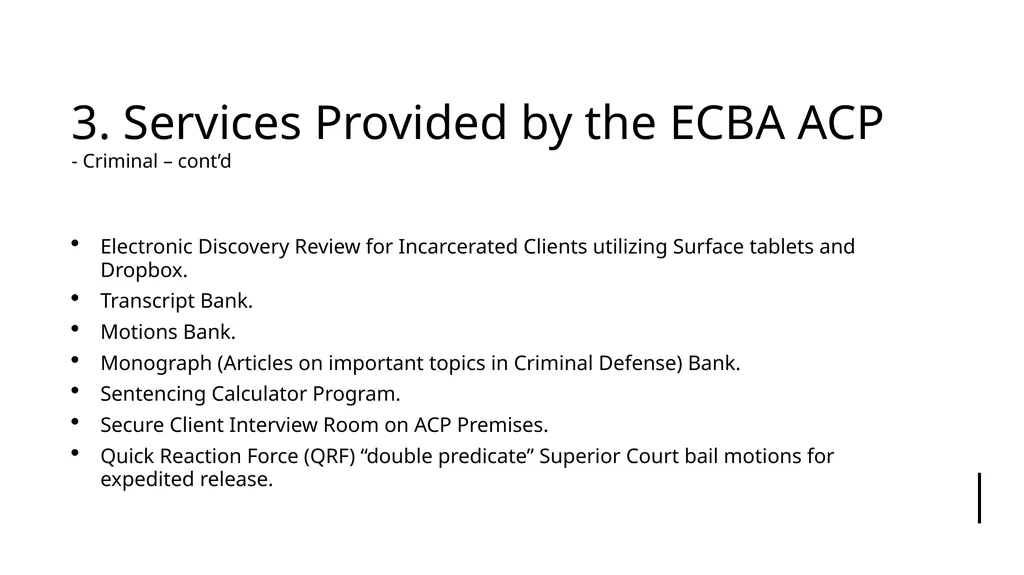
3. Services Provided by the ECBA ACP
- Criminal – cont’d Electronic Discovery Review for Incarcerated Clients utilizing Surface tablets and Dropbox.
Transcript Bank.
Motions Bank.
Monograph (Articles on important topics in Criminal Defense) Bank.
Sentencing Calculator Program.
Secure Client Interview Room on ACP Premises.
Quick Reaction Force (QRF) “double predicate” Superior Court bail motions for expedited release.<br>
Transcript Bank.
Motions Bank.
Monograph (Articles on important topics in Criminal Defense) Bank.
Sentencing Calculator Program.
Secure Client Interview Room on ACP Premises.
Quick Reaction Force (QRF) “double predicate” Superior Court bail motions for expedited release.<br>
17
3. Services Provided by the ECBA ACP
- Criminal – cont’d “One on one” mentorship for less experienced attorneys.
Felony “one on one” mentorship for recently elevated felony attorneys.
Subject matter expert “Mentors at Large” on Homicide, DWI, Parole, DVSJA, High Level Felonies, and High-Profile Cases.<br>
Felony “one on one” mentorship for recently elevated felony attorneys.
Subject matter expert “Mentors at Large” on Homicide, DWI, Parole, DVSJA, High Level Felonies, and High-Profile Cases.<br>
18
3. Services Provided by the ECBA ACP –
Family Court Assignment of 9,000 cases per year; administration of those assignments;
A robust “Counsel At First Appearance” program for Article 10 (abuse/neglect);
Expert Family Court consultations and case review by the Second Deputy – Family Court and the Deputy for Child Welfare.
Access to contract investigators.
One FT and one half-time (shared with the Criminal Division) Licensed Master Social Workers for resource coordination.<br>
A robust “Counsel At First Appearance” program for Article 10 (abuse/neglect);
Expert Family Court consultations and case review by the Second Deputy – Family Court and the Deputy for Child Welfare.
Access to contract investigators.
One FT and one half-time (shared with the Criminal Division) Licensed Master Social Workers for resource coordination.<br>
19
3. Services Provided by the ECBA ACP
- Family Court – cont’d Provision of defense expert resources.
Timely and relevant Continuing Legal Education (CLE) courses.
Legal research and motion writing assistance and support.
Contemporaneous litigation support for hearings and trials.<br>
Timely and relevant Continuing Legal Education (CLE) courses.
Legal research and motion writing assistance and support.
Contemporaneous litigation support for hearings and trials.<br>
20
4. How We Ensure High Quality Representation - Criminal – New Panel Attorneys ACP panel participation is not guaranteed. Attorneys must meet stringent requirements and perform with excellence to gain entry to, and remain in good standing with, ACP. ACP attorneys are separated into panels based upon demonstrated experience.
Panelists are divided into Misdemeanor, C,D,E Felony, Violent Felony, Homicide and Specialty Panels (Parole, DWI, IDV, Appeals, DVSJA) based upon their knowledge and demonstrated acumen. Attorneys may not be assigned cases above their panel standing. Movement between panels is closely monitored and no attorney may be elevated without review and permission of Criminal Division management.<br>
Panelists are divided into Misdemeanor, C,D,E Felony, Violent Felony, Homicide and Specialty Panels (Parole, DWI, IDV, Appeals, DVSJA) based upon their knowledge and demonstrated acumen. Attorneys may not be assigned cases above their panel standing. Movement between panels is closely monitored and no attorney may be elevated without review and permission of Criminal Division management.<br>
21
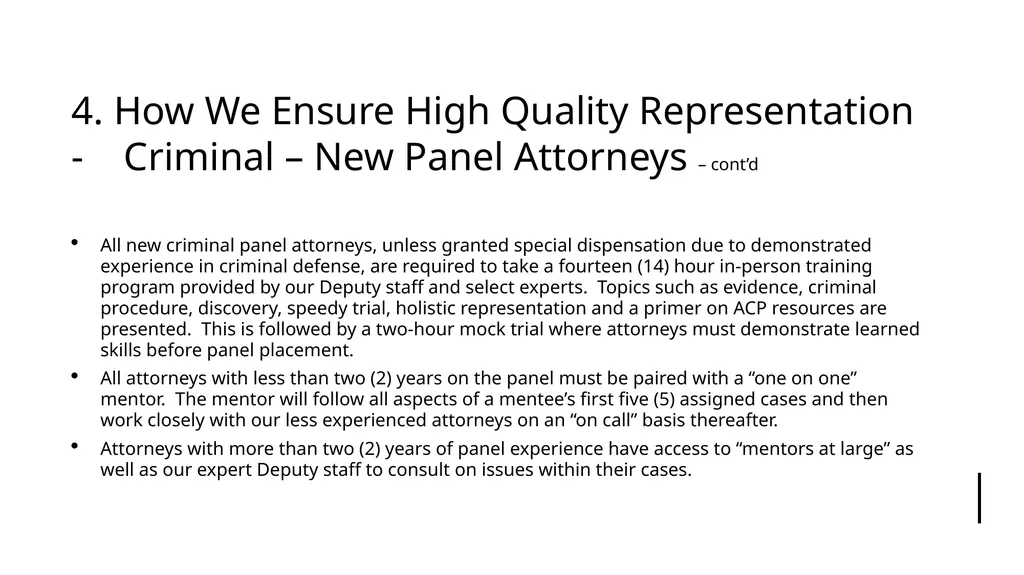
4. How We Ensure High Quality Representation - Criminal – New Panel Attorneys – cont’d All new criminal panel attorneys, unless granted special dispensation due to demonstrated experience in criminal defense, are required to take a fourteen (14) hour in-person training program provided by our Deputy staff and select experts. Topics such as evidence, criminal procedure, discovery, speedy trial, holistic representation and a primer on ACP resources are presented. This is followed by a two-hour mock trial where attorneys must demonstrate learned skills before panel placement.
All attorneys with less than two (2) years on the panel must be paired with a “one on one” mentor. The mentor will follow all aspects of a mentee’s first five (5) assigned cases and then work closely with our less experienced attorneys on an “on call” basis thereafter.
Attorneys with more than two (2) years of panel experience have access to “mentors at large” as well as our expert Deputy staff to consult on issues within their cases.<br>
All attorneys with less than two (2) years on the panel must be paired with a “one on one” mentor. The mentor will follow all aspects of a mentee’s first five (5) assigned cases and then work closely with our less experienced attorneys on an “on call” basis thereafter.
Attorneys with more than two (2) years of panel experience have access to “mentors at large” as well as our expert Deputy staff to consult on issues within their cases.<br>
22
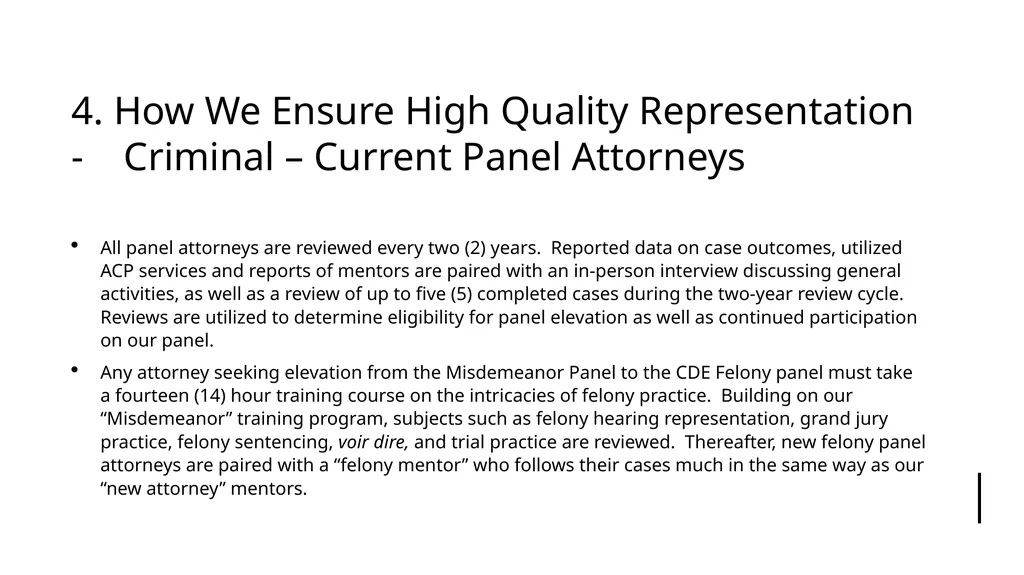
4. How We Ensure High Quality Representation - Criminal – Current Panel Attorneys All panel attorneys are reviewed every two (2) years. Reported data on case outcomes, utilized ACP services and reports of mentors are paired with an in-person interview discussing general activities, as well as a review of up to five (5) completed cases during the two-year review cycle. Reviews are utilized to determine eligibility for panel elevation as well as continued participation on our panel.
Any attorney seeking elevation from the Misdemeanor Panel to the CDE Felony panel must take a fourteen (14) hour training course on the intricacies of felony practice. Building on our “Misdemeanor” training program, subjects such as felony hearing representation, grand jury practice, felony sentencing, voir dire, and trial practice are reviewed. Thereafter, new felony panel attorneys are paired with a “felony mentor” who follows their cases much in the same way as our “new attorney” mentors.<br>
Any attorney seeking elevation from the Misdemeanor Panel to the CDE Felony panel must take a fourteen (14) hour training course on the intricacies of felony practice. Building on our “Misdemeanor” training program, subjects such as felony hearing representation, grand jury practice, felony sentencing, voir dire, and trial practice are reviewed. Thereafter, new felony panel attorneys are paired with a “felony mentor” who follows their cases much in the same way as our “new attorney” mentors.<br>
23
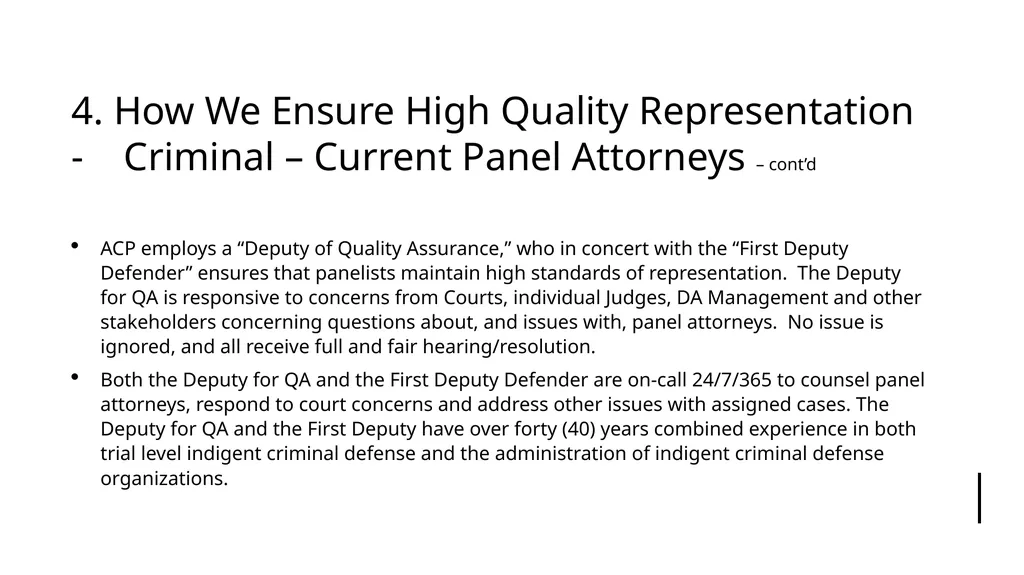
4. How We Ensure High Quality Representation - Criminal – Current Panel Attorneys – cont’d ACP employs a “Deputy of Quality Assurance,” who in concert with the “First Deputy Defender” ensures that panelists maintain high standards of representation. The Deputy for QA is responsive to concerns from Courts, individual Judges, DA Management and other stakeholders concerning questions about, and issues with, panel attorneys. No issue is ignored, and all receive full and fair hearing/resolution.
Both the Deputy for QA and the First Deputy Defender are on-call 24/7/365 to counsel panel attorneys, respond to court concerns and address other issues with assigned cases. The Deputy for QA and the First Deputy have over forty (40) years combined experience in both trial level indigent criminal defense and the administration of indigent criminal defense organizations.<br>
Both the Deputy for QA and the First Deputy Defender are on-call 24/7/365 to counsel panel attorneys, respond to court concerns and address other issues with assigned cases. The Deputy for QA and the First Deputy have over forty (40) years combined experience in both trial level indigent criminal defense and the administration of indigent criminal defense organizations.<br>
24
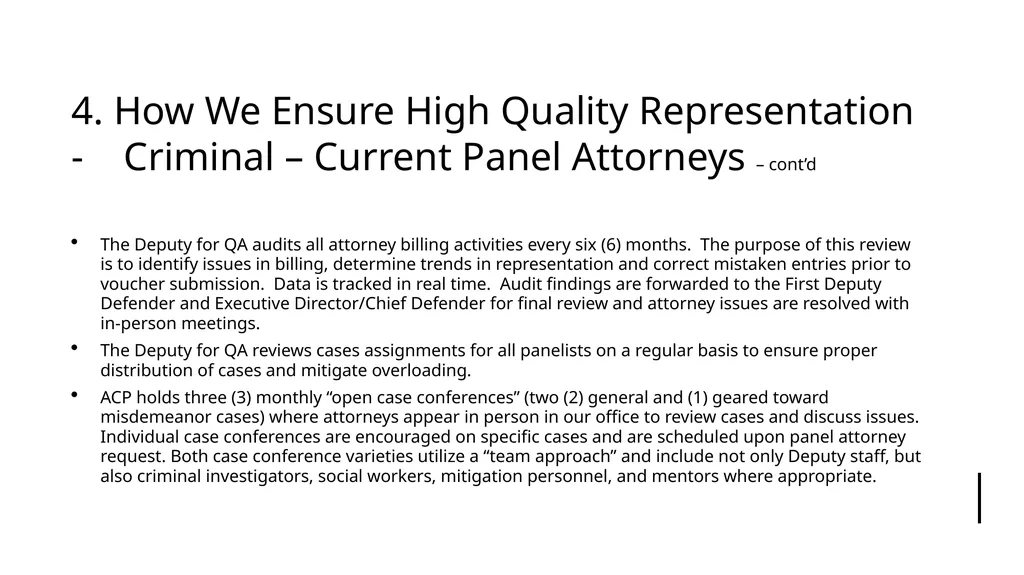
4. How We Ensure High Quality Representation - Criminal – Current Panel Attorneys – cont’d The Deputy for QA audits all attorney billing activities every six (6) months. The purpose of this review is to identify issues in billing, determine trends in representation and correct mistaken entries prior to voucher submission. Data is tracked in real time. Audit findings are forwarded to the First Deputy Defender and Executive Director/Chief Defender for final review and attorney issues are resolved with in-person meetings.
The Deputy for QA reviews cases assignments for all panelists on a regular basis to ensure proper distribution of cases and mitigate overloading.
ACP holds three (3) monthly “open case conferences” (two (2) general and (1) geared toward misdemeanor cases) where attorneys appear in person in our office to review cases and discuss issues. Individual case conferences are encouraged on specific cases and are scheduled upon panel attorney request. Both case conference varieties utilize a “team approach” and include not only Deputy staff, but also criminal investigators, social workers, mitigation personnel, and mentors where appropriate.<br>
The Deputy for QA reviews cases assignments for all panelists on a regular basis to ensure proper distribution of cases and mitigate overloading.
ACP holds three (3) monthly “open case conferences” (two (2) general and (1) geared toward misdemeanor cases) where attorneys appear in person in our office to review cases and discuss issues. Individual case conferences are encouraged on specific cases and are scheduled upon panel attorney request. Both case conference varieties utilize a “team approach” and include not only Deputy staff, but also criminal investigators, social workers, mitigation personnel, and mentors where appropriate.<br>
25
4. How We Ensure High Quality Representation - Criminal – Current Panel Attorneys – cont’d ACP provides high quality Continuing Legal Education courses which address not only timely updates in criminal jurisprudence, but also core skills required for expert practitioners.
One such example was our three (3) day “DWI Micro Institute Program” held in January 2024. This intensive program was required for admission to our specialty DWI Defense Panel and included twenty-four (24) hours of lectures and hands on workshops by nationally renowned DWI expert Steven Epstein.
More than one hundred (100) panelists participated and were certified as ACP DWI Defense Panelists.
DWI Panelists will be required to re-take this program every three (3) years to remain current with our DWI Defense Panel.<br>
One such example was our three (3) day “DWI Micro Institute Program” held in January 2024. This intensive program was required for admission to our specialty DWI Defense Panel and included twenty-four (24) hours of lectures and hands on workshops by nationally renowned DWI expert Steven Epstein.
More than one hundred (100) panelists participated and were certified as ACP DWI Defense Panelists.
DWI Panelists will be required to re-take this program every three (3) years to remain current with our DWI Defense Panel.<br>
26
4. How We Ensure High Quality Representation - Criminal – Activities Related to Case Work The majority of ACP assigned cases are provided 100% vertical representation. The attorney assigned to the case in the first instance represents the client from arraignment to case conclusion. This is accomplished through our “pre-arraignment” assignment program.
Those clients who are arraigned either by “Attorneys of the Day” or “Attorneys on Call” are assigned on an expedited basis and are in contact with counsel shortly following their first appearance. Thereafter, the assigned attorney represents the client to disposition.<br>
Those clients who are arraigned either by “Attorneys of the Day” or “Attorneys on Call” are assigned on an expedited basis and are in contact with counsel shortly following their first appearance. Thereafter, the assigned attorney represents the client to disposition.<br>
27
4. How We Ensure High Quality Representation - Criminal – Activities Related to Case Work – cont’d All Homicide cases are immediately assigned a “co-counsel” following assignment. All assigned violent felonies are offered “co-counsel” and many receive same.
ACP provides a “Second Chair” program for less experienced attorneys to gain experience working on higher level cases with more experienced practitioners. These assignments are “cost limited” and are required before movement from the Misdemeanor Panel to the Felony Panel.
All Violent felonies are assigned a criminal investigator as soon as assignment is made. Homicide attorneys are required to speak with the assigned criminal investigator within twenty-four (24) hours of assignment to ensure timely evidence gathering/preservation. A case conference with the assigned attorneys, Deputy staff, Homicide “mentor at large” and the Investigative staff is required within thirty (30) days of assignment.<br>
ACP provides a “Second Chair” program for less experienced attorneys to gain experience working on higher level cases with more experienced practitioners. These assignments are “cost limited” and are required before movement from the Misdemeanor Panel to the Felony Panel.
All Violent felonies are assigned a criminal investigator as soon as assignment is made. Homicide attorneys are required to speak with the assigned criminal investigator within twenty-four (24) hours of assignment to ensure timely evidence gathering/preservation. A case conference with the assigned attorneys, Deputy staff, Homicide “mentor at large” and the Investigative staff is required within thirty (30) days of assignment.<br>
28
4. How We Ensure High Quality Representation - Criminal – Activities Related to Case Work – cont’d Use of the “War Room” for hands-on, intensive litigation support during felony trials is strongly encouraged and highly utilized. ACP employs both a Deputy for Litigation and Appellate Support and a Deputy for CLE and Training who work in concert with the Criminal Investigators and their support team to provide expedited support during hearings/trials.
ACP Criminal Division Deputy staff are expert practitioners from both the defense and prosecution side. They maintain membership (and leadership positions) in statewide criminal defense organizations (New York State Defenders Association, Chief Defenders Association of New York, New York State Association of Criminal Defense Lawyers). They remain up to date on the latest trends in criminal defense and advocate for structural changes in the criminal legal system in concert with the organizations above.<br>
ACP Criminal Division Deputy staff are expert practitioners from both the defense and prosecution side. They maintain membership (and leadership positions) in statewide criminal defense organizations (New York State Defenders Association, Chief Defenders Association of New York, New York State Association of Criminal Defense Lawyers). They remain up to date on the latest trends in criminal defense and advocate for structural changes in the criminal legal system in concert with the organizations above.<br>
29
4. How We Ensure High Quality Representation - Criminal – Activities Related to Case Work – cont’d ACP maintains a robust “Counsel at First Appearance” program which ensures that all clients are represented at arraignment proceedings. This program is utilized for those cases which were not assigned “pre-arraignment” and consists of:
“Attorneys of the Day” in twenty-three (23) large municipal Courts. Attorneys are present during regular court appearances.
“Attorneys on Call” for regular court appearances in thirteen (13) smaller municipal courts for regular court appearances and for “off hours” coverages in ALL courts. “Off Hours” arraignments are divided into seven (7) geographic regions (including after-hours Adolescent Offender Arraignments at BPD HQ) and coverage is provided 24/7/365.
Youth Part Daily “Attorneys on Call” handle daily appearances in Youth Part (Erie County Family Court.)
Superior Court “Attorneys of the Day” are present in Criminal Special Term to handle fugitive matters, warrant returns and arraignments on sealed indictment matters.<br>
“Attorneys of the Day” in twenty-three (23) large municipal Courts. Attorneys are present during regular court appearances.
“Attorneys on Call” for regular court appearances in thirteen (13) smaller municipal courts for regular court appearances and for “off hours” coverages in ALL courts. “Off Hours” arraignments are divided into seven (7) geographic regions (including after-hours Adolescent Offender Arraignments at BPD HQ) and coverage is provided 24/7/365.
Youth Part Daily “Attorneys on Call” handle daily appearances in Youth Part (Erie County Family Court.)
Superior Court “Attorneys of the Day” are present in Criminal Special Term to handle fugitive matters, warrant returns and arraignments on sealed indictment matters.<br>
30
4. How We Ensure High Quality Representation - Criminal – Holistic Representation “Holistic defense reduces the likelihood of a custodial sentence by 16% and expected sentence length by 24%, without increasing future crime.”
Anderson, et al, Holistic Representation: An Innovative Approach to Defending Poor Clients Can Reduce Incarceration and Save Taxpayers Dollars – Without Harm to Public Safety, RAND Corporation (Jan. 11, 2019).<br>
Anderson, et al, Holistic Representation: An Innovative Approach to Defending Poor Clients Can Reduce Incarceration and Save Taxpayers Dollars – Without Harm to Public Safety, RAND Corporation (Jan. 11, 2019).<br>
31
4. How We Ensure High Quality Representation - Criminal – Activities Re: Holistic Representation – cont’d Traditional public defense model: emphasis on criminal representation and courtroom advocacy by a single lawyer
Holistic defense model: defenders must address not only the case at hand but also the enmeshed, or collateral, legal consequences of criminal justice involvement (such as loss of employment, public housing, custody of one's children, and immigration status) and the underlying life circumstances and nonlegal issues that so often play a role in driving clients into the criminal justice system in the first place (such as drug addiction, mental illness, or family or housing instability).
Holistic representation requires an interdisciplinary team that includes not just criminal defense lawyers and related support staff (investigators and paralegals) but also civil, family, and immigration lawyers, as well as social workers and nonlawyer advocates — all working collectively and on an equal footing with each other.
The following slides outline how the ECBA ACP works to achieve this.<br>
Holistic defense model: defenders must address not only the case at hand but also the enmeshed, or collateral, legal consequences of criminal justice involvement (such as loss of employment, public housing, custody of one's children, and immigration status) and the underlying life circumstances and nonlegal issues that so often play a role in driving clients into the criminal justice system in the first place (such as drug addiction, mental illness, or family or housing instability).
Holistic representation requires an interdisciplinary team that includes not just criminal defense lawyers and related support staff (investigators and paralegals) but also civil, family, and immigration lawyers, as well as social workers and nonlawyer advocates — all working collectively and on an equal footing with each other.
The following slides outline how the ECBA ACP works to achieve this.<br>
32
4. How We Ensure High Quality Representation - Criminal – Activities Re: Holistic Representation – cont’d All of these activities are geared toward ensuring that our clients are of the highest priority.
ACP takes significant steps to ensure that each client entrusted to us for assignment receives representation that exceeds industry standards.
We maintain programs that ensure expedited and often pre-arraignment assignment of cases to ensure attorney consultation at the earliest stages; limiting the possibility of evidence spoliation and ensuring the most positive resolutions available.
We are in constant communication with our panelists through regular e-mails, cases conferences, panel alerts and live presentations on important issues.<br>
ACP takes significant steps to ensure that each client entrusted to us for assignment receives representation that exceeds industry standards.
We maintain programs that ensure expedited and often pre-arraignment assignment of cases to ensure attorney consultation at the earliest stages; limiting the possibility of evidence spoliation and ensuring the most positive resolutions available.
We are in constant communication with our panelists through regular e-mails, cases conferences, panel alerts and live presentations on important issues.<br>
33
4. How We Ensure High Quality Representation - Criminal – Activities Re: Holistic Representation – cont’d Panel attorneys utilize our ACP Social Work Program for coordination of resources at the earliest possible stage of their cases. Social workers are available for information gathering, resource location and coordination and support to attorneys/clients with special requirements.
Panel attorneys utilize our Mitigation Supervisor and ACP’s team of mitigation writers to gather information essential to obtaining the best possible disposition.
Panel Attorneys are provided direct access to the Western New York Regional Immigration Assistance Center for case review and advice on cases with non-citizen clients.
Clients are provided opportunities for feedback through a dedicated website link and direct contact with the Deputy for QA. Client concerns relevant to their representation are handled on a priority basis.<br>
Panel attorneys utilize our Mitigation Supervisor and ACP’s team of mitigation writers to gather information essential to obtaining the best possible disposition.
Panel Attorneys are provided direct access to the Western New York Regional Immigration Assistance Center for case review and advice on cases with non-citizen clients.
Clients are provided opportunities for feedback through a dedicated website link and direct contact with the Deputy for QA. Client concerns relevant to their representation are handled on a priority basis.<br>
34
4. How We Ensure High Quality Representation -
Family Court The ACP Family Court Division is a client centered program that strives to provide education, mentorship, resources, and other support to our panel so that the panel can provide outstanding representation to our indigent clients.
Training
Annual, multi-part training class that cover all aspects of family law practice including in-depth training on the substantive areas of law for FCA Articles 4, 5, 6, 8 and 10.
Case Conferences
There is a monthly virtual case conference session where attorneys drop in to discuss issues with their cases, ask questions, and share their experiences.<br>
Training
Annual, multi-part training class that cover all aspects of family law practice including in-depth training on the substantive areas of law for FCA Articles 4, 5, 6, 8 and 10.
Case Conferences
There is a monthly virtual case conference session where attorneys drop in to discuss issues with their cases, ask questions, and share their experiences.<br>
35
4. How We Ensure High Quality Representation -
Family Court – cont’d Mentorship
No attorney is allowed to automatically join our panel. Upon application and training an attorney is assigned a mentor and a small number of cases.
The least experienced attorney starts with custody/visitation matters (Art 6); working with their mentor on every aspect of the case from the client interview to the ultimate resolution.
Over time, they attorney is exposed to the remaining types of Family Court cases (Article 4, 5 & 8).
When the mentor is comfortable with the fact that the trainee is sufficiently prepared to work on their own, upon consultation with the Second Deputy the trainee is released and joins the panel. The process generally takes approximately 18 months.
After a trainee has been released and a significant time has passed the trainee may be invited or may apply to do Article 10 work. If a trainee is accepted to the Article 10 panel they are monitored by the Second Deputy or the Deputy for Child Welfare in a manner like that of the original training.<br>
No attorney is allowed to automatically join our panel. Upon application and training an attorney is assigned a mentor and a small number of cases.
The least experienced attorney starts with custody/visitation matters (Art 6); working with their mentor on every aspect of the case from the client interview to the ultimate resolution.
Over time, they attorney is exposed to the remaining types of Family Court cases (Article 4, 5 & 8).
When the mentor is comfortable with the fact that the trainee is sufficiently prepared to work on their own, upon consultation with the Second Deputy the trainee is released and joins the panel. The process generally takes approximately 18 months.
After a trainee has been released and a significant time has passed the trainee may be invited or may apply to do Article 10 work. If a trainee is accepted to the Article 10 panel they are monitored by the Second Deputy or the Deputy for Child Welfare in a manner like that of the original training.<br>
36
4. How We Ensure High Quality Representation -
Family Court – cont’d CLE
These cover a myriad of topics including appellate work, evidence issues, and case updates.
Case updates are presented quarterly and encompass highlights from all four appellate decisions for the quarter.
Networking
The Second Deputy and the Deputy for Child Welfare remain in continuous contact with the Judges, confidential law clerks, court attorney referees, and support magistrates. This allows us to maintain a positive relationship with the judiciary as well as determine if there are issues with any attorneys that need to be addressed.
They also represent ACP on the Court Improvement Project Committee, the Bar Association Practice & Procedure Committee, as well as the ILS Family Court Standards Committee.<br>
These cover a myriad of topics including appellate work, evidence issues, and case updates.
Case updates are presented quarterly and encompass highlights from all four appellate decisions for the quarter.
Networking
The Second Deputy and the Deputy for Child Welfare remain in continuous contact with the Judges, confidential law clerks, court attorney referees, and support magistrates. This allows us to maintain a positive relationship with the judiciary as well as determine if there are issues with any attorneys that need to be addressed.
They also represent ACP on the Court Improvement Project Committee, the Bar Association Practice & Procedure Committee, as well as the ILS Family Court Standards Committee.<br>
37
4. How We Ensure High Quality Representation -
Family Court – cont’d Panel Review
Each year there is a review of one-third of the entire Family Court panel.
This process depends on interviews with judges, attorneys, and confidential law clerks about the panel member. And a random selection for case review.
Multi-Disciplinary Practice
There are two Family Court social workers who work with our panel members in a multi-disciplinary fashion to support the client in a holistic fashion that extends beyond the legal issues which have brought them into the system.
We provide contract investigators and other experts to aid the practitioner in building their case to provide the best representation possible for our indigent clients.<br>
Each year there is a review of one-third of the entire Family Court panel.
This process depends on interviews with judges, attorneys, and confidential law clerks about the panel member. And a random selection for case review.
Multi-Disciplinary Practice
There are two Family Court social workers who work with our panel members in a multi-disciplinary fashion to support the client in a holistic fashion that extends beyond the legal issues which have brought them into the system.
We provide contract investigators and other experts to aid the practitioner in building their case to provide the best representation possible for our indigent clients.<br>
38
4. How We Ensure High Quality Representation -
Family Court – cont’d Complaints
All client complaints receive individualized attention. Each complaint is investigated and where appropriate action is taken including the re-assignment of a matter.
Article 10 Pre-Petition Practice
The Redlich Horowitz Fund grant has given us the resources to intervene at the investigatory stage of an abuse/neglect matter. This process has allowed us to represent people before court intervention even occurs. Even though the program is relatively new, we have managed to keep over sixty families intact and out of the court system. We anticipate that this program will continue to grow and yield even more impressive results.<br>
All client complaints receive individualized attention. Each complaint is investigated and where appropriate action is taken including the re-assignment of a matter.
Article 10 Pre-Petition Practice
The Redlich Horowitz Fund grant has given us the resources to intervene at the investigatory stage of an abuse/neglect matter. This process has allowed us to represent people before court intervention even occurs. Even though the program is relatively new, we have managed to keep over sixty families intact and out of the court system. We anticipate that this program will continue to grow and yield even more impressive results.<br>
39
4. How We Ensure High Quality Representation -
Family Court – cont’d Article 10 AOD Program
There is a daily AOD program whereby 2 attorneys are available to represent any Art 10 clients who come into court for arraignment. There is no person in Erie County accused of abuse and/or neglect who comes to court and is unrepresented from the outset of the case. This innovation was a game changer for clients who previously came to court facing the possible immediate removal of their children without the benefit of counsel.
We have recently made this process even more client friendly in that we have forged a working agreement with DSS whereby we are notified immediately by DSS that a Petition is being filed. Additionally, they are providing us with contact information for the client so that we can have access to the client before a court session. This gives the attorney a chance to be better prepared to effectively represent the client at the initial appearance where removal of children from the home is a possibility.<br>
There is a daily AOD program whereby 2 attorneys are available to represent any Art 10 clients who come into court for arraignment. There is no person in Erie County accused of abuse and/or neglect who comes to court and is unrepresented from the outset of the case. This innovation was a game changer for clients who previously came to court facing the possible immediate removal of their children without the benefit of counsel.
We have recently made this process even more client friendly in that we have forged a working agreement with DSS whereby we are notified immediately by DSS that a Petition is being filed. Additionally, they are providing us with contact information for the client so that we can have access to the client before a court session. This gives the attorney a chance to be better prepared to effectively represent the client at the initial appearance where removal of children from the home is a possibility.<br>
40
5. The Cost of the Program:
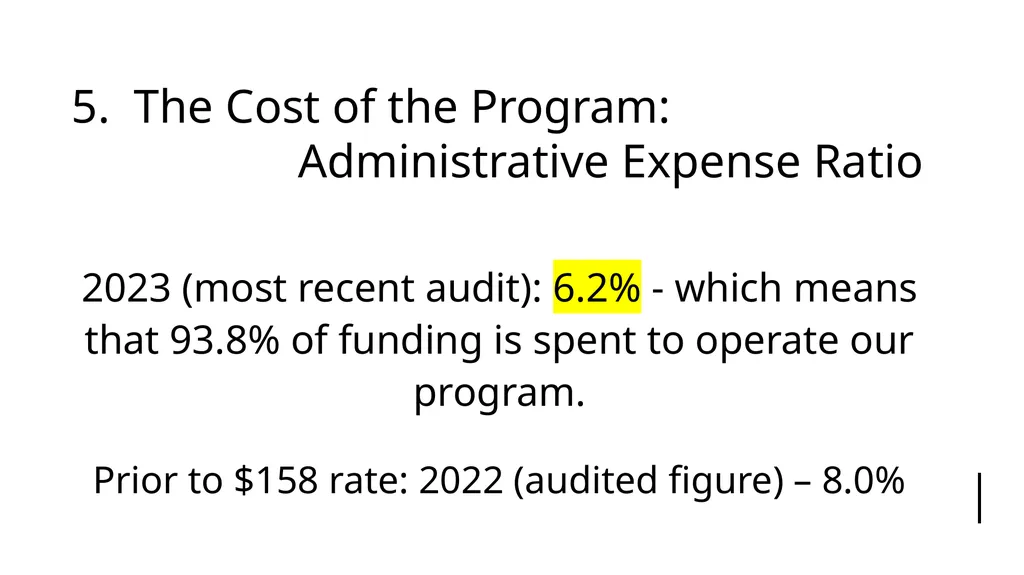
Administrative Expense Ratio 2023 (most recent audit): 6.2% - which means that 93.8% of funding is spent to operate our program.
Prior to $158 rate: 2022 (audited figure) – 8.0%<br>
Prior to $158 rate: 2022 (audited figure) – 8.0%<br>
41
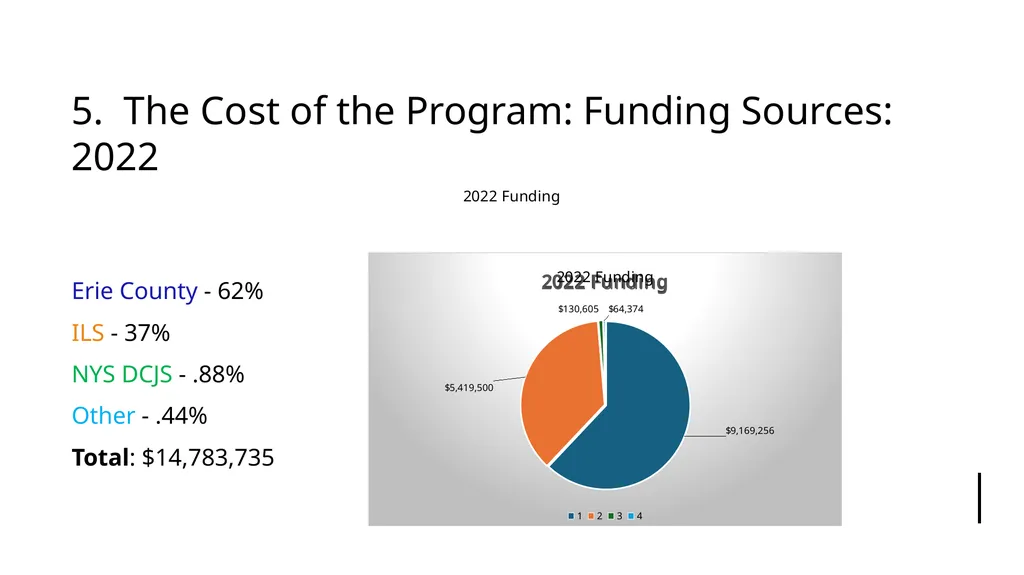
5. The Cost of the Program: Funding Sources: 2022 Erie County - 62%
ILS - 37%
NYS DCJS - .88%
Other - .44%
Total: $14,783,735<br>
ILS - 37%
NYS DCJS - .88%
Other - .44%
Total: $14,783,735<br>
42
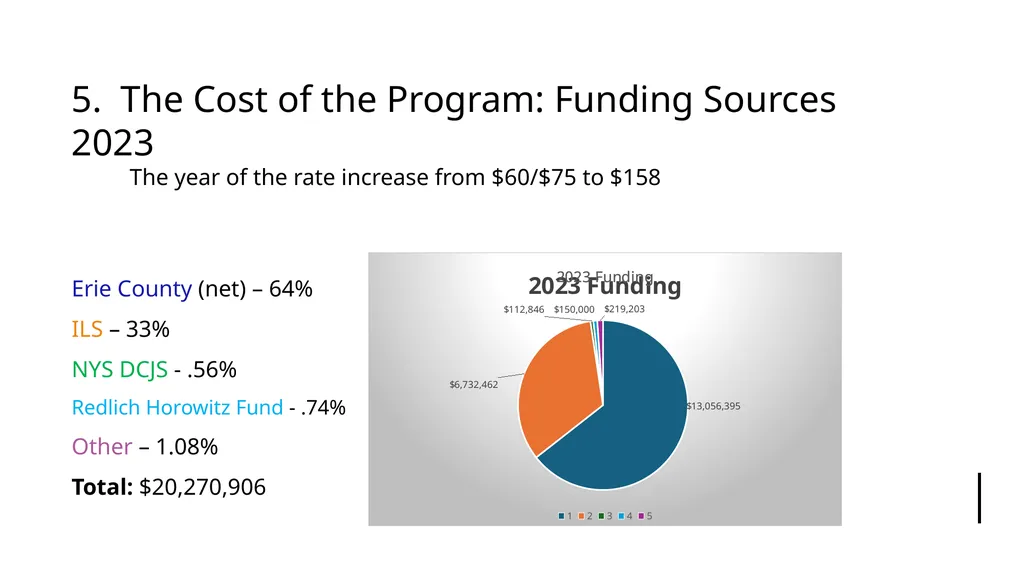
5. The Cost of the Program: Funding Sources 2023
The year of the rate increase from $60/$75 to $158 Erie County (net) – 64%
ILS – 33%
NYS DCJS - .56%
Redlich Horowitz Fund - .74%
Other – 1.08%
Total: $20,270,906<br>
ILS – 33%
NYS DCJS - .56%
Redlich Horowitz Fund - .74%
Other – 1.08%
Total: $20,270,906<br>
43
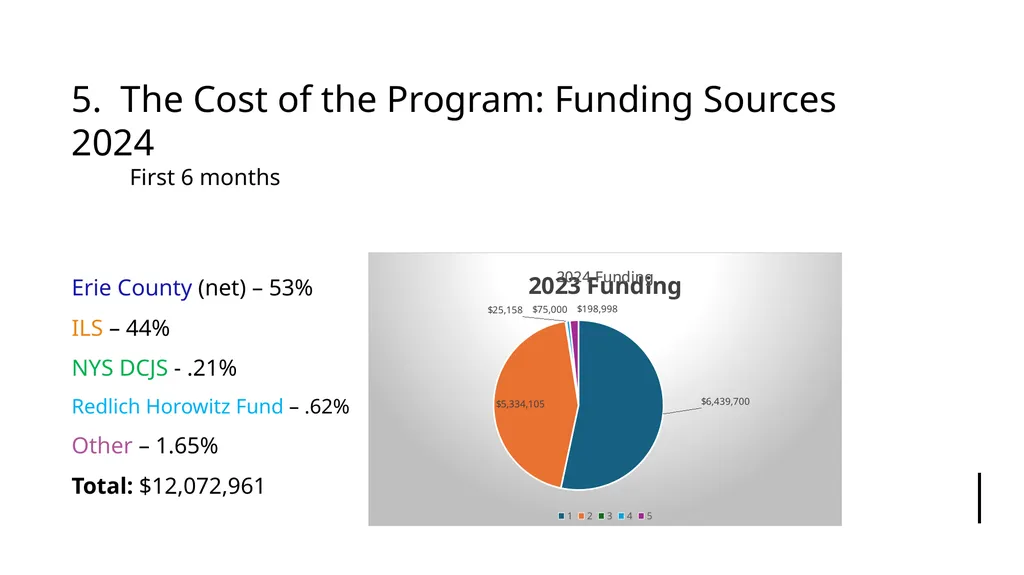
5. The Cost of the Program: Funding Sources 2024
First 6 months Erie County (net) – 53%
ILS – 44%
NYS DCJS - .21%
Redlich Horowitz Fund – .62%
Other – 1.65%
Total: $12,072,961<br>
ILS – 44%
NYS DCJS - .21%
Redlich Horowitz Fund – .62%
Other – 1.65%
Total: $12,072,961<br>
44
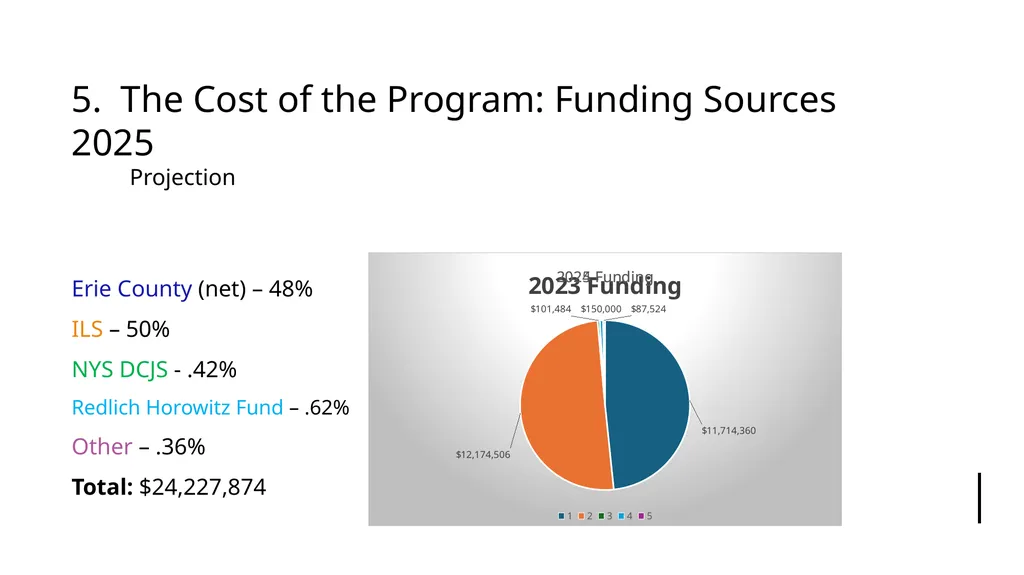
5. The Cost of the Program: Funding Sources 2025
Projection Erie County (net) – 48%
ILS – 50%
NYS DCJS - .42%
Redlich Horowitz Fund – .62%
Other – .36%
Total: $24,227,874<br>
ILS – 50%
NYS DCJS - .42%
Redlich Horowitz Fund – .62%
Other – .36%
Total: $24,227,874<br>
45
6. ILS Support to ACPs for Increased Voucher Costs The cost of the Program keeps track with inflation, so there is a slight increase each year.
How can there be an increase, yet the County’s portion of spending decreases?
Because the ECBA ACP takes full advantage of the ILS funding line for “Increased Voucher Costs.”<br>
How can there be an increase, yet the County’s portion of spending decreases?
Because the ECBA ACP takes full advantage of the ILS funding line for “Increased Voucher Costs.”<br>
46
6. ILS Support to ACPs for Increased Voucher Costs Improving the quality of ACP criminal representation pursuant to the Hurrell-Haring stipulated settlement included ensuring that panel attorneys have reasonable caseloads.
ILS’ plan to the NYS Division of Budget included budgeting for the increase in ACP attorney vouchers associated with more time and improved quality representation. We have encouraged the panel attorney to spend more time on their cases, utilizing the ACP resources and support.
As per state law, the funds are to supplement, not supplant county funding. To account for this, a reference point of county funding was developed starting in 2015. There is a complex formula that takes the reference point into account to ensure that ILS funding for increased voucher costs supplements, and does not supplant, Erie County funding for the cost of attorney vouchers.<br>
ILS’ plan to the NYS Division of Budget included budgeting for the increase in ACP attorney vouchers associated with more time and improved quality representation. We have encouraged the panel attorney to spend more time on their cases, utilizing the ACP resources and support.
As per state law, the funds are to supplement, not supplant county funding. To account for this, a reference point of county funding was developed starting in 2015. There is a complex formula that takes the reference point into account to ensure that ILS funding for increased voucher costs supplements, and does not supplant, Erie County funding for the cost of attorney vouchers.<br>
47
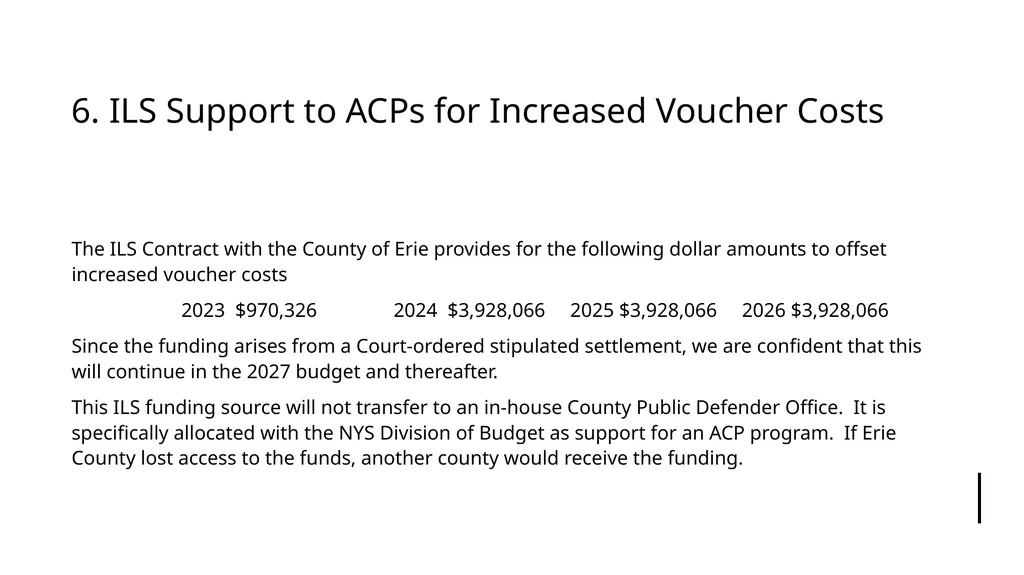
6. ILS Support to ACPs for Increased Voucher Costs The ILS Contract with the County of Erie provides for the following dollar amounts to offset increased voucher costs
2023 $970,326 2024 $3,928,066 2025 $3,928,066 2026 $3,928,066
Since the funding arises from a Court-ordered stipulated settlement, we are confident that this will continue in the 2027 budget and thereafter.
This ILS funding source will not transfer to an in-house County Public Defender Office. It is specifically allocated with the NYS Division of Budget as support for an ACP program. If Erie County lost access to the funds, another county would receive the funding.<br>
2023 $970,326 2024 $3,928,066 2025 $3,928,066 2026 $3,928,066
Since the funding arises from a Court-ordered stipulated settlement, we are confident that this will continue in the 2027 budget and thereafter.
This ILS funding source will not transfer to an in-house County Public Defender Office. It is specifically allocated with the NYS Division of Budget as support for an ACP program. If Erie County lost access to the funds, another county would receive the funding.<br>
48
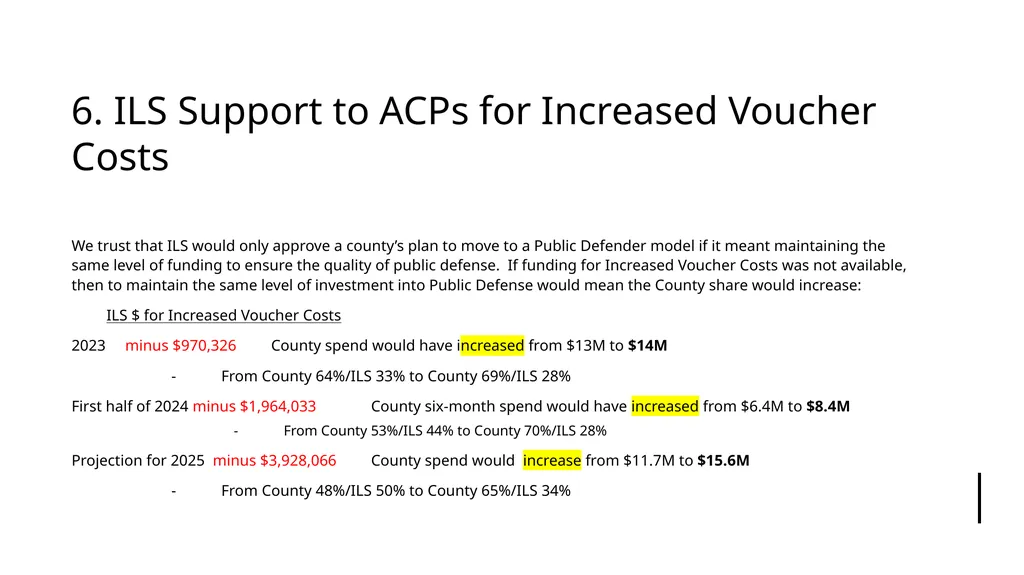
6. ILS Support to ACPs for Increased Voucher Costs We trust that ILS would only approve a county’s plan to move to a Public Defender model if it meant maintaining the same level of funding to ensure the quality of public defense. If funding for Increased Voucher Costs was not available, then to maintain the same level of investment into Public Defense would mean the County share would increase:
ILS $ for Increased Voucher Costs
2023 minus $970,326 County spend would have increased from $13M to $14M
- From County 64%/ILS 33% to County 69%/ILS 28%
First half of 2024 minus $1,964,033 County six-month spend would have increased from $6.4M to $8.4M
- From County 53%/ILS 44% to County 70%/ILS 28%
Projection for 2025 minus $3,928,066 County spend would increase from $11.7M to $15.6M
- From County 48%/ILS 50% to County 65%/ILS 34%<br>
ILS $ for Increased Voucher Costs
2023 minus $970,326 County spend would have increased from $13M to $14M
- From County 64%/ILS 33% to County 69%/ILS 28%
First half of 2024 minus $1,964,033 County six-month spend would have increased from $6.4M to $8.4M
- From County 53%/ILS 44% to County 70%/ILS 28%
Projection for 2025 minus $3,928,066 County spend would increase from $11.7M to $15.6M
- From County 48%/ILS 50% to County 65%/ILS 34%<br>
49
7. Trends in Erie County Spending
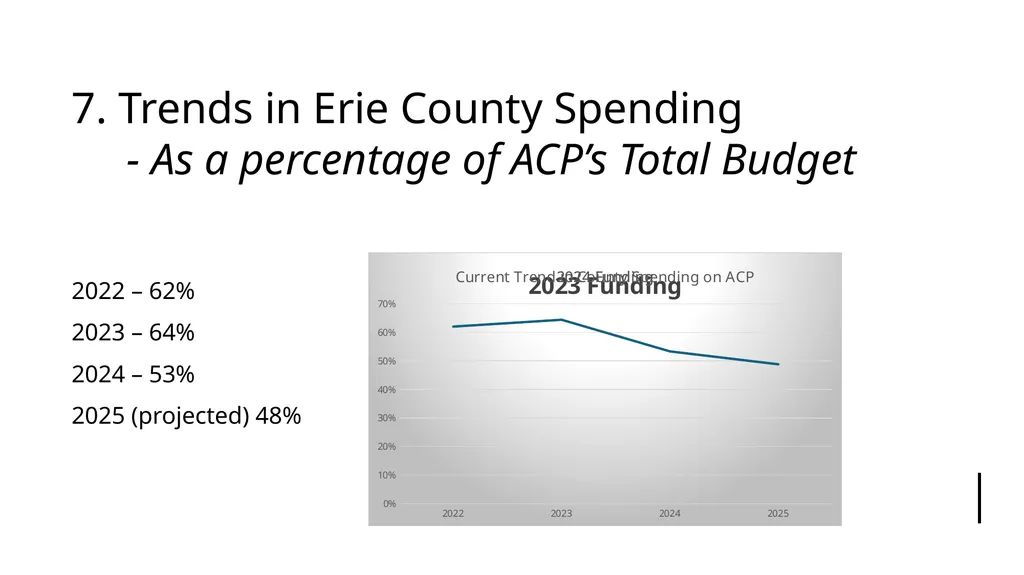
- As a percentage of ACP’s Total Budget 2022 – 62%
2023 – 64%
2024 – 53%
2025 (projected) 48%<br>
2023 – 64%
2024 – 53%
2025 (projected) 48%<br>
50
7. Trends in Erie County Spending
- As a percentage of ACP’s Total Budget – cont’d The ECBA ACP is increasing its reliance on ILS funding which means the County’s proportion of investment is decreasing.
Largely this is due to the increased amount of ILS funding for “Increased Voucher Costs.” Why now?
This occurred in phases. Phase 1 was ECBA ACP’s use of ILS fund to bolster the ACP infrastructure. ILS wanted the infrastructure put in place first so that the Program would reach a point where attorneys spent more time on average for their cases. This investment included additional ACP administrative positions and organizational support, increased access to non-attorney professionals, a Mentor Program, a Second Chair program, and enhanced access to quality training for panel attorneys.
Phase 2 was the implementation of the Increased Attorney Voucher Cost claiming process. Once the infrastructure was in place, then the Program could draw against that resource.<br>
Largely this is due to the increased amount of ILS funding for “Increased Voucher Costs.” Why now?
This occurred in phases. Phase 1 was ECBA ACP’s use of ILS fund to bolster the ACP infrastructure. ILS wanted the infrastructure put in place first so that the Program would reach a point where attorneys spent more time on average for their cases. This investment included additional ACP administrative positions and organizational support, increased access to non-attorney professionals, a Mentor Program, a Second Chair program, and enhanced access to quality training for panel attorneys.
Phase 2 was the implementation of the Increased Attorney Voucher Cost claiming process. Once the infrastructure was in place, then the Program could draw against that resource.<br>
51
7. Trends in Erie County Spending
- As a percentage of ACP’s Total Budget – cont’d This coincided with the more favorable discovery rules and body-worn cameras. Result: attorneys are spending more time on reviewing electronic discovery which is reflected in the increased number of hours in the vouchers.
Another factor is the ILS creation of a WNY Regional Office in Buffalo. The availability of manpower to review the ECBA ACP work plans and contracts with Erie County means that contracts are executed faster than in the past. Which means that more ILS resources are being made available to the ACP, and we take full advantage.
It’s reflected in the 2023 audit – ACP will return $3.3M to Erie County which was offset by the ILS funding for Increased Voucher Costs.
It’s reflected in our 2025 proposed County budget, by which we will seek $18.5M – a decrease of $1.8M from 2024 ($20.3M.) A decrease of 8.96%. In 2025, the County’s portion of ACP spending will be under 50% of our total budget.<br>
Another factor is the ILS creation of a WNY Regional Office in Buffalo. The availability of manpower to review the ECBA ACP work plans and contracts with Erie County means that contracts are executed faster than in the past. Which means that more ILS resources are being made available to the ACP, and we take full advantage.
It’s reflected in the 2023 audit – ACP will return $3.3M to Erie County which was offset by the ILS funding for Increased Voucher Costs.
It’s reflected in our 2025 proposed County budget, by which we will seek $18.5M – a decrease of $1.8M from 2024 ($20.3M.) A decrease of 8.96%. In 2025, the County’s portion of ACP spending will be under 50% of our total budget.<br>
52
7. Trends in Erie County Spending
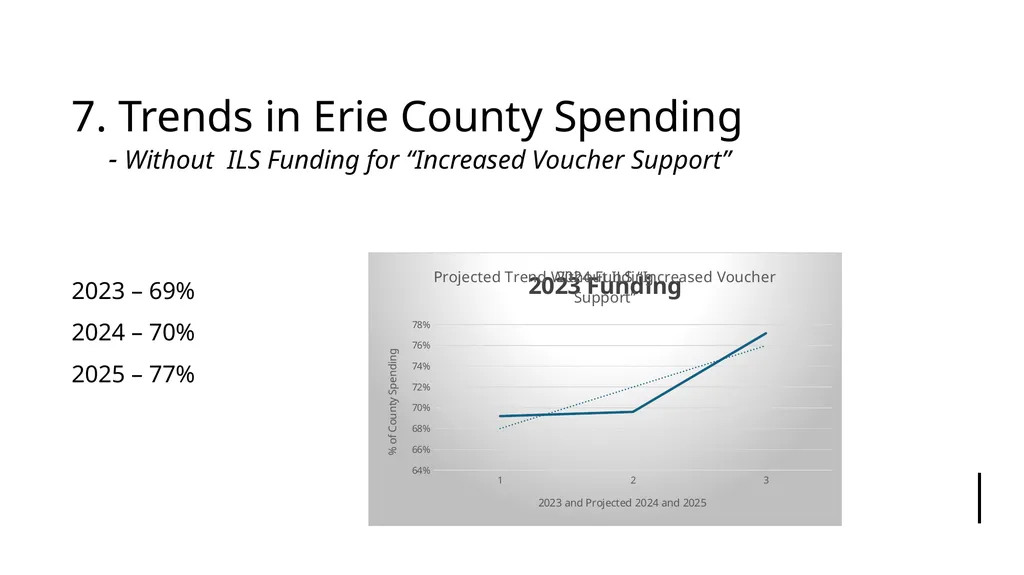
- Without ILS Funding for “Increased Voucher Support” 2023 – 69%
2024 – 70%
2025 – 77%<br>
2024 – 70%
2025 – 77%<br>
53
7. Trends in Erie County Spending
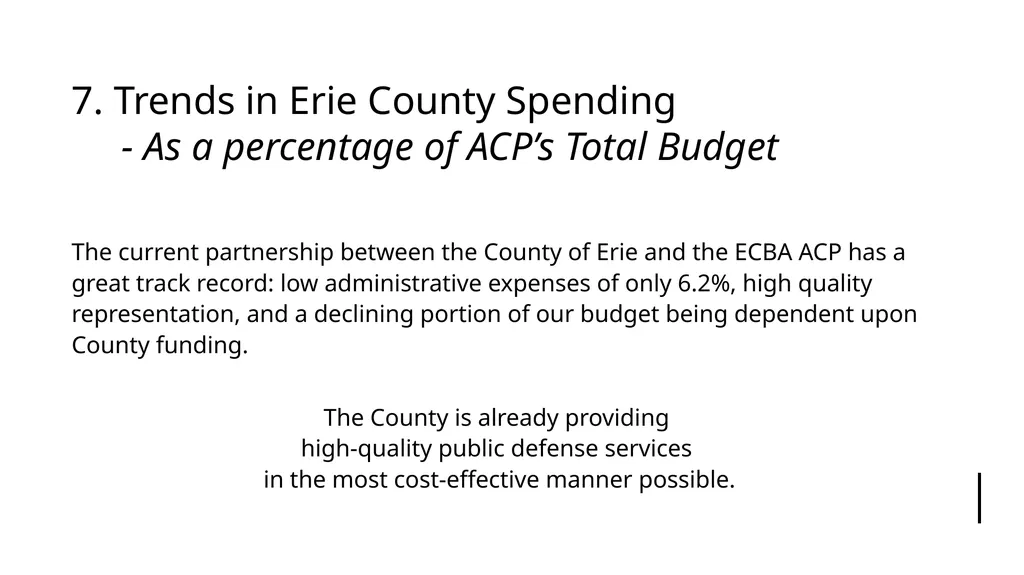
- As a percentage of ACP’s Total Budget The current partnership between the County of Erie and the ECBA ACP has a great track record: low administrative expenses of only 6.2%, high quality representation, and a declining portion of our budget being dependent upon County funding.
The County is already providing
high-quality public defense services
in the most cost-effective manner possible.<br>
The County is already providing
high-quality public defense services
in the most cost-effective manner possible.<br>
54
8. Comparing Erie and Monroe Counties –
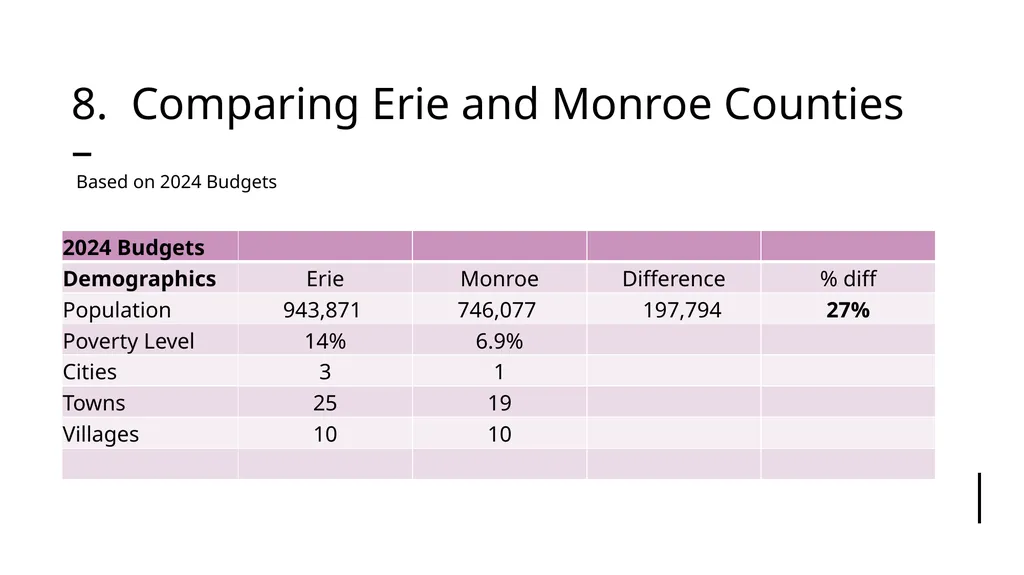
Based on 2024 Budgets<br>
55
8. Comparing Erie and Monroe Counties –
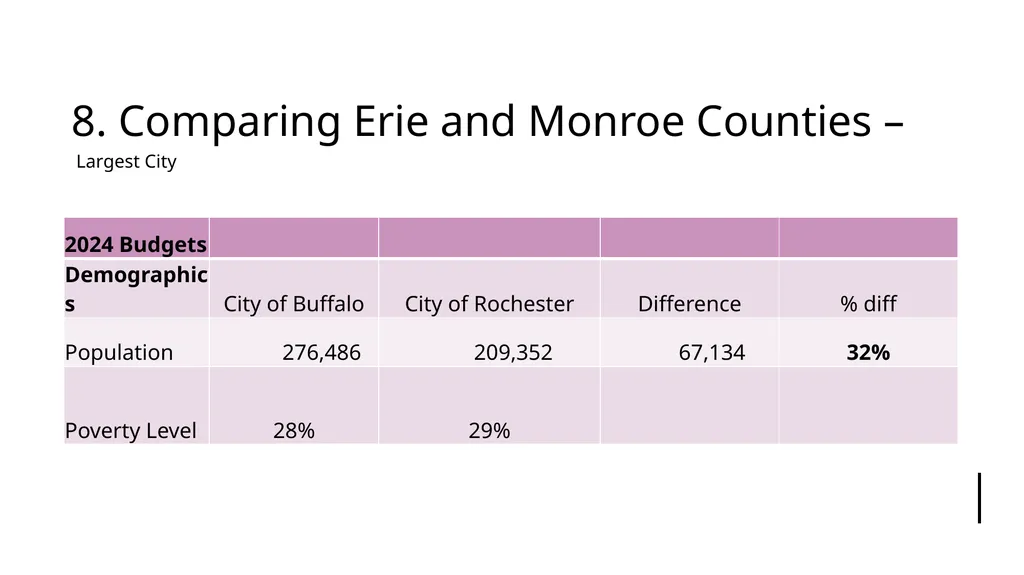
Largest City<br>
56
8. Comparing Erie and Monroe Counties –
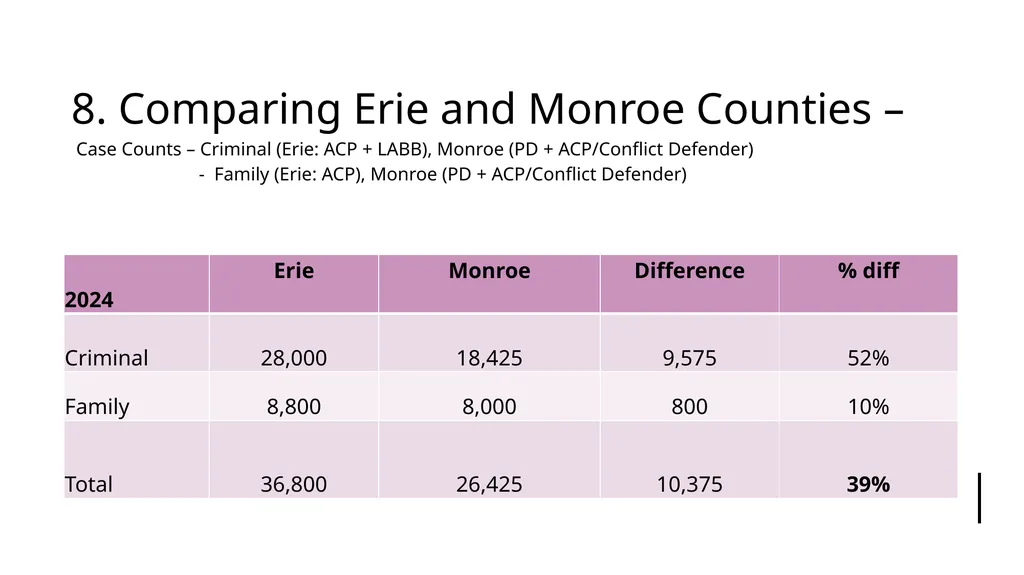
Case Counts – Criminal (Erie: ACP + LABB), Monroe (PD + ACP/Conflict Defender)
- Family (Erie: ACP), Monroe (PD + ACP/Conflict Defender)<br>
57
8. Comparing Erie and Monroe Counties –
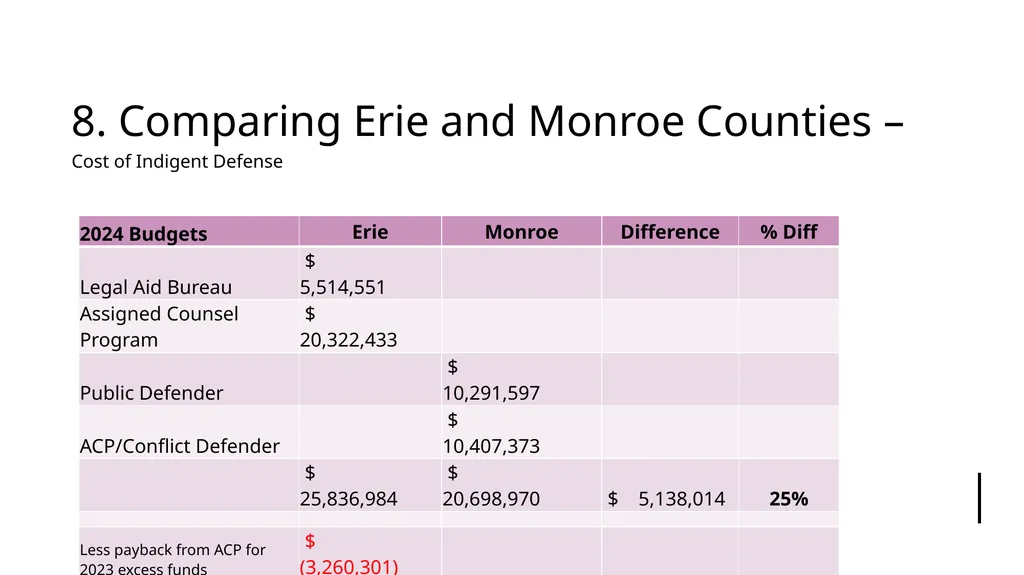
Cost of Indigent Defense<br>
58
8. Comparing Erie and Monroe Counties –
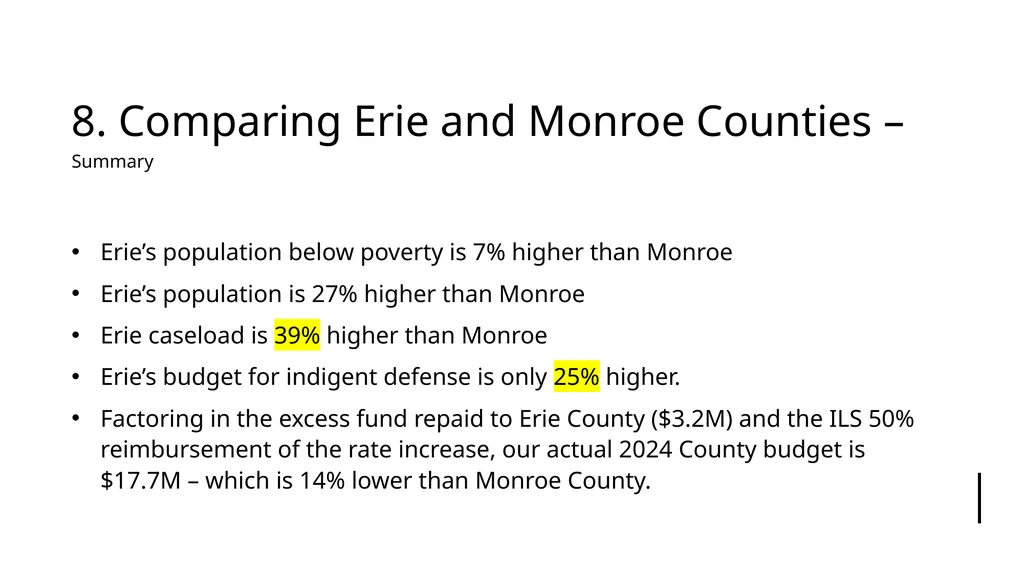
Summary Erie’s population below poverty is 7% higher than Monroe
Erie’s population is 27% higher than Monroe
Erie caseload is 39% higher than Monroe
Erie’s budget for indigent defense is only 25% higher.
Factoring in the excess fund repaid to Erie County ($3.2M) and the ILS 50% reimbursement of the rate increase, our actual 2024 County budget is $17.7M – which is 14% lower than Monroe County.<br>
Erie’s population is 27% higher than Monroe
Erie caseload is 39% higher than Monroe
Erie’s budget for indigent defense is only 25% higher.
Factoring in the excess fund repaid to Erie County ($3.2M) and the ILS 50% reimbursement of the rate increase, our actual 2024 County budget is $17.7M – which is 14% lower than Monroe County.<br>
59
9. Your Questions<br>