
PRESENTATION ON THE ANNUAL PERFORMANCE PLAN

Description: PRESENTATION ON THE ANNUAL PERFORMANCE PLAN 201920 OF THE DEPARTMENT OF INTERNATIONAL RELATIONS AND COOPERATION JULY 2019 MANDATE OF DIRCO Coordinating and aligning SA foreign policy abroad Monitoring developments in the international
Related Topics
Download Presentation
"PRESENTATION ON THE ANNUAL PERFORMANCE PLAN" is the property of its rightful owner. Permission is granted to download and print the materials on this website for personal, non-commercial use only, and to display it on your personal computer provided you do not modify the materials and that you retain all copyright notices contained in the materials. By downloading content from our website, you accept the terms of this agreement.
Presentation Transcript
slide1. PRESENTATION ON THE
ANNUAL PERFORMANCE PLAN 2019/20
OF THE
DEPARTMENT OF
INTERNATIONAL RELATIONS
AND
COOPERATION
JULY 2019<br>
slide2. MANDATE OF DIRCO Coordinating and aligning SA foreign policy abroad
Monitoring developments in the international arena
Communicating government’s policy positions
Developing and advising government on foreign policy options and creating mechanisms and avenues for achieving objectives
Protecting South Africa’s sovereignty and territorial integrity
Contributing to the creation of an enabling international environment for SA business
Sourcing of developmental assistance
Assisting South African Citizens abroad 2<br>
slide3. 3 OFFICE OF THE MINISTER OFFICE OF THE DEPUTY MINISTER 1 OFFICE OF THE DEPUTY MINISTER 2 OFFICE OF THE DIRECTOR-GENERAL INTERNAL AUDIT RISK MANAGEMENT OFFICE OF THE CHIEF STATE LAW ADVISOR OFFICE OF THE CHIEF OPERATIONS OFFICER BRANCH
AFRICA BRANCH FINANCE & ASSET MANAGEMENT BRANCH AMERICAS & EUROPE BRANCH
ASIA & MIDDLE EAST BRANCH CORPORATE MANAGEMENT BRANCH GLOBAL GOVERNANCE & CONTINENTAL AFFAIRS BRANCH DIPLOMATIC TRAINING, RESEARCH & DEVELOPMENT BRANCH PUBLIC DIPLOMACY BRANCH STATE PROTOCOL & CONSULAR AFFAIRS<br>
slide4. South Africa’s Global Footprint Missions per Region
Africa Bilateral – 46
Africa Multilateral – 1
Americas & Caribbean – 17
Europe – 27
Asia & Middle East – 32
Multilateral -2
Total: 125 4<br>
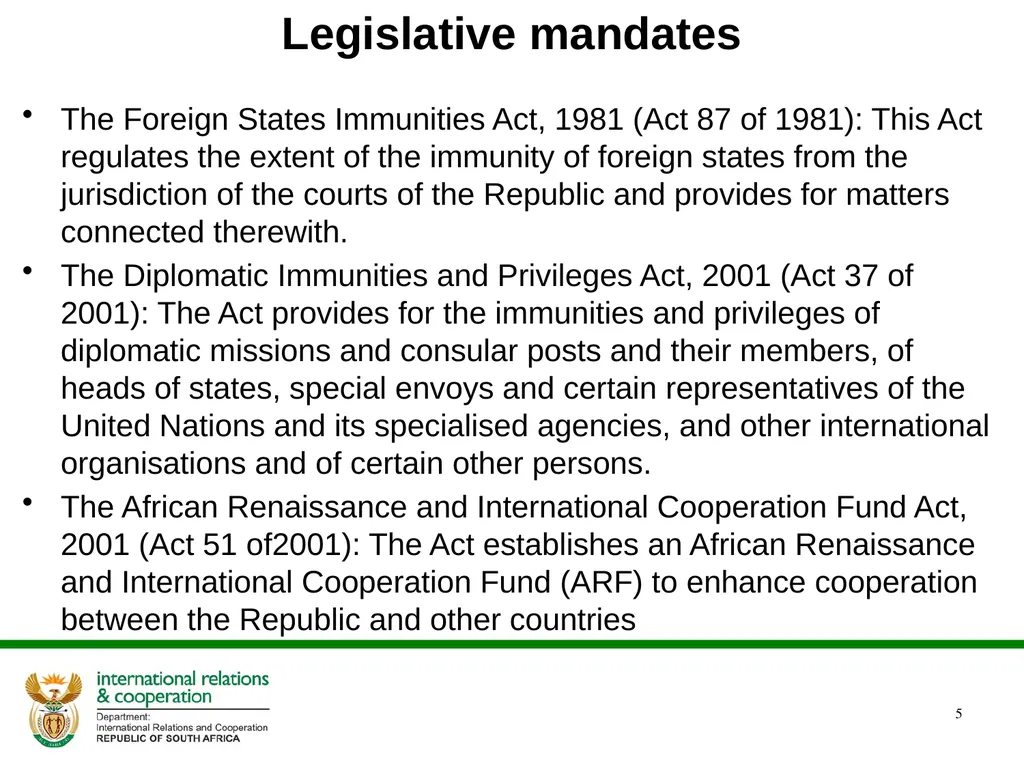
slide5. Legislative mandates The Foreign States Immunities Act, 1981 (Act 87 of 1981): This Act regulates the extent of the immunity of foreign states from the jurisdiction of the courts of the Republic and provides for matters connected therewith.
The Diplomatic Immunities and Privileges Act, 2001 (Act 37 of 2001): The Act provides for the immunities and privileges of diplomatic missions and consular posts and their members, of heads of states, special envoys and certain representatives of the United Nations and its specialised agencies, and other international organisations and of certain other persons.
The African Renaissance and International Cooperation Fund Act, 2001 (Act 51 of2001): The Act establishes an African Renaissance and International Cooperation Fund (ARF) to enhance cooperation between the Republic and other countries 5<br>
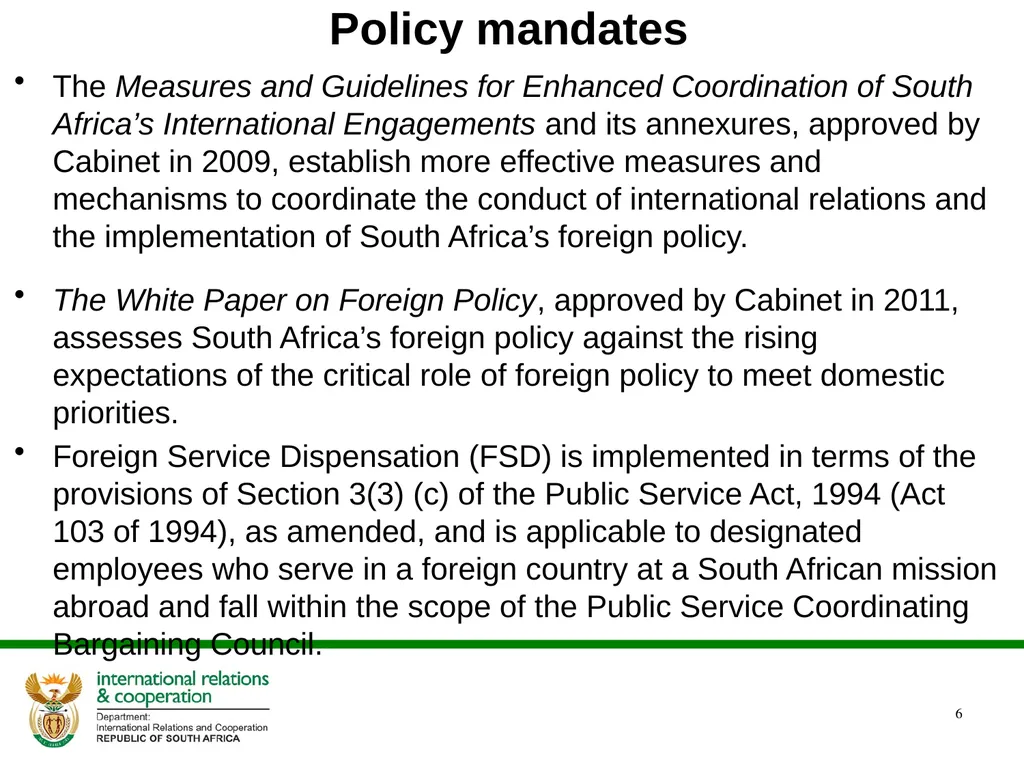
slide6. Policy mandates The Measures and Guidelines for Enhanced Coordination of South Africa’s International Engagements and its annexures, approved by Cabinet in 2009, establish more effective measures and mechanisms to coordinate the conduct of international relations and the implementation of South Africa’s foreign policy.
The White Paper on Foreign Policy, approved by Cabinet in 2011, assesses South Africa’s foreign policy against the rising expectations of the critical role of foreign policy to meet domestic priorities.
Foreign Service Dispensation (FSD) is implemented in terms of the provisions of Section 3(3) (c) of the Public Service Act, 1994 (Act 103 of 1994), as amended, and is applicable to designated employees who serve in a foreign country at a South African mission abroad and fall within the scope of the Public Service Coordinating Bargaining Council. 6<br>
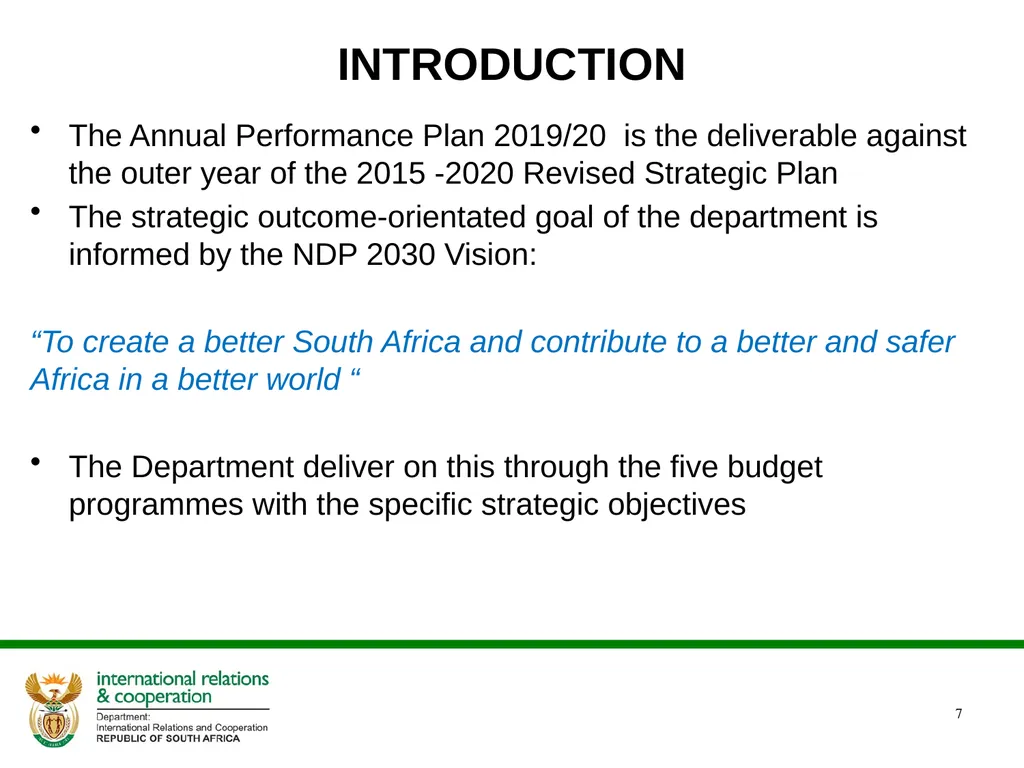
slide7. INTRODUCTION The Annual Performance Plan 2019/20 is the deliverable against the outer year of the 2015 -2020 Revised Strategic Plan
The strategic outcome-orientated goal of the department is informed by the NDP 2030 Vision:
“To create a better South Africa and contribute to a better and safer Africa in a better world “
The Department deliver on this through the five budget programmes with the specific strategic objectives 7<br>
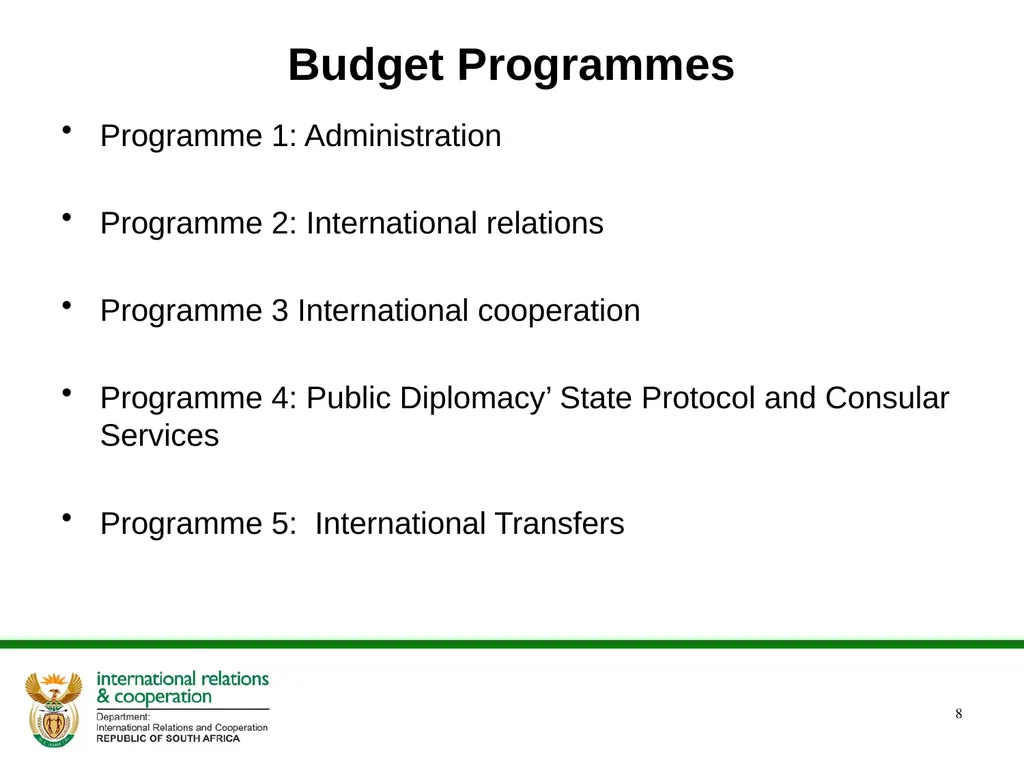
slide8. Budget Programmes Programme 1: Administration
Programme 2: International relations
Programme 3 International cooperation
Programme 4: Public Diplomacy’ State Protocol and Consular Services
Programme 5: International Transfers 8<br>
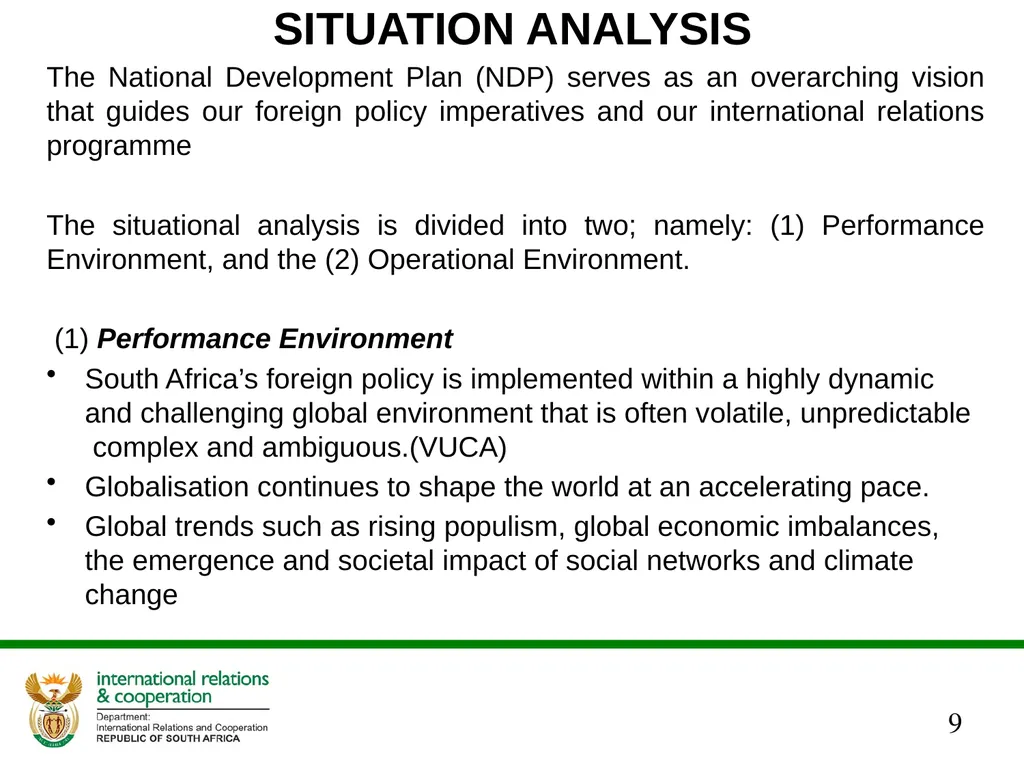
slide9. 9 The National Development Plan (NDP) serves as an overarching vision that guides our foreign policy imperatives and our international relations programme
The situational analysis is divided into two; namely: (1) Performance Environment, and the (2) Operational Environment.
(1) Performance Environment
South Africa’s foreign policy is implemented within a highly dynamic and challenging global environment that is often volatile, unpredictable complex and ambiguous.(VUCA)
Globalisation continues to shape the world at an accelerating pace.
Global trends such as rising populism, global economic imbalances, the emergence and societal impact of social networks and climate change SITUATION ANALYSIS<br>
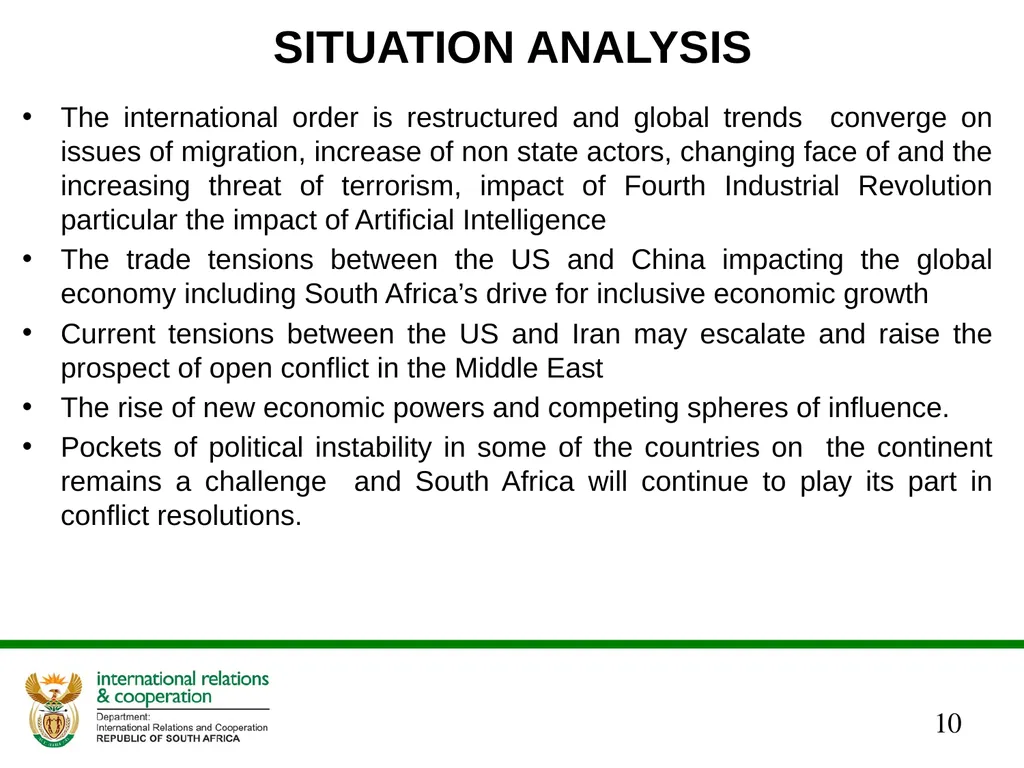
slide10. 10 The international order is restructured and global trends converge on issues of migration, increase of non state actors, changing face of and the increasing threat of terrorism, impact of Fourth Industrial Revolution particular the impact of Artificial Intelligence
The trade tensions between the US and China impacting the global economy including South Africa’s drive for inclusive economic growth
Current tensions between the US and Iran may escalate and raise the prospect of open conflict in the Middle East
The rise of new economic powers and competing spheres of influence.
Pockets of political instability in some of the countries on the continent remains a challenge and South Africa will continue to play its part in conflict resolutions. SITUATION ANALYSIS<br>
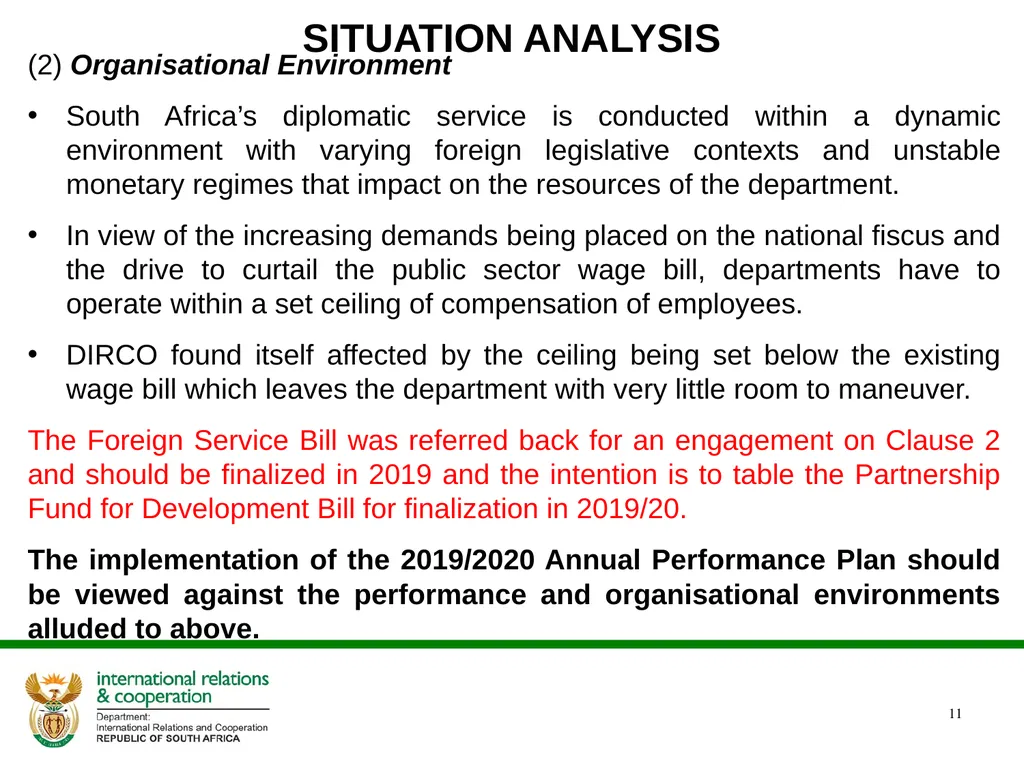
slide11. SITUATION ANALYSIS (2) Organisational Environment
South Africa’s diplomatic service is conducted within a dynamic environment with varying foreign legislative contexts and unstable monetary regimes that impact on the resources of the department.
In view of the increasing demands being placed on the national fiscus and the drive to curtail the public sector wage bill, departments have to operate within a set ceiling of compensation of employees.
DIRCO found itself affected by the ceiling being set below the existing wage bill which leaves the department with very little room to maneuver.
The Foreign Service Bill was referred back for an engagement on Clause 2 and should be finalized in 2019 and the intention is to table the Partnership Fund for Development Bill for finalization in 2019/20.
The implementation of the 2019/2020 Annual Performance Plan should be viewed against the performance and organisational environments alluded to above. 11<br>
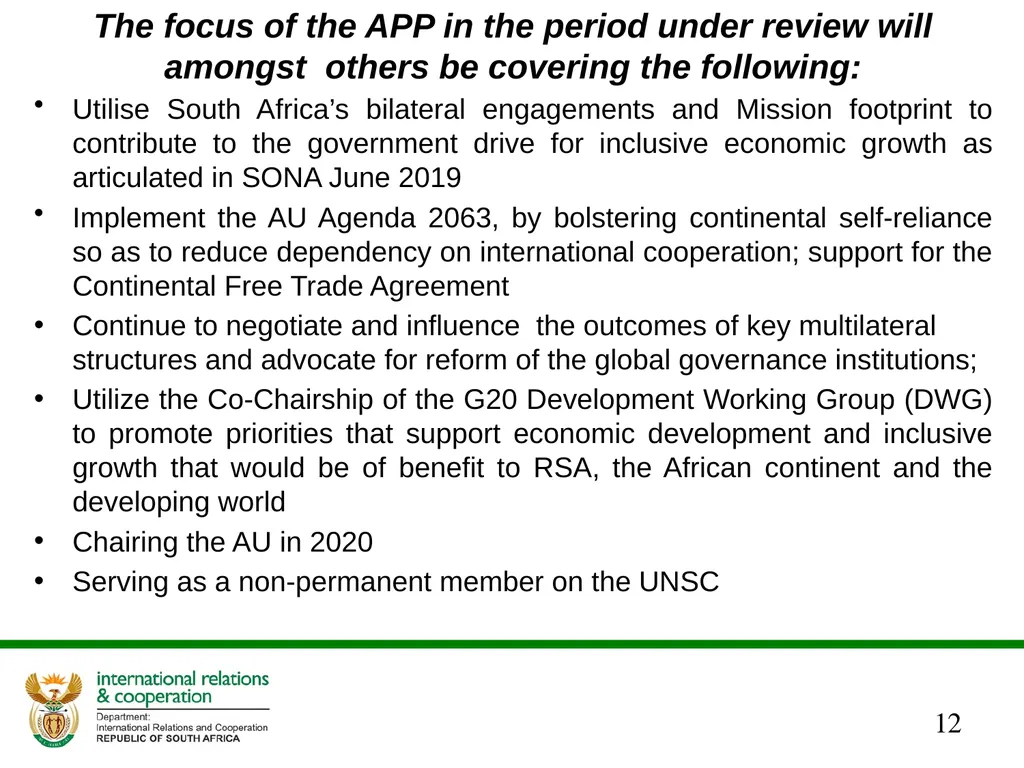
slide12. 12 Utilise South Africa’s bilateral engagements and Mission footprint to contribute to the government drive for inclusive economic growth as articulated in SONA June 2019
Implement the AU Agenda 2063, by bolstering continental self-reliance so as to reduce dependency on international cooperation; support for the Continental Free Trade Agreement
Continue to negotiate and influence the outcomes of key multilateral structures and advocate for reform of the global governance institutions;
Utilize the Co-Chairship of the G20 Development Working Group (DWG) to promote priorities that support economic development and inclusive growth that would be of benefit to RSA, the African continent and the developing world
Chairing the AU in 2020
Serving as a non-permanent member on the UNSC The focus of the APP in the period under review will amongst others be covering the following:<br>
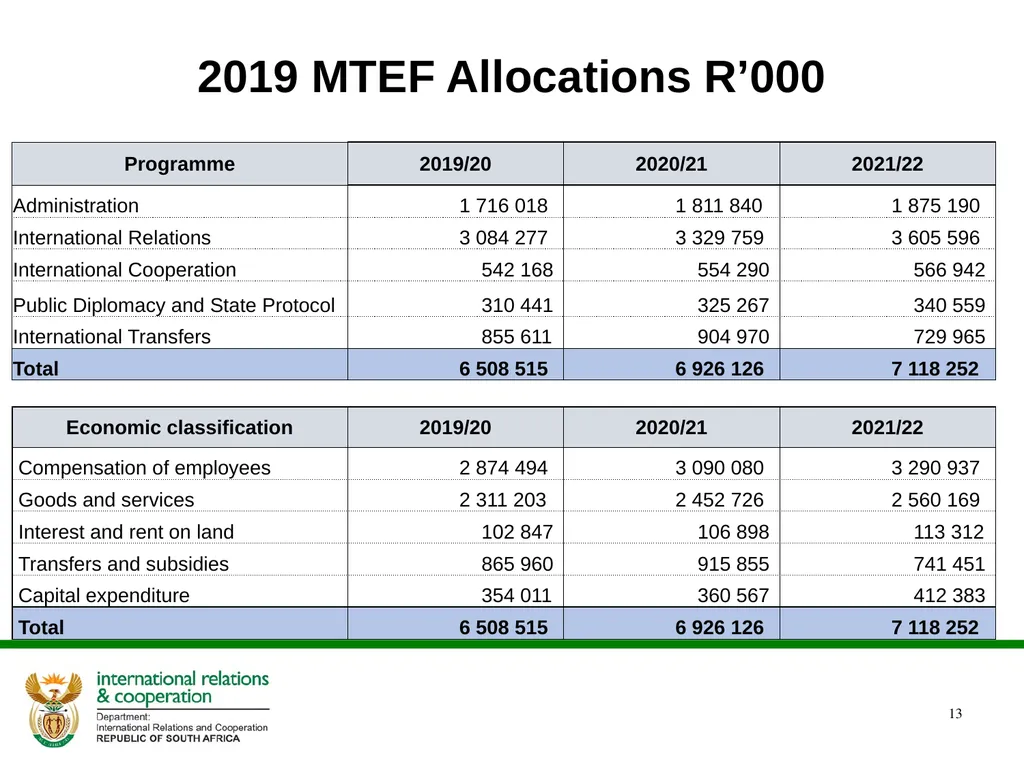
slide13. 2019 MTEF Allocations R’000 13<br>
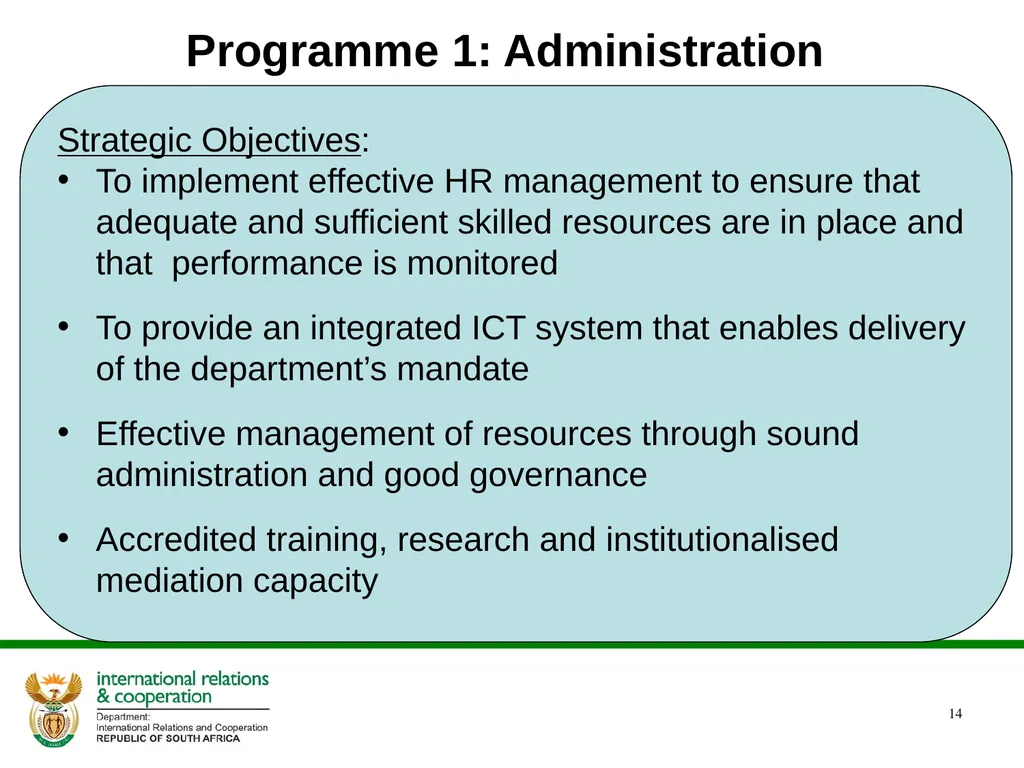
slide14. Programme 1: Administration 14 Strategic Objectives:
To implement effective HR management to ensure that adequate and sufficient skilled resources are in place and that performance is monitored
To provide an integrated ICT system that enables delivery of the department’s mandate
Effective management of resources through sound administration and good governance
Accredited training, research and institutionalised mediation capacity<br>
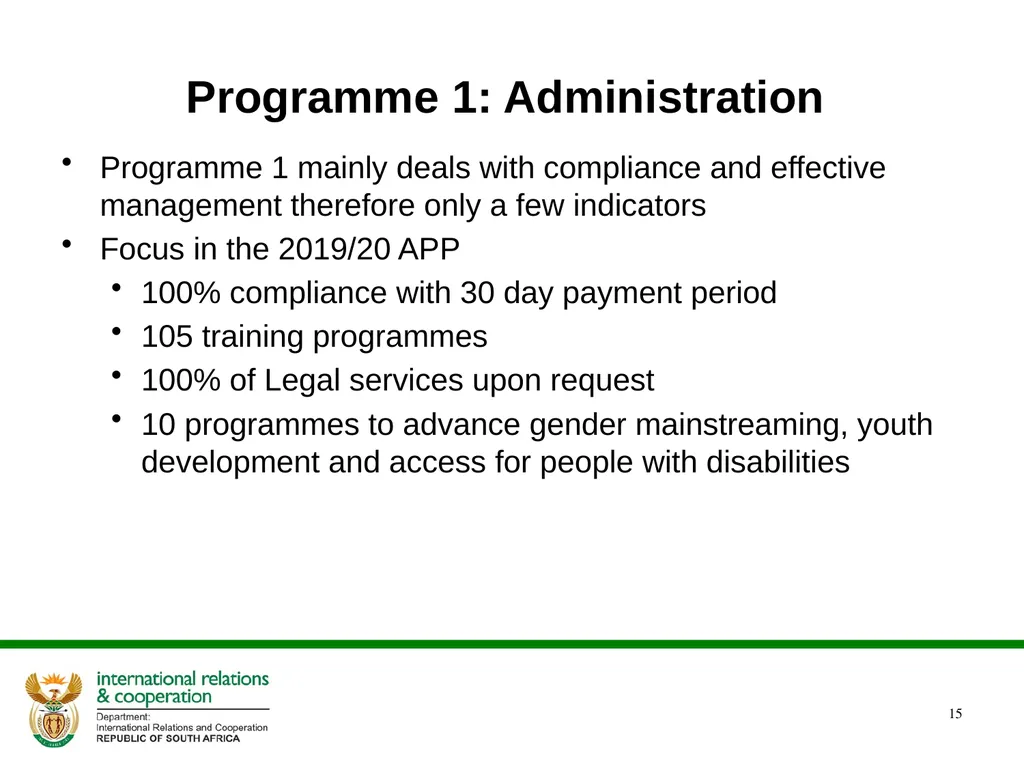
slide15. Programme 1: Administration Programme 1 mainly deals with compliance and effective management therefore only a few indicators
Focus in the 2019/20 APP
100% compliance with 30 day payment period
105 training programmes
100% of Legal services upon request
10 programmes to advance gender mainstreaming, youth development and access for people with disabilities 15<br>
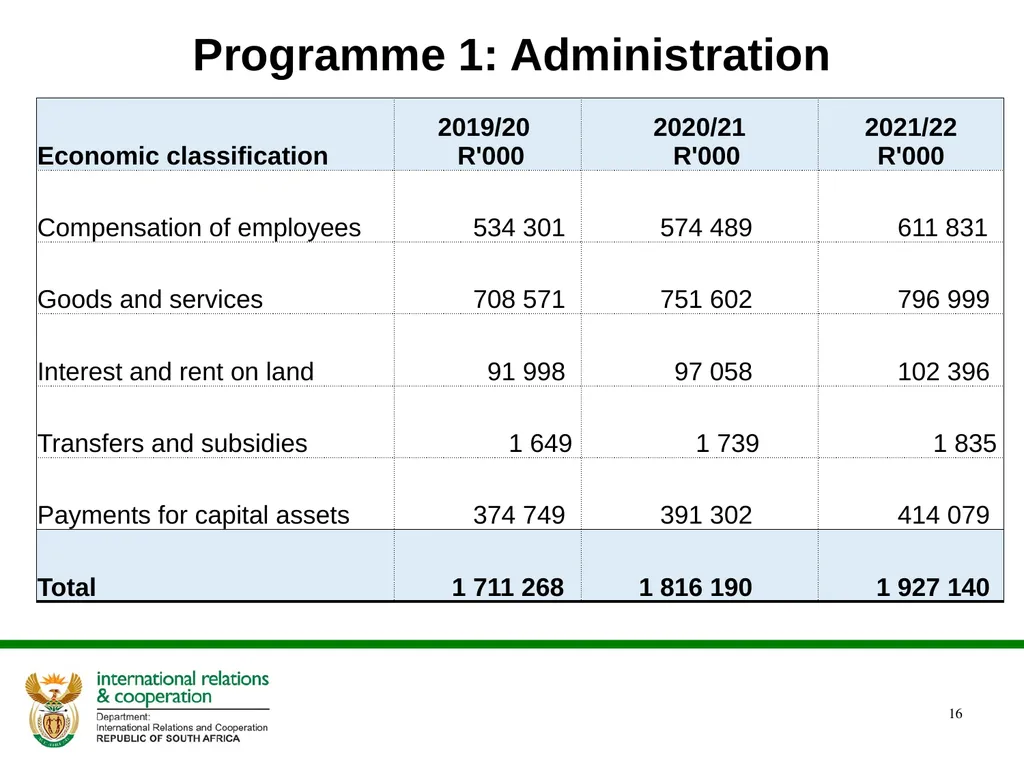
slide16. Programme 1: Administration 16<br>
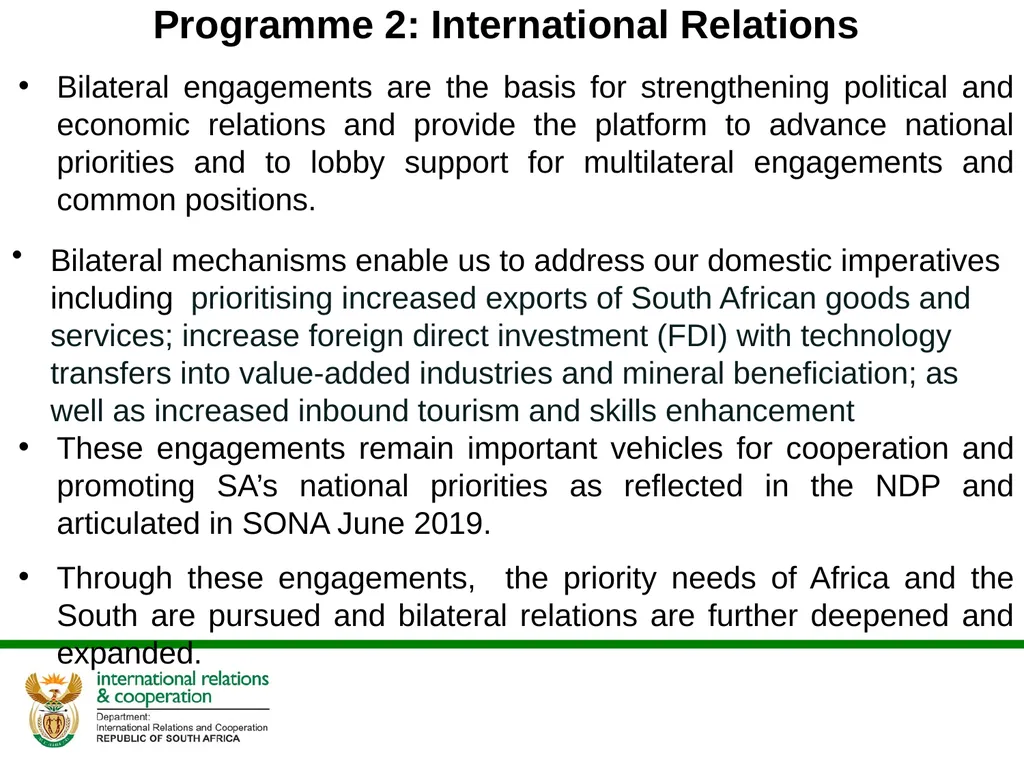
slide17. Programme 2: International Relations Bilateral engagements are the basis for strengthening political and economic relations and provide the platform to advance national priorities and to lobby support for multilateral engagements and common positions.
Bilateral mechanisms enable us to address our domestic imperatives including prioritising increased exports of South African goods and services; increase foreign direct investment (FDI) with technology transfers into value-added industries and mineral beneficiation; as well as increased inbound tourism and skills enhancement
These engagements remain important vehicles for cooperation and promoting SA’s national priorities as reflected in the NDP and articulated in SONA June 2019.
Through these engagements, the priority needs of Africa and the South are pursued and bilateral relations are further deepened and expanded.<br>
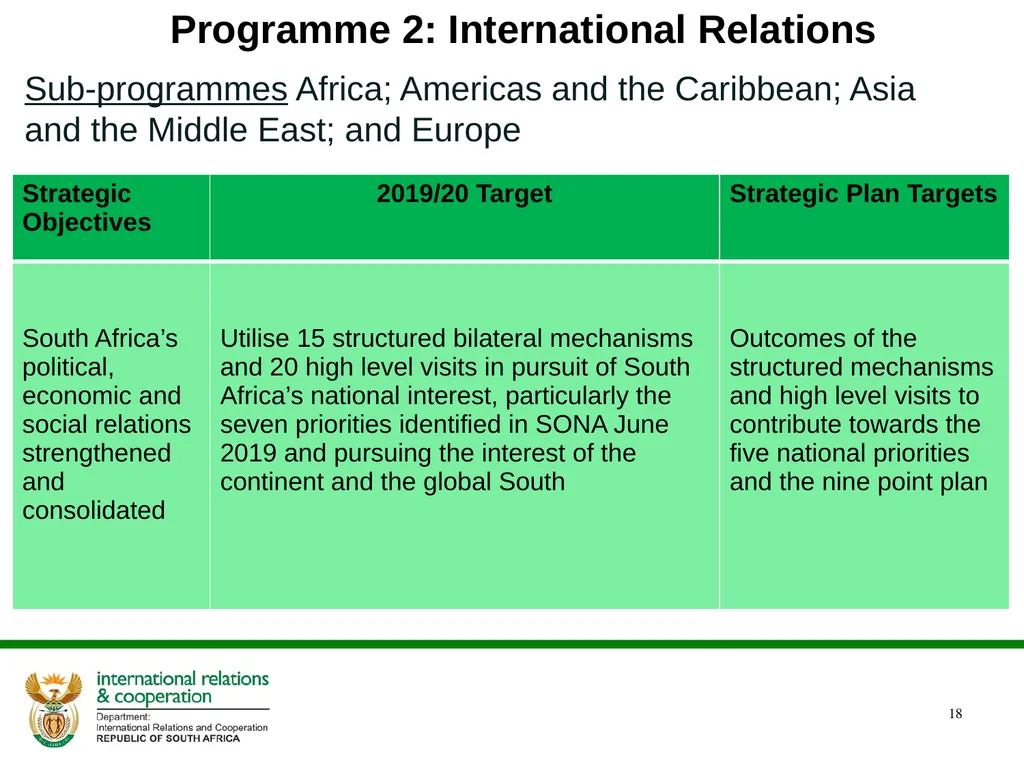
slide18. Programme 2: International Relations 18 Sub-programmes Africa; Americas and the Caribbean; Asia and the Middle East; and Europe<br>
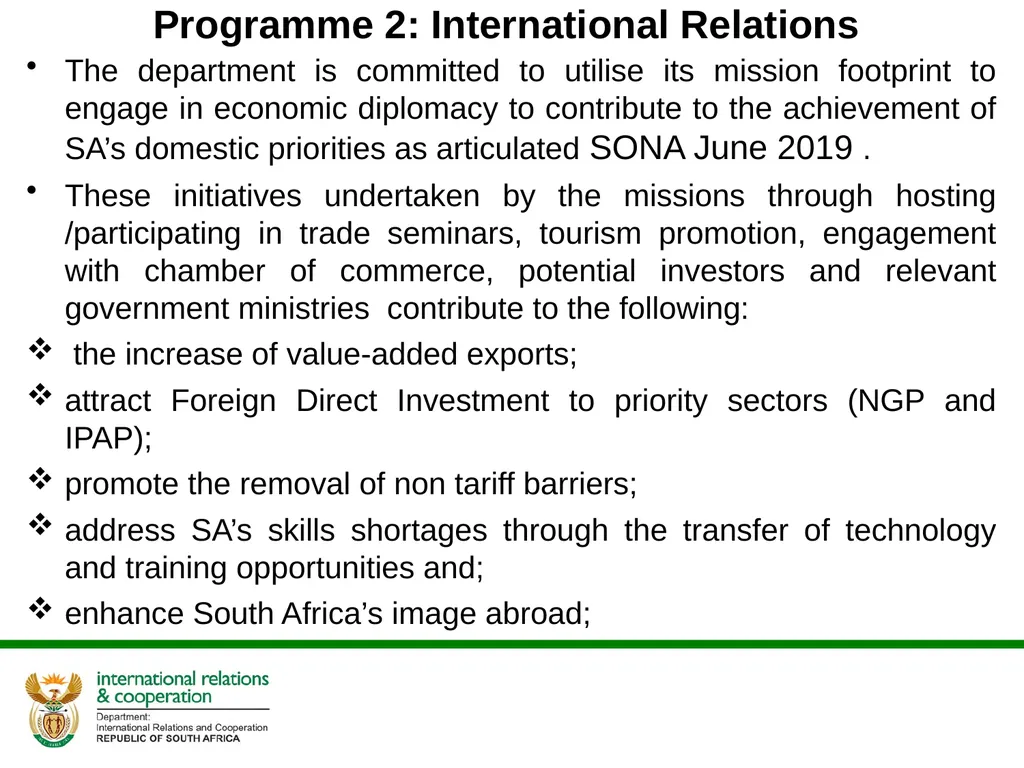
slide19. Programme 2: International Relations The department is committed to utilise its mission footprint to engage in economic diplomacy to contribute to the achievement of SA’s domestic priorities as articulated SONA June 2019 .
These initiatives undertaken by the missions through hosting /participating in trade seminars, tourism promotion, engagement with chamber of commerce, potential investors and relevant government ministries contribute to the following:
the increase of value-added exports;
attract Foreign Direct Investment to priority sectors (NGP and IPAP);
promote the removal of non tariff barriers;
address SA’s skills shortages through the transfer of technology and training opportunities and;
enhance South Africa’s image abroad;<br>
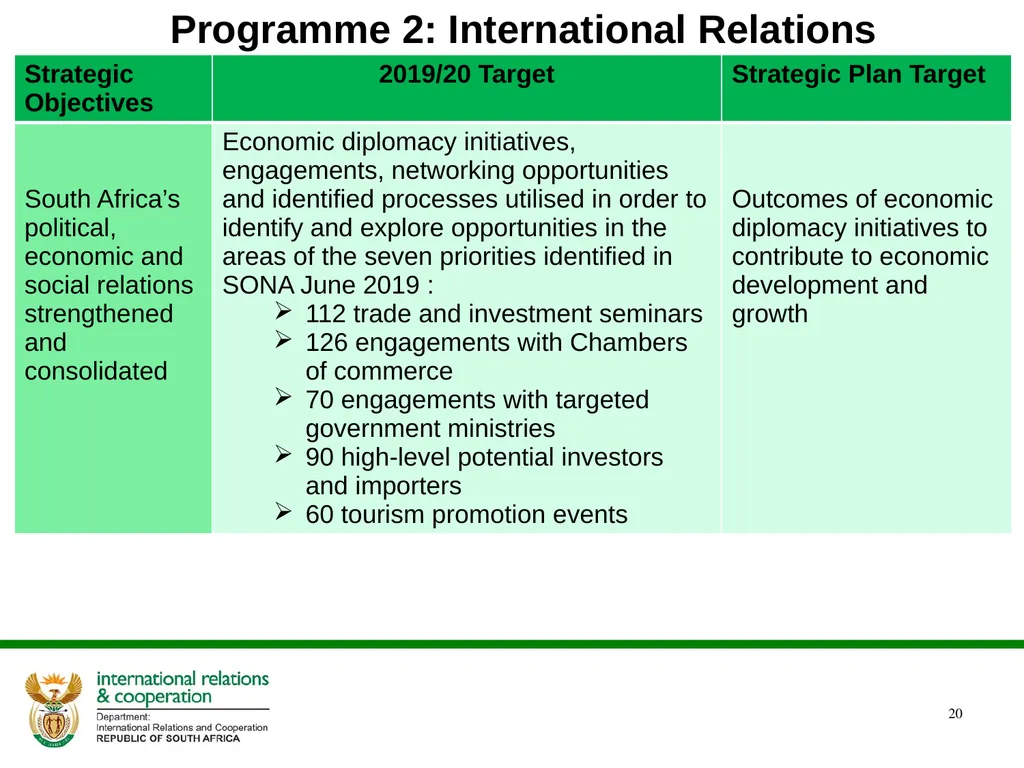
slide20. Programme 2: International Relations 20<br>
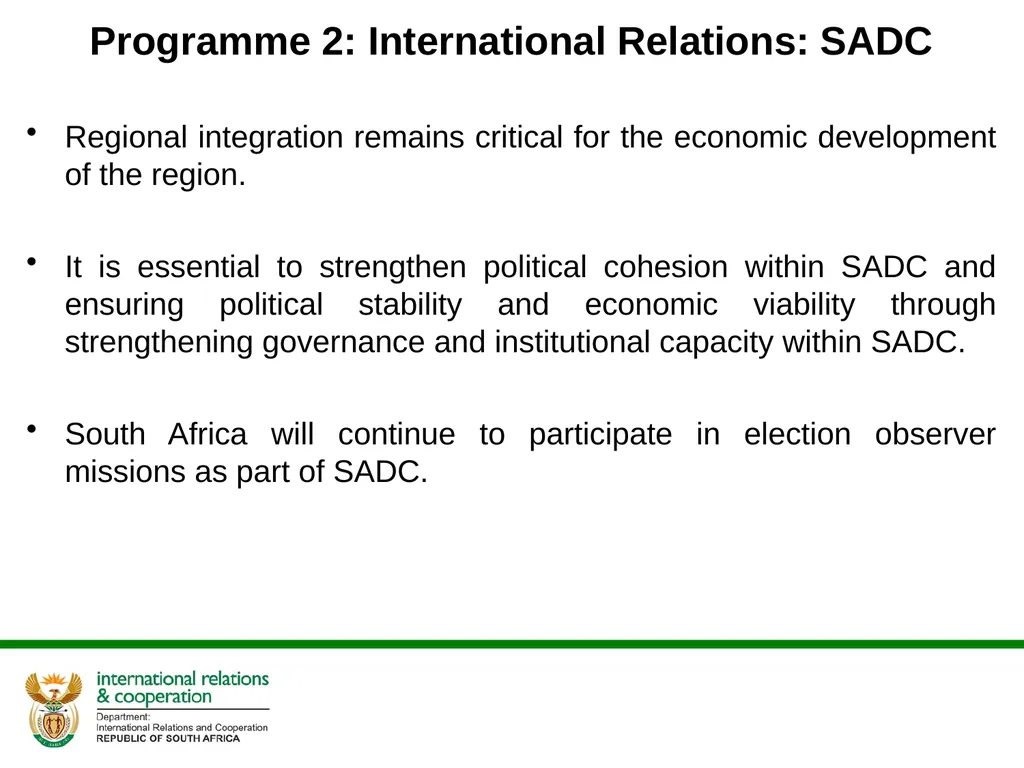
slide21. Programme 2: International Relations: SADC Regional integration remains critical for the economic development of the region.
It is essential to strengthen political cohesion within SADC and ensuring political stability and economic viability through strengthening governance and institutional capacity within SADC.
South Africa will continue to participate in election observer missions as part of SADC.<br>
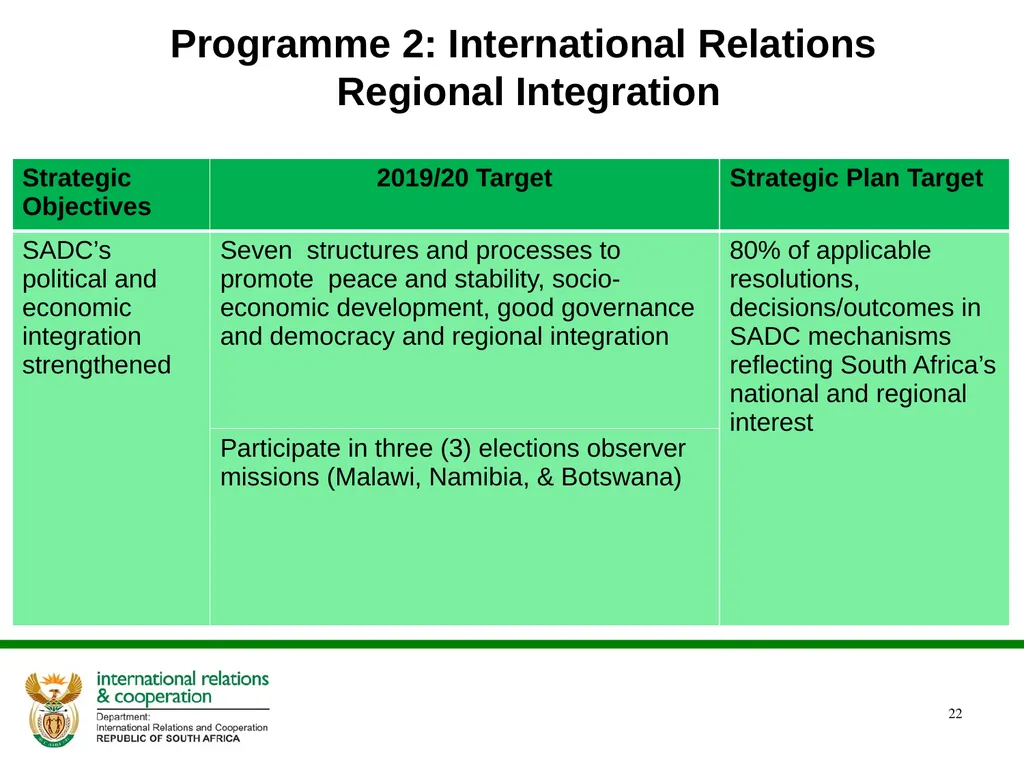
slide22. Programme 2: International Relations Regional Integration 22<br>
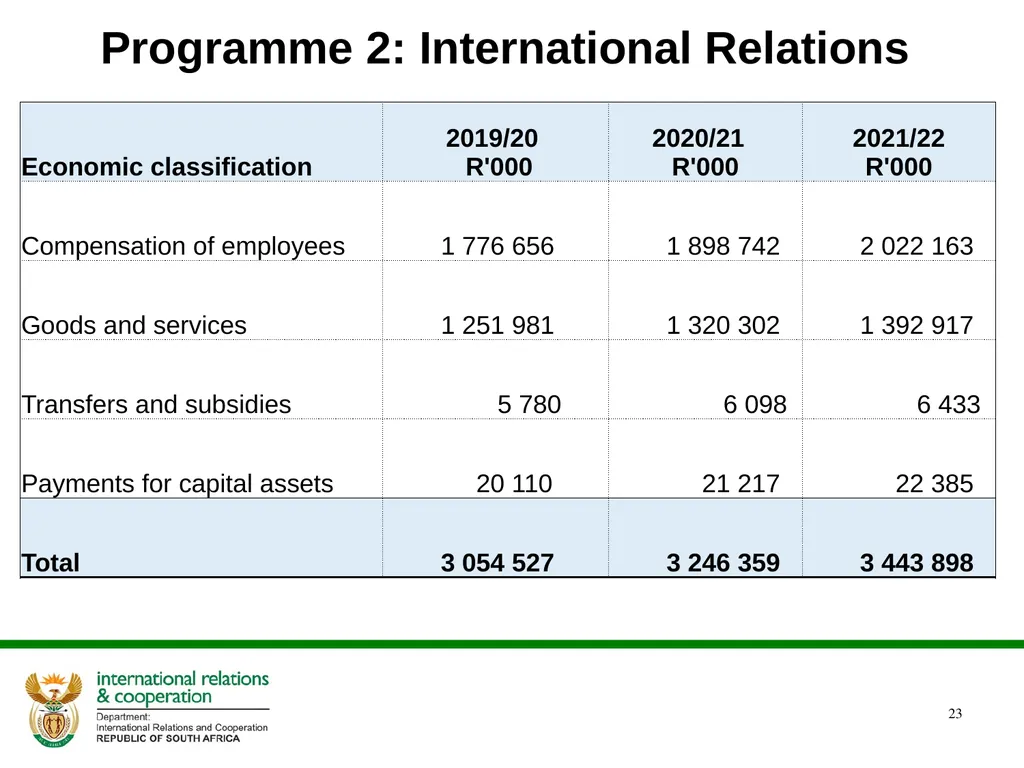
slide23. Programme 2: International Relations 23<br>
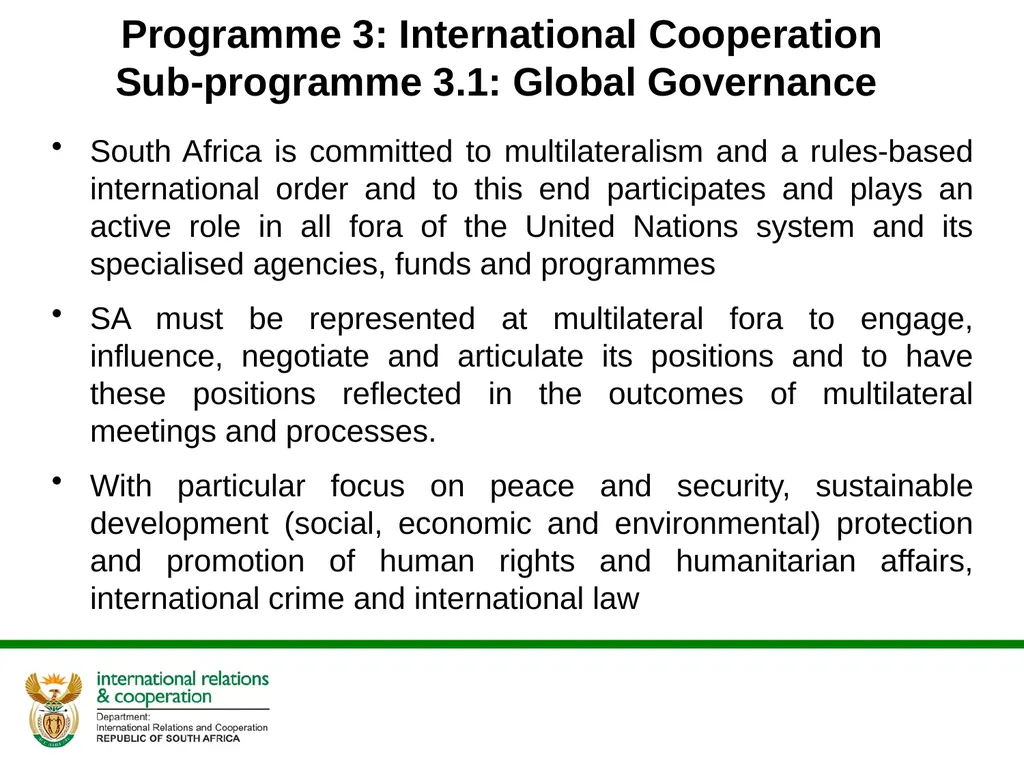
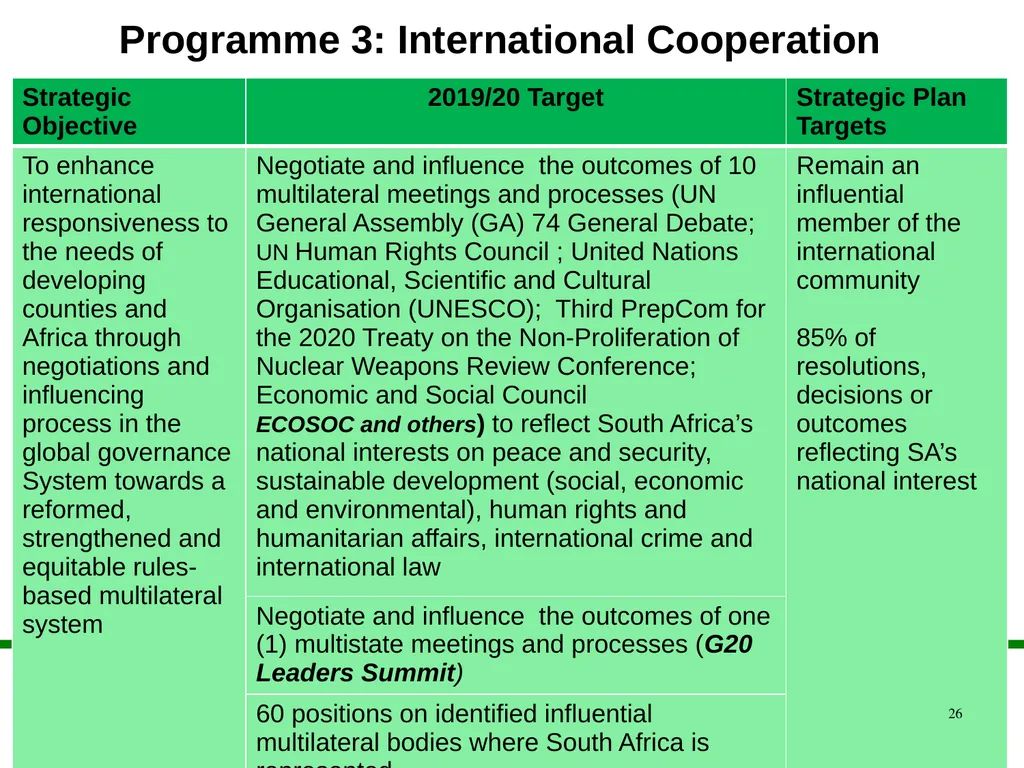
slide24. Programme 3: International Cooperation Sub-programme 3.1: Global Governance South Africa is committed to multilateralism and a rules-based international order and to this end participates and plays an active role in all fora of the United Nations system and its specialised agencies, funds and programmes
SA must be represented at multilateral fora to engage, influence, negotiate and articulate its positions and to have these positions reflected in the outcomes of multilateral meetings and processes.
With particular focus on peace and security, sustainable development (social, economic and environmental) protection and promotion of human rights and humanitarian affairs, international crime and international law<br>
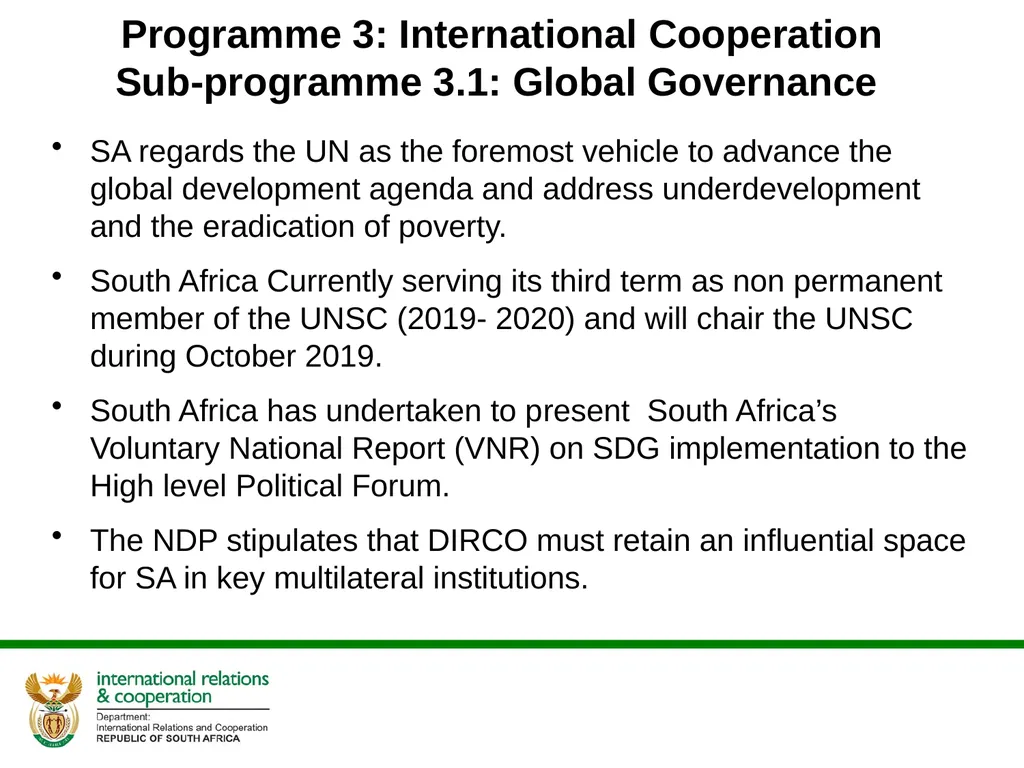
slide25. Programme 3: International Cooperation Sub-programme 3.1: Global Governance SA regards the UN as the foremost vehicle to advance the global development agenda and address underdevelopment and the eradication of poverty.
South Africa Currently serving its third term as non permanent member of the UNSC (2019- 2020) and will chair the UNSC during October 2019.
South Africa has undertaken to present South Africa’s Voluntary National Report (VNR) on SDG implementation to the High level Political Forum.
The NDP stipulates that DIRCO must retain an influential space for SA in key multilateral institutions.<br>
slide26. Programme 3: International Cooperation 26<br>
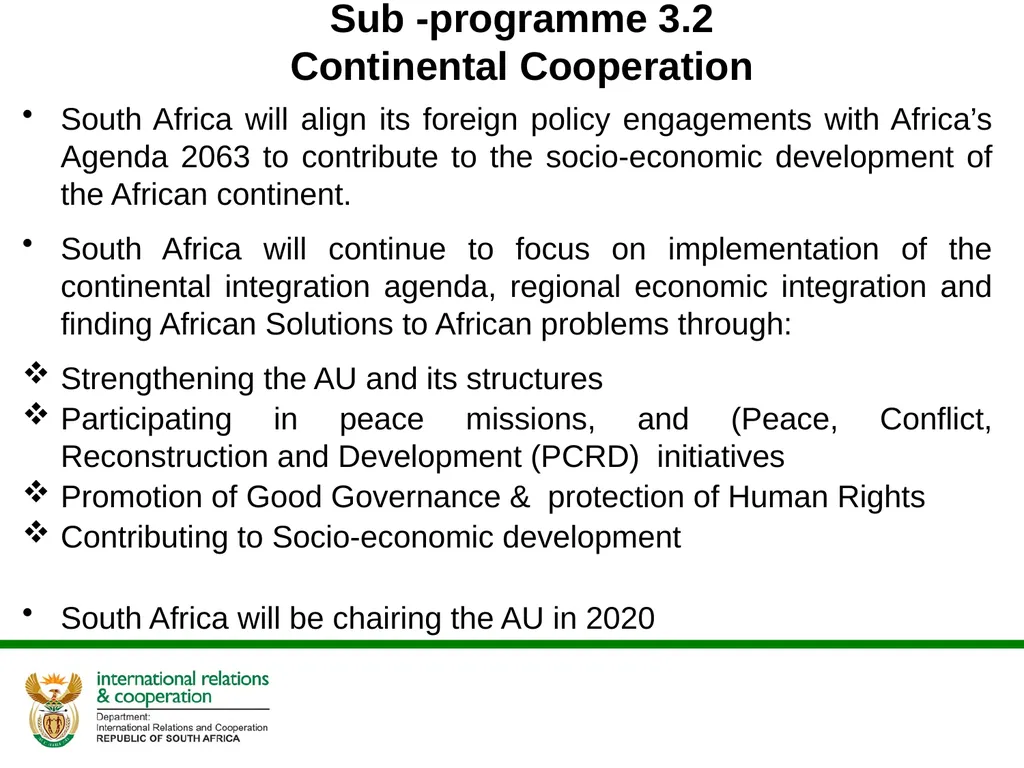
slide27. Sub -programme 3.2 Continental Cooperation South Africa will align its foreign policy engagements with Africa’s Agenda 2063 to contribute to the socio-economic development of the African continent.
South Africa will continue to focus on implementation of the continental integration agenda, regional economic integration and finding African Solutions to African problems through:
Strengthening the AU and its structures
Participating in peace missions, and (Peace, Conflict, Reconstruction and Development (PCRD) initiatives
Promotion of Good Governance & protection of Human Rights
Contributing to Socio-economic development
South Africa will be chairing the AU in 2020<br>
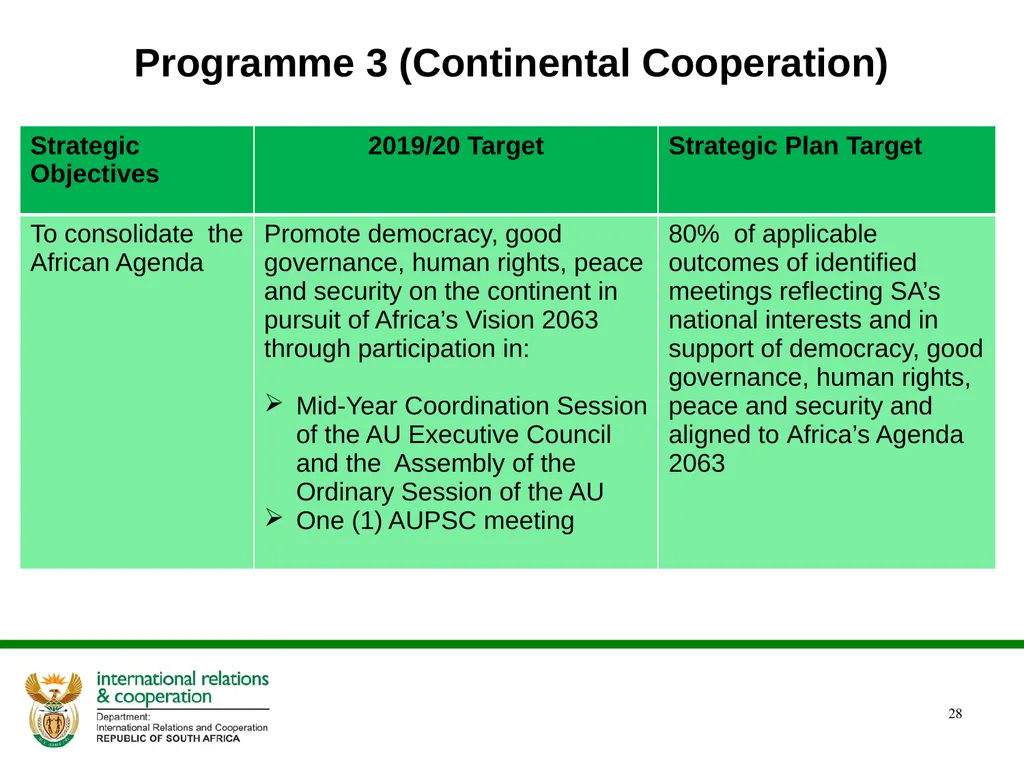
slide28. Programme 3 (Continental Cooperation) 28<br>
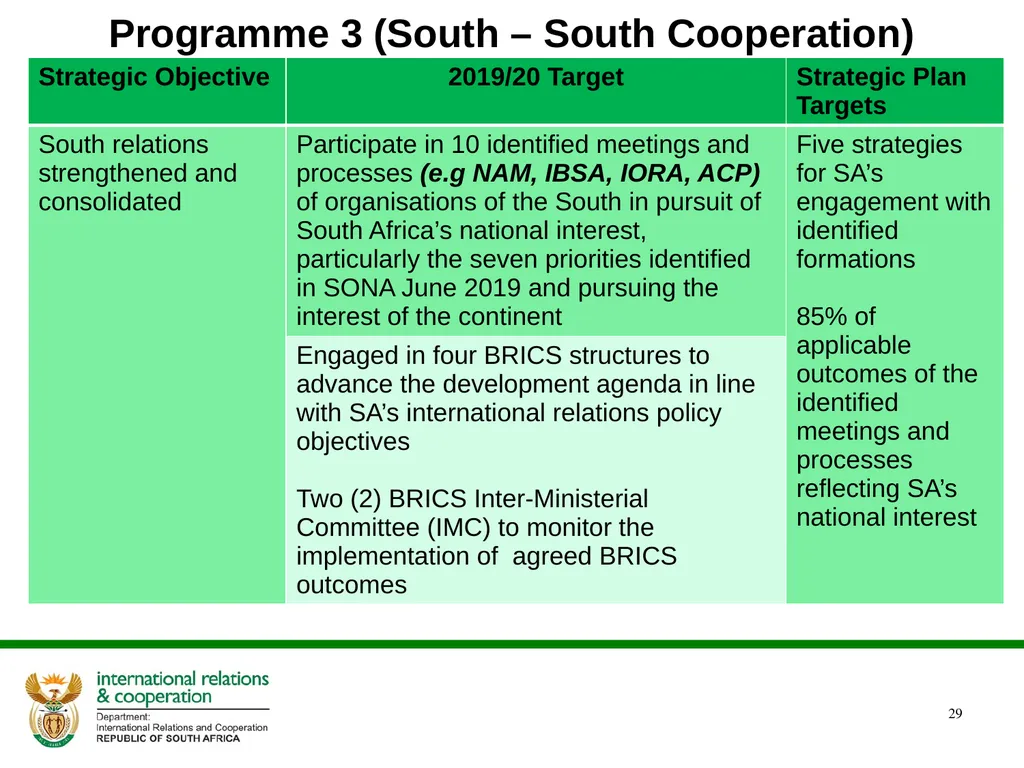
slide29. Programme 3 (South – South Cooperation) 29<br>
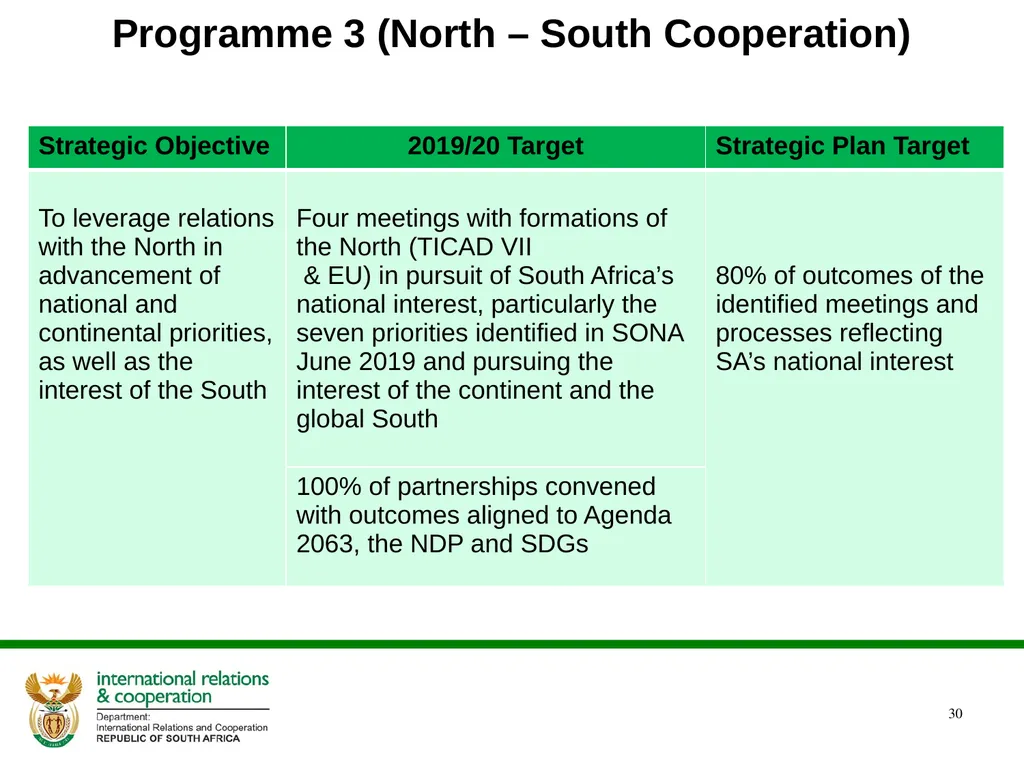
slide30. Programme 3 (North – South Cooperation) 30<br>
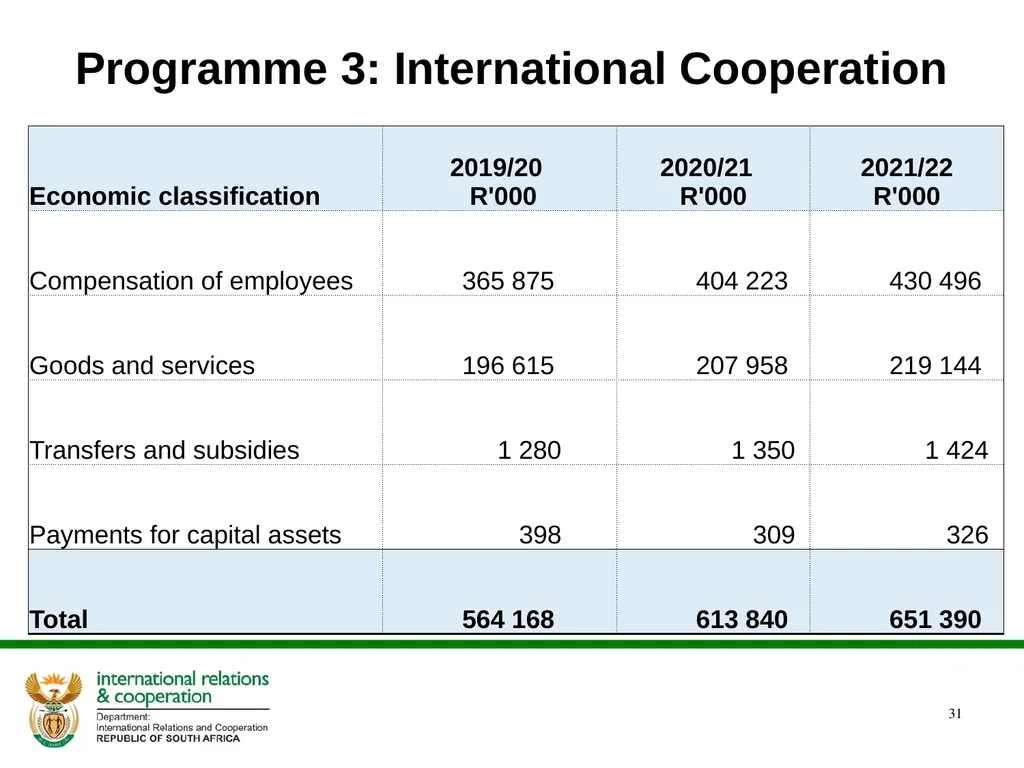
slide31. Programme 3: International Cooperation 31<br>
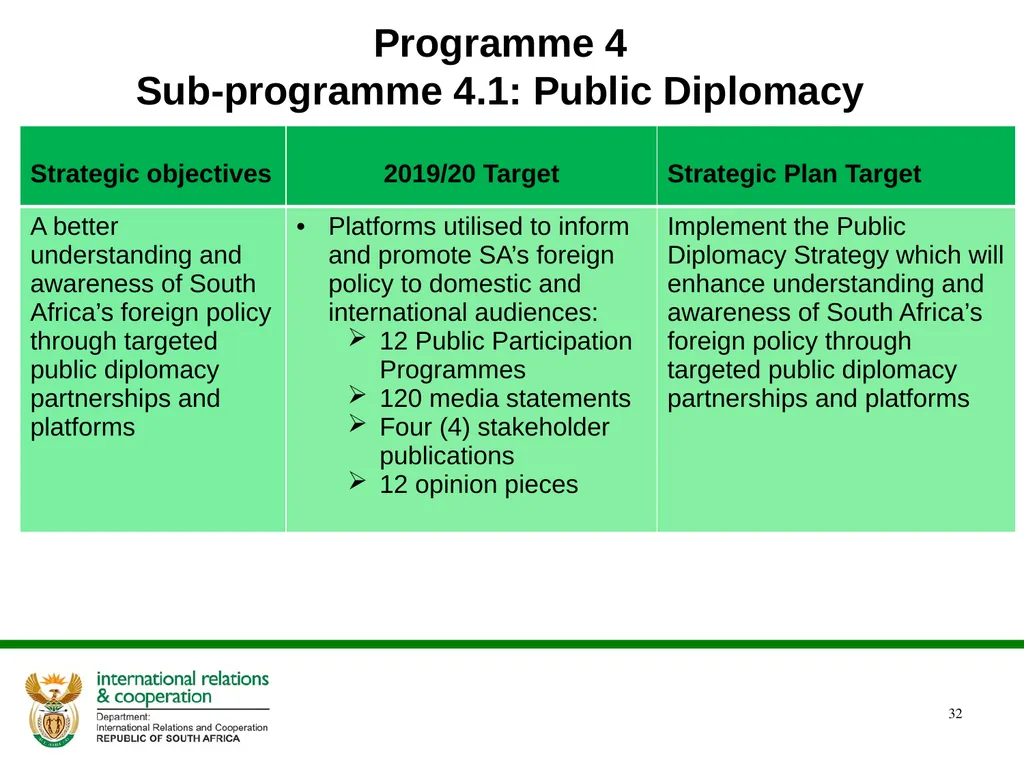
slide32. Programme 4 Sub-programme 4.1: Public Diplomacy 32<br>
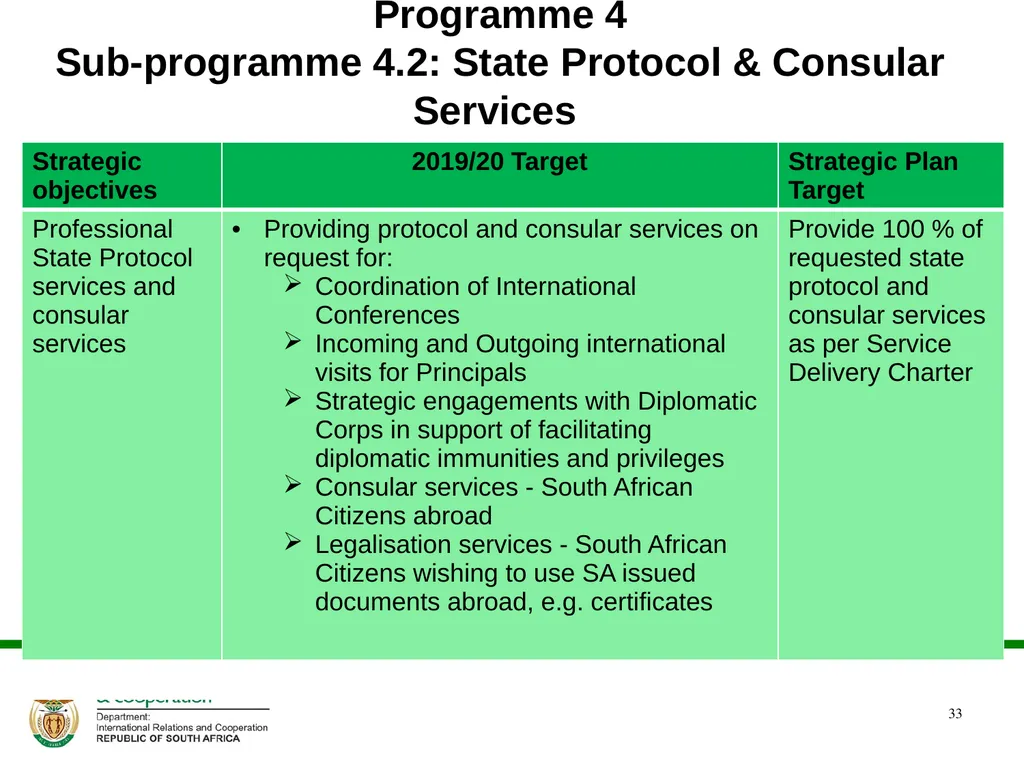
slide33. Programme 4 Sub-programme 4.2: State Protocol & Consular Services 33<br>
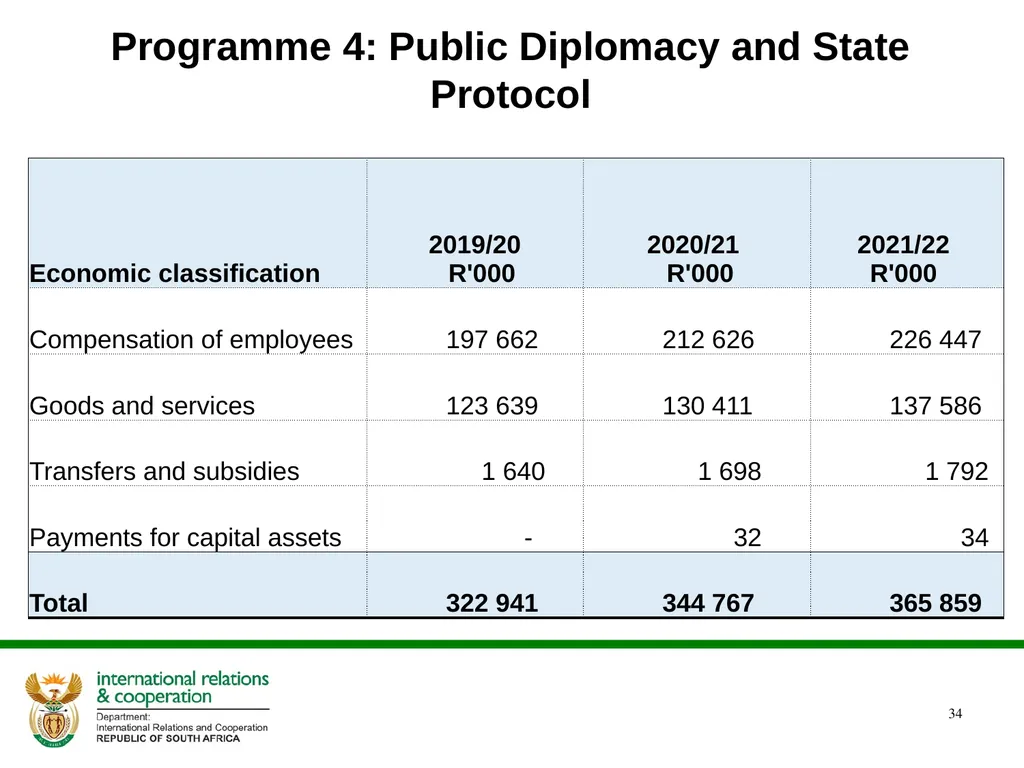
slide34. Programme 4: Public Diplomacy and State Protocol 34<br>
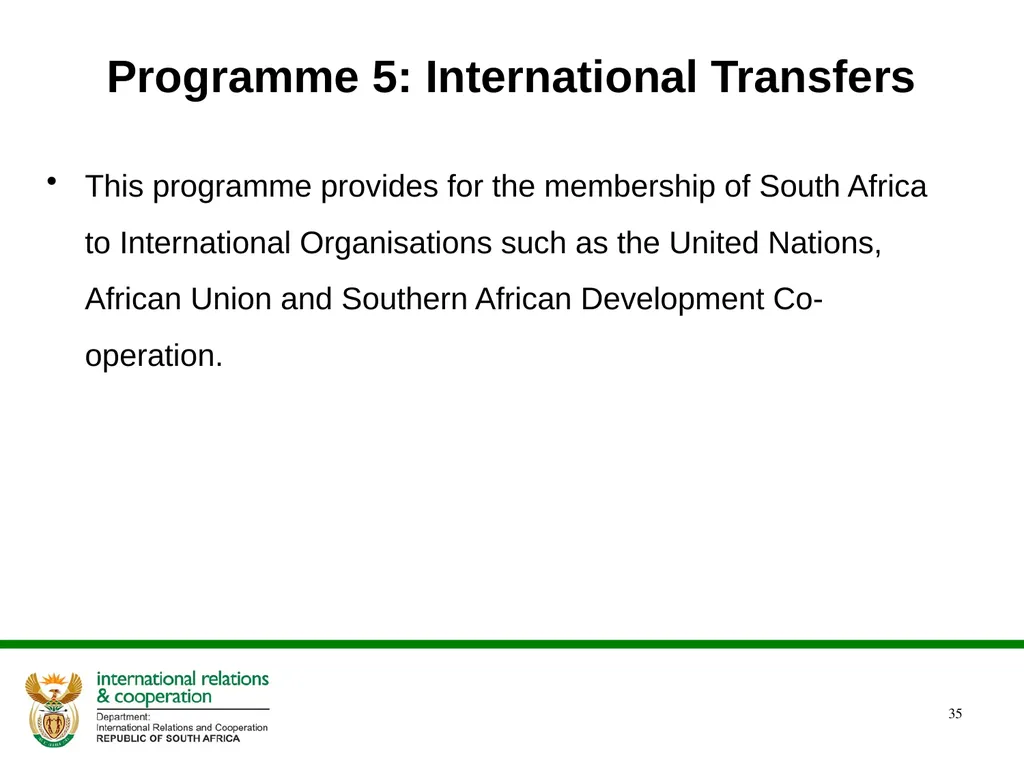
slide35. Programme 5: International Transfers This programme provides for the membership of South Africa to International Organisations such as the United Nations, African Union and Southern African Development Co-operation. 35<br>
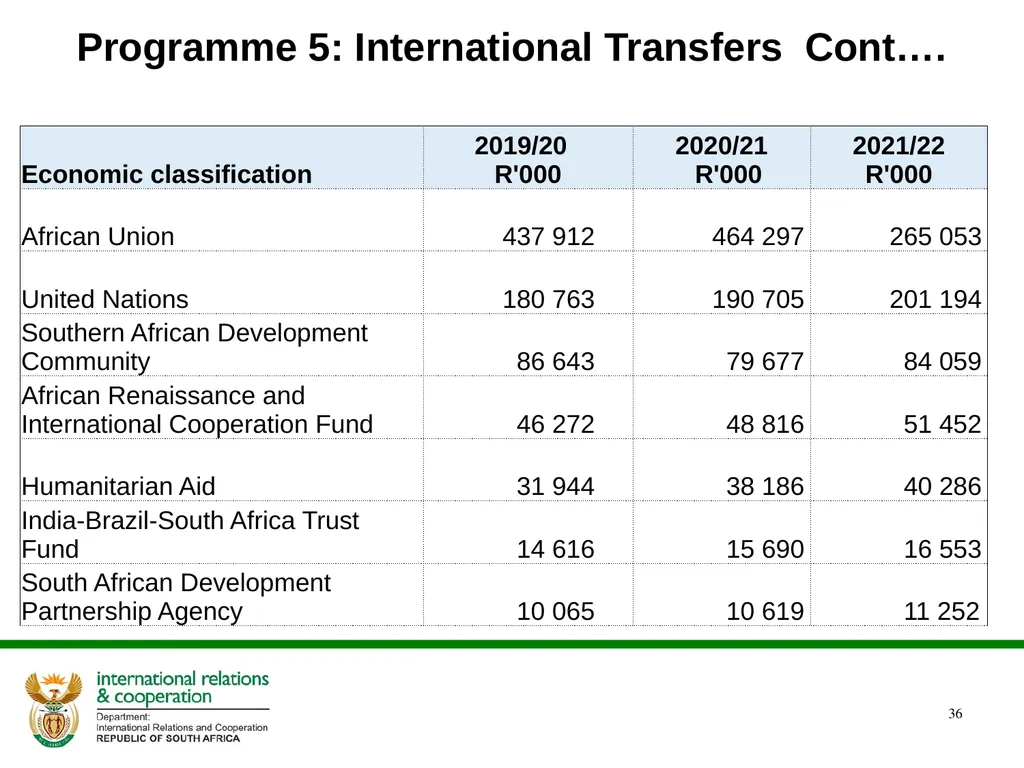
slide36. Programme 5: International Transfers Cont…. 36<br>
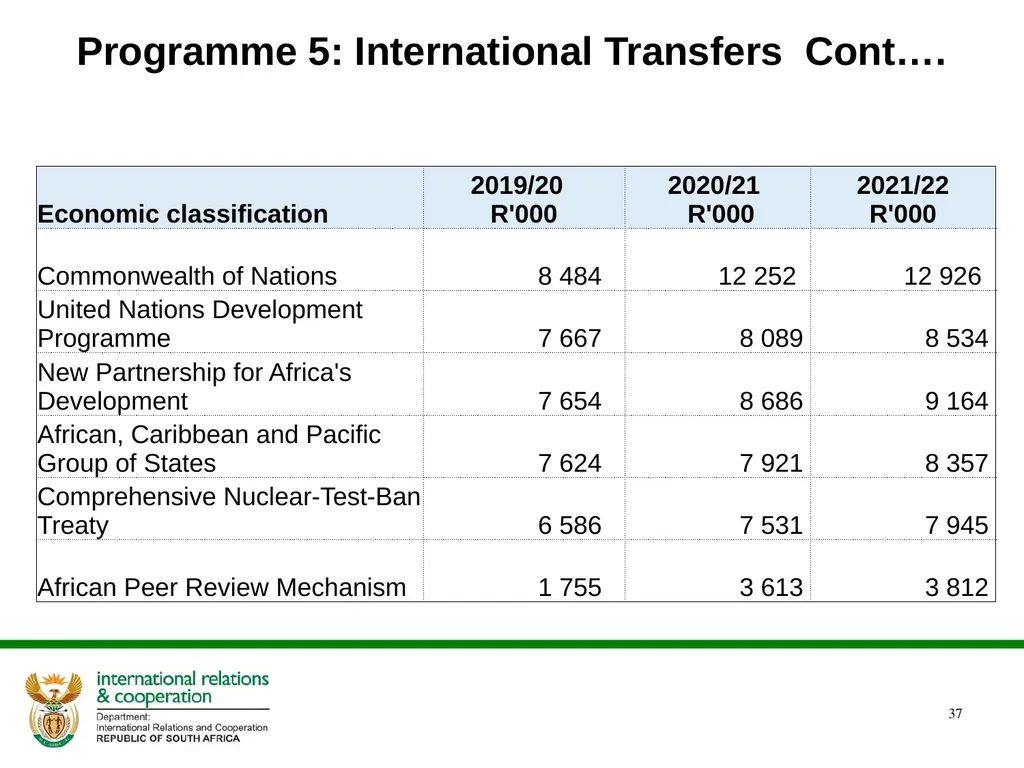
slide37. Programme 5: International Transfers Cont…. 37<br>
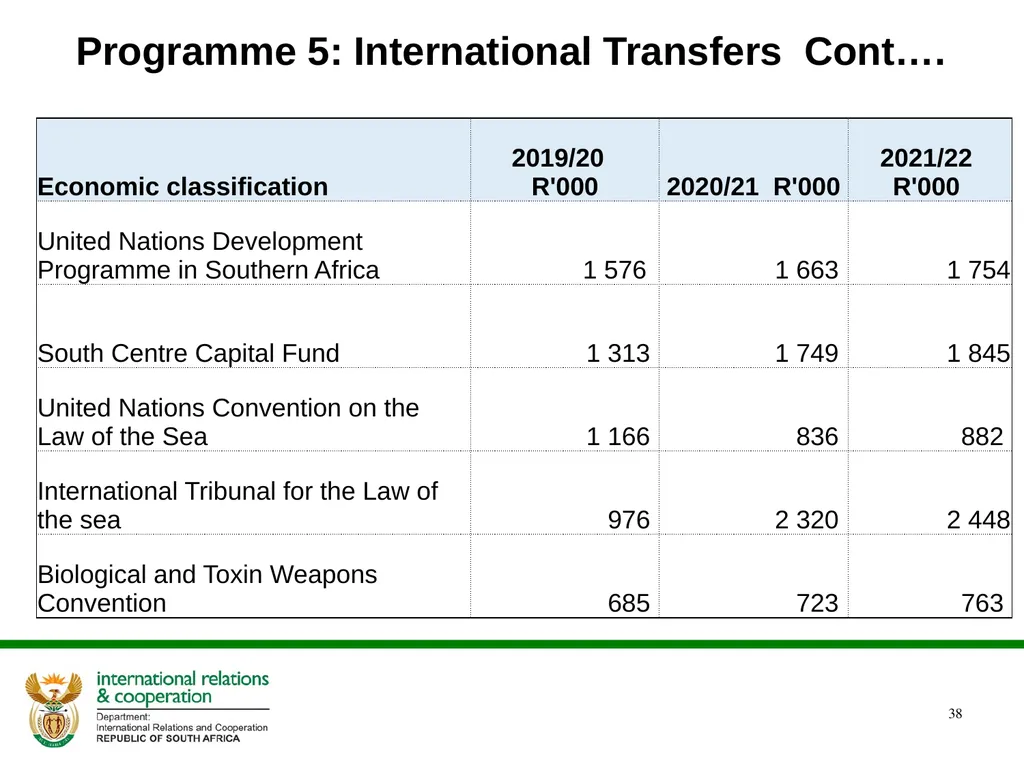
slide38. Programme 5: International Transfers Cont…. 38<br>
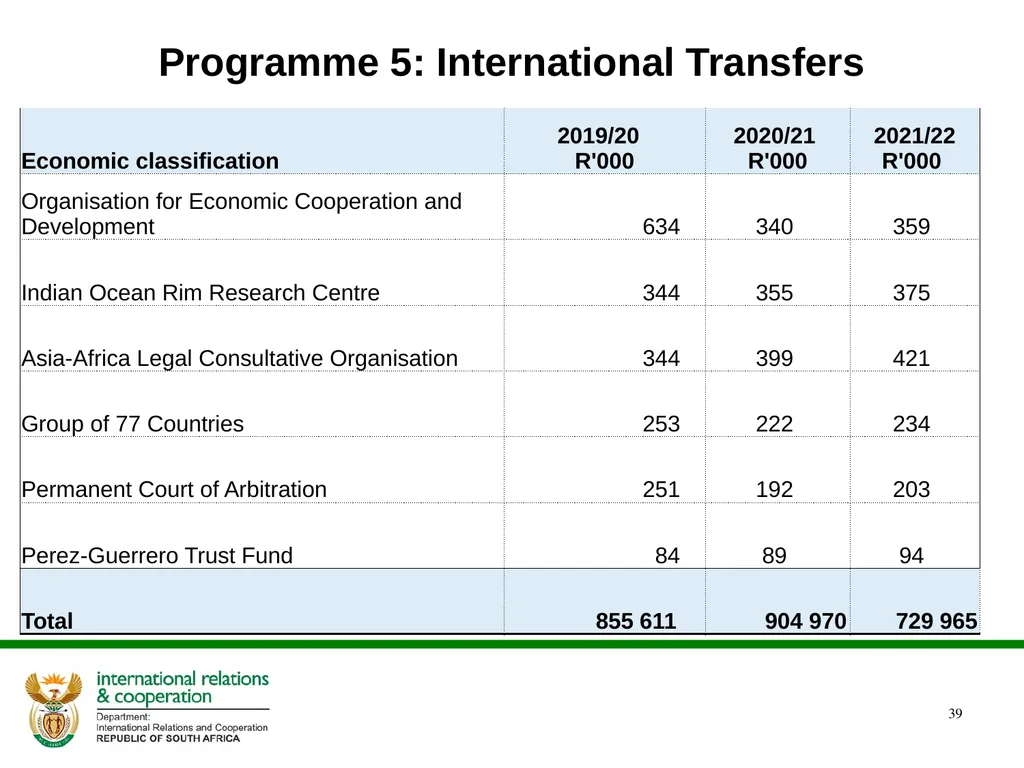
slide39. Programme 5: International Transfers 39<br>
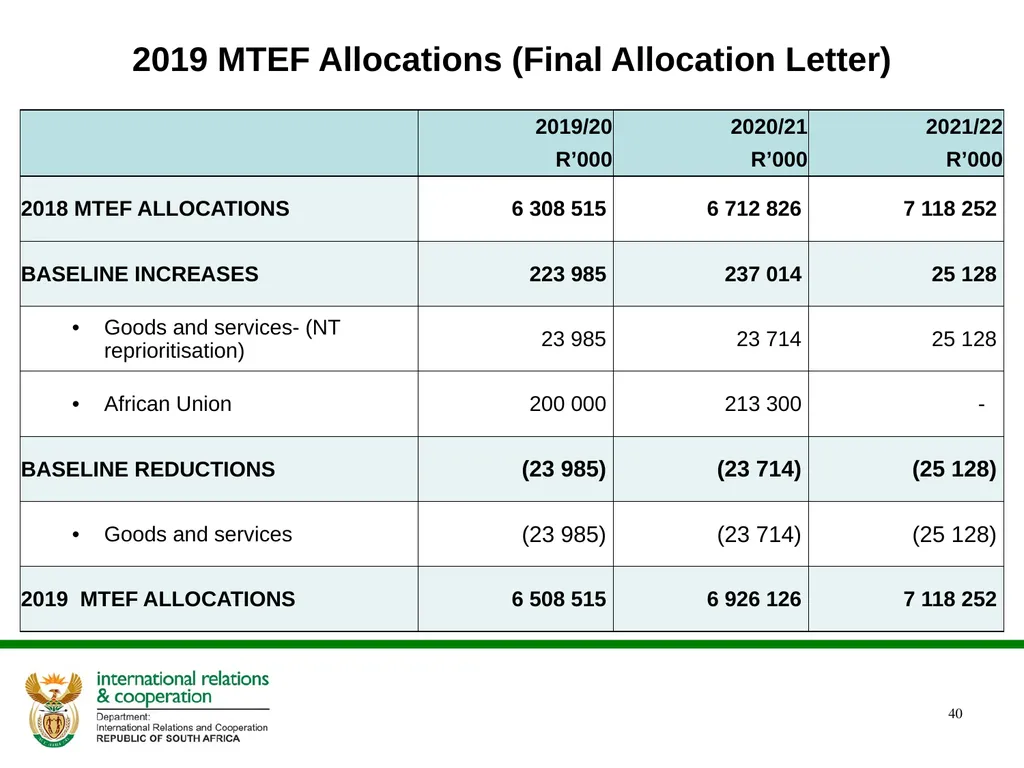
slide40. 2019 MTEF Allocations (Final Allocation Letter) 40<br>
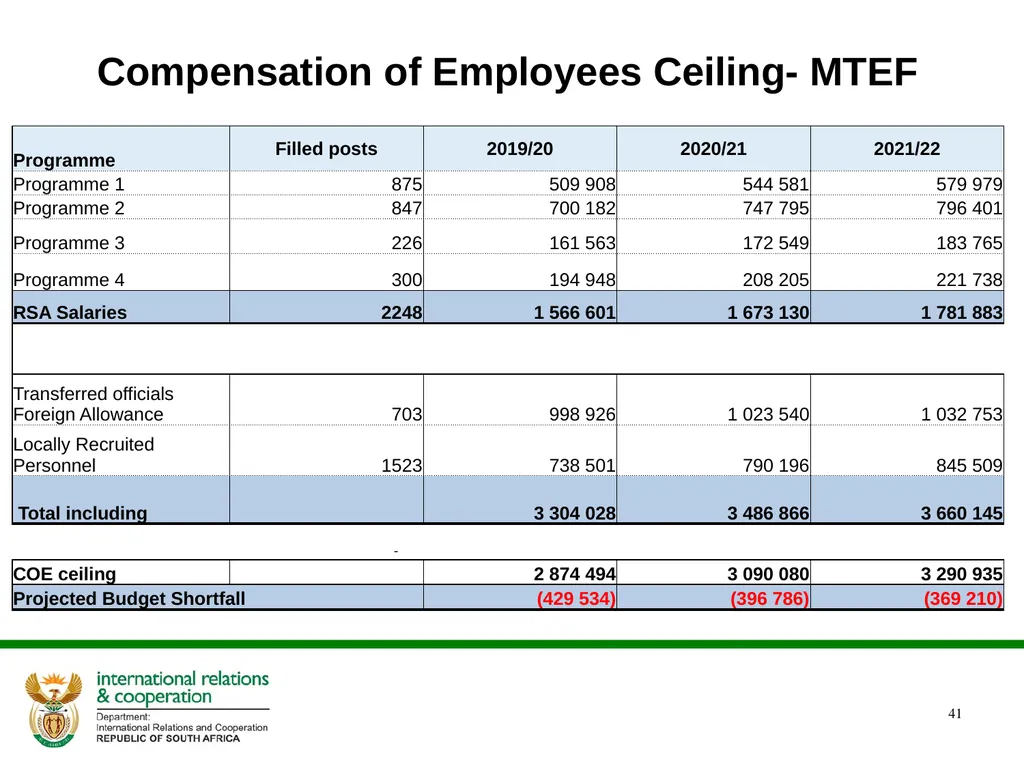
slide41. Compensation of Employees Ceiling- MTEF 41<br>
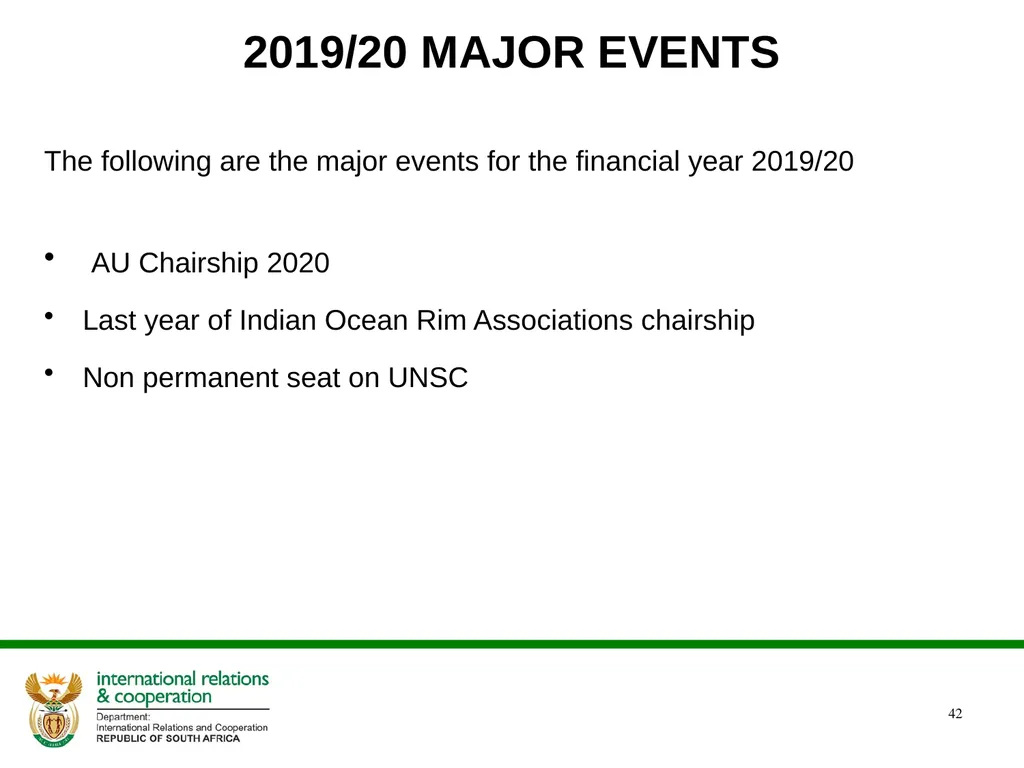
slide42. 2019/20 MAJOR EVENTS The following are the major events for the financial year 2019/20
AU Chairship 2020
Last year of Indian Ocean Rim Associations chairship
Non permanent seat on UNSC 42<br>
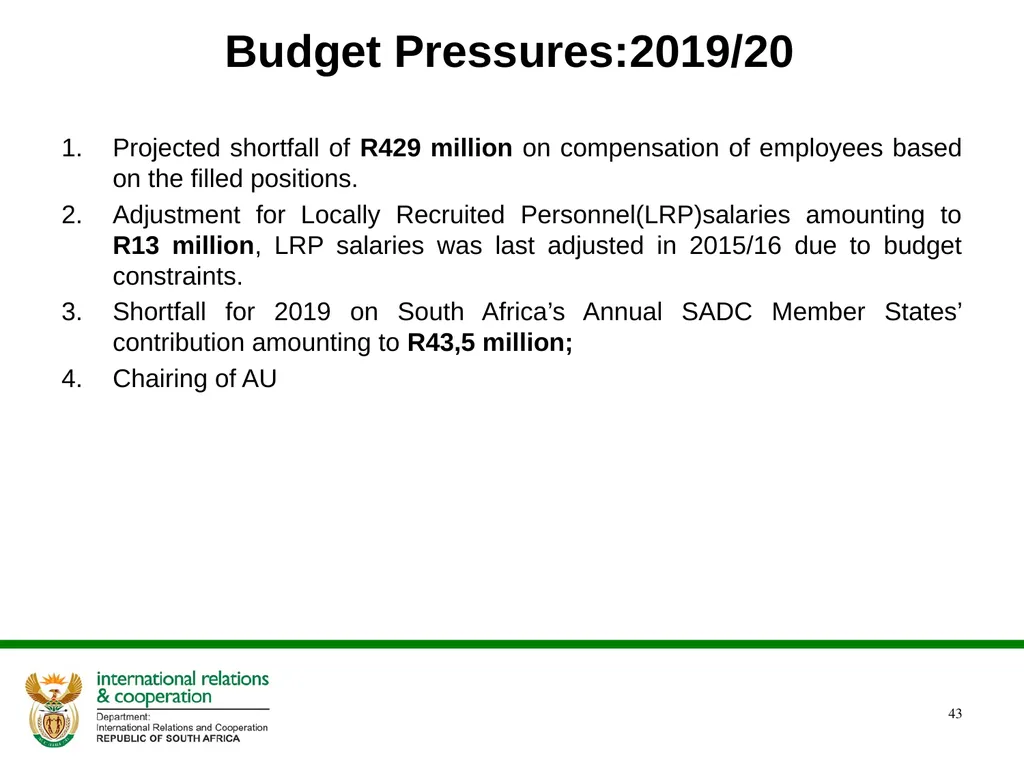
slide43. Budget Pressures:2019/20 Projected shortfall of R429 million on compensation of employees based on the filled positions.
Adjustment for Locally Recruited Personnel(LRP)salaries amounting to R13 million, LRP salaries was last adjusted in 2015/16 due to budget constraints.
Shortfall for 2019 on South Africa’s Annual SADC Member States’ contribution amounting to R43,5 million;
Chairing of AU 43<br>
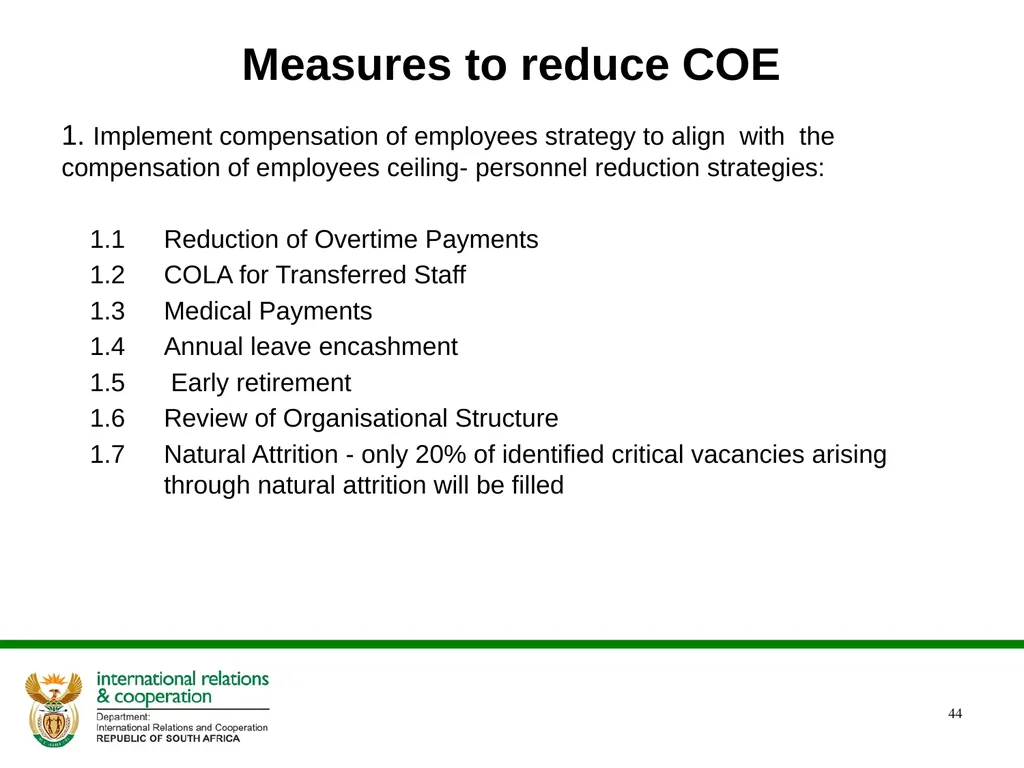
slide44. Measures to reduce COE 1. Implement compensation of employees strategy to align with the compensation of employees ceiling- personnel reduction strategies:
1.1 Reduction of Overtime Payments
1.2 COLA for Transferred Staff
1.3 Medical Payments
1.4 Annual leave encashment
1.5 Early retirement
1.6 Review of Organisational Structure
1.7 Natural Attrition - only 20% of identified critical vacancies arising through natural attrition will be filled 44<br>
slide45. Thank you<br>
ANNUAL PERFORMANCE PLAN 2019/20
OF THE
DEPARTMENT OF
INTERNATIONAL RELATIONS
AND
COOPERATION
JULY 2019<br>
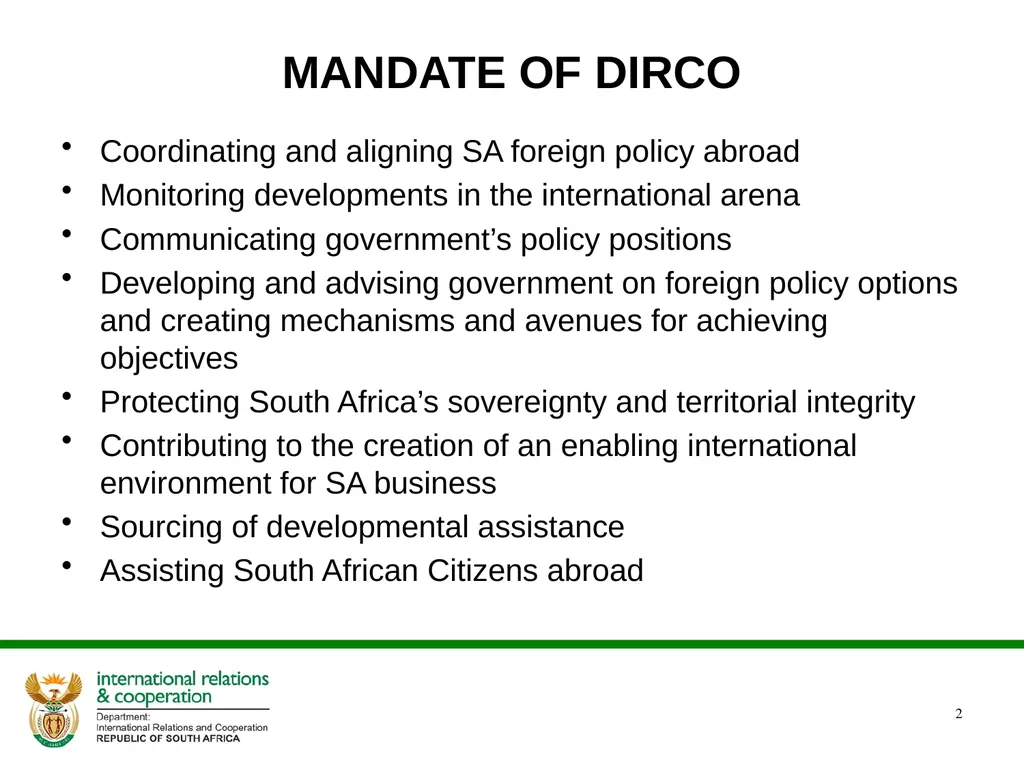
slide2. MANDATE OF DIRCO Coordinating and aligning SA foreign policy abroad
Monitoring developments in the international arena
Communicating government’s policy positions
Developing and advising government on foreign policy options and creating mechanisms and avenues for achieving objectives
Protecting South Africa’s sovereignty and territorial integrity
Contributing to the creation of an enabling international environment for SA business
Sourcing of developmental assistance
Assisting South African Citizens abroad 2<br>
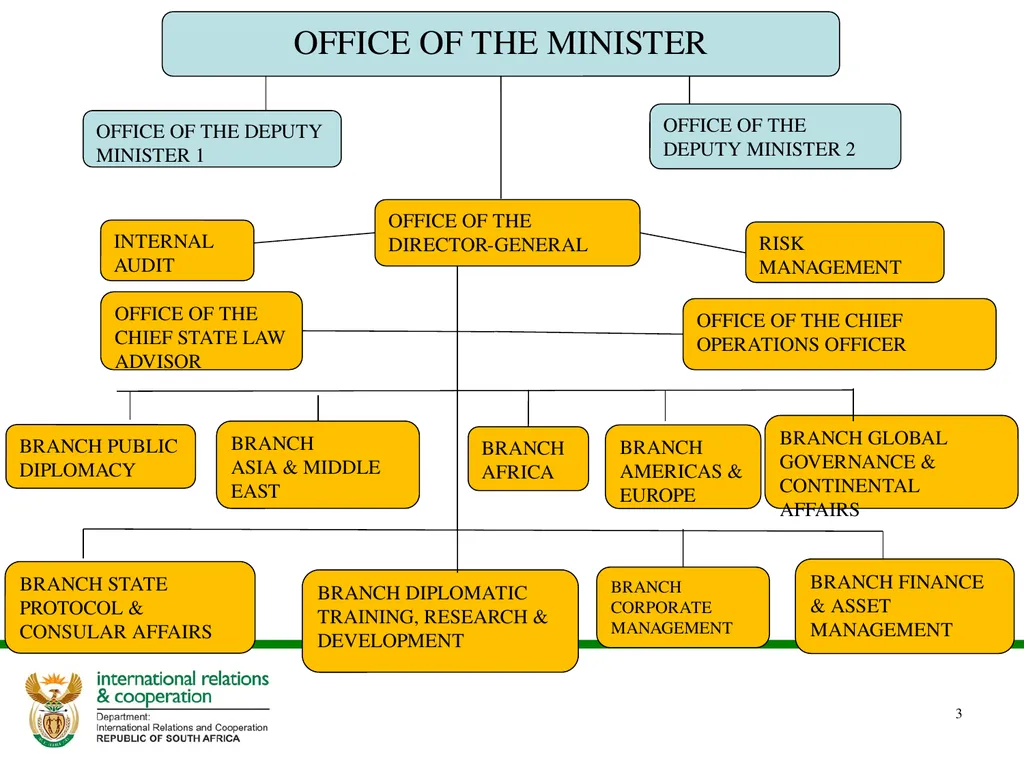
slide3. 3 OFFICE OF THE MINISTER OFFICE OF THE DEPUTY MINISTER 1 OFFICE OF THE DEPUTY MINISTER 2 OFFICE OF THE DIRECTOR-GENERAL INTERNAL AUDIT RISK MANAGEMENT OFFICE OF THE CHIEF STATE LAW ADVISOR OFFICE OF THE CHIEF OPERATIONS OFFICER BRANCH
AFRICA BRANCH FINANCE & ASSET MANAGEMENT BRANCH AMERICAS & EUROPE BRANCH
ASIA & MIDDLE EAST BRANCH CORPORATE MANAGEMENT BRANCH GLOBAL GOVERNANCE & CONTINENTAL AFFAIRS BRANCH DIPLOMATIC TRAINING, RESEARCH & DEVELOPMENT BRANCH PUBLIC DIPLOMACY BRANCH STATE PROTOCOL & CONSULAR AFFAIRS<br>
slide4. South Africa’s Global Footprint Missions per Region
Africa Bilateral – 46
Africa Multilateral – 1
Americas & Caribbean – 17
Europe – 27
Asia & Middle East – 32
Multilateral -2
Total: 125 4<br>
slide5. Legislative mandates The Foreign States Immunities Act, 1981 (Act 87 of 1981): This Act regulates the extent of the immunity of foreign states from the jurisdiction of the courts of the Republic and provides for matters connected therewith.
The Diplomatic Immunities and Privileges Act, 2001 (Act 37 of 2001): The Act provides for the immunities and privileges of diplomatic missions and consular posts and their members, of heads of states, special envoys and certain representatives of the United Nations and its specialised agencies, and other international organisations and of certain other persons.
The African Renaissance and International Cooperation Fund Act, 2001 (Act 51 of2001): The Act establishes an African Renaissance and International Cooperation Fund (ARF) to enhance cooperation between the Republic and other countries 5<br>
slide6. Policy mandates The Measures and Guidelines for Enhanced Coordination of South Africa’s International Engagements and its annexures, approved by Cabinet in 2009, establish more effective measures and mechanisms to coordinate the conduct of international relations and the implementation of South Africa’s foreign policy.
The White Paper on Foreign Policy, approved by Cabinet in 2011, assesses South Africa’s foreign policy against the rising expectations of the critical role of foreign policy to meet domestic priorities.
Foreign Service Dispensation (FSD) is implemented in terms of the provisions of Section 3(3) (c) of the Public Service Act, 1994 (Act 103 of 1994), as amended, and is applicable to designated employees who serve in a foreign country at a South African mission abroad and fall within the scope of the Public Service Coordinating Bargaining Council. 6<br>
slide7. INTRODUCTION The Annual Performance Plan 2019/20 is the deliverable against the outer year of the 2015 -2020 Revised Strategic Plan
The strategic outcome-orientated goal of the department is informed by the NDP 2030 Vision:
“To create a better South Africa and contribute to a better and safer Africa in a better world “
The Department deliver on this through the five budget programmes with the specific strategic objectives 7<br>
slide8. Budget Programmes Programme 1: Administration
Programme 2: International relations
Programme 3 International cooperation
Programme 4: Public Diplomacy’ State Protocol and Consular Services
Programme 5: International Transfers 8<br>
slide9. 9 The National Development Plan (NDP) serves as an overarching vision that guides our foreign policy imperatives and our international relations programme
The situational analysis is divided into two; namely: (1) Performance Environment, and the (2) Operational Environment.
(1) Performance Environment
South Africa’s foreign policy is implemented within a highly dynamic and challenging global environment that is often volatile, unpredictable complex and ambiguous.(VUCA)
Globalisation continues to shape the world at an accelerating pace.
Global trends such as rising populism, global economic imbalances, the emergence and societal impact of social networks and climate change SITUATION ANALYSIS<br>
slide10. 10 The international order is restructured and global trends converge on issues of migration, increase of non state actors, changing face of and the increasing threat of terrorism, impact of Fourth Industrial Revolution particular the impact of Artificial Intelligence
The trade tensions between the US and China impacting the global economy including South Africa’s drive for inclusive economic growth
Current tensions between the US and Iran may escalate and raise the prospect of open conflict in the Middle East
The rise of new economic powers and competing spheres of influence.
Pockets of political instability in some of the countries on the continent remains a challenge and South Africa will continue to play its part in conflict resolutions. SITUATION ANALYSIS<br>
slide11. SITUATION ANALYSIS (2) Organisational Environment
South Africa’s diplomatic service is conducted within a dynamic environment with varying foreign legislative contexts and unstable monetary regimes that impact on the resources of the department.
In view of the increasing demands being placed on the national fiscus and the drive to curtail the public sector wage bill, departments have to operate within a set ceiling of compensation of employees.
DIRCO found itself affected by the ceiling being set below the existing wage bill which leaves the department with very little room to maneuver.
The Foreign Service Bill was referred back for an engagement on Clause 2 and should be finalized in 2019 and the intention is to table the Partnership Fund for Development Bill for finalization in 2019/20.
The implementation of the 2019/2020 Annual Performance Plan should be viewed against the performance and organisational environments alluded to above. 11<br>
slide12. 12 Utilise South Africa’s bilateral engagements and Mission footprint to contribute to the government drive for inclusive economic growth as articulated in SONA June 2019
Implement the AU Agenda 2063, by bolstering continental self-reliance so as to reduce dependency on international cooperation; support for the Continental Free Trade Agreement
Continue to negotiate and influence the outcomes of key multilateral structures and advocate for reform of the global governance institutions;
Utilize the Co-Chairship of the G20 Development Working Group (DWG) to promote priorities that support economic development and inclusive growth that would be of benefit to RSA, the African continent and the developing world
Chairing the AU in 2020
Serving as a non-permanent member on the UNSC The focus of the APP in the period under review will amongst others be covering the following:<br>
slide13. 2019 MTEF Allocations R’000 13<br>
slide14. Programme 1: Administration 14 Strategic Objectives:
To implement effective HR management to ensure that adequate and sufficient skilled resources are in place and that performance is monitored
To provide an integrated ICT system that enables delivery of the department’s mandate
Effective management of resources through sound administration and good governance
Accredited training, research and institutionalised mediation capacity<br>
slide15. Programme 1: Administration Programme 1 mainly deals with compliance and effective management therefore only a few indicators
Focus in the 2019/20 APP
100% compliance with 30 day payment period
105 training programmes
100% of Legal services upon request
10 programmes to advance gender mainstreaming, youth development and access for people with disabilities 15<br>
slide16. Programme 1: Administration 16<br>
slide17. Programme 2: International Relations Bilateral engagements are the basis for strengthening political and economic relations and provide the platform to advance national priorities and to lobby support for multilateral engagements and common positions.
Bilateral mechanisms enable us to address our domestic imperatives including prioritising increased exports of South African goods and services; increase foreign direct investment (FDI) with technology transfers into value-added industries and mineral beneficiation; as well as increased inbound tourism and skills enhancement
These engagements remain important vehicles for cooperation and promoting SA’s national priorities as reflected in the NDP and articulated in SONA June 2019.
Through these engagements, the priority needs of Africa and the South are pursued and bilateral relations are further deepened and expanded.<br>
slide18. Programme 2: International Relations 18 Sub-programmes Africa; Americas and the Caribbean; Asia and the Middle East; and Europe<br>
slide19. Programme 2: International Relations The department is committed to utilise its mission footprint to engage in economic diplomacy to contribute to the achievement of SA’s domestic priorities as articulated SONA June 2019 .
These initiatives undertaken by the missions through hosting /participating in trade seminars, tourism promotion, engagement with chamber of commerce, potential investors and relevant government ministries contribute to the following:
the increase of value-added exports;
attract Foreign Direct Investment to priority sectors (NGP and IPAP);
promote the removal of non tariff barriers;
address SA’s skills shortages through the transfer of technology and training opportunities and;
enhance South Africa’s image abroad;<br>
slide20. Programme 2: International Relations 20<br>
slide21. Programme 2: International Relations: SADC Regional integration remains critical for the economic development of the region.
It is essential to strengthen political cohesion within SADC and ensuring political stability and economic viability through strengthening governance and institutional capacity within SADC.
South Africa will continue to participate in election observer missions as part of SADC.<br>
slide22. Programme 2: International Relations Regional Integration 22<br>
slide23. Programme 2: International Relations 23<br>
slide24. Programme 3: International Cooperation Sub-programme 3.1: Global Governance South Africa is committed to multilateralism and a rules-based international order and to this end participates and plays an active role in all fora of the United Nations system and its specialised agencies, funds and programmes
SA must be represented at multilateral fora to engage, influence, negotiate and articulate its positions and to have these positions reflected in the outcomes of multilateral meetings and processes.
With particular focus on peace and security, sustainable development (social, economic and environmental) protection and promotion of human rights and humanitarian affairs, international crime and international law<br>
slide25. Programme 3: International Cooperation Sub-programme 3.1: Global Governance SA regards the UN as the foremost vehicle to advance the global development agenda and address underdevelopment and the eradication of poverty.
South Africa Currently serving its third term as non permanent member of the UNSC (2019- 2020) and will chair the UNSC during October 2019.
South Africa has undertaken to present South Africa’s Voluntary National Report (VNR) on SDG implementation to the High level Political Forum.
The NDP stipulates that DIRCO must retain an influential space for SA in key multilateral institutions.<br>
slide26. Programme 3: International Cooperation 26<br>
slide27. Sub -programme 3.2 Continental Cooperation South Africa will align its foreign policy engagements with Africa’s Agenda 2063 to contribute to the socio-economic development of the African continent.
South Africa will continue to focus on implementation of the continental integration agenda, regional economic integration and finding African Solutions to African problems through:
Strengthening the AU and its structures
Participating in peace missions, and (Peace, Conflict, Reconstruction and Development (PCRD) initiatives
Promotion of Good Governance & protection of Human Rights
Contributing to Socio-economic development
South Africa will be chairing the AU in 2020<br>
slide28. Programme 3 (Continental Cooperation) 28<br>
slide29. Programme 3 (South – South Cooperation) 29<br>
slide30. Programme 3 (North – South Cooperation) 30<br>
slide31. Programme 3: International Cooperation 31<br>
slide32. Programme 4 Sub-programme 4.1: Public Diplomacy 32<br>
slide33. Programme 4 Sub-programme 4.2: State Protocol & Consular Services 33<br>
slide34. Programme 4: Public Diplomacy and State Protocol 34<br>
slide35. Programme 5: International Transfers This programme provides for the membership of South Africa to International Organisations such as the United Nations, African Union and Southern African Development Co-operation. 35<br>
slide36. Programme 5: International Transfers Cont…. 36<br>
slide37. Programme 5: International Transfers Cont…. 37<br>
slide38. Programme 5: International Transfers Cont…. 38<br>
slide39. Programme 5: International Transfers 39<br>
slide40. 2019 MTEF Allocations (Final Allocation Letter) 40<br>
slide41. Compensation of Employees Ceiling- MTEF 41<br>
slide42. 2019/20 MAJOR EVENTS The following are the major events for the financial year 2019/20
AU Chairship 2020
Last year of Indian Ocean Rim Associations chairship
Non permanent seat on UNSC 42<br>
slide43. Budget Pressures:2019/20 Projected shortfall of R429 million on compensation of employees based on the filled positions.
Adjustment for Locally Recruited Personnel(LRP)salaries amounting to R13 million, LRP salaries was last adjusted in 2015/16 due to budget constraints.
Shortfall for 2019 on South Africa’s Annual SADC Member States’ contribution amounting to R43,5 million;
Chairing of AU 43<br>
slide44. Measures to reduce COE 1. Implement compensation of employees strategy to align with the compensation of employees ceiling- personnel reduction strategies:
1.1 Reduction of Overtime Payments
1.2 COLA for Transferred Staff
1.3 Medical Payments
1.4 Annual leave encashment
1.5 Early retirement
1.6 Review of Organisational Structure
1.7 Natural Attrition - only 20% of identified critical vacancies arising through natural attrition will be filled 44<br>
slide45. Thank you<br>