
Presentation on the Skills Audit Report and the
TG
Published · 52 slides · 0 views

1 / 1
Description
Presentation on the Skills Audit Report and the Tourism Sector Human Resource Development Strategy to the Portfolio Committee on Tourism 22 November 2017 Tourism Sector Skills Audit and Strategy 22 November 2017 2 Presentation Outline
Related Topics
Share
Embed code
Download this presentation From Below
"Presentation on the Skills Audit Report and the" is the property of its rightful owner. Permission is granted to download and print the materials on this website for personal, non-commercial use only, and to display it on your personal computer provided you do not modify the materials and that you retain all copyright notices contained in the materials. By downloading content from our website, you accept the terms of this agreement.
Presentation Transcript
01
Presentation on the Skills Audit Report and
the Tourism Sector Human Resource Development Strategy
to the
Portfolio Committee on Tourism
22 November 2017<br>
02
Tourism Sector Skills Audit and Strategy 22 November 2017 2 Presentation Outline Acronyms.
Context and overview of the TSHRD Strategy.
Skills Audit and TSHRD Strategy Review and Methodology.
Overview of the Skills Audit Findings as a way of contextualizing the TSHRD Strategy.
Summary of the TSHRD Strategy for South Africa (2016-2026).
TSHRD Strategy implementation plan and the Monitoring and Evaluation Framework.
The way forward.<br>
Context and overview of the TSHRD Strategy.
Skills Audit and TSHRD Strategy Review and Methodology.
Overview of the Skills Audit Findings as a way of contextualizing the TSHRD Strategy.
Summary of the TSHRD Strategy for South Africa (2016-2026).
TSHRD Strategy implementation plan and the Monitoring and Evaluation Framework.
The way forward.<br>
03
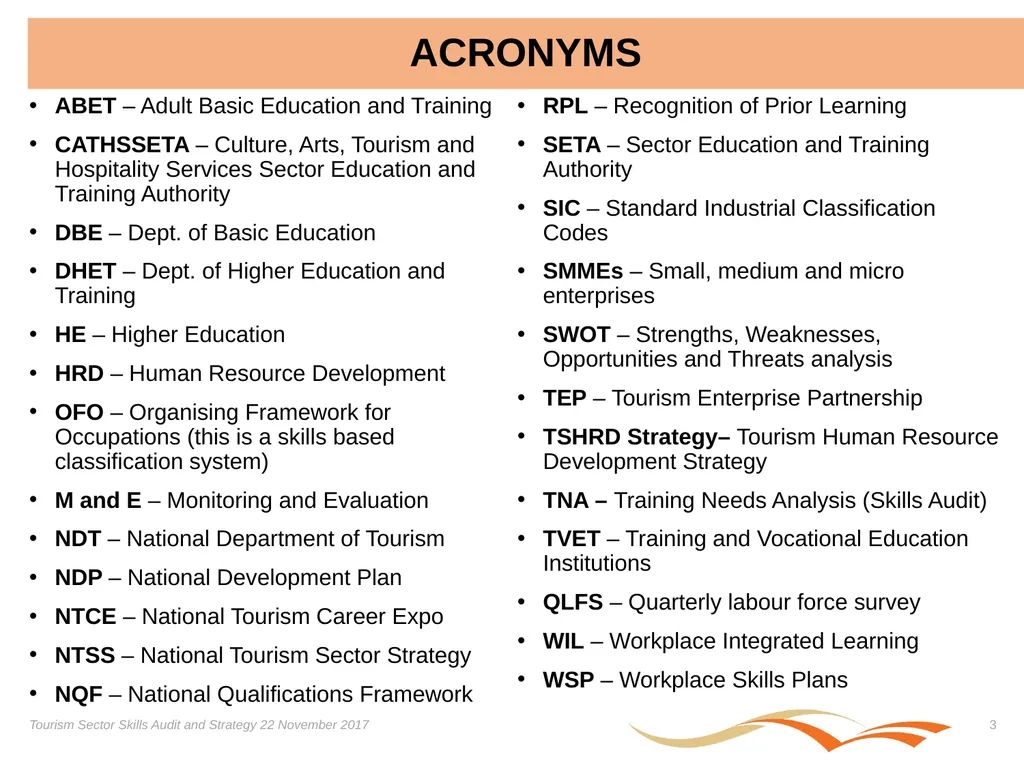
Tourism Sector Skills Audit and Strategy 22 November 2017 3 ACRONYMS ABET – Adult Basic Education and Training
CATHSSETA – Culture, Arts, Tourism and Hospitality Services Sector Education and Training Authority
DBE – Dept. of Basic Education
DHET – Dept. of Higher Education and Training
HE – Higher Education
HRD – Human Resource Development
OFO – Organising Framework for Occupations (this is a skills based classification system)
M and E – Monitoring and Evaluation
NDT – National Department of Tourism
NDP – National Development Plan
NTCE – National Tourism Career Expo
NTSS – National Tourism Sector Strategy
NQF – National Qualifications Framework
RPL – Recognition of Prior Learning
SETA – Sector Education and Training Authority
SIC – Standard Industrial Classification Codes
SMMEs – Small, medium and micro enterprises
SWOT – Strengths, Weaknesses, Opportunities and Threats analysis
TEP – Tourism Enterprise Partnership
TSHRD Strategy– Tourism Human Resource Development Strategy
TNA – Training Needs Analysis (Skills Audit)
TVET – Training and Vocational Education Institutions
QLFS – Quarterly labour force survey
WIL – Workplace Integrated Learning
WSP – Workplace Skills Plans<br>
CATHSSETA – Culture, Arts, Tourism and Hospitality Services Sector Education and Training Authority
DBE – Dept. of Basic Education
DHET – Dept. of Higher Education and Training
HE – Higher Education
HRD – Human Resource Development
OFO – Organising Framework for Occupations (this is a skills based classification system)
M and E – Monitoring and Evaluation
NDT – National Department of Tourism
NDP – National Development Plan
NTCE – National Tourism Career Expo
NTSS – National Tourism Sector Strategy
NQF – National Qualifications Framework
RPL – Recognition of Prior Learning
SETA – Sector Education and Training Authority
SIC – Standard Industrial Classification Codes
SMMEs – Small, medium and micro enterprises
SWOT – Strengths, Weaknesses, Opportunities and Threats analysis
TEP – Tourism Enterprise Partnership
TSHRD Strategy– Tourism Human Resource Development Strategy
TNA – Training Needs Analysis (Skills Audit)
TVET – Training and Vocational Education Institutions
QLFS – Quarterly labour force survey
WIL – Workplace Integrated Learning
WSP – Workplace Skills Plans<br>
04
4 CONTEXT AND OVERVIEW OF THE
TSHRD STRATEGY Tourism industry has been recognised as having significant growth potential (5.4% employment growth annually);
It contributes to economic growth and employment creation;
Growth potential could be harnessed to a much greater extent if certain conditions are met;
Hindering this growth potential are factors such global competitiveness, excellent visitor experience, and safety and security;
All of these factors are to a varying extent influenced by the quality of human resource development in the industry. Tourism Sector Skills Audit and Strategy 22 November 2017<br>
It contributes to economic growth and employment creation;
Growth potential could be harnessed to a much greater extent if certain conditions are met;
Hindering this growth potential are factors such global competitiveness, excellent visitor experience, and safety and security;
All of these factors are to a varying extent influenced by the quality of human resource development in the industry. Tourism Sector Skills Audit and Strategy 22 November 2017<br>
05
SKILLS AUDIT
AND
TSHRD STRATEGY REVIEW AND METHODOLOGY Tourism Sector Skills Audit and Strategy 22 November 2017 5<br>
AND
TSHRD STRATEGY REVIEW AND METHODOLOGY Tourism Sector Skills Audit and Strategy 22 November 2017 5<br>
06
WHY A TSHRD STRATEGY REVIEW? Much has changed since 2008
Tourism Act (2014)
Adoption of National Tourism Sector Strategy
A dedicated National Department of Tourism
National Development Plan Vision 2030
Impact of Technology - consider new trends and implications - new skills and/or reskilling (e.g. Uber, Air BNB etc.)
But many of the problems identified in the previous strategy still remain…. Tourism Sector Skills Audit and Strategy 22 November 2017 6<br>
Tourism Act (2014)
Adoption of National Tourism Sector Strategy
A dedicated National Department of Tourism
National Development Plan Vision 2030
Impact of Technology - consider new trends and implications - new skills and/or reskilling (e.g. Uber, Air BNB etc.)
But many of the problems identified in the previous strategy still remain…. Tourism Sector Skills Audit and Strategy 22 November 2017 6<br>
07
WHY A TSHRD STRATEGY REVIEW? Cont …. Concerns with absorption of tourism/hospitality graduates,
Graduates generally viewed as not meeting employer expectations
Low wages, almost non-existent labour market pathways and poor employment conditions
Education and training system is fragmented, curricula perceived not to be aligned to employer needs, and quality is highly variable
Complex nature of training supply across many sources Tourism Sector Skills Audit and Strategy 22 November 2017 7<br>
Graduates generally viewed as not meeting employer expectations
Low wages, almost non-existent labour market pathways and poor employment conditions
Education and training system is fragmented, curricula perceived not to be aligned to employer needs, and quality is highly variable
Complex nature of training supply across many sources Tourism Sector Skills Audit and Strategy 22 November 2017 7<br>
08
TSHRD STRATEGY RESEARCH OBJECTIVES Overall Purpose: Conducting a skills audit and develop a comprehensive HRD strategy for the Tourism industry, through a consultative and participatory process for the period 2016 - 2026.
Specific Objectives:
To identify the specific workforce skills needs and gaps in the tourism sector
Compile employees’ current skills profile
Provide skills profiles for Tourism Industry occupations
Profile the existing skills and knowledge in the Tourism Industry;
Identify the scarce and critical skills needs of the Tourism Industry Tourism Sector Skills Audit and Strategy 22 November 2017 8<br>
Specific Objectives:
To identify the specific workforce skills needs and gaps in the tourism sector
Compile employees’ current skills profile
Provide skills profiles for Tourism Industry occupations
Profile the existing skills and knowledge in the Tourism Industry;
Identify the scarce and critical skills needs of the Tourism Industry Tourism Sector Skills Audit and Strategy 22 November 2017 8<br>
09
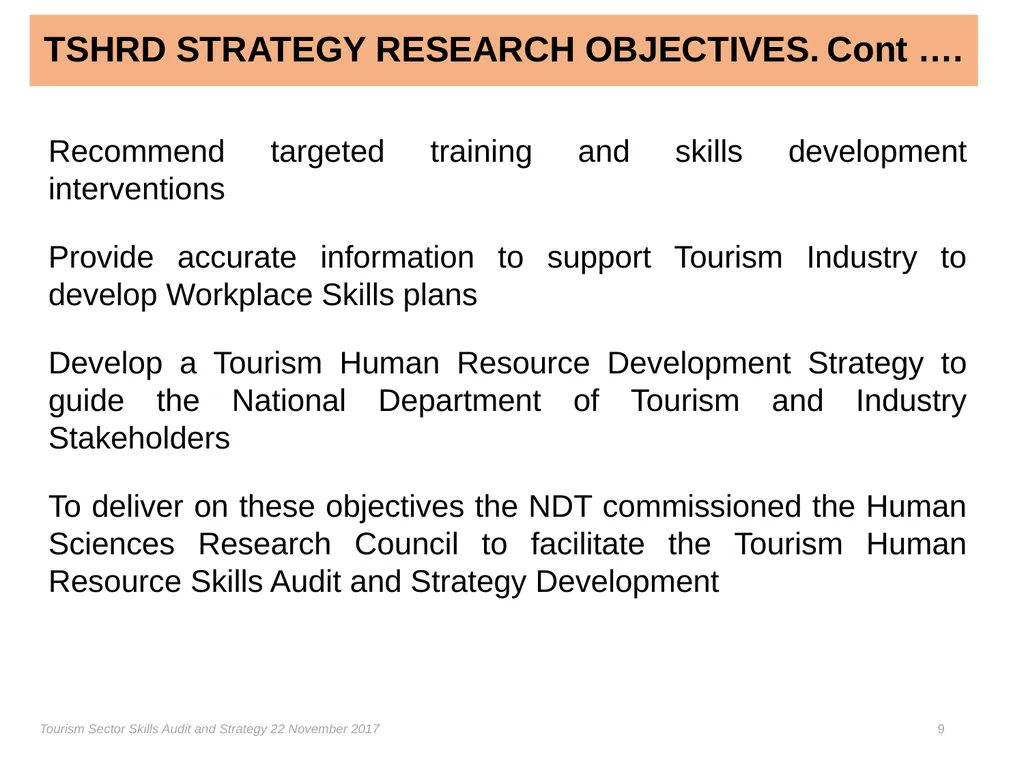
TSHRD STRATEGY RESEARCH OBJECTIVES. Cont …. Recommend targeted training and skills development interventions
Provide accurate information to support Tourism Industry to develop Workplace Skills plans
Develop a Tourism Human Resource Development Strategy to guide the National Department of Tourism and Industry Stakeholders
To deliver on these objectives the NDT commissioned the Human Sciences Research Council to facilitate the Tourism Human Resource Skills Audit and Strategy Development Tourism Sector Skills Audit and Strategy 22 November 2017 9<br>
Provide accurate information to support Tourism Industry to develop Workplace Skills plans
Develop a Tourism Human Resource Development Strategy to guide the National Department of Tourism and Industry Stakeholders
To deliver on these objectives the NDT commissioned the Human Sciences Research Council to facilitate the Tourism Human Resource Skills Audit and Strategy Development Tourism Sector Skills Audit and Strategy 22 November 2017 9<br>
10
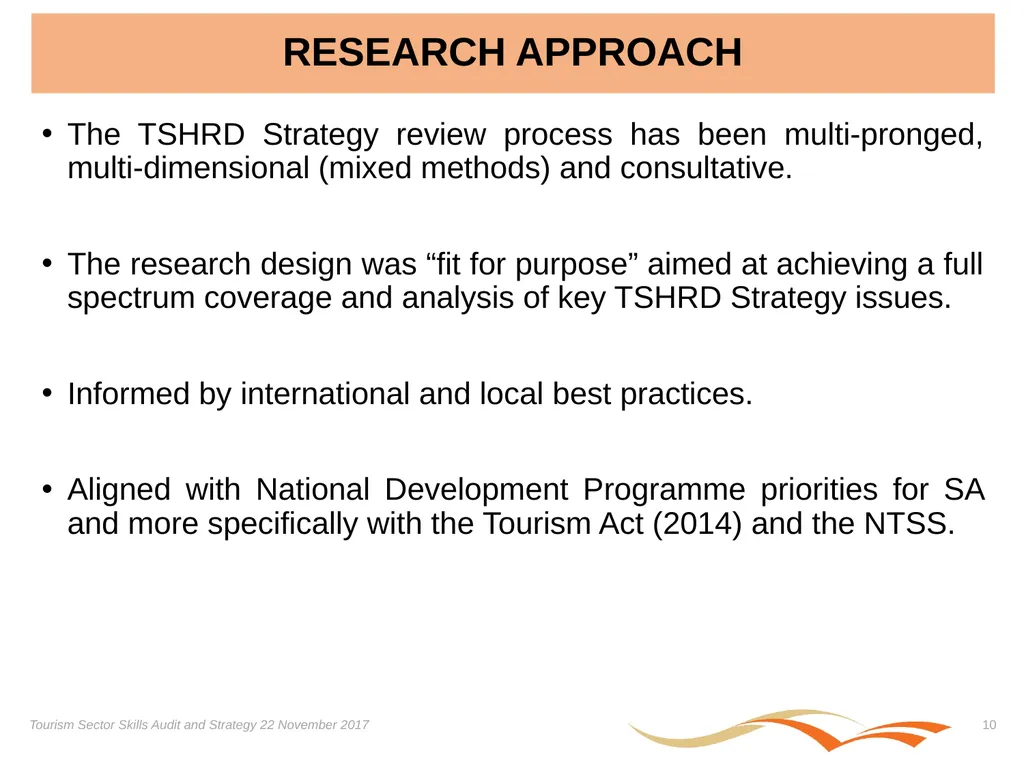
RESEARCH APPROACH The TSHRD Strategy review process has been multi-pronged, multi-dimensional (mixed methods) and consultative.
The research design was “fit for purpose” aimed at achieving a full spectrum coverage and analysis of key TSHRD Strategy issues.
Informed by international and local best practices.
Aligned with National Development Programme priorities for SA and more specifically with the Tourism Act (2014) and the NTSS. Tourism Sector Skills Audit and Strategy 22 November 2017 10<br>
The research design was “fit for purpose” aimed at achieving a full spectrum coverage and analysis of key TSHRD Strategy issues.
Informed by international and local best practices.
Aligned with National Development Programme priorities for SA and more specifically with the Tourism Act (2014) and the NTSS. Tourism Sector Skills Audit and Strategy 22 November 2017 10<br>
11
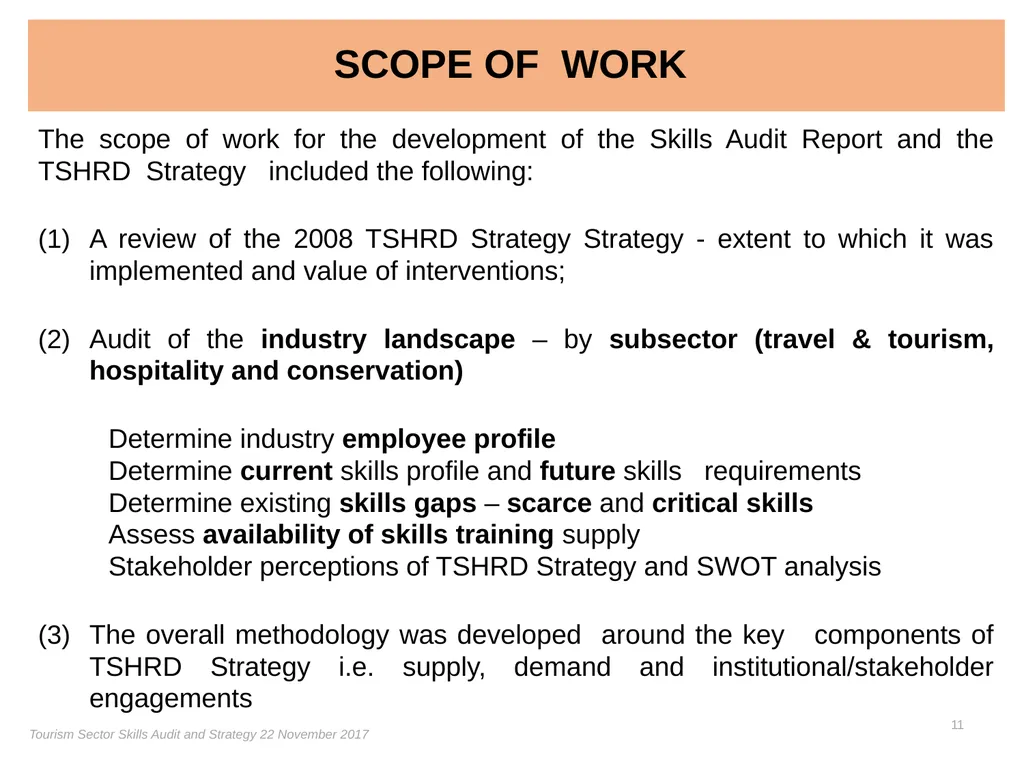
SCOPE OF WORK The scope of work for the development of the Skills Audit Report and the TSHRD Strategy included the following:
A review of the 2008 TSHRD Strategy Strategy - extent to which it was implemented and value of interventions;
Audit of the industry landscape – by subsector (travel & tourism, hospitality and conservation)
Determine industry employee profile
Determine current skills profile and future skills requirements
Determine existing skills gaps – scarce and critical skills
Assess availability of skills training supply
Stakeholder perceptions of TSHRD Strategy and SWOT analysis
The overall methodology was developed around the key components of TSHRD Strategy i.e. supply, demand and institutional/stakeholder engagements Tourism Sector Skills Audit and Strategy 22 November 2017 11<br>
A review of the 2008 TSHRD Strategy Strategy - extent to which it was implemented and value of interventions;
Audit of the industry landscape – by subsector (travel & tourism, hospitality and conservation)
Determine industry employee profile
Determine current skills profile and future skills requirements
Determine existing skills gaps – scarce and critical skills
Assess availability of skills training supply
Stakeholder perceptions of TSHRD Strategy and SWOT analysis
The overall methodology was developed around the key components of TSHRD Strategy i.e. supply, demand and institutional/stakeholder engagements Tourism Sector Skills Audit and Strategy 22 November 2017 11<br>
12
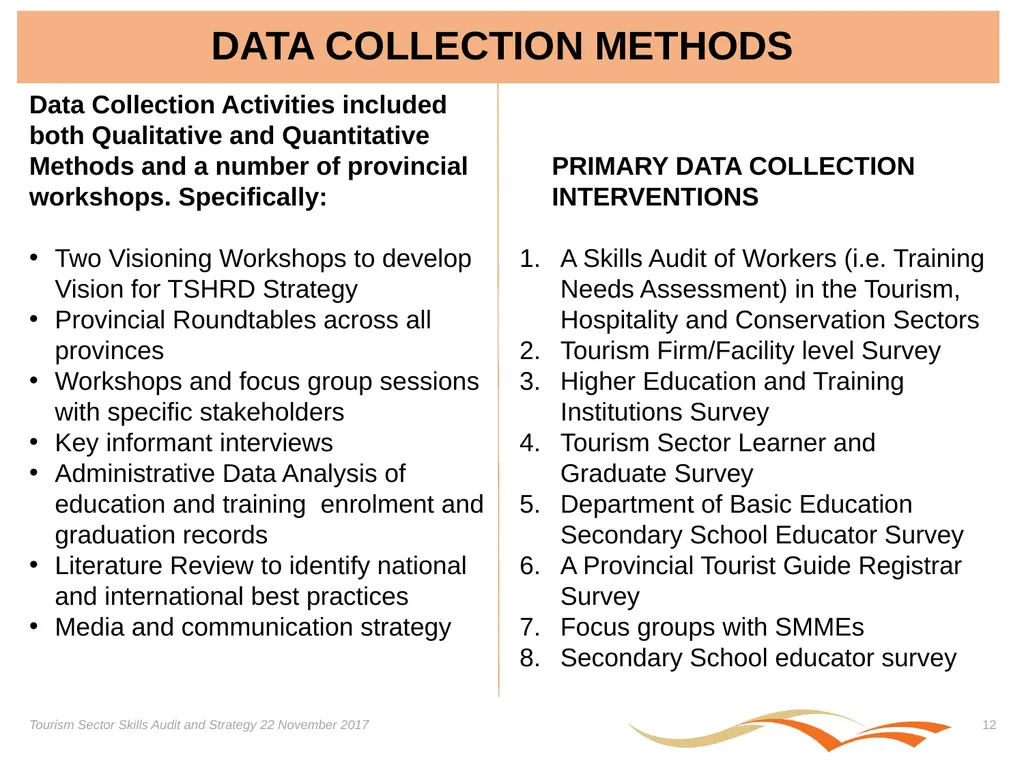
DATA COLLECTION METHODS Data Collection Activities included both Qualitative and Quantitative Methods and a number of provincial workshops. Specifically:
Two Visioning Workshops to develop Vision for TSHRD Strategy
Provincial Roundtables across all provinces
Workshops and focus group sessions with specific stakeholders
Key informant interviews
Administrative Data Analysis of education and training enrolment and graduation records
Literature Review to identify national and international best practices
Media and communication strategy
PRIMARY DATA COLLECTION
INTERVENTIONS
A Skills Audit of Workers (i.e. Training Needs Assessment) in the Tourism, Hospitality and Conservation Sectors
Tourism Firm/Facility level Survey
Higher Education and Training Institutions Survey
Tourism Sector Learner and Graduate Survey
Department of Basic Education Secondary School Educator Survey
A Provincial Tourist Guide Registrar Survey
Focus groups with SMMEs
Secondary School educator survey Tourism Sector Skills Audit and Strategy 22 November 2017 12<br>
Two Visioning Workshops to develop Vision for TSHRD Strategy
Provincial Roundtables across all provinces
Workshops and focus group sessions with specific stakeholders
Key informant interviews
Administrative Data Analysis of education and training enrolment and graduation records
Literature Review to identify national and international best practices
Media and communication strategy
PRIMARY DATA COLLECTION
INTERVENTIONS
A Skills Audit of Workers (i.e. Training Needs Assessment) in the Tourism, Hospitality and Conservation Sectors
Tourism Firm/Facility level Survey
Higher Education and Training Institutions Survey
Tourism Sector Learner and Graduate Survey
Department of Basic Education Secondary School Educator Survey
A Provincial Tourist Guide Registrar Survey
Focus groups with SMMEs
Secondary School educator survey Tourism Sector Skills Audit and Strategy 22 November 2017 12<br>
13
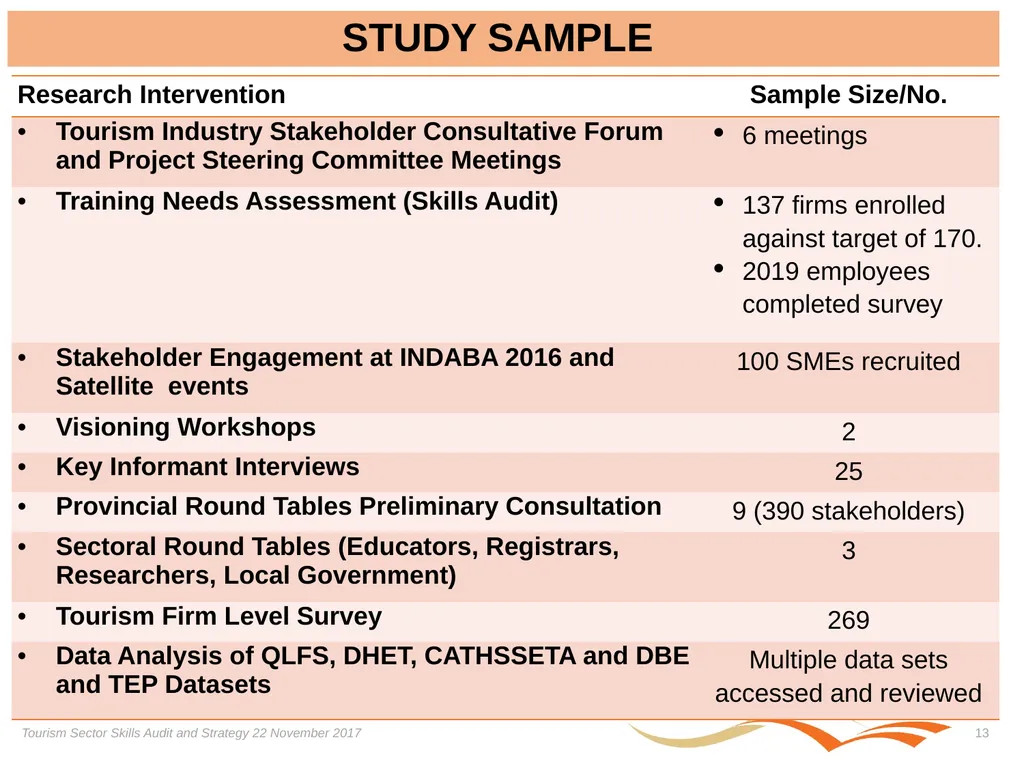
STUDY SAMPLE Tourism Sector Skills Audit and Strategy 22 November 2017 13<br>
14
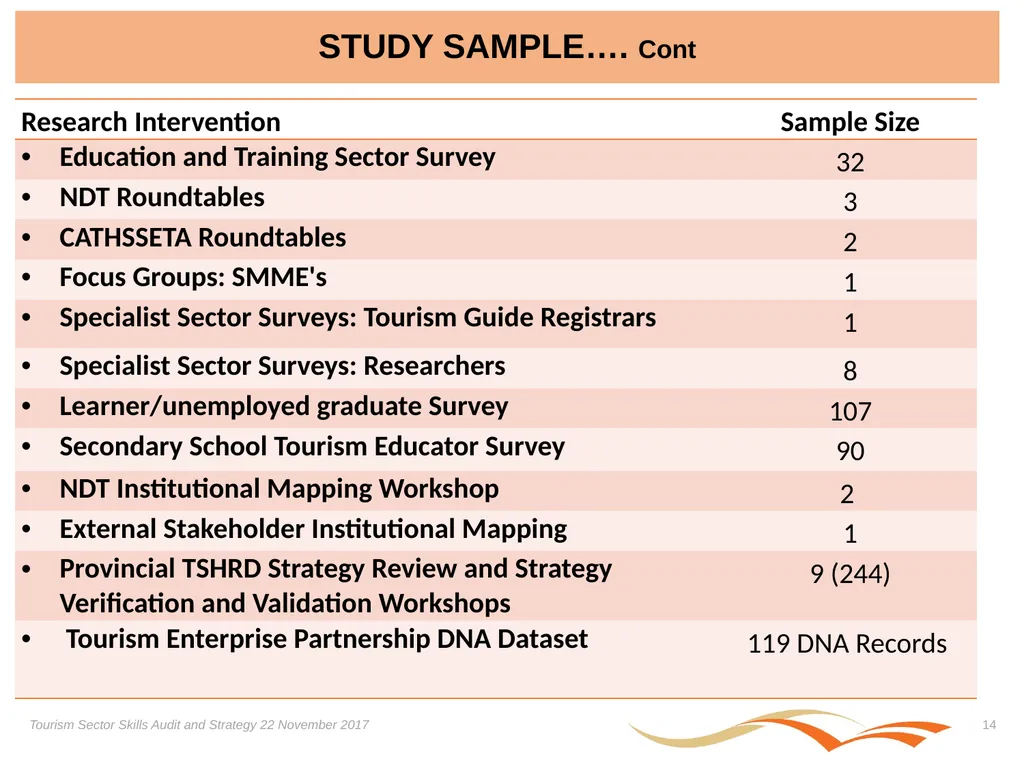
STUDY SAMPLE…. Cont Tourism Sector Skills Audit and Strategy 22 November 2017 14<br>
15
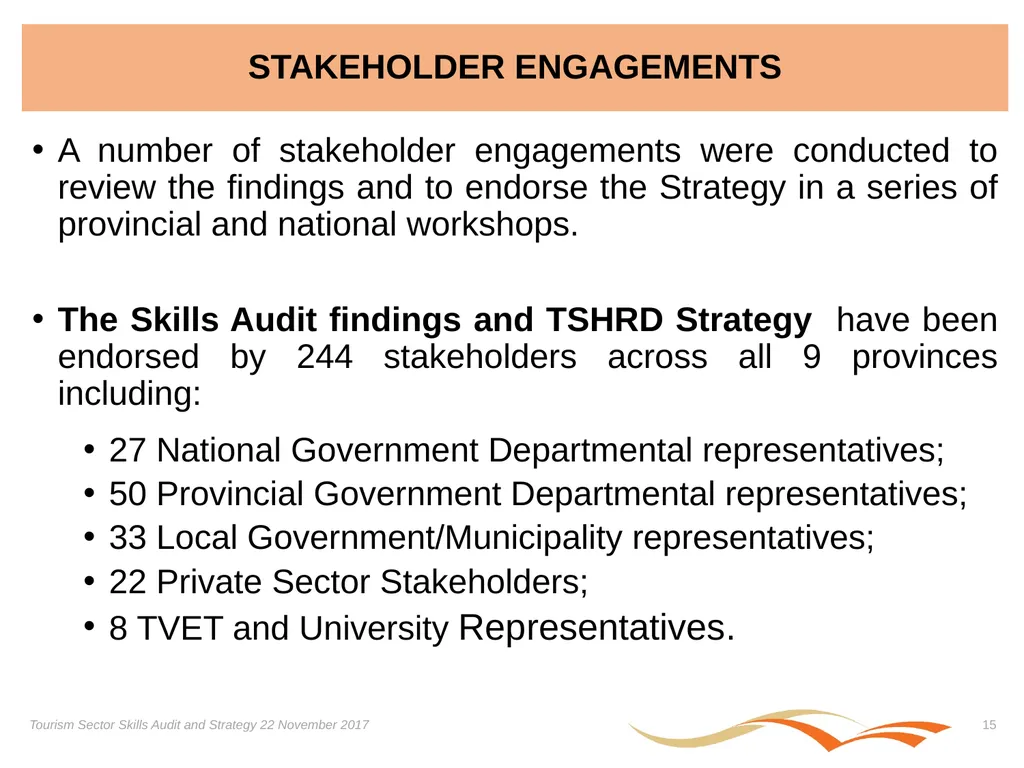
STAKEHOLDER ENGAGEMENTS A number of stakeholder engagements were conducted to review the findings and to endorse the Strategy in a series of provincial and national workshops.
The Skills Audit findings and TSHRD Strategy have been endorsed by 244 stakeholders across all 9 provinces including:
27 National Government Departmental representatives;
50 Provincial Government Departmental representatives;
33 Local Government/Municipality representatives;
22 Private Sector Stakeholders;
8 TVET and University Representatives. Tourism Sector Skills Audit and Strategy 22 November 2017 15<br>
The Skills Audit findings and TSHRD Strategy have been endorsed by 244 stakeholders across all 9 provinces including:
27 National Government Departmental representatives;
50 Provincial Government Departmental representatives;
33 Local Government/Municipality representatives;
22 Private Sector Stakeholders;
8 TVET and University Representatives. Tourism Sector Skills Audit and Strategy 22 November 2017 15<br>
16
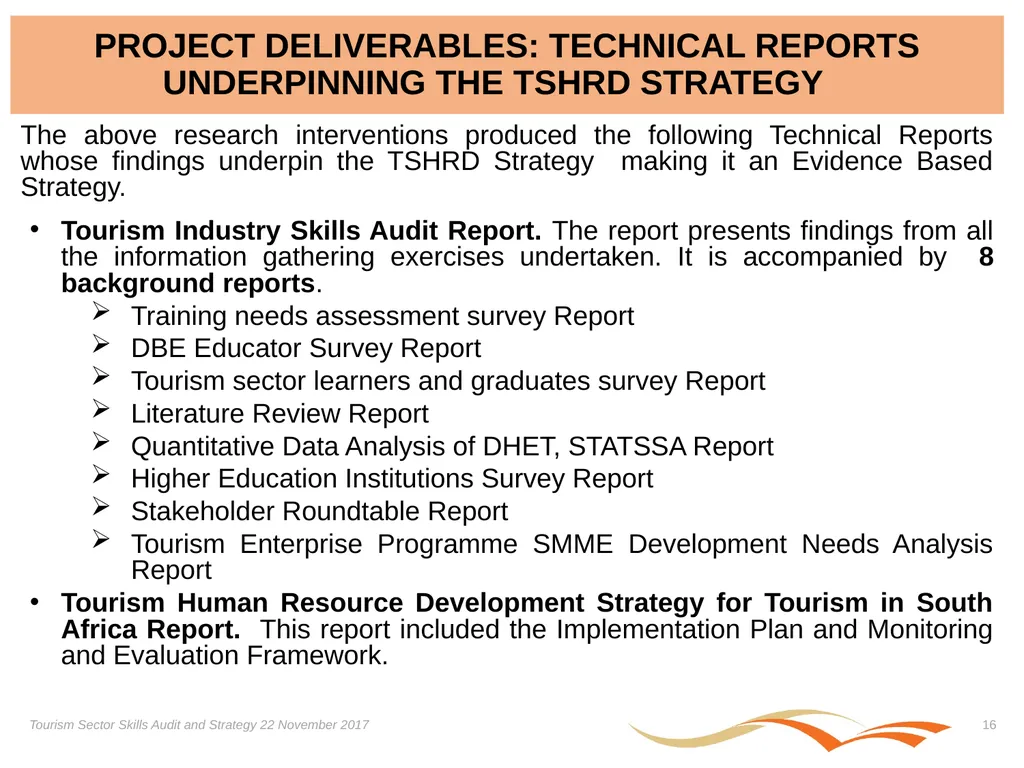
PROJECT DELIVERABLES: TECHNICAL REPORTS UNDERPINNING THE TSHRD STRATEGY The above research interventions produced the following Technical Reports whose findings underpin the TSHRD Strategy making it an Evidence Based Strategy.
Tourism Industry Skills Audit Report. The report presents findings from all the information gathering exercises undertaken. It is accompanied by 8 background reports.
Training needs assessment survey Report
DBE Educator Survey Report
Tourism sector learners and graduates survey Report
Literature Review Report
Quantitative Data Analysis of DHET, STATSSA Report
Higher Education Institutions Survey Report
Stakeholder Roundtable Report
Tourism Enterprise Programme SMME Development Needs Analysis Report
Tourism Human Resource Development Strategy for Tourism in South Africa Report. This report included the Implementation Plan and Monitoring and Evaluation Framework. Tourism Sector Skills Audit and Strategy 22 November 2017 16<br>
Tourism Industry Skills Audit Report. The report presents findings from all the information gathering exercises undertaken. It is accompanied by 8 background reports.
Training needs assessment survey Report
DBE Educator Survey Report
Tourism sector learners and graduates survey Report
Literature Review Report
Quantitative Data Analysis of DHET, STATSSA Report
Higher Education Institutions Survey Report
Stakeholder Roundtable Report
Tourism Enterprise Programme SMME Development Needs Analysis Report
Tourism Human Resource Development Strategy for Tourism in South Africa Report. This report included the Implementation Plan and Monitoring and Evaluation Framework. Tourism Sector Skills Audit and Strategy 22 November 2017 16<br>
17
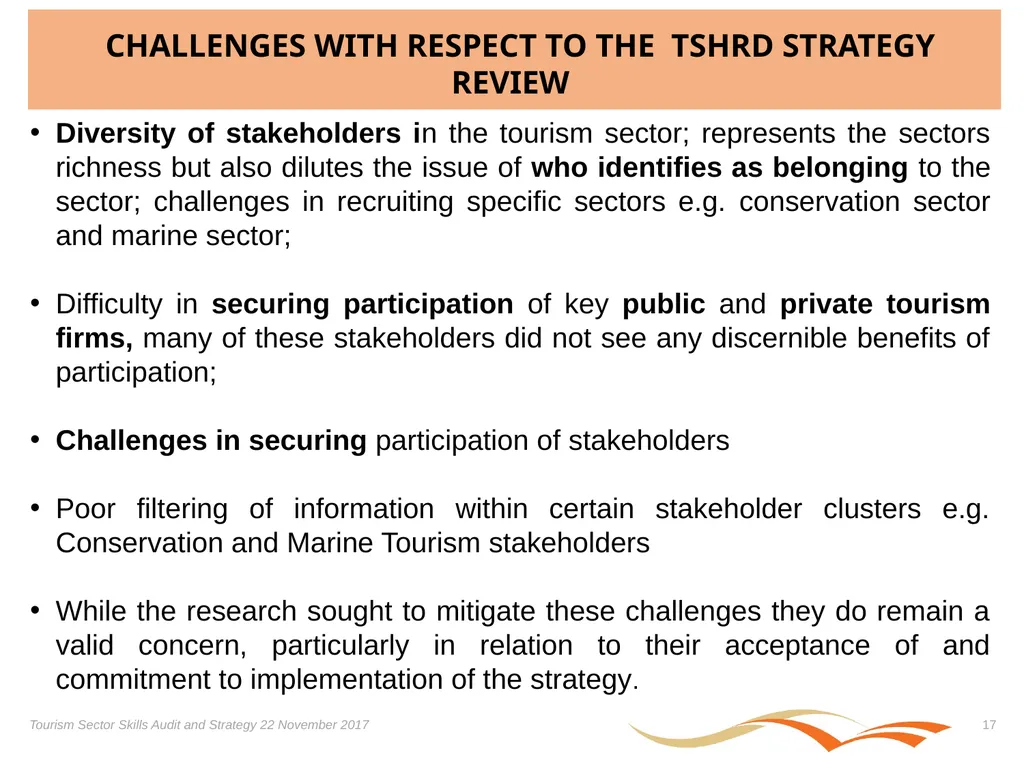
CHALLENGES WITH RESPECT TO THE TSHRD STRATEGY REVIEW Diversity of stakeholders in the tourism sector; represents the sectors richness but also dilutes the issue of who identifies as belonging to the sector; challenges in recruiting specific sectors e.g. conservation sector and marine sector;
Difficulty in securing participation of key public and private tourism firms, many of these stakeholders did not see any discernible benefits of participation;
Challenges in securing participation of stakeholders
Poor filtering of information within certain stakeholder clusters e.g. Conservation and Marine Tourism stakeholders
While the research sought to mitigate these challenges they do remain a valid concern, particularly in relation to their acceptance of and commitment to implementation of the strategy. Tourism Sector Skills Audit and Strategy 22 November 2017 17<br>
Difficulty in securing participation of key public and private tourism firms, many of these stakeholders did not see any discernible benefits of participation;
Challenges in securing participation of stakeholders
Poor filtering of information within certain stakeholder clusters e.g. Conservation and Marine Tourism stakeholders
While the research sought to mitigate these challenges they do remain a valid concern, particularly in relation to their acceptance of and commitment to implementation of the strategy. Tourism Sector Skills Audit and Strategy 22 November 2017 17<br>
18
18 OVERVIEW OF THE SKILLS AUDIT FINDINGS
AS A WAY
OF CONTEXTUALISING THE TSHRD
STRATEGY Tourism Sector Skills Audit and Strategy 22 November 2017<br>
AS A WAY
OF CONTEXTUALISING THE TSHRD
STRATEGY Tourism Sector Skills Audit and Strategy 22 November 2017<br>
19
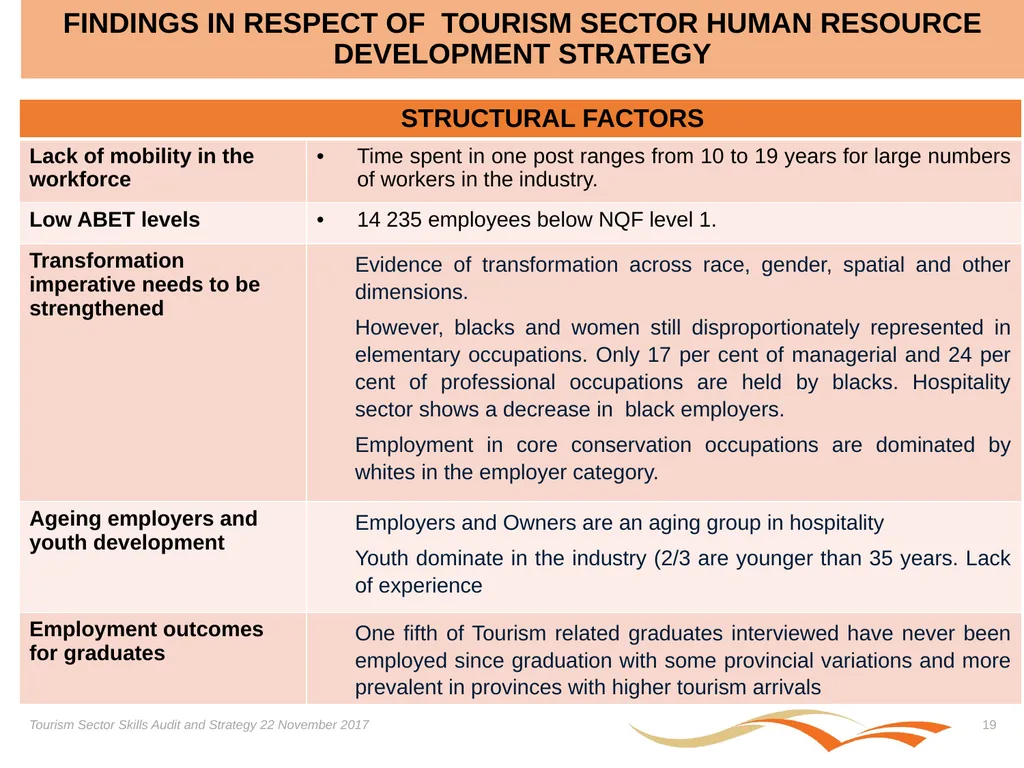
19 FINDINGS IN RESPECT OF TOURISM SECTOR HUMAN RESOURCE DEVELOPMENT STRATEGY Tourism Sector Skills Audit and Strategy 22 November 2017<br>
20
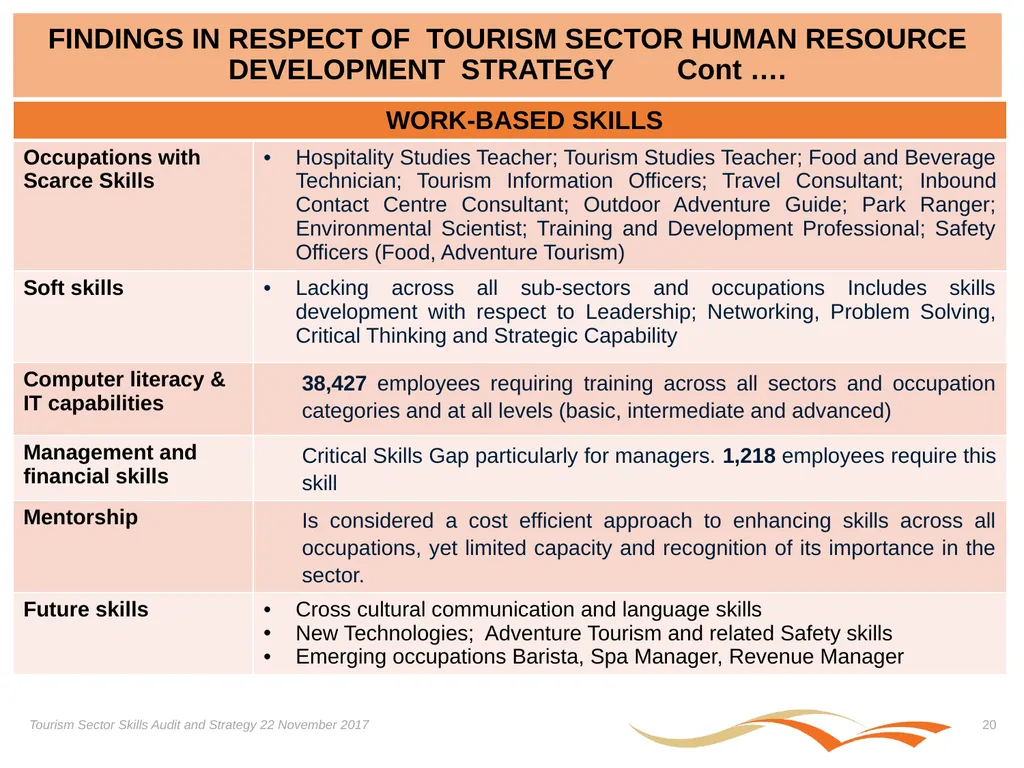
20 FINDINGS IN RESPECT OF TOURISM SECTOR HUMAN RESOURCE DEVELOPMENT STRATEGY Cont …. Tourism Sector Skills Audit and Strategy 22 November 2017<br>
21
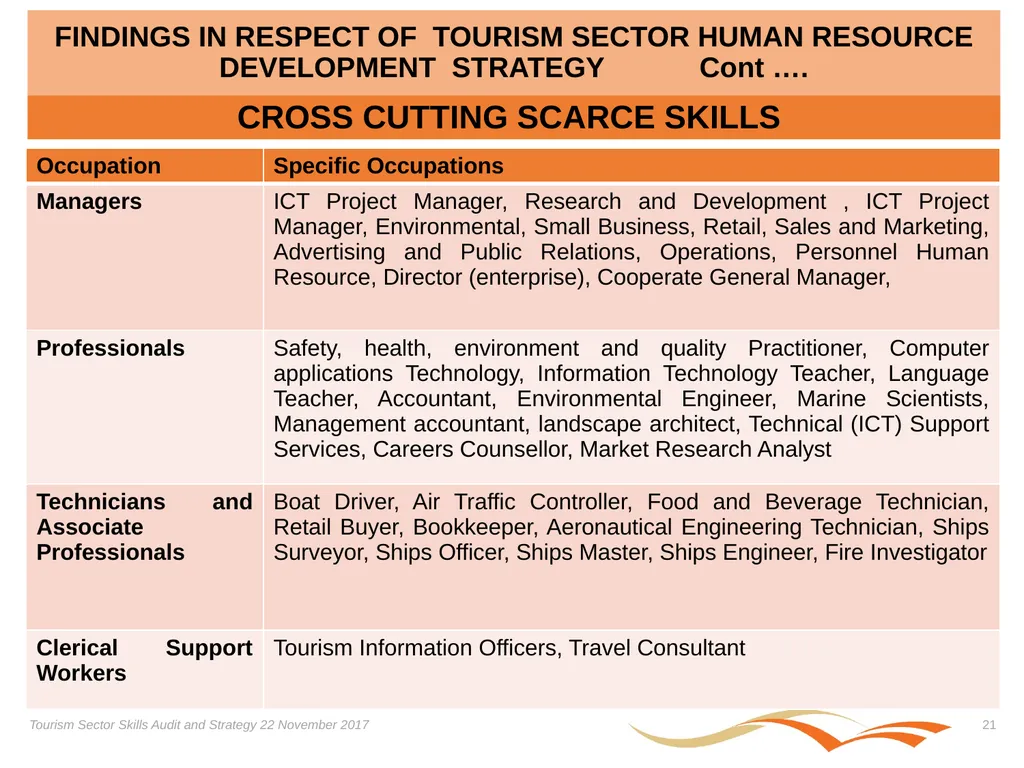
21 FINDINGS IN RESPECT OF TOURISM SECTOR HUMAN RESOURCE DEVELOPMENT STRATEGY Cont …. CROSS CUTTING SCARCE SKILLS Tourism Sector Skills Audit and Strategy 22 November 2017<br>
22
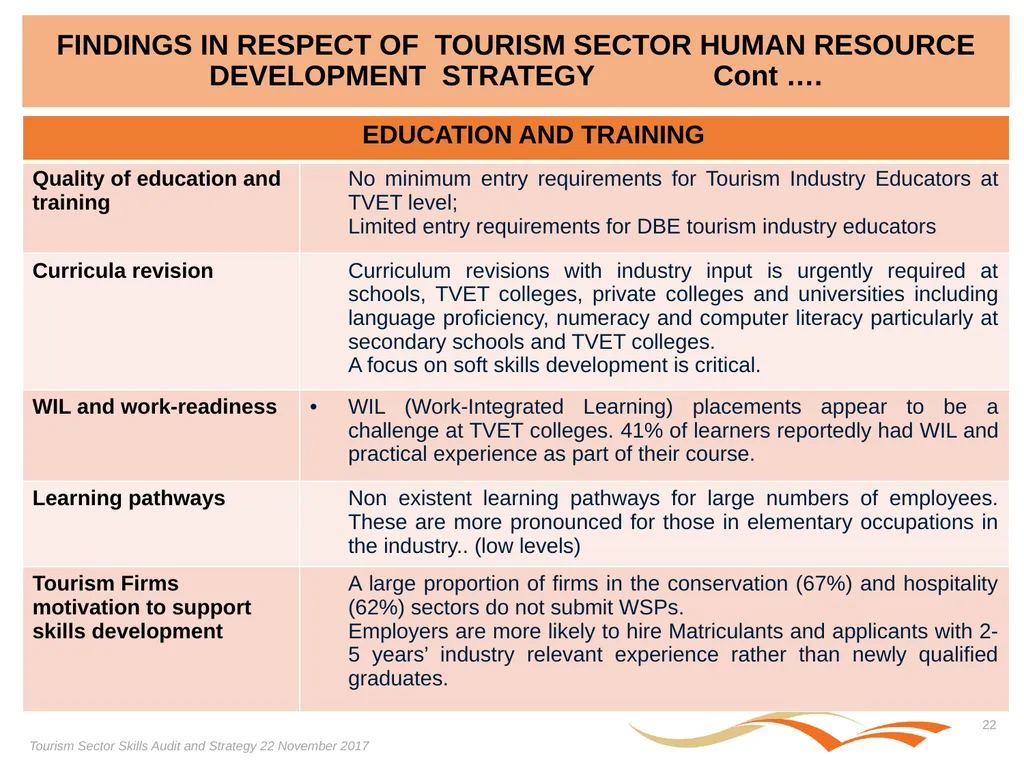
22 FINDINGS IN RESPECT OF TOURISM SECTOR HUMAN RESOURCE DEVELOPMENT STRATEGY Cont …. Tourism Sector Skills Audit and Strategy 22 November 2017<br>
23
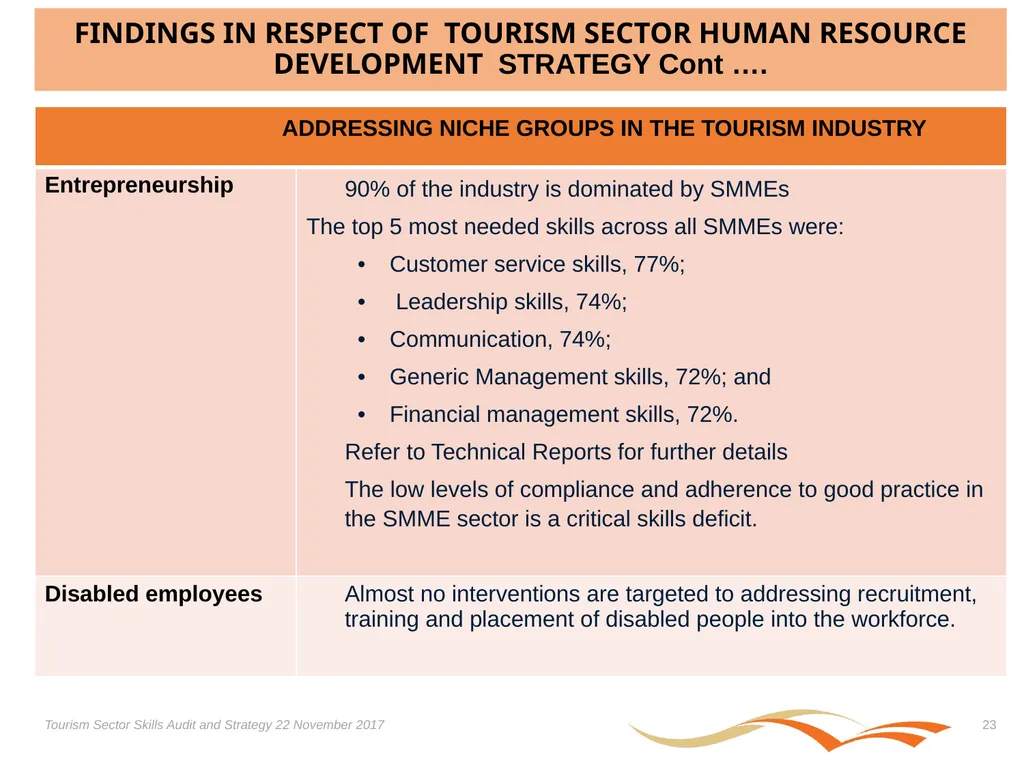
23 FINDINGS IN RESPECT OF TOURISM SECTOR HUMAN RESOURCE DEVELOPMENT STRATEGY Cont …. Tourism Sector Skills Audit and Strategy 22 November 2017<br>
24
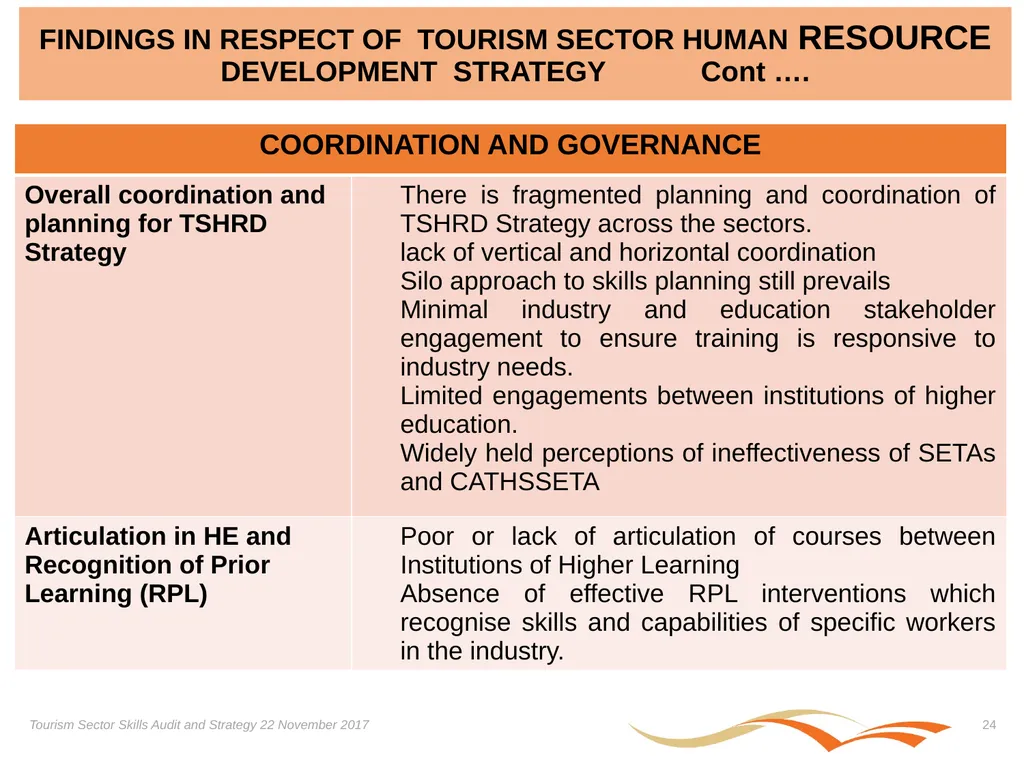
24 FINDINGS IN RESPECT OF TOURISM SECTOR HUMAN RESOURCE DEVELOPMENT STRATEGY Cont …. Tourism Sector Skills Audit and Strategy 22 November 2017<br>
25
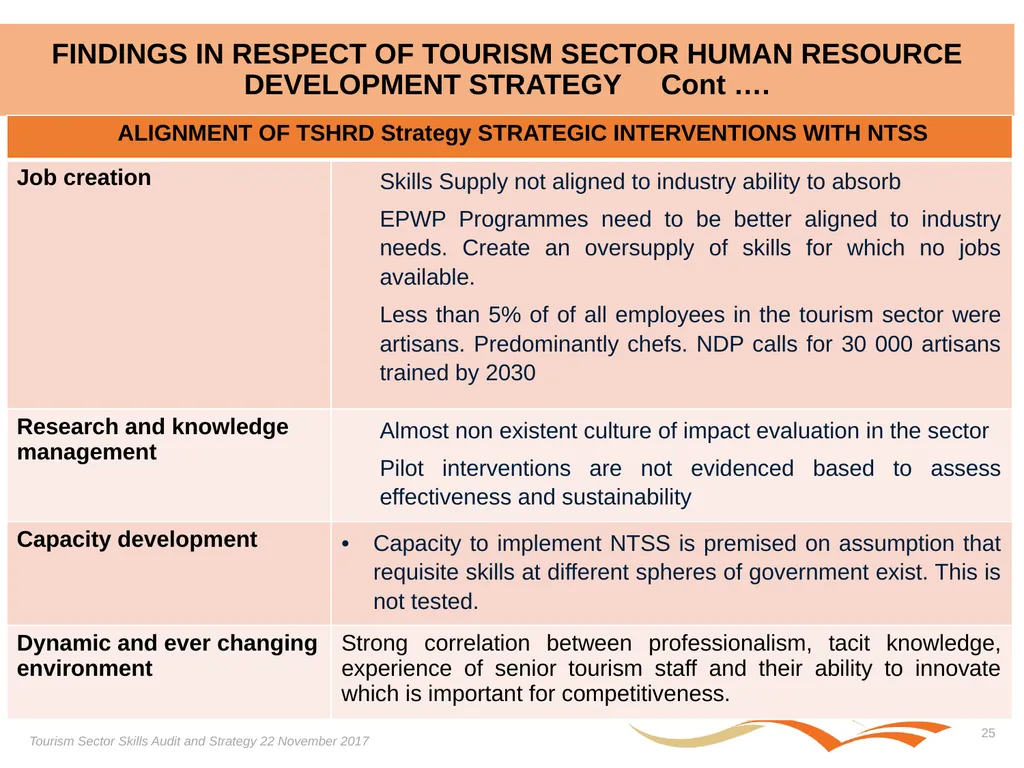
25 FINDINGS IN RESPECT OF TOURISM SECTOR HUMAN RESOURCE DEVELOPMENT STRATEGY Cont …. Tourism Sector Skills Audit and Strategy 22 November 2017<br>
26
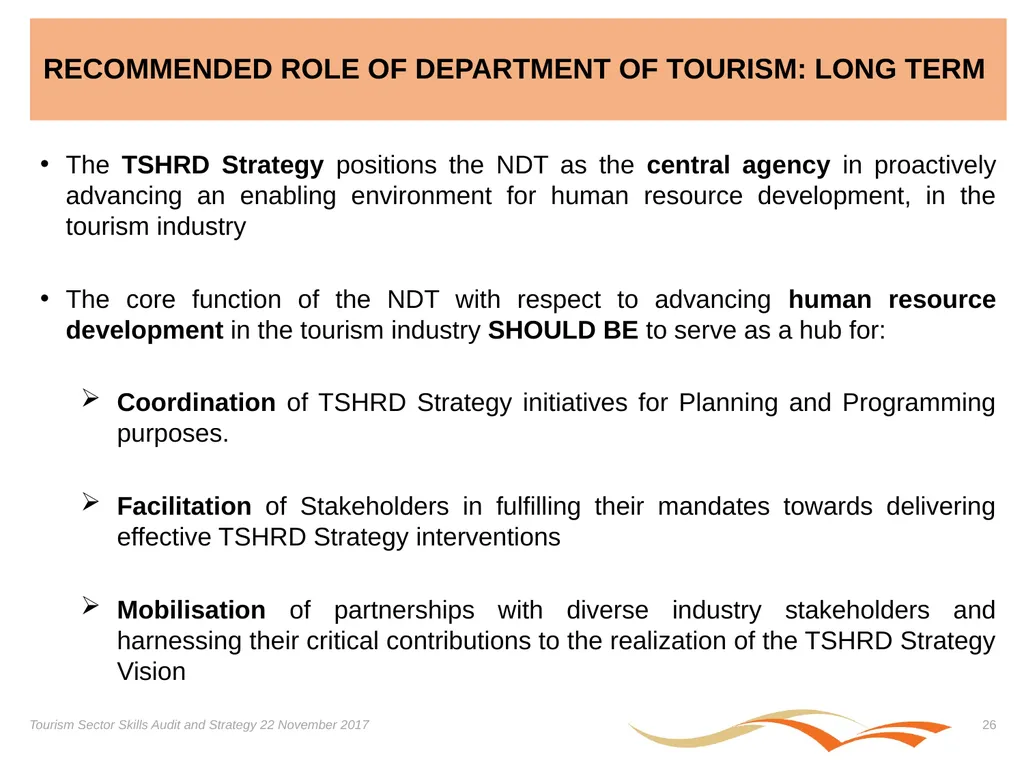
26 RECOMMENDED ROLE OF DEPARTMENT OF TOURISM: LONG TERM The TSHRD Strategy positions the NDT as the central agency in proactively advancing an enabling environment for human resource development, in the tourism industry
The core function of the NDT with respect to advancing human resource development in the tourism industry SHOULD BE to serve as a hub for:
Coordination of TSHRD Strategy initiatives for Planning and Programming purposes.
Facilitation of Stakeholders in fulfilling their mandates towards delivering effective TSHRD Strategy interventions
Mobilisation of partnerships with diverse industry stakeholders and harnessing their critical contributions to the realization of the TSHRD Strategy Vision Tourism Sector Skills Audit and Strategy 22 November 2017<br>
The core function of the NDT with respect to advancing human resource development in the tourism industry SHOULD BE to serve as a hub for:
Coordination of TSHRD Strategy initiatives for Planning and Programming purposes.
Facilitation of Stakeholders in fulfilling their mandates towards delivering effective TSHRD Strategy interventions
Mobilisation of partnerships with diverse industry stakeholders and harnessing their critical contributions to the realization of the TSHRD Strategy Vision Tourism Sector Skills Audit and Strategy 22 November 2017<br>
27
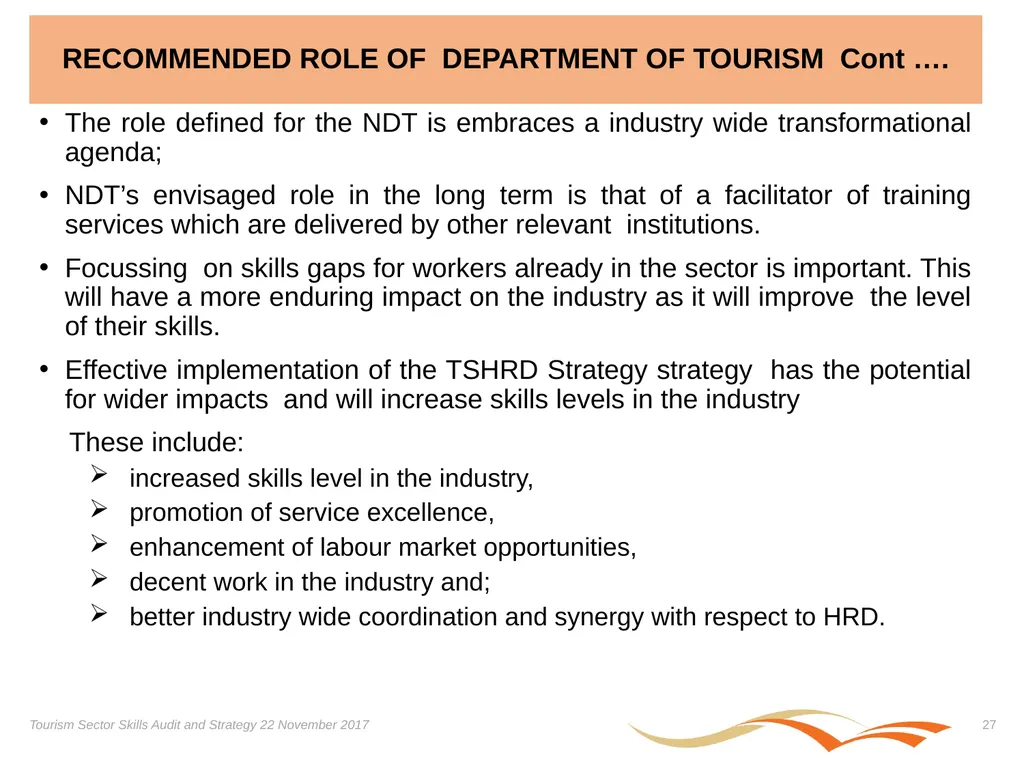
27 RECOMMENDED ROLE OF DEPARTMENT OF TOURISM Cont …. The role defined for the NDT is embraces a industry wide transformational agenda;
NDT’s envisaged role in the long term is that of a facilitator of training services which are delivered by other relevant institutions.
Focussing on skills gaps for workers already in the sector is important. This will have a more enduring impact on the industry as it will improve the level of their skills.
Effective implementation of the TSHRD Strategy strategy has the potential for wider impacts and will increase skills levels in the industry
These include:
increased skills level in the industry,
promotion of service excellence,
enhancement of labour market opportunities,
decent work in the industry and;
better industry wide coordination and synergy with respect to HRD. Tourism Sector Skills Audit and Strategy 22 November 2017<br>
NDT’s envisaged role in the long term is that of a facilitator of training services which are delivered by other relevant institutions.
Focussing on skills gaps for workers already in the sector is important. This will have a more enduring impact on the industry as it will improve the level of their skills.
Effective implementation of the TSHRD Strategy strategy has the potential for wider impacts and will increase skills levels in the industry
These include:
increased skills level in the industry,
promotion of service excellence,
enhancement of labour market opportunities,
decent work in the industry and;
better industry wide coordination and synergy with respect to HRD. Tourism Sector Skills Audit and Strategy 22 November 2017<br>
28
SUMMARY OF THE TOURISM SECTOR
HUMAN RESOURCE DEVELOPMENT STRATEGY
FOR SOUTH AFRICA (2016-2026) 28 Tourism Sector Skills Audit and Strategy 22 November 2017<br>
29
29 VISION:
TOURISM SECTOR HUMAN RESOURCE
DEVELOPMENT STRATEGY Tourism Sector Skills Audit and Strategy 22 November 2017<br>
30
30 GUIDING PRINCIPLES INFORMING THE IMPLEMENTATION
OF THE TSHRD STRATEGY Demand driven training and skills development approach;
Upholding Norms and Standards
Service excellence is a core norm in the industry requiring adherence
Professionalisation of critical of occupations;
Transformation
Meeting equity and diversity objectives
Up-skilling
Need for greater mobility, responding to industry needs Tourism Sector Skills Audit and Strategy 22 November 2017<br>
Upholding Norms and Standards
Service excellence is a core norm in the industry requiring adherence
Professionalisation of critical of occupations;
Transformation
Meeting equity and diversity objectives
Up-skilling
Need for greater mobility, responding to industry needs Tourism Sector Skills Audit and Strategy 22 November 2017<br>
31
TSHRD STRATEGY IMPLEMENTATION PLAN
AND THE
MONITORING AND EVALUATION FRAMEWORK Tourism Sector Skills Audit and Strategy 22 November 2017 31<br>
32
32 CONTEXTUALISING THE TSHRD STRATEGY IMPLEMENTATION PLAN The NDT is positioned to advance an enabling environment for the implantation of the TSHRD Strategy. As such, many of the interventions in the medium to long term must be implemented by relevant institutions as part of their core mandate.
Actions which are not within the NDTs mandate, have to be embraced by these relevant institutions and integrated into their strategic and annual performance plans. Tourism Sector Skills Audit and Strategy 22 November 2017<br>
Actions which are not within the NDTs mandate, have to be embraced by these relevant institutions and integrated into their strategic and annual performance plans. Tourism Sector Skills Audit and Strategy 22 November 2017<br>
33
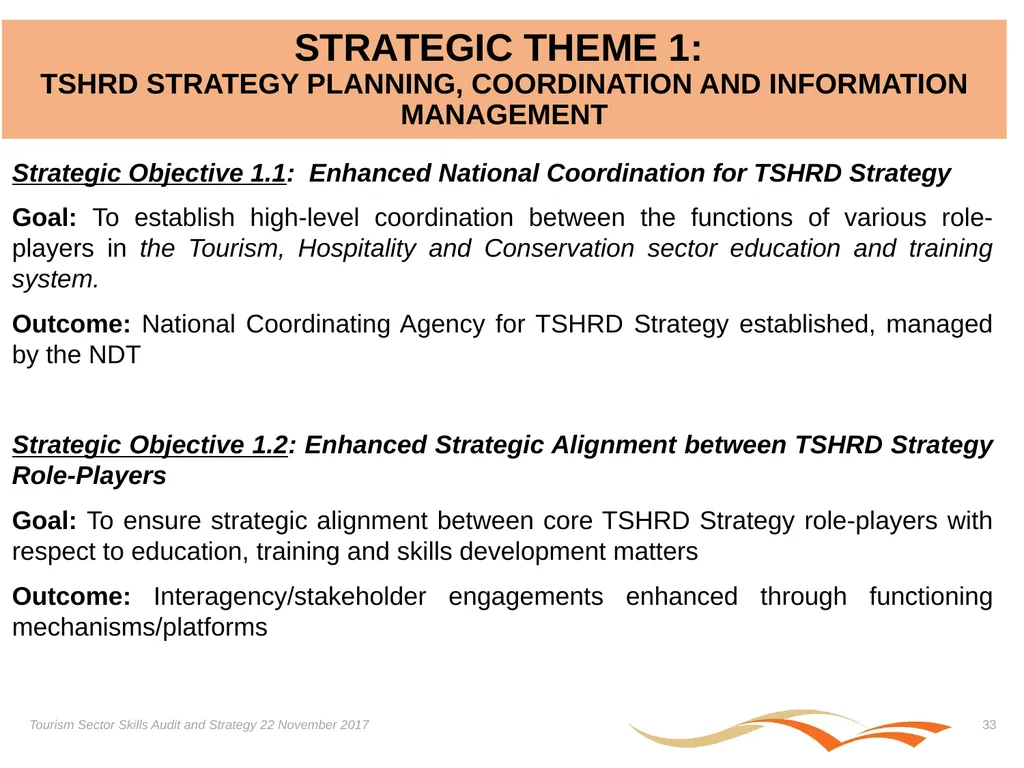
STRATEGIC THEME 1:
TSHRD STRATEGY PLANNING, COORDINATION AND INFORMATION MANAGEMENT Strategic Objective 1.1: Enhanced National Coordination for TSHRD Strategy
Goal: To establish high-level coordination between the functions of various role-players in the Tourism, Hospitality and Conservation sector education and training system.
Outcome: National Coordinating Agency for TSHRD Strategy established, managed by the NDT
Strategic Objective 1.2: Enhanced Strategic Alignment between TSHRD Strategy Role-Players
Goal: To ensure strategic alignment between core TSHRD Strategy role-players with respect to education, training and skills development matters
Outcome: Interagency/stakeholder engagements enhanced through functioning mechanisms/platforms Tourism Sector Skills Audit and Strategy 22 November 2017 33<br>
Goal: To establish high-level coordination between the functions of various role-players in the Tourism, Hospitality and Conservation sector education and training system.
Outcome: National Coordinating Agency for TSHRD Strategy established, managed by the NDT
Strategic Objective 1.2: Enhanced Strategic Alignment between TSHRD Strategy Role-Players
Goal: To ensure strategic alignment between core TSHRD Strategy role-players with respect to education, training and skills development matters
Outcome: Interagency/stakeholder engagements enhanced through functioning mechanisms/platforms Tourism Sector Skills Audit and Strategy 22 November 2017 33<br>
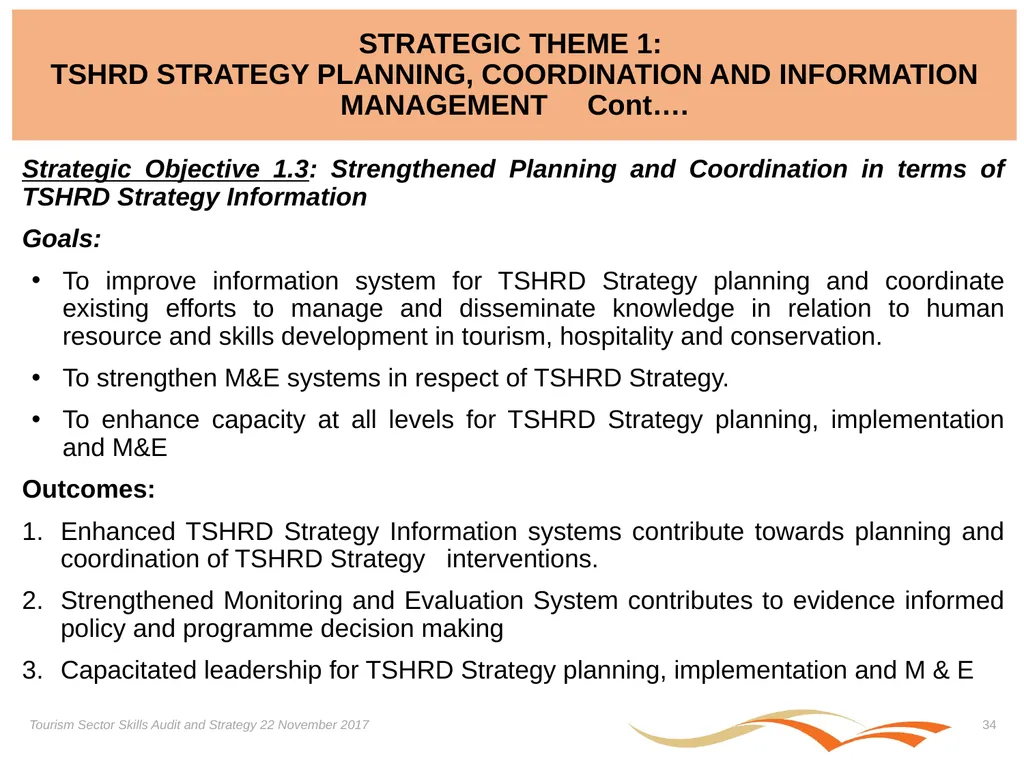
34
34 Strategic Objective 1.3: Strengthened Planning and Coordination in terms of TSHRD Strategy Information
Goals:
To improve information system for TSHRD Strategy planning and coordinate existing efforts to manage and disseminate knowledge in relation to human resource and skills development in tourism, hospitality and conservation.
To strengthen M&E systems in respect of TSHRD Strategy.
To enhance capacity at all levels for TSHRD Strategy planning, implementation and M&E
Outcomes:
Enhanced TSHRD Strategy Information systems contribute towards planning and coordination of TSHRD Strategy interventions.
Strengthened Monitoring and Evaluation System contributes to evidence informed policy and programme decision making
Capacitated leadership for TSHRD Strategy planning, implementation and M & E STRATEGIC THEME 1: TSHRD STRATEGY PLANNING, COORDINATION AND INFORMATION MANAGEMENT Cont…. Tourism Sector Skills Audit and Strategy 22 November 2017<br>
Goals:
To improve information system for TSHRD Strategy planning and coordinate existing efforts to manage and disseminate knowledge in relation to human resource and skills development in tourism, hospitality and conservation.
To strengthen M&E systems in respect of TSHRD Strategy.
To enhance capacity at all levels for TSHRD Strategy planning, implementation and M&E
Outcomes:
Enhanced TSHRD Strategy Information systems contribute towards planning and coordination of TSHRD Strategy interventions.
Strengthened Monitoring and Evaluation System contributes to evidence informed policy and programme decision making
Capacitated leadership for TSHRD Strategy planning, implementation and M & E STRATEGIC THEME 1: TSHRD STRATEGY PLANNING, COORDINATION AND INFORMATION MANAGEMENT Cont…. Tourism Sector Skills Audit and Strategy 22 November 2017<br>
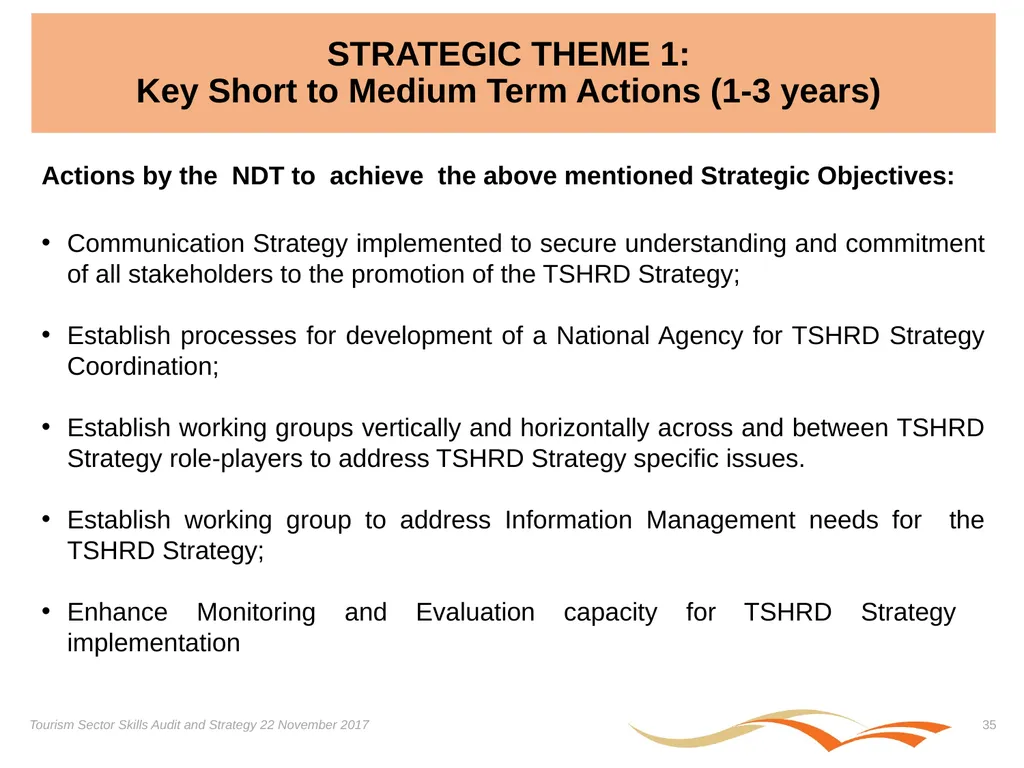
35
35 STRATEGIC THEME 1:
Key Short to Medium Term Actions (1-3 years) Actions by the NDT to achieve the above mentioned Strategic Objectives:
Communication Strategy implemented to secure understanding and commitment of all stakeholders to the promotion of the TSHRD Strategy;
Establish processes for development of a National Agency for TSHRD Strategy Coordination;
Establish working groups vertically and horizontally across and between TSHRD Strategy role-players to address TSHRD Strategy specific issues.
Establish working group to address Information Management needs for the TSHRD Strategy;
Enhance Monitoring and Evaluation capacity for TSHRD Strategy implementation Tourism Sector Skills Audit and Strategy 22 November 2017<br>
Communication Strategy implemented to secure understanding and commitment of all stakeholders to the promotion of the TSHRD Strategy;
Establish processes for development of a National Agency for TSHRD Strategy Coordination;
Establish working groups vertically and horizontally across and between TSHRD Strategy role-players to address TSHRD Strategy specific issues.
Establish working group to address Information Management needs for the TSHRD Strategy;
Enhance Monitoring and Evaluation capacity for TSHRD Strategy implementation Tourism Sector Skills Audit and Strategy 22 November 2017<br>
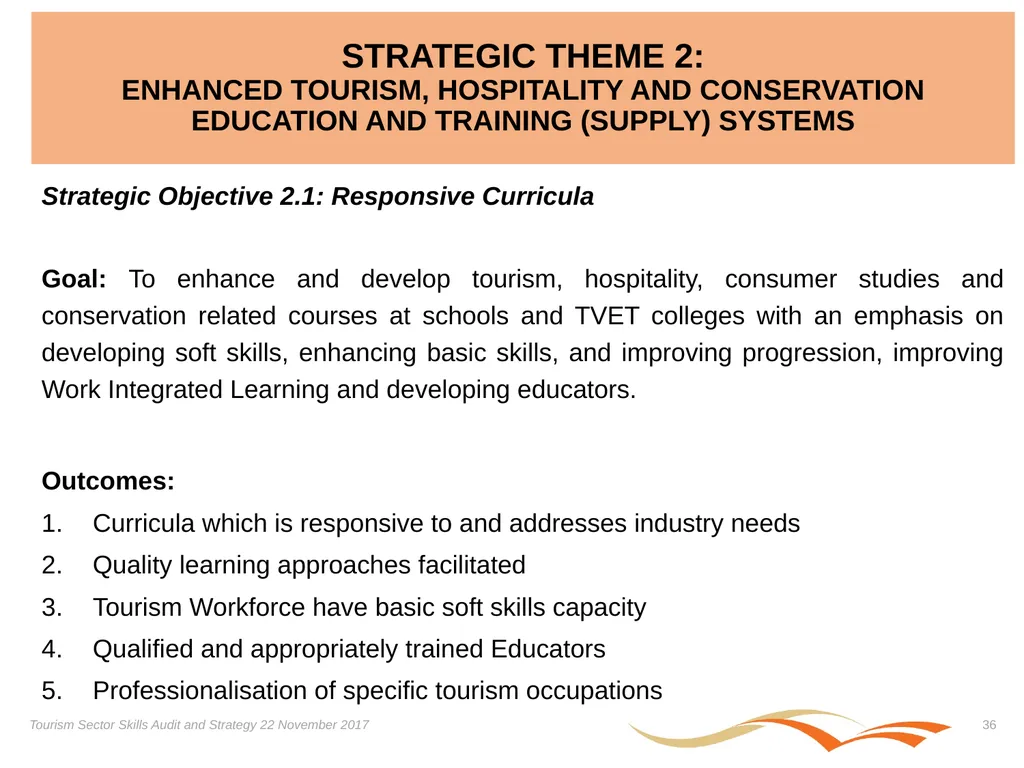
36
36 STRATEGIC THEME 2:
ENHANCED TOURISM, HOSPITALITY AND CONSERVATION EDUCATION AND TRAINING (SUPPLY) SYSTEMS Strategic Objective 2.1: Responsive Curricula
Goal: To enhance and develop tourism, hospitality, consumer studies and conservation related courses at schools and TVET colleges with an emphasis on developing soft skills, enhancing basic skills, and improving progression, improving Work Integrated Learning and developing educators.
Outcomes:
Curricula which is responsive to and addresses industry needs
Quality learning approaches facilitated
Tourism Workforce have basic soft skills capacity
Qualified and appropriately trained Educators
Professionalisation of specific tourism occupations Tourism Sector Skills Audit and Strategy 22 November 2017<br>
Goal: To enhance and develop tourism, hospitality, consumer studies and conservation related courses at schools and TVET colleges with an emphasis on developing soft skills, enhancing basic skills, and improving progression, improving Work Integrated Learning and developing educators.
Outcomes:
Curricula which is responsive to and addresses industry needs
Quality learning approaches facilitated
Tourism Workforce have basic soft skills capacity
Qualified and appropriately trained Educators
Professionalisation of specific tourism occupations Tourism Sector Skills Audit and Strategy 22 November 2017<br>
37
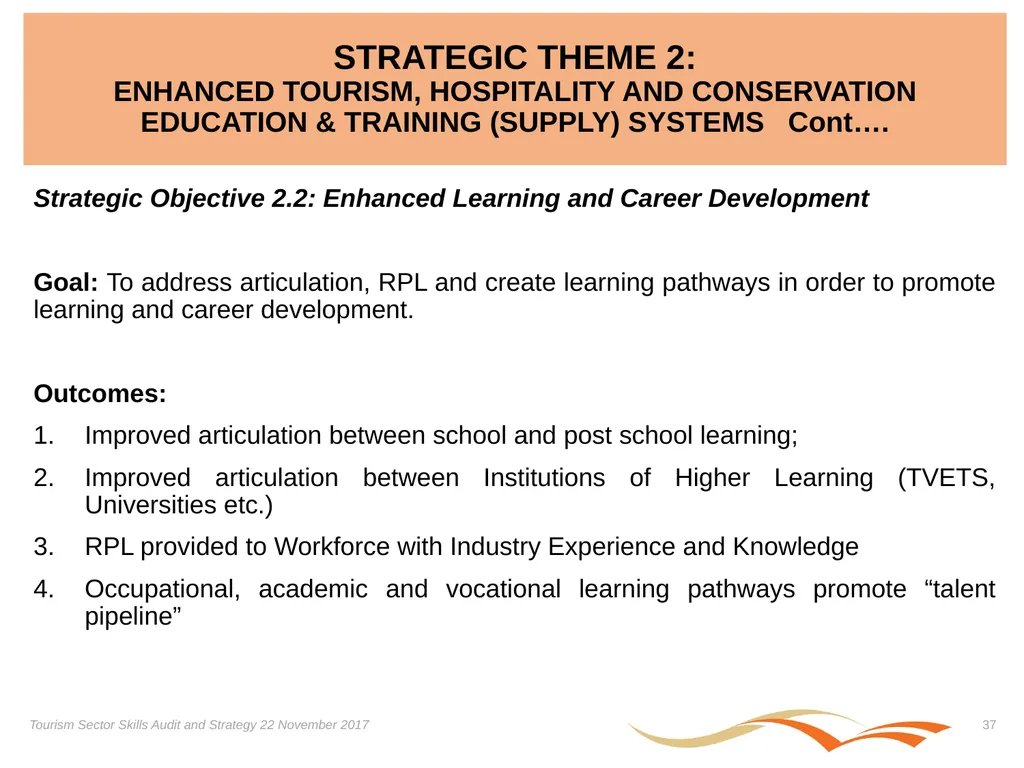
37 Strategic Objective 2.2: Enhanced Learning and Career Development
Goal: To address articulation, RPL and create learning pathways in order to promote learning and career development.
Outcomes:
Improved articulation between school and post school learning;
Improved articulation between Institutions of Higher Learning (TVETS, Universities etc.)
RPL provided to Workforce with Industry Experience and Knowledge
Occupational, academic and vocational learning pathways promote “talent pipeline” STRATEGIC THEME 2: ENHANCED TOURISM, HOSPITALITY AND CONSERVATION EDUCATION & TRAINING (SUPPLY) SYSTEMS Cont…. Tourism Sector Skills Audit and Strategy 22 November 2017<br>
Goal: To address articulation, RPL and create learning pathways in order to promote learning and career development.
Outcomes:
Improved articulation between school and post school learning;
Improved articulation between Institutions of Higher Learning (TVETS, Universities etc.)
RPL provided to Workforce with Industry Experience and Knowledge
Occupational, academic and vocational learning pathways promote “talent pipeline” STRATEGIC THEME 2: ENHANCED TOURISM, HOSPITALITY AND CONSERVATION EDUCATION & TRAINING (SUPPLY) SYSTEMS Cont…. Tourism Sector Skills Audit and Strategy 22 November 2017<br>
38
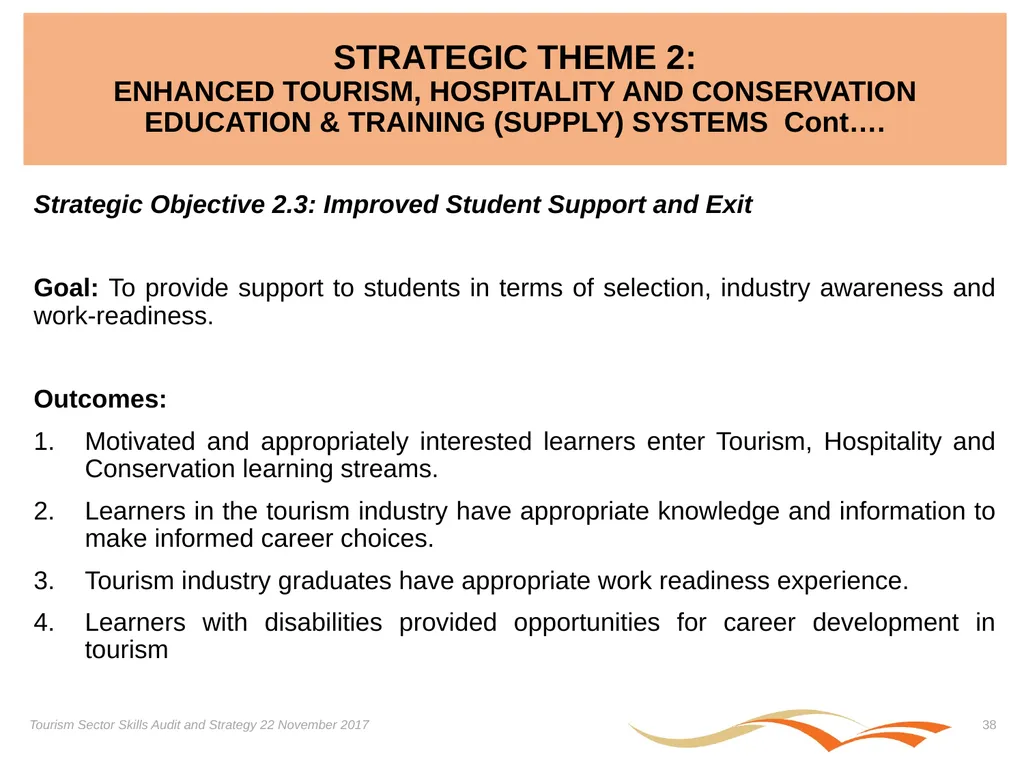
38 Strategic Objective 2.3: Improved Student Support and Exit
Goal: To provide support to students in terms of selection, industry awareness and work-readiness.
Outcomes:
Motivated and appropriately interested learners enter Tourism, Hospitality and Conservation learning streams.
Learners in the tourism industry have appropriate knowledge and information to make informed career choices.
Tourism industry graduates have appropriate work readiness experience.
Learners with disabilities provided opportunities for career development in tourism STRATEGIC THEME 2: ENHANCED TOURISM, HOSPITALITY AND CONSERVATION EDUCATION & TRAINING (SUPPLY) SYSTEMS Cont…. Tourism Sector Skills Audit and Strategy 22 November 2017<br>
Goal: To provide support to students in terms of selection, industry awareness and work-readiness.
Outcomes:
Motivated and appropriately interested learners enter Tourism, Hospitality and Conservation learning streams.
Learners in the tourism industry have appropriate knowledge and information to make informed career choices.
Tourism industry graduates have appropriate work readiness experience.
Learners with disabilities provided opportunities for career development in tourism STRATEGIC THEME 2: ENHANCED TOURISM, HOSPITALITY AND CONSERVATION EDUCATION & TRAINING (SUPPLY) SYSTEMS Cont…. Tourism Sector Skills Audit and Strategy 22 November 2017<br>
39
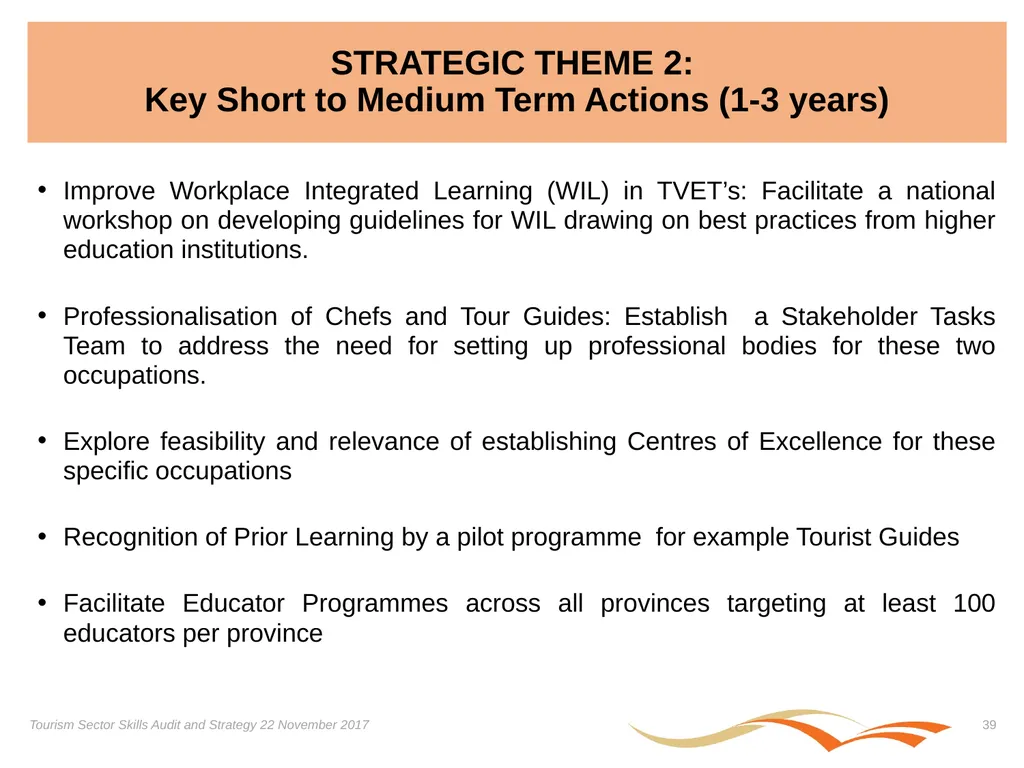
39 STRATEGIC THEME 2:
Key Short to Medium Term Actions (1-3 years) Improve Workplace Integrated Learning (WIL) in TVET’s: Facilitate a national workshop on developing guidelines for WIL drawing on best practices from higher education institutions.
Professionalisation of Chefs and Tour Guides: Establish a Stakeholder Tasks Team to address the need for setting up professional bodies for these two occupations.
Explore feasibility and relevance of establishing Centres of Excellence for these specific occupations
Recognition of Prior Learning by a pilot programme for example Tourist Guides
Facilitate Educator Programmes across all provinces targeting at least 100 educators per province Tourism Sector Skills Audit and Strategy 22 November 2017<br>
Professionalisation of Chefs and Tour Guides: Establish a Stakeholder Tasks Team to address the need for setting up professional bodies for these two occupations.
Explore feasibility and relevance of establishing Centres of Excellence for these specific occupations
Recognition of Prior Learning by a pilot programme for example Tourist Guides
Facilitate Educator Programmes across all provinces targeting at least 100 educators per province Tourism Sector Skills Audit and Strategy 22 November 2017<br>
40
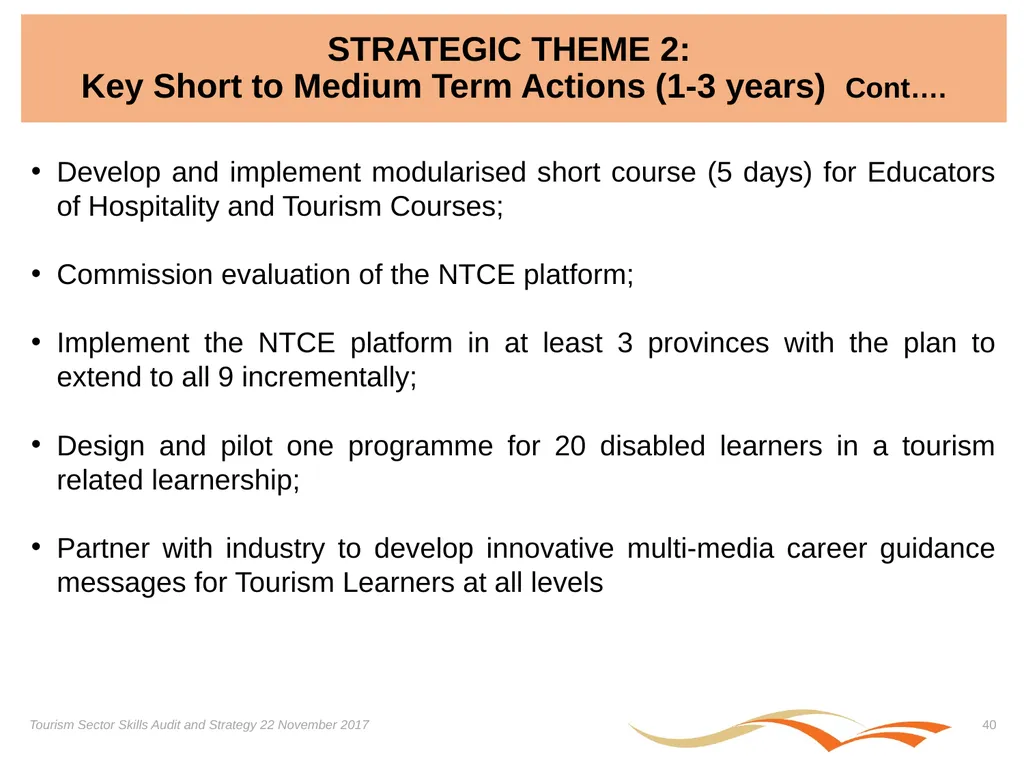
40 STRATEGIC THEME 2:
Key Short to Medium Term Actions (1-3 years) Cont…. Develop and implement modularised short course (5 days) for Educators of Hospitality and Tourism Courses;
Commission evaluation of the NTCE platform;
Implement the NTCE platform in at least 3 provinces with the plan to extend to all 9 incrementally;
Design and pilot one programme for 20 disabled learners in a tourism related learnership;
Partner with industry to develop innovative multi-media career guidance messages for Tourism Learners at all levels Tourism Sector Skills Audit and Strategy 22 November 2017<br>
Commission evaluation of the NTCE platform;
Implement the NTCE platform in at least 3 provinces with the plan to extend to all 9 incrementally;
Design and pilot one programme for 20 disabled learners in a tourism related learnership;
Partner with industry to develop innovative multi-media career guidance messages for Tourism Learners at all levels Tourism Sector Skills Audit and Strategy 22 November 2017<br>
41
41 STRATEGIC THEME 3:
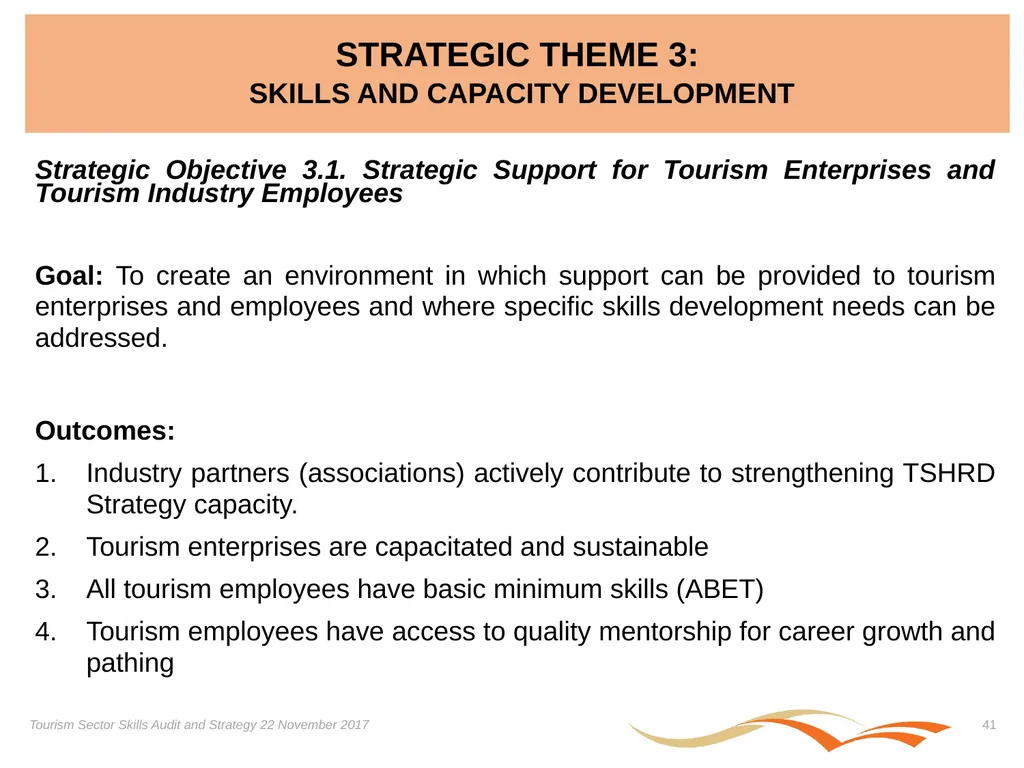
SKILLS AND CAPACITY DEVELOPMENT Strategic Objective 3.1. Strategic Support for Tourism Enterprises and Tourism Industry Employees
Goal: To create an environment in which support can be provided to tourism enterprises and employees and where specific skills development needs can be addressed.
Outcomes:
Industry partners (associations) actively contribute to strengthening TSHRD Strategy capacity.
Tourism enterprises are capacitated and sustainable
All tourism employees have basic minimum skills (ABET)
Tourism employees have access to quality mentorship for career growth and pathing Tourism Sector Skills Audit and Strategy 22 November 2017<br>
Goal: To create an environment in which support can be provided to tourism enterprises and employees and where specific skills development needs can be addressed.
Outcomes:
Industry partners (associations) actively contribute to strengthening TSHRD Strategy capacity.
Tourism enterprises are capacitated and sustainable
All tourism employees have basic minimum skills (ABET)
Tourism employees have access to quality mentorship for career growth and pathing Tourism Sector Skills Audit and Strategy 22 November 2017<br>
42
42 STRATEGIC THEME 3:
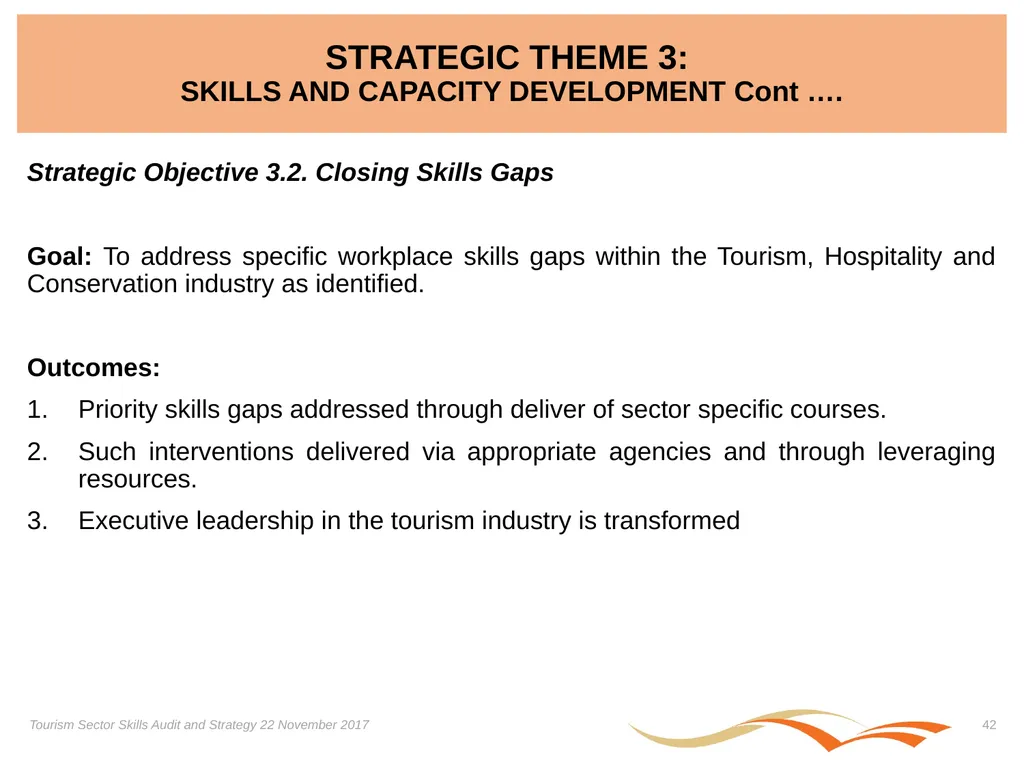
SKILLS AND CAPACITY DEVELOPMENT Cont …. Strategic Objective 3.2. Closing Skills Gaps
Goal: To address specific workplace skills gaps within the Tourism, Hospitality and Conservation industry as identified.
Outcomes:
Priority skills gaps addressed through deliver of sector specific courses.
Such interventions delivered via appropriate agencies and through leveraging resources.
Executive leadership in the tourism industry is transformed Tourism Sector Skills Audit and Strategy 22 November 2017<br>
Goal: To address specific workplace skills gaps within the Tourism, Hospitality and Conservation industry as identified.
Outcomes:
Priority skills gaps addressed through deliver of sector specific courses.
Such interventions delivered via appropriate agencies and through leveraging resources.
Executive leadership in the tourism industry is transformed Tourism Sector Skills Audit and Strategy 22 November 2017<br>
43
43 STRATEGIC THEME 3:
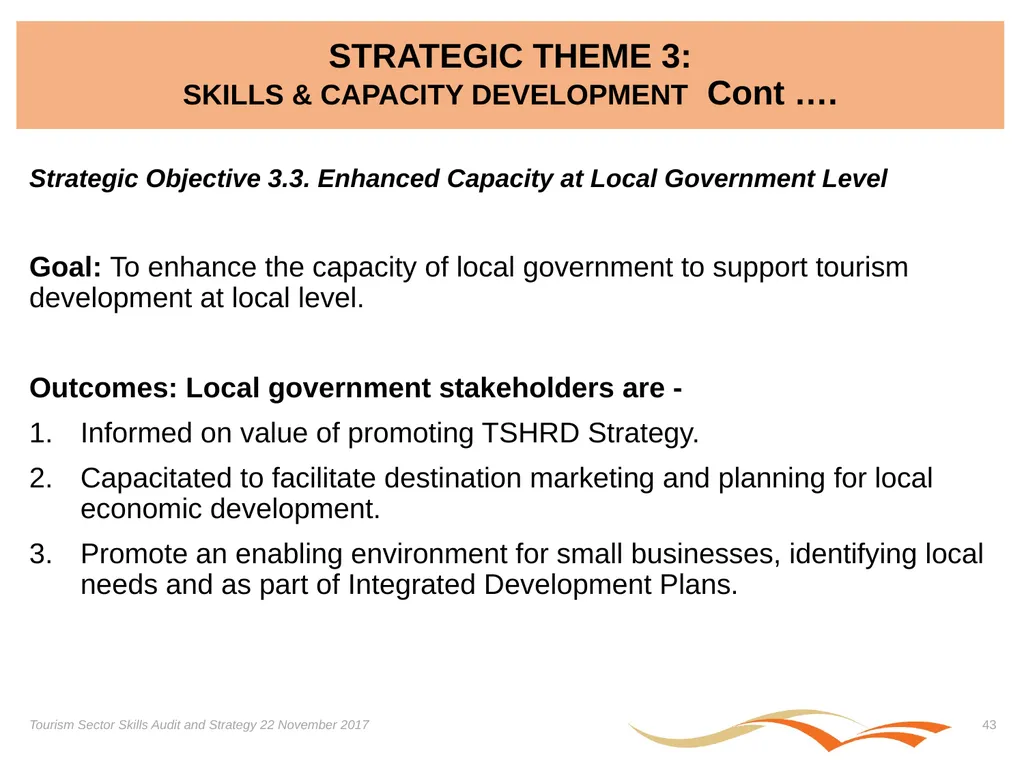
SKILLS & CAPACITY DEVELOPMENT Cont …. Strategic Objective 3.3. Enhanced Capacity at Local Government Level
Goal: To enhance the capacity of local government to support tourism development at local level.
Outcomes: Local government stakeholders are -
Informed on value of promoting TSHRD Strategy.
Capacitated to facilitate destination marketing and planning for local economic development.
Promote an enabling environment for small businesses, identifying local needs and as part of Integrated Development Plans. Tourism Sector Skills Audit and Strategy 22 November 2017<br>
Goal: To enhance the capacity of local government to support tourism development at local level.
Outcomes: Local government stakeholders are -
Informed on value of promoting TSHRD Strategy.
Capacitated to facilitate destination marketing and planning for local economic development.
Promote an enabling environment for small businesses, identifying local needs and as part of Integrated Development Plans. Tourism Sector Skills Audit and Strategy 22 November 2017<br>
44
44 STRATEGIC THEME 3:
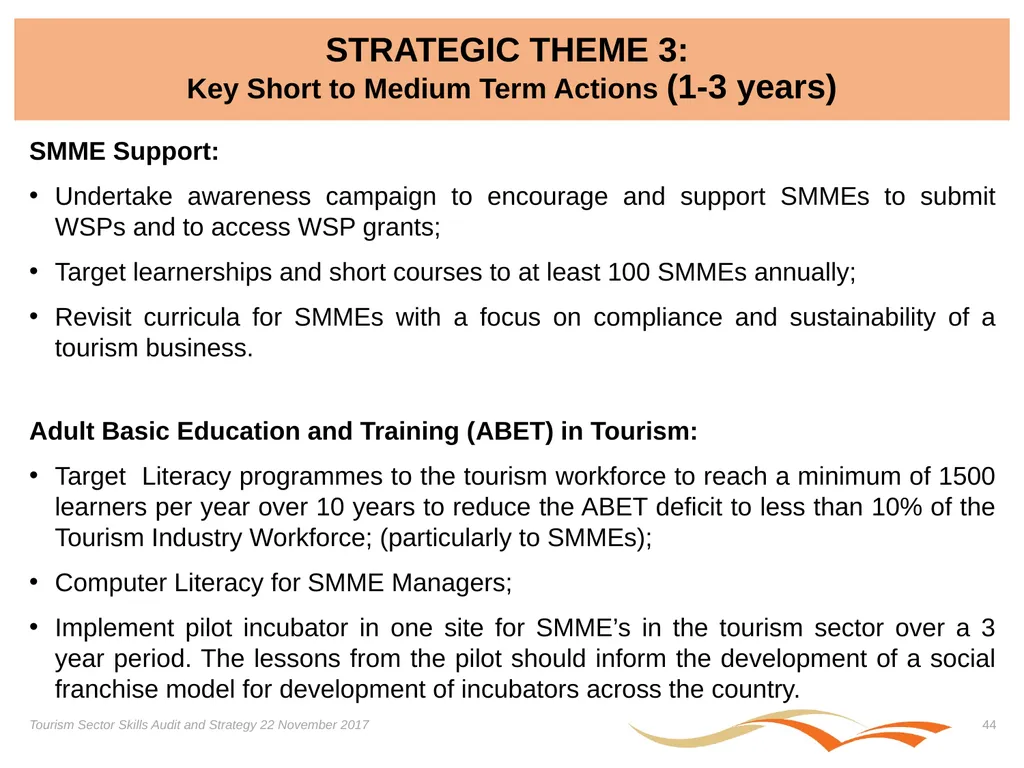
Key Short to Medium Term Actions (1-3 years) SMME Support:
Undertake awareness campaign to encourage and support SMMEs to submit WSPs and to access WSP grants;
Target learnerships and short courses to at least 100 SMMEs annually;
Revisit curricula for SMMEs with a focus on compliance and sustainability of a tourism business.
Adult Basic Education and Training (ABET) in Tourism:
Target Literacy programmes to the tourism workforce to reach a minimum of 1500 learners per year over 10 years to reduce the ABET deficit to less than 10% of the Tourism Industry Workforce; (particularly to SMMEs);
Computer Literacy for SMME Managers;
Implement pilot incubator in one site for SMME’s in the tourism sector over a 3 year period. The lessons from the pilot should inform the development of a social franchise model for development of incubators across the country. Tourism Sector Skills Audit and Strategy 22 November 2017<br>
Undertake awareness campaign to encourage and support SMMEs to submit WSPs and to access WSP grants;
Target learnerships and short courses to at least 100 SMMEs annually;
Revisit curricula for SMMEs with a focus on compliance and sustainability of a tourism business.
Adult Basic Education and Training (ABET) in Tourism:
Target Literacy programmes to the tourism workforce to reach a minimum of 1500 learners per year over 10 years to reduce the ABET deficit to less than 10% of the Tourism Industry Workforce; (particularly to SMMEs);
Computer Literacy for SMME Managers;
Implement pilot incubator in one site for SMME’s in the tourism sector over a 3 year period. The lessons from the pilot should inform the development of a social franchise model for development of incubators across the country. Tourism Sector Skills Audit and Strategy 22 November 2017<br>
45
Tourism Sector Skills Audit and Strategy 22 November 2017 45 STRATEGIC THEME 3:
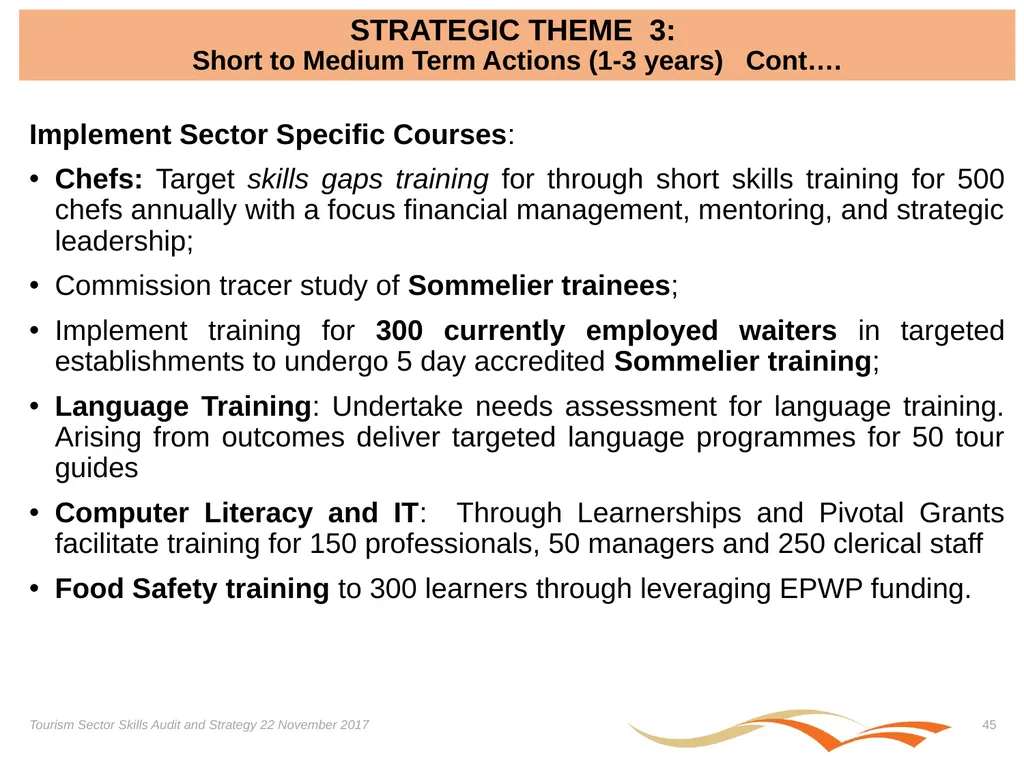
Short to Medium Term Actions (1-3 years) Cont…. Implement Sector Specific Courses:
Chefs: Target skills gaps training for through short skills training for 500 chefs annually with a focus financial management, mentoring, and strategic leadership;
Commission tracer study of Sommelier trainees;
Implement training for 300 currently employed waiters in targeted establishments to undergo 5 day accredited Sommelier training;
Language Training: Undertake needs assessment for language training. Arising from outcomes deliver targeted language programmes for 50 tour guides
Computer Literacy and IT: Through Learnerships and Pivotal Grants facilitate training for 150 professionals, 50 managers and 250 clerical staff
Food Safety training to 300 learners through leveraging EPWP funding.<br>
Chefs: Target skills gaps training for through short skills training for 500 chefs annually with a focus financial management, mentoring, and strategic leadership;
Commission tracer study of Sommelier trainees;
Implement training for 300 currently employed waiters in targeted establishments to undergo 5 day accredited Sommelier training;
Language Training: Undertake needs assessment for language training. Arising from outcomes deliver targeted language programmes for 50 tour guides
Computer Literacy and IT: Through Learnerships and Pivotal Grants facilitate training for 150 professionals, 50 managers and 250 clerical staff
Food Safety training to 300 learners through leveraging EPWP funding.<br>
46
46 STRATEGIC THEME 3:
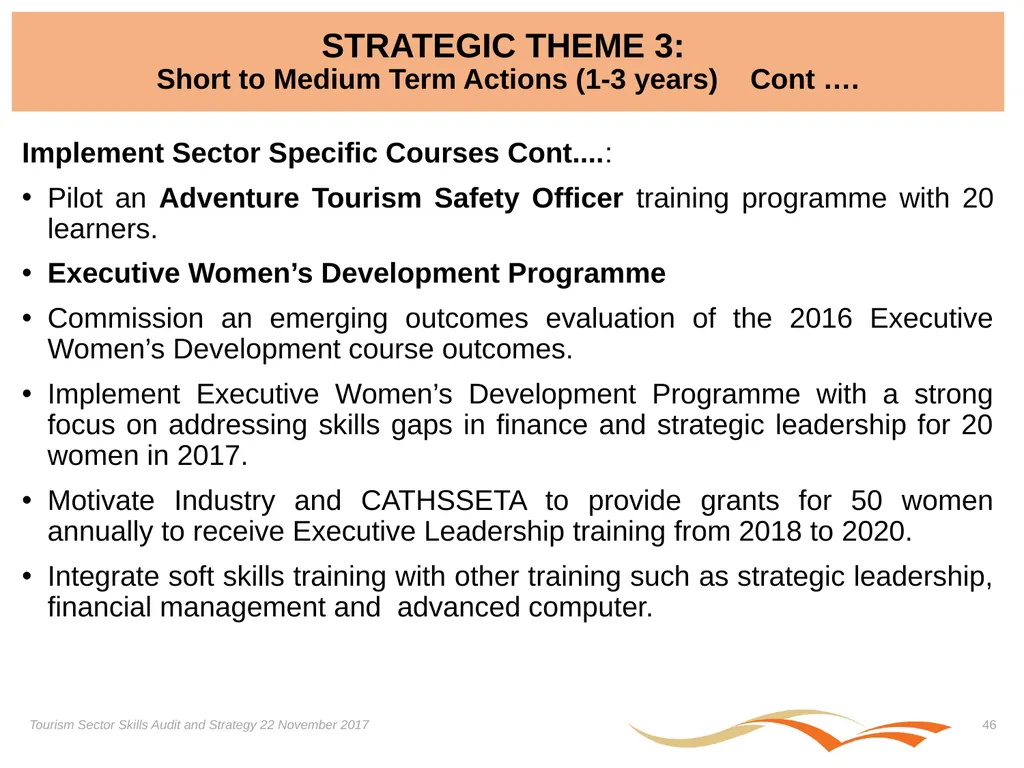
Short to Medium Term Actions (1-3 years) Cont …. Implement Sector Specific Courses Cont....:
Pilot an Adventure Tourism Safety Officer training programme with 20 learners.
Executive Women’s Development Programme
Commission an emerging outcomes evaluation of the 2016 Executive Women’s Development course outcomes.
Implement Executive Women’s Development Programme with a strong focus on addressing skills gaps in finance and strategic leadership for 20 women in 2017.
Motivate Industry and CATHSSETA to provide grants for 50 women annually to receive Executive Leadership training from 2018 to 2020.
Integrate soft skills training with other training such as strategic leadership, financial management and advanced computer. Tourism Sector Skills Audit and Strategy 22 November 2017<br>
Pilot an Adventure Tourism Safety Officer training programme with 20 learners.
Executive Women’s Development Programme
Commission an emerging outcomes evaluation of the 2016 Executive Women’s Development course outcomes.
Implement Executive Women’s Development Programme with a strong focus on addressing skills gaps in finance and strategic leadership for 20 women in 2017.
Motivate Industry and CATHSSETA to provide grants for 50 women annually to receive Executive Leadership training from 2018 to 2020.
Integrate soft skills training with other training such as strategic leadership, financial management and advanced computer. Tourism Sector Skills Audit and Strategy 22 November 2017<br>
47
Tourism Sector Skills Audit and Strategy 22 November 2017 47 STRATEGIC THEME 3:
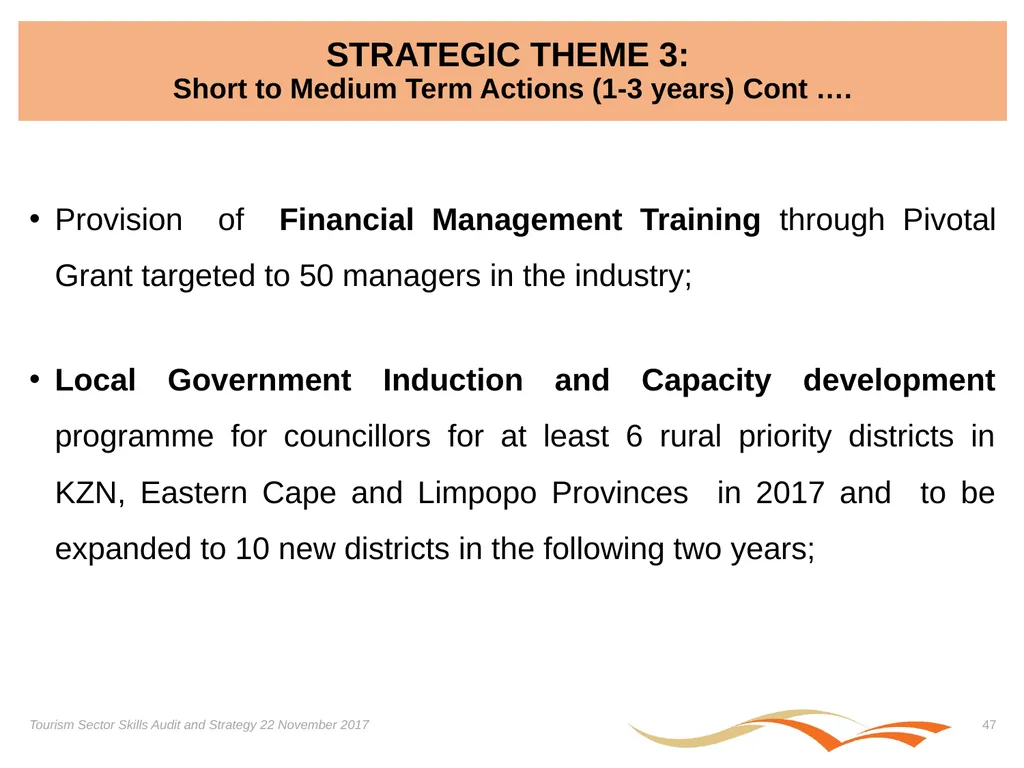
Short to Medium Term Actions (1-3 years) Cont …. Provision of Financial Management Training through Pivotal Grant targeted to 50 managers in the industry;
Local Government Induction and Capacity development programme for councillors for at least 6 rural priority districts in KZN, Eastern Cape and Limpopo Provinces in 2017 and to be expanded to 10 new districts in the following two years;<br>
Local Government Induction and Capacity development programme for councillors for at least 6 rural priority districts in KZN, Eastern Cape and Limpopo Provinces in 2017 and to be expanded to 10 new districts in the following two years;<br>
48
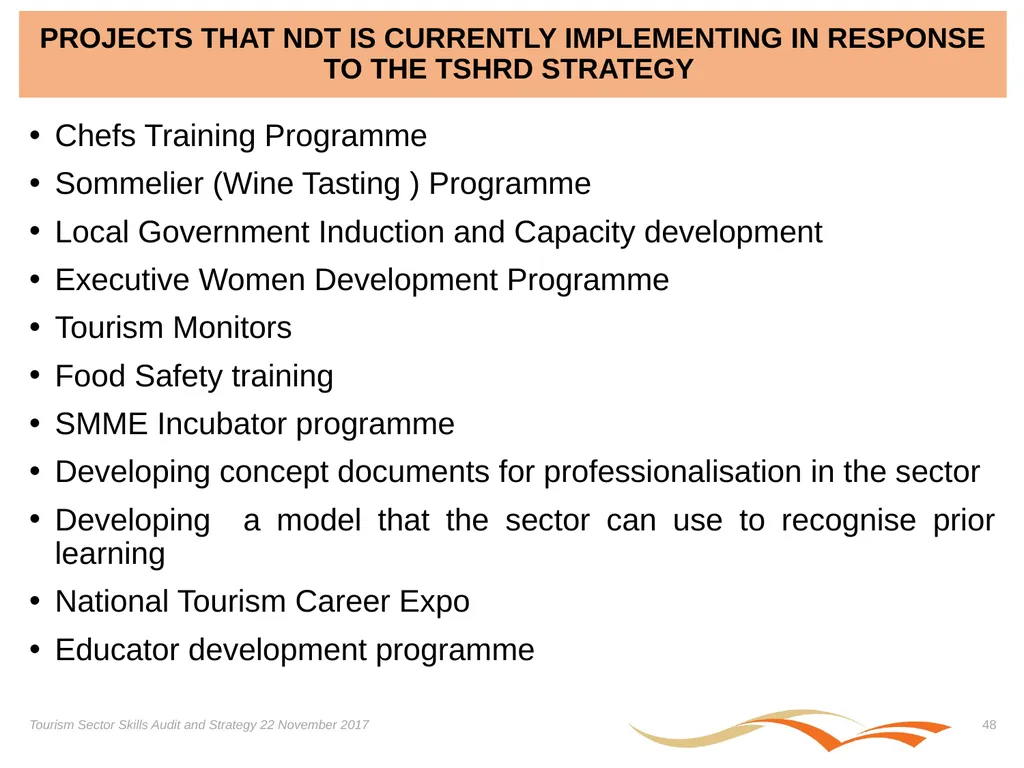
Tourism Sector Skills Audit and Strategy 22 November 2017 48 PROJECTS THAT NDT IS CURRENTLY IMPLEMENTING IN RESPONSE TO THE TSHRD STRATEGY Chefs Training Programme
Sommelier (Wine Tasting ) Programme
Local Government Induction and Capacity development
Executive Women Development Programme
Tourism Monitors
Food Safety training
SMME Incubator programme
Developing concept documents for professionalisation in the sector
Developing a model that the sector can use to recognise prior learning
National Tourism Career Expo
Educator development programme<br>
Sommelier (Wine Tasting ) Programme
Local Government Induction and Capacity development
Executive Women Development Programme
Tourism Monitors
Food Safety training
SMME Incubator programme
Developing concept documents for professionalisation in the sector
Developing a model that the sector can use to recognise prior learning
National Tourism Career Expo
Educator development programme<br>
49
49 WAY FORWARD Tourism Sector Skills Audit and Strategy 22 November 2017<br>
50
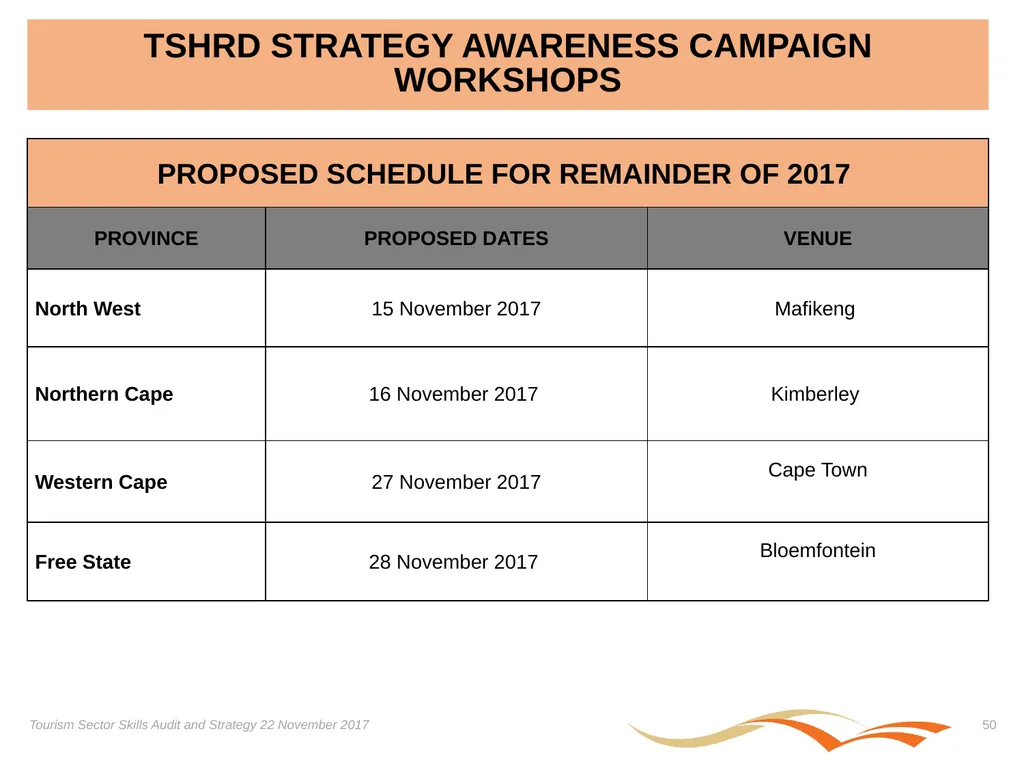
50 TSHRD STRATEGY AWARENESS CAMPAIGN WORKSHOPS Tourism Sector Skills Audit and Strategy 22 November 2017<br>
51
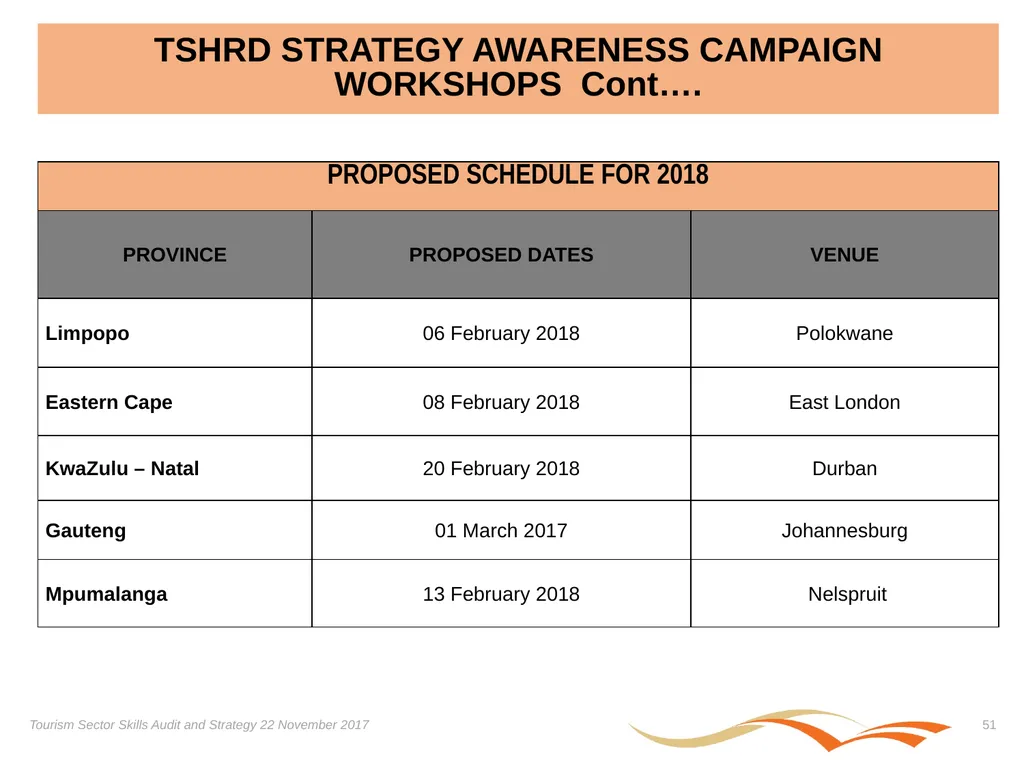
51 TSHRD STRATEGY AWARENESS CAMPAIGN WORKSHOPS Cont…. Tourism Sector Skills Audit and Strategy 22 November 2017<br>
52
THANK YOU! Tourism Sector Skills Audit and Strategy 22 November 2017 52<br>