
PRESENTATION TITLE Presented by: Name Surname
LD
Published · 17 slides · 0 views
1 / 1
Description
PRESENTATION TITLE Presented by: Name Surname Directorate Date PSC Roundtable: Efficient, Economic and Effective use of Resources in the Procurement Environment Panel discussion Experiences in the Public Procurement Environment Trevor
Related Topics
Share
Embed code
Download this presentation From Below
"PRESENTATION TITLE Presented by: Name Surname" is the property of its rightful owner. Permission is granted to download and print the materials on this website for personal, non-commercial use only, and to display it on your personal computer provided you do not modify the materials and that you retain all copyright notices contained in the materials. By downloading content from our website, you accept the terms of this agreement.
Presentation Transcript
01
PRESENTATION TITLE
Presented by:
Name Surname
Directorate
Date PSC Roundtable: Efficient, Economic and Effective use of Resources in the Procurement Environment Panel discussion Experiences in the Public Procurement Environment Trevor Balzer
Acting Director-General
Department of Water and Sanitation 28 October 2020<br>
Presented by:
Name Surname
Directorate
Date PSC Roundtable: Efficient, Economic and Effective use of Resources in the Procurement Environment Panel discussion Experiences in the Public Procurement Environment Trevor Balzer
Acting Director-General
Department of Water and Sanitation 28 October 2020<br>
02
Purpose To reflect on the experiences related to Supply Chain Management in the Department of Water and Sanitation to advance the Efficient, Economic and effective use of resources with a focus on the timeous payment of suppliers. 2<br>
03
Experiences in the SCM environment Section 217(1) of the Constitution provides that “When an organ of state in the national, provincial or local sphere of government, or any other institution identified in national legislation, contracts for goods or services, it must do so in accordance with a system which is fair, equitable, transparent, competitive and cost-effective.
Complying with the procurement prescripts contributes to efficient processes, possible good quality of service delivery including economic growth.
The Department has incurred over the previous financial years irregular expenditure which was in contravention section 217 (1) of the constitution and National Treasury procurement prescripts.
These contraventions has in many cases proved costly to the Department due to high litigation costs associated with these contracts also leading to losses, fruitless and wasteful expenditure. 3<br>
Complying with the procurement prescripts contributes to efficient processes, possible good quality of service delivery including economic growth.
The Department has incurred over the previous financial years irregular expenditure which was in contravention section 217 (1) of the constitution and National Treasury procurement prescripts.
These contraventions has in many cases proved costly to the Department due to high litigation costs associated with these contracts also leading to losses, fruitless and wasteful expenditure. 3<br>
04
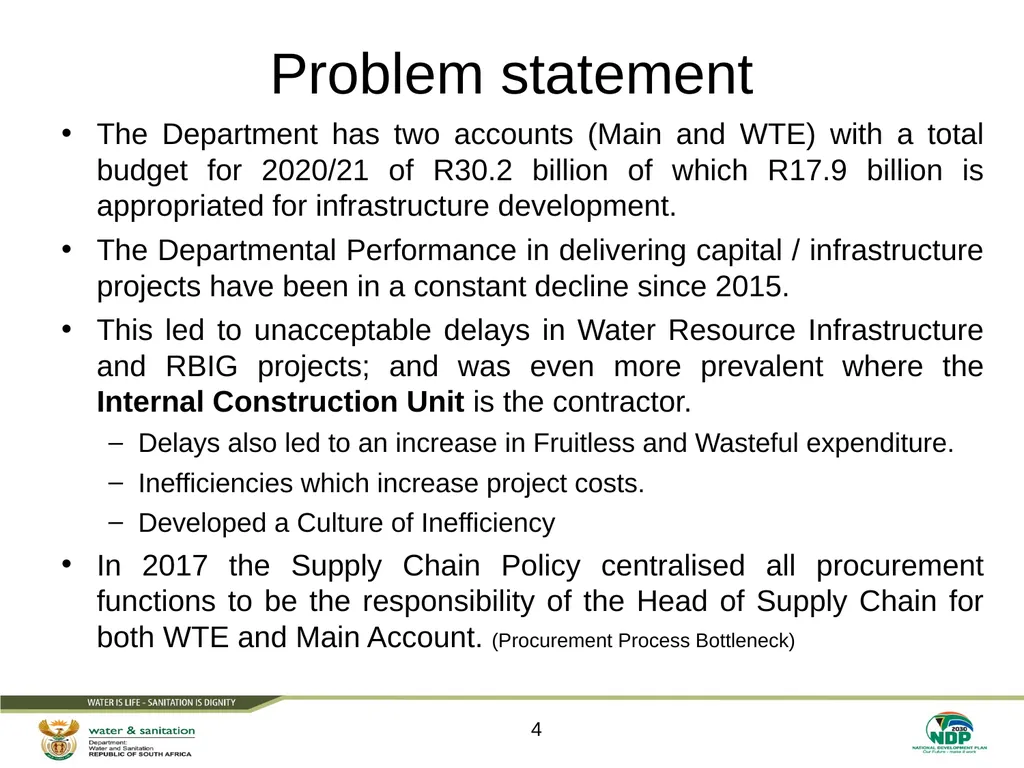
Problem statement The Department has two accounts (Main and WTE) with a total budget for 2020/21 of R30.2 billion of which R17.9 billion is appropriated for infrastructure development.
The Departmental Performance in delivering capital / infrastructure projects have been in a constant decline since 2015.
This led to unacceptable delays in Water Resource Infrastructure and RBIG projects; and was even more prevalent where the Internal Construction Unit is the contractor.
Delays also led to an increase in Fruitless and Wasteful expenditure.
Inefficiencies which increase project costs.
Developed a Culture of Inefficiency
In 2017 the Supply Chain Policy centralised all procurement functions to be the responsibility of the Head of Supply Chain for both WTE and Main Account. (Procurement Process Bottleneck) 4<br>
The Departmental Performance in delivering capital / infrastructure projects have been in a constant decline since 2015.
This led to unacceptable delays in Water Resource Infrastructure and RBIG projects; and was even more prevalent where the Internal Construction Unit is the contractor.
Delays also led to an increase in Fruitless and Wasteful expenditure.
Inefficiencies which increase project costs.
Developed a Culture of Inefficiency
In 2017 the Supply Chain Policy centralised all procurement functions to be the responsibility of the Head of Supply Chain for both WTE and Main Account. (Procurement Process Bottleneck) 4<br>
05
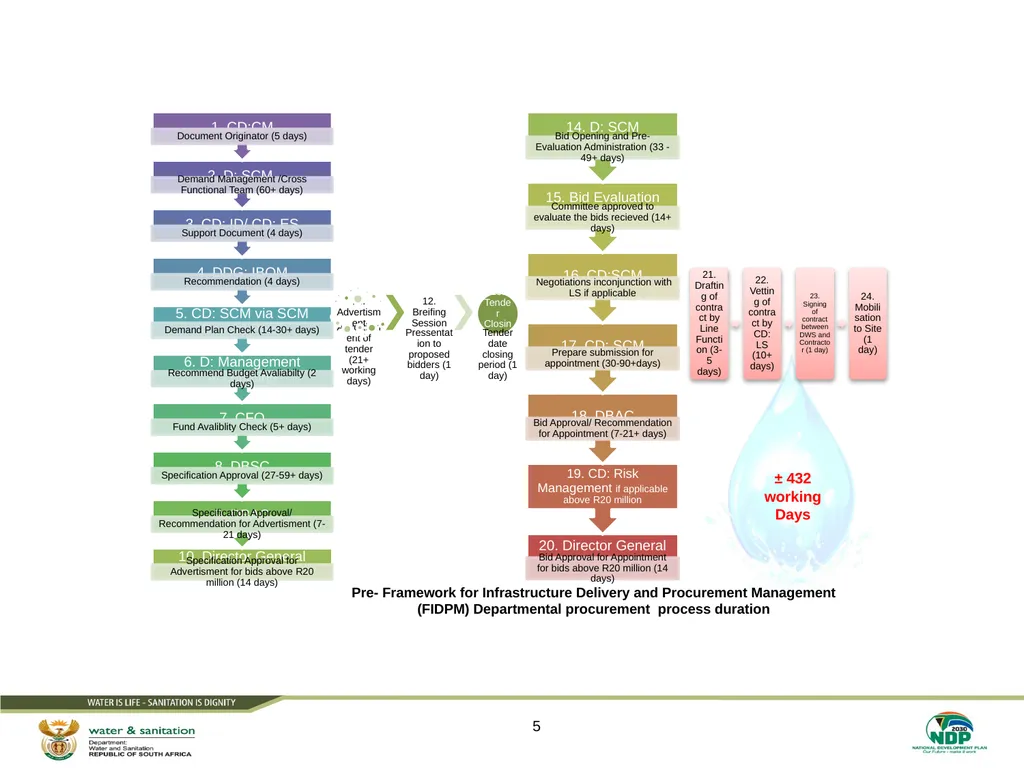
Pre- Framework for Infrastructure Delivery and Procurement Management (FIDPM) Departmental procurement process duration 5 ± 432 working Days<br>
06
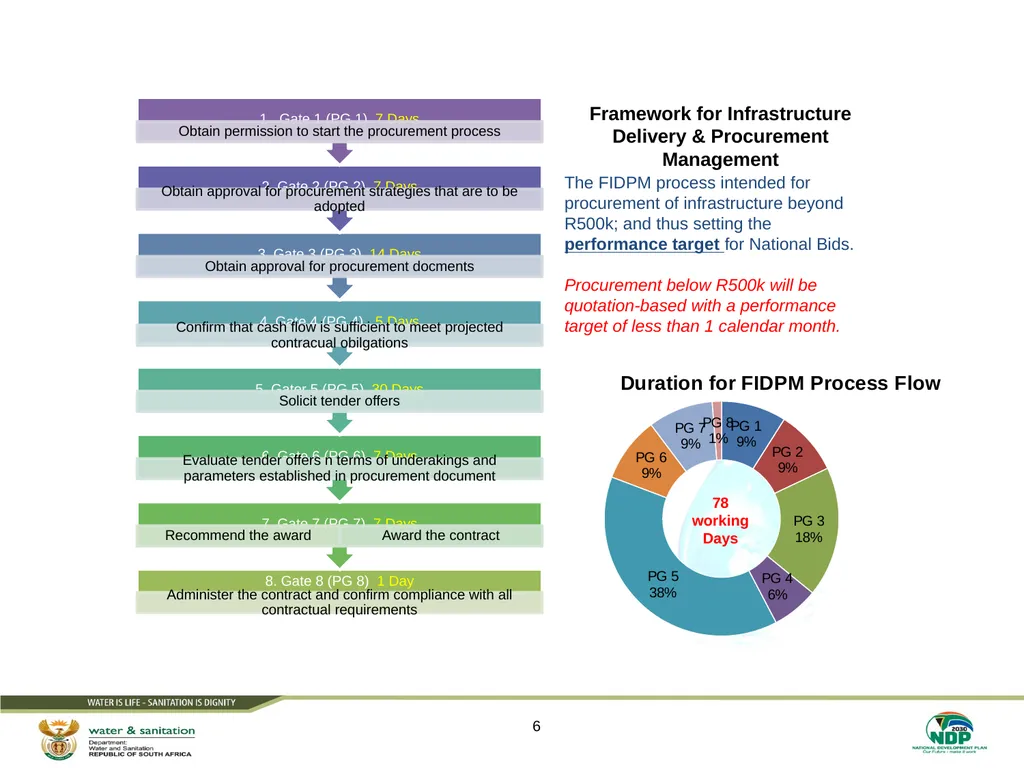
Framework for Infrastructure Delivery & Procurement Management 6 78 working Days The FIDPM process intended for procurement of infrastructure beyond R500k; and thus setting the performance target for National Bids.
Procurement below R500k will be quotation-based with a performance target of less than 1 calendar month.<br>
Procurement below R500k will be quotation-based with a performance target of less than 1 calendar month.<br>
07
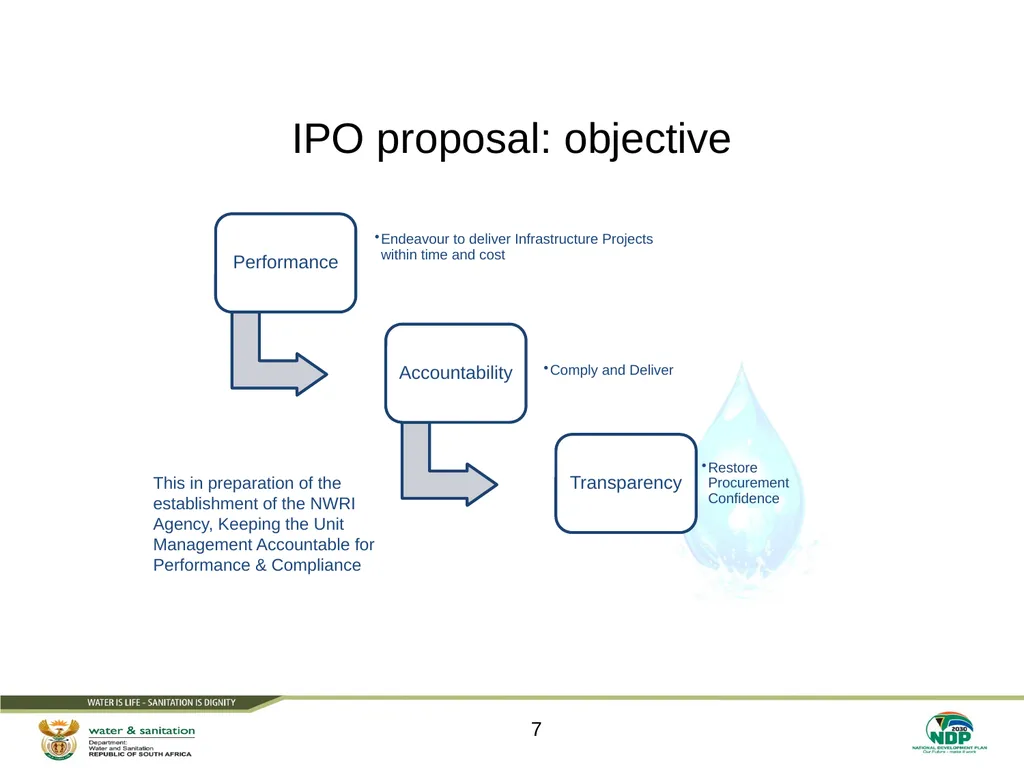
IPO proposal: objective 7 This in preparation of the establishment of the NWRI Agency, Keeping the Unit Management Accountable for Performance & Compliance<br>
08
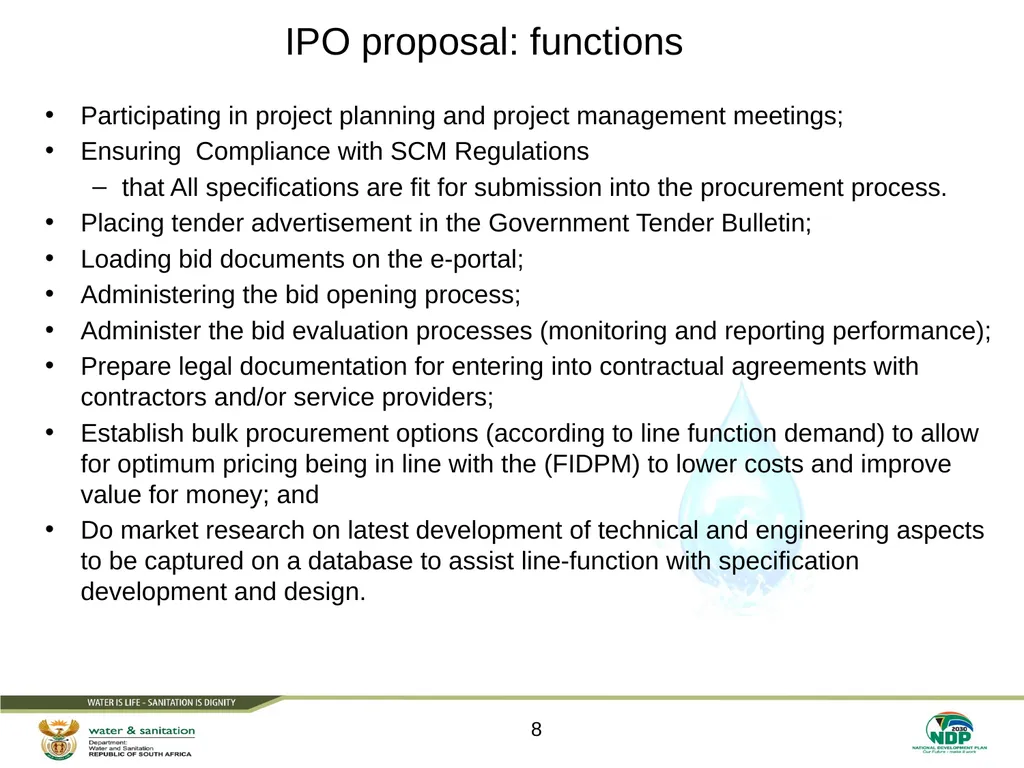
IPO proposal: functions Participating in project planning and project management meetings;
Ensuring Compliance with SCM Regulations
that All specifications are fit for submission into the procurement process.
Placing tender advertisement in the Government Tender Bulletin;
Loading bid documents on the e-portal;
Administering the bid opening process;
Administer the bid evaluation processes (monitoring and reporting performance);
Prepare legal documentation for entering into contractual agreements with contractors and/or service providers;
Establish bulk procurement options (according to line function demand) to allow for optimum pricing being in line with the (FIDPM) to lower costs and improve value for money; and
Do market research on latest development of technical and engineering aspects to be captured on a database to assist line-function with specification development and design. 8<br>
Ensuring Compliance with SCM Regulations
that All specifications are fit for submission into the procurement process.
Placing tender advertisement in the Government Tender Bulletin;
Loading bid documents on the e-portal;
Administering the bid opening process;
Administer the bid evaluation processes (monitoring and reporting performance);
Prepare legal documentation for entering into contractual agreements with contractors and/or service providers;
Establish bulk procurement options (according to line function demand) to allow for optimum pricing being in line with the (FIDPM) to lower costs and improve value for money; and
Do market research on latest development of technical and engineering aspects to be captured on a database to assist line-function with specification development and design. 8<br>
09
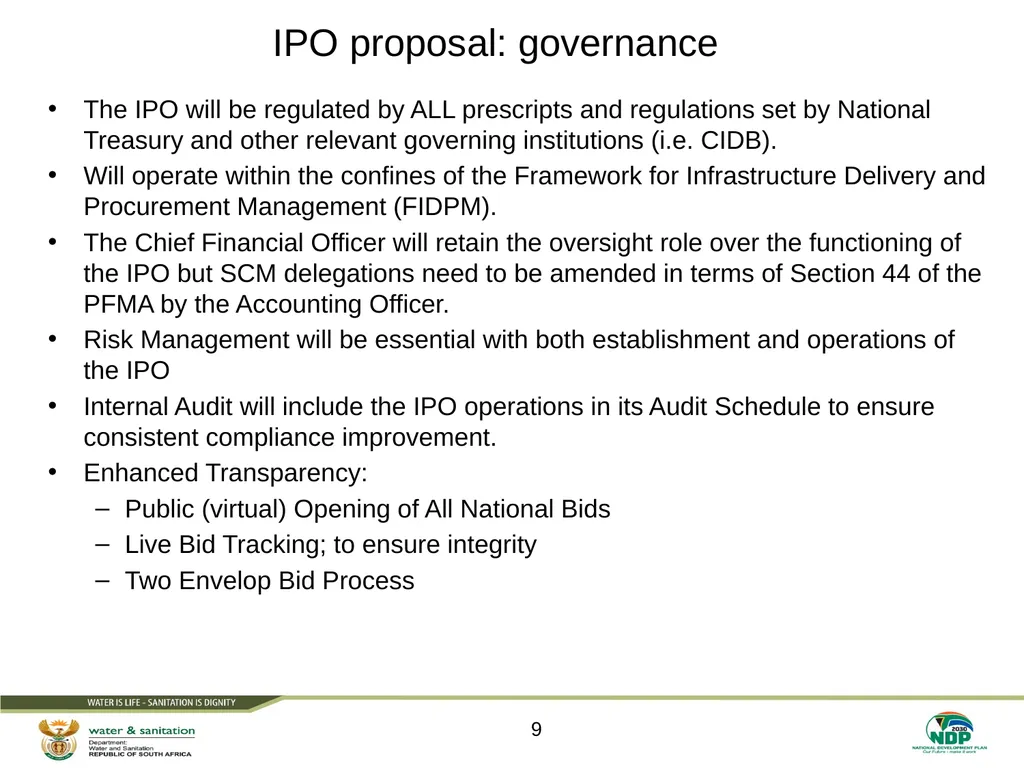
IPO proposal: governance The IPO will be regulated by ALL prescripts and regulations set by National Treasury and other relevant governing institutions (i.e. CIDB).
Will operate within the confines of the Framework for Infrastructure Delivery and Procurement Management (FIDPM).
The Chief Financial Officer will retain the oversight role over the functioning of the IPO but SCM delegations need to be amended in terms of Section 44 of the PFMA by the Accounting Officer.
Risk Management will be essential with both establishment and operations of the IPO
Internal Audit will include the IPO operations in its Audit Schedule to ensure consistent compliance improvement.
Enhanced Transparency:
Public (virtual) Opening of All National Bids
Live Bid Tracking; to ensure integrity
Two Envelop Bid Process 9<br>
Will operate within the confines of the Framework for Infrastructure Delivery and Procurement Management (FIDPM).
The Chief Financial Officer will retain the oversight role over the functioning of the IPO but SCM delegations need to be amended in terms of Section 44 of the PFMA by the Accounting Officer.
Risk Management will be essential with both establishment and operations of the IPO
Internal Audit will include the IPO operations in its Audit Schedule to ensure consistent compliance improvement.
Enhanced Transparency:
Public (virtual) Opening of All National Bids
Live Bid Tracking; to ensure integrity
Two Envelop Bid Process 9<br>
10
IPO Proposal
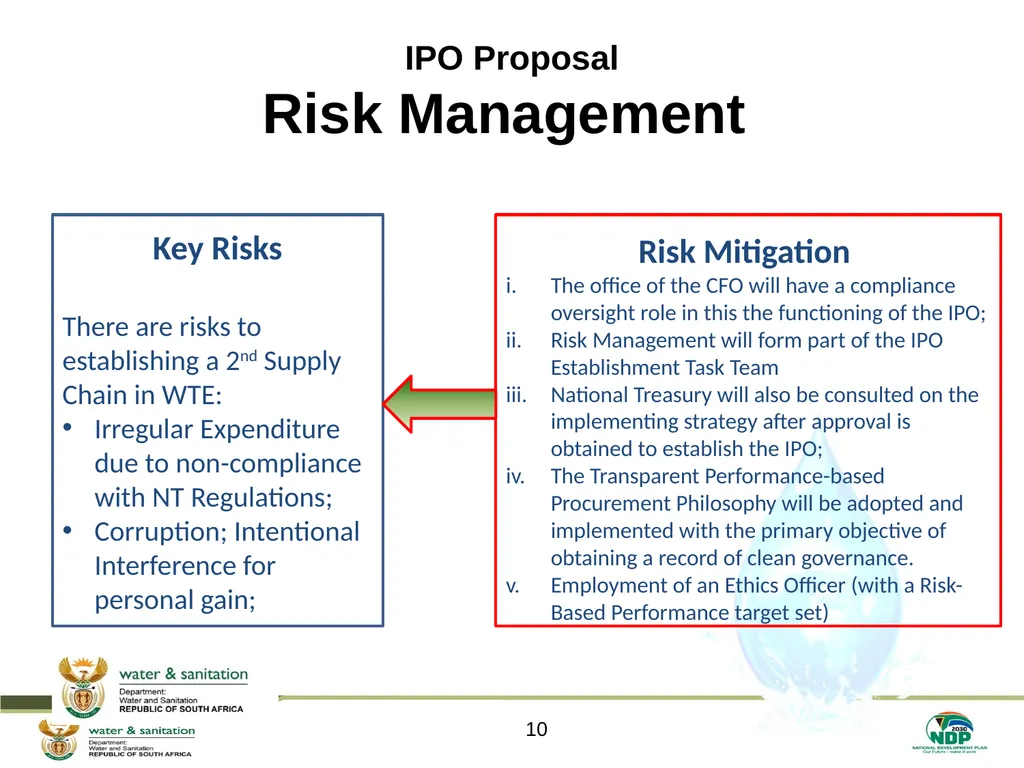
Risk Management 10 Key Risks
There are risks to establishing a 2nd Supply Chain in WTE:
Irregular Expenditure due to non-compliance with NT Regulations;
Corruption; Intentional Interference for personal gain; Risk Mitigation
The office of the CFO will have a compliance oversight role in this the functioning of the IPO;
Risk Management will form part of the IPO Establishment Task Team
National Treasury will also be consulted on the implementing strategy after approval is obtained to establish the IPO;
The Transparent Performance-based Procurement Philosophy will be adopted and implemented with the primary objective of obtaining a record of clean governance.
Employment of an Ethics Officer (with a Risk-Based Performance target set)<br>
There are risks to establishing a 2nd Supply Chain in WTE:
Irregular Expenditure due to non-compliance with NT Regulations;
Corruption; Intentional Interference for personal gain; Risk Mitigation
The office of the CFO will have a compliance oversight role in this the functioning of the IPO;
Risk Management will form part of the IPO Establishment Task Team
National Treasury will also be consulted on the implementing strategy after approval is obtained to establish the IPO;
The Transparent Performance-based Procurement Philosophy will be adopted and implemented with the primary objective of obtaining a record of clean governance.
Employment of an Ethics Officer (with a Risk-Based Performance target set)<br>
11
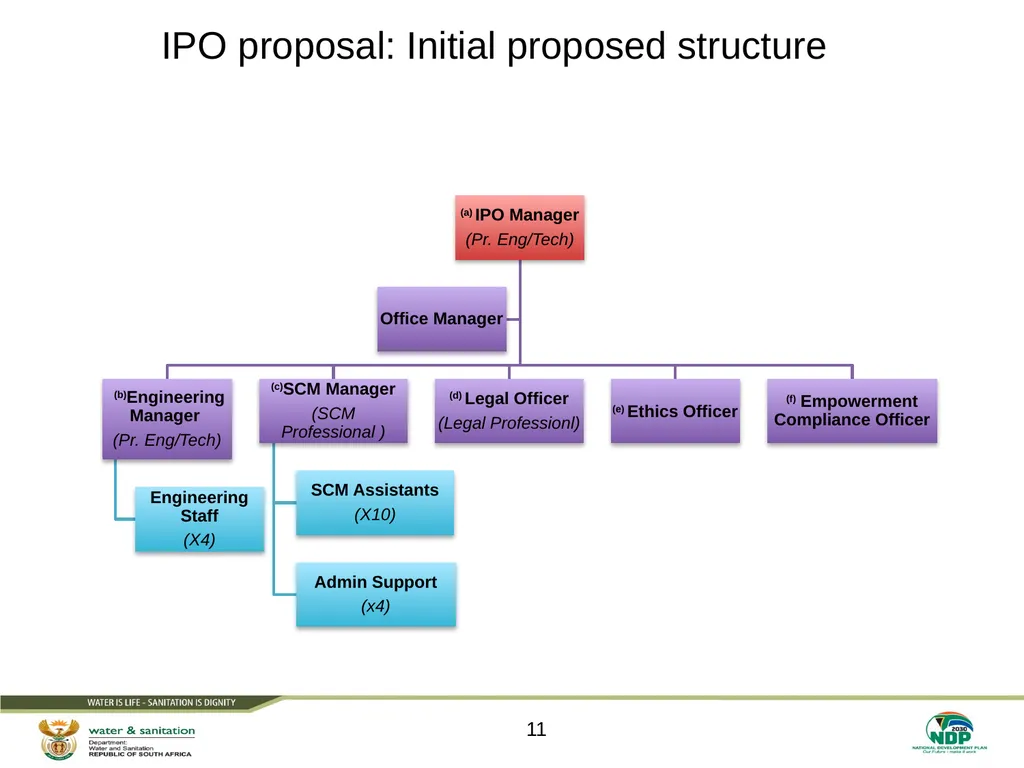
IPO proposal: Initial proposed structure 11<br>
12
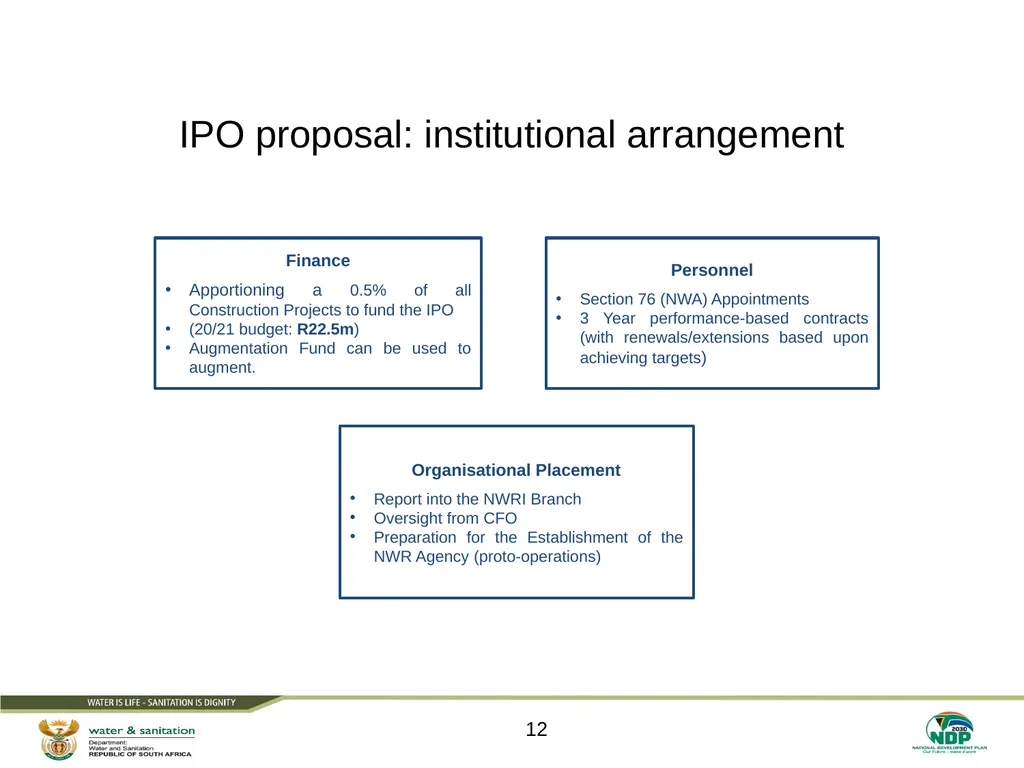
IPO proposal: institutional arrangement 12 Finance
Apportioning a 0.5% of all Construction Projects to fund the IPO
(20/21 budget: R22.5m)e
Augmentation Fund can be used to augment. Organisational Placement
Report into the NWRI Branch
Oversight from CFO
Preparation for the Establishment of the NWR Agency (proto-operations) Personnel
Section 76 (NWA) Appointments
3 Year performance-based contracts (with renewals/extensions based upon achieving targets)<br>
Apportioning a 0.5% of all Construction Projects to fund the IPO
(20/21 budget: R22.5m)e
Augmentation Fund can be used to augment. Organisational Placement
Report into the NWRI Branch
Oversight from CFO
Preparation for the Establishment of the NWR Agency (proto-operations) Personnel
Section 76 (NWA) Appointments
3 Year performance-based contracts (with renewals/extensions based upon achieving targets)<br>
13
IPO Proposal
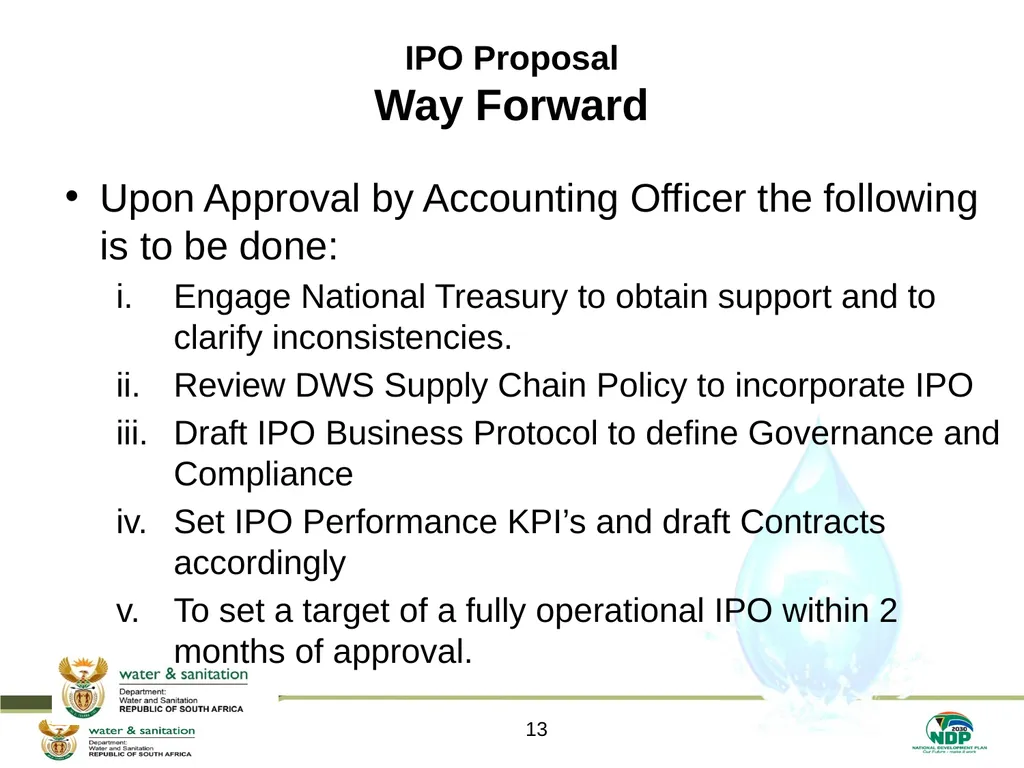
Way Forward Upon Approval by Accounting Officer the following is to be done:
Engage National Treasury to obtain support and to clarify inconsistencies.
Review DWS Supply Chain Policy to incorporate IPO
Draft IPO Business Protocol to define Governance and Compliance
Set IPO Performance KPI’s and draft Contracts accordingly
To set a target of a fully operational IPO within 2 months of approval. 13<br>
Engage National Treasury to obtain support and to clarify inconsistencies.
Review DWS Supply Chain Policy to incorporate IPO
Draft IPO Business Protocol to define Governance and Compliance
Set IPO Performance KPI’s and draft Contracts accordingly
To set a target of a fully operational IPO within 2 months of approval. 13<br>
14
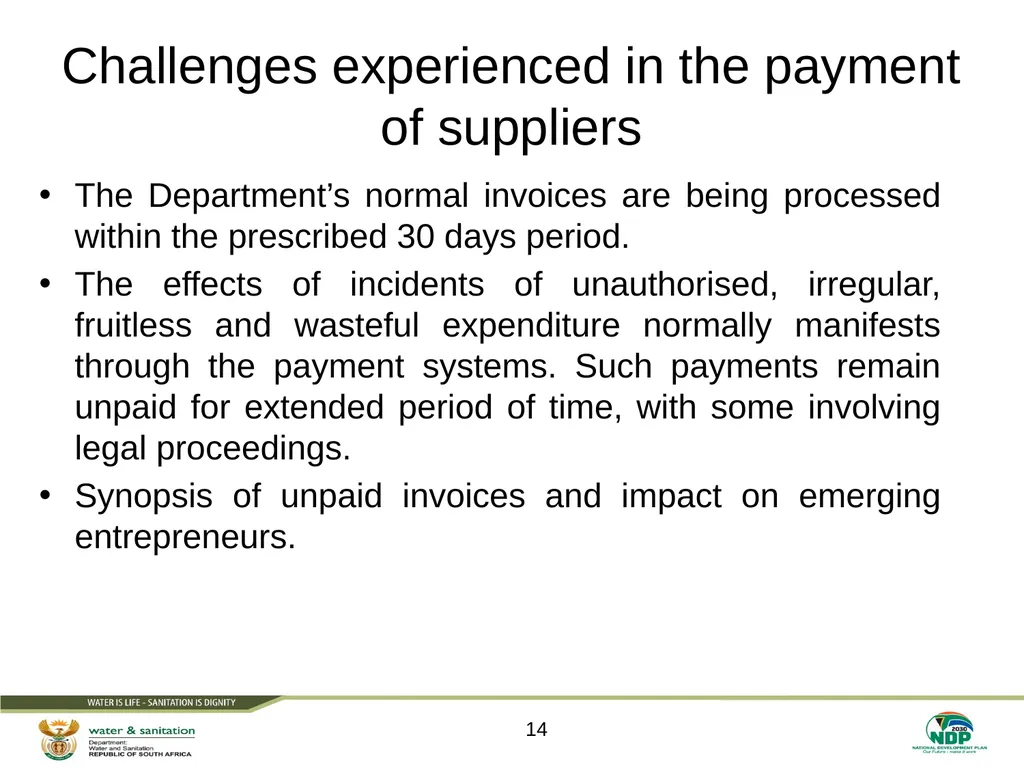
Challenges experienced in the payment of suppliers The Department’s normal invoices are being processed within the prescribed 30 days period.
The effects of incidents of unauthorised, irregular, fruitless and wasteful expenditure normally manifests through the payment systems. Such payments remain unpaid for extended period of time, with some involving legal proceedings.
Synopsis of unpaid invoices and impact on emerging entrepreneurs. 14<br>
The effects of incidents of unauthorised, irregular, fruitless and wasteful expenditure normally manifests through the payment systems. Such payments remain unpaid for extended period of time, with some involving legal proceedings.
Synopsis of unpaid invoices and impact on emerging entrepreneurs. 14<br>
15
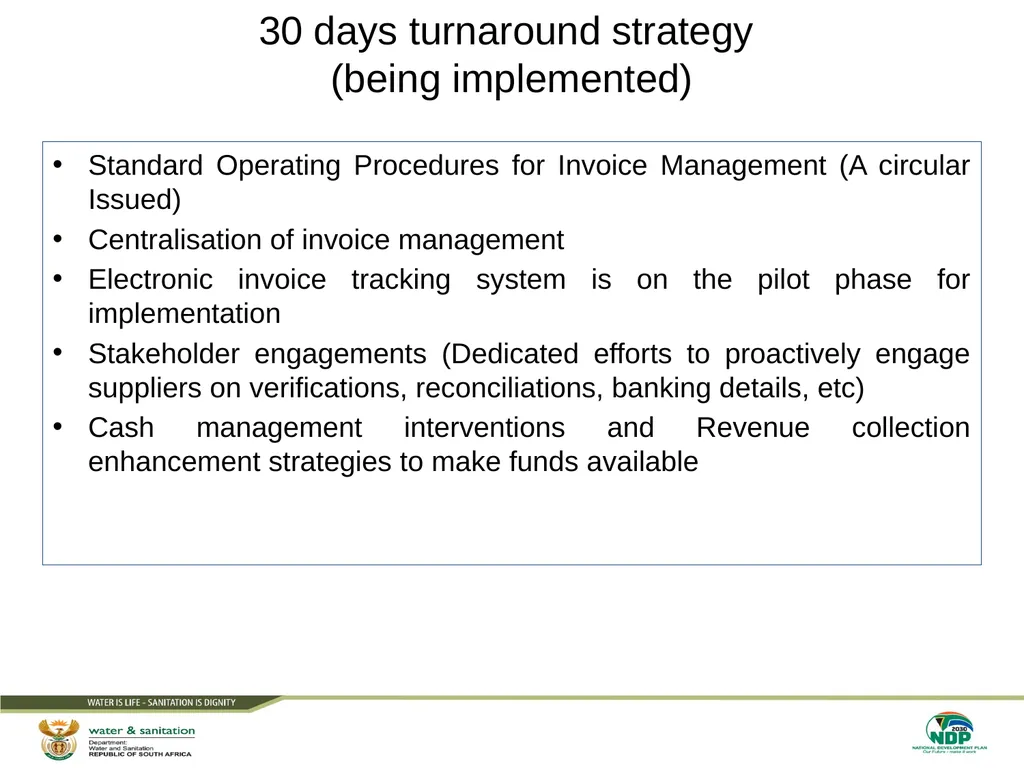
30 days turnaround strategy
(being implemented) Standard Operating Procedures for Invoice Management (A circular Issued)
Centralisation of invoice management
Electronic invoice tracking system is on the pilot phase for implementation
Stakeholder engagements (Dedicated efforts to proactively engage suppliers on verifications, reconciliations, banking details, etc)
Cash management interventions and Revenue collection enhancement strategies to make funds available<br>
Centralisation of invoice management
Electronic invoice tracking system is on the pilot phase for implementation
Stakeholder engagements (Dedicated efforts to proactively engage suppliers on verifications, reconciliations, banking details, etc)
Cash management interventions and Revenue collection enhancement strategies to make funds available<br>
16
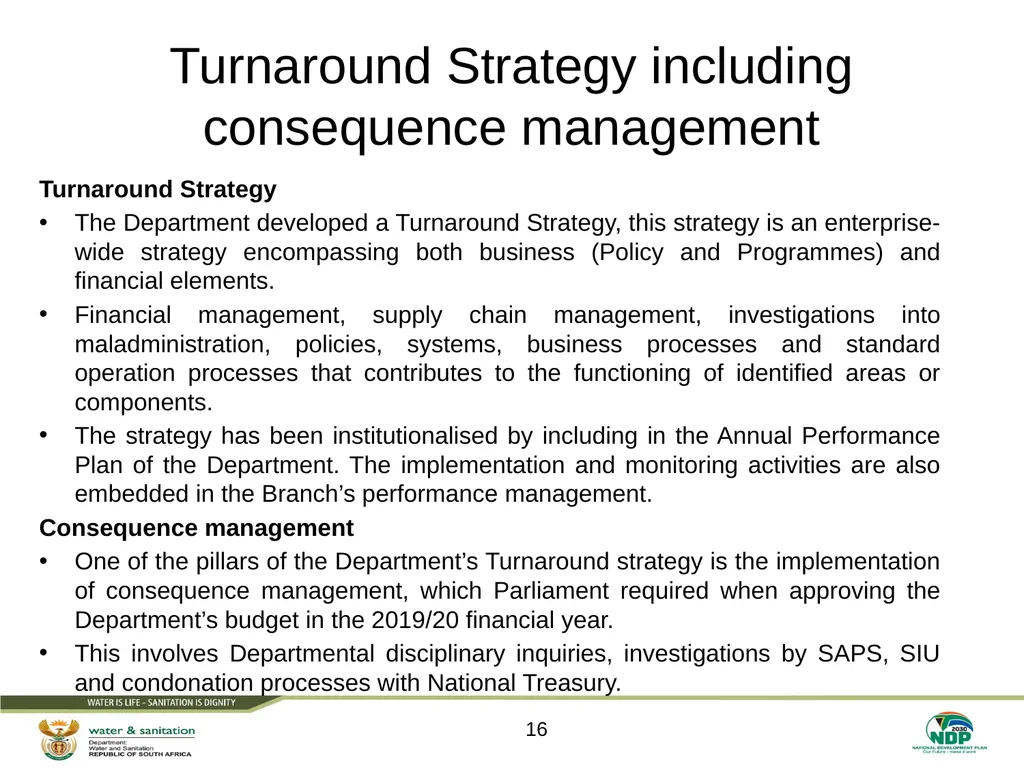
Turnaround Strategy including consequence management Turnaround Strategy
The Department developed a Turnaround Strategy, this strategy is an enterprise-wide strategy encompassing both business (Policy and Programmes) and financial elements.
Financial management, supply chain management, investigations into maladministration, policies, systems, business processes and standard operation processes that contributes to the functioning of identified areas or components.
The strategy has been institutionalised by including in the Annual Performance Plan of the Department. The implementation and monitoring activities are also embedded in the Branch’s performance management.
Consequence management
One of the pillars of the Department’s Turnaround strategy is the implementation of consequence management, which Parliament required when approving the Department’s budget in the 2019/20 financial year.
This involves Departmental disciplinary inquiries, investigations by SAPS, SIU and condonation processes with National Treasury. 16<br>
The Department developed a Turnaround Strategy, this strategy is an enterprise-wide strategy encompassing both business (Policy and Programmes) and financial elements.
Financial management, supply chain management, investigations into maladministration, policies, systems, business processes and standard operation processes that contributes to the functioning of identified areas or components.
The strategy has been institutionalised by including in the Annual Performance Plan of the Department. The implementation and monitoring activities are also embedded in the Branch’s performance management.
Consequence management
One of the pillars of the Department’s Turnaround strategy is the implementation of consequence management, which Parliament required when approving the Department’s budget in the 2019/20 financial year.
This involves Departmental disciplinary inquiries, investigations by SAPS, SIU and condonation processes with National Treasury. 16<br>
17
Thank you 17<br>