
PRESENTATION TO THE JOINT PORTFOLIO COMMITTEES ON
AS
Published · 25 slides · 0 views

1 / 1
Description
PRESENTATION TO THE JOINT PORTFOLIO COMMITTEES ON TRADE AND INDUSTRY ECONOMIC DEVELOPMENT ON THE STEEL INDUSTRY INTERVENTIONS 23 AUGUST 2016 1 CONTENT CONTEXT GLOBAL OVERSUPPY STRUCTURAL CHALLENGES (HIGH STEEL PRODUCTION COSTS) STRATEGIC
Related Topics
Share
Embed code
Download this presentation From Below
"PRESENTATION TO THE JOINT PORTFOLIO COMMITTEES ON" is the property of its rightful owner. Permission is granted to download and print the materials on this website for personal, non-commercial use only, and to display it on your personal computer provided you do not modify the materials and that you retain all copyright notices contained in the materials. By downloading content from our website, you accept the terms of this agreement.
Presentation Transcript
01
PRESENTATION TO THE JOINT PORTFOLIO COMMITTEES
ON TRADE AND INDUSTRY & ECONOMIC DEVELOPMENT
ON THE STEEL INDUSTRY INTERVENTIONS
23 AUGUST 2016 1<br>
02
CONTENT CONTEXT
GLOBAL OVERSUPPY
STRUCTURAL CHALLENGES (HIGH STEEL PRODUCTION COSTS)
STRATEGIC IMPORTANCE OF STEEL SECTOR
STEEL OUTLOOK FOR SA
POLICY INTERVENTIONS
PRIMARY STEEL TARIFF SUPPORT AND COMMITMENTS
STEEL COMMITTEE
INVESTMENT COMMITMENTS
KEY INVESTMENT ISSUES (HIGHVELD, CISCO)
FOUNDRIES
DOWNSTREAM SUPPORT MEASURES (TARIFF REVIEW AND REBATES)
LOCAL PROCUREMENT AND DESIGNATIONS
PRICING PRINCIPLES
COMPETITION COMMISSION SETTLEMENT WITH AMSA 2<br>
GLOBAL OVERSUPPY
STRUCTURAL CHALLENGES (HIGH STEEL PRODUCTION COSTS)
STRATEGIC IMPORTANCE OF STEEL SECTOR
STEEL OUTLOOK FOR SA
POLICY INTERVENTIONS
PRIMARY STEEL TARIFF SUPPORT AND COMMITMENTS
STEEL COMMITTEE
INVESTMENT COMMITMENTS
KEY INVESTMENT ISSUES (HIGHVELD, CISCO)
FOUNDRIES
DOWNSTREAM SUPPORT MEASURES (TARIFF REVIEW AND REBATES)
LOCAL PROCUREMENT AND DESIGNATIONS
PRICING PRINCIPLES
COMPETITION COMMISSION SETTLEMENT WITH AMSA 2<br>
03
CONTEXT The global economic environment remains difficult for resource based economies with sharply lower commodity prices a reflection of a decline in global demand but also of over supply by major producers
Many emerging market currencies exposed to lower growth prospects and subdued commodity prices have seen the sharpest falls
The steel industry has been particularly hard hit - oversupply and massive installed capacity in China has seen a number of countries deploying a range of measures to protect steel production capacity
Governments around the world are grappling with the steel crisis
Forecasts predict that an oversupply (currently at 400 mtons/annum) will remain for some time due to China’s massive over capacity as well as the declining global demand. China accounts for 50% of global steel production. 3<br>
Many emerging market currencies exposed to lower growth prospects and subdued commodity prices have seen the sharpest falls
The steel industry has been particularly hard hit - oversupply and massive installed capacity in China has seen a number of countries deploying a range of measures to protect steel production capacity
Governments around the world are grappling with the steel crisis
Forecasts predict that an oversupply (currently at 400 mtons/annum) will remain for some time due to China’s massive over capacity as well as the declining global demand. China accounts for 50% of global steel production. 3<br>
04
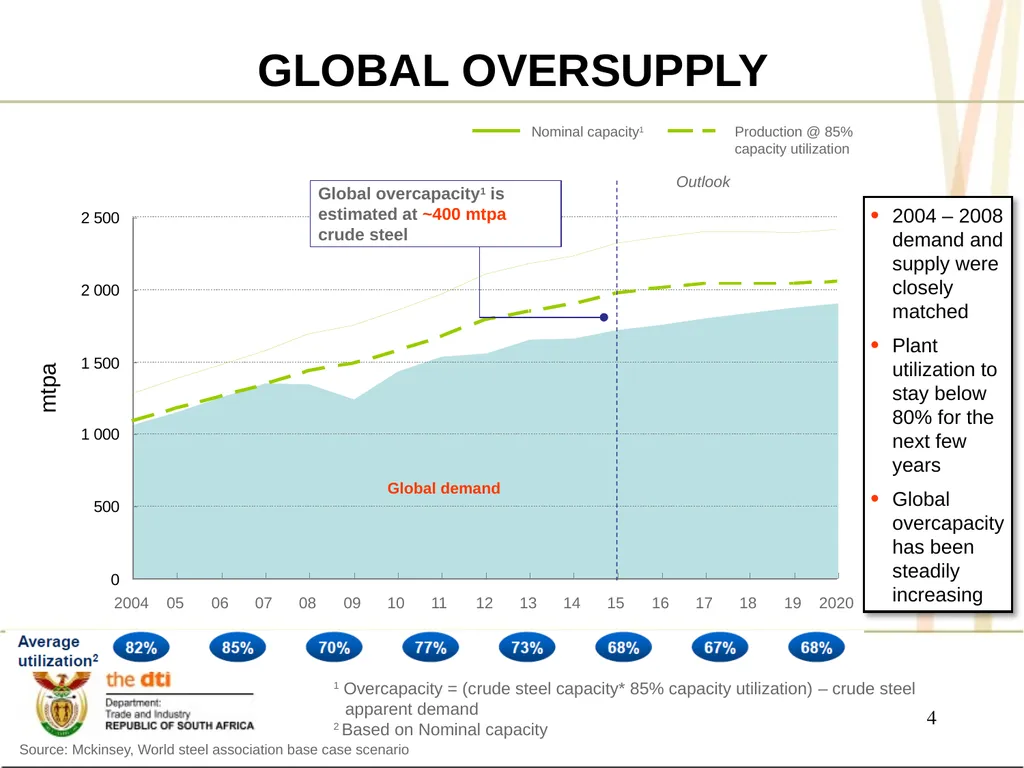
Source: Mckinsey, World steel association base case scenario 1 Overcapacity = (crude steel capacity* 85% capacity utilization) – crude steel apparent demand
2 Based on Nominal capacity 06 05 2004 2020 19 18 17 16 15 14 13 12 11 10 09 08 07 Global demand Global overcapacity1 is estimated at ~400 mtpa crude steel 2004 – 2008 demand and supply were closely matched
Plant utilization to stay below 80% for the next few years
Global overcapacity has been steadily increasing Production @ 85%
capacity utilization Nominal capacity1 mtpa GLOBAL OVERSUPPLY 4<br>
2 Based on Nominal capacity 06 05 2004 2020 19 18 17 16 15 14 13 12 11 10 09 08 07 Global demand Global overcapacity1 is estimated at ~400 mtpa crude steel 2004 – 2008 demand and supply were closely matched
Plant utilization to stay below 80% for the next few years
Global overcapacity has been steadily increasing Production @ 85%
capacity utilization Nominal capacity1 mtpa GLOBAL OVERSUPPLY 4<br>
05
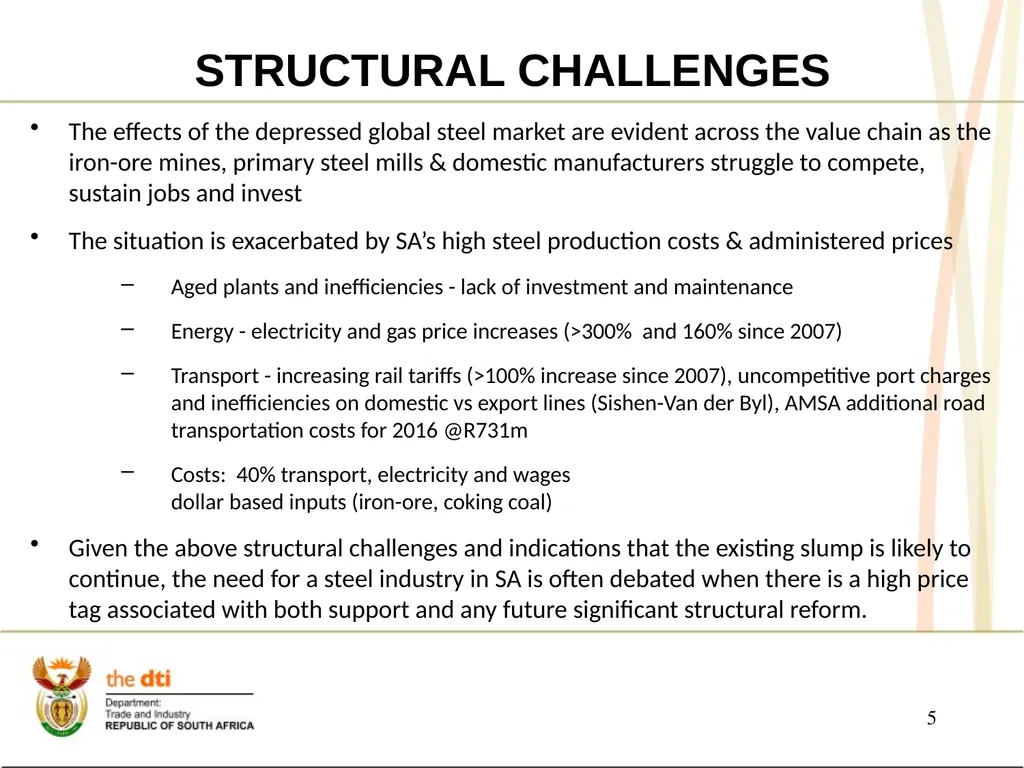
STRUCTURAL CHALLENGES The effects of the depressed global steel market are evident across the value chain as the iron-ore mines, primary steel mills & domestic manufacturers struggle to compete, sustain jobs and invest
The situation is exacerbated by SA’s high steel production costs & administered prices
Aged plants and inefficiencies - lack of investment and maintenance
Energy - electricity and gas price increases (>300% and 160% since 2007)
Transport - increasing rail tariffs (>100% increase since 2007), uncompetitive port charges and inefficiencies on domestic vs export lines (Sishen-Van der Byl), AMSA additional road transportation costs for 2016 @R731m
Costs: 40% transport, electricity and wages dollar based inputs (iron-ore, coking coal)
Given the above structural challenges and indications that the existing slump is likely to continue, the need for a steel industry in SA is often debated when there is a high price tag associated with both support and any future significant structural reform. 5<br>
The situation is exacerbated by SA’s high steel production costs & administered prices
Aged plants and inefficiencies - lack of investment and maintenance
Energy - electricity and gas price increases (>300% and 160% since 2007)
Transport - increasing rail tariffs (>100% increase since 2007), uncompetitive port charges and inefficiencies on domestic vs export lines (Sishen-Van der Byl), AMSA additional road transportation costs for 2016 @R731m
Costs: 40% transport, electricity and wages dollar based inputs (iron-ore, coking coal)
Given the above structural challenges and indications that the existing slump is likely to continue, the need for a steel industry in SA is often debated when there is a high price tag associated with both support and any future significant structural reform. 5<br>
06
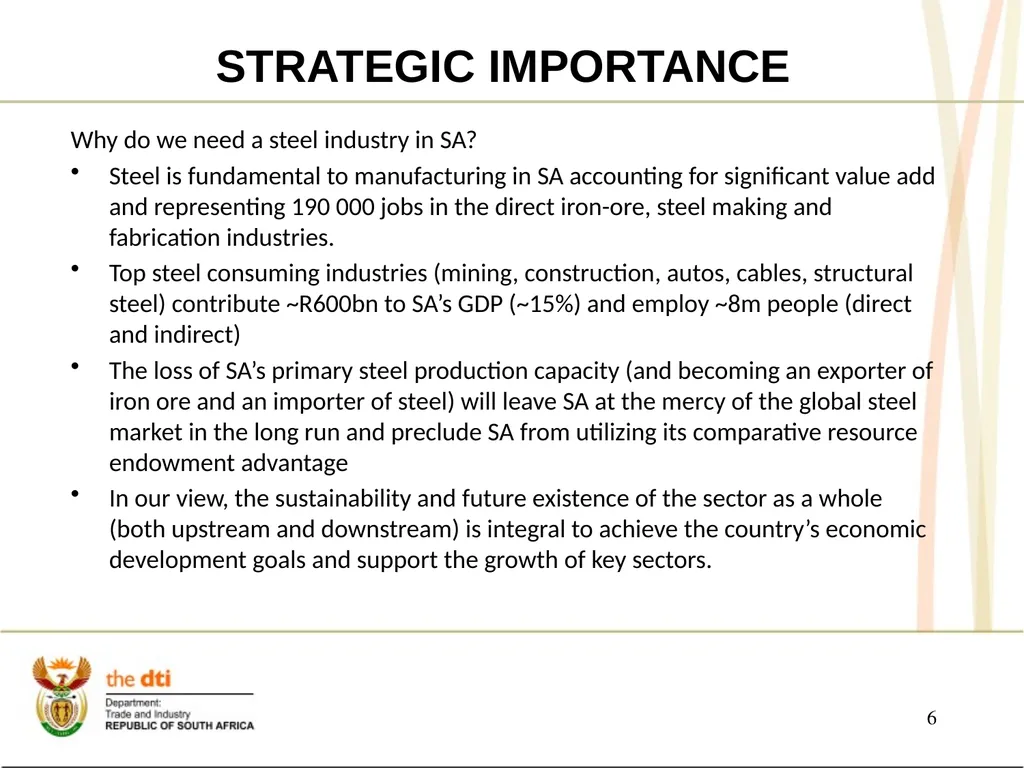
STRATEGIC IMPORTANCE Why do we need a steel industry in SA?
Steel is fundamental to manufacturing in SA accounting for significant value add and representing 190 000 jobs in the direct iron-ore, steel making and fabrication industries.
Top steel consuming industries (mining, construction, autos, cables, structural steel) contribute ~R600bn to SA’s GDP (~15%) and employ ~8m people (direct and indirect)
The loss of SA’s primary steel production capacity (and becoming an exporter of iron ore and an importer of steel) will leave SA at the mercy of the global steel market in the long run and preclude SA from utilizing its comparative resource endowment advantage
In our view, the sustainability and future existence of the sector as a whole (both upstream and downstream) is integral to achieve the country’s economic development goals and support the growth of key sectors. 6<br>
Steel is fundamental to manufacturing in SA accounting for significant value add and representing 190 000 jobs in the direct iron-ore, steel making and fabrication industries.
Top steel consuming industries (mining, construction, autos, cables, structural steel) contribute ~R600bn to SA’s GDP (~15%) and employ ~8m people (direct and indirect)
The loss of SA’s primary steel production capacity (and becoming an exporter of iron ore and an importer of steel) will leave SA at the mercy of the global steel market in the long run and preclude SA from utilizing its comparative resource endowment advantage
In our view, the sustainability and future existence of the sector as a whole (both upstream and downstream) is integral to achieve the country’s economic development goals and support the growth of key sectors. 6<br>
07
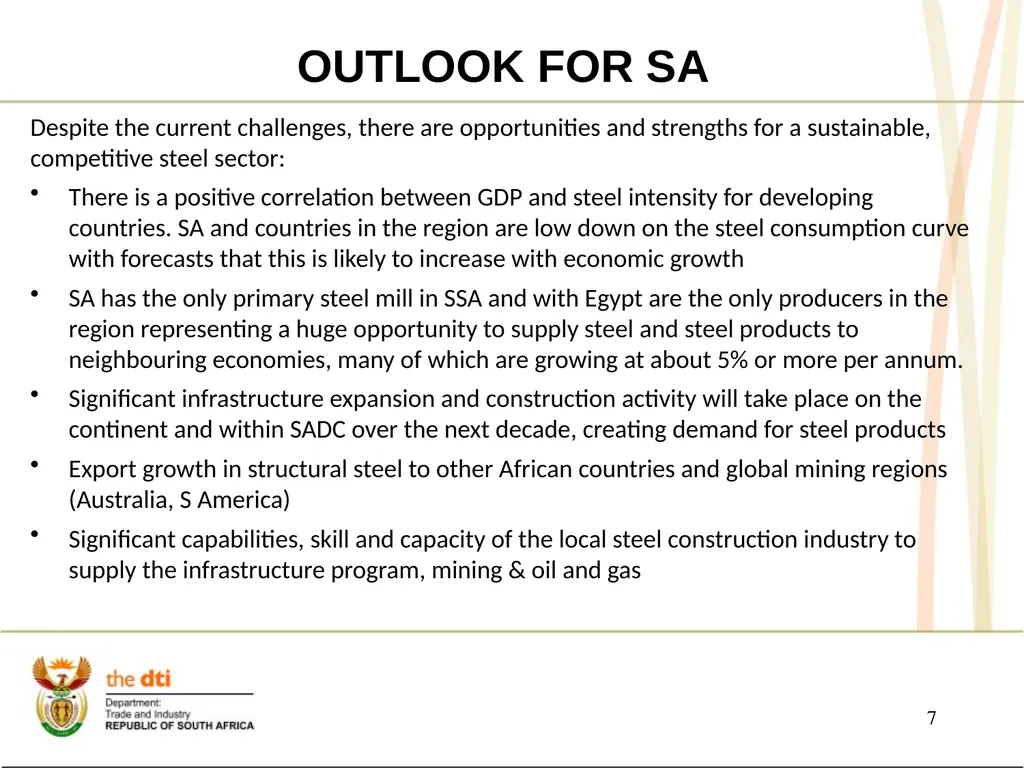
OUTLOOK FOR SA Despite the current challenges, there are opportunities and strengths for a sustainable, competitive steel sector:
There is a positive correlation between GDP and steel intensity for developing countries. SA and countries in the region are low down on the steel consumption curve with forecasts that this is likely to increase with economic growth
SA has the only primary steel mill in SSA and with Egypt are the only producers in the region representing a huge opportunity to supply steel and steel products to neighbouring economies, many of which are growing at about 5% or more per annum.
Significant infrastructure expansion and construction activity will take place on the continent and within SADC over the next decade, creating demand for steel products
Export growth in structural steel to other African countries and global mining regions (Australia, S America)
Significant capabilities, skill and capacity of the local steel construction industry to supply the infrastructure program, mining & oil and gas 7<br>
There is a positive correlation between GDP and steel intensity for developing countries. SA and countries in the region are low down on the steel consumption curve with forecasts that this is likely to increase with economic growth
SA has the only primary steel mill in SSA and with Egypt are the only producers in the region representing a huge opportunity to supply steel and steel products to neighbouring economies, many of which are growing at about 5% or more per annum.
Significant infrastructure expansion and construction activity will take place on the continent and within SADC over the next decade, creating demand for steel products
Export growth in structural steel to other African countries and global mining regions (Australia, S America)
Significant capabilities, skill and capacity of the local steel construction industry to supply the infrastructure program, mining & oil and gas 7<br>
08
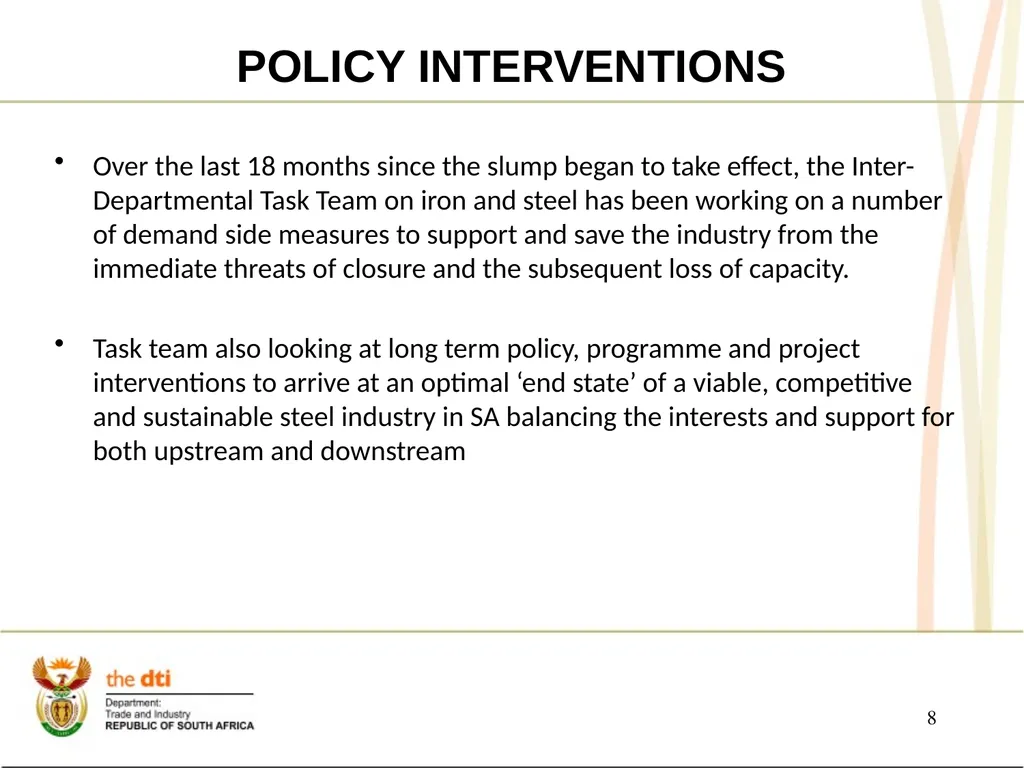
Over the last 18 months since the slump began to take effect, the Inter-Departmental Task Team on iron and steel has been working on a number of demand side measures to support and save the industry from the immediate threats of closure and the subsequent loss of capacity.
Task team also looking at long term policy, programme and project interventions to arrive at an optimal ‘end state’ of a viable, competitive and sustainable steel industry in SA balancing the interests and support for both upstream and downstream POLICY INTERVENTIONS 8<br>
Task team also looking at long term policy, programme and project interventions to arrive at an optimal ‘end state’ of a viable, competitive and sustainable steel industry in SA balancing the interests and support for both upstream and downstream POLICY INTERVENTIONS 8<br>
09
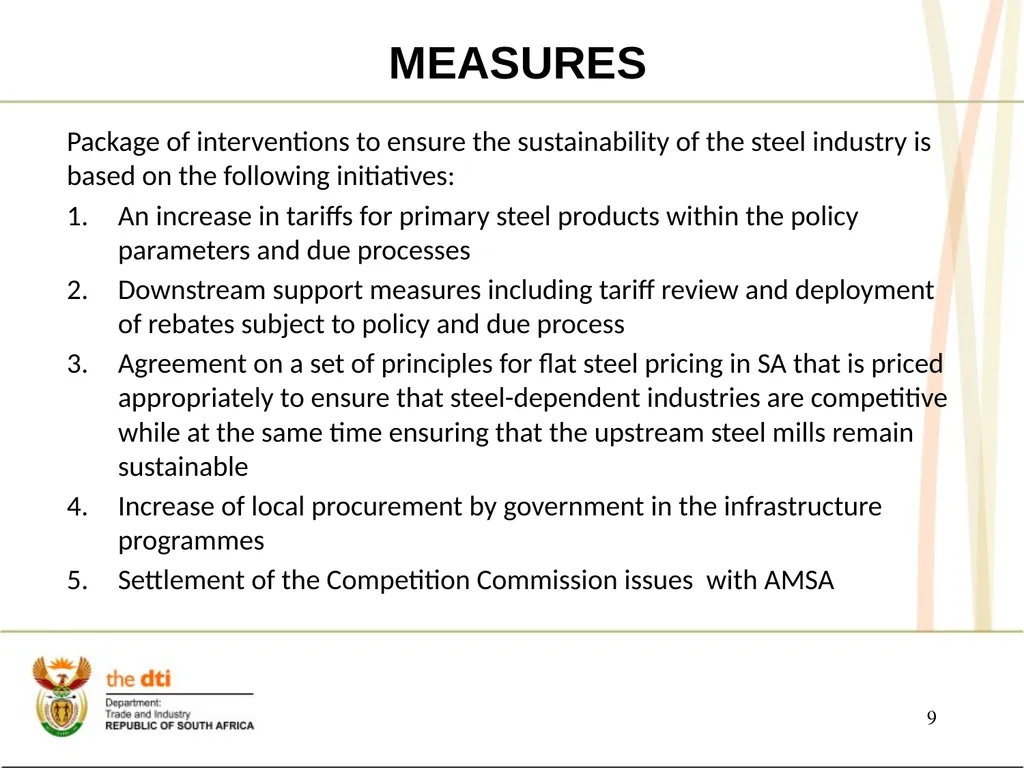
MEASURES Package of interventions to ensure the sustainability of the steel industry is based on the following initiatives:
An increase in tariffs for primary steel products within the policy parameters and due processes
Downstream support measures including tariff review and deployment of rebates subject to policy and due process
Agreement on a set of principles for flat steel pricing in SA that is priced appropriately to ensure that steel-dependent industries are competitive while at the same time ensuring that the upstream steel mills remain sustainable
Increase of local procurement by government in the infrastructure programmes
Settlement of the Competition Commission issues with AMSA 9<br>
An increase in tariffs for primary steel products within the policy parameters and due processes
Downstream support measures including tariff review and deployment of rebates subject to policy and due process
Agreement on a set of principles for flat steel pricing in SA that is priced appropriately to ensure that steel-dependent industries are competitive while at the same time ensuring that the upstream steel mills remain sustainable
Increase of local procurement by government in the infrastructure programmes
Settlement of the Competition Commission issues with AMSA 9<br>
10
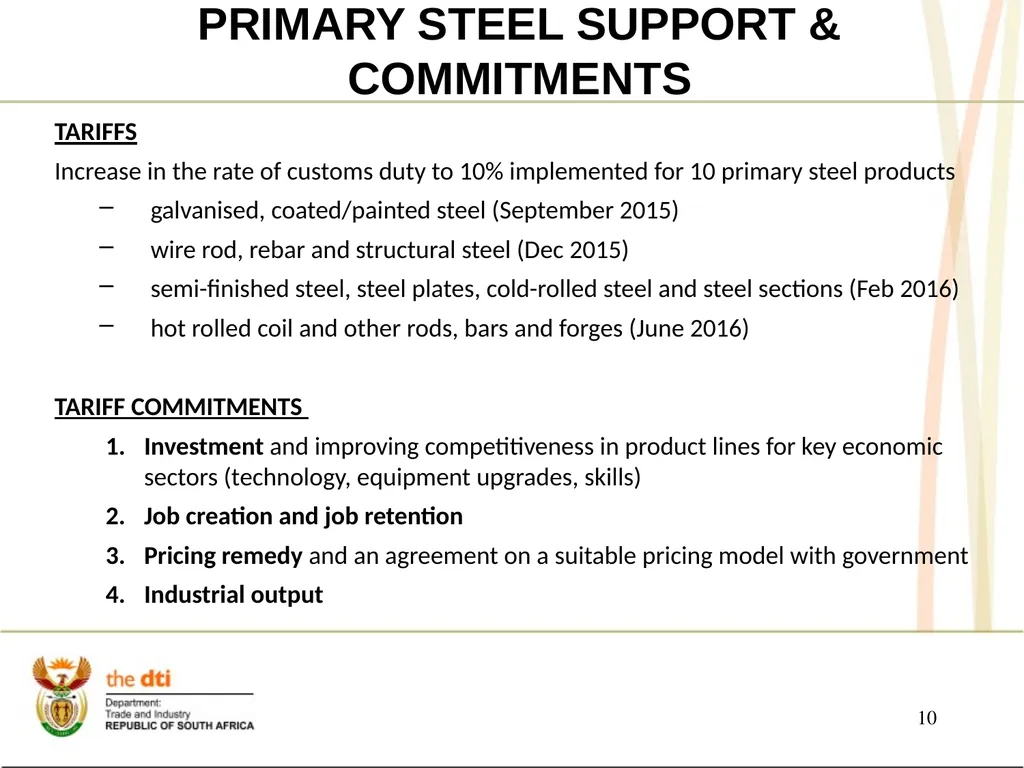
PRIMARY STEEL SUPPORT & COMMITMENTS TARIFFS
Increase in the rate of customs duty to 10% implemented for 10 primary steel products
galvanised, coated/painted steel (September 2015)
wire rod, rebar and structural steel (Dec 2015)
semi-finished steel, steel plates, cold-rolled steel and steel sections (Feb 2016)
hot rolled coil and other rods, bars and forges (June 2016)
Tariff Commitments
Investment and improving competitiveness in product lines for key economic sectors (technology, equipment upgrades, skills)
Job creation and job retention
Pricing remedy and an agreement on a suitable pricing model with government
Industrial output 10<br>
Increase in the rate of customs duty to 10% implemented for 10 primary steel products
galvanised, coated/painted steel (September 2015)
wire rod, rebar and structural steel (Dec 2015)
semi-finished steel, steel plates, cold-rolled steel and steel sections (Feb 2016)
hot rolled coil and other rods, bars and forges (June 2016)
Tariff Commitments
Investment and improving competitiveness in product lines for key economic sectors (technology, equipment upgrades, skills)
Job creation and job retention
Pricing remedy and an agreement on a suitable pricing model with government
Industrial output 10<br>
11
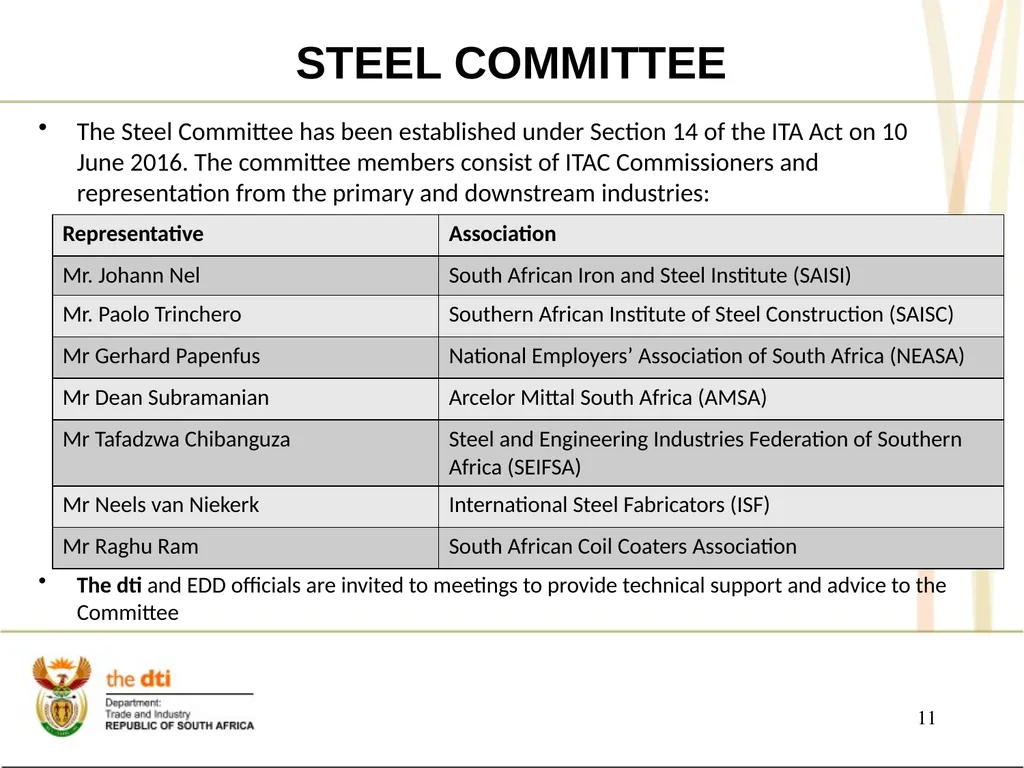
STEEL COMMITTEE The Steel Committee has been established under Section 14 of the ITA Act on 10 June 2016. The committee members consist of ITAC Commissioners and representation from the primary and downstream industries:
The dti and EDD officials are invited to meetings to provide technical support and advice to the Committee 11<br>
The dti and EDD officials are invited to meetings to provide technical support and advice to the Committee 11<br>
12
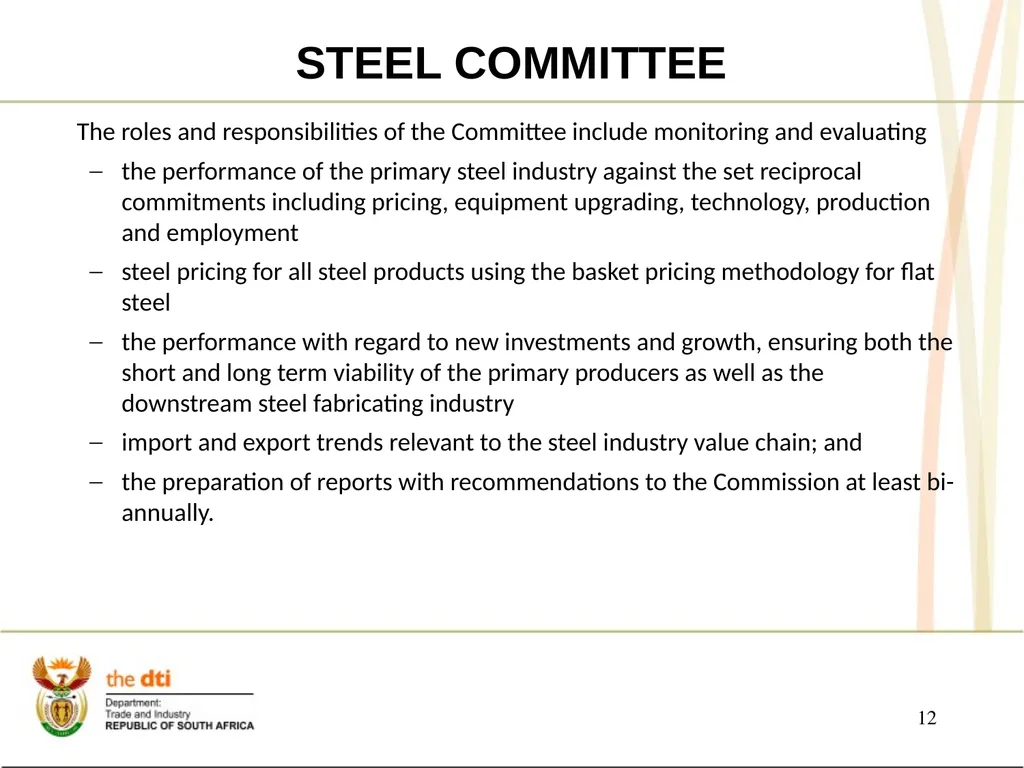
STEEL COMMITTEE The roles and responsibilities of the Committee include monitoring and evaluating
the performance of the primary steel industry against the set reciprocal commitments including pricing, equipment upgrading, technology, production and employment
steel pricing for all steel products using the basket pricing methodology for flat steel
the performance with regard to new investments and growth, ensuring both the short and long term viability of the primary producers as well as the downstream steel fabricating industry
import and export trends relevant to the steel industry value chain; and
the preparation of reports with recommendations to the Commission at least bi-annually. 12<br>
the performance of the primary steel industry against the set reciprocal commitments including pricing, equipment upgrading, technology, production and employment
steel pricing for all steel products using the basket pricing methodology for flat steel
the performance with regard to new investments and growth, ensuring both the short and long term viability of the primary producers as well as the downstream steel fabricating industry
import and export trends relevant to the steel industry value chain; and
the preparation of reports with recommendations to the Commission at least bi-annually. 12<br>
13
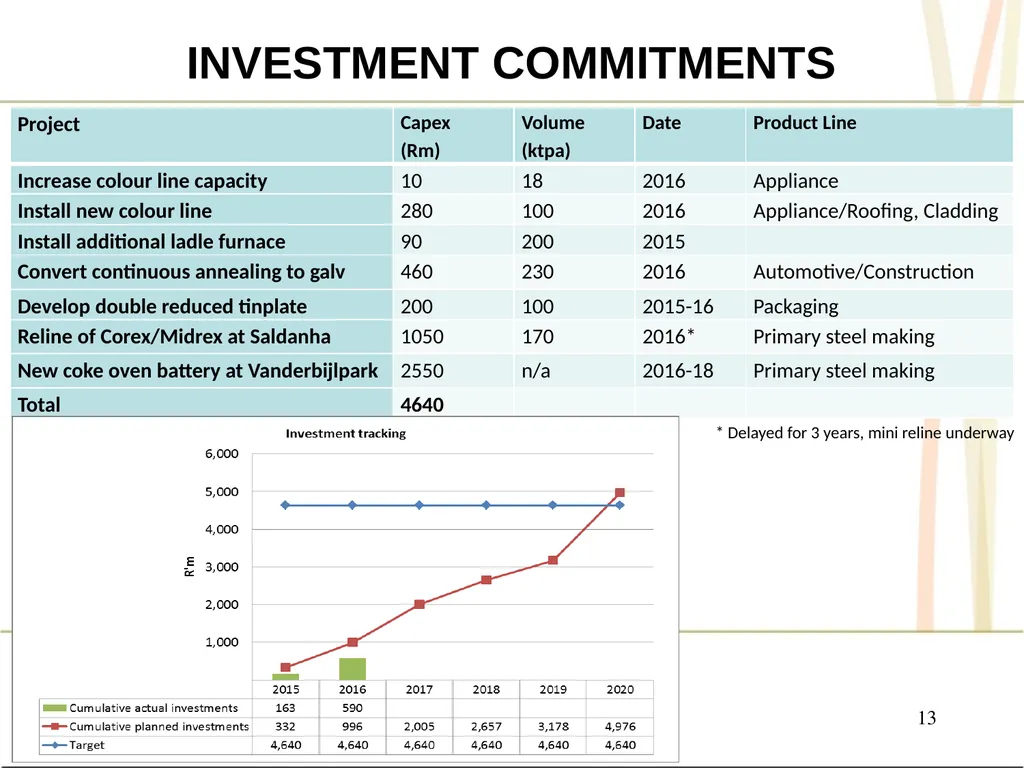
INVESTMENT COMMITMENTS * Delayed for 3 years, mini reline underway 13<br>
14
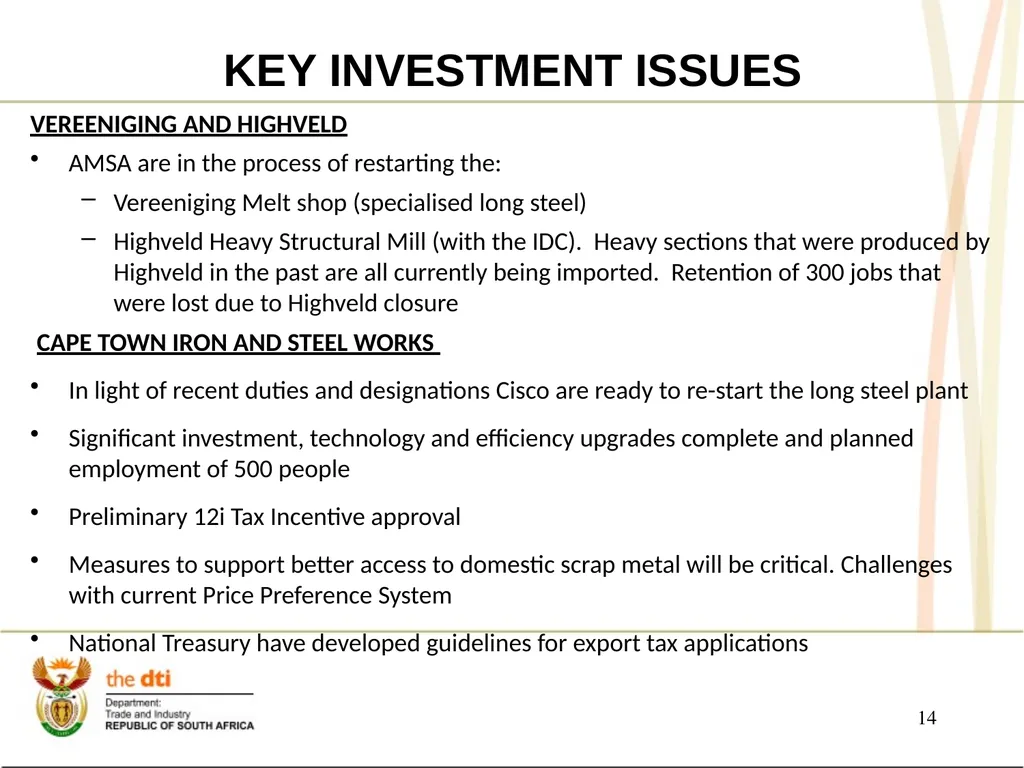
KEY INVESTMENT ISSUES VEREENIGING AND HIGHVELD
AMSA are in the process of restarting the:
Vereeniging Melt shop (specialised long steel)
Highveld Heavy Structural Mill (with the IDC). Heavy sections that were produced by Highveld in the past are all currently being imported. Retention of 300 jobs that were lost due to Highveld closure
Cape Town Iron and Steel Works
In light of recent duties and designations Cisco are ready to re-start the long steel plant
Significant investment, technology and efficiency upgrades complete and planned employment of 500 people
Preliminary 12i Tax Incentive approval
Measures to support better access to domestic scrap metal will be critical. Challenges with current Price Preference System
National Treasury have developed guidelines for export tax applications 14<br>
AMSA are in the process of restarting the:
Vereeniging Melt shop (specialised long steel)
Highveld Heavy Structural Mill (with the IDC). Heavy sections that were produced by Highveld in the past are all currently being imported. Retention of 300 jobs that were lost due to Highveld closure
Cape Town Iron and Steel Works
In light of recent duties and designations Cisco are ready to re-start the long steel plant
Significant investment, technology and efficiency upgrades complete and planned employment of 500 people
Preliminary 12i Tax Incentive approval
Measures to support better access to domestic scrap metal will be critical. Challenges with current Price Preference System
National Treasury have developed guidelines for export tax applications 14<br>
15
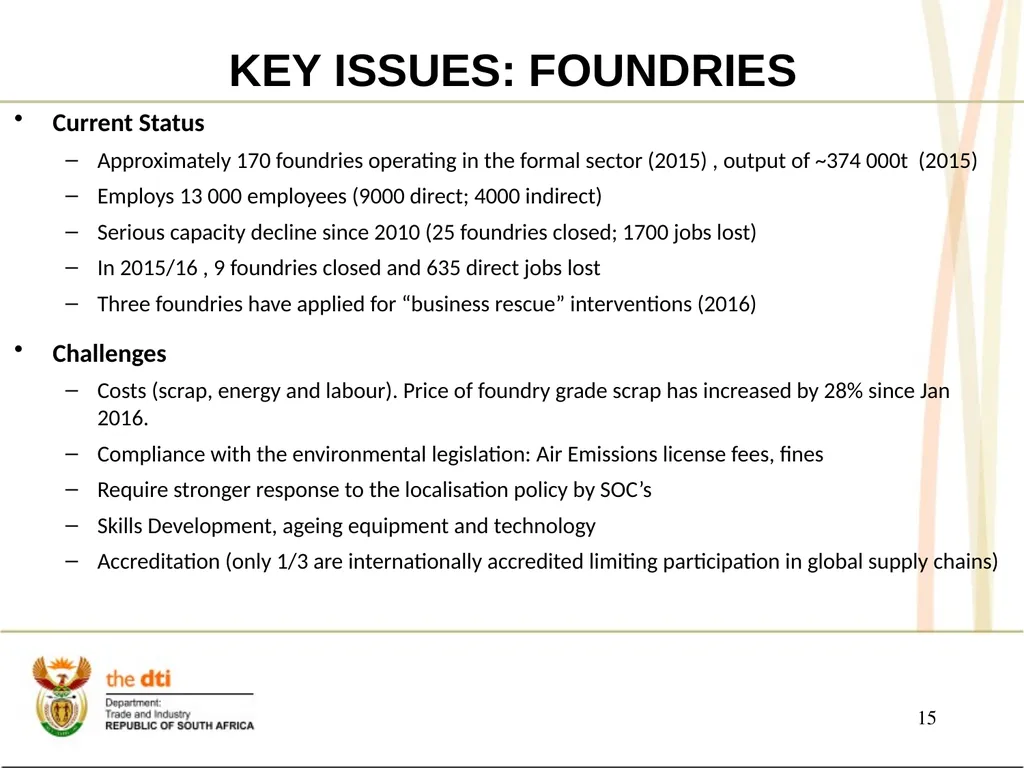
KEY ISSUES: FOUNDRIES Current Status
Approximately 170 foundries operating in the formal sector (2015) , output of ~374 000t (2015)
Employs 13 000 employees (9000 direct; 4000 indirect)
Serious capacity decline since 2010 (25 foundries closed; 1700 jobs lost)
In 2015/16 , 9 foundries closed and 635 direct jobs lost
Three foundries have applied for “business rescue” interventions (2016)
Challenges
Costs (scrap, energy and labour). Price of foundry grade scrap has increased by 28% since Jan 2016.
Compliance with the environmental legislation: Air Emissions license fees, fines
Require stronger response to the localisation policy by SOC’s
Skills Development, ageing equipment and technology
Accreditation (only 1/3 are internationally accredited limiting participation in global supply chains) 15<br>
Approximately 170 foundries operating in the formal sector (2015) , output of ~374 000t (2015)
Employs 13 000 employees (9000 direct; 4000 indirect)
Serious capacity decline since 2010 (25 foundries closed; 1700 jobs lost)
In 2015/16 , 9 foundries closed and 635 direct jobs lost
Three foundries have applied for “business rescue” interventions (2016)
Challenges
Costs (scrap, energy and labour). Price of foundry grade scrap has increased by 28% since Jan 2016.
Compliance with the environmental legislation: Air Emissions license fees, fines
Require stronger response to the localisation policy by SOC’s
Skills Development, ageing equipment and technology
Accreditation (only 1/3 are internationally accredited limiting participation in global supply chains) 15<br>
16
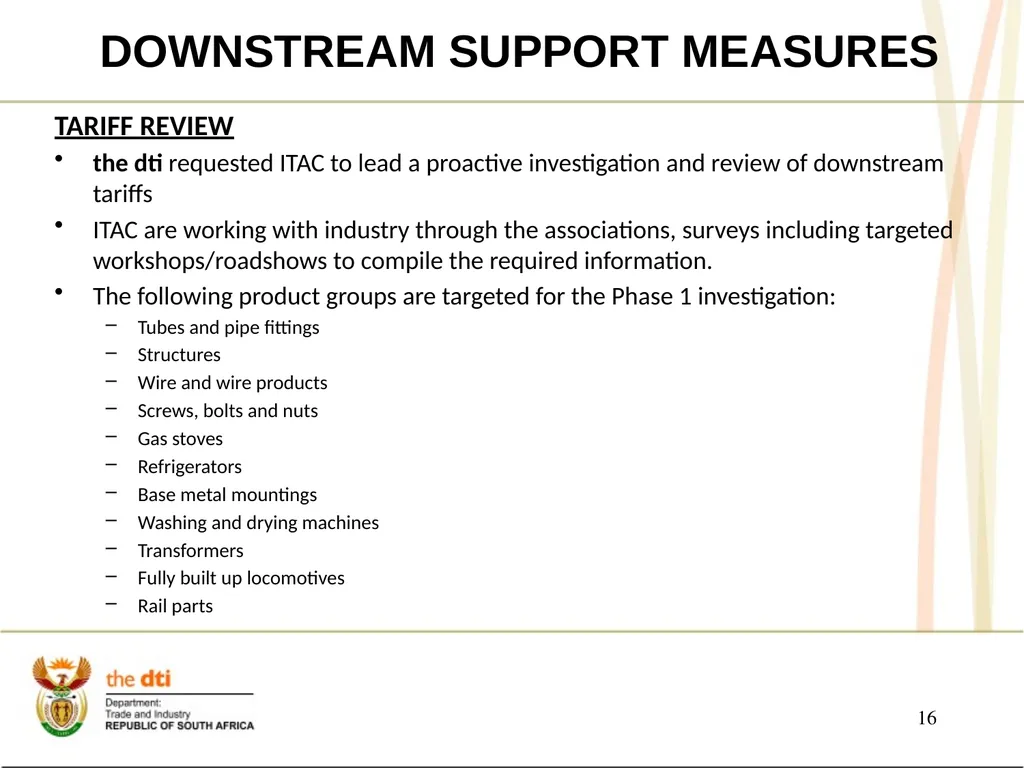
DOWNSTREAM SUPPORT MEASURES TARIFF REVIEW
the dti requested ITAC to lead a proactive investigation and review of downstream tariffs
ITAC are working with industry through the associations, surveys including targeted workshops/roadshows to compile the required information.
The following product groups are targeted for the Phase 1 investigation:
Tubes and pipe fittings
Structures
Wire and wire products
Screws, bolts and nuts
Gas stoves
Refrigerators
Base metal mountings
Washing and drying machines
Transformers
Fully built up locomotives
Rail parts 16<br>
the dti requested ITAC to lead a proactive investigation and review of downstream tariffs
ITAC are working with industry through the associations, surveys including targeted workshops/roadshows to compile the required information.
The following product groups are targeted for the Phase 1 investigation:
Tubes and pipe fittings
Structures
Wire and wire products
Screws, bolts and nuts
Gas stoves
Refrigerators
Base metal mountings
Washing and drying machines
Transformers
Fully built up locomotives
Rail parts 16<br>
17
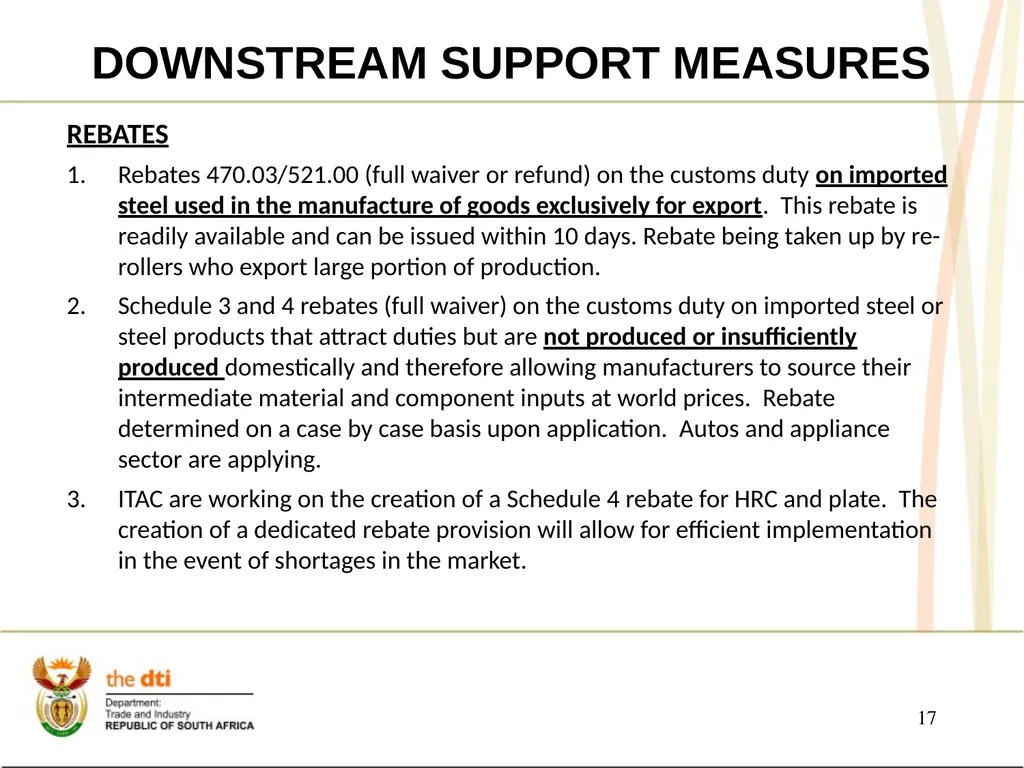
DOWNSTREAM SUPPORT MEASURES REBATES
Rebates 470.03/521.00 (full waiver or refund) on the customs duty on imported steel used in the manufacture of goods exclusively for export. This rebate is readily available and can be issued within 10 days. Rebate being taken up by re-rollers who export large portion of production.
Schedule 3 and 4 rebates (full waiver) on the customs duty on imported steel or steel products that attract duties but are not produced or insufficiently produced domestically and therefore allowing manufacturers to source their intermediate material and component inputs at world prices. Rebate determined on a case by case basis upon application. Autos and appliance sector are applying.
ITAC are working on the creation of a Schedule 4 rebate for HRC and plate. The creation of a dedicated rebate provision will allow for efficient implementation in the event of shortages in the market. 17<br>
Rebates 470.03/521.00 (full waiver or refund) on the customs duty on imported steel used in the manufacture of goods exclusively for export. This rebate is readily available and can be issued within 10 days. Rebate being taken up by re-rollers who export large portion of production.
Schedule 3 and 4 rebates (full waiver) on the customs duty on imported steel or steel products that attract duties but are not produced or insufficiently produced domestically and therefore allowing manufacturers to source their intermediate material and component inputs at world prices. Rebate determined on a case by case basis upon application. Autos and appliance sector are applying.
ITAC are working on the creation of a Schedule 4 rebate for HRC and plate. The creation of a dedicated rebate provision will allow for efficient implementation in the event of shortages in the market. 17<br>
18
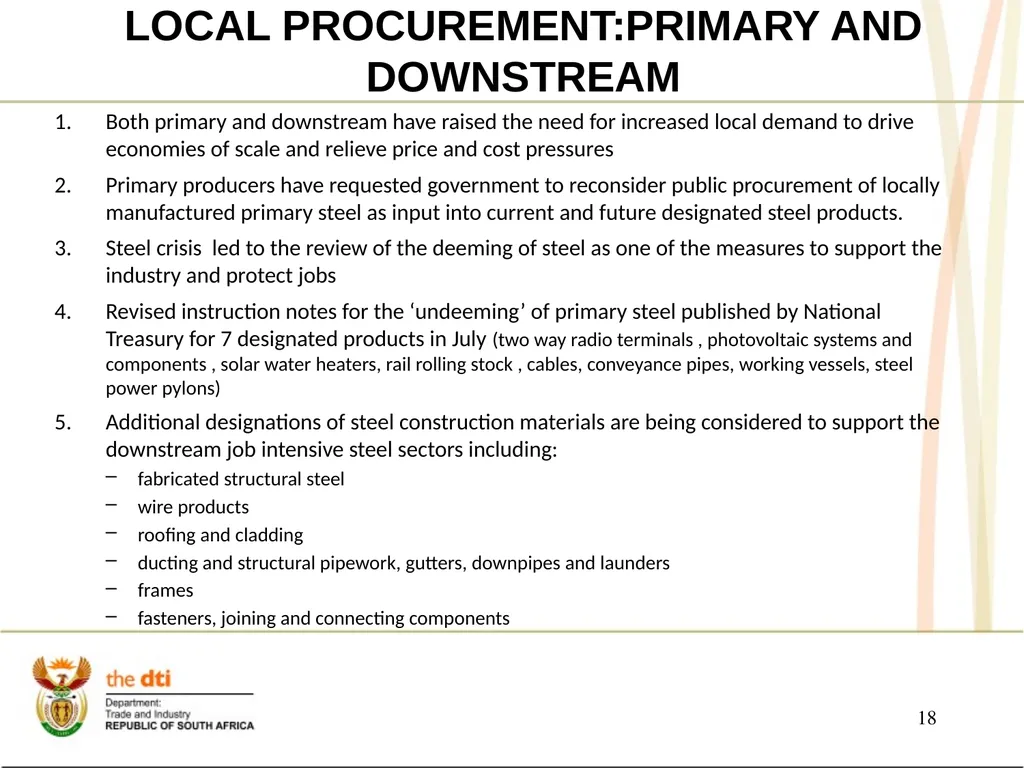
LOCAL PROCUREMENT:PRIMARY AND DOWNSTREAM Both primary and downstream have raised the need for increased local demand to drive economies of scale and relieve price and cost pressures
Primary producers have requested government to reconsider public procurement of locally manufactured primary steel as input into current and future designated steel products.
Steel crisis led to the review of the deeming of steel as one of the measures to support the industry and protect jobs
Revised instruction notes for the ‘undeeming’ of primary steel published by National Treasury for 7 designated products in July (two way radio terminals , photovoltaic systems and components , solar water heaters, rail rolling stock , cables, conveyance pipes, working vessels, steel power pylons)
Additional designations of steel construction materials are being considered to support the downstream job intensive steel sectors including:
fabricated structural steel
wire products
roofing and cladding
ducting and structural pipework, gutters, downpipes and launders
frames
fasteners, joining and connecting components 18<br>
Primary producers have requested government to reconsider public procurement of locally manufactured primary steel as input into current and future designated steel products.
Steel crisis led to the review of the deeming of steel as one of the measures to support the industry and protect jobs
Revised instruction notes for the ‘undeeming’ of primary steel published by National Treasury for 7 designated products in July (two way radio terminals , photovoltaic systems and components , solar water heaters, rail rolling stock , cables, conveyance pipes, working vessels, steel power pylons)
Additional designations of steel construction materials are being considered to support the downstream job intensive steel sectors including:
fabricated structural steel
wire products
roofing and cladding
ducting and structural pipework, gutters, downpipes and launders
frames
fasteners, joining and connecting components 18<br>
19
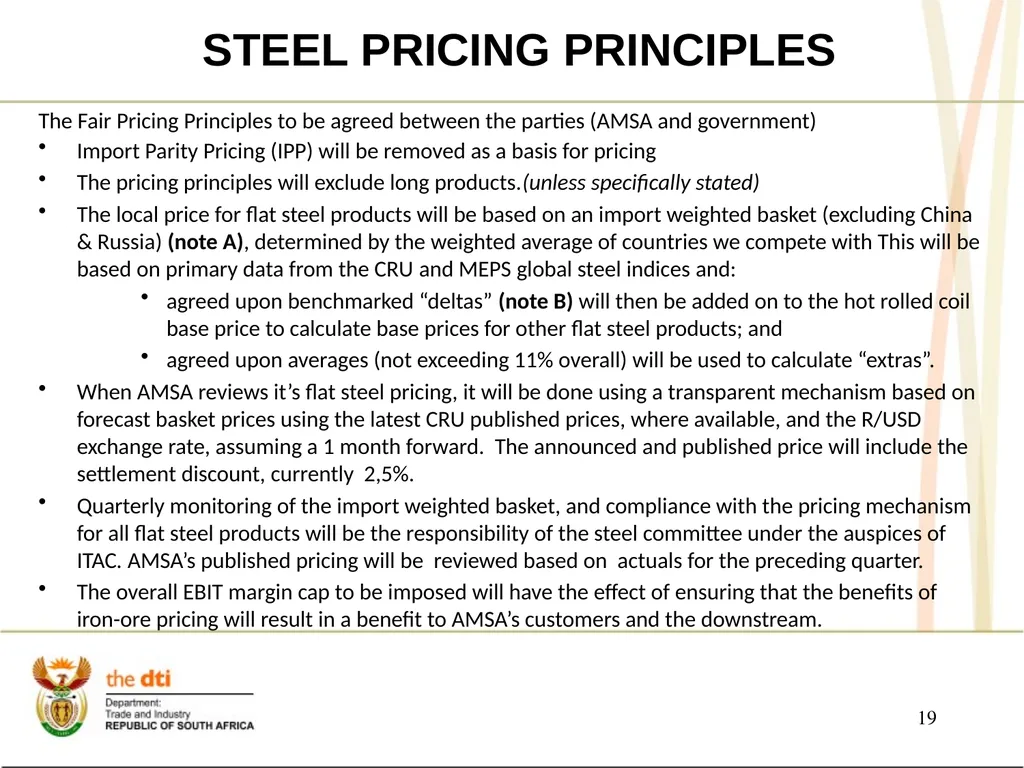
STEEL PRICING PRINCIPLES The Fair Pricing Principles to be agreed between the parties (AMSA and government)
Import Parity Pricing (IPP) will be removed as a basis for pricing
The pricing principles will exclude long products.(unless specifically stated)
The local price for flat steel products will be based on an import weighted basket (excluding China & Russia) (note A), determined by the weighted average of countries we compete with This will be based on primary data from the CRU and MEPS global steel indices and:
agreed upon benchmarked “deltas” (note B) will then be added on to the hot rolled coil base price to calculate base prices for other flat steel products; and
agreed upon averages (not exceeding 11% overall) will be used to calculate “extras”.
When AMSA reviews it’s flat steel pricing, it will be done using a transparent mechanism based on forecast basket prices using the latest CRU published prices, where available, and the R/USD exchange rate, assuming a 1 month forward. The announced and published price will include the settlement discount, currently 2,5%.
Quarterly monitoring of the import weighted basket, and compliance with the pricing mechanism for all flat steel products will be the responsibility of the steel committee under the auspices of ITAC. AMSA’s published pricing will be reviewed based on actuals for the preceding quarter.
The overall EBIT margin cap to be imposed will have the effect of ensuring that the benefits of iron-ore pricing will result in a benefit to AMSA’s customers and the downstream. 19<br>
Import Parity Pricing (IPP) will be removed as a basis for pricing
The pricing principles will exclude long products.(unless specifically stated)
The local price for flat steel products will be based on an import weighted basket (excluding China & Russia) (note A), determined by the weighted average of countries we compete with This will be based on primary data from the CRU and MEPS global steel indices and:
agreed upon benchmarked “deltas” (note B) will then be added on to the hot rolled coil base price to calculate base prices for other flat steel products; and
agreed upon averages (not exceeding 11% overall) will be used to calculate “extras”.
When AMSA reviews it’s flat steel pricing, it will be done using a transparent mechanism based on forecast basket prices using the latest CRU published prices, where available, and the R/USD exchange rate, assuming a 1 month forward. The announced and published price will include the settlement discount, currently 2,5%.
Quarterly monitoring of the import weighted basket, and compliance with the pricing mechanism for all flat steel products will be the responsibility of the steel committee under the auspices of ITAC. AMSA’s published pricing will be reviewed based on actuals for the preceding quarter.
The overall EBIT margin cap to be imposed will have the effect of ensuring that the benefits of iron-ore pricing will result in a benefit to AMSA’s customers and the downstream. 19<br>
20
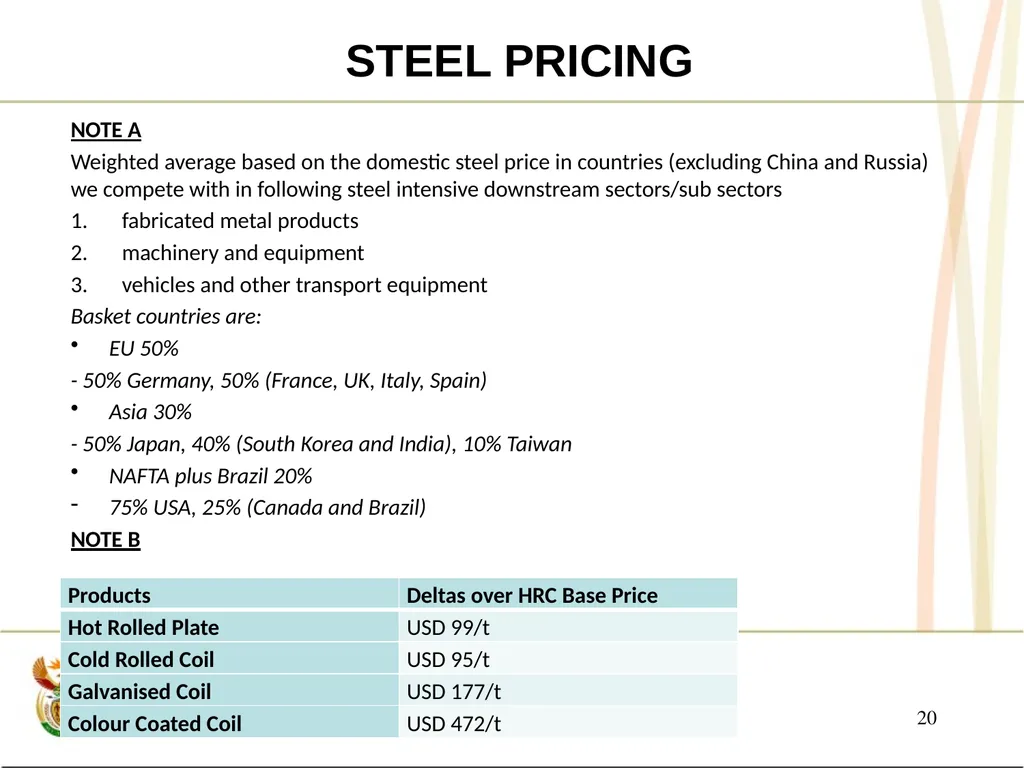
STEEL PRICING NOTE A
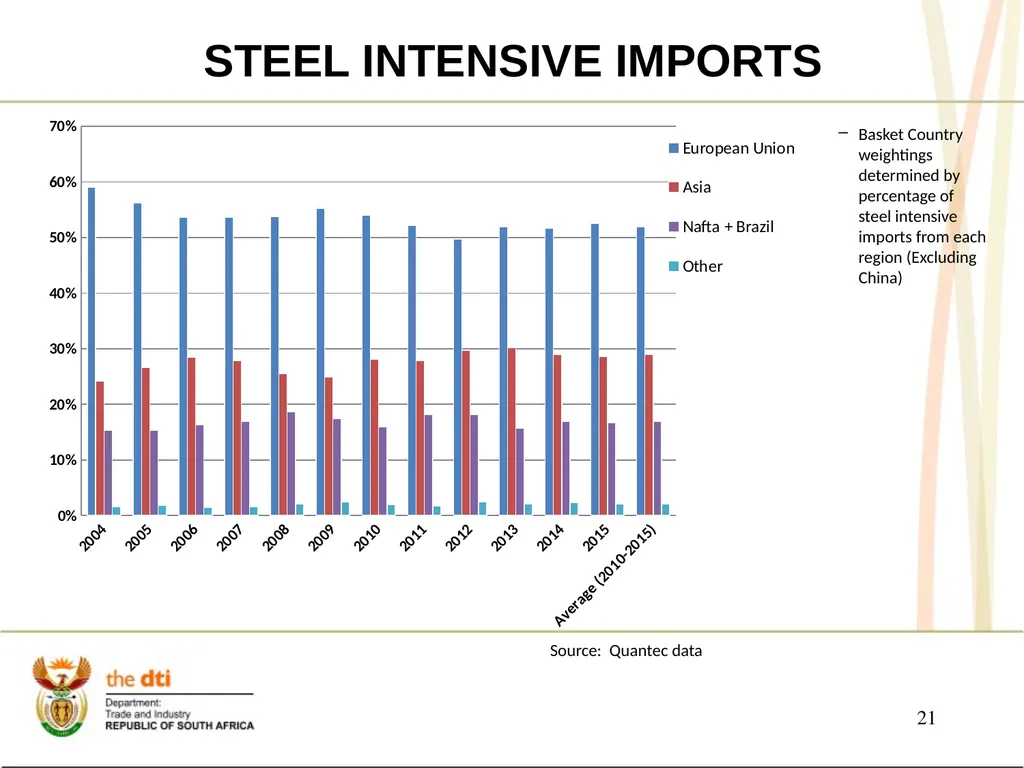
Weighted average based on the domestic steel price in countries (excluding China and Russia) we compete with in following steel intensive downstream sectors/sub sectors
fabricated metal products
machinery and equipment
vehicles and other transport equipment
Basket countries are:
EU 50%
- 50% Germany, 50% (France, UK, Italy, Spain)
Asia 30%
- 50% Japan, 40% (South Korea and India), 10% Taiwan
NAFTA plus Brazil 20%
75% USA, 25% (Canada and Brazil)
NOTE B 20<br>
Weighted average based on the domestic steel price in countries (excluding China and Russia) we compete with in following steel intensive downstream sectors/sub sectors
fabricated metal products
machinery and equipment
vehicles and other transport equipment
Basket countries are:
EU 50%
- 50% Germany, 50% (France, UK, Italy, Spain)
Asia 30%
- 50% Japan, 40% (South Korea and India), 10% Taiwan
NAFTA plus Brazil 20%
75% USA, 25% (Canada and Brazil)
NOTE B 20<br>
21
STEEL INTENSIVE IMPORTS 21 Basket Country weightings determined by percentage of steel intensive imports from each region (Excluding China) Source: Quantec data<br>
22
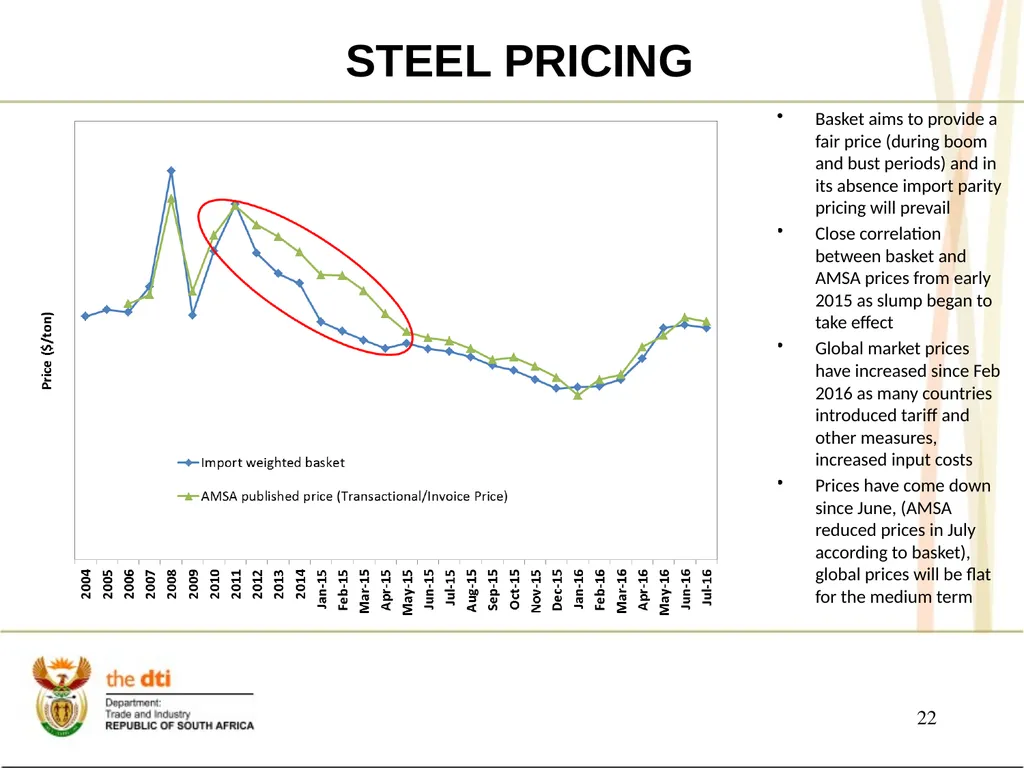
STEEL PRICING 22 Basket aims to provide a fair price (during boom and bust periods) and in its absence import parity pricing will prevail
Close correlation between basket and AMSA prices from early 2015 as slump began to take effect
Global market prices have increased since Feb 2016 as many countries introduced tariff and other measures, increased input costs
Prices have come down since June, (AMSA reduced prices in July according to basket), global prices will be flat for the medium term<br>
Close correlation between basket and AMSA prices from early 2015 as slump began to take effect
Global market prices have increased since Feb 2016 as many countries introduced tariff and other measures, increased input costs
Prices have come down since June, (AMSA reduced prices in July according to basket), global prices will be flat for the medium term<br>
23
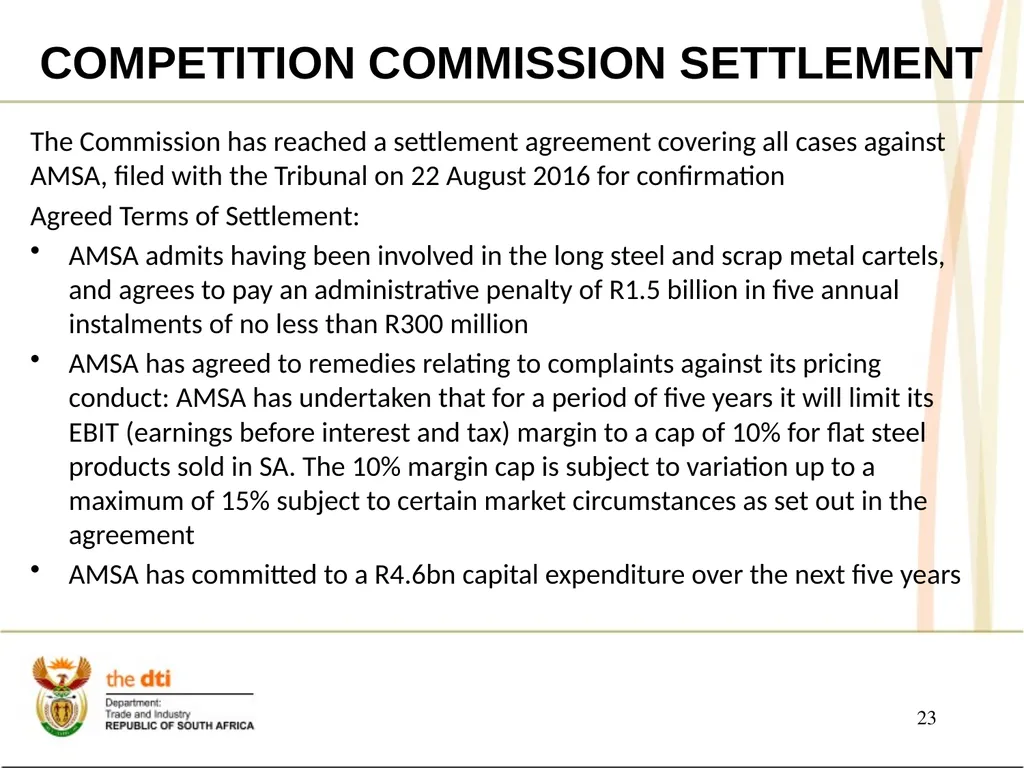
COMPETITION COMMISSION SETTLEMENT The Commission has reached a settlement agreement covering all cases against AMSA, filed with the Tribunal on 22 August 2016 for confirmation
Agreed Terms of Settlement:
AMSA admits having been involved in the long steel and scrap metal cartels, and agrees to pay an administrative penalty of R1.5 billion in five annual instalments of no less than R300 million
AMSA has agreed to remedies relating to complaints against its pricing conduct: AMSA has undertaken that for a period of five years it will limit its EBIT (earnings before interest and tax) margin to a cap of 10% for flat steel products sold in SA. The 10% margin cap is subject to variation up to a maximum of 15% subject to certain market circumstances as set out in the agreement
AMSA has committed to a R4.6bn capital expenditure over the next five years 23<br>
Agreed Terms of Settlement:
AMSA admits having been involved in the long steel and scrap metal cartels, and agrees to pay an administrative penalty of R1.5 billion in five annual instalments of no less than R300 million
AMSA has agreed to remedies relating to complaints against its pricing conduct: AMSA has undertaken that for a period of five years it will limit its EBIT (earnings before interest and tax) margin to a cap of 10% for flat steel products sold in SA. The 10% margin cap is subject to variation up to a maximum of 15% subject to certain market circumstances as set out in the agreement
AMSA has committed to a R4.6bn capital expenditure over the next five years 23<br>
24
CONCLUDING REMARKS Given the current severe challenges, the future of SA’s steel sector depends on a holistic solution underpinned by interventions that are designed to ensure a sustainable primary steel industry whilst supporting the downstream industry
Key objectives is to stimulate the economy, generate exports and create employment
Sustaining a competitive local steel producing capacity and capability will be a significant advantage in contributing to economic growth and infrastructure development in a cost effective manner
Support for the value added, labour intensive downstream industry remains a priority and imperative of government
The key outcome is the optimal ‘end state’ of a viable, competitive and sustainable steel industry in SA 24<br>
Key objectives is to stimulate the economy, generate exports and create employment
Sustaining a competitive local steel producing capacity and capability will be a significant advantage in contributing to economic growth and infrastructure development in a cost effective manner
Support for the value added, labour intensive downstream industry remains a priority and imperative of government
The key outcome is the optimal ‘end state’ of a viable, competitive and sustainable steel industry in SA 24<br>
25
THANK YOU!
QUESTIONS & COMMENTS? 25<br>