
Presented by Denise Tarlinton Bloom's Revised
FD
Published · 58 slides · 0 views

1 / 1


Description
Presented by Denise Tarlinton Blooms Revised Taxonomy The mind is not a vessel to be filled, but a fire to be ignited. (Plutarch) Overview Blooms Taxonomy and higher-order thinking Take a walk down memory lane Investigate the Revised
Related Topics
Share
Embed code
Download this presentation From Below
"Presented by Denise Tarlinton Bloom's Revised" is the property of its rightful owner. Permission is granted to download and print the materials on this website for personal, non-commercial use only, and to display it on your personal computer provided you do not modify the materials and that you retain all copyright notices contained in the materials. By downloading content from our website, you accept the terms of this agreement.
Presentation Transcript
01
Presented by Denise Tarlinton Bloom's Revised
Taxonomy<br>
Taxonomy<br>
02
The mind is not a vessel to be filled, but a fire to be ignited.
(Plutarch)<br>
(Plutarch)<br>
03
Overview Bloom’s Taxonomy and higher-order thinking
Take a walk down memory lane
Investigate the Revised Taxonomy
New terms
New emphasis
Explore each of the six levels
See how questioning plays an important role within the framework (oral language)
Use the taxonomy to plan a unit
Look at an integrated approach
Begin planning with a SMART Bloom’s Unit Planning Matrix<br>
04
Productive Pedagogies A guide to Productive Pedagogies: Classroom reflection manual lists three degrees of incorporation of Higher-order thinking skills in a “Continuum of practice”:
Students are engaged only in lower-order thinking; i.e. they receive, or recite, or participate in routine practice. In no activities during the lesson do students go beyond simple reproduction of knowledge.
Students are primarily engaged in routine lower-order thinking for a good share of the lesson. There is at least one significant question or activity in which some students perform some higher-order thinking.
Almost all students, almost all of the time are engaged in higher-order thinking.
(Department of Education, Queensland, 2002, p. 1)<br>
05
What is Higher-order thinking? A guide to Productive Pedagogies: Classroom reflection manual states that:
Higher-order thinking by students involves the transformation of information and ideas. This transformation occurs when students combine facts and ideas and synthesise, generalise, explain, hypothesise or arrive at some conclusion or interpretation. Manipulating information and ideas through these processes allows students to solve problems, gain understanding and discover new meaning. When students engage in the construction of knowledge, an element of uncertainty is introduced into the instructional process and the outcomes are not always predictable; in other words, the teacher is not certain what the students will produce. In helping students become producers of knowledge, the teacher’s main instructional task is to create activities or environments that allow them opportunities to engage in higher-order thinking.
(Department of Education, Queensland, 2002, p. 1)<br>
06
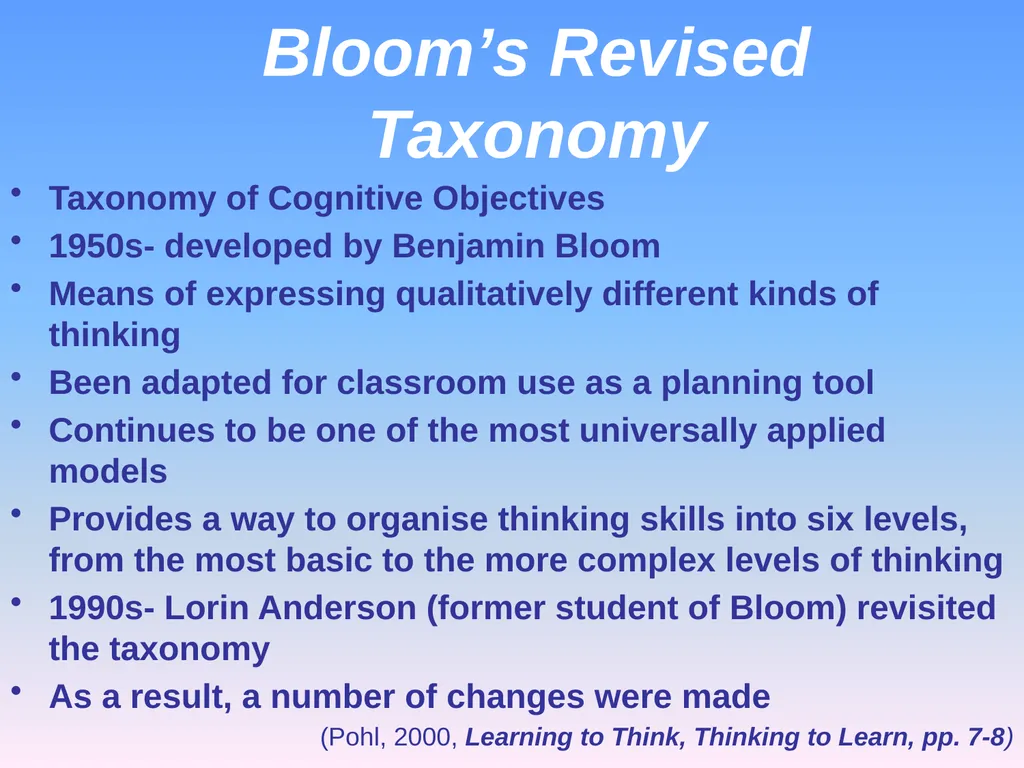
Bloom’s Revised Taxonomy Taxonomy of Cognitive Objectives
1950s- developed by Benjamin Bloom
Means of expressing qualitatively different kinds of thinking
Been adapted for classroom use as a planning tool
Continues to be one of the most universally applied models
Provides a way to organise thinking skills into six levels, from the most basic to the more complex levels of thinking
1990s- Lorin Anderson (former student of Bloom) revisited the taxonomy
As a result, a number of changes were made
(Pohl, 2000, Learning to Think, Thinking to Learn, pp. 7-8)<br>
07
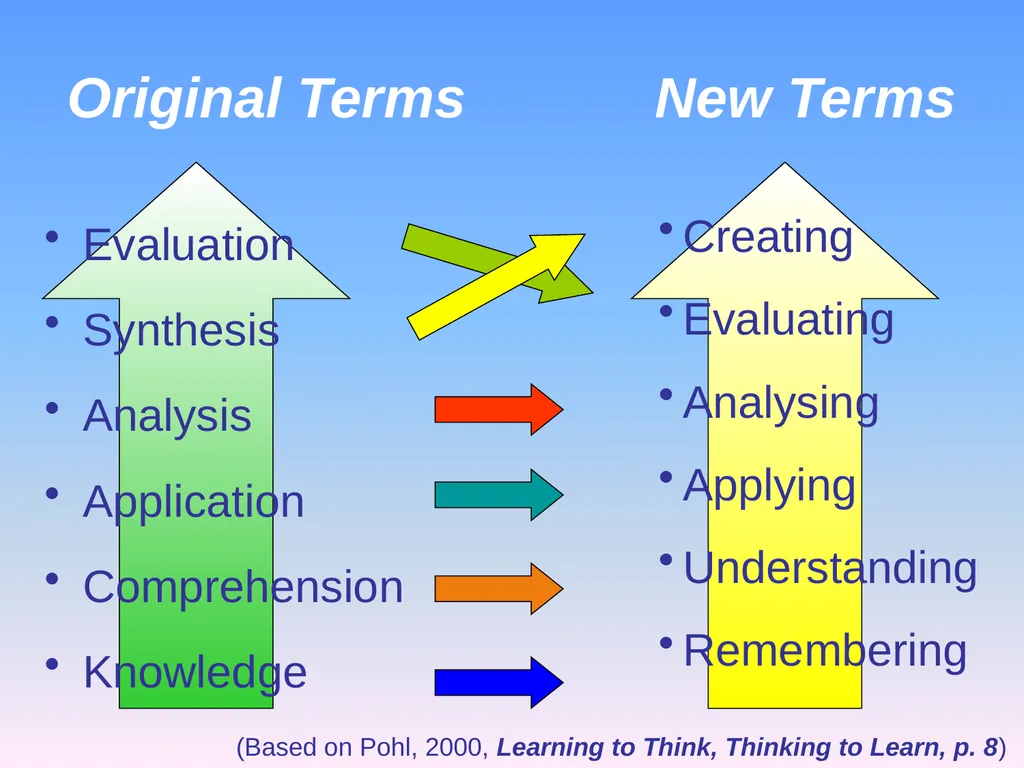
Original Terms New Terms Evaluation
Synthesis
Analysis
Application
Comprehension
Knowledge Creating
Evaluating
Analysing
Applying
Understanding
Remembering (Based on Pohl, 2000, Learning to Think, Thinking to Learn, p. 8)<br>
Synthesis
Analysis
Application
Comprehension
Knowledge Creating
Evaluating
Analysing
Applying
Understanding
Remembering (Based on Pohl, 2000, Learning to Think, Thinking to Learn, p. 8)<br>
08
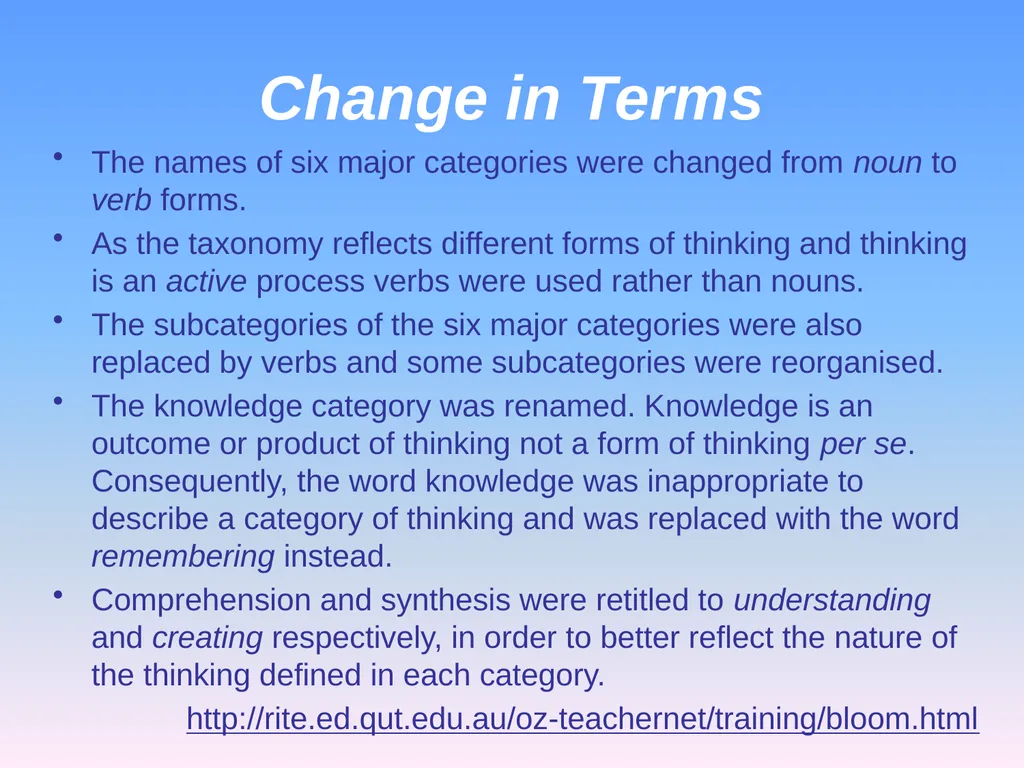
Change in Terms The names of six major categories were changed from noun to verb forms.
As the taxonomy reflects different forms of thinking and thinking is an active process verbs were used rather than nouns.
The subcategories of the six major categories were also replaced by verbs and some subcategories were reorganised.
The knowledge category was renamed. Knowledge is an outcome or product of thinking not a form of thinking per se. Consequently, the word knowledge was inappropriate to describe a category of thinking and was replaced with the word remembering instead.
Comprehension and synthesis were retitled to understanding and creating respectively, in order to better reflect the nature of the thinking defined in each category.
http://rite.ed.qut.edu.au/oz-teachernet/training/bloom.html<br>
09
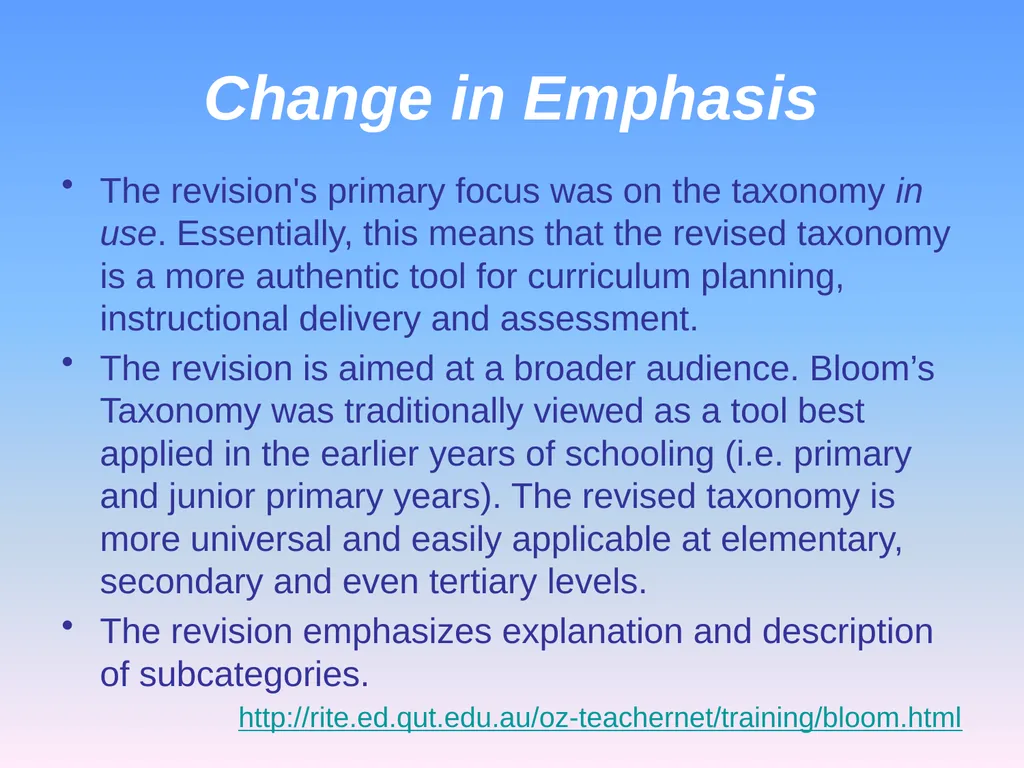
Change in Emphasis The revision's primary focus was on the taxonomy in use. Essentially, this means that the revised taxonomy is a more authentic tool for curriculum planning, instructional delivery and assessment.
The revision is aimed at a broader audience. Bloom’s Taxonomy was traditionally viewed as a tool best applied in the earlier years of schooling (i.e. primary and junior primary years). The revised taxonomy is more universal and easily applicable at elementary, secondary and even tertiary levels.
The revision emphasizes explanation and description of subcategories.
http://rite.ed.qut.edu.au/oz-teachernet/training/bloom.html<br>
10
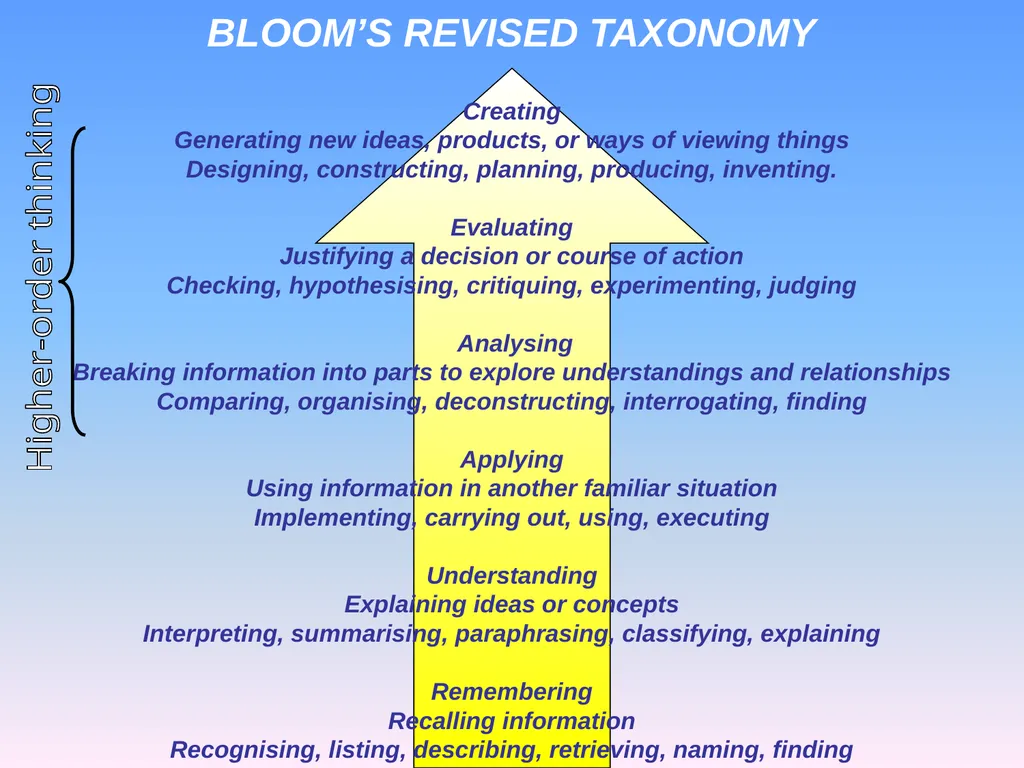
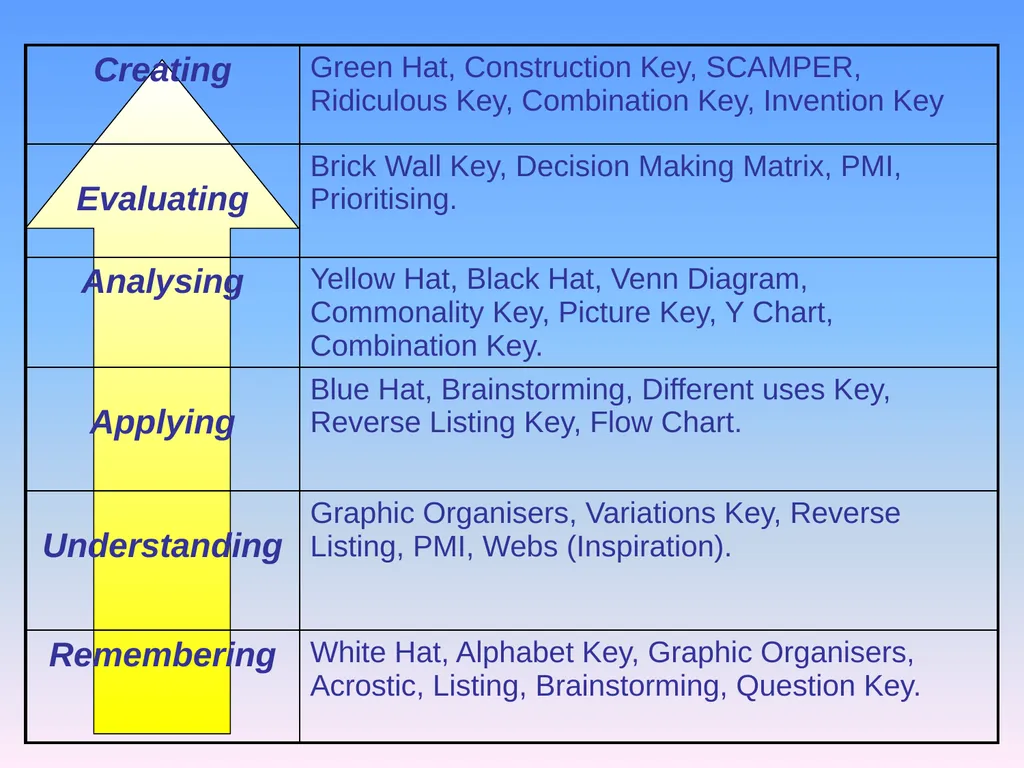
BLOOM’S REVISED TAXONOMY
Creating
Generating new ideas, products, or ways of viewing things
Designing, constructing, planning, producing, inventing.
Evaluating
Justifying a decision or course of action
Checking, hypothesising, critiquing, experimenting, judging
Analysing
Breaking information into parts to explore understandings and relationships
Comparing, organising, deconstructing, interrogating, finding
Applying
Using information in another familiar situation
Implementing, carrying out, using, executing
Understanding
Explaining ideas or concepts
Interpreting, summarising, paraphrasing, classifying, explaining
Remembering
Recalling information
Recognising, listing, describing, retrieving, naming, finding Higher-order thinking<br>
11
A turtle makes progress when it sticks its neck out.
(Anon)<br>
(Anon)<br>
12
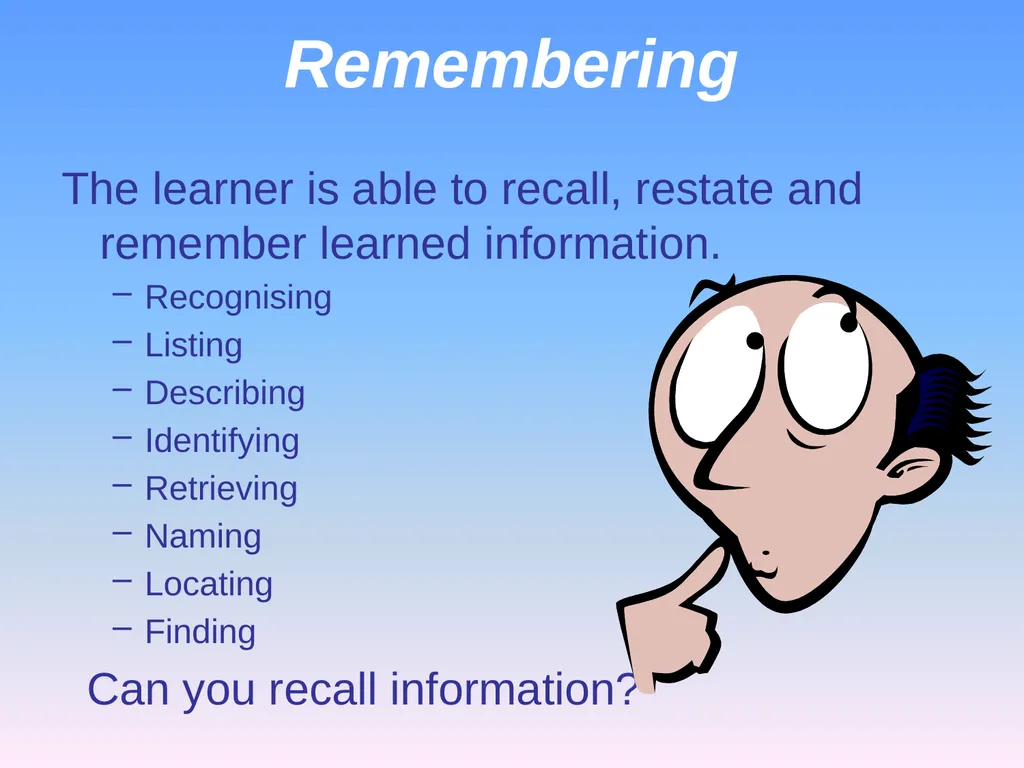
Remembering The learner is able to recall, restate and remember learned information.
Recognising
Listing
Describing
Identifying
Retrieving
Naming
Locating
Finding
Can you recall information?<br>
Recognising
Listing
Describing
Identifying
Retrieving
Naming
Locating
Finding
Can you recall information?<br>
13
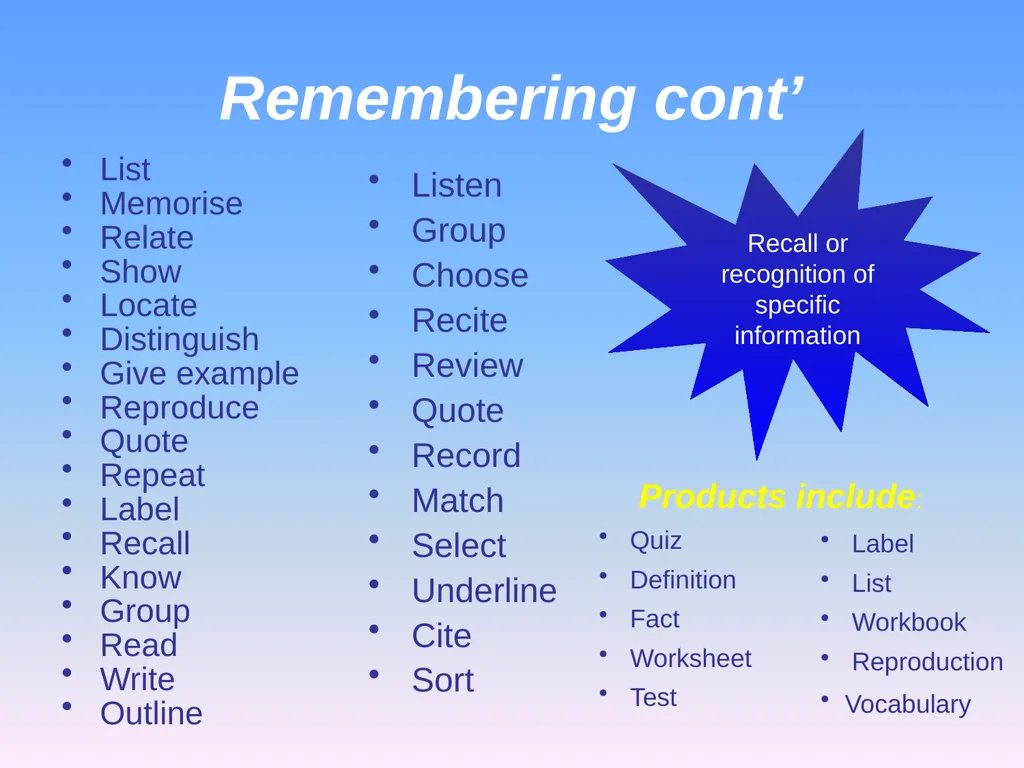
Remembering cont’ List
Memorise
Relate
Show
Locate
Distinguish
Give example
Reproduce
Quote
Repeat
Label
Recall
Know
Group
Read
Write
Outline Listen
Group
Choose
Recite
Review
Quote
Record
Match
Select
Underline
Cite
Sort Recall or recognition of specific information Products include:
Quiz
Definition
Fact
Worksheet
Test Label
List
Workbook
Reproduction
Vocabulary<br>
14
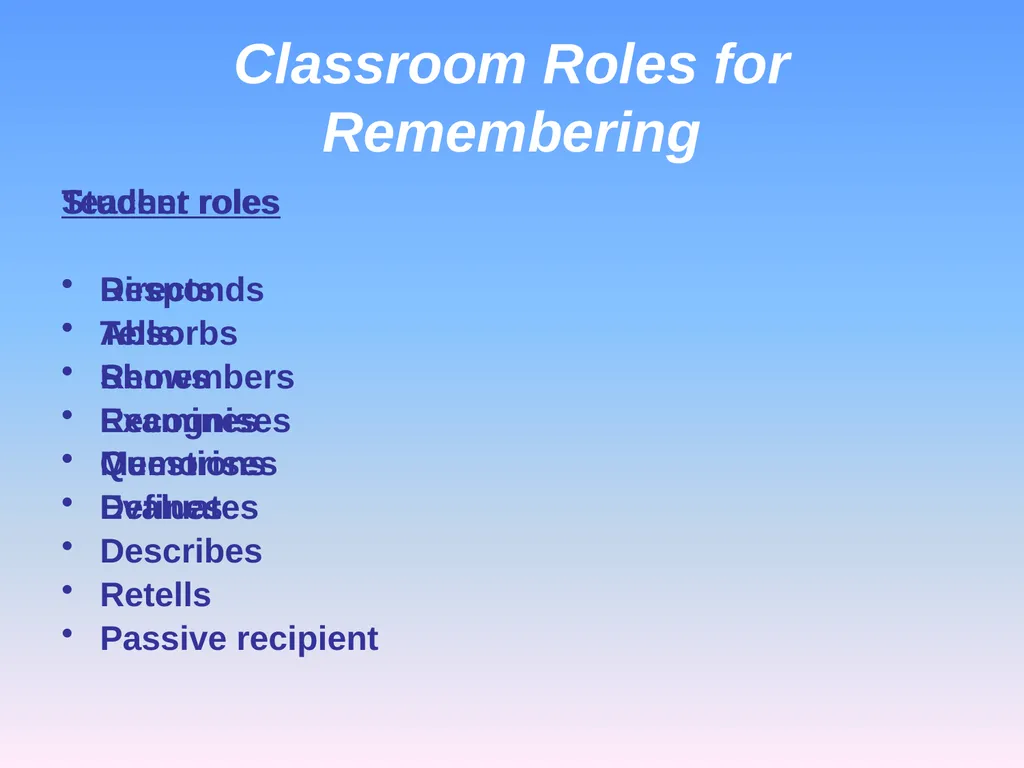
Classroom Roles for Remembering Teacher roles
Directs
Tells
Shows
Examines
Questions
Evaluates Student roles
Responds
Absorbs
Remembers
Recognises
Memorises
Defines
Describes
Retells
Passive recipient<br>
Directs
Tells
Shows
Examines
Questions
Evaluates Student roles
Responds
Absorbs
Remembers
Recognises
Memorises
Defines
Describes
Retells
Passive recipient<br>
15
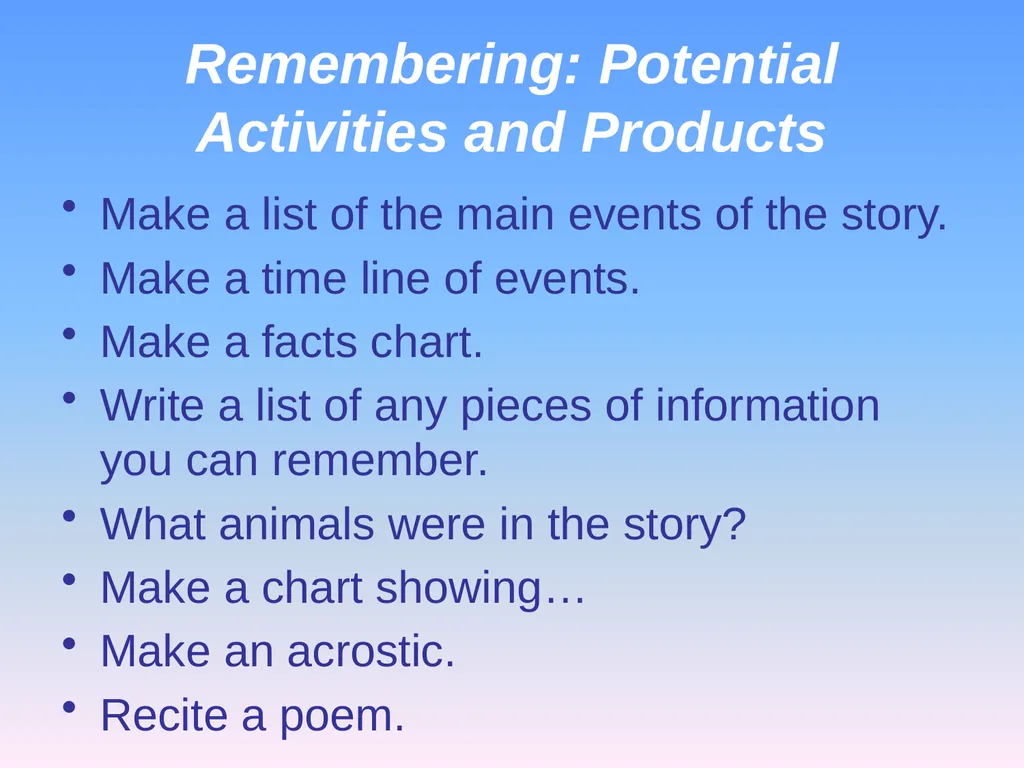
Remembering: Potential Activities and Products Make a list of the main events of the story.
Make a time line of events.
Make a facts chart.
Write a list of any pieces of information you can remember.
What animals were in the story?
Make a chart showing…
Make an acrostic.
Recite a poem.<br>
Make a time line of events.
Make a facts chart.
Write a list of any pieces of information you can remember.
What animals were in the story?
Make a chart showing…
Make an acrostic.
Recite a poem.<br>
16
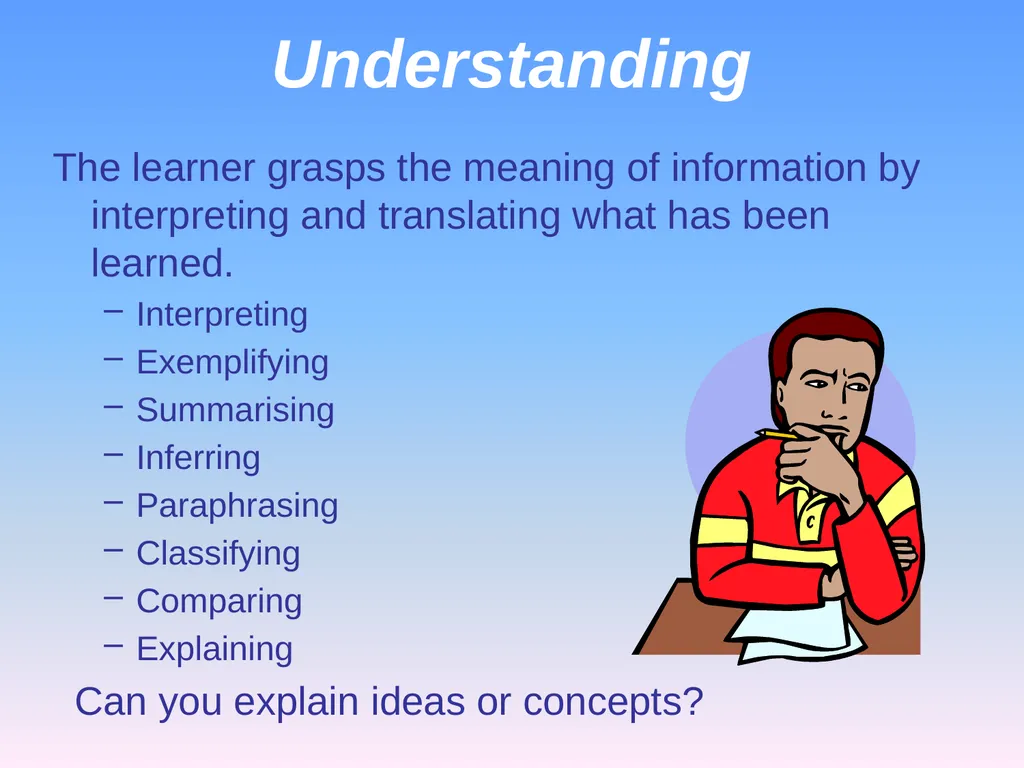
Understanding The learner grasps the meaning of information by interpreting and translating what has been learned.
Interpreting
Exemplifying
Summarising
Inferring
Paraphrasing
Classifying
Comparing
Explaining
Can you explain ideas or concepts?<br>
Interpreting
Exemplifying
Summarising
Inferring
Paraphrasing
Classifying
Comparing
Explaining
Can you explain ideas or concepts?<br>
17
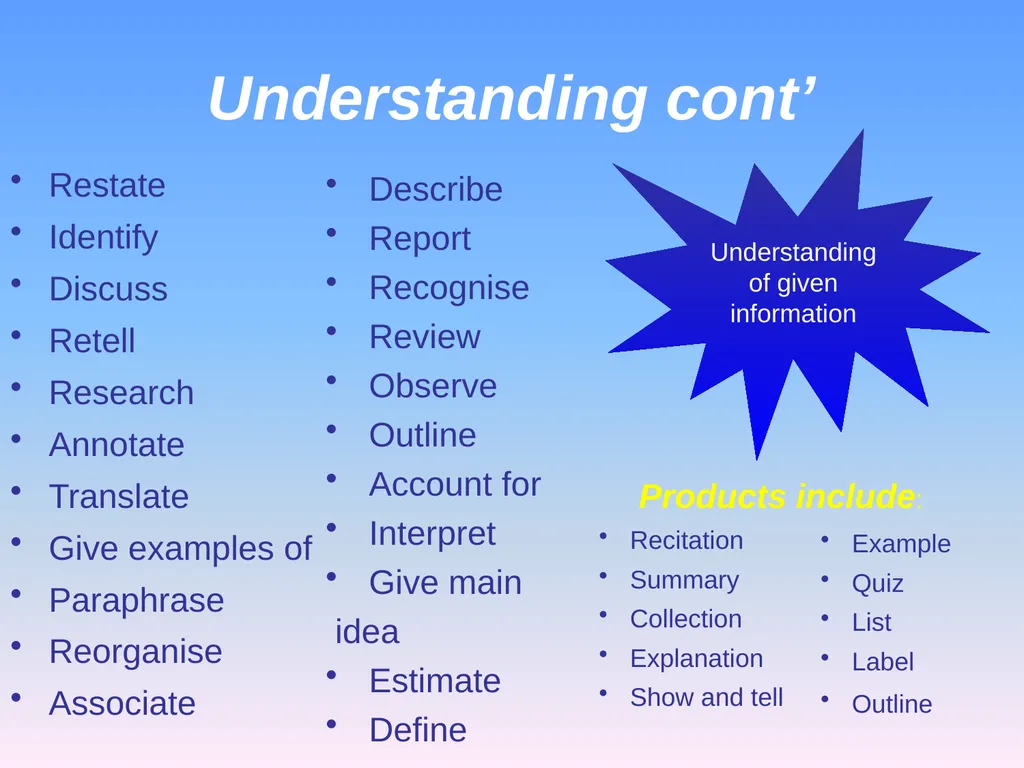
Understanding cont’ Restate
Identify
Discuss
Retell
Research
Annotate
Translate
Give examples of
Paraphrase
Reorganise
Associate Describe
Report
Recognise
Review
Observe
Outline
Account for
Interpret
Give main
idea
Estimate
Define Understanding of given information Products include:
Recitation
Summary
Collection
Explanation
Show and tell Example
Quiz
List
Label
Outline<br>
18
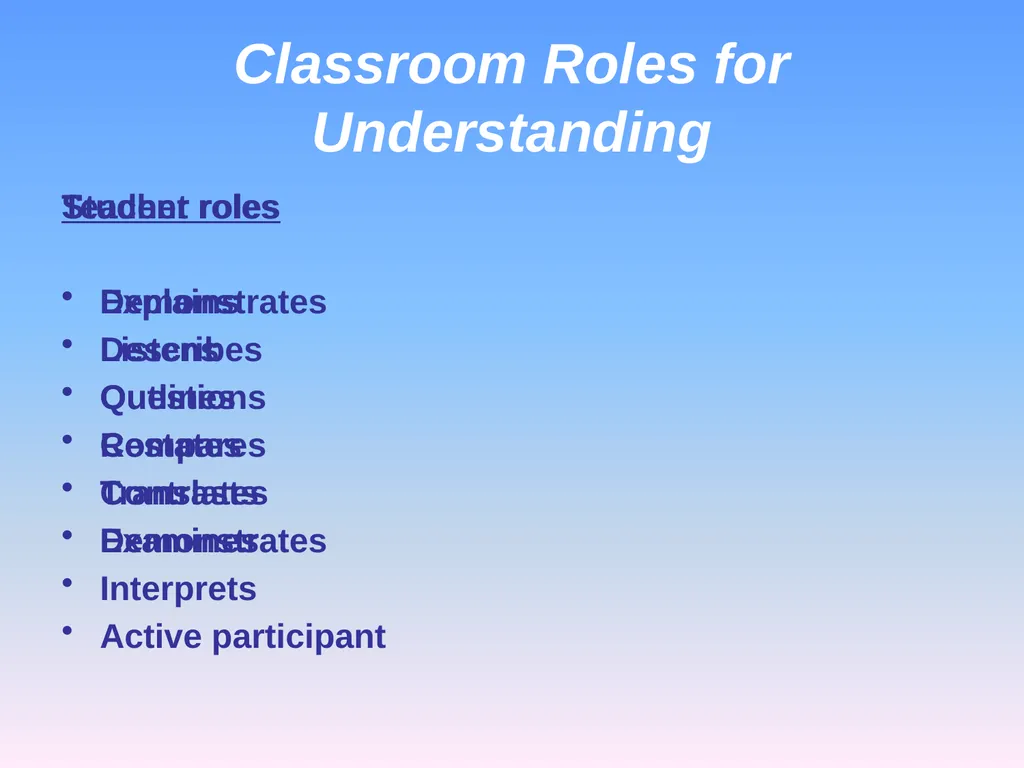
Classroom Roles for Understanding Teacher roles
Demonstrates
Listens
Questions
Compares
Contrasts
Examines Student roles
Explains
Describes
Outlines
Restates
Translates
Demonstrates
Interprets
Active participant<br>
Demonstrates
Listens
Questions
Compares
Contrasts
Examines Student roles
Explains
Describes
Outlines
Restates
Translates
Demonstrates
Interprets
Active participant<br>
19
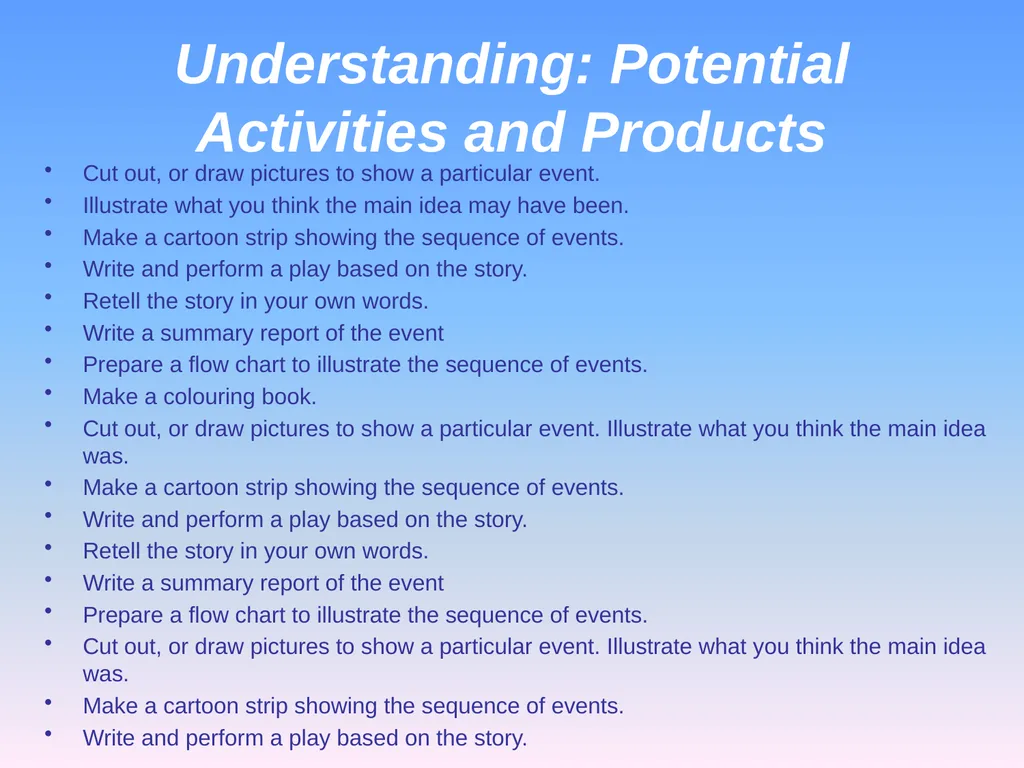
Understanding: Potential Activities and Products Cut out, or draw pictures to show a particular event.
Illustrate what you think the main idea may have been.
Make a cartoon strip showing the sequence of events.
Write and perform a play based on the story.
Retell the story in your own words.
Write a summary report of the event
Prepare a flow chart to illustrate the sequence of events.
Make a colouring book.
Cut out, or draw pictures to show a particular event. Illustrate what you think the main idea was.
Make a cartoon strip showing the sequence of events.
Write and perform a play based on the story.
Retell the story in your own words.
Write a summary report of the event
Prepare a flow chart to illustrate the sequence of events.
Cut out, or draw pictures to show a particular event. Illustrate what you think the main idea was.
Make a cartoon strip showing the sequence of events.
Write and perform a play based on the story.<br>
20
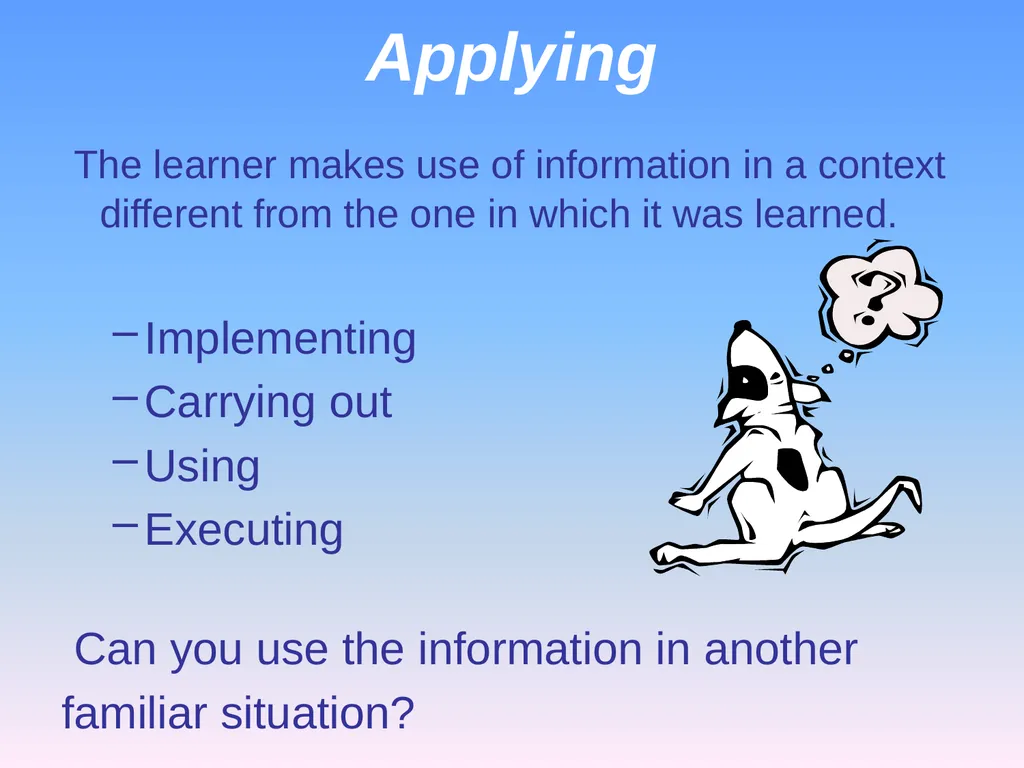
Applying The learner makes use of information in a context different from the one in which it was learned.
Implementing
Carrying out
Using
Executing
Can you use the information in another
familiar situation?<br>
Implementing
Carrying out
Using
Executing
Can you use the information in another
familiar situation?<br>
21
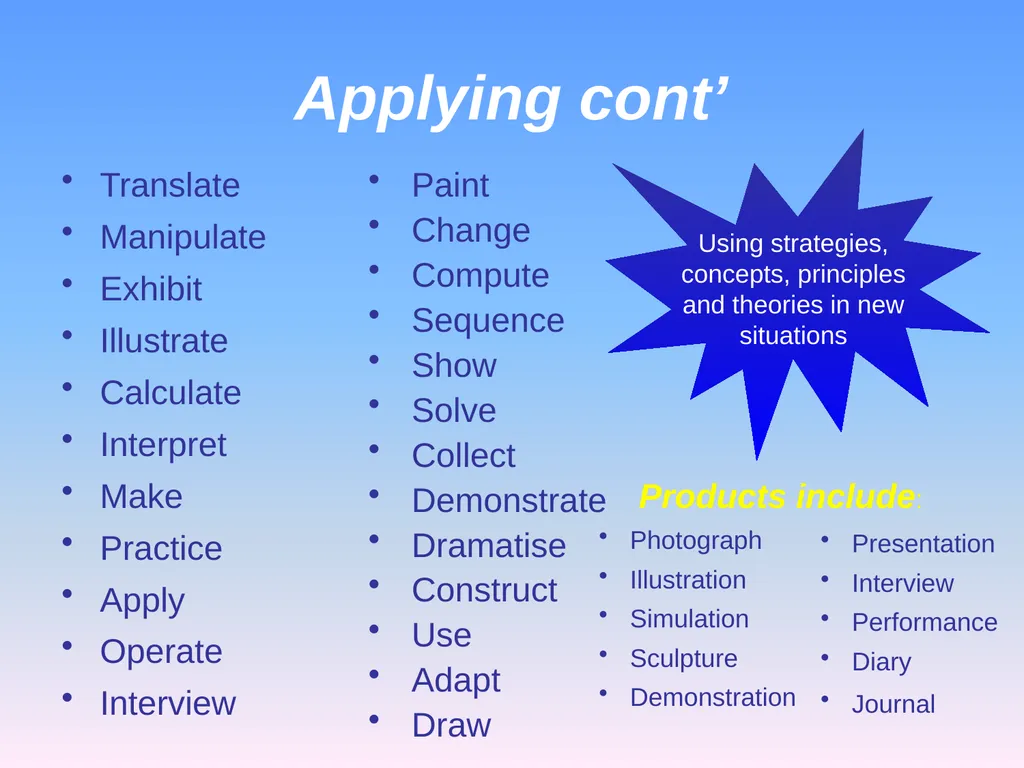
Applying cont’ Translate
Manipulate
Exhibit
Illustrate
Calculate
Interpret
Make
Practice
Apply
Operate
Interview Paint
Change
Compute
Sequence
Show
Solve
Collect
Demonstrate
Dramatise
Construct
Use
Adapt
Draw Using strategies, concepts, principles and theories in new situations Products include:
Photograph
Illustration
Simulation
Sculpture
Demonstration Presentation
Interview
Performance
Diary
Journal<br>
22
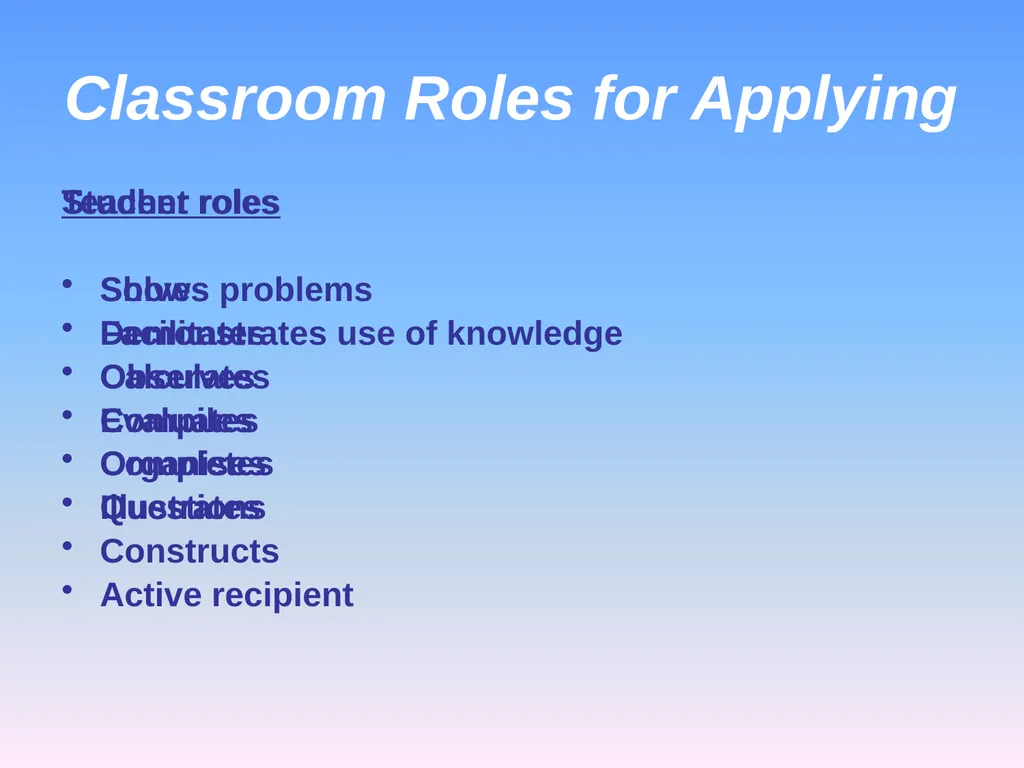
Classroom Roles for Applying Teacher roles
Shows
Facilitates
Observes
Evaluates
Organises
Questions Student roles
Solves problems
Demonstrates use of knowledge
Calculates
Compiles
Completes
Illustrates
Constructs
Active recipient<br>
Shows
Facilitates
Observes
Evaluates
Organises
Questions Student roles
Solves problems
Demonstrates use of knowledge
Calculates
Compiles
Completes
Illustrates
Constructs
Active recipient<br>
23
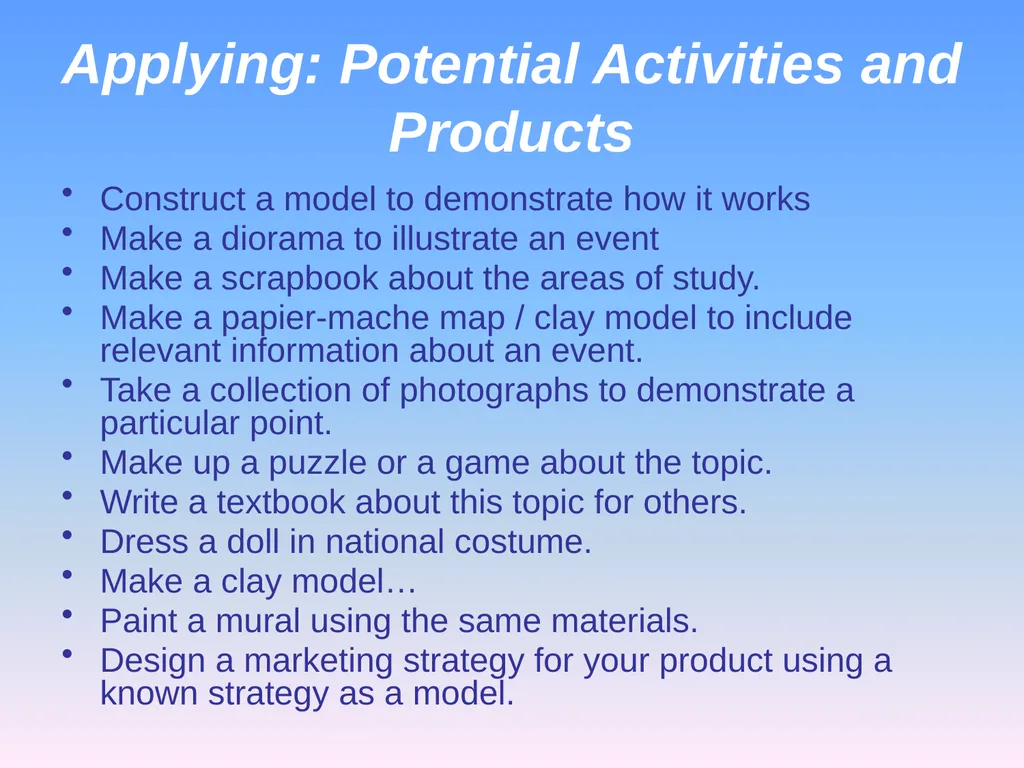
Applying: Potential Activities and Products Construct a model to demonstrate how it works
Make a diorama to illustrate an event
Make a scrapbook about the areas of study.
Make a papier-mache map / clay model to include relevant information about an event.
Take a collection of photographs to demonstrate a particular point.
Make up a puzzle or a game about the topic.
Write a textbook about this topic for others.
Dress a doll in national costume.
Make a clay model…
Paint a mural using the same materials.
Design a marketing strategy for your product using a known strategy as a model.<br>
24
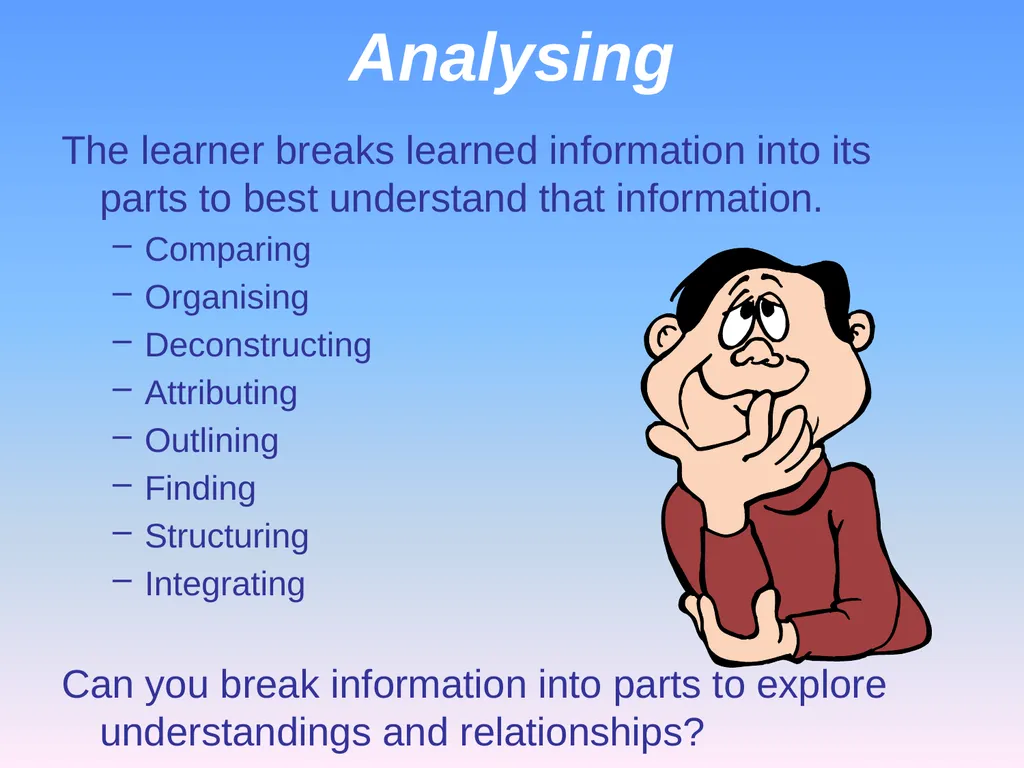
Analysing The learner breaks learned information into its parts to best understand that information.
Comparing
Organising
Deconstructing
Attributing
Outlining
Finding
Structuring
Integrating
Can you break information into parts to explore understandings and relationships?<br>
Comparing
Organising
Deconstructing
Attributing
Outlining
Finding
Structuring
Integrating
Can you break information into parts to explore understandings and relationships?<br>
25
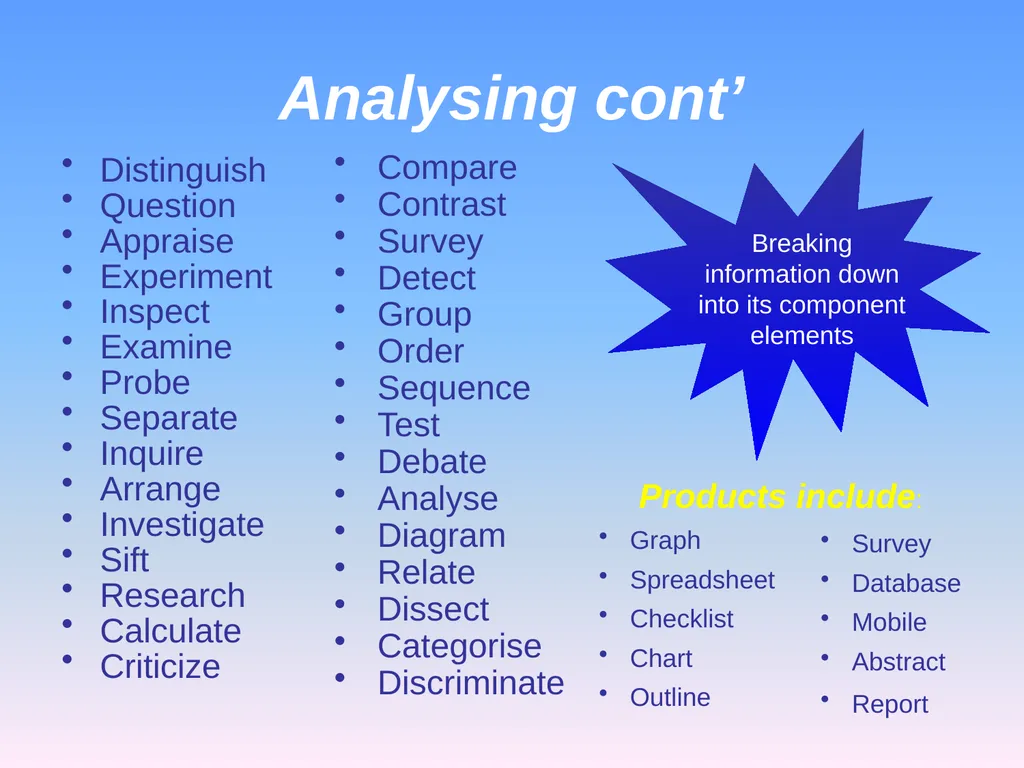
Analysing cont’ Distinguish
Question
Appraise
Experiment
Inspect
Examine
Probe
Separate
Inquire
Arrange
Investigate
Sift
Research
Calculate
Criticize Compare
Contrast
Survey
Detect
Group
Order
Sequence
Test
Debate
Analyse
Diagram
Relate
Dissect
Categorise
Discriminate Breaking information down into its component elements Products include:
Graph
Spreadsheet
Checklist
Chart
Outline Survey
Database
Mobile
Abstract
Report<br>
26
Classroom Roles for Analysing Teacher roles
Probes
Guides
Observes
Evaluates
Acts as a resource
Questions
Organises
Dissects Student roles
Discusses
Uncovers
Argues
Debates
Thinks deeply
Tests
Examines
Questions
Calculates
Investigates
Inquires
Active participant<br>
Probes
Guides
Observes
Evaluates
Acts as a resource
Questions
Organises
Dissects Student roles
Discusses
Uncovers
Argues
Debates
Thinks deeply
Tests
Examines
Questions
Calculates
Investigates
Inquires
Active participant<br>
27
Analysing: Potential Activities and Products Design a questionnaire to gather information.
Write a commercial to sell a new product
Make a flow chart to show the critical stages.
Construct a graph to illustrate selected information.
Make a family tree showing relationships.
Devise a play about the study area.
Write a biography of a person studied.
Prepare a report about the area of study.
Conduct an investigation to produce information to support a view.
Review a work of art in terms of form, colour and texture.<br>
28
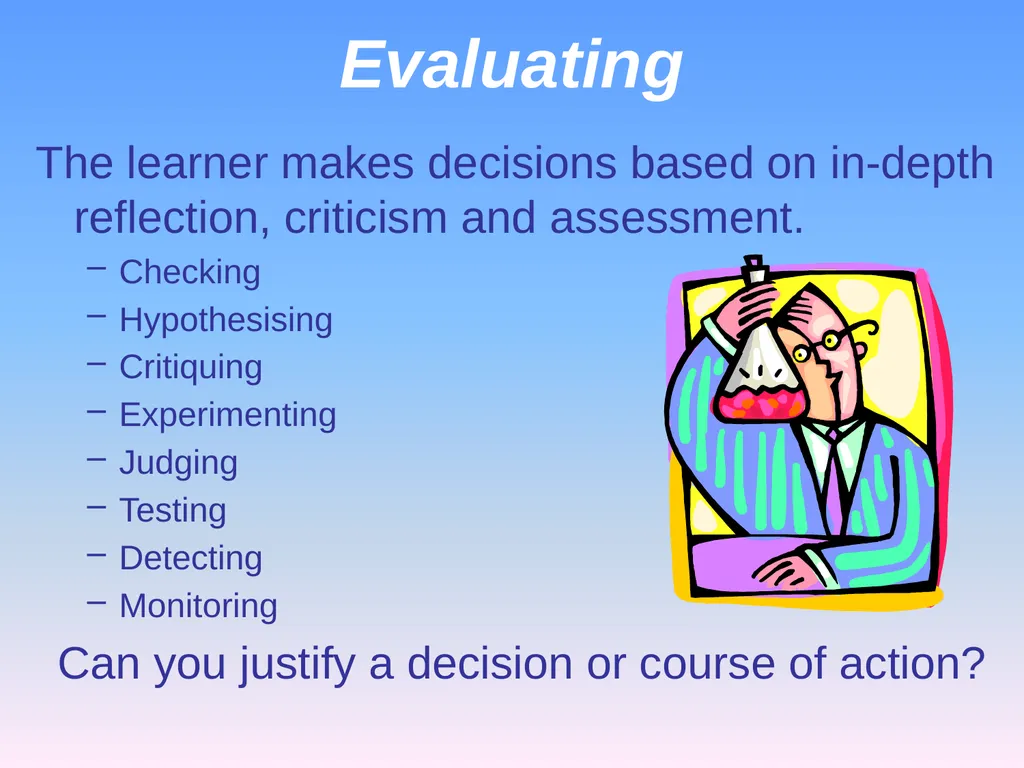
Evaluating The learner makes decisions based on in-depth reflection, criticism and assessment.
Checking
Hypothesising
Critiquing
Experimenting
Judging
Testing
Detecting
Monitoring
Can you justify a decision or course of action?<br>
Checking
Hypothesising
Critiquing
Experimenting
Judging
Testing
Detecting
Monitoring
Can you justify a decision or course of action?<br>
29
Evaluating cont’ Judge
Rate
Validate
Predict
Assess
Score
Revise
Infer
Determine
Prioritise
Tell why
Compare
Evaluate
Defend
Select
Measure Choose
Conclude
Deduce
Debate
Justify
Recommend
Discriminate
Appraise
Value
Probe
Argue
Decide
Criticise
Rank
Reject Judging the value of ideas, materials and methods by developing and applying standards and criteria. Products include:
Debate
Panel
Report
Evaluation Investigation
Verdict
Conclusion
Persuasive speech<br>
30
Classroom Roles for Evaluating Teacher roles
Clarifies
Accepts
Guides Student roles
Judges
Disputes
Compares
Critiques
Questions
Argues
Assesses
Decides
Selects
Justifies
Active participant<br>
Clarifies
Accepts
Guides Student roles
Judges
Disputes
Compares
Critiques
Questions
Argues
Assesses
Decides
Selects
Justifies
Active participant<br>
31
Evaluating: Potential Activities and Products Prepare a list of criteria to judge…
Conduct a debate about an issue of special interest.
Make a booklet about five rules you see as important. Convince others.
Form a panel to discuss views.
Write a letter to. ..advising on changes needed.
Write a half-yearly report.
Prepare a case to present your view about...<br>
Conduct a debate about an issue of special interest.
Make a booklet about five rules you see as important. Convince others.
Form a panel to discuss views.
Write a letter to. ..advising on changes needed.
Write a half-yearly report.
Prepare a case to present your view about...<br>
32
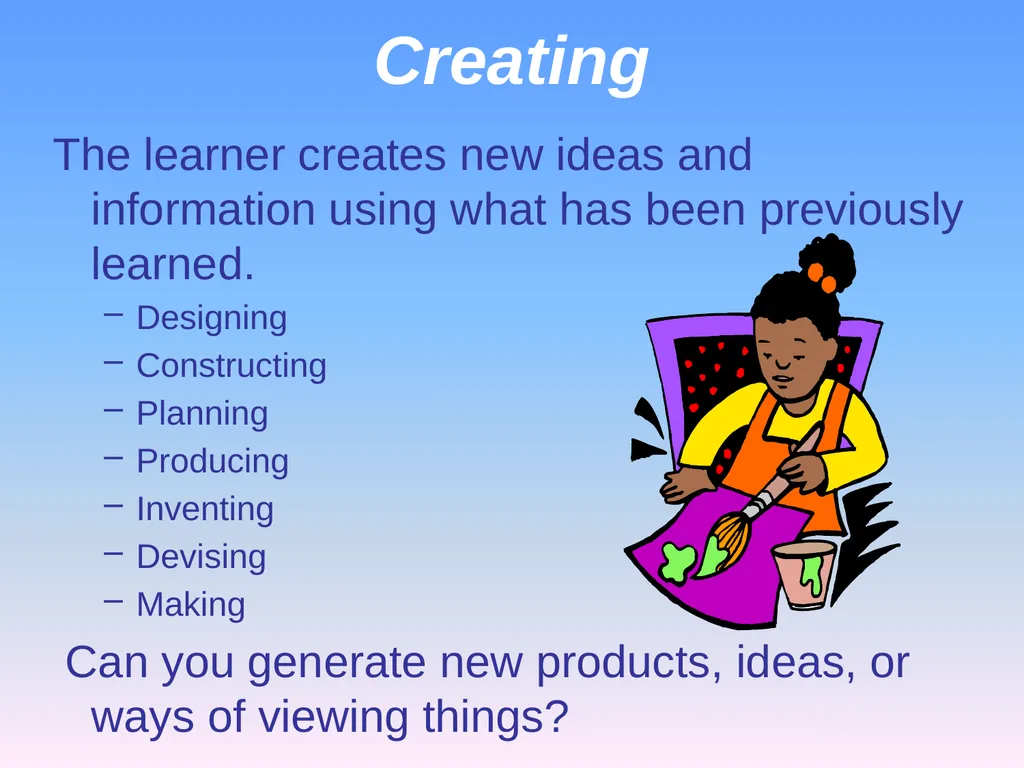
Creating The learner creates new ideas and information using what has been previously learned.
Designing
Constructing
Planning
Producing
Inventing
Devising
Making
Can you generate new products, ideas, or ways of viewing things?<br>
Designing
Constructing
Planning
Producing
Inventing
Devising
Making
Can you generate new products, ideas, or ways of viewing things?<br>
33
Creating cont’ Compose
Assemble
Organise
Invent
Compile
Forecast
Devise
Propose
Construct
Plan
Prepare
Develop
Originate
Imagine
Generate Formulate
Improve
Act
Predict
Produce
Blend
Set up
Devise
Concoct
Compile Putting together ideas or elements to develop a original idea or engage in creative thinking. Products include:
Film
Story
Project
Plan
New game Song
Newspaper
Media product
Advertisement
Painting<br>
34
Classroom Roles for Creating Teacher roles
Facilitates
Extends
Reflects
Analyses
Evaluates Student roles
Designs
Formulates
Plans
Takes risks
Modifies
Creates
Proposes
Active participant<br>
Facilitates
Extends
Reflects
Analyses
Evaluates Student roles
Designs
Formulates
Plans
Takes risks
Modifies
Creates
Proposes
Active participant<br>
35
Creating: Potential Activities and Products Invent a machine to do a specific task.
Design a building to house your study.
Create a new product. Give it a name and plan a marketing campaign.
Write about your feelings in relation to...
Write a TV show play, puppet show, role play, song or pantomime about..
Design a record, book or magazine cover for...
Sell an idea
Devise a way to...
Make up a new language and use it in an example.<br>
36
Practical Bloom’s Suitable for use with the entire class
Emphasis on certain levels for different children
Extend children’s thinking skills through emphasis on higher levels of the taxonomy (analysis, evaluation, creation)
Possible approaches with a class could be:
All children work through the remembering and understanding stages and then select at least one activity from each other level
All children work through first two levels and then select activities from any other level
Some children work at lower level while others work at higher levels
All children select activities from any level
Some activities are tagged “essential” while others are “optional”
A thinking process singled out for particular attention eg. Comparing, (done with all children, small group or individual)
Some children work through the lower levels and then design their own activities at the higher levels
All children write their own activities from the taxonomy
(Black, 1988, p. 23).<br>
37
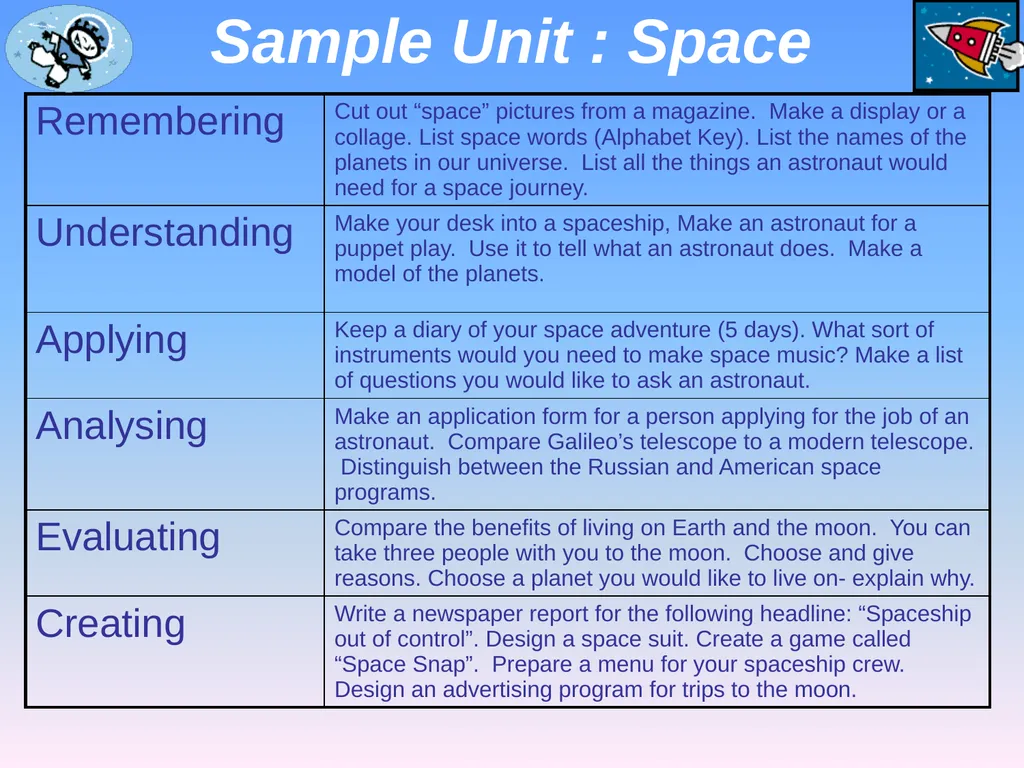
Sample Unit : Space<br>
38
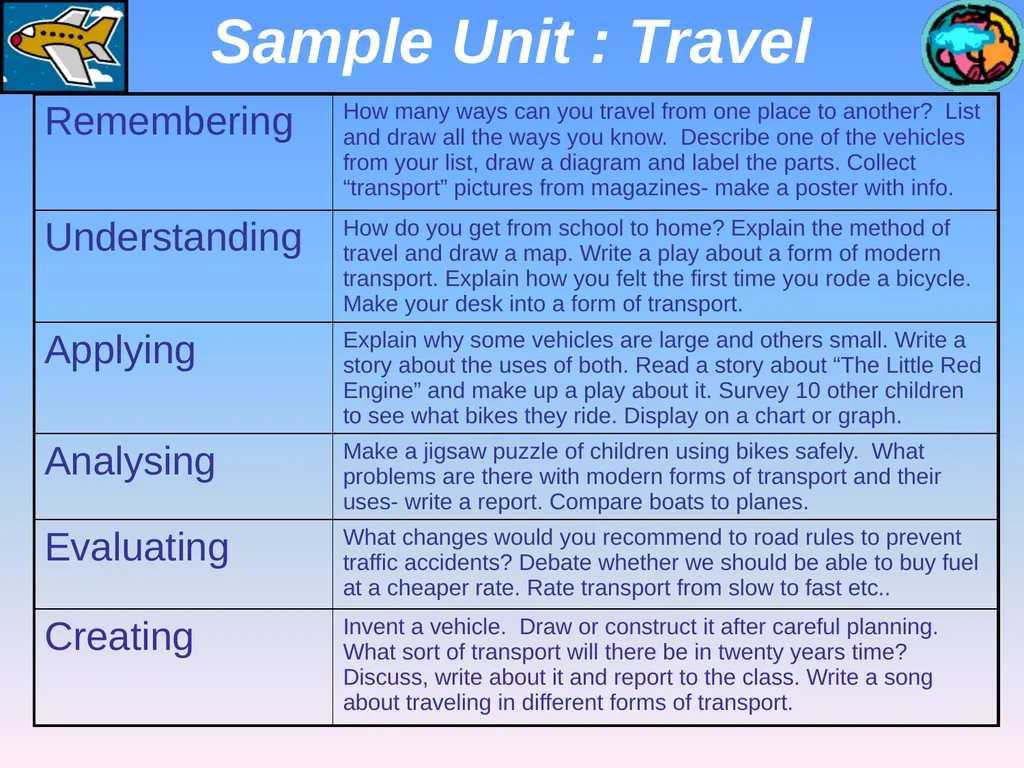
Sample Unit : Travel<br>
39
A good teacher makes you think even when you don’t want to.
(Fisher, 1998, Teaching Thinking)<br>
(Fisher, 1998, Teaching Thinking)<br>
40
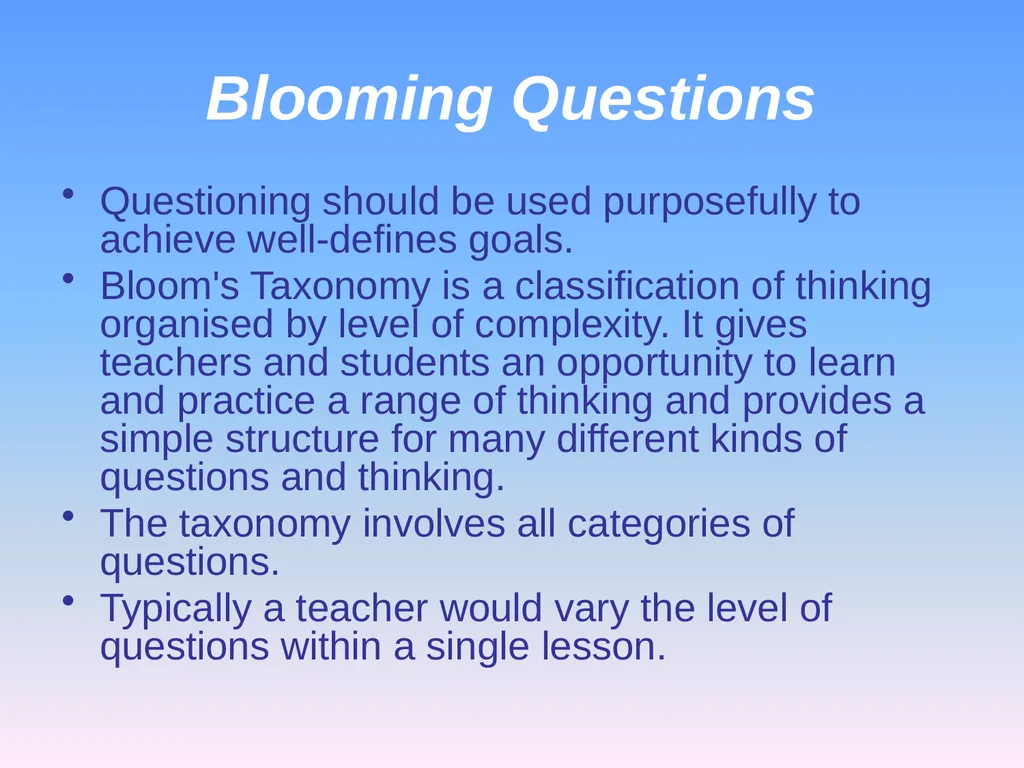
Blooming Questions Questioning should be used purposefully to achieve well-defines goals.
Bloom's Taxonomy is a classification of thinking organised by level of complexity. It gives teachers and students an opportunity to learn and practice a range of thinking and provides a simple structure for many different kinds of questions and thinking.
The taxonomy involves all categories of questions.
Typically a teacher would vary the level of questions within a single lesson.<br>
41
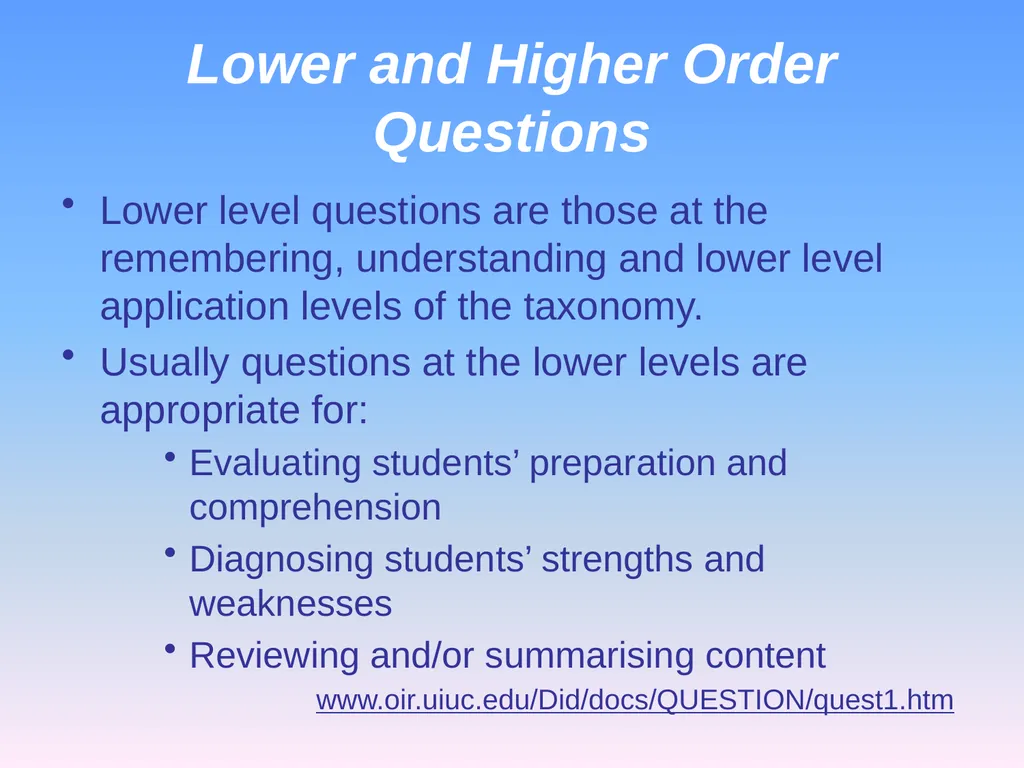
Lower and Higher Order Questions Lower level questions are those at the remembering, understanding and lower level application levels of the taxonomy.
Usually questions at the lower levels are appropriate for:
Evaluating students’ preparation and comprehension
Diagnosing students’ strengths and weaknesses
Reviewing and/or summarising content
www.oir.uiuc.edu/Did/docs/QUESTION/quest1.htm<br>
Usually questions at the lower levels are appropriate for:
Evaluating students’ preparation and comprehension
Diagnosing students’ strengths and weaknesses
Reviewing and/or summarising content
www.oir.uiuc.edu/Did/docs/QUESTION/quest1.htm<br>
42
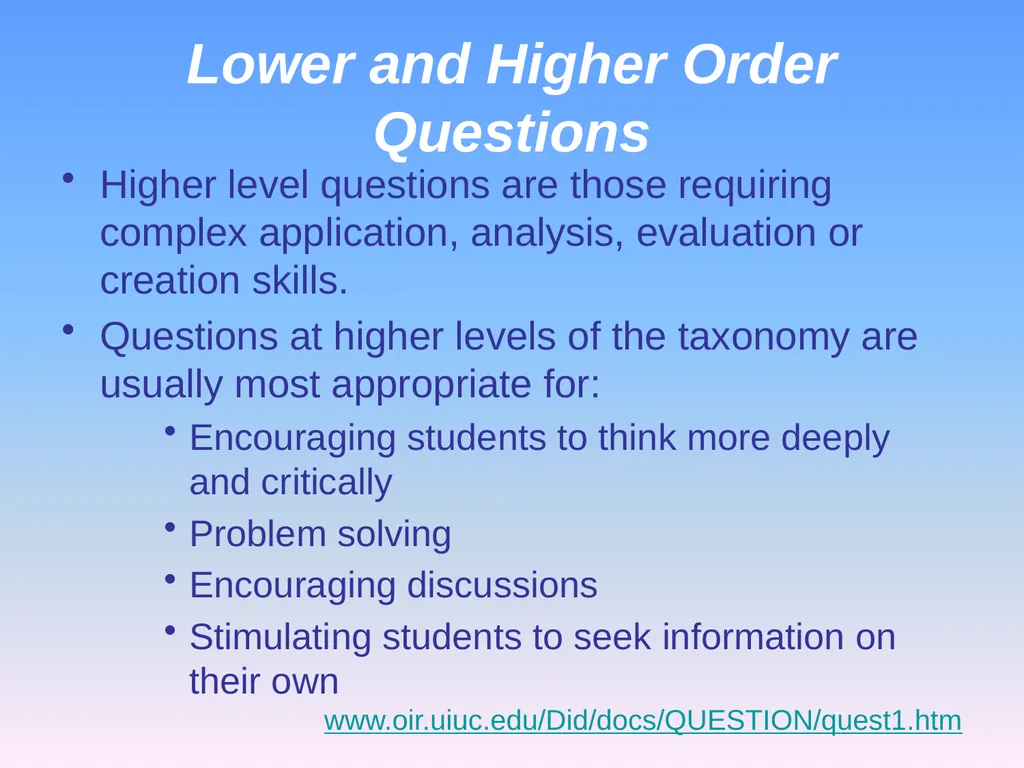
Lower and Higher Order Questions Higher level questions are those requiring complex application, analysis, evaluation or creation skills.
Questions at higher levels of the taxonomy are usually most appropriate for:
Encouraging students to think more deeply and critically
Problem solving
Encouraging discussions
Stimulating students to seek information on their own
www.oir.uiuc.edu/Did/docs/QUESTION/quest1.htm<br>
Questions at higher levels of the taxonomy are usually most appropriate for:
Encouraging students to think more deeply and critically
Problem solving
Encouraging discussions
Stimulating students to seek information on their own
www.oir.uiuc.edu/Did/docs/QUESTION/quest1.htm<br>
43
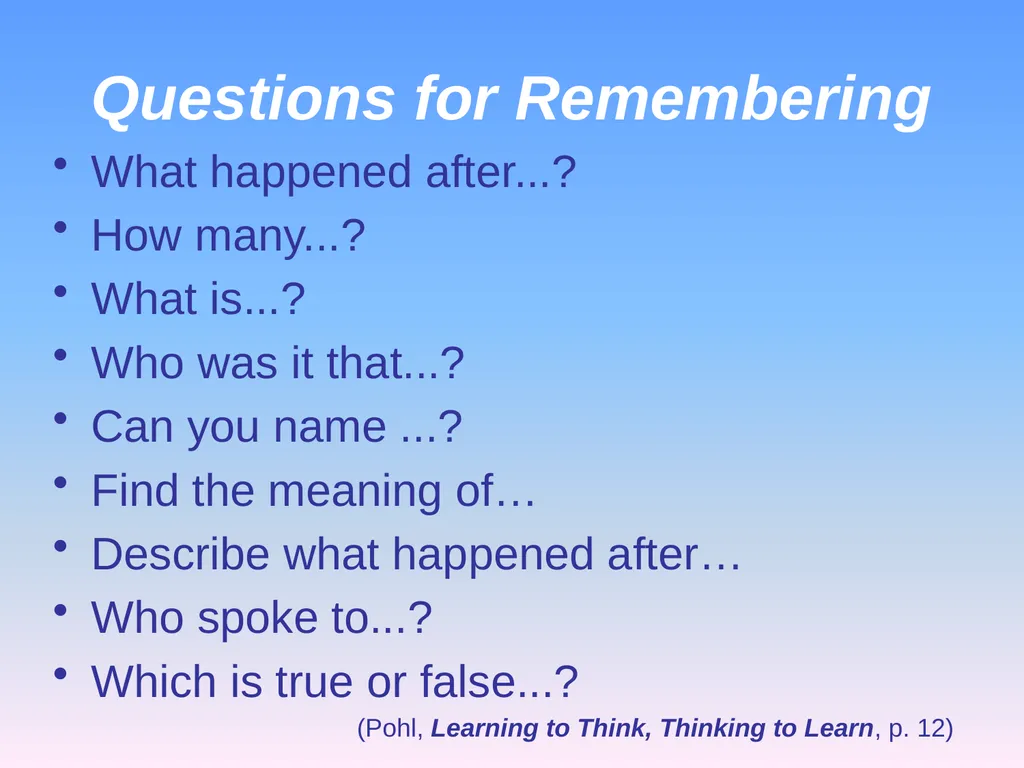
Questions for Remembering What happened after...?
How many...?
What is...?
Who was it that...?
Can you name ...?
Find the meaning of…
Describe what happened after…
Who spoke to...?
Which is true or false...?
(Pohl, Learning to Think, Thinking to Learn, p. 12)<br>
How many...?
What is...?
Who was it that...?
Can you name ...?
Find the meaning of…
Describe what happened after…
Who spoke to...?
Which is true or false...?
(Pohl, Learning to Think, Thinking to Learn, p. 12)<br>
44
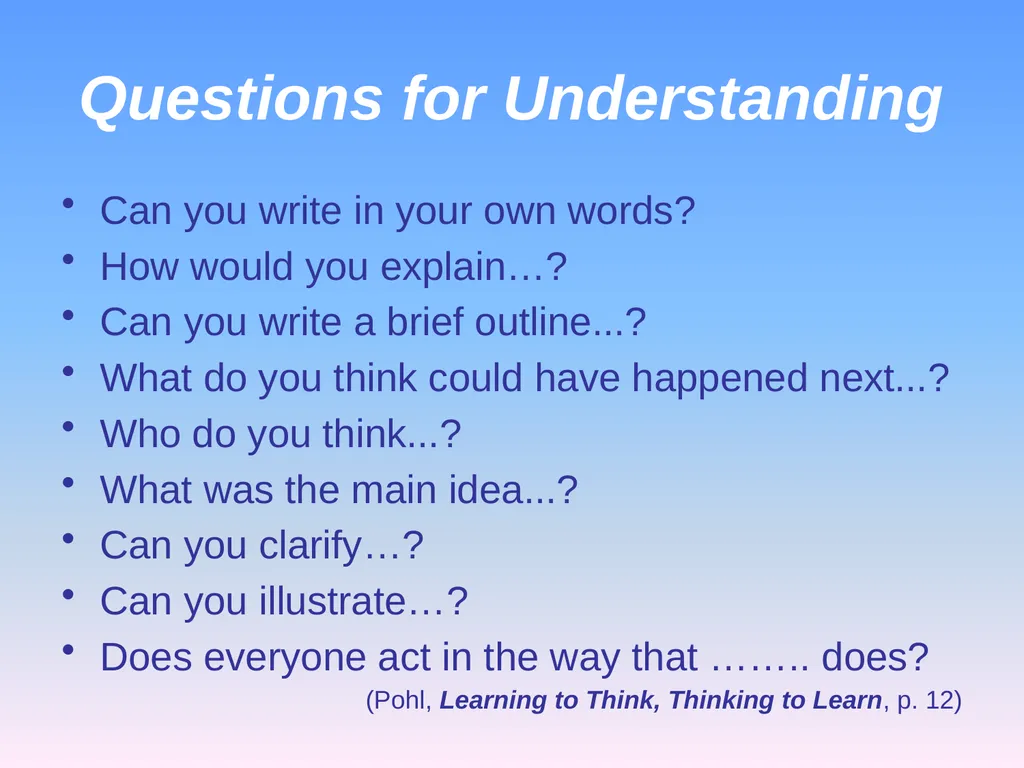
Questions for Understanding Can you write in your own words?
How would you explain…?
Can you write a brief outline...?
What do you think could have happened next...?
Who do you think...?
What was the main idea...?
Can you clarify…?
Can you illustrate…?
Does everyone act in the way that …….. does?
(Pohl, Learning to Think, Thinking to Learn, p. 12)<br>
How would you explain…?
Can you write a brief outline...?
What do you think could have happened next...?
Who do you think...?
What was the main idea...?
Can you clarify…?
Can you illustrate…?
Does everyone act in the way that …….. does?
(Pohl, Learning to Think, Thinking to Learn, p. 12)<br>
45
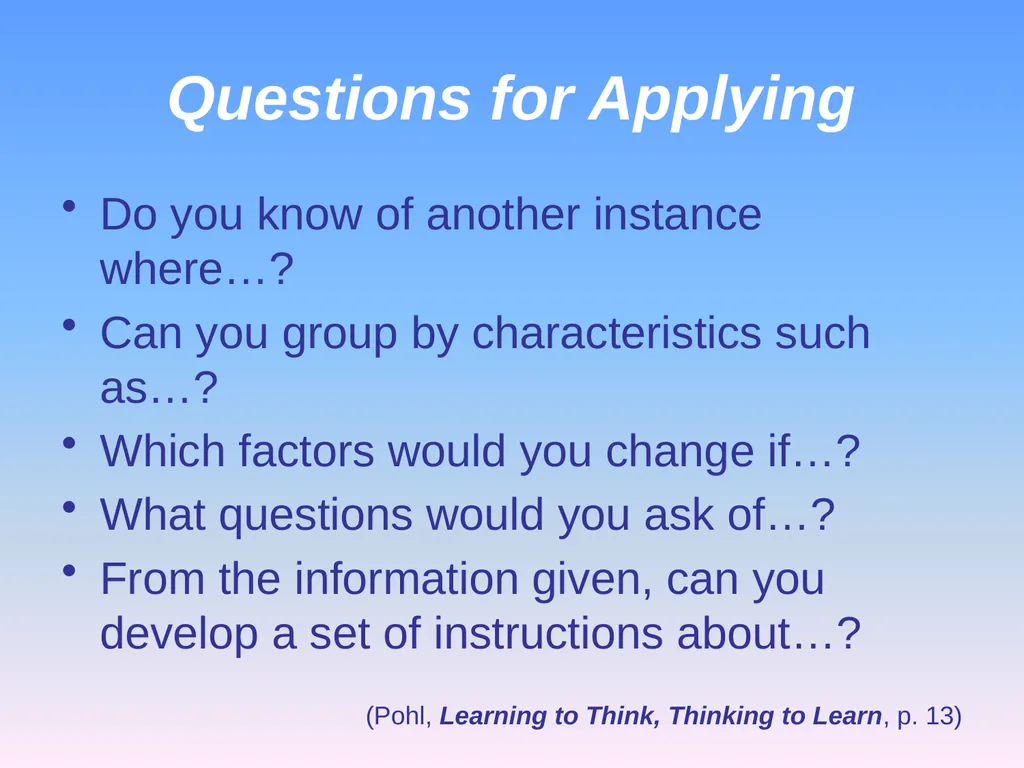
Questions for Applying Do you know of another instance where…?
Can you group by characteristics such as…?
Which factors would you change if…?
What questions would you ask of…?
From the information given, can you develop a set of instructions about…?
(Pohl, Learning to Think, Thinking to Learn, p. 13)<br>
Can you group by characteristics such as…?
Which factors would you change if…?
What questions would you ask of…?
From the information given, can you develop a set of instructions about…?
(Pohl, Learning to Think, Thinking to Learn, p. 13)<br>
46
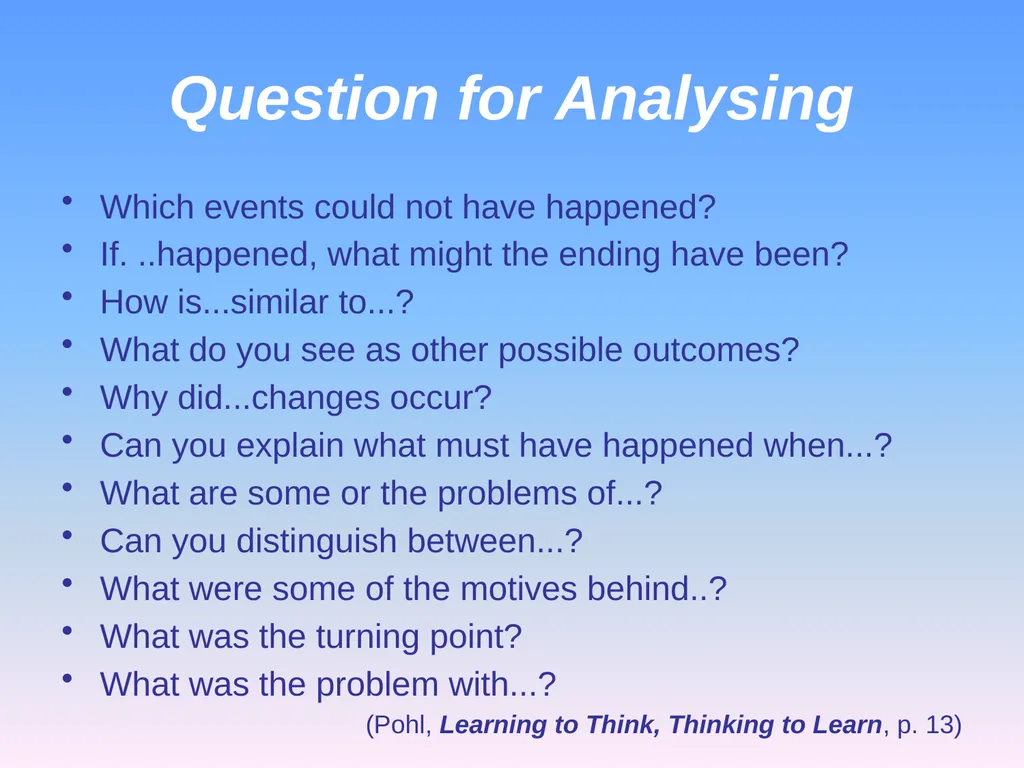
Question for Analysing Which events could not have happened?
If. ..happened, what might the ending have been?
How is...similar to...?
What do you see as other possible outcomes?
Why did...changes occur?
Can you explain what must have happened when...?
What are some or the problems of...?
Can you distinguish between...?
What were some of the motives behind..?
What was the turning point?
What was the problem with...?
(Pohl, Learning to Think, Thinking to Learn, p. 13)<br>
47
Questions for Evaluating Is there a better solution to...?
Judge the value of... What do you think about...?
Can you defend your position about...?
Do you think...is a good or bad thing?
How would you have handled...?
What changes to.. would you recommend?
Do you believe...? How would you feel if. ..?
How effective are. ..?
What are the consequences..?
What influence will....have on our lives?
What are the pros and cons of....?
Why is ....of value?
What are the alternatives?
Who will gain & who will loose?
(Pohl, Learning to Think, Thinking to Learn, p. 14)<br>
48
Questions for Creating Can you design a...to...?
Can you see a possible solution to...?
If you had access to all resources, how would you deal with...?
Why don't you devise your own way to...?
What would happen if ...?
How many ways can you...?
Can you create new and unusual uses for...?
Can you develop a proposal which would...?
(Pohl, Learning to Think, Thinking to Learn, p. 14)<br>
49
Now it’s your turn… Use the Bloom’s Matrix and these notes to plan a number of activities or questions for each level of the taxonomy.
You may choose to use this term’s context or unit, or focus on next term’s.
Work with your teaching partner.
I will copy these for our Thinking Skills Folder so everyone can share our BRILLIANT ideas.
HAVE FUN!<br>
You may choose to use this term’s context or unit, or focus on next term’s.
Work with your teaching partner.
I will copy these for our Thinking Skills Folder so everyone can share our BRILLIANT ideas.
HAVE FUN!<br>
50
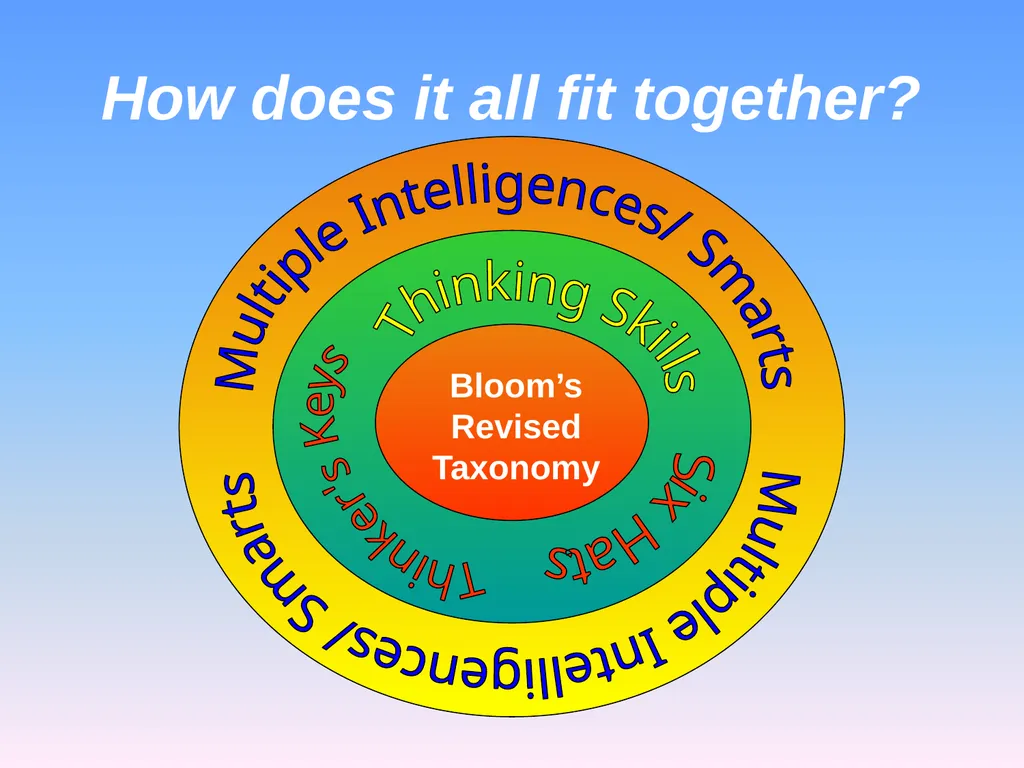
How does it all fit together? Bloom’s Revised Taxonomy Thinker's Keys Six Hats Multiple Intelligences/ Smarts Multiple Intelligences/ Smarts Thinking Skills<br>
51
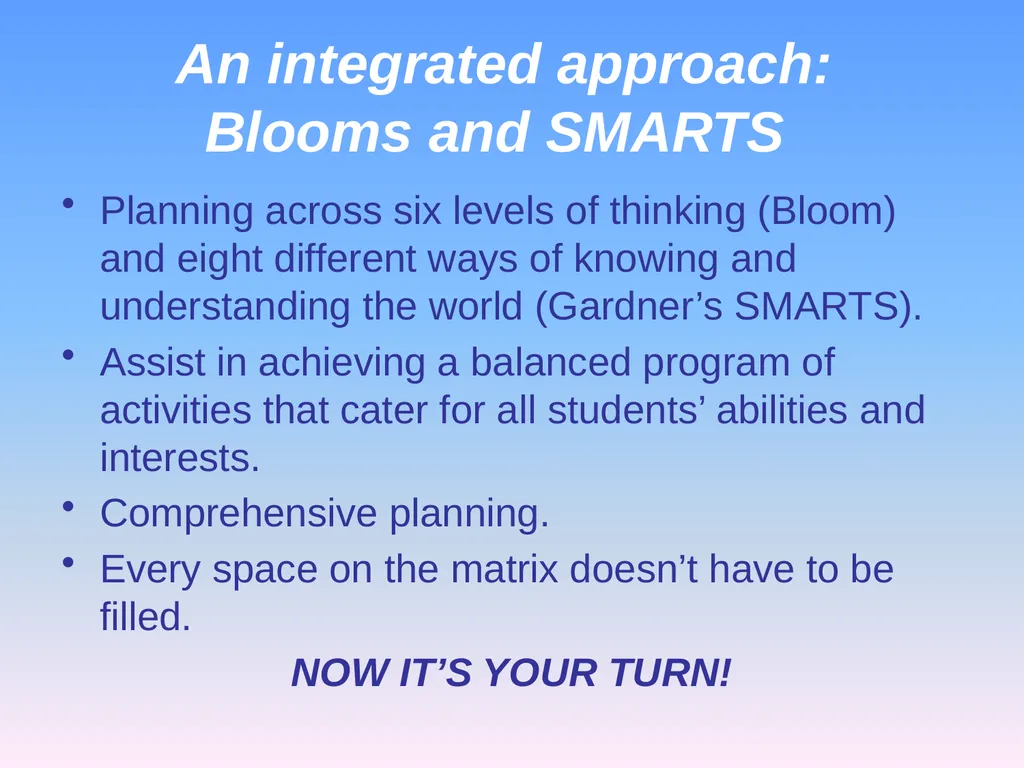
An integrated approach:
Blooms and SMARTS Planning across six levels of thinking (Bloom) and eight different ways of knowing and understanding the world (Gardner’s SMARTS).
Assist in achieving a balanced program of activities that cater for all students’ abilities and interests.
Comprehensive planning.
Every space on the matrix doesn’t have to be filled.
NOW IT’S YOUR TURN!<br>
Assist in achieving a balanced program of activities that cater for all students’ abilities and interests.
Comprehensive planning.
Every space on the matrix doesn’t have to be filled.
NOW IT’S YOUR TURN!<br>
52
This world is but a canvas for our imaginations.
(Henry David Thoreau)<br>
(Henry David Thoreau)<br>
53
Bloom on the Internet Bloom's(1956) Revised Taxonomy
http://rite.ed.qut.edu.au/oz-teachernet/training/bloom.html
An excellent introduction and explanation of the revised Taxonomy by Michael Pole on the oz-TeacherNet site written for the QSITE Higher order Thinking Skills Online Course 2000. Pohl explains the terms and provides a comprehensive overview of the sub-categories, along with some suggested question starters that aim to evoke thinking specific to each level of the taxonomy. Suggested potential activities and student products are also listed.
Bloom’s Revised Taxonomy
http://coe.sdsu.edu/eet/articles/bloomrev/index.htm
Another useful site for teachers with useful explanations and examples of questions from the College of Education at San Diego State University.
Taxonomy of Technology Integration
http://education.ed.pacificu.edu/aacu/workshop/reconcept2B.html
This site compiled by the Berglund Center for Internet Studies at Pacific University, makes a valiant effort towards linking ICT (information and communication technologies) to learning via Bloom's Revised Taxonomy of Educational Objectives (Anderson, et. al., 2001). The taxonomy presented on this site is designed to represent the varying cognitive processes that can be facilitated by the integration of ICT into the teaching and learning process.
Critical and Creative Thinking - Bloom's Taxonomy
http://eduscapes.com/tap/topic69.htm
Part of Eduscape.com, this site includes a definitive overview of critical and creative thinking as well as how Bloom’s domains of learning can be reflected in technology-rich projects. Many other links to Internet resources to support Bloom’s Taxonomy, as well as research and papers on Thinking Skills. Well worth a look.<br>
54
Bloom on the Internet http://www.tedi.uq.edu.au/Assess/Assessment/bloomtax.html
http://www.acps.k12.va.us/hammond/readstrat/BloomsTaxonomy2.html
http://www.teachers.ash.org.au/researchskills/dalton.htm
http://www.officeport.com/edu/blooms.htm
http://www.quia.com/fc/90134.html
http://www.utexas.edu/student/utlc/handouts/1414.html Model questions and keywords
http://schools.sd68.bc.ca/webquests/blooms.htm
http://www.coun.uvic.ca/learn/program/hndouts/bloom.html
http://caribou.cc.trincoll.edu/depts_educ/Resources/Bloom.htm
http://www.kent.wednet.edu/KSD/MA/resources/blooms/teachers_blooms.html
http://www.hcc.hawaii.edu/intranet/committees/FacDevCom/guidebk/teachtip/questype.htm
http://www.nexus.edu.au/teachstud/gat/painter.htm Questioning Techniques that includes reference to Bloom’s Taxonomy.
http://scs.une.edu.au/TalentEd/EdSupport/Snugglepot.htm<br>
55
Print Resources Clements, D.; C. Gilliland and P. Holko. (1992). Thinking in Themes: An Approach Through the Learning Centre. Melbourne: Oxford University Press.
Crawford, Jean (ed.) (1991). Achieveing Excellence: Units of Work for levels P-8. Carlton South, Vic.: Education Shop, Ministry of Education and Training, Victoria.
Crosby, N. and E. Martin. (1981). Don’t Teach! Let Me Learn. Book 3. Cheltenham, Vic.: Hawker Brownlow.
Dalton, Joan. (1986). Extending Children’s Special Abilities: Strategies for Primary Classrooms. Victoria: Department of School Education, Victoria.
Forte, Imogene and S. Schurr. (1997). The All-New Science Mind Stretchers: Interdisciplinary Units to Teach Science Concepts and Strengthen Thinking Skills. Cheltenham, Vic.: Hawker Brownlow.
Fogarty, R. (1997). Problem-based learning and other curriculum models for the multiple intelligences classroom. Arlington Heights, IL: IRI/Skylight Training and Publishing, Inc.
Frangenheim, E. (1998). Reflections on Classroom Thinking Strategies. Loganholme: Rodin Educational Consultancy.<br>
56
Print Resources Knight, BA., S. Bailey, W. Wearne and D. Brown. (1999). Blooms Multiple Intelligences Themes and Activities.
McGrath, H and T. Noble. (1995). Seven Ways at Once: Units of Work Based on the Seven Intelligences. Book 1. South Melbourne: Longman.
Pohl, M. (2000). Teaching Complex Thinking: Critical, Creative, Caring. Cheltenham, Vic.: Hawker Brownlow.
Pohl, Michael. (1997). Teaching Thinking Skills in the Primary Years: A Whole School Approach. Cheltenham, Vic.: Hawker Brownlow Education.
Pohl, Michael. (2000). Learning to Think, Thinking to Learn: Models and Strategies to Develop a Classroom Culture of Thinking. Cheltenham, Vic.: Hawker Brownlow.
Ryan, Maureen. (1996). The Gifted and Talented Children’s Course: Resolving Issues, Book 13- 7-8 Year Olds. Greenwood, WA: Ready-Ed Publications.<br>
57
He who learns but does not think is lost
(Chinese Proverb)<br>
(Chinese Proverb)<br>