Presented by : Dr Rajesh D, Associate Professor DICT Training Accessible Digital Resources, CWSN Vertical Date: 30102023, Session 03 Time: 02.00 -03.00 pm Orientation of State Resource Groups (SRGs) on Development of eContents for
Related Topics
Share
Embed code
Download this presentation From Below
"Presented by : Dr Rajesh D, Associate Professor –" is the property of its rightful owner. Permission is granted to
download and print the materials on this website for personal, non-commercial use only, and to display it
on your personal computer provided you do not modify the materials and that you retain all copyright
notices contained in the materials. By downloading content from our website, you accept the terms of this
agreement.
Presentation Transcript
01
Presented by : Dr Rajesh D, Associate Professor – DICT & Training Accessible Digital Resources, CWSN Vertical Date: 30/10/2023, Session – 03
Time: 02.00 -03.00 pm Orientation of State Resource Groups (SRGs) on Development of eContents for DIKSHA (2023-24)<br>
02
“Disability results from the interaction between persons with impairments and attitudinal and environmental barriers that hinder their full and effective participation in society on an equal basis with others”-(CRPD-2006)
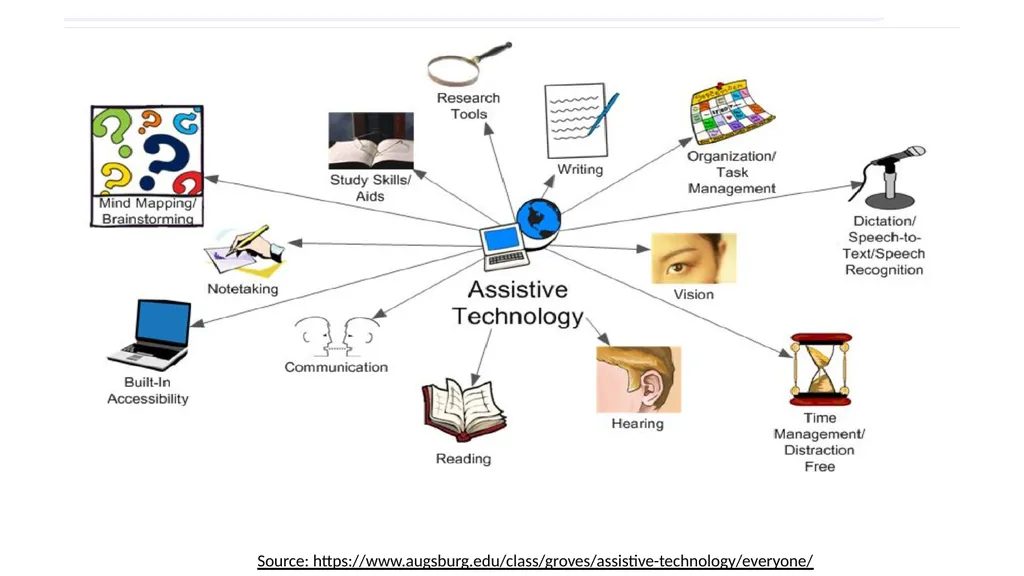
Any Software, Device/gadget or system that can assist person with special needs.
A major prerequisite to achieve inclusive education
The Universal Design for Learning (UDL) has a great role to play. ASSISTIVE TECHNOLOGIES<br>
03
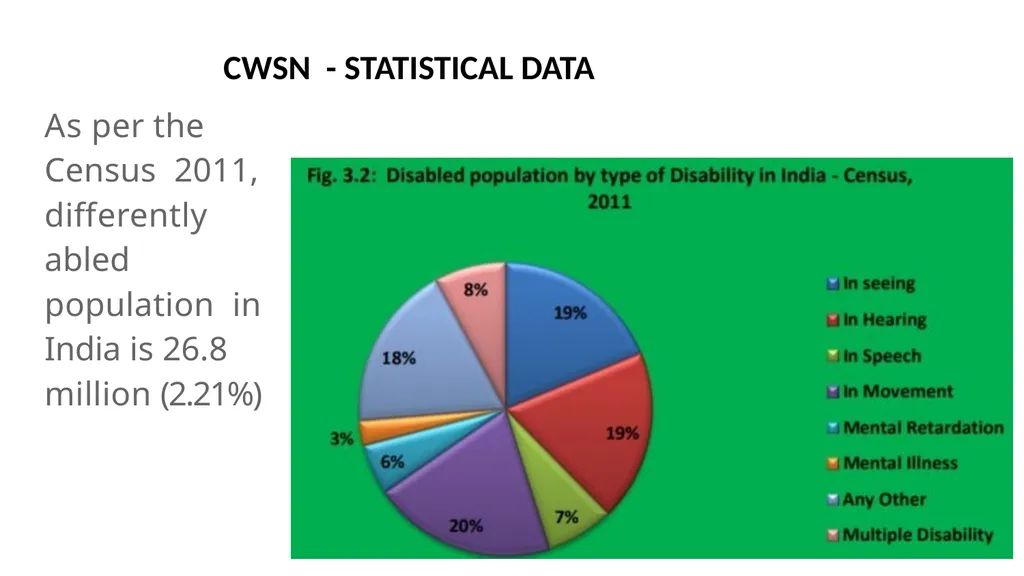
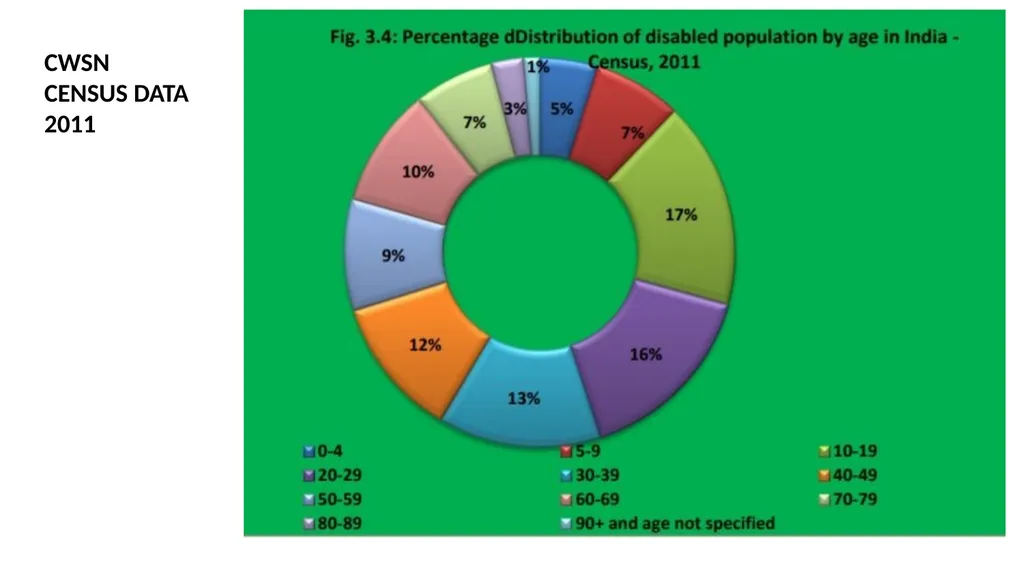
As per the Census 2011, differently abled population in India is 26.8 million (2.21%) CWSN - STATISTICAL DATA<br>
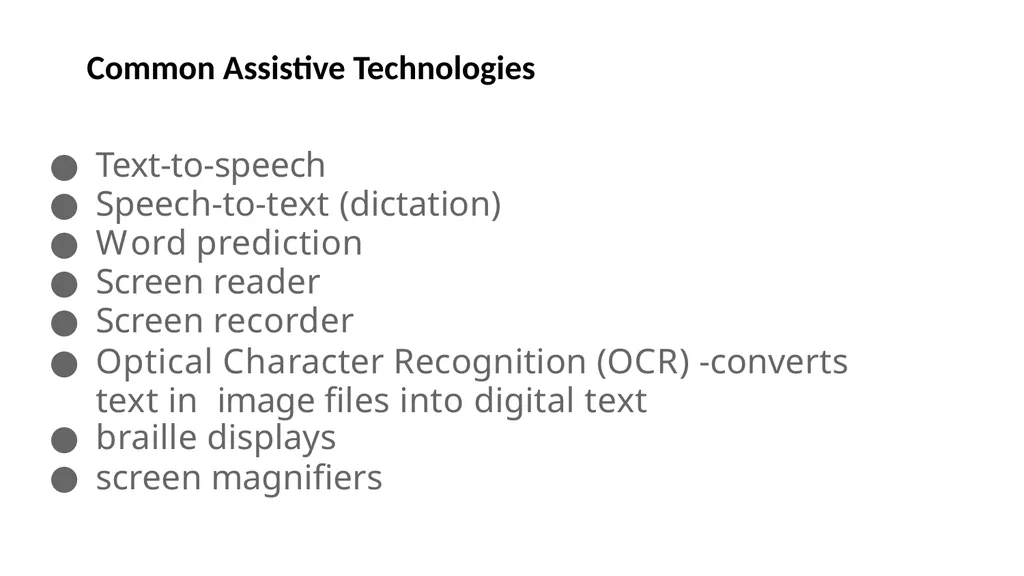
Text-to-speech
Speech-to-text (dictation)
Word prediction
Screen reader
Screen recorder
Optical Character Recognition (OCR) -converts text in image files into digital text
braille displays
screen magnifiers Common Assistive Technologies<br>
07
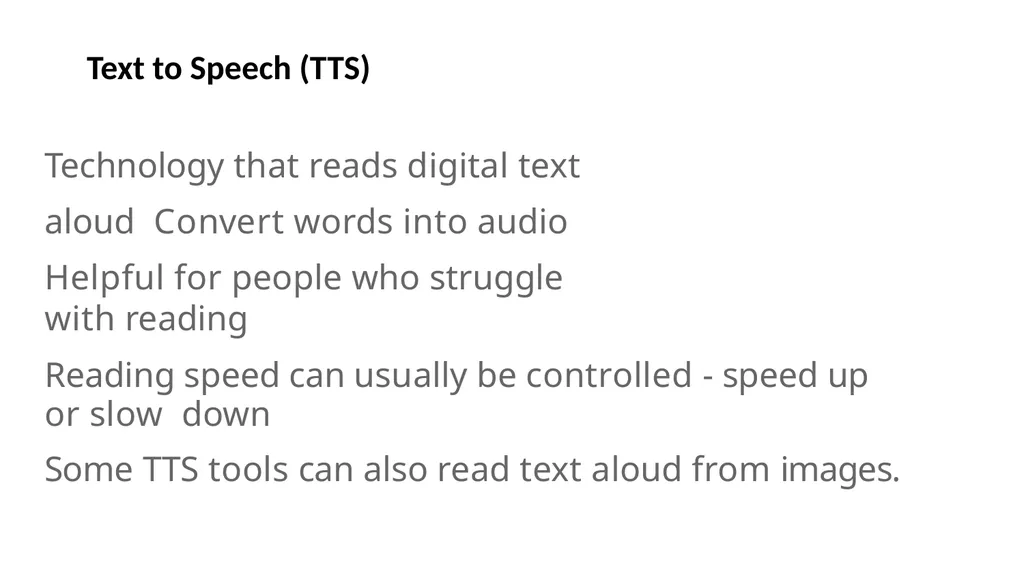
Technology that reads digital text aloud Convert words into audio
Helpful for people who struggle with reading
Reading speed can usually be controlled - speed up or slow down
Some TTS tools can also read text aloud from images. Text to Speech (TTS)<br>
08
Built-in text-to-speech in devices (desktop and laptop computers, smartphones, digital tablets, and Chromebooks)
Web-based tools: Some websites have TTS tools on-site
Text-to-speech apps: users can download TTS apps on smartphones and tablets
Text-to-speech software Types of TTS Tools<br>
09
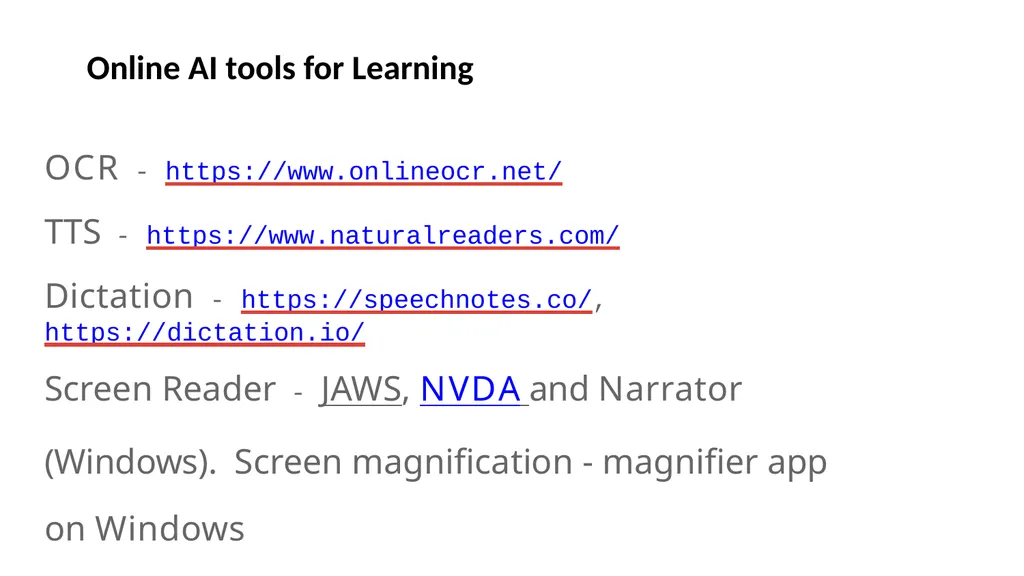
OCR - https://www.onlineocr.net/
TTS - https://www.naturalreaders.com/
Dictation - https://speechnotes.co/, https://dictation.io/
Screen Reader - JAWS, NVDA and Narrator (Windows). Screen magnification - magnifier app on Windows Online AI tools for Learning<br>
10
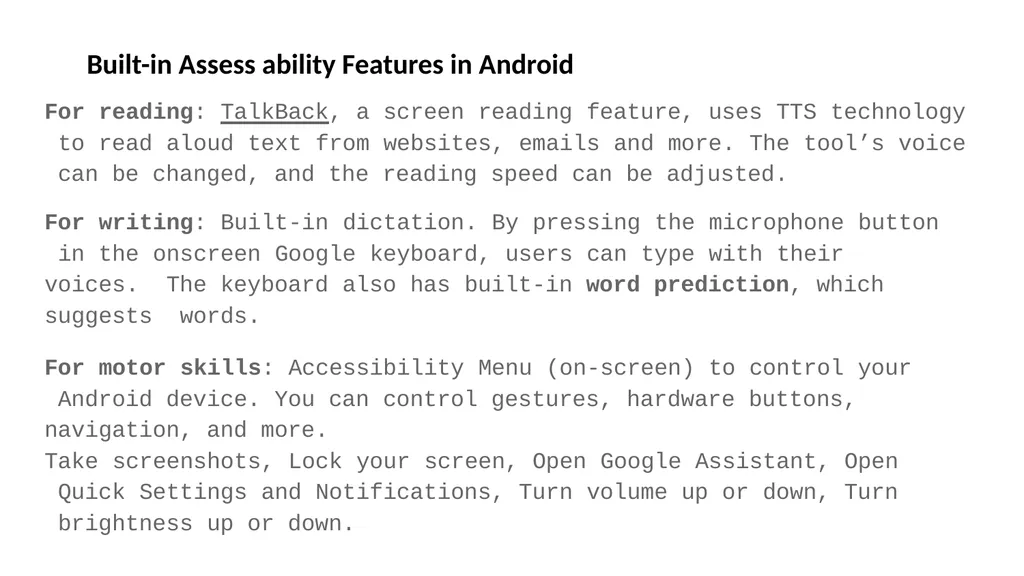
For reading: TalkBack, a screen reading feature, uses TTS technology to read aloud text from websites, emails and more. The tool’s voice can be changed, and the reading speed can be adjusted.
For writing: Built-in dictation. By pressing the microphone button in the onscreen Google keyboard, users can type with their voices. The keyboard also has built-in word prediction, which suggests words.
For motor skills: Accessibility Menu (on-screen) to control your Android device. You can control gestures, hardware buttons, navigation, and more.
Take screenshots, Lock your screen, Open Google Assistant, Open Quick Settings and Notifications, Turn volume up or down, Turn brightness up or down. Built-in Assess ability Features in Android<br>
11
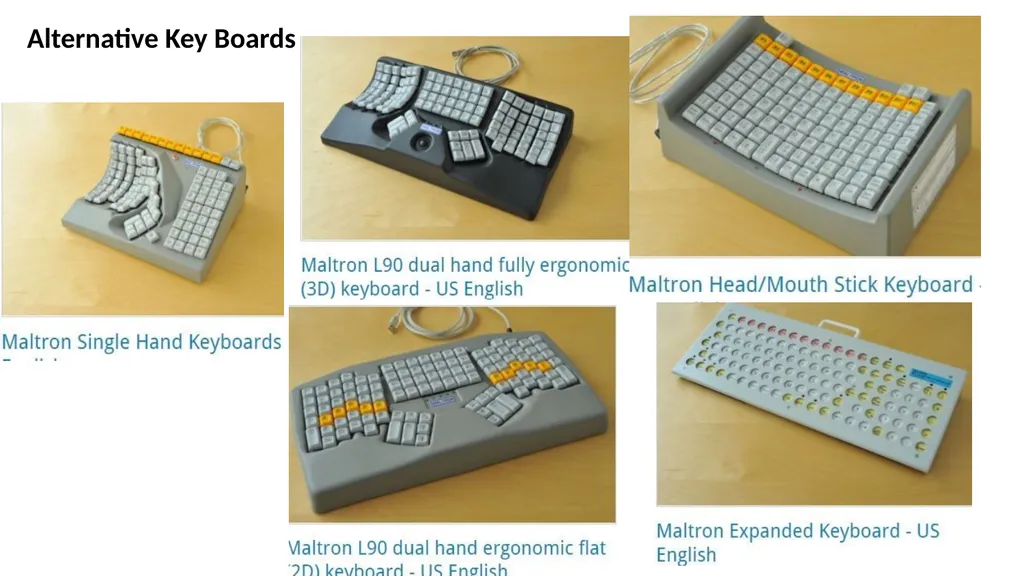
v Alternative Key Boards<br>
12
Head pointers
Single switch entry devices
Foot switches
Sip-and-puff switches - https://youtu.be/Bhj5vs9P5cw
Eye-tracking software
Augmentative and Alternative Communication (AAC) tool
Dynavox AAC device - https://youtu.be/g95TO20hnmo
Braille display - refreshable. converts the digital text on the screen into braille
Braille notetaker - https://youtu.be/dV0KZtVmcIo Alternative Input Devices<br>
13
Web is fundamentally designed to work for all people, whatever their hardware, software, language, location, or ability.
However, when web sites, applications, technologies, or tools are badly designed, they can create barriers Ensuring Web Accessibility as an E- Content Developer<br>
14
Alternative Text for Images - for people who cannot see and use a screen reader
Keyboard Input - those who cannot use a mouse due to limited fine motor control. Helps assistive technologies that mimic the keyboard, such as speech input.
Transcripts for Audio - people who are deaf or hard of hearing, as well as to search engines
Sign language interpretation of audio content
Operable user interface and navigation Ensuring Web Accessibility as an E-Content Developer..Contd…<br>