
Presented by Gilad Laredo Atom-photons

Description: Presented by Gilad Laredo Atom-photons interactions 118137 Spring 2017 Introduction System evolves according to Schrödinger eq. But how do we solve this? By the RWA: Difficult Easy ? RWA rotating wave approximation Paper goal Present
Related Topics
Download Presentation
"Presented by Gilad Laredo Atom-photons" is the property of its rightful owner. Permission is granted to download and print the materials on this website for personal, non-commercial use only, and to display it on your personal computer provided you do not modify the materials and that you retain all copyright notices contained in the materials. By downloading content from our website, you accept the terms of this agreement.
Presentation Transcript
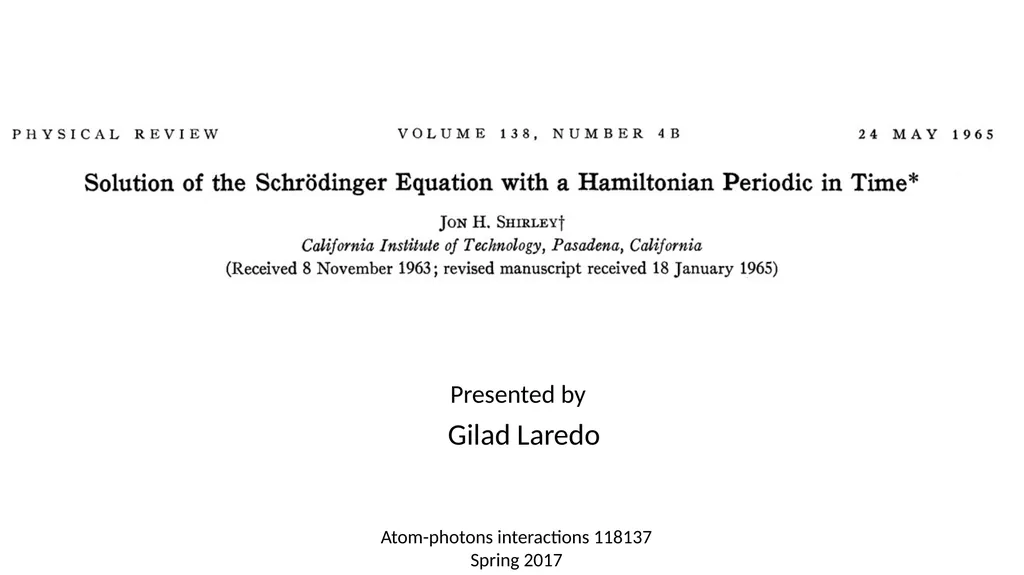
slide1. Presented by
Gilad Laredo Atom-photons interactions 118137
Spring 2017<br>
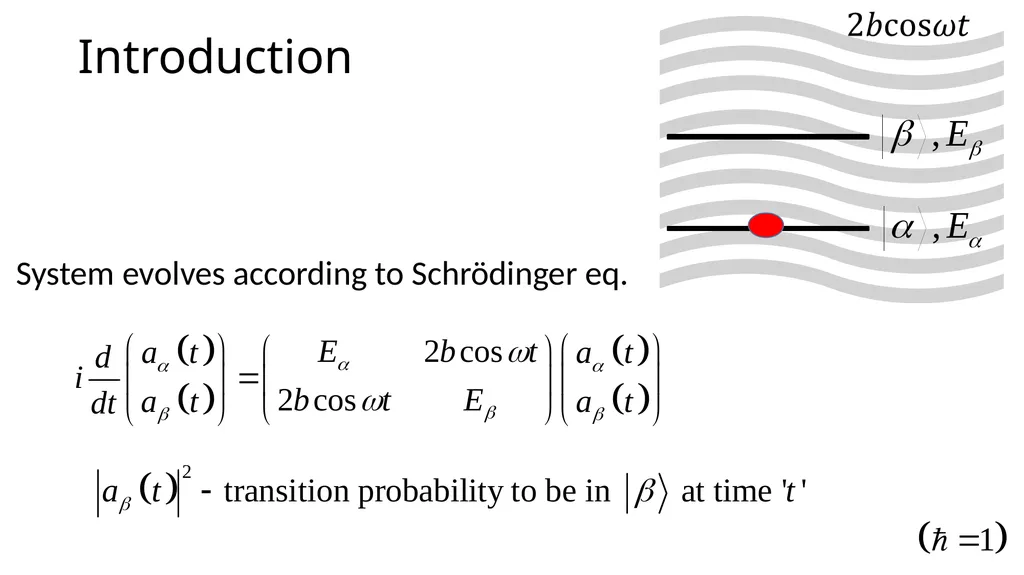
slide2. Introduction System evolves according to Schrödinger eq.<br>
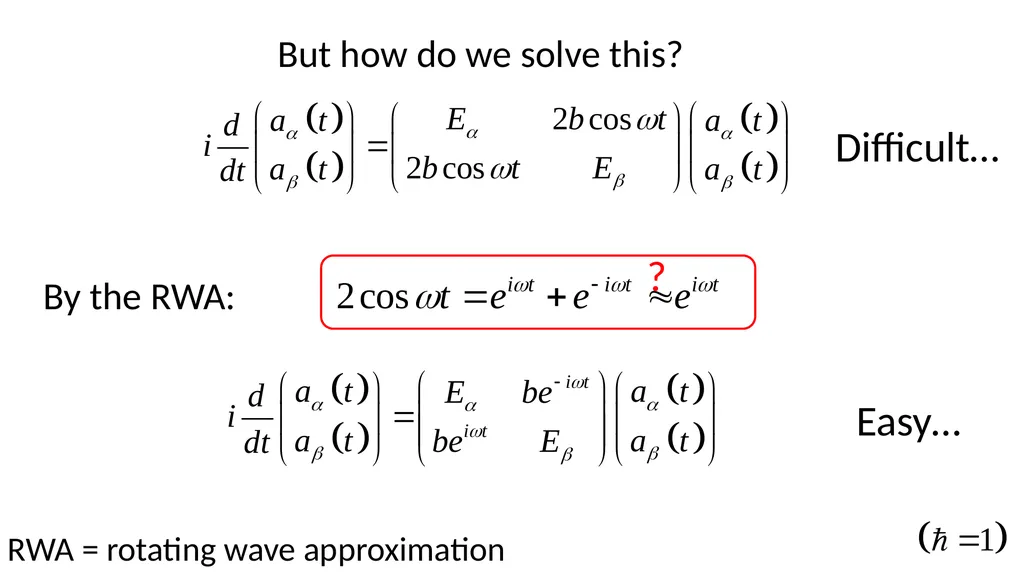
slide3. But how do we solve this? By the RWA: Difficult… Easy… ? RWA = rotating wave approximation<br>
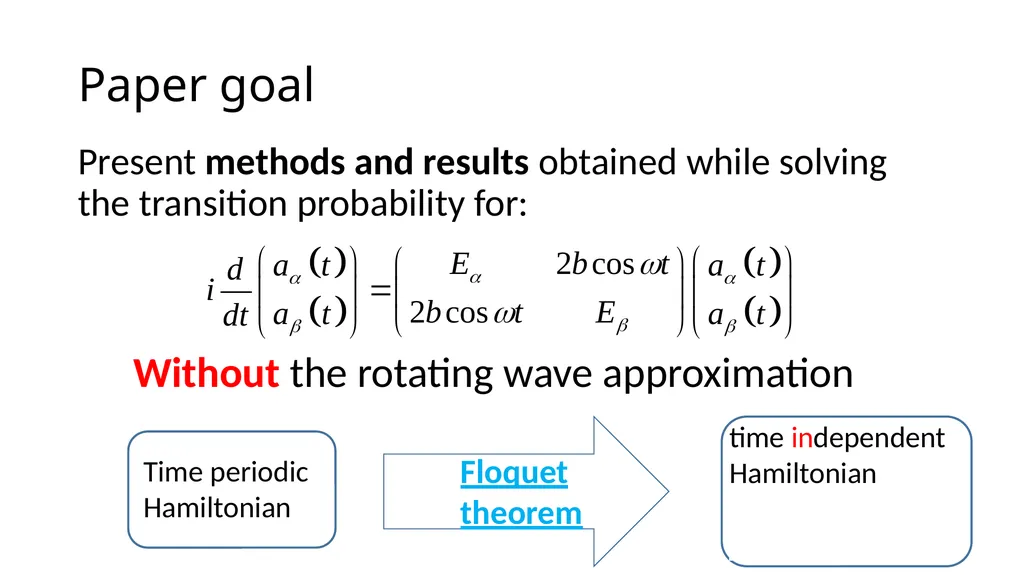
slide4. Paper goal Present methods and results obtained while solving the transition probability for: Time periodic Hamiltonian time independent Hamiltonian Infinite matrix representation Floquet theorem Without the rotating wave approximation<br>
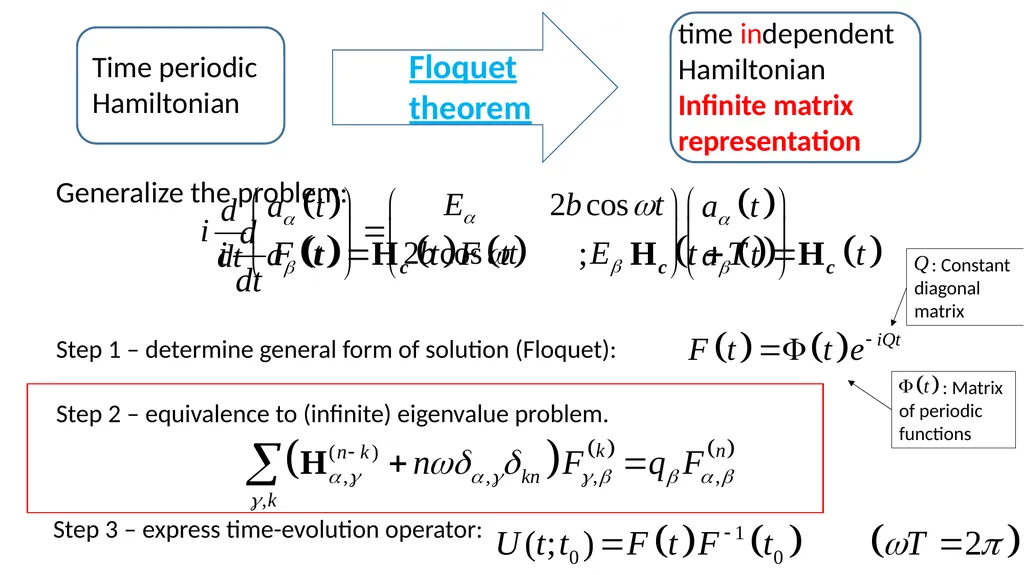
slide5. Generalize the problem: Time periodic Hamiltonian time independent Hamiltonian Infinite matrix representation Floquet theorem Generalize the problem: Step 1 – determine general form of solution (Floquet): : Constant diagonal matrix : Matrix of periodic functions Step 2 – equivalence to (infinite) eigenvalue problem. Step 3 – express time-evolution operator:<br>
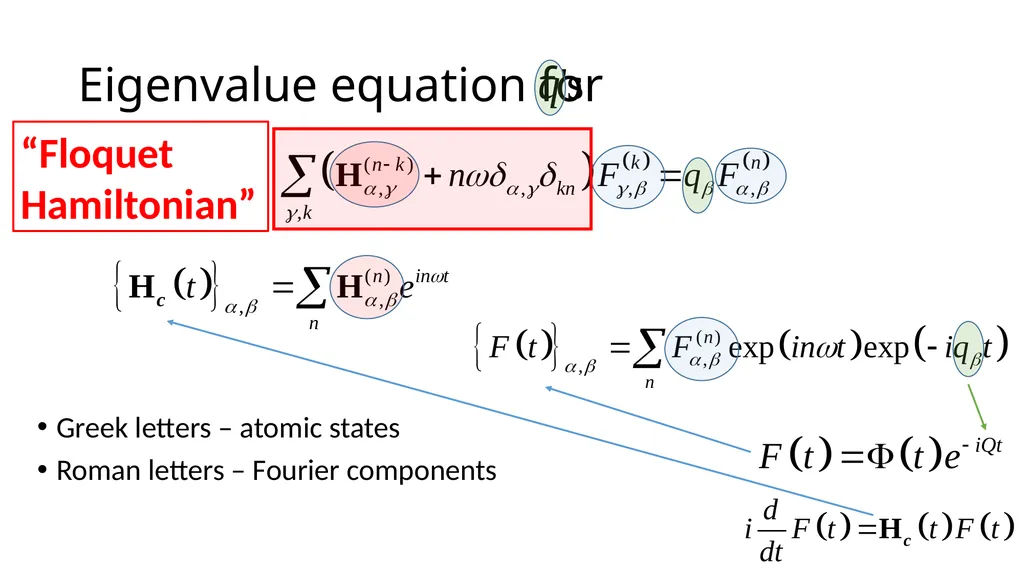
slide6. Eigenvalue equation for Greek letters – atomic states
Roman letters – Fourier components “Floquet Hamiltonian”<br>
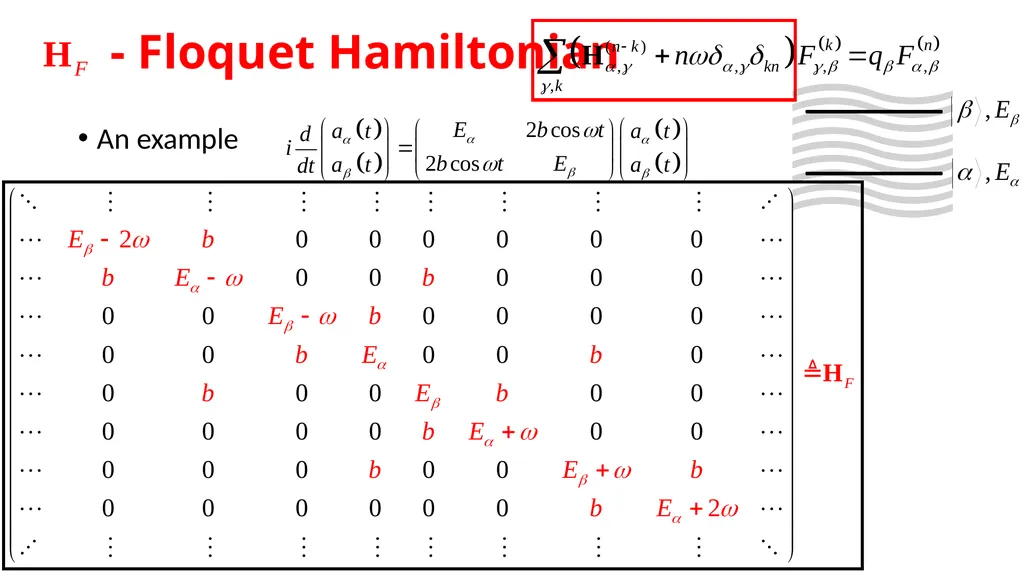
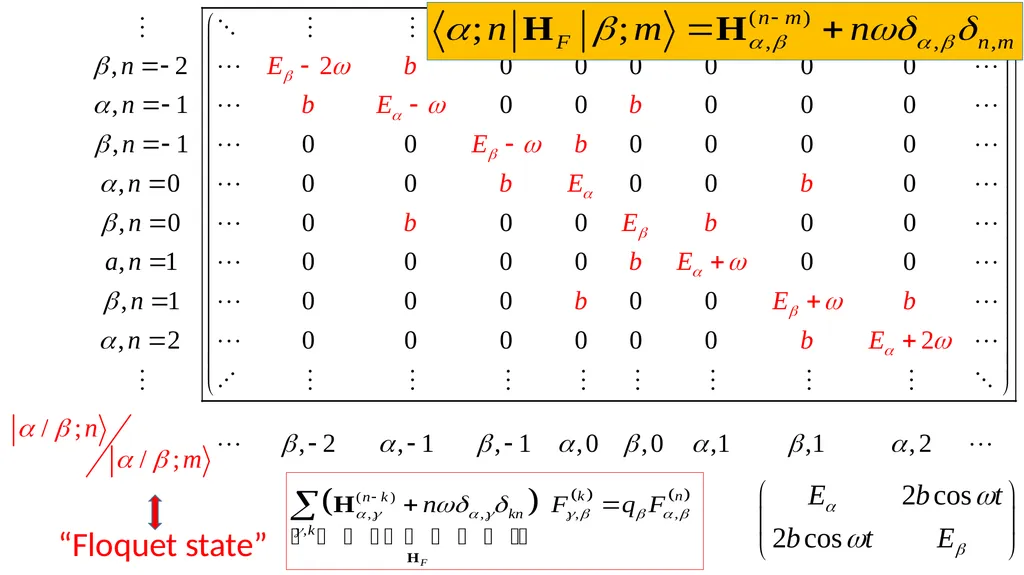
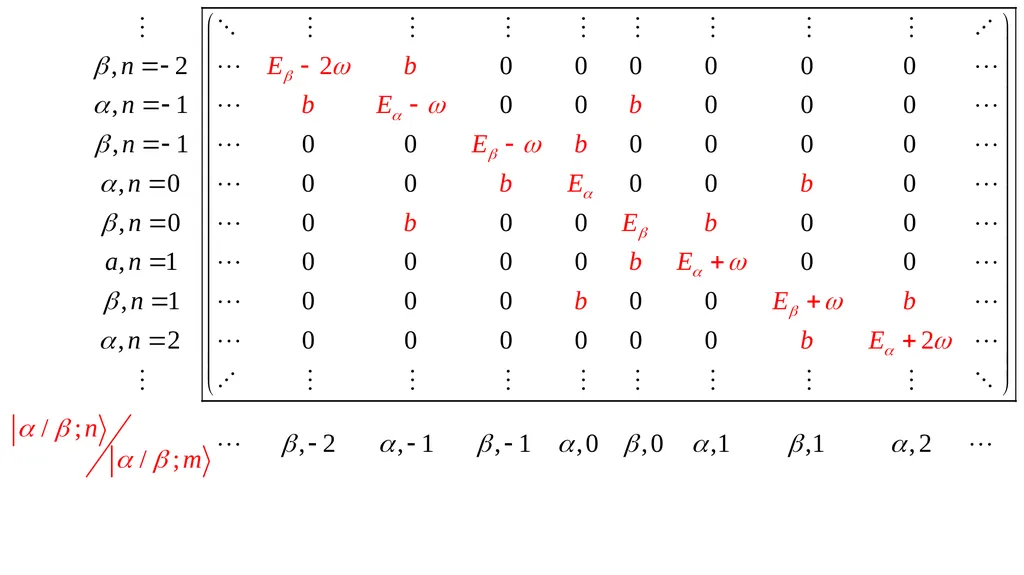
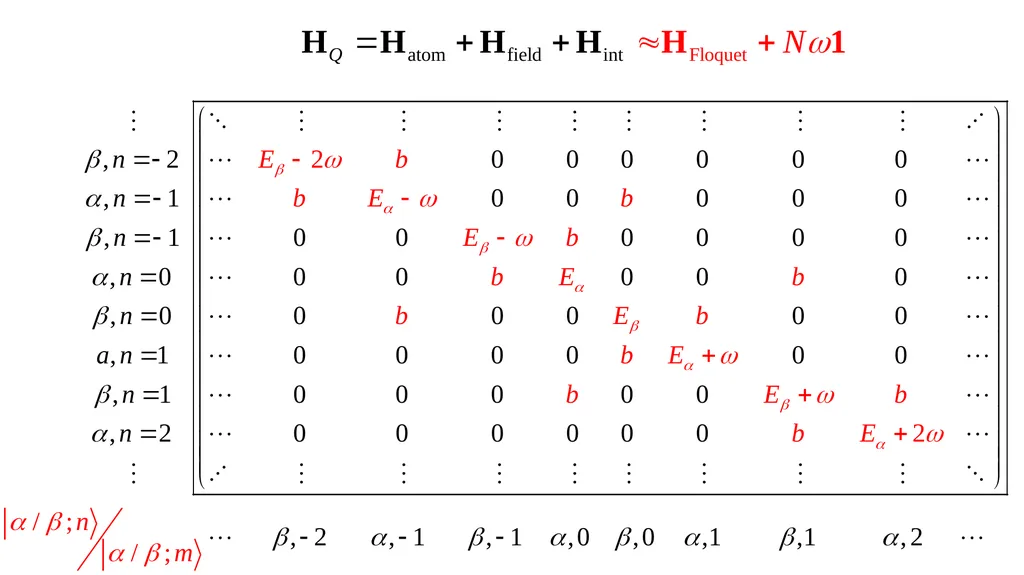
slide7. - Floquet Hamiltonian An example<br>
slide8. “Floquet state”<br>
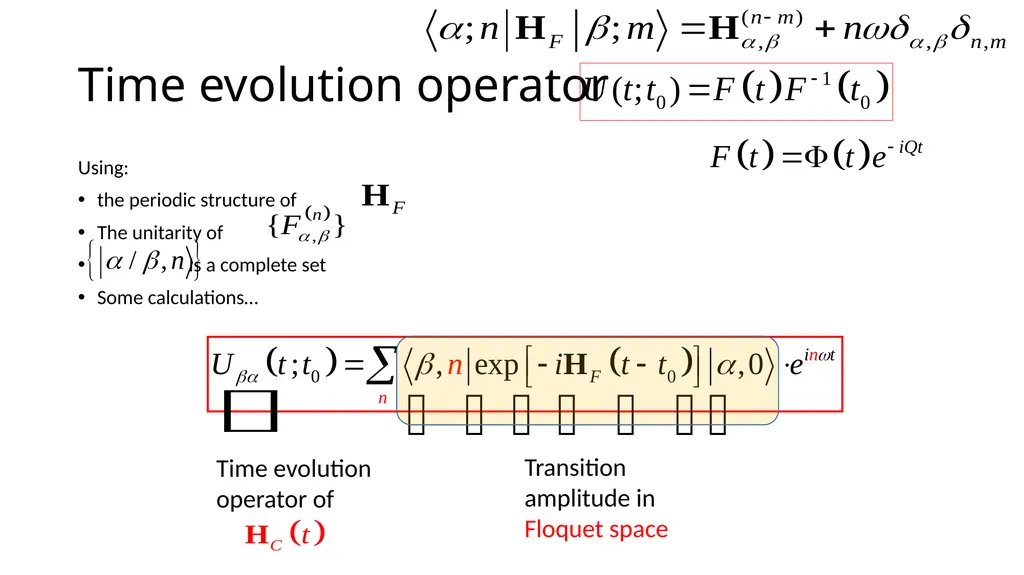
slide9. Time evolution operator Using:
the periodic structure of
The unitarity of
Is a complete set
Some calculations… Transition amplitude in Floquet space Time evolution operator of<br>
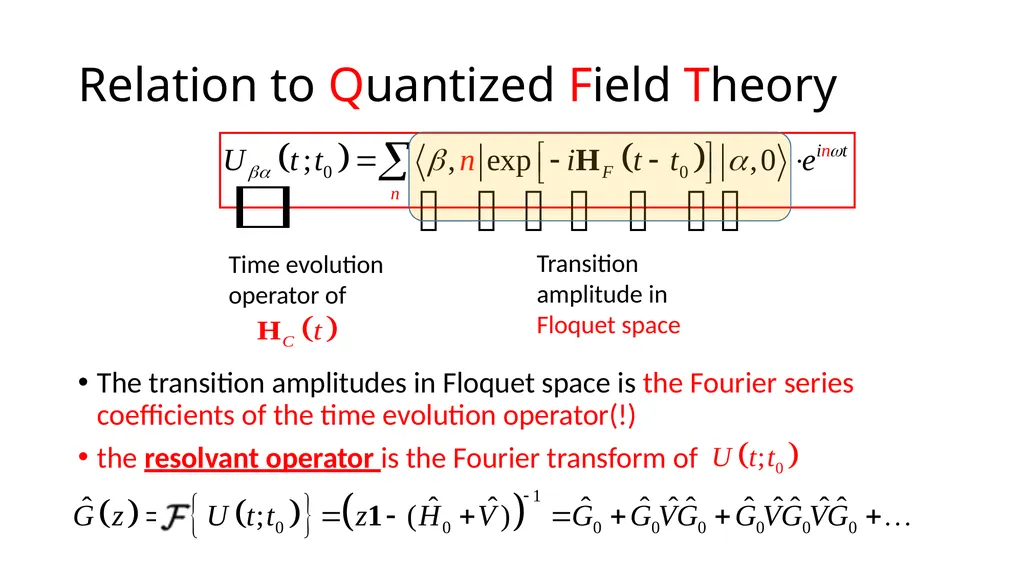
slide10. Relation to Quantized Field Theory The transition amplitudes in Floquet space is the Fourier series coefficients of the time evolution operator(!)
the resolvant operator is the Fourier transform of Transition amplitude in Floquet space Time evolution operator of<br>
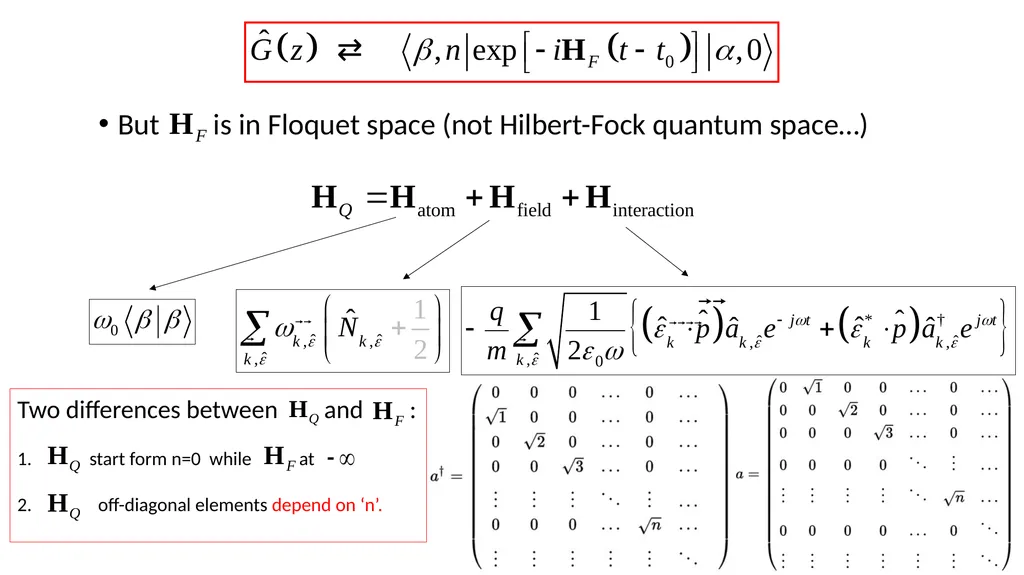
slide11. But is in Floquet space (not Hilbert-Fock quantum space…) Two differences between and :
start form n=0 while at
off-diagonal elements depend on ‘n’.<br>
slide13. and are similar but NOT the same! Main differences between and :
off-diagonal elements depend on ‘n’.
start form n=0 while at But, our writer didn’t give up. Jon H. Shirley solution :
“consider in the vicinity of some very large photon number N” In the matrix region, the off-diagonal terms change slowly.
if is an eigenvalue of then is also eigenvalue. why?<br>
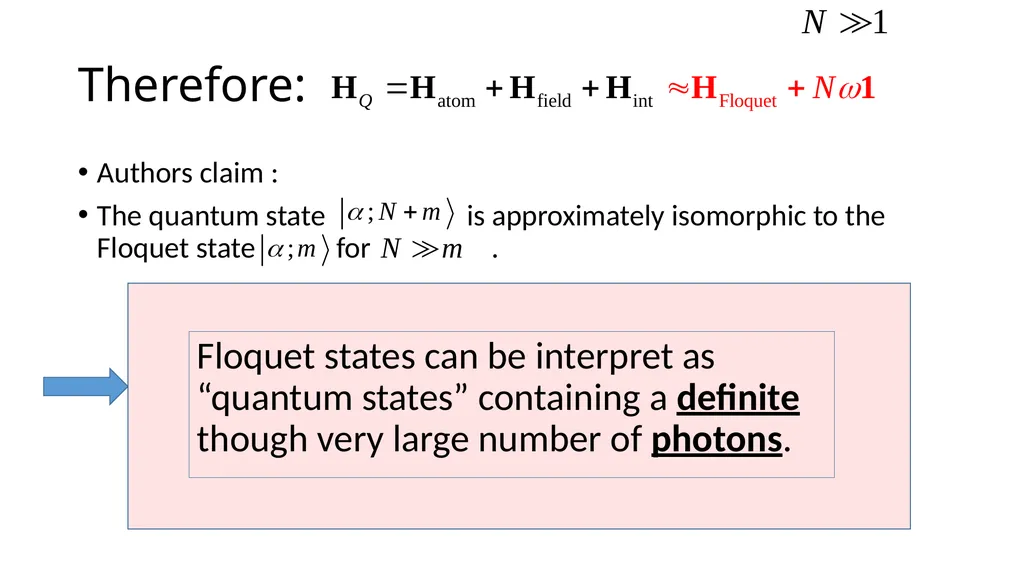
slide14. Therefore: Authors claim :
The quantum state is approximately isomorphic to the Floquet state for . Floquet states can be interpret as “quantum states” containing a definite though very large number of photons.<br>
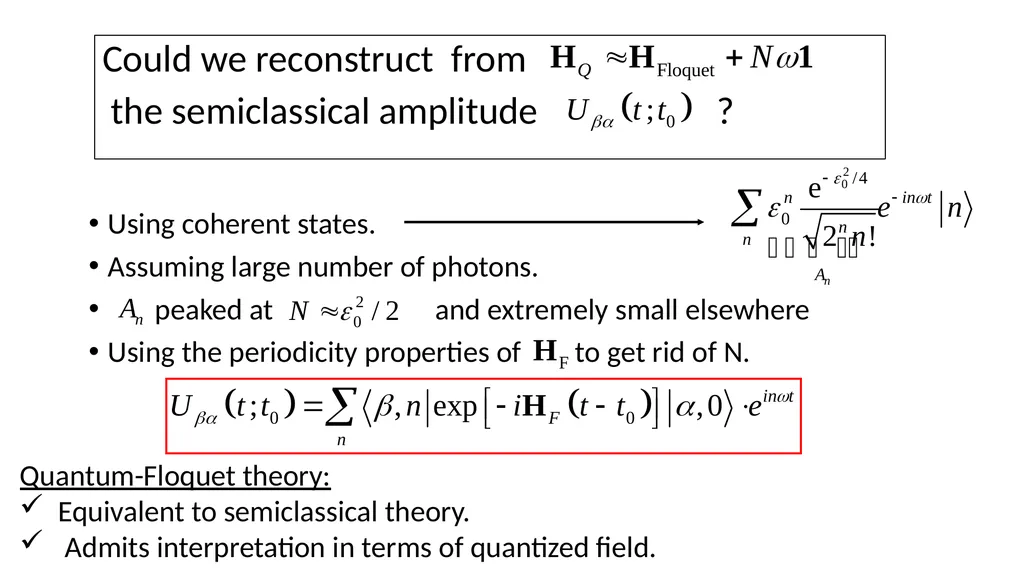
slide16. Using coherent states.
Assuming large number of photons.
peaked at and extremely small elsewhere
Using the periodicity properties of to get rid of N. Could we reconstruct from
the semiclassical amplitude ? Quantum-Floquet theory:
Equivalent to semiclassical theory.
Admits interpretation in terms of quantized field.<br>
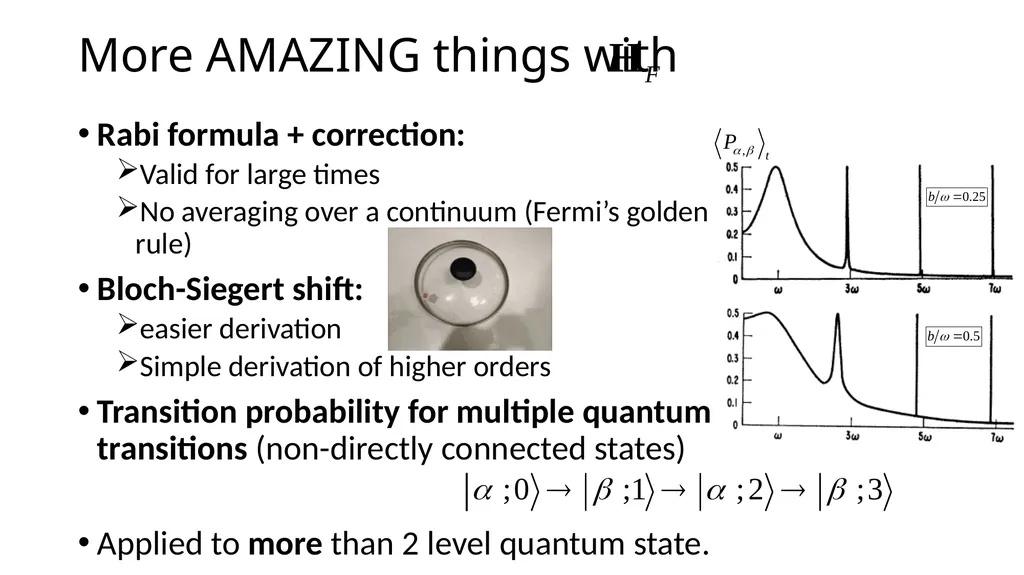
slide17. More AMAZING things with Rabi formula + correction:
Valid for large times
No averaging over a continuum (Fermi’s golden rule)
Bloch-Siegert shift:
easier derivation
Simple derivation of higher orders
Transition probability for multiple quantum transitions (non-directly connected states)
Applied to more than 2 level quantum state.<br>
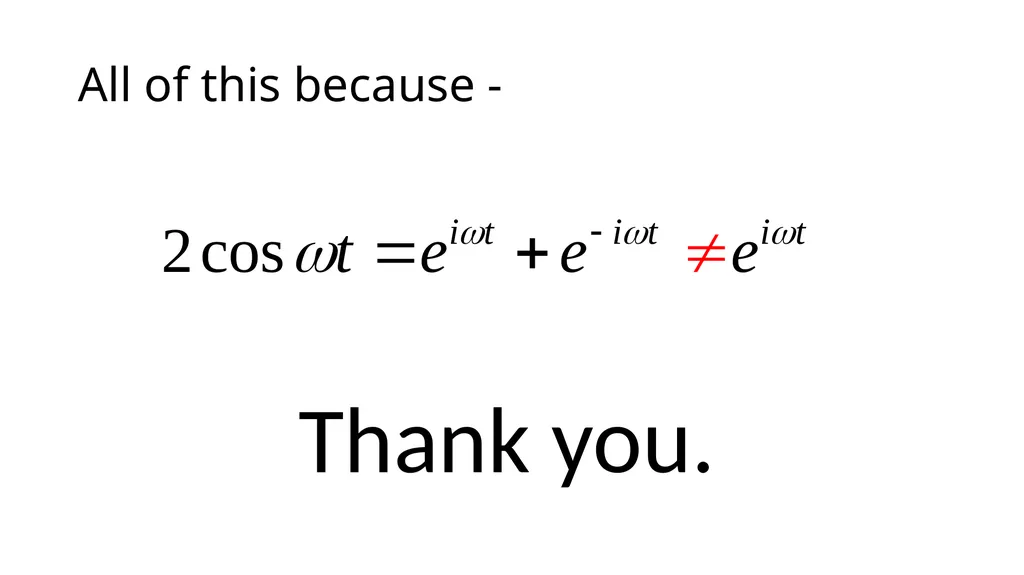
slide18. All of this because - Thank you.<br>
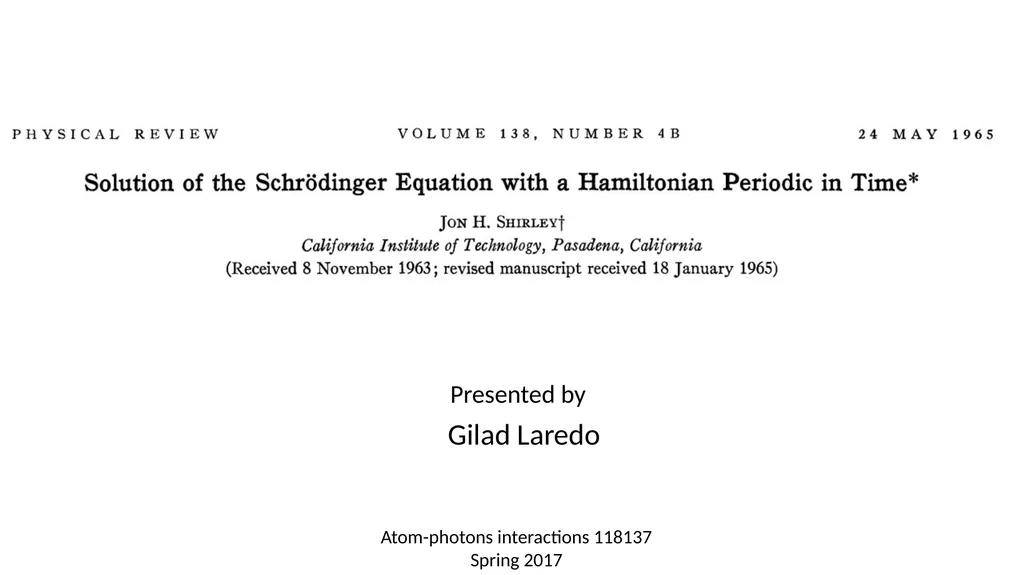
Gilad Laredo Atom-photons interactions 118137
Spring 2017<br>
slide2. Introduction System evolves according to Schrödinger eq.<br>
slide3. But how do we solve this? By the RWA: Difficult… Easy… ? RWA = rotating wave approximation<br>
slide4. Paper goal Present methods and results obtained while solving the transition probability for: Time periodic Hamiltonian time independent Hamiltonian Infinite matrix representation Floquet theorem Without the rotating wave approximation<br>
slide5. Generalize the problem: Time periodic Hamiltonian time independent Hamiltonian Infinite matrix representation Floquet theorem Generalize the problem: Step 1 – determine general form of solution (Floquet): : Constant diagonal matrix : Matrix of periodic functions Step 2 – equivalence to (infinite) eigenvalue problem. Step 3 – express time-evolution operator:<br>
slide6. Eigenvalue equation for Greek letters – atomic states
Roman letters – Fourier components “Floquet Hamiltonian”<br>
slide7. - Floquet Hamiltonian An example<br>
slide8. “Floquet state”<br>
slide9. Time evolution operator Using:
the periodic structure of
The unitarity of
Is a complete set
Some calculations… Transition amplitude in Floquet space Time evolution operator of<br>
slide10. Relation to Quantized Field Theory The transition amplitudes in Floquet space is the Fourier series coefficients of the time evolution operator(!)
the resolvant operator is the Fourier transform of Transition amplitude in Floquet space Time evolution operator of<br>
slide11. But is in Floquet space (not Hilbert-Fock quantum space…) Two differences between and :
start form n=0 while at
off-diagonal elements depend on ‘n’.<br>
slide13. and are similar but NOT the same! Main differences between and :
off-diagonal elements depend on ‘n’.
start form n=0 while at But, our writer didn’t give up. Jon H. Shirley solution :
“consider in the vicinity of some very large photon number N” In the matrix region, the off-diagonal terms change slowly.
if is an eigenvalue of then is also eigenvalue. why?<br>
slide14. Therefore: Authors claim :
The quantum state is approximately isomorphic to the Floquet state for . Floquet states can be interpret as “quantum states” containing a definite though very large number of photons.<br>
slide16. Using coherent states.
Assuming large number of photons.
peaked at and extremely small elsewhere
Using the periodicity properties of to get rid of N. Could we reconstruct from
the semiclassical amplitude ? Quantum-Floquet theory:
Equivalent to semiclassical theory.
Admits interpretation in terms of quantized field.<br>
slide17. More AMAZING things with Rabi formula + correction:
Valid for large times
No averaging over a continuum (Fermi’s golden rule)
Bloch-Siegert shift:
easier derivation
Simple derivation of higher orders
Transition probability for multiple quantum transitions (non-directly connected states)
Applied to more than 2 level quantum state.<br>
slide18. All of this because - Thank you.<br>