Presented by Mr Patrick Yip Wang Wing, Ag. Deputy Financial Secretary The Policy Context Government restated its resolve to embark on a Transformation Agenda underpinned by the 3 objectives of : High Income Inclusiveness Sustainability
"Presented by Mr Patrick Yip Wang Wing, Ag. Deputy" is the property of its rightful owner. Permission is granted to
download and print the materials on this website for personal, non-commercial use only, and to display it
on your personal computer provided you do not modify the materials and that you retain all copyright
notices contained in the materials. By downloading content from our website, you accept the terms of this
agreement.
Presentation Transcript
01
Presented by Mr Patrick Yip Wang Wing,
Ag. Deputy Financial Secretary<br>
02
The Policy Context Government restated its resolve to embark on a Transformation Agenda underpinned by the 3 objectives of :–
High Income
Inclusiveness
Sustainability<br>
03
Specific Policy Announcements Reform of the public sector, in particular rationalisation of activities of parastatal bodies
Reforms in business facilitation, with particular attention to SMEs
Reactivation of the Financial Services Consultative Council to take the sector to a new threshold of development
Better coordination of macroeconomic policies<br>
04
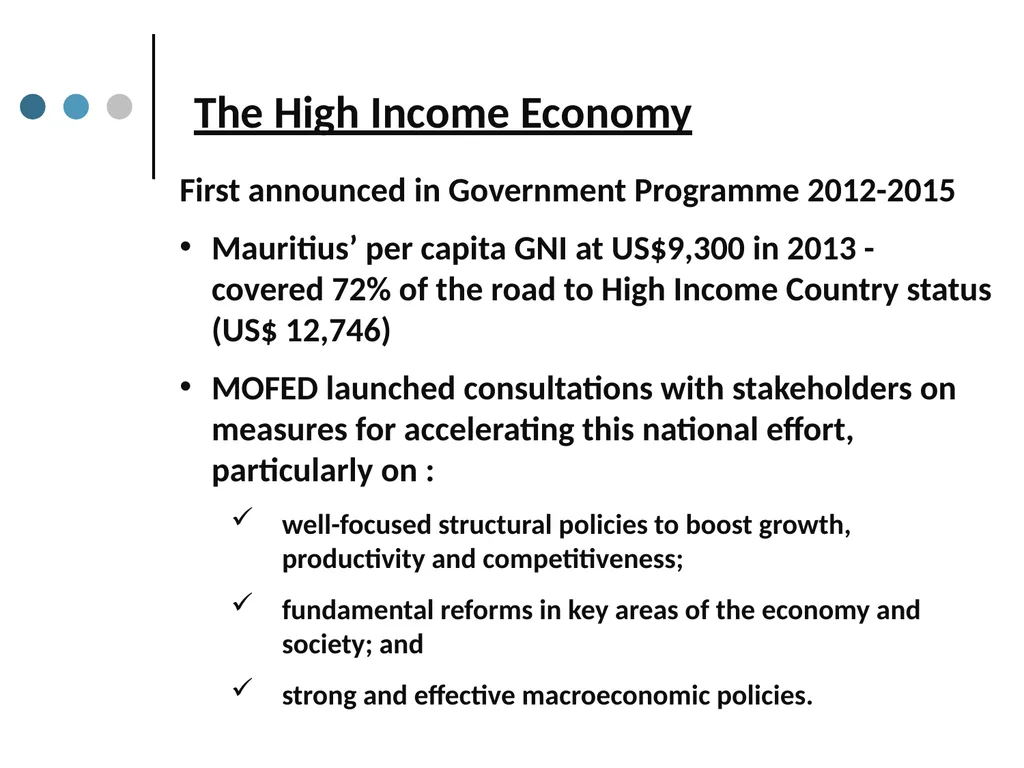
The High Income Economy First announced in Government Programme 2012-2015
Mauritius’ per capita GNI at US$9,300 in 2013 - covered 72% of the road to High Income Country status (US$ 12,746)
MOFED launched consultations with stakeholders on measures for accelerating this national effort, particularly on :
well-focused structural policies to boost growth, productivity and competitiveness;
fundamental reforms in key areas of the economy and society; and
strong and effective macroeconomic policies.<br>
05
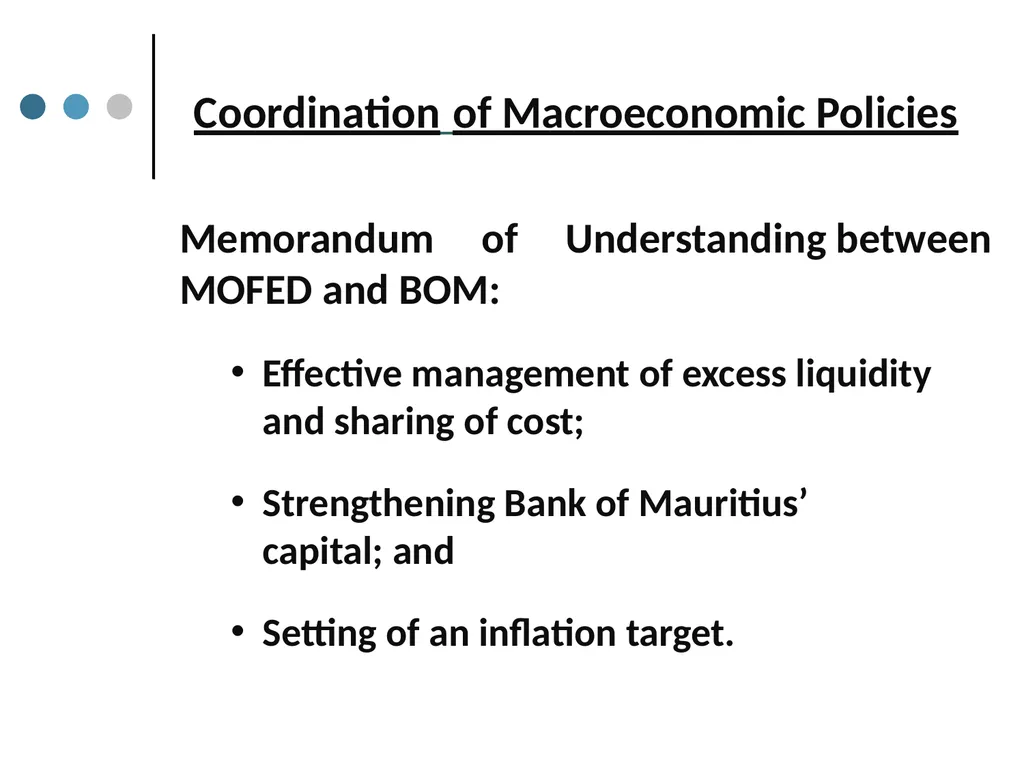
Coordination of Macroeconomic Policies Memorandum of Understanding between MOFED and BOM:
Effective management of excess liquidity and sharing of cost;
Strengthening Bank of Mauritius’ capital; and
Setting of an inflation target.<br>
06
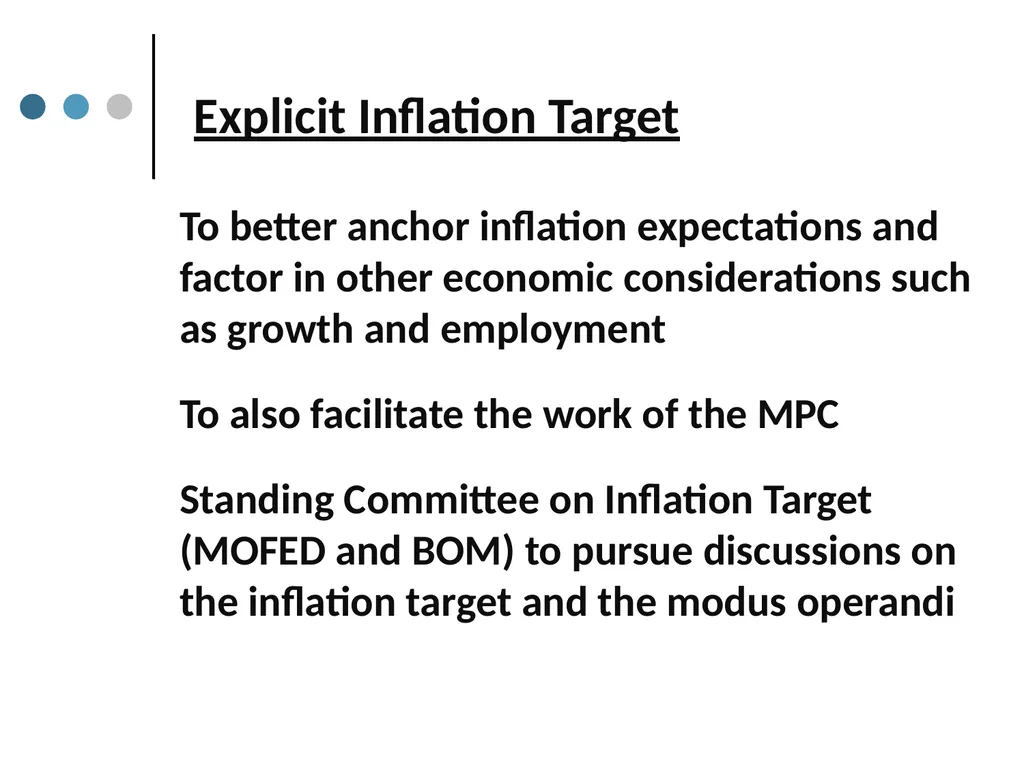
Explicit Inflation Target To better anchor inflation expectations and factor in other economic considerations such as growth and employment
To also facilitate the work of the MPC
Standing Committee on Inflation Target (MOFED and BOM) to pursue discussions on the inflation target and the modus operandi<br>
07
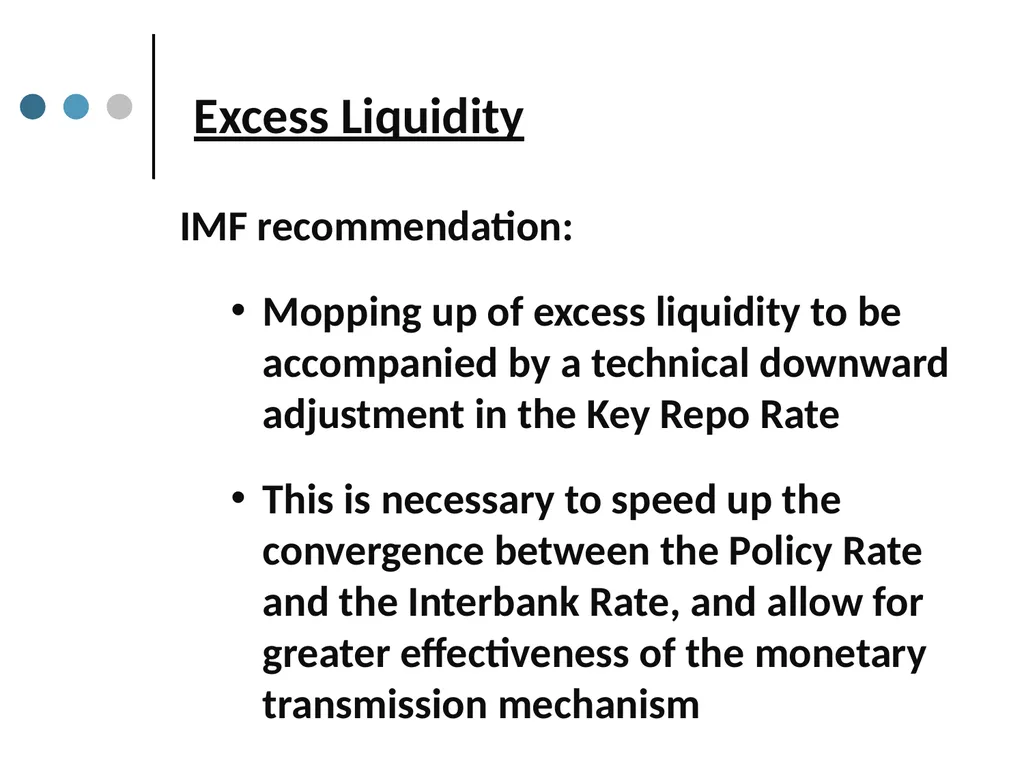
Excess Liquidity IMF recommendation:
Mopping up of excess liquidity to be accompanied by a technical downward adjustment in the Key Repo Rate
This is necessary to speed up the convergence between the Policy Rate and the Interbank Rate, and allow for greater effectiveness of the monetary transmission mechanism<br>
08
Excess Liquidity … cont’d IMF supports comprehensive approach of Joint Working Committee on Liquidity at MOFED
Various measures and policy options subject of in-depth technical discussions and extensive consultations between MOFED, BOM and IMF
Latest draft MoU, which MOFED has shared with the Bank, should provide a solid and sound foundation for continued institutional cooperation.<br>
09
Excess Liquidity … cont’d Government borrowings of Rs 4 bn already frontloaded to mop up excess liquidity
MOFED will shortly issue additional Rs 2 bn of 5-Year Bonds [fixed coupon rate of 6% p.a. and Inflation Index-linked] on a retail basis
Opportunity for small savers to get higher return on their savings
Provide full protection from inflation<br>
10
Global Economy Momentum in global economic recovery less strong than expected earlier
Disappointing first quarter:
Euro Area: 0.2% - France stagnating & Italy contracting
US: -2.9%
Recovery remains tepid and uneven - not strong enough to reduce unemployment and debt.
Significant downside risks - accommodative monetary policy stance for a prolonged period<br>
11
Domestic Economy Growth in 2014 lower than initially forecast
First quarter growth rate only 2.4% in Q1 2014 (3.8% in Q1 2013)
SM revised downwards growth projection for 2014 from 3.7% to 3.5%
Textile: 1.5% against 2% expected in March
Other Manufacturing: no growth against 2%
Construction sector: -4.8% against -3%.
Tourism sector recovering: 3.5% against 3% but downside risks remain<br>
12
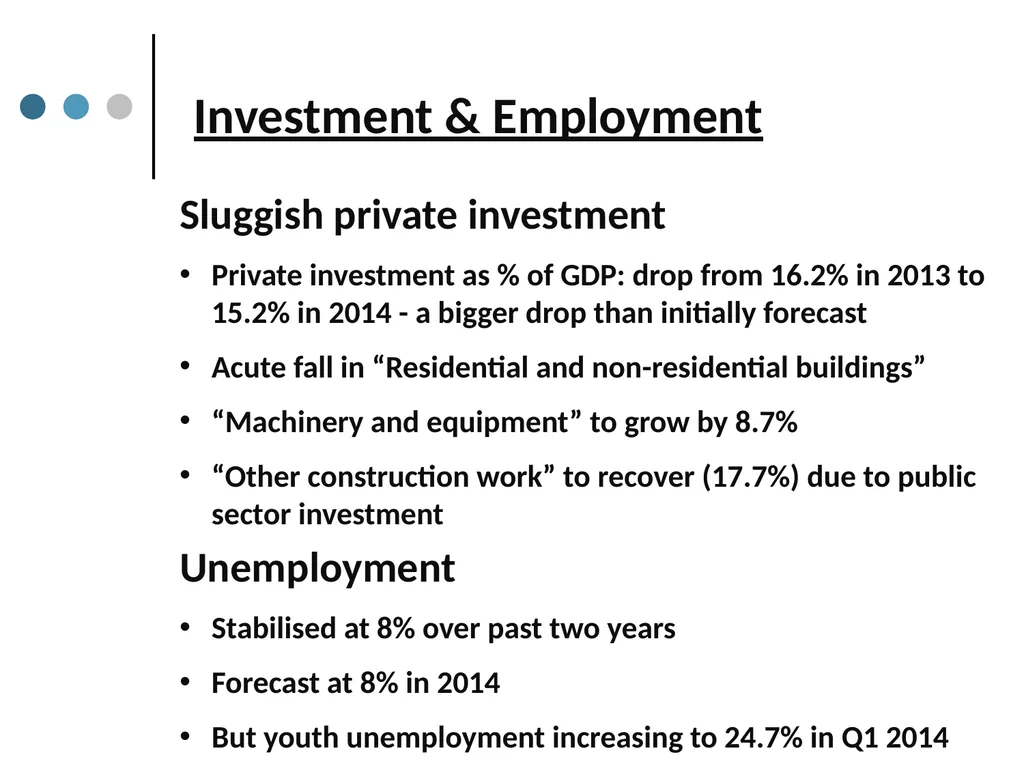
Investment & Employment Sluggish private investment
Private investment as % of GDP: drop from 16.2% in 2013 to 15.2% in 2014 - a bigger drop than initially forecast
Acute fall in “Residential and non-residential buildings”
“Machinery and equipment” to grow by 8.7%
“Other construction work” to recover (17.7%) due to public sector investment
Unemployment
Stabilised at 8% over past two years
Forecast at 8% in 2014
But youth unemployment increasing to 24.7% in Q1 2014<br>
13
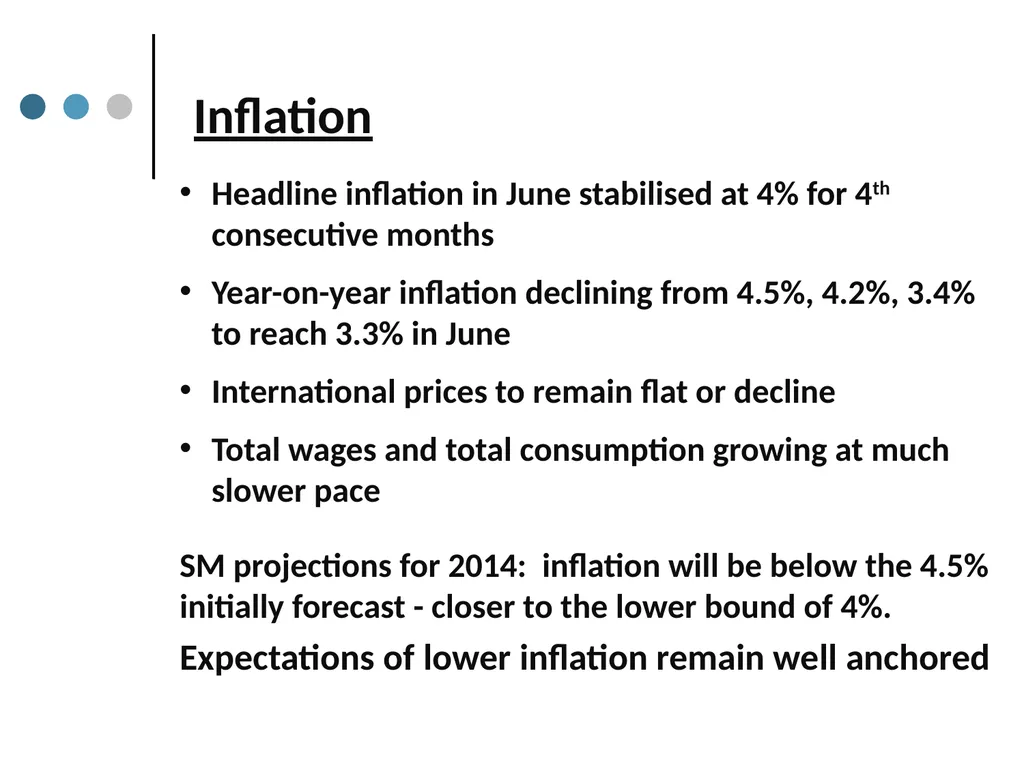
Inflation Headline inflation in June stabilised at 4% for 4th consecutive months
Year-on-year inflation declining from 4.5%, 4.2%, 3.4% to reach 3.3% in June
International prices to remain flat or decline
Total wages and total consumption growing at much slower pace
SM projections for 2014: inflation will be below the 4.5% initially forecast - closer to the lower bound of 4%.
Expectations of lower inflation remain well anchored<br>
14
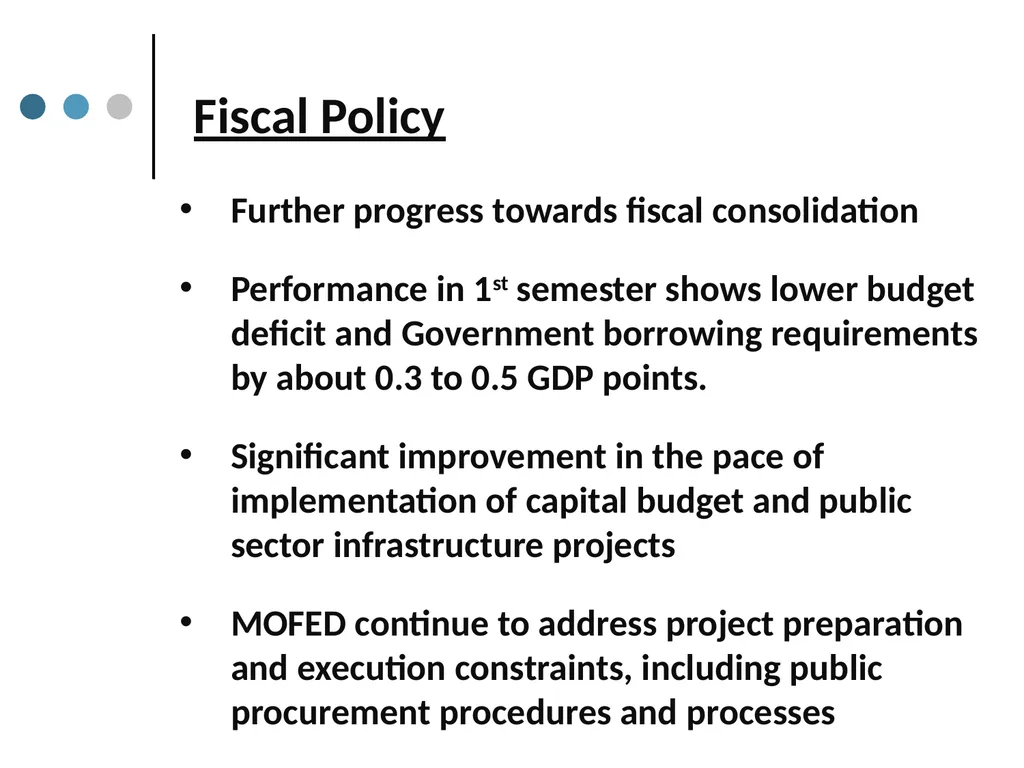
Fiscal Policy Further progress towards fiscal consolidation
Performance in 1st semester shows lower budget deficit and Government borrowing requirements by about 0.3 to 0.5 GDP points.
Significant improvement in the pace of implementation of capital budget and public sector infrastructure projects
MOFED continue to address project preparation and execution constraints, including public procurement procedures and processes<br>
15
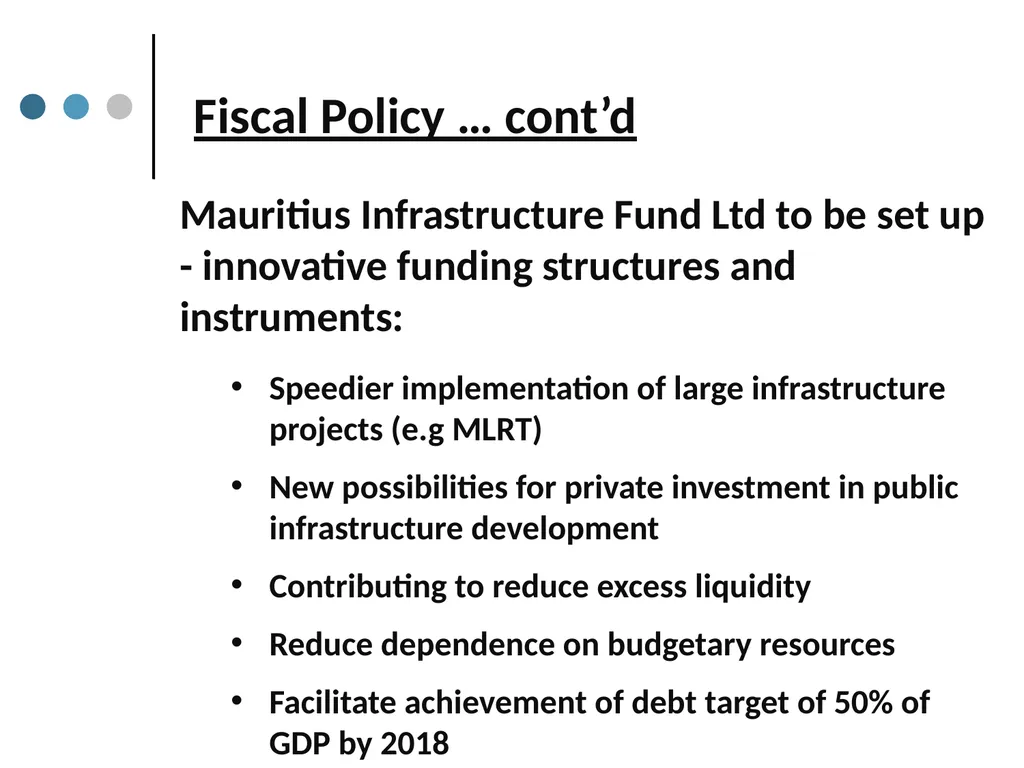
Fiscal Policy … cont’d Mauritius Infrastructure Fund Ltd to be set up - innovative funding structures and instruments:
Speedier implementation of large infrastructure projects (e.g MLRT)
New possibilities for private investment in public infrastructure development
Contributing to reduce excess liquidity
Reduce dependence on budgetary resources
Facilitate achievement of debt target of 50% of GDP by 2018<br>
16
Global Trend in Policy Interest Rate Current monetary policy stance not indicating any rising pressure on price level
Kept policy rate unchanged - US Federal Reserve, Bank of England, Reserve Bank of India, Bank of Japan, and South African Reserve Bank
European Central Bank (ECB) cut benchmark rate from 0.25% to 0.15% in June. Kept same rate in July.
Interest rates to remain at their present level for an “extended period of time in view of the current outlook for inflation”<br>
17
Conclusion Situation warrants very careful approach to monetary policy:
There is still uncertainty
GDP growth forecast lowered
Inflationary pressures very subdued
Positive outcome of preceding monetary policy stance, and of structural and fiscal policies can be seen on unemployment rate
MOFED view:
monetary policy continue to be accommodative
KRR be kept at its current level<br>