Presented to: Assis.Prof.Dr. Sahand Daneshvar Presented by: Yahya El Osman El Dandachi 15500727 Mohammad A. Kh. Hamdan 16500161 Out-of-Kilter Algorithm Network Flows IENG 516 Introduction 5152017 2 The out of kilter algorithm is an
"Presented to: Assis.Prof.Dr. Sahand Daneshvar" is the property of its rightful owner. Permission is granted to
download and print the materials on this website for personal, non-commercial use only, and to display it
on your personal computer provided you do not modify the materials and that you retain all copyright
notices contained in the materials. By downloading content from our website, you accept the terms of this
agreement.
Presentation Transcript
01
Presented to: Assis.Prof.Dr. Sahand Daneshvar
Presented by: Yahya El Osman El Dandachi 15500727
Mohammad A. Kh. Hamdan 16500161 Out-of-Kilter Algorithm Network Flows IENG 516<br>
02
Introduction 5/15/2017 2 The out of kilter algorithm is an example of a primal-dual algorithm.
It works on both the primal problem (edges of the network) and the dual problem (nodes) in successive phases to find a feasible solution, and then to optimize the problem. Out of Kilter : Yahya Dandachi & Mohammad Hamdan<br>
03
What do we keep track of ? We will have a variable for each node wi, and the flows through each edge of the original network.
As well as these variables, each edge will be given a kilter state and a kilter number kij.
Edges are either “in kilter” or “out of kilter”.
We want all edges to be in kilter, so the algorithm keeps “in kilter” edges in kilter, and brings “out of kilter” edges into kilter. 5/15/2017 3 Out of Kilter : Yahya Dandachi & Mohammad Hamdan<br>
04
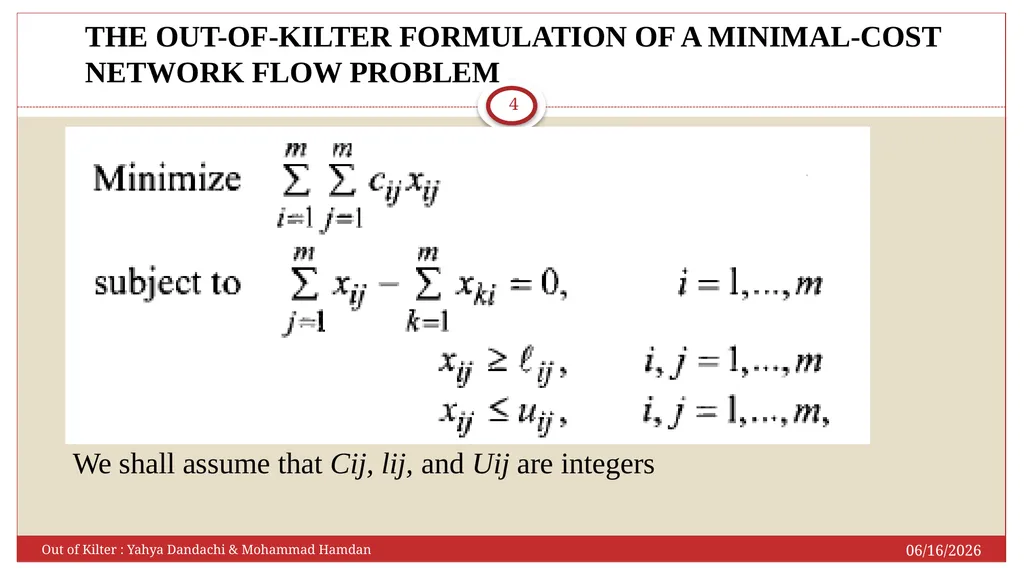
THE OUT-OF-KILTER FORMULATION OF A MINIMAL-COST NETWORK FLOW PROBLEM We shall assume that Cij, lij, and Uij are integers 5/15/2017 4 Out of Kilter : Yahya Dandachi & Mohammad Hamdan<br>
05
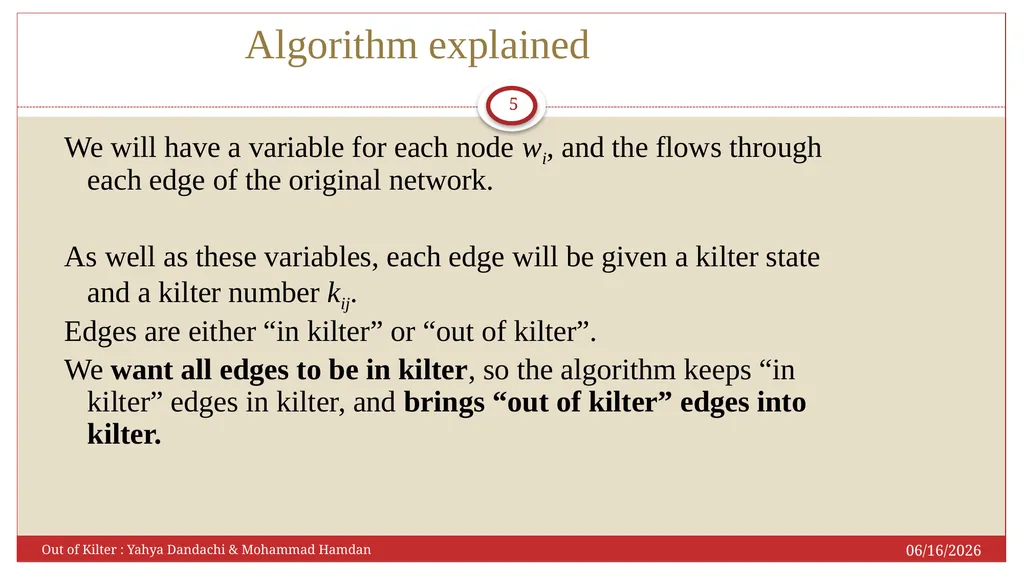
Algorithm explained 5/15/2017 5 We will have a variable for each node wi, and the flows through each edge of the original network.
As well as these variables, each edge will be given a kilter state and a kilter number kij.
Edges are either “in kilter” or “out of kilter”.
We want all edges to be in kilter, so the algorithm keeps “in kilter” edges in kilter, and brings “out of kilter” edges into kilter. Out of Kilter : Yahya Dandachi & Mohammad Hamdan<br>
06
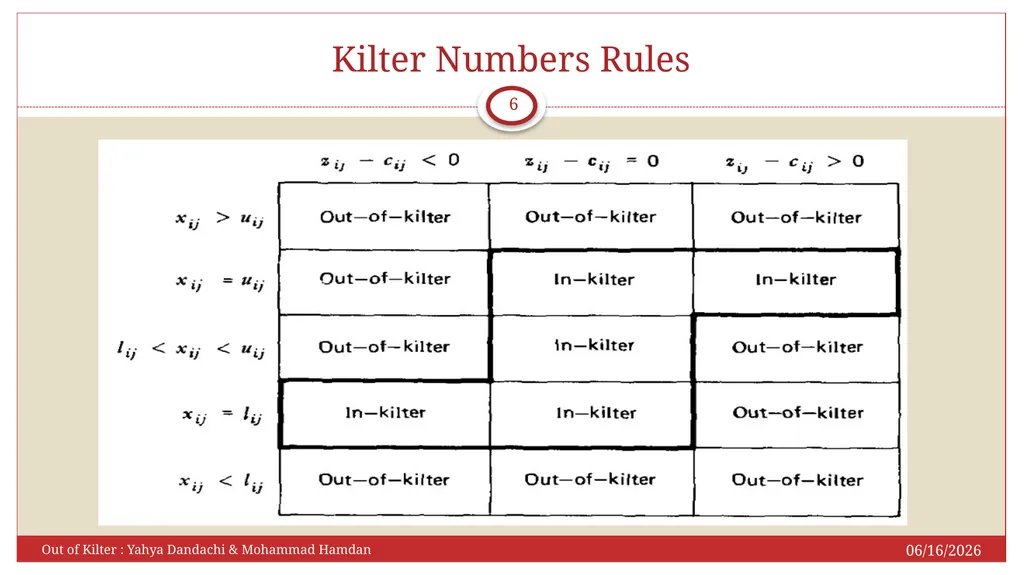
Kilter Numbers Rules 5/15/2017 6 Out of Kilter : Yahya Dandachi & Mohammad Hamdan<br>
07
5/15/2017 7 Out of Kilter : Yahya Dandachi & Mohammad Hamdan<br>
08
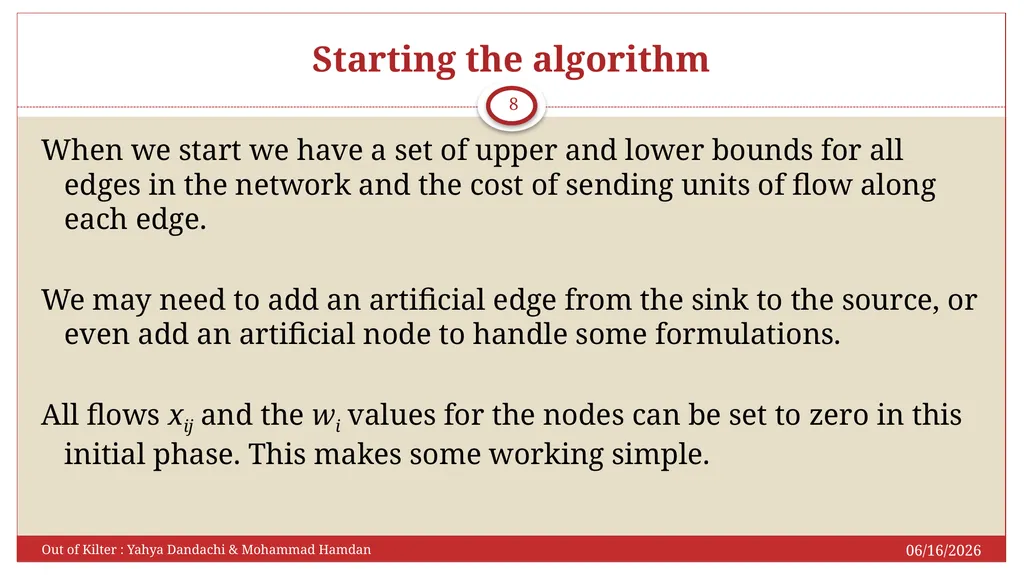
Starting the algorithm When we start we have a set of upper and lower bounds for all edges in the network and the cost of sending units of flow along each edge.
We may need to add an artificial edge from the sink to the source, or even add an artificial node to handle some formulations.
All flows xij and the wi values for the nodes can be set to zero in this initial phase. This makes some working simple. 5/15/2017 8 Out of Kilter : Yahya Dandachi & Mohammad Hamdan<br>
09
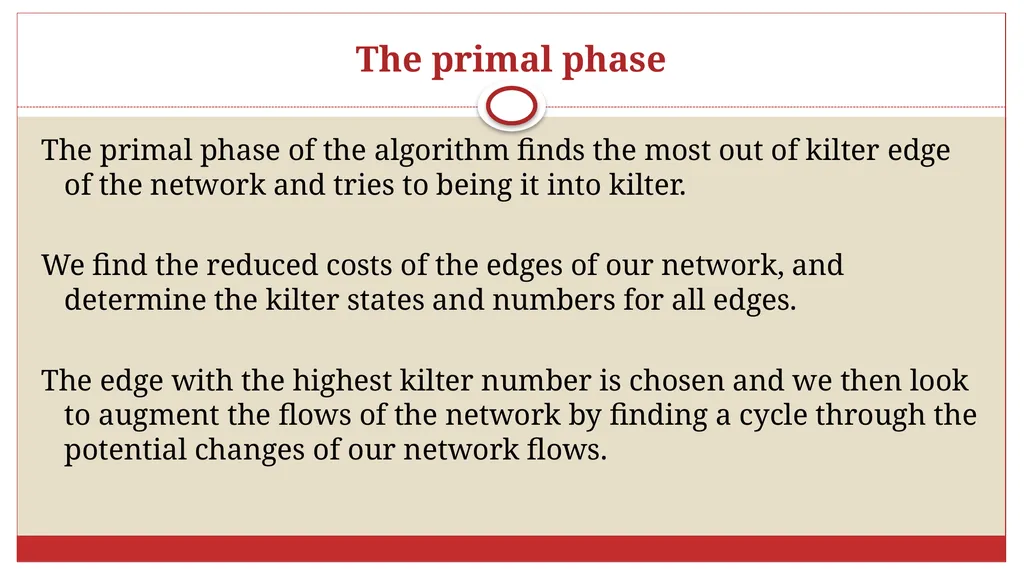
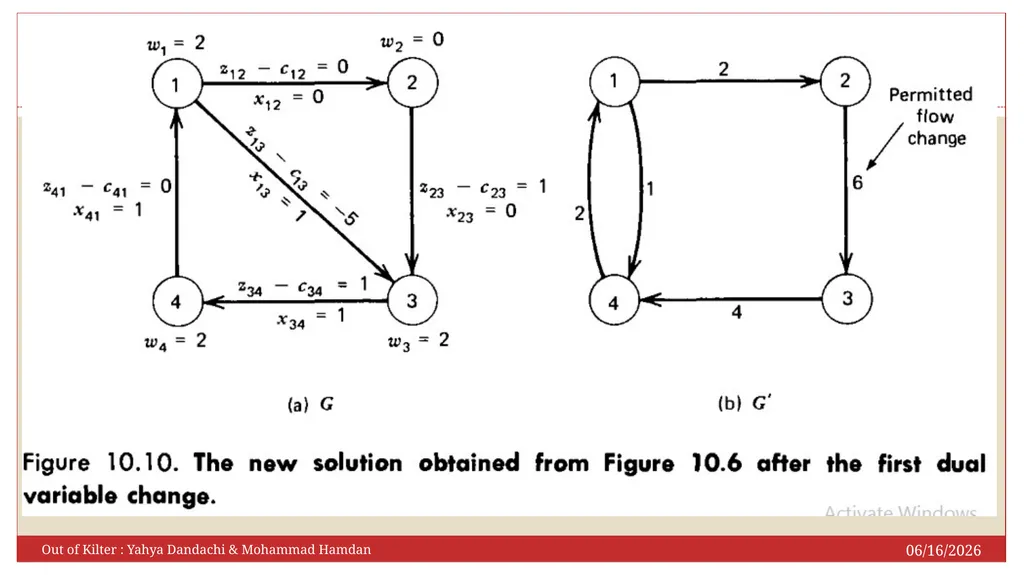
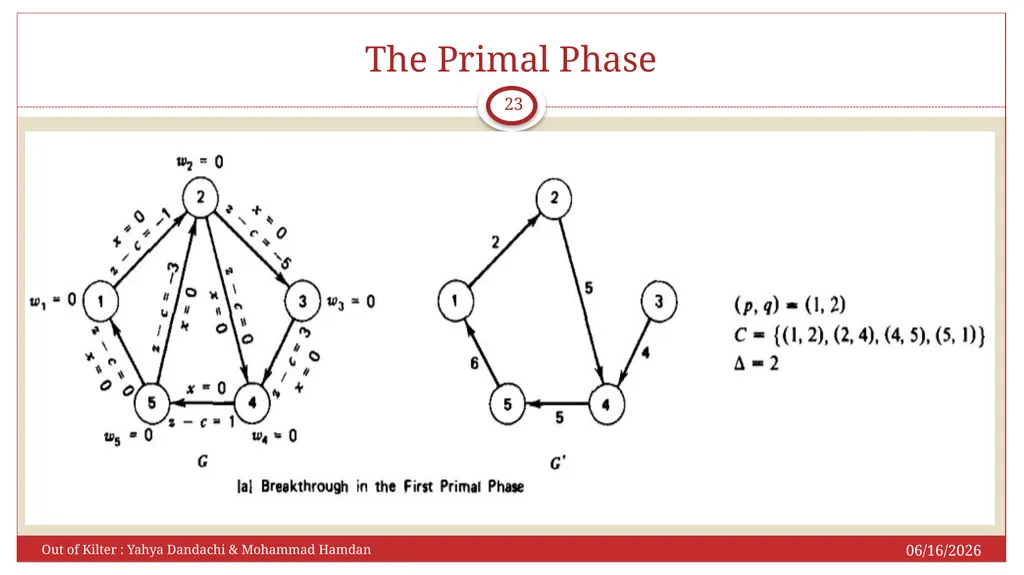
The primal phase The primal phase of the algorithm finds the most out of kilter edge of the network and tries to being it into kilter.
We find the reduced costs of the edges of our network, and determine the kilter states and numbers for all edges.
The edge with the highest kilter number is chosen and we then look to augment the flows of the network by finding a cycle through the potential changes of our network flows.<br>
10
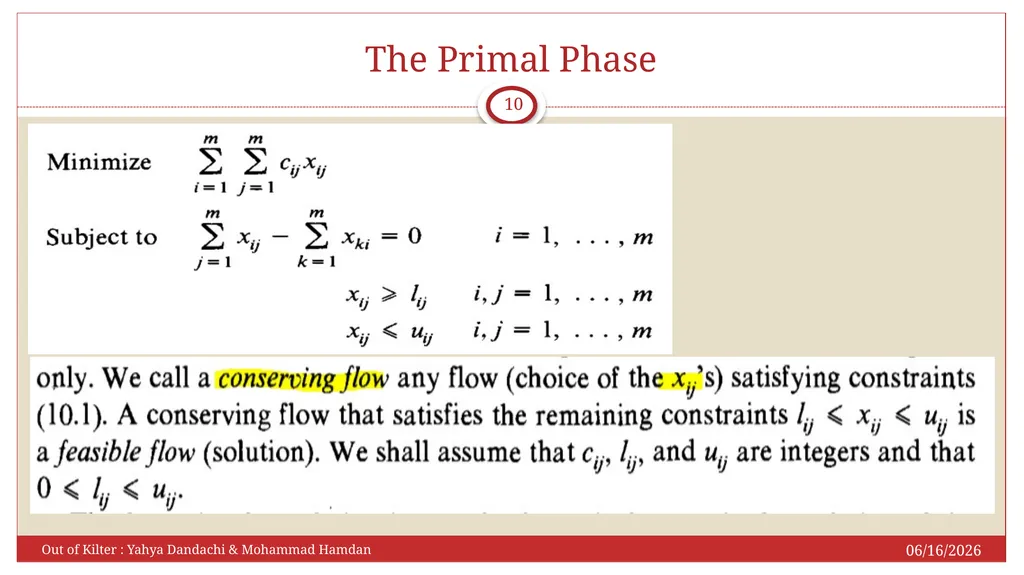
The Primal Phase 5/16/2017 Out of Kilter : Yahya Dandachi & Mohammad Hamdan 10<br>
11
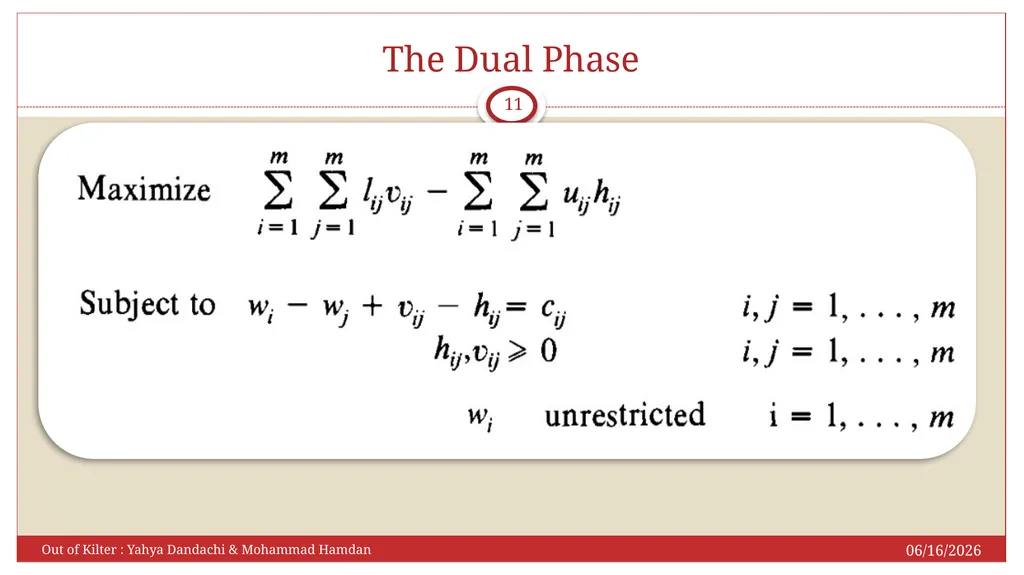
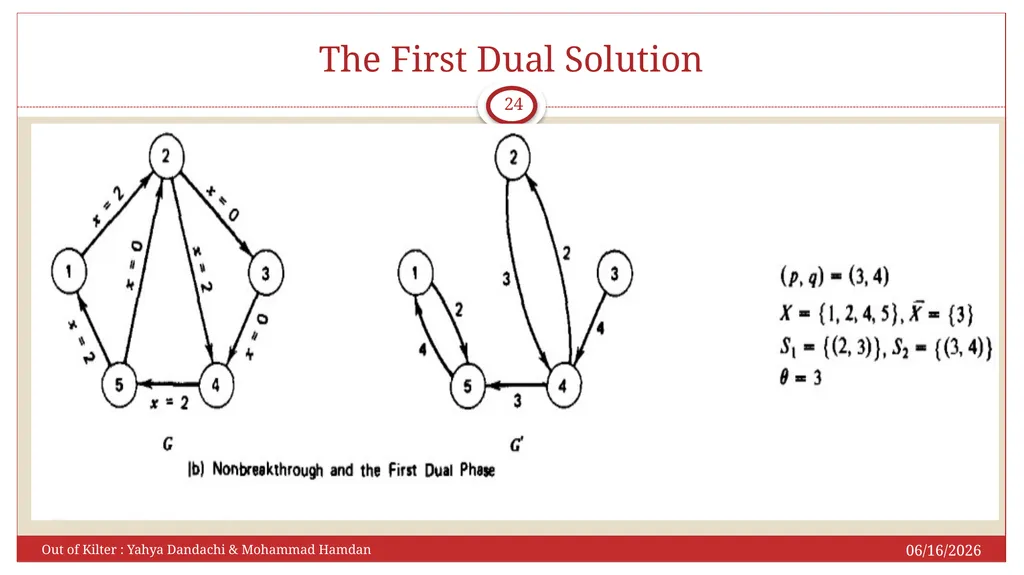
The Dual Phase 5/15/2017 11 Out of Kilter : Yahya Dandachi & Mohammad Hamdan<br>
12
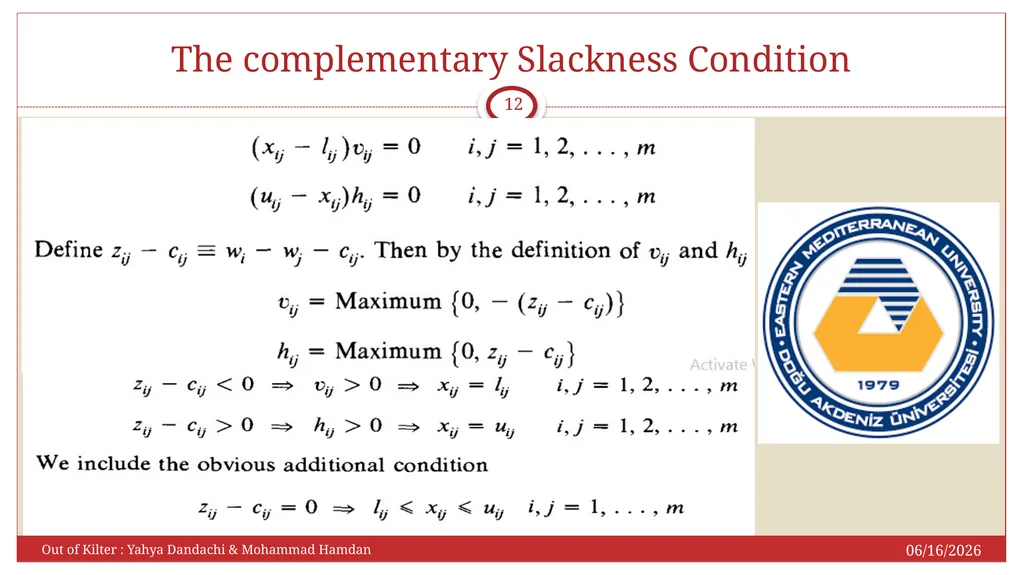
The complementary Slackness Condition 5/15/2017 12 Out of Kilter : Yahya Dandachi & Mohammad Hamdan<br>
13
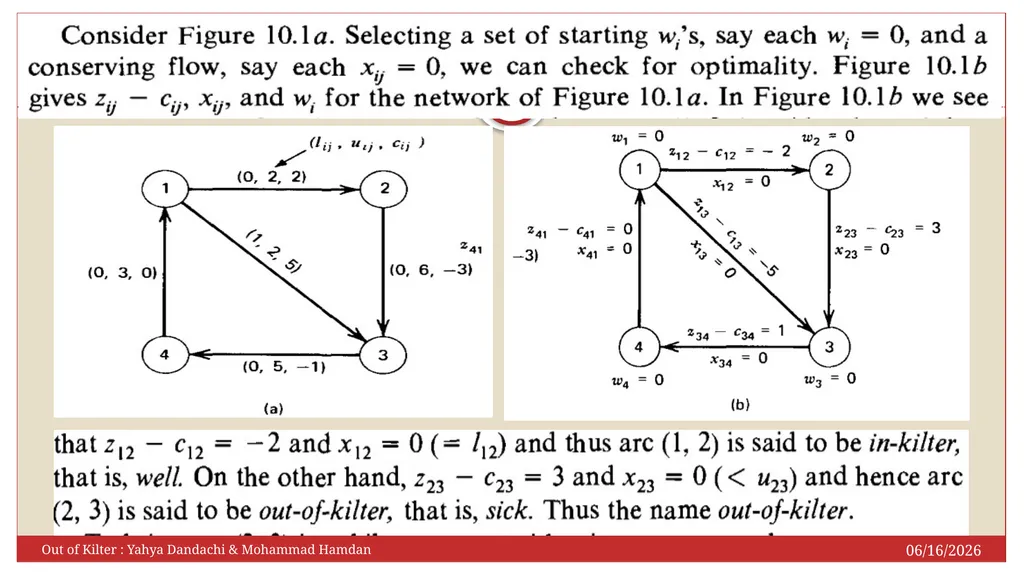
5/16/2017 13 Out of Kilter : Yahya Dandachi & Mohammad Hamdan<br>
14
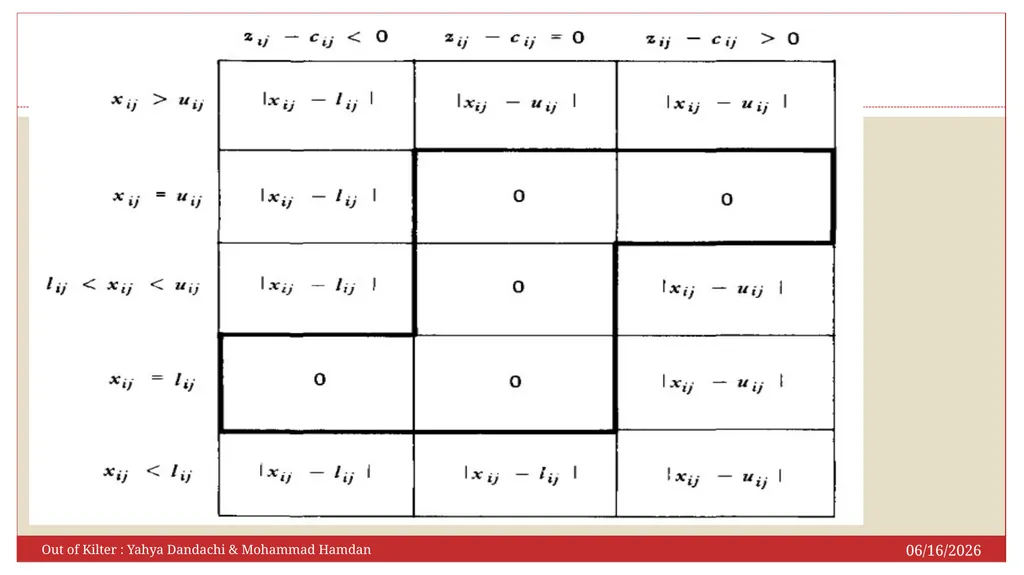
The Kilter States and Kilter Numbers 5/16/2017 14 A kilter number can be thought of as the change required to bring a flow into feasibility and eventually optimality.
So we can add up all the kilter numbers to find how far from optimality we are at any given time.
An in kilter edge has a kilter number of zero. Out of Kilter : Yahya Dandachi & Mohammad Hamdan<br>
15
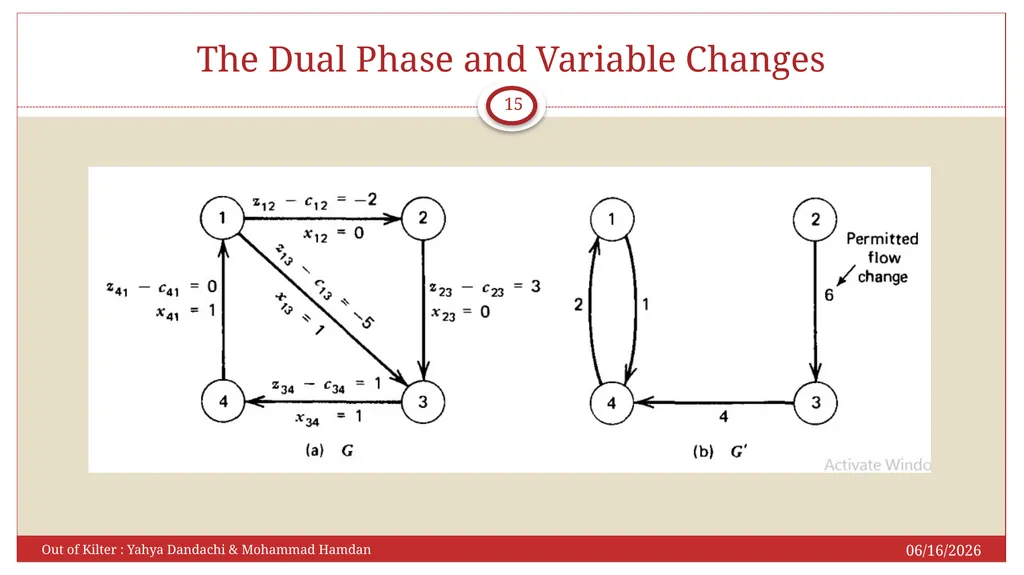
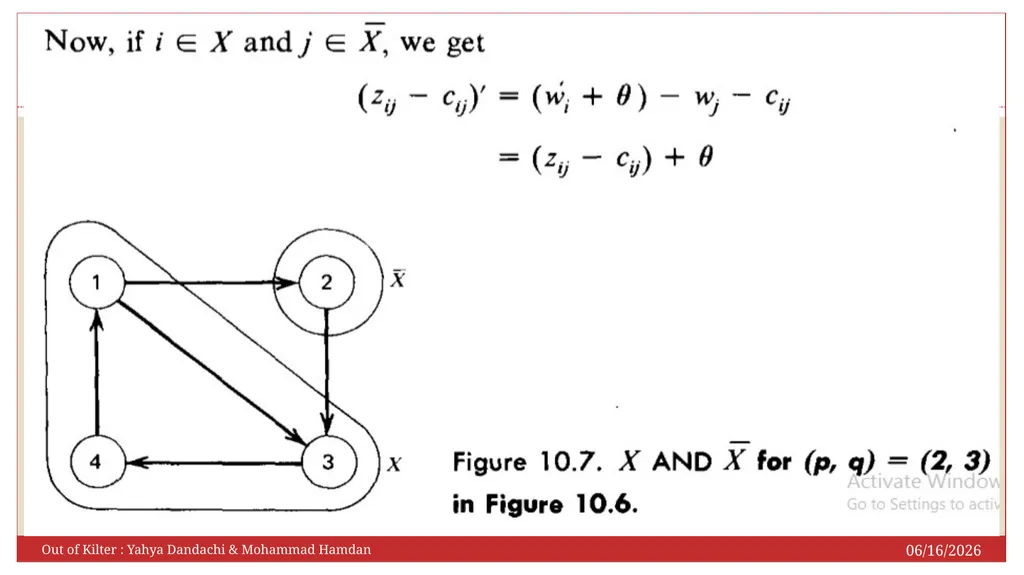
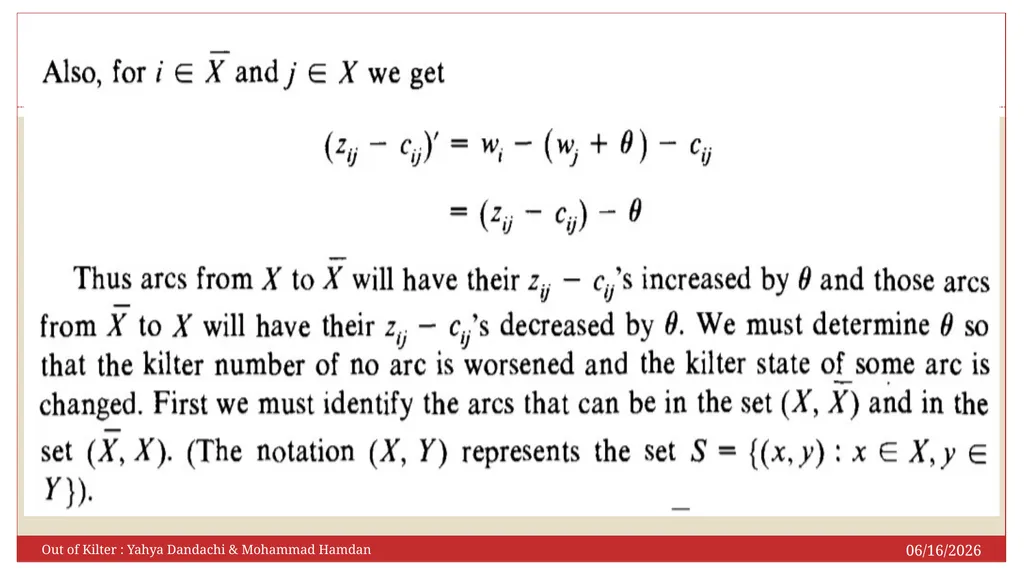
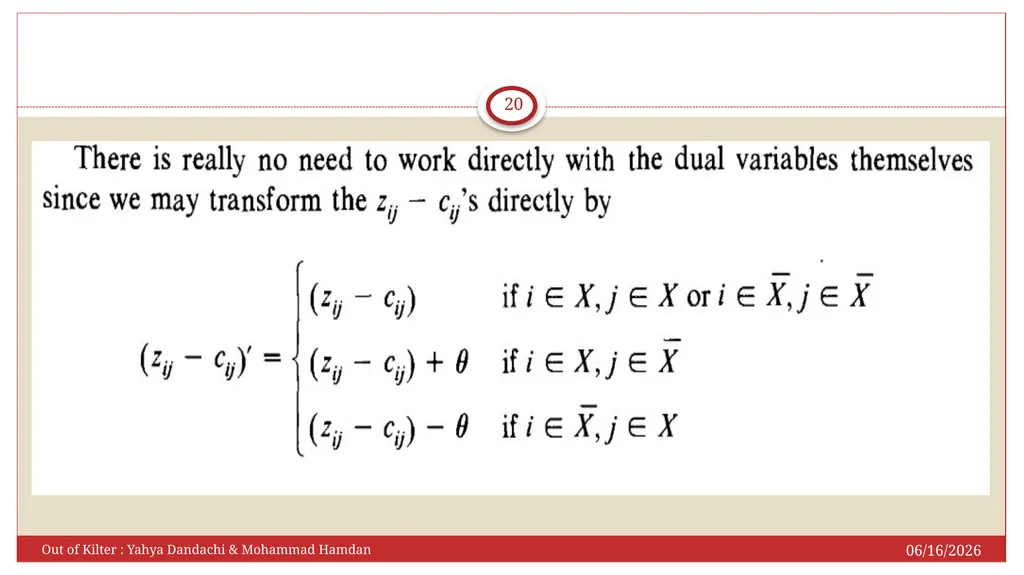
The Dual Phase and Variable Changes 5/15/2017 15 Out of Kilter : Yahya Dandachi & Mohammad Hamdan<br>
16
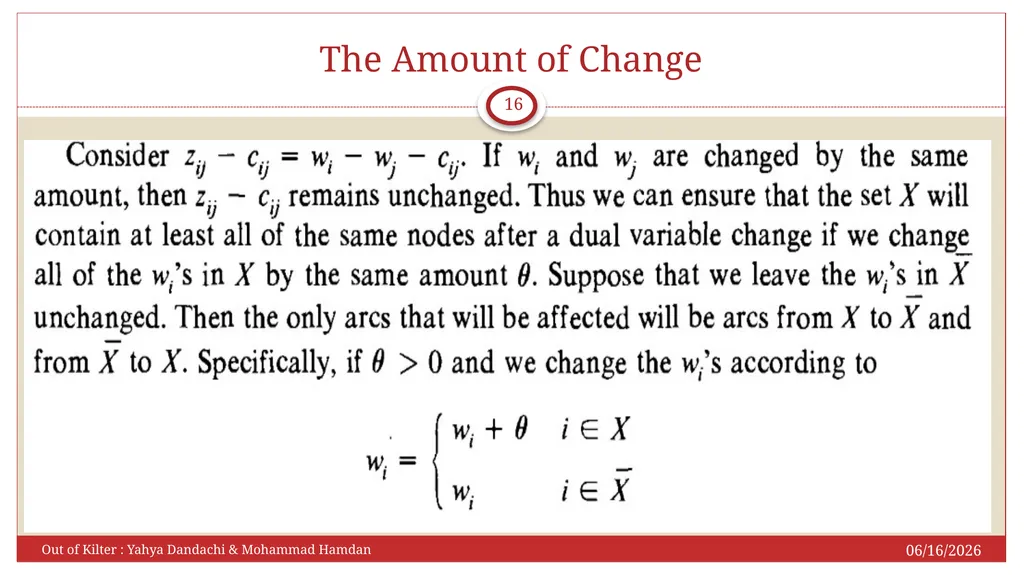
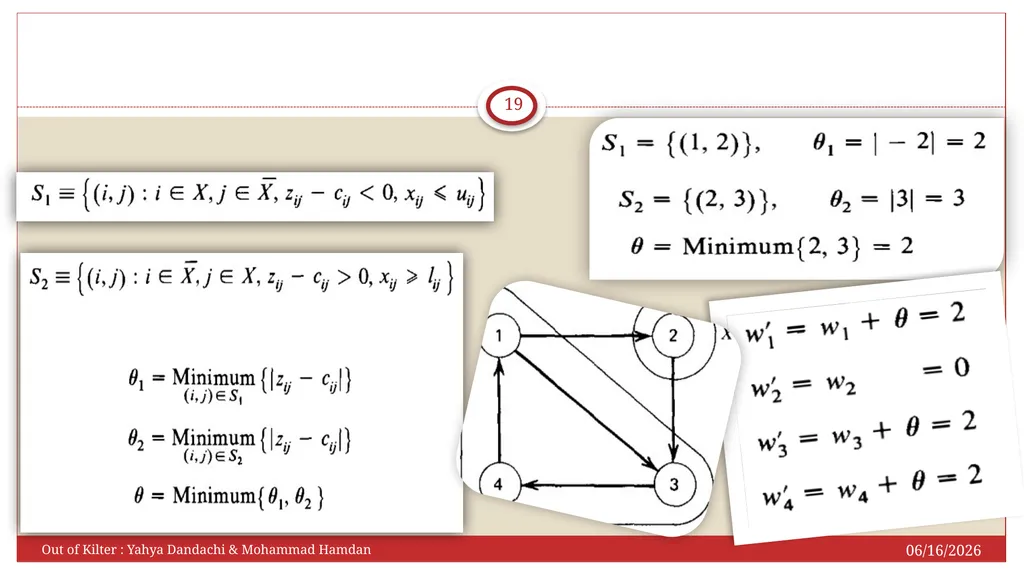
The Amount of Change 5/16/2017 Out of Kilter : Yahya Dandachi & Mohammad Hamdan 16<br>
17
5/16/2017 Out of Kilter : Yahya Dandachi & Mohammad Hamdan 17<br>
18
5/16/2017 Out of Kilter : Yahya Dandachi & Mohammad Hamdan 18<br>
19
5/16/2017 Out of Kilter : Yahya Dandachi & Mohammad Hamdan 19<br>
20
5/16/2017 Out of Kilter : Yahya Dandachi & Mohammad Hamdan 20<br>
21
5/16/2017 Out of Kilter : Yahya Dandachi & Mohammad Hamdan 21<br>
22
5/16/2017 Out of Kilter : Yahya Dandachi & Mohammad Hamdan 22<br>
23
The Primal Phase 5/16/2017 Out of Kilter : Yahya Dandachi & Mohammad Hamdan 23<br>
24
The First Dual Solution 5/16/2017 Out of Kilter : Yahya Dandachi & Mohammad Hamdan 24<br>
25
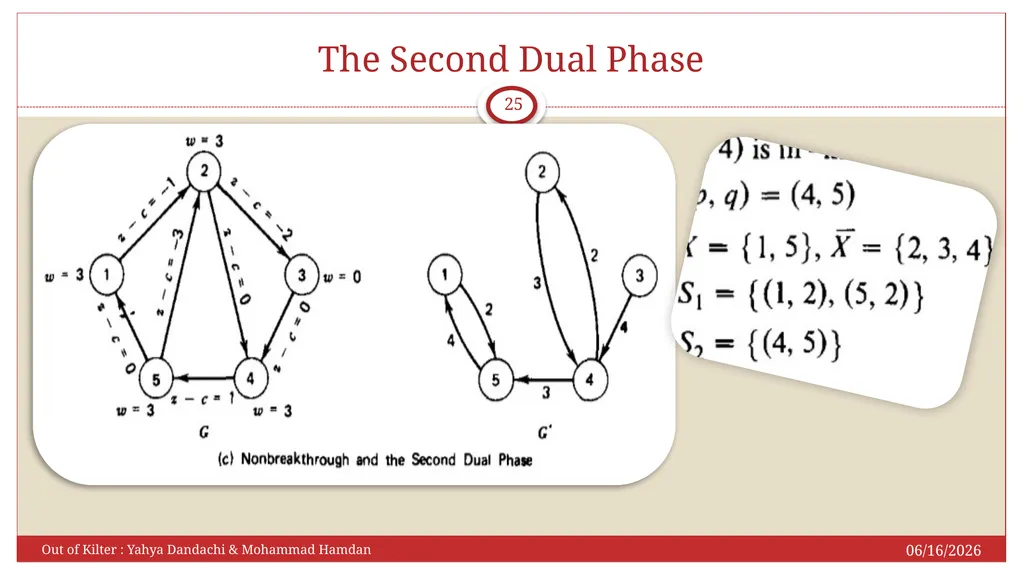
The Second Dual Phase 5/16/2017 Out of Kilter : Yahya Dandachi & Mohammad Hamdan 25<br>
26
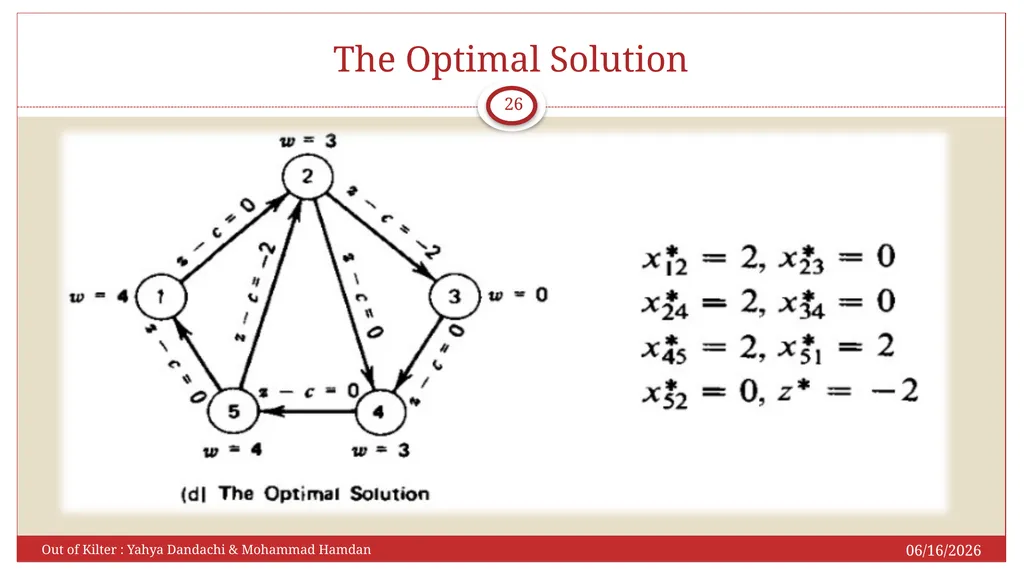
The Optimal Solution 5/16/2017 Out of Kilter : Yahya Dandachi & Mohammad Hamdan 26<br>