
Preventing Musculoskeletal Injuries Module 5
TD
Published · 48 slides · 0 views
1 / 1


Description
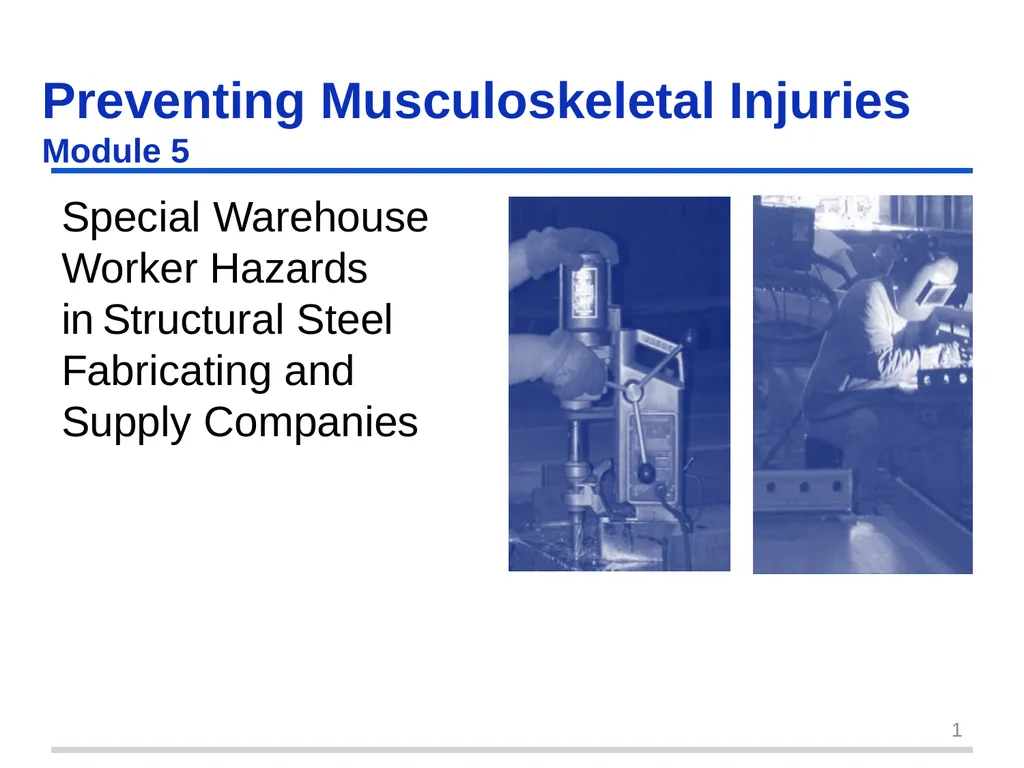
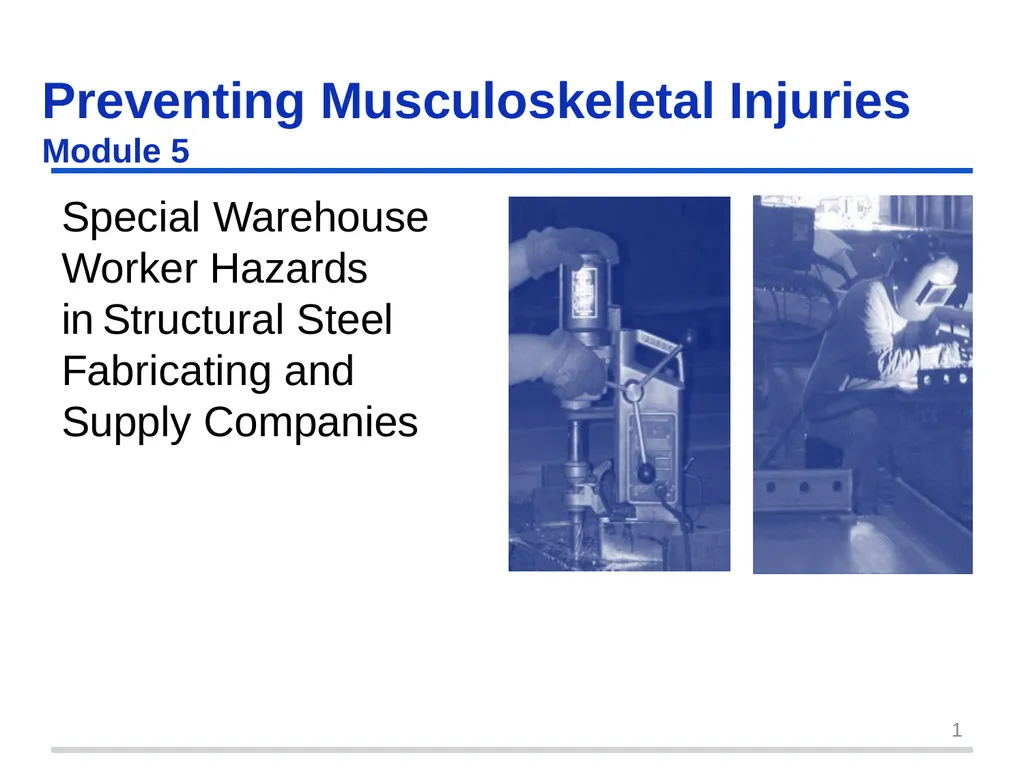
Preventing Musculoskeletal Injuries Module 5 Special Warehouse Worker Hazards in Structural Steel Fabricating and Supply Companies 1 Preventing Musculoskeletal Injuries Module 5 OSHA Grant Information This material was produced under grant
Related Topics
Share
Embed code
Download this presentation From Below
"Preventing Musculoskeletal Injuries Module 5" is the property of its rightful owner. Permission is granted to download and print the materials on this website for personal, non-commercial use only, and to display it on your personal computer provided you do not modify the materials and that you retain all copyright notices contained in the materials. By downloading content from our website, you accept the terms of this agreement.
Presentation Transcript
01
Preventing Musculoskeletal Injuries
Module 5 Special Warehouse
Worker Hazards
in Structural Steel
Fabricating and
Supply Companies 1<br>
Worker Hazards
in Structural Steel
Fabricating and
Supply Companies 1<br>
02
Preventing Musculoskeletal Injuries
Module 5 OSHA Grant Information
This material was produced under grant number
SH-26316-SH4 from the Occupational Safety and Health Administration, U.S. Department of Labor. It does not necessarily reflect the views or policies of the U.S. Department of Labor, nor does mention of trades names, commercial products, or organizations imply endorsement by the U.S. Government.<br>
This material was produced under grant number
SH-26316-SH4 from the Occupational Safety and Health Administration, U.S. Department of Labor. It does not necessarily reflect the views or policies of the U.S. Department of Labor, nor does mention of trades names, commercial products, or organizations imply endorsement by the U.S. Government.<br>
03
Preventing Musculoskeletal Injuries
Module 5 Program Development
This program was developed by faculty and students in the School of Planning, Design and Construction at Michigan State University in conjunction with
the American Institute of Steel Construction - Safety Committee and the University of Puerto Rico
March 2015<br>
This program was developed by faculty and students in the School of Planning, Design and Construction at Michigan State University in conjunction with
the American Institute of Steel Construction - Safety Committee and the University of Puerto Rico
March 2015<br>
04
Preventing Musculoskeletal Injuries
Module 5 slide 4 Learning Outcomes: Participants shall be able to:
Demonstrate understanding of the principles of ergonomics and their applications
Use good work practices, including proper lifting techniques
Demonstrate awareness of work tasks that may lead
to pain or injury
Recognize early symptoms of MSDs 4<br>
Demonstrate understanding of the principles of ergonomics and their applications
Use good work practices, including proper lifting techniques
Demonstrate awareness of work tasks that may lead
to pain or injury
Recognize early symptoms of MSDs 4<br>
05
Preventing Musculoskeletal Injuries
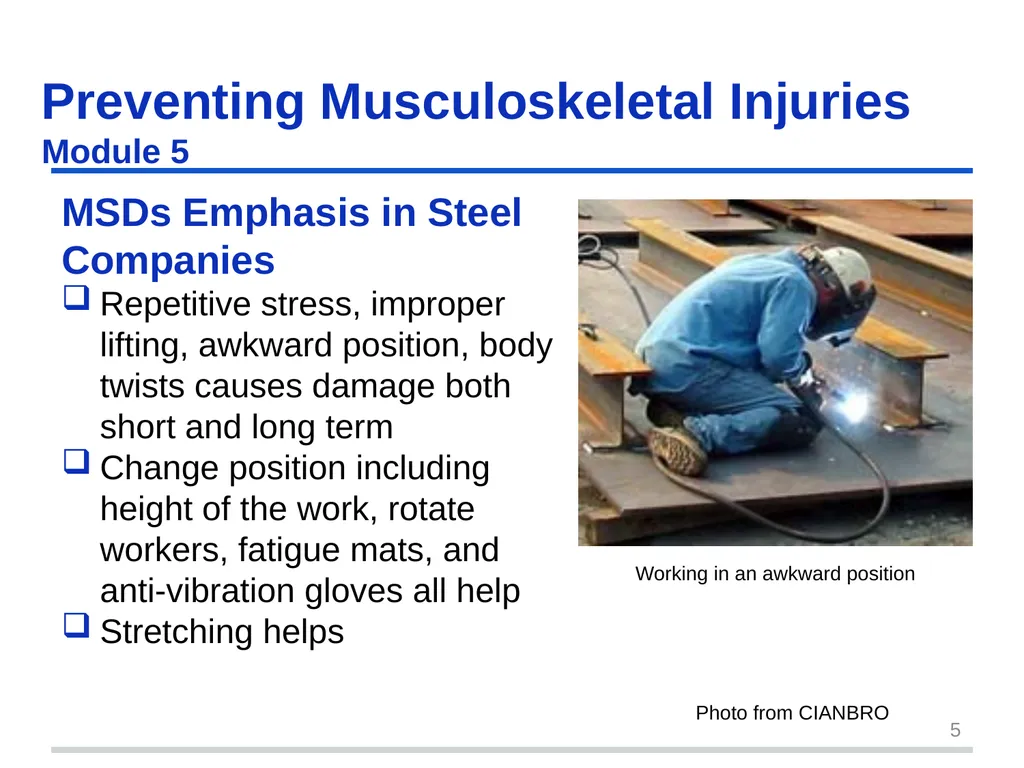
Module 5 slide 5 MSDs Emphasis in Steel Companies
Repetitive stress, improper lifting, awkward position, body twists causes damage both short and long term
Change position including height of the work, rotate workers, fatigue mats, and anti-vibration gloves all help
Stretching helps 5 Photo from CIANBRO Working in an awkward position<br>
Repetitive stress, improper lifting, awkward position, body twists causes damage both short and long term
Change position including height of the work, rotate workers, fatigue mats, and anti-vibration gloves all help
Stretching helps 5 Photo from CIANBRO Working in an awkward position<br>
06
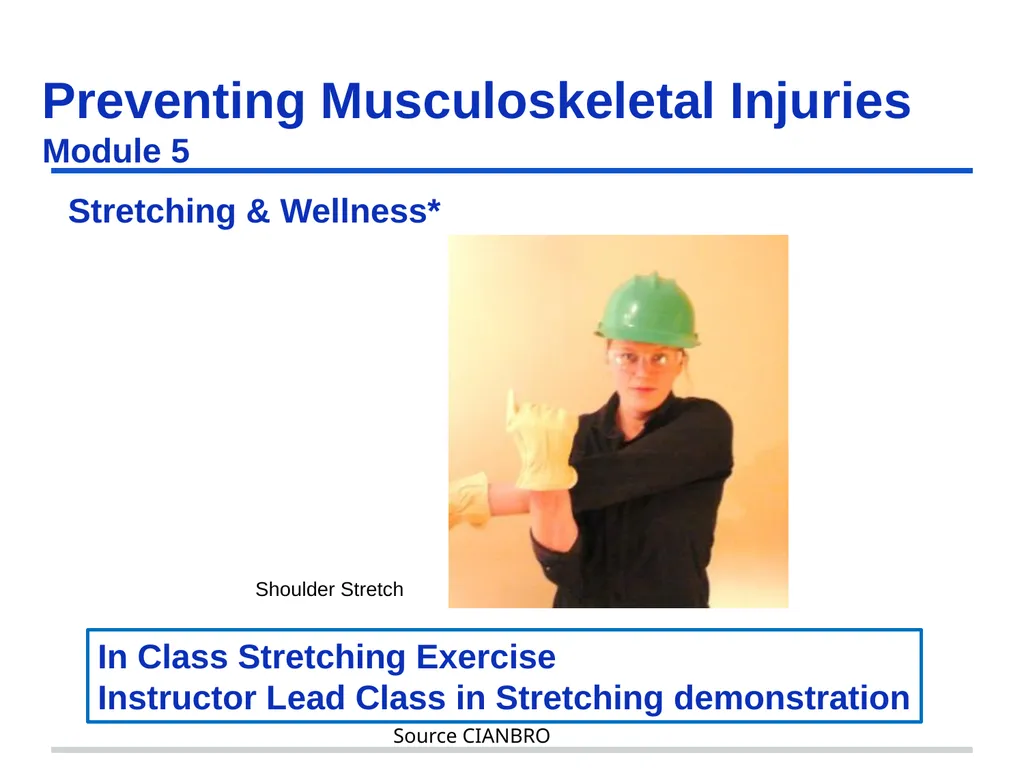
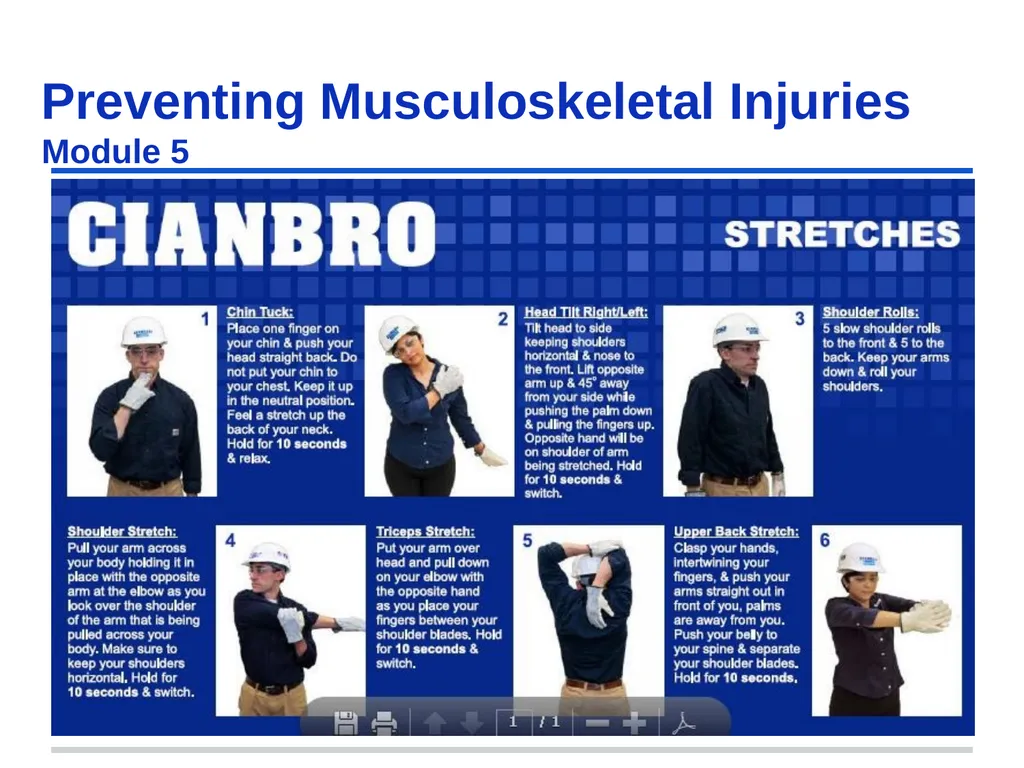
Source CIANBRO Stretching & Wellness* Preventing Musculoskeletal Injuries
Module 5 slide 6 In Class Stretching Exercise
Instructor Lead Class in Stretching demonstration Shoulder Stretch<br>
Instructor Lead Class in Stretching demonstration Shoulder Stretch<br>
07
Preventing Musculoskeletal Injuries
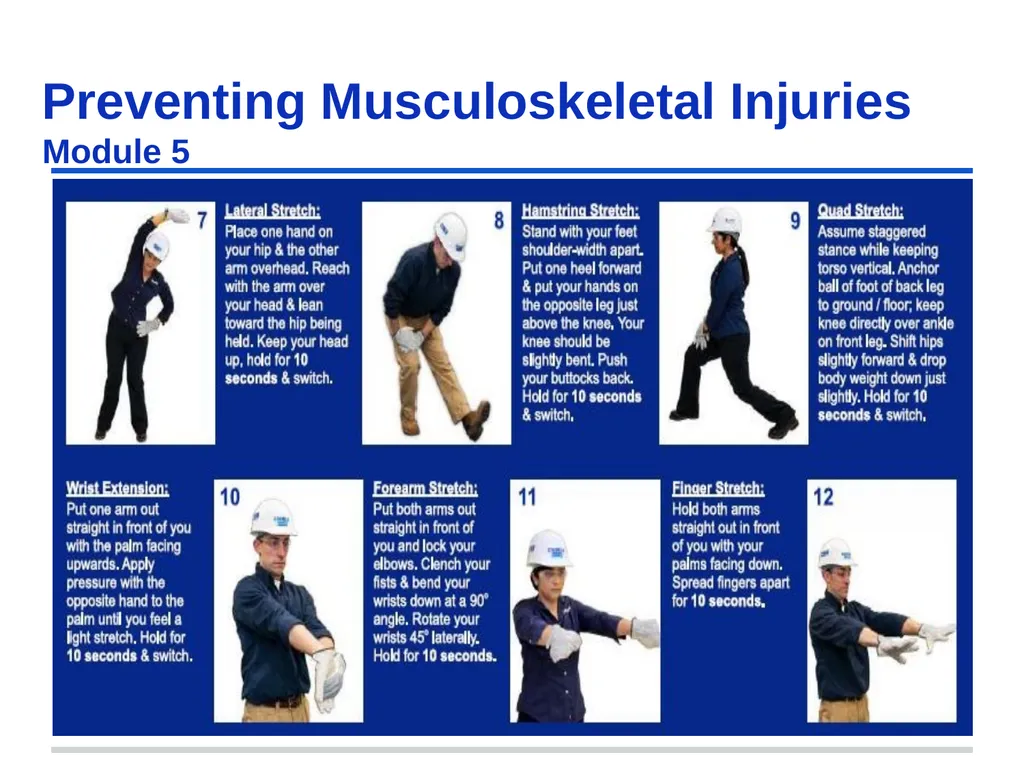
Module 5 slide 7<br>
08
Preventing Musculoskeletal Injuries
Module 5 slide 8<br>
09
Preventing Musculoskeletal Injuries
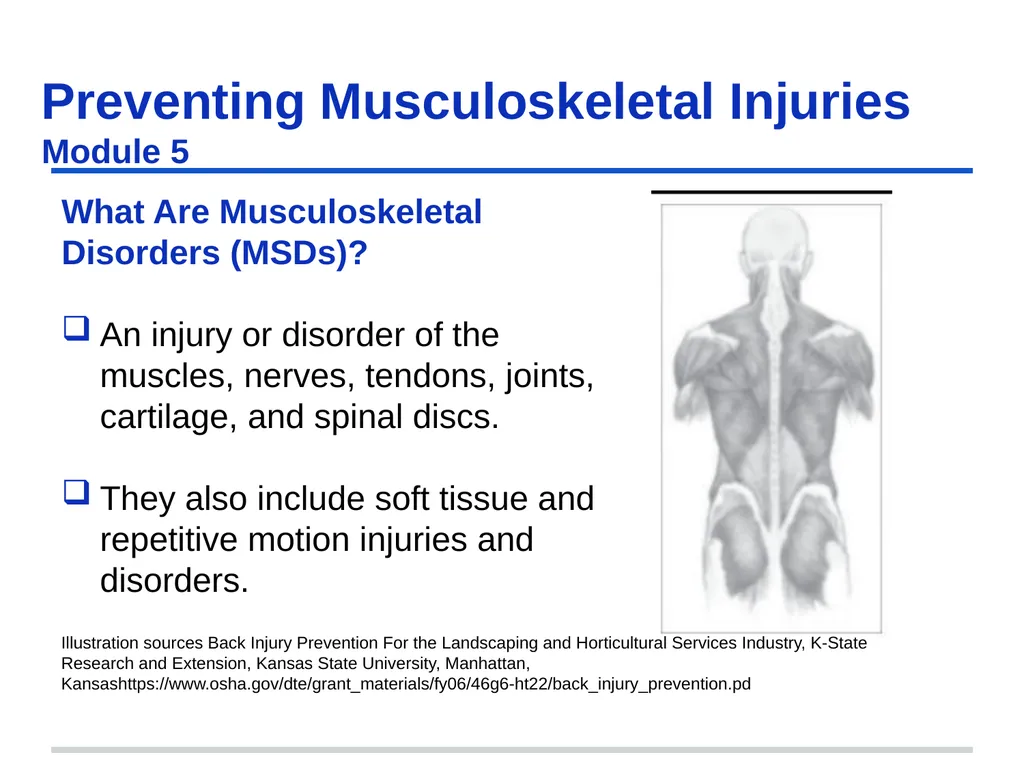
Module 5 slide 9 What Are Musculoskeletal Disorders (MSDs)?
An injury or disorder of the muscles, nerves, tendons, joints, cartilage, and spinal discs.
They also include soft tissue and repetitive motion injuries and disorders. Illustration sources Back Injury Prevention For the Landscaping and Horticultural Services Industry, K-State Research and Extension, Kansas State University, Manhattan, Kansashttps://www.osha.gov/dte/grant_materials/fy06/46g6-ht22/back_injury_prevention.pd<br>
An injury or disorder of the muscles, nerves, tendons, joints, cartilage, and spinal discs.
They also include soft tissue and repetitive motion injuries and disorders. Illustration sources Back Injury Prevention For the Landscaping and Horticultural Services Industry, K-State Research and Extension, Kansas State University, Manhattan, Kansashttps://www.osha.gov/dte/grant_materials/fy06/46g6-ht22/back_injury_prevention.pd<br>
10
Preventing Musculoskeletal Injuries
Module 5 slide 10 MSD IMPACT
“Work related MSDs are among the most frequently reported causes of lost or restricted work time
In 2011, the Bureau of Labor Statistics (BLS) reported
the 387,820 MSD cases accounted for 33% of all
worker injury and illness cases in 2011.” 10 Link to Ergonomics on OSHA Website<br>
“Work related MSDs are among the most frequently reported causes of lost or restricted work time
In 2011, the Bureau of Labor Statistics (BLS) reported
the 387,820 MSD cases accounted for 33% of all
worker injury and illness cases in 2011.” 10 Link to Ergonomics on OSHA Website<br>
11
MSDs Affect Many
Parts of the Body
“Back
Neck
Shoulders
Arms
Elbows
Wrists
Fingers”
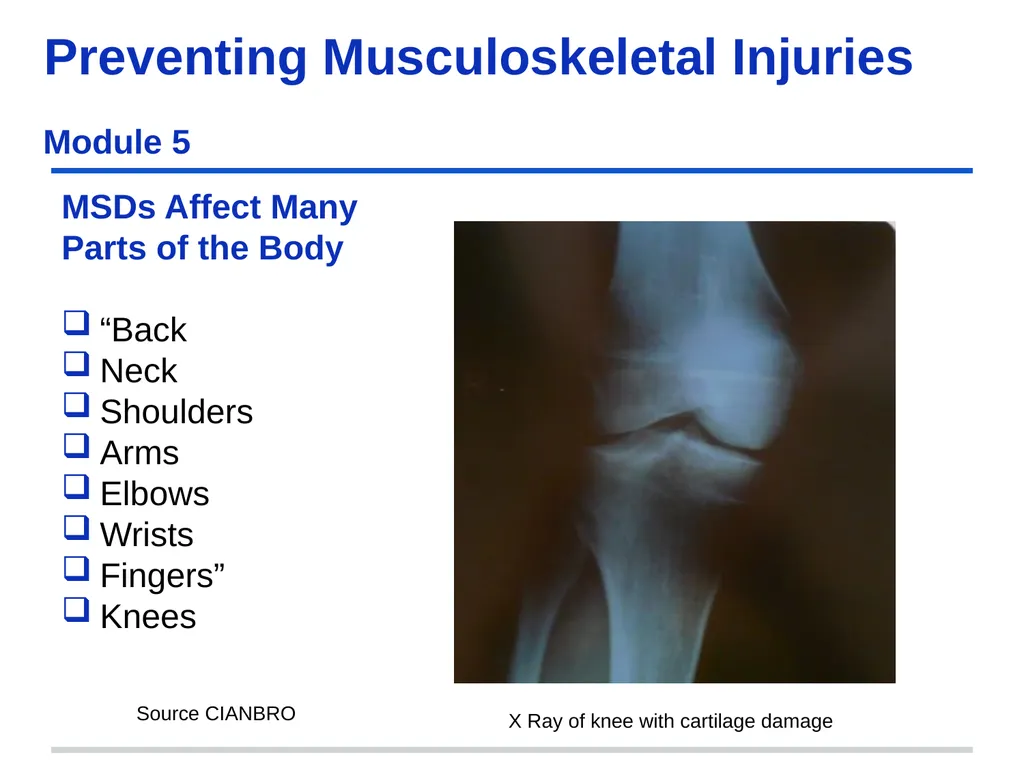
Knees Source CIANBRO Module 5 slide 11 X Ray of knee with cartilage damage Preventing Musculoskeletal Injuries<br>
Parts of the Body
“Back
Neck
Shoulders
Arms
Elbows
Wrists
Fingers”
Knees Source CIANBRO Module 5 slide 11 X Ray of knee with cartilage damage Preventing Musculoskeletal Injuries<br>
12
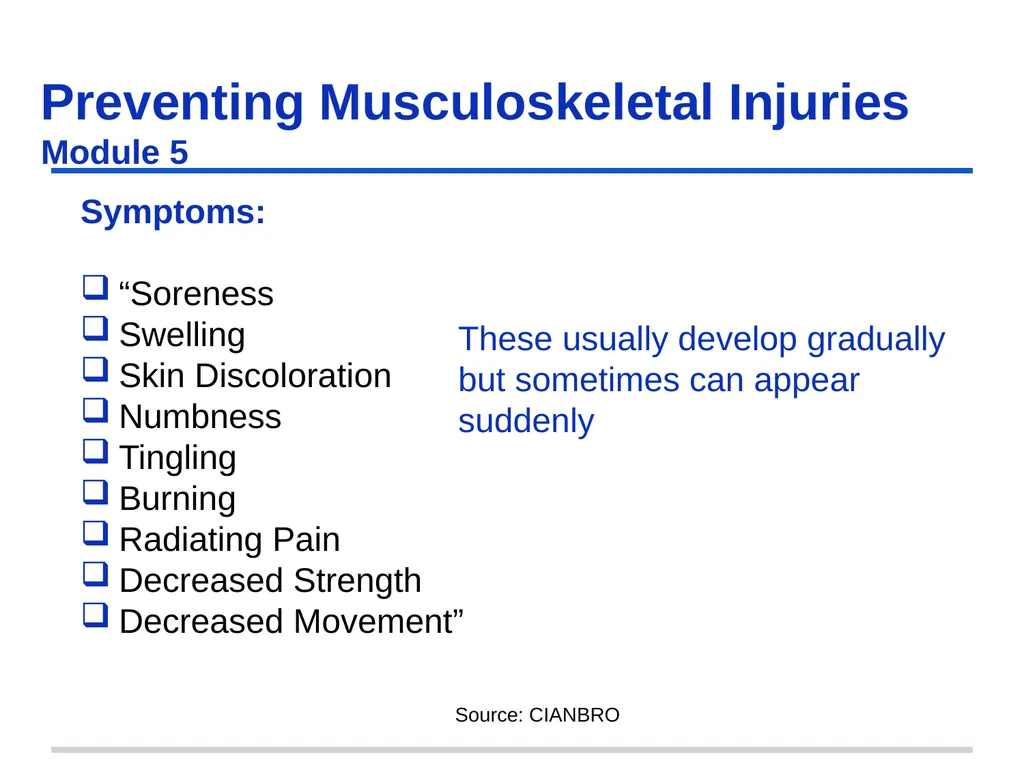
Symptoms:
“Soreness
Swelling
Skin Discoloration
Numbness
Tingling
Burning
Radiating Pain
Decreased Strength
Decreased Movement” Source: CIANBRO These usually develop gradually
but sometimes can appear suddenly Preventing Musculoskeletal Injuries Module 5 slide 12<br>
“Soreness
Swelling
Skin Discoloration
Numbness
Tingling
Burning
Radiating Pain
Decreased Strength
Decreased Movement” Source: CIANBRO These usually develop gradually
but sometimes can appear suddenly Preventing Musculoskeletal Injuries Module 5 slide 12<br>
13
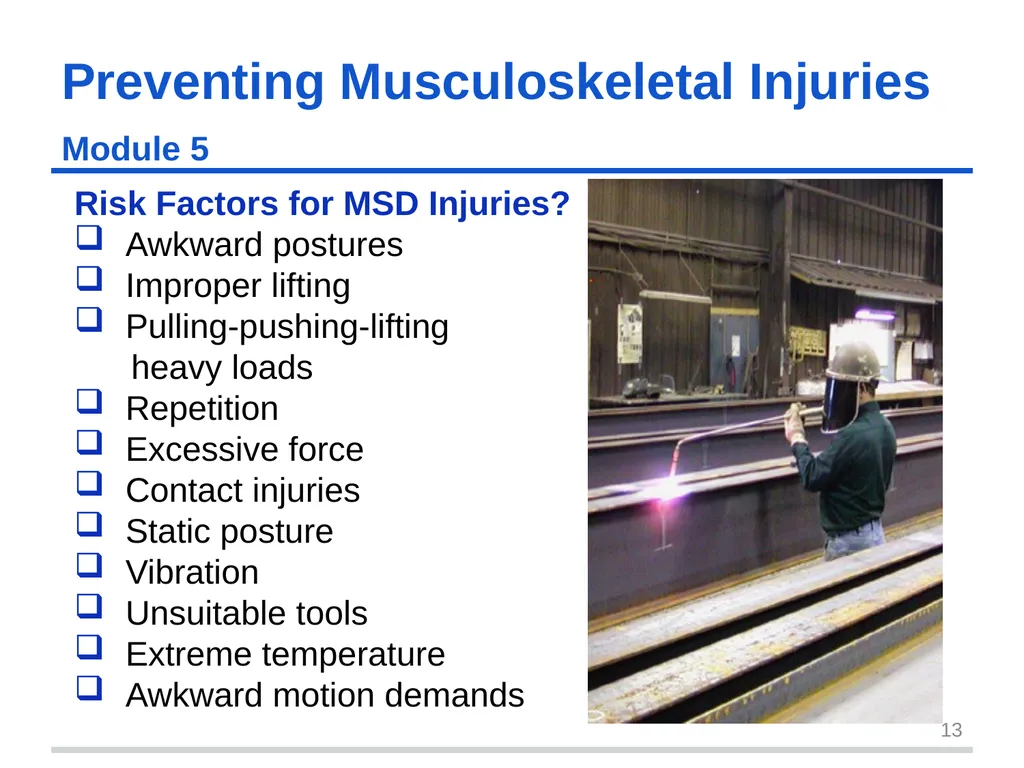
Preventing Musculoskeletal Injuries Module 5 slide 13 Risk Factors for MSD Injuries?
Awkward postures
Improper lifting
Pulling-pushing-lifting
heavy loads
Repetition
Excessive force
Contact injuries
Static posture
Vibration
Unsuitable tools
Extreme temperature
Awkward motion demands 13 slide 13<br>
Awkward postures
Improper lifting
Pulling-pushing-lifting
heavy loads
Repetition
Excessive force
Contact injuries
Static posture
Vibration
Unsuitable tools
Extreme temperature
Awkward motion demands 13 slide 13<br>
14
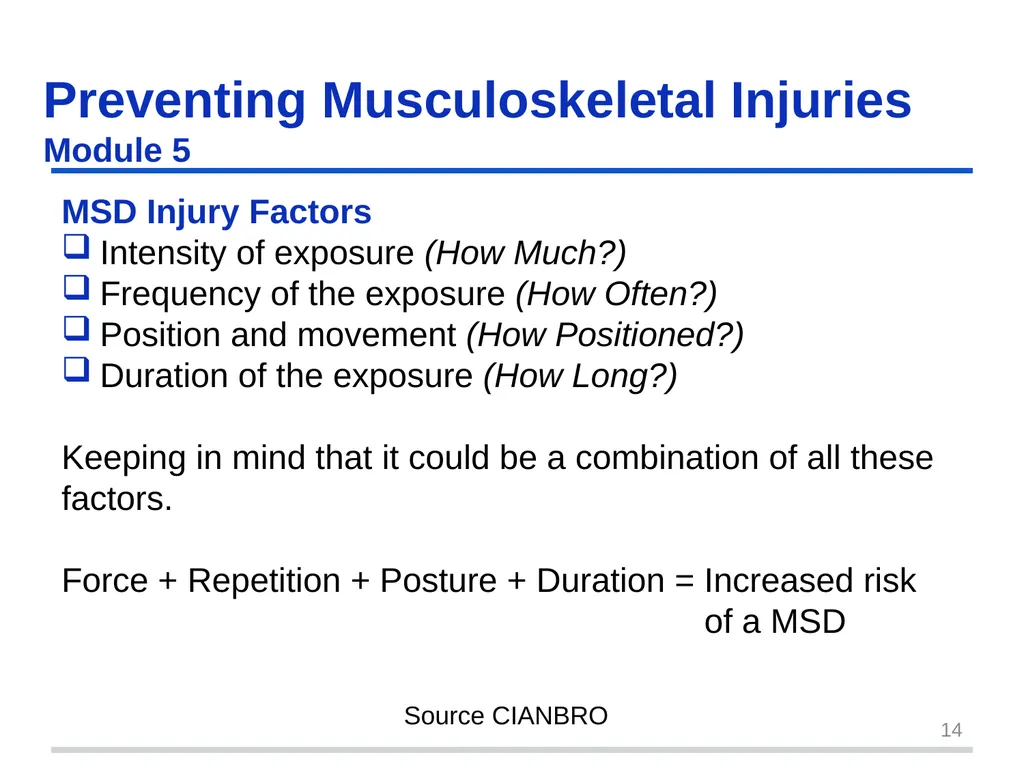
MSD Injury Factors
Intensity of exposure (How Much?)
Frequency of the exposure (How Often?)
Position and movement (How Positioned?)
Duration of the exposure (How Long?)
Keeping in mind that it could be a combination of all these factors.
Force + Repetition + Posture + Duration = Increased risk
of a MSD Source CIANBRO 14 Preventing Musculoskeletal Injuries Module 5 slide 14<br>
Intensity of exposure (How Much?)
Frequency of the exposure (How Often?)
Position and movement (How Positioned?)
Duration of the exposure (How Long?)
Keeping in mind that it could be a combination of all these factors.
Force + Repetition + Posture + Duration = Increased risk
of a MSD Source CIANBRO 14 Preventing Musculoskeletal Injuries Module 5 slide 14<br>
15
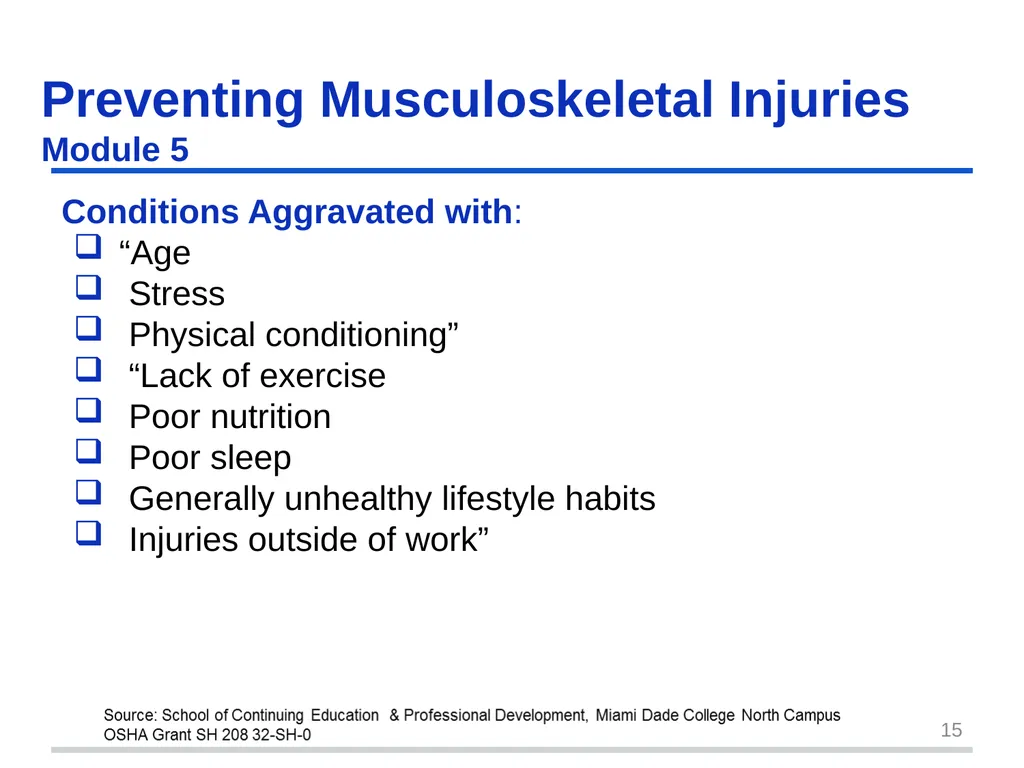
Conditions Aggravated with:
“Age
Stress
Physical conditioning”
“Lack of exercise
Poor nutrition
Poor sleep
Generally unhealthy lifestyle habits
Injuries outside of work” 15 Preventing Musculoskeletal Injuries Module 5 slide 15<br>
“Age
Stress
Physical conditioning”
“Lack of exercise
Poor nutrition
Poor sleep
Generally unhealthy lifestyle habits
Injuries outside of work” 15 Preventing Musculoskeletal Injuries Module 5 slide 15<br>
16
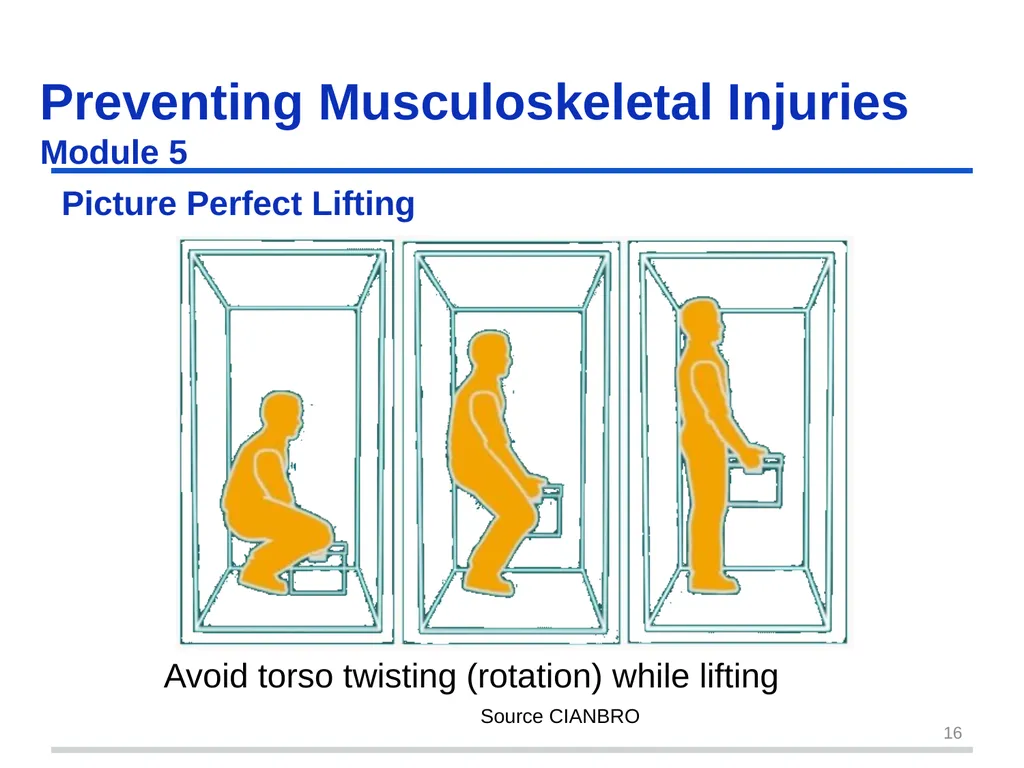
Avoid torso twisting (rotation) while lifting Source CIANBRO Picture Perfect Lifting 16 Preventing Musculoskeletal Injuries
Module 5 slide 16<br>
17
Back Injuries
“The back is the most frequently injured body part. Once
injured, the risk of recurrence doubles
Low back injuries represent over 90% of all injury claims
Second only to the common cold in lost work days
Back pain costs American businesses an estimated $30
billion each year
4 out of every 5 people will experience back pain
in their lifetime” Preventing Musculoskeletal Injuries Module 5 slide 17<br>
“The back is the most frequently injured body part. Once
injured, the risk of recurrence doubles
Low back injuries represent over 90% of all injury claims
Second only to the common cold in lost work days
Back pain costs American businesses an estimated $30
billion each year
4 out of every 5 people will experience back pain
in their lifetime” Preventing Musculoskeletal Injuries Module 5 slide 17<br>
18
Back
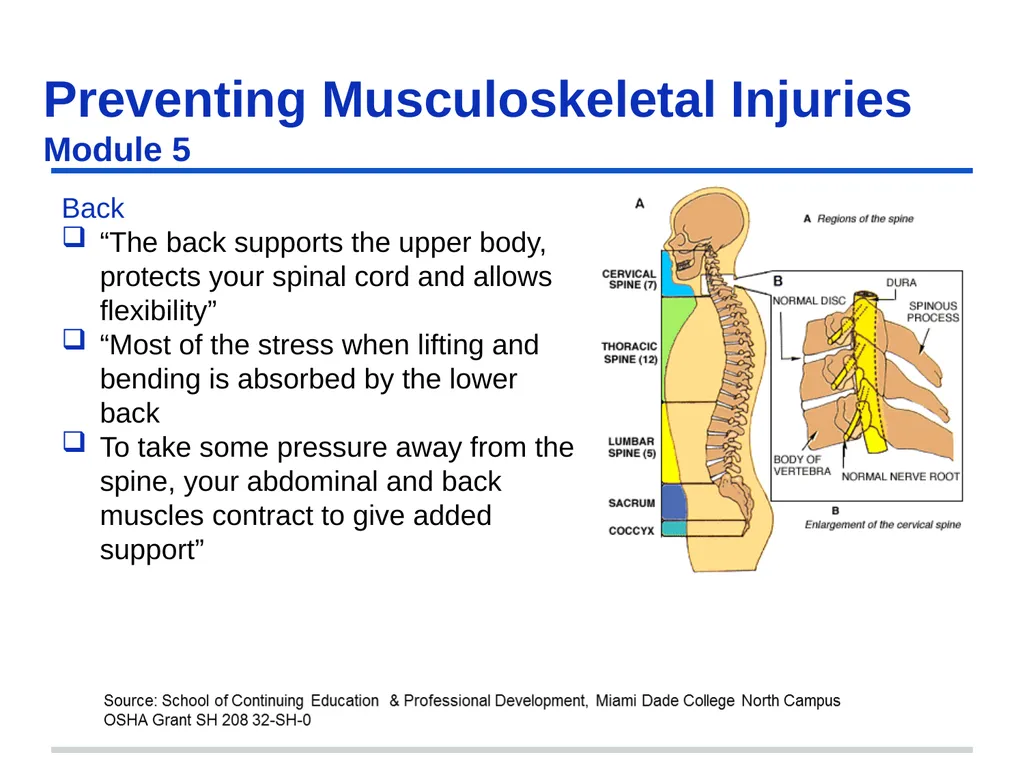
“The back supports the upper body, protects your spinal cord and allows flexibility”
“Most of the stress when lifting and bending is absorbed by the lower back
To take some pressure away from the spine, your abdominal and back muscles contract to give added support” Preventing Musculoskeletal Injuries Module 5 slide 18<br>
“The back supports the upper body, protects your spinal cord and allows flexibility”
“Most of the stress when lifting and bending is absorbed by the lower back
To take some pressure away from the spine, your abdominal and back muscles contract to give added support” Preventing Musculoskeletal Injuries Module 5 slide 18<br>
19
“Causes of Back Injury
Improper lifting techniques
Overexertion
Poor posture
Medical factors (age, other disabilities, etc.)
Slips and falls
Excessive weight
Lack of exercise
Stress” 19 Preventing Musculoskeletal Injuries Module 5 slide 19<br>
Improper lifting techniques
Overexertion
Poor posture
Medical factors (age, other disabilities, etc.)
Slips and falls
Excessive weight
Lack of exercise
Stress” 19 Preventing Musculoskeletal Injuries Module 5 slide 19<br>
20
“Symptoms of Back Injury
Pain
Stiffness
Numbness in the legs
Limited ability to sit or stand
Muscle weakness, spasms and strains
Decreased range of motion” 20 Preventing Musculoskeletal Injuries Module 5 slide 20<br>
Pain
Stiffness
Numbness in the legs
Limited ability to sit or stand
Muscle weakness, spasms and strains
Decreased range of motion” 20 Preventing Musculoskeletal Injuries Module 5 slide 20<br>
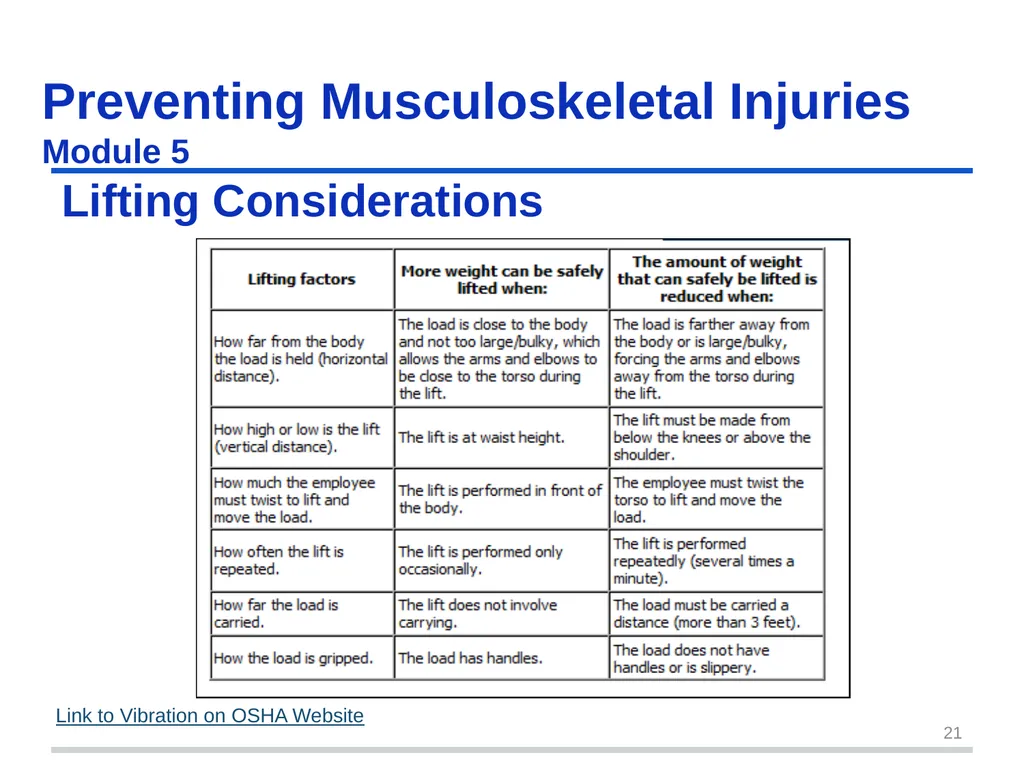
21
Lifting Considerations Link to Vibration on OSHA Website 21 Preventing Musculoskeletal Injuries
Module 5 slide 21<br>
22
Plan your job lift
“Reduce the weights you lift
Reduce the distance you carry a load
Eliminate twisting
Reduce the frequency of lifting
Lift in a safe range
When Lifting…
Keep the load close to the body
Keep your feet apart for a stable stance
Position your feet prior to lifting to eliminate twisting
Don’t lift beyond your safe limit. Get help”! Source: CIANBRO Preventing Musculoskeletal Injuries Module 5 slide 22<br>
“Reduce the weights you lift
Reduce the distance you carry a load
Eliminate twisting
Reduce the frequency of lifting
Lift in a safe range
When Lifting…
Keep the load close to the body
Keep your feet apart for a stable stance
Position your feet prior to lifting to eliminate twisting
Don’t lift beyond your safe limit. Get help”! Source: CIANBRO Preventing Musculoskeletal Injuries Module 5 slide 22<br>
23
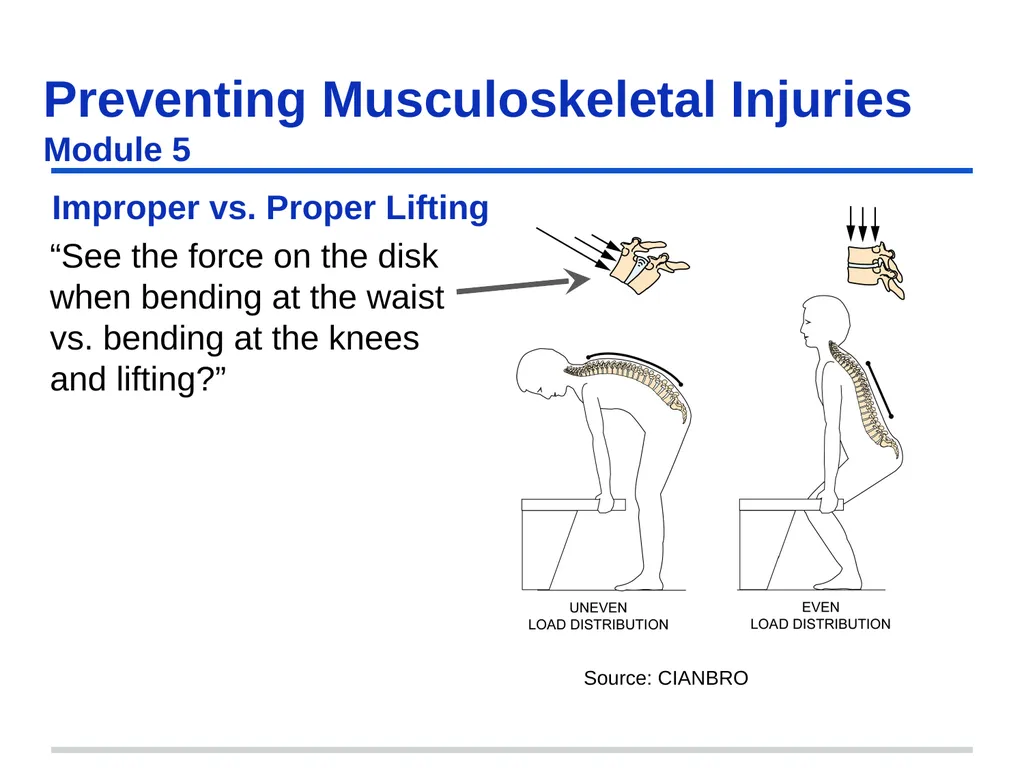
“See the force on the disk when bending at the waist vs. bending at the knees and lifting?” Source: CIANBRO Improper vs. Proper Lifting Preventing Musculoskeletal Injuries
Module 5 slide 23<br>
24
Preventing Musculoskeletal Injuries
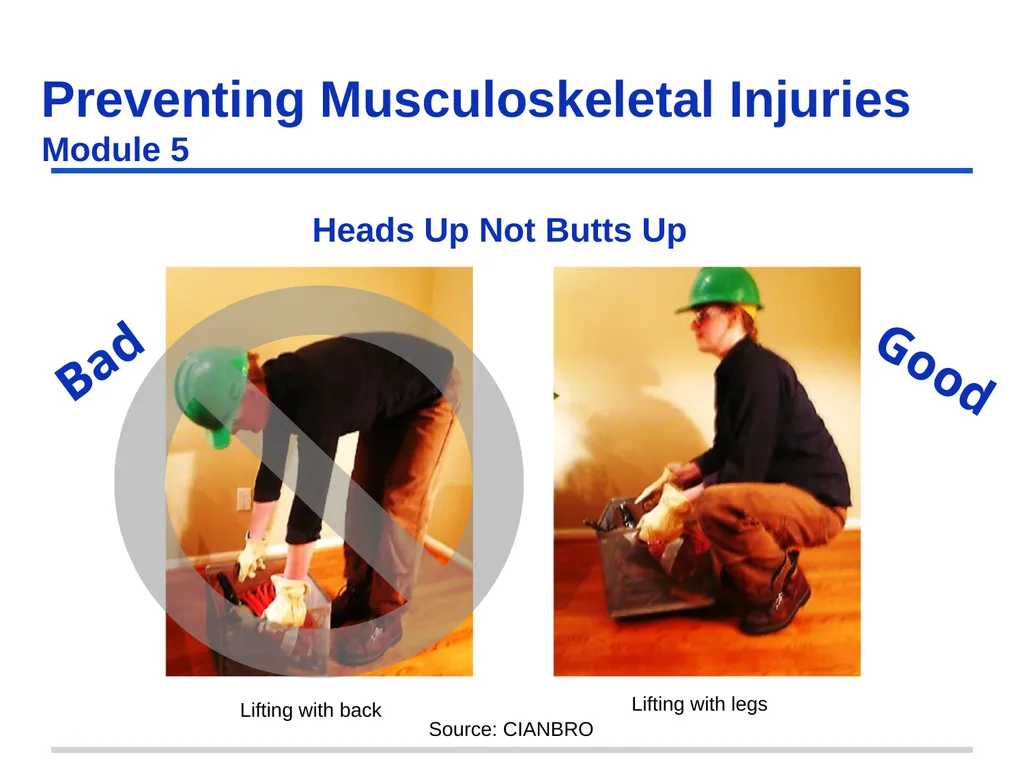
Module 5 slide 24 Bad Good Heads Up Not Butts Up Source: CIANBRO Lifting with back Lifting with legs<br>
25
Preventing Musculoskeletal Injuries
Module 5 slide 25 Heads Up Not Butts Up In Class Lifting Demonstration
Instructor Lead Class Lifting Demonstration
Select a volunteer-lift an object from the floor<br>
Instructor Lead Class Lifting Demonstration
Select a volunteer-lift an object from the floor<br>
26
Vibration Exposure
“Whole body vibration (WBV) is a form of mechanical vibration transmitted through a supporting surface to the body. Like in equipment or a truck seat.
Vibration from hand tools can be dampened by anti-vibratory gloves, tool wraps or even by choosing tools that provide less vibration.” Source; CIANBRO 26 Preventing Musculoskeletal Injuries Module 5 slide 26<br>
“Whole body vibration (WBV) is a form of mechanical vibration transmitted through a supporting surface to the body. Like in equipment or a truck seat.
Vibration from hand tools can be dampened by anti-vibratory gloves, tool wraps or even by choosing tools that provide less vibration.” Source; CIANBRO 26 Preventing Musculoskeletal Injuries Module 5 slide 26<br>
27
Vibration in steel shops
Grinders
Sanders
Drills
Chipping hammers and chisels Preventing Musculoskeletal Injuries Module 5 slide 27<br>
Grinders
Sanders
Drills
Chipping hammers and chisels Preventing Musculoskeletal Injuries Module 5 slide 27<br>
28
H.A.V.S. Symptoms (Hand-Arm Vibration Syndrome)
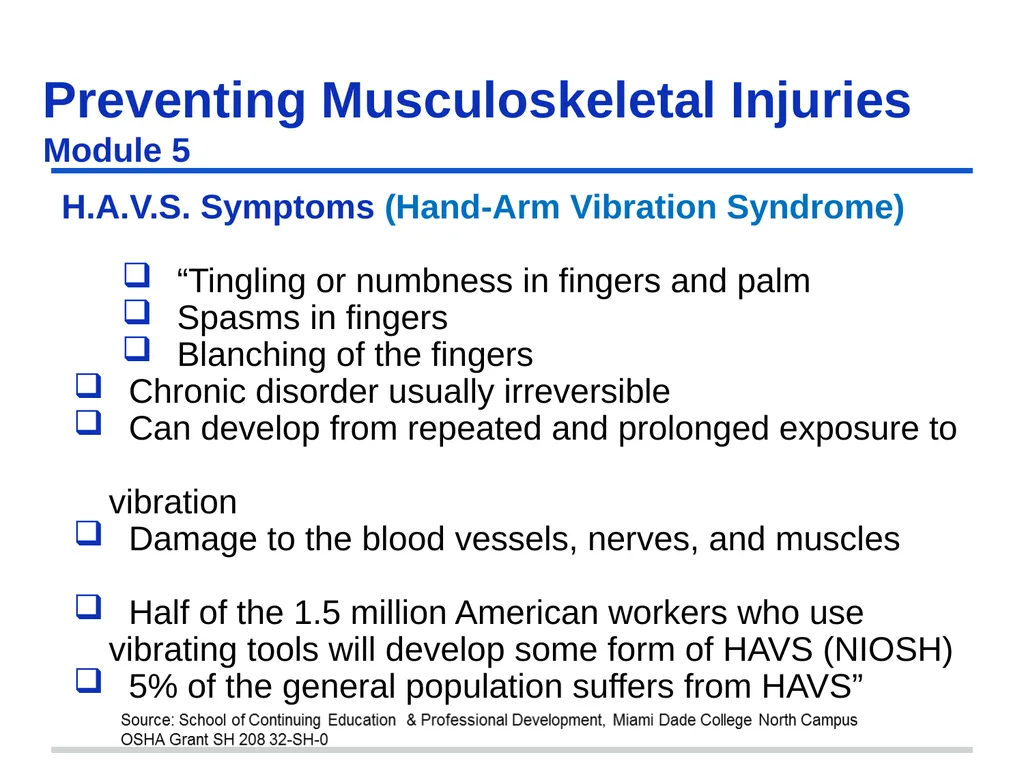
“Tingling or numbness in fingers and palm
Spasms in fingers
Blanching of the fingers
Chronic disorder usually irreversible
Can develop from repeated and prolonged exposure to
vibration
Damage to the blood vessels, nerves, and muscles
Half of the 1.5 million American workers who use
vibrating tools will develop some form of HAVS (NIOSH)
5% of the general population suffers from HAVS” Preventing Musculoskeletal Injuries Module 5 slide 28<br>
“Tingling or numbness in fingers and palm
Spasms in fingers
Blanching of the fingers
Chronic disorder usually irreversible
Can develop from repeated and prolonged exposure to
vibration
Damage to the blood vessels, nerves, and muscles
Half of the 1.5 million American workers who use
vibrating tools will develop some form of HAVS (NIOSH)
5% of the general population suffers from HAVS” Preventing Musculoskeletal Injuries Module 5 slide 28<br>
29
H.A.V.S. Risk Factors
“Repeated and prolonged exposure
to hand-held vibrating tools
Improper tool use
Forceful tool grip
Aggravated by
Temperature - Cold
Damp environment
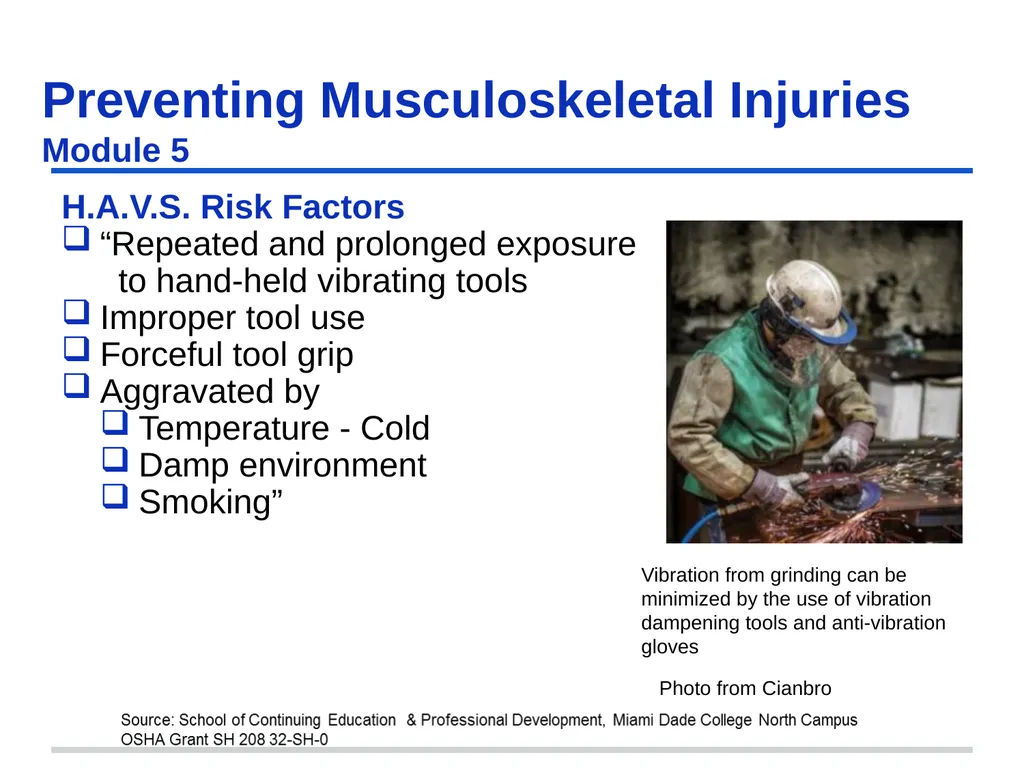
Smoking” Vibration from grinding can be
minimized by the use of vibration
dampening tools and anti-vibration
gloves Preventing Musculoskeletal Injuries Module 5 slide 29 Photo from Cianbro<br>
“Repeated and prolonged exposure
to hand-held vibrating tools
Improper tool use
Forceful tool grip
Aggravated by
Temperature - Cold
Damp environment
Smoking” Vibration from grinding can be
minimized by the use of vibration
dampening tools and anti-vibration
gloves Preventing Musculoskeletal Injuries Module 5 slide 29 Photo from Cianbro<br>
30
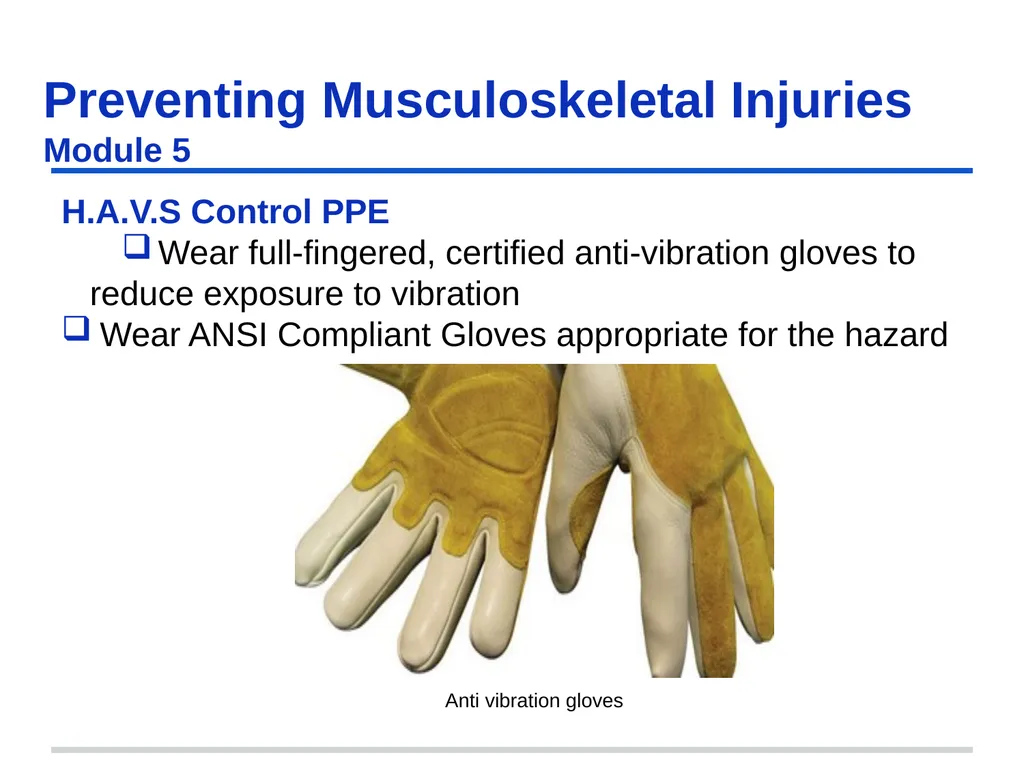
H.A.V.S Control PPE
Wear full-fingered, certified anti-vibration gloves to
reduce exposure to vibration
Wear ANSI Compliant Gloves appropriate for the hazard Preventing Musculoskeletal Injuries Module 5 slide 30 Anti vibration gloves<br>
Wear full-fingered, certified anti-vibration gloves to
reduce exposure to vibration
Wear ANSI Compliant Gloves appropriate for the hazard Preventing Musculoskeletal Injuries Module 5 slide 30 Anti vibration gloves<br>
31
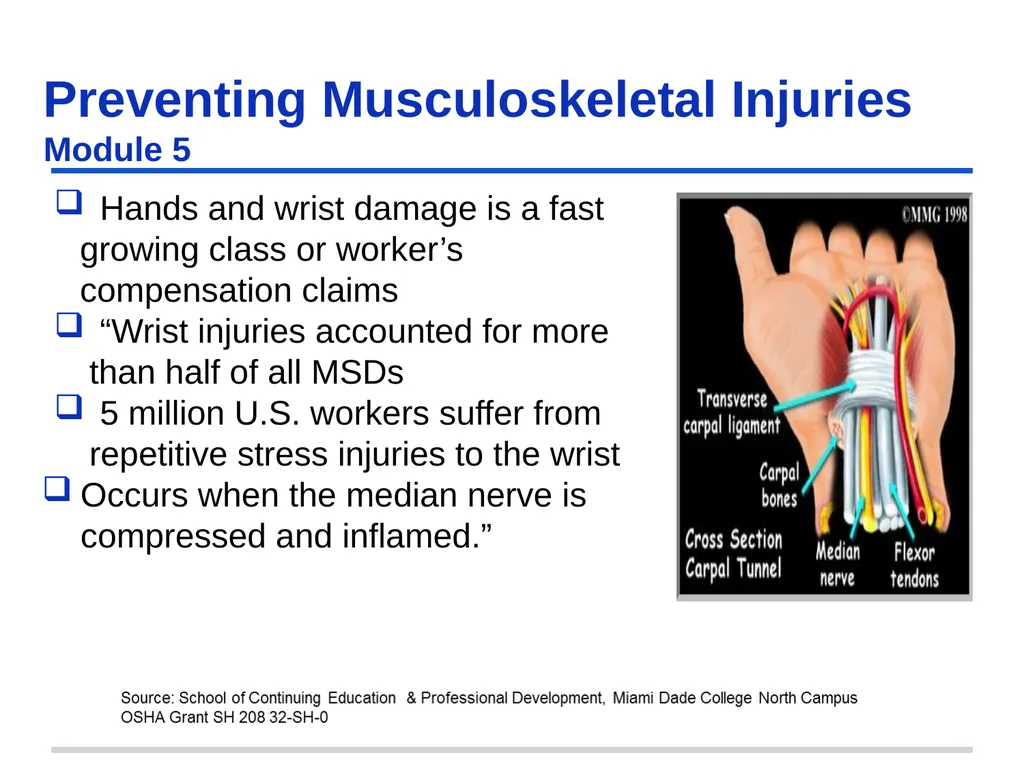
Hands and wrist damage is a fast
growing class or worker’s
compensation claims
“Wrist injuries accounted for more
than half of all MSDs
5 million U.S. workers suffer from
repetitive stress injuries to the wrist
Occurs when the median nerve is compressed and inflamed.” Preventing Musculoskeletal Injuries Module 5 slide 31<br>
growing class or worker’s
compensation claims
“Wrist injuries accounted for more
than half of all MSDs
5 million U.S. workers suffer from
repetitive stress injuries to the wrist
Occurs when the median nerve is compressed and inflamed.” Preventing Musculoskeletal Injuries Module 5 slide 31<br>
32
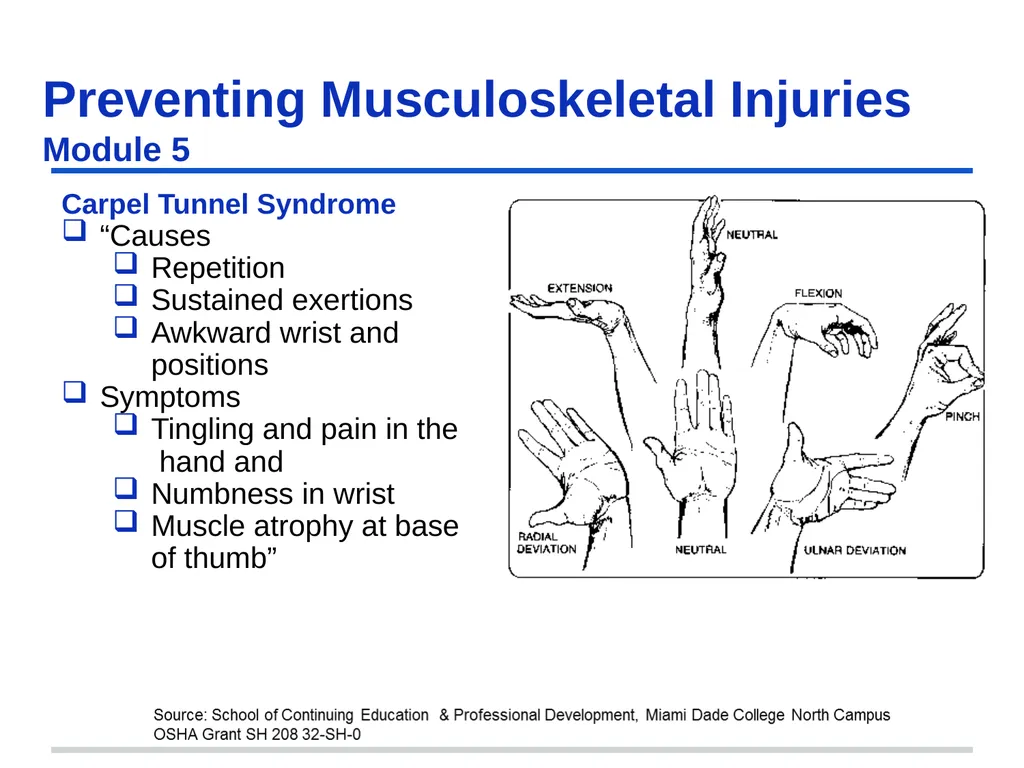
Carpel Tunnel Syndrome
“Causes
Repetition
Sustained exertions
Awkward wrist and positions
Symptoms
Tingling and pain in the hand and
Numbness in wrist
Muscle atrophy at base of thumb” Preventing Musculoskeletal Injuries Module 5 slide 32<br>
“Causes
Repetition
Sustained exertions
Awkward wrist and positions
Symptoms
Tingling and pain in the hand and
Numbness in wrist
Muscle atrophy at base of thumb” Preventing Musculoskeletal Injuries Module 5 slide 32<br>
33
Preventing Musculoskeletal Injuries
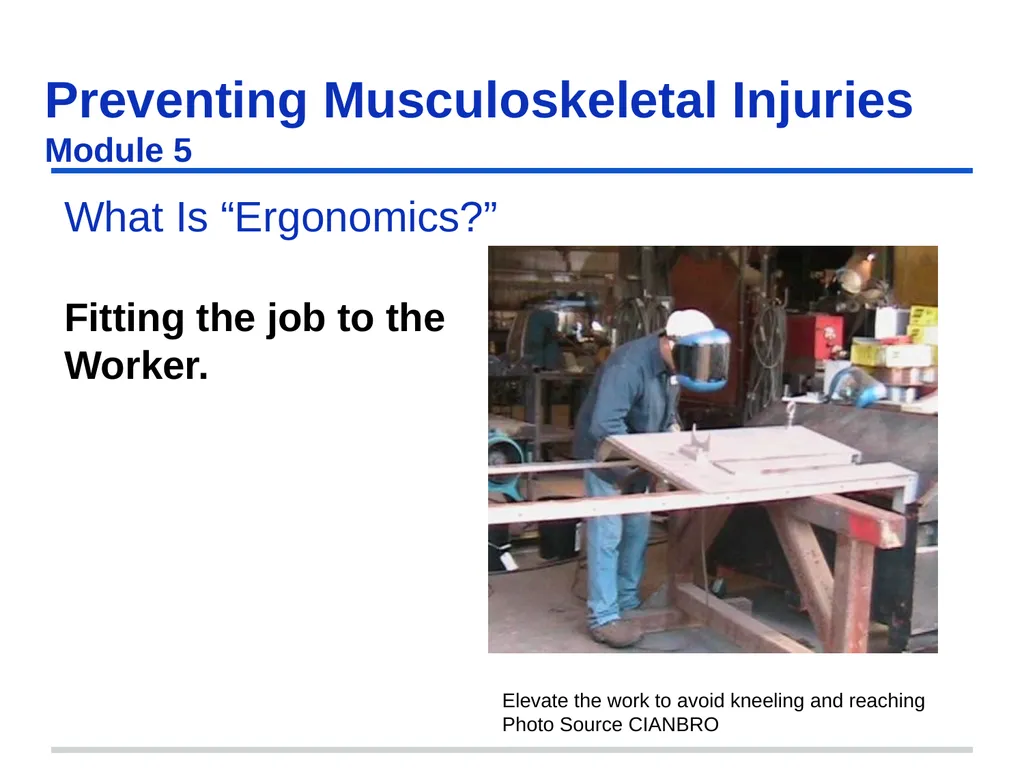
Module 5 slide 33 What Is “Ergonomics?”
Fitting the job to the
Worker. Elevate the work to avoid kneeling and reaching
Photo Source CIANBRO<br>
Fitting the job to the
Worker. Elevate the work to avoid kneeling and reaching
Photo Source CIANBRO<br>
34
What is Ergonomics?
“The science of adapting work-stations, tools, equipment, and job techniques to be compatible with human anatomy and physiology to reduce the risk of Musculoskeletal Disorder injuries due to Ergonomic Stressors.”
“Fit the job to the person” rather than the “person to the job.” Preventing Musculoskeletal Injuries Module 5 slide 34<br>
“The science of adapting work-stations, tools, equipment, and job techniques to be compatible with human anatomy and physiology to reduce the risk of Musculoskeletal Disorder injuries due to Ergonomic Stressors.”
“Fit the job to the person” rather than the “person to the job.” Preventing Musculoskeletal Injuries Module 5 slide 34<br>
35
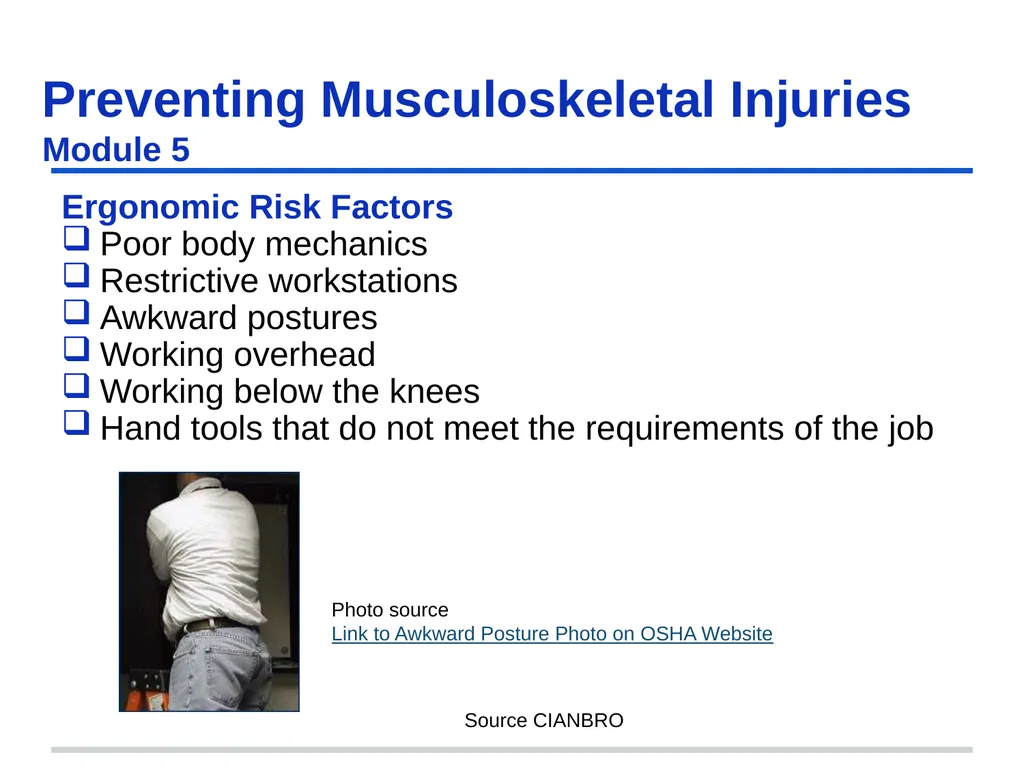
Ergonomic Risk Factors
Poor body mechanics
Restrictive workstations
Awkward postures
Working overhead
Working below the knees
Hand tools that do not meet the requirements of the job Source CIANBRO Preventing Musculoskeletal Injuries Module 5 slide 35 Photo source Link to Awkward Posture Photo on OSHA Website<br>
Poor body mechanics
Restrictive workstations
Awkward postures
Working overhead
Working below the knees
Hand tools that do not meet the requirements of the job Source CIANBRO Preventing Musculoskeletal Injuries Module 5 slide 35 Photo source Link to Awkward Posture Photo on OSHA Website<br>
36
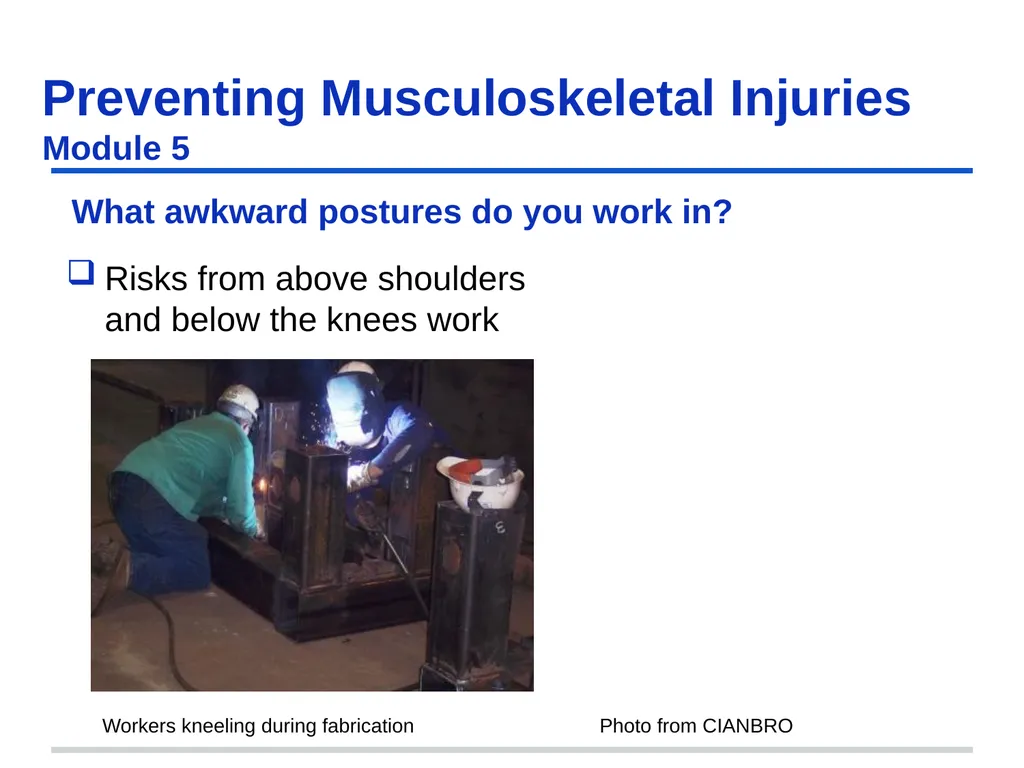
What awkward postures do you work in? Preventing Musculoskeletal Injuries
Module 5 slide 36 Risks from above shoulders and below the knees work Photo from CIANBRO Workers kneeling during fabrication<br>
37
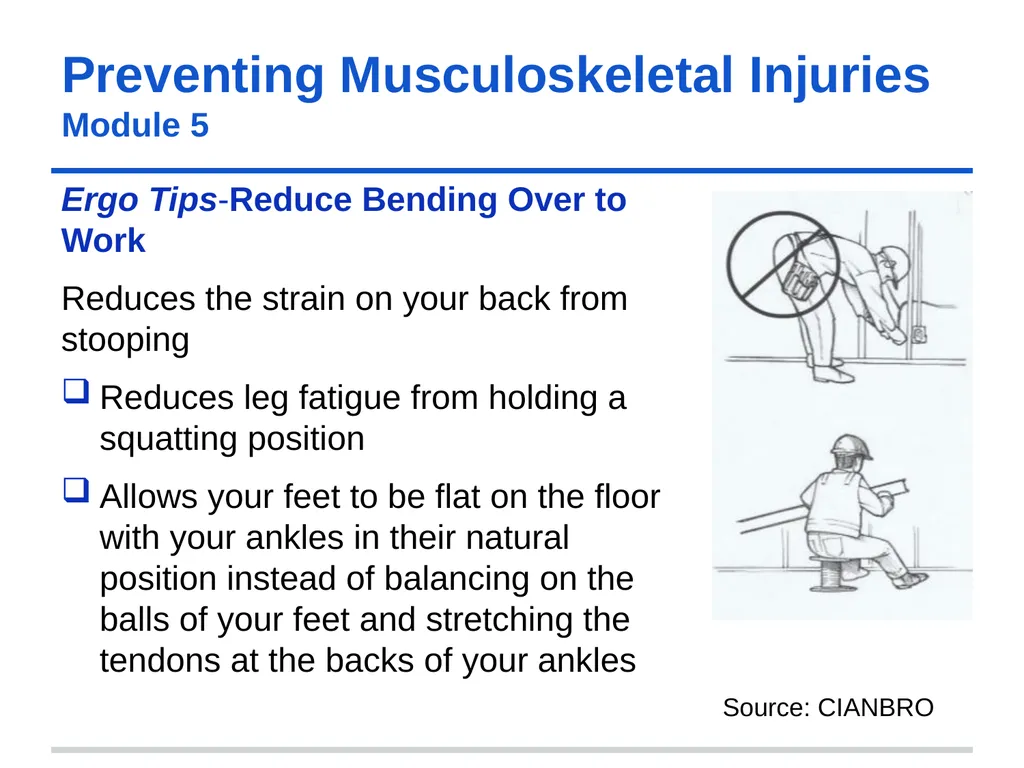
Preventing Musculoskeletal Injuries Module 5 Slide 37 Ergo Tips-Reduce Bending Over to Work
Reduces the strain on your back from stooping
Reduces leg fatigue from holding a squatting position
Allows your feet to be flat on the floor with your ankles in their natural position instead of balancing on the balls of your feet and stretching the tendons at the backs of your ankles Source: CIANBRO 37<br>
Reduces the strain on your back from stooping
Reduces leg fatigue from holding a squatting position
Allows your feet to be flat on the floor with your ankles in their natural position instead of balancing on the balls of your feet and stretching the tendons at the backs of your ankles Source: CIANBRO 37<br>
38
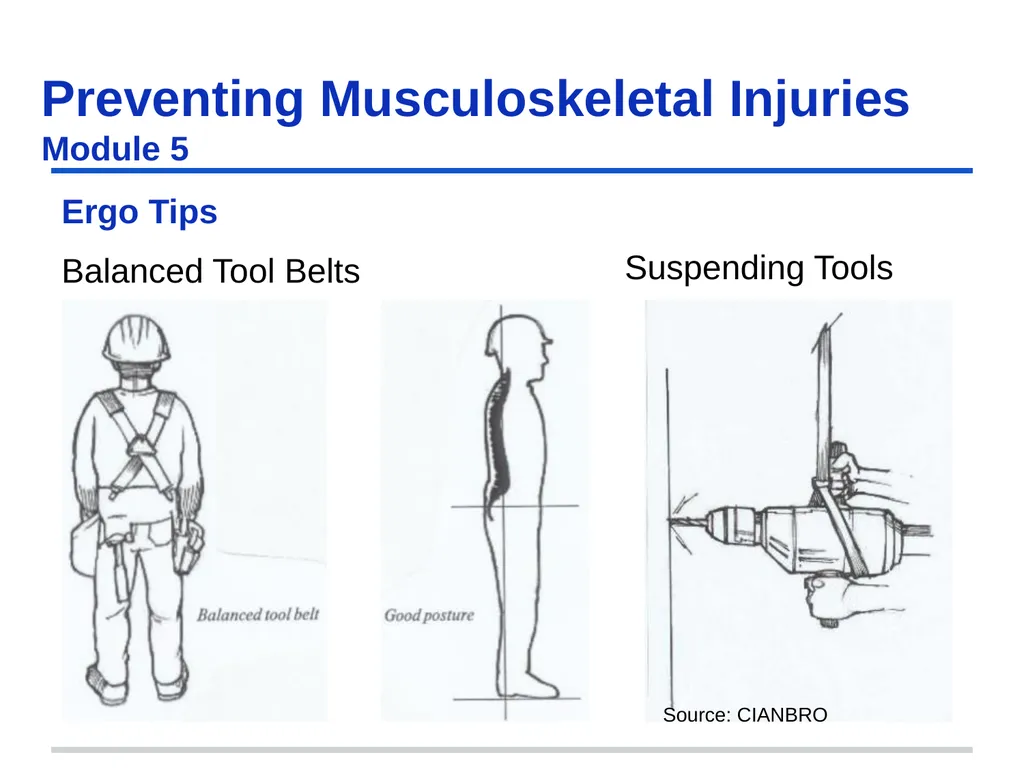
Balanced Tool Belts Ergo Tips Suspending Tools Source: CIANBRO Preventing Musculoskeletal Injuries
Module 5 slide 38<br>
39
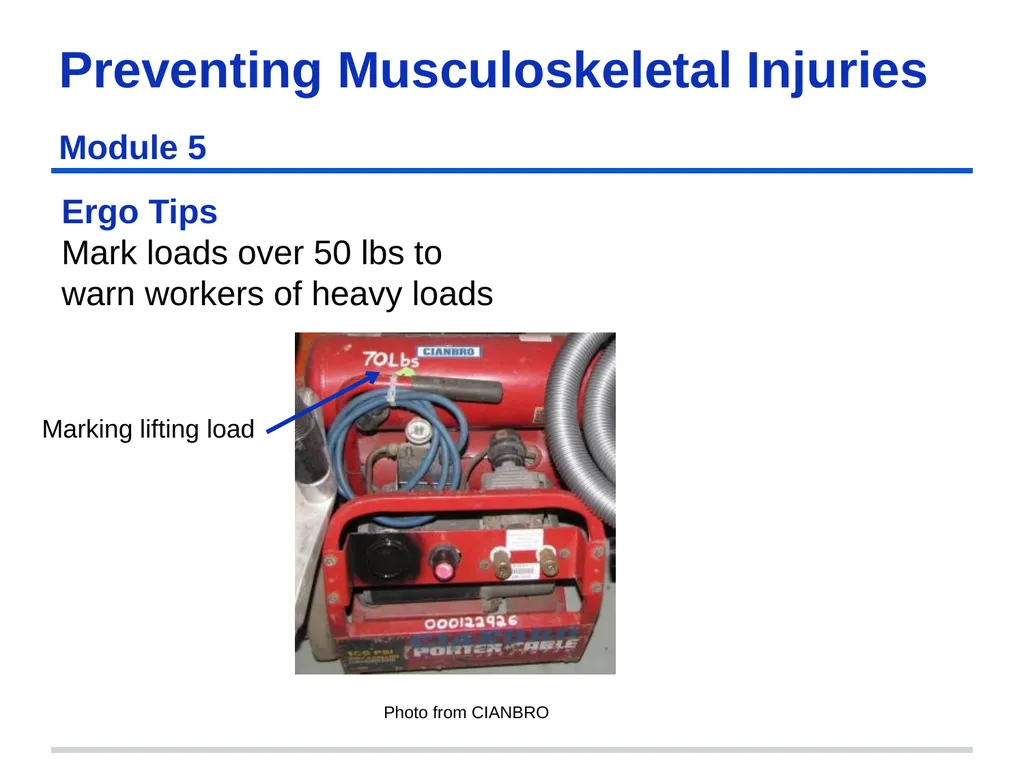
Ergo Tips
Mark loads over 50 lbs to
warn workers of heavy loads Photo from CIANBRO Module 5 slide 39 Marking lifting load Preventing Musculoskeletal Injuries<br>
Mark loads over 50 lbs to
warn workers of heavy loads Photo from CIANBRO Module 5 slide 39 Marking lifting load Preventing Musculoskeletal Injuries<br>
40
Ergo Tips
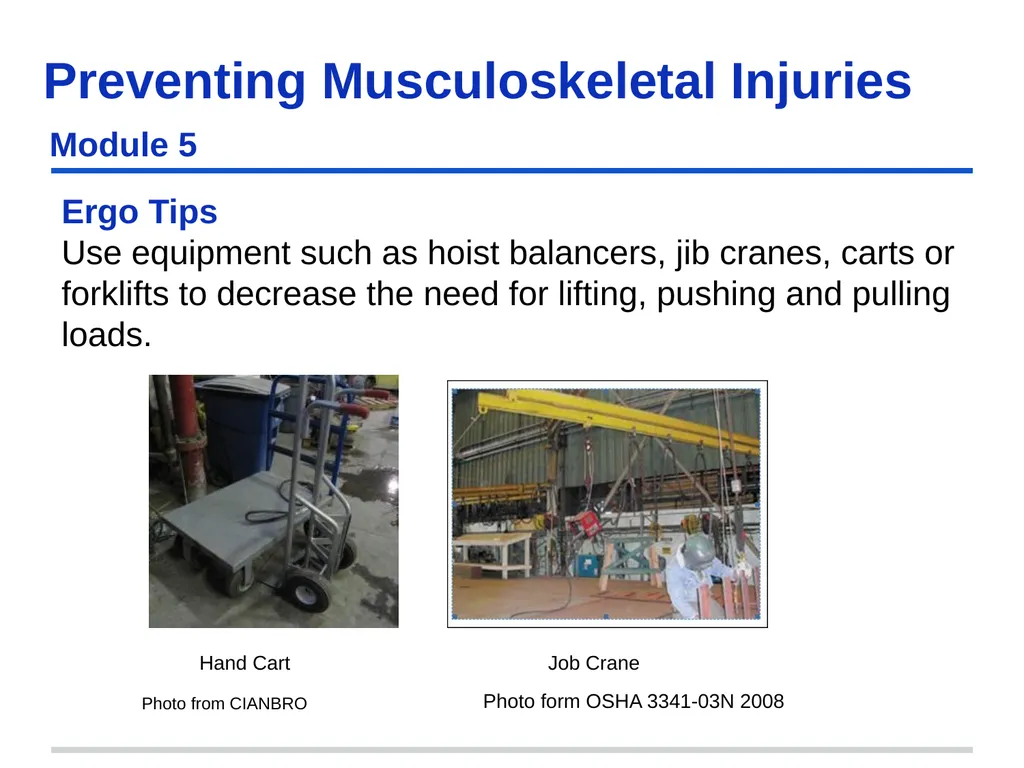
Use equipment such as hoist balancers, jib cranes, carts or forklifts to decrease the need for lifting, pushing and pulling loads. Module 5 Photo from CIANBRO Photo form OSHA 3341-03N 2008 Hand Cart Job Crane Preventing Musculoskeletal Injuries<br>
Use equipment such as hoist balancers, jib cranes, carts or forklifts to decrease the need for lifting, pushing and pulling loads. Module 5 Photo from CIANBRO Photo form OSHA 3341-03N 2008 Hand Cart Job Crane Preventing Musculoskeletal Injuries<br>
41
Preventing Musculoskeletal Injuries
Module 5 slide 41 Job Rotation
“Job rotation is vital when conducting demanding repetitive tasks.
When planning out the job keep in mind that good job rotations are those that have team members using different muscle groups between tasks or at the very least less demanding tasks”. Source: CIANBRO<br>
“Job rotation is vital when conducting demanding repetitive tasks.
When planning out the job keep in mind that good job rotations are those that have team members using different muscle groups between tasks or at the very least less demanding tasks”. Source: CIANBRO<br>
42
Preventing Musculoskeletal Injuries
Module 5 slide 42 Early Reporting of MSD Symptoms
Addressing injuries early can help prevent them from becoming more serious. 42 Source: 3341-03N 2009<br>
Addressing injuries early can help prevent them from becoming more serious. 42 Source: 3341-03N 2009<br>
43
Preventing Musculoskeletal Injuries
Module 5 slide 43 Use of the General Duty clause
“OSHA will use the General Duty Clause to cite employers for ergonomic hazards. Under the OSH Act's General Duty Clause, employers must keep their workplaces free from recognized serious hazards, including ergonomic hazards. This requirement exists whether or not there are voluntary guidelines”
Link to Standards and Enforcement FAQs on OSHA Website<br>
“OSHA will use the General Duty Clause to cite employers for ergonomic hazards. Under the OSH Act's General Duty Clause, employers must keep their workplaces free from recognized serious hazards, including ergonomic hazards. This requirement exists whether or not there are voluntary guidelines”
Link to Standards and Enforcement FAQs on OSHA Website<br>
44
Preventing Musculoskeletal Injuries
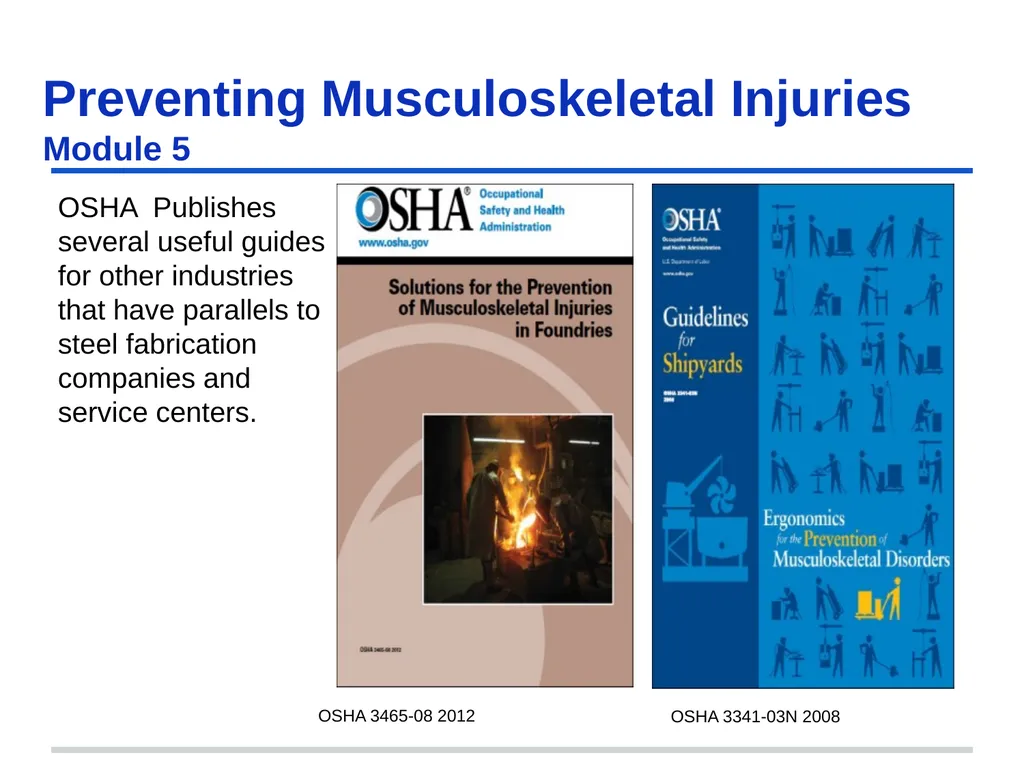
Module 5 slide 44 OSHA 3465-08 2012 OSHA 3341-03N 2008 OSHA Publishes several useful guides
for other industries that have parallels to steel fabrication companies and service centers.<br>
for other industries that have parallels to steel fabrication companies and service centers.<br>
45
Preventing Musculoskeletal Injuries
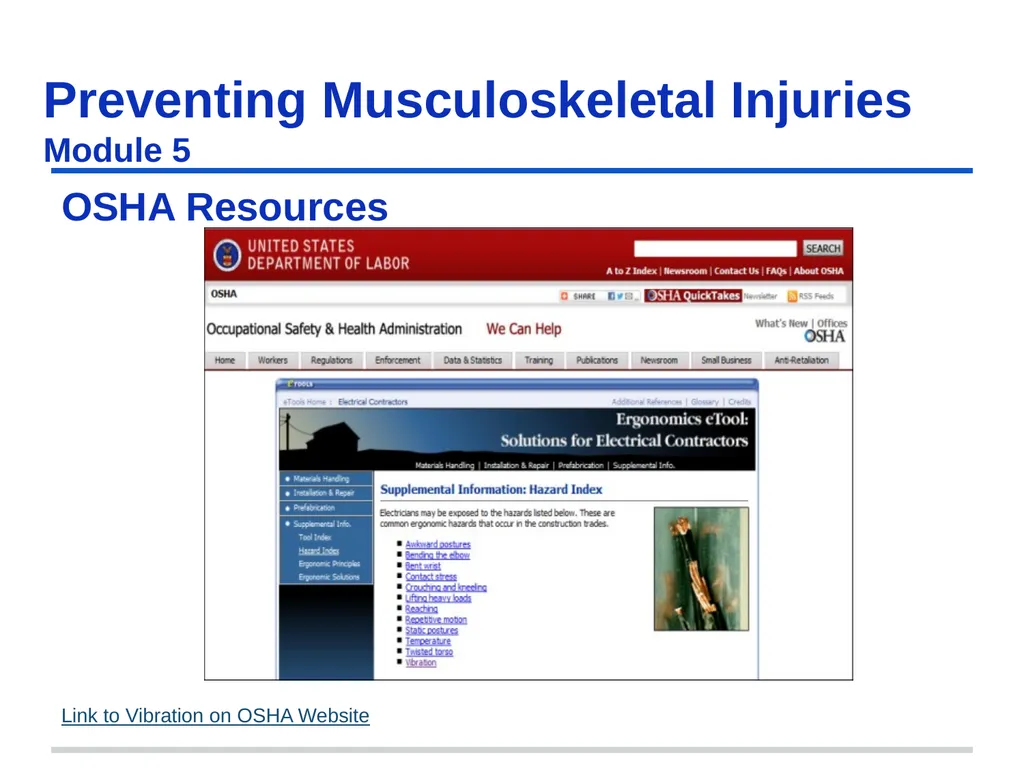
Module 5 slide 45 OSHA Resources Link to Vibration on OSHA Website<br>
46
Preventing Musculoskeletal Injuries
Module 5 slide 46 Summary Key Points
“Use your brain, not your back.
Work smarter, not harder.
Fix the job, not the worker.
Use safe ergonomic habits at home” Source: CIANBRO<br>
“Use your brain, not your back.
Work smarter, not harder.
Fix the job, not the worker.
Use safe ergonomic habits at home” Source: CIANBRO<br>
47
Sources
Link to grant training material on injury prevention
Link to Ergonomics on OSHA Website
Link to Solutions to Control Hazards on OSHA Website
Link to Server Error (File not Found)
Link to Server Error (File not Found)
Link to OSHA Publication 3465
Link to grant training materials - jeopardy game
Link to bulletin Standaup Forklift Under-ride Hazards
Link to Computer Workstattions eTool
Link to Ergonomics Training on OSHA Website
Link to Trucking Industry on OSHA Website
lwww.safetyservicescompany.com/.../warehouse-safety-general-guide. OSHA
CIANBROSafety Bulletin-Ergonomics
Grandjean E. “Fitting the task to the Man”, Taylor & Francis London, 1988
Lauren Hebert, “Personal Ergonomic Guide material handling Low Back Tasks”
Construction Occupational Health Program, UMass Module 5 Musculoskeletal Safety<br>
Link to grant training material on injury prevention
Link to Ergonomics on OSHA Website
Link to Solutions to Control Hazards on OSHA Website
Link to Server Error (File not Found)
Link to Server Error (File not Found)
Link to OSHA Publication 3465
Link to grant training materials - jeopardy game
Link to bulletin Standaup Forklift Under-ride Hazards
Link to Computer Workstattions eTool
Link to Ergonomics Training on OSHA Website
Link to Trucking Industry on OSHA Website
lwww.safetyservicescompany.com/.../warehouse-safety-general-guide. OSHA
CIANBROSafety Bulletin-Ergonomics
Grandjean E. “Fitting the task to the Man”, Taylor & Francis London, 1988
Lauren Hebert, “Personal Ergonomic Guide material handling Low Back Tasks”
Construction Occupational Health Program, UMass Module 5 Musculoskeletal Safety<br>
48
Musculoskeletal Safety
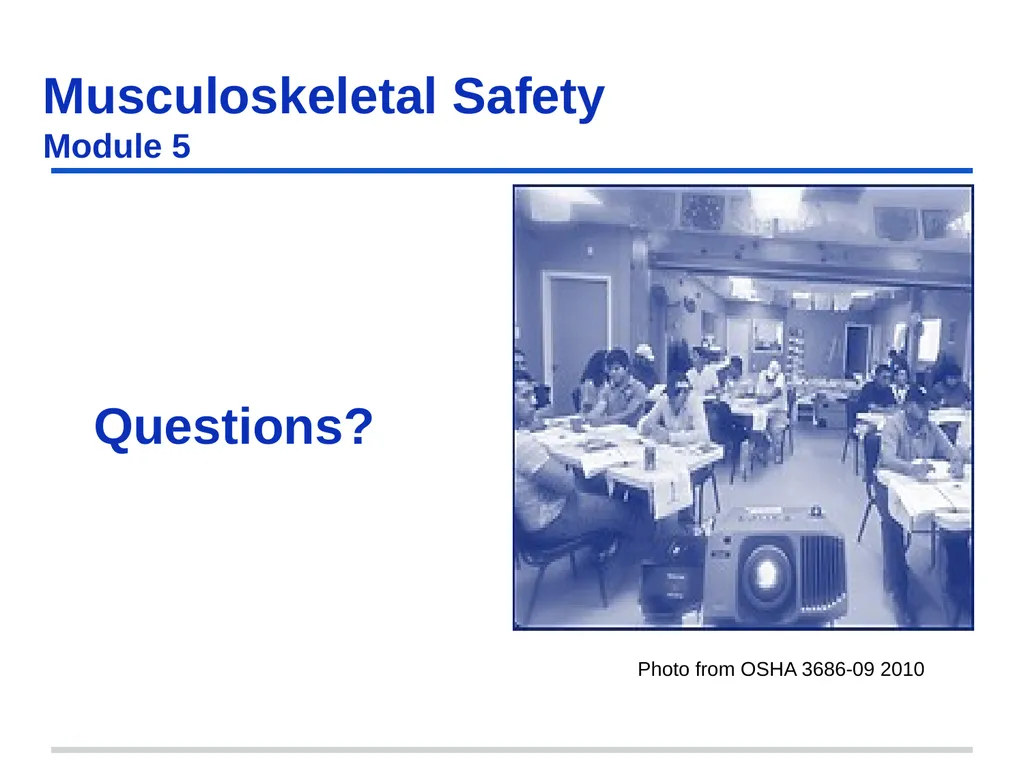
Module 5 Questions? Photo from OSHA 3686-09 2010<br>