
Price Index Module 16: Price Index Session IV 3
AM
Published · 32 slides · 0 views

1 / 1
Description
Price Index Module 16: Price Index Session IV 3 Contents Session IV Constructing Price Index - Part I Issues involved Price Index Purpose, Scope and Coverage Periodicity and Timeliness Constructing Price Index Issues involved 5
Related Topics
Share
Embed code
Download this presentation From Below
"Price Index Module 16: Price Index Session IV 3" is the property of its rightful owner. Permission is granted to download and print the materials on this website for personal, non-commercial use only, and to display it on your personal computer provided you do not modify the materials and that you retain all copyright notices contained in the materials. By downloading content from our website, you accept the terms of this agreement.
Presentation Transcript
01
Price Index<br>
02
Module 16: Price Index Session IV<br>
03
3 Contents – Session IV Constructing Price Index - Part I
Issues involved
Price Index – Purpose, Scope and Coverage
Periodicity and Timeliness<br>
Issues involved
Price Index – Purpose, Scope and Coverage
Periodicity and Timeliness<br>
04
Constructing Price Index
– Issues involved<br>
– Issues involved<br>
05
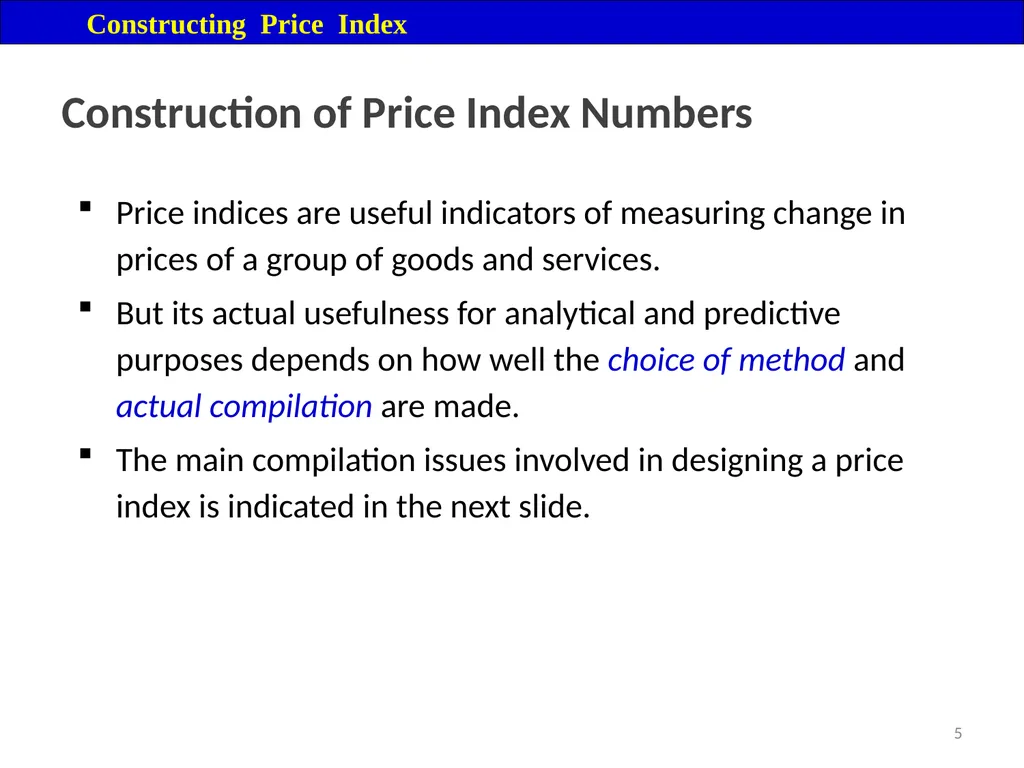
5 Construction of Price Index Numbers Price indices are useful indicators of measuring change in prices of a group of goods and services.
But its actual usefulness for analytical and predictive purposes depends on how well the choice of method and actual compilation are made.
The main compilation issues involved in designing a price index is indicated in the next slide. Constructing Price Index<br>
But its actual usefulness for analytical and predictive purposes depends on how well the choice of method and actual compilation are made.
The main compilation issues involved in designing a price index is indicated in the next slide. Constructing Price Index<br>
06
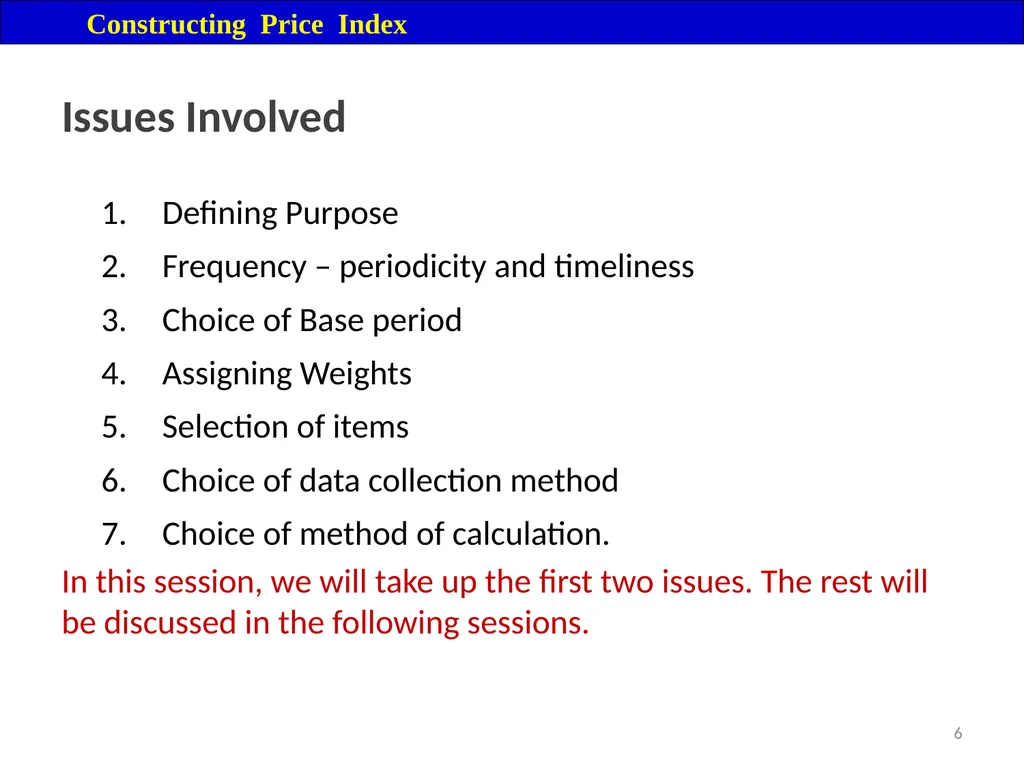
6 Issues Involved Defining Purpose
Frequency – periodicity and timeliness
Choice of Base period
Assigning Weights
Selection of items
Choice of data collection method
Choice of method of calculation.
In this session, we will take up the first two issues. The rest will be discussed in the following sessions. Constructing Price Index<br>
Frequency – periodicity and timeliness
Choice of Base period
Assigning Weights
Selection of items
Choice of data collection method
Choice of method of calculation.
In this session, we will take up the first two issues. The rest will be discussed in the following sessions. Constructing Price Index<br>
07
Price Index – Purpose, Scope and Coverage
Price Index – as a Measure of Inflation
Price index relating to standard of living
Purpose served by a price index
Scope and coverage of Price Index<br>
Price Index – as a Measure of Inflation
Price index relating to standard of living
Purpose served by a price index
Scope and coverage of Price Index<br>
08
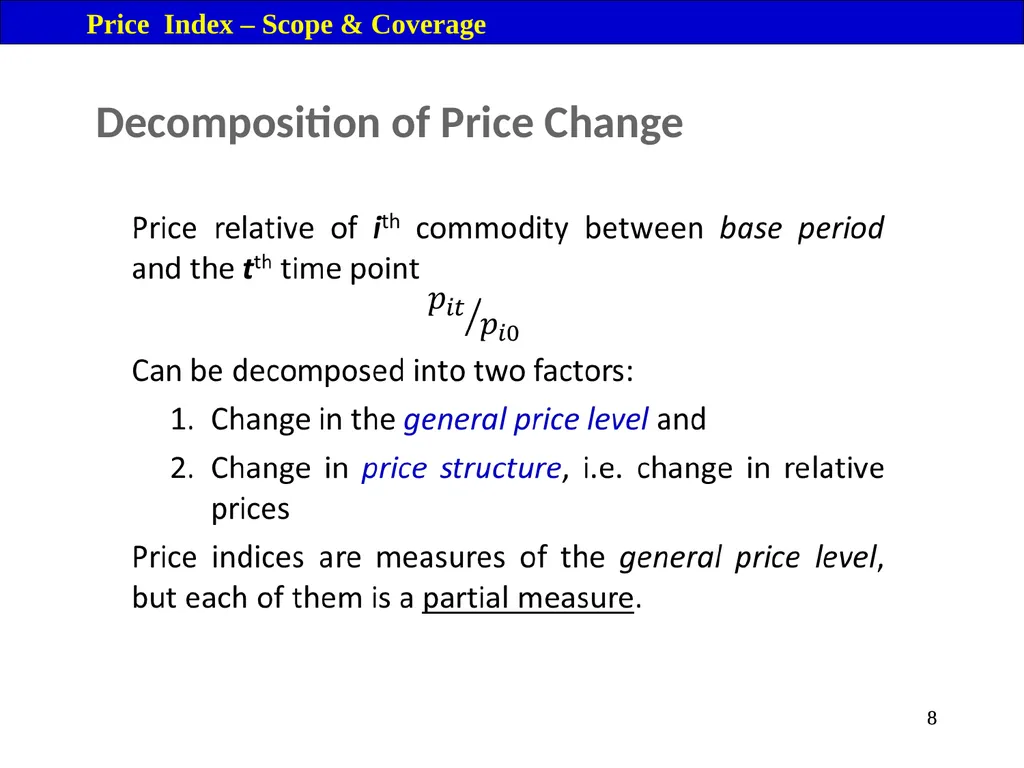
Decomposition of Price Change 8 8 Price Index – Scope & Coverage<br>
09
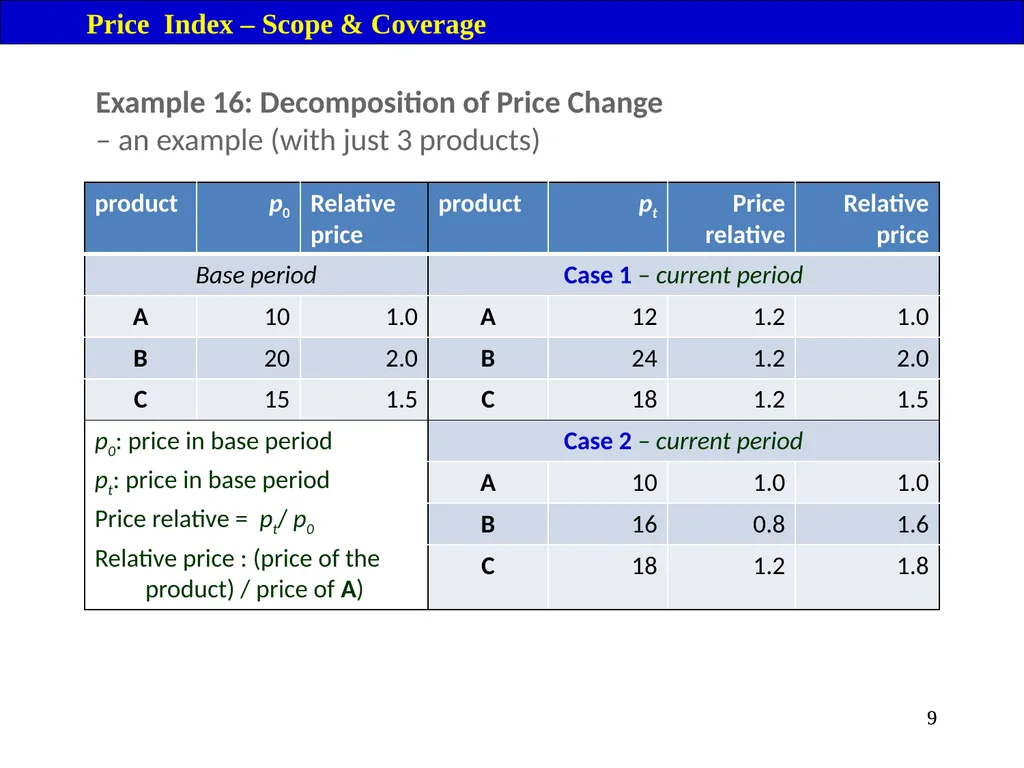
Example 16: Decomposition of Price Change
– an example (with just 3 products) 9 9 Price Index – Scope & Coverage<br>
10
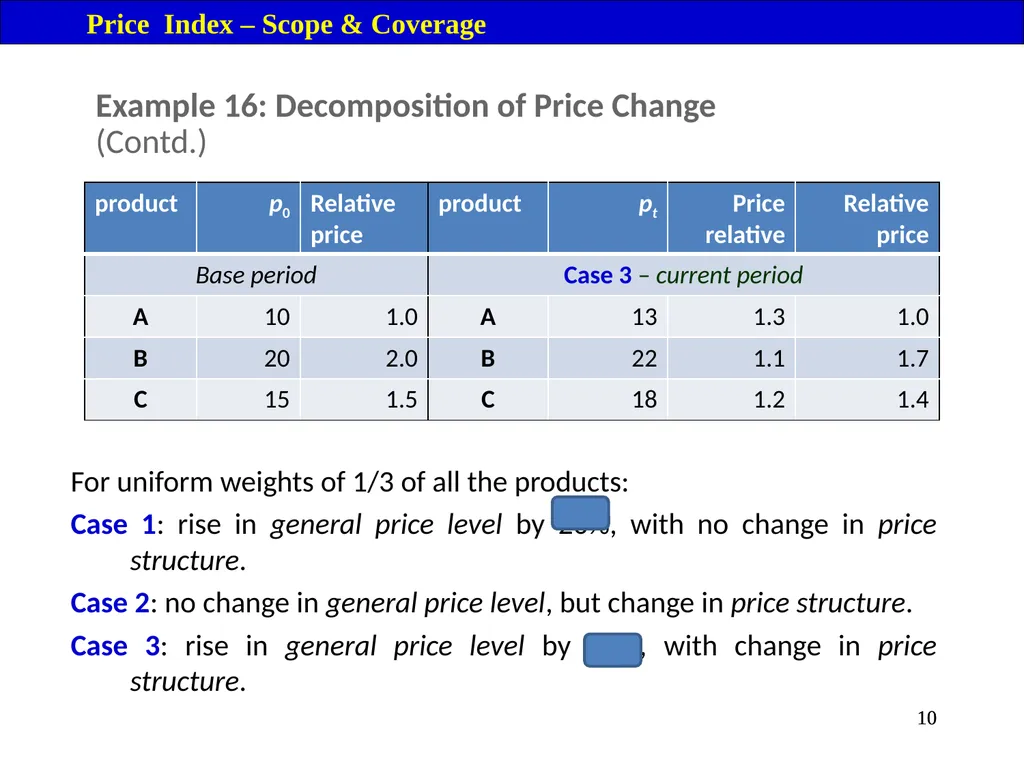
Example 16: Decomposition of Price Change (Contd.) For uniform weights of 1/3 of all the products:
Case 1: rise in general price level by 20%, with no change in price structure.
Case 2: no change in general price level, but change in price structure.
Case 3: rise in general price level by 20%, with change in price structure. 10 10 Price Index – Scope & Coverage<br>
Case 1: rise in general price level by 20%, with no change in price structure.
Case 2: no change in general price level, but change in price structure.
Case 3: rise in general price level by 20%, with change in price structure. 10 10 Price Index – Scope & Coverage<br>
11
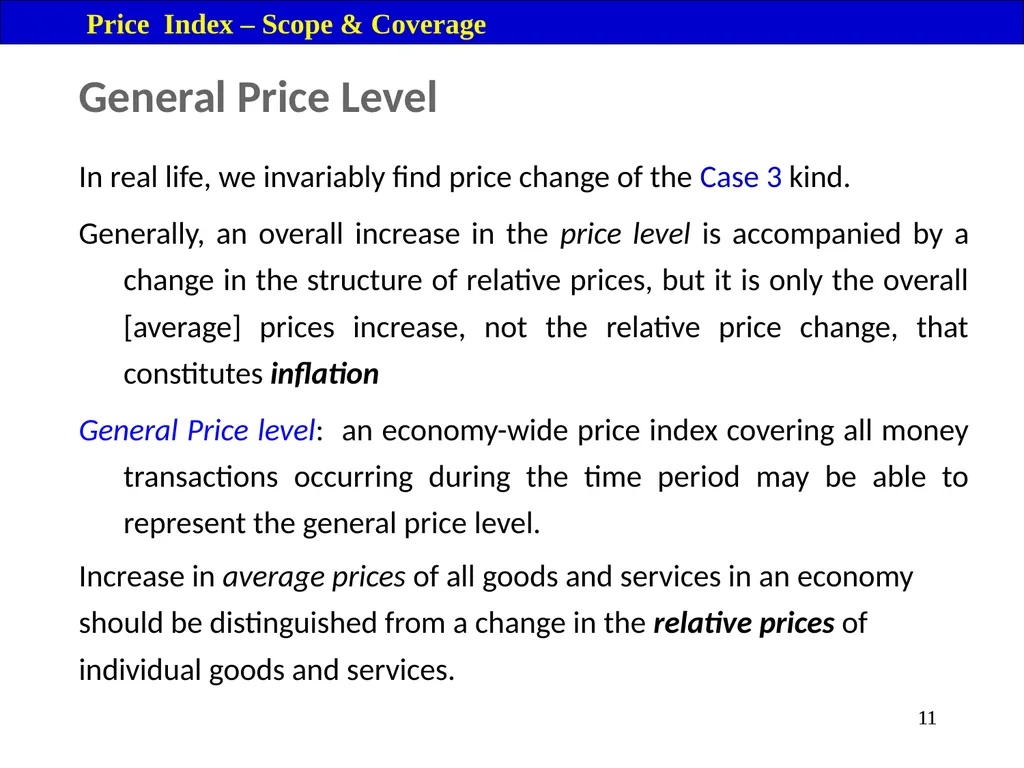
General Price Level In real life, we invariably find price change of the Case 3 kind.
Generally, an overall increase in the price level is accompanied by a change in the structure of relative prices, but it is only the overall [average] prices increase, not the relative price change, that constitutes inflation
General Price level: an economy-wide price index covering all money transactions occurring during the time period may be able to represent the general price level.
Increase in average prices of all goods and services in an economy should be distinguished from a change in the relative prices of individual goods and services. 11 11 Price Index – Scope & Coverage<br>
Generally, an overall increase in the price level is accompanied by a change in the structure of relative prices, but it is only the overall [average] prices increase, not the relative price change, that constitutes inflation
General Price level: an economy-wide price index covering all money transactions occurring during the time period may be able to represent the general price level.
Increase in average prices of all goods and services in an economy should be distinguished from a change in the relative prices of individual goods and services. 11 11 Price Index – Scope & Coverage<br>
12
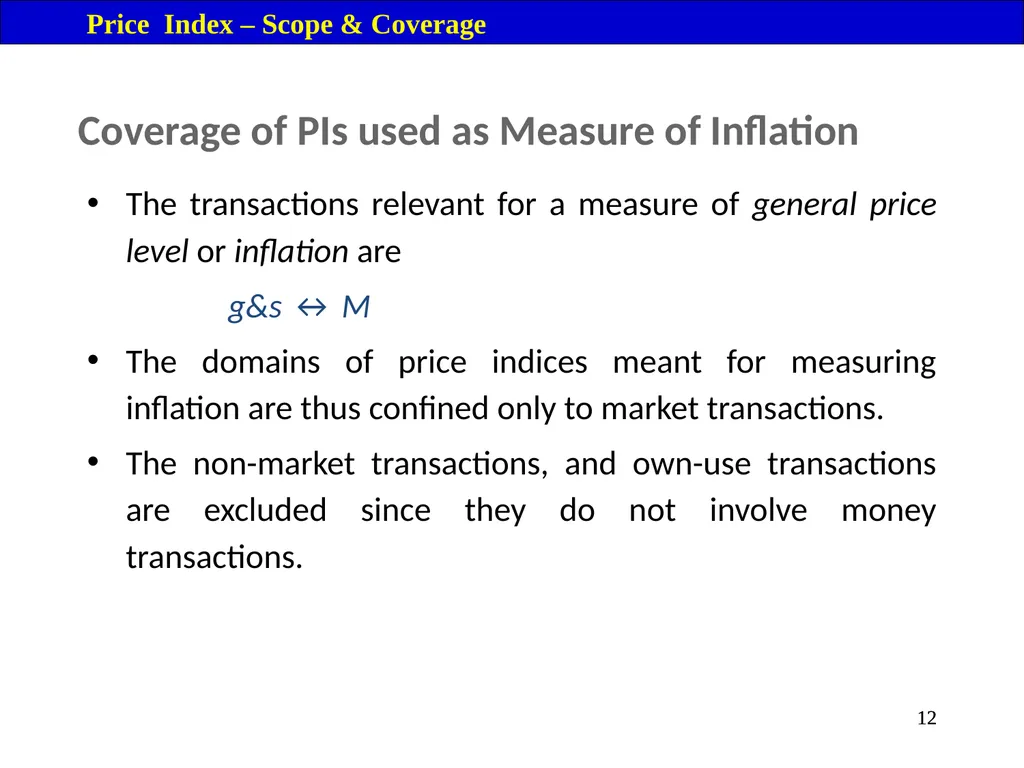
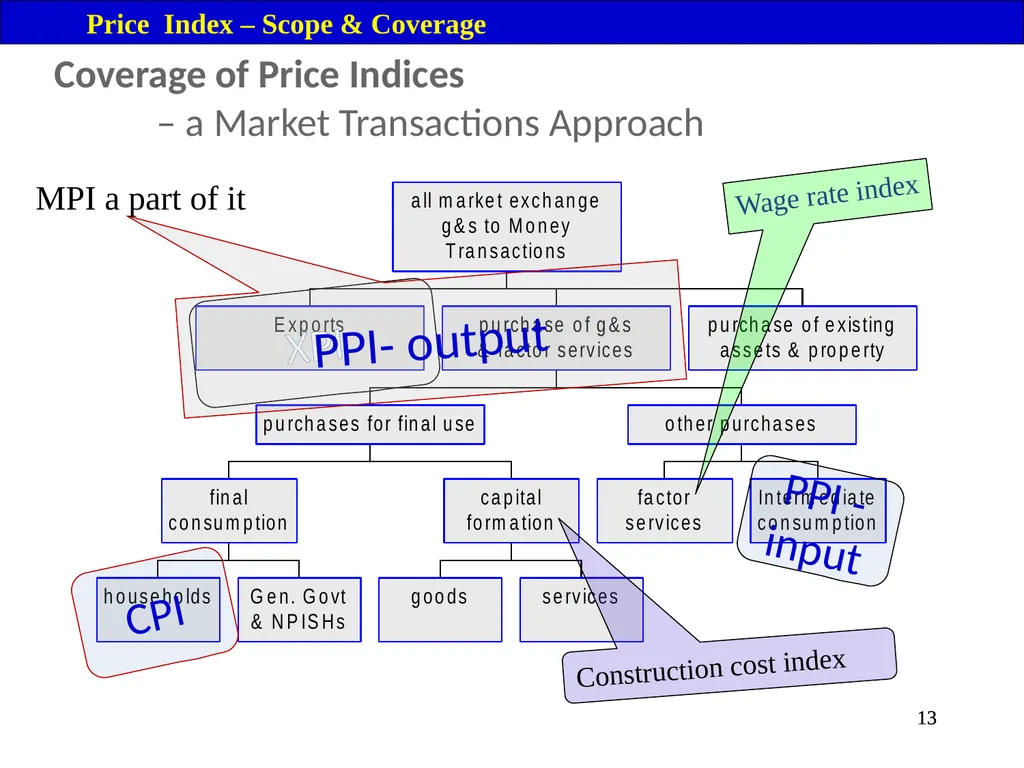
Coverage of PIs used as Measure of Inflation The transactions relevant for a measure of general price level or inflation are
g&s ↔ M
The domains of price indices meant for measuring inflation are thus confined only to market transactions.
The non-market transactions, and own-use transactions are excluded since they do not involve money transactions. 12 12 Price Index – Scope & Coverage<br>
g&s ↔ M
The domains of price indices meant for measuring inflation are thus confined only to market transactions.
The non-market transactions, and own-use transactions are excluded since they do not involve money transactions. 12 12 Price Index – Scope & Coverage<br>
13
Coverage of Price Indices
– a Market Transactions Approach 13 13 CPI PPI - input XPI Wage rate index Construction cost index PPI- output MPI a part of it Price Index – Scope & Coverage<br>
14
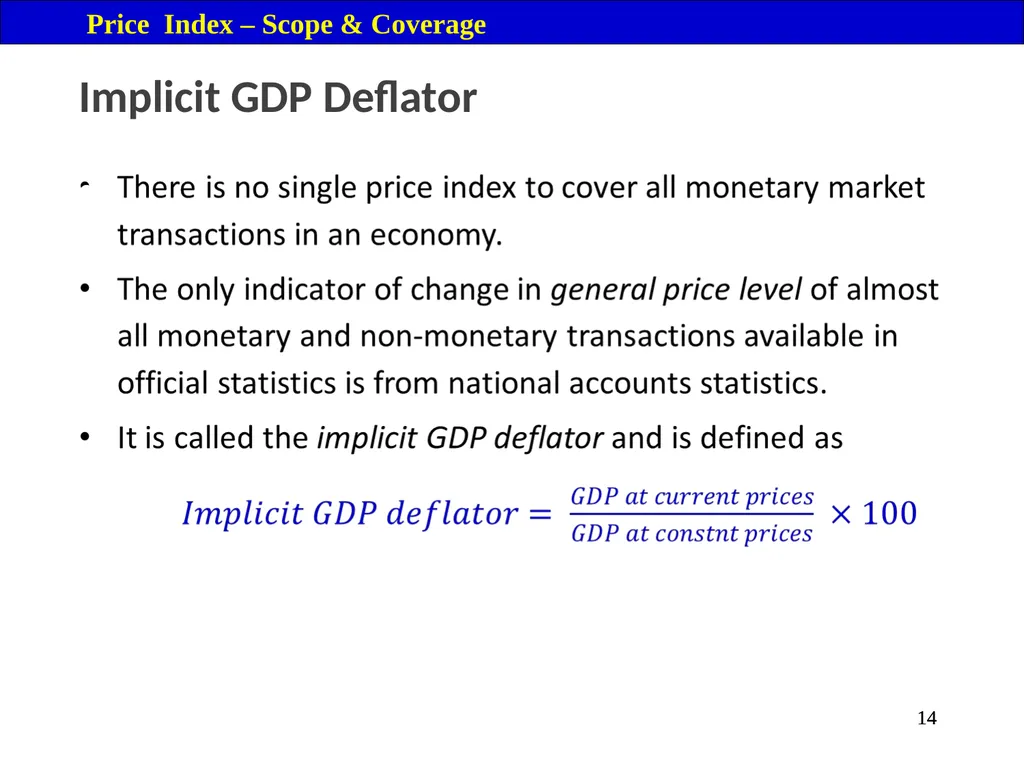
Implicit GDP Deflator 14 14 Price Index – Scope & Coverage<br>
15
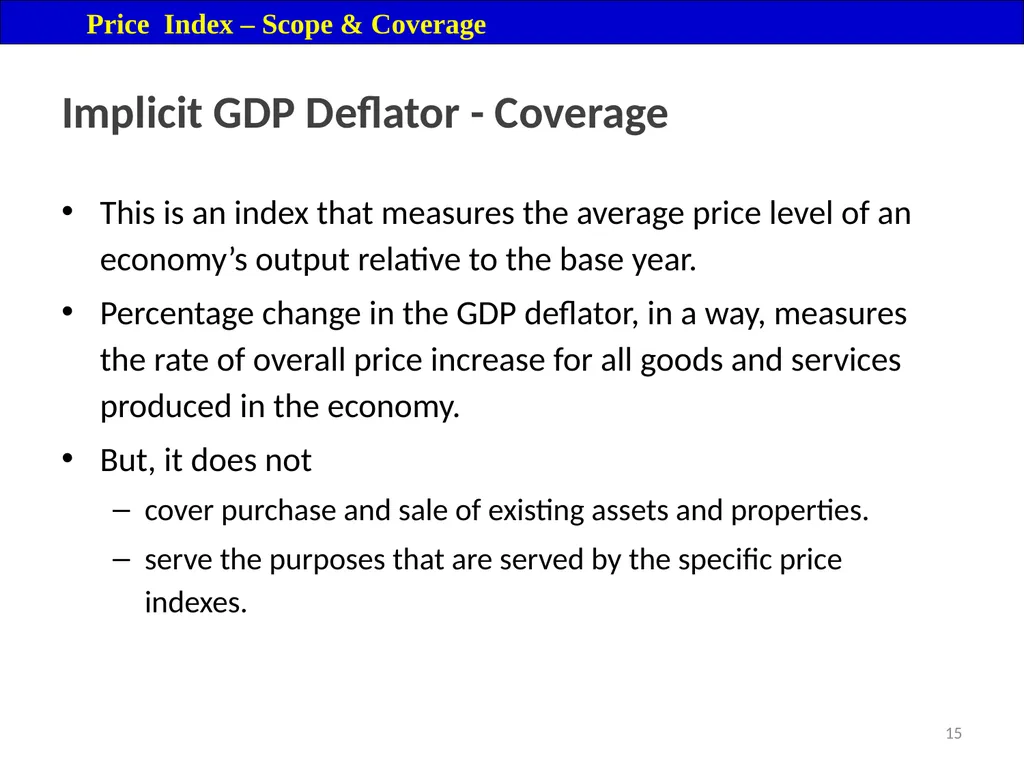
15 Implicit GDP Deflator - Coverage This is an index that measures the average price level of an economy’s output relative to the base year.
Percentage change in the GDP deflator, in a way, measures the rate of overall price increase for all goods and services produced in the economy.
But, it does not
cover purchase and sale of existing assets and properties.
serve the purposes that are served by the specific price indexes. Price Index – Scope & Coverage<br>
Percentage change in the GDP deflator, in a way, measures the rate of overall price increase for all goods and services produced in the economy.
But, it does not
cover purchase and sale of existing assets and properties.
serve the purposes that are served by the specific price indexes. Price Index – Scope & Coverage<br>
16
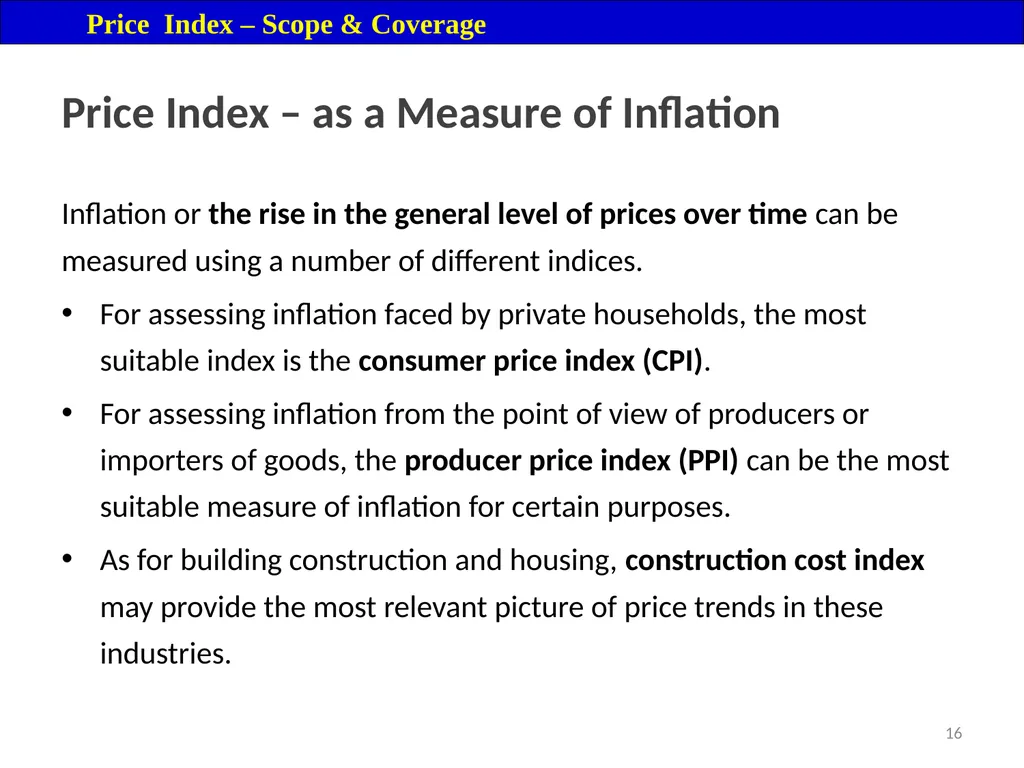
16 Price Index – as a Measure of Inflation Inflation or the rise in the general level of prices over time can be measured using a number of different indices.
For assessing inflation faced by private households, the most suitable index is the consumer price index (CPI).
For assessing inflation from the point of view of producers or importers of goods, the producer price index (PPI) can be the most suitable measure of inflation for certain purposes.
As for building construction and housing, construction cost index may provide the most relevant picture of price trends in these industries. Price Index – Scope & Coverage<br>
For assessing inflation faced by private households, the most suitable index is the consumer price index (CPI).
For assessing inflation from the point of view of producers or importers of goods, the producer price index (PPI) can be the most suitable measure of inflation for certain purposes.
As for building construction and housing, construction cost index may provide the most relevant picture of price trends in these industries. Price Index – Scope & Coverage<br>
17
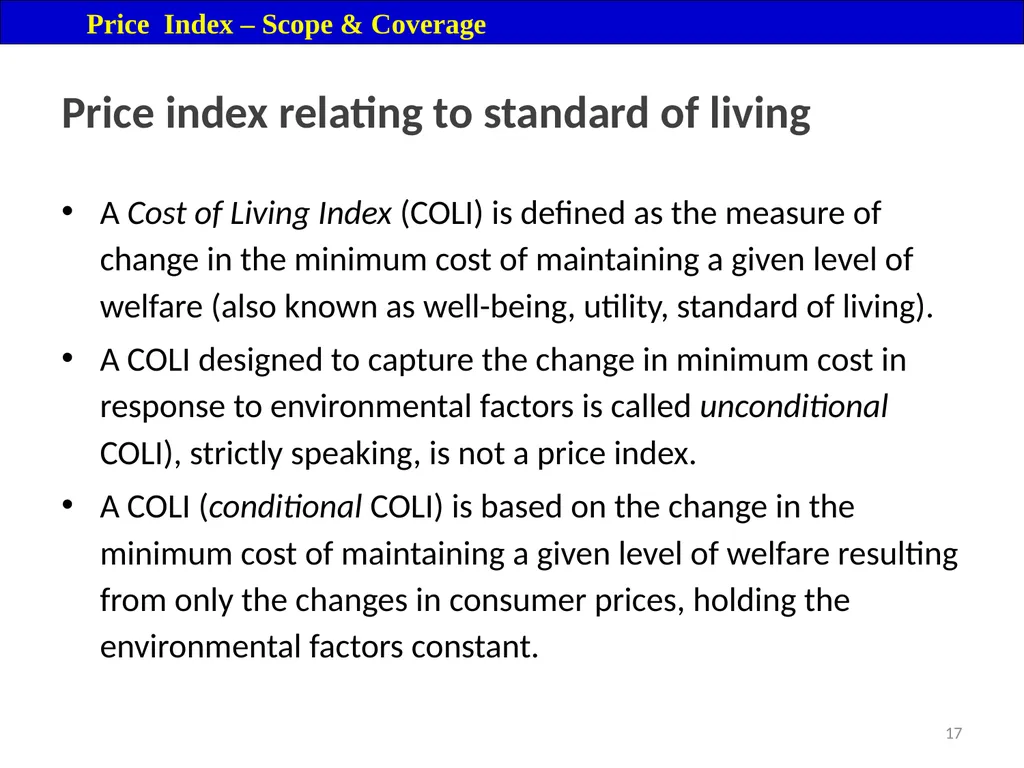
17 Price index relating to standard of living A Cost of Living Index (COLI) is defined as the measure of change in the minimum cost of maintaining a given level of welfare (also known as well-being, utility, standard of living).
A COLI designed to capture the change in minimum cost in response to environmental factors is called unconditional COLI), strictly speaking, is not a price index.
A COLI (conditional COLI) is based on the change in the minimum cost of maintaining a given level of welfare resulting from only the changes in consumer prices, holding the environmental factors constant. Price Index – Scope & Coverage<br>
A COLI designed to capture the change in minimum cost in response to environmental factors is called unconditional COLI), strictly speaking, is not a price index.
A COLI (conditional COLI) is based on the change in the minimum cost of maintaining a given level of welfare resulting from only the changes in consumer prices, holding the environmental factors constant. Price Index – Scope & Coverage<br>
18
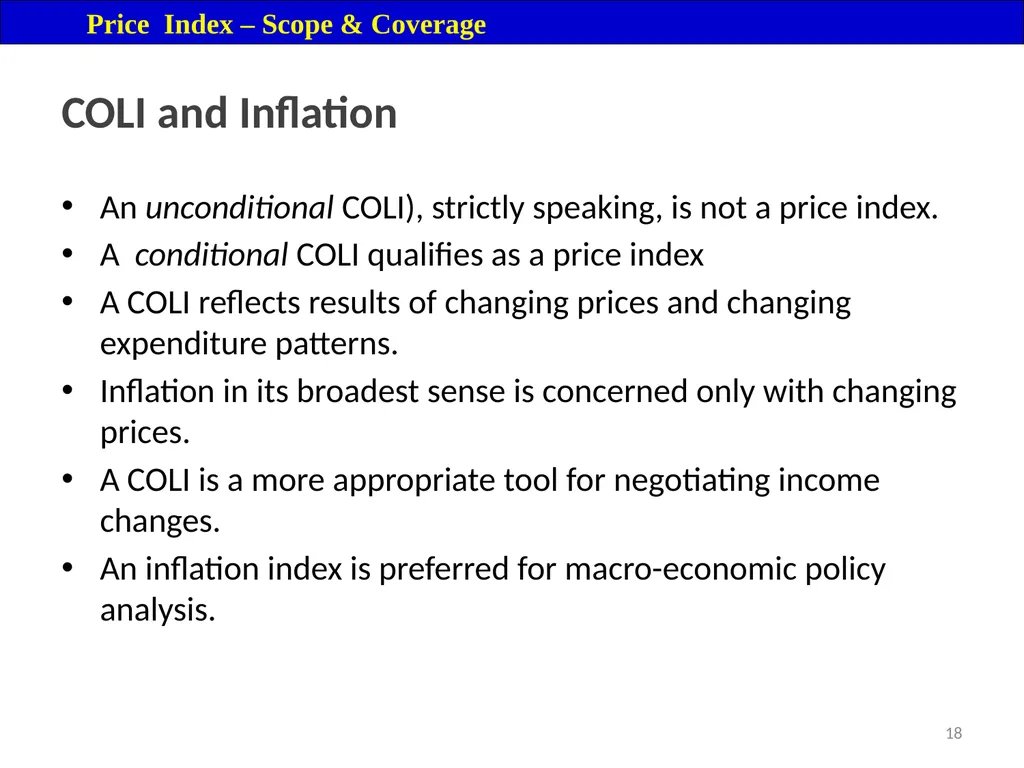
18 COLI and Inflation An unconditional COLI), strictly speaking, is not a price index.
A conditional COLI qualifies as a price index
A COLI reflects results of changing prices and changing expenditure patterns.
Inflation in its broadest sense is concerned only with changing prices.
A COLI is a more appropriate tool for negotiating income changes.
An inflation index is preferred for macro-economic policy analysis. Price Index – Scope & Coverage<br>
A conditional COLI qualifies as a price index
A COLI reflects results of changing prices and changing expenditure patterns.
Inflation in its broadest sense is concerned only with changing prices.
A COLI is a more appropriate tool for negotiating income changes.
An inflation index is preferred for macro-economic policy analysis. Price Index – Scope & Coverage<br>
19
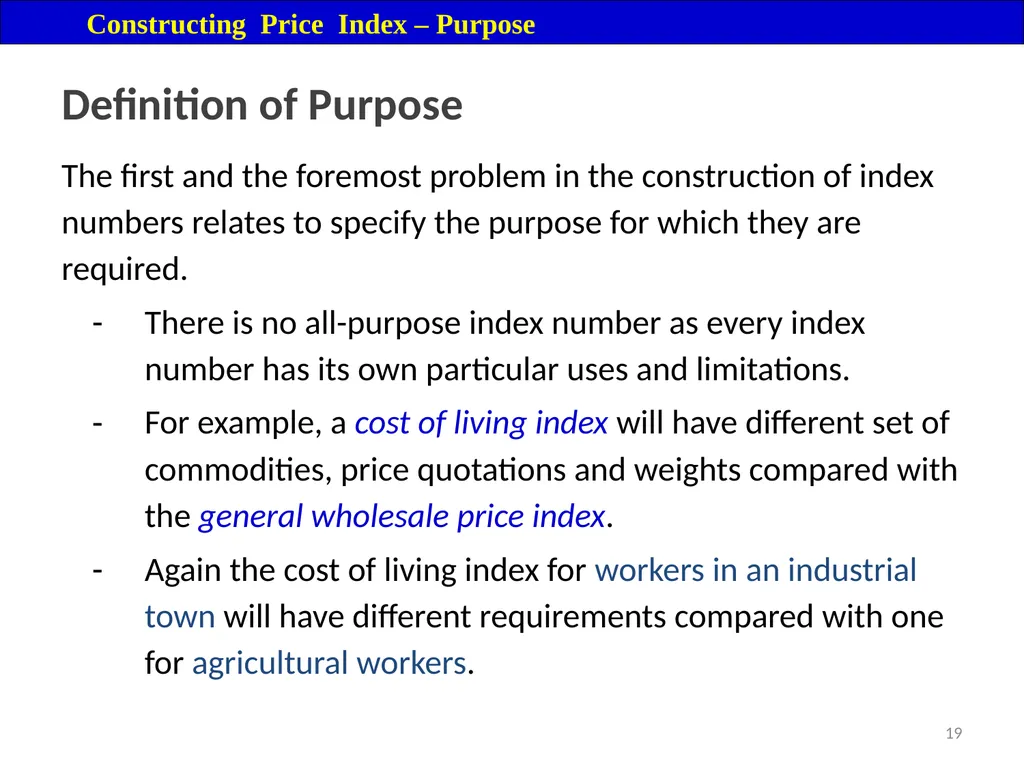
19 Definition of Purpose The first and the foremost problem in the construction of index numbers relates to specify the purpose for which they are required.
There is no all-purpose index number as every index number has its own particular uses and limitations.
For example, a cost of living index will have different set of commodities, price quotations and weights compared with the general wholesale price index.
Again the cost of living index for workers in an industrial town will have different requirements compared with one for agricultural workers. Constructing Price Index – Purpose<br>
There is no all-purpose index number as every index number has its own particular uses and limitations.
For example, a cost of living index will have different set of commodities, price quotations and weights compared with the general wholesale price index.
Again the cost of living index for workers in an industrial town will have different requirements compared with one for agricultural workers. Constructing Price Index – Purpose<br>
20
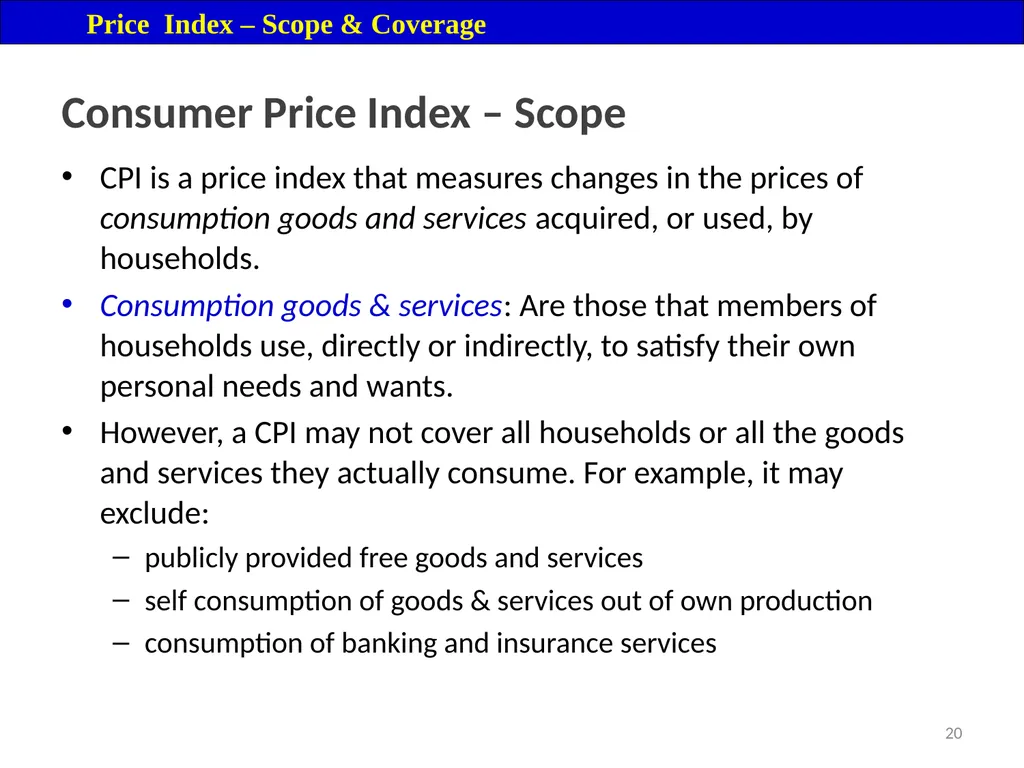
20 Consumer Price Index – Scope CPI is a price index that measures changes in the prices of consumption goods and services acquired, or used, by households.
Consumption goods & services: Are those that members of households use, directly or indirectly, to satisfy their own personal needs and wants.
However, a CPI may not cover all households or all the goods and services they actually consume. For example, it may exclude:
publicly provided free goods and services
self consumption of goods & services out of own production
consumption of banking and insurance services Price Index – Scope & Coverage<br>
Consumption goods & services: Are those that members of households use, directly or indirectly, to satisfy their own personal needs and wants.
However, a CPI may not cover all households or all the goods and services they actually consume. For example, it may exclude:
publicly provided free goods and services
self consumption of goods & services out of own production
consumption of banking and insurance services Price Index – Scope & Coverage<br>
21
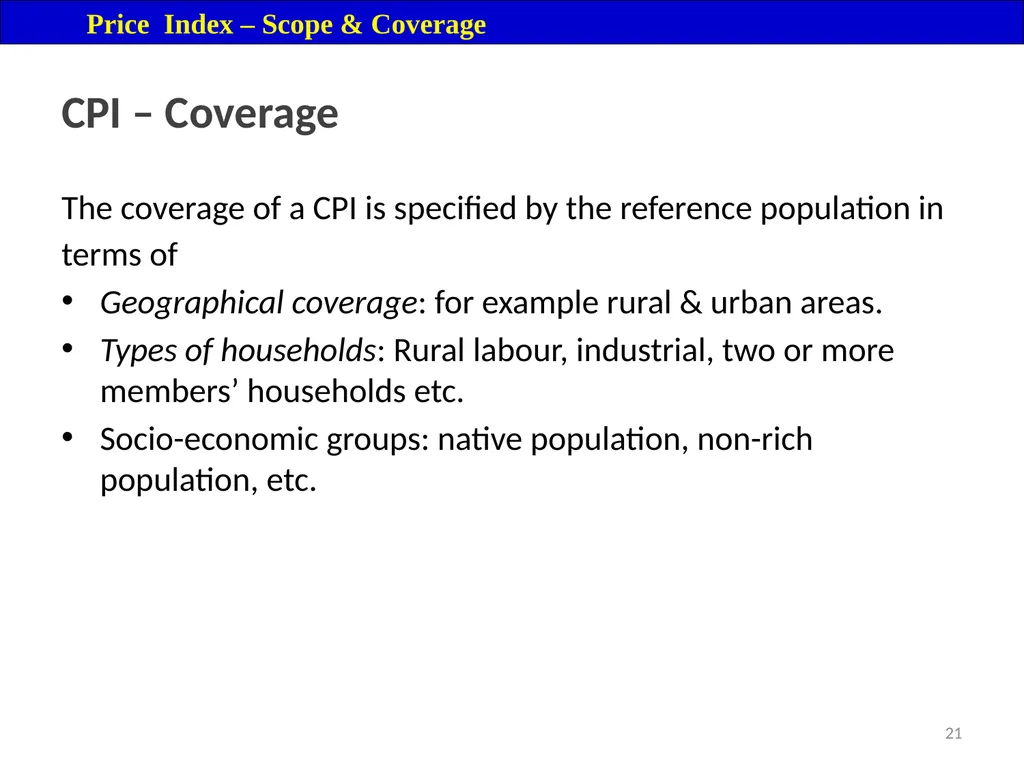
21 CPI – Coverage The coverage of a CPI is specified by the reference population in terms of
Geographical coverage: for example rural & urban areas.
Types of households: Rural labour, industrial, two or more members’ households etc.
Socio-economic groups: native population, non-rich population, etc. Price Index – Scope & Coverage<br>
Geographical coverage: for example rural & urban areas.
Types of households: Rural labour, industrial, two or more members’ households etc.
Socio-economic groups: native population, non-rich population, etc. Price Index – Scope & Coverage<br>
22
22 Producer Price Index – Scope & Coverage (1) PPIs provide measures of average movements of prices received (or paid) by the producers of commodities.
The scope of PPIs varies – they generally reflect the changes in prices received (or paid) by a definable industry such as manufacturing, agriculture or mining. Price Index – Scope & Coverage<br>
The scope of PPIs varies – they generally reflect the changes in prices received (or paid) by a definable industry such as manufacturing, agriculture or mining. Price Index – Scope & Coverage<br>
23
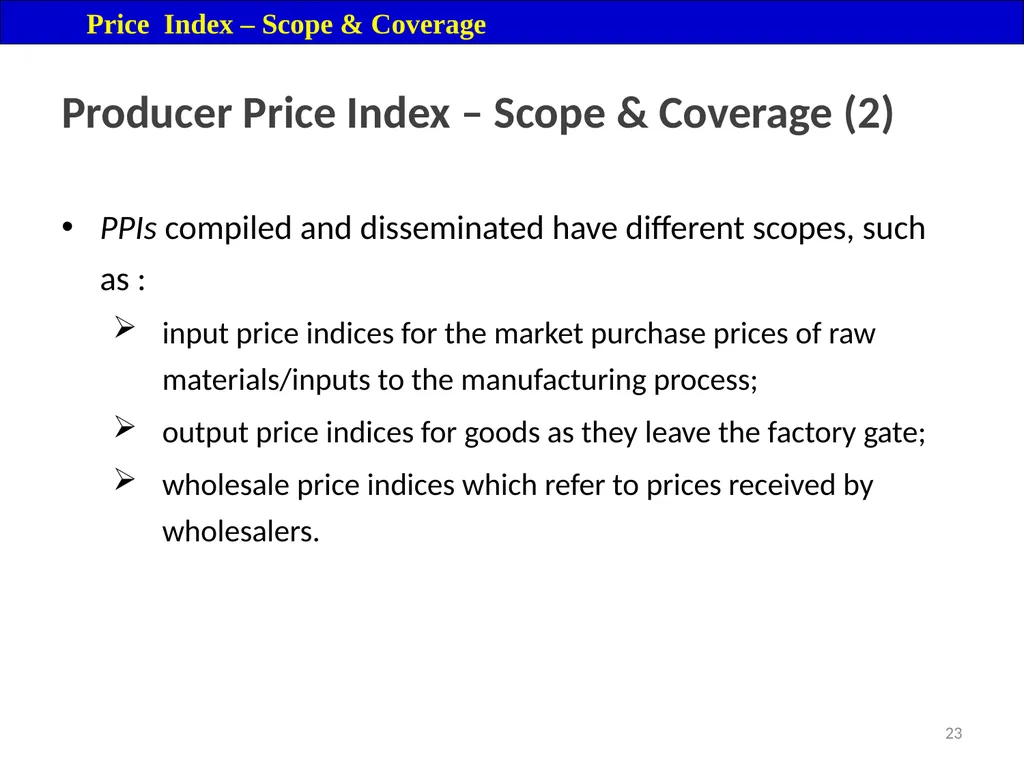
23 Producer Price Index – Scope & Coverage (2) PPIs compiled and disseminated have different scopes, such as :
input price indices for the market purchase prices of raw materials/inputs to the manufacturing process;
output price indices for goods as they leave the factory gate;
wholesale price indices which refer to prices received by wholesalers. Price Index – Scope & Coverage<br>
input price indices for the market purchase prices of raw materials/inputs to the manufacturing process;
output price indices for goods as they leave the factory gate;
wholesale price indices which refer to prices received by wholesalers. Price Index – Scope & Coverage<br>
24
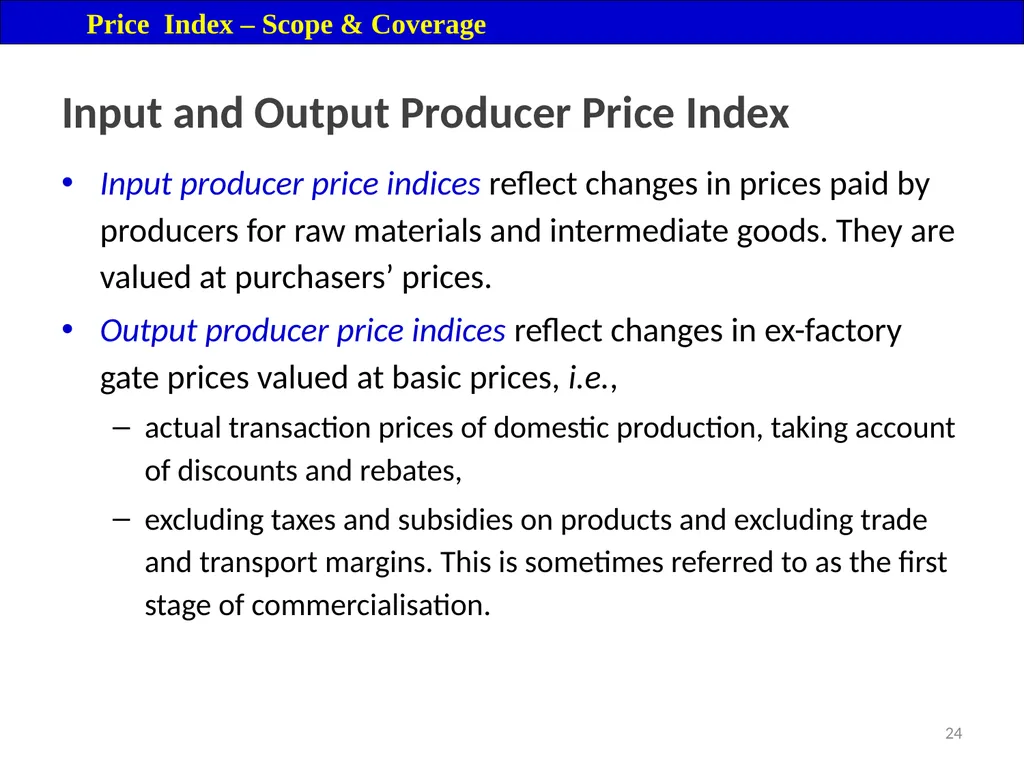
24 Input and Output Producer Price Index Input producer price indices reflect changes in prices paid by producers for raw materials and intermediate goods. They are valued at purchasers’ prices.
Output producer price indices reflect changes in ex-factory gate prices valued at basic prices, i.e.,
actual transaction prices of domestic production, taking account of discounts and rebates,
excluding taxes and subsidies on products and excluding trade and transport margins. This is sometimes referred to as the first stage of commercialisation. Price Index – Scope & Coverage<br>
Output producer price indices reflect changes in ex-factory gate prices valued at basic prices, i.e.,
actual transaction prices of domestic production, taking account of discounts and rebates,
excluding taxes and subsidies on products and excluding trade and transport margins. This is sometimes referred to as the first stage of commercialisation. Price Index – Scope & Coverage<br>
25
Price Index – Periodicity and timeliness
Reference period and reference time point
Timeliness<br>
Reference period and reference time point
Timeliness<br>
26
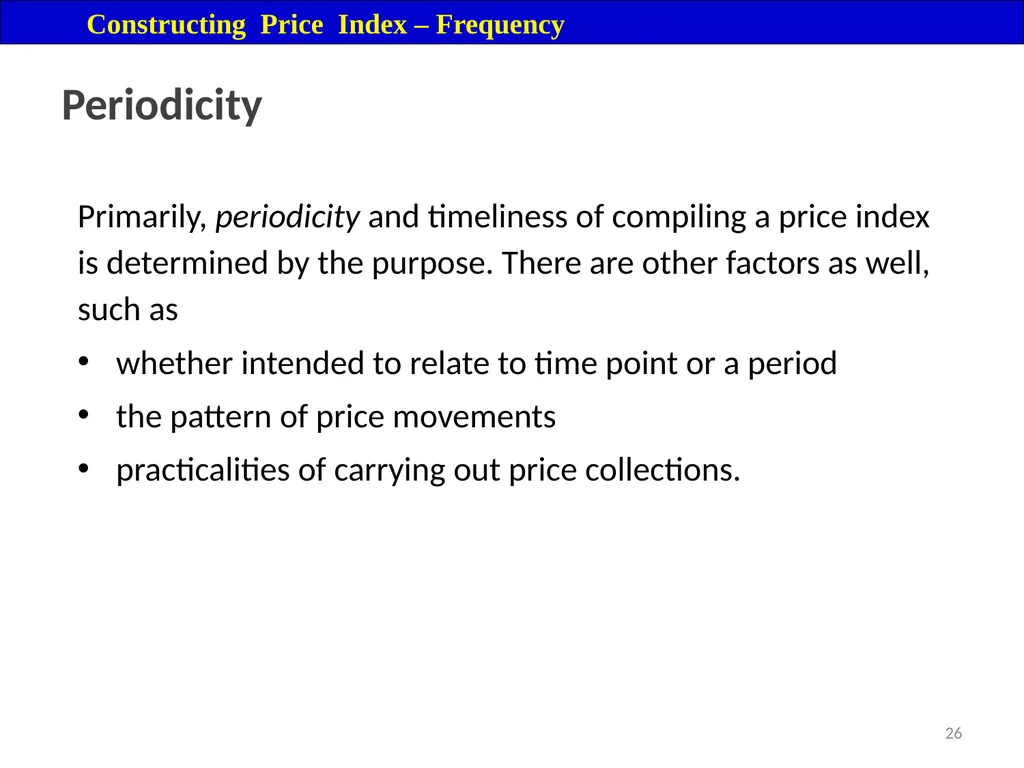
26 Periodicity Primarily, periodicity and timeliness of compiling a price index is determined by the purpose. There are other factors as well, such as
whether intended to relate to time point or a period
the pattern of price movements
practicalities of carrying out price collections. Constructing Price Index – Frequency<br>
whether intended to relate to time point or a period
the pattern of price movements
practicalities of carrying out price collections. Constructing Price Index – Frequency<br>
27
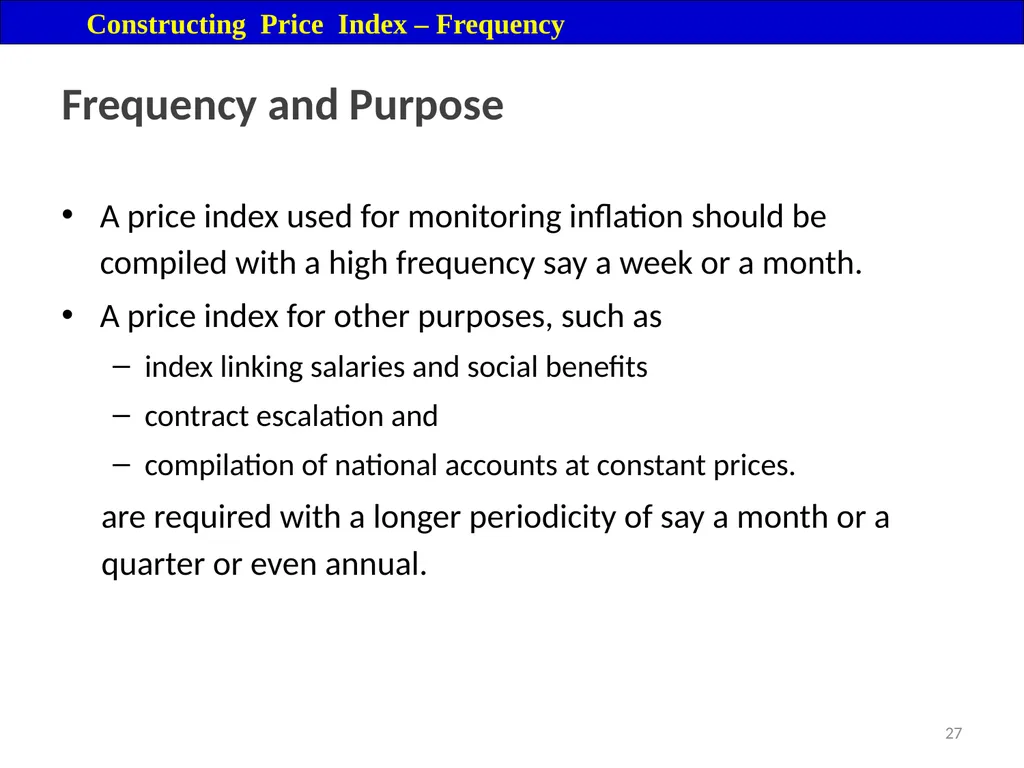
27 Frequency and Purpose A price index used for monitoring inflation should be compiled with a high frequency say a week or a month.
A price index for other purposes, such as
index linking salaries and social benefits
contract escalation and
compilation of national accounts at constant prices.
are required with a longer periodicity of say a month or a quarter or even annual. Constructing Price Index – Frequency<br>
A price index for other purposes, such as
index linking salaries and social benefits
contract escalation and
compilation of national accounts at constant prices.
are required with a longer periodicity of say a month or a quarter or even annual. Constructing Price Index – Frequency<br>
28
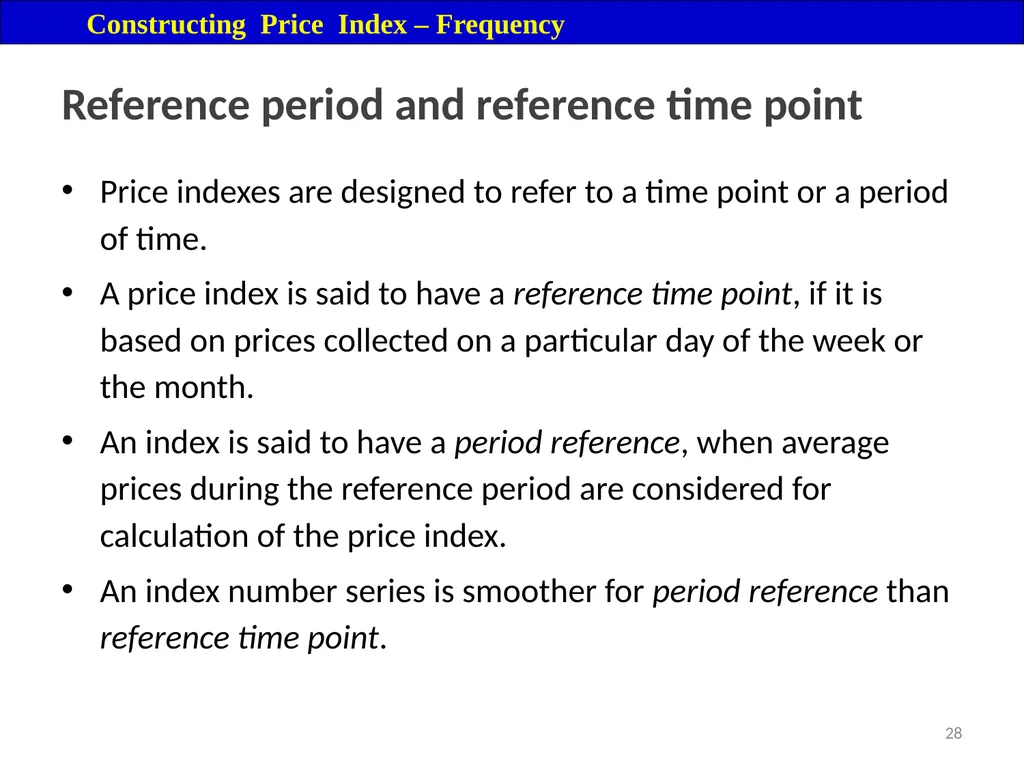
28 Reference period and reference time point Price indexes are designed to refer to a time point or a period of time.
A price index is said to have a reference time point, if it is based on prices collected on a particular day of the week or the month.
An index is said to have a period reference, when average prices during the reference period are considered for calculation of the price index.
An index number series is smoother for period reference than reference time point. Constructing Price Index – Frequency<br>
A price index is said to have a reference time point, if it is based on prices collected on a particular day of the week or the month.
An index is said to have a period reference, when average prices during the reference period are considered for calculation of the price index.
An index number series is smoother for period reference than reference time point. Constructing Price Index – Frequency<br>
29
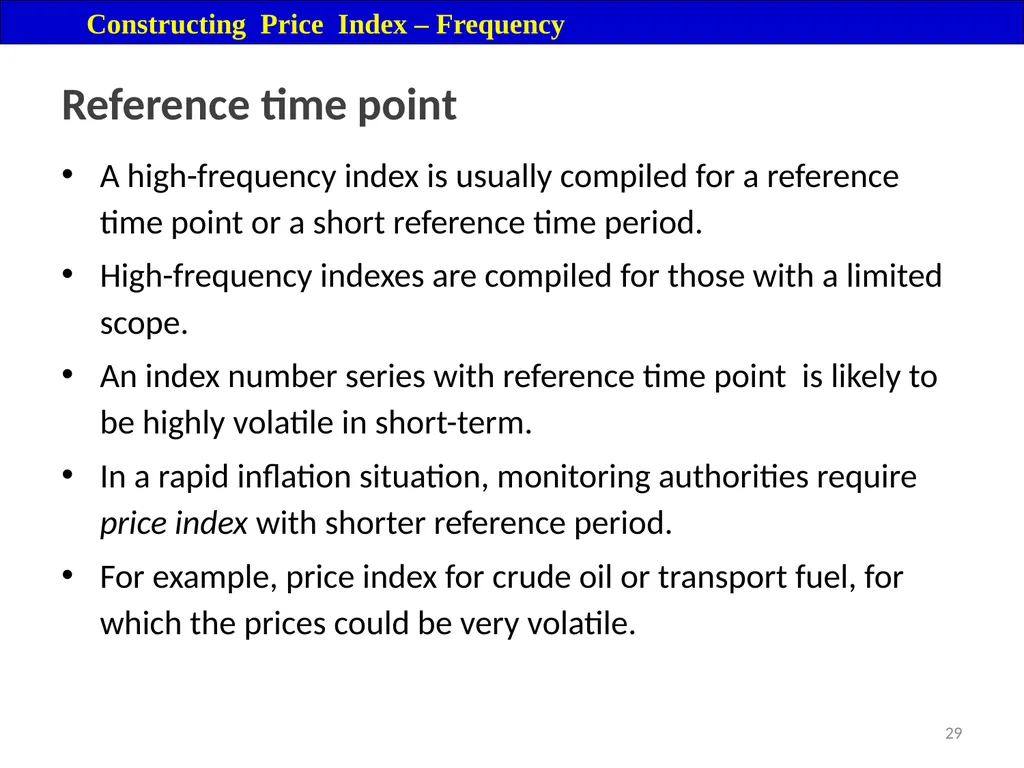
29 Reference time point A high-frequency index is usually compiled for a reference time point or a short reference time period.
High-frequency indexes are compiled for those with a limited scope.
An index number series with reference time point is likely to be highly volatile in short-term.
In a rapid inflation situation, monitoring authorities require price index with shorter reference period.
For example, price index for crude oil or transport fuel, for which the prices could be very volatile. Constructing Price Index – Frequency<br>
High-frequency indexes are compiled for those with a limited scope.
An index number series with reference time point is likely to be highly volatile in short-term.
In a rapid inflation situation, monitoring authorities require price index with shorter reference period.
For example, price index for crude oil or transport fuel, for which the prices could be very volatile. Constructing Price Index – Frequency<br>
30
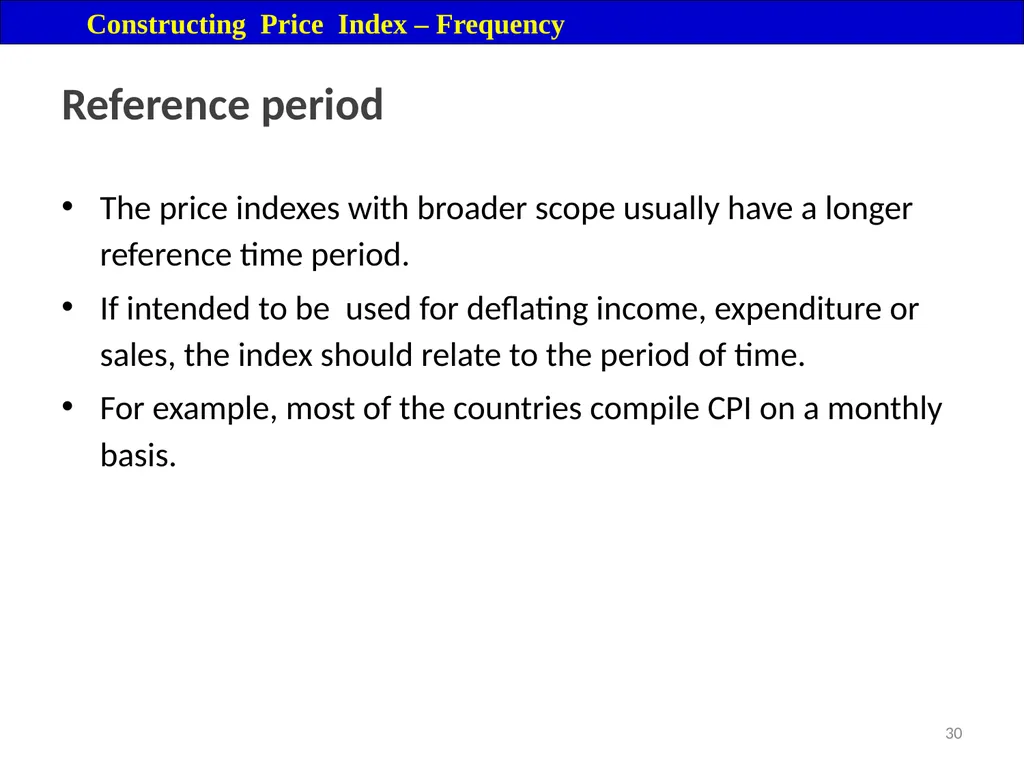
30 Reference period The price indexes with broader scope usually have a longer reference time period.
If intended to be used for deflating income, expenditure or sales, the index should relate to the period of time.
For example, most of the countries compile CPI on a monthly basis. Constructing Price Index – Frequency<br>
If intended to be used for deflating income, expenditure or sales, the index should relate to the period of time.
For example, most of the countries compile CPI on a monthly basis. Constructing Price Index – Frequency<br>
31
31 Timeliness The required timeliness of publishing a price index is closely linked to its frequency of compilation.
The high frequency price indexes – used for monitoring purposes – demand shorter time lag. Constructing Price Index – Frequency<br>
The high frequency price indexes – used for monitoring purposes – demand shorter time lag. Constructing Price Index – Frequency<br>
32
End of Session IV<br>