"PRIMARY TEETH OBJECTIVES : 1) Identify name ," is the property of its rightful owner. Permission is granted to
download and print the materials on this website for personal, non-commercial use only, and to display it
on your personal computer provided you do not modify the materials and that you retain all copyright
notices contained in the materials. By downloading content from our website, you accept the terms of this
agreement.
Share
Embed code
Presentation Transcript
01
PRIMARY TEETH<br>
02
OBJECTIVES : 1) Identify name , number , and eruption dates of primary teeth.
2) Describe functions of primary teeth.
3) Compare primary teeth to permanent teeth.<br>
03
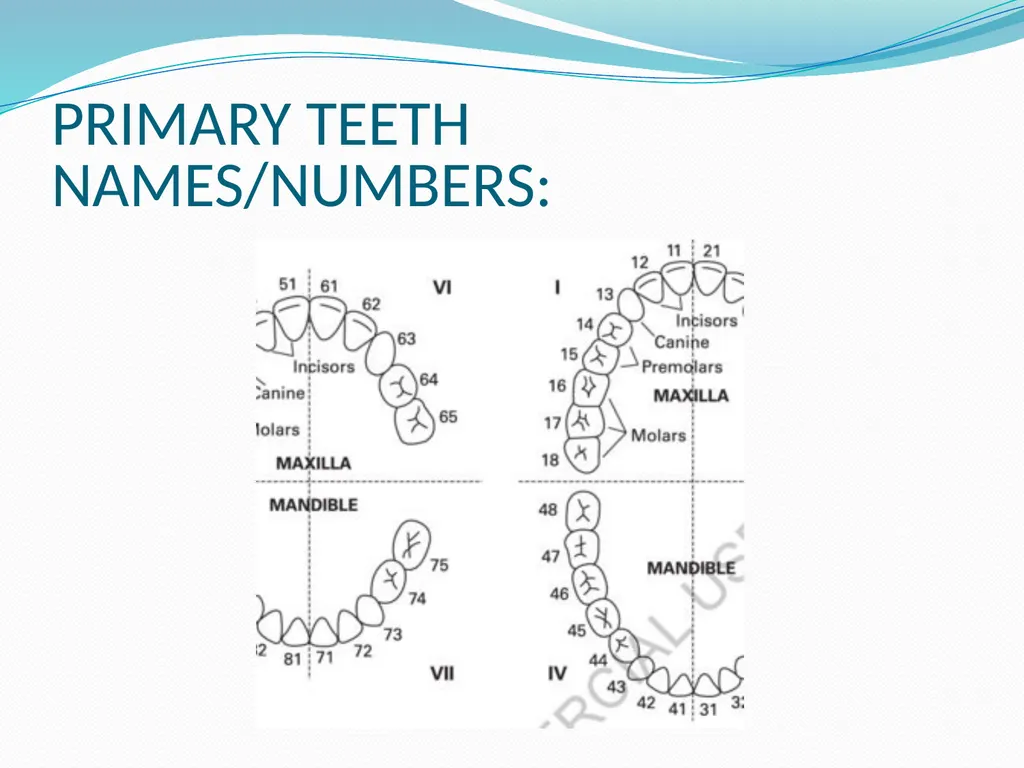
PRIMARY TEETH NAMES / NUMBERS: Twenty primary teeth;
--> Ten maxillary and ten mandibular.
--> 5 primary teeth in each quadrant.
Each quadrant has central incisor,lateral incisor,
Canine,first molar and second molar.
No premolar in primary dentition.
Also referred to as Deciduous teeth,baby teeth,
Milk teeth or first teeth.
NOT temporary teeth.<br>
04
PRIMARY TEETH NAMES/NUMBERS:<br>
05
ERUPTION/EXFOLIATION : Period of eruption for primary teeth is between 6-12months and 2 ½ - 3 years.
All primary teeth are usually emerged and aligned by age 3.
Exfoliation begins at age 6.
Mandibular centrals are usually first to erupt.<br>
06
COMPARISON WITH PERMANENT TEETH : Primary anterior teeth and secondary molars resemble the permanent counterparts.
Primary teeth have more pronounced cervical ridge.
Roots of posterior are more flared(divergent);
->Allowing growth of the permanent teeth forming below them.
->Cervix appears to be more constricted than permanent teeth.
Primary crowns have less enamel than permanent teeth,and pulp horns extend more occlusally.<br>
07
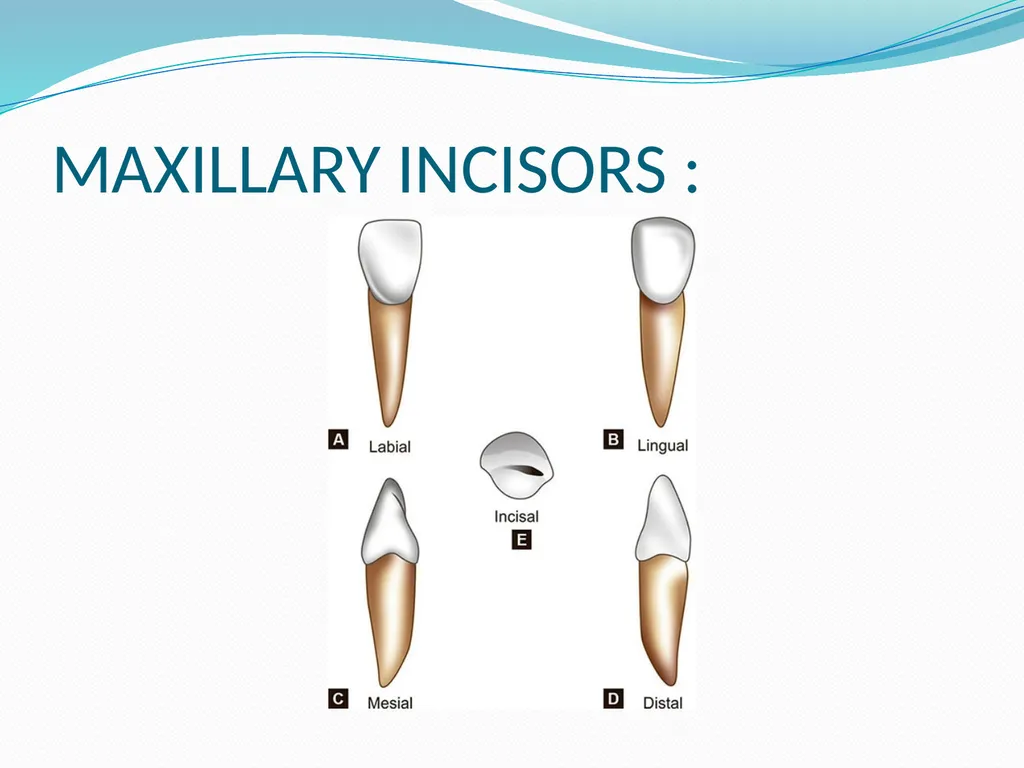
MAXILLARY INCISORS :<br>
08
Maxillary Central Incisors : E,F
Maxillary Lateral Incisors : D,G
Labial crown of incisors is smooth with a straight incisal edge.
-> No mamelons.
Crown is wide with a cingulum and marginal ridges on lingual surface.<br>
09
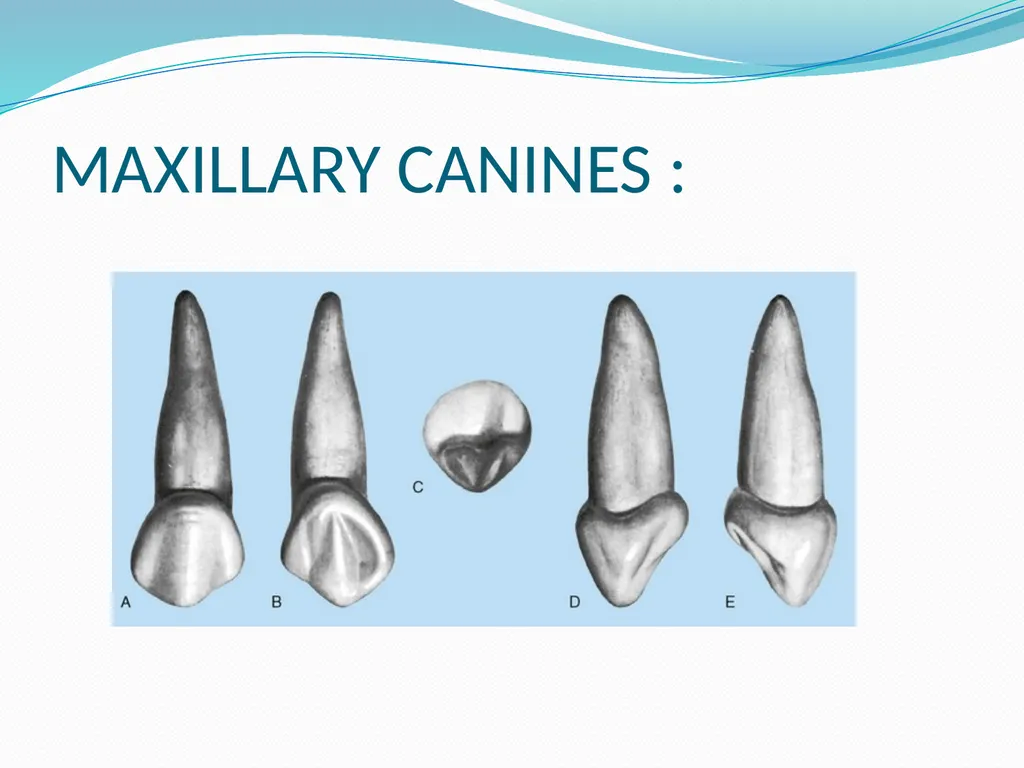
MAXILLARY CANINES :<br>
10
C,H
Broad cervial ridge on canine causes cervix to appear constricted,
Short,pointed cusp with long,slender root.<br>
11
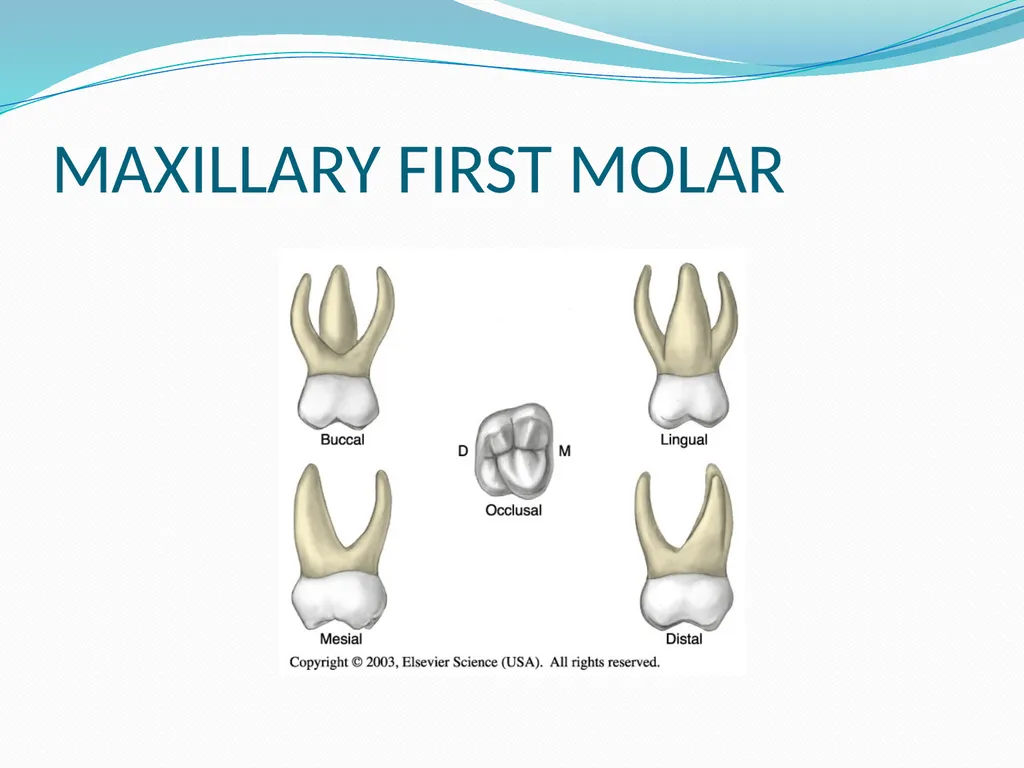
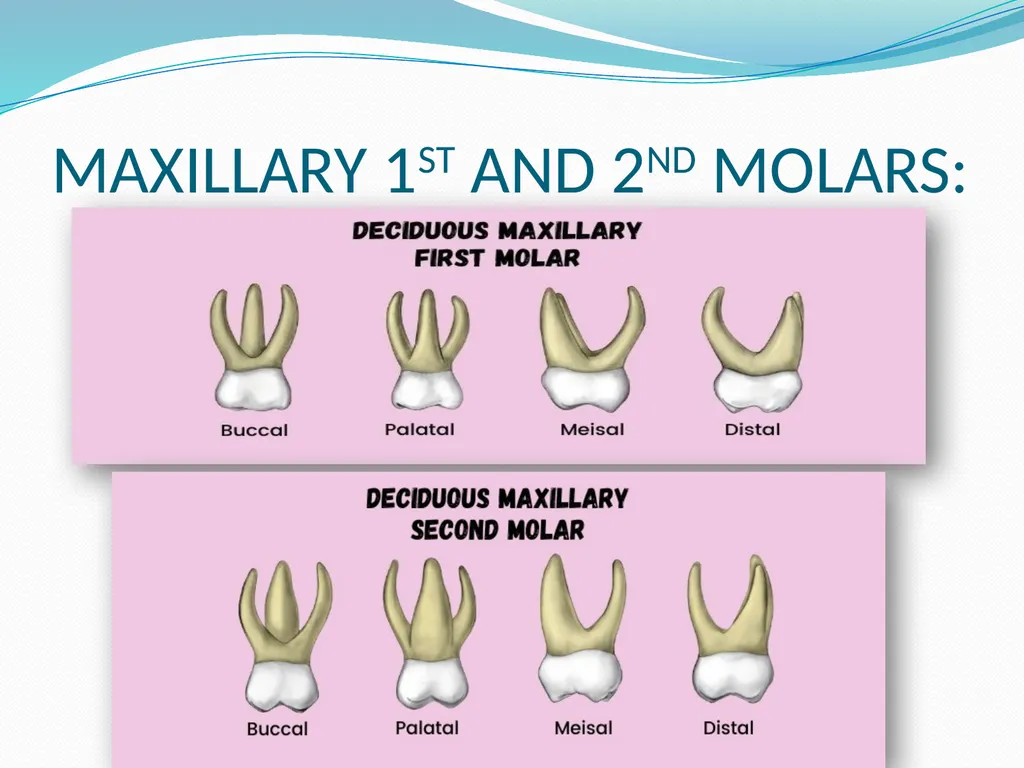
MAXILLARY FIRST MOLAR<br>
12
B,I
Number of cusps varies from 2 to 4.
No dividing groove on buccal surface.
Three roots on all maxillary molars.
Occlusal surface has central fossa and mesial triangular fossa connected by central groove.<br>
13
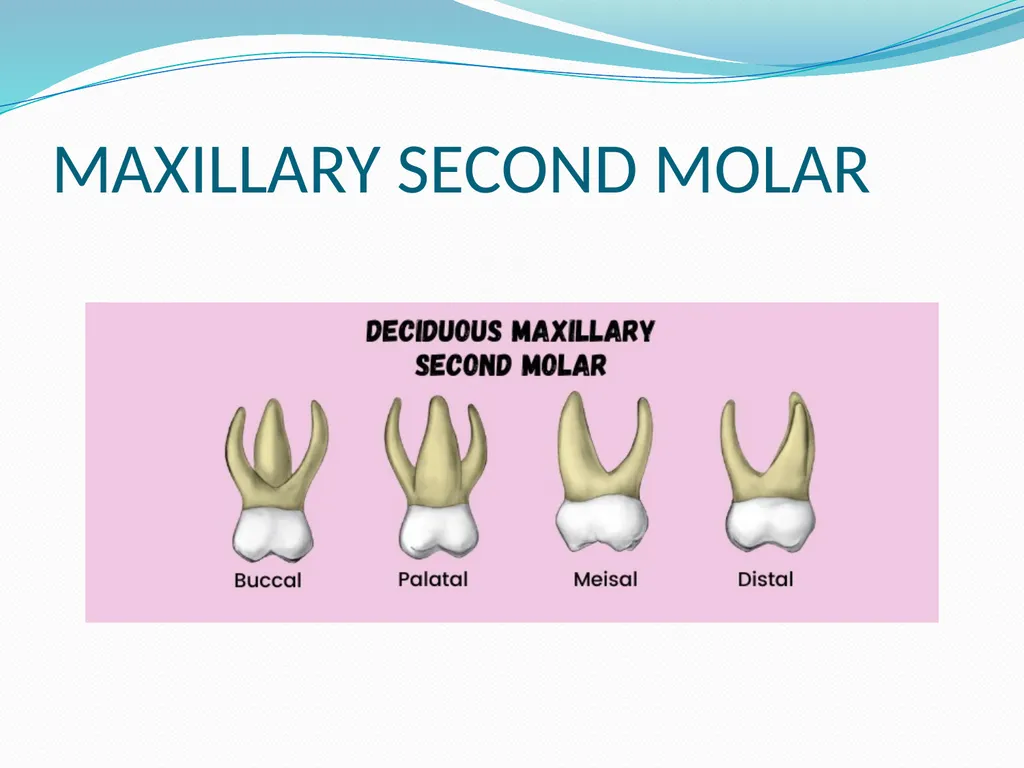
MAXILLARY SECOND MOLAR<br>
14
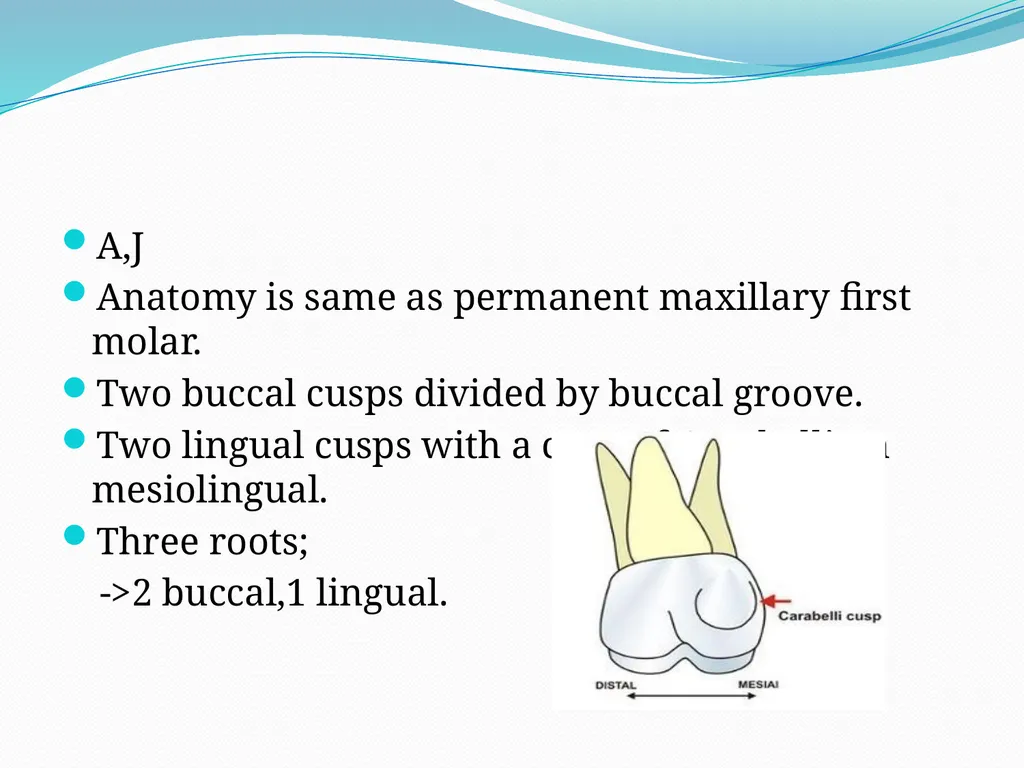
A,J
Anatomy is same as permanent maxillary first molar.
Two buccal cusps divided by buccal groove.
Two lingual cusps with a cusp of Carabelli on mesiolingual.
Three roots;
->2 buccal,1 lingual.<br>
15
MAXILLARY 1ST AND 2ND MOLARS:<br>
16
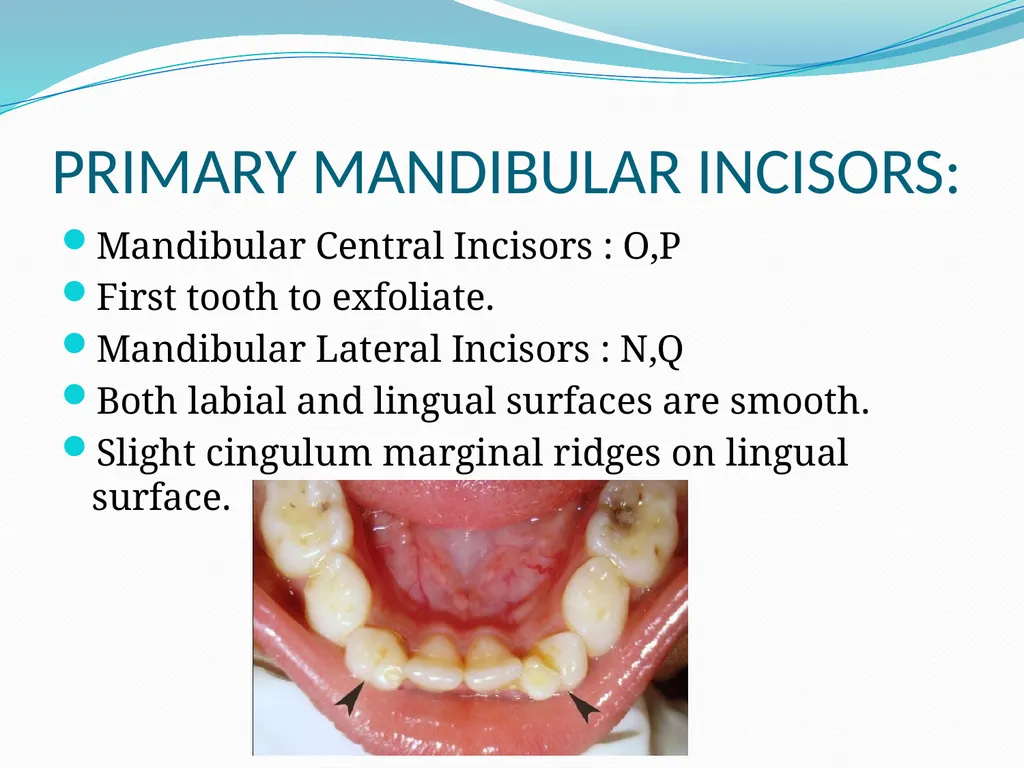
PRIMARY MANDIBULAR INCISORS: Mandibular Central Incisors : O,P
First tooth to exfoliate.
Mandibular Lateral Incisors : N,Q
Both labial and lingual surfaces are smooth.
Slight cingulum marginal ridges on lingual surface.<br>
17
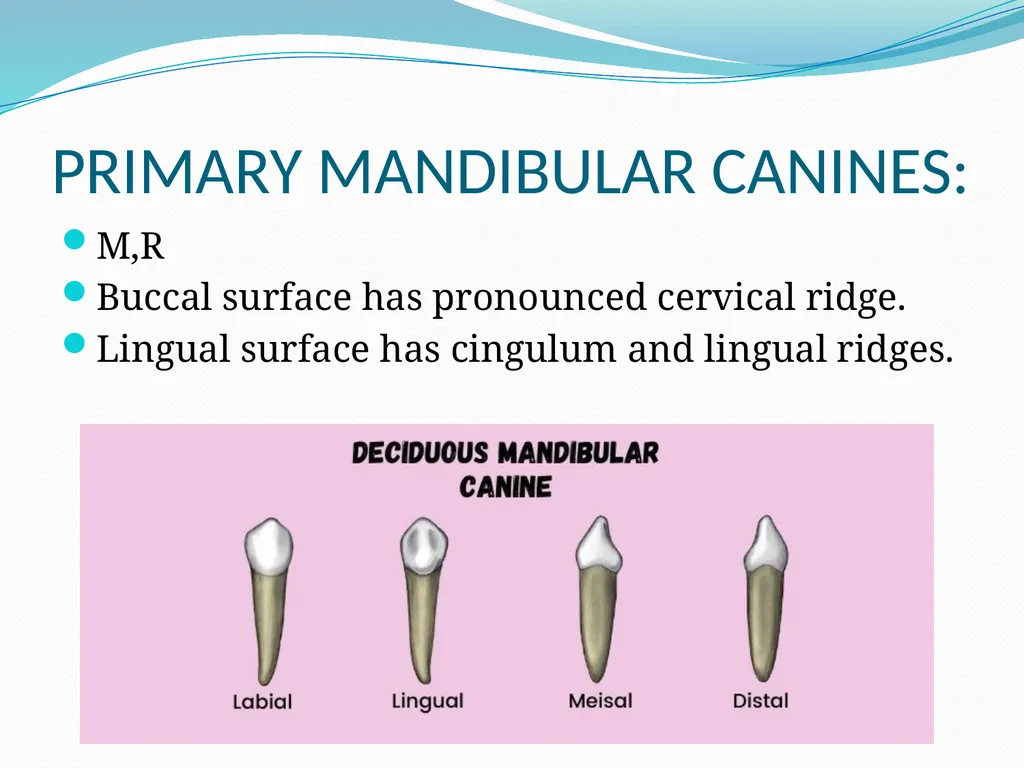
PRIMARY MANDIBULAR CANINES: M,R
Buccal surface has pronounced cervical ridge.
Lingual surface has cingulum and lingual ridges.<br>
18
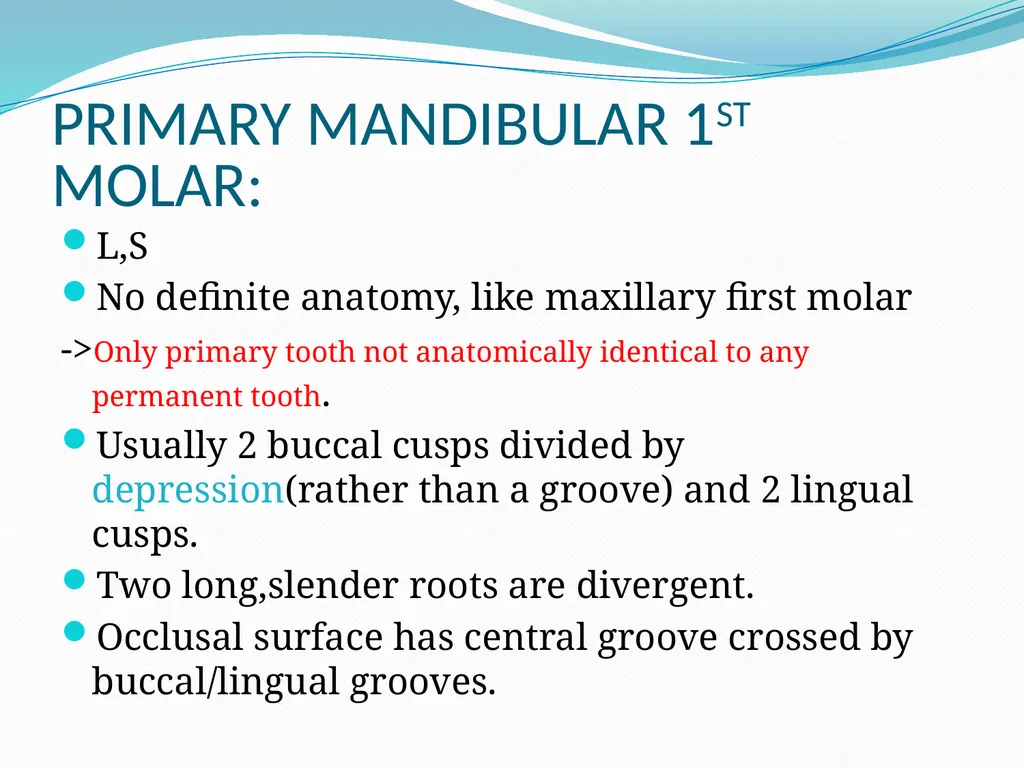
PRIMARY MANDIBULAR 1ST MOLAR: L,S
No definite anatomy, like maxillary first molar
->Only primary tooth not anatomically identical to any permanent tooth.
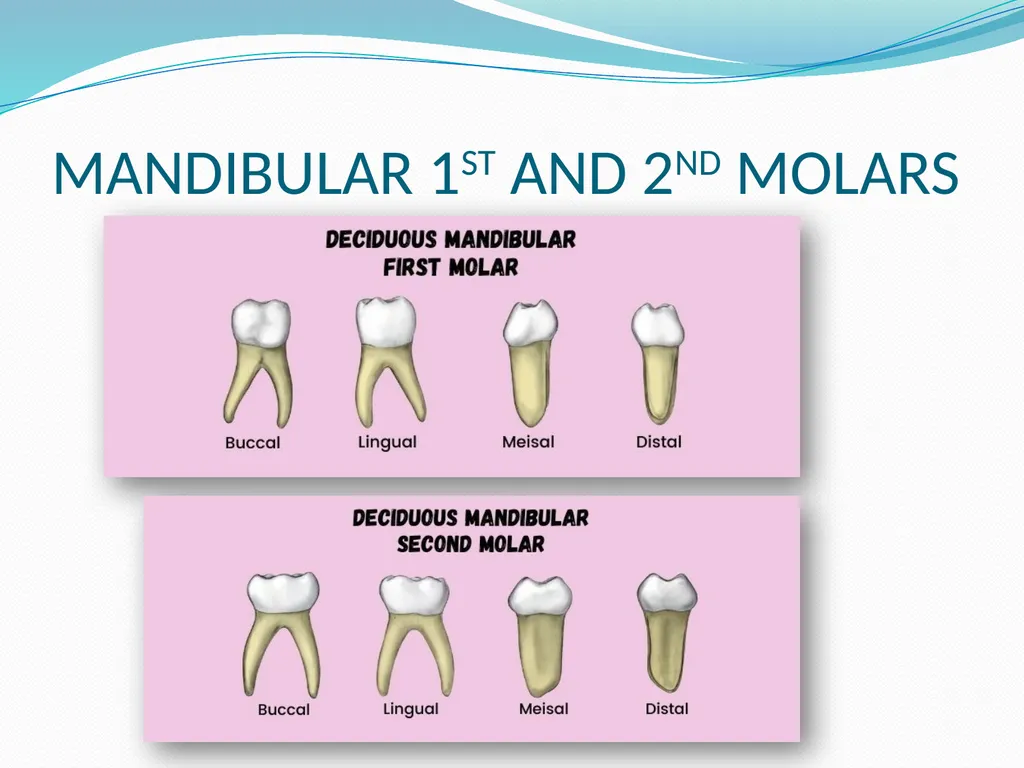
Usually 2 buccal cusps divided by depression(rather than a groove) and 2 lingual cusps.
Two long,slender roots are divergent.
Occlusal surface has central groove crossed by buccal/lingual grooves.<br>
19
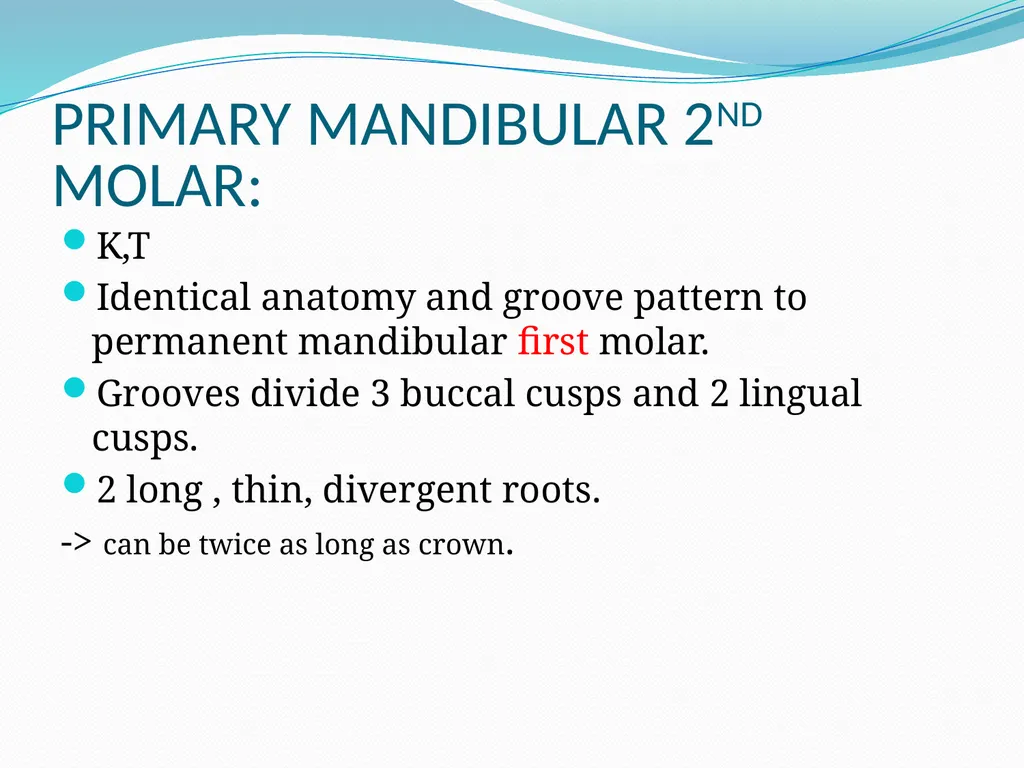
PRIMARY MANDIBULAR 2ND MOLAR: K,T
Identical anatomy and groove pattern to permanent mandibular first molar.
Grooves divide 3 buccal cusps and 2 lingual cusps.
2 long , thin, divergent roots.
-> can be twice as long as crown.<br>
20
MANDIBULAR 1ST AND 2ND MOLARS<br>
21
IMPORTANCE OF PRIMARY TEETH: Both form and function of primary dentition is important;
->Each primary tooth has same function as permanent tooth that follows.
->Maintains a solid position for permanent tooth replacement.
Damage to primary teeth could cause problems with permanent dentition.
When both deciduous and permanent teeth are present in the oral cavity its called mixed dentition.<br>