
Principles of Cyber Security Lecture 05: Managing
AM
Published · 24 slides · 0 views

1 / 1



Description
Principles of Cyber Security Lecture 05: Managing Network Security Dr. Muamer Mohammed Objectives 5.1 List and discuss the various types of firewalls and the common approaches to firewall implementation. 5.2 Define and describe the types of
Related Topics
Share
Embed code
Download this presentation From Below
"Principles of Cyber Security Lecture 05: Managing" is the property of its rightful owner. Permission is granted to download and print the materials on this website for personal, non-commercial use only, and to display it on your personal computer provided you do not modify the materials and that you retain all copyright notices contained in the materials. By downloading content from our website, you accept the terms of this agreement.
Presentation Transcript
01
Principles of Cyber Security Lecture 05: Managing Network Security Dr. Muamer Mohammed<br>
02
Objectives 5.1 List and discuss the various types of firewalls and the common approaches to firewall implementation.
5.2 Define and describe the types of intrusion detection and prevention systems and the strategies on which they are based<br>
5.2 Define and describe the types of intrusion detection and prevention systems and the strategies on which they are based<br>
03
Firewalls In InfoSec, a firewall is any device that prevents a specific type of information from moving between the outside world, known as the untrusted network (e.g., the Internet), and the inside world, known as the trusted network
The firewall may be a separate computer system, a service running on an existing router or server, or a separate network containing a number of supporting devices<br>
The firewall may be a separate computer system, a service running on an existing router or server, or a separate network containing a number of supporting devices<br>
04
Categories of Firewalls While most firewalls are an amalgamation of various options, services, and capabilities, most are associated with one of the basic categories or types of firewalls
The most common types of firewalls are:
Packet filtering firewalls
Application layer proxy firewalls
Stateful packet inspection firewalls
Unified Threat Management (UTM) devices<br>
The most common types of firewalls are:
Packet filtering firewalls
Application layer proxy firewalls
Stateful packet inspection firewalls
Unified Threat Management (UTM) devices<br>
05
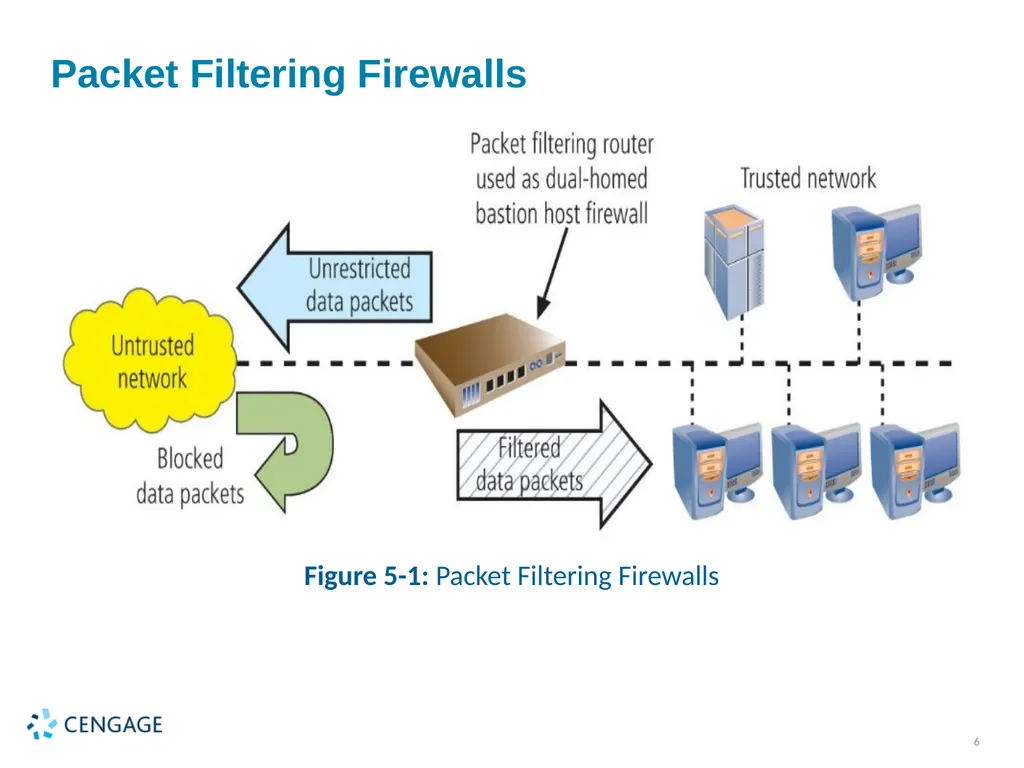
Packet Filtering Firewalls Packet filtering firewalls are simple networking devices that filter packets by examining every incoming and outgoing packet header
They can selectively filter packets based on values in the packet header, accepting or rejecting packets as needed
These devices can be configured to filter based on IP address, type of packet, port request, and/or other elements present in the packet<br>
They can selectively filter packets based on values in the packet header, accepting or rejecting packets as needed
These devices can be configured to filter based on IP address, type of packet, port request, and/or other elements present in the packet<br>
06
Packet Filtering Firewalls Figure 5-1: Packet Filtering Firewalls<br>
07
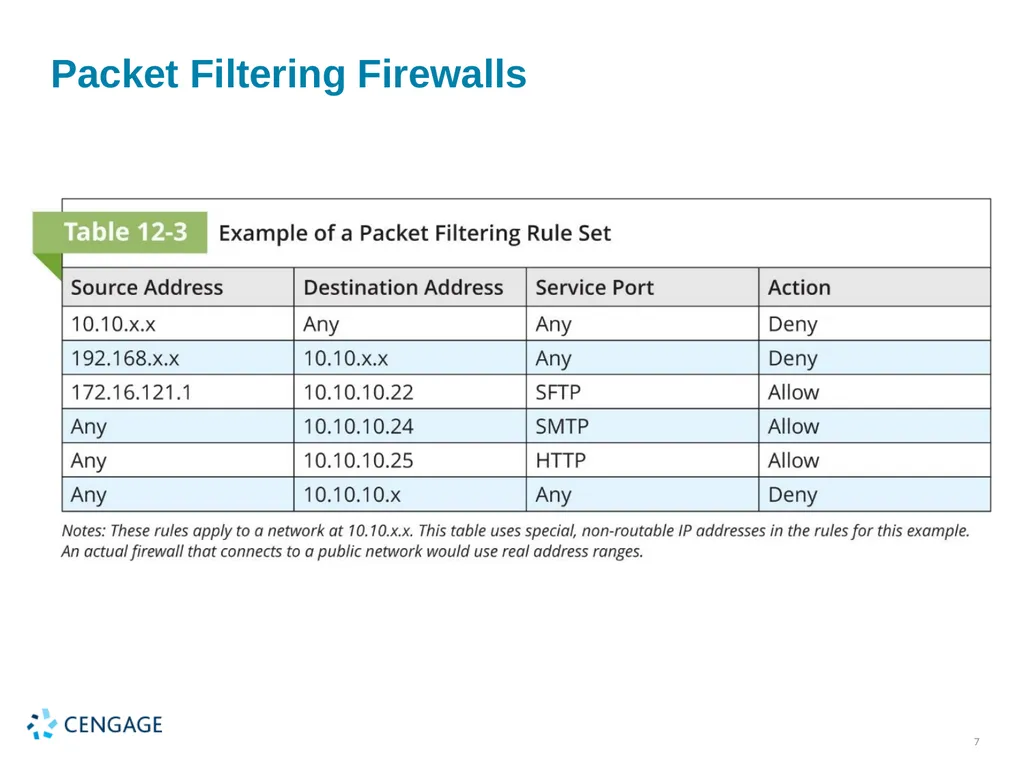
Packet Filtering Firewalls<br>
08
In the strictest sense, an application layer firewall (or application-level firewall) works like a packet filtering firewall, but at the application layer
A proxy server works as an intermediary between the requestor of information and the server that provides it, adding a layer of separation and thus security
If such a server stores the most recently accessed information in its internal cache to provide content to others accessing the same information, it may also be called a cache server
A proxy firewall, on the other hand, provides both proxy and firewall services Application Layer Proxy Firewall<br>
A proxy server works as an intermediary between the requestor of information and the server that provides it, adding a layer of separation and thus security
If such a server stores the most recently accessed information in its internal cache to provide content to others accessing the same information, it may also be called a cache server
A proxy firewall, on the other hand, provides both proxy and firewall services Application Layer Proxy Firewall<br>
09
When the firewall rather than an internal server is exposed to the outside world from within a network segment, it is considered deployed within a demilitarized zone (DMZ)
Using this model, additional filtering devices are placed between the proxy server and internal systems, thereby restricting access to internal systems to the proxy server alone Application Layer Proxy Firewall (Continued)<br>
Using this model, additional filtering devices are placed between the proxy server and internal systems, thereby restricting access to internal systems to the proxy server alone Application Layer Proxy Firewall (Continued)<br>
10
Stateful packet inspection (SPI) firewalls keep track of each network connection established between internal and external systems using a state table, which tracks the state and context of each packet exchanged by recording which station sent which packet and when
A SPI firewall can restrict incoming packets by allowing access only to packets that constitute responses to internal requests
If the SPI firewall receives an incoming packet that it cannot match to its state table, then it defaults to traditional packet filtering against its rule base, and if the packet is allowed, it updates its state table Stateful Packet Inspection Firewalls<br>
A SPI firewall can restrict incoming packets by allowing access only to packets that constitute responses to internal requests
If the SPI firewall receives an incoming packet that it cannot match to its state table, then it defaults to traditional packet filtering against its rule base, and if the packet is allowed, it updates its state table Stateful Packet Inspection Firewalls<br>
11
Unified Threat Management (UTM) devices are categorized by their ability to perform the work of a SPI firewall, network intrusion detection and prevention system, content filter, and spam filter as well as a malware scanner and filter
With the proper configuration, these devices are even able to “drill down” into the protocol layers and examine application-specific data, encrypted, compressed, and/or encoded data—commonly referred to as deep packet inspection (DPI) Unified Threat Management Devices<br>
With the proper configuration, these devices are even able to “drill down” into the protocol layers and examine application-specific data, encrypted, compressed, and/or encoded data—commonly referred to as deep packet inspection (DPI) Unified Threat Management Devices<br>
12
Similar to UTM devices, next-generation firewalls (NextGen or NGFW) combine traditional firewall functions with other network security functions such as deep packet inspection, IDPSs, and the ability to decrypt encrypted traffic
The functions are so similar to those of UTM devices that the difference may lie only in the vendor’s description
According to Kevin Beaver of Principle Logic, LLC, the difference may only be one of scope. “Unified threat management (UTM) systems do a good job at a lot of things, while next-generation firewalls (NGFWs) do an excellent job at just a handful of things” Next-Generation (NextGen) Firewalls<br>
The functions are so similar to those of UTM devices that the difference may lie only in the vendor’s description
According to Kevin Beaver of Principle Logic, LLC, the difference may only be one of scope. “Unified threat management (UTM) systems do a good job at a lot of things, while next-generation firewalls (NGFWs) do an excellent job at just a handful of things” Next-Generation (NextGen) Firewalls<br>
13
When evaluating a firewall, ask the following questions:
What type of firewall technology offers the right balance between protection and cost for the needs of the organization?
What features are included in the base price? What features are available at extra cost? Are all cost factors known?
How easy is it to set up and configure the firewall? How accessible are the staff technicians who can competently configure the firewall?
Can the candidate firewall adapt to the growing network in the target organization? Selecting the Right Firewall<br>
What type of firewall technology offers the right balance between protection and cost for the needs of the organization?
What features are included in the base price? What features are available at extra cost? Are all cost factors known?
How easy is it to set up and configure the firewall? How accessible are the staff technicians who can competently configure the firewall?
Can the candidate firewall adapt to the growing network in the target organization? Selecting the Right Firewall<br>
14
Intrusion Detection and Prevention Systems<br>
15
IDPSs work like burglar alarms and combine tried-and-true detection methods from intrusion detection systems (IDSs) with the capability to react to changes in the environment, which is available in intrusion prevention technology
As most modern technology in this category has the capability both to detect and prevent, the term IDPS is generally used to describe the devices or applications Intrusion Detection and Prevention Systems<br>
As most modern technology in this category has the capability both to detect and prevent, the term IDPS is generally used to describe the devices or applications Intrusion Detection and Prevention Systems<br>
16
Systems that include IPS technology attempt to prevent the attack from succeeding by:
Stopping the attack by terminating the network connection or the attacker’s user session
Changing the security environment by reconfiguring network devices (firewalls, routers, and switches) to block access to the targeted system
Changing the attack’s content to make it benign—for example, by removing an infected file attachment from an e-mail before the e-mail reaches the recipient Intrusion Detection and Prevention Systems (Continued)<br>
Stopping the attack by terminating the network connection or the attacker’s user session
Changing the security environment by reconfiguring network devices (firewalls, routers, and switches) to block access to the targeted system
Changing the attack’s content to make it benign—for example, by removing an infected file attachment from an e-mail before the e-mail reaches the recipient Intrusion Detection and Prevention Systems (Continued)<br>
17
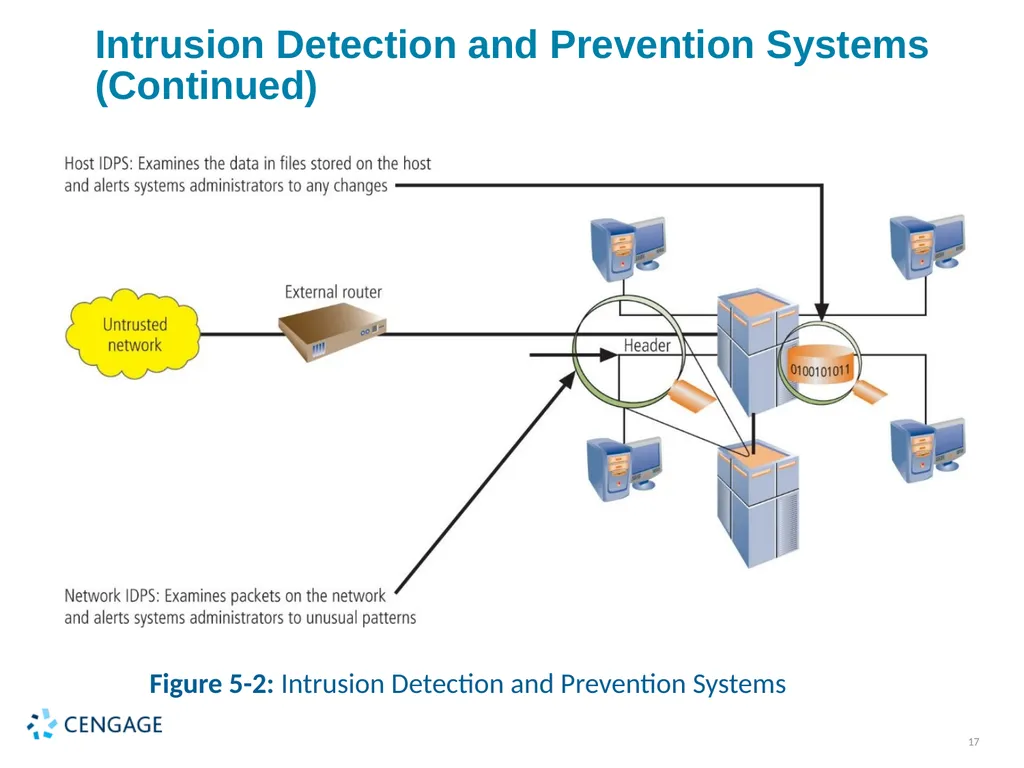
Intrusion Detection and Prevention Systems (Continued) Figure 5-2: Intrusion Detection and Prevention Systems<br>
18
A host-based IDPS works by configuring and classifying various categories of systems and data files
Unless the IDPS is very precisely configured, benign actions can generate a large volume of false alarms
Host-based IDPSs can monitor multiple computers simultaneously by storing a client file on each monitored host and then making that host report back to the master console, which is usually located on the system administrator’s computer Host-Based IDPS<br>
Unless the IDPS is very precisely configured, benign actions can generate a large volume of false alarms
Host-based IDPSs can monitor multiple computers simultaneously by storing a client file on each monitored host and then making that host report back to the master console, which is usually located on the system administrator’s computer Host-Based IDPS<br>
19
Network-based IDPSs monitor network traffic and, when a predefined condition occurs, notify the appropriate administrator
The network-based IDPS looks for patterns of network traffic and must match known and unknown attack strategies against their knowledge base to determine whether an attack has occurred
These systems yield many more false-positive readings than do host-based IDPSs, because they are attempting to read the network activity pattern to determine what is normal and what is not Network-Based IDPS<br>
The network-based IDPS looks for patterns of network traffic and must match known and unknown attack strategies against their knowledge base to determine whether an attack has occurred
These systems yield many more false-positive readings than do host-based IDPSs, because they are attempting to read the network activity pattern to determine what is normal and what is not Network-Based IDPS<br>
20
A signature-based IDPS or knowledge-based IDPS examines data traffic for something that matches the signatures—predetermined attack patterns
The problem with this approach is that the signatures must be continually updated
If attackers are slow and methodical, they may slip undetected through the IDPS, as their actions may not match a signature that includes factors based on duration of the events Signature-Based IDPS<br>
The problem with this approach is that the signatures must be continually updated
If attackers are slow and methodical, they may slip undetected through the IDPS, as their actions may not match a signature that includes factors based on duration of the events Signature-Based IDPS<br>
21
The anomaly-based IDPS or behavior-based IDPS first collects data from normal traffic and establishes a baseline; it then periodically samples network activity and compares the samples to the baseline
When the activity falls outside the baseline parameters (or clipping level), the IDPS notifies the administrator
The anomaly-based IDPS is able to detect new types of attacks, as it looks for any type of abnormal activity
Unfortunately, these IDPSs require significant processing capacity as they constantly attempt to match activity to the baseline, and may generate many false-positive warnings Anomaly-Based IDPS<br>
When the activity falls outside the baseline parameters (or clipping level), the IDPS notifies the administrator
The anomaly-based IDPS is able to detect new types of attacks, as it looks for any type of abnormal activity
Unfortunately, these IDPSs require significant processing capacity as they constantly attempt to match activity to the baseline, and may generate many false-positive warnings Anomaly-Based IDPS<br>
22
Summary A firewall in an InfoSec program is any device that prevents a specific type of information from moving between the outside world (the untrusted network) and the inside world (the trusted network)
Types of firewalls include packet filtering firewalls, application layer proxy firewalls, stateful packet inspection firewalls, and Unified Threat Management devices. There are three common architectural implementations of firewalls: single bastion hosts, screened-host firewalls, and screened-subnet firewalls<br>
Types of firewalls include packet filtering firewalls, application layer proxy firewalls, stateful packet inspection firewalls, and Unified Threat Management devices. There are three common architectural implementations of firewalls: single bastion hosts, screened-host firewalls, and screened-subnet firewalls<br>
23
Summary A host-based IDPS resides on a particular computer or server and monitors activity on that system. A network-based IDPS monitors network traffic; when a predefined condition occurs, it responds and notifies the appropriate administrator
A signature-based IDPS, also known as a knowledge-based IDPS, examines data traffic for activity that matches signatures, which are preconfigured, predetermined attack patterns
A statistical anomaly-based IDPS (also known as a behavior-based IDPS) collects data from normal traffic and establishes a baseline. When the activity is outside the baseline parameters (called the clipping level), the IDPS notifies the administrator<br>
A signature-based IDPS, also known as a knowledge-based IDPS, examines data traffic for activity that matches signatures, which are preconfigured, predetermined attack patterns
A statistical anomaly-based IDPS (also known as a behavior-based IDPS) collects data from normal traffic and establishes a baseline. When the activity is outside the baseline parameters (called the clipping level), the IDPS notifies the administrator<br>
24
Thank you<br>