
Processes and Partnership with Nursing on
A
Published · 31 slides · 0 views
1 / 1





Description
Processes and Partnership with Nursing on Mitigating Drug Diversion in Clinical Settings Jesse Breidenbach, Pharm D Director of Acute Care Pharmacy Sanford Medical Center Fargo Objectives Define successful structure to prevent drug
Related Topics
Share
Embed code
Download this presentation From Below
"Processes and Partnership with Nursing on" is the property of its rightful owner. Permission is granted to download and print the materials on this website for personal, non-commercial use only, and to display it on your personal computer provided you do not modify the materials and that you retain all copyright notices contained in the materials. By downloading content from our website, you accept the terms of this agreement.
Presentation Transcript
01
Processes and Partnership with Nursing on Mitigating Drug Diversion in Clinical Settings Jesse Breidenbach, Pharm D
Director of Acute Care Pharmacy
Sanford Medical Center Fargo<br>
Director of Acute Care Pharmacy
Sanford Medical Center Fargo<br>
02
Objectives Define successful structure to prevent drug diversion in a clinical setting
Define how tight control of narcotics in a clinical setting protects against diversion
Organized plan for diversion investigation
Develop a team approach for diversion investigation
Describe staff and leadership education
Describe common reasons supervisors are surprised that an employee is diverting drugs
Define the top myths of behavior
Describe how supervisors should use a team approach to prevent blind spots<br>
Define how tight control of narcotics in a clinical setting protects against diversion
Organized plan for diversion investigation
Develop a team approach for diversion investigation
Describe staff and leadership education
Describe common reasons supervisors are surprised that an employee is diverting drugs
Define the top myths of behavior
Describe how supervisors should use a team approach to prevent blind spots<br>
03
What is Drug Diversion? The theft of a controlled substance or other medications from the organization’s supply, or from a patient’s supply, for purposes of self-administration, selling or other use.<br>
04
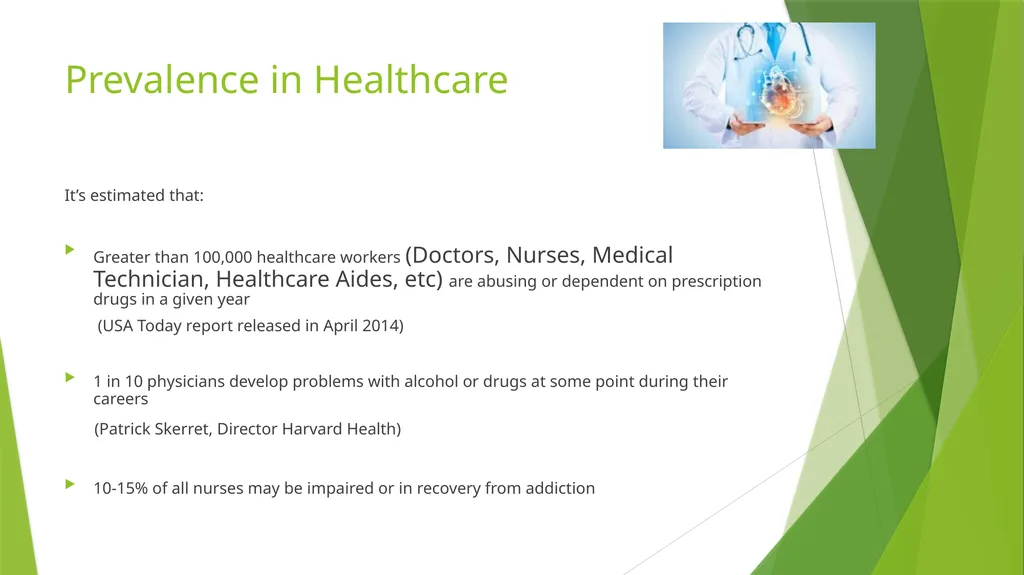
Prevalence in Healthcare It’s estimated that:
Greater than 100,000 healthcare workers (Doctors, Nurses, Medical Technician, Healthcare Aides, etc) are abusing or dependent on prescription drugs in a given year
(USA Today report released in April 2014)
1 in 10 physicians develop problems with alcohol or drugs at some point during their careers
(Patrick Skerret, Director Harvard Health)
10-15% of all nurses may be impaired or in recovery from addiction<br>
Greater than 100,000 healthcare workers (Doctors, Nurses, Medical Technician, Healthcare Aides, etc) are abusing or dependent on prescription drugs in a given year
(USA Today report released in April 2014)
1 in 10 physicians develop problems with alcohol or drugs at some point during their careers
(Patrick Skerret, Director Harvard Health)
10-15% of all nurses may be impaired or in recovery from addiction<br>
05
Impact on the Workplace Patient Care & Safety
Patient Satisfaction
Lost Productivity
Poor Decision Making
Safety Risk
Decreased Morale
Bottom Line<br>
Patient Satisfaction
Lost Productivity
Poor Decision Making
Safety Risk
Decreased Morale
Bottom Line<br>
06
Prevention of drug diversion in a clinical setting DEA requirements
DEA form 106
“Federal regulations require that registrants notify the DEA Field Division Office in their area, in writing, of the theft or significant loss of any controlled substance within one business day of discovery of such loss or theft. The registrant shall also complete and submit to the Field Division Office in their area, DEA Form 106, "Report of Theft or Loss of Controlled Substances" regarding the theft or loss. (21 C.F.R. § 1301.76(b))”
https://www.deadiversion.usdoj.gov/21cfr_reports/theft/<br>
DEA form 106
“Federal regulations require that registrants notify the DEA Field Division Office in their area, in writing, of the theft or significant loss of any controlled substance within one business day of discovery of such loss or theft. The registrant shall also complete and submit to the Field Division Office in their area, DEA Form 106, "Report of Theft or Loss of Controlled Substances" regarding the theft or loss. (21 C.F.R. § 1301.76(b))”
https://www.deadiversion.usdoj.gov/21cfr_reports/theft/<br>
07
Prevention of drug diversion in a clinical setting Defined process for ordering, receiving, restocking and dispensing controlled substances (CS)
Limited access to ordering
CSOS/DEA 222 forms
Receiving
Person placing CS order does not receive/check in CS order
CS stored in narcotic vault in pharmacy
Restocking
Narcotic vault communicates with automated dispensing cabinets
CS removed from vault for restocking creates an open loop
Loop is closed when the cabinet has that narcotic restocked
Loops can be closed manually but not by the person that opened the loop (monitored)
Dispensing CS
Primarily via automated dispensing cabinets
Enables extensive tracking and documentation of access
Non-automated dispenses
Maintain chain of custody<br>
Limited access to ordering
CSOS/DEA 222 forms
Receiving
Person placing CS order does not receive/check in CS order
CS stored in narcotic vault in pharmacy
Restocking
Narcotic vault communicates with automated dispensing cabinets
CS removed from vault for restocking creates an open loop
Loop is closed when the cabinet has that narcotic restocked
Loops can be closed manually but not by the person that opened the loop (monitored)
Dispensing CS
Primarily via automated dispensing cabinets
Enables extensive tracking and documentation of access
Non-automated dispenses
Maintain chain of custody<br>
08
Prevention of drug diversion in a clinical setting Tight control of controlled substances is necessary to prevent diversion
Documentation of what was done with the CS
Security – locked or under constant supervision
ADCs often used for most frequently used
Enforced by policy and auditing to policy requirements
Auditing can be very time consuming
Policies need to support best practices and be enforced
Decision support/data review
Identify potential diverters<br>
Documentation of what was done with the CS
Security – locked or under constant supervision
ADCs often used for most frequently used
Enforced by policy and auditing to policy requirements
Auditing can be very time consuming
Policies need to support best practices and be enforced
Decision support/data review
Identify potential diverters<br>
09
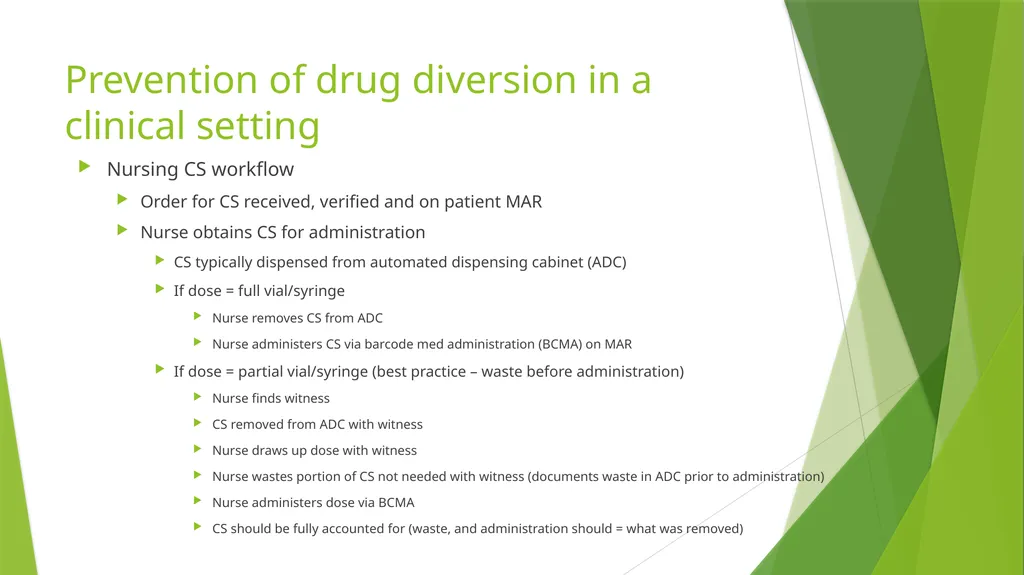
Prevention of drug diversion in a clinical setting Nursing CS workflow
Order for CS received, verified and on patient MAR
Nurse obtains CS for administration
CS typically dispensed from automated dispensing cabinet (ADC)
If dose = full vial/syringe
Nurse removes CS from ADC
Nurse administers CS via barcode med administration (BCMA) on MAR
If dose = partial vial/syringe (best practice – waste before administration)
Nurse finds witness
CS removed from ADC with witness
Nurse draws up dose with witness
Nurse wastes portion of CS not needed with witness (documents waste in ADC prior to administration)
Nurse administers dose via BCMA
CS should be fully accounted for (waste, and administration should = what was removed)<br>
Order for CS received, verified and on patient MAR
Nurse obtains CS for administration
CS typically dispensed from automated dispensing cabinet (ADC)
If dose = full vial/syringe
Nurse removes CS from ADC
Nurse administers CS via barcode med administration (BCMA) on MAR
If dose = partial vial/syringe (best practice – waste before administration)
Nurse finds witness
CS removed from ADC with witness
Nurse draws up dose with witness
Nurse wastes portion of CS not needed with witness (documents waste in ADC prior to administration)
Nurse administers dose via BCMA
CS should be fully accounted for (waste, and administration should = what was removed)<br>
10
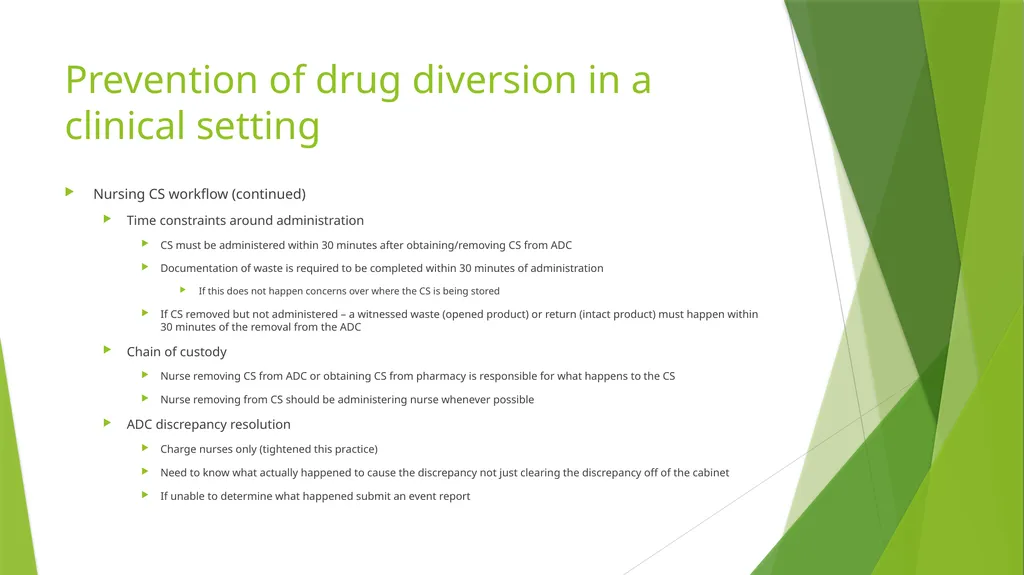
Prevention of drug diversion in a clinical setting Nursing CS workflow (continued)
Time constraints around administration
CS must be administered within 30 minutes after obtaining/removing CS from ADC
Documentation of waste is required to be completed within 30 minutes of administration
If this does not happen concerns over where the CS is being stored
If CS removed but not administered – a witnessed waste (opened product) or return (intact product) must happen within 30 minutes of the removal from the ADC
Chain of custody
Nurse removing CS from ADC or obtaining CS from pharmacy is responsible for what happens to the CS
Nurse removing from CS should be administering nurse whenever possible
ADC discrepancy resolution
Charge nurses only (tightened this practice)
Need to know what actually happened to cause the discrepancy not just clearing the discrepancy off of the cabinet
If unable to determine what happened submit an event report<br>
Time constraints around administration
CS must be administered within 30 minutes after obtaining/removing CS from ADC
Documentation of waste is required to be completed within 30 minutes of administration
If this does not happen concerns over where the CS is being stored
If CS removed but not administered – a witnessed waste (opened product) or return (intact product) must happen within 30 minutes of the removal from the ADC
Chain of custody
Nurse removing CS from ADC or obtaining CS from pharmacy is responsible for what happens to the CS
Nurse removing from CS should be administering nurse whenever possible
ADC discrepancy resolution
Charge nurses only (tightened this practice)
Need to know what actually happened to cause the discrepancy not just clearing the discrepancy off of the cabinet
If unable to determine what happened submit an event report<br>
11
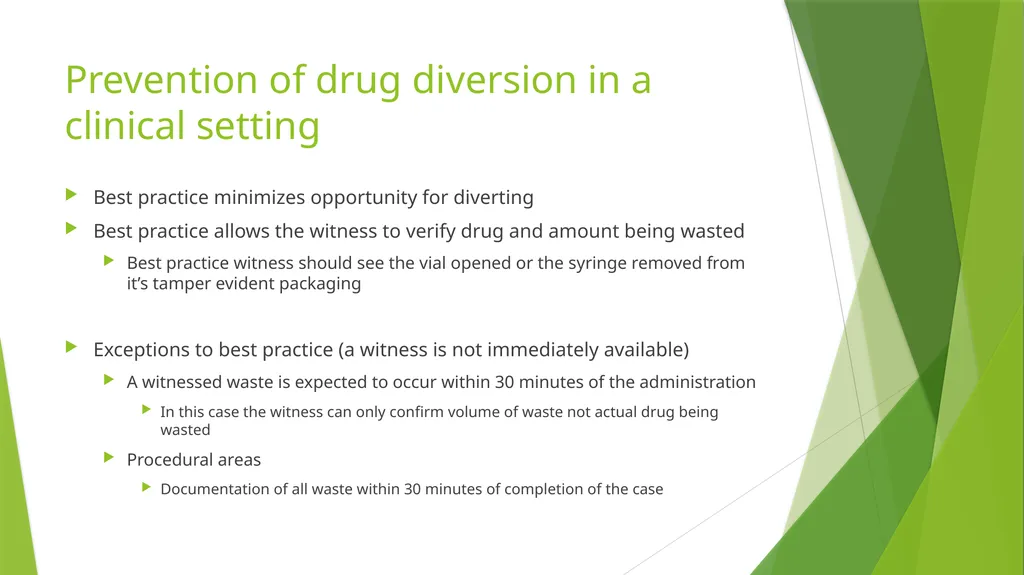
Prevention of drug diversion in a clinical setting Best practice minimizes opportunity for diverting
Best practice allows the witness to verify drug and amount being wasted
Best practice witness should see the vial opened or the syringe removed from it’s tamper evident packaging
Exceptions to best practice (a witness is not immediately available)
A witnessed waste is expected to occur within 30 minutes of the administration
In this case the witness can only confirm volume of waste not actual drug being wasted
Procedural areas
Documentation of all waste within 30 minutes of completion of the case<br>
Best practice allows the witness to verify drug and amount being wasted
Best practice witness should see the vial opened or the syringe removed from it’s tamper evident packaging
Exceptions to best practice (a witness is not immediately available)
A witnessed waste is expected to occur within 30 minutes of the administration
In this case the witness can only confirm volume of waste not actual drug being wasted
Procedural areas
Documentation of all waste within 30 minutes of completion of the case<br>
12
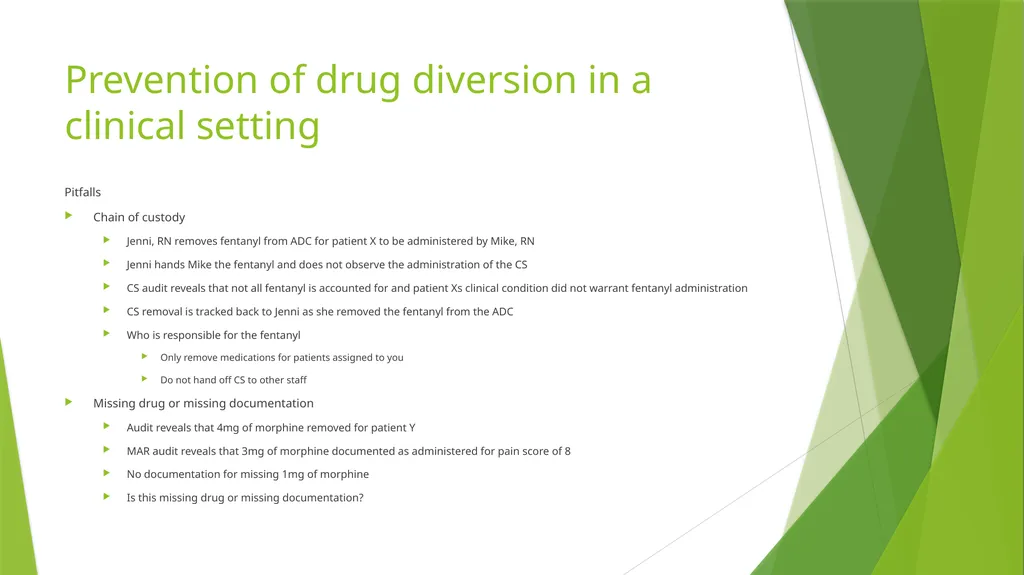
Prevention of drug diversion in a clinical setting Pitfalls
Chain of custody
Jenni, RN removes fentanyl from ADC for patient X to be administered by Mike, RN
Jenni hands Mike the fentanyl and does not observe the administration of the CS
CS audit reveals that not all fentanyl is accounted for and patient Xs clinical condition did not warrant fentanyl administration
CS removal is tracked back to Jenni as she removed the fentanyl from the ADC
Who is responsible for the fentanyl
Only remove medications for patients assigned to you
Do not hand off CS to other staff
Missing drug or missing documentation
Audit reveals that 4mg of morphine removed for patient Y
MAR audit reveals that 3mg of morphine documented as administered for pain score of 8
No documentation for missing 1mg of morphine
Is this missing drug or missing documentation?<br>
Chain of custody
Jenni, RN removes fentanyl from ADC for patient X to be administered by Mike, RN
Jenni hands Mike the fentanyl and does not observe the administration of the CS
CS audit reveals that not all fentanyl is accounted for and patient Xs clinical condition did not warrant fentanyl administration
CS removal is tracked back to Jenni as she removed the fentanyl from the ADC
Who is responsible for the fentanyl
Only remove medications for patients assigned to you
Do not hand off CS to other staff
Missing drug or missing documentation
Audit reveals that 4mg of morphine removed for patient Y
MAR audit reveals that 3mg of morphine documented as administered for pain score of 8
No documentation for missing 1mg of morphine
Is this missing drug or missing documentation?<br>
13
Organized Plan for Diversion Investigations Have sound institutional policy regarding drug diversion
Input from nursing, pharmacy, legal, risk, providers and administration/HR
Supports best practices
Policy provides basis for corrective action
Use of a checklist that follows policy
Help guide the investigation
Keeps investigating team on the same page
Difficult to navigate investigation if you have not been involved in one in the past
Leadership turnover
Timing of the investigation and potential meeting with staff being investigated
Call the staff person in on day off or wait until their next scheduled shift
What happens to the employee during this time
limiting access to drugs/ADC access
Cover staffing if you don’t plan to have them staff after meeting<br>
Input from nursing, pharmacy, legal, risk, providers and administration/HR
Supports best practices
Policy provides basis for corrective action
Use of a checklist that follows policy
Help guide the investigation
Keeps investigating team on the same page
Difficult to navigate investigation if you have not been involved in one in the past
Leadership turnover
Timing of the investigation and potential meeting with staff being investigated
Call the staff person in on day off or wait until their next scheduled shift
What happens to the employee during this time
limiting access to drugs/ADC access
Cover staffing if you don’t plan to have them staff after meeting<br>
14
Organized Plan for Diversion Investigations Accurate data from a reliable source
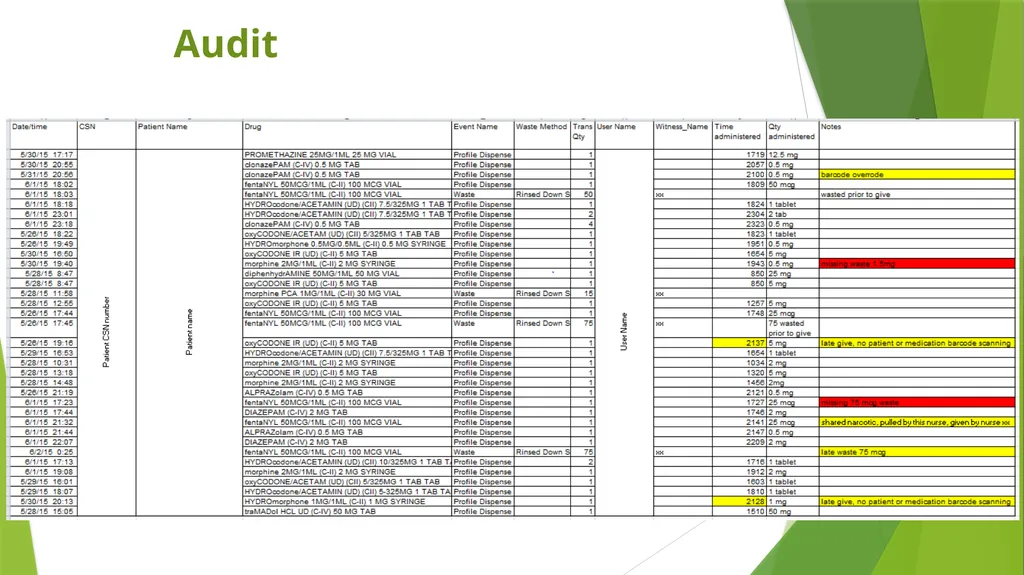
CS logs and chart information
MAR administrations
ADC dispensation, waste and return documentation
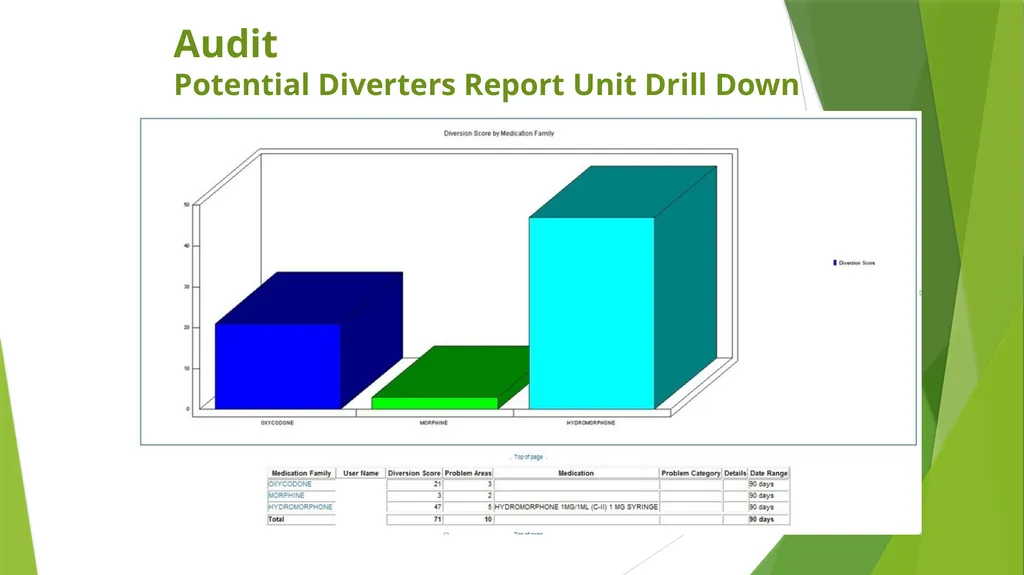
ADC reporting and diversion scoring
HBI data – third party data analysis
Observation of control/wasting practices
Employee pledge
Documented observation of best practices being followed
Work and communication performance
Often discussed during investigating team meeting and/or with staff being investigated
When is it beneficial use of a Drug screen
Pros and cons of drug screening related to diversion
Diverting for self or possibly for others
Easy to have diversion without an impaired professional<br>
CS logs and chart information
MAR administrations
ADC dispensation, waste and return documentation
ADC reporting and diversion scoring
HBI data – third party data analysis
Observation of control/wasting practices
Employee pledge
Documented observation of best practices being followed
Work and communication performance
Often discussed during investigating team meeting and/or with staff being investigated
When is it beneficial use of a Drug screen
Pros and cons of drug screening related to diversion
Diverting for self or possibly for others
Easy to have diversion without an impaired professional<br>
15
Audit
Potential Diverters Report Unit Drill Down<br>
16
Audit
Potential Diverters Report Unit Drill Down<br>
17
Audit
Potential Diverters Report Unit Drill Down<br>
18
Audit<br>
19
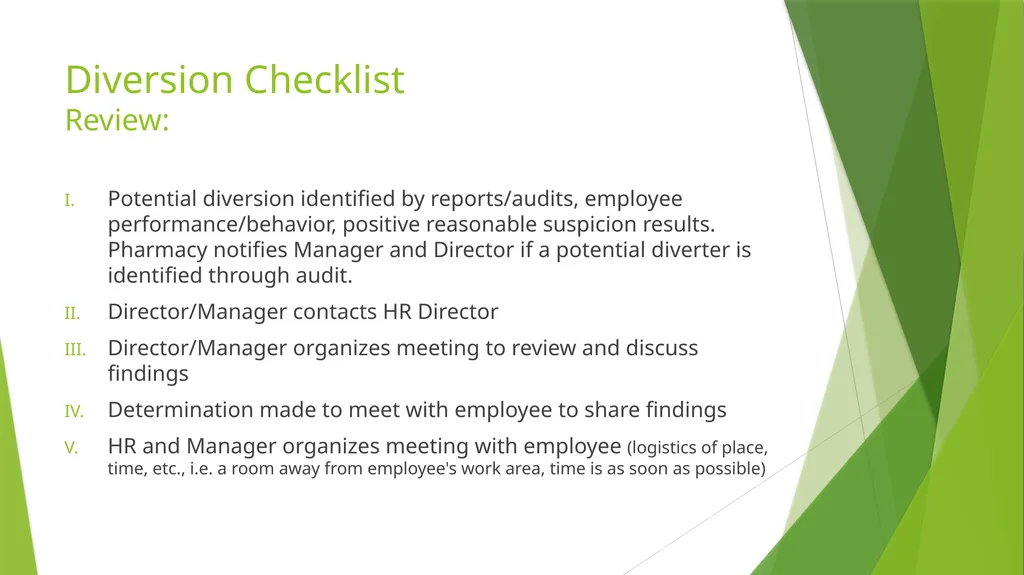
Diversion Checklist
Review: Potential diversion identified by reports/audits, employee performance/behavior, positive reasonable suspicion results. Pharmacy notifies Manager and Director if a potential diverter is identified through audit.
Director/Manager contacts HR Director
Director/Manager organizes meeting to review and discuss findings
Determination made to meet with employee to share findings
HR and Manager organizes meeting with employee (logistics of place, time, etc., i.e. a room away from employee's work area, time is as soon as possible)<br>
Director/Manager contacts HR Director
Director/Manager organizes meeting to review and discuss findings
Determination made to meet with employee to share findings
HR and Manager organizes meeting with employee (logistics of place, time, etc., i.e. a room away from employee's work area, time is as soon as possible)<br>
20
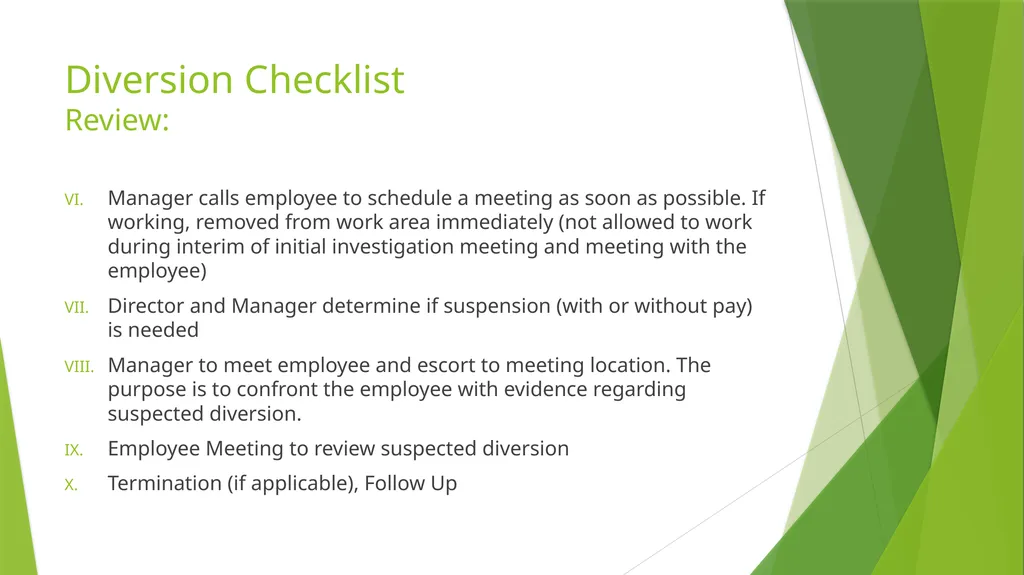
Diversion Checklist
Review: Manager calls employee to schedule a meeting as soon as possible. If working, removed from work area immediately (not allowed to work during interim of initial investigation meeting and meeting with the employee)
Director and Manager determine if suspension (with or without pay) is needed
Manager to meet employee and escort to meeting location. The purpose is to confront the employee with evidence regarding suspected diversion.
Employee Meeting to review suspected diversion
Termination (if applicable), Follow Up<br>
Director and Manager determine if suspension (with or without pay) is needed
Manager to meet employee and escort to meeting location. The purpose is to confront the employee with evidence regarding suspected diversion.
Employee Meeting to review suspected diversion
Termination (if applicable), Follow Up<br>
21
Team Approach For Diversion Investigation An educated/experienced core team is key
It should have at the minimum Nursing Practice, HR, Pharmacy, Risk and a “like” provider if appropriate
The core team should be
well versed in the reading /analyzing the data
ability to ask hard questions
seasoned leaders
understand appropriate regulations
be able to respond on a short notice to support the direct supervisors
Needs to be a priority when diversion is suspected
The team develops an action plan with the direct supervisor and see that the plan is carried out
The team is a support system for the direct supervisor and is also responsible to see that the employee is fairly treated<br>
It should have at the minimum Nursing Practice, HR, Pharmacy, Risk and a “like” provider if appropriate
The core team should be
well versed in the reading /analyzing the data
ability to ask hard questions
seasoned leaders
understand appropriate regulations
be able to respond on a short notice to support the direct supervisors
Needs to be a priority when diversion is suspected
The team develops an action plan with the direct supervisor and see that the plan is carried out
The team is a support system for the direct supervisor and is also responsible to see that the employee is fairly treated<br>
22
Team Approach For Diversion Investigation Set up Drug Diversion Mitigation Committee to meet on an on going basis:
CMO, CNO, Risk, Office of Nursing Practice, Security Director, Legal, HR, Anesthesia, Pharmacy<br>
CMO, CNO, Risk, Office of Nursing Practice, Security Director, Legal, HR, Anesthesia, Pharmacy<br>
23
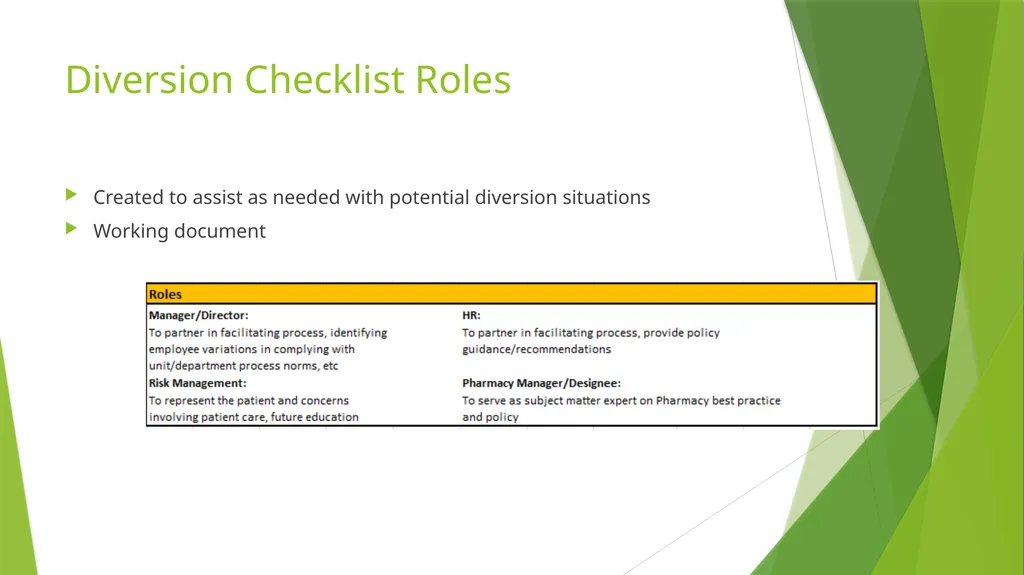
Diversion Checklist Roles Created to assist as needed with potential diversion situations
Working document<br>
Working document<br>
24
Staff And Leadership Education Leaders are often naïve about the consequences and prevalence of addiction issues
Both regulatory and policy need to be thoroughly discussed and review
Leaders need a structure to rely upon to be sure that all aspects are covered
education on process flow or checklist approach is important
Leaders and staff needs to understand signs and symptoms of an impaired coworker
Why some signs may actually fool you
Staff need to know how to reach out and speak up about concerns
Staff need to have clear understanding/expectations
competency assessed on a regular basis on CS policies and procedures<br>
Both regulatory and policy need to be thoroughly discussed and review
Leaders need a structure to rely upon to be sure that all aspects are covered
education on process flow or checklist approach is important
Leaders and staff needs to understand signs and symptoms of an impaired coworker
Why some signs may actually fool you
Staff need to know how to reach out and speak up about concerns
Staff need to have clear understanding/expectations
competency assessed on a regular basis on CS policies and procedures<br>
25
Staff And Leadership Education All nursing staff educated
All nurses validated on appropriate wasting and chain of custody for CS
All nursing management educated
Supervisors through directors
What is diversion
Policy review
Diversion team/checklist
Identification of resources
Physician executive council educated
Anesthesia department educated<br>
All nurses validated on appropriate wasting and chain of custody for CS
All nursing management educated
Supervisors through directors
What is diversion
Policy review
Diversion team/checklist
Identification of resources
Physician executive council educated
Anesthesia department educated<br>
26
Leadership Expectation Understand the issue from a Patient Safety Viewpoint
Use a balanced team to scope, analyze issues and agree on a plan forward
Be open to the fact that you might be blind sided
Be open to examining work flows that are preventing best practices and changing them<br>
Use a balanced team to scope, analyze issues and agree on a plan forward
Be open to the fact that you might be blind sided
Be open to examining work flows that are preventing best practices and changing them<br>
27
Common reasons for not identifying diversion Top myths of staff diverting CS
A person with addiction is very smart, wants to work, and wants to stay in good standing
These characteristics help keep them in proximity to drugs, because these behaviors keep the employee “under the radar” or “out of trouble”
These employees are often very “helpful”
They offer to run and get things
They offer to run to give meds to your patients
They offer to run to pharmacy to pick up a drip
These behaviors keep them valuable to their team members
There is a less likely chance someone would report “odd” behavior when they like the person (the person is “being helpful”)<br>
A person with addiction is very smart, wants to work, and wants to stay in good standing
These characteristics help keep them in proximity to drugs, because these behaviors keep the employee “under the radar” or “out of trouble”
These employees are often very “helpful”
They offer to run and get things
They offer to run to give meds to your patients
They offer to run to pharmacy to pick up a drip
These behaviors keep them valuable to their team members
There is a less likely chance someone would report “odd” behavior when they like the person (the person is “being helpful”)<br>
28
Why don’t we see it? Award Winners New Grads Team Leaders Pregnant Healthcare Workers Techs, Providers, Nurses Pharmacists, Aides<br>
29
Signs and Symptoms Emotionally
Aggression, anxiety, paranoia, defensive
Behaviorally
Increased absence/availability to pick up shifts, unsteady, slurred speech, irritable, overly helpful i.e. “I’ll pull your meds for you”
Physically
Weight loss, sweating, smell of alcohol, pinpoint pupils or glassy-eyed, lethargic<br>
Aggression, anxiety, paranoia, defensive
Behaviorally
Increased absence/availability to pick up shifts, unsteady, slurred speech, irritable, overly helpful i.e. “I’ll pull your meds for you”
Physically
Weight loss, sweating, smell of alcohol, pinpoint pupils or glassy-eyed, lethargic<br>
30
How Supervisors Should Use A Team Approach To Prevent Blind Spots Supervisors are invested in staff they hire
They support and want to believe they made a good choice to hire the person
They might develop personal relationships with staff (inside and outside of work)
Supervisors like being fully staffed
Dealing with the issue may mean a gap in schedule
Cases where diverting staff has been working a lot/picking up shifts
Because of these blinders, Supervisors need a team of objective and multi-disciplinary leaders to help drive the investigation and planning
These are hard conversation so having a team approach gives the directors and supervisors support in the actual meetings and interventions<br>
They support and want to believe they made a good choice to hire the person
They might develop personal relationships with staff (inside and outside of work)
Supervisors like being fully staffed
Dealing with the issue may mean a gap in schedule
Cases where diverting staff has been working a lot/picking up shifts
Because of these blinders, Supervisors need a team of objective and multi-disciplinary leaders to help drive the investigation and planning
These are hard conversation so having a team approach gives the directors and supervisors support in the actual meetings and interventions<br>
31
Resources: Road Map to Diversion Prevention: http://www.health.state.mn.us/patientsafety/drugdiversion/divroadmap041812.pdf
http://www.nursingworld.org/DocumentVault/Position-Statements/Drug-and-Alcohol-Abuse/pos.html
DEA Office of Diversion Control: https://www.deadiversion.usdoj.gov/index.html
NCSBN Substance Abuse Disorder in Nursing: https://www.ncsbn.org/index.htm
Substance Abuse and Mental Health Services Adminis-tration. (2010). Results from the 2009 National Survey on Drug Use and Health: Volume I. Summary of National Findings (Office of Applied Studies, NSDUH Series H-38A, HHS Publication No. SMA 10-4586 Findings). Rockville, MD.
Hansen RN, Oster G, Edelsberg J, Woody GE, Sullivan SD (2011). Economic costs of nonmedical use of prescription opioids. Clinical Journal of Pain 27(3): 194-202.<br>
http://www.nursingworld.org/DocumentVault/Position-Statements/Drug-and-Alcohol-Abuse/pos.html
DEA Office of Diversion Control: https://www.deadiversion.usdoj.gov/index.html
NCSBN Substance Abuse Disorder in Nursing: https://www.ncsbn.org/index.htm
Substance Abuse and Mental Health Services Adminis-tration. (2010). Results from the 2009 National Survey on Drug Use and Health: Volume I. Summary of National Findings (Office of Applied Studies, NSDUH Series H-38A, HHS Publication No. SMA 10-4586 Findings). Rockville, MD.
Hansen RN, Oster G, Edelsberg J, Woody GE, Sullivan SD (2011). Economic costs of nonmedical use of prescription opioids. Clinical Journal of Pain 27(3): 194-202.<br>