Production, Information Costs, and Economic Organization Armen Alchian and Harold Demsetz (1972) American Economic Review Main Argument Capitalist society Resources are owned and allocated by non-governmental institutions Markets and
"Production, Information Costs, and Economic" is the property of its rightful owner. Permission is granted to
download and print the materials on this website for personal, non-commercial use only, and to display it
on your personal computer provided you do not modify the materials and that you retain all copyright
notices contained in the materials. By downloading content from our website, you accept the terms of this
agreement.
Presentation Transcript
01
Production, Information Costs, and Economic Organization Armen Alchian and Harold Demsetz
(1972)
American Economic Review<br>
02
Main Argument Capitalist society Resources are owned and allocated by non-governmental institutions
Markets and firms - Owners increase productivity through cooperative specialization/production
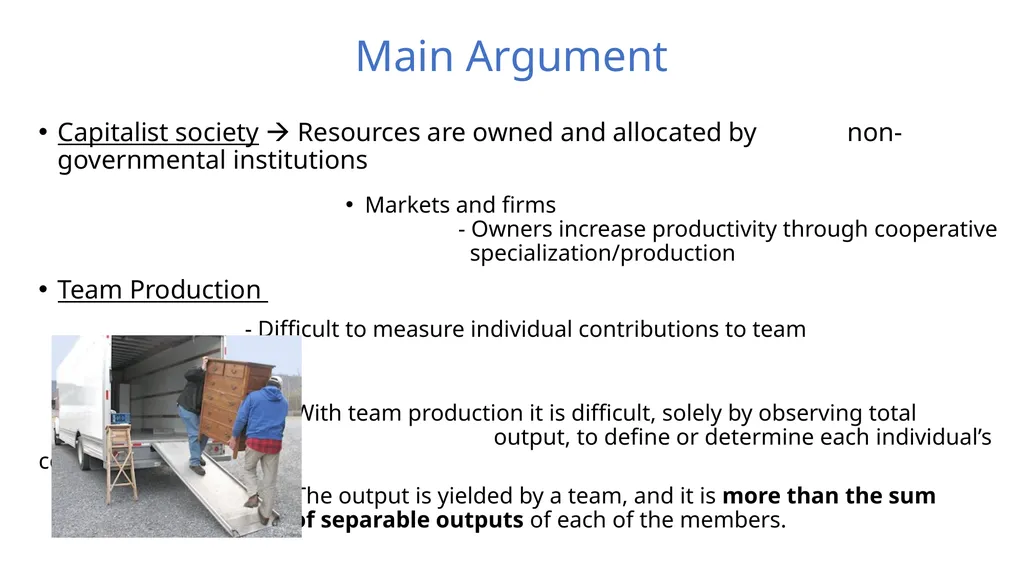
Team Production
- Difficult to measure individual contributions to team production.
- With team production it is difficult, solely by observing total output, to define or determine each individual’s contribution.
- The output is yielded by a team, and it is more than the sum of separable outputs of each of the members.<br>
03
Two important issues Gains from specialization and cooperative production can be better obtained through teams rather than markets.
Thus, it demands economic organizations to facilitate teams/cooperation.
BUT
How to monitor input and output in cooperation/teams?
Monitoring is costly
The solution is a FIRM (an economic organization)
Monitors individual input
Thus, long term contracts are not the essence of the firm
Firm team use of inputs + centralized contractual agent<br>
04
The Metering Problem Shirking A real problem for organizations and institutions
Classic economic theory
Fails to address the costs associated with metering (measuring) productivity and rewards
Assumptions Metering costs = 0
Productivity creates its reward Authors’ Opposing View
The system of rewarding relied upon to stimulate productivity.
An economic organization that meters well – making rewards and productively tightly correlated – will have higher productivity.<br>
05
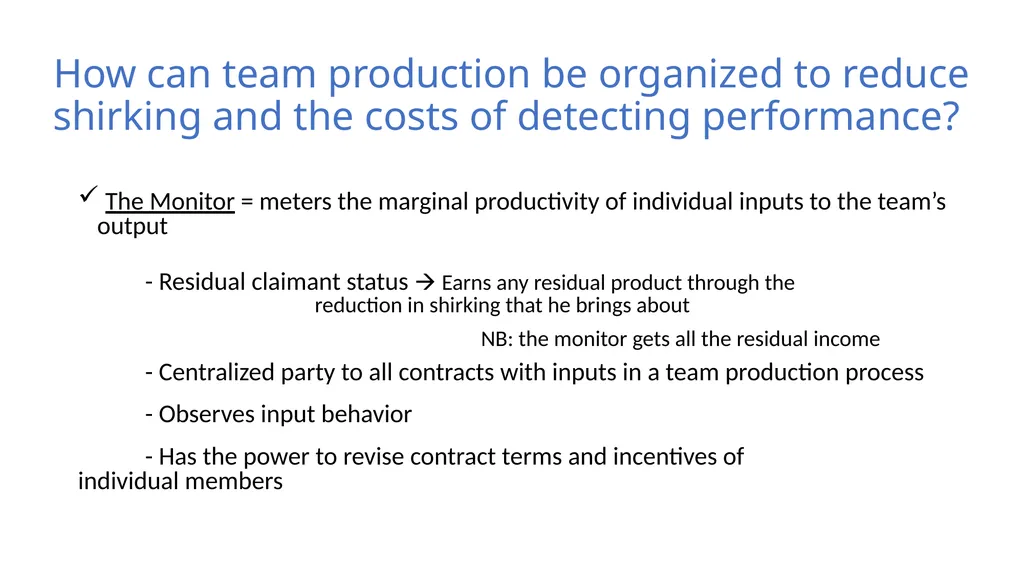
How can team production be organized to reduce shirking and the costs of detecting performance? The Monitor = meters the marginal productivity of individual inputs to the team’s output
- Residual claimant status Earns any residual product through the reduction in shirking that he brings about
NB: the monitor gets all the residual income
- Centralized party to all contracts with inputs in a team production process
- Observes input behavior
- Has the power to revise contract terms and incentives of individual members<br>
06
Necessary conditions for the existence of the classical firm (1) It is possible to increase productivity through team-oriented production,
(which is) a production technique for which it is costly to directly measure the marginal outputs of the cooperating inputs, and that makes it more difficult to restrict shirking through simple market exchange between cooperating inputs.
(2) It is economical to estimate marginal productivity by observing or specifying input behavior (high task programmability)
Firms exist due to costs of managing
Extension of Coase (1937) Classic
Capitalist
Firm “Ceteris paribus, the higher is the cost of transacting across markets the greater will be the comparative advantage of organizing resources within the firm.”<br>
07
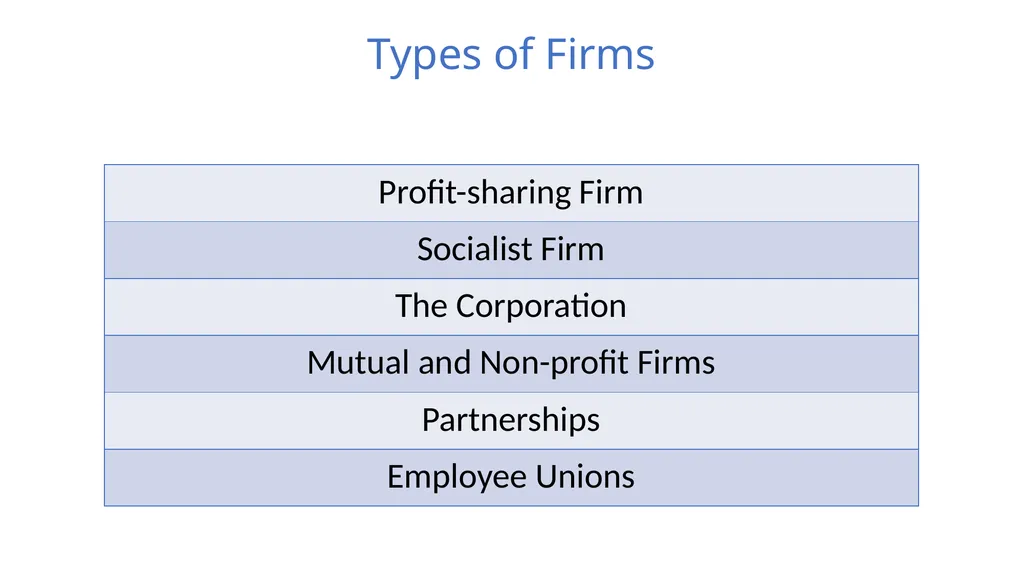
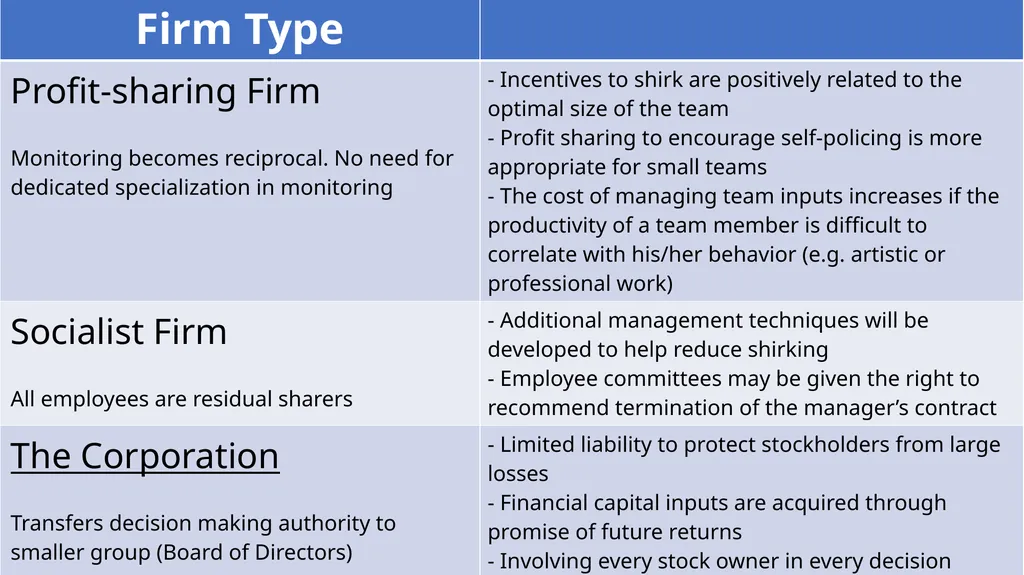
Types of Firms<br>
08
Corporations and business firms, and organizations in general, should try to instill team spirit and loyalty to reduce shirking.<br>
09
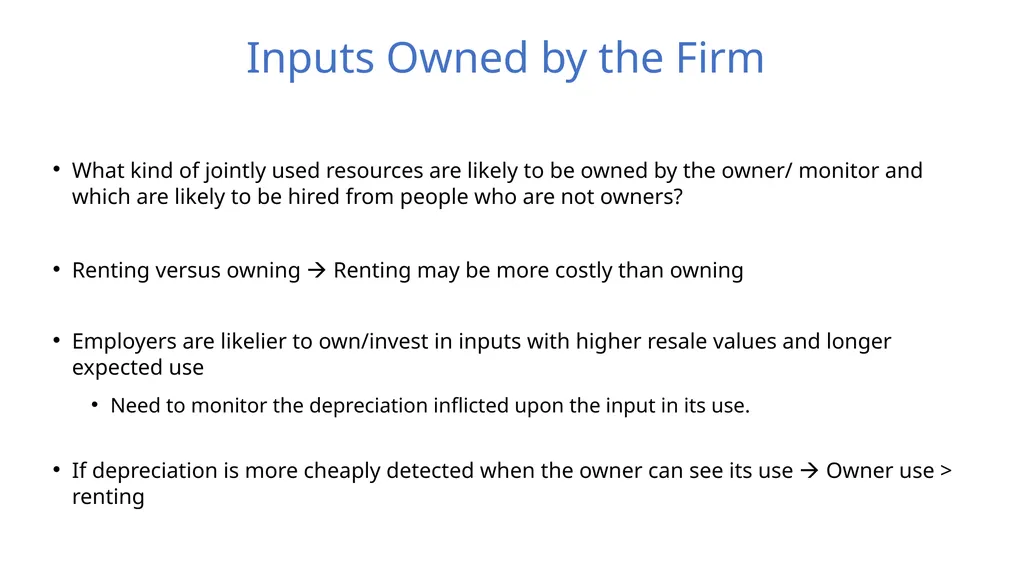
Inputs Owned by the Firm What kind of jointly used resources are likely to be owned by the owner/ monitor and which are likely to be hired from people who are not owners?
Renting versus owning Renting may be more costly than owning
Employers are likelier to own/invest in inputs with higher resale values and longer expected use
Need to monitor the depreciation inflicted upon the input in its use.
If depreciation is more cheaply detected when the owner can see its use Owner use > renting<br>
10
Firms as specialized market institutions The firm serves as a highly specialized surrogate market
A device for enhancing competition among sets of input resources.
A device for more efficiently rewarding these inputs.
The employer acquires superior information about many inputs’ productive talents
-Aids his directive (market hiring) efficiency.
-Allows him to ascertain opportunities for profitable team production more economically and accurately.
-He “sells” this information to employees.<br>
11
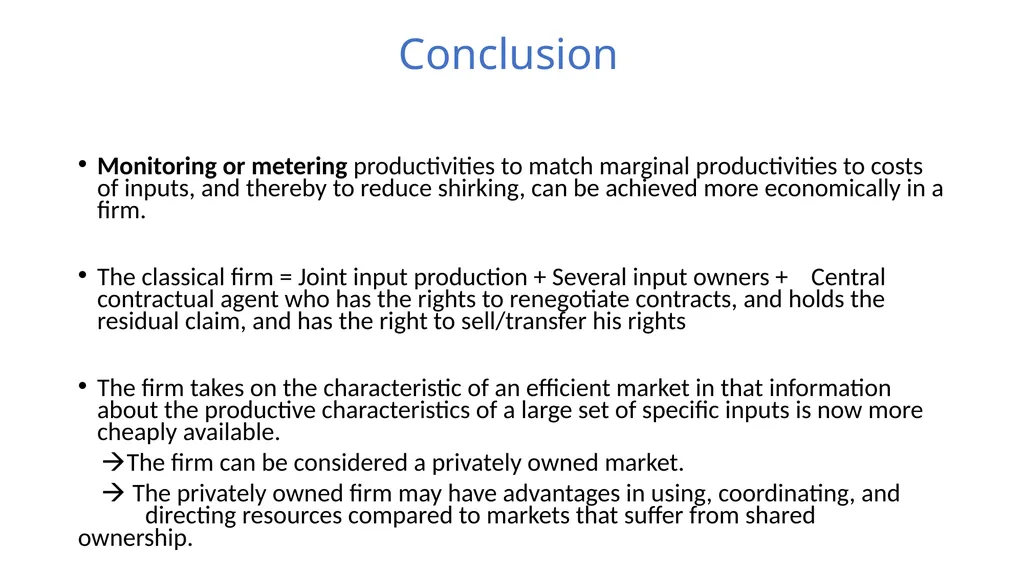
Conclusion Monitoring or metering productivities to match marginal productivities to costs of inputs, and thereby to reduce shirking, can be achieved more economically in a firm.
The classical firm = Joint input production + Several input owners + Central contractual agent who has the rights to renegotiate contracts, and holds the residual claim, and has the right to sell/transfer his rights
The firm takes on the characteristic of an efficient market in that information about the productive characteristics of a large set of specific inputs is now more cheaply available.
The firm can be considered a privately owned market.
The privately owned firm may have advantages in using, coordinating, and directing resources compared to markets that suffer from shared ownership.<br>