
Professionalism issues in estimation of Commercial
DJ
Published · 24 slides · 0 views

1 / 1

Description
Professionalism issues in estimation of Commercial Vehicle Third Party Reserves Serving the Cause of Public Interest Indian Actuarial Profession Shruti Saxena Vaibhav Tyagi Varadaprasad Jagannathan Guide: Khushwant Pahwa Evolution of
Related Topics
Share
Embed code
Download this presentation From Below
"Professionalism issues in estimation of Commercial" is the property of its rightful owner. Permission is granted to download and print the materials on this website for personal, non-commercial use only, and to display it on your personal computer provided you do not modify the materials and that you retain all copyright notices contained in the materials. By downloading content from our website, you accept the terms of this agreement.
Presentation Transcript
01
Professionalism issues in estimation of Commercial Vehicle Third Party Reserves Serving the Cause of Public Interest Indian Actuarial Profession Shruti Saxena
Vaibhav Tyagi
Varadaprasad Jagannathan
Guide: Khushwant Pahwa<br>
Vaibhav Tyagi
Varadaprasad Jagannathan
Guide: Khushwant Pahwa<br>
02
Evolution of Commercial TP Business in India
Technical Issues in Reserving
Professional Issues in Reserving
Recommendations to address professional issues Agenda<br>
Technical Issues in Reserving
Professional Issues in Reserving
Recommendations to address professional issues Agenda<br>
03
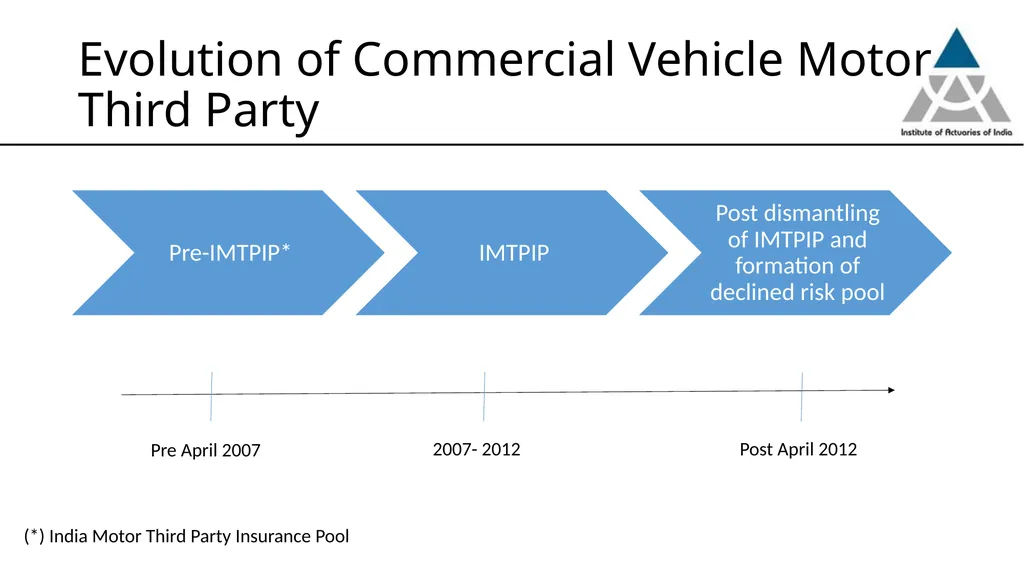
Pre April 2007 2007- 2012 Post April 2012 (*) India Motor Third Party Insurance Pool Evolution of Commercial Vehicle Motor Third Party<br>
04
Evolution of Commercial TP Business in India
Technical Issues in Reserving
Professional Issues in Reserving
Recommendations to address professional issues Agenda<br>
Technical Issues in Reserving
Professional Issues in Reserving
Recommendations to address professional issues Agenda<br>
05
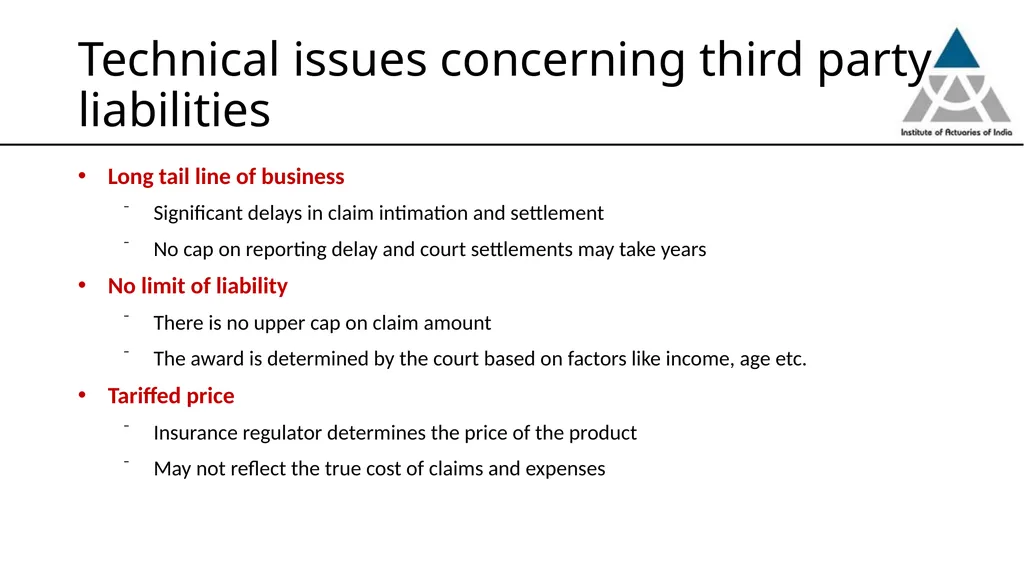
Long tail line of business
Significant delays in claim intimation and settlement
No cap on reporting delay and court settlements may take years
No limit of liability
There is no upper cap on claim amount
The award is determined by the court based on factors like income, age etc.
Tariffed price
Insurance regulator determines the price of the product
May not reflect the true cost of claims and expenses Technical issues concerning third party liabilities<br>
Significant delays in claim intimation and settlement
No cap on reporting delay and court settlements may take years
No limit of liability
There is no upper cap on claim amount
The award is determined by the court based on factors like income, age etc.
Tariffed price
Insurance regulator determines the price of the product
May not reflect the true cost of claims and expenses Technical issues concerning third party liabilities<br>
06
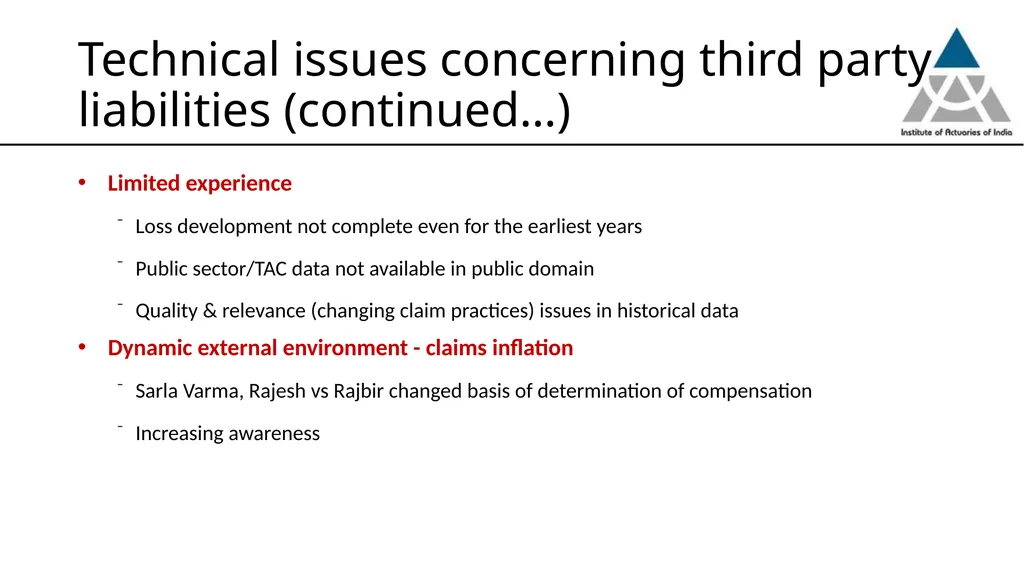
Technical issues concerning third party liabilities (continued…) Limited experience
Loss development not complete even for the earliest years
Public sector/TAC data not available in public domain
Quality & relevance (changing claim practices) issues in historical data
Dynamic external environment - claims inflation
Sarla Varma, Rajesh vs Rajbir changed basis of determination of compensation
Increasing awareness<br>
Loss development not complete even for the earliest years
Public sector/TAC data not available in public domain
Quality & relevance (changing claim practices) issues in historical data
Dynamic external environment - claims inflation
Sarla Varma, Rajesh vs Rajbir changed basis of determination of compensation
Increasing awareness<br>
07
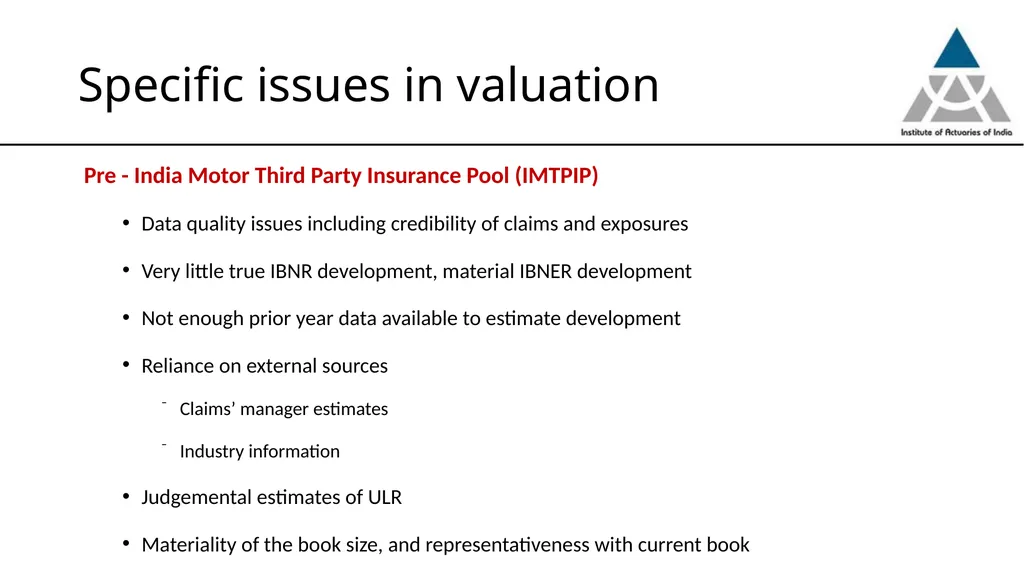
Specific issues in valuation Pre - India Motor Third Party Insurance Pool (IMTPIP)
Data quality issues including credibility of claims and exposures
Very little true IBNR development, material IBNER development
Not enough prior year data available to estimate development
Reliance on external sources
Claims’ manager estimates
Industry information
Judgemental estimates of ULR
Materiality of the book size, and representativeness with current book<br>
Data quality issues including credibility of claims and exposures
Very little true IBNR development, material IBNER development
Not enough prior year data available to estimate development
Reliance on external sources
Claims’ manager estimates
Industry information
Judgemental estimates of ULR
Materiality of the book size, and representativeness with current book<br>
08
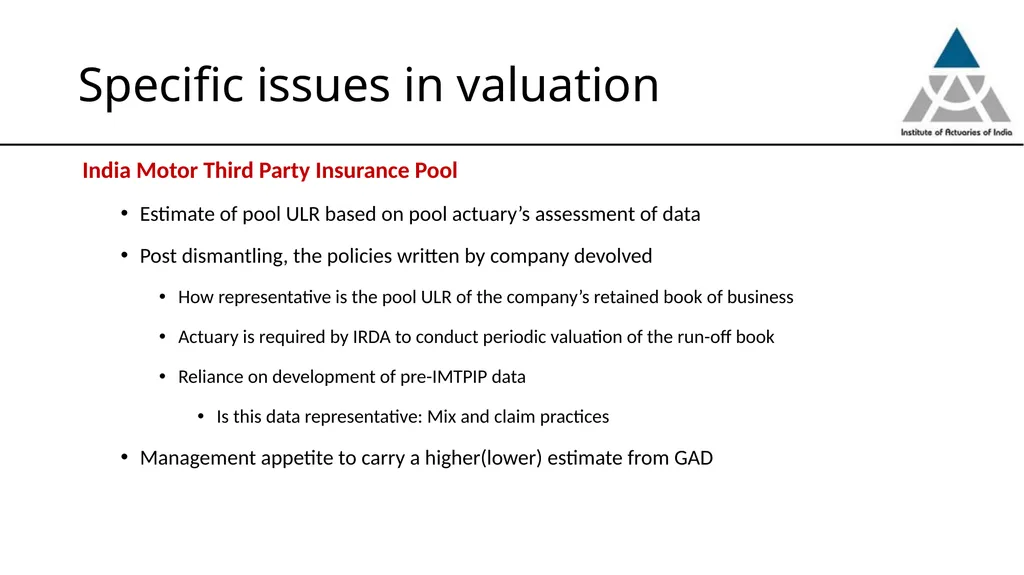
Specific issues in valuation India Motor Third Party Insurance Pool
Estimate of pool ULR based on pool actuary’s assessment of data
Post dismantling, the policies written by company devolved
How representative is the pool ULR of the company’s retained book of business
Actuary is required by IRDA to conduct periodic valuation of the run-off book
Reliance on development of pre-IMTPIP data
Is this data representative: Mix and claim practices
Management appetite to carry a higher(lower) estimate from GAD<br>
Estimate of pool ULR based on pool actuary’s assessment of data
Post dismantling, the policies written by company devolved
How representative is the pool ULR of the company’s retained book of business
Actuary is required by IRDA to conduct periodic valuation of the run-off book
Reliance on development of pre-IMTPIP data
Is this data representative: Mix and claim practices
Management appetite to carry a higher(lower) estimate from GAD<br>
09
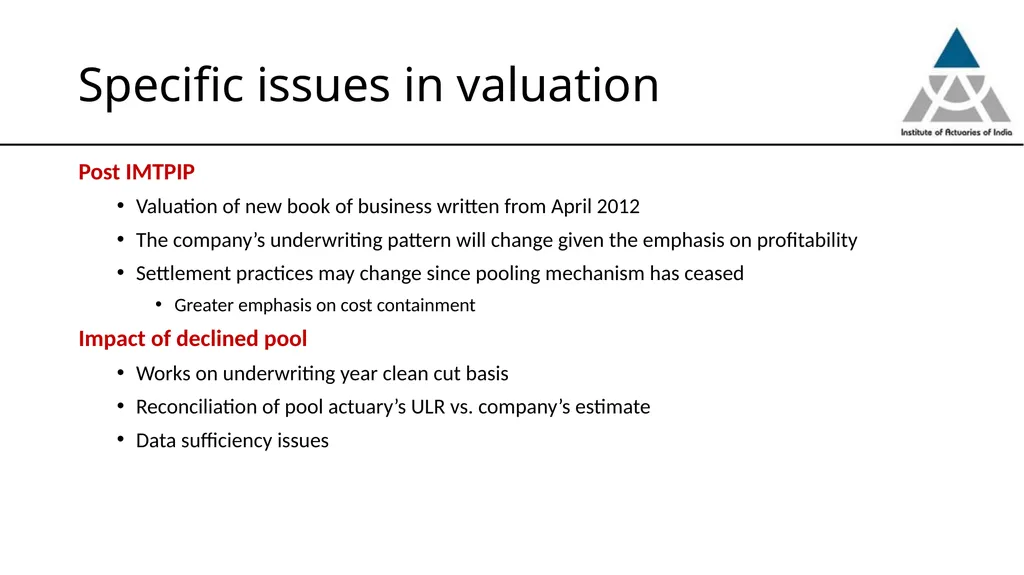
Specific issues in valuation Post IMTPIP
Valuation of new book of business written from April 2012
The company’s underwriting pattern will change given the emphasis on profitability
Settlement practices may change since pooling mechanism has ceased
Greater emphasis on cost containment
Impact of declined pool
Works on underwriting year clean cut basis
Reconciliation of pool actuary’s ULR vs. company’s estimate
Data sufficiency issues<br>
Valuation of new book of business written from April 2012
The company’s underwriting pattern will change given the emphasis on profitability
Settlement practices may change since pooling mechanism has ceased
Greater emphasis on cost containment
Impact of declined pool
Works on underwriting year clean cut basis
Reconciliation of pool actuary’s ULR vs. company’s estimate
Data sufficiency issues<br>
10
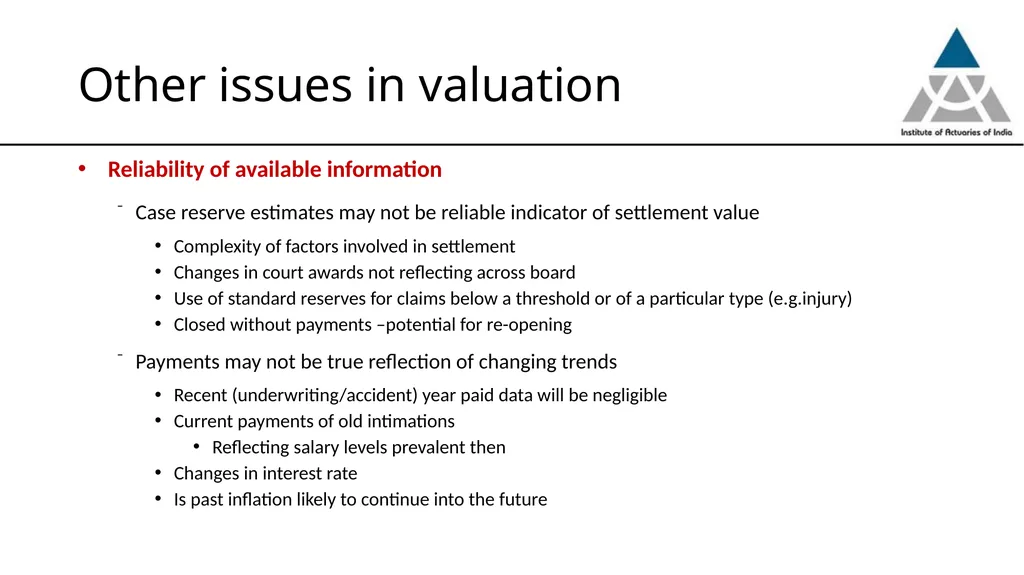
Other issues in valuation Reliability of available information
Case reserve estimates may not be reliable indicator of settlement value
Complexity of factors involved in settlement
Changes in court awards not reflecting across board
Use of standard reserves for claims below a threshold or of a particular type (e.g.injury)
Closed without payments –potential for re-opening
Payments may not be true reflection of changing trends
Recent (underwriting/accident) year paid data will be negligible
Current payments of old intimations
Reflecting salary levels prevalent then
Changes in interest rate
Is past inflation likely to continue into the future<br>
Case reserve estimates may not be reliable indicator of settlement value
Complexity of factors involved in settlement
Changes in court awards not reflecting across board
Use of standard reserves for claims below a threshold or of a particular type (e.g.injury)
Closed without payments –potential for re-opening
Payments may not be true reflection of changing trends
Recent (underwriting/accident) year paid data will be negligible
Current payments of old intimations
Reflecting salary levels prevalent then
Changes in interest rate
Is past inflation likely to continue into the future<br>
11
Evolution of Commercial TP Business in India
Technical Issues in Reserving
Professional Issues in Reserving
Recommendations to address professional issues Agenda<br>
Technical Issues in Reserving
Professional Issues in Reserving
Recommendations to address professional issues Agenda<br>
12
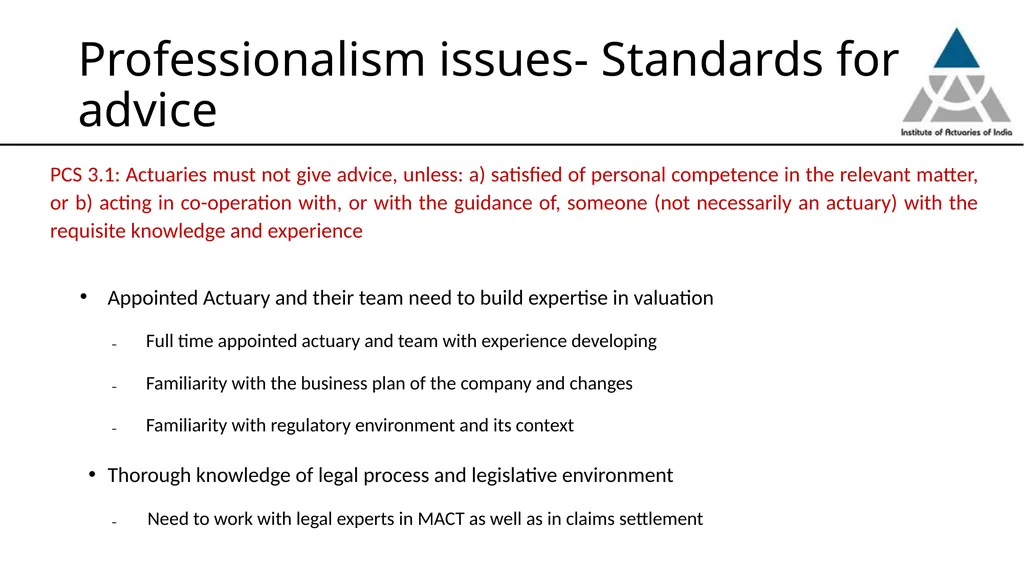
Professionalism issues- Standards for advice PCS 3.1: Actuaries must not give advice, unless: a) satisfied of personal competence in the relevant matter, or b) acting in co-operation with, or with the guidance of, someone (not necessarily an actuary) with the requisite knowledge and experience
Appointed Actuary and their team need to build expertise in valuation
Full time appointed actuary and team with experience developing
Familiarity with the business plan of the company and changes
Familiarity with regulatory environment and its context
Thorough knowledge of legal process and legislative environment
Need to work with legal experts in MACT as well as in claims settlement<br>
Appointed Actuary and their team need to build expertise in valuation
Full time appointed actuary and team with experience developing
Familiarity with the business plan of the company and changes
Familiarity with regulatory environment and its context
Thorough knowledge of legal process and legislative environment
Need to work with legal experts in MACT as well as in claims settlement<br>
13
Issues for actuaries valuing liabilities Lack of experienced actuaries in General Insurance
Indian non life actuaries have limited experience
Actuarial valuation of IBNR required only from FY 06
Private insurance companies relatively new and growing book
Limited expertise for peer guidance/ review
Ability to take and justify judgement calls
True IBNR development
IBNER provision
Estimates of future inflation for estimating loss ratio for budgeting
Cannot consult peer actuaries on account of confidentiality considerations
Could be construed as competitive information<br>
Indian non life actuaries have limited experience
Actuarial valuation of IBNR required only from FY 06
Private insurance companies relatively new and growing book
Limited expertise for peer guidance/ review
Ability to take and justify judgement calls
True IBNR development
IBNER provision
Estimates of future inflation for estimating loss ratio for budgeting
Cannot consult peer actuaries on account of confidentiality considerations
Could be construed as competitive information<br>
14
Professionalism issues- Standards for advice PCS 3.4: An Actuary must consider the extent to which it is appropriate to carry out investigations to assess the accuracy and reasonableness of any data being used. The advice should normally include an explanation or qualification if the actuary has any reservations about the reliability of data
Given the long tail nature of the liabilities the actuary will need historical data
Is this data available and credible?
Company data vs. IIB data
Is this data representative of the current context: business mix, settlement processes
Information on court award inflation and exoneration trends may be anecdotal
Extrapolating regional trends at national level<br>
Given the long tail nature of the liabilities the actuary will need historical data
Is this data available and credible?
Company data vs. IIB data
Is this data representative of the current context: business mix, settlement processes
Information on court award inflation and exoneration trends may be anecdotal
Extrapolating regional trends at national level<br>
15
Professionalism issues- Standards for advice PCS 3.5: Advice should normally include sufficient information and discussion about each relevant factor and about the results of the actuary’s investigations to enable the intended recipient of the advice to judge both the appropriateness of the recommendations and the implications of accepting them. Further, the actuary should…
Detailed Documentation of valuation exercise is critical
Validate assumptions through detailed analysis of experience exercise
Appropriate communication of assumptions with key stakeholders
Use of actuarial judgement and its impact on the analysis
Continuous monitoring of emerging experience and communicating its impact with the stakeholders<br>
Detailed Documentation of valuation exercise is critical
Validate assumptions through detailed analysis of experience exercise
Appropriate communication of assumptions with key stakeholders
Use of actuarial judgement and its impact on the analysis
Continuous monitoring of emerging experience and communicating its impact with the stakeholders<br>
16
Professionalism issues- Standards for advice PCS 3.6: An Actuary giving advice which is formulated in the interests of a particular client must ensure that the client is aware that the advice is not of broader applicability than intended by the actuary, nor is it necessarily the advice that would be given to another client…
The ULR of old book, IMTPIP, new book and the declined pool will all have to be estimated separately
Assumptions, data, methods of estimation will vary according to the context
CV-TP liabilities of the pool are fixed across the industry, however individual company books may develop differently
ULR for one company may not be representative of ULR for another company or the industry, though these tend to be compared<br>
The ULR of old book, IMTPIP, new book and the declined pool will all have to be estimated separately
Assumptions, data, methods of estimation will vary according to the context
CV-TP liabilities of the pool are fixed across the industry, however individual company books may develop differently
ULR for one company may not be representative of ULR for another company or the industry, though these tend to be compared<br>
17
Professionalism issues- Financial interest PCS 6.3: Financial rewards which are large in relation to the professional time spent, including success related or contingency fees, can threaten objectivity…Accordingly, actuaries are advised to exercise extreme care…
Actuary as an employee of a company may have financial interests linked to the financial health of the firm
Profit linked Bonus, Stock options, etc.
Is it appropriate for actuary to accept significant bonus linked to financial performance of the company, and does it impact objectivity
Governance structure
How are the KPI’s set and what is the reporting structure (CFO, CUO)<br>
Actuary as an employee of a company may have financial interests linked to the financial health of the firm
Profit linked Bonus, Stock options, etc.
Is it appropriate for actuary to accept significant bonus linked to financial performance of the company, and does it impact objectivity
Governance structure
How are the KPI’s set and what is the reporting structure (CFO, CUO)<br>
18
Professionalism issues- Conflict of interest PCS 5.1: Clients are entitled to assume that advice given by an actuary is unaffected by interests other than those of the client, taking account of any identifiable professional or legal duty of care of the client in respect of a third party
The valuation of the declined pool is conducted by Actuaries who are also Appointed Actuaries of GI companies
Their view on the pool ULR has material impact on the financials of their company<br>
The valuation of the declined pool is conducted by Actuaries who are also Appointed Actuaries of GI companies
Their view on the pool ULR has material impact on the financials of their company<br>
19
Other professional issues for actuaries valuing CV-TP liabilities Third party liabilities tend to be large part of overall claims reserves
Any change can impact company’s profitability materially
Management sensitivity and scrutiny
Communicating effectively is very essential
Long tail of development
Succeeding actuary will have to manage the legacy of his predecessors
PCS 4.3: May lead to professionalism breach issues between actuaries<br>
Any change can impact company’s profitability materially
Management sensitivity and scrutiny
Communicating effectively is very essential
Long tail of development
Succeeding actuary will have to manage the legacy of his predecessors
PCS 4.3: May lead to professionalism breach issues between actuaries<br>
20
Professionalism issues- breach If any member has reason to believe that another member is understating the reserves (wilfully or otherwise)
Eg. Actuaries in the regulatory body or reinsurance companies
Members in other insurance companies (through may be confidentiality issues here)
PCS 4.3.3: in deciding whether a breach of guidance is material, the member may need to exercise judgement…
PCS 4.3.4: if the member decides that the nature of the breach is such that action is called for, the member must, in the first instance…
PCS 4.3.5: If the member does not consider a discussion to be appropriate, or if the matter is not resolved …<br>
Eg. Actuaries in the regulatory body or reinsurance companies
Members in other insurance companies (through may be confidentiality issues here)
PCS 4.3.3: in deciding whether a breach of guidance is material, the member may need to exercise judgement…
PCS 4.3.4: if the member decides that the nature of the breach is such that action is called for, the member must, in the first instance…
PCS 4.3.5: If the member does not consider a discussion to be appropriate, or if the matter is not resolved …<br>
21
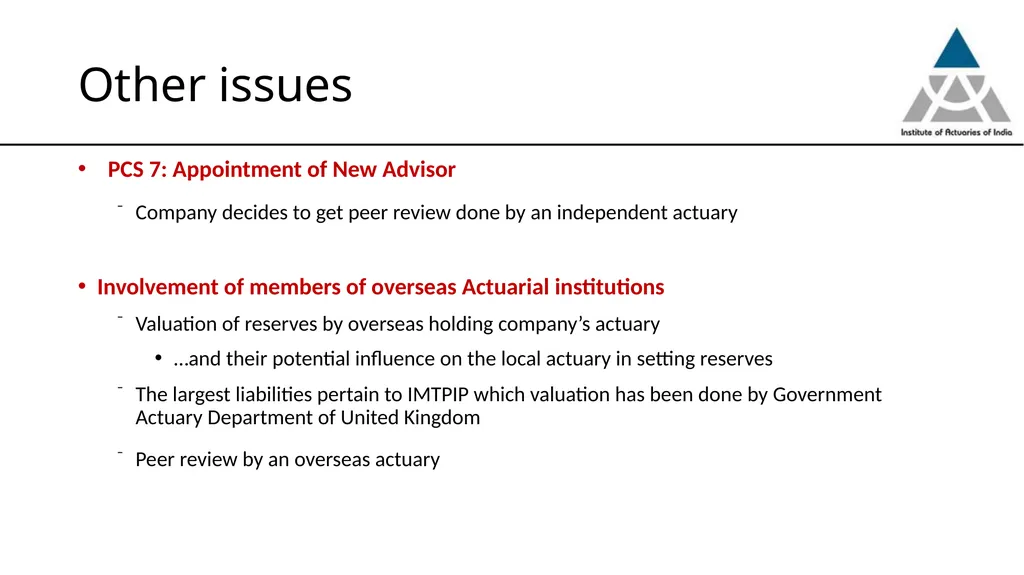
Other issues PCS 7: Appointment of New Advisor
Company decides to get peer review done by an independent actuary
Involvement of members of overseas Actuarial institutions
Valuation of reserves by overseas holding company’s actuary
…and their potential influence on the local actuary in setting reserves
The largest liabilities pertain to IMTPIP which valuation has been done by Government Actuary Department of United Kingdom
Peer review by an overseas actuary<br>
Company decides to get peer review done by an independent actuary
Involvement of members of overseas Actuarial institutions
Valuation of reserves by overseas holding company’s actuary
…and their potential influence on the local actuary in setting reserves
The largest liabilities pertain to IMTPIP which valuation has been done by Government Actuary Department of United Kingdom
Peer review by an overseas actuary<br>
22
Evolution of Commercial TP Business in India
Technical Issues in Reserving
Professional Issues in Reserving
Recommendations to address professional issues Agenda<br>
Technical Issues in Reserving
Professional Issues in Reserving
Recommendations to address professional issues Agenda<br>
23
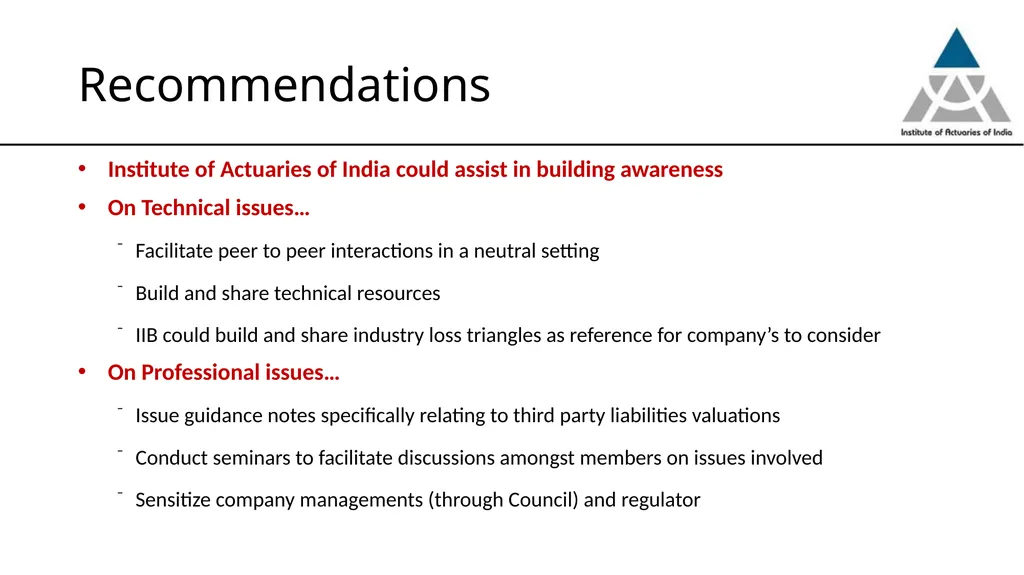
Recommendations Institute of Actuaries of India could assist in building awareness
On Technical issues…
Facilitate peer to peer interactions in a neutral setting
Build and share technical resources
IIB could build and share industry loss triangles as reference for company’s to consider
On Professional issues…
Issue guidance notes specifically relating to third party liabilities valuations
Conduct seminars to facilitate discussions amongst members on issues involved
Sensitize company managements (through Council) and regulator<br>
On Technical issues…
Facilitate peer to peer interactions in a neutral setting
Build and share technical resources
IIB could build and share industry loss triangles as reference for company’s to consider
On Professional issues…
Issue guidance notes specifically relating to third party liabilities valuations
Conduct seminars to facilitate discussions amongst members on issues involved
Sensitize company managements (through Council) and regulator<br>
24
Thank you<br>