
Program Analysis and Verification 0368-4479 Noam




Description: Program Analysis and Verification 0368-4479 Noam Rinetzky Lecture 1: Introduction Overview 1 Slides credit: Tom Ball, Dawson Engler, Roman Manevich, Erik Poll, Mooly Sagiv, Jean Souyris, Eran Tromer, Avishai Wool, Eran Yahav Admin
Related Topics
Download Presentation
"Program Analysis and Verification 0368-4479 Noam" is the property of its rightful owner. Permission is granted to download and print the materials on this website for personal, non-commercial use only, and to display it on your personal computer provided you do not modify the materials and that you retain all copyright notices contained in the materials. By downloading content from our website, you accept the terms of this agreement.
Presentation Transcript
slide1. Program Analysis and Verification
0368-4479 Noam Rinetzky
Lecture 1: Introduction & Overview 1 Slides credit: Tom Ball, Dawson Engler, Roman Manevich, Erik Poll, Mooly Sagiv, Jean Souyris, Eran Tromer, Avishai Wool, Eran Yahav<br>
slide2. Admin Lecturer: Noam Rinetzky
maon@cs.tau.ac.il
http://www.cs.tau.ac.il/~maon
14 Lessons
Monday, 13:00-16:00, Shenkar-Physics 222
4 Assignments (30%)
1 involves programming
1 Lesson summary (10%)
Final exam (60%)
Must pass 2<br>
slide3. Today Motivation
Introduction
Not technical 3<br>
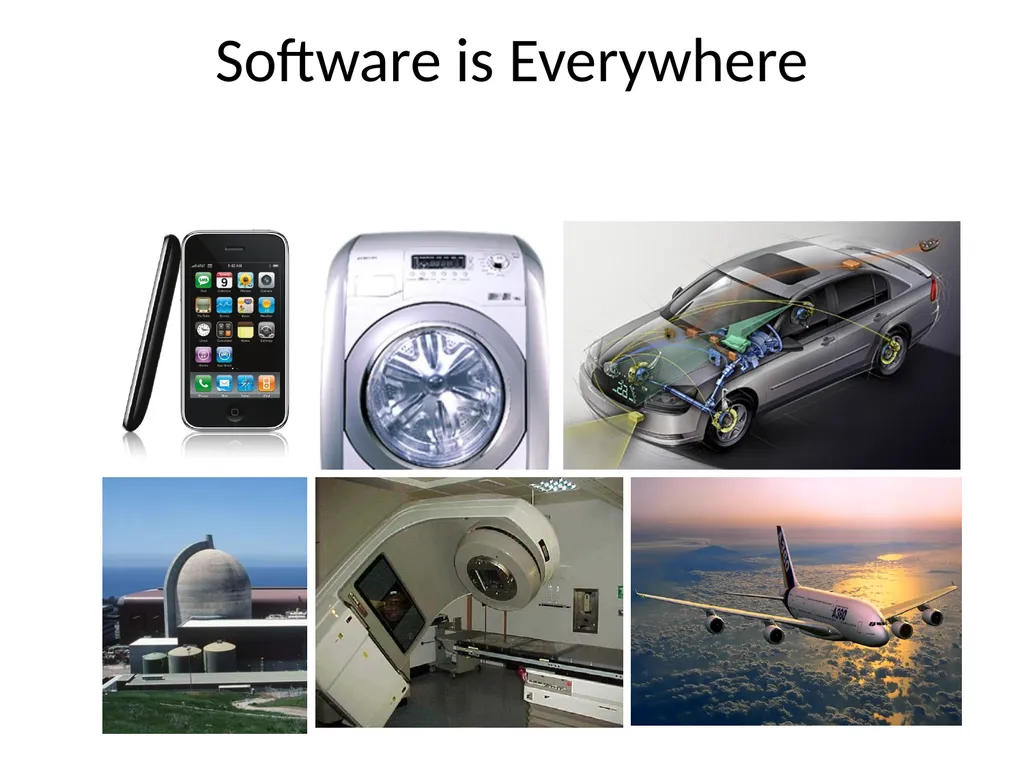
slide4. Software is Everywhere<br>
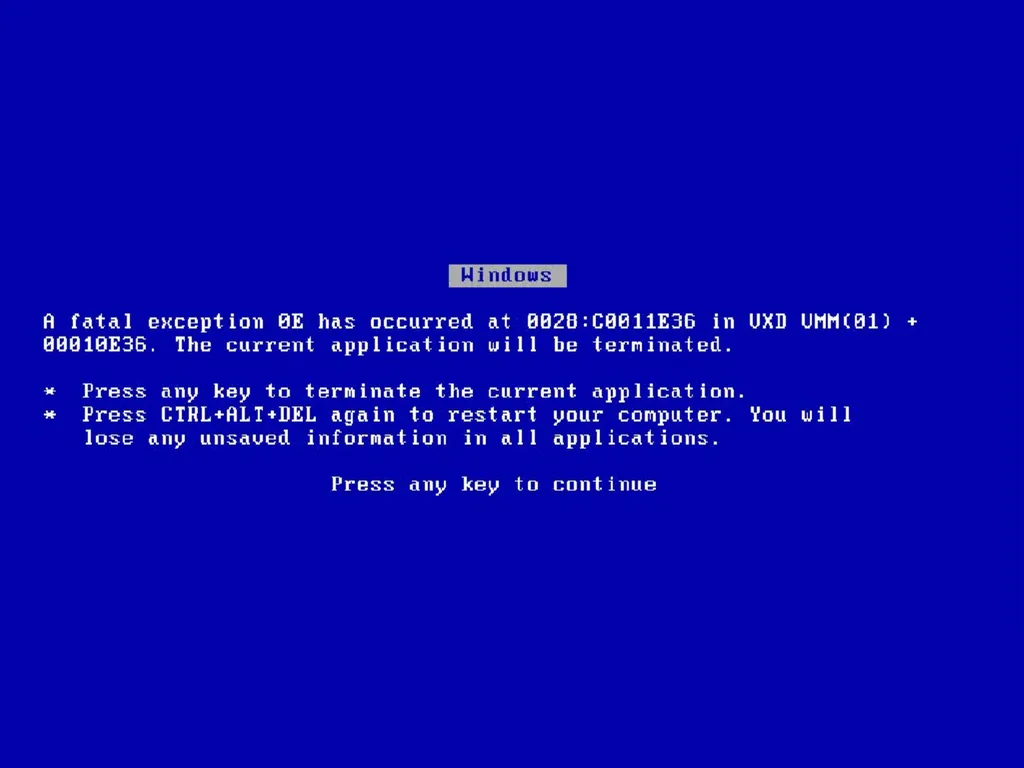
slide5. Software is Everywhere Unreliable<br>
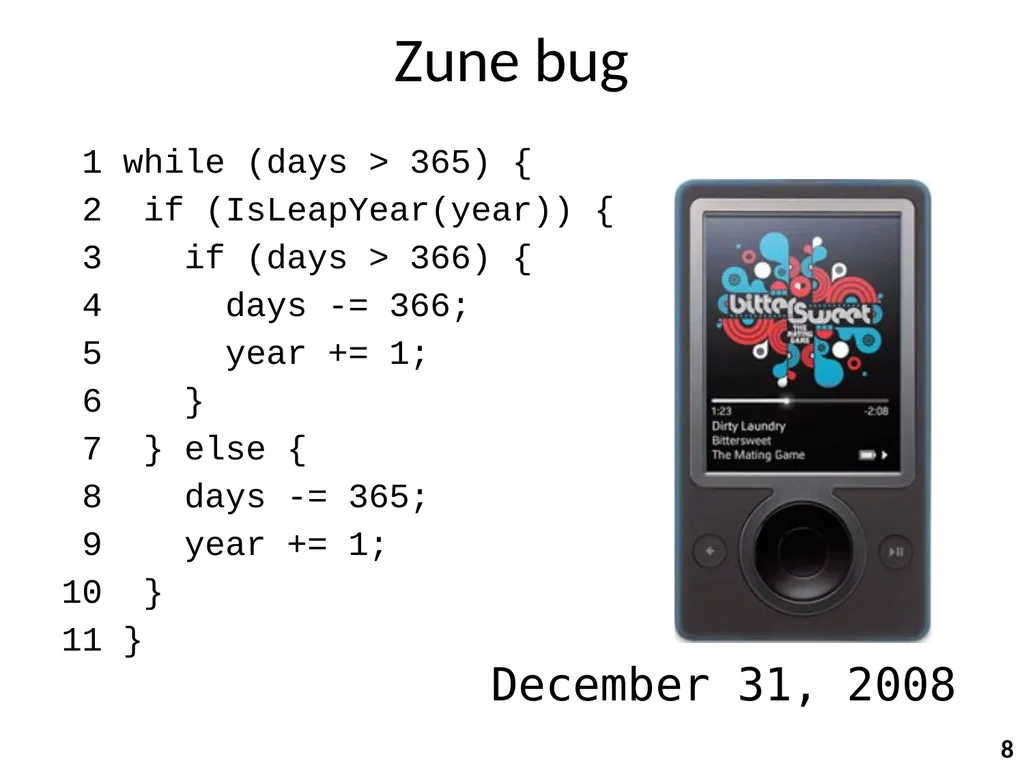
slide7. 30GB Zunes all over the world fail en masse 7 December 31, 2008<br>
slide8. Zune bug 1 while (days > 365) {
2 if (IsLeapYear(year)) {
3 if (days > 366) {
4 days -= 366;
5 year += 1;
6 }
7 } else {
8 days -= 365;
9 year += 1;
10 }
11 } 8 December 31, 2008<br>
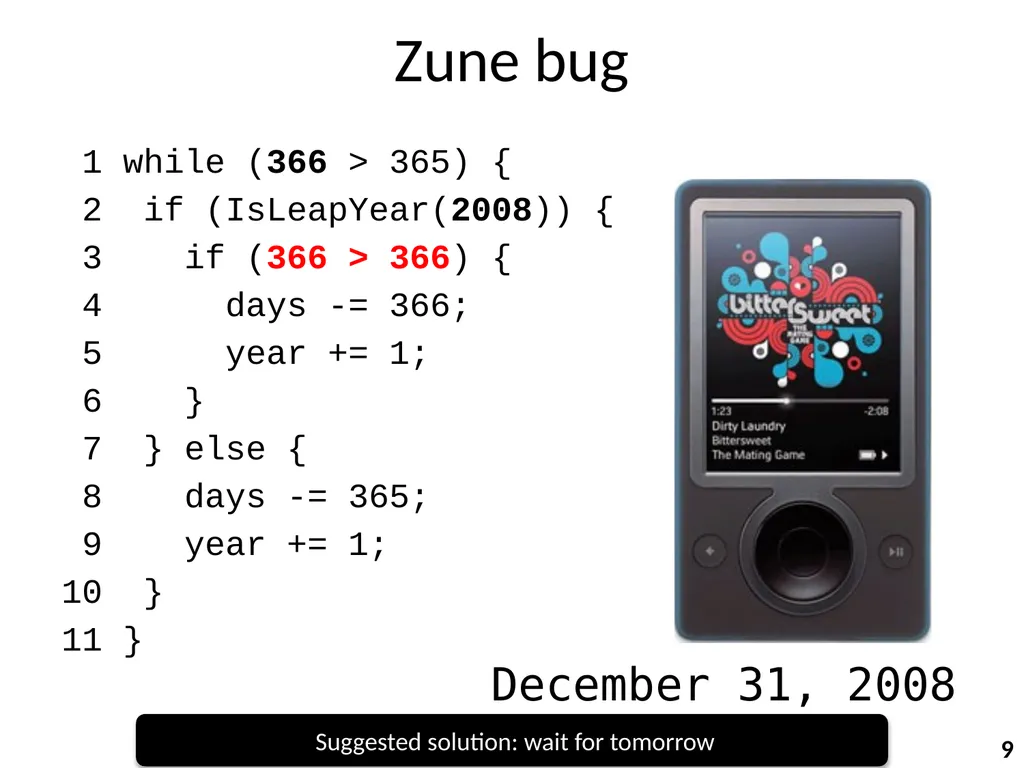
slide9. Zune bug 1 while (366 > 365) {
2 if (IsLeapYear(2008)) {
3 if (366 > 366) {
4 days -= 366;
5 year += 1;
6 }
7 } else {
8 days -= 365;
9 year += 1;
10 }
11 } Suggested solution: wait for tomorrow 9 December 31, 2008<br>
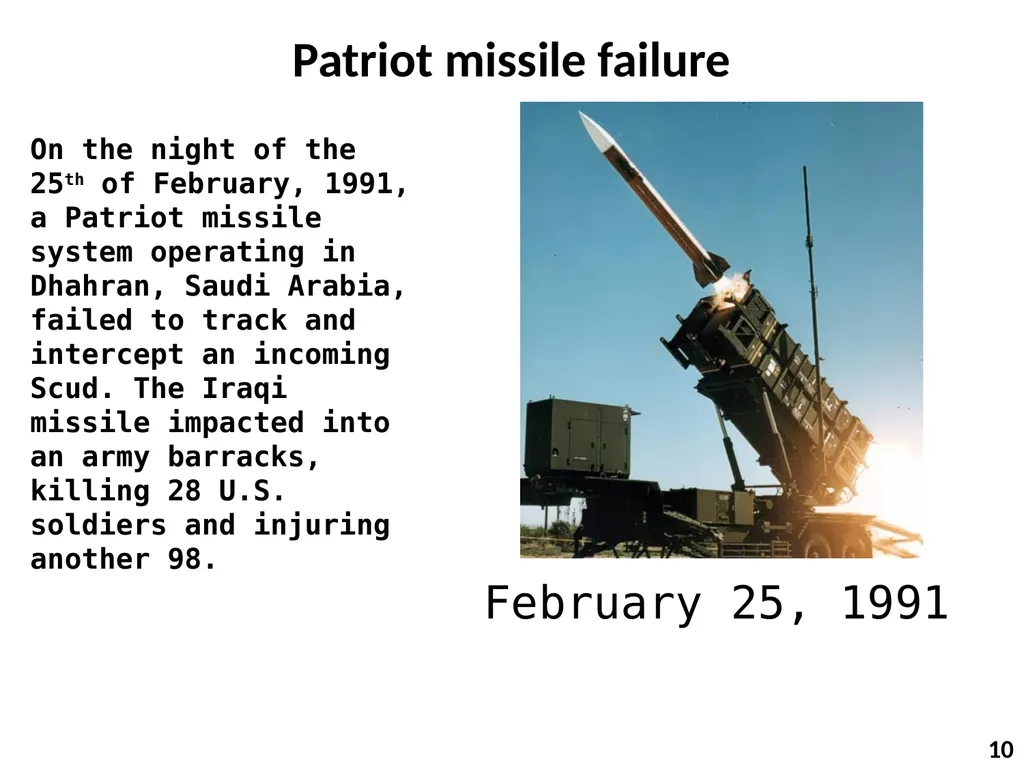
slide10. February 25, 1991 On the night of the 25th of February, 1991, a Patriot missile system operating in Dhahran, Saudi Arabia, failed to track and intercept an incoming Scud. The Iraqi missile impacted into an army barracks, killing 28 U.S. soldiers and injuring another 98. Patriot missile failure 10<br>
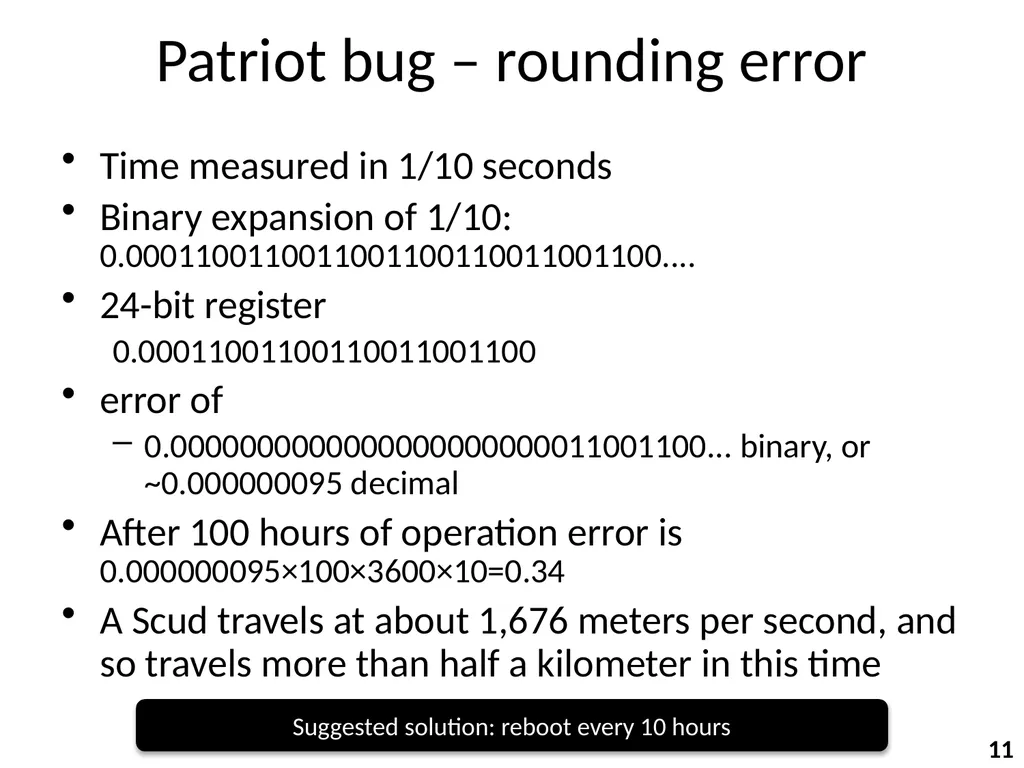
slide11. Patriot bug – rounding error Time measured in 1/10 seconds
Binary expansion of 1/10: 0.0001100110011001100110011001100....
24-bit register
0.00011001100110011001100
error of
0.0000000000000000000000011001100... binary, or ~0.000000095 decimal
After 100 hours of operation error is 0.000000095×100×3600×10=0.34
A Scud travels at about 1,676 meters per second, and so travels more than half a kilometer in this time Suggested solution: reboot every 10 hours 11<br>
slide12. Toyota recalls 160,000 Prius hybrid vehicles Programming error can activate all warning lights, causing the car to think its engine has failed October 2005<br>
slide13. Therac-25 leads to 3 deaths and 3 injuries Software error exposes patients to radiation overdose (100X of intended dose) 1985 to 1987<br>
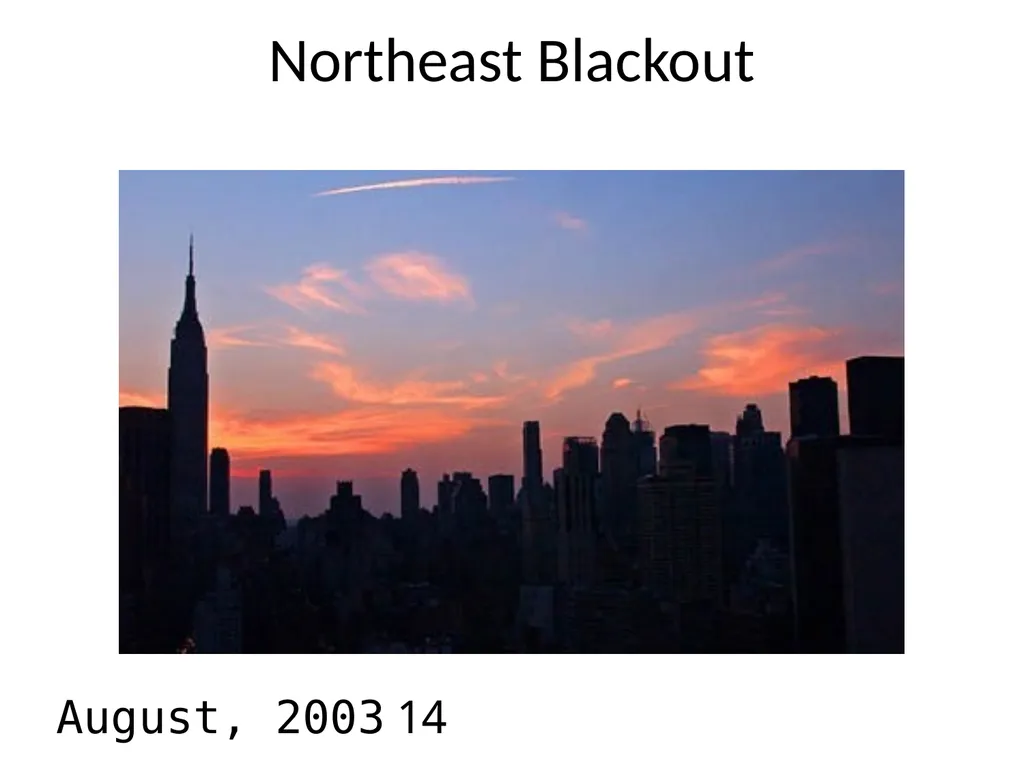
slide14. Northeast Blackout 14 August, 2003<br>
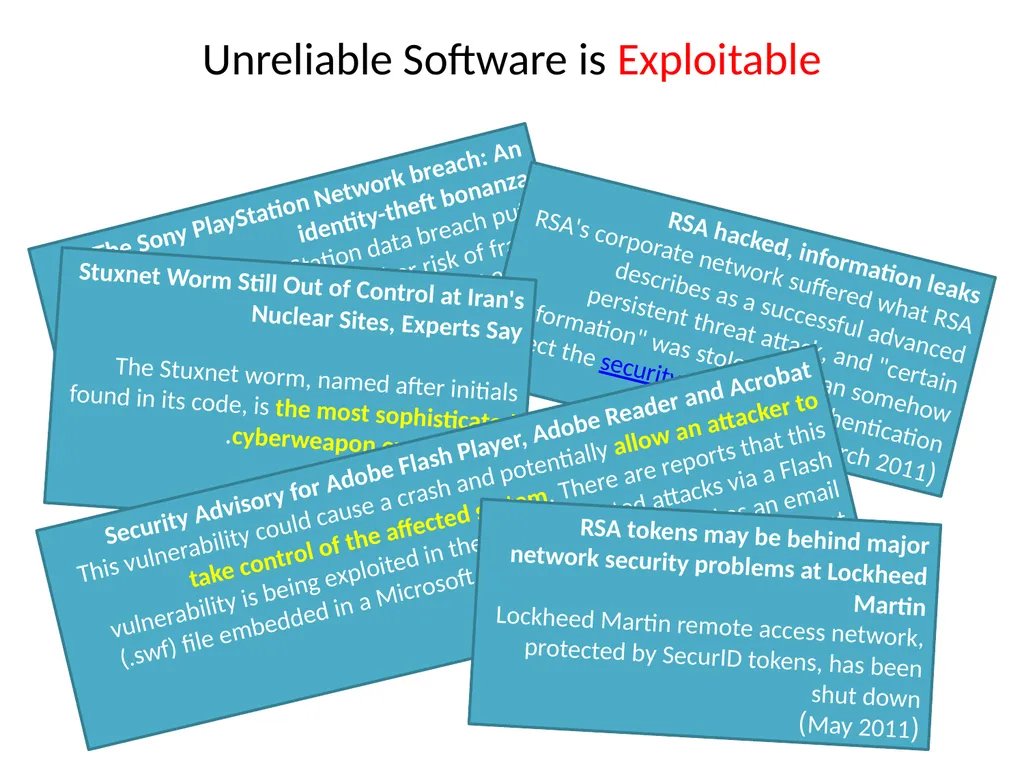
slide15. Unreliable Software is Exploitable The Sony PlayStation Network breach: An identity-theft bonanza
Massive Sony PlayStation data breach puts about 77 million people at higher risk of fraud
(April 2011) RSA hacked, information leaks RSA's corporate network suffered what RSA describes as a successful advanced persistent threat attack, and "certain information" was stolen that can somehow affect the security of SecurID authentication
(March 2011) Stuxnet Worm Still Out of Control at Iran's Nuclear Sites, Experts Say
The Stuxnet worm, named after initials found in its code, is the most sophisticated cyberweapon ever created.
(December 2010) Security Advisory for Adobe Flash Player, Adobe Reader and Acrobat
This vulnerability could cause a crash and potentially allow an attacker to take control of the affected system. There are reports that this vulnerability is being exploited in the wild in targeted attacks via a Flash (.swf) file embedded in a Microsoft Excel (.xls) file delivered as an email attachment.
(March 2011) RSA tokens may be behind major network security problems at Lockheed Martin
Lockheed Martin remote access network, protected by SecurID tokens, has been shut down
(May 2011)<br>
slide16. August 13, 2003 Billy Gates why do you make this possible ? Stop making money and fix your software!! (W32.Blaster.Worm) 16<br>
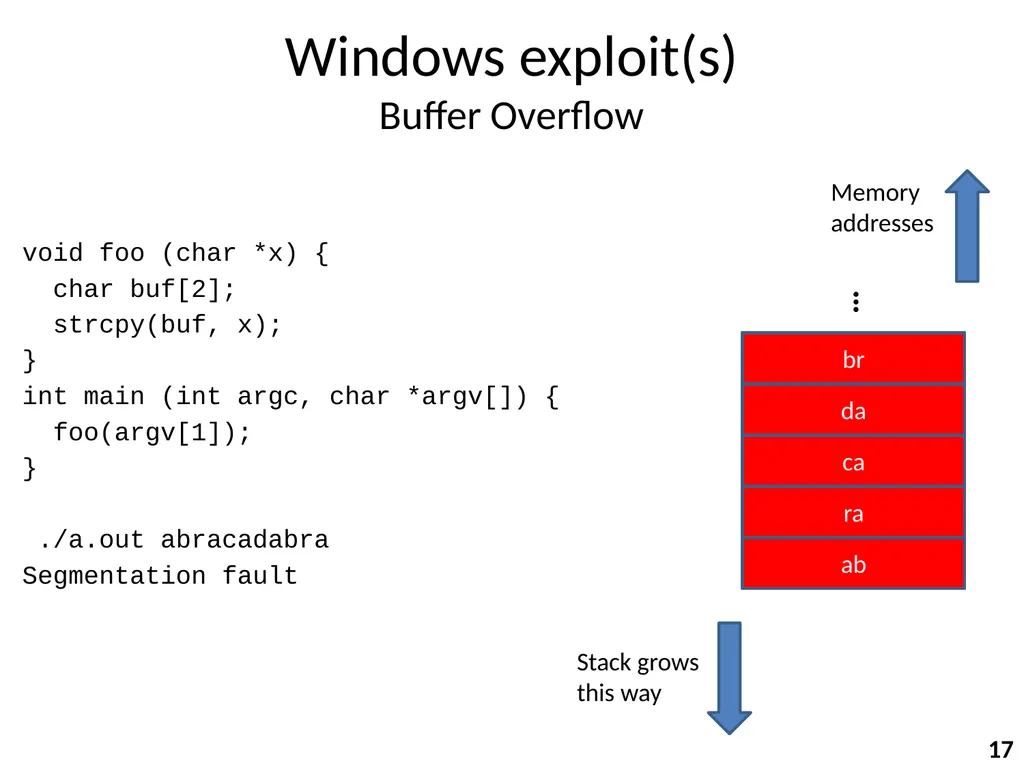
slide17. Windows exploit(s) Buffer Overflow 17 void foo (char *x) {
char buf[2];
strcpy(buf, x);
}
int main (int argc, char *argv[]) {
foo(argv[1]);
}
./a.out abracadabra
Segmentation fault Stack grows
this way Memory
addresses Previous frame Return address Saved FP char* x buf[2] … ab ra ca da br<br>
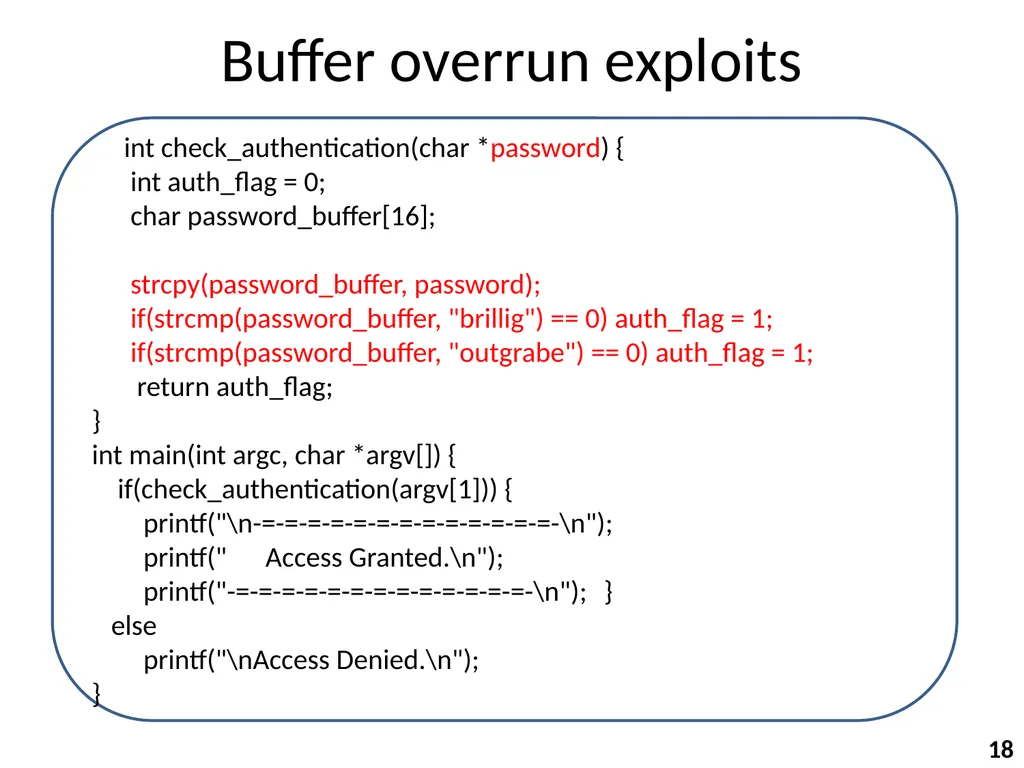
slide18. Buffer overrun exploits int check_authentication(char *password) {
int auth_flag = 0;
char password_buffer[16];
strcpy(password_buffer, password);
if(strcmp(password_buffer, "brillig") == 0) auth_flag = 1;
if(strcmp(password_buffer, "outgrabe") == 0) auth_flag = 1;
return auth_flag;
}
int main(int argc, char *argv[]) {
if(check_authentication(argv[1])) {
printf("\n-=-=-=-=-=-=-=-=-=-=-=-=-=-\n");
printf(" Access Granted.\n");
printf("-=-=-=-=-=-=-=-=-=-=-=-=-=-\n"); }
else
printf("\nAccess Denied.\n");
} (source: “hacking – the art of exploitation, 2nd Ed”) 18<br>
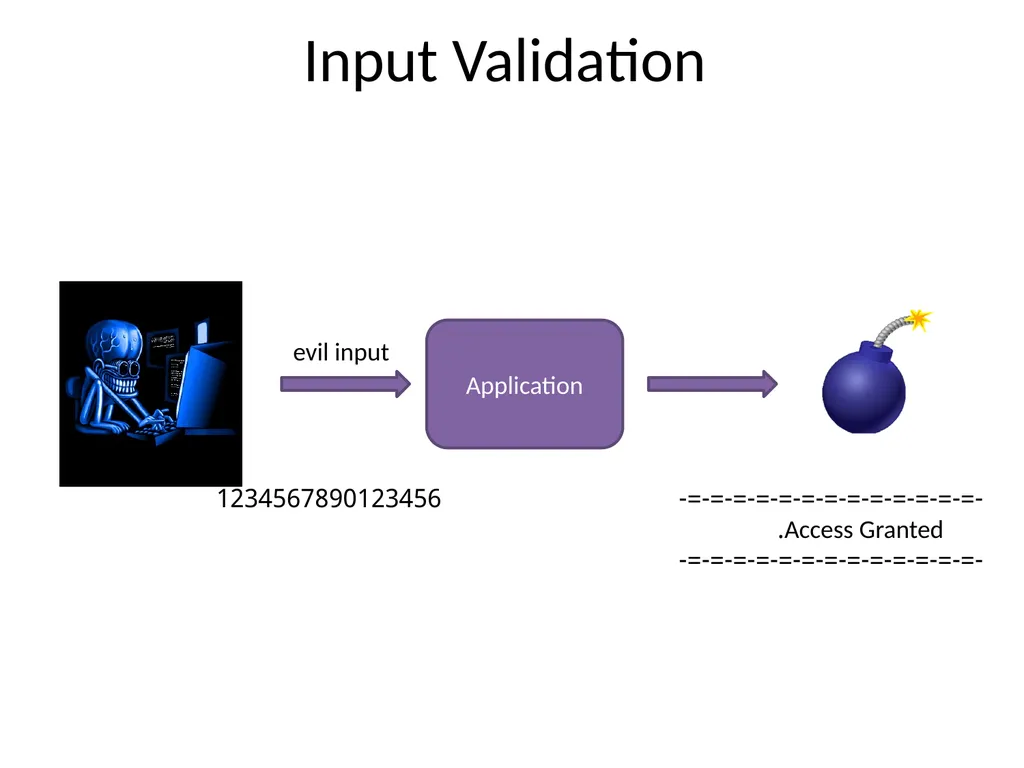
slide19. Input Validation Application evil input 1234567890123456 -=-=-=-=-=-=-=-=-=-=-=-=-=-
Access Granted.
-=-=-=-=-=-=-=-=-=-=-=-=-=-<br>
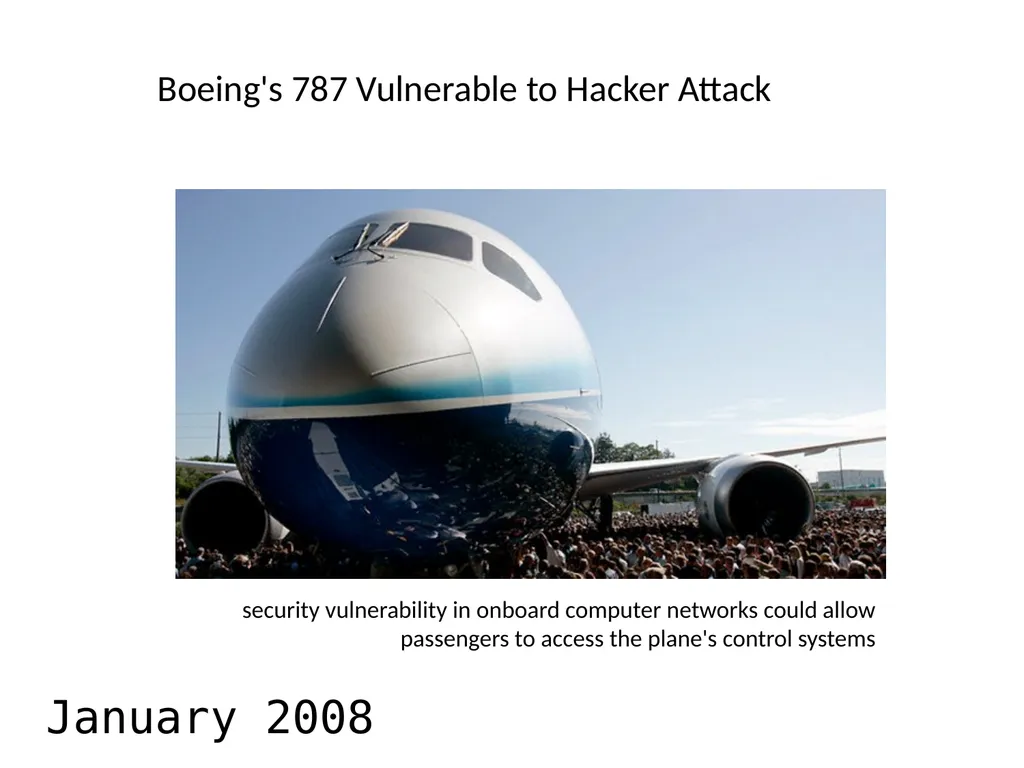
slide20. Boeing's 787 Vulnerable to Hacker Attack security vulnerability in onboard computer networks could allow passengers to access the plane's control systems January 2008<br>
slide21. What can we do about it?<br>
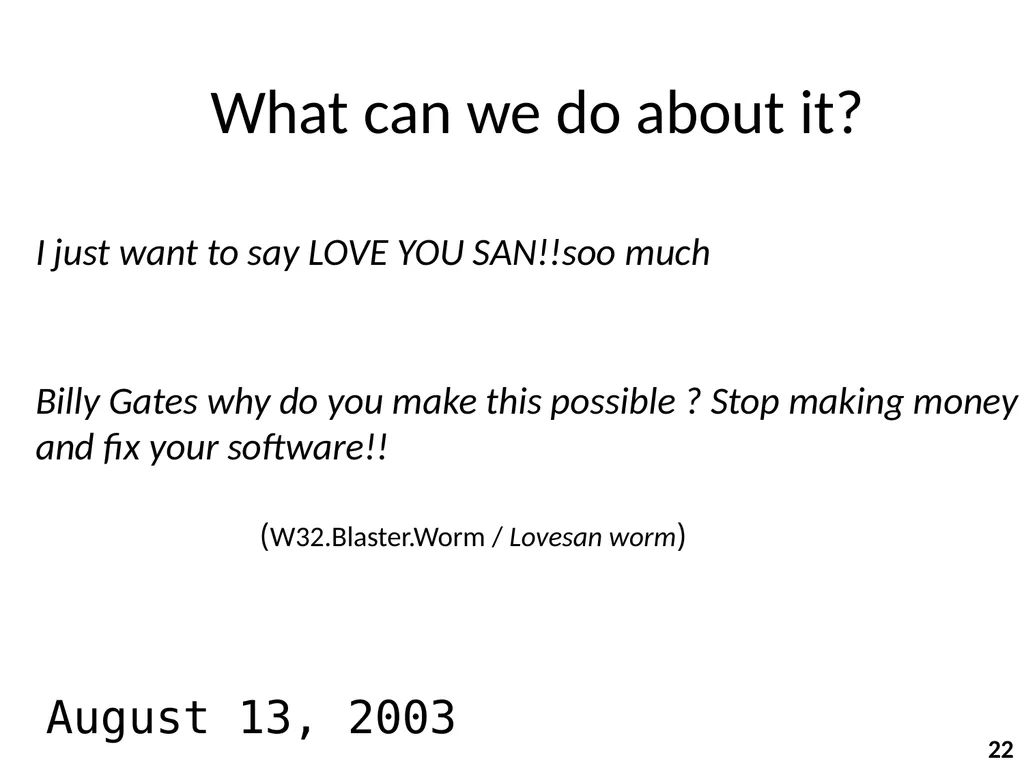
slide22. August 13, 2003 I just want to say LOVE YOU SAN!!soo much (W32.Blaster.Worm / Lovesan worm) 22 Billy Gates why do you make this possible ? Stop making money
and fix your software!! What can we do about it?<br>
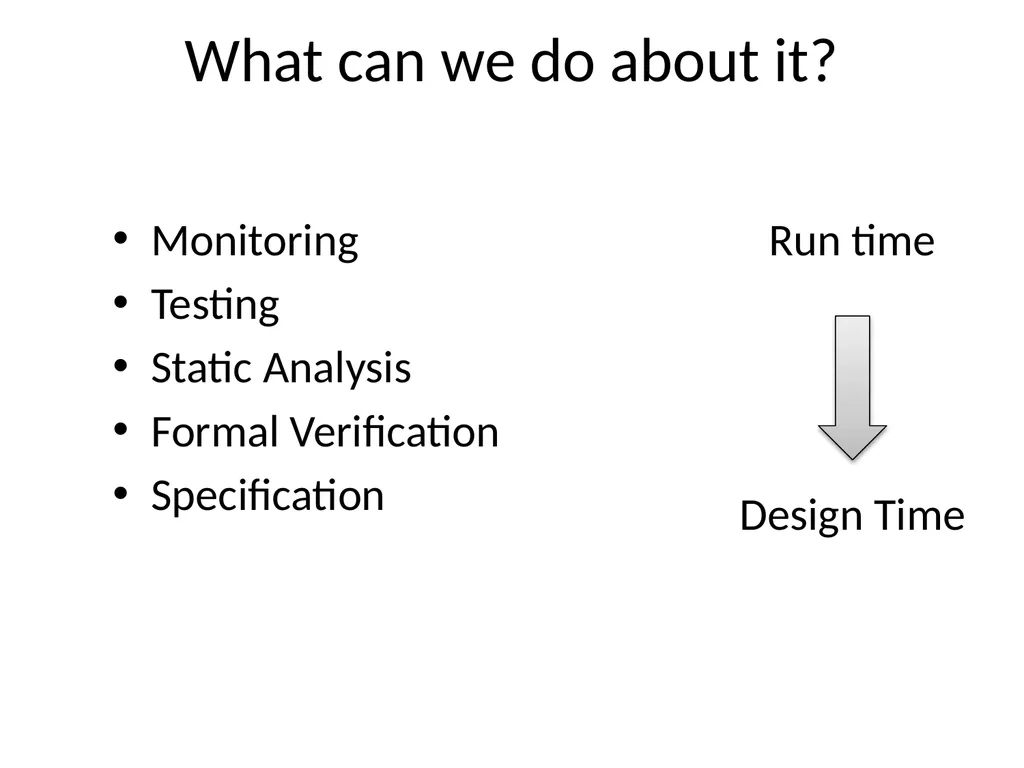
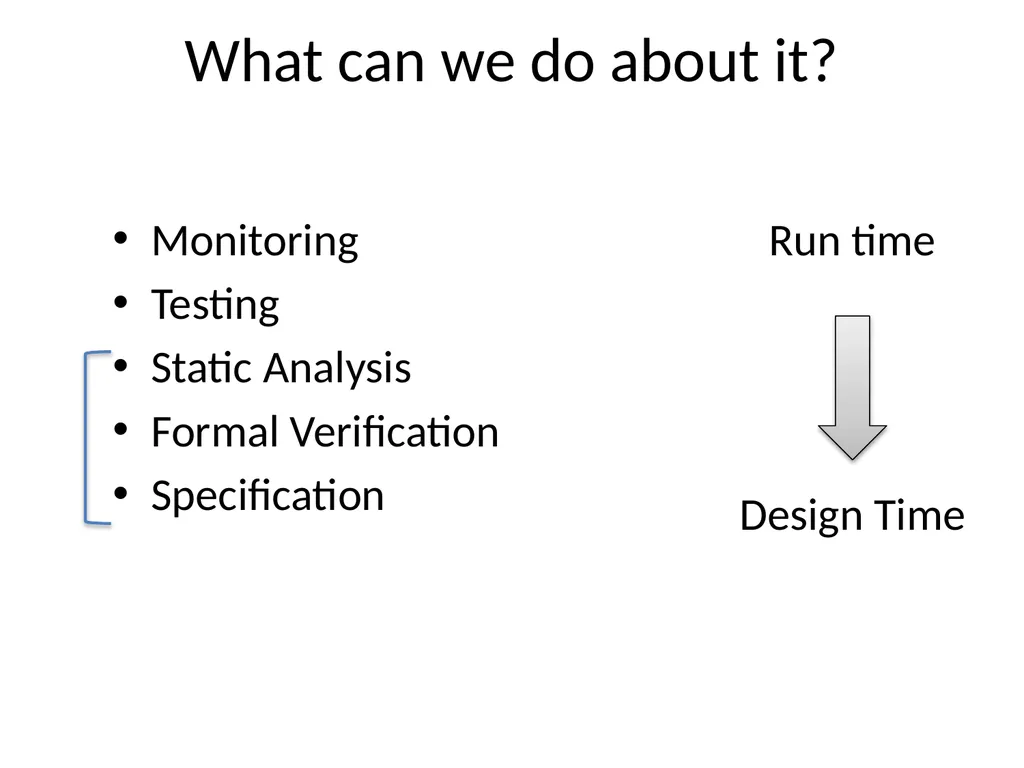
slide23. What can we do about it? Monitoring
Testing
Static Analysis
Formal Verification
Specification<br>
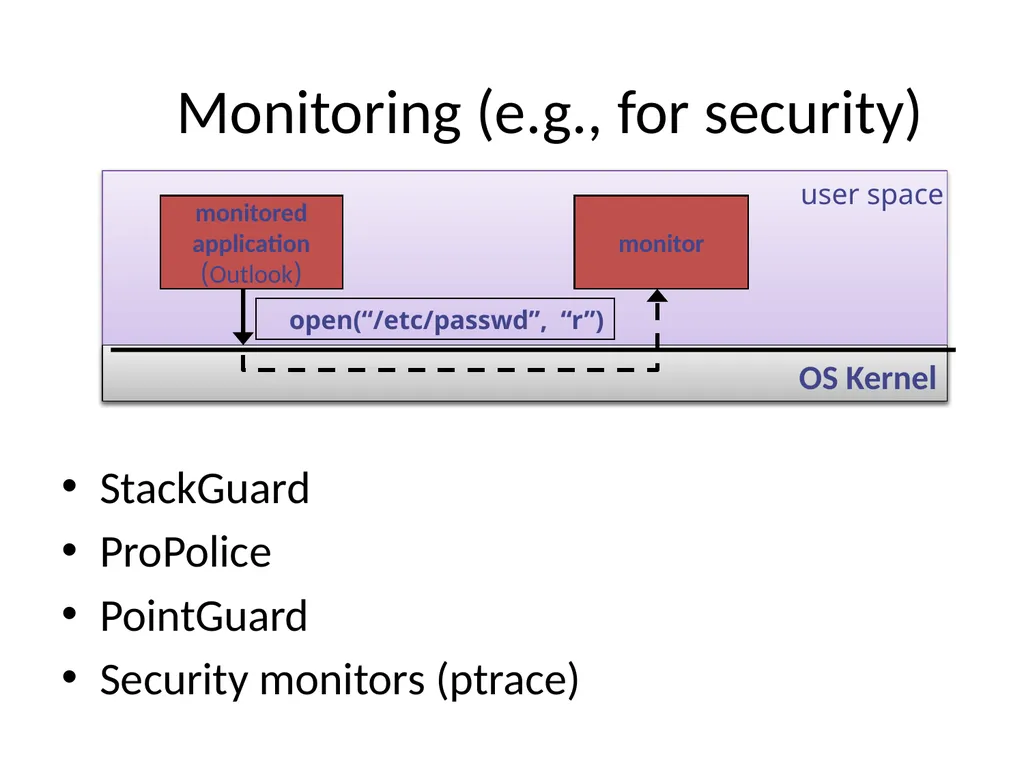
slide24. Monitoring (e.g., for security) StackGuard
ProPolice
PointGuard
Security monitors (ptrace) OS Kernel monitored
application
(Outlook) monitor user space open(“/etc/passwd”, “r”)<br>
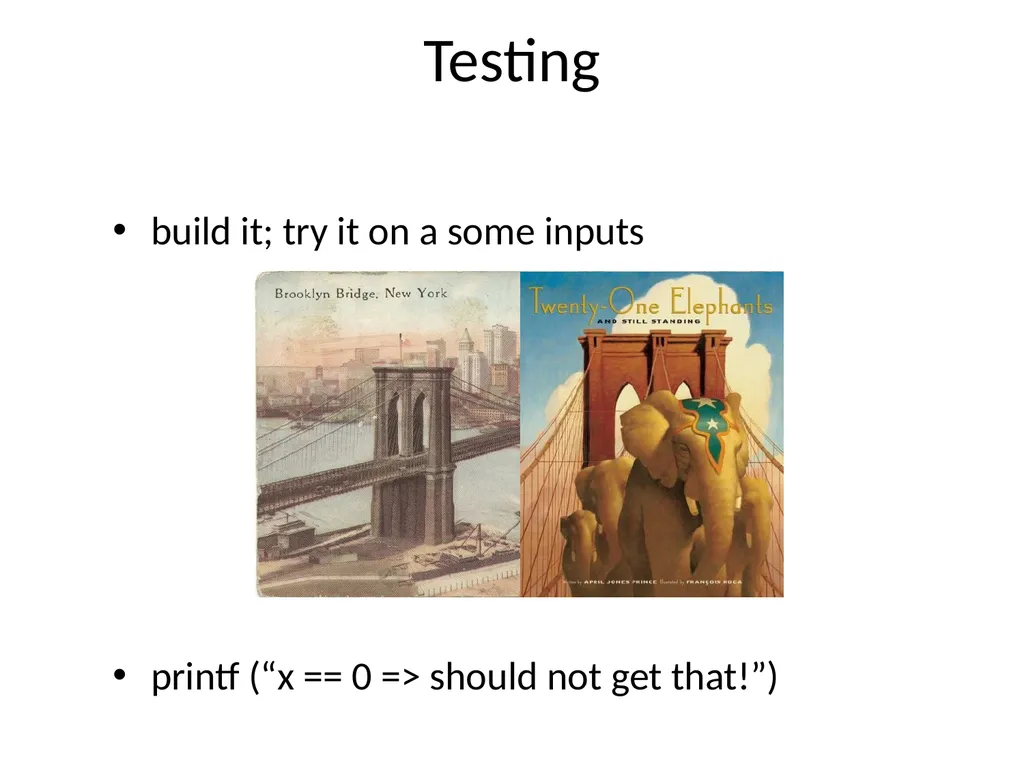
slide25. Testing build it; try it on a some inputs
printf (“x == 0 => should not get that!”)<br>
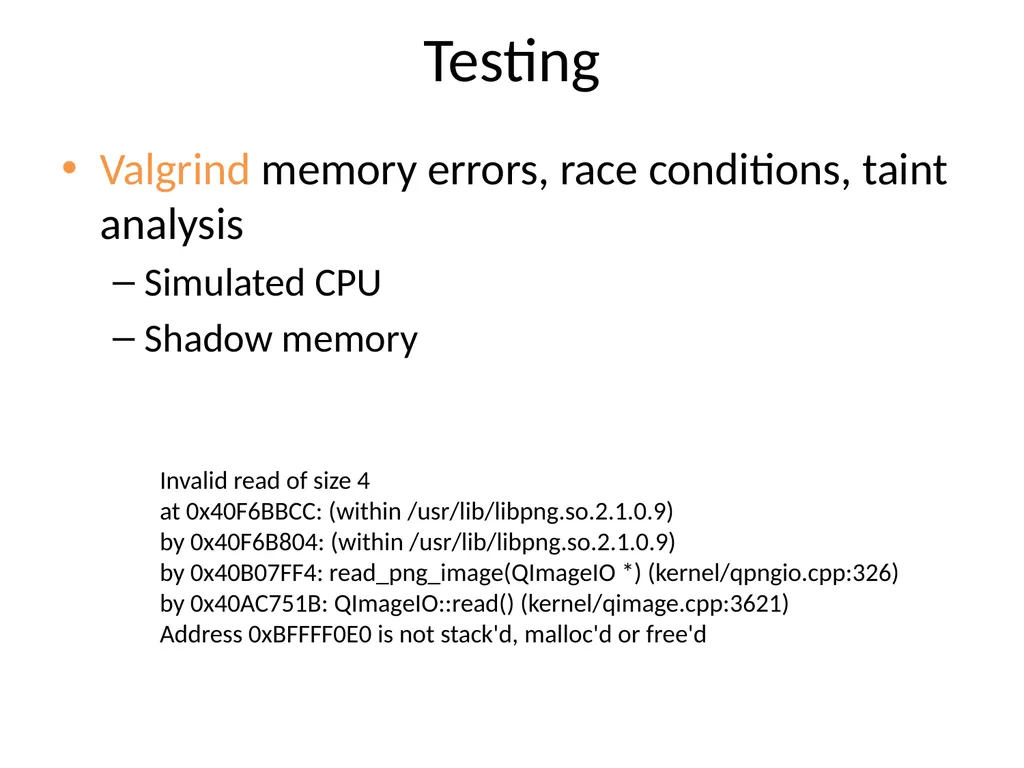
slide26. Testing Valgrind memory errors, race conditions, taint analysis
Simulated CPU
Shadow memory Invalid read of size 4
at 0x40F6BBCC: (within /usr/lib/libpng.so.2.1.0.9)
by 0x40F6B804: (within /usr/lib/libpng.so.2.1.0.9)
by 0x40B07FF4: read_png_image(QImageIO *) (kernel/qpngio.cpp:326)
by 0x40AC751B: QImageIO::read() (kernel/qimage.cpp:3621)
Address 0xBFFFF0E0 is not stack'd, malloc'd or free'd<br>
slide27. Testing Valgrind memory errors, race conditions
Parasoft Jtest/Insure++ memory errors + visualizer, race conditions, exceptions …
IBM Rational Purify memory errors
IBM PureCoverage detect untested paths
Daikon dynamic invariant detection<br>
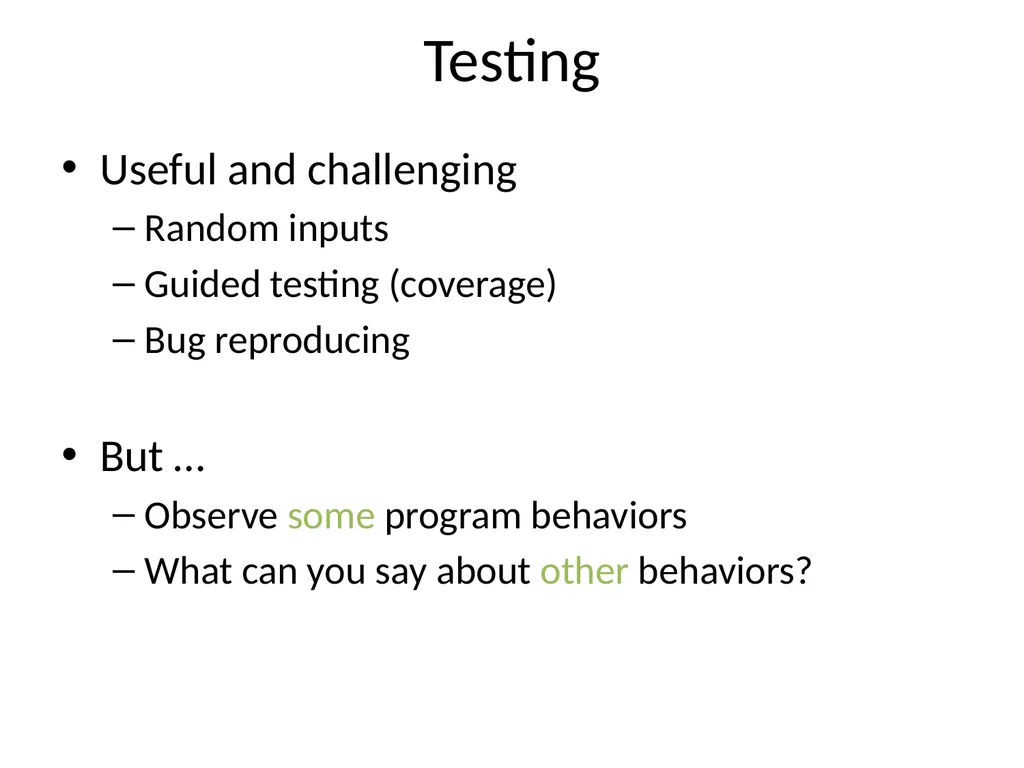
slide28. Testing Useful and challenging
Random inputs
Guided testing (coverage)
Bug reproducing
But …
Observe some program behaviors
What can you say about other behaviors?<br>
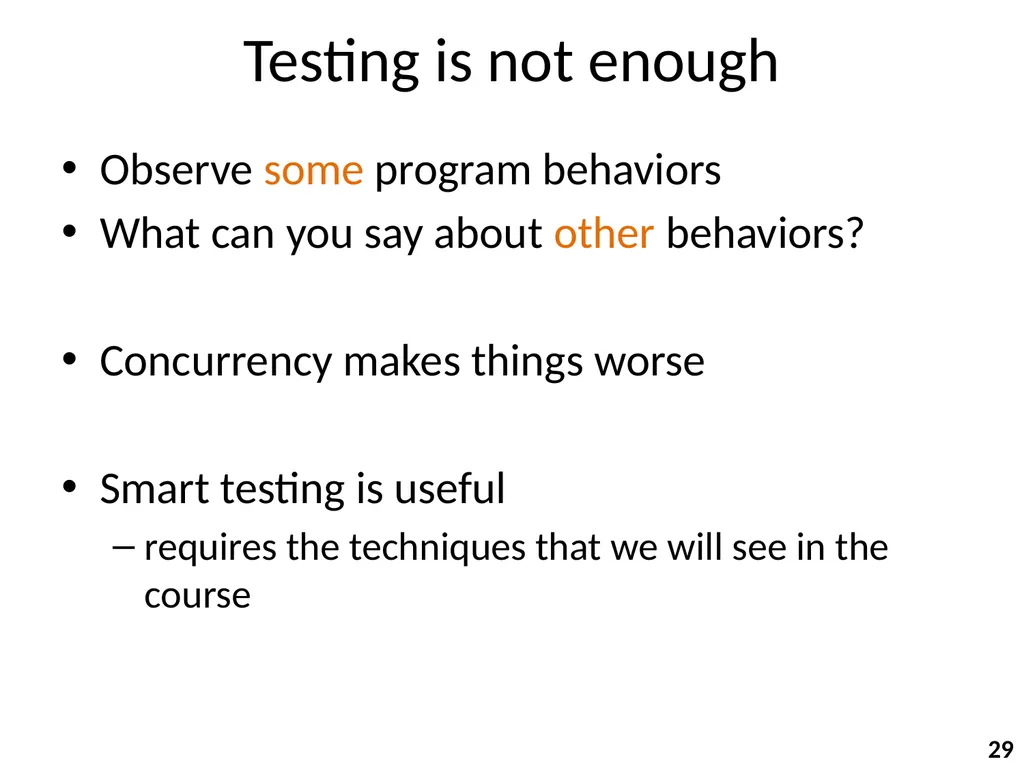
slide29. Testing is not enough Observe some program behaviors
What can you say about other behaviors?
Concurrency makes things worse
Smart testing is useful
requires the techniques that we will see in the course 29<br>
slide30. What can we do about it? Monitoring
Testing
Static Analysis
Formal Verification
Specification<br>
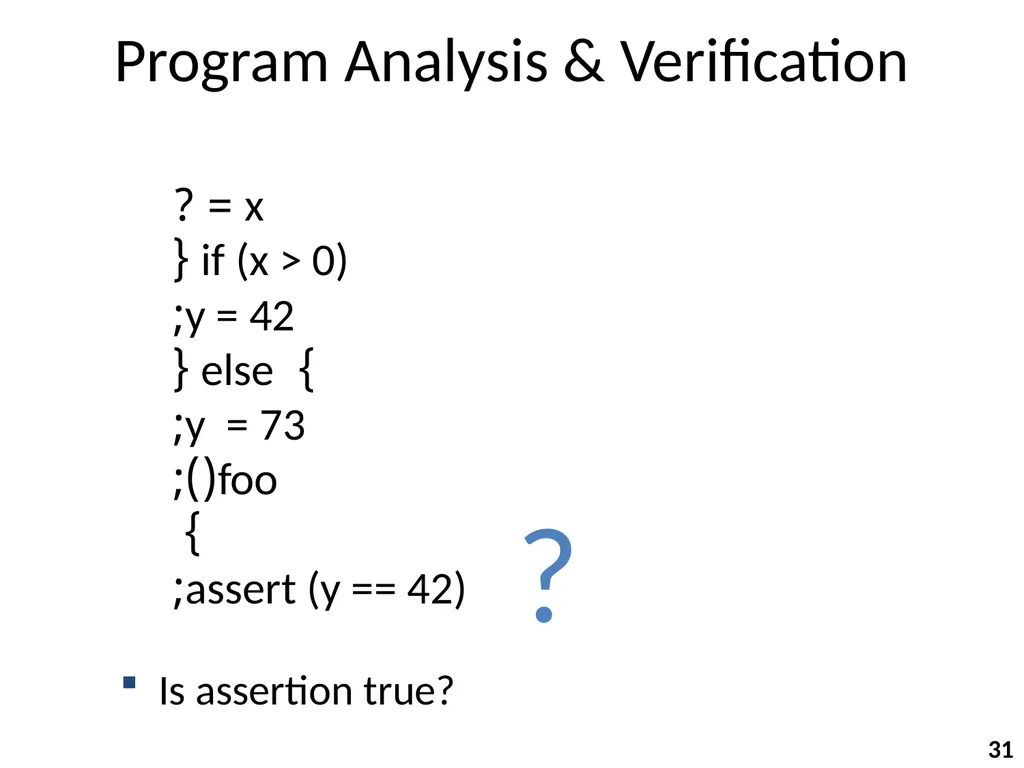
slide31. Program Analysis & Verification x = ?
if (x > 0) {
y = 42;
} else {
y = 73;
foo();
}
assert (y == 42); Is assertion true? 31 ?<br>
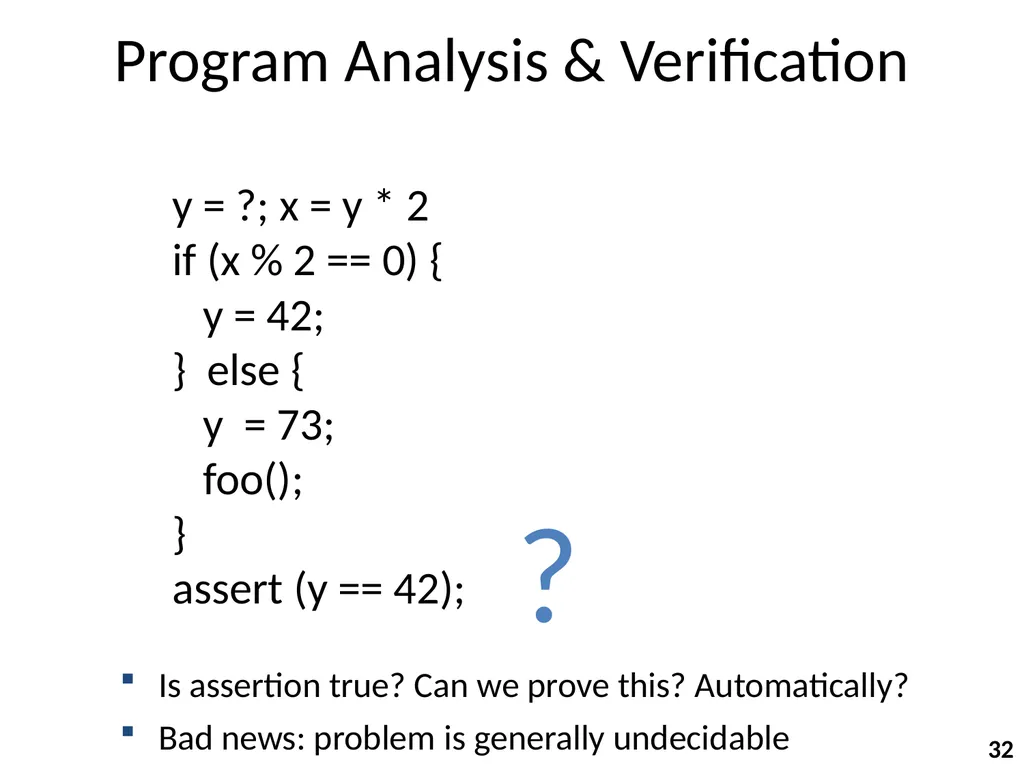
slide32. Program Analysis & Verification y = ?; x = y * 2
if (x % 2 == 0) {
y = 42;
} else {
y = 73;
foo();
}
assert (y == 42); 32 Is assertion true? Can we prove this? Automatically?
Bad news: problem is generally undecidable ?<br>
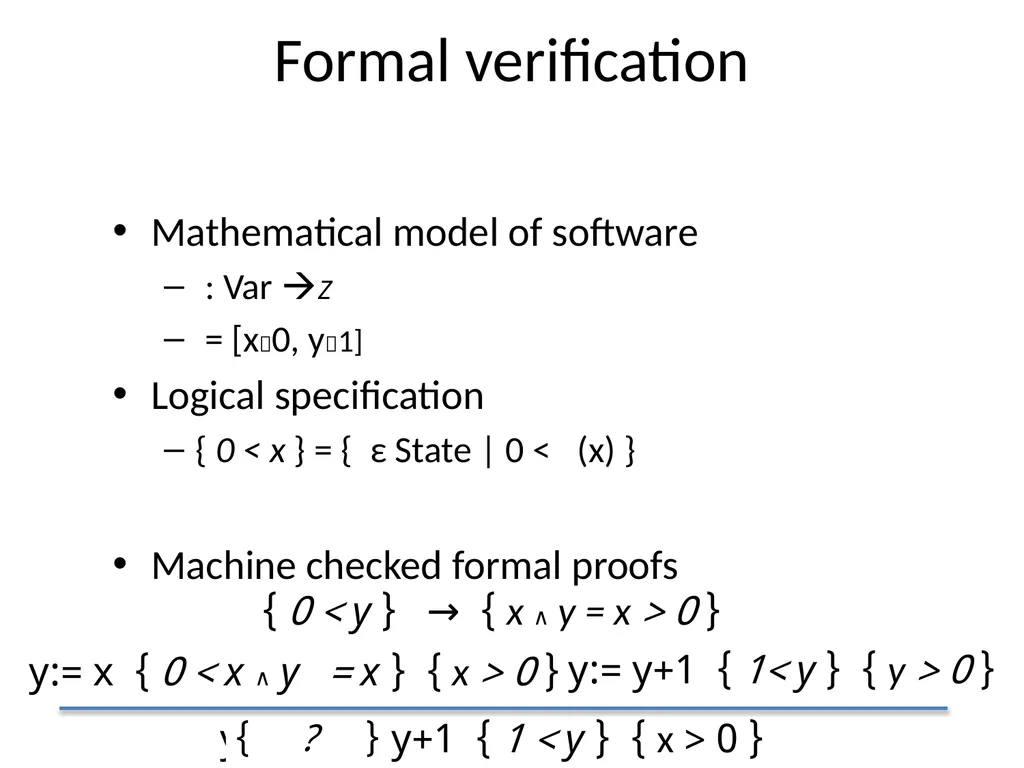
slide33. Formal verification Mathematical model of software
: Var Z
= [x0, y1]
Logical specification
{ 0 < x } = { ε State | 0 < (x) }
Machine checked formal proofs { 0 < x } y:= x ; y:=y+1 { 1 < y } { 0 < x } y:= x { 0 < x ∧ y = x } { 0 < y } y:= y+1 { 1< y } { ? } { 0 < x ∧ y = x } → { 0 < y }<br>
slide34. Formal verification Mathematical model of software
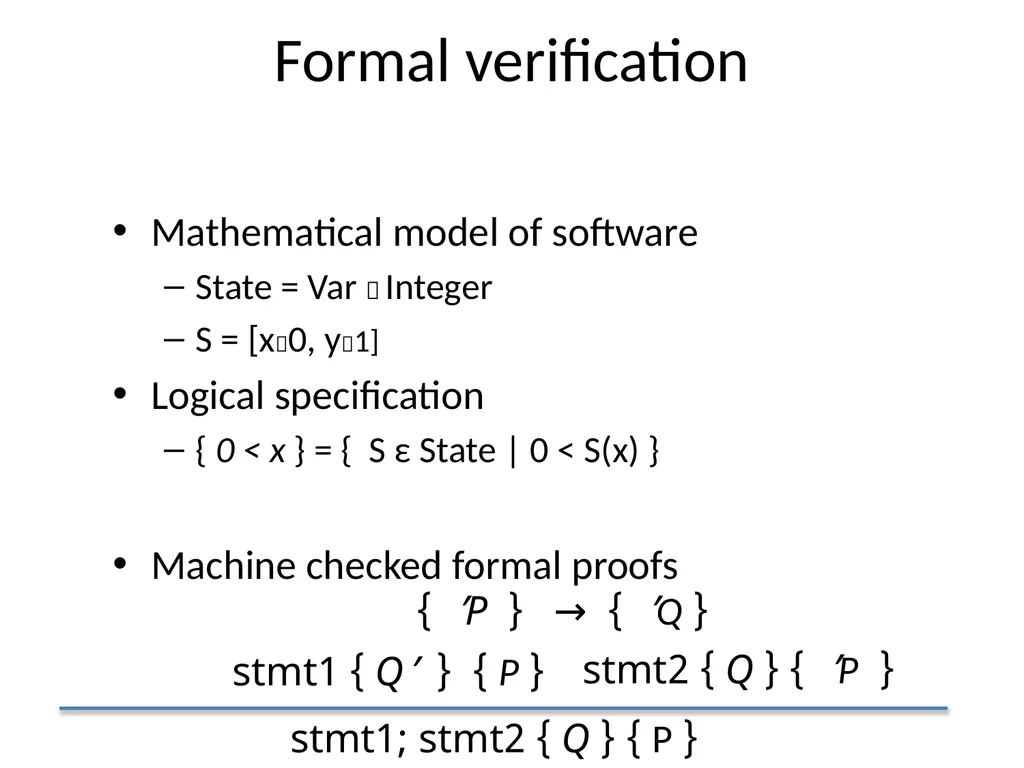
State = Var Integer
S = [x0, y1]
Logical specification
{ 0 < x } = { S ε State | 0 < S(x) }
Machine checked formal proofs { P } stmt1 { Q’ } { P’ } stmt2 { Q } { Q’ } → { P’ } { P } stmt1; stmt2 { Q }<br>
slide35. Program Verification {true}
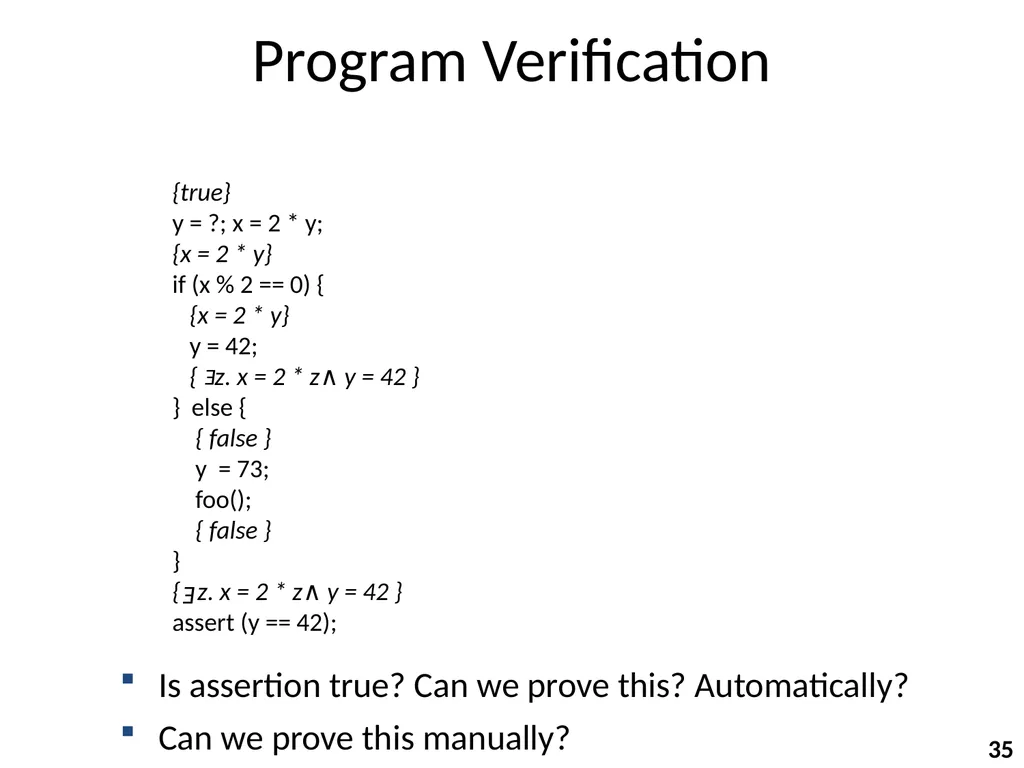
y = ?; x = 2 * y;
{x = 2 * y}
if (x % 2 == 0) {
{x = 2 * y}
y = 42;
{ z. x = 2 * z∧ y = 42 }
} else {
{ false }
y = 73;
foo();
{ false }
}
{ z. x = 2 * z∧ y = 42 }
assert (y == 42); 35 Is assertion true? Can we prove this? Automatically?
Can we prove this manually? E E<br>
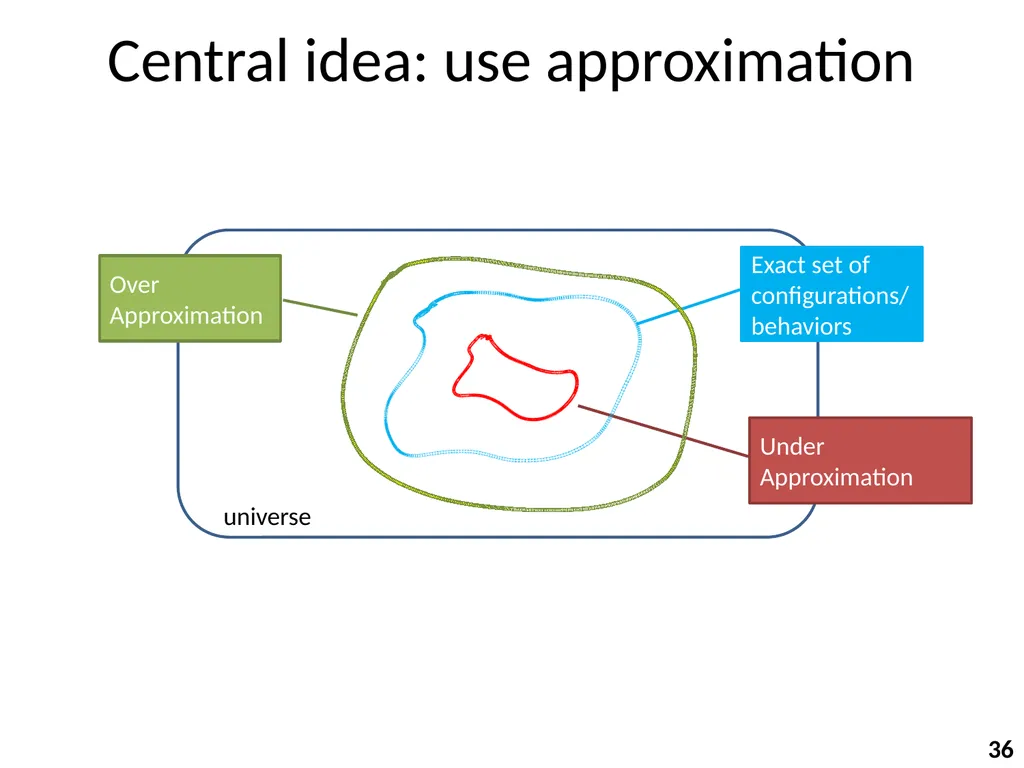
slide36. Central idea: use approximation Under Approximation Exact set of configurations/
behaviors 36<br>
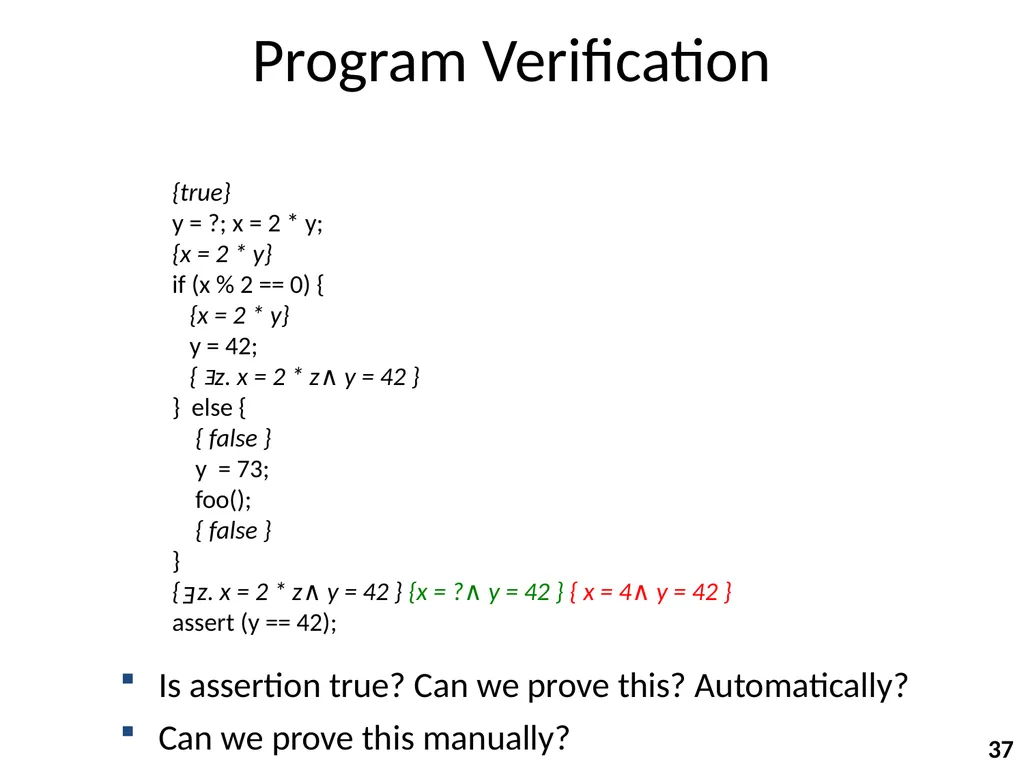
slide37. Program Verification {true}
y = ?; x = 2 * y;
{x = 2 * y}
if (x % 2 == 0) {
{x = 2 * y}
y = 42;
{ z. x = 2 * z∧ y = 42 }
} else {
{ false }
y = 73;
foo();
{ false }
}
{ z. x = 2 * z∧ y = 42 } {x = ?∧ y = 42 } { x = 4∧ y = 42 }
assert (y == 42); 37 Is assertion true? Can we prove this? Automatically?
Can we prove this manually? E E<br>
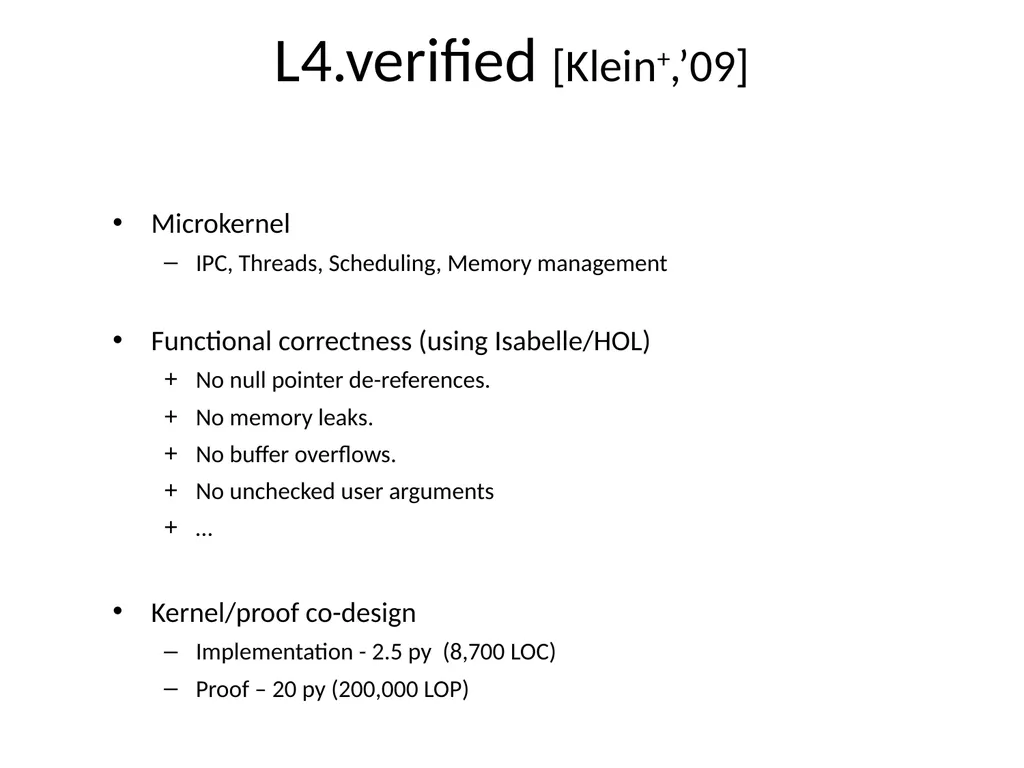
slide38. L4.verified [Klein+,’09] Microkernel
IPC, Threads, Scheduling, Memory management
Functional correctness (using Isabelle/HOL)
No null pointer de-references.
No memory leaks.
No buffer overflows.
No unchecked user arguments
…
Kernel/proof co-design
Implementation - 2.5 py (8,700 LOC)
Proof – 20 py (200,000 LOP)<br>
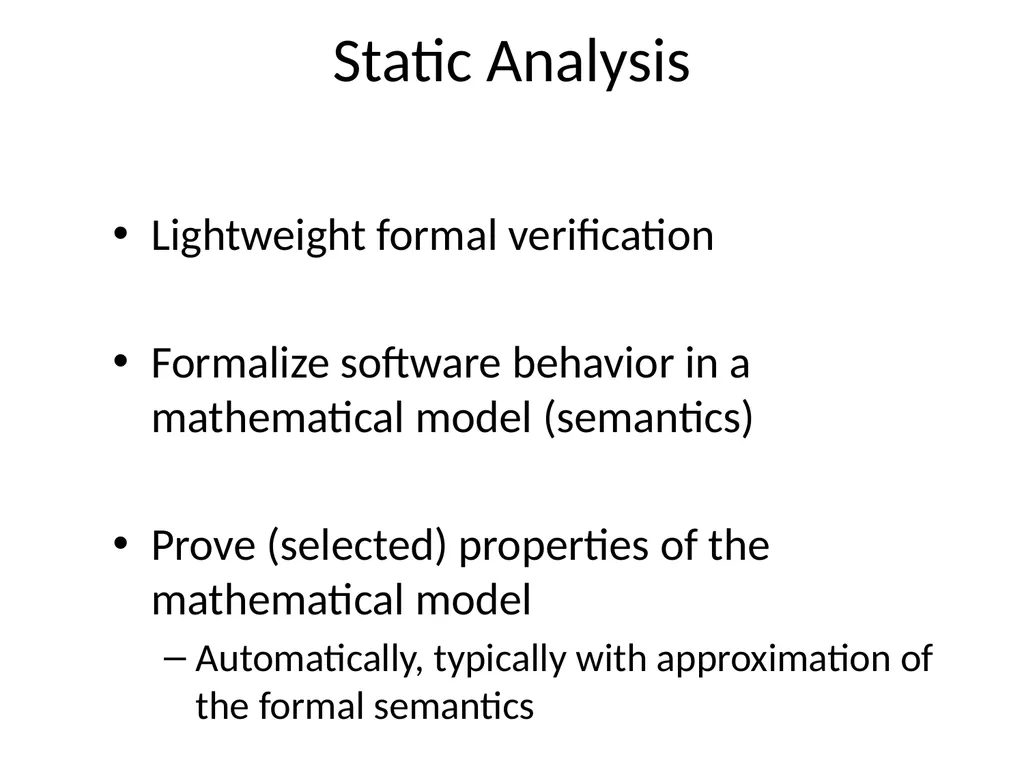
slide39. Static Analysis Lightweight formal verification
Formalize software behavior in a mathematical model (semantics)
Prove (selected) properties of the mathematical model
Automatically, typically with approximation of the formal semantics<br>
slide40. Why static analysis? Some errors are hard to find by testing
arise in unusual circumstances/uncommon execution paths
buffer overruns, unvalidated input, exceptions, ...
involve non-determinism
race conditions
Full-blown formal verification too expensive<br>
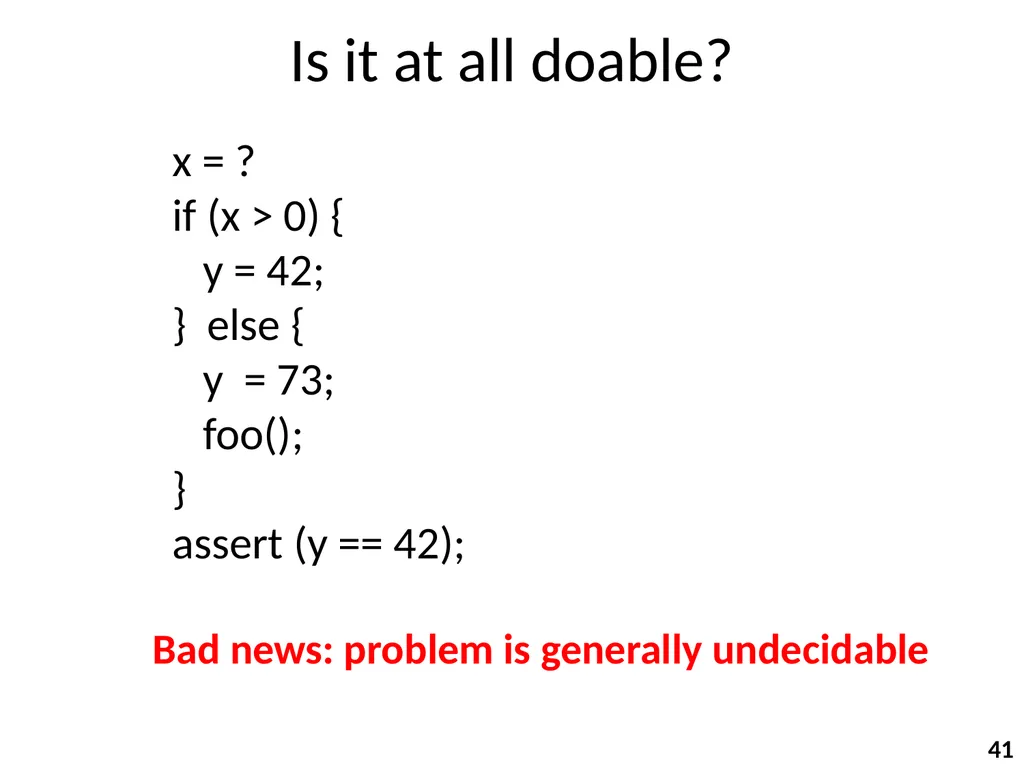
slide41. Is it at all doable? x = ?
if (x > 0) {
y = 42;
} else {
y = 73;
foo();
}
assert (y == 42); Bad news: problem is generally undecidable 41<br>
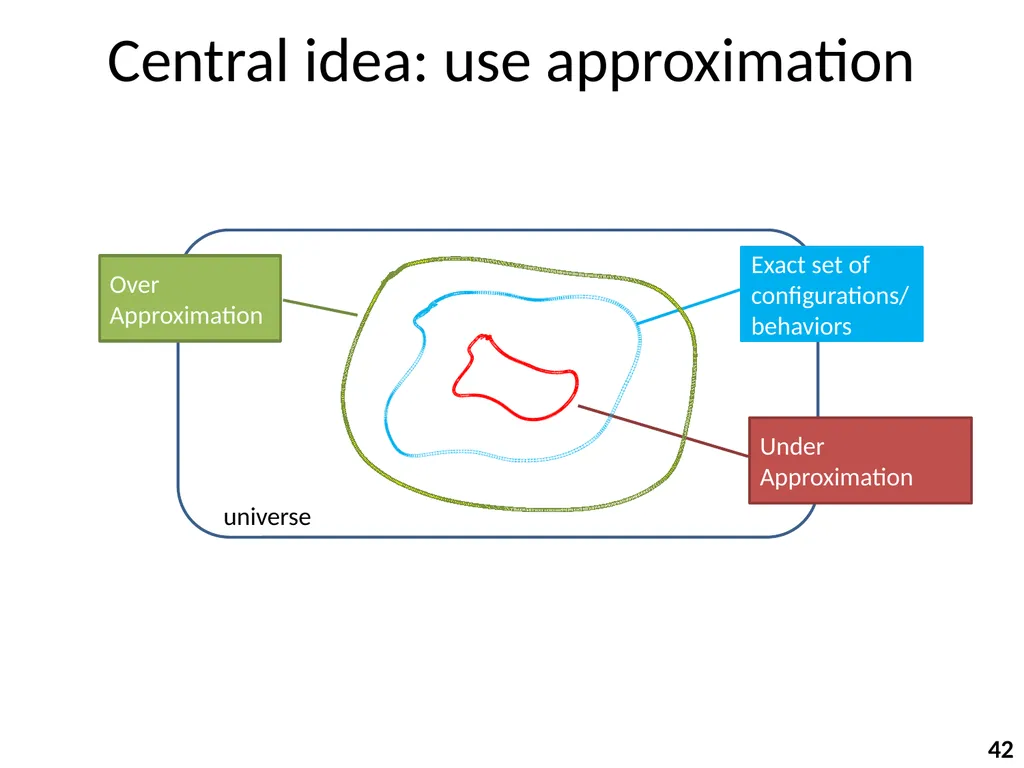
slide42. Central idea: use approximation Under Approximation Exact set of configurations/
behaviors 42<br>
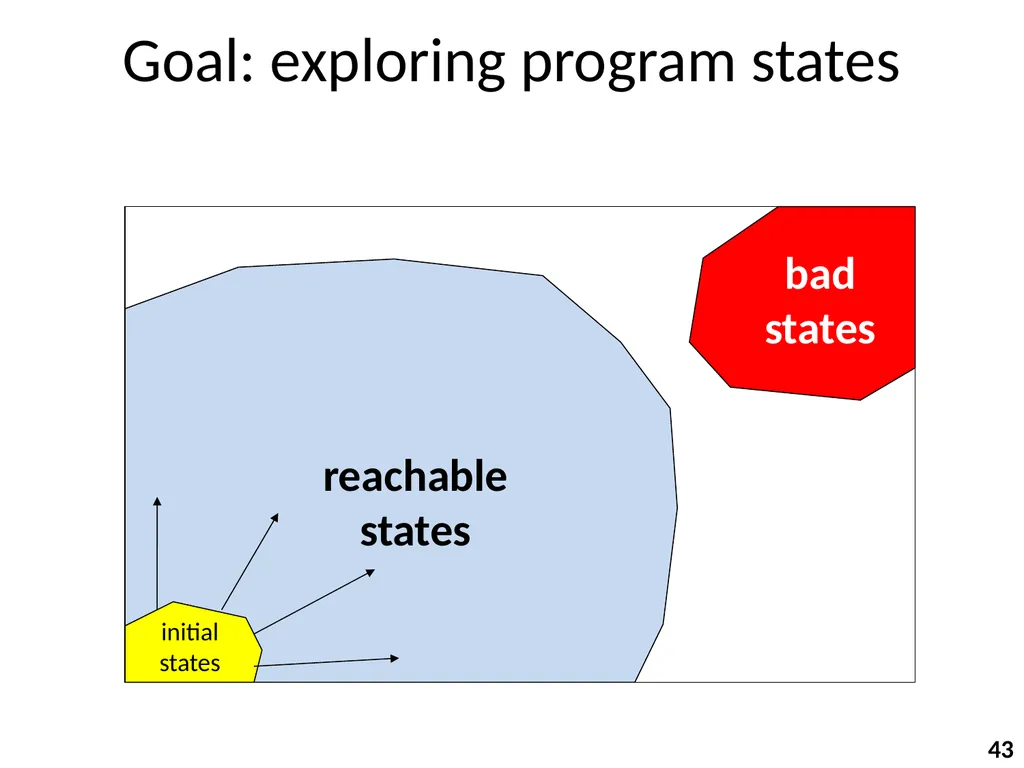
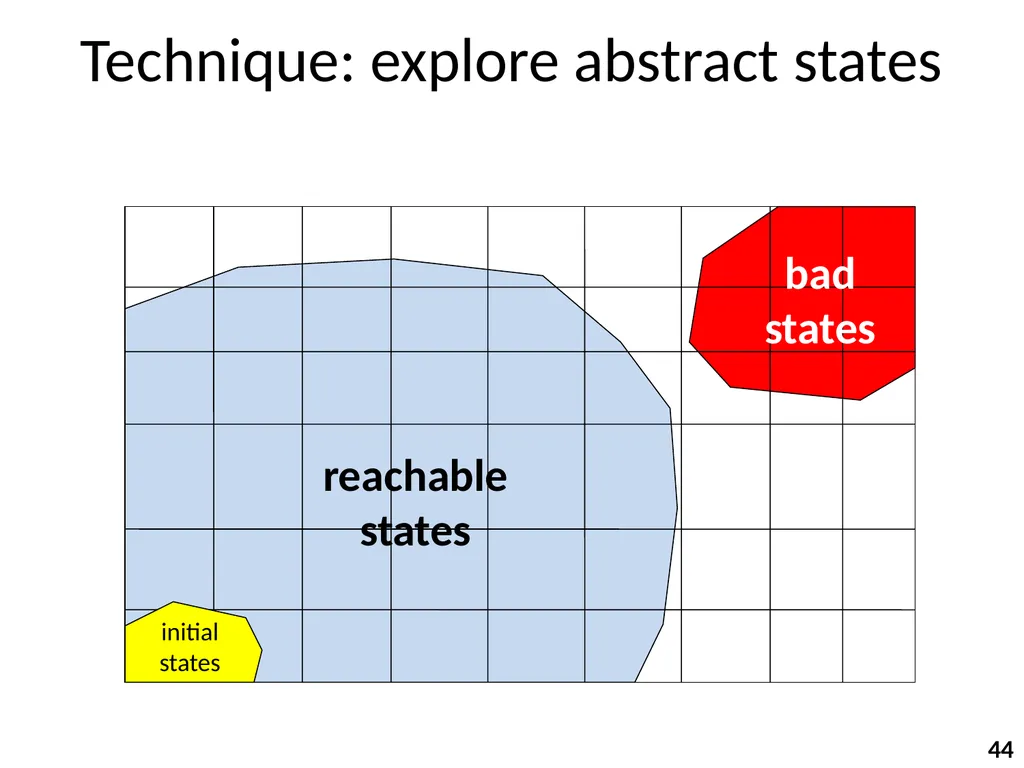
slide43. Goal: exploring program states initial states bad states 43 reachable states<br>
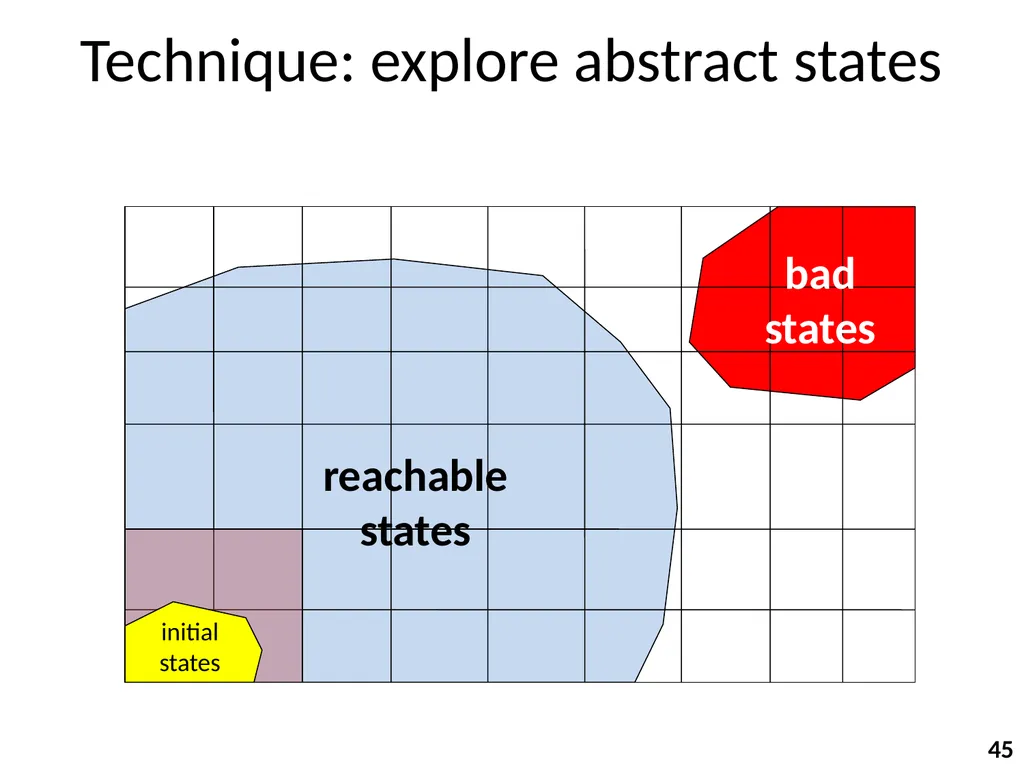
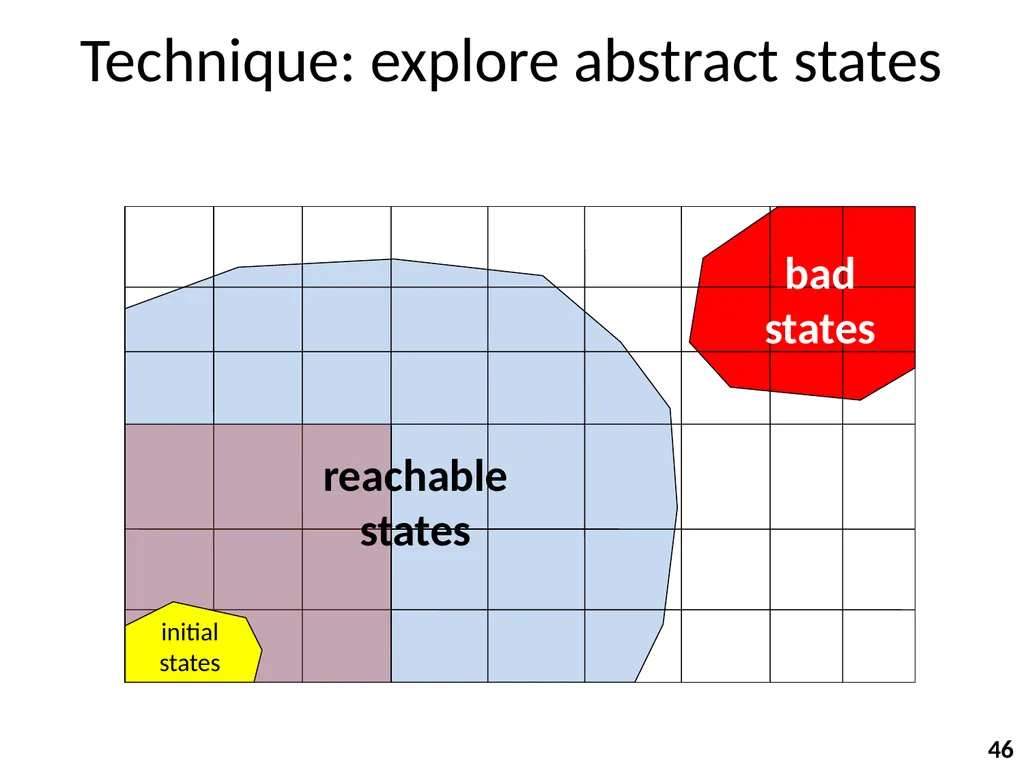
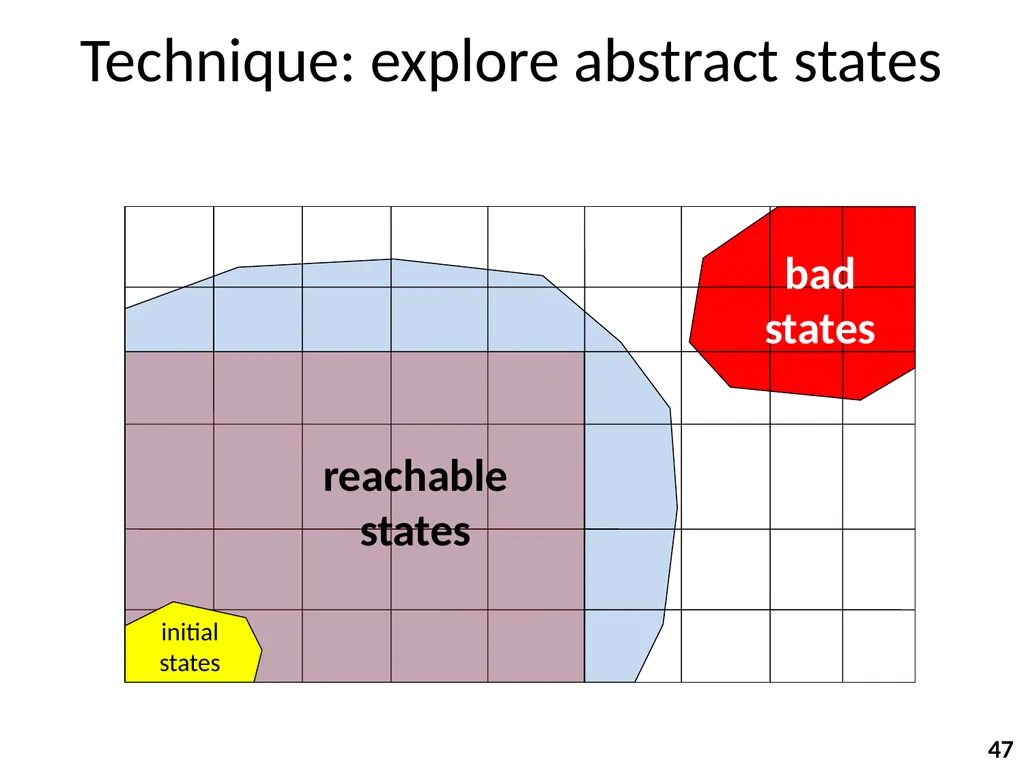
slide44. Technique: explore abstract states initial states bad states 44 reachable states<br>
slide45. Technique: explore abstract states bad states 45 reachable states<br>
slide46. Technique: explore abstract states bad states 46 reachable states<br>
slide47. Technique: explore abstract states bad states 47 reachable states<br>
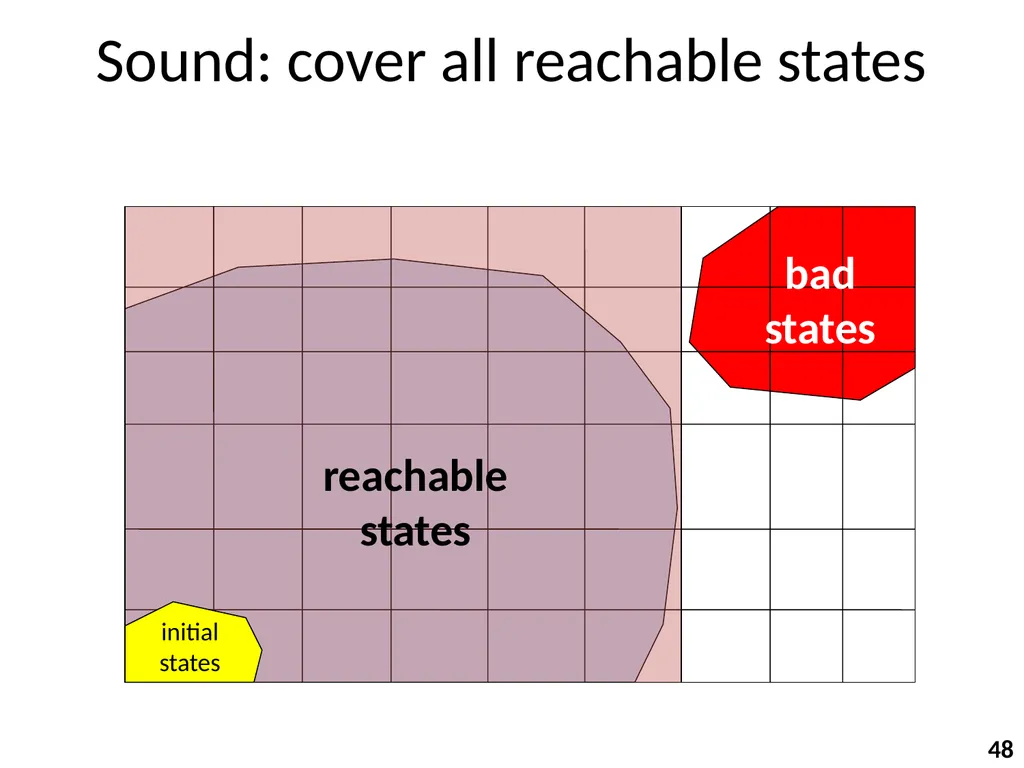
slide48. Sound: cover all reachable states 48 bad states reachable states<br>
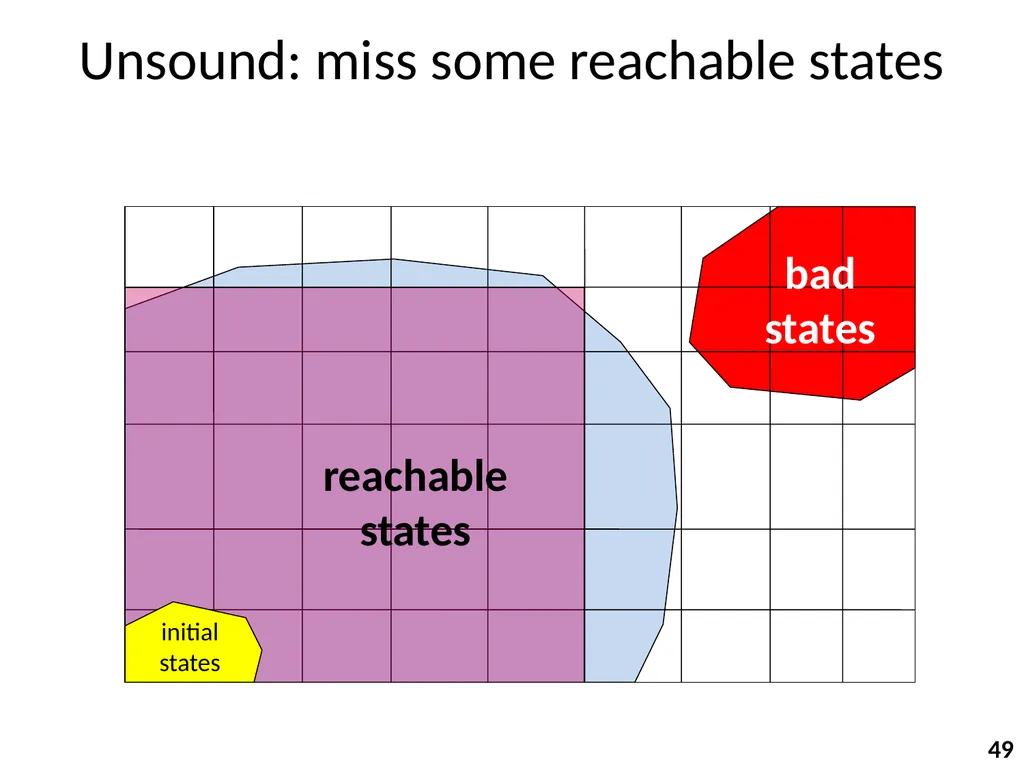
slide49. Unsound: miss some reachable states 49 bad states reachable states<br>
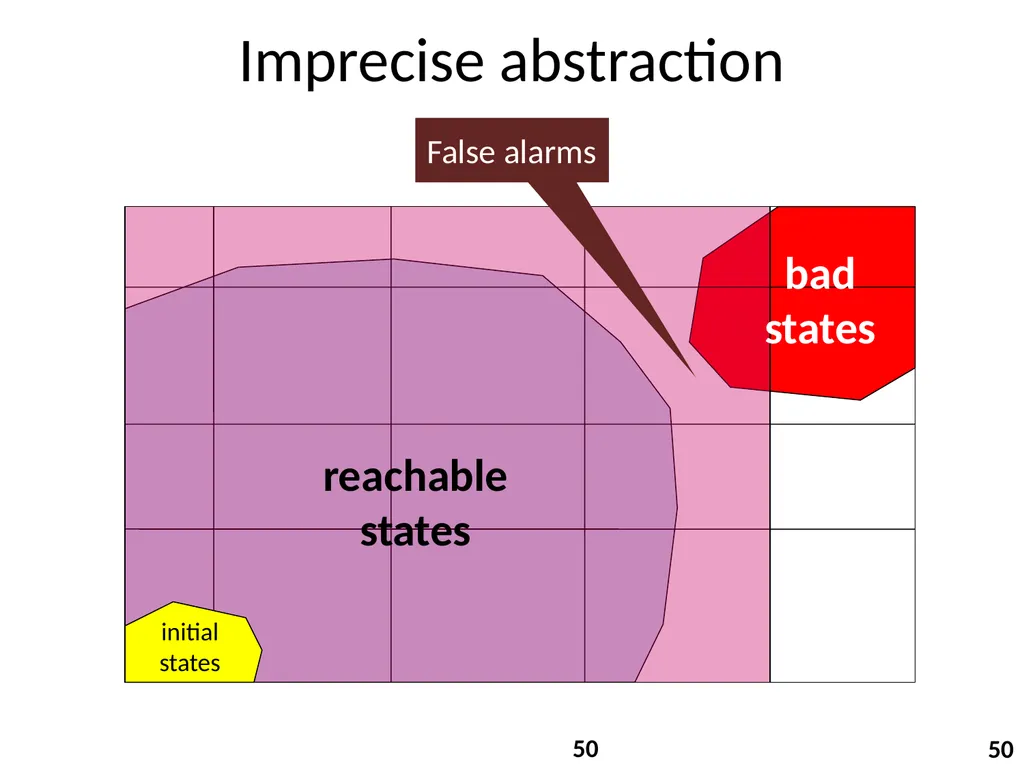
slide50. 50 Imprecise abstraction bad states 50 reachable states False alarms<br>
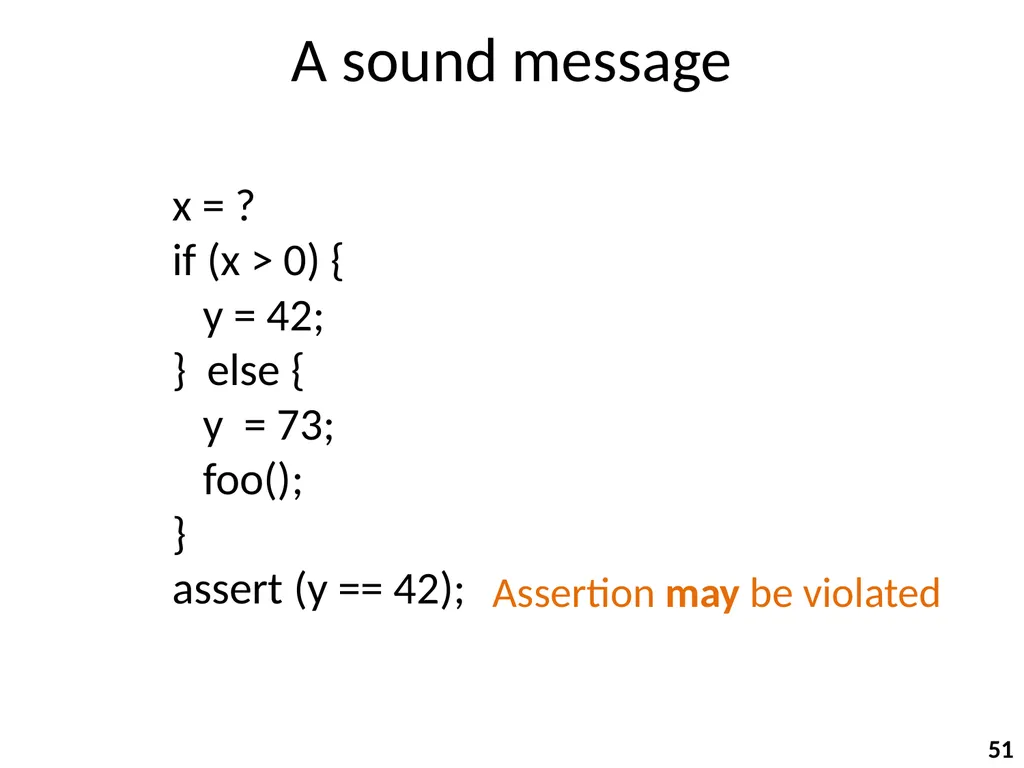
slide51. A sound message x = ?
if (x > 0) {
y = 42;
} else {
y = 73;
foo();
}
assert (y == 42); Assertion may be violated 51<br>
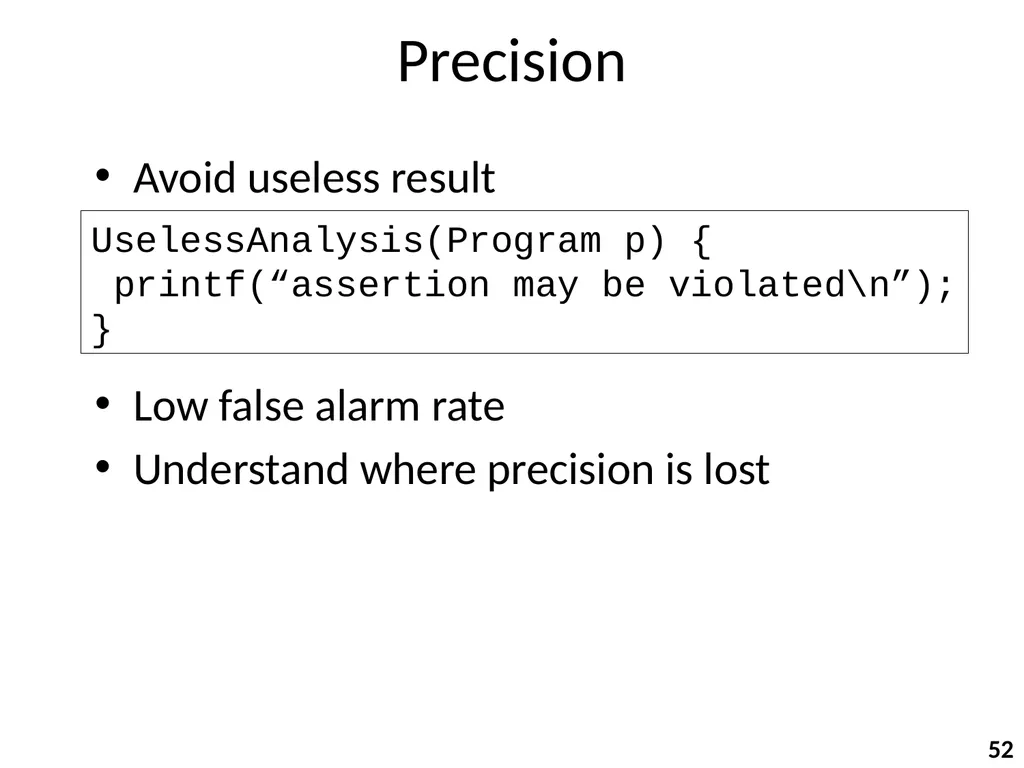
slide52. Avoid useless result
Low false alarm rate
Understand where precision is lost Precision UselessAnalysis(Program p) {
printf(“assertion may be violated\n”);
} 52<br>
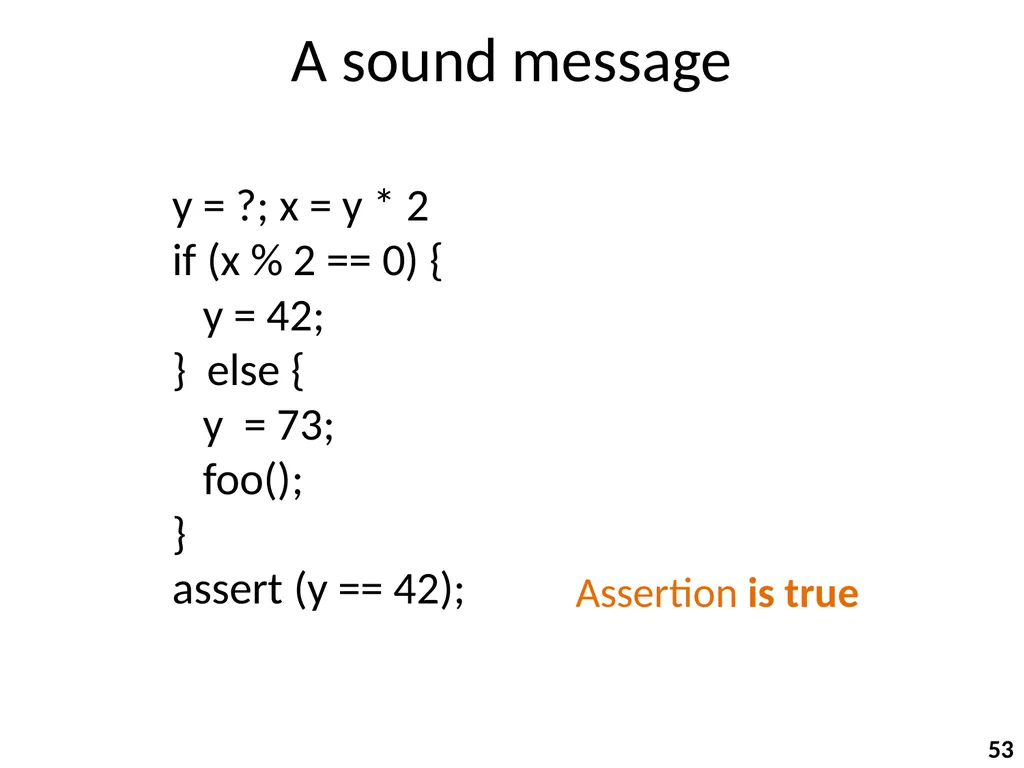
slide53. A sound message y = ?; x = y * 2
if (x % 2 == 0) {
y = 42;
} else {
y = 73;
foo();
}
assert (y == 42); Assertion is true 53<br>
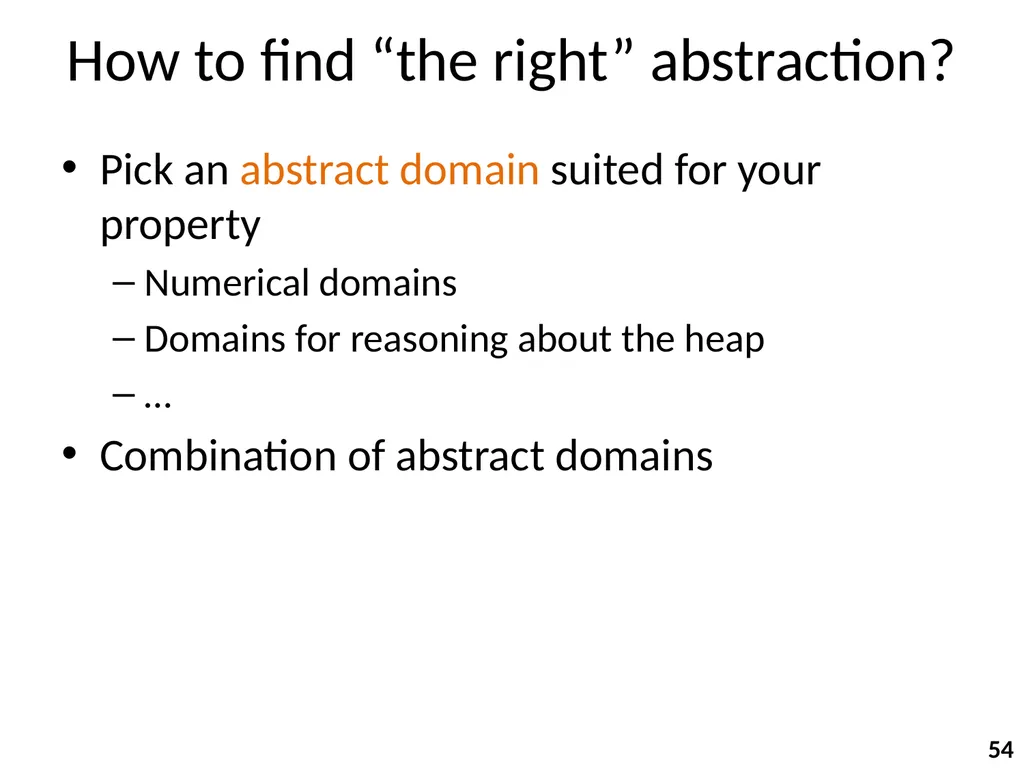
slide54. How to find “the right” abstraction? Pick an abstract domain suited for your property
Numerical domains
Domains for reasoning about the heap
…
Combination of abstract domains 54<br>
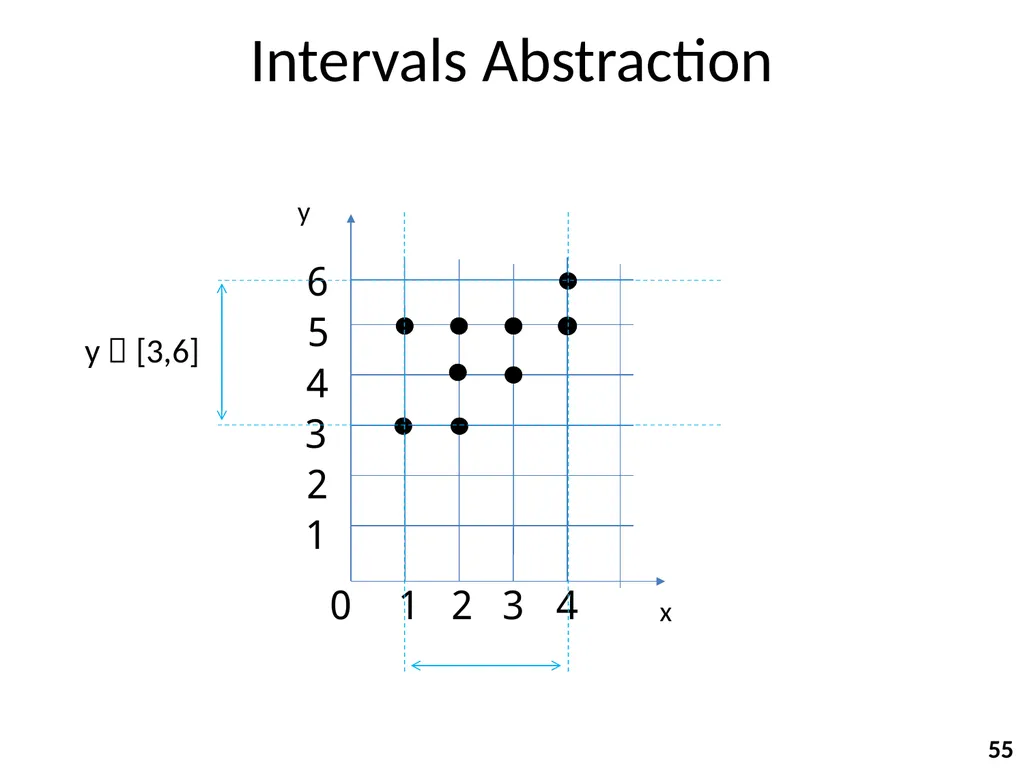
slide55. Intervals Abstraction 55 0 2 3 1 2 3 4 5 4 6 x y 1 y [3,6] x [1,4]<br>
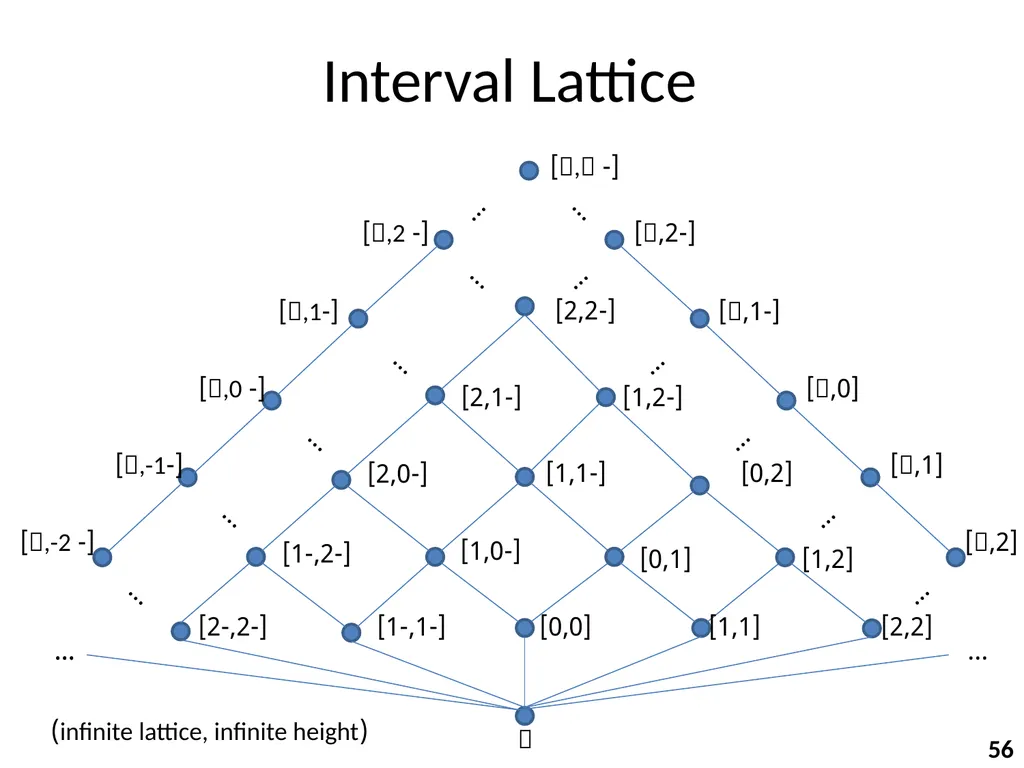
slide56. Interval Lattice [0,0] [-1,-1] [-2,-2] [-2,-1] [-2,0] [1,1] [2,2] [-1,0] [0,1] [1,2] … [-1,1] [0,2] [-2,1] [-1,2] [-2,2] … … [2,] … [1,] [0,] [-1,] [-2,] … … … … [- ,] … … [- ,-2] … [-,-1] [- ,0] [-,1] [- ,2] … … … … 56 (infinite lattice, infinite height)<br>
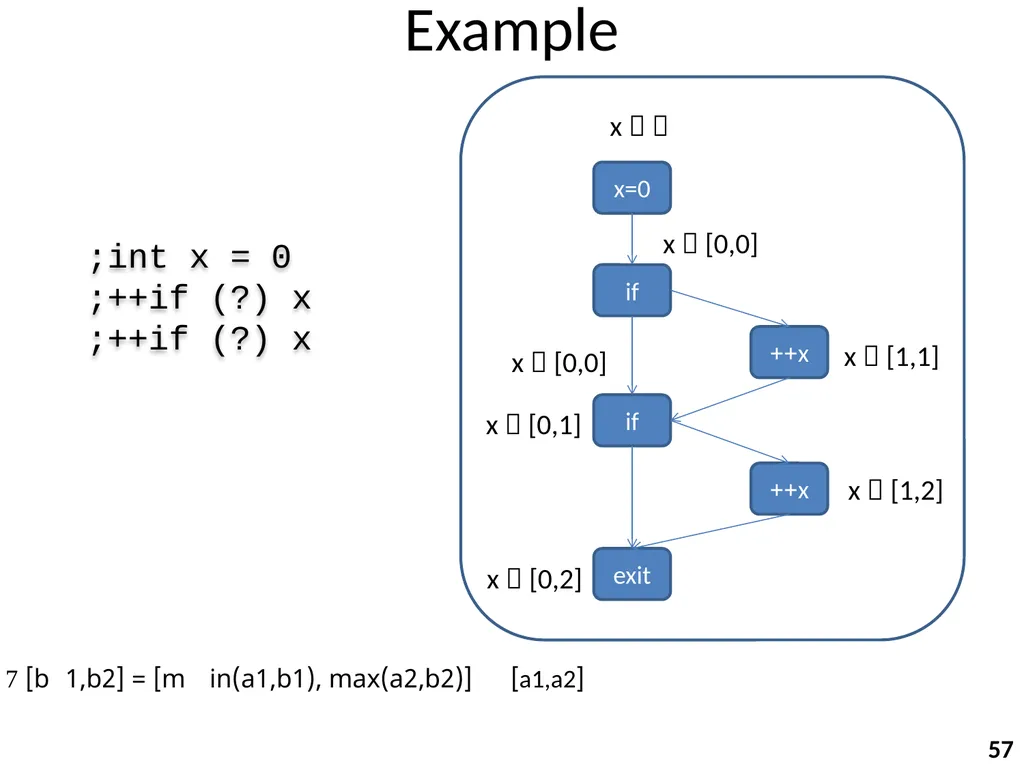
slide57. Example 57 int x = 0;
if (?) x++;
if (?) x++; x [0,0] x x [0,1] x [0,2] x=0 if x++ if x++ exit x [0,0] x [1,1] x [1,2] [a1,a2] [b1,b2] = [min(a1,b1), max(a2,b2)]<br>
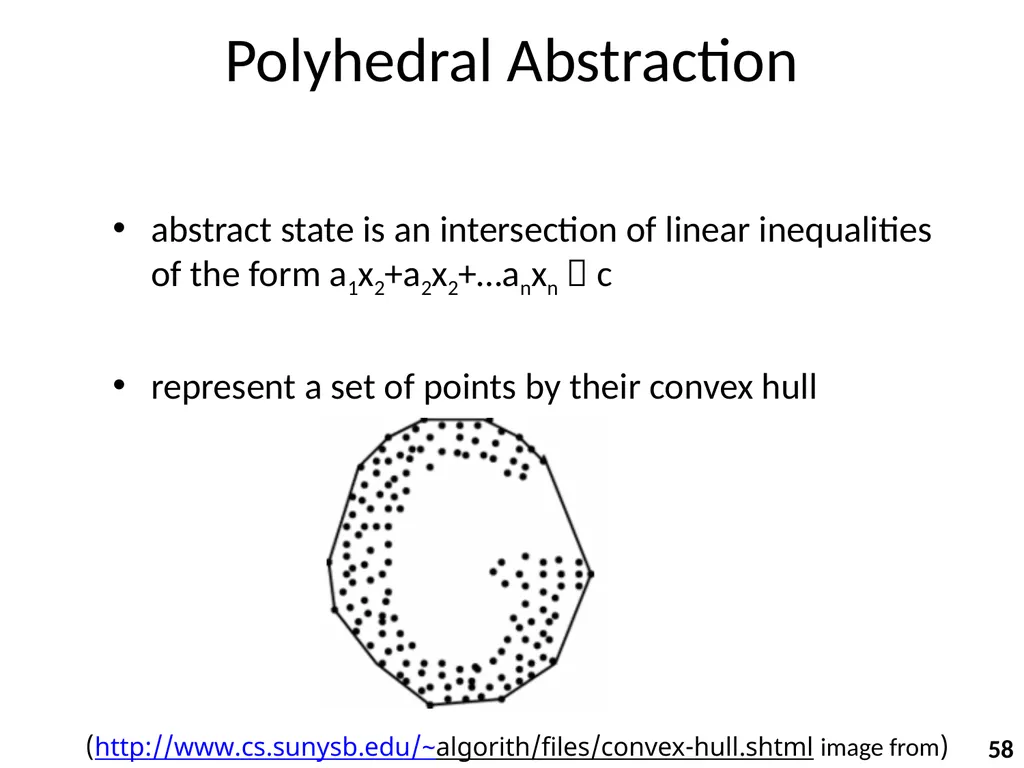
slide58. Polyhedral Abstraction abstract state is an intersection of linear inequalities of the form a1x2+a2x2+…anxn c
represent a set of points by their convex hull 58 (image from http://www.cs.sunysb.edu/~algorith/files/convex-hull.shtml)<br>
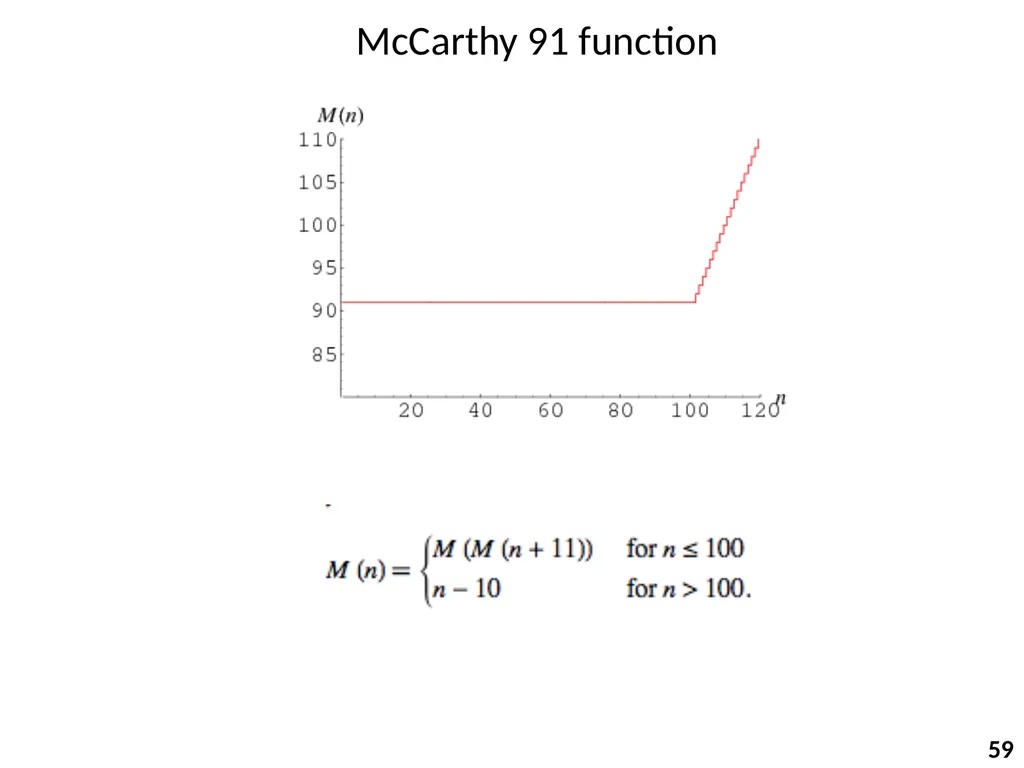
slide59. McCarthy 91 function 59<br>
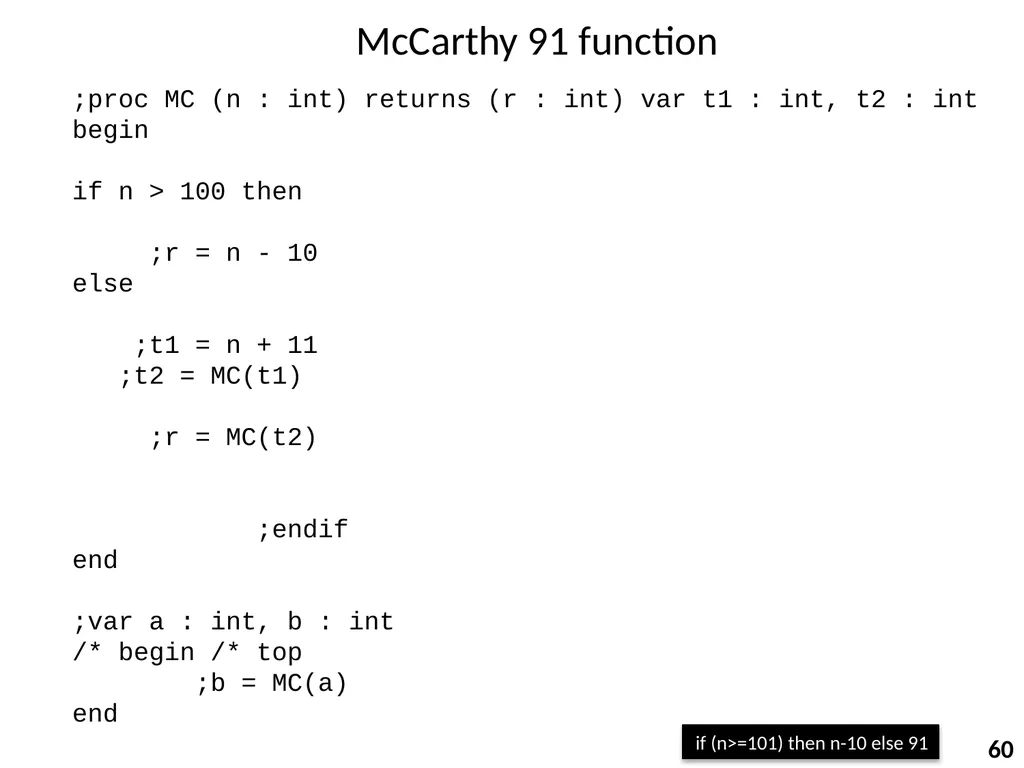
slide60. McCarthy 91 function proc MC (n : int) returns (r : int) var t1 : int, t2 : int;
begin
if n > 100 then
r = n - 10;
else
t1 = n + 11;
t2 = MC(t1);
r = MC(t2);
endif;
end
var a : int, b : int;
begin /* top */
b = MC(a);
end if (n>=101) then n-10 else 91 60<br>
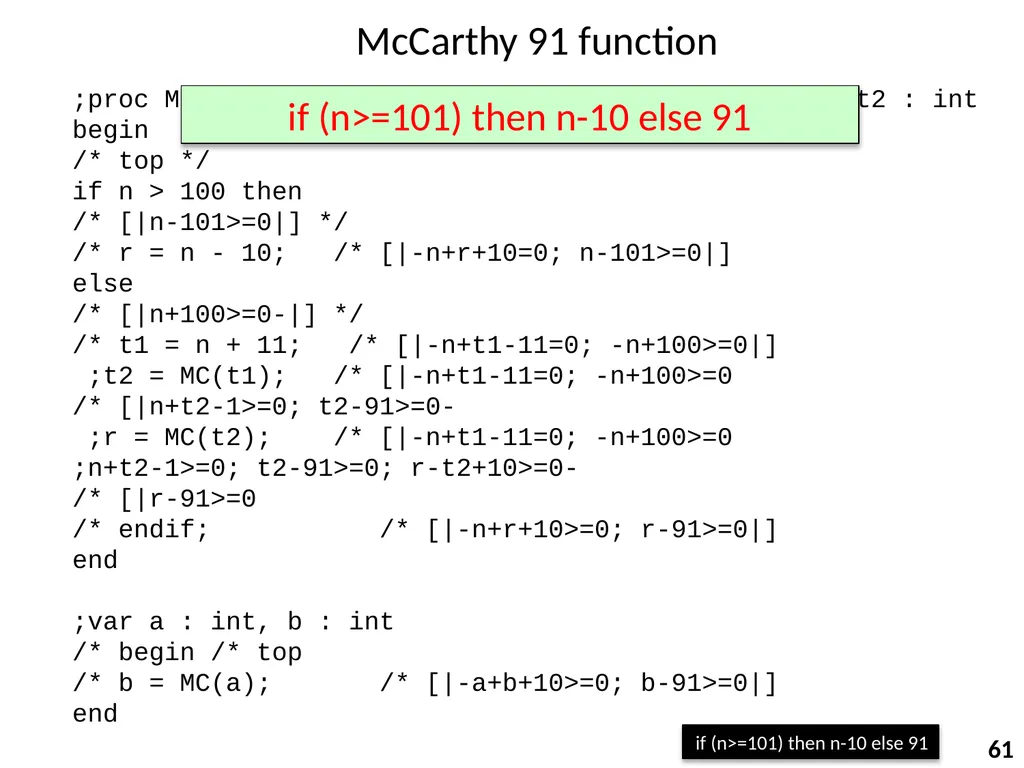
slide61. McCarthy 91 function proc MC (n : int) returns (r : int) var t1 : int, t2 : int;
begin
/* top */
if n > 100 then
/* [|n-101>=0|] */
r = n - 10; /* [|-n+r+10=0; n-101>=0|] */
else
/* [|-n+100>=0|] */
t1 = n + 11; /* [|-n+t1-11=0; -n+100>=0|] */
t2 = MC(t1); /* [|-n+t1-11=0; -n+100>=0;
-n+t2-1>=0; t2-91>=0|] */
r = MC(t2); /* [|-n+t1-11=0; -n+100>=0;
-n+t2-1>=0; t2-91>=0; r-t2+10>=0;
r-91>=0|] */
endif; /* [|-n+r+10>=0; r-91>=0|] */
end
var a : int, b : int;
begin /* top */
b = MC(a); /* [|-a+b+10>=0; b-91>=0|] */
end if (n>=101) then n-10 else 91 61 if (n>=101) then n-10 else 91<br>
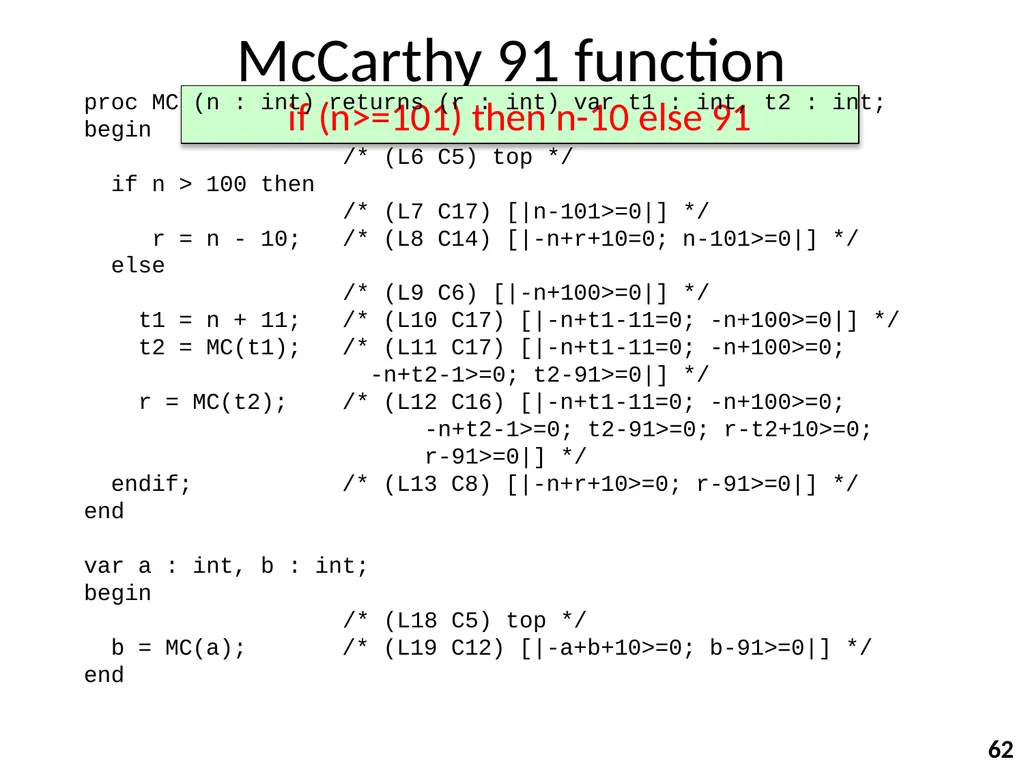
slide62. McCarthy 91 function if (n>=101) then n-10 else 91 62 proc MC (n : int) returns (r : int) var t1 : int, t2 : int;
begin
/* (L6 C5) top */
if n > 100 then
/* (L7 C17) [|n-101>=0|] */
r = n - 10; /* (L8 C14) [|-n+r+10=0; n-101>=0|] */
else
/* (L9 C6) [|-n+100>=0|] */
t1 = n + 11; /* (L10 C17) [|-n+t1-11=0; -n+100>=0|] */
t2 = MC(t1); /* (L11 C17) [|-n+t1-11=0; -n+100>=0;
-n+t2-1>=0; t2-91>=0|] */
r = MC(t2); /* (L12 C16) [|-n+t1-11=0; -n+100>=0;
-n+t2-1>=0; t2-91>=0; r-t2+10>=0;
r-91>=0|] */
endif; /* (L13 C8) [|-n+r+10>=0; r-91>=0|] */
end
var a : int, b : int;
begin
/* (L18 C5) top */
b = MC(a); /* (L19 C12) [|-a+b+10>=0; b-91>=0|] */
end<br>
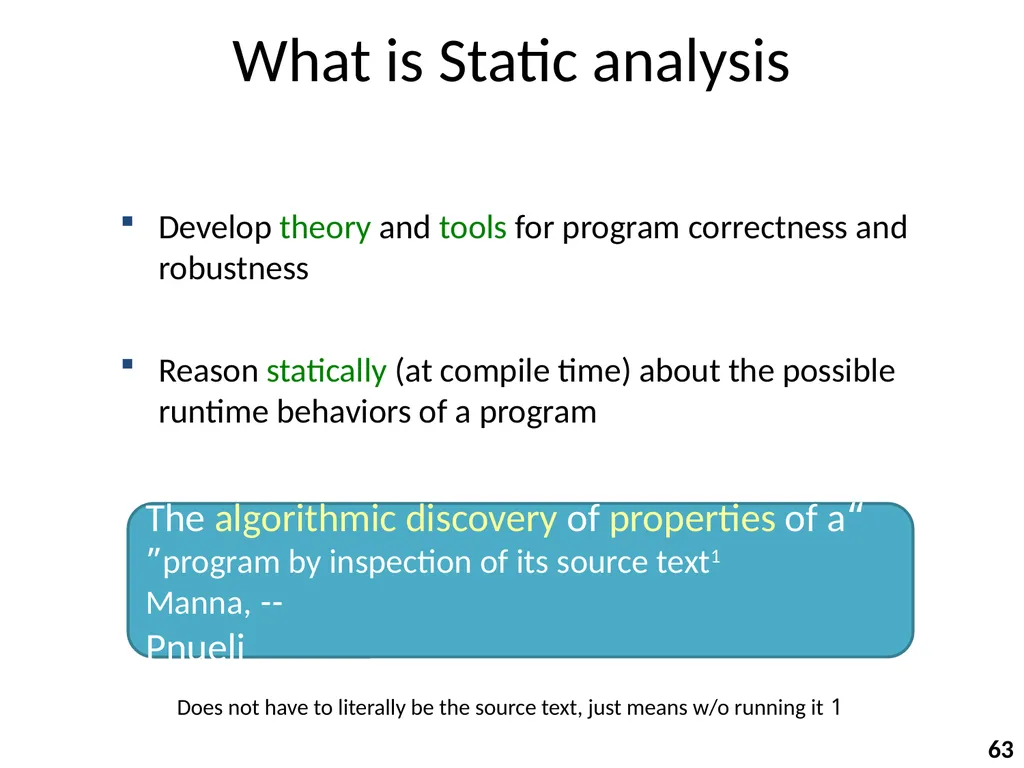
slide63. Develop theory and tools for program correctness and robustness
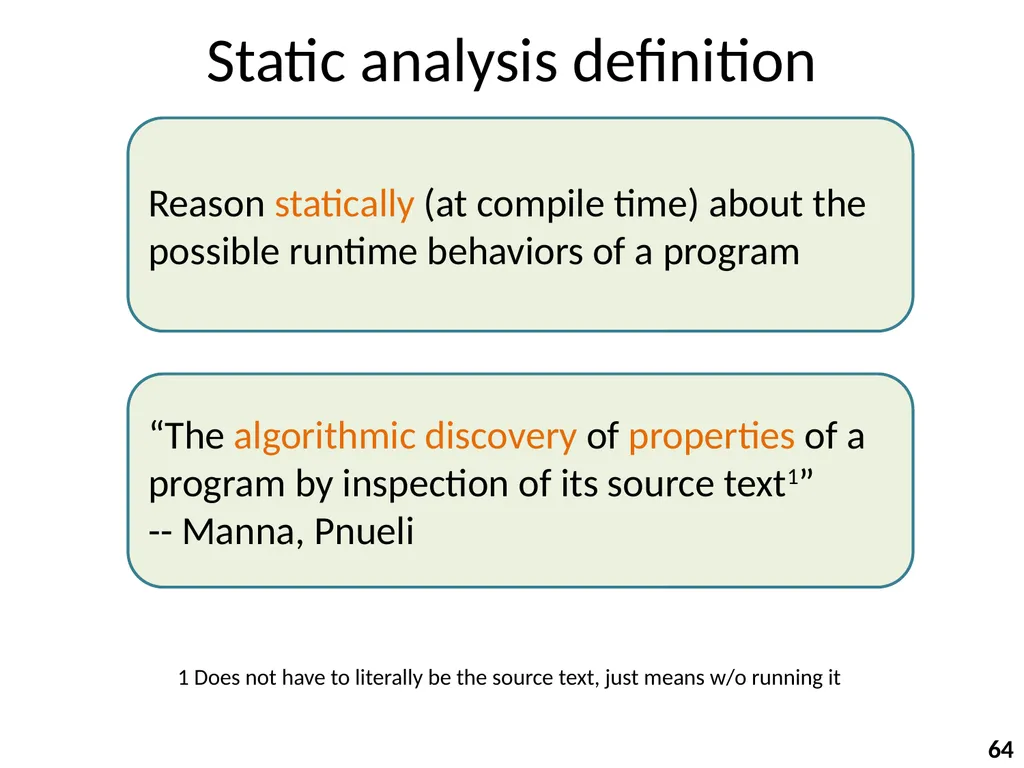
Reason statically (at compile time) about the possible runtime behaviors of a program What is Static analysis 63 “The algorithmic discovery of properties of a program by inspection of its source text1”
-- Manna, Pnueli 1 Does not have to literally be the source text, just means w/o running it<br>
slide64. Static analysis definition Reason statically (at compile time) about the possible runtime behaviors of a program “The algorithmic discovery of properties of a program by inspection of its source text1”
-- Manna, Pnueli 1 Does not have to literally be the source text, just means w/o running it 64<br>
slide65. Some automatic tools 65<br>
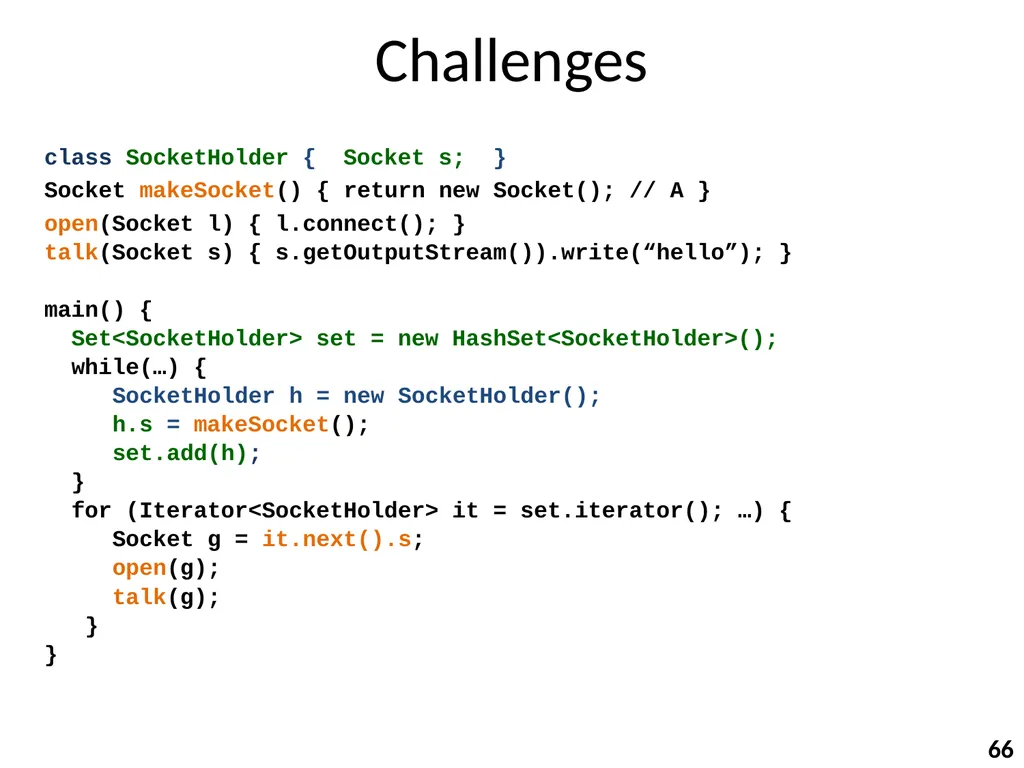
slide66. Challenges class SocketHolder { Socket s; }
Socket makeSocket() { return new Socket(); // A }
open(Socket l) { l.connect(); }
talk(Socket s) { s.getOutputStream()).write(“hello”); }
main() {
Set<SocketHolder> set = new HashSet<SocketHolder>();
while(…) {
SocketHolder h = new SocketHolder();
h.s = makeSocket();
set.add(h);
}
for (Iterator<SocketHolder> it = set.iterator(); …) {
Socket g = it.next().s;
open(g);
talk(g);
}
} 66<br>
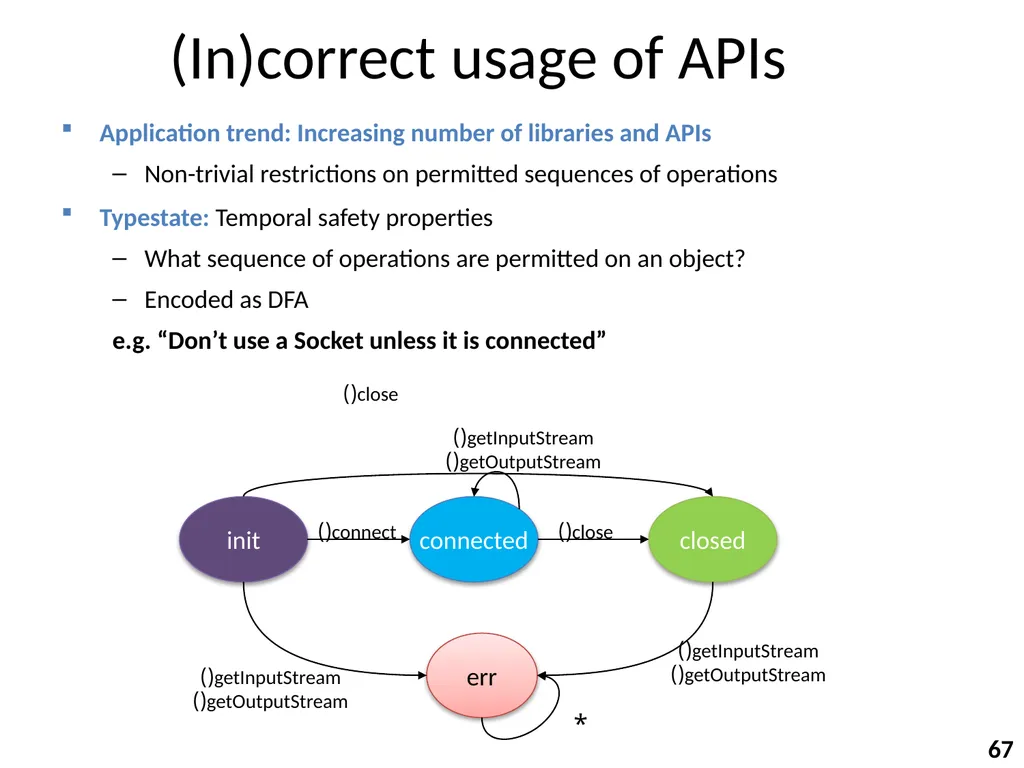
slide67. (In)correct usage of APIs Application trend: Increasing number of libraries and APIs
Non-trivial restrictions on permitted sequences of operations
Typestate: Temporal safety properties
What sequence of operations are permitted on an object?
Encoded as DFA
e.g. “Don’t use a Socket unless it is connected” 67<br>
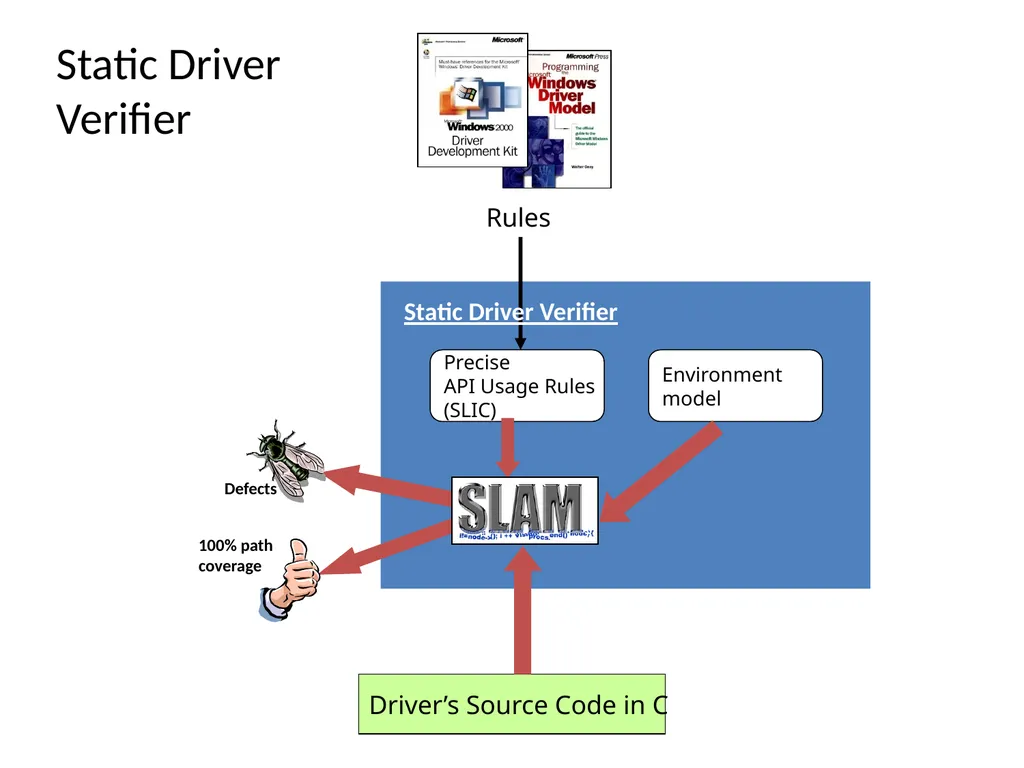
slide68. Driver’s Source Code in C Rules Static Driver Verifier Environment
model Static Driver Verifier<br>
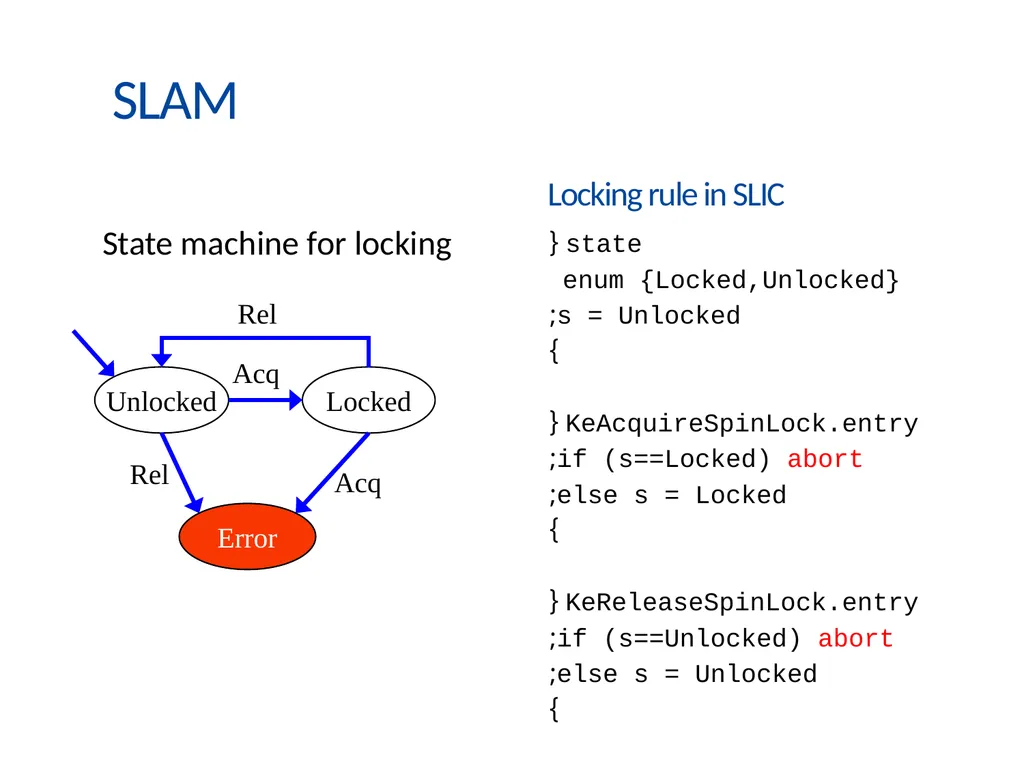
slide69. State machine for locking Unlocked Locked Error Rel Acq Acq Rel state {
enum {Locked,Unlocked}
s = Unlocked;
}
KeAcquireSpinLock.entry {
if (s==Locked) abort;
else s = Locked;
}
KeReleaseSpinLock.entry {
if (s==Unlocked) abort;
else s = Unlocked;
} SLAM Locking rule in SLIC<br>
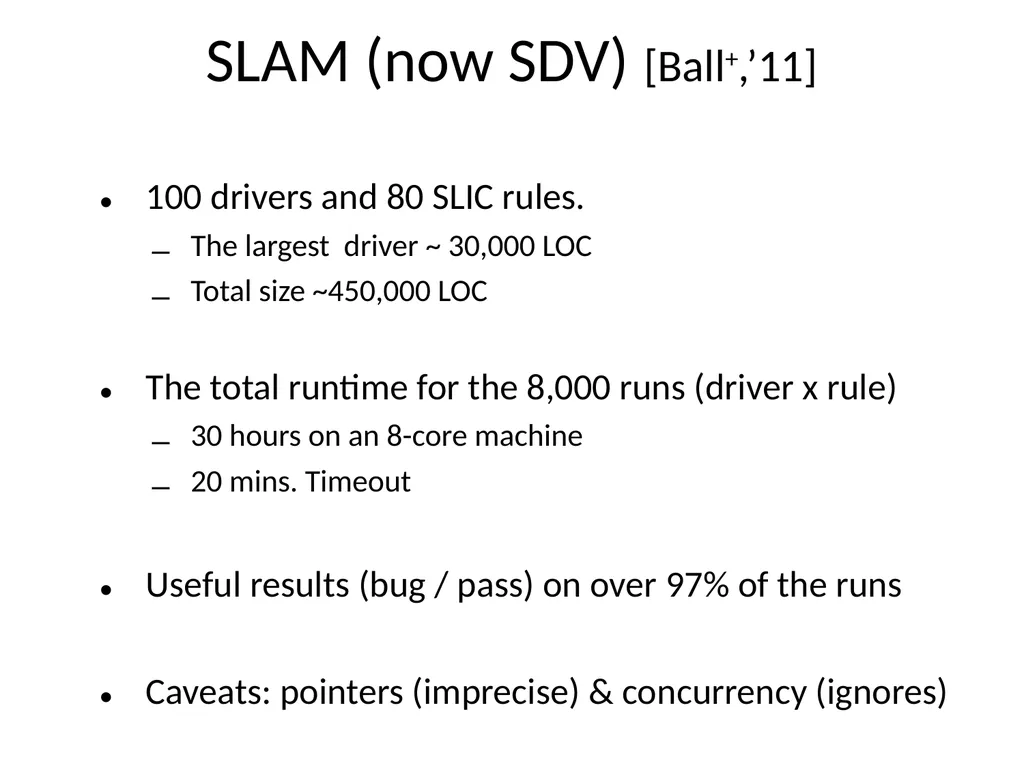
slide70. SLAM (now SDV) [Ball+,’11] 100 drivers and 80 SLIC rules.
The largest driver ~ 30,000 LOC
Total size ~450,000 LOC
The total runtime for the 8,000 runs (driver x rule)
30 hours on an 8-core machine
20 mins. Timeout
Useful results (bug / pass) on over 97% of the runs
Caveats: pointers (imprecise) & concurrency (ignores)<br>
slide71. The Astrée Static Analyzer Patrick Cousot
Radhia Cousot
Jérôme Feret Laurent Mauborgne
Antoine Miné
Xavier Rival ENS France<br>
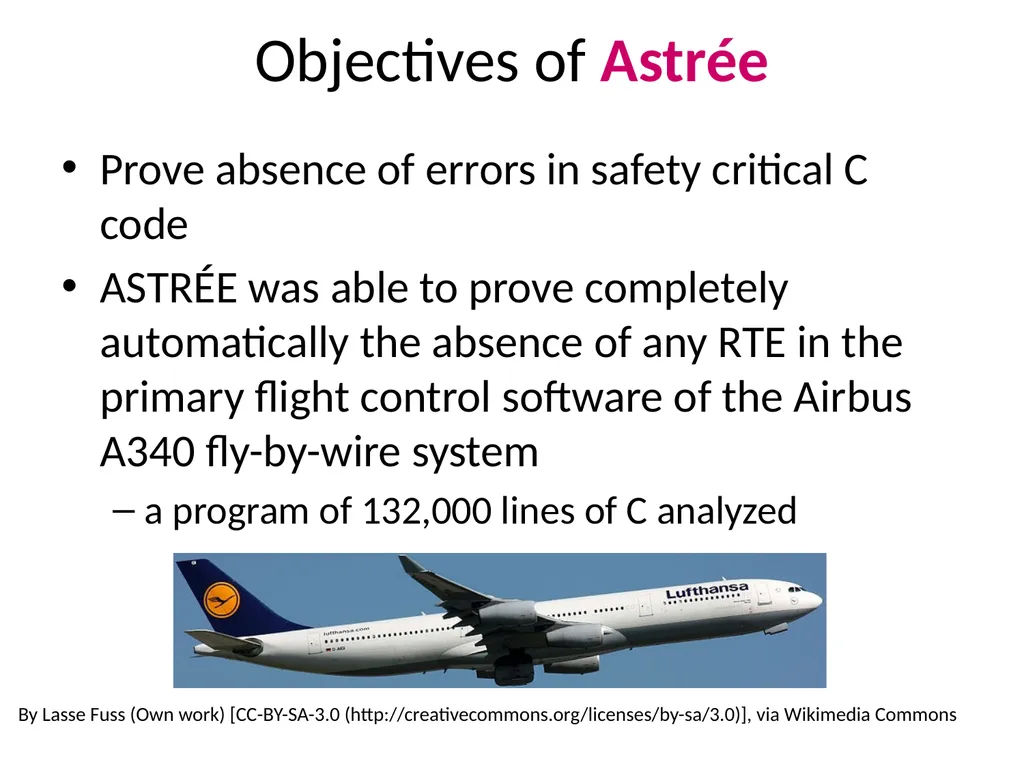
slide72. Objectives of Astrée Prove absence of errors in safety critical C code
ASTRÉE was able to prove completely automatically the absence of any RTE in the primary flight control software of the Airbus A340 fly-by-wire system
a program of 132,000 lines of C analyzed By Lasse Fuss (Own work) [CC-BY-SA-3.0 (http://creativecommons.org/licenses/by-sa/3.0)], via Wikimedia Commons<br>
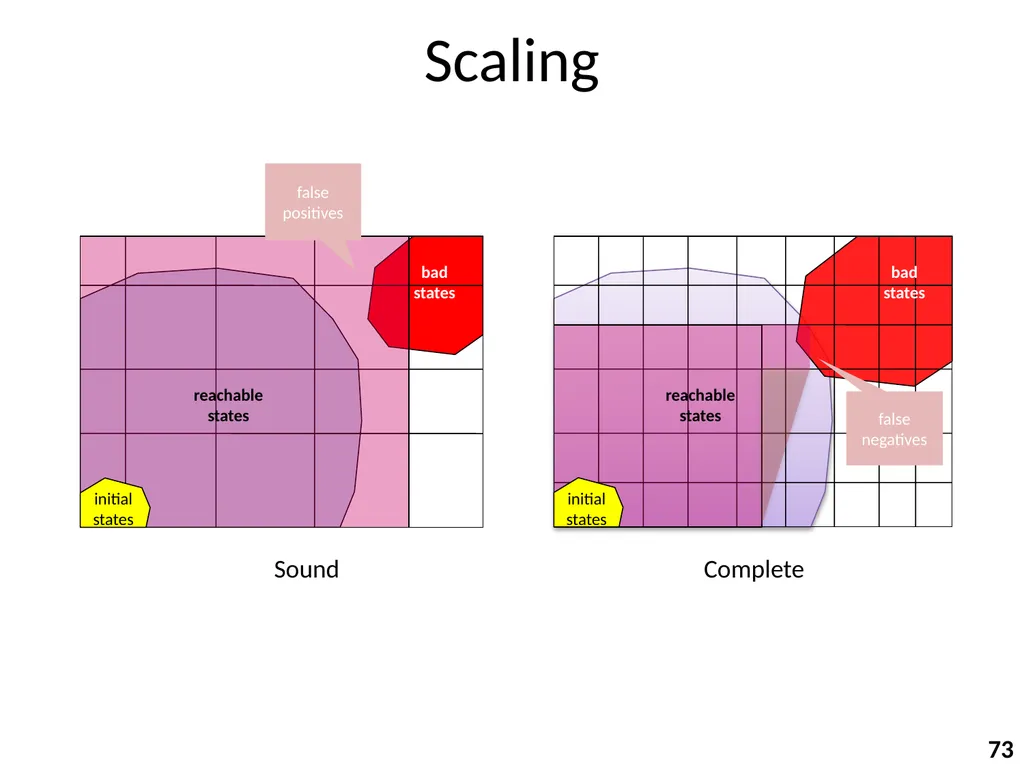
slide73. Scaling 73 bad states reachable states false positives bad states reachable states false negatives Sound Complete<br>
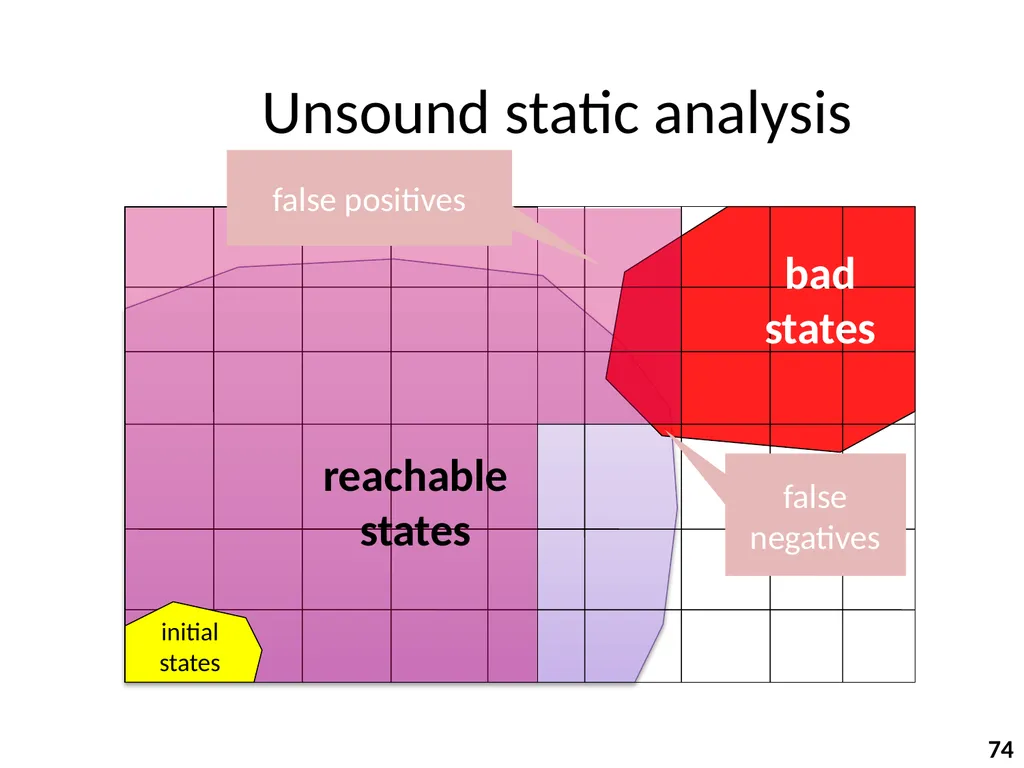
slide74. 74 bad states reachable states false negatives false positives Unsound static analysis<br>
slide75. Unsound static analysis Static analysis
No code execution
Trade soundness for scalability
Do not cover all execution paths
But cover “many”<br>
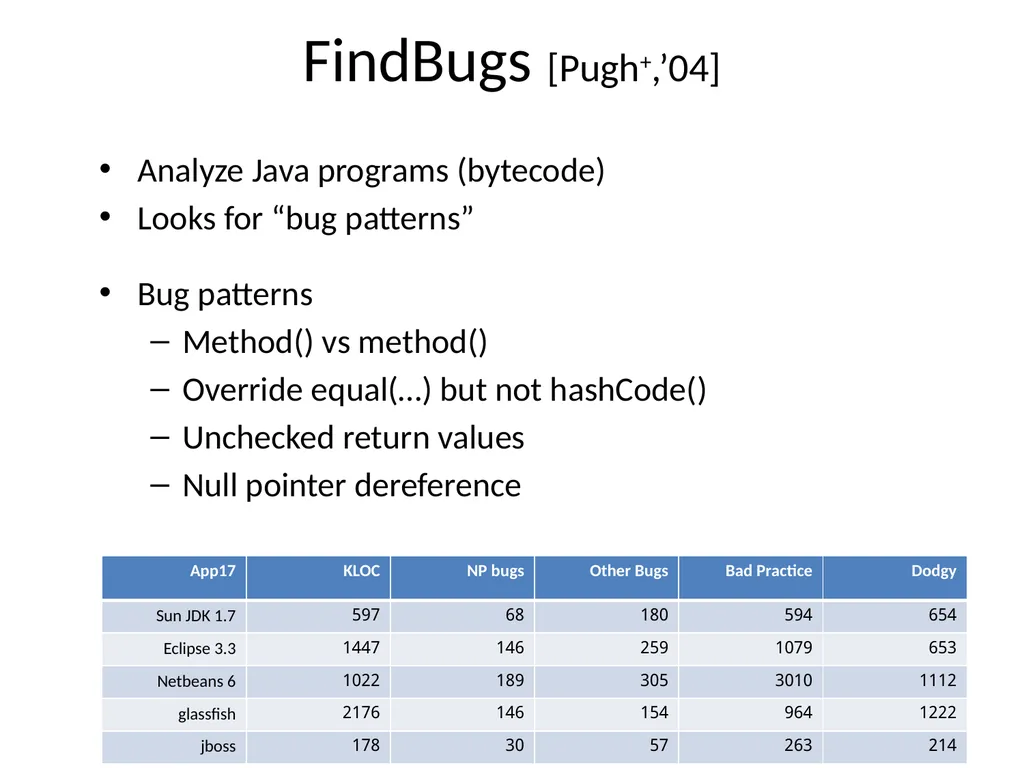
slide76. FindBugs [Pugh+,’04] Analyze Java programs (bytecode)
Looks for “bug patterns”
Bug patterns
Method() vs method()
Override equal(…) but not hashCode()
Unchecked return values
Null pointer dereference<br>
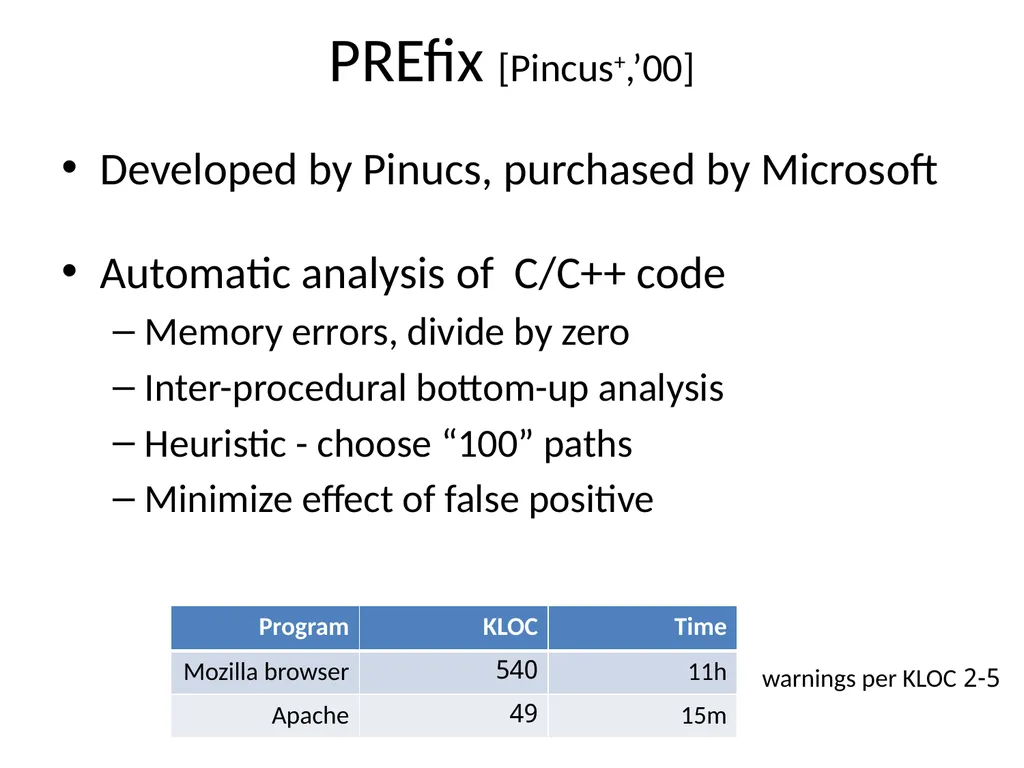
slide77. PREfix [Pincus+,’00] Developed by Pinucs, purchased by Microsoft
Automatic analysis of C/C++ code
Memory errors, divide by zero
Inter-procedural bottom-up analysis
Heuristic - choose “100” paths
Minimize effect of false positive 2-5 warnings per KLOC<br>
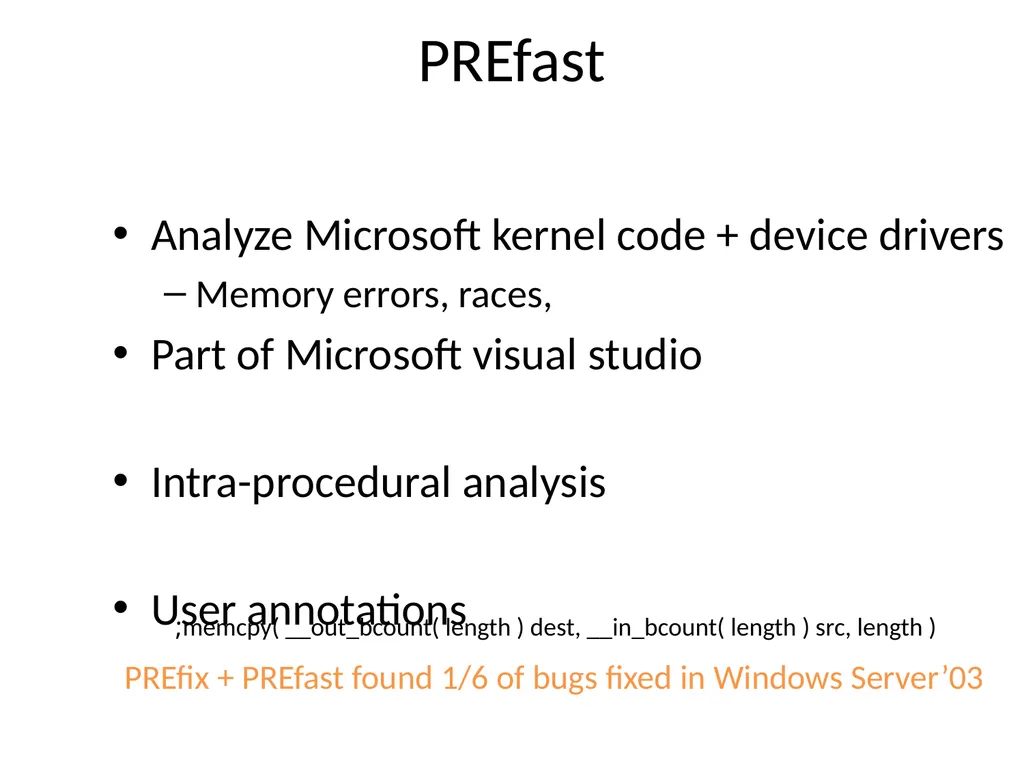
slide78. PREfast Analyze Microsoft kernel code + device drivers
Memory errors, races,
Part of Microsoft visual studio
Intra-procedural analysis
User annotations memcpy( __out_bcount( length ) dest, __in_bcount( length ) src, length ); PREfix + PREfast found 1/6 of bugs fixed in Windows Server’03<br>
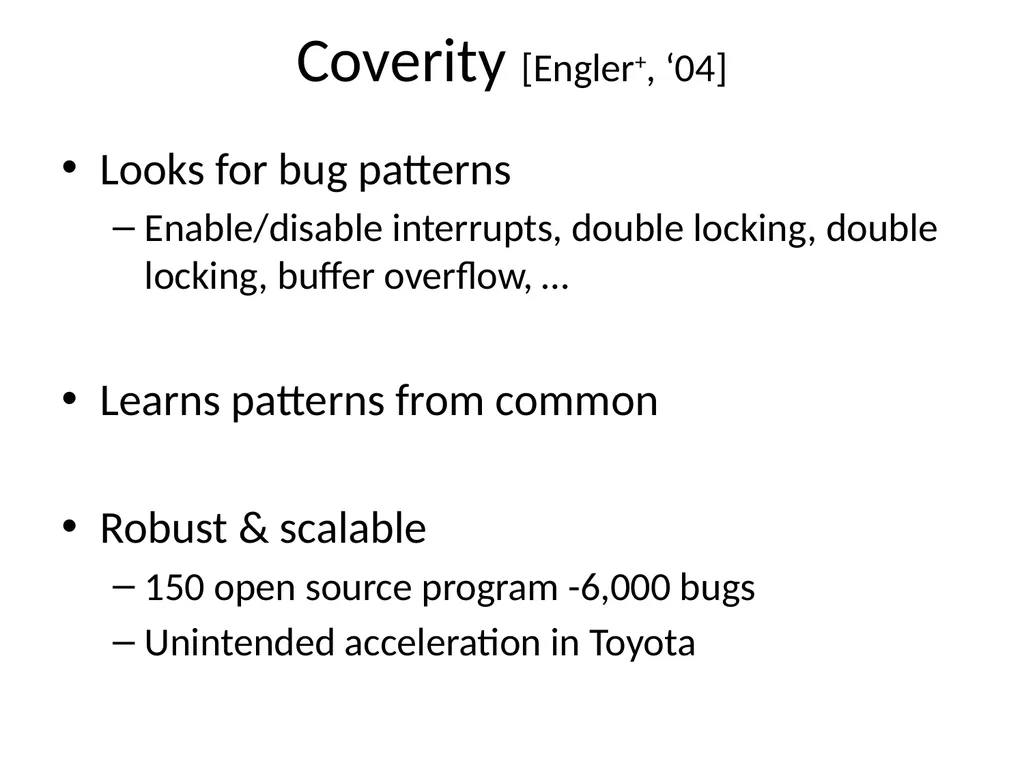
slide79. Coverity [Engler+, ‘04] Looks for bug patterns
Enable/disable interrupts, double locking, double locking, buffer overflow, …
Learns patterns from common
Robust & scalable
150 open source program -6,000 bugs
Unintended acceleration in Toyota<br>
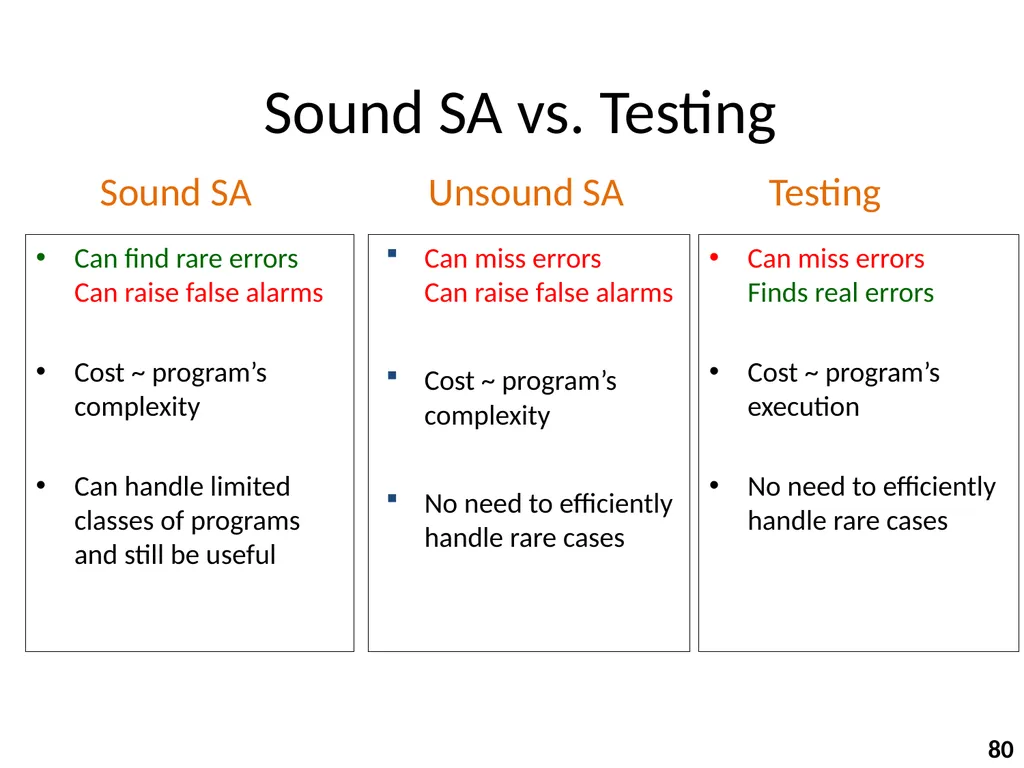
slide80. Sound SA vs. Testing Can find rare errors Can raise false alarms
Cost ~ program’s complexity
Can handle limited classes of programs and still be useful Can miss errors Finds real errors
Cost ~ program’s execution
No need to efficiently handle rare cases Sound SA Testing 80 Can miss errors Can raise false alarms
Cost ~ program’s complexity
No need to efficiently handle rare cases Unsound SA<br>
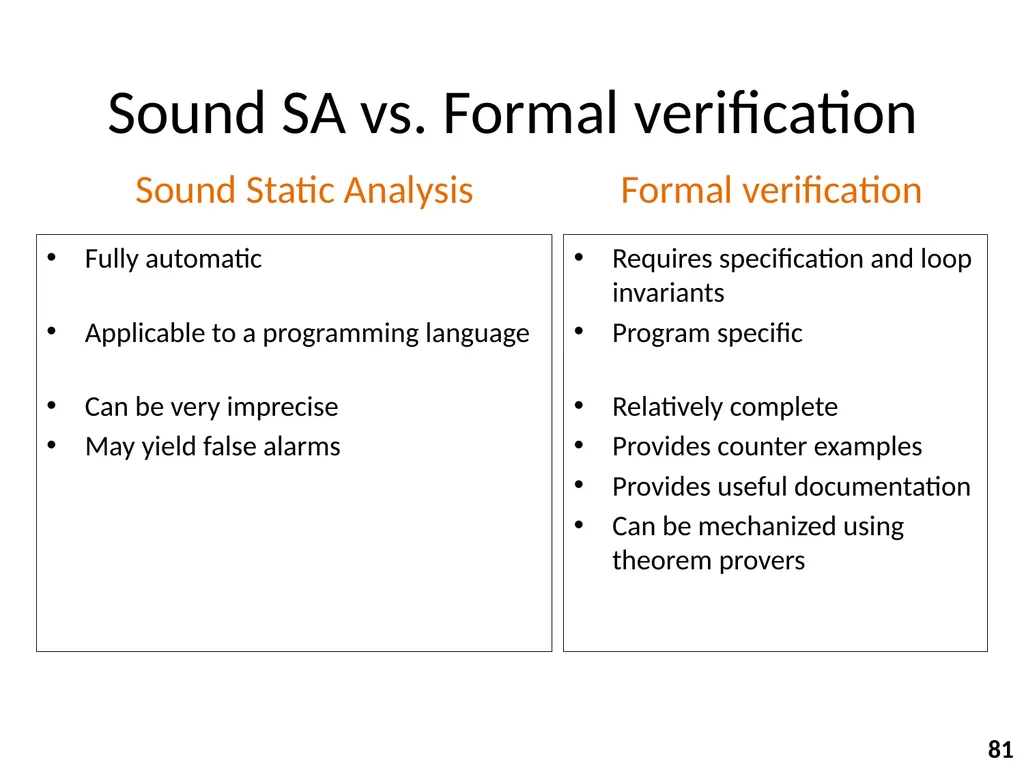
slide81. Sound SA vs. Formal verification Fully automatic
Applicable to a programming language
Can be very imprecise
May yield false alarms Requires specification and loop invariants
Program specific
Relatively complete
Provides counter examples
Provides useful documentation
Can be mechanized using theorem provers Sound Static Analysis Formal verification 81<br>
slide82. The End<br>
Lecture 1: Introduction & Overview 1 Slides credit: Tom Ball, Dawson Engler, Roman Manevich, Erik Poll, Mooly Sagiv, Jean Souyris, Eran Tromer, Avishai Wool, Eran Yahav<br>
slide2. Admin Lecturer: Noam Rinetzky
maon@cs.tau.ac.il
http://www.cs.tau.ac.il/~maon
14 Lessons
Monday, 13:00-16:00, Shenkar-Physics 222
4 Assignments (30%)
1 involves programming
1 Lesson summary (10%)
Final exam (60%)
Must pass 2<br>
slide3. Today Motivation
Introduction
Not technical 3<br>
slide4. Software is Everywhere<br>
slide5. Software is Everywhere Unreliable<br>
slide7. 30GB Zunes all over the world fail en masse 7 December 31, 2008<br>
slide8. Zune bug 1 while (days > 365) {
2 if (IsLeapYear(year)) {
3 if (days > 366) {
4 days -= 366;
5 year += 1;
6 }
7 } else {
8 days -= 365;
9 year += 1;
10 }
11 } 8 December 31, 2008<br>
slide9. Zune bug 1 while (366 > 365) {
2 if (IsLeapYear(2008)) {
3 if (366 > 366) {
4 days -= 366;
5 year += 1;
6 }
7 } else {
8 days -= 365;
9 year += 1;
10 }
11 } Suggested solution: wait for tomorrow 9 December 31, 2008<br>
slide10. February 25, 1991 On the night of the 25th of February, 1991, a Patriot missile system operating in Dhahran, Saudi Arabia, failed to track and intercept an incoming Scud. The Iraqi missile impacted into an army barracks, killing 28 U.S. soldiers and injuring another 98. Patriot missile failure 10<br>
slide11. Patriot bug – rounding error Time measured in 1/10 seconds
Binary expansion of 1/10: 0.0001100110011001100110011001100....
24-bit register
0.00011001100110011001100
error of
0.0000000000000000000000011001100... binary, or ~0.000000095 decimal
After 100 hours of operation error is 0.000000095×100×3600×10=0.34
A Scud travels at about 1,676 meters per second, and so travels more than half a kilometer in this time Suggested solution: reboot every 10 hours 11<br>
slide12. Toyota recalls 160,000 Prius hybrid vehicles Programming error can activate all warning lights, causing the car to think its engine has failed October 2005<br>
slide13. Therac-25 leads to 3 deaths and 3 injuries Software error exposes patients to radiation overdose (100X of intended dose) 1985 to 1987<br>
slide14. Northeast Blackout 14 August, 2003<br>
slide15. Unreliable Software is Exploitable The Sony PlayStation Network breach: An identity-theft bonanza
Massive Sony PlayStation data breach puts about 77 million people at higher risk of fraud
(April 2011) RSA hacked, information leaks RSA's corporate network suffered what RSA describes as a successful advanced persistent threat attack, and "certain information" was stolen that can somehow affect the security of SecurID authentication
(March 2011) Stuxnet Worm Still Out of Control at Iran's Nuclear Sites, Experts Say
The Stuxnet worm, named after initials found in its code, is the most sophisticated cyberweapon ever created.
(December 2010) Security Advisory for Adobe Flash Player, Adobe Reader and Acrobat
This vulnerability could cause a crash and potentially allow an attacker to take control of the affected system. There are reports that this vulnerability is being exploited in the wild in targeted attacks via a Flash (.swf) file embedded in a Microsoft Excel (.xls) file delivered as an email attachment.
(March 2011) RSA tokens may be behind major network security problems at Lockheed Martin
Lockheed Martin remote access network, protected by SecurID tokens, has been shut down
(May 2011)<br>
slide16. August 13, 2003 Billy Gates why do you make this possible ? Stop making money and fix your software!! (W32.Blaster.Worm) 16<br>
slide17. Windows exploit(s) Buffer Overflow 17 void foo (char *x) {
char buf[2];
strcpy(buf, x);
}
int main (int argc, char *argv[]) {
foo(argv[1]);
}
./a.out abracadabra
Segmentation fault Stack grows
this way Memory
addresses Previous frame Return address Saved FP char* x buf[2] … ab ra ca da br<br>
slide18. Buffer overrun exploits int check_authentication(char *password) {
int auth_flag = 0;
char password_buffer[16];
strcpy(password_buffer, password);
if(strcmp(password_buffer, "brillig") == 0) auth_flag = 1;
if(strcmp(password_buffer, "outgrabe") == 0) auth_flag = 1;
return auth_flag;
}
int main(int argc, char *argv[]) {
if(check_authentication(argv[1])) {
printf("\n-=-=-=-=-=-=-=-=-=-=-=-=-=-\n");
printf(" Access Granted.\n");
printf("-=-=-=-=-=-=-=-=-=-=-=-=-=-\n"); }
else
printf("\nAccess Denied.\n");
} (source: “hacking – the art of exploitation, 2nd Ed”) 18<br>
slide19. Input Validation Application evil input 1234567890123456 -=-=-=-=-=-=-=-=-=-=-=-=-=-
Access Granted.
-=-=-=-=-=-=-=-=-=-=-=-=-=-<br>
slide20. Boeing's 787 Vulnerable to Hacker Attack security vulnerability in onboard computer networks could allow passengers to access the plane's control systems January 2008<br>
slide21. What can we do about it?<br>
slide22. August 13, 2003 I just want to say LOVE YOU SAN!!soo much (W32.Blaster.Worm / Lovesan worm) 22 Billy Gates why do you make this possible ? Stop making money
and fix your software!! What can we do about it?<br>
slide23. What can we do about it? Monitoring
Testing
Static Analysis
Formal Verification
Specification<br>
slide24. Monitoring (e.g., for security) StackGuard
ProPolice
PointGuard
Security monitors (ptrace) OS Kernel monitored
application
(Outlook) monitor user space open(“/etc/passwd”, “r”)<br>
slide25. Testing build it; try it on a some inputs
printf (“x == 0 => should not get that!”)<br>
slide26. Testing Valgrind memory errors, race conditions, taint analysis
Simulated CPU
Shadow memory Invalid read of size 4
at 0x40F6BBCC: (within /usr/lib/libpng.so.2.1.0.9)
by 0x40F6B804: (within /usr/lib/libpng.so.2.1.0.9)
by 0x40B07FF4: read_png_image(QImageIO *) (kernel/qpngio.cpp:326)
by 0x40AC751B: QImageIO::read() (kernel/qimage.cpp:3621)
Address 0xBFFFF0E0 is not stack'd, malloc'd or free'd<br>
slide27. Testing Valgrind memory errors, race conditions
Parasoft Jtest/Insure++ memory errors + visualizer, race conditions, exceptions …
IBM Rational Purify memory errors
IBM PureCoverage detect untested paths
Daikon dynamic invariant detection<br>
slide28. Testing Useful and challenging
Random inputs
Guided testing (coverage)
Bug reproducing
But …
Observe some program behaviors
What can you say about other behaviors?<br>
slide29. Testing is not enough Observe some program behaviors
What can you say about other behaviors?
Concurrency makes things worse
Smart testing is useful
requires the techniques that we will see in the course 29<br>
slide30. What can we do about it? Monitoring
Testing
Static Analysis
Formal Verification
Specification<br>
slide31. Program Analysis & Verification x = ?
if (x > 0) {
y = 42;
} else {
y = 73;
foo();
}
assert (y == 42); Is assertion true? 31 ?<br>
slide32. Program Analysis & Verification y = ?; x = y * 2
if (x % 2 == 0) {
y = 42;
} else {
y = 73;
foo();
}
assert (y == 42); 32 Is assertion true? Can we prove this? Automatically?
Bad news: problem is generally undecidable ?<br>
slide33. Formal verification Mathematical model of software
: Var Z
= [x0, y1]
Logical specification
{ 0 < x } = { ε State | 0 < (x) }
Machine checked formal proofs { 0 < x } y:= x ; y:=y+1 { 1 < y } { 0 < x } y:= x { 0 < x ∧ y = x } { 0 < y } y:= y+1 { 1< y } { ? } { 0 < x ∧ y = x } → { 0 < y }<br>
slide34. Formal verification Mathematical model of software
State = Var Integer
S = [x0, y1]
Logical specification
{ 0 < x } = { S ε State | 0 < S(x) }
Machine checked formal proofs { P } stmt1 { Q’ } { P’ } stmt2 { Q } { Q’ } → { P’ } { P } stmt1; stmt2 { Q }<br>
slide35. Program Verification {true}
y = ?; x = 2 * y;
{x = 2 * y}
if (x % 2 == 0) {
{x = 2 * y}
y = 42;
{ z. x = 2 * z∧ y = 42 }
} else {
{ false }
y = 73;
foo();
{ false }
}
{ z. x = 2 * z∧ y = 42 }
assert (y == 42); 35 Is assertion true? Can we prove this? Automatically?
Can we prove this manually? E E<br>
slide36. Central idea: use approximation Under Approximation Exact set of configurations/
behaviors 36<br>
slide37. Program Verification {true}
y = ?; x = 2 * y;
{x = 2 * y}
if (x % 2 == 0) {
{x = 2 * y}
y = 42;
{ z. x = 2 * z∧ y = 42 }
} else {
{ false }
y = 73;
foo();
{ false }
}
{ z. x = 2 * z∧ y = 42 } {x = ?∧ y = 42 } { x = 4∧ y = 42 }
assert (y == 42); 37 Is assertion true? Can we prove this? Automatically?
Can we prove this manually? E E<br>
slide38. L4.verified [Klein+,’09] Microkernel
IPC, Threads, Scheduling, Memory management
Functional correctness (using Isabelle/HOL)
No null pointer de-references.
No memory leaks.
No buffer overflows.
No unchecked user arguments
…
Kernel/proof co-design
Implementation - 2.5 py (8,700 LOC)
Proof – 20 py (200,000 LOP)<br>
slide39. Static Analysis Lightweight formal verification
Formalize software behavior in a mathematical model (semantics)
Prove (selected) properties of the mathematical model
Automatically, typically with approximation of the formal semantics<br>
slide40. Why static analysis? Some errors are hard to find by testing
arise in unusual circumstances/uncommon execution paths
buffer overruns, unvalidated input, exceptions, ...
involve non-determinism
race conditions
Full-blown formal verification too expensive<br>
slide41. Is it at all doable? x = ?
if (x > 0) {
y = 42;
} else {
y = 73;
foo();
}
assert (y == 42); Bad news: problem is generally undecidable 41<br>
slide42. Central idea: use approximation Under Approximation Exact set of configurations/
behaviors 42<br>
slide43. Goal: exploring program states initial states bad states 43 reachable states<br>
slide44. Technique: explore abstract states initial states bad states 44 reachable states<br>
slide45. Technique: explore abstract states bad states 45 reachable states<br>
slide46. Technique: explore abstract states bad states 46 reachable states<br>
slide47. Technique: explore abstract states bad states 47 reachable states<br>
slide48. Sound: cover all reachable states 48 bad states reachable states<br>
slide49. Unsound: miss some reachable states 49 bad states reachable states<br>
slide50. 50 Imprecise abstraction bad states 50 reachable states False alarms<br>
slide51. A sound message x = ?
if (x > 0) {
y = 42;
} else {
y = 73;
foo();
}
assert (y == 42); Assertion may be violated 51<br>
slide52. Avoid useless result
Low false alarm rate
Understand where precision is lost Precision UselessAnalysis(Program p) {
printf(“assertion may be violated\n”);
} 52<br>
slide53. A sound message y = ?; x = y * 2
if (x % 2 == 0) {
y = 42;
} else {
y = 73;
foo();
}
assert (y == 42); Assertion is true 53<br>
slide54. How to find “the right” abstraction? Pick an abstract domain suited for your property
Numerical domains
Domains for reasoning about the heap
…
Combination of abstract domains 54<br>
slide55. Intervals Abstraction 55 0 2 3 1 2 3 4 5 4 6 x y 1 y [3,6] x [1,4]<br>
slide56. Interval Lattice [0,0] [-1,-1] [-2,-2] [-2,-1] [-2,0] [1,1] [2,2] [-1,0] [0,1] [1,2] … [-1,1] [0,2] [-2,1] [-1,2] [-2,2] … … [2,] … [1,] [0,] [-1,] [-2,] … … … … [- ,] … … [- ,-2] … [-,-1] [- ,0] [-,1] [- ,2] … … … … 56 (infinite lattice, infinite height)<br>
slide57. Example 57 int x = 0;
if (?) x++;
if (?) x++; x [0,0] x x [0,1] x [0,2] x=0 if x++ if x++ exit x [0,0] x [1,1] x [1,2] [a1,a2] [b1,b2] = [min(a1,b1), max(a2,b2)]<br>
slide58. Polyhedral Abstraction abstract state is an intersection of linear inequalities of the form a1x2+a2x2+…anxn c
represent a set of points by their convex hull 58 (image from http://www.cs.sunysb.edu/~algorith/files/convex-hull.shtml)<br>
slide59. McCarthy 91 function 59<br>
slide60. McCarthy 91 function proc MC (n : int) returns (r : int) var t1 : int, t2 : int;
begin
if n > 100 then
r = n - 10;
else
t1 = n + 11;
t2 = MC(t1);
r = MC(t2);
endif;
end
var a : int, b : int;
begin /* top */
b = MC(a);
end if (n>=101) then n-10 else 91 60<br>
slide61. McCarthy 91 function proc MC (n : int) returns (r : int) var t1 : int, t2 : int;
begin
/* top */
if n > 100 then
/* [|n-101>=0|] */
r = n - 10; /* [|-n+r+10=0; n-101>=0|] */
else
/* [|-n+100>=0|] */
t1 = n + 11; /* [|-n+t1-11=0; -n+100>=0|] */
t2 = MC(t1); /* [|-n+t1-11=0; -n+100>=0;
-n+t2-1>=0; t2-91>=0|] */
r = MC(t2); /* [|-n+t1-11=0; -n+100>=0;
-n+t2-1>=0; t2-91>=0; r-t2+10>=0;
r-91>=0|] */
endif; /* [|-n+r+10>=0; r-91>=0|] */
end
var a : int, b : int;
begin /* top */
b = MC(a); /* [|-a+b+10>=0; b-91>=0|] */
end if (n>=101) then n-10 else 91 61 if (n>=101) then n-10 else 91<br>
slide62. McCarthy 91 function if (n>=101) then n-10 else 91 62 proc MC (n : int) returns (r : int) var t1 : int, t2 : int;
begin
/* (L6 C5) top */
if n > 100 then
/* (L7 C17) [|n-101>=0|] */
r = n - 10; /* (L8 C14) [|-n+r+10=0; n-101>=0|] */
else
/* (L9 C6) [|-n+100>=0|] */
t1 = n + 11; /* (L10 C17) [|-n+t1-11=0; -n+100>=0|] */
t2 = MC(t1); /* (L11 C17) [|-n+t1-11=0; -n+100>=0;
-n+t2-1>=0; t2-91>=0|] */
r = MC(t2); /* (L12 C16) [|-n+t1-11=0; -n+100>=0;
-n+t2-1>=0; t2-91>=0; r-t2+10>=0;
r-91>=0|] */
endif; /* (L13 C8) [|-n+r+10>=0; r-91>=0|] */
end
var a : int, b : int;
begin
/* (L18 C5) top */
b = MC(a); /* (L19 C12) [|-a+b+10>=0; b-91>=0|] */
end<br>
slide63. Develop theory and tools for program correctness and robustness
Reason statically (at compile time) about the possible runtime behaviors of a program What is Static analysis 63 “The algorithmic discovery of properties of a program by inspection of its source text1”
-- Manna, Pnueli 1 Does not have to literally be the source text, just means w/o running it<br>
slide64. Static analysis definition Reason statically (at compile time) about the possible runtime behaviors of a program “The algorithmic discovery of properties of a program by inspection of its source text1”
-- Manna, Pnueli 1 Does not have to literally be the source text, just means w/o running it 64<br>
slide65. Some automatic tools 65<br>
slide66. Challenges class SocketHolder { Socket s; }
Socket makeSocket() { return new Socket(); // A }
open(Socket l) { l.connect(); }
talk(Socket s) { s.getOutputStream()).write(“hello”); }
main() {
Set<SocketHolder> set = new HashSet<SocketHolder>();
while(…) {
SocketHolder h = new SocketHolder();
h.s = makeSocket();
set.add(h);
}
for (Iterator<SocketHolder> it = set.iterator(); …) {
Socket g = it.next().s;
open(g);
talk(g);
}
} 66<br>
slide67. (In)correct usage of APIs Application trend: Increasing number of libraries and APIs
Non-trivial restrictions on permitted sequences of operations
Typestate: Temporal safety properties
What sequence of operations are permitted on an object?
Encoded as DFA
e.g. “Don’t use a Socket unless it is connected” 67<br>
slide68. Driver’s Source Code in C Rules Static Driver Verifier Environment
model Static Driver Verifier<br>
slide69. State machine for locking Unlocked Locked Error Rel Acq Acq Rel state {
enum {Locked,Unlocked}
s = Unlocked;
}
KeAcquireSpinLock.entry {
if (s==Locked) abort;
else s = Locked;
}
KeReleaseSpinLock.entry {
if (s==Unlocked) abort;
else s = Unlocked;
} SLAM Locking rule in SLIC<br>
slide70. SLAM (now SDV) [Ball+,’11] 100 drivers and 80 SLIC rules.
The largest driver ~ 30,000 LOC
Total size ~450,000 LOC
The total runtime for the 8,000 runs (driver x rule)
30 hours on an 8-core machine
20 mins. Timeout
Useful results (bug / pass) on over 97% of the runs
Caveats: pointers (imprecise) & concurrency (ignores)<br>
slide71. The Astrée Static Analyzer Patrick Cousot
Radhia Cousot
Jérôme Feret Laurent Mauborgne
Antoine Miné
Xavier Rival ENS France<br>
slide72. Objectives of Astrée Prove absence of errors in safety critical C code
ASTRÉE was able to prove completely automatically the absence of any RTE in the primary flight control software of the Airbus A340 fly-by-wire system
a program of 132,000 lines of C analyzed By Lasse Fuss (Own work) [CC-BY-SA-3.0 (http://creativecommons.org/licenses/by-sa/3.0)], via Wikimedia Commons<br>
slide73. Scaling 73 bad states reachable states false positives bad states reachable states false negatives Sound Complete<br>
slide74. 74 bad states reachable states false negatives false positives Unsound static analysis<br>
slide75. Unsound static analysis Static analysis
No code execution
Trade soundness for scalability
Do not cover all execution paths
But cover “many”<br>
slide76. FindBugs [Pugh+,’04] Analyze Java programs (bytecode)
Looks for “bug patterns”
Bug patterns
Method() vs method()
Override equal(…) but not hashCode()
Unchecked return values
Null pointer dereference<br>
slide77. PREfix [Pincus+,’00] Developed by Pinucs, purchased by Microsoft
Automatic analysis of C/C++ code
Memory errors, divide by zero
Inter-procedural bottom-up analysis
Heuristic - choose “100” paths
Minimize effect of false positive 2-5 warnings per KLOC<br>
slide78. PREfast Analyze Microsoft kernel code + device drivers
Memory errors, races,
Part of Microsoft visual studio
Intra-procedural analysis
User annotations memcpy( __out_bcount( length ) dest, __in_bcount( length ) src, length ); PREfix + PREfast found 1/6 of bugs fixed in Windows Server’03<br>
slide79. Coverity [Engler+, ‘04] Looks for bug patterns
Enable/disable interrupts, double locking, double locking, buffer overflow, …
Learns patterns from common
Robust & scalable
150 open source program -6,000 bugs
Unintended acceleration in Toyota<br>
slide80. Sound SA vs. Testing Can find rare errors Can raise false alarms
Cost ~ program’s complexity
Can handle limited classes of programs and still be useful Can miss errors Finds real errors
Cost ~ program’s execution
No need to efficiently handle rare cases Sound SA Testing 80 Can miss errors Can raise false alarms
Cost ~ program’s complexity
No need to efficiently handle rare cases Unsound SA<br>
slide81. Sound SA vs. Formal verification Fully automatic
Applicable to a programming language
Can be very imprecise
May yield false alarms Requires specification and loop invariants
Program specific
Relatively complete
Provides counter examples
Provides useful documentation
Can be mechanized using theorem provers Sound Static Analysis Formal verification 81<br>
slide82. The End<br>