
Program Information Session Techcelerator
Description: Program Information Session Techcelerator Supporting early stage prototyping in Deep Tech Dilek Cetindamar Kozanoglu, PhD Director, Techcelerator Faculty of Engineering and IT Questions ? FAQ on the Techcelerator website Send your questions
Related Topics
Download Presentation
"Program Information Session Techcelerator" is the property of its rightful owner. Permission is granted to download and print the materials on this website for personal, non-commercial use only, and to display it on your personal computer provided you do not modify the materials and that you retain all copyright notices contained in the materials. By downloading content from our website, you accept the terms of this agreement.
Presentation Transcript
slide1. Program Information Session Techcelerator
Supporting early stage prototyping in Deep Tech Dilek Cetindamar Kozanoglu, PhD
Director, Techcelerator
Faculty of Engineering and IT<br>
slide2. Questions ? FAQ on the Techcelerator website
Send your questions to Jessica Gu via chat during the Information Session – any questions we can’t answer now, we will follow up through email.
Techcelerator@uts.edu.au<br>
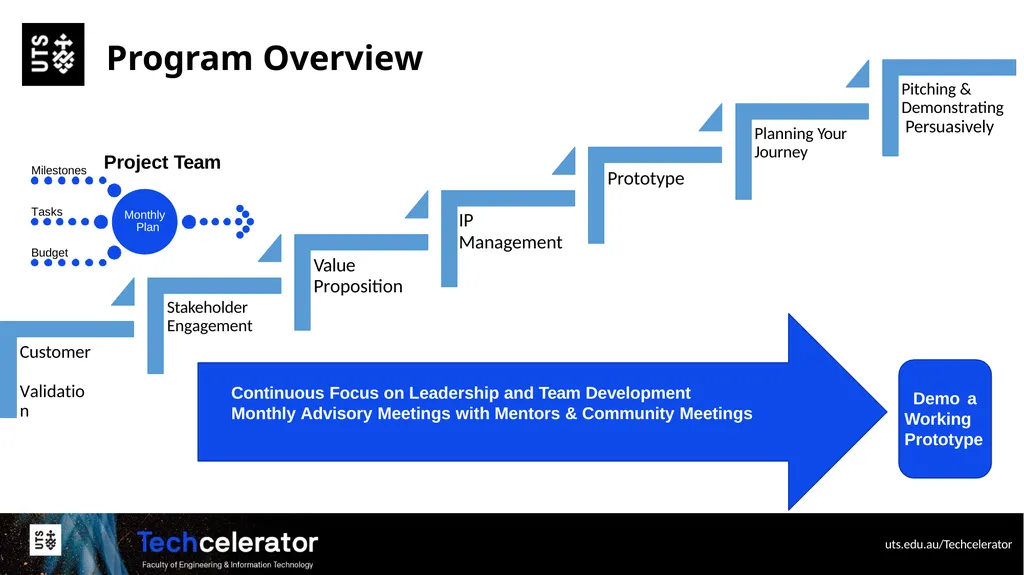
slide3. Program Overview uts.edu.au/Techcelerator Customer Validation Value Proposition
Stakeholder Engagement IP
Management Prototype Planning Your Journey Pitching & Demonstrating Persuasively Monthly Plan Milestones Tasks Budget Demo a Working Prototype Continuous Focus on Leadership and Team Development Monthly Advisory Meetings with Mentors & Community Meetings Project Team<br>
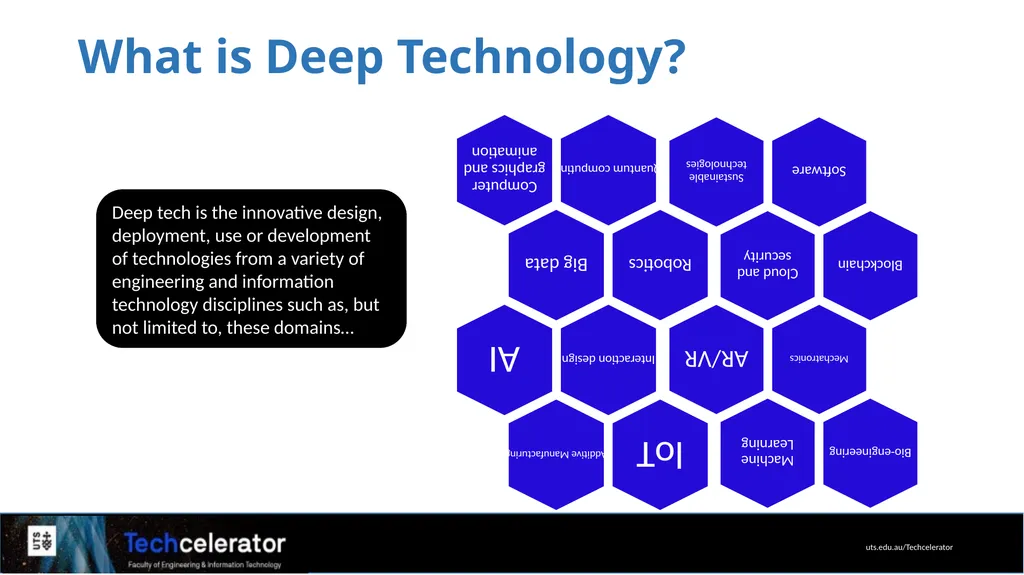
slide4. What is Deep Technology? Deep tech is the innovative design, deployment, use or development of technologies from a variety of engineering and information technology disciplines such as, but not limited to, these domains…<br>
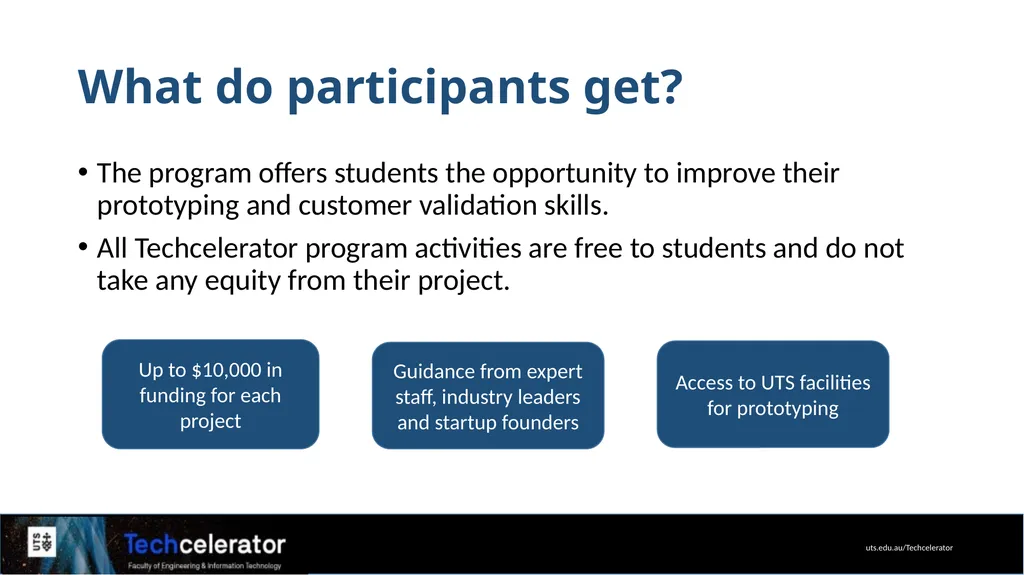
slide5. What do participants get? The program offers students the opportunity to improve their prototyping and customer validation skills.
All Techcelerator program activities are free to students and do not take any equity from their project. Up to $10,000 in funding for each project Guidance from expert staff, industry leaders and startup founders Access to UTS facilities for prototyping<br>
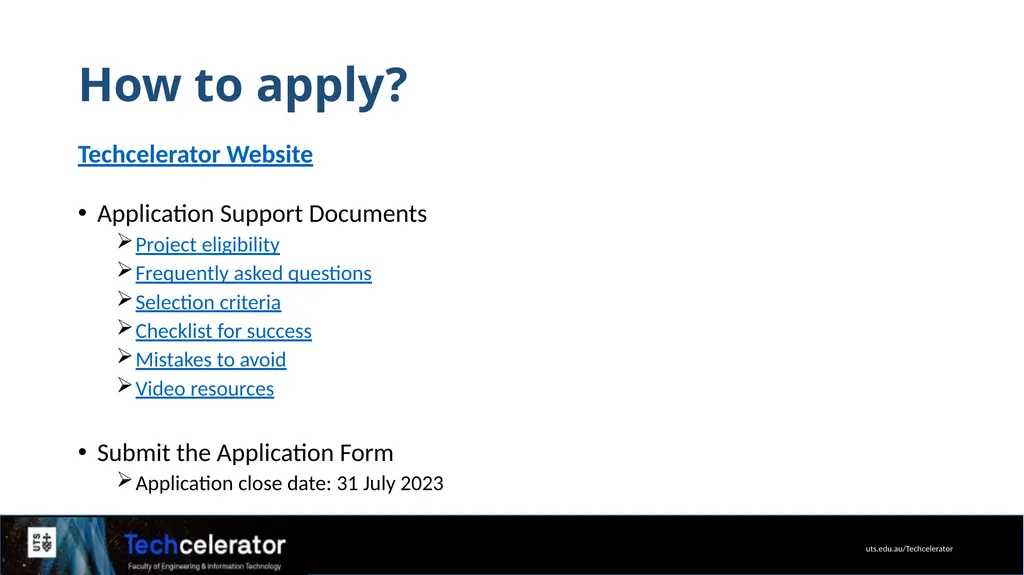
slide6. How to apply? Techcelerator Website
Application Support Documents
Project eligibility
Frequently asked questions
Selection criteria
Checklist for success
Mistakes to avoid
Video resources
Submit the Application Form
Application close date: 31 July 2023<br>
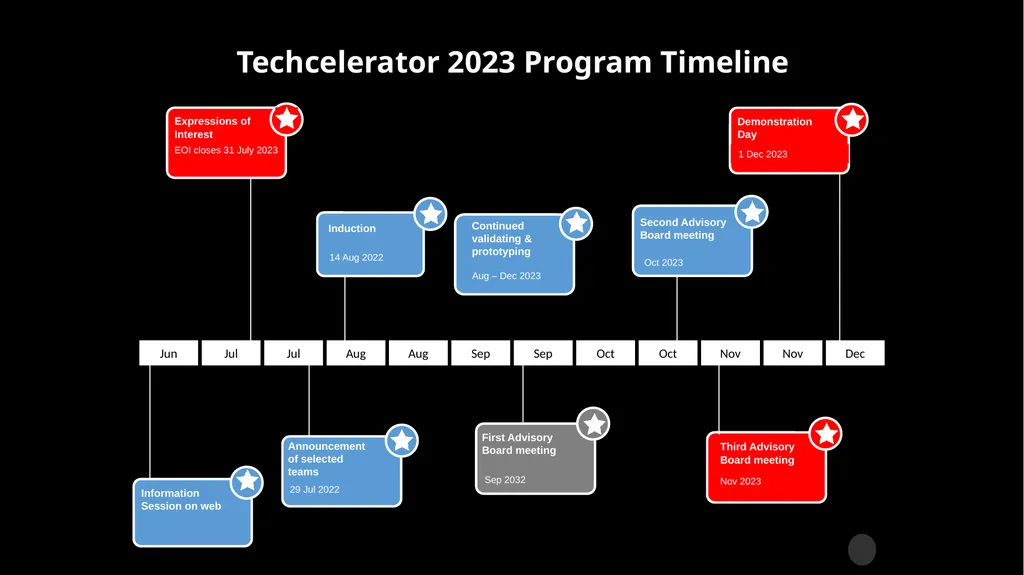
slide7. EOI closes 31 July 2023 Expressions of Interest Techcelerator 2023 Program Timeline Jun Jul Jul Aug Aug Sep Sep Oct Oct Nov Nov Dec 14 Aug 2022 Induction Sep 2032 First Advisory Board meeting Aug – Dec 2023 Continued validating & prototyping Oct 2023 Second Advisory Board meeting 1 Dec 2023 Demonstration Day 29 Jul 2022 Announcement of selected teams Nov 2023 Third Advisory Board meeting Information Session on web<br>
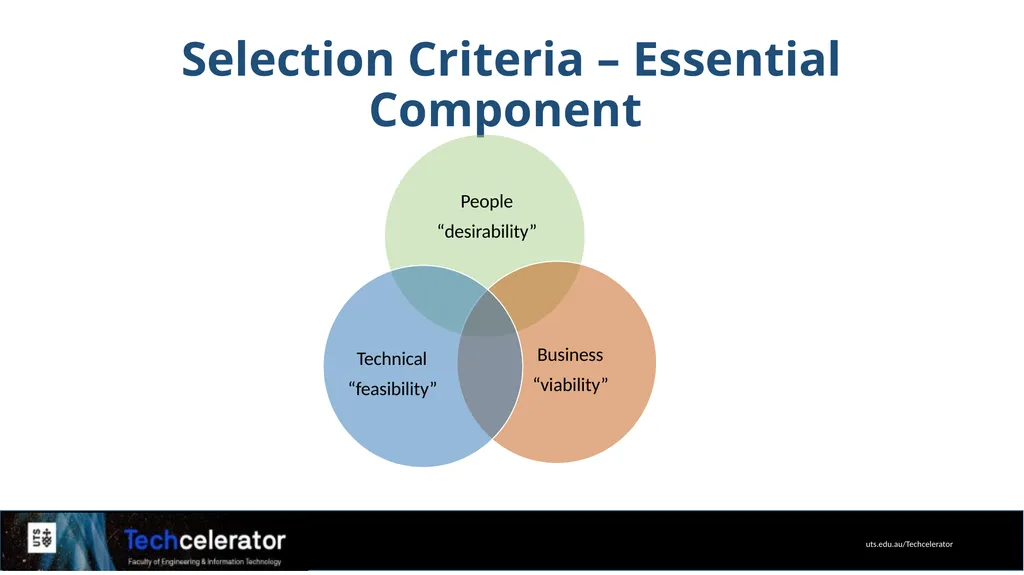
slide8. Selection Criteria – Essential Component<br>
slide9. Essential Component - Desirability 1. What is the problem?
Does your solution solve the problem?
Is there solution already in the market? Unique value proposition?
2. Who is your customer?
What value can this solution bring to the customer?
Is it cost-benefit to the customer?<br>
slide10. Essential Component – Desirability 3. Is the Market attractive?
Industry growth potential
Size of the market
Entry barriers/risks
Competitive analysis
Competitors (numbers? Strength?)
Alternative products/service
The unique features of your proposal
Competitive advantage<br>
slide11. Checklist Take time to conduct desk research
Talk with potential customers or conducts simple surveys (demonstrate the need)
Make sure you are proposing something unique and not replicating a solution
Conduct a quick competitive analysis
Emphasise customer validation activities in you project plan<br>
slide12. Essential Component - Feasibility Is it an original deployment of deep tech?
Does it leverage UTS facilities/research?
Do you own the IP? Are you respecting the IP of others?
Is this feasible in a 4 month period?
Do you have an appropriate and well-estimated milestones, tasks and budget? How this funds takes you to the next stage of commercialisation?<br>
slide13. Checklist Draft your project plan and budget
Conduct an IP search<br>
slide14. Essential Component - Viability Do you have the right business model?
Have I considered & chosen the appropriate channel(s)?
Have I identified the key metrics I will use for measuring performance?
Do you have the right market alliances or partners?
Have I identified my first customer(s)or early adopters?
What partnerships or market alliances will enhance my business goals?
Do you have the right team?
Are my mindsets, skills & experience aligned with this solution?
Can I/we demonstrate our unfair advantage?
How can I demonstrate my passion for the problem and the customer?<br>
slide15. Checklist Conduct the desk research to identify the profile of your first customer or early adopters
Read the article about market alliances/partnerships so that you could answer a question about which partners are aligned to your solution alliances
Identify the business model and revenue model that makes sense at this point in the ideation process
Identify what makes you/your team special—your unfair advantage<br>
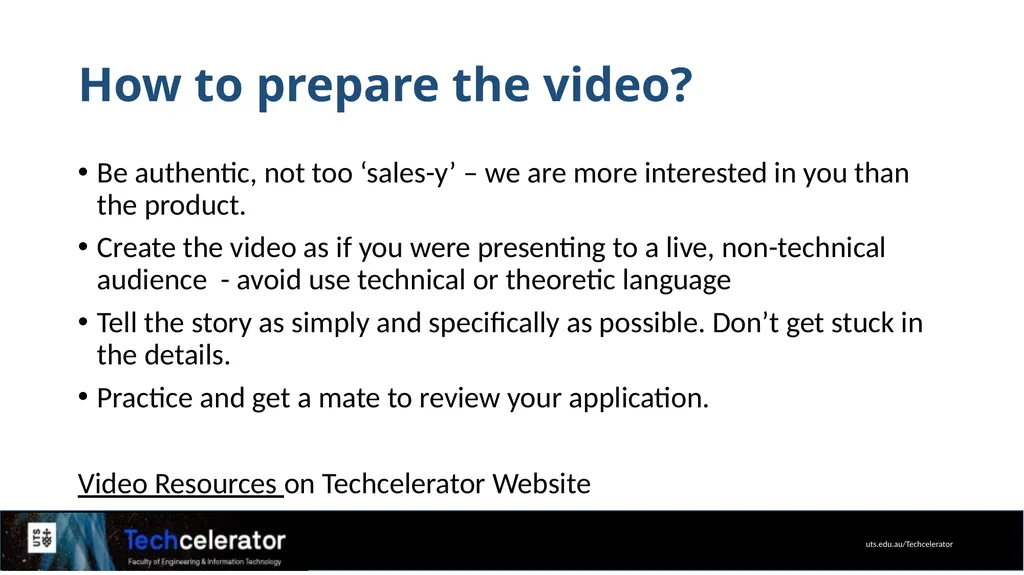
slide16. How to prepare the video? Be authentic, not too ‘sales-y’ – we are more interested in you than the product.
Create the video as if you were presenting to a live, non-technical audience - avoid use technical or theoretic language
Tell the story as simply and specifically as possible. Don’t get stuck in the details.
Practice and get a mate to review your application.
Video Resources on Techcelerator Website<br>
Director, Techcelerator
Faculty of Engineering and IT<br>
slide2. Questions ? FAQ on the Techcelerator website
Send your questions to Jessica Gu via chat during the Information Session – any questions we can’t answer now, we will follow up through email.
Techcelerator@uts.edu.au<br>
slide3. Program Overview uts.edu.au/Techcelerator Customer Validation Value Proposition
Stakeholder Engagement IP
Management Prototype Planning Your Journey Pitching & Demonstrating Persuasively Monthly Plan Milestones Tasks Budget Demo a Working Prototype Continuous Focus on Leadership and Team Development Monthly Advisory Meetings with Mentors & Community Meetings Project Team<br>
slide4. What is Deep Technology? Deep tech is the innovative design, deployment, use or development of technologies from a variety of engineering and information technology disciplines such as, but not limited to, these domains…<br>
slide5. What do participants get? The program offers students the opportunity to improve their prototyping and customer validation skills.
All Techcelerator program activities are free to students and do not take any equity from their project. Up to $10,000 in funding for each project Guidance from expert staff, industry leaders and startup founders Access to UTS facilities for prototyping<br>
slide6. How to apply? Techcelerator Website
Application Support Documents
Project eligibility
Frequently asked questions
Selection criteria
Checklist for success
Mistakes to avoid
Video resources
Submit the Application Form
Application close date: 31 July 2023<br>
slide7. EOI closes 31 July 2023 Expressions of Interest Techcelerator 2023 Program Timeline Jun Jul Jul Aug Aug Sep Sep Oct Oct Nov Nov Dec 14 Aug 2022 Induction Sep 2032 First Advisory Board meeting Aug – Dec 2023 Continued validating & prototyping Oct 2023 Second Advisory Board meeting 1 Dec 2023 Demonstration Day 29 Jul 2022 Announcement of selected teams Nov 2023 Third Advisory Board meeting Information Session on web<br>
slide8. Selection Criteria – Essential Component<br>
slide9. Essential Component - Desirability 1. What is the problem?
Does your solution solve the problem?
Is there solution already in the market? Unique value proposition?
2. Who is your customer?
What value can this solution bring to the customer?
Is it cost-benefit to the customer?<br>
slide10. Essential Component – Desirability 3. Is the Market attractive?
Industry growth potential
Size of the market
Entry barriers/risks
Competitive analysis
Competitors (numbers? Strength?)
Alternative products/service
The unique features of your proposal
Competitive advantage<br>
slide11. Checklist Take time to conduct desk research
Talk with potential customers or conducts simple surveys (demonstrate the need)
Make sure you are proposing something unique and not replicating a solution
Conduct a quick competitive analysis
Emphasise customer validation activities in you project plan<br>
slide12. Essential Component - Feasibility Is it an original deployment of deep tech?
Does it leverage UTS facilities/research?
Do you own the IP? Are you respecting the IP of others?
Is this feasible in a 4 month period?
Do you have an appropriate and well-estimated milestones, tasks and budget? How this funds takes you to the next stage of commercialisation?<br>
slide13. Checklist Draft your project plan and budget
Conduct an IP search<br>
slide14. Essential Component - Viability Do you have the right business model?
Have I considered & chosen the appropriate channel(s)?
Have I identified the key metrics I will use for measuring performance?
Do you have the right market alliances or partners?
Have I identified my first customer(s)or early adopters?
What partnerships or market alliances will enhance my business goals?
Do you have the right team?
Are my mindsets, skills & experience aligned with this solution?
Can I/we demonstrate our unfair advantage?
How can I demonstrate my passion for the problem and the customer?<br>
slide15. Checklist Conduct the desk research to identify the profile of your first customer or early adopters
Read the article about market alliances/partnerships so that you could answer a question about which partners are aligned to your solution alliances
Identify the business model and revenue model that makes sense at this point in the ideation process
Identify what makes you/your team special—your unfair advantage<br>
slide16. How to prepare the video? Be authentic, not too ‘sales-y’ – we are more interested in you than the product.
Create the video as if you were presenting to a live, non-technical audience - avoid use technical or theoretic language
Tell the story as simply and specifically as possible. Don’t get stuck in the details.
Practice and get a mate to review your application.
Video Resources on Techcelerator Website<br>