
Program Title Air Force Review Board (AFRB) Date
Description: Program Title Air Force Review Board (AFRB) Date Rank, Name Office Symbol Date Milestone B Template See Notes Pages for additional information CLASSIFICATIONFOR OFFICIAL USE ONLYPre-DecisionalAFRB (or DAB) Support CLASSIFICATIONFOR
Related Topics
Download Presentation
"Program Title Air Force Review Board (AFRB) Date" is the property of its rightful owner. Permission is granted to download and print the materials on this website for personal, non-commercial use only, and to display it on your personal computer provided you do not modify the materials and that you retain all copyright notices contained in the materials. By downloading content from our website, you accept the terms of this agreement.
Presentation Transcript
slide1. Program Title
Air Force Review Board (AFRB) Date Rank, Name
Office Symbol
Date Milestone B Template See Notes Pages
for additional
information CLASSIFICATION/FOR OFFICIAL USE ONLY/Pre-Decisional/AFRB (or DAB) Support CLASSIFICATION/FOR OFFICIAL USE ONLY/Pre-Decisional/AFRB (or DAB) Support This template is for guidance only
and is not mandatory.
Examples are for illustrative purposed only<br>
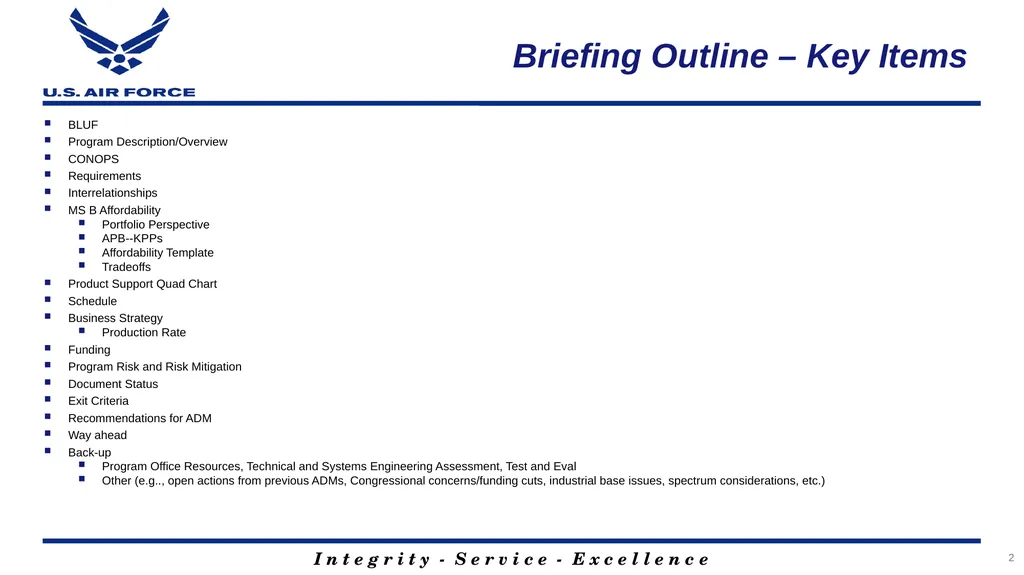
slide2. Briefing Outline – Key Items BLUF
Program Description/Overview
CONOPS
Requirements
Interrelationships
MS B Affordability
Portfolio Perspective
APB--KPPs
Affordability Template
Tradeoffs
Product Support Quad Chart
Schedule
Business Strategy
Production Rate
Funding
Program Risk and Risk Mitigation
Document Status
Exit Criteria
Recommendations for ADM
Way ahead
Back-up
Program Office Resources, Technical and Systems Engineering Assessment, Test and Eval
Other (e.g.., open actions from previous ADMs, Congressional concerns/funding cuts, industrial base issues, spectrum considerations, etc.) 2<br>
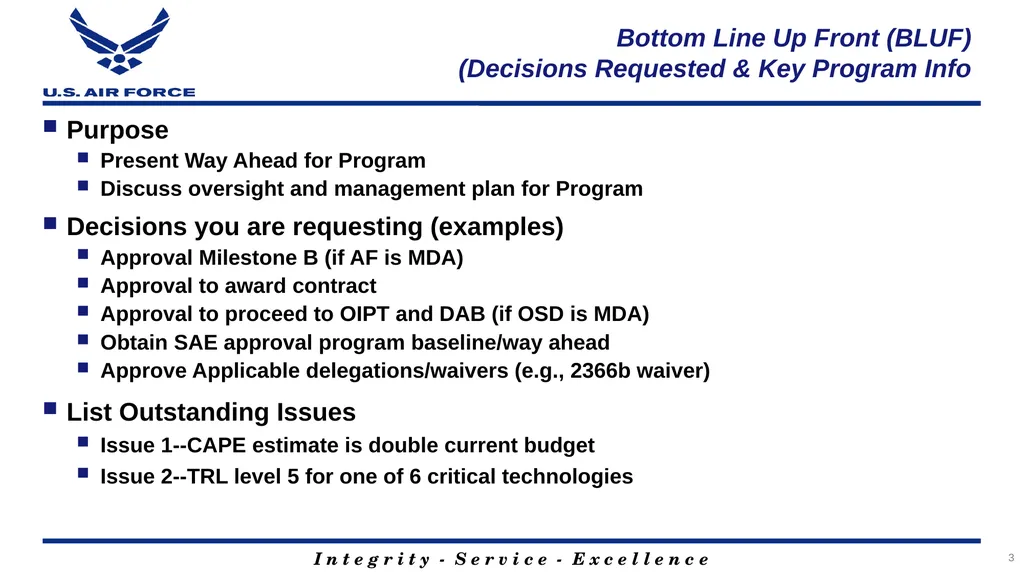
slide3. Bottom Line Up Front (BLUF) (Decisions Requested & Key Program Info Purpose
Present Way Ahead for Program
Discuss oversight and management plan for Program
Decisions you are requesting (examples)
Approval Milestone B (if AF is MDA)
Approval to award contract
Approval to proceed to OIPT and DAB (if OSD is MDA)
Obtain SAE approval program baseline/way ahead
Approve Applicable delegations/waivers (e.g., 2366b waiver)
List Outstanding Issues
Issue 1--CAPE estimate is double current budget
Issue 2--TRL level 5 for one of 6 critical technologies 3<br>
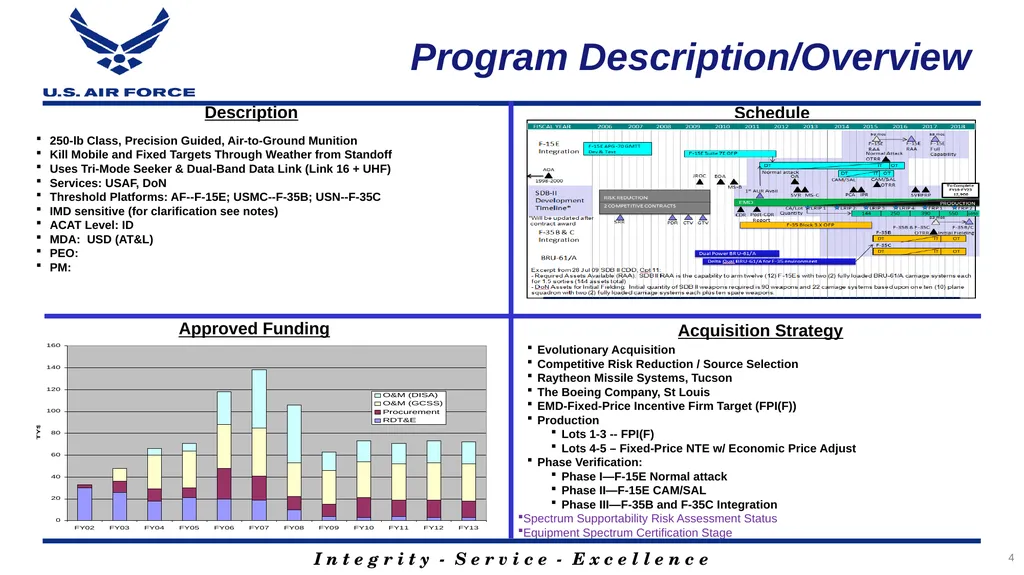
slide4. Description Acquisition Strategy Evolutionary Acquisition
Competitive Risk Reduction / Source Selection
Raytheon Missile Systems, Tucson
The Boeing Company, St Louis
EMD-Fixed-Price Incentive Firm Target (FPI(F))
Production
Lots 1-3 -- FPI(F)
Lots 4-5 – Fixed-Price NTE w/ Economic Price Adjust
Phase Verification:
Phase I—F-15E Normal attack
Phase II—F-15E CAM/SAL
Phase III—F-35B and F-35C Integration
Spectrum Supportability Risk Assessment Status
Equipment Spectrum Certification Stage 250-lb Class, Precision Guided, Air-to-Ground Munition
Kill Mobile and Fixed Targets Through Weather from Standoff
Uses Tri-Mode Seeker & Dual-Band Data Link (Link 16 + UHF)
Services: USAF, DoN
Threshold Platforms: AF--F-15E; USMC--F-35B; USN--F-35C
IMD sensitive (for clarification see notes)
ACAT Level: ID
MDA: USD (AT&L)
PEO:
PM: Schedule Approved Funding Program Description/Overview 4<br>
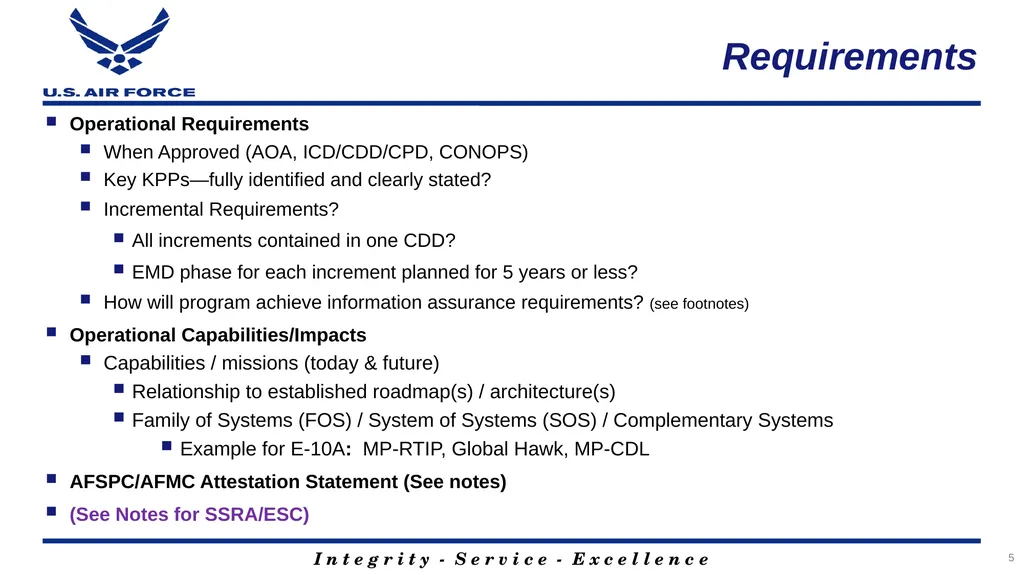
slide5. Requirements Operational Requirements
When Approved (AOA, ICD/CDD/CPD, CONOPS)
Key KPPs—fully identified and clearly stated?
Incremental Requirements?
All increments contained in one CDD?
EMD phase for each increment planned for 5 years or less?
How will program achieve information assurance requirements? (see footnotes)
Operational Capabilities/Impacts
Capabilities / missions (today & future)
Relationship to established roadmap(s) / architecture(s)
Family of Systems (FOS) / System of Systems (SOS) / Complementary Systems
Example for E-10A: MP-RTIP, Global Hawk, MP-CDL
AFSPC/AFMC Attestation Statement (See notes)
(See Notes for SSRA/ESC) 5<br>
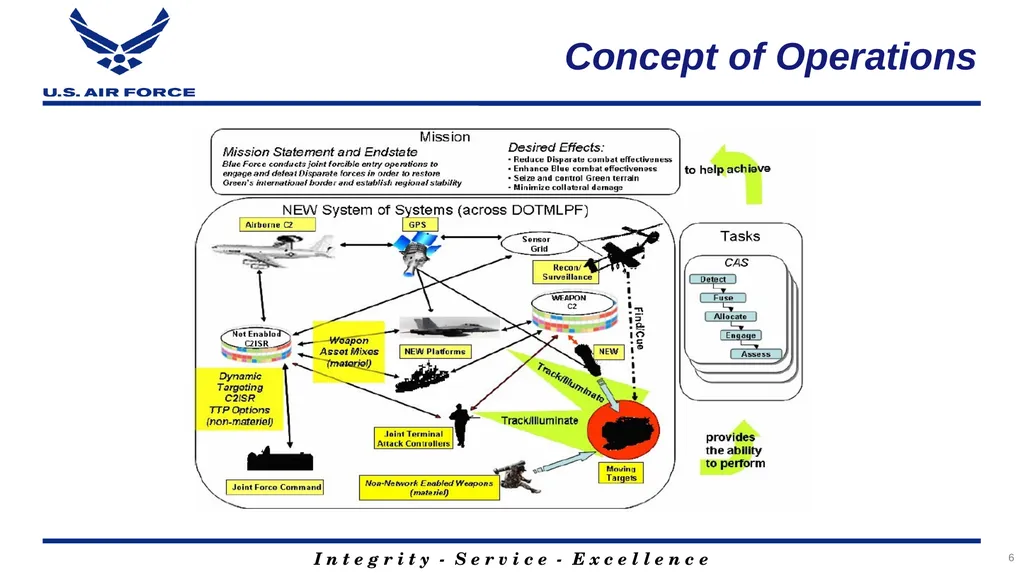
slide6. Concept of Operations 6<br>
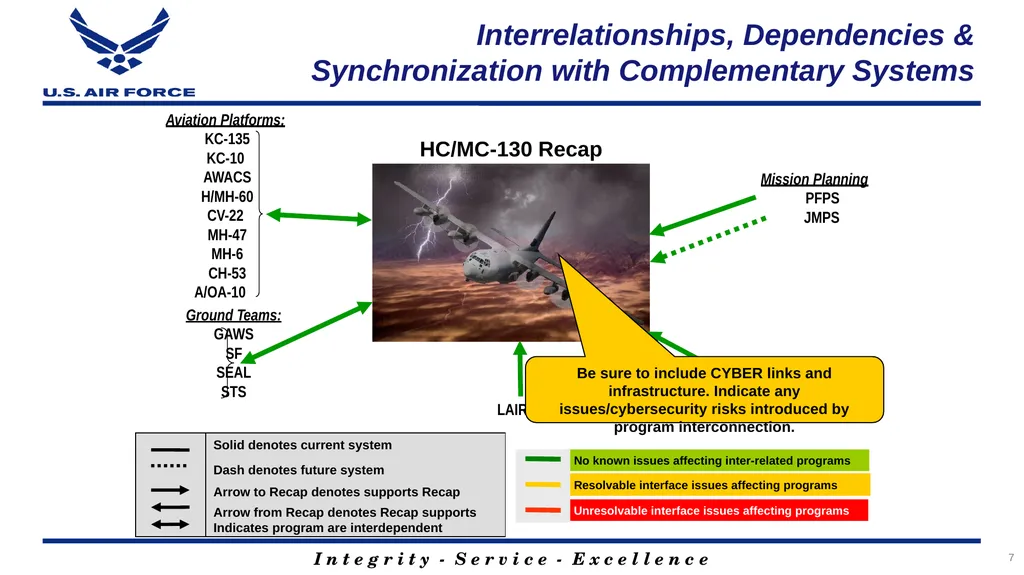
slide7. Interrelationships, Dependencies & Synchronization with Complementary Systems Mission Planning
PFPS
JMPS LAIRCM C-130J:
Aircraft Procurement
& Block Upgrades Be sure to include CYBER links and infrastructure. Indicate any issues/cybersecurity risks introduced by program interconnection. 7<br>
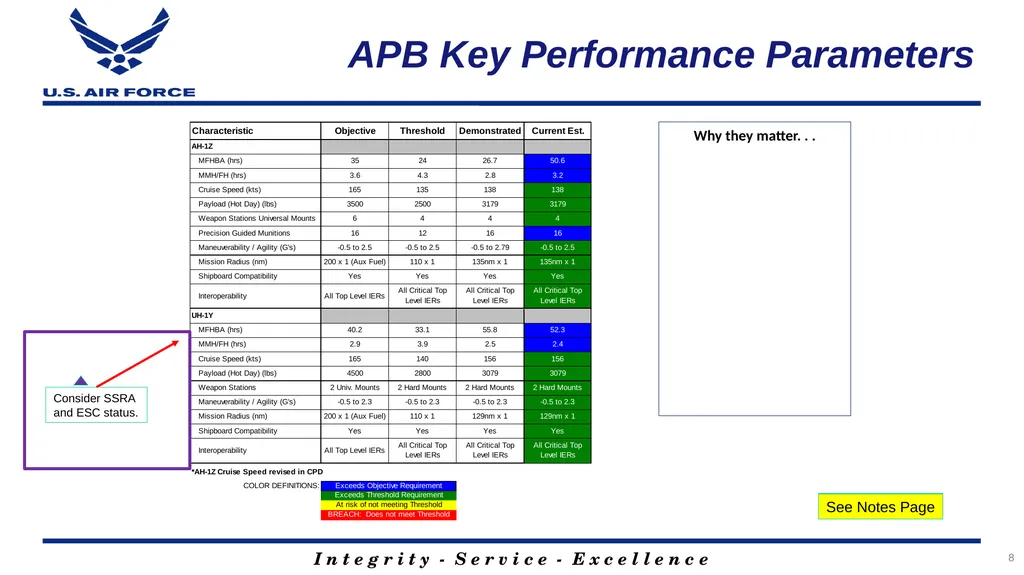
slide8. Why they matter. . . See Notes Page APB Key Performance Parameters 8<br>
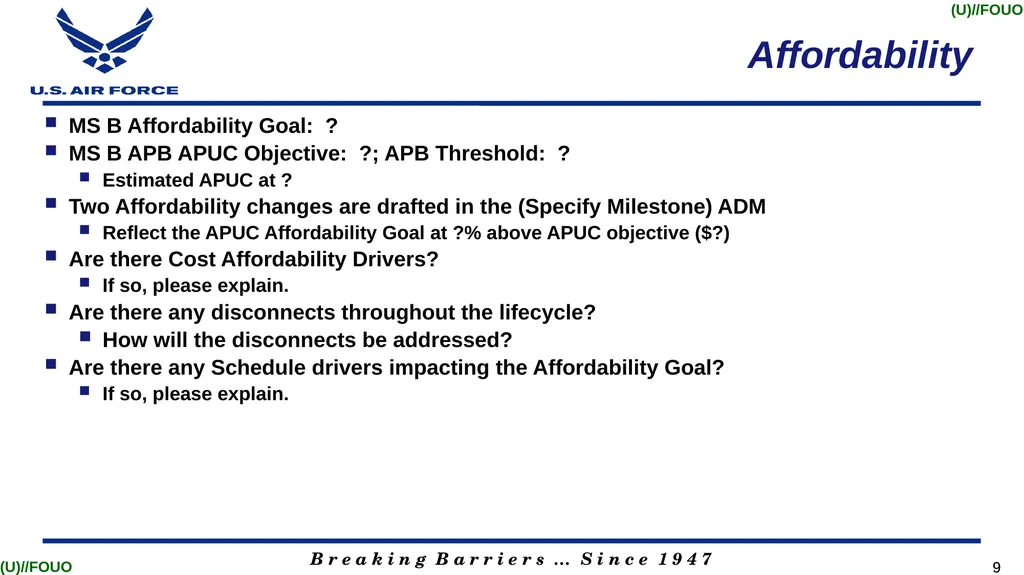
slide9. Affordability MS B Affordability Goal: ?
MS B APB APUC Objective: ?; APB Threshold: ?
Estimated APUC at ?
Two Affordability changes are drafted in the (Specify Milestone) ADM
Reflect the APUC Affordability Goal at ?% above APUC objective ($?)
Are there Cost Affordability Drivers?
If so, please explain.
Are there any disconnects throughout the lifecycle?
How will the disconnects be addressed?
Are there any Schedule drivers impacting the Affordability Goal?
If so, please explain.<br>
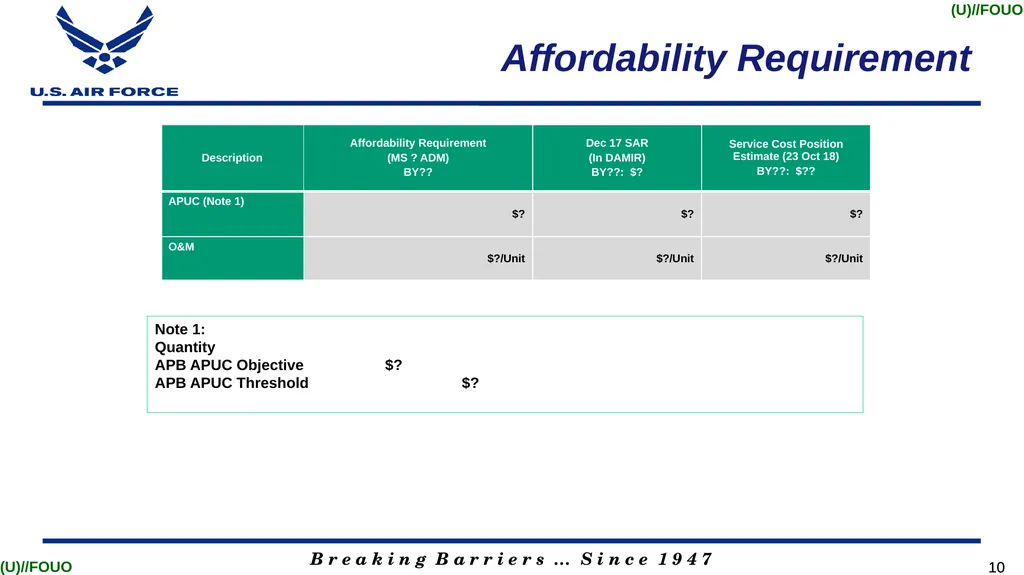
slide10. Affordability Requirement Note 1:
Quantity
APB APUC Objective $?
APB APUC Threshold $?<br>
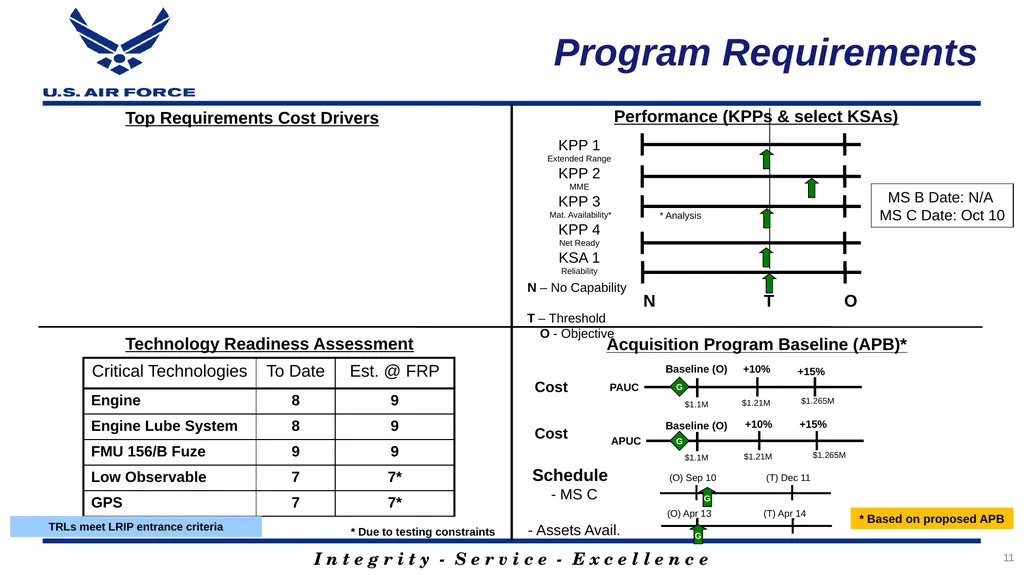
slide11. Top Requirements Cost Drivers Performance (KPPs & select KSAs) KPP 1
Extended Range
KPP 2
MME
KPP 3
Mat. Availability*
KPP 4
Net Ready
KSA 1
Reliability N T O Technology Readiness Assessment N – No Capability
T – Threshold
O - Objective MS B Date: N/A
MS C Date: Oct 10 Program Requirements * Analysis Acquisition Program Baseline (APB)* Schedule
- MS C
- Assets Avail. Cost PAUC +10% +15% $1.1M Baseline (O) $1.21M $1.265M (O) Sep 10 (T) Dec 11 (O) Apr 13 (T) Apr 14 G G * Based on proposed APB * Due to testing constraints Cost APUC +10% +15% $1.1M Baseline (O) $1.21M $1.265M G G TRLs meet LRIP entrance criteria 11<br>
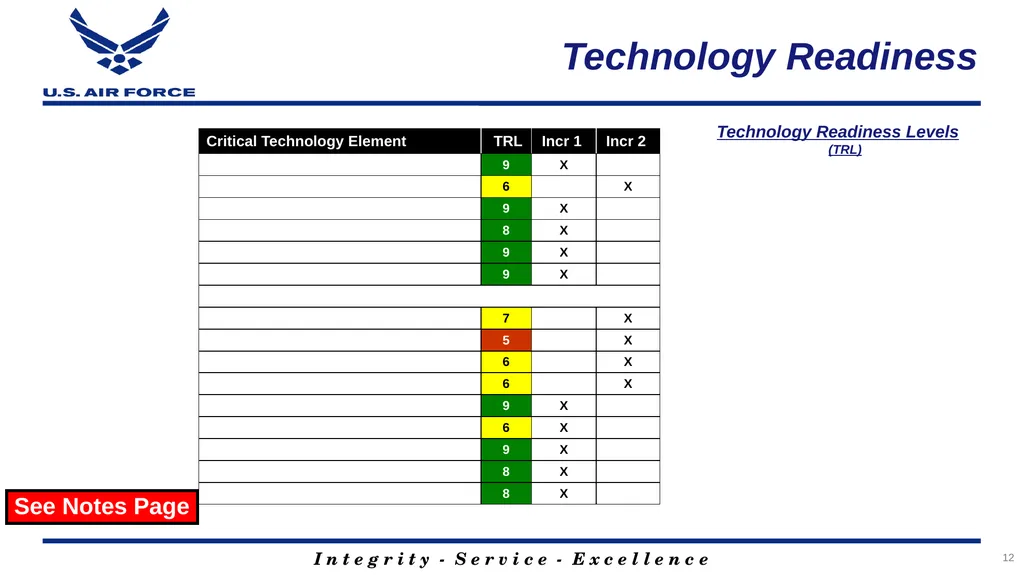
slide12. Technology Readiness Technology Readiness Levels (TRL) See Notes Page 12<br>
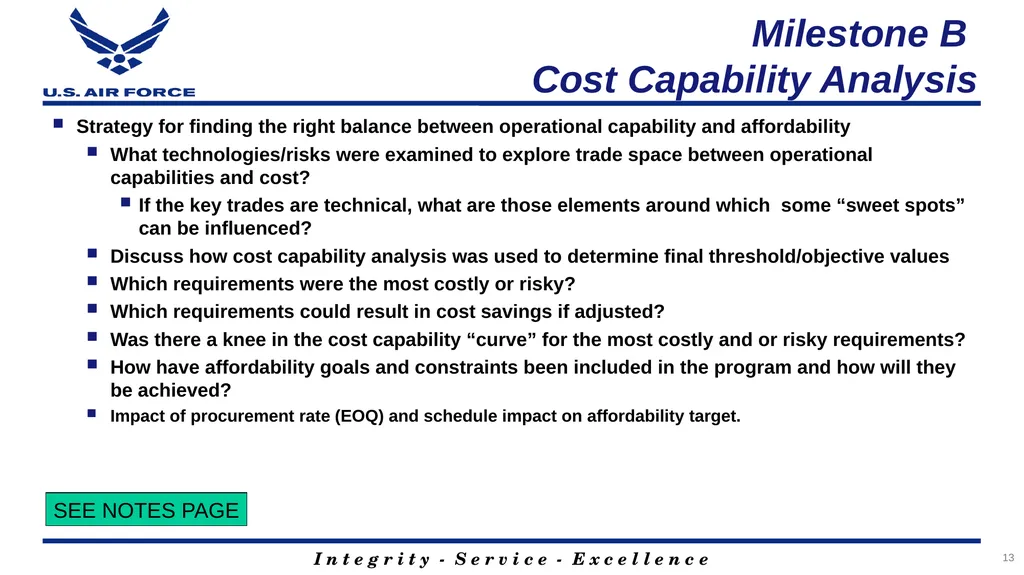
slide13. Milestone B Cost Capability Analysis Strategy for finding the right balance between operational capability and affordability
What technologies/risks were examined to explore trade space between operational capabilities and cost?
If the key trades are technical, what are those elements around which some “sweet spots” can be influenced?
Discuss how cost capability analysis was used to determine final threshold/objective values
Which requirements were the most costly or risky?
Which requirements could result in cost savings if adjusted?
Was there a knee in the cost capability “curve” for the most costly and or risky requirements?
How have affordability goals and constraints been included in the program and how will they be achieved?
Impact of procurement rate (EOQ) and schedule impact on affordability target. SEE NOTES PAGE 13<br>
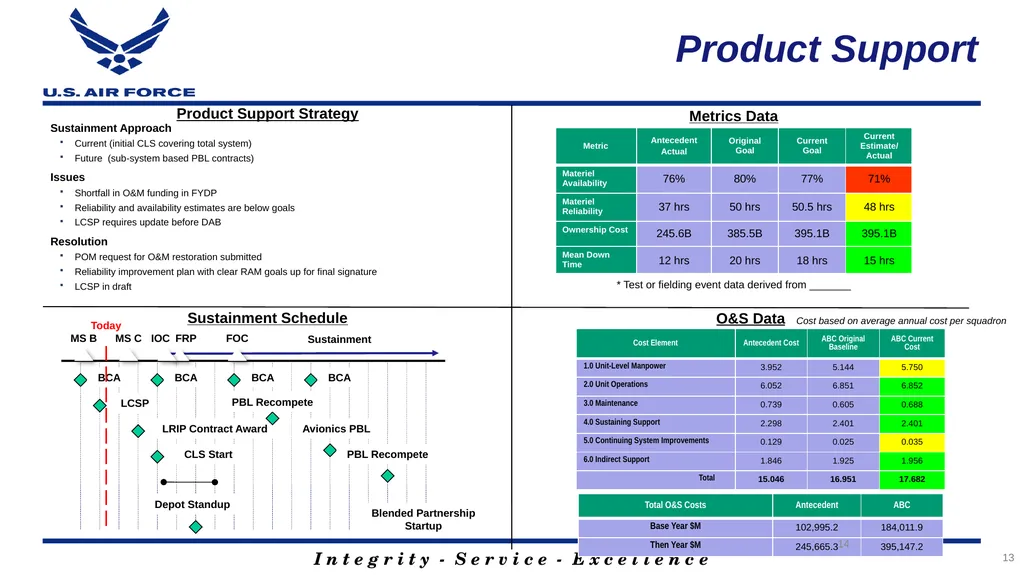
slide14. Product Support Strategy Metrics Data * Test or fielding event data derived from _______ Sustainment Schedule O&S Data MS B MS C IOC FRP FOC Sustainment BCA LCSP CLS Start Depot Standup LRIP Contract Award Blended Partnership Startup PBL Recompete Avionics PBL PBL Recompete Sustainment Approach
Current (initial CLS covering total system)
Future (sub-system based PBL contracts)
Issues
Shortfall in O&M funding in FYDP
Reliability and availability estimates are below goals
LCSP requires update before DAB
Resolution
POM request for O&M restoration submitted
Reliability improvement plan with clear RAM goals up for final signature
LCSP in draft BCA BCA BCA Cost based on average annual cost per squadron Today 14 Product Support 13<br>
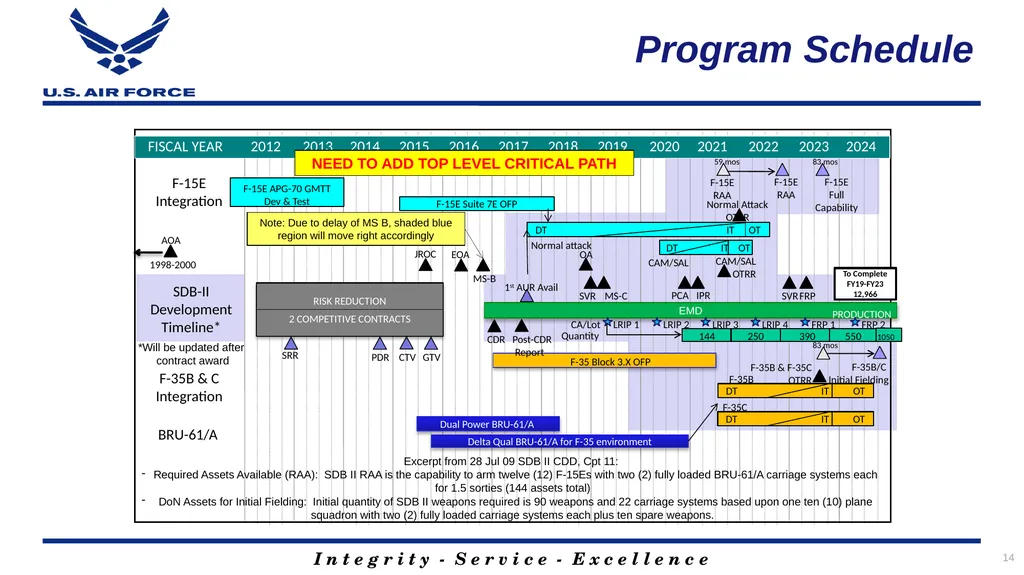
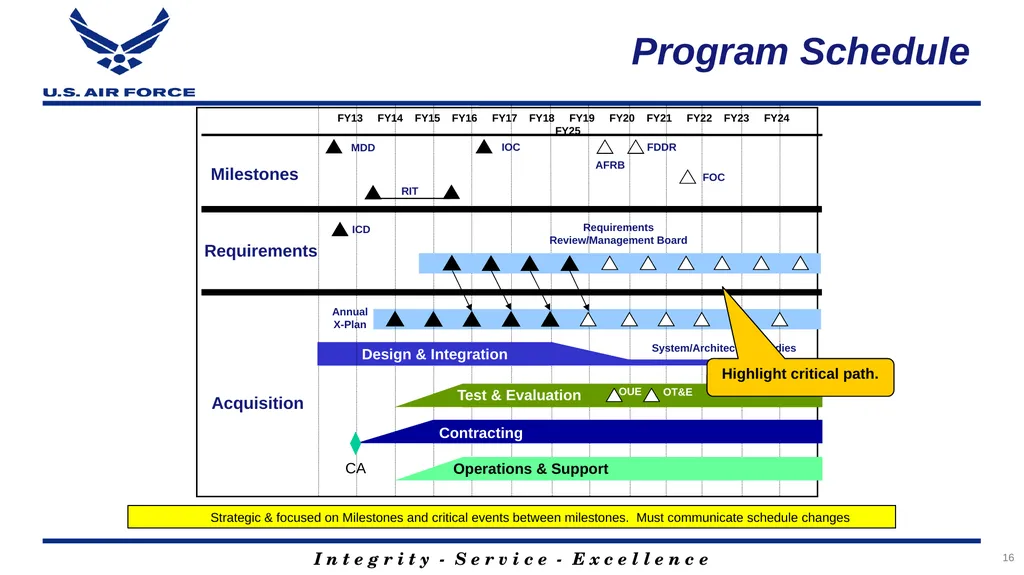
slide15. Program Schedule 14<br>
slide16. Program Schedule FY13 FY14 FY15 FY16 FY17 FY18 FY19 FY20 FY21 FY22 FY23 FY24 FY25 Requirements ICD Acquisition IOC RIT MDD Annual
X-Plan Milestones AFRB Requirements Review/Management Board FDDR Design & Integration System/Architecture Studies Contracting Operations & Support Test & Evaluation OUE OT&E FOC Strategic & focused on Milestones and critical events between milestones. Must communicate schedule changes Highlight critical path. CA 16<br>
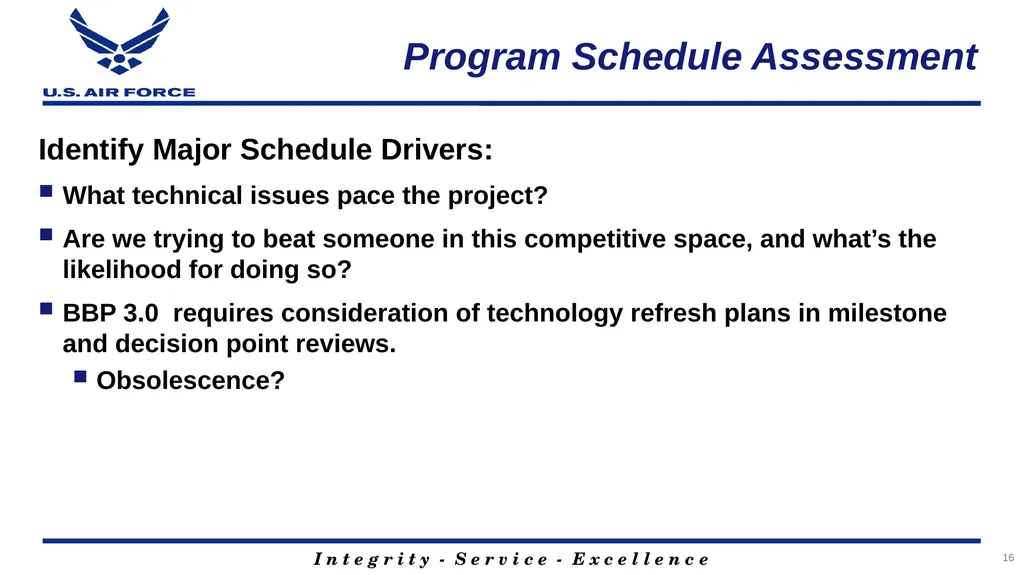
slide17. Program Schedule Assessment Identify Major Schedule Drivers:
What technical issues pace the project?
Are we trying to beat someone in this competitive space, and what’s the likelihood for doing so?
BBP 3.0 requires consideration of technology refresh plans in milestone and decision point reviews.
Obsolescence? 16<br>
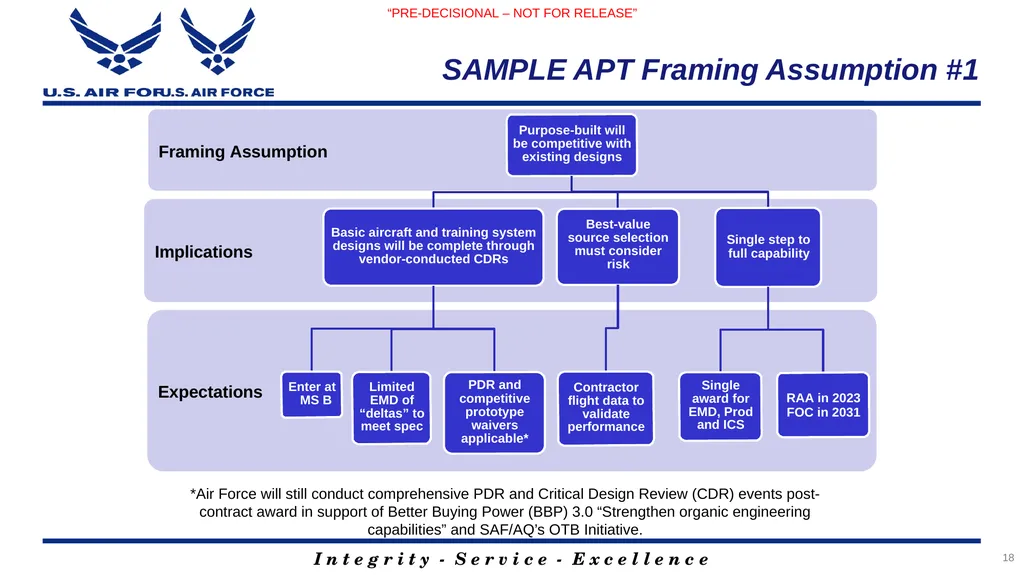
slide18. SAMPLE APT Framing Assumption #1 Expectations Implications Framing Assumption Purpose-built will be competitive with existing designs Basic aircraft and training system designs will be complete through vendor-conducted CDRs Enter at MS B Limited EMD of “deltas” to meet spec PDR and competitive prototype waivers applicable* Best-value source selection must consider risk Contractor flight data to validate performance Single step to full capability Single award for EMD, Prod and ICS RAA in 2023
FOC in 2031 *Air Force will still conduct comprehensive PDR and Critical Design Review (CDR) events post-contract award in support of Better Buying Power (BBP) 3.0 “Strengthen organic engineering capabilities” and SAF/AQ’s OTB Initiative. “PRE-DECISIONAL – NOT FOR RELEASE” 18<br>
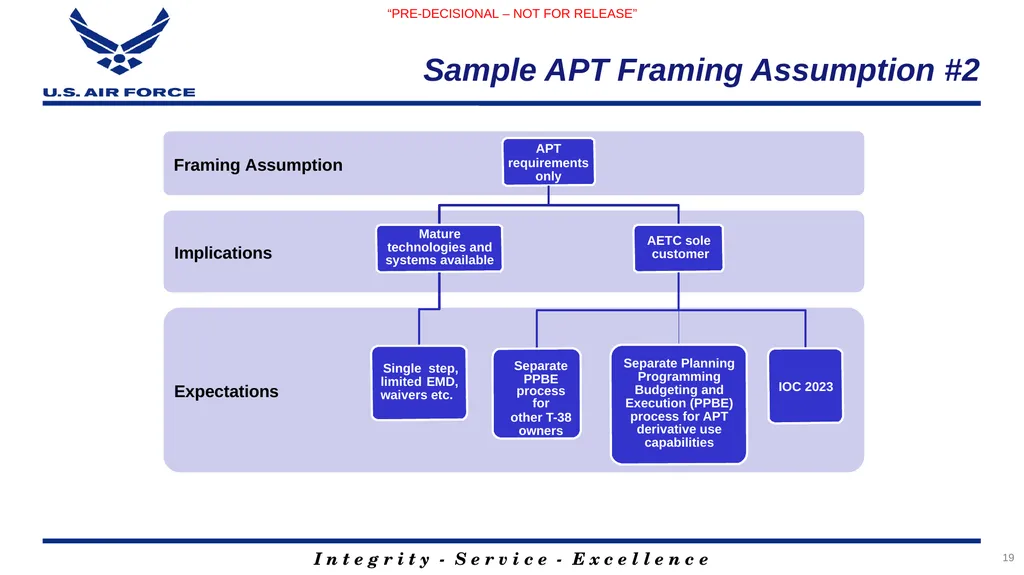
slide19. Sample APT Framing Assumption #2 Expectations Implications Framing Assumption APT
requirements only Mature technologies and systems available Single step, limited EMD, waivers etc. AETC sole customer Separate PPBE
process for
other T-38 owners Separate Planning Programming Budgeting and Execution (PPBE) process for APT derivative use capabilities IOC 2023 “PRE-DECISIONAL – NOT FOR RELEASE” 19<br>
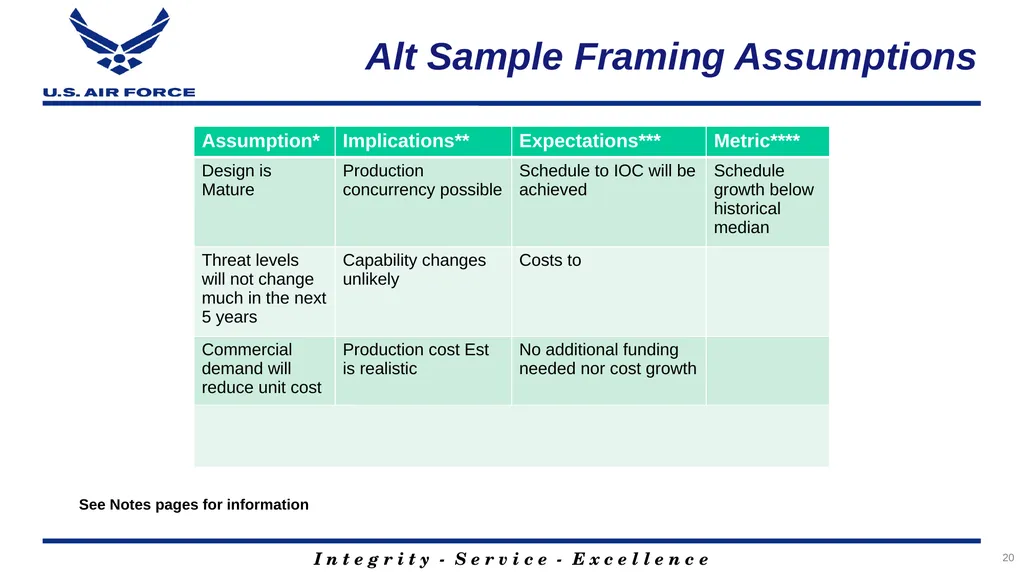
slide20. Alt Sample Framing Assumptions See Notes pages for information 20<br>
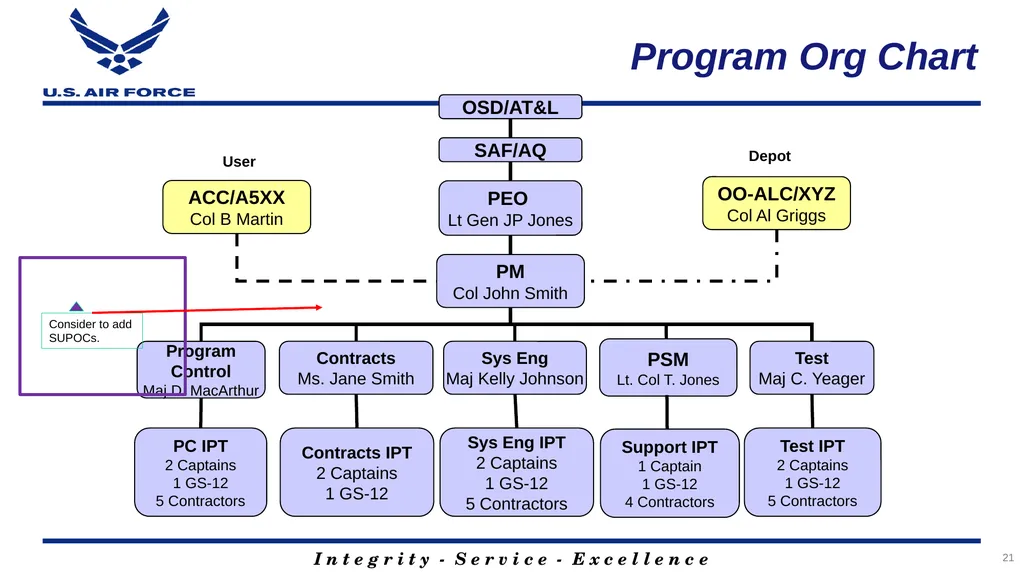
slide21. Program Org Chart 21 OSD/AT&L SAF/AQ PEO
Lt Gen JP Jones PM
Col John Smith Program
Control
Maj D. MacArthur Contracts
Ms. Jane Smith Sys Eng
Maj Kelly Johnson Test
Maj C. Yeager Test IPT
2 Captains
1 GS-12
5 Contractors PC IPT
2 Captains
1 GS-12
5 Contractors Contracts IPT
2 Captains
1 GS-12 Sys Eng IPT
2 Captains
1 GS-12
5 Contractors ACC/A5XX
Col B Martin OO-ALC/XYZ
Col Al Griggs User Depot PSM
Lt. Col T. Jones Support IPT
1 Captain
1 GS-12
4 Contractors<br>
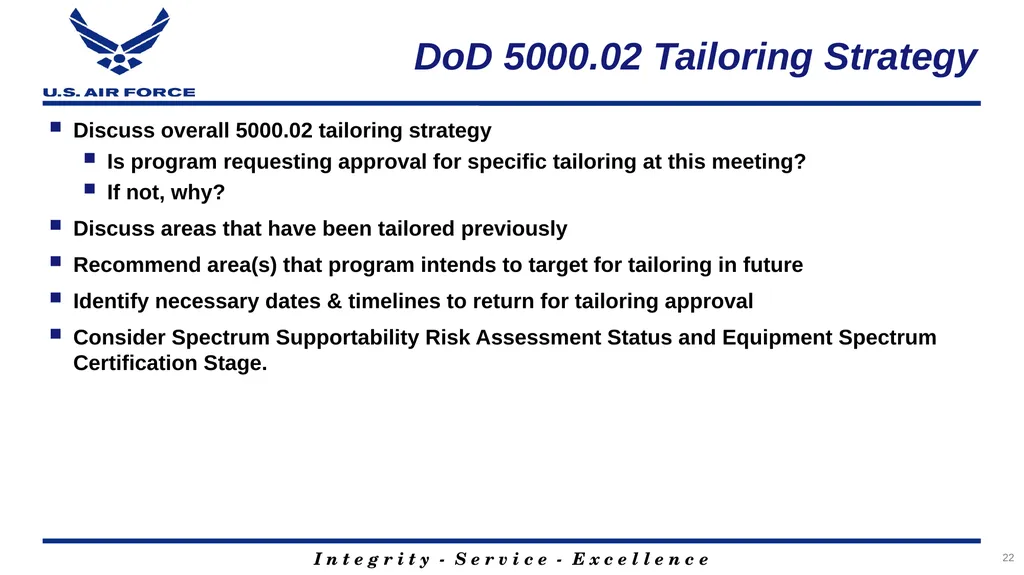
slide22. DoD 5000.02 Tailoring Strategy Discuss overall 5000.02 tailoring strategy
Is program requesting approval for specific tailoring at this meeting?
If not, why?
Discuss areas that have been tailored previously
Recommend area(s) that program intends to target for tailoring in future
Identify necessary dates & timelines to return for tailoring approval
Consider Spectrum Supportability Risk Assessment Status and Equipment Spectrum Certification Stage. 22<br>
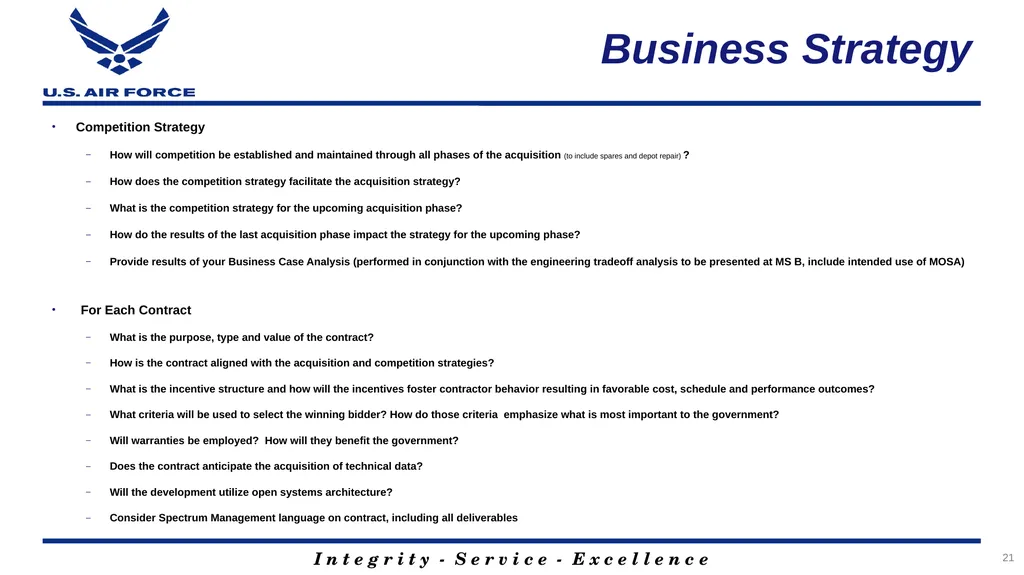
slide23. Business Strategy Competition Strategy
How will competition be established and maintained through all phases of the acquisition (to include spares and depot repair) ?
How does the competition strategy facilitate the acquisition strategy?
What is the competition strategy for the upcoming acquisition phase?
How do the results of the last acquisition phase impact the strategy for the upcoming phase?
Provide results of your Business Case Analysis (performed in conjunction with the engineering tradeoff analysis to be presented at MS B, include intended use of MOSA)
For Each Contract
What is the purpose, type and value of the contract?
How is the contract aligned with the acquisition and competition strategies?
What is the incentive structure and how will the incentives foster contractor behavior resulting in favorable cost, schedule and performance outcomes?
What criteria will be used to select the winning bidder? How do those criteria emphasize what is most important to the government?
Will warranties be employed? How will they benefit the government?
Does the contract anticipate the acquisition of technical data?
Will the development utilize open systems architecture?
Consider Spectrum Management language on contract, including all deliverables 21<br>
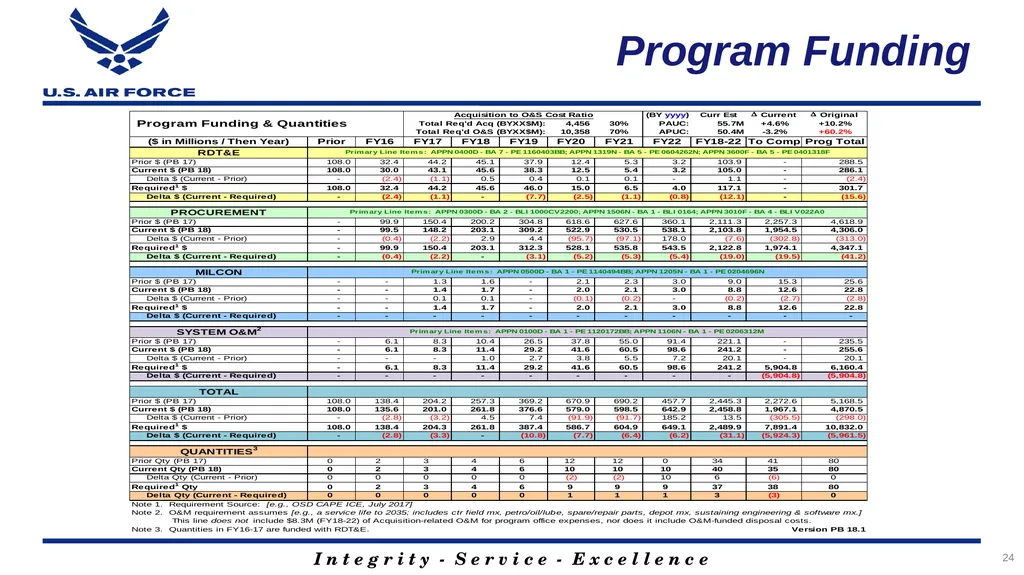
slide24. Program Funding 24<br>
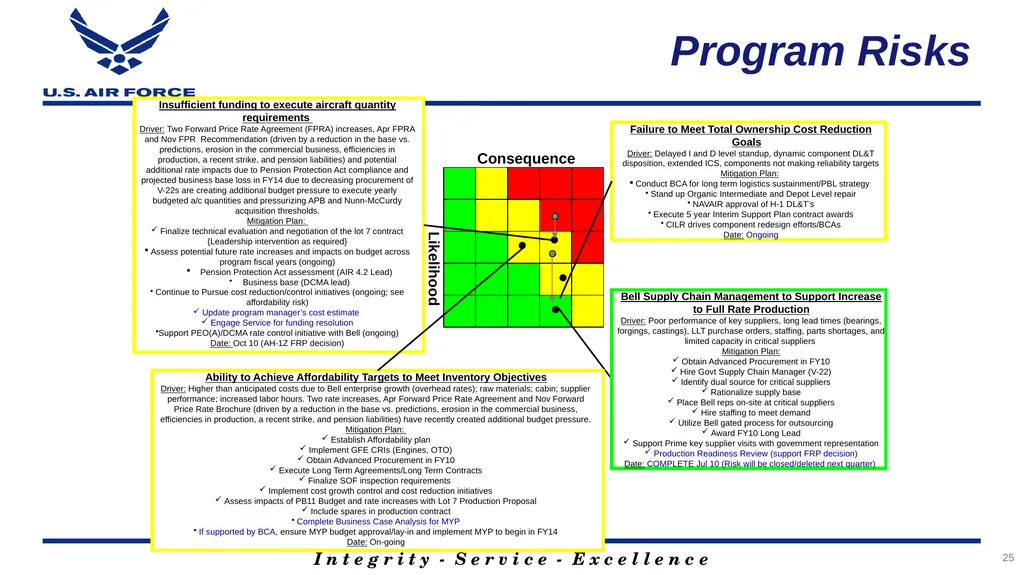
slide25. Program Risks 25<br>
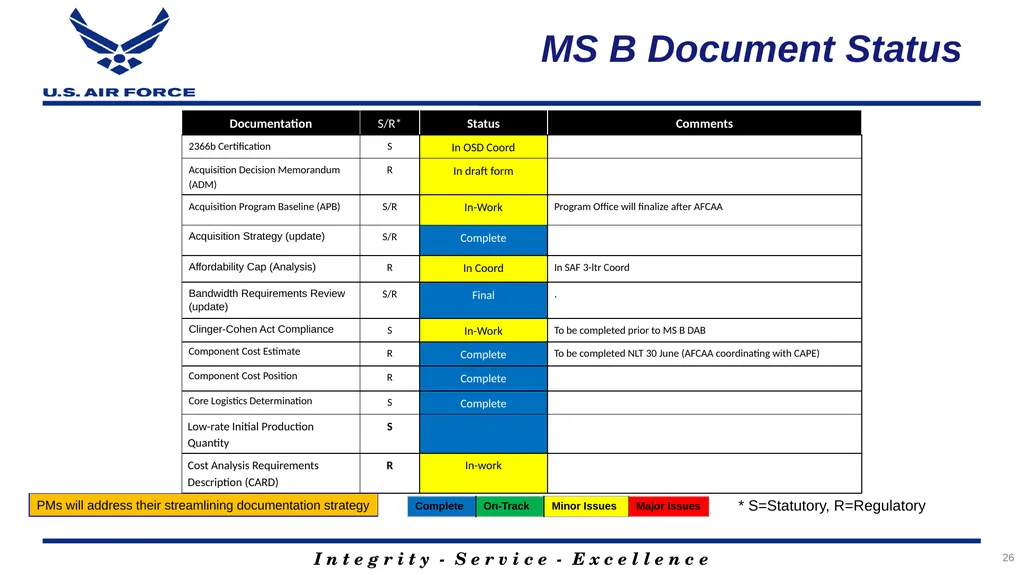
slide26. MS B Document Status * S=Statutory, R=Regulatory PMs will address their streamlining documentation strategy 26<br>
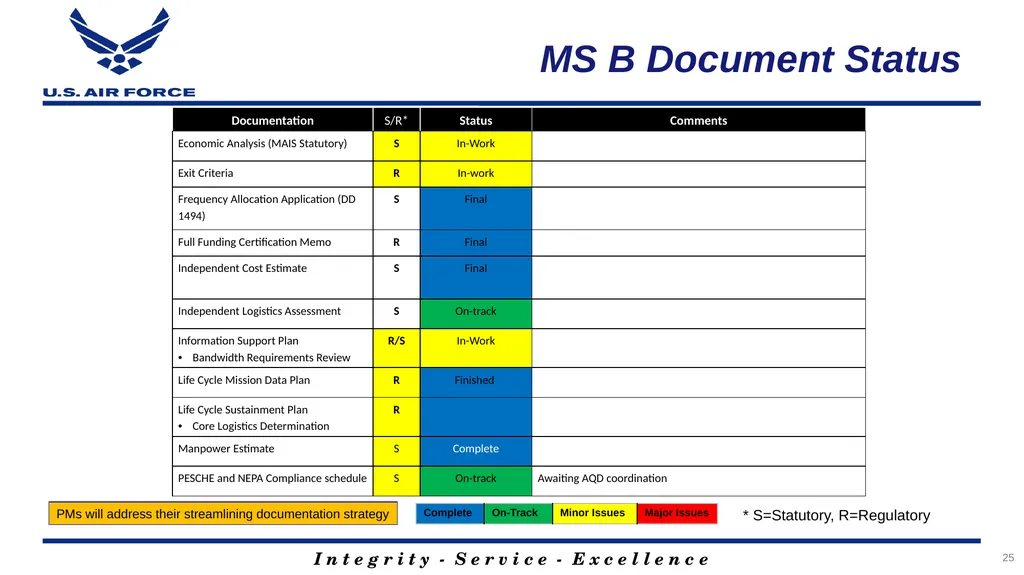
slide27. MS B Document Status * S=Statutory, R=Regulatory PMs will address their streamlining documentation strategy 25<br>
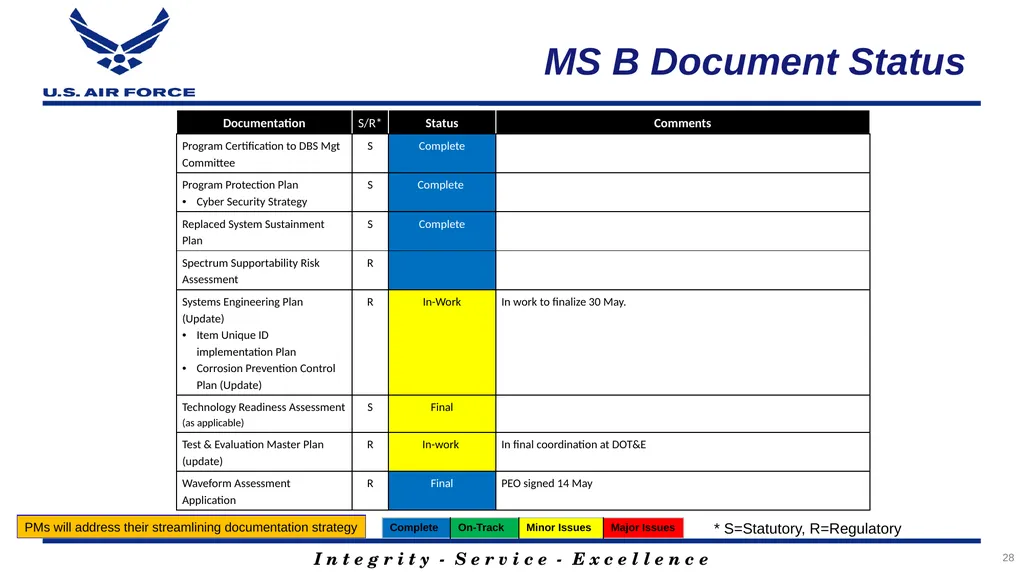
slide28. MS B Document Status * S=Statutory, R=Regulatory PMs will address their streamlining documentation strategy 28<br>
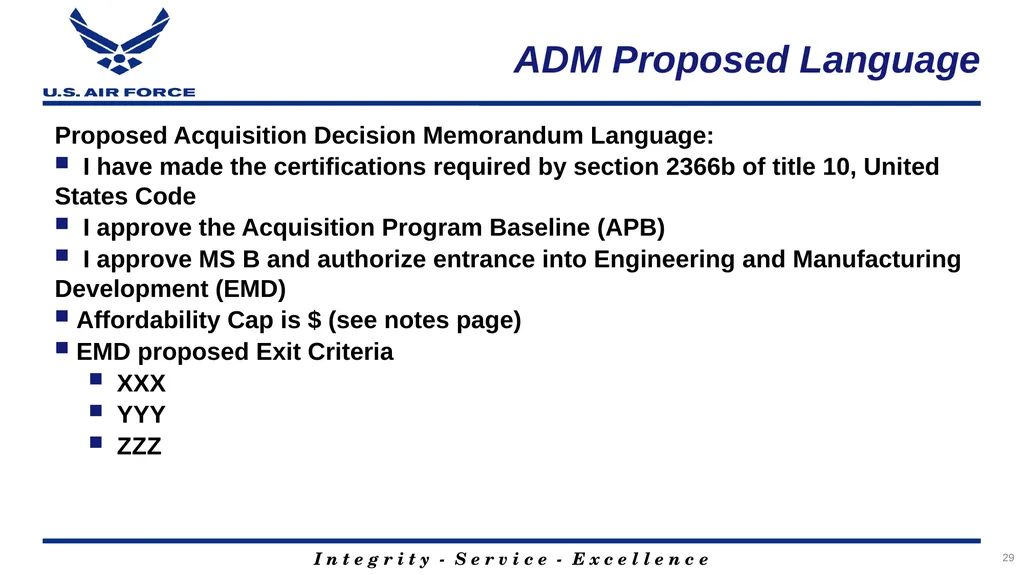
slide29. ADM Proposed Language Proposed Acquisition Decision Memorandum Language:
I have made the certifications required by section 2366b of title 10, United States Code
I approve the Acquisition Program Baseline (APB)
I approve MS B and authorize entrance into Engineering and Manufacturing Development (EMD)
Affordability Cap is $ (see notes page)
EMD proposed Exit Criteria
XXX
YYY
ZZZ 29<br>
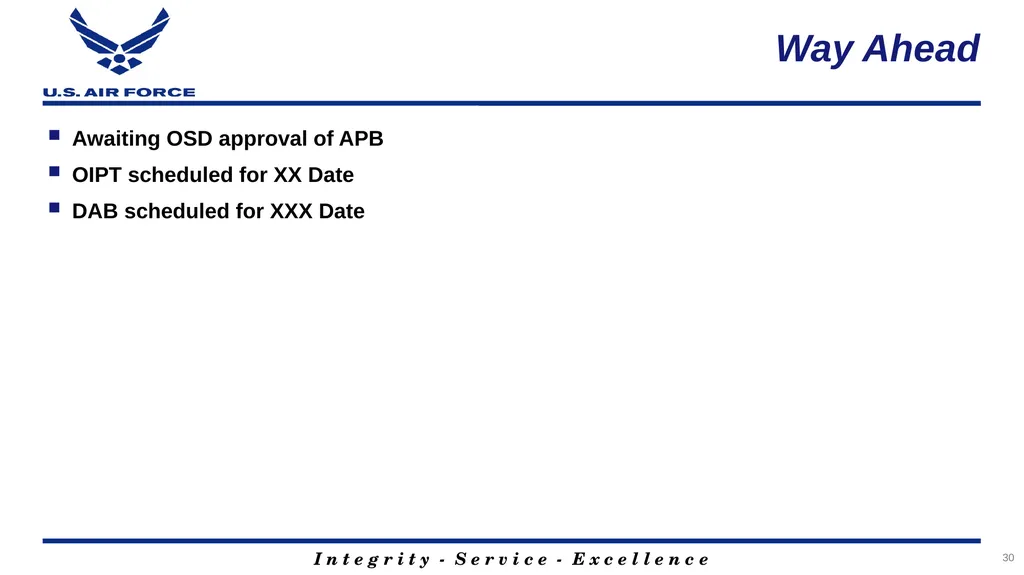
slide30. Way Ahead Awaiting OSD approval of APB
OIPT scheduled for XX Date
DAB scheduled for XXX Date 30<br>
slide31. BACKUP and SAMPLES See Footnotes for additional information 31<br>
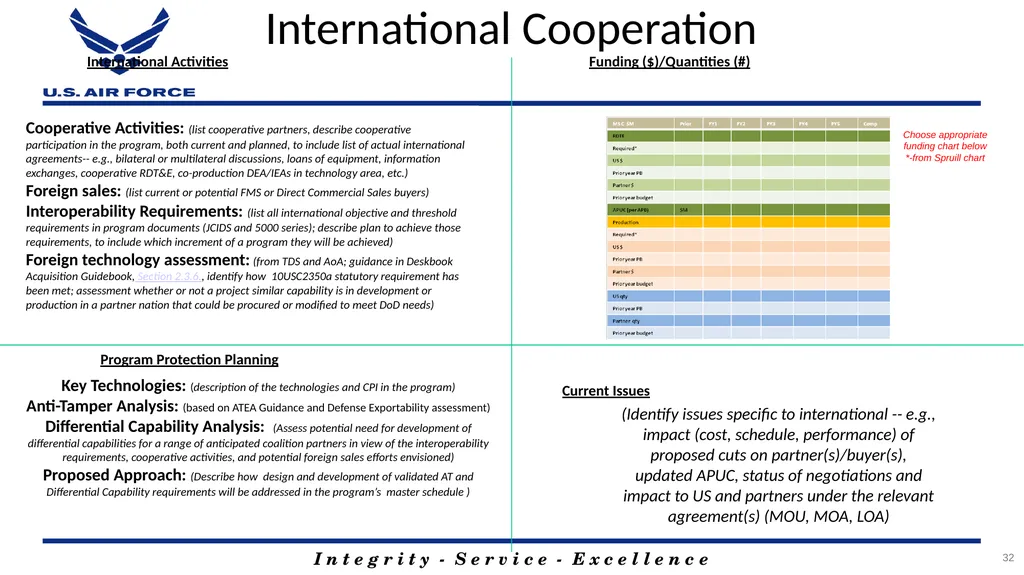
slide32. Cooperative Activities: (list cooperative partners, describe cooperative participation in the program, both current and planned, to include list of actual international agreements-- e.g., bilateral or multilateral discussions, loans of equipment, information exchanges, cooperative RDT&E, co-production DEA/IEAs in technology area, etc.)
Foreign sales: (list current or potential FMS or Direct Commercial Sales buyers)
Interoperability Requirements: (list all international objective and threshold requirements in program documents (JCIDS and 5000 series); describe plan to achieve those requirements, to include which increment of a program they will be achieved)
Foreign technology assessment: (from TDS and AoA; guidance in Deskbook Acquisition Guidebook, Section 2.3.6., identify how 10USC2350a statutory requirement has been met; assessment whether or not a project similar capability is in development or production in a partner nation that could be procured or modified to meet DoD needs) (Identify issues specific to international -- e.g., impact (cost, schedule, performance) of proposed cuts on partner(s)/buyer(s), updated APUC, status of negotiations and impact to US and partners under the relevant agreement(s) (MOU, MOA, LOA) Key Technologies: (description of the technologies and CPI in the program)
Anti-Tamper Analysis: (based on ATEA Guidance and Defense Exportability assessment)
Differential Capability Analysis: (Assess potential need for development of differential capabilities for a range of anticipated coalition partners in view of the interoperability requirements, cooperative activities, and potential foreign sales efforts envisioned)
Proposed Approach: (Describe how design and development of validated AT and Differential Capability requirements will be addressed in the program’s master schedule ) Choose appropriate funding chart below
*-from Spruill chart 32<br>
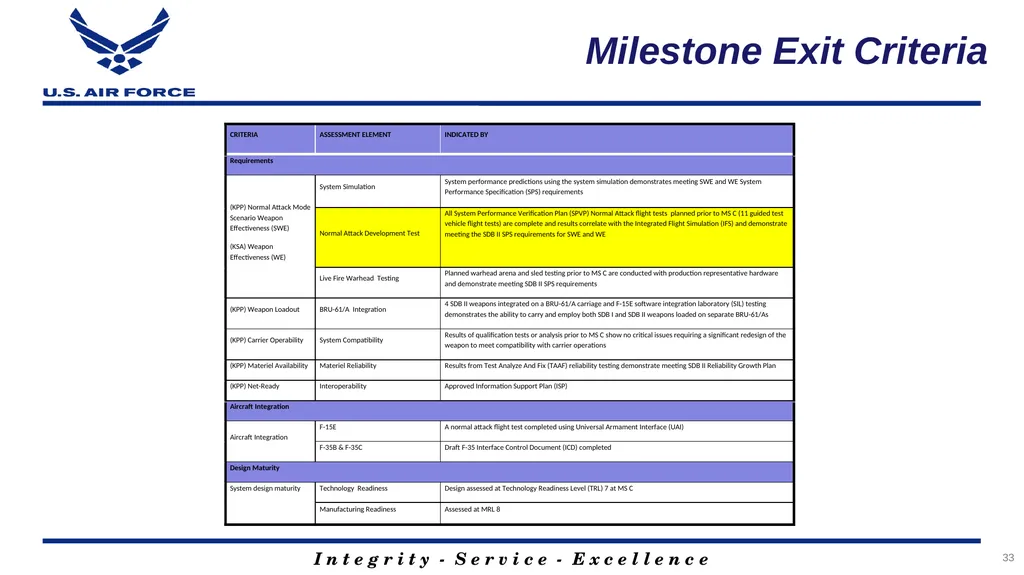
slide33. Milestone Exit Criteria 33<br>
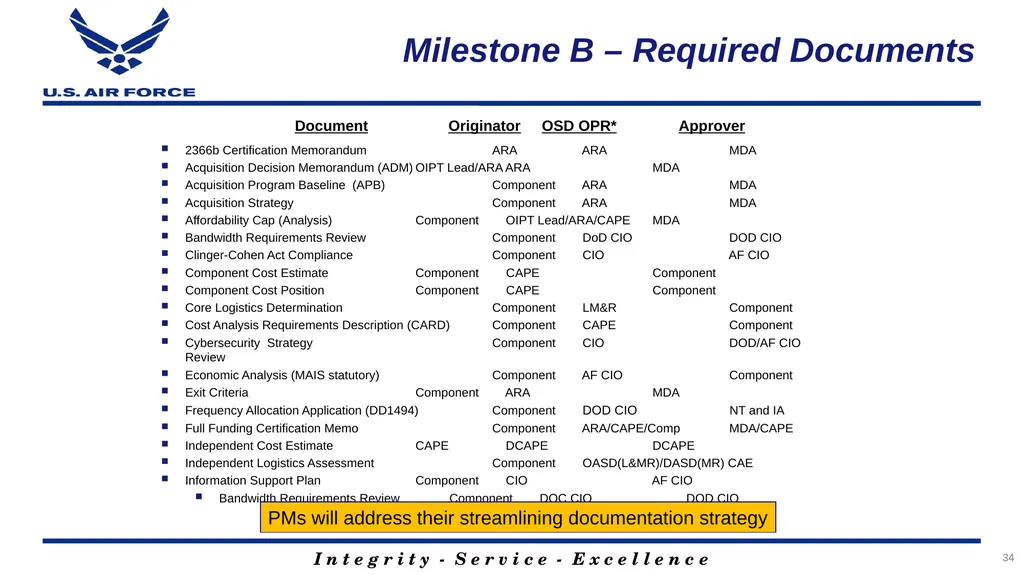
slide34. Milestone B – Required Documents 2366b Certification Memorandum ARA ARA MDA
Acquisition Decision Memorandum (ADM) OIPT Lead/ARA ARA MDA
Acquisition Program Baseline (APB) Component ARA MDA
Acquisition Strategy Component ARA MDA
Affordability Cap (Analysis) Component OIPT Lead/ARA/CAPE MDA
Bandwidth Requirements Review Component DoD CIO DOD CIO
Clinger-Cohen Act Compliance Component CIO AF CIO
Component Cost Estimate Component CAPE Component
Component Cost Position Component CAPE Component
Core Logistics Determination Component LM&R Component
Cost Analysis Requirements Description (CARD) Component CAPE Component
Cybersecurity Strategy Component CIO DOD/AF CIO Review
Economic Analysis (MAIS statutory) Component AF CIO Component
Exit Criteria Component ARA MDA
Frequency Allocation Application (DD1494) Component DOD CIO NT and IA
Full Funding Certification Memo Component ARA/CAPE/Comp MDA/CAPE
Independent Cost Estimate CAPE DCAPE DCAPE
Independent Logistics Assessment Component OASD(L&MR)/DASD(MR) CAE
Information Support Plan Component CIO AF CIO
Bandwidth Requirements Review Component DOC CIO DOD CIO Document Originator OSD OPR* Approver PMs will address their streamlining documentation strategy 34<br>
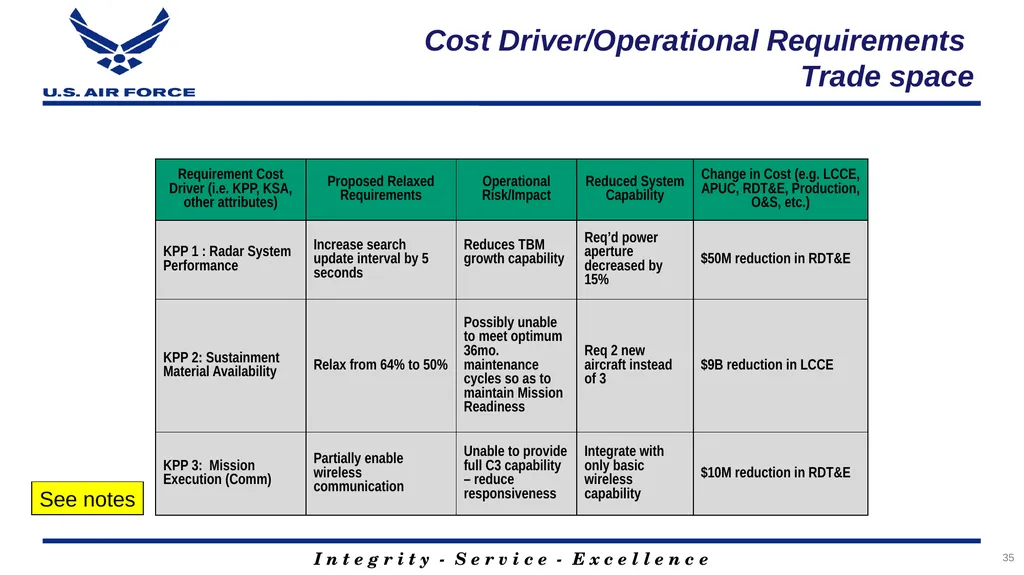
slide35. Cost Driver/Operational Requirements
Trade space See notes 35<br>
Air Force Review Board (AFRB) Date Rank, Name
Office Symbol
Date Milestone B Template See Notes Pages
for additional
information CLASSIFICATION/FOR OFFICIAL USE ONLY/Pre-Decisional/AFRB (or DAB) Support CLASSIFICATION/FOR OFFICIAL USE ONLY/Pre-Decisional/AFRB (or DAB) Support This template is for guidance only
and is not mandatory.
Examples are for illustrative purposed only<br>
slide2. Briefing Outline – Key Items BLUF
Program Description/Overview
CONOPS
Requirements
Interrelationships
MS B Affordability
Portfolio Perspective
APB--KPPs
Affordability Template
Tradeoffs
Product Support Quad Chart
Schedule
Business Strategy
Production Rate
Funding
Program Risk and Risk Mitigation
Document Status
Exit Criteria
Recommendations for ADM
Way ahead
Back-up
Program Office Resources, Technical and Systems Engineering Assessment, Test and Eval
Other (e.g.., open actions from previous ADMs, Congressional concerns/funding cuts, industrial base issues, spectrum considerations, etc.) 2<br>
slide3. Bottom Line Up Front (BLUF) (Decisions Requested & Key Program Info Purpose
Present Way Ahead for Program
Discuss oversight and management plan for Program
Decisions you are requesting (examples)
Approval Milestone B (if AF is MDA)
Approval to award contract
Approval to proceed to OIPT and DAB (if OSD is MDA)
Obtain SAE approval program baseline/way ahead
Approve Applicable delegations/waivers (e.g., 2366b waiver)
List Outstanding Issues
Issue 1--CAPE estimate is double current budget
Issue 2--TRL level 5 for one of 6 critical technologies 3<br>
slide4. Description Acquisition Strategy Evolutionary Acquisition
Competitive Risk Reduction / Source Selection
Raytheon Missile Systems, Tucson
The Boeing Company, St Louis
EMD-Fixed-Price Incentive Firm Target (FPI(F))
Production
Lots 1-3 -- FPI(F)
Lots 4-5 – Fixed-Price NTE w/ Economic Price Adjust
Phase Verification:
Phase I—F-15E Normal attack
Phase II—F-15E CAM/SAL
Phase III—F-35B and F-35C Integration
Spectrum Supportability Risk Assessment Status
Equipment Spectrum Certification Stage 250-lb Class, Precision Guided, Air-to-Ground Munition
Kill Mobile and Fixed Targets Through Weather from Standoff
Uses Tri-Mode Seeker & Dual-Band Data Link (Link 16 + UHF)
Services: USAF, DoN
Threshold Platforms: AF--F-15E; USMC--F-35B; USN--F-35C
IMD sensitive (for clarification see notes)
ACAT Level: ID
MDA: USD (AT&L)
PEO:
PM: Schedule Approved Funding Program Description/Overview 4<br>
slide5. Requirements Operational Requirements
When Approved (AOA, ICD/CDD/CPD, CONOPS)
Key KPPs—fully identified and clearly stated?
Incremental Requirements?
All increments contained in one CDD?
EMD phase for each increment planned for 5 years or less?
How will program achieve information assurance requirements? (see footnotes)
Operational Capabilities/Impacts
Capabilities / missions (today & future)
Relationship to established roadmap(s) / architecture(s)
Family of Systems (FOS) / System of Systems (SOS) / Complementary Systems
Example for E-10A: MP-RTIP, Global Hawk, MP-CDL
AFSPC/AFMC Attestation Statement (See notes)
(See Notes for SSRA/ESC) 5<br>
slide6. Concept of Operations 6<br>
slide7. Interrelationships, Dependencies & Synchronization with Complementary Systems Mission Planning
PFPS
JMPS LAIRCM C-130J:
Aircraft Procurement
& Block Upgrades Be sure to include CYBER links and infrastructure. Indicate any issues/cybersecurity risks introduced by program interconnection. 7<br>
slide8. Why they matter. . . See Notes Page APB Key Performance Parameters 8<br>
slide9. Affordability MS B Affordability Goal: ?
MS B APB APUC Objective: ?; APB Threshold: ?
Estimated APUC at ?
Two Affordability changes are drafted in the (Specify Milestone) ADM
Reflect the APUC Affordability Goal at ?% above APUC objective ($?)
Are there Cost Affordability Drivers?
If so, please explain.
Are there any disconnects throughout the lifecycle?
How will the disconnects be addressed?
Are there any Schedule drivers impacting the Affordability Goal?
If so, please explain.<br>
slide10. Affordability Requirement Note 1:
Quantity
APB APUC Objective $?
APB APUC Threshold $?<br>
slide11. Top Requirements Cost Drivers Performance (KPPs & select KSAs) KPP 1
Extended Range
KPP 2
MME
KPP 3
Mat. Availability*
KPP 4
Net Ready
KSA 1
Reliability N T O Technology Readiness Assessment N – No Capability
T – Threshold
O - Objective MS B Date: N/A
MS C Date: Oct 10 Program Requirements * Analysis Acquisition Program Baseline (APB)* Schedule
- MS C
- Assets Avail. Cost PAUC +10% +15% $1.1M Baseline (O) $1.21M $1.265M (O) Sep 10 (T) Dec 11 (O) Apr 13 (T) Apr 14 G G * Based on proposed APB * Due to testing constraints Cost APUC +10% +15% $1.1M Baseline (O) $1.21M $1.265M G G TRLs meet LRIP entrance criteria 11<br>
slide12. Technology Readiness Technology Readiness Levels (TRL) See Notes Page 12<br>
slide13. Milestone B Cost Capability Analysis Strategy for finding the right balance between operational capability and affordability
What technologies/risks were examined to explore trade space between operational capabilities and cost?
If the key trades are technical, what are those elements around which some “sweet spots” can be influenced?
Discuss how cost capability analysis was used to determine final threshold/objective values
Which requirements were the most costly or risky?
Which requirements could result in cost savings if adjusted?
Was there a knee in the cost capability “curve” for the most costly and or risky requirements?
How have affordability goals and constraints been included in the program and how will they be achieved?
Impact of procurement rate (EOQ) and schedule impact on affordability target. SEE NOTES PAGE 13<br>
slide14. Product Support Strategy Metrics Data * Test or fielding event data derived from _______ Sustainment Schedule O&S Data MS B MS C IOC FRP FOC Sustainment BCA LCSP CLS Start Depot Standup LRIP Contract Award Blended Partnership Startup PBL Recompete Avionics PBL PBL Recompete Sustainment Approach
Current (initial CLS covering total system)
Future (sub-system based PBL contracts)
Issues
Shortfall in O&M funding in FYDP
Reliability and availability estimates are below goals
LCSP requires update before DAB
Resolution
POM request for O&M restoration submitted
Reliability improvement plan with clear RAM goals up for final signature
LCSP in draft BCA BCA BCA Cost based on average annual cost per squadron Today 14 Product Support 13<br>
slide15. Program Schedule 14<br>
slide16. Program Schedule FY13 FY14 FY15 FY16 FY17 FY18 FY19 FY20 FY21 FY22 FY23 FY24 FY25 Requirements ICD Acquisition IOC RIT MDD Annual
X-Plan Milestones AFRB Requirements Review/Management Board FDDR Design & Integration System/Architecture Studies Contracting Operations & Support Test & Evaluation OUE OT&E FOC Strategic & focused on Milestones and critical events between milestones. Must communicate schedule changes Highlight critical path. CA 16<br>
slide17. Program Schedule Assessment Identify Major Schedule Drivers:
What technical issues pace the project?
Are we trying to beat someone in this competitive space, and what’s the likelihood for doing so?
BBP 3.0 requires consideration of technology refresh plans in milestone and decision point reviews.
Obsolescence? 16<br>
slide18. SAMPLE APT Framing Assumption #1 Expectations Implications Framing Assumption Purpose-built will be competitive with existing designs Basic aircraft and training system designs will be complete through vendor-conducted CDRs Enter at MS B Limited EMD of “deltas” to meet spec PDR and competitive prototype waivers applicable* Best-value source selection must consider risk Contractor flight data to validate performance Single step to full capability Single award for EMD, Prod and ICS RAA in 2023
FOC in 2031 *Air Force will still conduct comprehensive PDR and Critical Design Review (CDR) events post-contract award in support of Better Buying Power (BBP) 3.0 “Strengthen organic engineering capabilities” and SAF/AQ’s OTB Initiative. “PRE-DECISIONAL – NOT FOR RELEASE” 18<br>
slide19. Sample APT Framing Assumption #2 Expectations Implications Framing Assumption APT
requirements only Mature technologies and systems available Single step, limited EMD, waivers etc. AETC sole customer Separate PPBE
process for
other T-38 owners Separate Planning Programming Budgeting and Execution (PPBE) process for APT derivative use capabilities IOC 2023 “PRE-DECISIONAL – NOT FOR RELEASE” 19<br>
slide20. Alt Sample Framing Assumptions See Notes pages for information 20<br>
slide21. Program Org Chart 21 OSD/AT&L SAF/AQ PEO
Lt Gen JP Jones PM
Col John Smith Program
Control
Maj D. MacArthur Contracts
Ms. Jane Smith Sys Eng
Maj Kelly Johnson Test
Maj C. Yeager Test IPT
2 Captains
1 GS-12
5 Contractors PC IPT
2 Captains
1 GS-12
5 Contractors Contracts IPT
2 Captains
1 GS-12 Sys Eng IPT
2 Captains
1 GS-12
5 Contractors ACC/A5XX
Col B Martin OO-ALC/XYZ
Col Al Griggs User Depot PSM
Lt. Col T. Jones Support IPT
1 Captain
1 GS-12
4 Contractors<br>
slide22. DoD 5000.02 Tailoring Strategy Discuss overall 5000.02 tailoring strategy
Is program requesting approval for specific tailoring at this meeting?
If not, why?
Discuss areas that have been tailored previously
Recommend area(s) that program intends to target for tailoring in future
Identify necessary dates & timelines to return for tailoring approval
Consider Spectrum Supportability Risk Assessment Status and Equipment Spectrum Certification Stage. 22<br>
slide23. Business Strategy Competition Strategy
How will competition be established and maintained through all phases of the acquisition (to include spares and depot repair) ?
How does the competition strategy facilitate the acquisition strategy?
What is the competition strategy for the upcoming acquisition phase?
How do the results of the last acquisition phase impact the strategy for the upcoming phase?
Provide results of your Business Case Analysis (performed in conjunction with the engineering tradeoff analysis to be presented at MS B, include intended use of MOSA)
For Each Contract
What is the purpose, type and value of the contract?
How is the contract aligned with the acquisition and competition strategies?
What is the incentive structure and how will the incentives foster contractor behavior resulting in favorable cost, schedule and performance outcomes?
What criteria will be used to select the winning bidder? How do those criteria emphasize what is most important to the government?
Will warranties be employed? How will they benefit the government?
Does the contract anticipate the acquisition of technical data?
Will the development utilize open systems architecture?
Consider Spectrum Management language on contract, including all deliverables 21<br>
slide24. Program Funding 24<br>
slide25. Program Risks 25<br>
slide26. MS B Document Status * S=Statutory, R=Regulatory PMs will address their streamlining documentation strategy 26<br>
slide27. MS B Document Status * S=Statutory, R=Regulatory PMs will address their streamlining documentation strategy 25<br>
slide28. MS B Document Status * S=Statutory, R=Regulatory PMs will address their streamlining documentation strategy 28<br>
slide29. ADM Proposed Language Proposed Acquisition Decision Memorandum Language:
I have made the certifications required by section 2366b of title 10, United States Code
I approve the Acquisition Program Baseline (APB)
I approve MS B and authorize entrance into Engineering and Manufacturing Development (EMD)
Affordability Cap is $ (see notes page)
EMD proposed Exit Criteria
XXX
YYY
ZZZ 29<br>
slide30. Way Ahead Awaiting OSD approval of APB
OIPT scheduled for XX Date
DAB scheduled for XXX Date 30<br>
slide31. BACKUP and SAMPLES See Footnotes for additional information 31<br>
slide32. Cooperative Activities: (list cooperative partners, describe cooperative participation in the program, both current and planned, to include list of actual international agreements-- e.g., bilateral or multilateral discussions, loans of equipment, information exchanges, cooperative RDT&E, co-production DEA/IEAs in technology area, etc.)
Foreign sales: (list current or potential FMS or Direct Commercial Sales buyers)
Interoperability Requirements: (list all international objective and threshold requirements in program documents (JCIDS and 5000 series); describe plan to achieve those requirements, to include which increment of a program they will be achieved)
Foreign technology assessment: (from TDS and AoA; guidance in Deskbook Acquisition Guidebook, Section 2.3.6., identify how 10USC2350a statutory requirement has been met; assessment whether or not a project similar capability is in development or production in a partner nation that could be procured or modified to meet DoD needs) (Identify issues specific to international -- e.g., impact (cost, schedule, performance) of proposed cuts on partner(s)/buyer(s), updated APUC, status of negotiations and impact to US and partners under the relevant agreement(s) (MOU, MOA, LOA) Key Technologies: (description of the technologies and CPI in the program)
Anti-Tamper Analysis: (based on ATEA Guidance and Defense Exportability assessment)
Differential Capability Analysis: (Assess potential need for development of differential capabilities for a range of anticipated coalition partners in view of the interoperability requirements, cooperative activities, and potential foreign sales efforts envisioned)
Proposed Approach: (Describe how design and development of validated AT and Differential Capability requirements will be addressed in the program’s master schedule ) Choose appropriate funding chart below
*-from Spruill chart 32<br>
slide33. Milestone Exit Criteria 33<br>
slide34. Milestone B – Required Documents 2366b Certification Memorandum ARA ARA MDA
Acquisition Decision Memorandum (ADM) OIPT Lead/ARA ARA MDA
Acquisition Program Baseline (APB) Component ARA MDA
Acquisition Strategy Component ARA MDA
Affordability Cap (Analysis) Component OIPT Lead/ARA/CAPE MDA
Bandwidth Requirements Review Component DoD CIO DOD CIO
Clinger-Cohen Act Compliance Component CIO AF CIO
Component Cost Estimate Component CAPE Component
Component Cost Position Component CAPE Component
Core Logistics Determination Component LM&R Component
Cost Analysis Requirements Description (CARD) Component CAPE Component
Cybersecurity Strategy Component CIO DOD/AF CIO Review
Economic Analysis (MAIS statutory) Component AF CIO Component
Exit Criteria Component ARA MDA
Frequency Allocation Application (DD1494) Component DOD CIO NT and IA
Full Funding Certification Memo Component ARA/CAPE/Comp MDA/CAPE
Independent Cost Estimate CAPE DCAPE DCAPE
Independent Logistics Assessment Component OASD(L&MR)/DASD(MR) CAE
Information Support Plan Component CIO AF CIO
Bandwidth Requirements Review Component DOC CIO DOD CIO Document Originator OSD OPR* Approver PMs will address their streamlining documentation strategy 34<br>
slide35. Cost Driver/Operational Requirements
Trade space See notes 35<br>