
PROMOTORAS: A VALUE DRIVEN SOLUTION FOR COMMUNITY
CP
Published · 38 slides · 0 views
1 / 1


Description
PROMOTORAS: A VALUE DRIVEN SOLUTION FOR COMMUNITY HEALTH Cynthia Alvillar Vision y Compromiso Annual Conference Ontario, California October 29, 2016 Why ROI? Why are we looking at ROI? What is the impetus for measuring ROI? Until now there
Related Topics
Share
Embed code
Download this presentation From Below
"PROMOTORAS: A VALUE DRIVEN SOLUTION FOR COMMUNITY" is the property of its rightful owner. Permission is granted to download and print the materials on this website for personal, non-commercial use only, and to display it on your personal computer provided you do not modify the materials and that you retain all copyright notices contained in the materials. By downloading content from our website, you accept the terms of this agreement.
Presentation Transcript
01
PROMOTORAS: A VALUE DRIVEN SOLUTION FOR COMMUNITY HEALTH Cynthia Alvillar
Vision y Compromiso Annual Conference
Ontario, California
October 29, 2016<br>
Vision y Compromiso Annual Conference
Ontario, California
October 29, 2016<br>
02
Why ROI? Why are we looking at ROI? What is the impetus for measuring ROI?
Until now there has not been massive research on ROI, yet there have been important pro-CHW decisions without it
Some wish to measure and manage their core health-related value/sustainability goals.
Some argue that in some cases demonstrating improved health outcomes alone is not sufficient in order to sustain programs. Some have found that a positive ROI is also necessary to continue when grant funding comes to an end.<br>
Until now there has not been massive research on ROI, yet there have been important pro-CHW decisions without it
Some wish to measure and manage their core health-related value/sustainability goals.
Some argue that in some cases demonstrating improved health outcomes alone is not sufficient in order to sustain programs. Some have found that a positive ROI is also necessary to continue when grant funding comes to an end.<br>
03
Why ROI? The Center for Medicare and Medicaid Innovation Models, which encourages the use of CHWs, requires its grant recipients to show cost savings and analysis of returns on investment.<br>
04
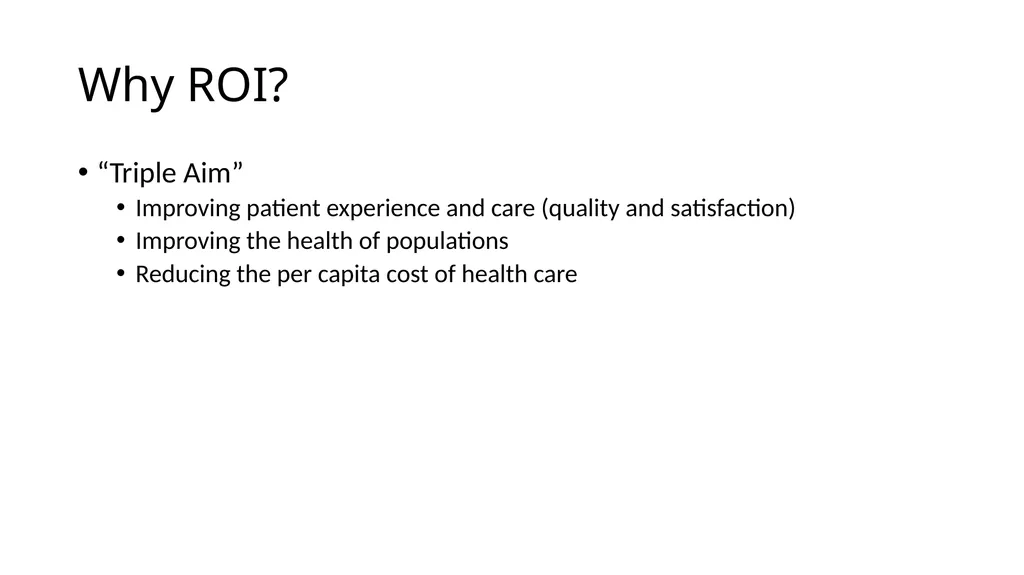
Why ROI? “Triple Aim”
Improving patient experience and care (quality and satisfaction)
Improving the health of populations
Reducing the per capita cost of health care<br>
Improving patient experience and care (quality and satisfaction)
Improving the health of populations
Reducing the per capita cost of health care<br>
05
What is your experience Are you feeling compelled to measure ROI?
Is it something you feel comfortable doing?
Are you eager to show the cost savings?<br>
Is it something you feel comfortable doing?
Are you eager to show the cost savings?<br>
06
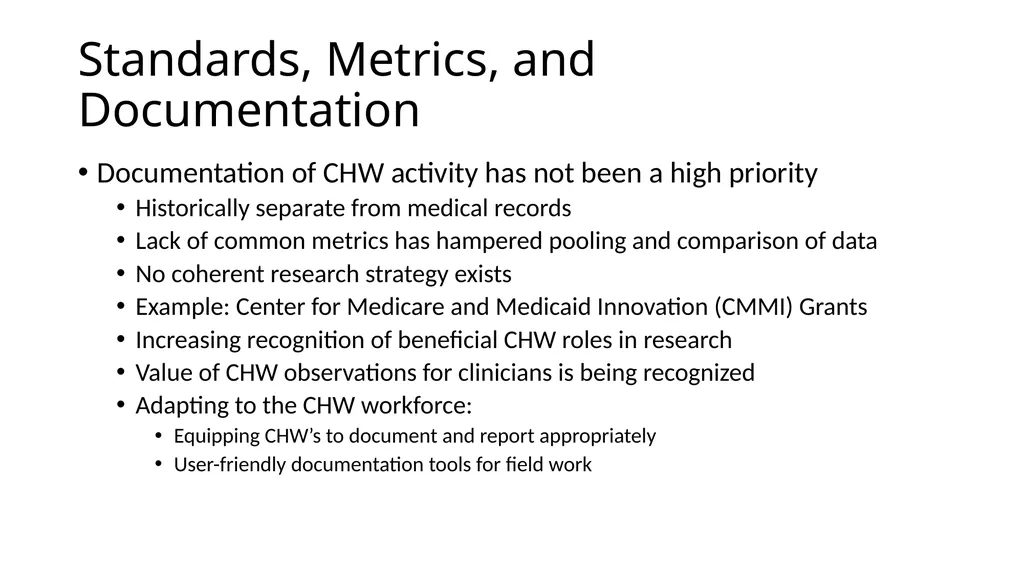
Standards, Metrics, and Documentation Documentation of CHW activity has not been a high priority
Historically separate from medical records
Lack of common metrics has hampered pooling and comparison of data
No coherent research strategy exists
Example: Center for Medicare and Medicaid Innovation (CMMI) Grants
Increasing recognition of beneficial CHW roles in research
Value of CHW observations for clinicians is being recognized
Adapting to the CHW workforce:
Equipping CHW’s to document and report appropriately
User-friendly documentation tools for field work<br>
Historically separate from medical records
Lack of common metrics has hampered pooling and comparison of data
No coherent research strategy exists
Example: Center for Medicare and Medicaid Innovation (CMMI) Grants
Increasing recognition of beneficial CHW roles in research
Value of CHW observations for clinicians is being recognized
Adapting to the CHW workforce:
Equipping CHW’s to document and report appropriately
User-friendly documentation tools for field work<br>
07
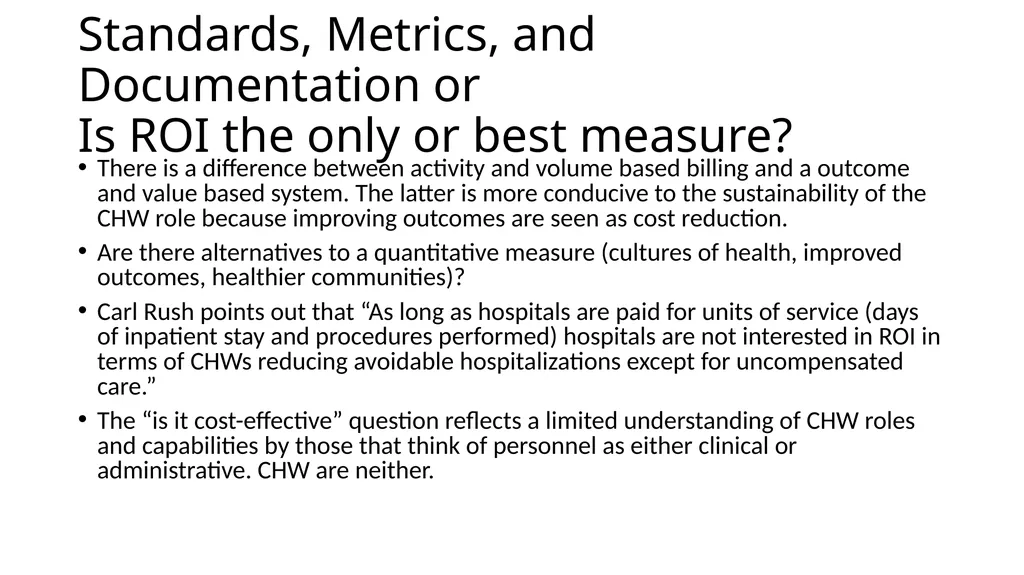
Standards, Metrics, and Documentation or
Is ROI the only or best measure? There is a difference between activity and volume based billing and a outcome and value based system. The latter is more conducive to the sustainability of the CHW role because improving outcomes are seen as cost reduction.
Are there alternatives to a quantitative measure (cultures of health, improved outcomes, healthier communities)?
Carl Rush points out that “As long as hospitals are paid for units of service (days of inpatient stay and procedures performed) hospitals are not interested in ROI in terms of CHWs reducing avoidable hospitalizations except for uncompensated care.”
The “is it cost-effective” question reflects a limited understanding of CHW roles and capabilities by those that think of personnel as either clinical or administrative. CHW are neither.<br>
Are there alternatives to a quantitative measure (cultures of health, improved outcomes, healthier communities)?
Carl Rush points out that “As long as hospitals are paid for units of service (days of inpatient stay and procedures performed) hospitals are not interested in ROI in terms of CHWs reducing avoidable hospitalizations except for uncompensated care.”
The “is it cost-effective” question reflects a limited understanding of CHW roles and capabilities by those that think of personnel as either clinical or administrative. CHW are neither.<br>
08
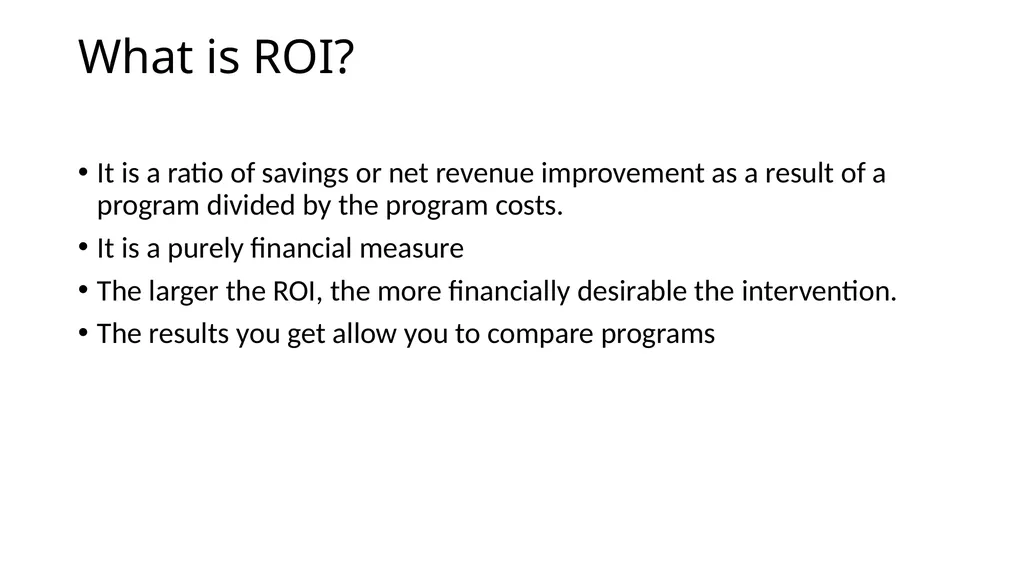
What is ROI? It is a ratio of savings or net revenue improvement as a result of a program divided by the program costs.
It is a purely financial measure
The larger the ROI, the more financially desirable the intervention.
The results you get allow you to compare programs<br>
It is a purely financial measure
The larger the ROI, the more financially desirable the intervention.
The results you get allow you to compare programs<br>
09
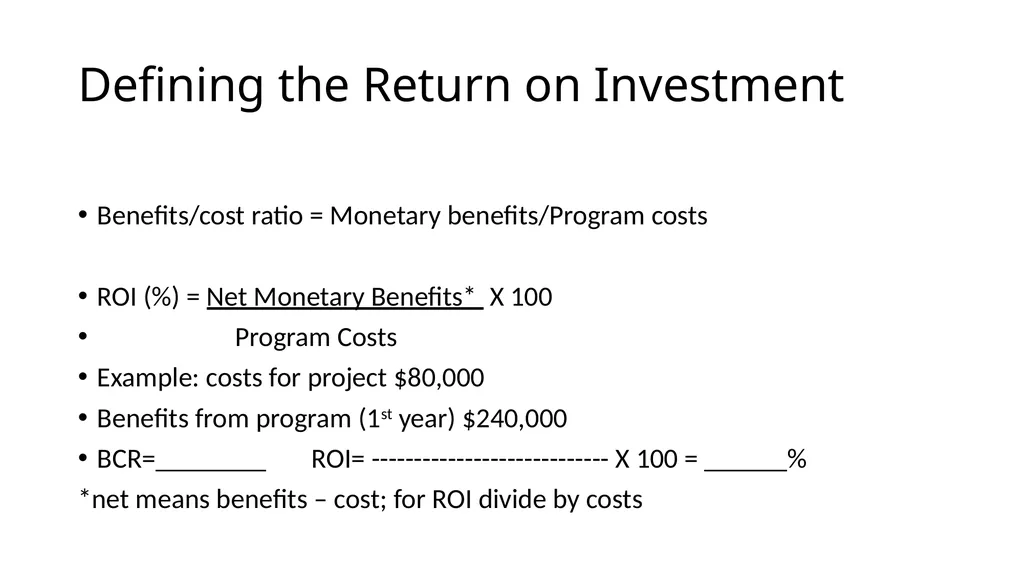
Defining the Return on Investment Benefits/cost ratio = Monetary benefits/Program costs
ROI (%) = Net Monetary Benefits* X 100
Program Costs
Example: costs for project $80,000
Benefits from program (1st year) $240,000
BCR=________ ROI= ---------------------------- X 100 = ______%
*net means benefits – cost; for ROI divide by costs<br>
ROI (%) = Net Monetary Benefits* X 100
Program Costs
Example: costs for project $80,000
Benefits from program (1st year) $240,000
BCR=________ ROI= ---------------------------- X 100 = ______%
*net means benefits – cost; for ROI divide by costs<br>
10
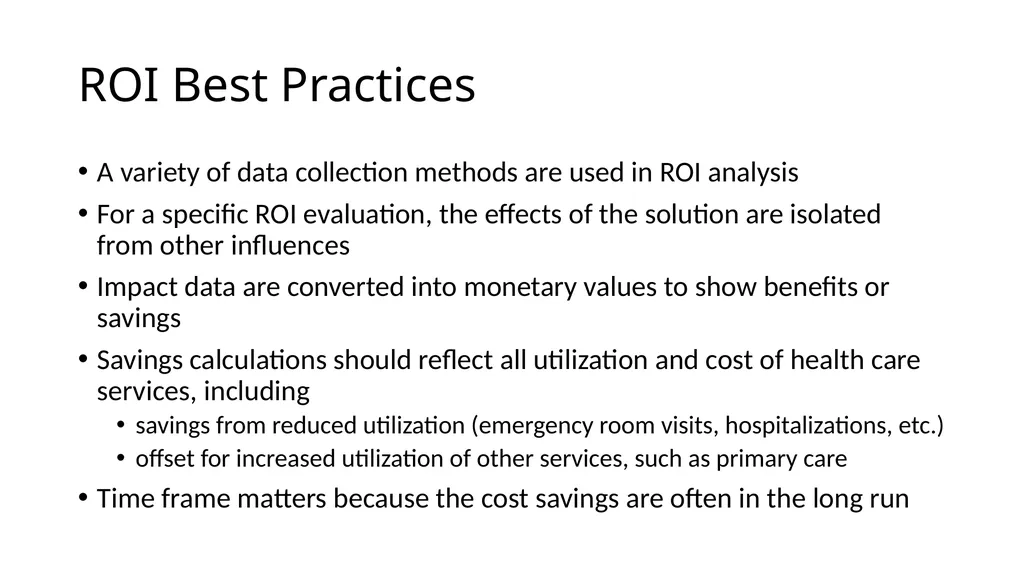
ROI Best Practices A variety of data collection methods are used in ROI analysis
For a specific ROI evaluation, the effects of the solution are isolated from other influences
Impact data are converted into monetary values to show benefits or savings
Savings calculations should reflect all utilization and cost of health care services, including
savings from reduced utilization (emergency room visits, hospitalizations, etc.)
offset for increased utilization of other services, such as primary care
Time frame matters because the cost savings are often in the long run<br>
For a specific ROI evaluation, the effects of the solution are isolated from other influences
Impact data are converted into monetary values to show benefits or savings
Savings calculations should reflect all utilization and cost of health care services, including
savings from reduced utilization (emergency room visits, hospitalizations, etc.)
offset for increased utilization of other services, such as primary care
Time frame matters because the cost savings are often in the long run<br>
11
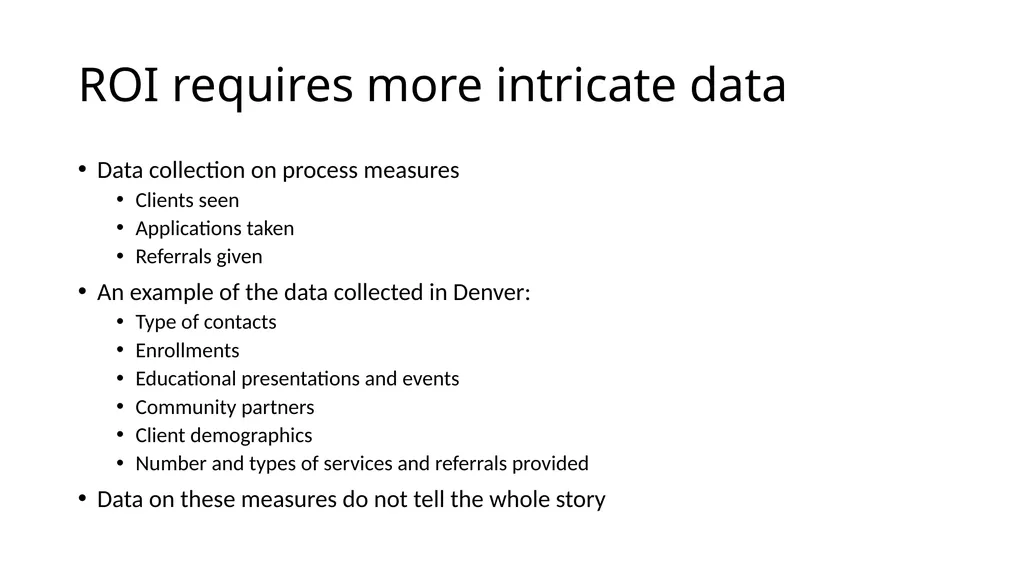
ROI requires more intricate data Data collection on process measures
Clients seen
Applications taken
Referrals given
An example of the data collected in Denver:
Type of contacts
Enrollments
Educational presentations and events
Community partners
Client demographics
Number and types of services and referrals provided
Data on these measures do not tell the whole story<br>
Clients seen
Applications taken
Referrals given
An example of the data collected in Denver:
Type of contacts
Enrollments
Educational presentations and events
Community partners
Client demographics
Number and types of services and referrals provided
Data on these measures do not tell the whole story<br>
12
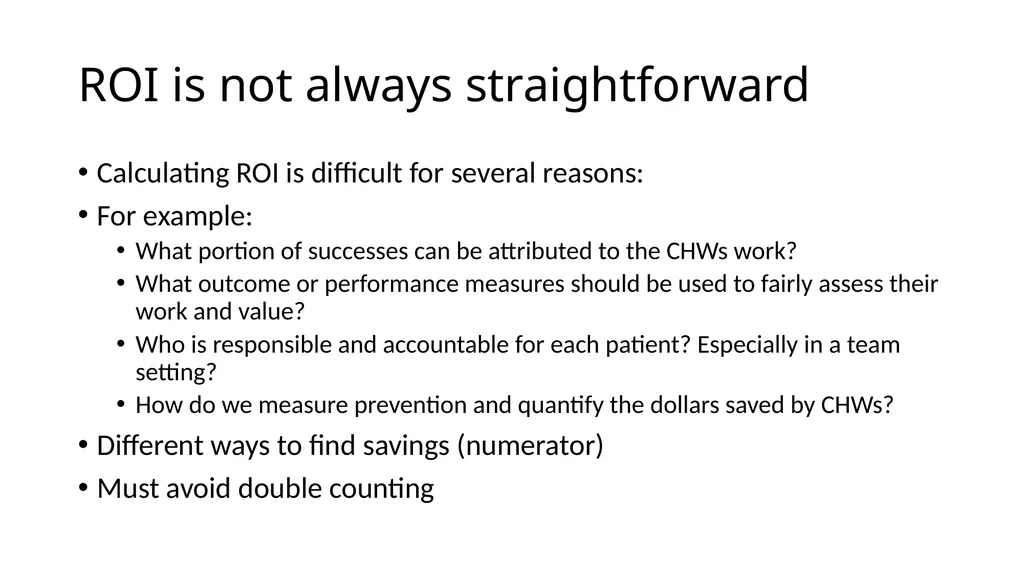
ROI is not always straightforward Calculating ROI is difficult for several reasons:
For example:
What portion of successes can be attributed to the CHWs work?
What outcome or performance measures should be used to fairly assess their work and value?
Who is responsible and accountable for each patient? Especially in a team setting?
How do we measure prevention and quantify the dollars saved by CHWs?
Different ways to find savings (numerator)
Must avoid double counting<br>
For example:
What portion of successes can be attributed to the CHWs work?
What outcome or performance measures should be used to fairly assess their work and value?
Who is responsible and accountable for each patient? Especially in a team setting?
How do we measure prevention and quantify the dollars saved by CHWs?
Different ways to find savings (numerator)
Must avoid double counting<br>
13
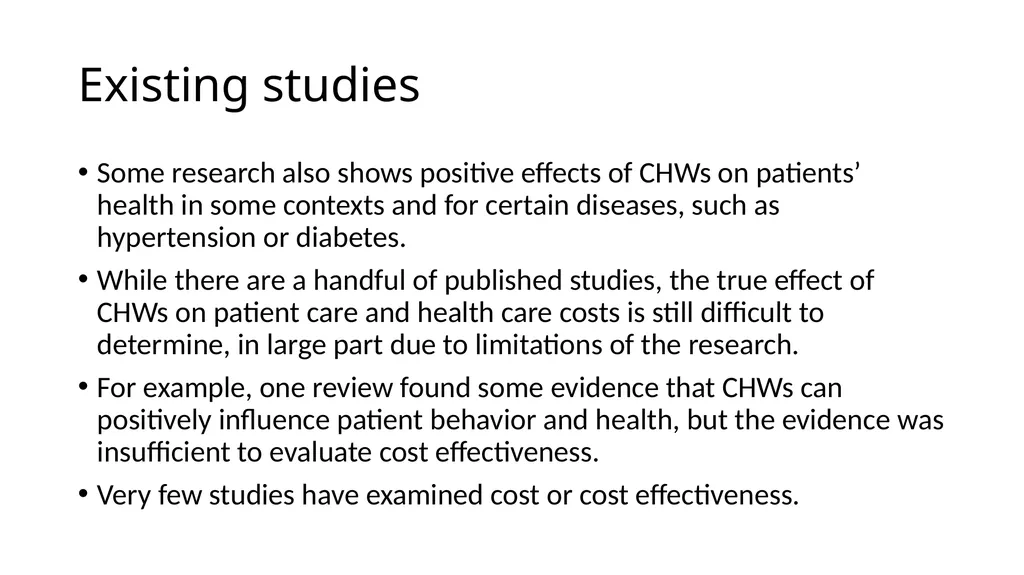
Existing studies Some research also shows positive effects of CHWs on patients’ health in some contexts and for certain diseases, such as hypertension or diabetes.
While there are a handful of published studies, the true effect of CHWs on patient care and health care costs is still difficult to determine, in large part due to limitations of the research.
For example, one review found some evidence that CHWs can positively influence patient behavior and health, but the evidence was insufficient to evaluate cost effectiveness.
Very few studies have examined cost or cost effectiveness.<br>
While there are a handful of published studies, the true effect of CHWs on patient care and health care costs is still difficult to determine, in large part due to limitations of the research.
For example, one review found some evidence that CHWs can positively influence patient behavior and health, but the evidence was insufficient to evaluate cost effectiveness.
Very few studies have examined cost or cost effectiveness.<br>
14
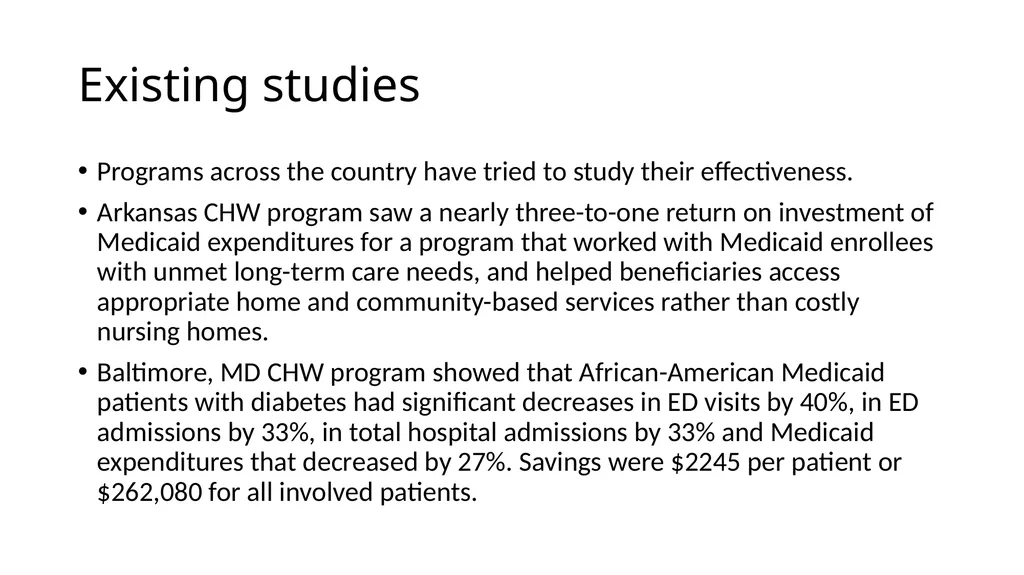
Existing studies Programs across the country have tried to study their effectiveness.
Arkansas CHW program saw a nearly three-to-one return on investment of Medicaid expenditures for a program that worked with Medicaid enrollees with unmet long-term care needs, and helped beneficiaries access appropriate home and community-based services rather than costly nursing homes.
Baltimore, MD CHW program showed that African-American Medicaid patients with diabetes had significant decreases in ED visits by 40%, in ED admissions by 33%, in total hospital admissions by 33% and Medicaid expenditures that decreased by 27%. Savings were $2245 per patient or $262,080 for all involved patients.<br>
Arkansas CHW program saw a nearly three-to-one return on investment of Medicaid expenditures for a program that worked with Medicaid enrollees with unmet long-term care needs, and helped beneficiaries access appropriate home and community-based services rather than costly nursing homes.
Baltimore, MD CHW program showed that African-American Medicaid patients with diabetes had significant decreases in ED visits by 40%, in ED admissions by 33%, in total hospital admissions by 33% and Medicaid expenditures that decreased by 27%. Savings were $2245 per patient or $262,080 for all involved patients.<br>
15
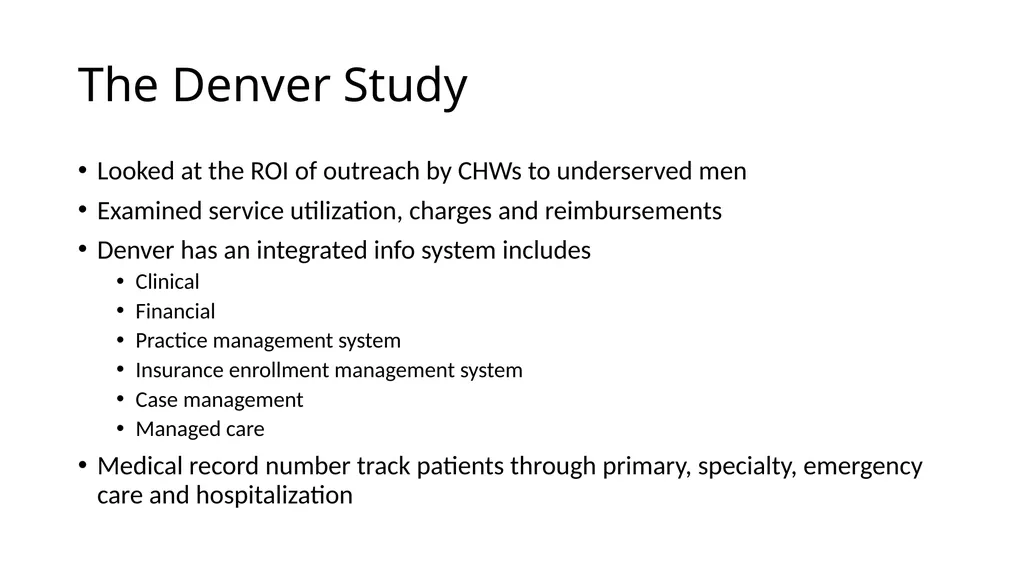
The Denver Study Looked at the ROI of outreach by CHWs to underserved men
Examined service utilization, charges and reimbursements
Denver has an integrated info system includes
Clinical
Financial
Practice management system
Insurance enrollment management system
Case management
Managed care
Medical record number track patients through primary, specialty, emergency care and hospitalization<br>
Examined service utilization, charges and reimbursements
Denver has an integrated info system includes
Clinical
Financial
Practice management system
Insurance enrollment management system
Case management
Managed care
Medical record number track patients through primary, specialty, emergency care and hospitalization<br>
16
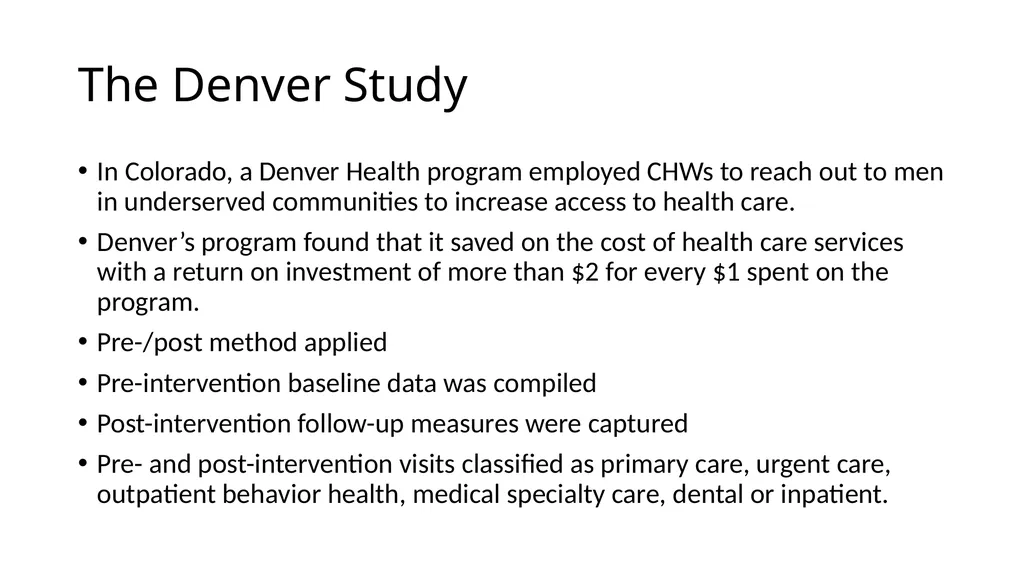
The Denver Study In Colorado, a Denver Health program employed CHWs to reach out to men in underserved communities to increase access to health care.
Denver’s program found that it saved on the cost of health care services with a return on investment of more than $2 for every $1 spent on the program.
Pre-/post method applied
Pre-intervention baseline data was compiled
Post-intervention follow-up measures were captured
Pre- and post-intervention visits classified as primary care, urgent care, outpatient behavior health, medical specialty care, dental or inpatient.<br>
Denver’s program found that it saved on the cost of health care services with a return on investment of more than $2 for every $1 spent on the program.
Pre-/post method applied
Pre-intervention baseline data was compiled
Post-intervention follow-up measures were captured
Pre- and post-intervention visits classified as primary care, urgent care, outpatient behavior health, medical specialty care, dental or inpatient.<br>
17
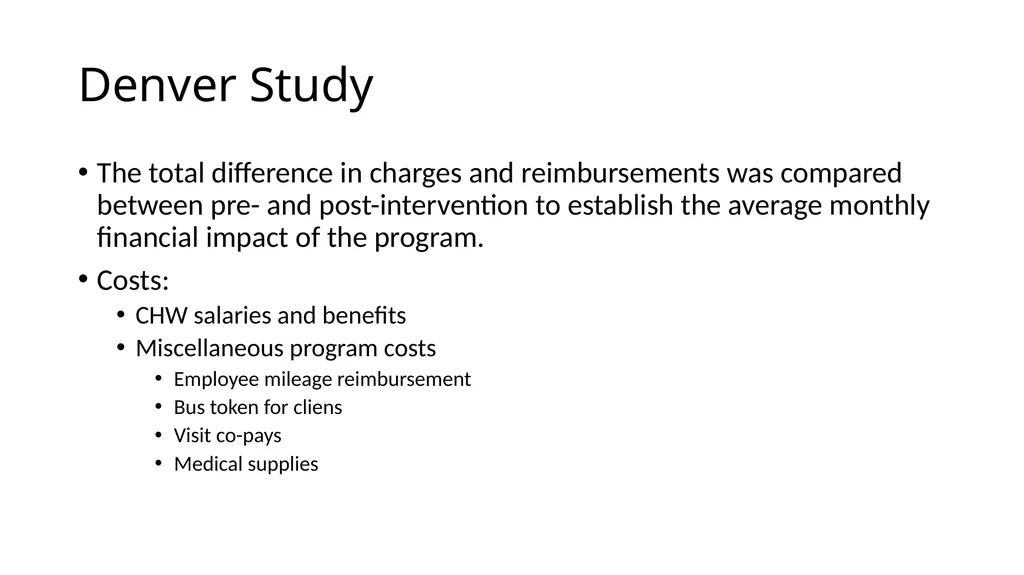
Denver Study The total difference in charges and reimbursements was compared between pre- and post-intervention to establish the average monthly financial impact of the program.
Costs:
CHW salaries and benefits
Miscellaneous program costs
Employee mileage reimbursement
Bus token for cliens
Visit co-pays
Medical supplies<br>
Costs:
CHW salaries and benefits
Miscellaneous program costs
Employee mileage reimbursement
Bus token for cliens
Visit co-pays
Medical supplies<br>
18
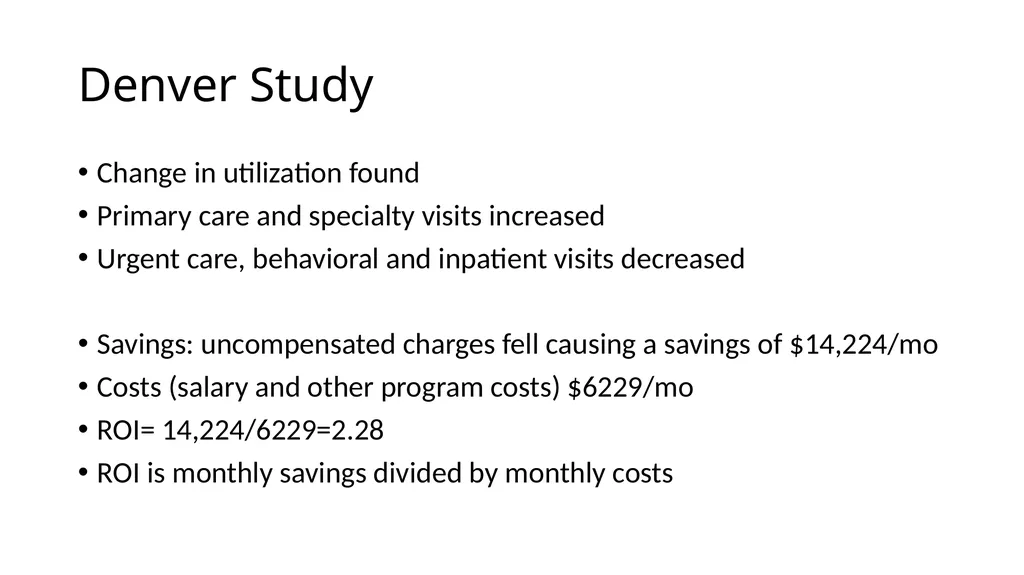
Denver Study Change in utilization found
Primary care and specialty visits increased
Urgent care, behavioral and inpatient visits decreased
Savings: uncompensated charges fell causing a savings of $14,224/mo
Costs (salary and other program costs) $6229/mo
ROI= 14,224/6229=2.28
ROI is monthly savings divided by monthly costs<br>
Primary care and specialty visits increased
Urgent care, behavioral and inpatient visits decreased
Savings: uncompensated charges fell causing a savings of $14,224/mo
Costs (salary and other program costs) $6229/mo
ROI= 14,224/6229=2.28
ROI is monthly savings divided by monthly costs<br>
19
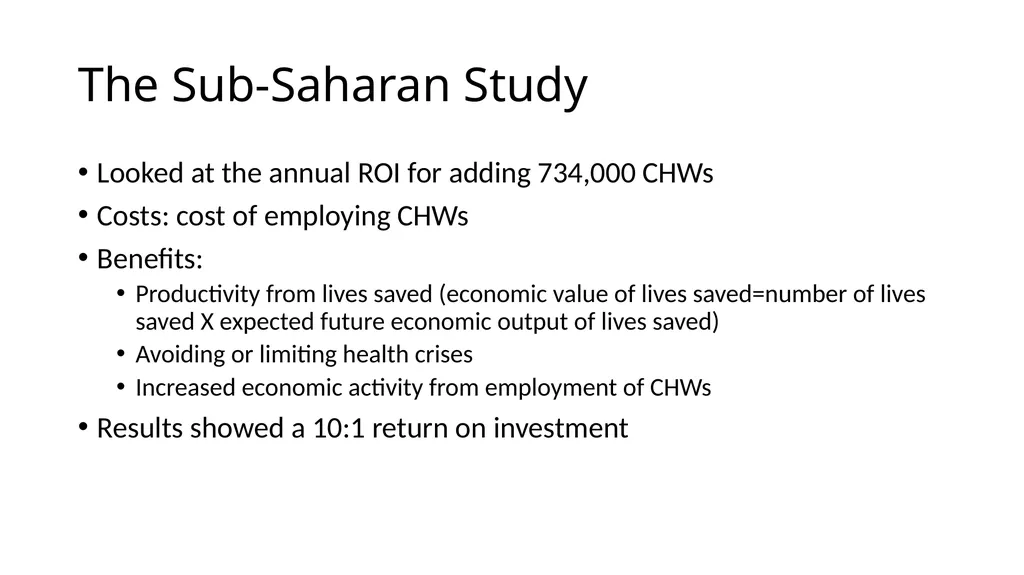
The Sub-Saharan Study Looked at the annual ROI for adding 734,000 CHWs
Costs: cost of employing CHWs
Benefits:
Productivity from lives saved (economic value of lives saved=number of lives saved X expected future economic output of lives saved)
Avoiding or limiting health crises
Increased economic activity from employment of CHWs
Results showed a 10:1 return on investment<br>
Costs: cost of employing CHWs
Benefits:
Productivity from lives saved (economic value of lives saved=number of lives saved X expected future economic output of lives saved)
Avoiding or limiting health crises
Increased economic activity from employment of CHWs
Results showed a 10:1 return on investment<br>
20
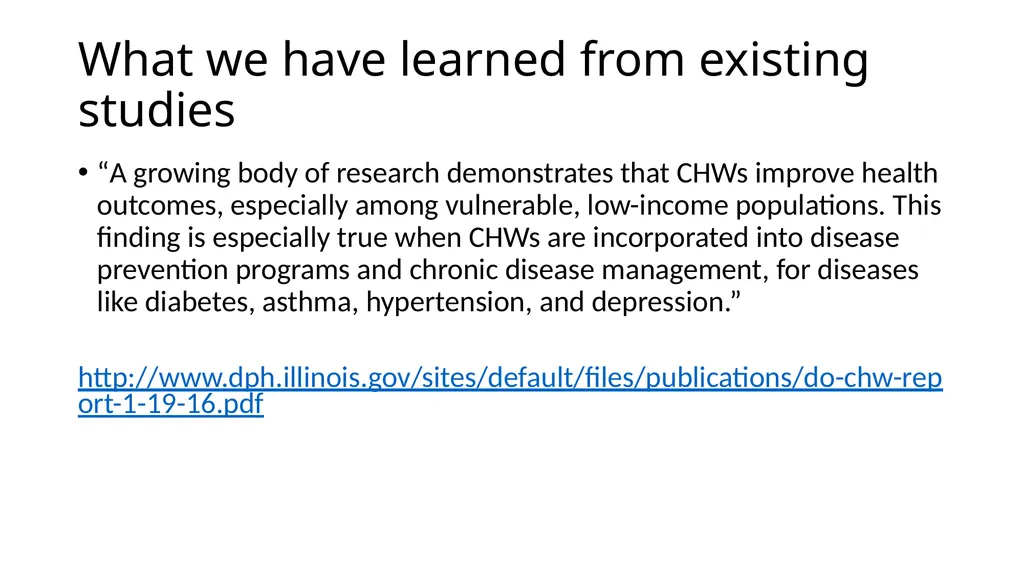
What we have learned from existing studies “A growing body of research demonstrates that CHWs improve health outcomes, especially among vulnerable, low-income populations. This finding is especially true when CHWs are incorporated into disease prevention programs and chronic disease management, for diseases like diabetes, asthma, hypertension, and depression.”
http://www.dph.illinois.gov/sites/default/files/publications/do-chw-report-1-19-16.pdf<br>
http://www.dph.illinois.gov/sites/default/files/publications/do-chw-report-1-19-16.pdf<br>
21
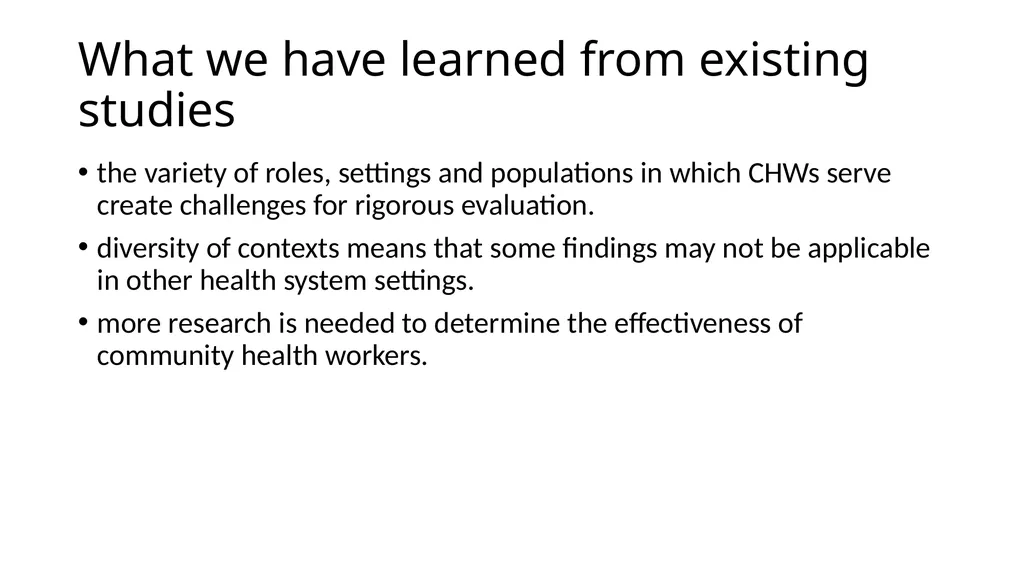
What we have learned from existing studies the variety of roles, settings and populations in which CHWs serve create challenges for rigorous evaluation.
diversity of contexts means that some findings may not be applicable in other health system settings.
more research is needed to determine the effectiveness of community health workers.<br>
diversity of contexts means that some findings may not be applicable in other health system settings.
more research is needed to determine the effectiveness of community health workers.<br>
22
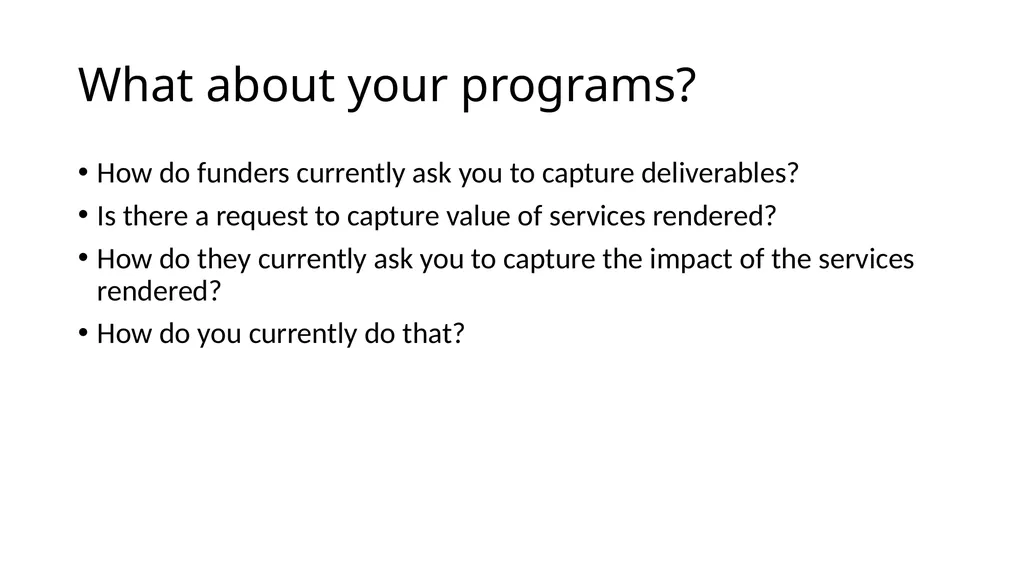
What about your programs? How do funders currently ask you to capture deliverables?
Is there a request to capture value of services rendered?
How do they currently ask you to capture the impact of the services rendered?
How do you currently do that?<br>
Is there a request to capture value of services rendered?
How do they currently ask you to capture the impact of the services rendered?
How do you currently do that?<br>
23
Let’s do an ROI exercise Let’s look at a program or an intervention for promotoras
The goal is to figure out how much it costs and how much we saved because of the intervention.<br>
The goal is to figure out how much it costs and how much we saved because of the intervention.<br>
24
Things to consider: benefits What does the promotora do?
What would it cost to achieve these things without a promotora? Is it even possible to do so?
Or is there qualitative value that is created, and can it be measured?<br>
What would it cost to achieve these things without a promotora? Is it even possible to do so?
Or is there qualitative value that is created, and can it be measured?<br>
25
Things to consider: cost reduction How do CHWs reduce cost?
Improve access, reduce ER use, improve chronic care?<br>
Improve access, reduce ER use, improve chronic care?<br>
26
Things to consider: how to measure How to measure the impact CHWs can have on improving the lives of the communities they serve (for example, how do we measure better health outcomes)
How do we show that CHWs improve the health and wellness of (vulnerable) communities and save health care costs?<br>
How do we show that CHWs improve the health and wellness of (vulnerable) communities and save health care costs?<br>
27
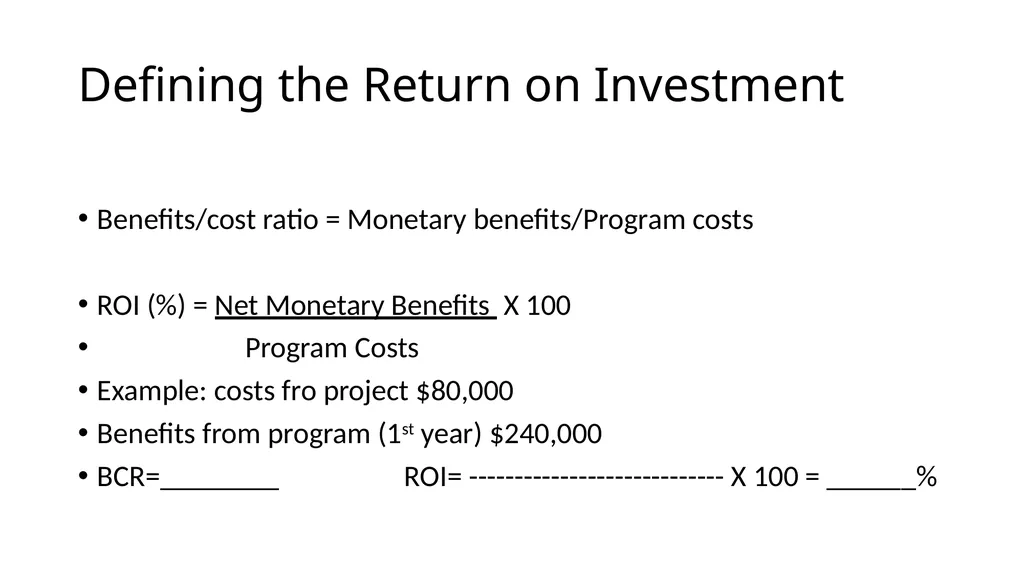
Defining the Return on Investment Benefits/cost ratio = Monetary benefits/Program costs
ROI (%) = Net Monetary Benefits X 100
Program Costs
Example: costs fro project $80,000
Benefits from program (1st year) $240,000
BCR=________ ROI= ---------------------------- X 100 = ______%<br>
ROI (%) = Net Monetary Benefits X 100
Program Costs
Example: costs fro project $80,000
Benefits from program (1st year) $240,000
BCR=________ ROI= ---------------------------- X 100 = ______%<br>
28
So where should we start? Let’s look at roles<br>
29
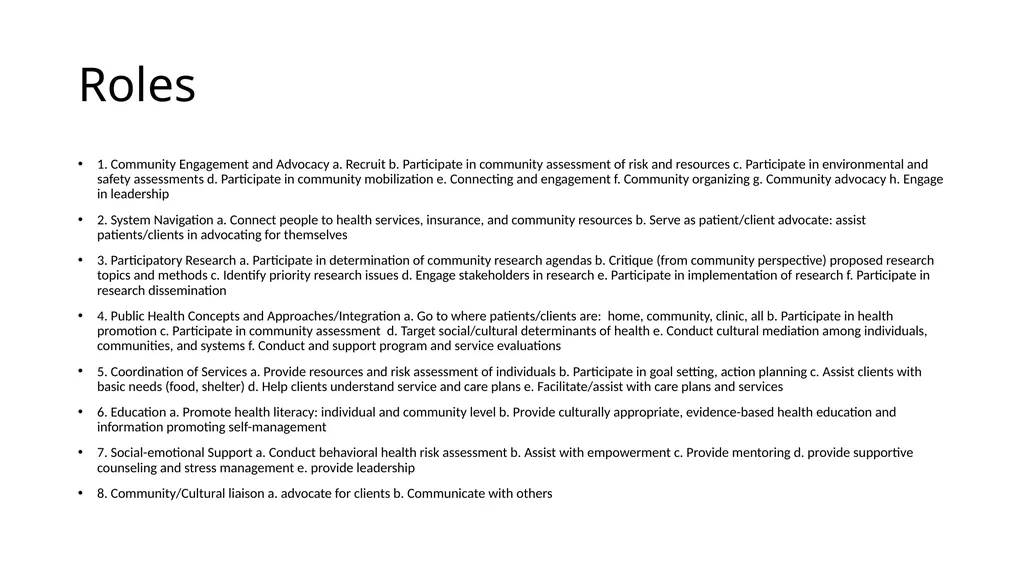
Roles 1. Community Engagement and Advocacy a. Recruit b. Participate in community assessment of risk and resources c. Participate in environmental and safety assessments d. Participate in community mobilization e. Connecting and engagement f. Community organizing g. Community advocacy h. Engage in leadership
2. System Navigation a. Connect people to health services, insurance, and community resources b. Serve as patient/client advocate: assist patients/clients in advocating for themselves
3. Participatory Research a. Participate in determination of community research agendas b. Critique (from community perspective) proposed research topics and methods c. Identify priority research issues d. Engage stakeholders in research e. Participate in implementation of research f. Participate in research dissemination
4. Public Health Concepts and Approaches/Integration a. Go to where patients/clients are: home, community, clinic, all b. Participate in health promotion c. Participate in community assessment d. Target social/cultural determinants of health e. Conduct cultural mediation among individuals, communities, and systems f. Conduct and support program and service evaluations
5. Coordination of Services a. Provide resources and risk assessment of individuals b. Participate in goal setting, action planning c. Assist clients with basic needs (food, shelter) d. Help clients understand service and care plans e. Facilitate/assist with care plans and services
6. Education a. Promote health literacy: individual and community level b. Provide culturally appropriate, evidence-based health education and information promoting self-management
7. Social-emotional Support a. Conduct behavioral health risk assessment b. Assist with empowerment c. Provide mentoring d. provide supportive counseling and stress management e. provide leadership
8. Community/Cultural liaison a. advocate for clients b. Communicate with others<br>
2. System Navigation a. Connect people to health services, insurance, and community resources b. Serve as patient/client advocate: assist patients/clients in advocating for themselves
3. Participatory Research a. Participate in determination of community research agendas b. Critique (from community perspective) proposed research topics and methods c. Identify priority research issues d. Engage stakeholders in research e. Participate in implementation of research f. Participate in research dissemination
4. Public Health Concepts and Approaches/Integration a. Go to where patients/clients are: home, community, clinic, all b. Participate in health promotion c. Participate in community assessment d. Target social/cultural determinants of health e. Conduct cultural mediation among individuals, communities, and systems f. Conduct and support program and service evaluations
5. Coordination of Services a. Provide resources and risk assessment of individuals b. Participate in goal setting, action planning c. Assist clients with basic needs (food, shelter) d. Help clients understand service and care plans e. Facilitate/assist with care plans and services
6. Education a. Promote health literacy: individual and community level b. Provide culturally appropriate, evidence-based health education and information promoting self-management
7. Social-emotional Support a. Conduct behavioral health risk assessment b. Assist with empowerment c. Provide mentoring d. provide supportive counseling and stress management e. provide leadership
8. Community/Cultural liaison a. advocate for clients b. Communicate with others<br>
30
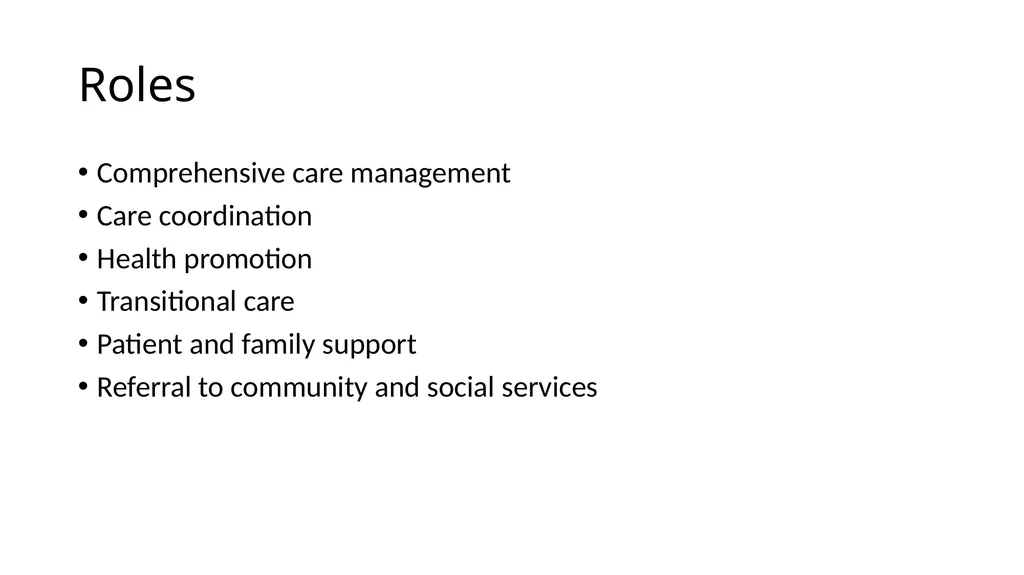
Roles Comprehensive care management
Care coordination
Health promotion
Transitional care
Patient and family support
Referral to community and social services<br>
Care coordination
Health promotion
Transitional care
Patient and family support
Referral to community and social services<br>
31
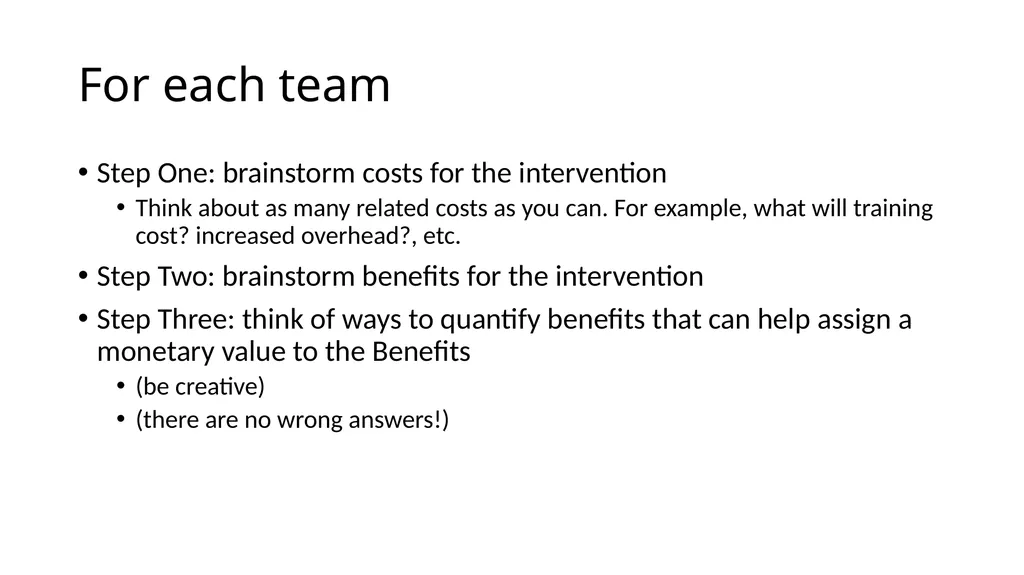
For each team Step One: brainstorm costs for the intervention
Think about as many related costs as you can. For example, what will training cost? increased overhead?, etc.
Step Two: brainstorm benefits for the intervention
Step Three: think of ways to quantify benefits that can help assign a monetary value to the Benefits
(be creative)
(there are no wrong answers!)<br>
Think about as many related costs as you can. For example, what will training cost? increased overhead?, etc.
Step Two: brainstorm benefits for the intervention
Step Three: think of ways to quantify benefits that can help assign a monetary value to the Benefits
(be creative)
(there are no wrong answers!)<br>
32
Time for report back<br>
33
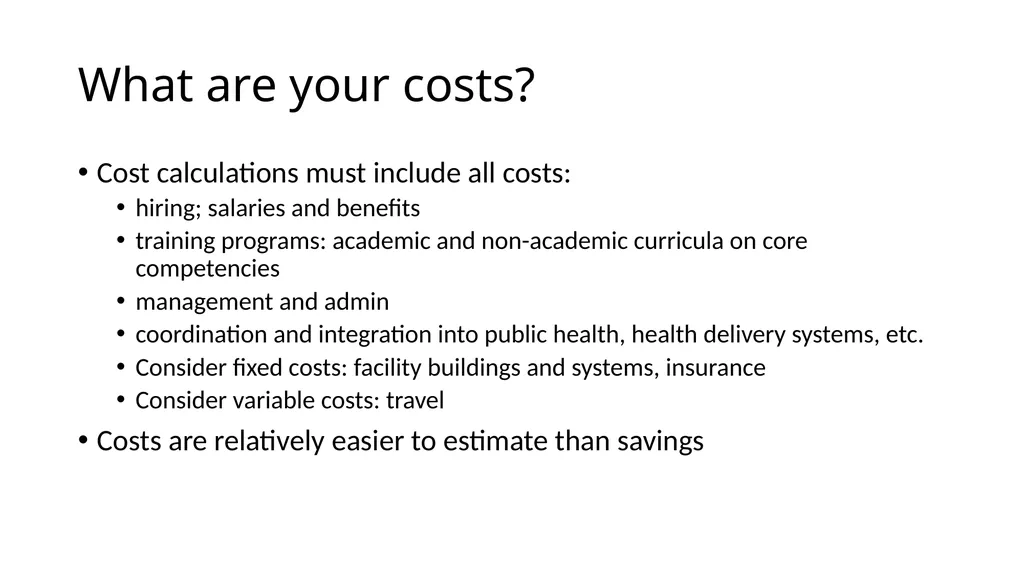
What are your costs? Cost calculations must include all costs:
hiring; salaries and benefits
training programs: academic and non-academic curricula on core competencies
management and admin
coordination and integration into public health, health delivery systems, etc.
Consider fixed costs: facility buildings and systems, insurance
Consider variable costs: travel
Costs are relatively easier to estimate than savings<br>
hiring; salaries and benefits
training programs: academic and non-academic curricula on core competencies
management and admin
coordination and integration into public health, health delivery systems, etc.
Consider fixed costs: facility buildings and systems, insurance
Consider variable costs: travel
Costs are relatively easier to estimate than savings<br>
34
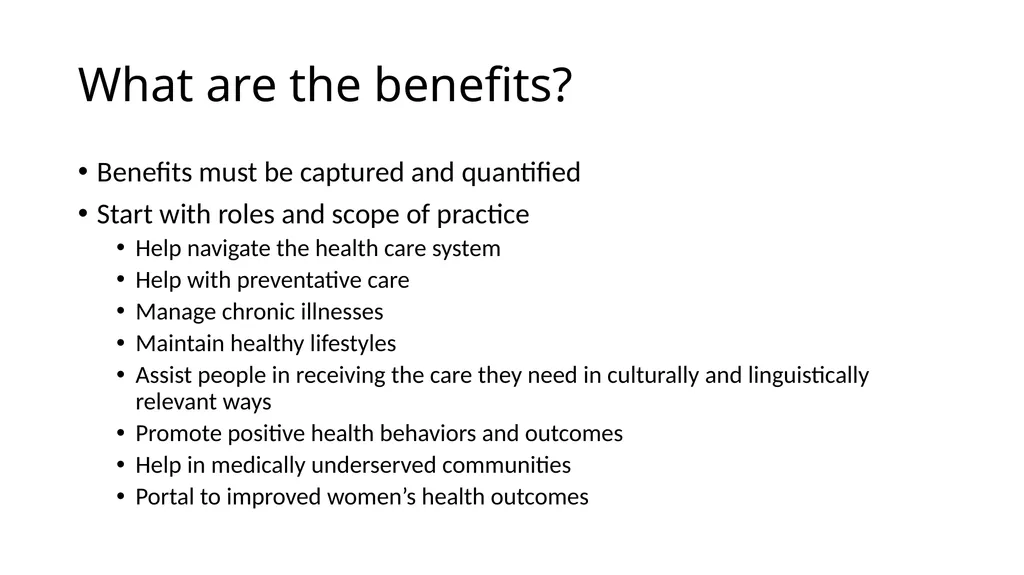
What are the benefits? Benefits must be captured and quantified
Start with roles and scope of practice
Help navigate the health care system
Help with preventative care
Manage chronic illnesses
Maintain healthy lifestyles
Assist people in receiving the care they need in culturally and linguistically relevant ways
Promote positive health behaviors and outcomes
Help in medically underserved communities
Portal to improved women’s health outcomes<br>
Start with roles and scope of practice
Help navigate the health care system
Help with preventative care
Manage chronic illnesses
Maintain healthy lifestyles
Assist people in receiving the care they need in culturally and linguistically relevant ways
Promote positive health behaviors and outcomes
Help in medically underserved communities
Portal to improved women’s health outcomes<br>
35
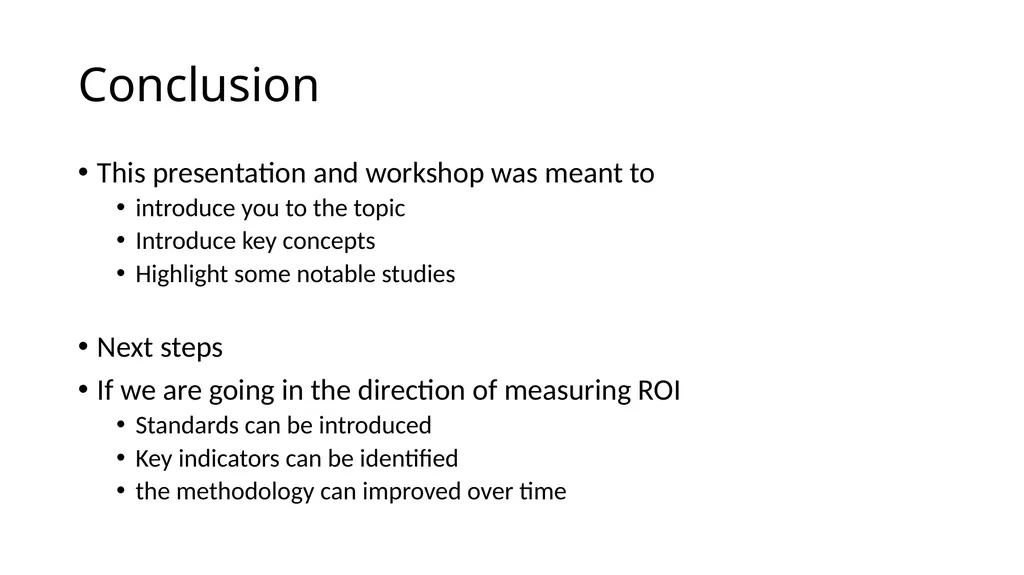
Conclusion This presentation and workshop was meant to
introduce you to the topic
Introduce key concepts
Highlight some notable studies
Next steps
If we are going in the direction of measuring ROI
Standards can be introduced
Key indicators can be identified
the methodology can improved over time<br>
introduce you to the topic
Introduce key concepts
Highlight some notable studies
Next steps
If we are going in the direction of measuring ROI
Standards can be introduced
Key indicators can be identified
the methodology can improved over time<br>
36
Any questions?<br>
37
Thank you<br>