
Proofs (Chapter 2) Used some materials from Book
TD
Published · 101 slides · 0 views

1 / 1



Description
Proofs (Chapter 2) Used some materials from Book of Proof by Richard H. Hammack https:www.people.vcu.edu rhammack BookOfProof BookOfProof Proofs A proof of a mathematical statement is logical argument which establishes the truth of
Related Topics
Share
Embed code
Download this presentation From Below
"Proofs (Chapter 2) Used some materials from Book" is the property of its rightful owner. Permission is granted to download and print the materials on this website for personal, non-commercial use only, and to display it on your personal computer provided you do not modify the materials and that you retain all copyright notices contained in the materials. By downloading content from our website, you accept the terms of this agreement.
Presentation Transcript
01
Proofs (Chapter 2) Used some materials from
Book of Proof by Richard H. Hammack https://www.people.vcu.edu › ~rhammack › BookOfProof › BookOfProof<br>
Book of Proof by Richard H. Hammack https://www.people.vcu.edu › ~rhammack › BookOfProof › BookOfProof<br>
02
Proofs A proof of a mathematical statement is logical argument which establishes the truth of a statement.
We will cover a variety of methods of proofs.
There are terms which we should know while proving things.<br>
We will cover a variety of methods of proofs.
There are terms which we should know while proving things.<br>
03
Mathematical definitions Even integer
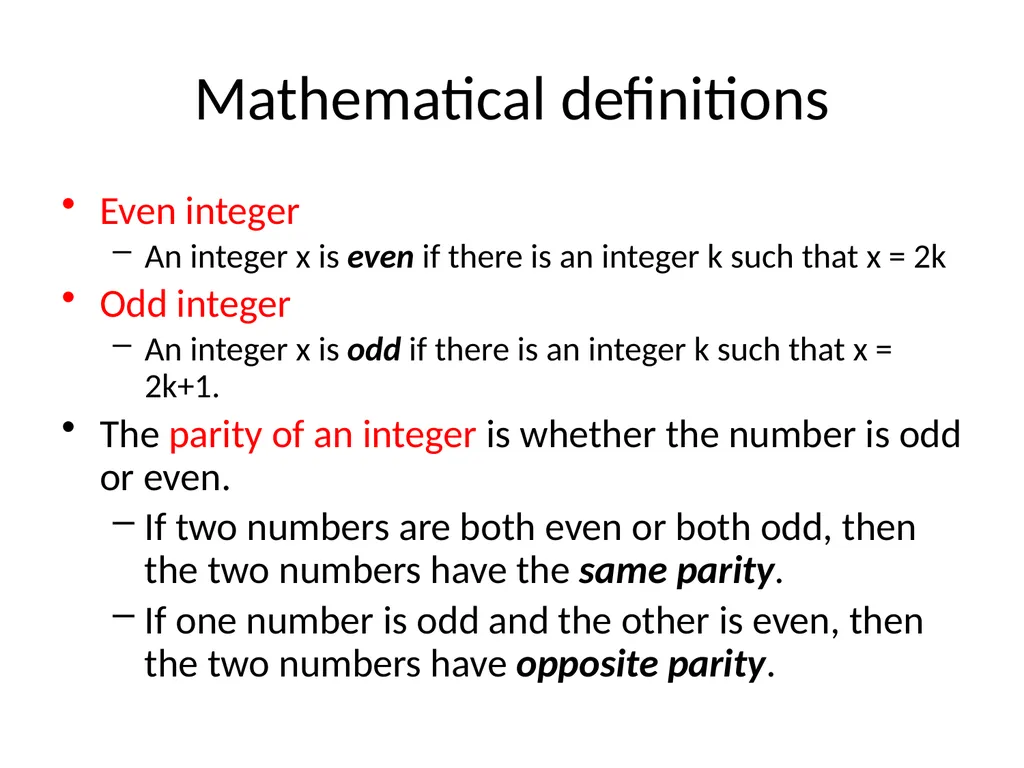
An integer x is even if there is an integer k such that x = 2k
Odd integer
An integer x is odd if there is an integer k such that x = 2k+1.
The parity of an integer is whether the number is odd or even.
If two numbers are both even or both odd, then the two numbers have the same parity.
If one number is odd and the other is even, then the two numbers have opposite parity.<br>
An integer x is even if there is an integer k such that x = 2k
Odd integer
An integer x is odd if there is an integer k such that x = 2k+1.
The parity of an integer is whether the number is odd or even.
If two numbers are both even or both odd, then the two numbers have the same parity.
If one number is odd and the other is even, then the two numbers have opposite parity.<br>
04
Mathematical definitions<br>
05
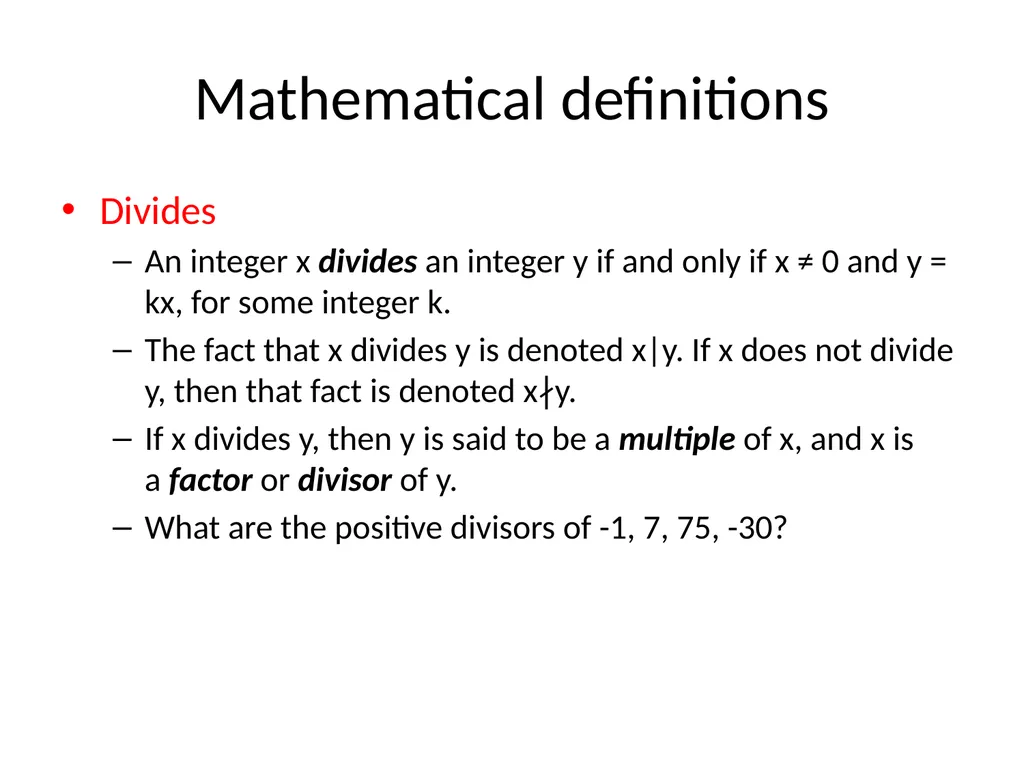
Mathematical definitions Divides
An integer x divides an integer y if and only if x ≠ 0 and y = kx, for some integer k.
The fact that x divides y is denoted x|y. If x does not divide y, then that fact is denoted x∤y.
If x divides y, then y is said to be a multiple of x, and x is a factor or divisor of y.
What are the positive divisors of -1, 7, 75, -30?<br>
An integer x divides an integer y if and only if x ≠ 0 and y = kx, for some integer k.
The fact that x divides y is denoted x|y. If x does not divide y, then that fact is denoted x∤y.
If x divides y, then y is said to be a multiple of x, and x is a factor or divisor of y.
What are the positive divisors of -1, 7, 75, -30?<br>
06
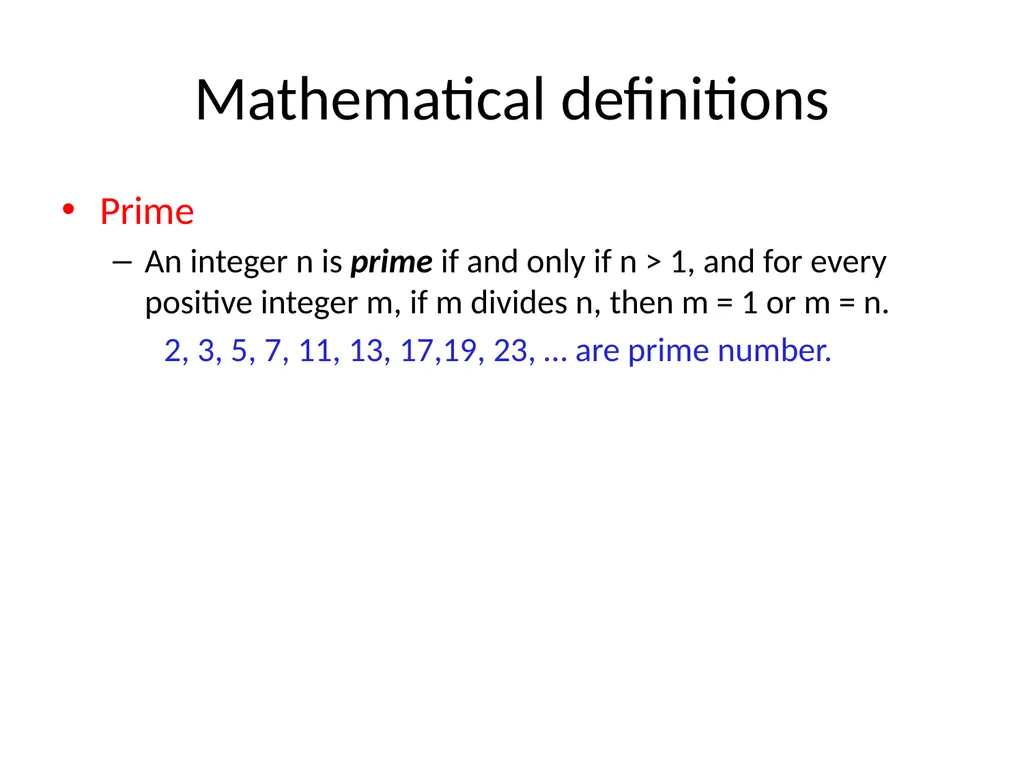
Mathematical definitions Prime
An integer n is prime if and only if n > 1, and for every positive integer m, if m divides n, then m = 1 or m = n.
2, 3, 5, 7, 11, 13, 17,19, 23, … are prime number.<br>
An integer n is prime if and only if n > 1, and for every positive integer m, if m divides n, then m = 1 or m = n.
2, 3, 5, 7, 11, 13, 17,19, 23, … are prime number.<br>
07
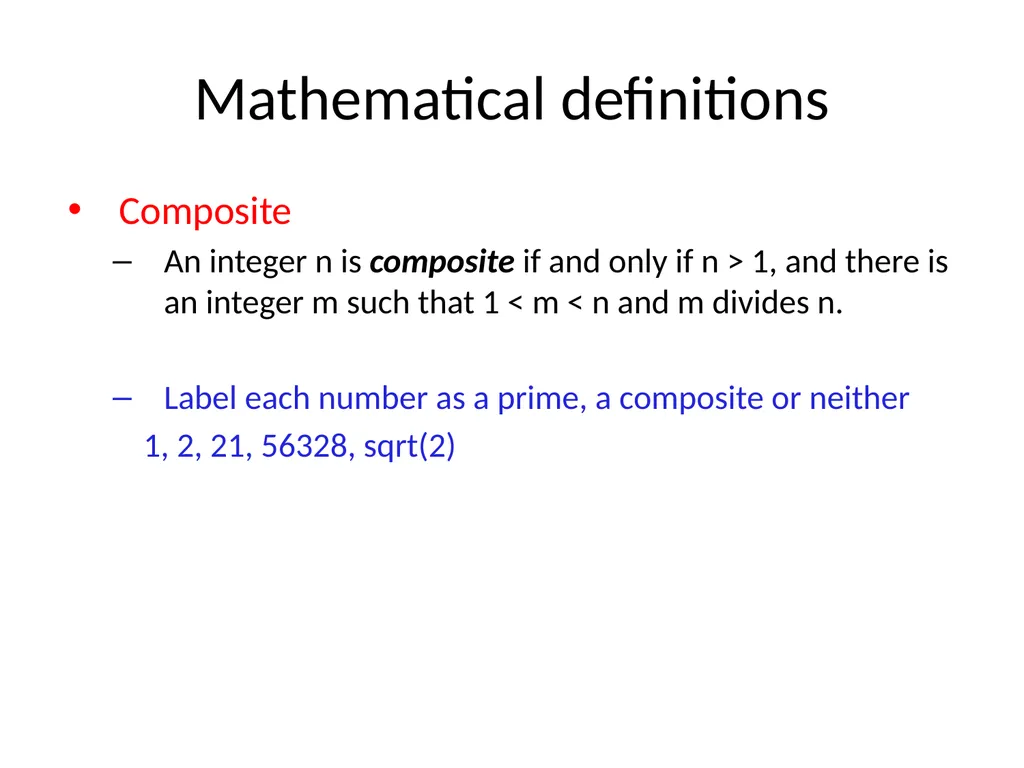
Mathematical definitions Composite
An integer n is composite if and only if n > 1, and there is an integer m such that 1 < m < n and m divides n.
Label each number as a prime, a composite or neither
1, 2, 21, 56328, sqrt(2)<br>
An integer n is composite if and only if n > 1, and there is an integer m such that 1 < m < n and m divides n.
Label each number as a prime, a composite or neither
1, 2, 21, 56328, sqrt(2)<br>
08
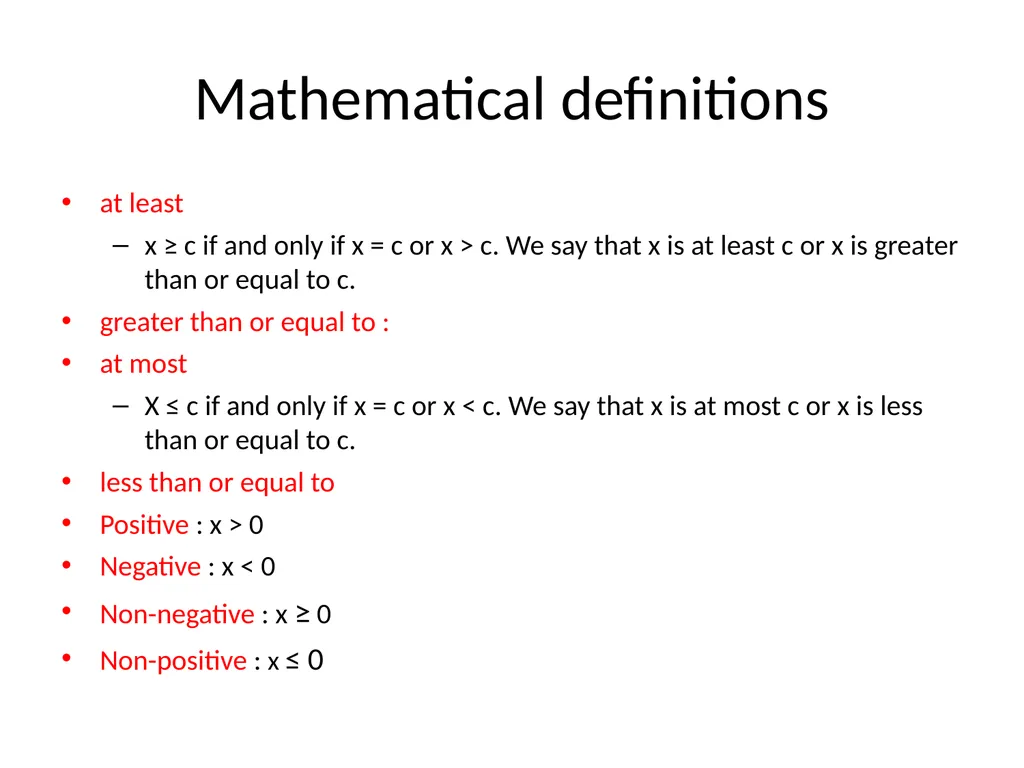
Mathematical definitions at least
x ≥ c if and only if x = c or x > c. We say that x is at least c or x is greater than or equal to c.
greater than or equal to :
at most
X ≤ c if and only if x = c or x < c. We say that x is at most c or x is less than or equal to c.
less than or equal to
Positive : x > 0
Negative : x < 0
Non-negative : x ≥ 0
Non-positive : x ≤ 0<br>
x ≥ c if and only if x = c or x > c. We say that x is at least c or x is greater than or equal to c.
greater than or equal to :
at most
X ≤ c if and only if x = c or x < c. We say that x is at most c or x is less than or equal to c.
less than or equal to
Positive : x > 0
Negative : x < 0
Non-negative : x ≥ 0
Non-positive : x ≤ 0<br>
09
Process of writing Proofs One of the hardest parts of writing proofs is knowing where to start.
A proof can be any sequence of logical steps.
which steps will lead to the proof?
Fortunately, many proofs follow one of a relatively small number of patterns.
Following one of the common patterns helps give the proof structure and some direction.<br>
A proof can be any sequence of logical steps.
which steps will lead to the proof?
Fortunately, many proofs follow one of a relatively small number of patterns.
Following one of the common patterns helps give the proof structure and some direction.<br>
10
Proofs by exhaustion If the domain of an open statement is small, it may be easiest to prove the statement by checking each element individually.
This kind of proof is called proof by exhaustion.<br>
This kind of proof is called proof by exhaustion.<br>
11
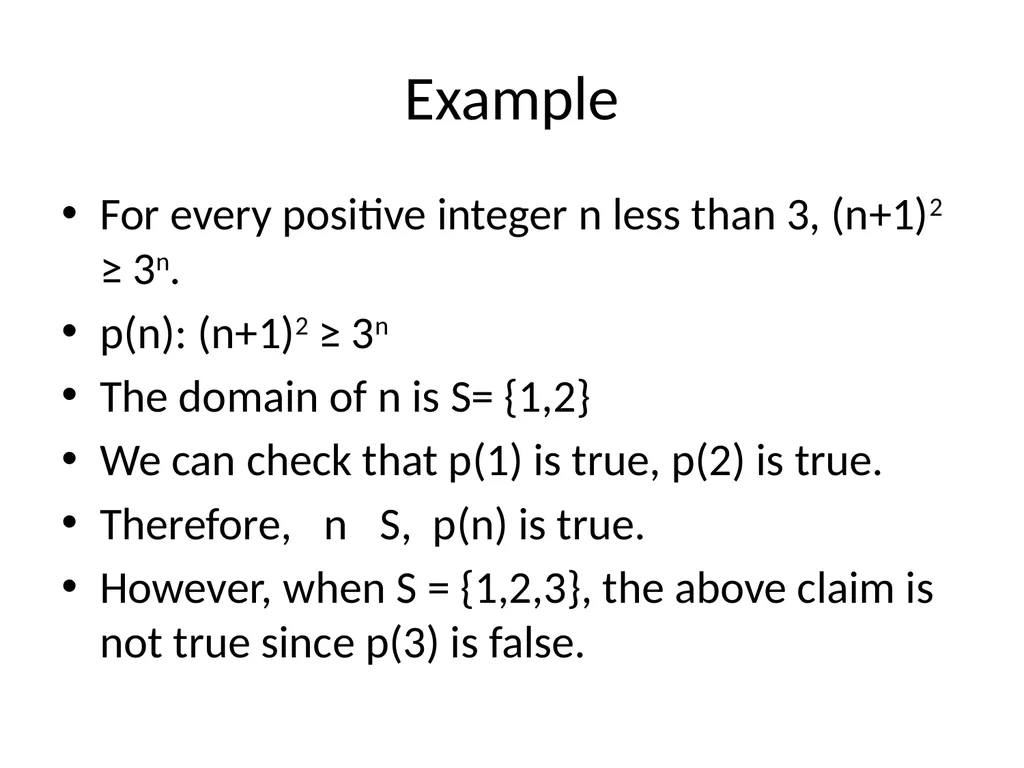
Example For every positive integer n less than 3, (n+1)2 ≥ 3n.
p(n): (n+1)2 ≥ 3n
The domain of n is S= {1,2}
We can check that p(1) is true, p(2) is true.
Therefore, n S, p(n) is true.
However, when S = {1,2,3}, the above claim is not true since p(3) is false.<br>
p(n): (n+1)2 ≥ 3n
The domain of n is S= {1,2}
We can check that p(1) is true, p(2) is true.
Therefore, n S, p(n) is true.
However, when S = {1,2,3}, the above claim is not true since p(3) is false.<br>
12
Counterexamples It is possible to disprove a claim by example as well.
A counterexample is an assignment of values to variables that shows a statement is false.<br>
A counterexample is an assignment of values to variables that shows a statement is false.<br>
13
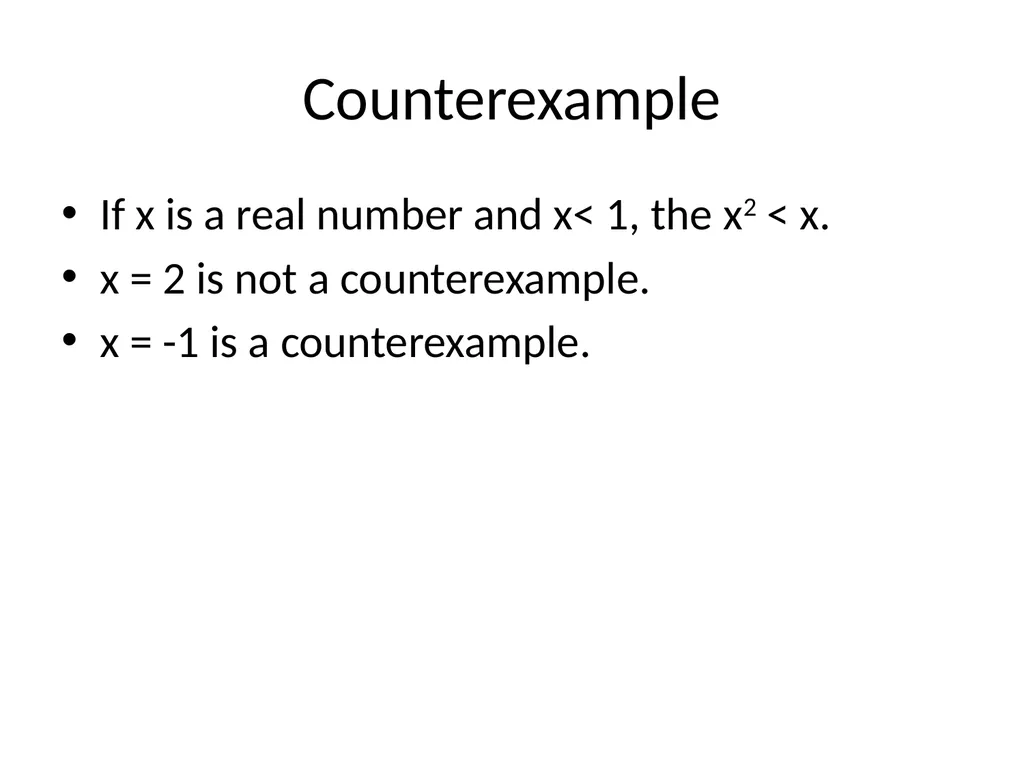
Counterexample If x is a real number and x< 1, the x2 < x.
x = 2 is not a counterexample.
x = -1 is a counterexample.<br>
x = 2 is not a counterexample.
x = -1 is a counterexample.<br>
14
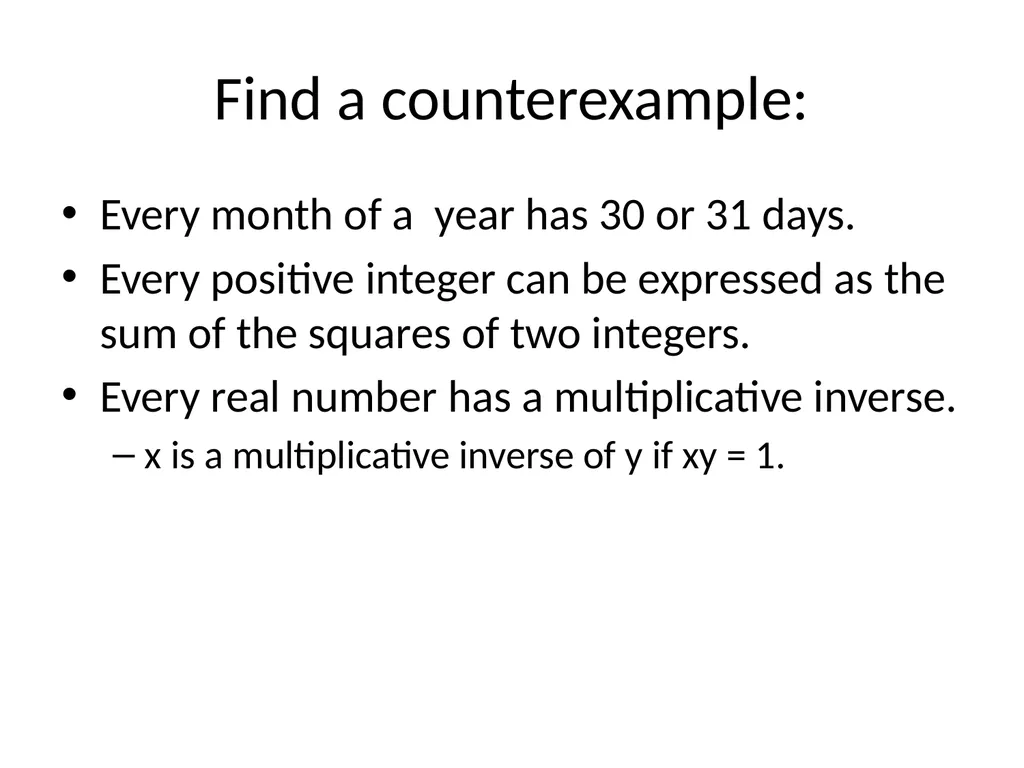
Find a counterexample: Every month of a year has 30 or 31 days.
Every positive integer can be expressed as the sum of the squares of two integers.
Every real number has a multiplicative inverse.
x is a multiplicative inverse of y if xy = 1.<br>
Every positive integer can be expressed as the sum of the squares of two integers.
Every real number has a multiplicative inverse.
x is a multiplicative inverse of y if xy = 1.<br>
15
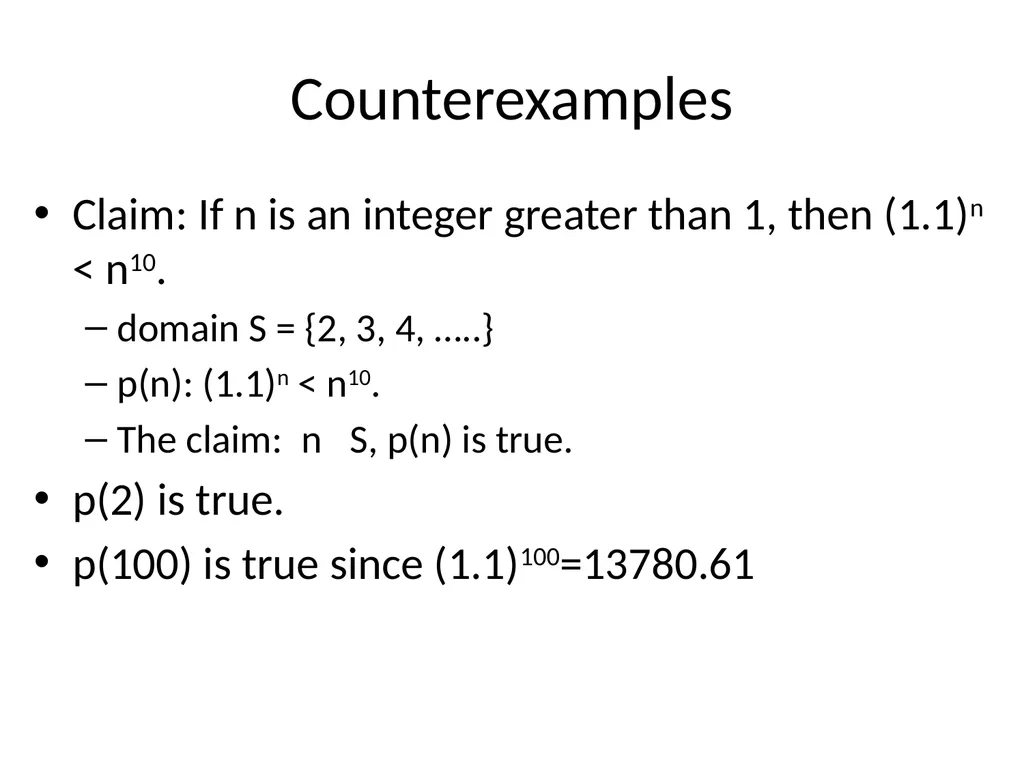
Counterexamples Claim: If n is an integer greater than 1, then (1.1)n < n10.
domain S = {2, 3, 4, …..}
p(n): (1.1)n < n10.
The claim: n S, p(n) is true.
p(2) is true.
p(100) is true since (1.1)100=13780.61<br>
domain S = {2, 3, 4, …..}
p(n): (1.1)n < n10.
The claim: n S, p(n) is true.
p(2) is true.
p(100) is true since (1.1)100=13780.61<br>
16
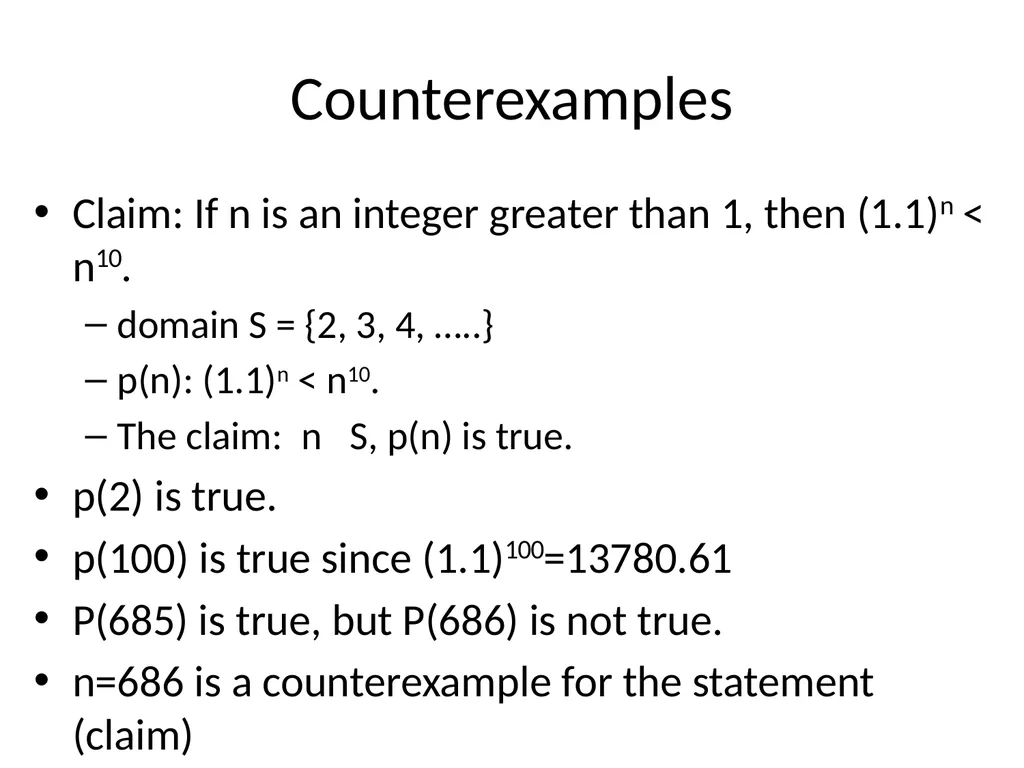
Counterexamples Claim: If n is an integer greater than 1, then (1.1)n < n10.
domain S = {2, 3, 4, …..}
p(n): (1.1)n < n10.
The claim: n S, p(n) is true.
p(2) is true.
p(100) is true since (1.1)100=13780.61
P(685) is true, but P(686) is not true.
n=686 is a counterexample for the statement (claim)<br>
domain S = {2, 3, 4, …..}
p(n): (1.1)n < n10.
The claim: n S, p(n) is true.
p(2) is true.
p(100) is true since (1.1)100=13780.61
P(685) is true, but P(686) is not true.
n=686 is a counterexample for the statement (claim)<br>
17
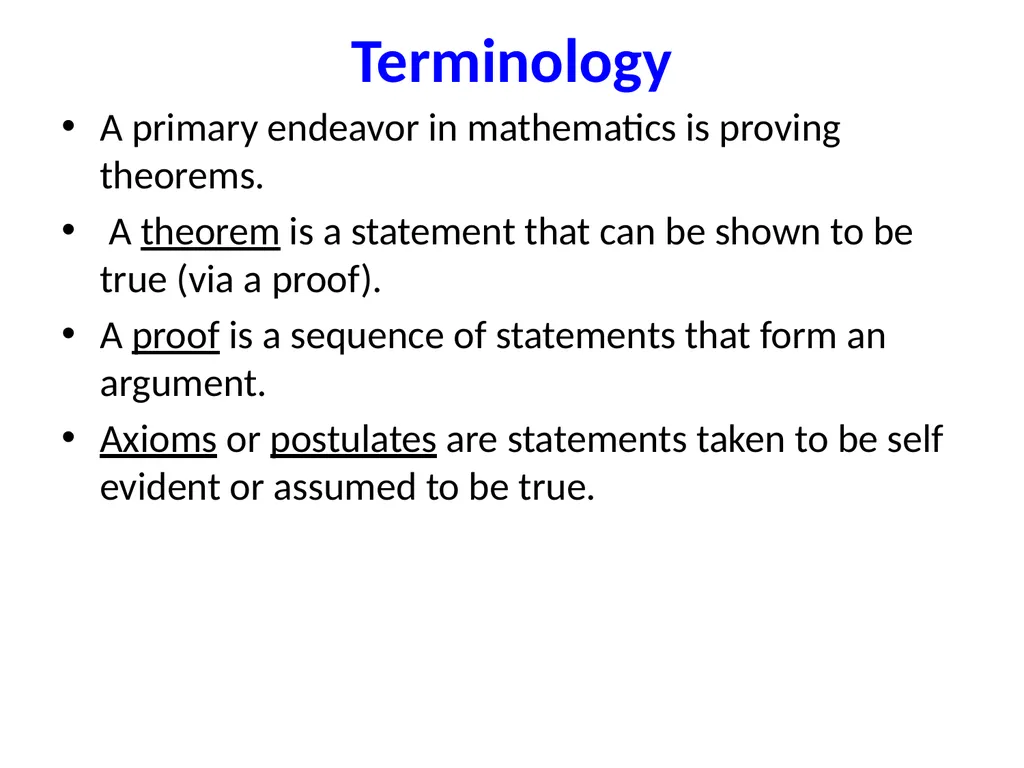
Terminology A primary endeavor in mathematics is proving theorems.
A theorem is a statement that can be shown to be true (via a proof).
A proof is a sequence of statements that form an argument.
Axioms or postulates are statements taken to be self evident or assumed to be true.<br>
A theorem is a statement that can be shown to be true (via a proof).
A proof is a sequence of statements that form an argument.
Axioms or postulates are statements taken to be self evident or assumed to be true.<br>
18
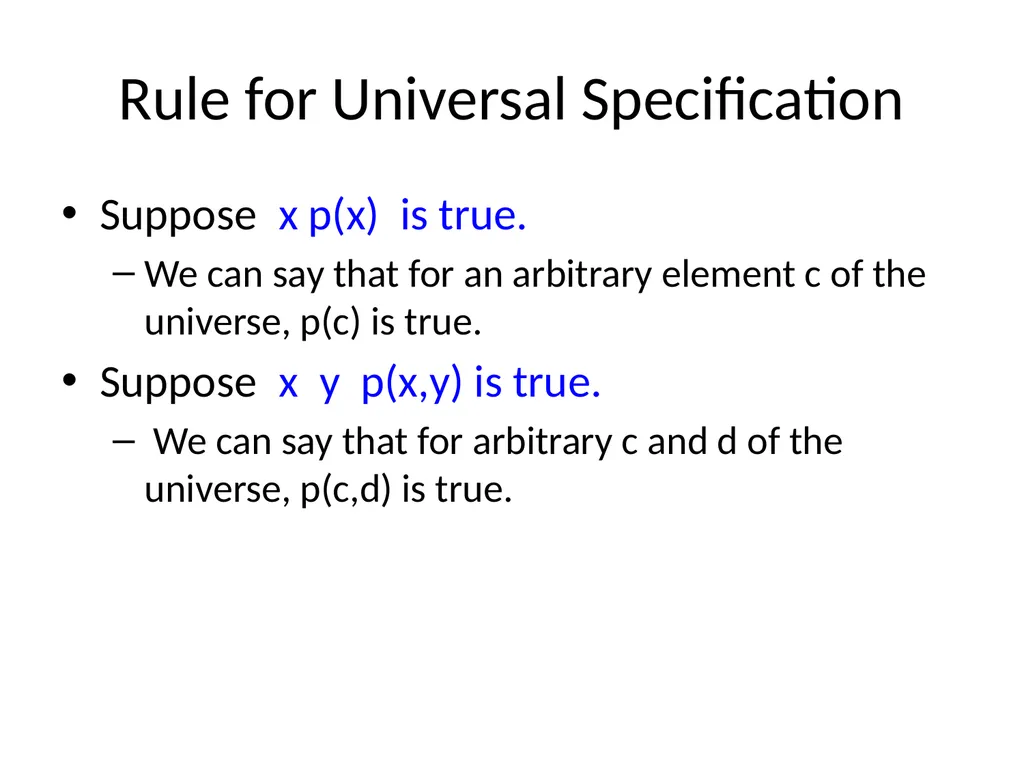
Rule for Universal Specification Suppose x p(x) is true.
We can say that for an arbitrary element c of the universe, p(c) is true.
Suppose x y p(x,y) is true.
We can say that for arbitrary c and d of the universe, p(c,d) is true.<br>
We can say that for an arbitrary element c of the universe, p(c) is true.
Suppose x y p(x,y) is true.
We can say that for arbitrary c and d of the universe, p(c,d) is true.<br>
19
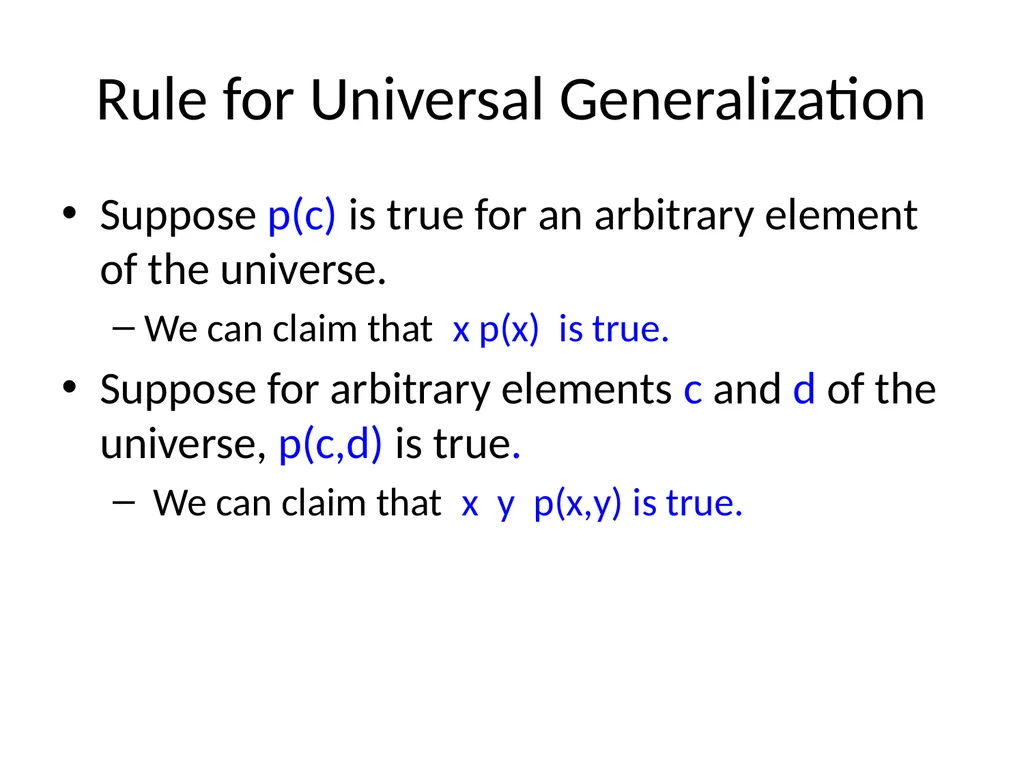
Rule for Universal Generalization Suppose p(c) is true for an arbitrary element of the universe.
We can claim that x p(x) is true.
Suppose for arbitrary elements c and d of the universe, p(c,d) is true.
We can claim that x y p(x,y) is true.<br>
We can claim that x p(x) is true.
Suppose for arbitrary elements c and d of the universe, p(c,d) is true.
We can claim that x y p(x,y) is true.<br>
20
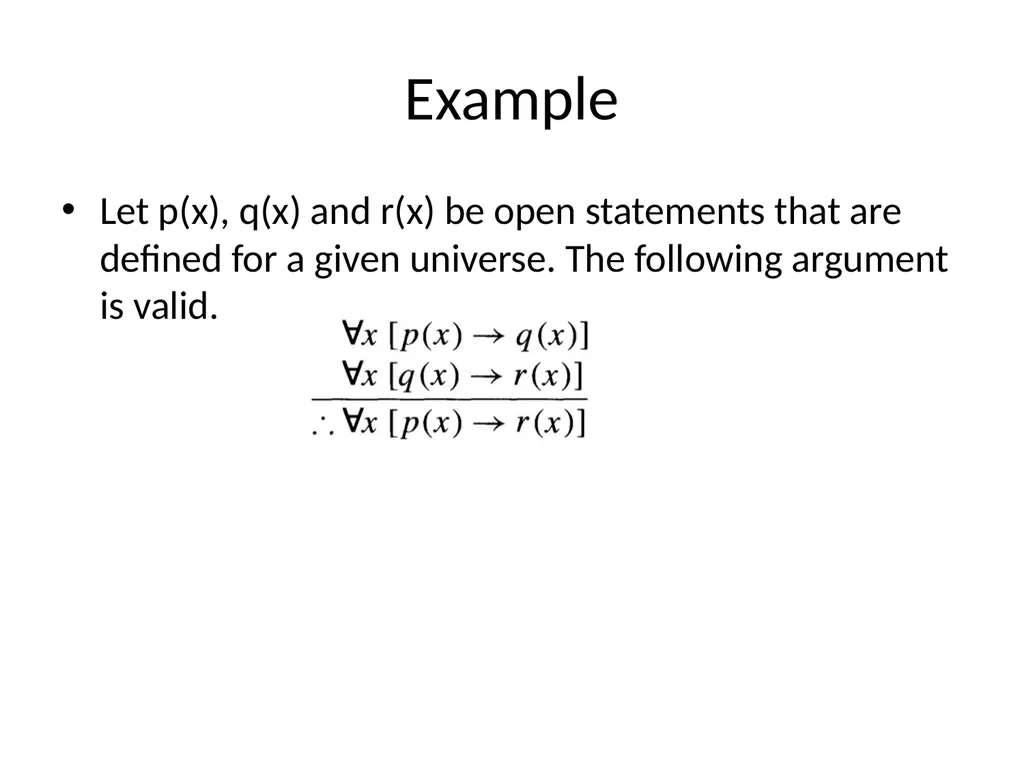
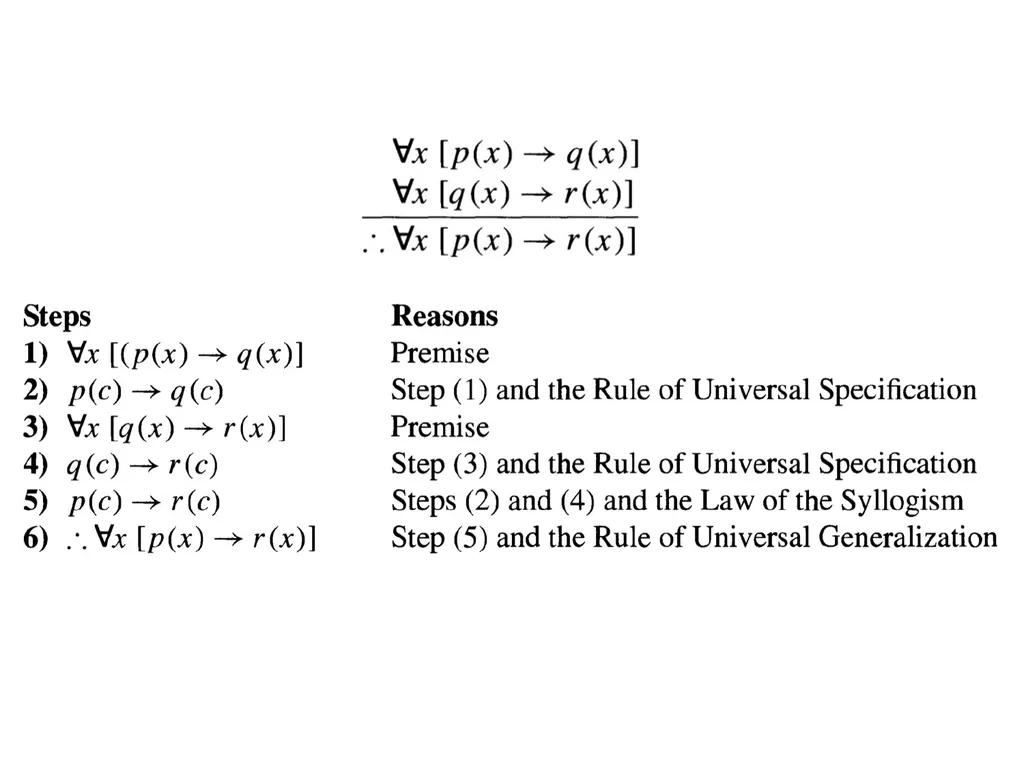
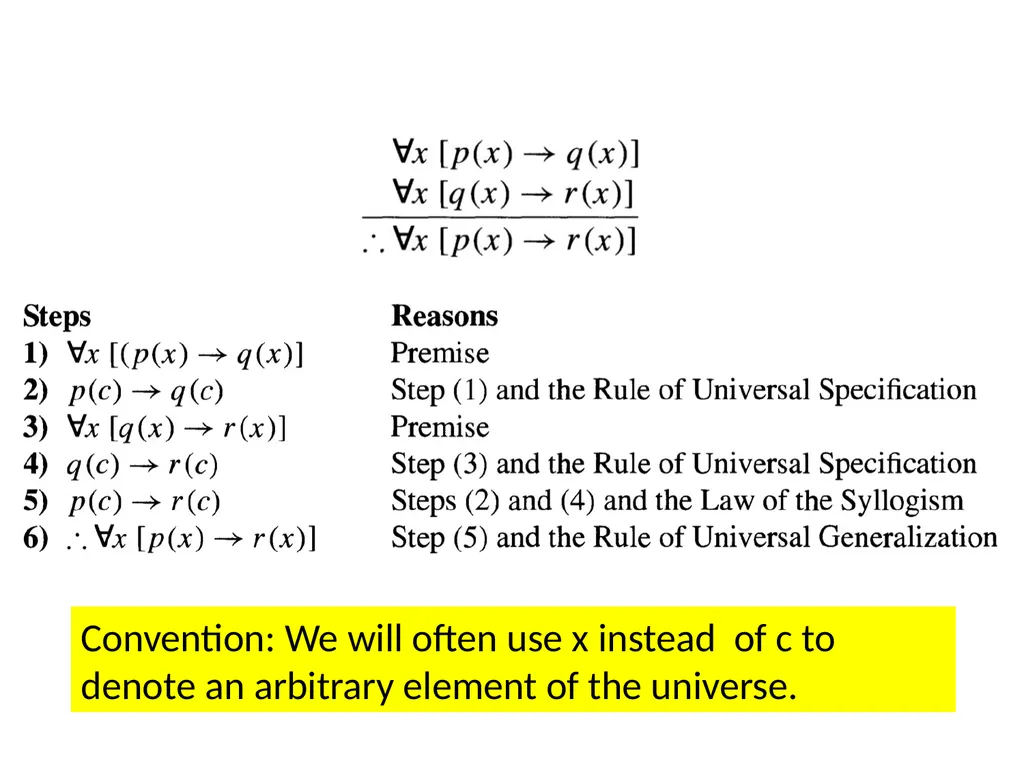
Example Let p(x), q(x) and r(x) be open statements that are defined for a given universe. The following argument is valid.<br>
21
Convention: We will often use x instead of c to denote an arbitrary element of the universe.<br>
22
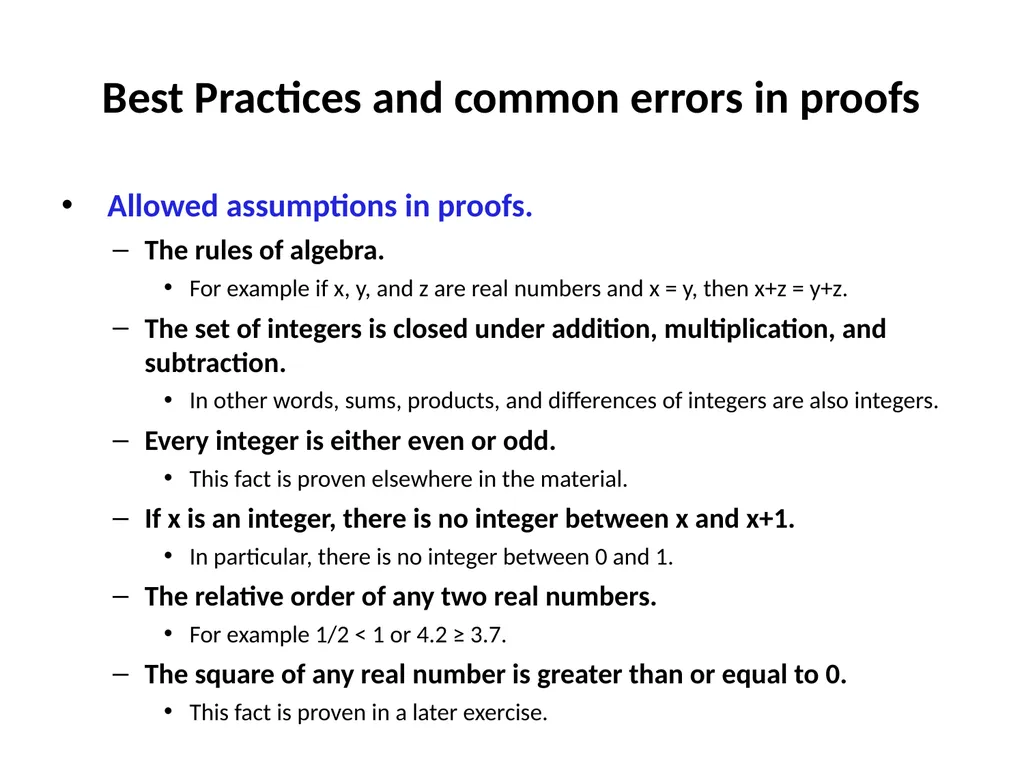
Best Practices and common errors in proofs Allowed assumptions in proofs.
The rules of algebra.
For example if x, y, and z are real numbers and x = y, then x+z = y+z.
The set of integers is closed under addition, multiplication, and subtraction.
In other words, sums, products, and differences of integers are also integers.
Every integer is either even or odd.
This fact is proven elsewhere in the material.
If x is an integer, there is no integer between x and x+1.
In particular, there is no integer between 0 and 1.
The relative order of any two real numbers.
For example 1/2 < 1 or 4.2 ≥ 3.7.
The square of any real number is greater than or equal to 0.
This fact is proven in a later exercise.<br>
The rules of algebra.
For example if x, y, and z are real numbers and x = y, then x+z = y+z.
The set of integers is closed under addition, multiplication, and subtraction.
In other words, sums, products, and differences of integers are also integers.
Every integer is either even or odd.
This fact is proven elsewhere in the material.
If x is an integer, there is no integer between x and x+1.
In particular, there is no integer between 0 and 1.
The relative order of any two real numbers.
For example 1/2 < 1 or 4.2 ≥ 3.7.
The square of any real number is greater than or equal to 0.
This fact is proven in a later exercise.<br>
23
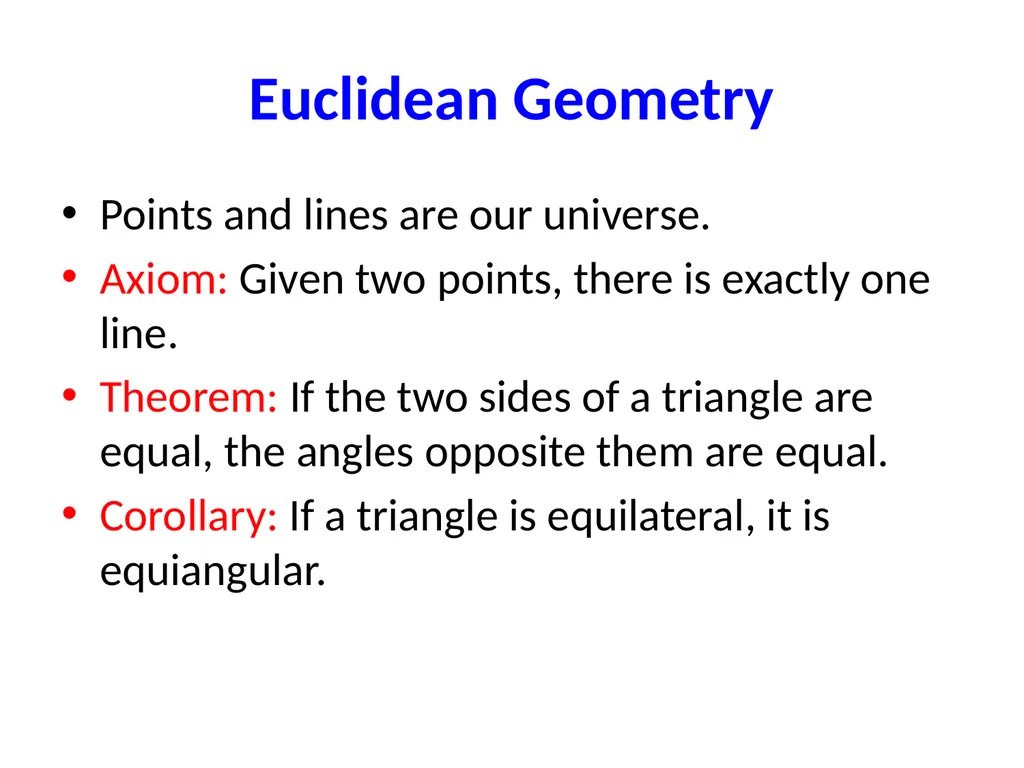
Euclidean Geometry Points and lines are our universe.
Axiom: Given two points, there is exactly one line.
Theorem: If the two sides of a triangle are equal, the angles opposite them are equal.
Corollary: If a triangle is equilateral, it is equiangular.<br>
Axiom: Given two points, there is exactly one line.
Theorem: If the two sides of a triangle are equal, the angles opposite them are equal.
Corollary: If a triangle is equilateral, it is equiangular.<br>
24
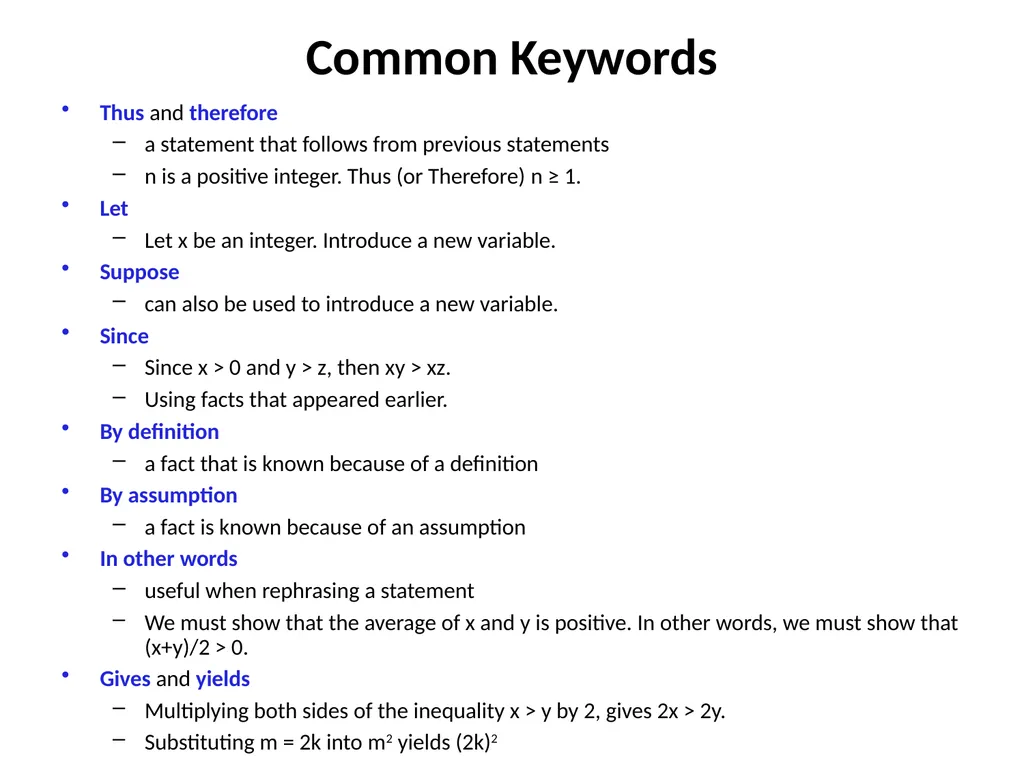
Common Keywords Thus and therefore
a statement that follows from previous statements
n is a positive integer. Thus (or Therefore) n ≥ 1.
Let
Let x be an integer. Introduce a new variable.
Suppose
can also be used to introduce a new variable.
Since
Since x > 0 and y > z, then xy > xz.
Using facts that appeared earlier.
By definition
a fact that is known because of a definition
By assumption
a fact is known because of an assumption
In other words
useful when rephrasing a statement
We must show that the average of x and y is positive. In other words, we must show that (x+y)/2 > 0.
Gives and yields
Multiplying both sides of the inequality x > y by 2, gives 2x > 2y.
Substituting m = 2k into m2 yields (2k)2<br>
a statement that follows from previous statements
n is a positive integer. Thus (or Therefore) n ≥ 1.
Let
Let x be an integer. Introduce a new variable.
Suppose
can also be used to introduce a new variable.
Since
Since x > 0 and y > z, then xy > xz.
Using facts that appeared earlier.
By definition
a fact that is known because of a definition
By assumption
a fact is known because of an assumption
In other words
useful when rephrasing a statement
We must show that the average of x and y is positive. In other words, we must show that (x+y)/2 > 0.
Gives and yields
Multiplying both sides of the inequality x > y by 2, gives 2x > 2y.
Substituting m = 2k into m2 yields (2k)2<br>
25
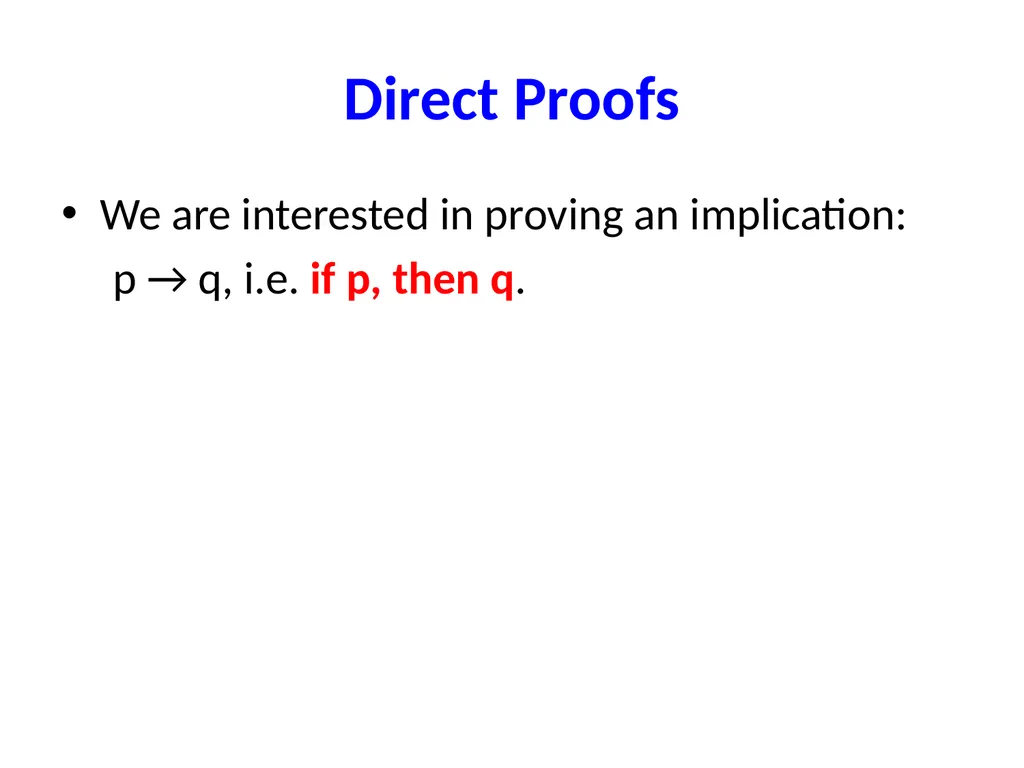
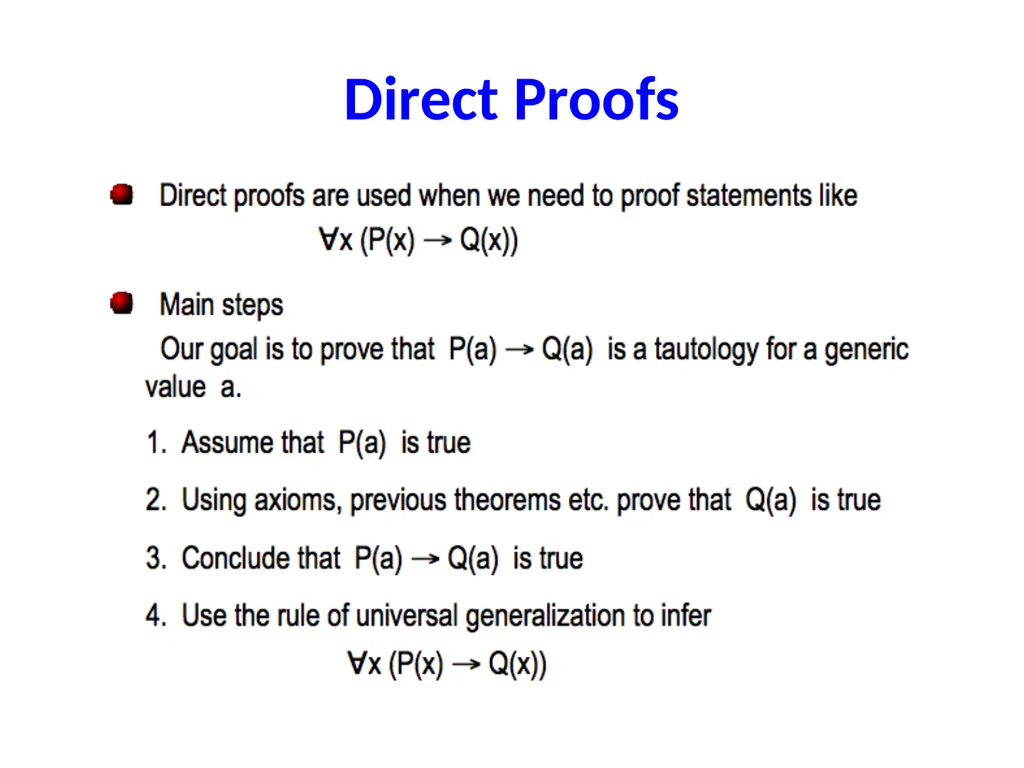
Direct Proofs We are interested in proving an implication:
p → q, i.e. if p, then q.<br>
p → q, i.e. if p, then q.<br>
26
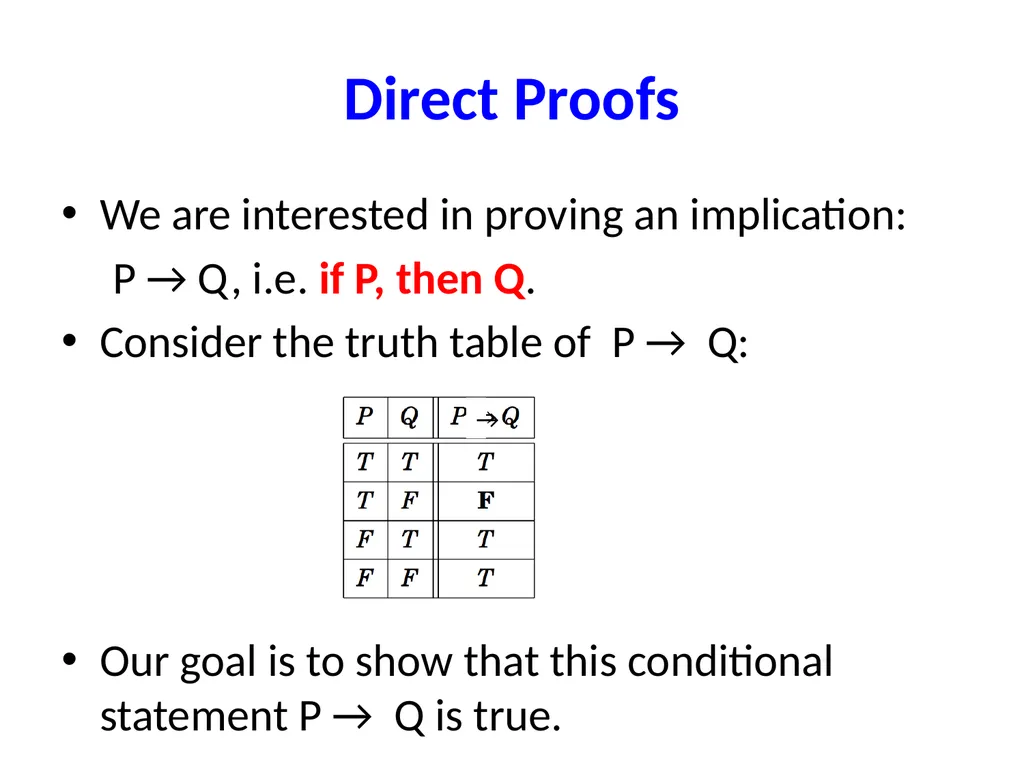
Direct Proofs We are interested in proving an implication:
P → Q, i.e. if P, then Q.
Consider the truth table of P → Q:
Our goal is to show that this conditional statement P → Q is true. →<br>
P → Q, i.e. if P, then Q.
Consider the truth table of P → Q:
Our goal is to show that this conditional statement P → Q is true. →<br>
27
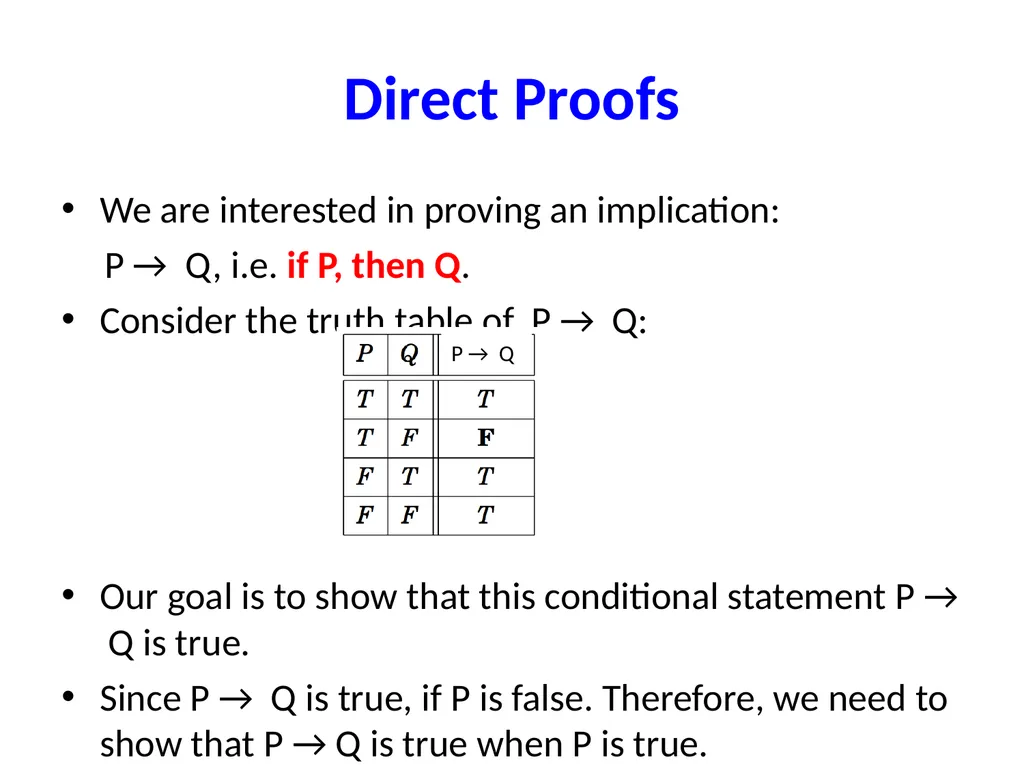
Direct Proofs We are interested in proving an implication:
P → Q, i.e. if P, then Q.
Consider the truth table of P → Q:
Our goal is to show that this conditional statement P → Q is true.
Since P → Q is true, if P is false. Therefore, we need to show that P → Q is true when P is true. P → Q<br>
P → Q, i.e. if P, then Q.
Consider the truth table of P → Q:
Our goal is to show that this conditional statement P → Q is true.
Since P → Q is true, if P is false. Therefore, we need to show that P → Q is true when P is true. P → Q<br>
28
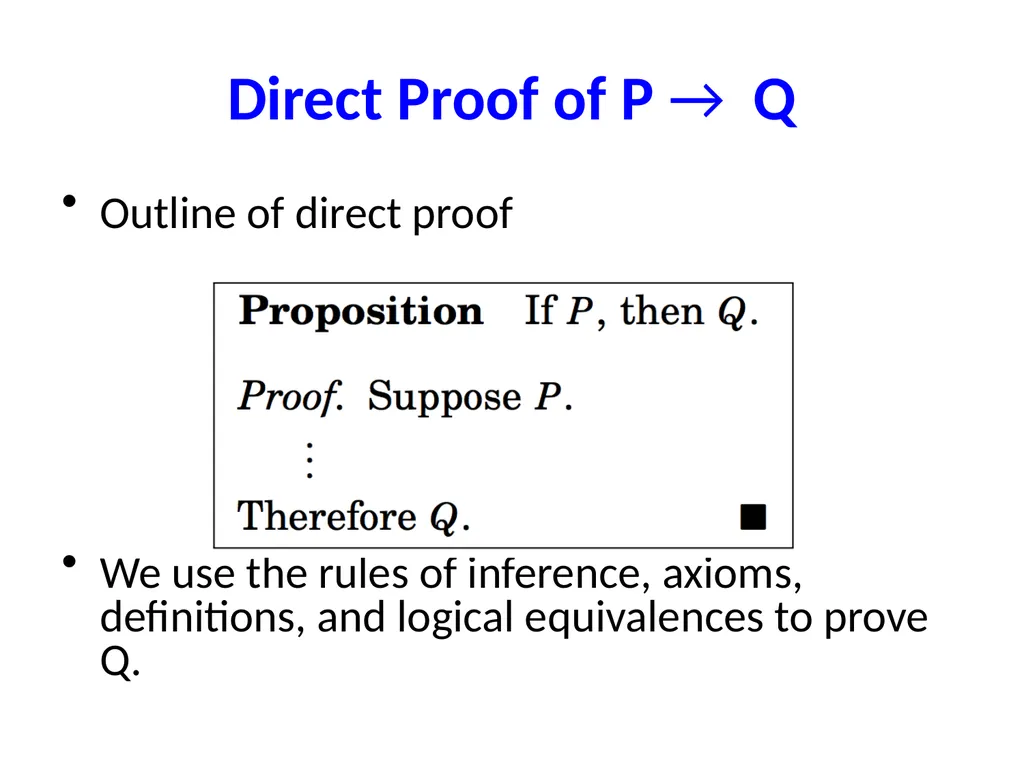
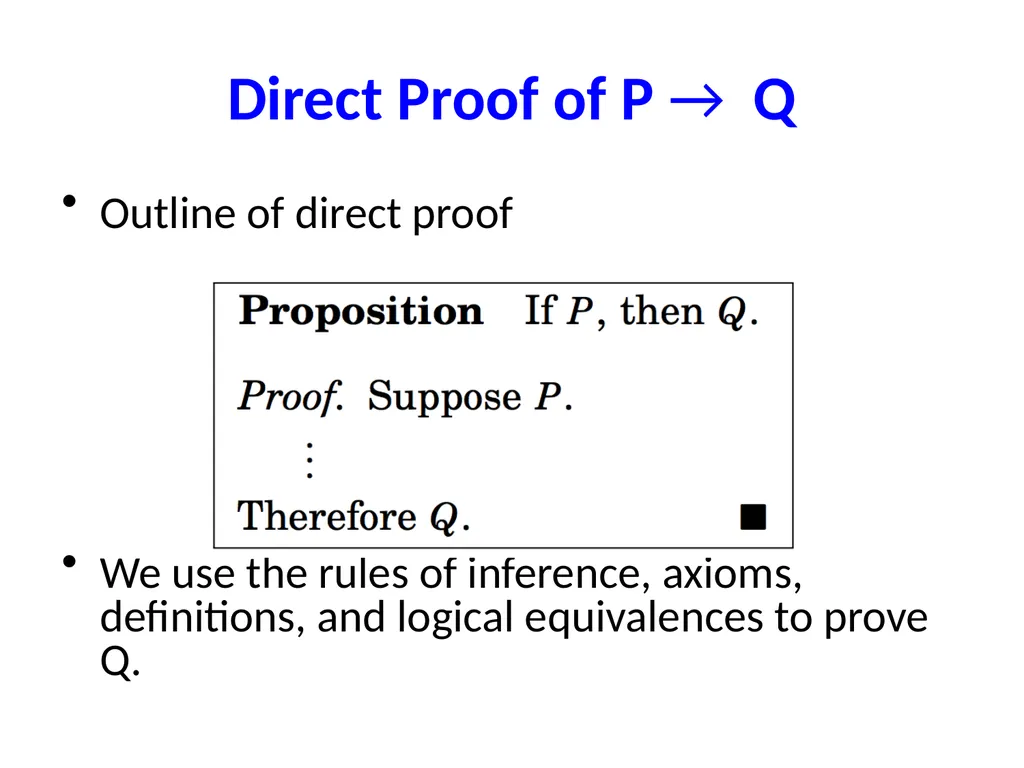
Direct Proof of P → Q Outline of direct proof
We use the rules of inference, axioms, definitions, and logical equivalences to prove Q.<br>
We use the rules of inference, axioms, definitions, and logical equivalences to prove Q.<br>
29
Direct Proofs<br>
30
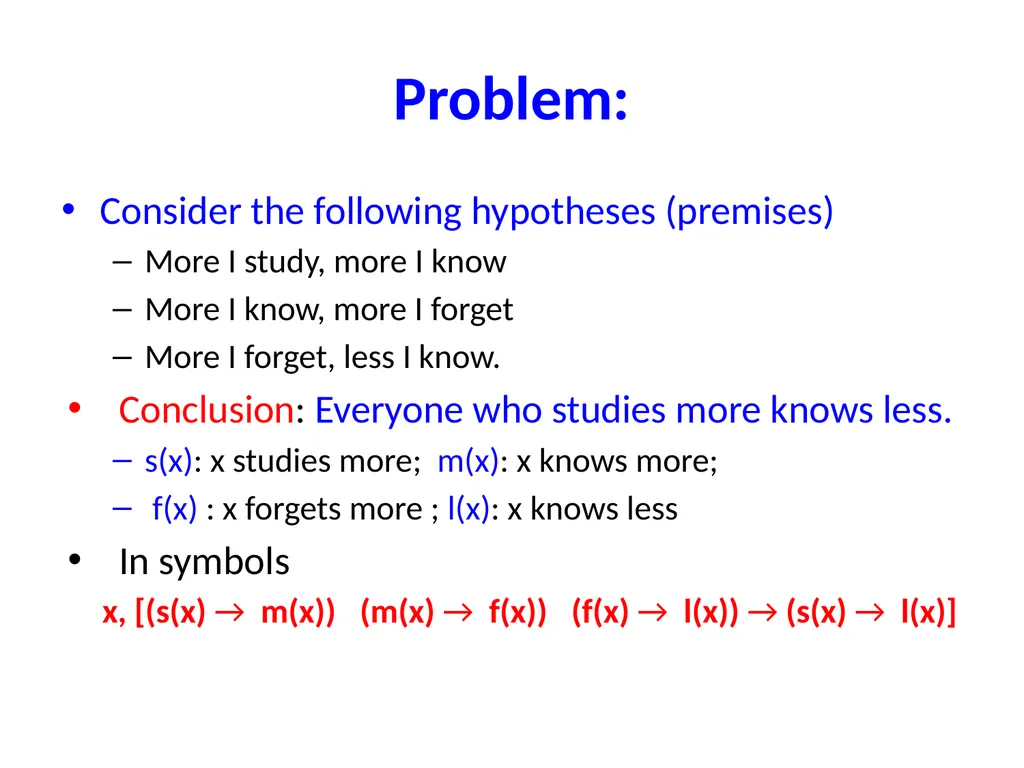
Problem: Consider the following hypotheses (premises)
More I study, more I know
More I know, more I forget
More I forget, less I know.
Conclusion: Everyone who studies more knows less.
s(x): x studies more; m(x): x knows more;
f(x) : x forgets more ; l(x): x knows less
In symbols
x, [(s(x) → m(x)) (m(x) → f(x)) (f(x) → l(x)) → (s(x) → l(x)]<br>
More I study, more I know
More I know, more I forget
More I forget, less I know.
Conclusion: Everyone who studies more knows less.
s(x): x studies more; m(x): x knows more;
f(x) : x forgets more ; l(x): x knows less
In symbols
x, [(s(x) → m(x)) (m(x) → f(x)) (f(x) → l(x)) → (s(x) → l(x)]<br>
31
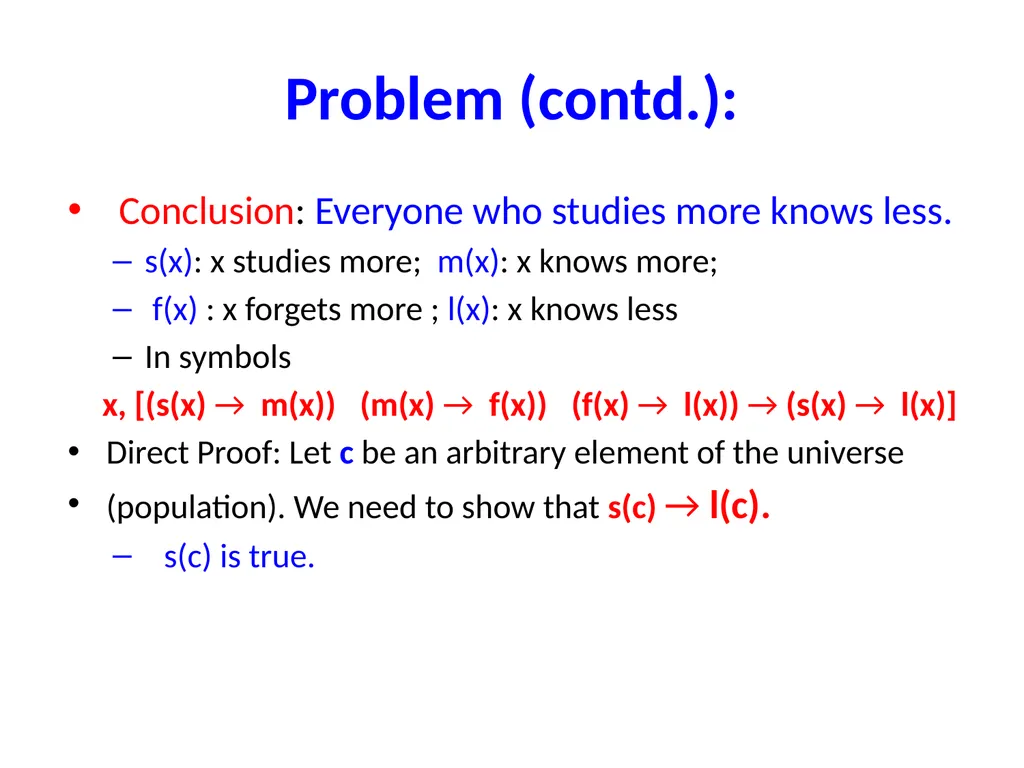
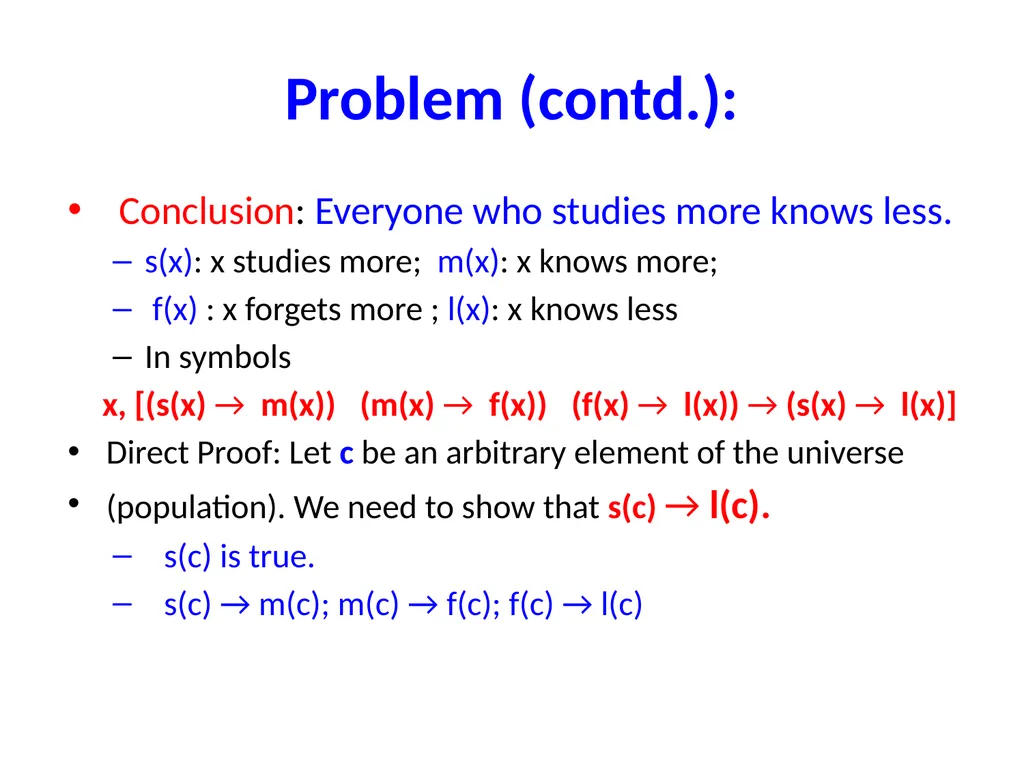
Problem (contd.): Conclusion: Everyone who studies more knows less.
s(x): x studies more; m(x): x knows more;
f(x) : x forgets more ; l(x): x knows less
In symbols
x, [(s(x) → m(x)) (m(x) → f(x)) (f(x) → l(x)) → (s(x) → l(x)]
Direct Proof: Let c be an arbitrary element of the universe
(population). We need to show that s(c) → l(c).
s(c) is true.<br>
s(x): x studies more; m(x): x knows more;
f(x) : x forgets more ; l(x): x knows less
In symbols
x, [(s(x) → m(x)) (m(x) → f(x)) (f(x) → l(x)) → (s(x) → l(x)]
Direct Proof: Let c be an arbitrary element of the universe
(population). We need to show that s(c) → l(c).
s(c) is true.<br>
32
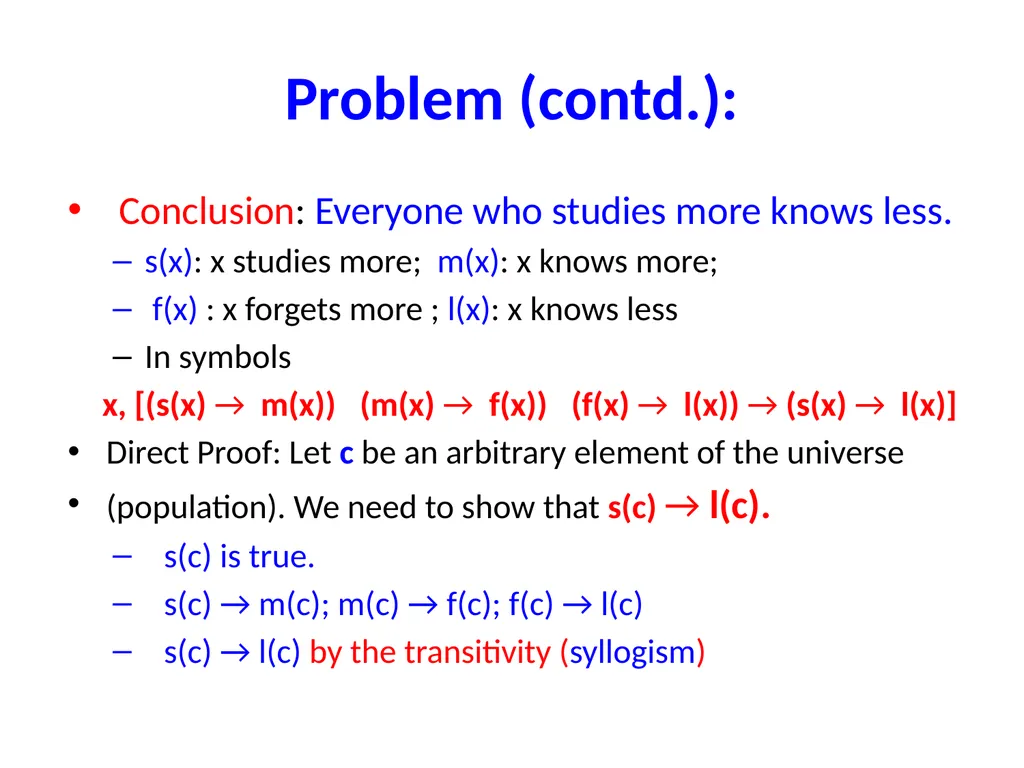
Problem (contd.): Conclusion: Everyone who studies more knows less.
s(x): x studies more; m(x): x knows more;
f(x) : x forgets more ; l(x): x knows less
In symbols
x, [(s(x) → m(x)) (m(x) → f(x)) (f(x) → l(x)) → (s(x) → l(x)]
Direct Proof: Let c be an arbitrary element of the universe
(population). We need to show that s(c) → l(c).
s(c) is true.
s(c) → m(c); m(c) → f(c); f(c) → l(c)<br>
s(x): x studies more; m(x): x knows more;
f(x) : x forgets more ; l(x): x knows less
In symbols
x, [(s(x) → m(x)) (m(x) → f(x)) (f(x) → l(x)) → (s(x) → l(x)]
Direct Proof: Let c be an arbitrary element of the universe
(population). We need to show that s(c) → l(c).
s(c) is true.
s(c) → m(c); m(c) → f(c); f(c) → l(c)<br>
33
Problem (contd.): Conclusion: Everyone who studies more knows less.
s(x): x studies more; m(x): x knows more;
f(x) : x forgets more ; l(x): x knows less
In symbols
x, [(s(x) → m(x)) (m(x) → f(x)) (f(x) → l(x)) → (s(x) → l(x)]
Direct Proof: Let c be an arbitrary element of the universe
(population). We need to show that s(c) → l(c).
s(c) is true.
s(c) → m(c); m(c) → f(c); f(c) → l(c)
s(c) → l(c) by the transitivity (syllogism)<br>
s(x): x studies more; m(x): x knows more;
f(x) : x forgets more ; l(x): x knows less
In symbols
x, [(s(x) → m(x)) (m(x) → f(x)) (f(x) → l(x)) → (s(x) → l(x)]
Direct Proof: Let c be an arbitrary element of the universe
(population). We need to show that s(c) → l(c).
s(c) is true.
s(c) → m(c); m(c) → f(c); f(c) → l(c)
s(c) → l(c) by the transitivity (syllogism)<br>
34
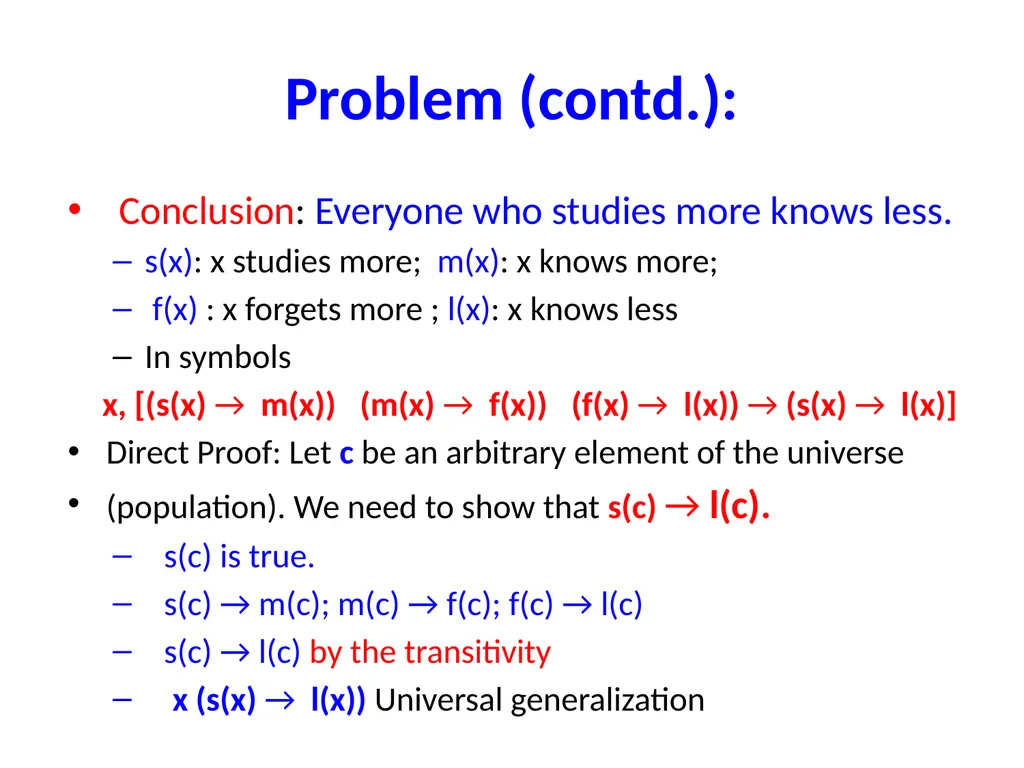
Problem (contd.): Conclusion: Everyone who studies more knows less.
s(x): x studies more; m(x): x knows more;
f(x) : x forgets more ; l(x): x knows less
In symbols
x, [(s(x) → m(x)) (m(x) → f(x)) (f(x) → l(x)) → (s(x) → l(x)]
Direct Proof: Let c be an arbitrary element of the universe
(population). We need to show that s(c) → l(c).
s(c) is true.
s(c) → m(c); m(c) → f(c); f(c) → l(c)
s(c) → l(c) by the transitivity
x (s(x) → l(x)) Universal generalization<br>
s(x): x studies more; m(x): x knows more;
f(x) : x forgets more ; l(x): x knows less
In symbols
x, [(s(x) → m(x)) (m(x) → f(x)) (f(x) → l(x)) → (s(x) → l(x)]
Direct Proof: Let c be an arbitrary element of the universe
(population). We need to show that s(c) → l(c).
s(c) is true.
s(c) → m(c); m(c) → f(c); f(c) → l(c)
s(c) → l(c) by the transitivity
x (s(x) → l(x)) Universal generalization<br>
35
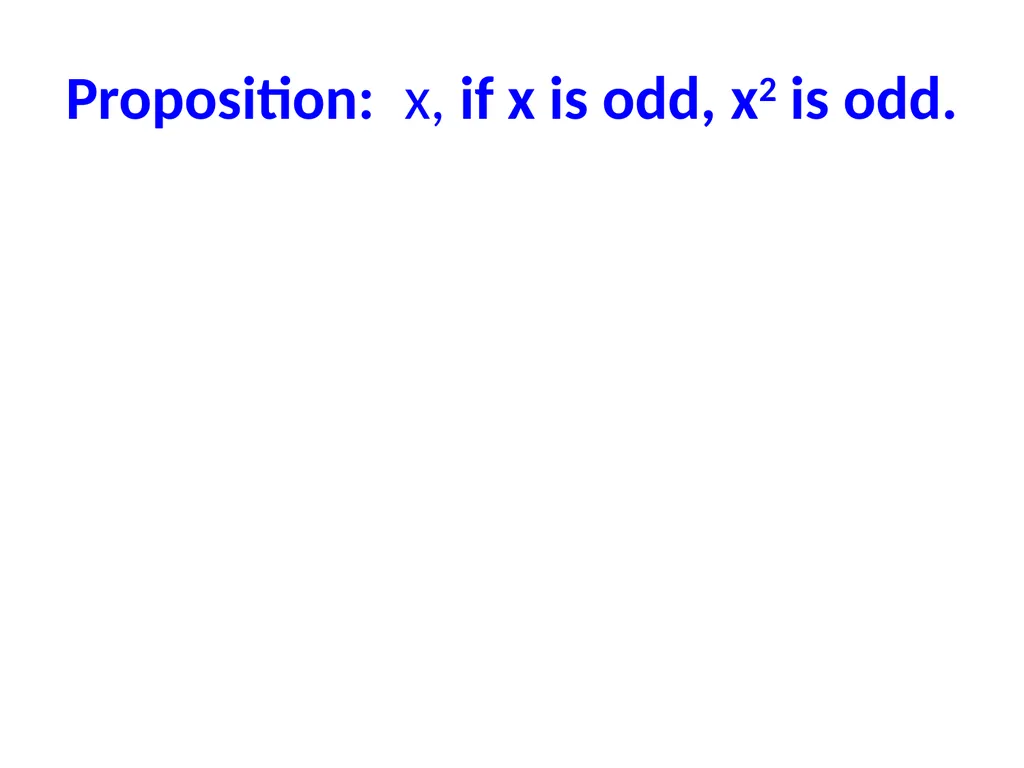
Proposition: x, if x is odd, x2 is odd.<br>
36
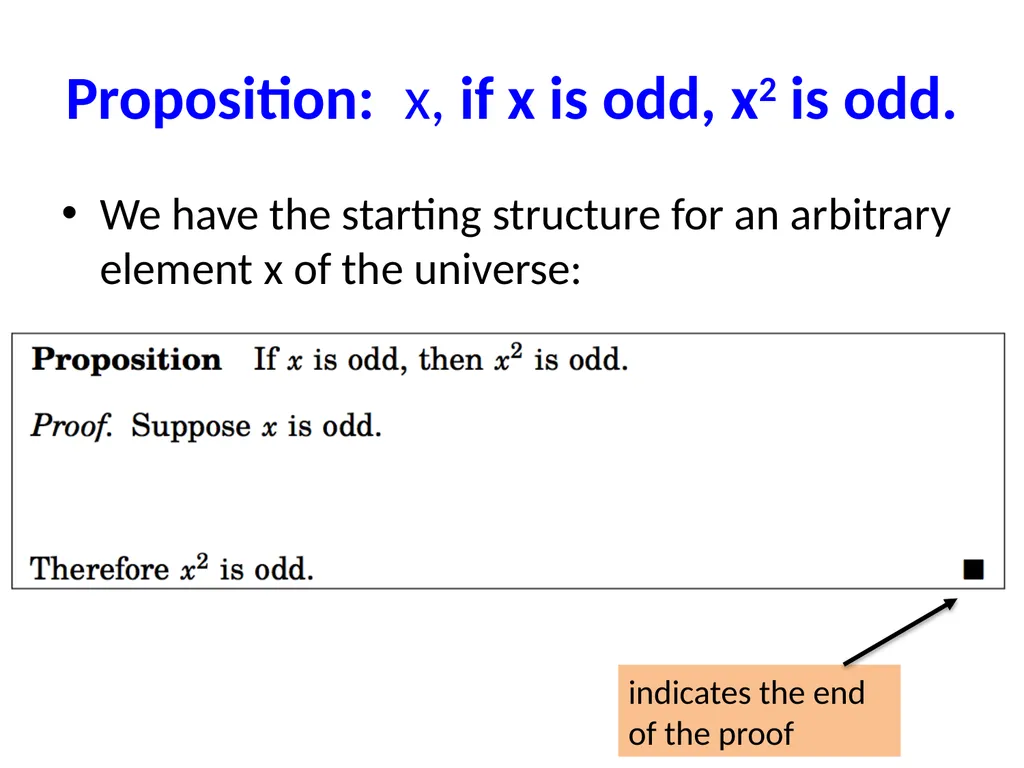
Proposition: x, if x is odd, x2 is odd. We have the starting structure for an arbitrary element x of the universe: indicates the end of the proof<br>
37
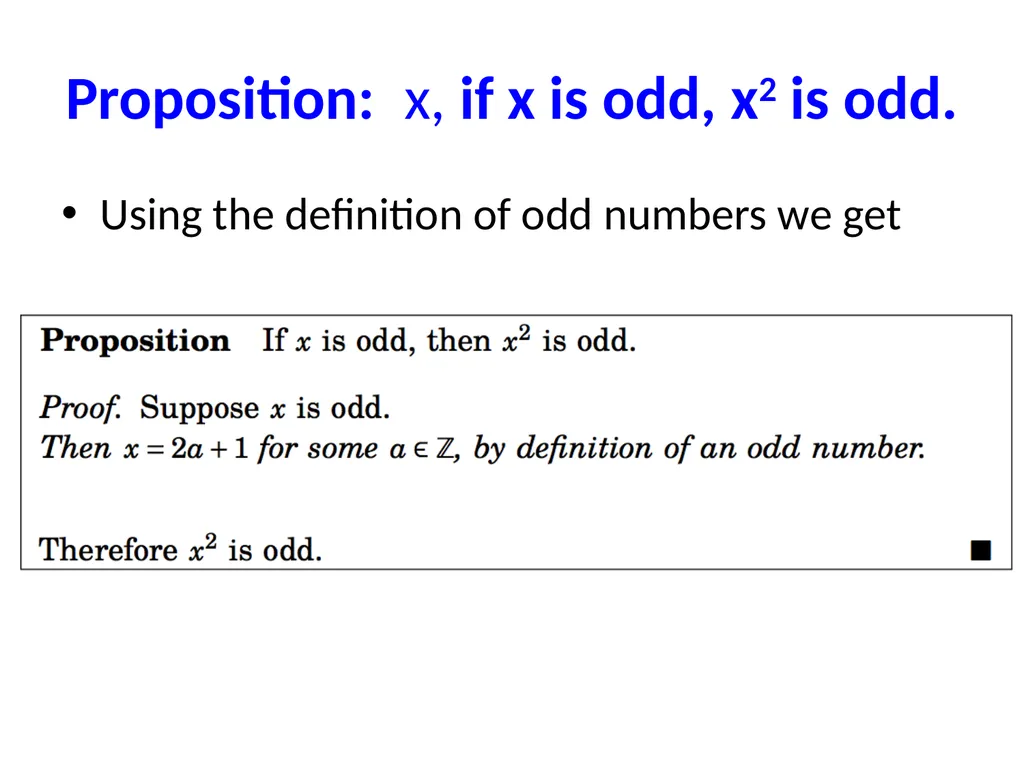
Proposition: x, if x is odd, x2 is odd. Using the definition of odd numbers we get<br>
38
Proposition: x, if x is odd, x2 is odd. We are almost there:<br>
39
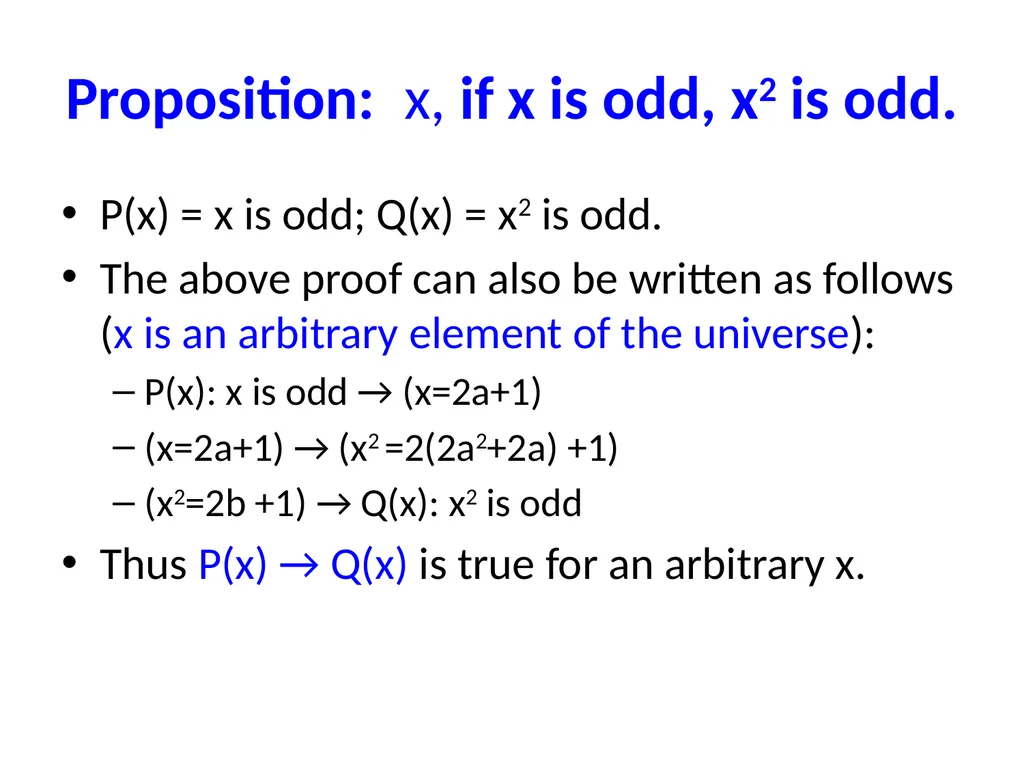
Proposition: x, if x is odd, x2 is odd. P(x) = x is odd; Q(x) = x2 is odd.
The above proof can also be written as follows (x is an arbitrary element of the universe):
P(x): x is odd → (x=2a+1)
(x=2a+1) → (x2 =2(2a2+2a) +1)
(x2=2b +1) → Q(x): x2 is odd
Thus P(x) → Q(x) is true for an arbitrary x.<br>
The above proof can also be written as follows (x is an arbitrary element of the universe):
P(x): x is odd → (x=2a+1)
(x=2a+1) → (x2 =2(2a2+2a) +1)
(x2=2b +1) → Q(x): x2 is odd
Thus P(x) → Q(x) is true for an arbitrary x.<br>
40
Show that 1+2+3+ …+ n =n(n+1)/2 We assume that n N.
We write
x = 1 + 2 + … + n.<br>
We write
x = 1 + 2 + … + n.<br>
41
Show that 1+2+3+ …+ n =n(n+1)/2 We assume that n N.
We write
x = 1 + 2 + … + n.
→ x = n + (n-1) + … + 1. (Commutative property)<br>
We write
x = 1 + 2 + … + n.
→ x = n + (n-1) + … + 1. (Commutative property)<br>
42
Show that 1+2+3+ …+ n =n(n+1)/2 We assume that n N.
We write
x = 1 + 2 + … + n.
→ x = n + (n-1) + … + 1. (Commutative property)
→ 2x = n(n+1) (adding them together)
→ x = n(n+1)/2<br>
We write
x = 1 + 2 + … + n.
→ x = n + (n-1) + … + 1. (Commutative property)
→ 2x = n(n+1) (adding them together)
→ x = n(n+1)/2<br>
43
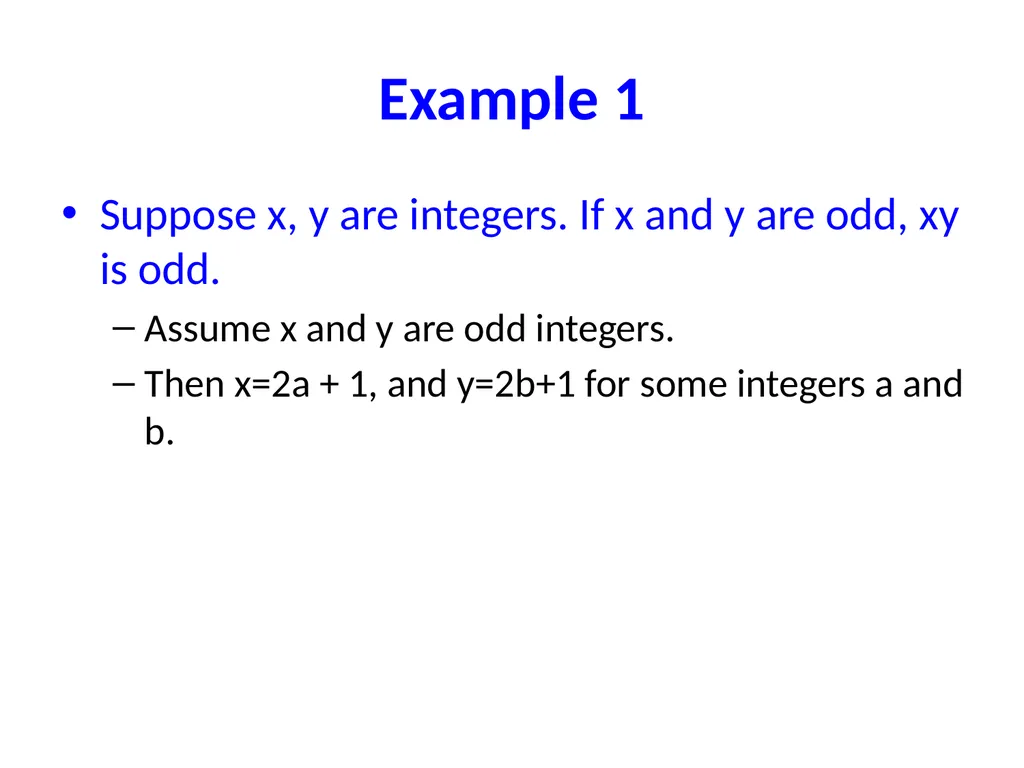
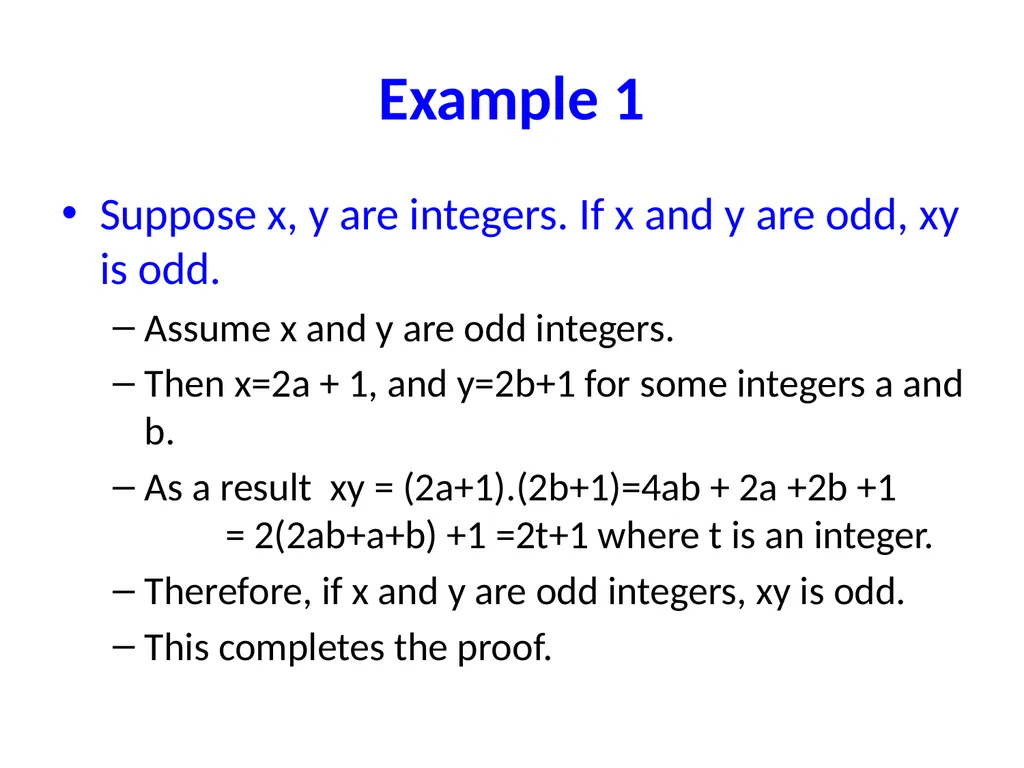
Example 1 Suppose x, y are integers. If x and y are odd, xy is odd.
Assume x and y are odd integers.
Then x=2a + 1, and y=2b+1 for some integers a and b.<br>
Assume x and y are odd integers.
Then x=2a + 1, and y=2b+1 for some integers a and b.<br>
44
Example 1 Suppose x, y are integers. If x and y are odd, xy is odd.
Assume x and y are odd integers.
Then x=2a + 1, and y=2b+1 for some integers a and b.
As a result xy = (2a+1).(2b+1)=4ab + 2a +2b +1 = 2(2ab+a+b) +1 =2t+1 where t is an integer.
Therefore, if x and y are odd integers, xy is odd.
This completes the proof.<br>
Assume x and y are odd integers.
Then x=2a + 1, and y=2b+1 for some integers a and b.
As a result xy = (2a+1).(2b+1)=4ab + 2a +2b +1 = 2(2ab+a+b) +1 =2t+1 where t is an integer.
Therefore, if x and y are odd integers, xy is odd.
This completes the proof.<br>
45
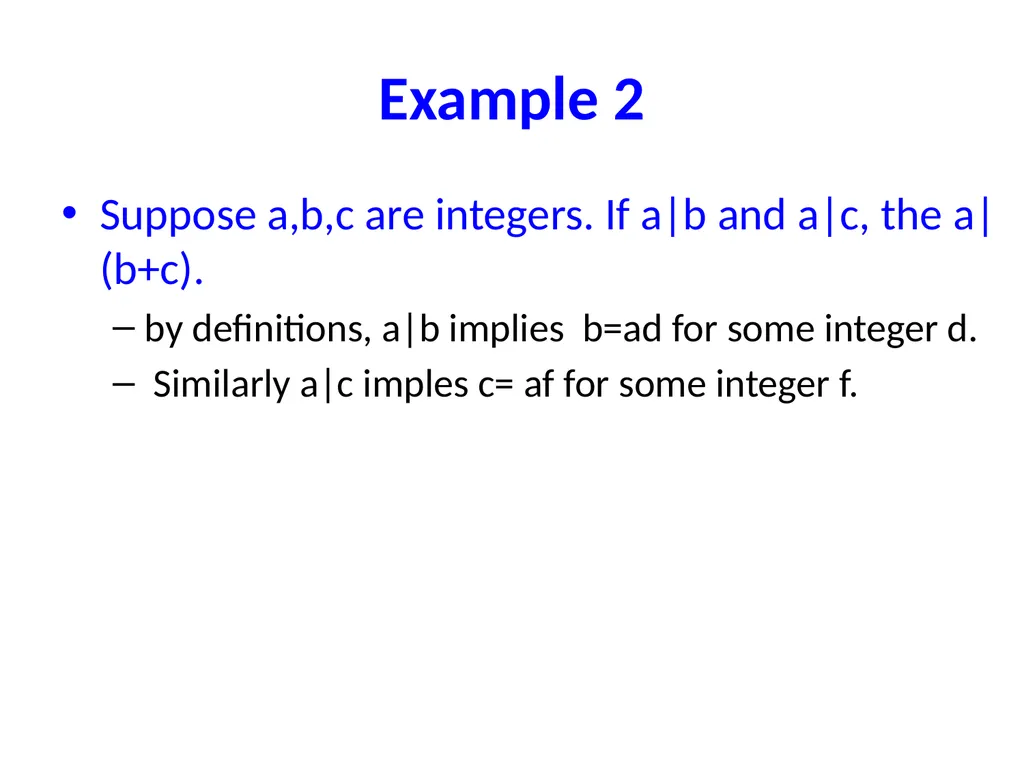
Example 2 Suppose a,b,c are integers. If a|b and a|c, the a|(b+c).
by definitions, a|b implies b=ad for some integer d.
Similarly a|c imples c= af for some integer f.<br>
by definitions, a|b implies b=ad for some integer d.
Similarly a|c imples c= af for some integer f.<br>
46
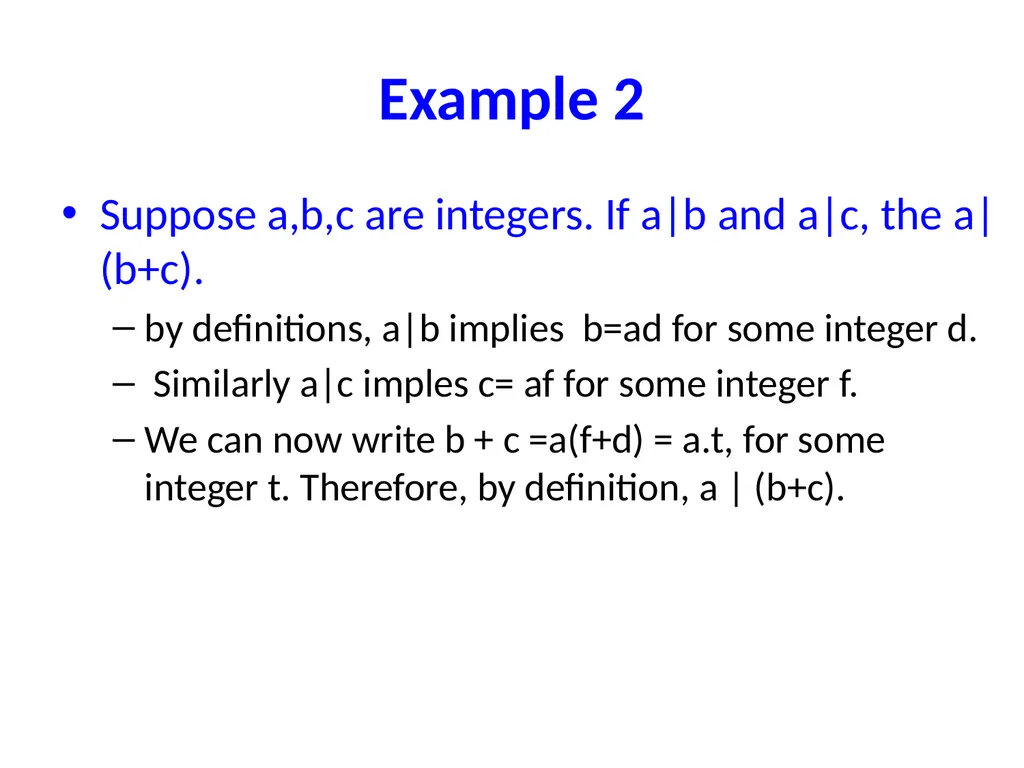
Example 2 Suppose a,b,c are integers. If a|b and a|c, the a|(b+c).
by definitions, a|b implies b=ad for some integer d.
Similarly a|c imples c= af for some integer f.
We can now write b + c =a(f+d) = a.t, for some integer t. Therefore, by definition, a | (b+c).<br>
by definitions, a|b implies b=ad for some integer d.
Similarly a|c imples c= af for some integer f.
We can now write b + c =a(f+d) = a.t, for some integer t. Therefore, by definition, a | (b+c).<br>
47
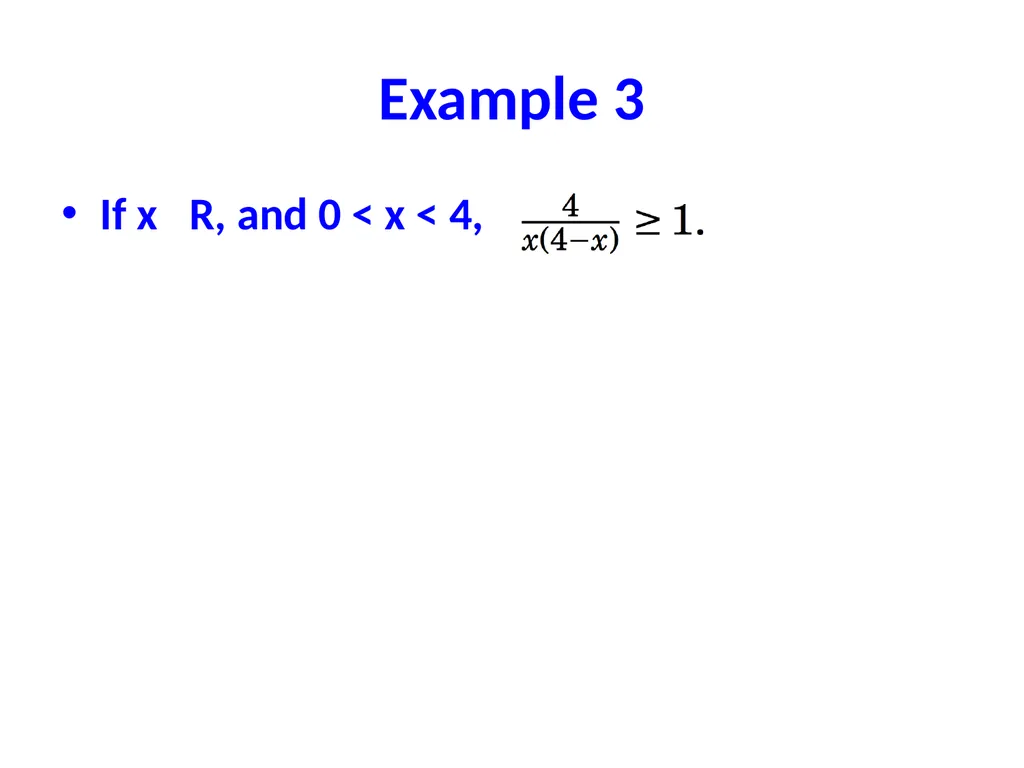
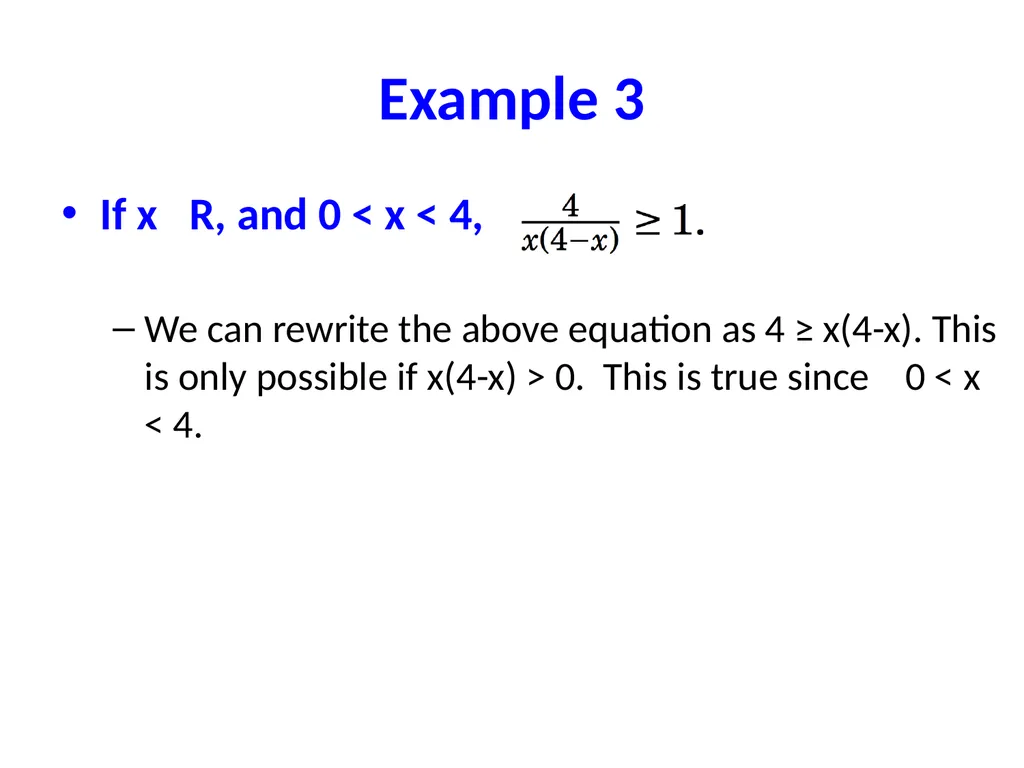
Example 3 If x R, and 0 < x < 4,<br>
48
Example 3 If x R, and 0 < x < 4,
We can rewrite the above equation as 4 ≥ x(4-x). This is only possible if x(4-x) > 0. This is true since 0 < x < 4.<br>
We can rewrite the above equation as 4 ≥ x(4-x). This is only possible if x(4-x) > 0. This is true since 0 < x < 4.<br>
49
Example 3 If x R, and 0 < x < 4,
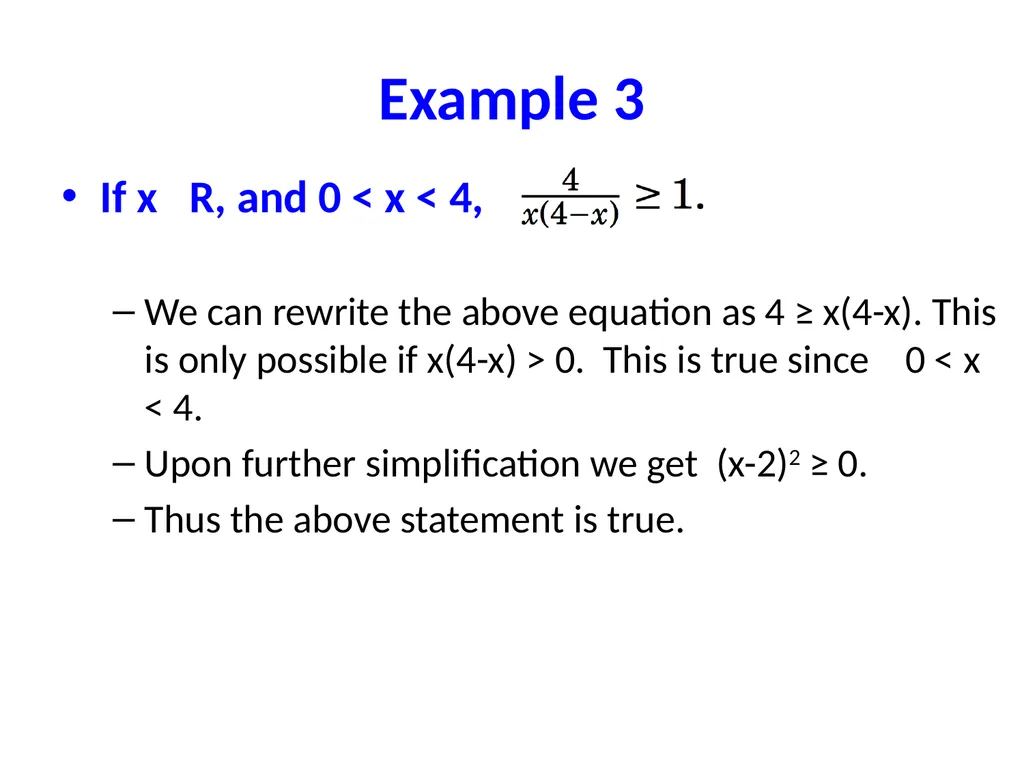
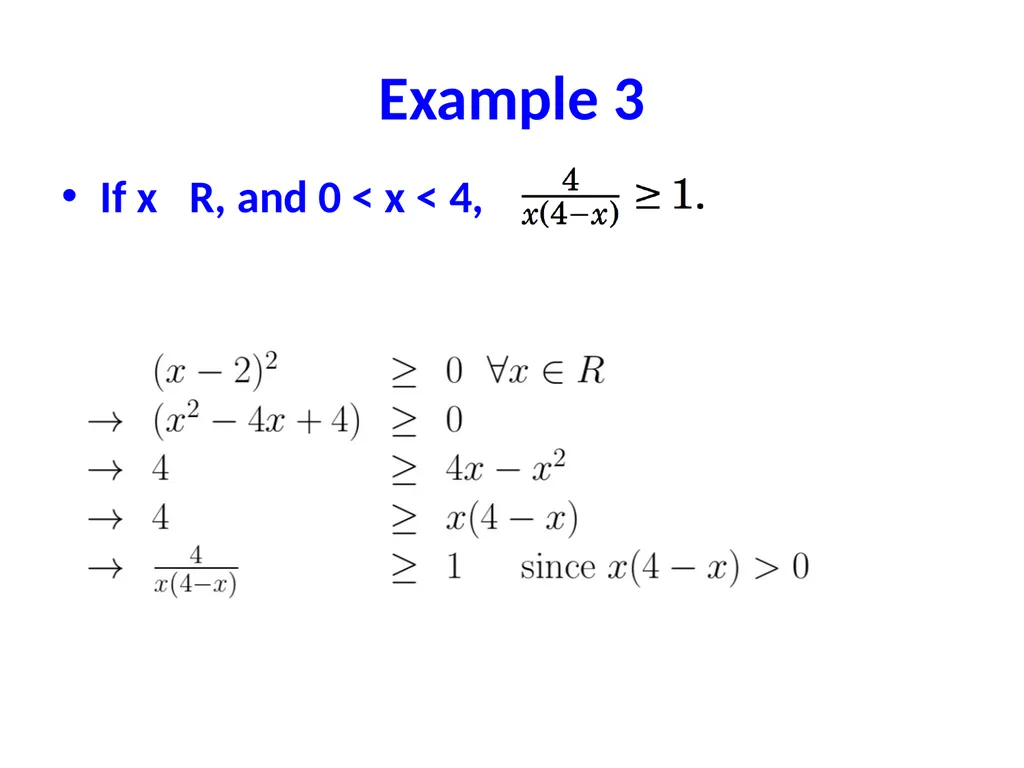
We can rewrite the above equation as 4 ≥ x(4-x). This is only possible if x(4-x) > 0. This is true since 0 < x < 4.
Upon further simplification we get (x-2)2 ≥ 0.
Thus the above statement is true.<br>
We can rewrite the above equation as 4 ≥ x(4-x). This is only possible if x(4-x) > 0. This is true since 0 < x < 4.
Upon further simplification we get (x-2)2 ≥ 0.
Thus the above statement is true.<br>
50
Example 3 If x R, and 0 < x < 4,<br>
51
Direct Proof of P → Q Outline of direct proof
We use the rules of inference, axioms, definitions, and logical equivalences to prove Q.<br>
We use the rules of inference, axioms, definitions, and logical equivalences to prove Q.<br>
52
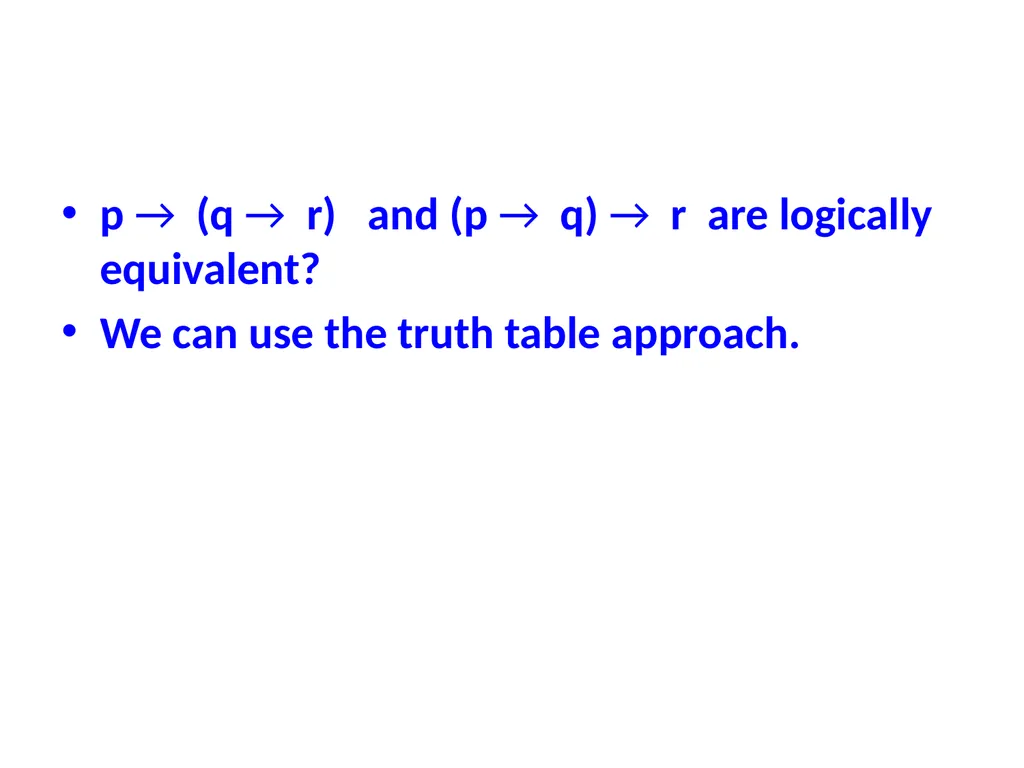
p → (q → r) and (p → q) → r are logically equivalent?
We can use the truth table approach.<br>
We can use the truth table approach.<br>
53
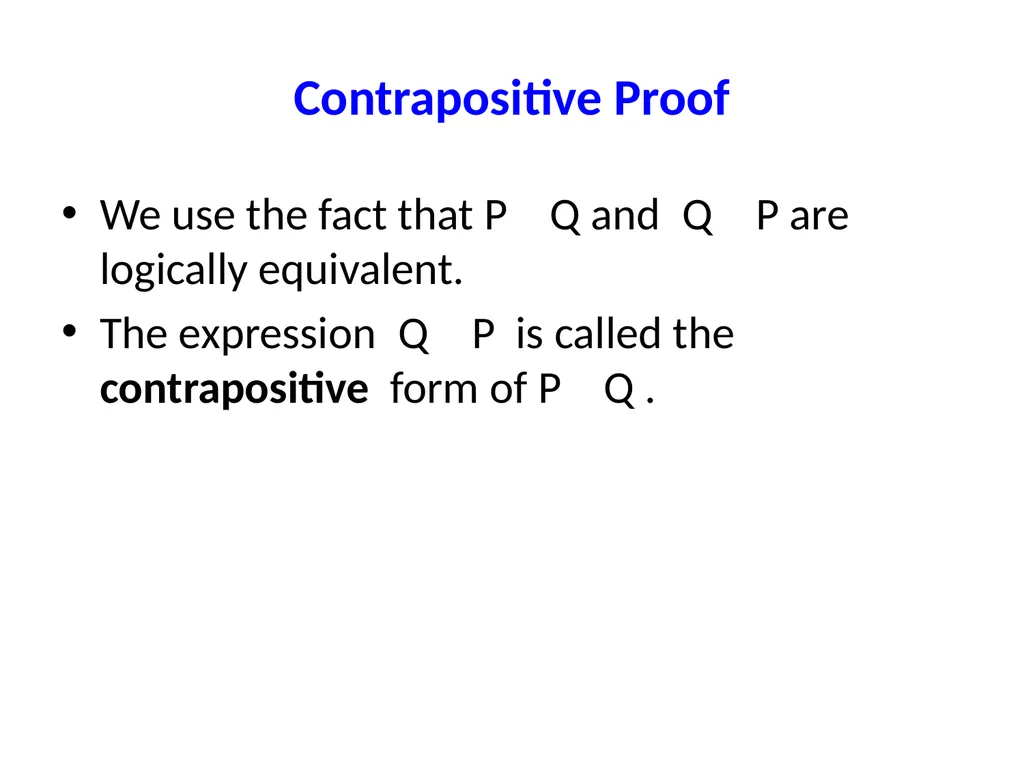
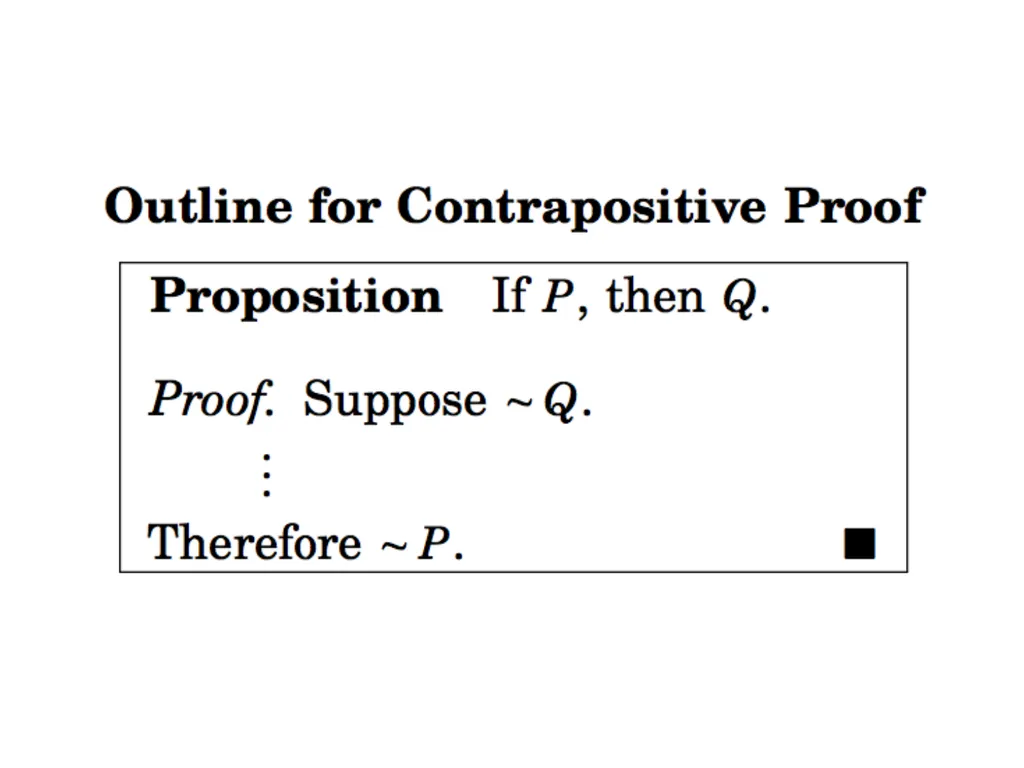
Contrapositive Proof We use the fact that P Q and Q P are logically equivalent.
The expression Q P is called the contrapositive form of P Q .<br>
The expression Q P is called the contrapositive form of P Q .<br>
54
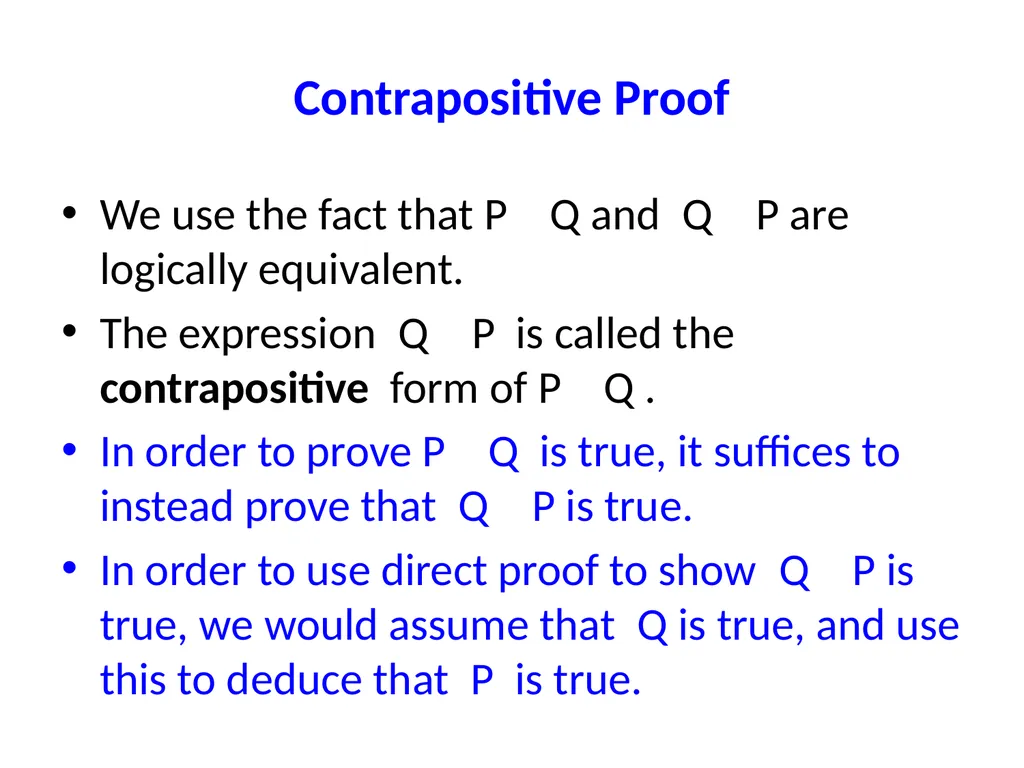
Contrapositive Proof We use the fact that P Q and Q P are logically equivalent.
The expression Q P is called the contrapositive form of P Q .
In order to prove P Q is true, it suffices to instead prove that Q P is true.
In order to use direct proof to show Q P is true, we would assume that Q is true, and use this to deduce that P is true.<br>
The expression Q P is called the contrapositive form of P Q .
In order to prove P Q is true, it suffices to instead prove that Q P is true.
In order to use direct proof to show Q P is true, we would assume that Q is true, and use this to deduce that P is true.<br>
55
Example<br>
56
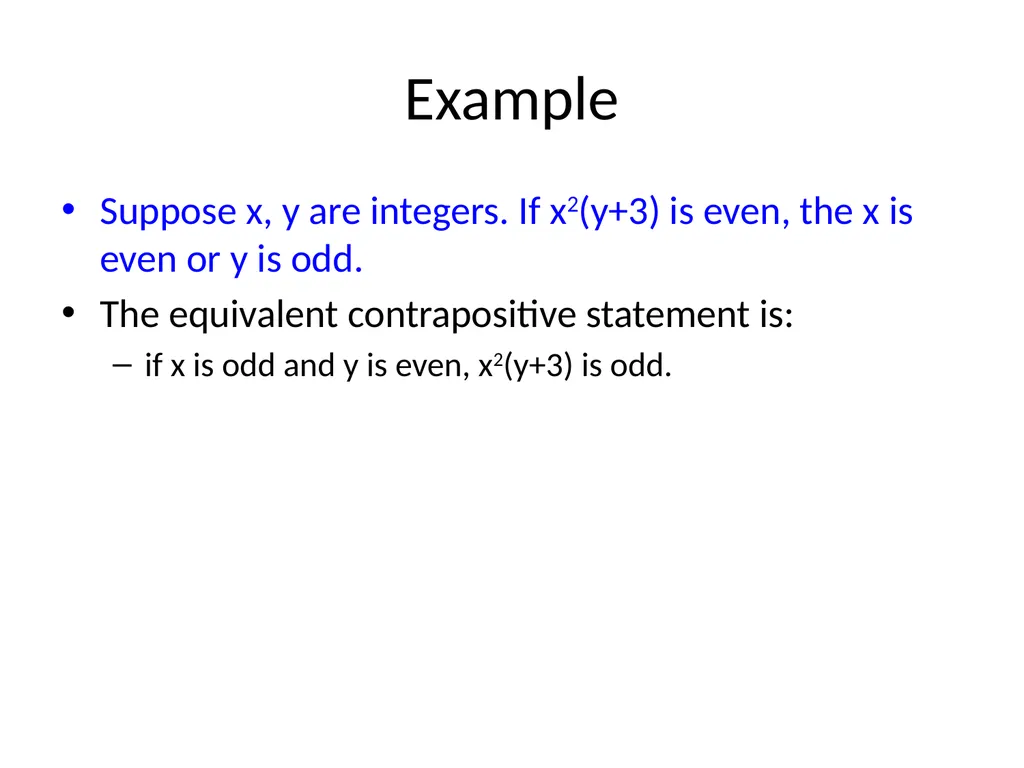
Example Suppose x, y are integers. If x2(y+3) is even, the x is even or y is odd.
The equivalent contrapositive statement is:
if x is odd and y is even, x2(y+3) is odd.<br>
The equivalent contrapositive statement is:
if x is odd and y is even, x2(y+3) is odd.<br>
57
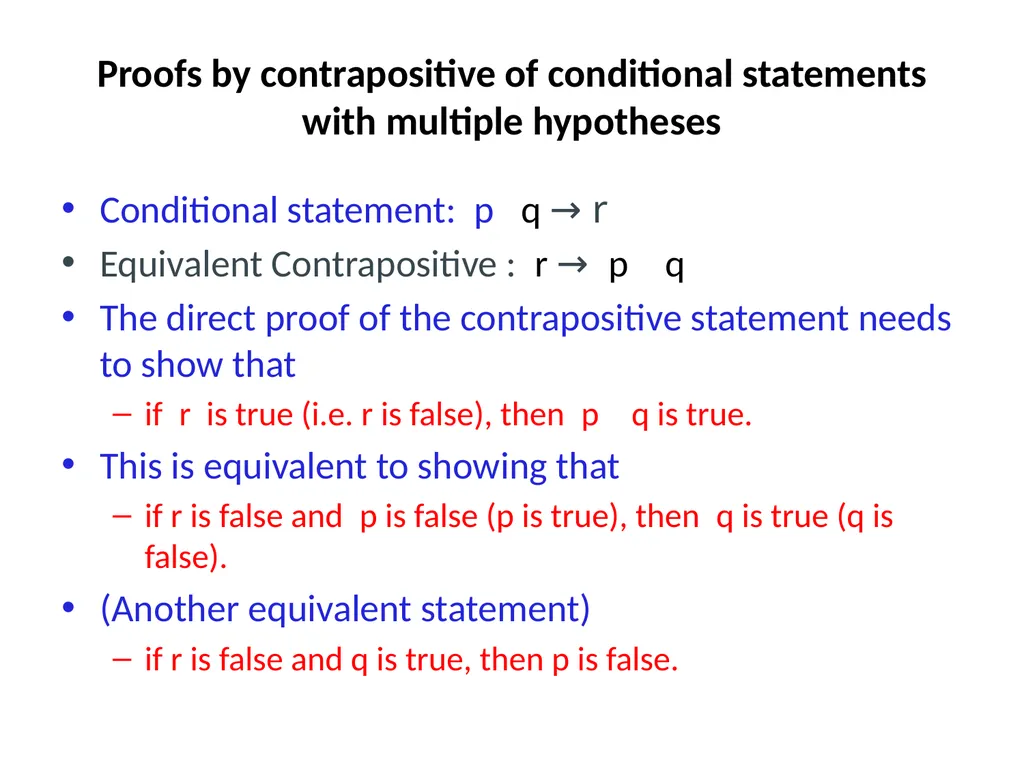
Proofs by contrapositive of conditional statements with multiple hypotheses Conditional statement: p q → r
Equivalent Contrapositive : r → p q
The direct proof of the contrapositive statement needs to show that
if r is true (i.e. r is false), then p q is true.
This is equivalent to showing that
if r is false and p is false (p is true), then q is true (q is false).
(Another equivalent statement)
if r is false and q is true, then p is false.<br>
Equivalent Contrapositive : r → p q
The direct proof of the contrapositive statement needs to show that
if r is true (i.e. r is false), then p q is true.
This is equivalent to showing that
if r is false and p is false (p is true), then q is true (q is false).
(Another equivalent statement)
if r is false and q is true, then p is false.<br>
58
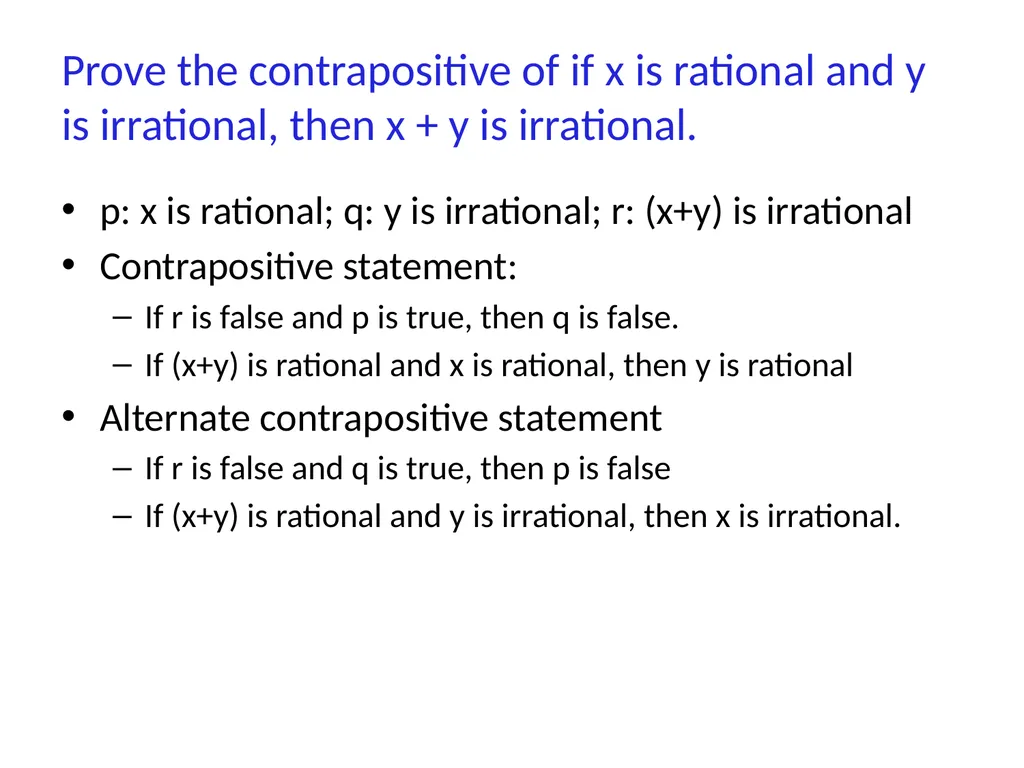
Prove the contrapositive of if x is rational and y is irrational, then x + y is irrational. p: x is rational; q: y is irrational; r: (x+y) is irrational
Contrapositive statement:
If r is false and p is true, then q is false.
If (x+y) is rational and x is rational, then y is rational
Alternate contrapositive statement
If r is false and q is true, then p is false
If (x+y) is rational and y is irrational, then x is irrational.<br>
Contrapositive statement:
If r is false and p is true, then q is false.
If (x+y) is rational and x is rational, then y is rational
Alternate contrapositive statement
If r is false and q is true, then p is false
If (x+y) is rational and y is irrational, then x is irrational.<br>
59
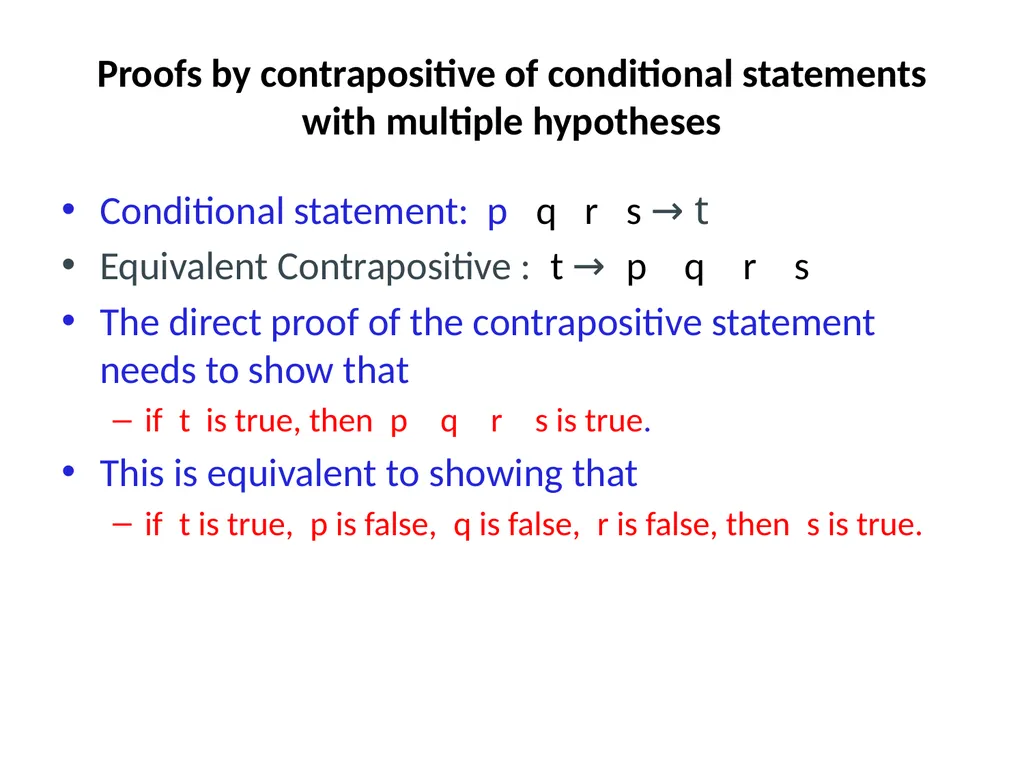
Proofs by contrapositive of conditional statements with multiple hypotheses Conditional statement: p q r s → t
Equivalent Contrapositive : t → p q r s
The direct proof of the contrapositive statement needs to show that
if t is true, then p q r s is true.
This is equivalent to showing that
if t is true, p is false, q is false, r is false, then s is true.<br>
Equivalent Contrapositive : t → p q r s
The direct proof of the contrapositive statement needs to show that
if t is true, then p q r s is true.
This is equivalent to showing that
if t is true, p is false, q is false, r is false, then s is true.<br>
60
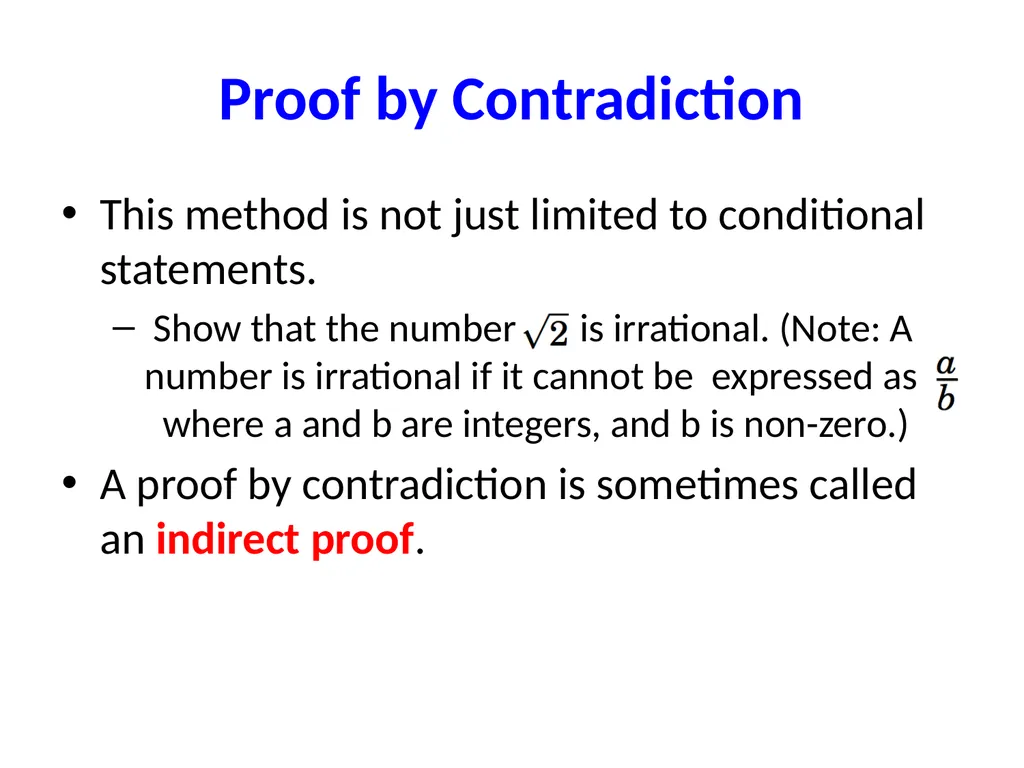
Proof by Contradiction This method is not just limited to conditional statements.
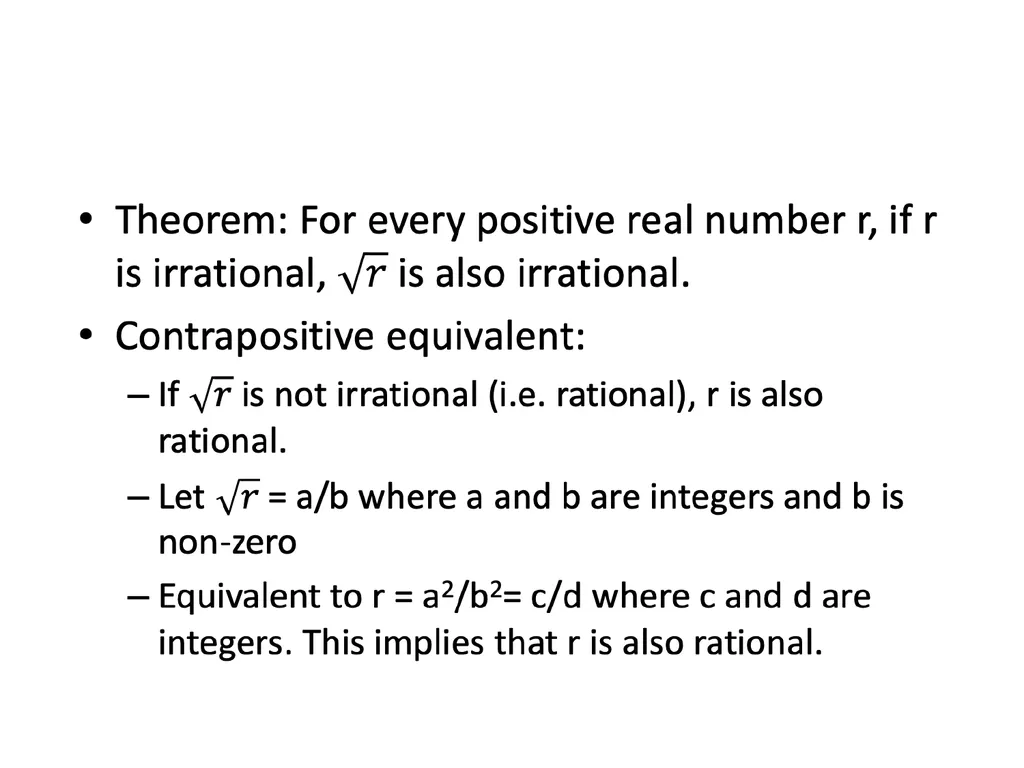
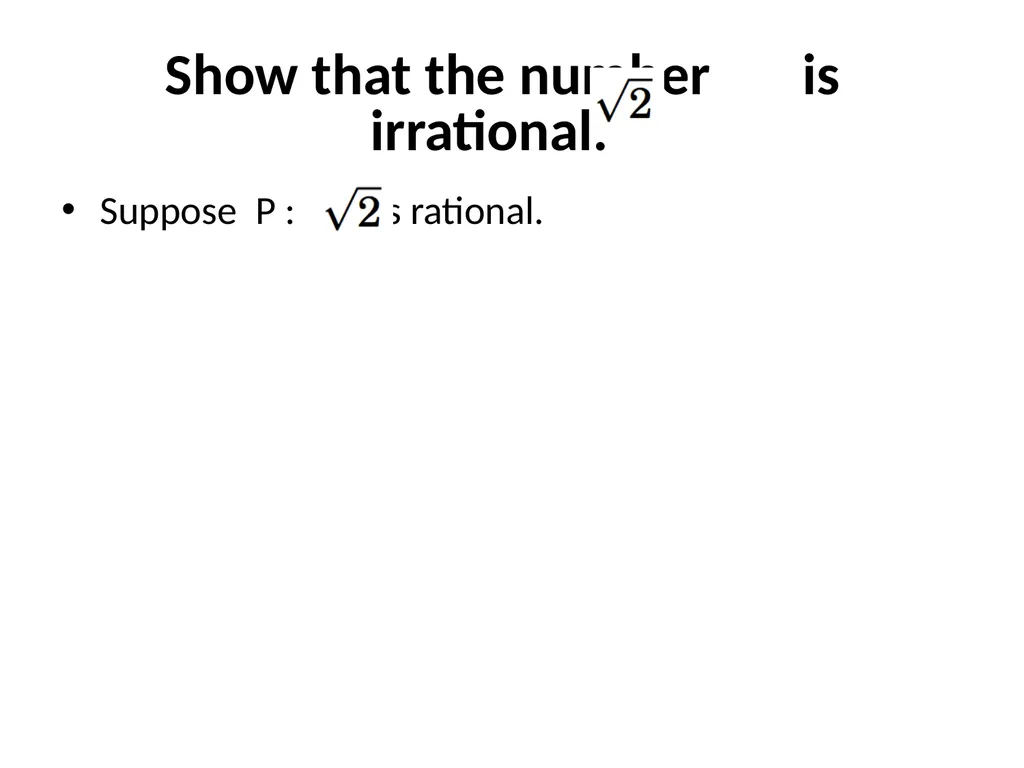
Show that the number is irrational. (Note: A number is irrational if it cannot be expressed as where a and b are integers, and b is non-zero.)
A proof by contradiction is sometimes called an indirect proof.<br>
Show that the number is irrational. (Note: A number is irrational if it cannot be expressed as where a and b are integers, and b is non-zero.)
A proof by contradiction is sometimes called an indirect proof.<br>
61
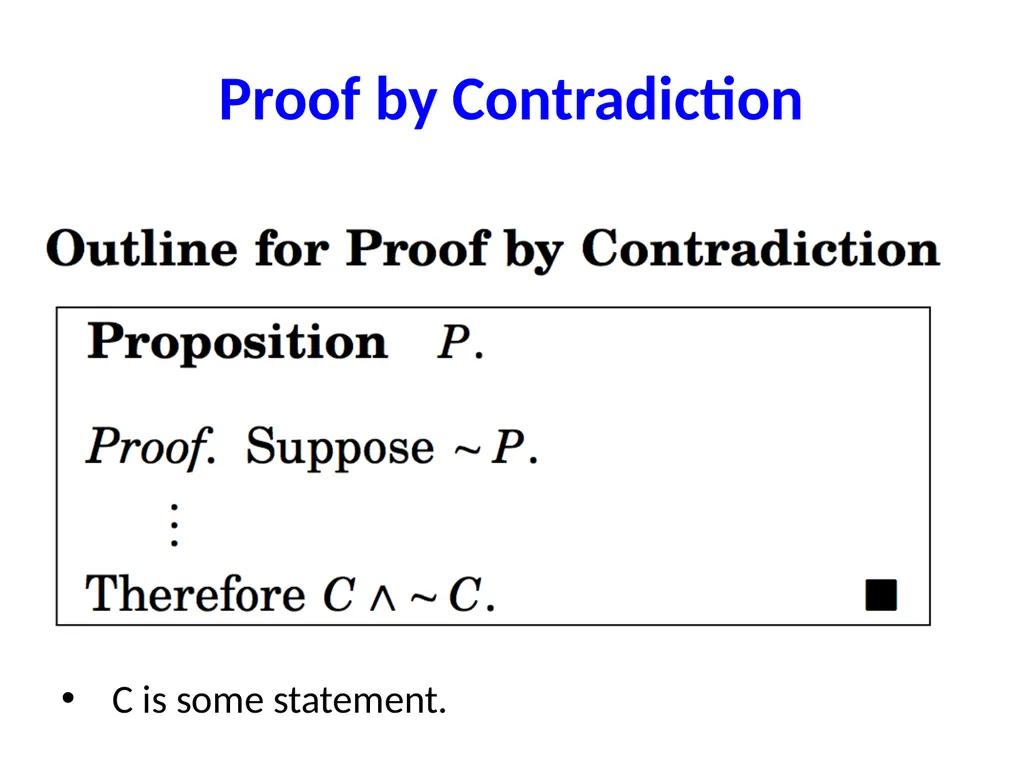
Proof by Contradiction C is some statement.<br>
62
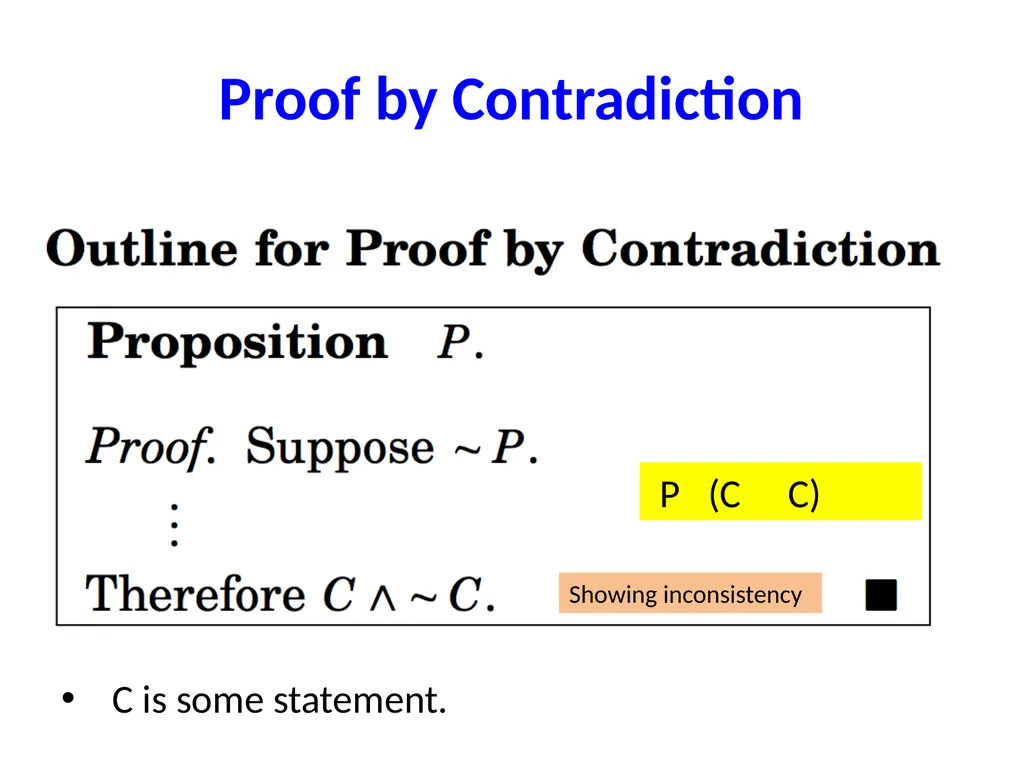
Proof by Contradiction C is some statement. P (C C) Showing inconsistency<br>
63
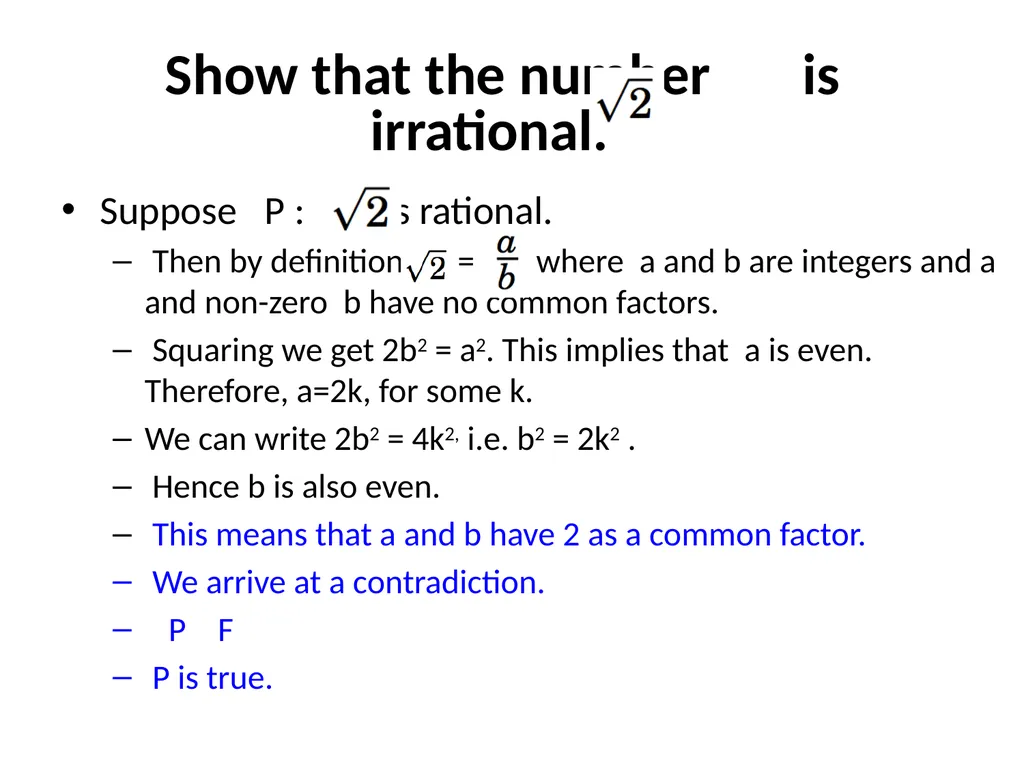
Show that the number is irrational. Suppose P : is rational.<br>
64
Show that the number is irrational. Suppose P : is rational.
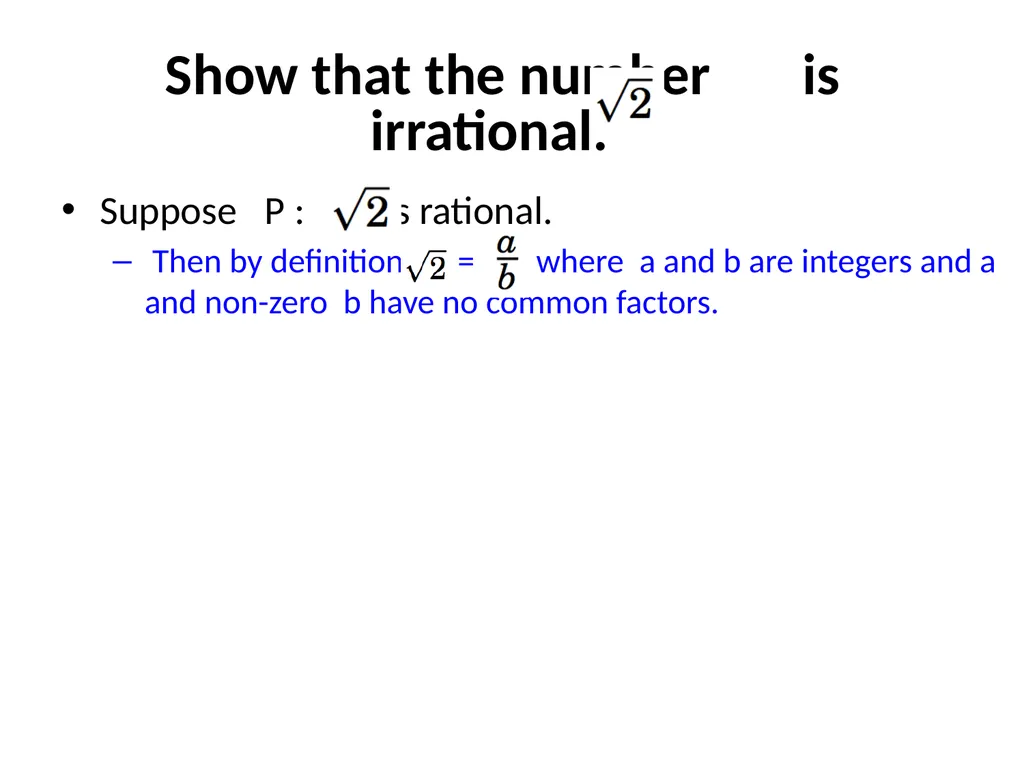
Then by definition = where a and b are integers and a and non-zero b have no common factors.<br>
Then by definition = where a and b are integers and a and non-zero b have no common factors.<br>
65
Show that the number is irrational. Suppose P : is rational.
Then by definition = where a and b are integers and a and non-zero b have no common factors.
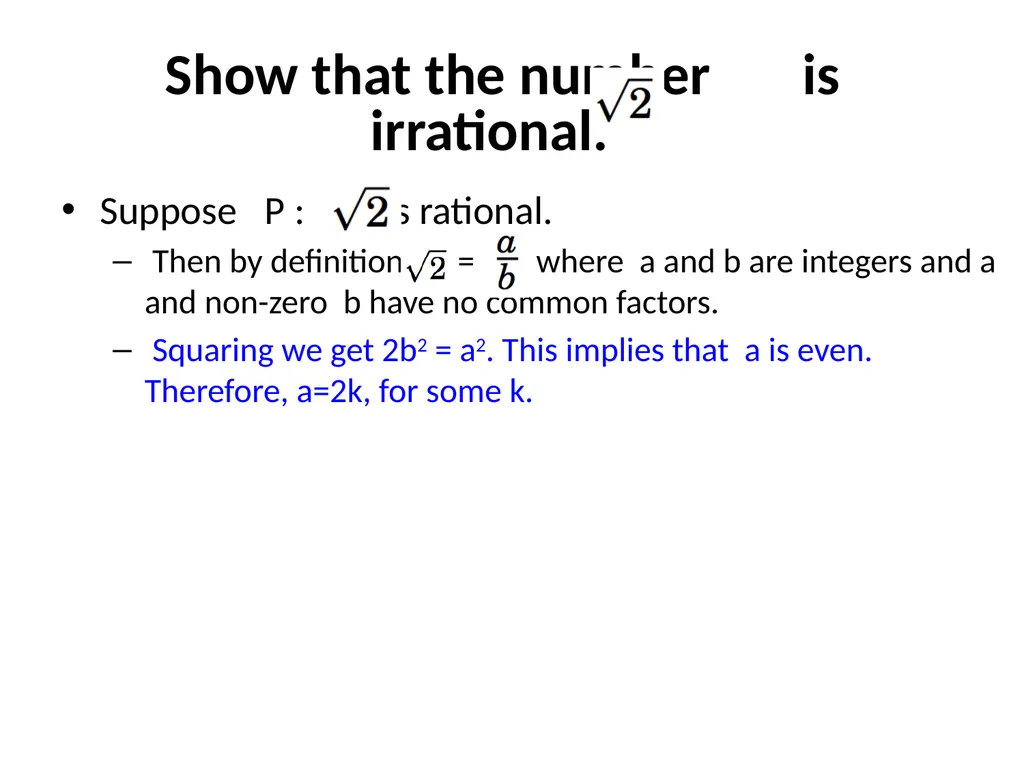
Squaring we get 2b2 = a2. This implies that a is even. Therefore, a=2k, for some k.<br>
Then by definition = where a and b are integers and a and non-zero b have no common factors.
Squaring we get 2b2 = a2. This implies that a is even. Therefore, a=2k, for some k.<br>
66
Show that the number is irrational. Suppose P : is rational.
Then by definition = where a and b are integers and a and non-zero b have no common factors.
Squaring we get 2b2 = a2. This implies that a is even. Therefore, a=2k, for some k.
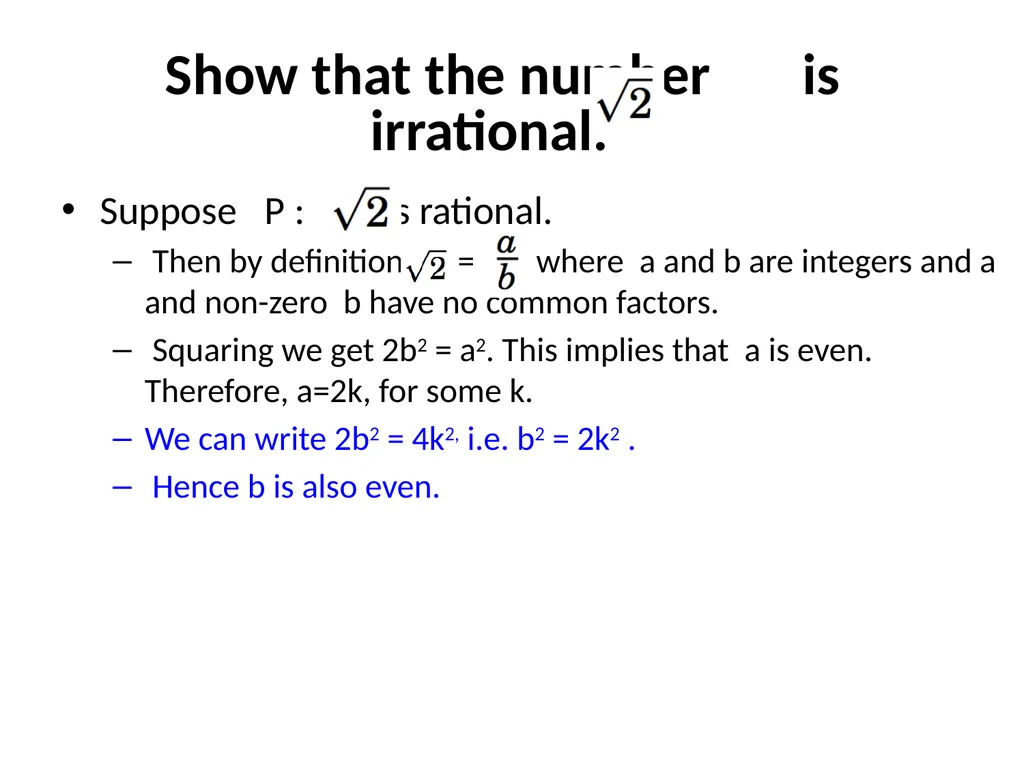
We can write 2b2 = 4k2, i.e. b2 = 2k2 .
Hence b is also even.<br>
Then by definition = where a and b are integers and a and non-zero b have no common factors.
Squaring we get 2b2 = a2. This implies that a is even. Therefore, a=2k, for some k.
We can write 2b2 = 4k2, i.e. b2 = 2k2 .
Hence b is also even.<br>
67
Show that the number is irrational. Suppose P : is rational.
Then by definition = where a and b are integers and a and non-zero b have no common factors.
Squaring we get 2b2 = a2. This implies that a is even. Therefore, a=2k, for some k.
We can write 2b2 = 4k2, i.e. b2 = 2k2 .
Hence b is also even.
This means that a and b have 2 as a common factor.
We arrive at a contradiction.
P F
P is true.<br>
Then by definition = where a and b are integers and a and non-zero b have no common factors.
Squaring we get 2b2 = a2. This implies that a is even. Therefore, a=2k, for some k.
We can write 2b2 = 4k2, i.e. b2 = 2k2 .
Hence b is also even.
This means that a and b have 2 as a common factor.
We arrive at a contradiction.
P F
P is true.<br>
68
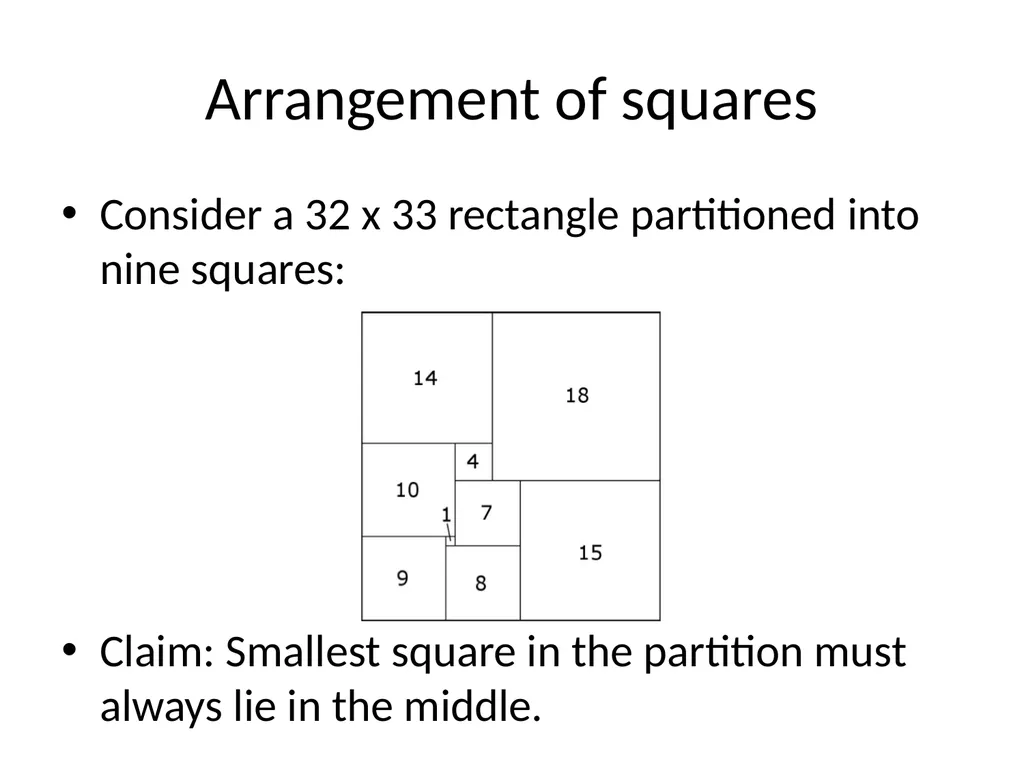
Arrangement of squares Consider a 32 x 33 rectangle partitioned into nine squares:
Claim: Smallest square in the partition must always lie in the middle.<br>
Claim: Smallest square in the partition must always lie in the middle.<br>
69
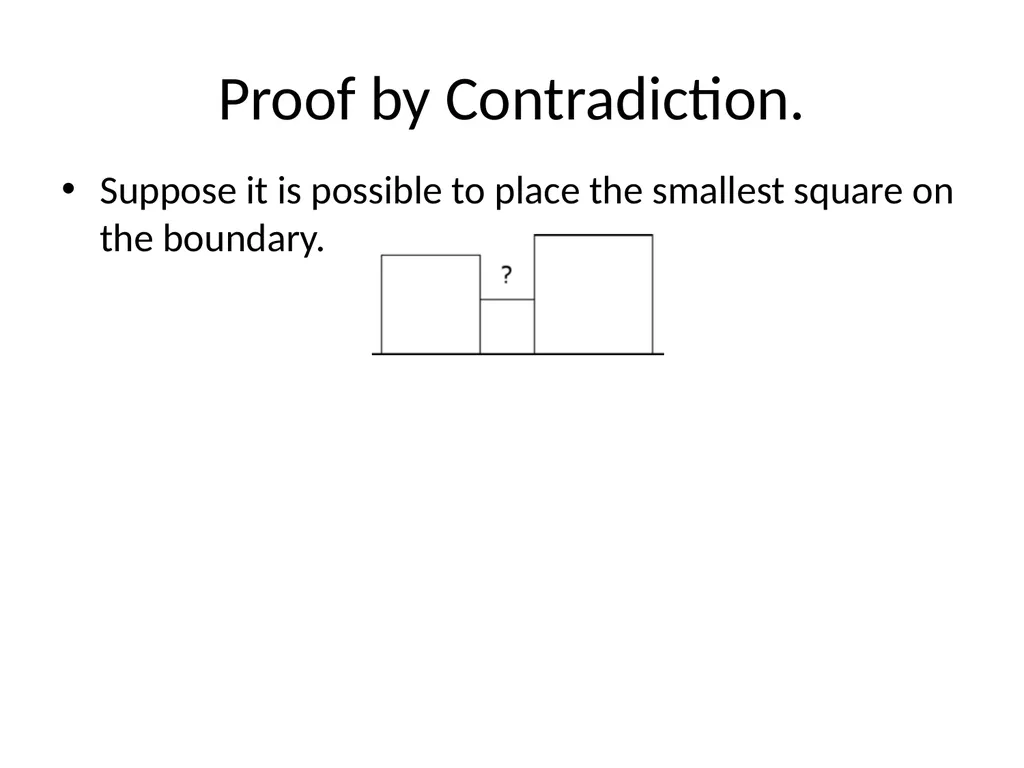
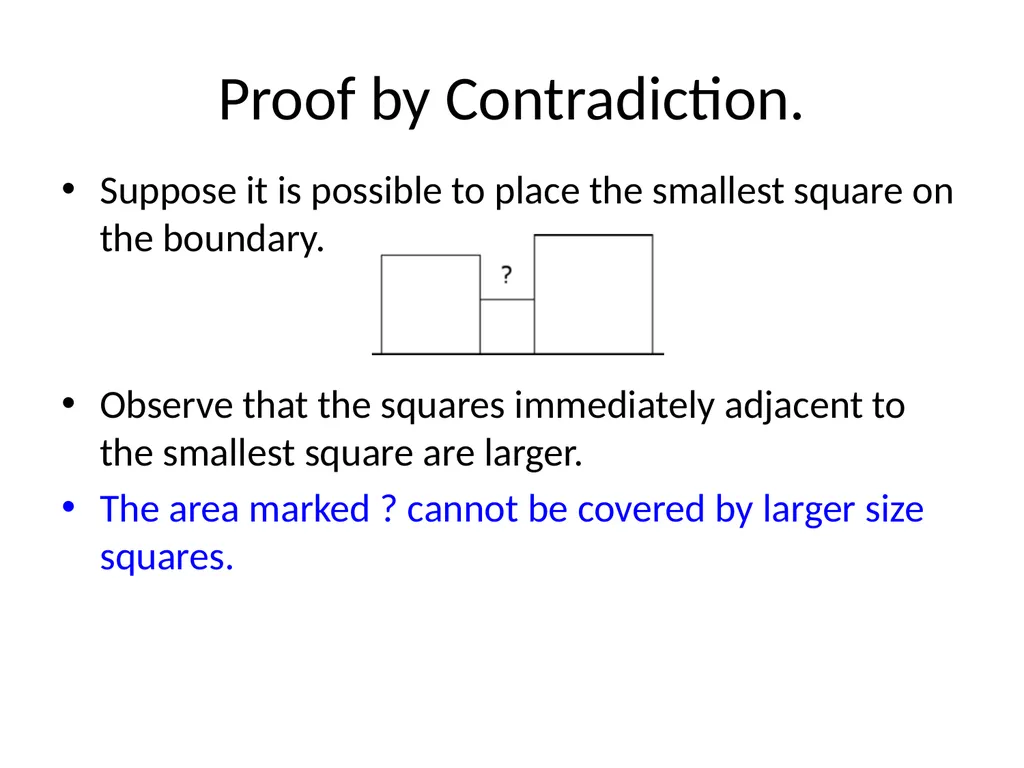
Proof by Contradiction. Suppose it is possible to place the smallest square on the boundary.<br>
70
Proof by Contradiction. Suppose it is possible to place the smallest square on the boundary.
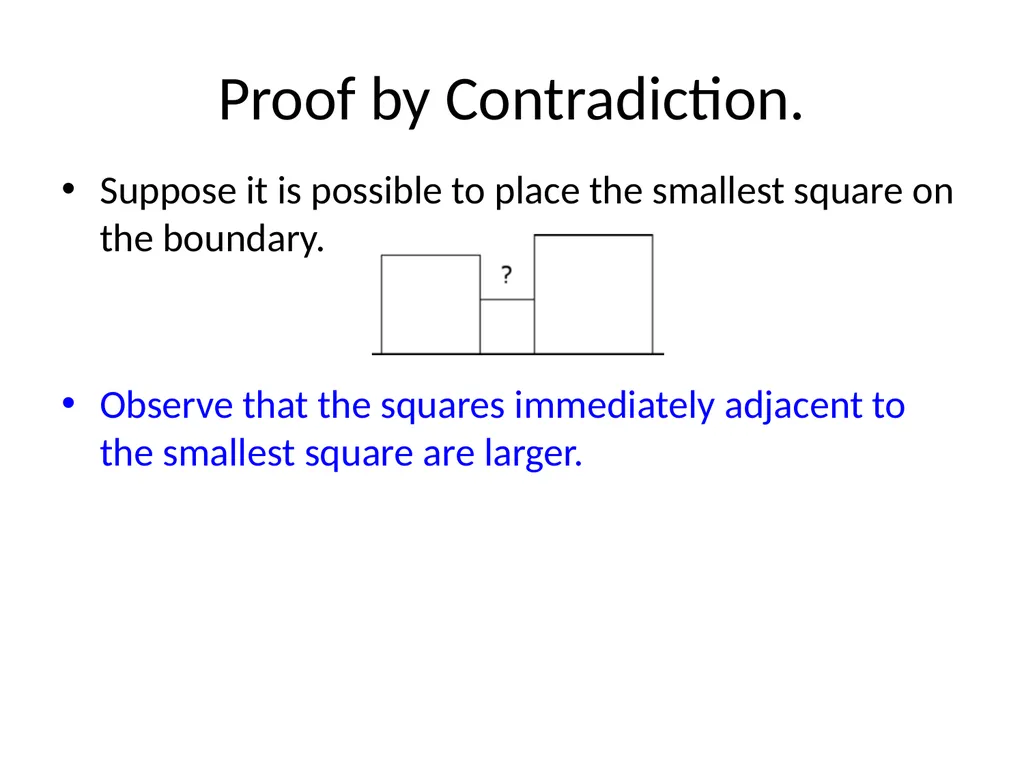
Observe that the squares immediately adjacent to the smallest square are larger.<br>
Observe that the squares immediately adjacent to the smallest square are larger.<br>
71
Proof by Contradiction. Suppose it is possible to place the smallest square on the boundary.
Observe that the squares immediately adjacent to the smallest square are larger.
The area marked ? cannot be covered by larger size squares.<br>
Observe that the squares immediately adjacent to the smallest square are larger.
The area marked ? cannot be covered by larger size squares.<br>
72
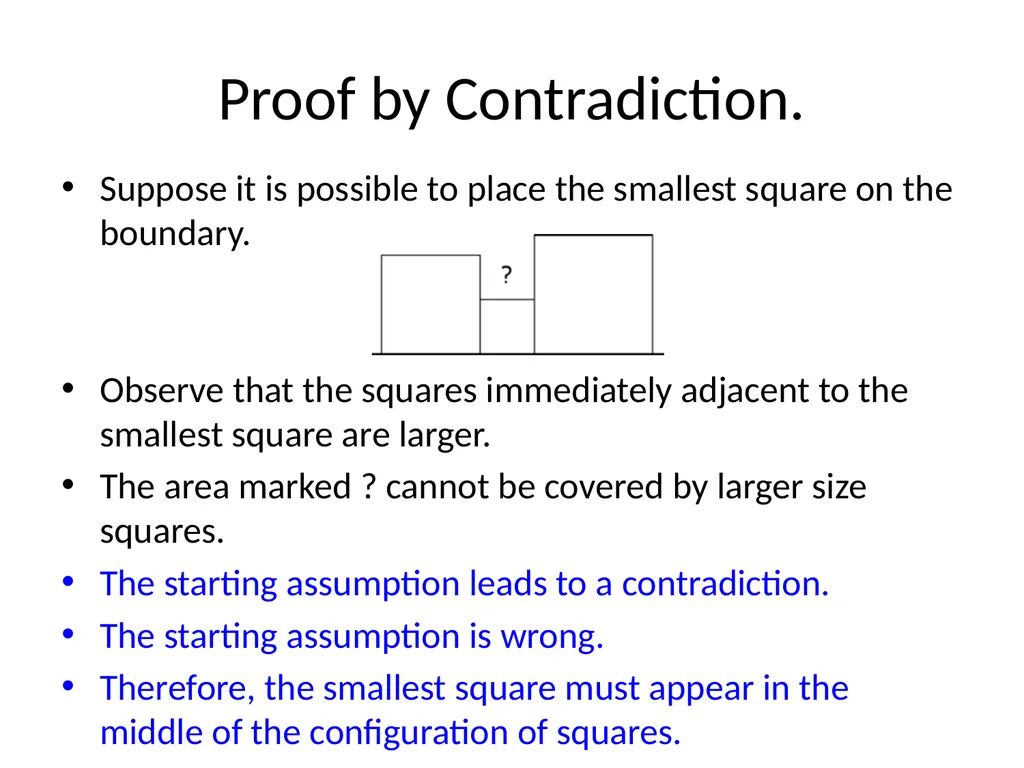
Proof by Contradiction. Suppose it is possible to place the smallest square on the boundary.
Observe that the squares immediately adjacent to the smallest square are larger.
The area marked ? cannot be covered by larger size squares.
The starting assumption leads to a contradiction.
The starting assumption is wrong.
Therefore, the smallest square must appear in the middle of the configuration of squares.<br>
Observe that the squares immediately adjacent to the smallest square are larger.
The area marked ? cannot be covered by larger size squares.
The starting assumption leads to a contradiction.
The starting assumption is wrong.
Therefore, the smallest square must appear in the middle of the configuration of squares.<br>
73
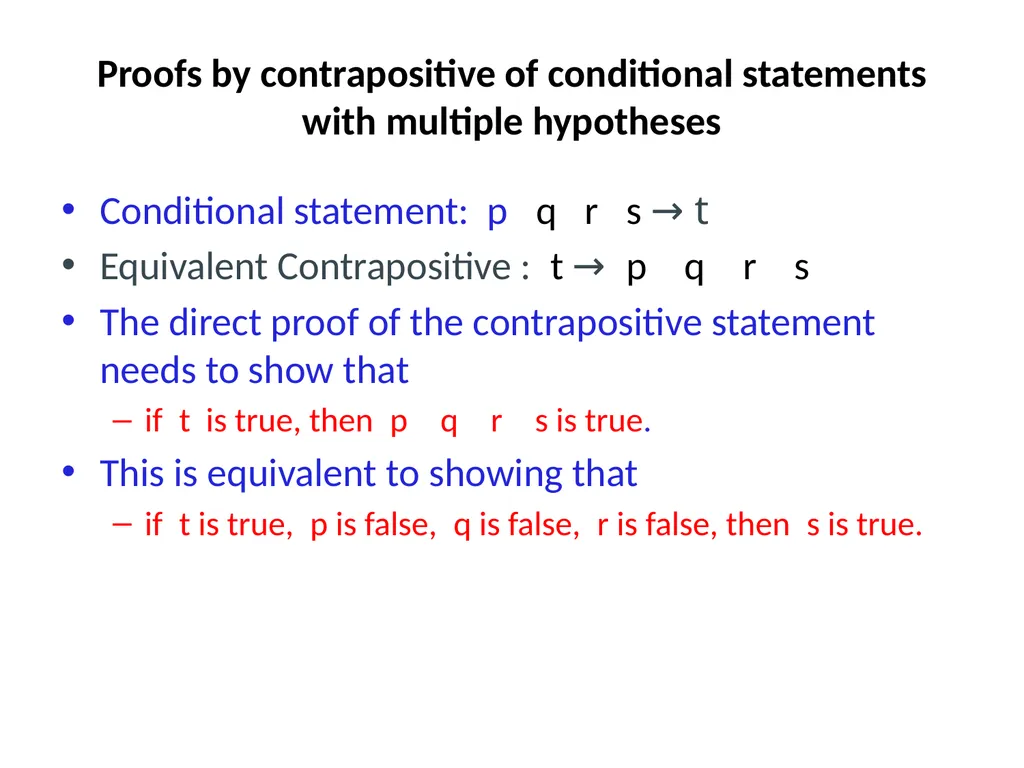
Proofs by contrapositive of conditional statements with multiple hypotheses Conditional statement: p q r s → t
Equivalent Contrapositive : t → p q r s
The direct proof of the contrapositive statement needs to show that
if t is true, then p q r s is true.
This is equivalent to showing that
if t is true, p is false, q is false, r is false, then s is true.<br>
Equivalent Contrapositive : t → p q r s
The direct proof of the contrapositive statement needs to show that
if t is true, then p q r s is true.
This is equivalent to showing that
if t is true, p is false, q is false, r is false, then s is true.<br>
74
There are infinitely many primes.<br>
75
There are infinitely many primes. Suppose there are finite number of primes, and they are, say, p1, p2, ….., pn.
Let pn is the largest prime number in the list.<br>
Let pn is the largest prime number in the list.<br>
76
There are infinitely many primes. Suppose there are finite number of primes, and they are, say, p1, p2, ….., pn.
Let pn is the largest prime number in the list.
Consider the number a = p1x p2x …..x pn + 1.<br>
Let pn is the largest prime number in the list.
Consider the number a = p1x p2x …..x pn + 1.<br>
77
There are infinitely many primes. Suppose there are finite number of primes, and they are, say, p1, p2, ….., pn.
Let pn is the largest prime number in the list.
Consider the number a = p1x p2x …..x pn + 1.
Since a is not divisible by pi for any pi, a is also a prime number.<br>
Let pn is the largest prime number in the list.
Consider the number a = p1x p2x …..x pn + 1.
Since a is not divisible by pi for any pi, a is also a prime number.<br>
78
There are infinitely many primes. Suppose there are finite number of primes, and they are, say, p1, p2, ….., pn.
Let pn is the largest prime number in the list.
Consider the number a = p1x p2x …..x pn + 1.
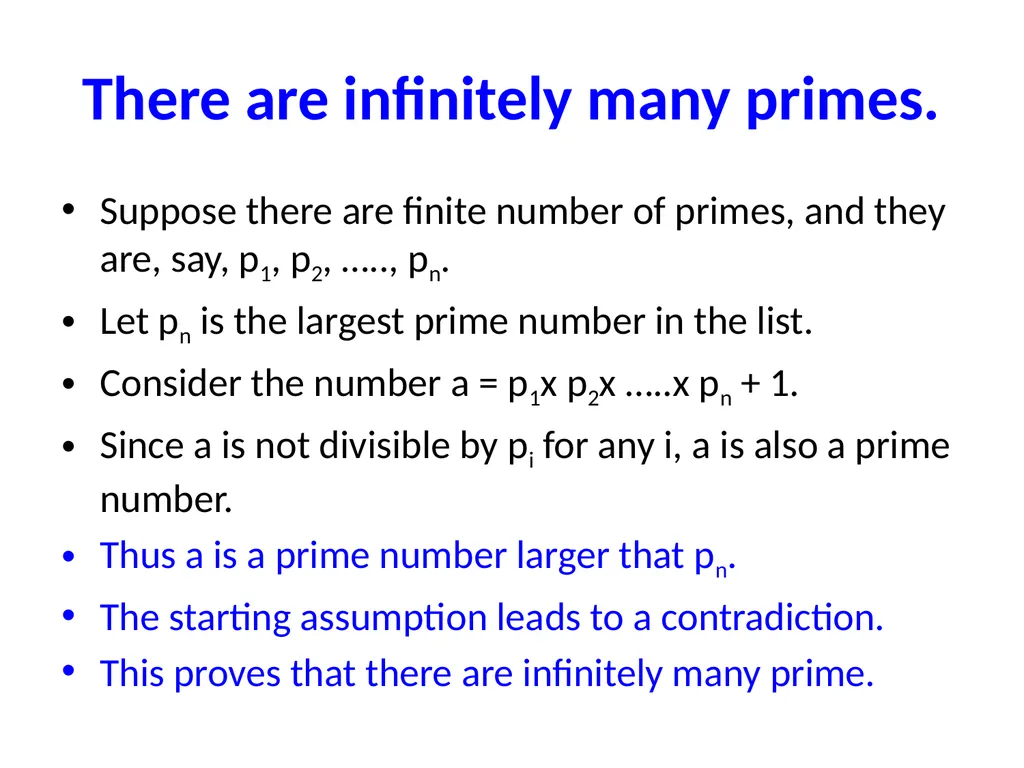
Since a is not divisible by pi for any i, a is also a prime number.
Thus a is a prime number larger that pn.
The starting assumption leads to a contradiction.
This proves that there are infinitely many prime.<br>
Let pn is the largest prime number in the list.
Consider the number a = p1x p2x …..x pn + 1.
Since a is not divisible by pi for any i, a is also a prime number.
Thus a is a prime number larger that pn.
The starting assumption leads to a contradiction.
This proves that there are infinitely many prime.<br>
79
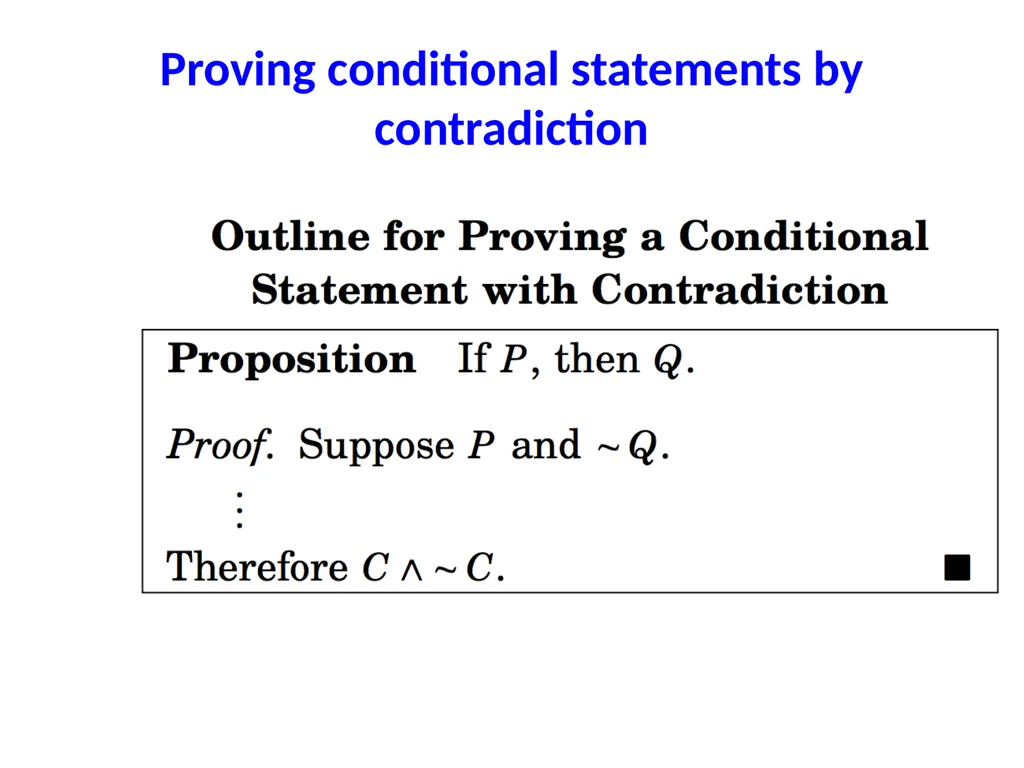
Proving conditional statements by contradiction<br>
80
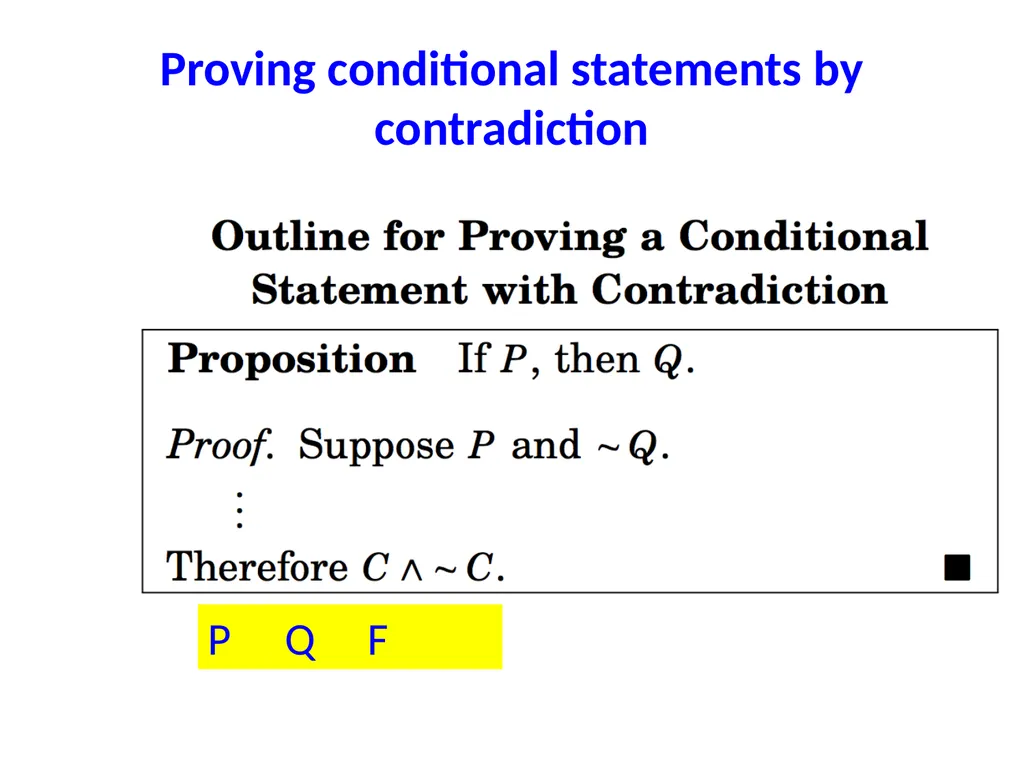
Proving conditional statements by contradiction P Q F<br>
81
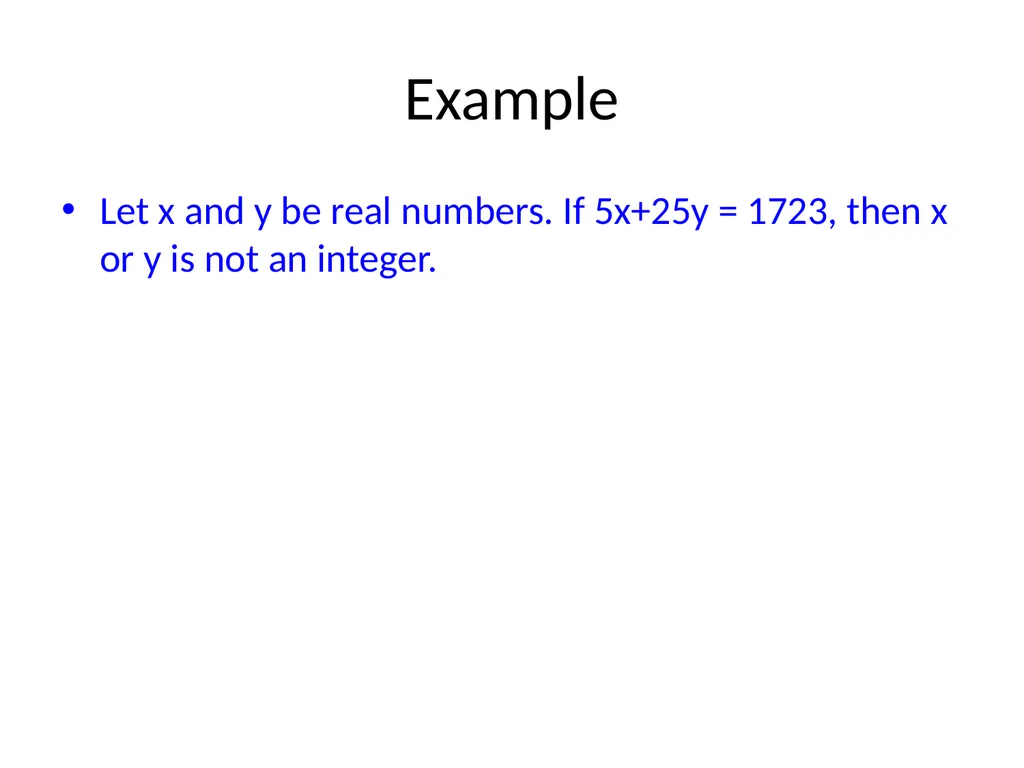
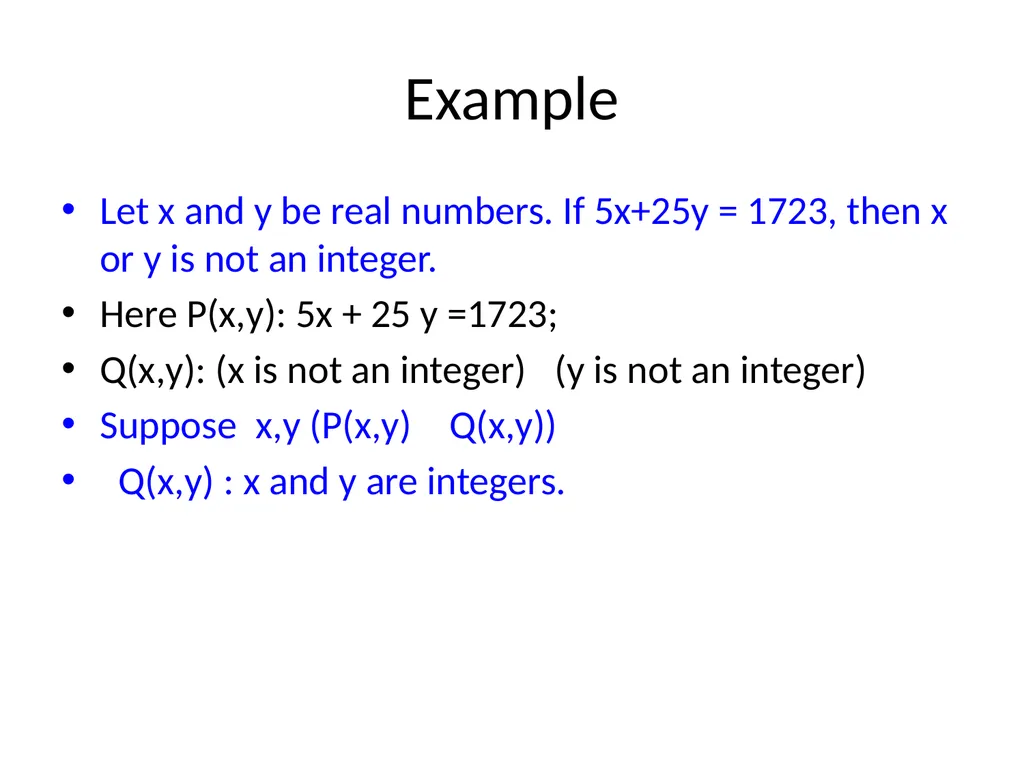
Example Let x and y be real numbers. If 5x+25y = 1723, then x or y is not an integer.<br>
82
Example Let x and y be real numbers. If 5x+25y = 1723, then x or y is not an integer.
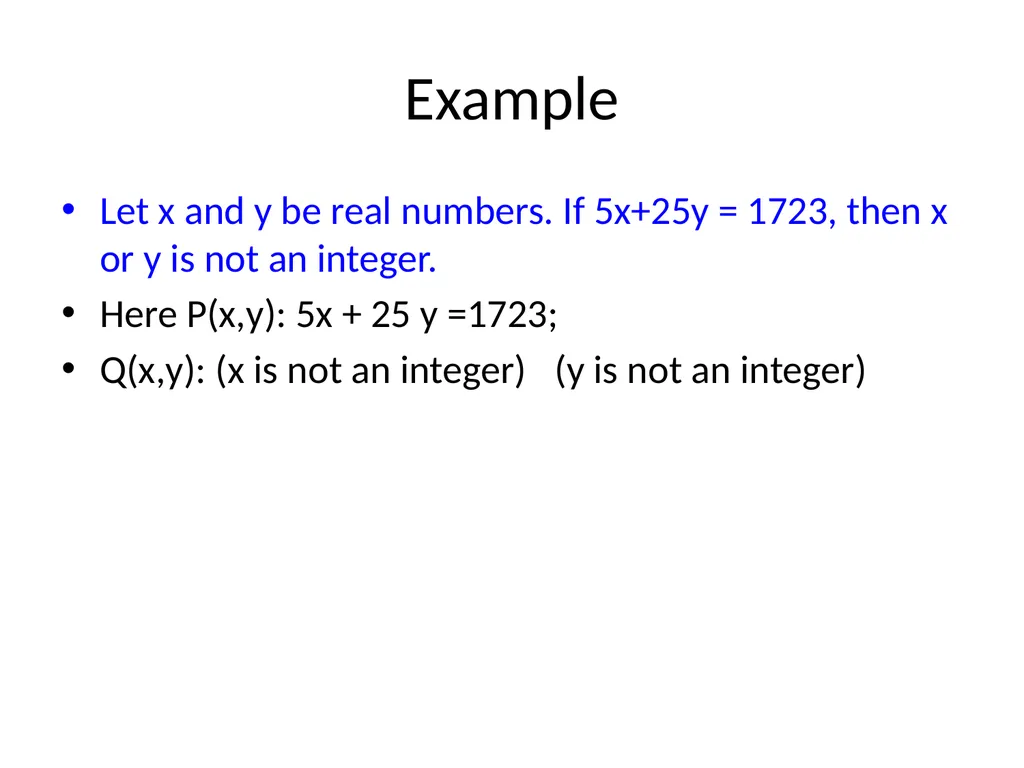
Here P(x,y): 5x + 25 y =1723;
Q(x,y): (x is not an integer) (y is not an integer)<br>
Here P(x,y): 5x + 25 y =1723;
Q(x,y): (x is not an integer) (y is not an integer)<br>
83
Example Let x and y be real numbers. If 5x+25y = 1723, then x or y is not an integer.
Here P(x,y): 5x + 25 y =1723;
Q(x,y): (x is not an integer) (y is not an integer)
Suppose x,y (P(x,y) Q(x,y))
Q(x,y) : x and y are integers.<br>
Here P(x,y): 5x + 25 y =1723;
Q(x,y): (x is not an integer) (y is not an integer)
Suppose x,y (P(x,y) Q(x,y))
Q(x,y) : x and y are integers.<br>
84
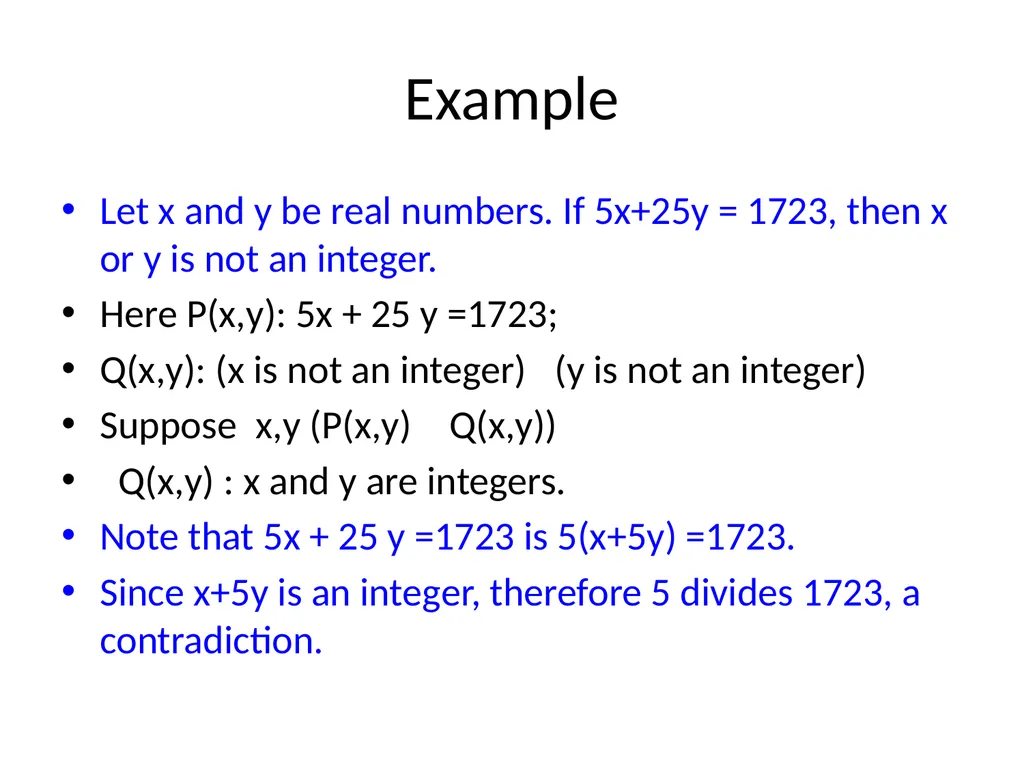
Example Let x and y be real numbers. If 5x+25y = 1723, then x or y is not an integer.
Here P(x,y): 5x + 25 y =1723;
Q(x,y): (x is not an integer) (y is not an integer)
Suppose x,y (P(x,y) Q(x,y))
Q(x,y) : x and y are integers.
Note that 5x + 25 y =1723 is 5(x+5y) =1723.
Since x+5y is an integer, therefore 5 divides 1723, a contradiction.<br>
Here P(x,y): 5x + 25 y =1723;
Q(x,y): (x is not an integer) (y is not an integer)
Suppose x,y (P(x,y) Q(x,y))
Q(x,y) : x and y are integers.
Note that 5x + 25 y =1723 is 5(x+5y) =1723.
Since x+5y is an integer, therefore 5 divides 1723, a contradiction.<br>
85
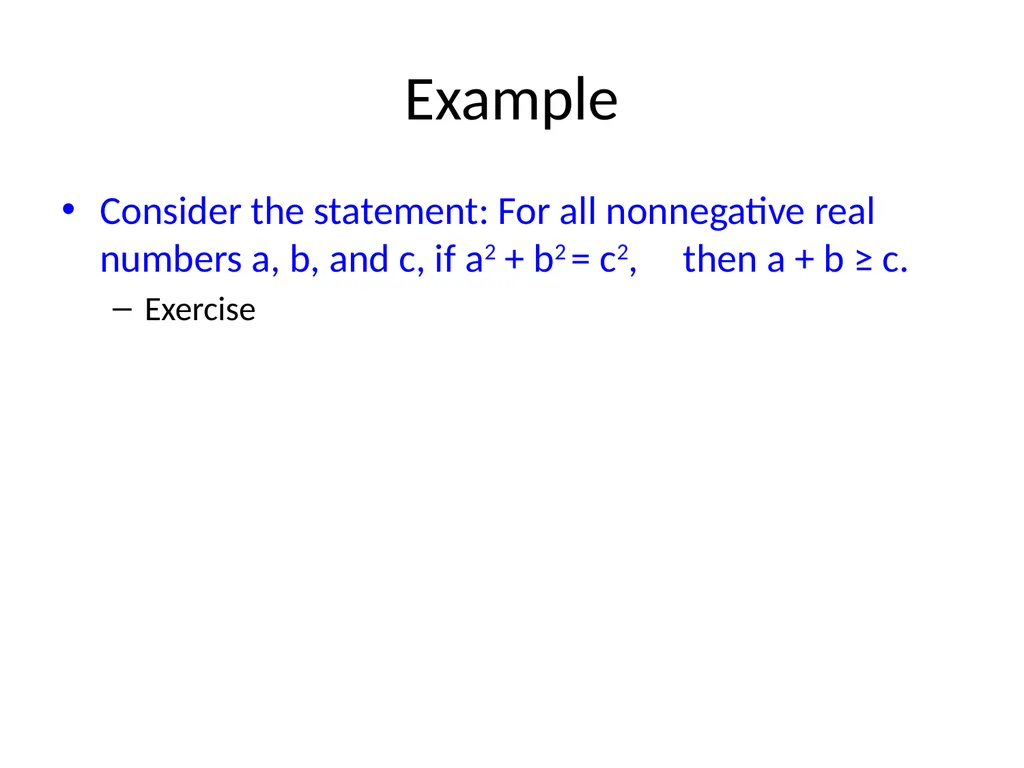
Example Consider the statement: For all nonnegative real numbers a, b, and c, if a2 + b2 = c2, then a + b ≥ c.
Exercise<br>
Exercise<br>
86
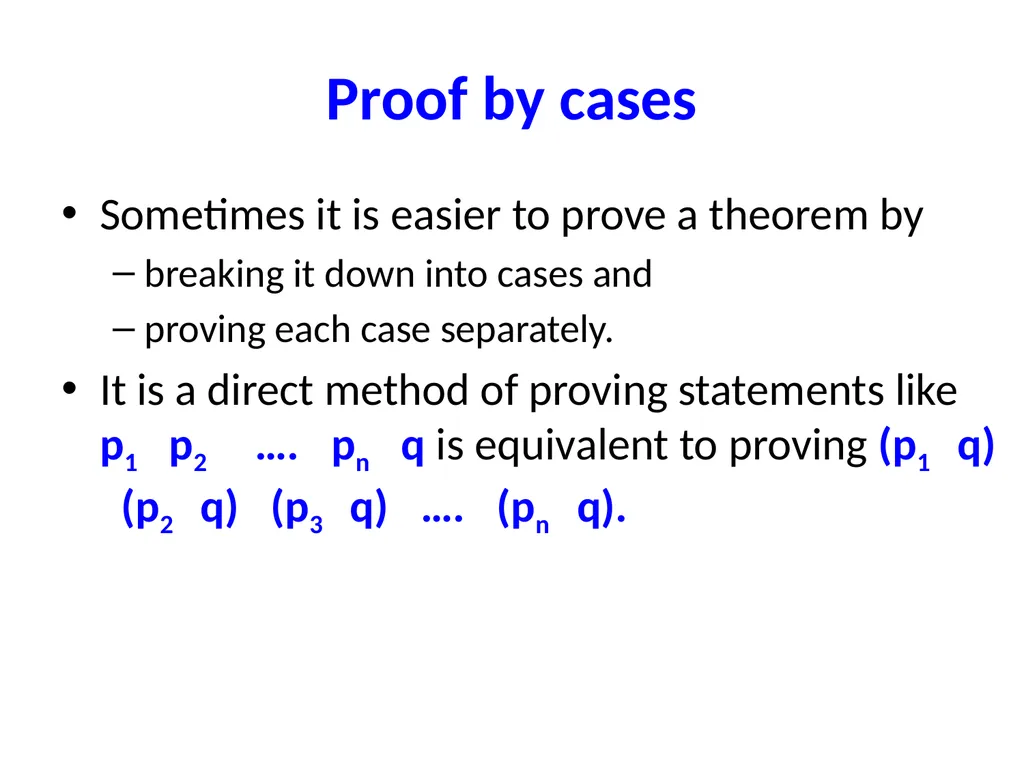
Proof by cases Sometimes it is easier to prove a theorem by
breaking it down into cases and
proving each case separately.
It is a direct method of proving statements like p1 p2 …. pn q is equivalent to proving (p1 q) (p2 q) (p3 q) …. (pn q).<br>
breaking it down into cases and
proving each case separately.
It is a direct method of proving statements like p1 p2 …. pn q is equivalent to proving (p1 q) (p2 q) (p3 q) …. (pn q).<br>
87
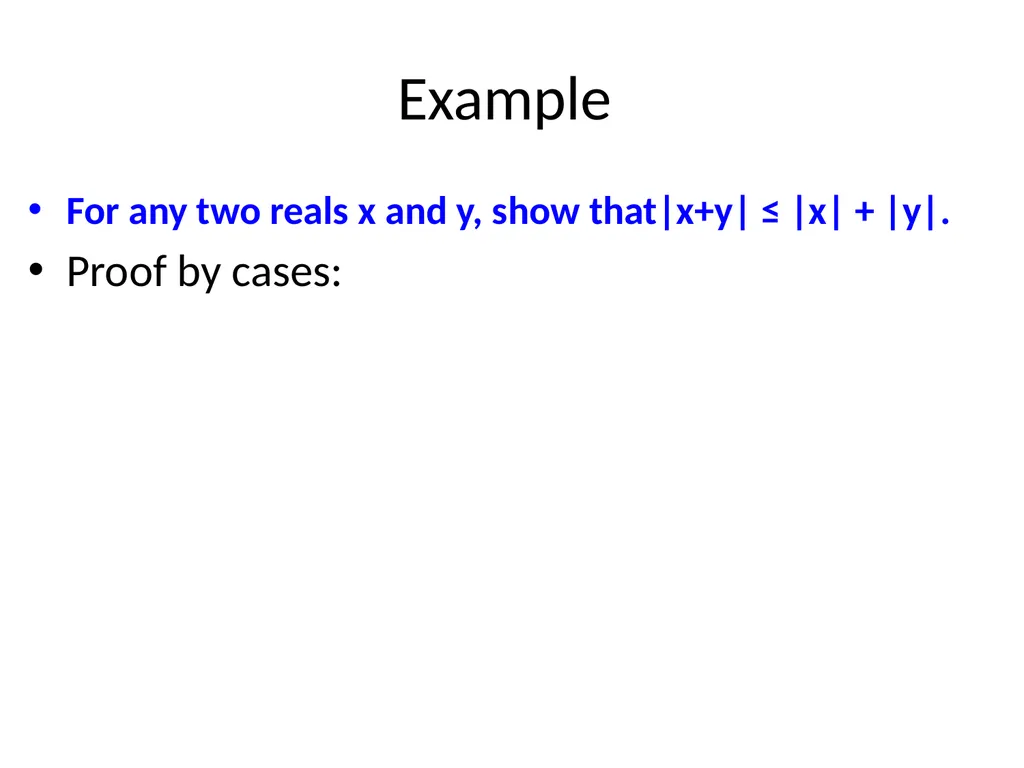
Example For any two reals x and y, show that|x+y| ≤ |x| + |y|.
Proof by cases:<br>
Proof by cases:<br>
88
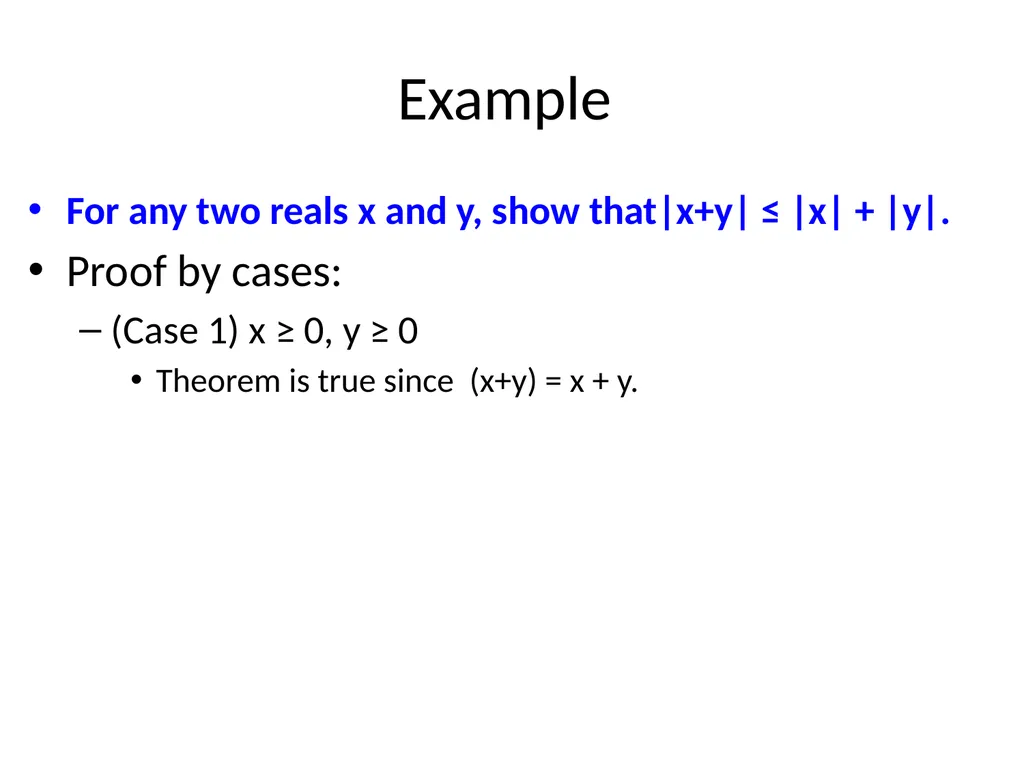
Example For any two reals x and y, show that|x+y| ≤ |x| + |y|.
Proof by cases:
(Case 1) x ≥ 0, y ≥ 0
Theorem is true since (x+y) = x + y.<br>
Proof by cases:
(Case 1) x ≥ 0, y ≥ 0
Theorem is true since (x+y) = x + y.<br>
89
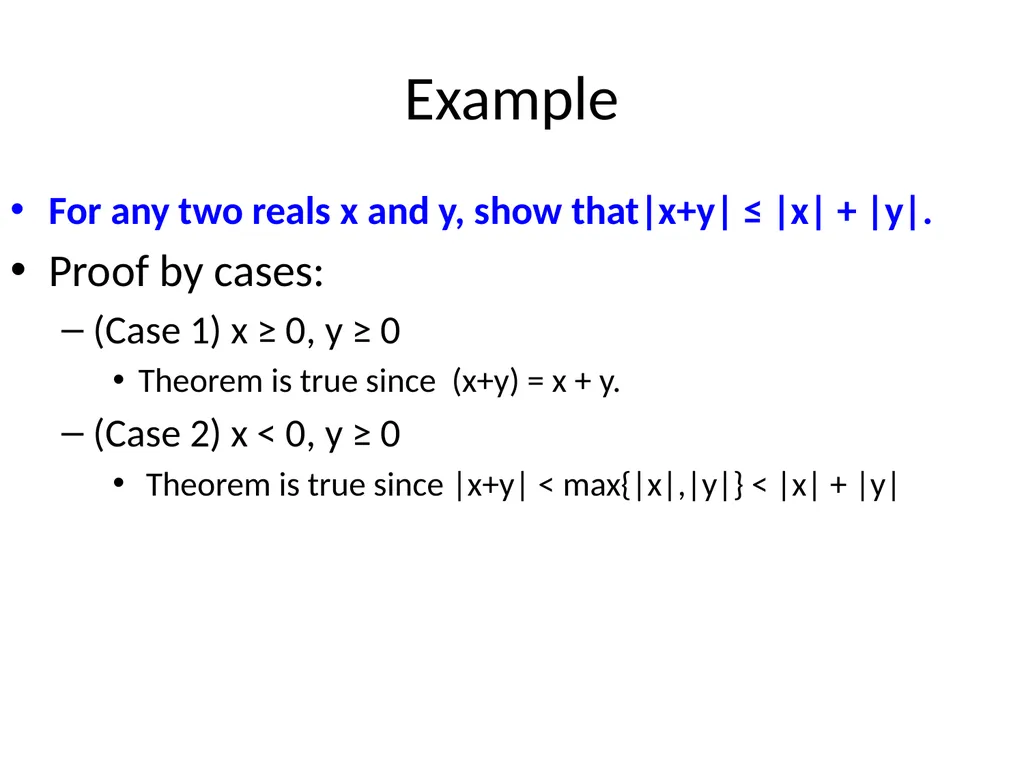
Example For any two reals x and y, show that|x+y| ≤ |x| + |y|.
Proof by cases:
(Case 1) x ≥ 0, y ≥ 0
Theorem is true since (x+y) = x + y.
(Case 2) x < 0, y ≥ 0
Theorem is true since |x+y| < max{|x|,|y|} < |x| + |y|<br>
Proof by cases:
(Case 1) x ≥ 0, y ≥ 0
Theorem is true since (x+y) = x + y.
(Case 2) x < 0, y ≥ 0
Theorem is true since |x+y| < max{|x|,|y|} < |x| + |y|<br>
90
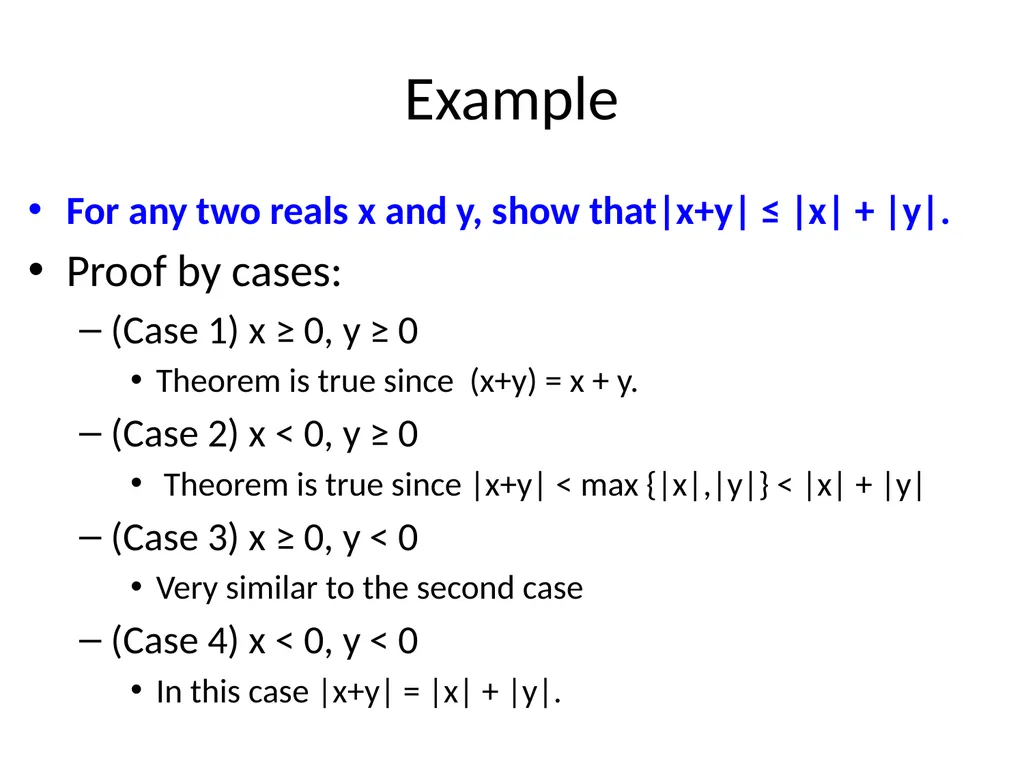
Example For any two reals x and y, show that|x+y| ≤ |x| + |y|.
Proof by cases:
(Case 1) x ≥ 0, y ≥ 0
Theorem is true since (x+y) = x + y.
(Case 2) x < 0, y ≥ 0
Theorem is true since |x+y| < max {|x|,|y|} < |x| + |y|
(Case 3) x ≥ 0, y < 0
Very similar to the second case
(Case 4) x < 0, y < 0
In this case |x+y| = |x| + |y|.<br>
Proof by cases:
(Case 1) x ≥ 0, y ≥ 0
Theorem is true since (x+y) = x + y.
(Case 2) x < 0, y ≥ 0
Theorem is true since |x+y| < max {|x|,|y|} < |x| + |y|
(Case 3) x ≥ 0, y < 0
Very similar to the second case
(Case 4) x < 0, y < 0
In this case |x+y| = |x| + |y|.<br>
91
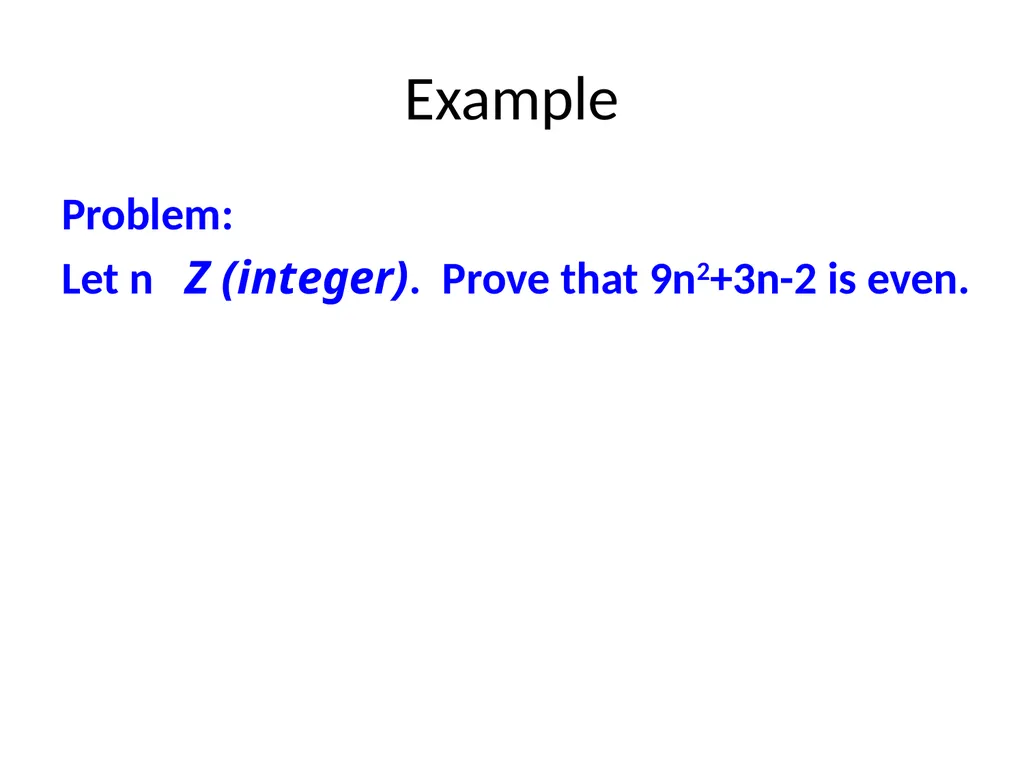
Example Problem:
Let n Z (integer). Prove that 9n2+3n-2 is even.<br>
Let n Z (integer). Prove that 9n2+3n-2 is even.<br>
92
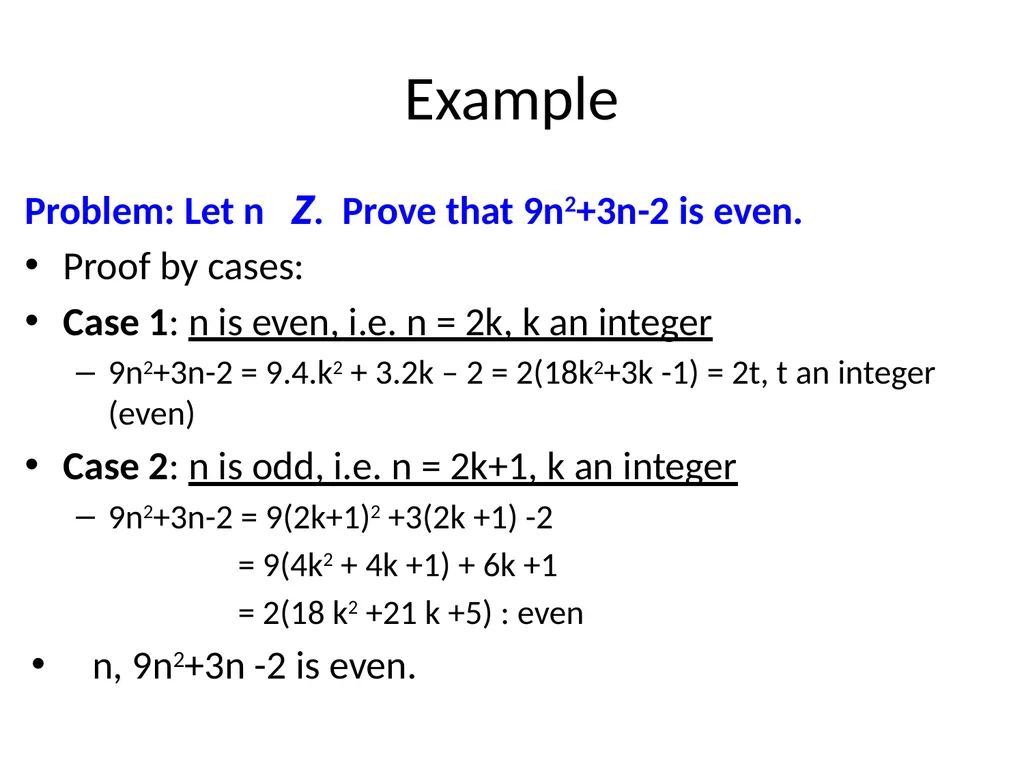
Example Problem: Let n Z. Prove that 9n2+3n-2 is even.
Proof by cases:
Case 1: n is even, i.e. n = 2k, k an integer
9n2+3n-2 = 9.4.k2 + 3.2k – 2 = 2(18k2+3k -1) = 2t, t an integer (even)
Case 2: n is odd, i.e. n = 2k+1, k an integer
9n2+3n-2 = 9(2k+1)2 +3(2k +1) -2
= 9(4k2 + 4k +1) + 6k +1
= 2(18 k2 +21 k +5) : even
n, 9n2+3n -2 is even.<br>
Proof by cases:
Case 1: n is even, i.e. n = 2k, k an integer
9n2+3n-2 = 9.4.k2 + 3.2k – 2 = 2(18k2+3k -1) = 2t, t an integer (even)
Case 2: n is odd, i.e. n = 2k+1, k an integer
9n2+3n-2 = 9(2k+1)2 +3(2k +1) -2
= 9(4k2 + 4k +1) + 6k +1
= 2(18 k2 +21 k +5) : even
n, 9n2+3n -2 is even.<br>
93
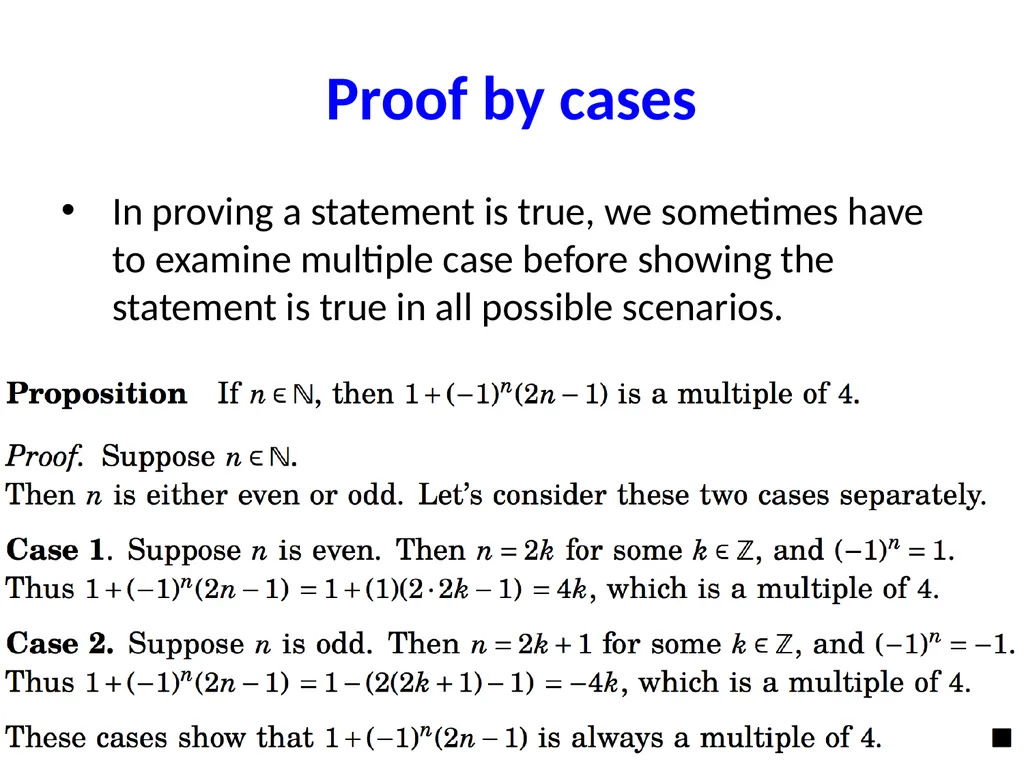
Proof by cases In proving a statement is true, we sometimes have to examine multiple case before showing the statement is true in all possible scenarios.<br>
94
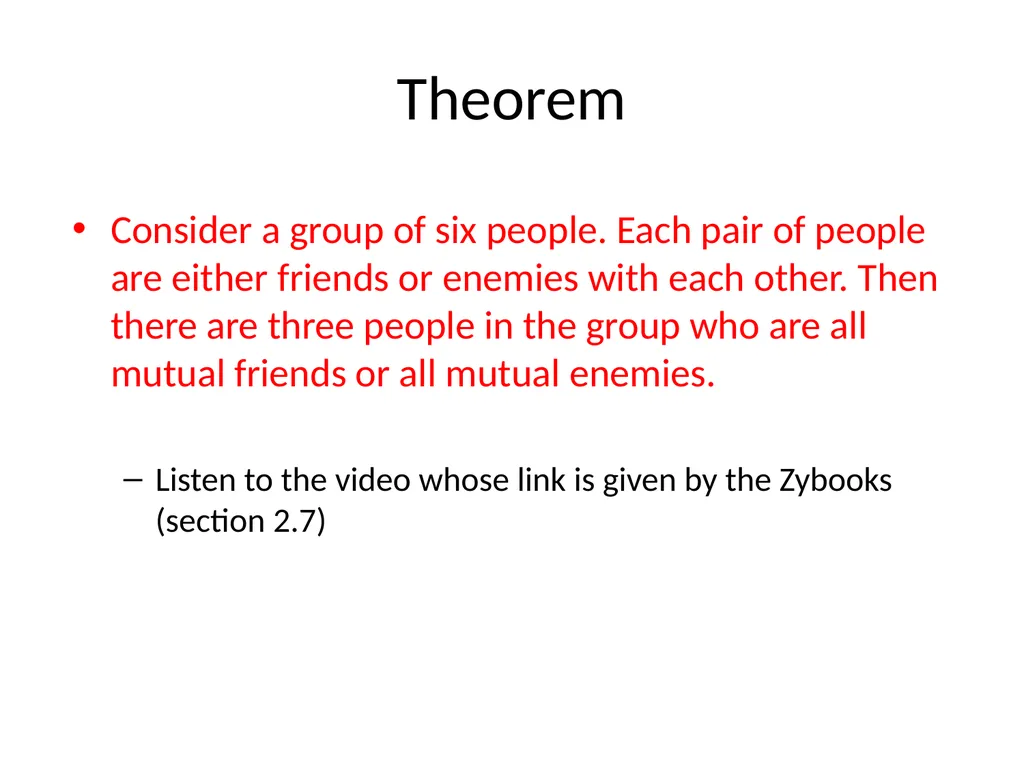
Theorem Consider a group of six people. Each pair of people are either friends or enemies with each other. Then there are three people in the group who are all mutual friends or all mutual enemies.
Listen to the video whose link is given by the Zybooks (section 2.7)<br>
Listen to the video whose link is given by the Zybooks (section 2.7)<br>
95
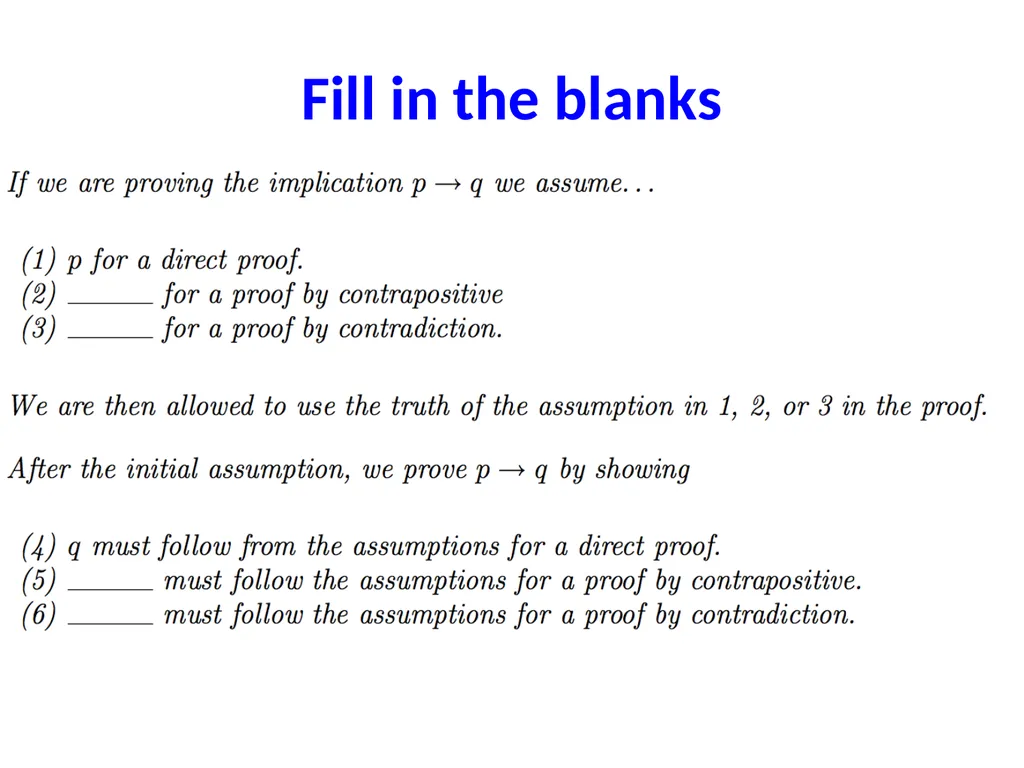
Fill in the blanks<br>