Proportionality as the Core Principle of the Supervision of a Heterogeneous Banking Sector Lessons Learned From Germany with an heterogeneous banking sector of roughly 2,000 banks Dirk Kramer Federal Financial Supervisory Authority
"Proportionality as the Core Principle of the" is the property of its rightful owner. Permission is granted to
download and print the materials on this website for personal, non-commercial use only, and to display it
on your personal computer provided you do not modify the materials and that you retain all copyright
notices contained in the materials. By downloading content from our website, you accept the terms of this
agreement.
Presentation Transcript
01
Proportionality as the Core Principle of the Supervision of a Heterogeneous Banking Sector Lessons Learned From Germany with an heterogeneous banking sector of roughly 2,000 banks Dirk Kramer Federal Financial Supervisory Authority (Germany) (Bundesanstalt für Finanzdienstleistungsaufsicht; BaFin) EBA Workshop „The application of proportionality measures in the EBA‘s regulatory work“
London, October 22 2013 Proportionality – Regulation & Supervision | 22.October.2013 | Page 1<br>
02
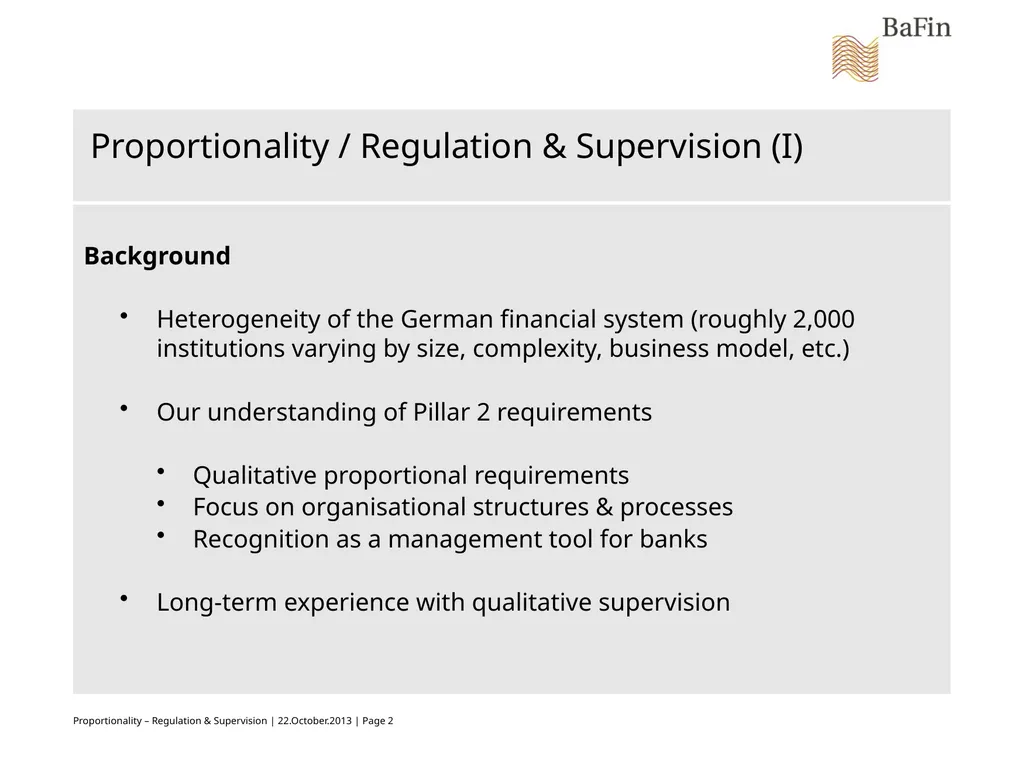
Background
Heterogeneity of the German financial system (roughly 2,000 institutions varying by size, complexity, business model, etc.)
Our understanding of Pillar 2 requirements
Qualitative proportional requirements
Focus on organisational structures & processes
Recognition as a management tool for banks
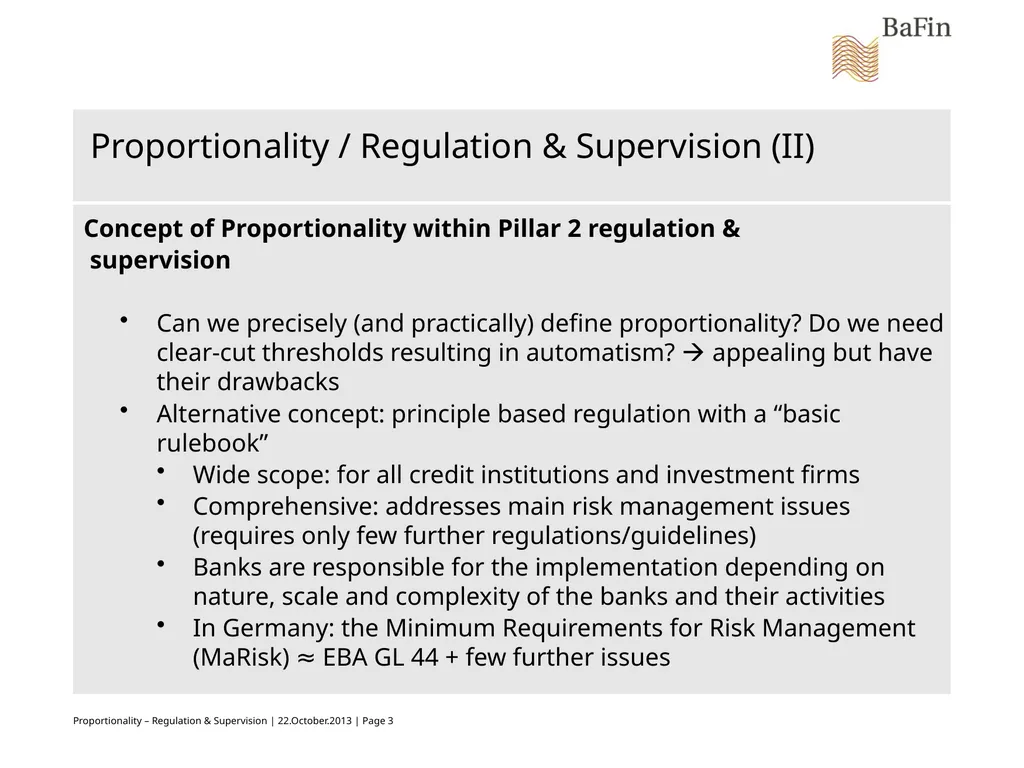
Concept of Proportionality within Pillar 2 regulation &
supervision
Can we precisely (and practically) define proportionality? Do we need clear-cut thresholds resulting in automatism? appealing but have their drawbacks
Alternative concept: principle based regulation with a “basic rulebook”
Wide scope: for all credit institutions and investment firms
Comprehensive: addresses main risk management issues (requires only few further regulations/guidelines)
Banks are responsible for the implementation depending on nature, scale and complexity of the banks and their activities
In Germany: the Minimum Requirements for Risk Management (MaRisk) ≈ EBA GL 44 + few further issues Proportionality / Regulation & Supervision (II) Proportionality – Regulation & Supervision | 22.October.2013 | Page 3<br>
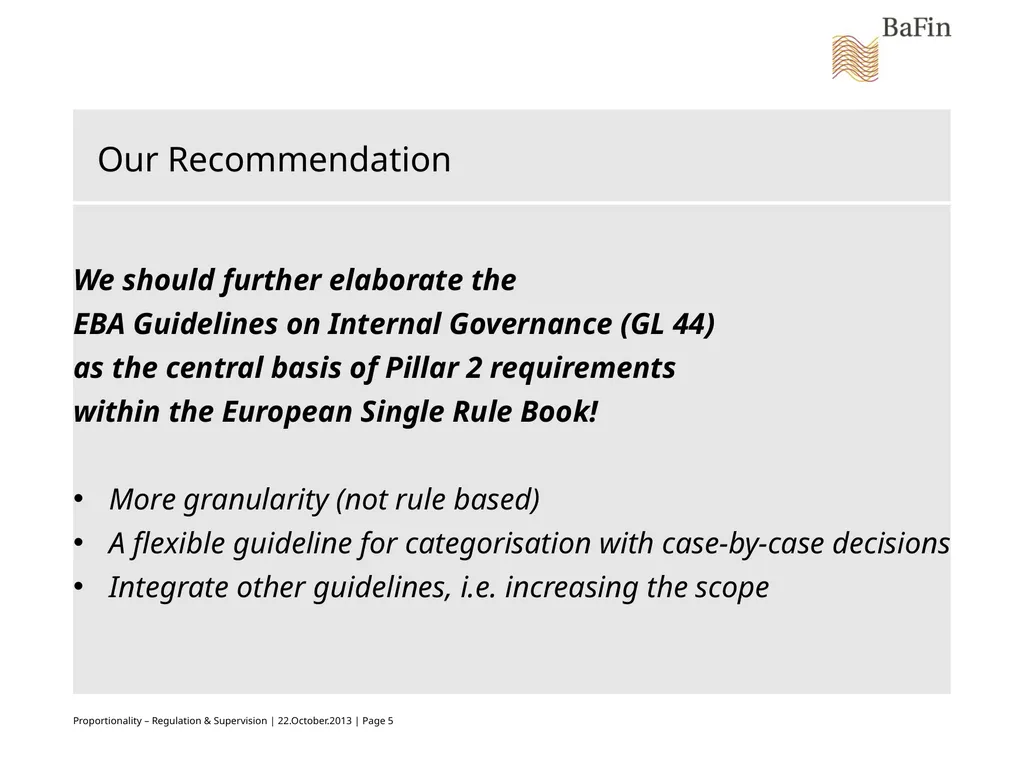
Our Recommendation We should further elaborate the
EBA Guidelines on Internal Governance (GL 44)
as the central basis of Pillar 2 requirements
within the European Single Rule Book!
More granularity (not rule based)
A flexible guideline for categorisation with case-by-case decisions
Integrate other guidelines, i.e. increasing the scope Proportionality – Regulation & Supervision | 22.October.2013 | Page 5<br>
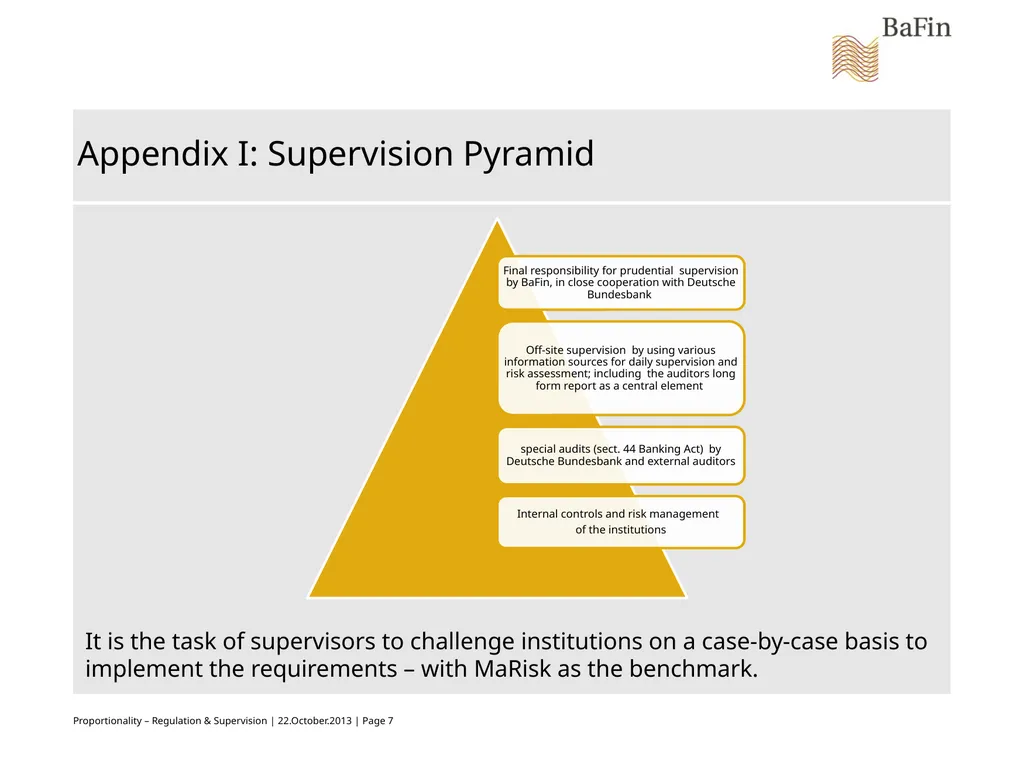
Appendix I: Supervision Pyramid It is the task of supervisors to challenge institutions on a case-by-case basis to implement the requirements – with MaRisk as the benchmark. Proportionality – Regulation & Supervision | 22.October.2013 | Page 7<br>
08
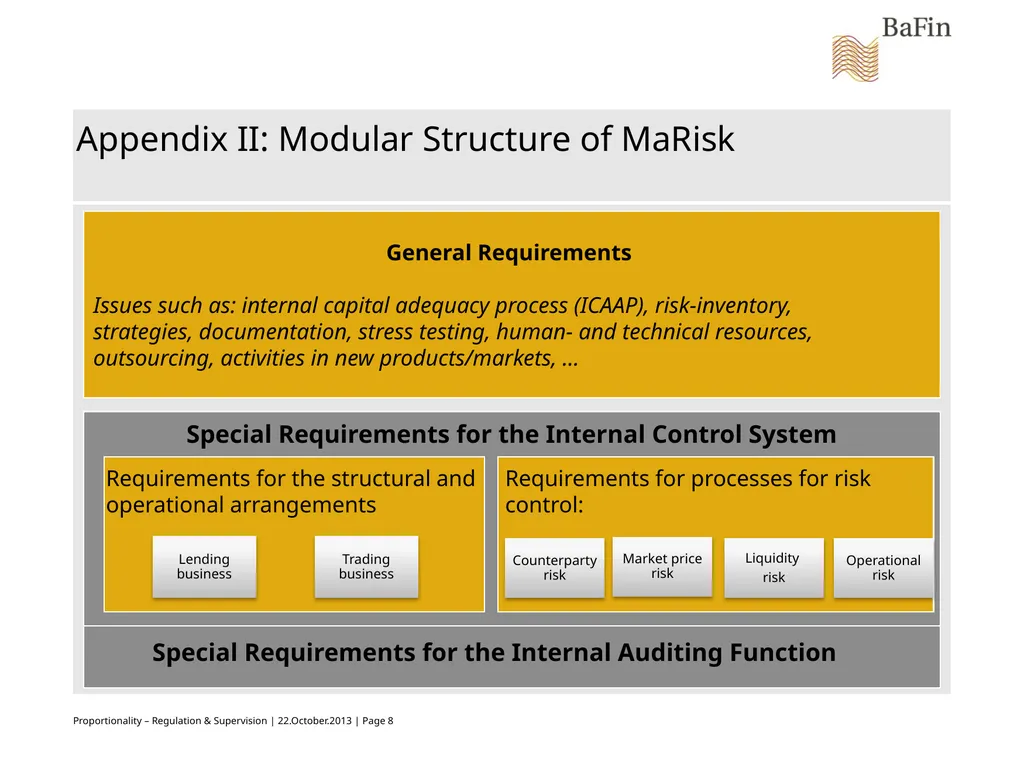
General Requirements
Issues such as: internal capital adequacy process (ICAAP), risk-inventory,
strategies, documentation, stress testing, human- and technical resources,
outsourcing, activities in new products/markets, … Special Requirements for the Internal Control System Requirements for the structural and operational arrangements Requirements for processes for risk
control: Special Requirements for the Internal Auditing Function Appendix II: Modular Structure of MaRisk Proportionality – Regulation & Supervision | 22.October.2013 | Page 8<br>