
Proposal Development and Budgeting Basics Todd


Description: Proposal Development and Budgeting Basics Todd Erceg Director, Sponsored Programs BMC Research Operations Introduction 2 The information presented today is designed to help you navigate the administrative requirements of proposal and budget
Related Topics
Download Presentation
"Proposal Development and Budgeting Basics Todd" is the property of its rightful owner. Permission is granted to download and print the materials on this website for personal, non-commercial use only, and to display it on your personal computer provided you do not modify the materials and that you retain all copyright notices contained in the materials. By downloading content from our website, you accept the terms of this agreement.
Presentation Transcript
slide1. Proposal Development and Budgeting Basics Todd Erceg
Director, Sponsored Programs
BMC Research Operations<br>
slide2. Introduction 2 The information presented today is designed to help you navigate the administrative requirements of proposal and budget development to improve the possibility of your application being reviewed and funded<br>
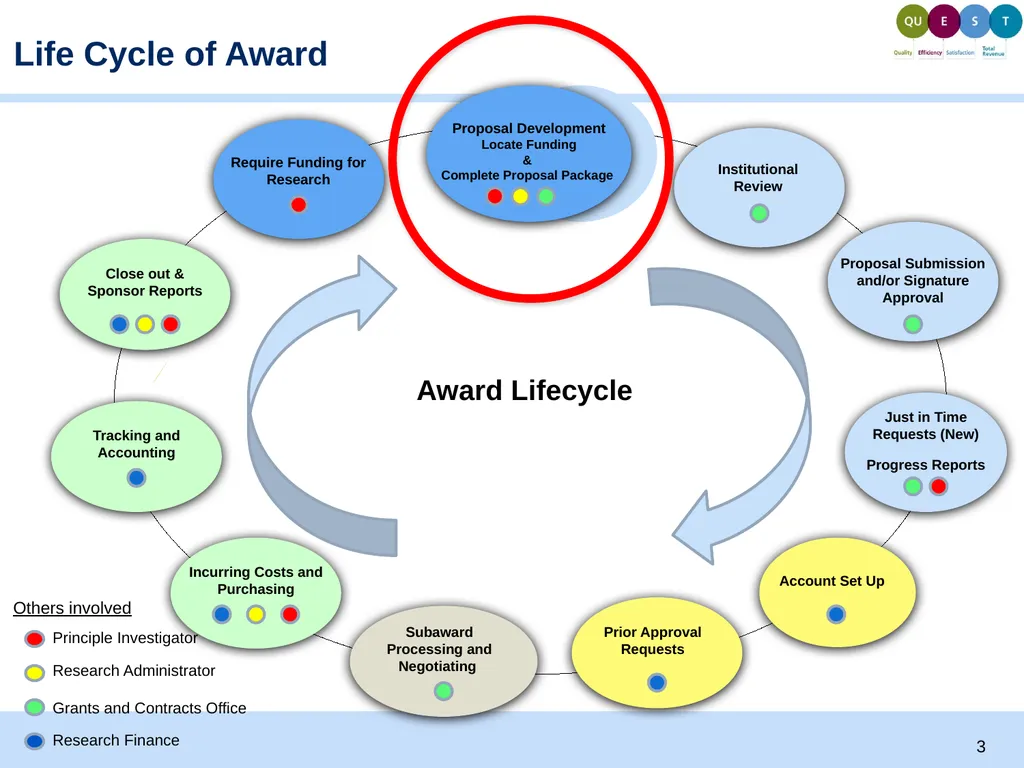
slide3. Life Cycle of Award 3 Just in Time Requests (New)
Progress Reports Account Set Up Principle Investigator
Research Administrator
Grants and Contracts Office
Research Finance Others involved Award Lifecycle Proposal Submission and/or Signature Approval Close out & Sponsor Reports Prior Approval Requests Subaward Processing and Negotiating Tracking and Accounting Incurring Costs and Purchasing<br>
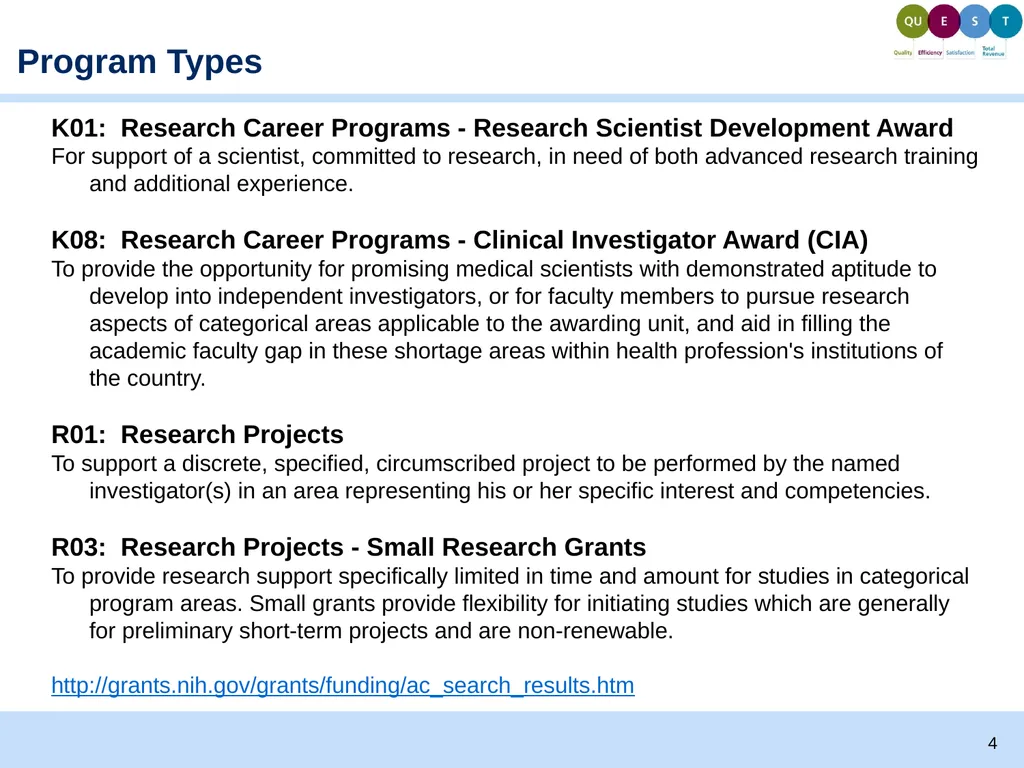
slide4. Program Types K01: Research Career Programs - Research Scientist Development Award
For support of a scientist, committed to research, in need of both advanced research training and additional experience.
K08: Research Career Programs - Clinical Investigator Award (CIA)
To provide the opportunity for promising medical scientists with demonstrated aptitude to develop into independent investigators, or for faculty members to pursue research aspects of categorical areas applicable to the awarding unit, and aid in filling the academic faculty gap in these shortage areas within health profession's institutions of the country.
R01: Research Projects
To support a discrete, specified, circumscribed project to be performed by the named investigator(s) in an area representing his or her specific interest and competencies.
R03: Research Projects - Small Research Grants
To provide research support specifically limited in time and amount for studies in categorical program areas. Small grants provide flexibility for initiating studies which are generally for preliminary short-term projects and are non-renewable.
http://grants.nih.gov/grants/funding/ac_search_results.htm 4<br>
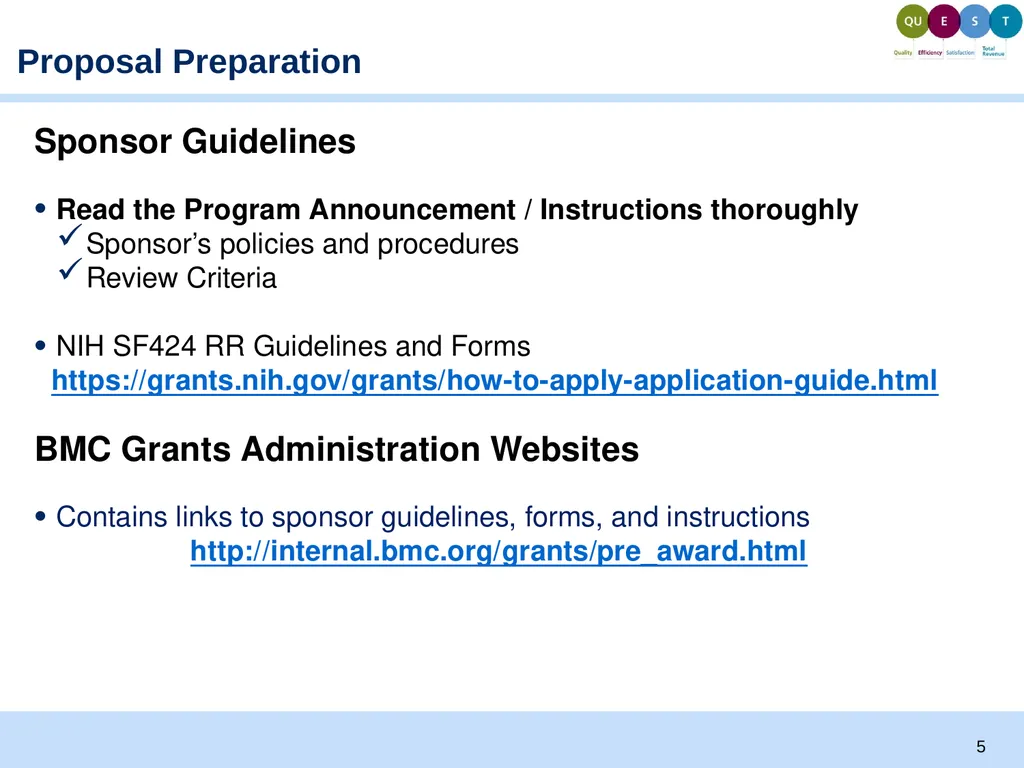
slide5. Proposal Preparation Sponsor Guidelines
Read the Program Announcement / Instructions thoroughly
Sponsor’s policies and procedures
Review Criteria
NIH SF424 RR Guidelines and Forms
https://grants.nih.gov/grants/how-to-apply-application-guide.html
BMC Grants Administration Websites
Contains links to sponsor guidelines, forms, and instructions
http://internal.bmc.org/grants/pre_award.html 5<br>
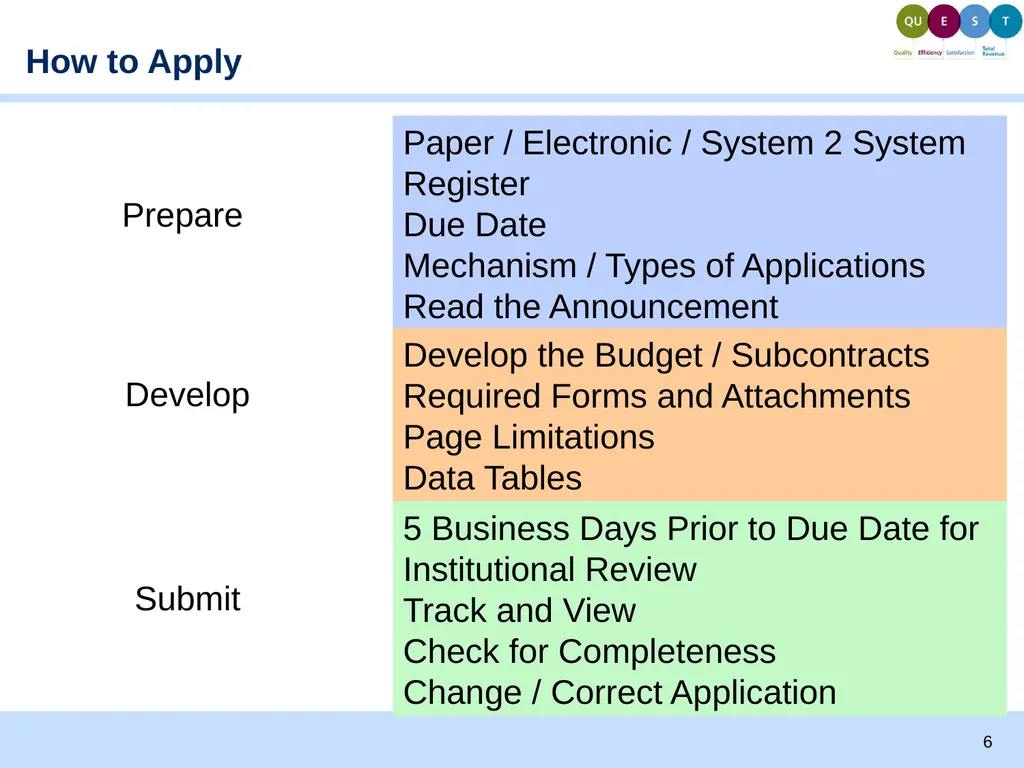
slide6. How to Apply 6 Prepare Paper / Electronic / System 2 System
Register
Due Date
Mechanism / Types of Applications
Read the Announcement Develop Develop the Budget / Subcontracts
Required Forms and Attachments
Page Limitations
Data Tables Submit 5 Business Days Prior to Due Date for Institutional Review
Track and View
Check for Completeness
Change / Correct Application<br>
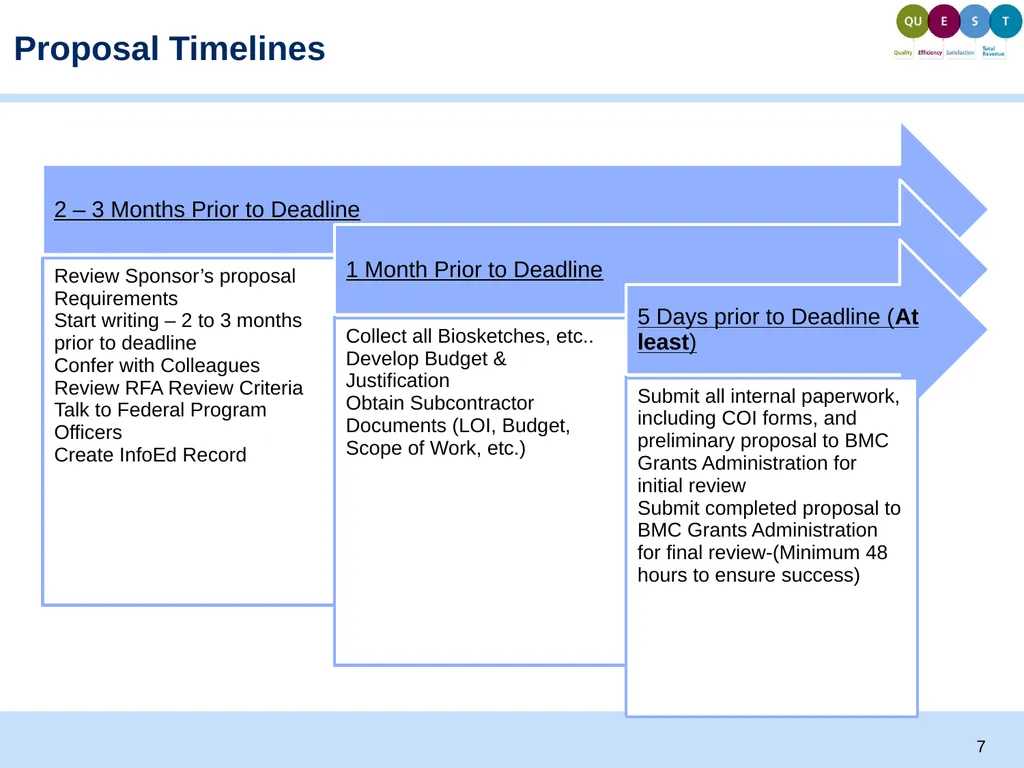
slide7. Proposal Timelines 7<br>
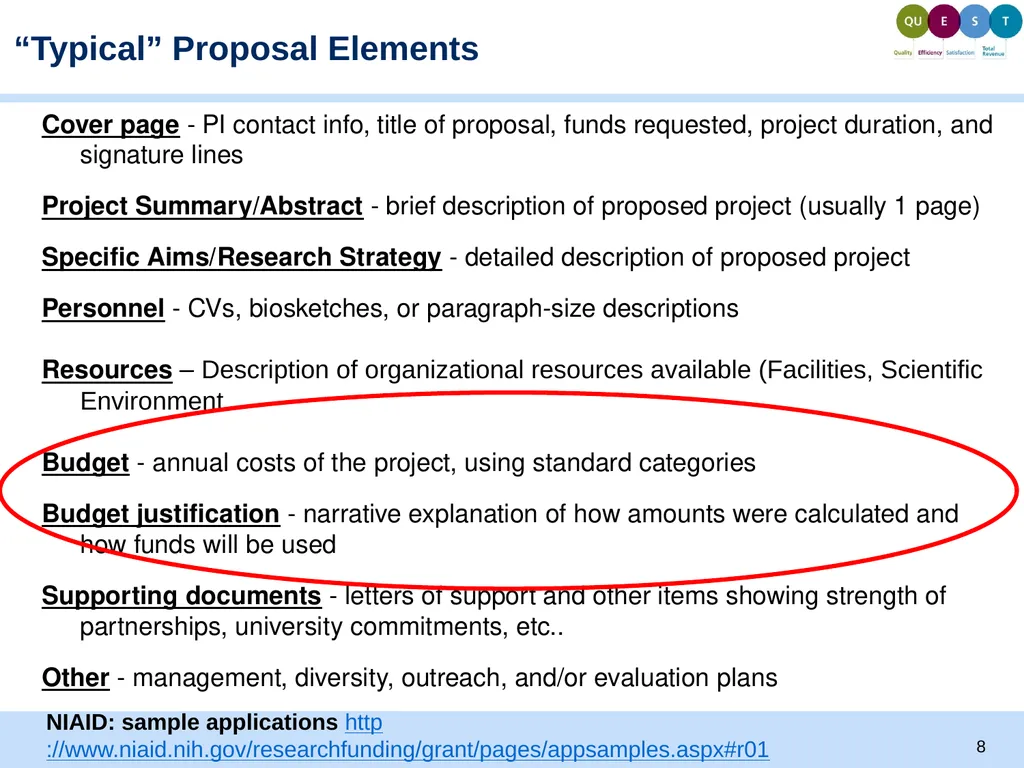
slide8. “Typical” Proposal Elements Cover page - PI contact info, title of proposal, funds requested, project duration, and signature lines
Project Summary/Abstract - brief description of proposed project (usually 1 page)
Specific Aims/Research Strategy - detailed description of proposed project
Personnel - CVs, biosketches, or paragraph-size descriptions
Resources – Description of organizational resources available (Facilities, Scientific Environment
Budget - annual costs of the project, using standard categories
Budget justification - narrative explanation of how amounts were calculated and how funds will be used
Supporting documents - letters of support and other items showing strength of partnerships, university commitments, etc..
Other - management, diversity, outreach, and/or evaluation plans 8 NIAID: sample applications http://www.niaid.nih.gov/researchfunding/grant/pages/appsamples.aspx#r01<br>
slide9. BUDGETS 9<br>
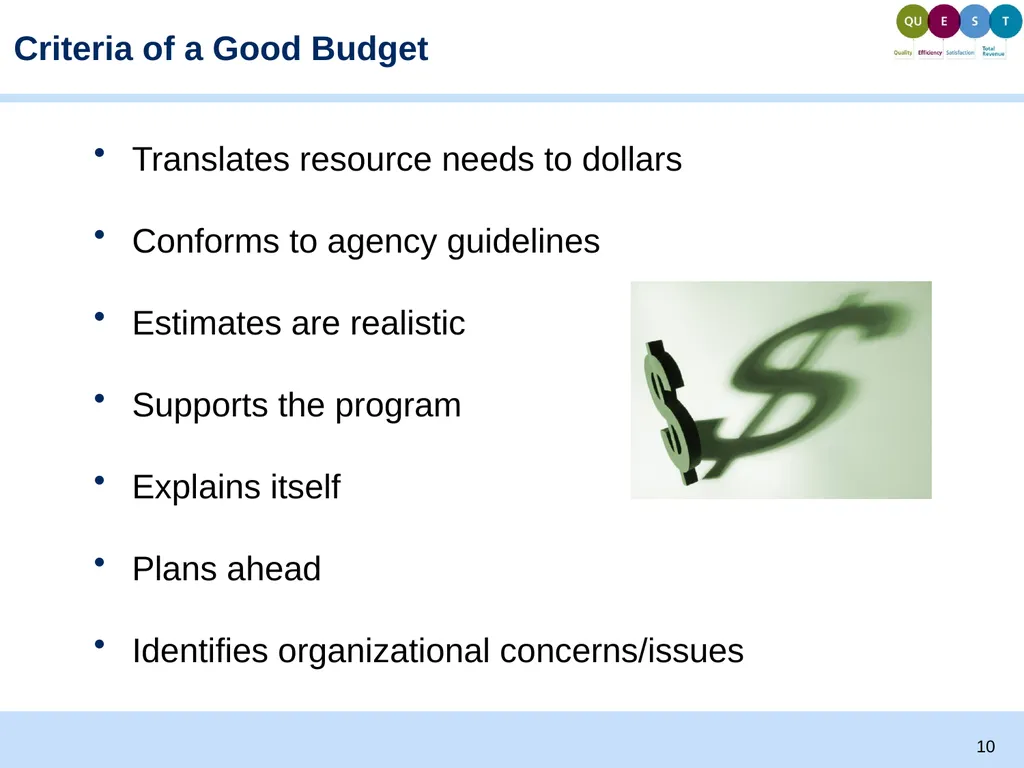
slide10. Translates resource needs to dollars
Conforms to agency guidelines
Estimates are realistic
Supports the program
Explains itself
Plans ahead
Identifies organizational concerns/issues Criteria of a Good Budget 10<br>
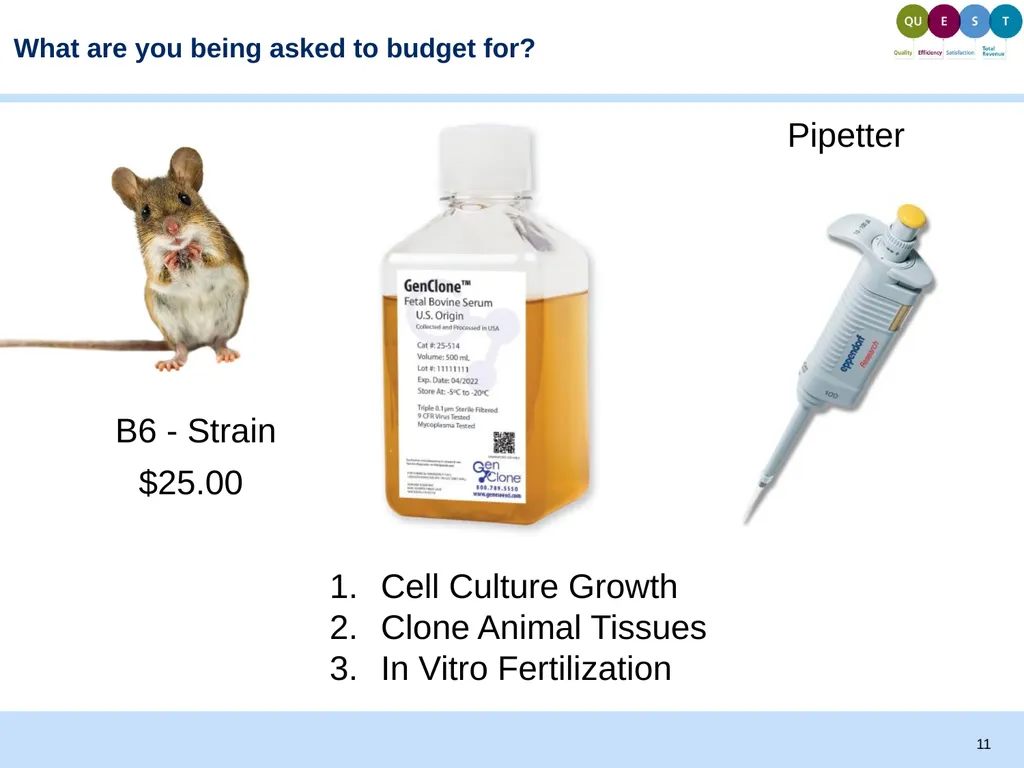
slide11. What are you being asked to budget for? 11 Cell Culture Growth
Clone Animal Tissues
In Vitro Fertilization Pipetter B6 - Strain $25.00<br>
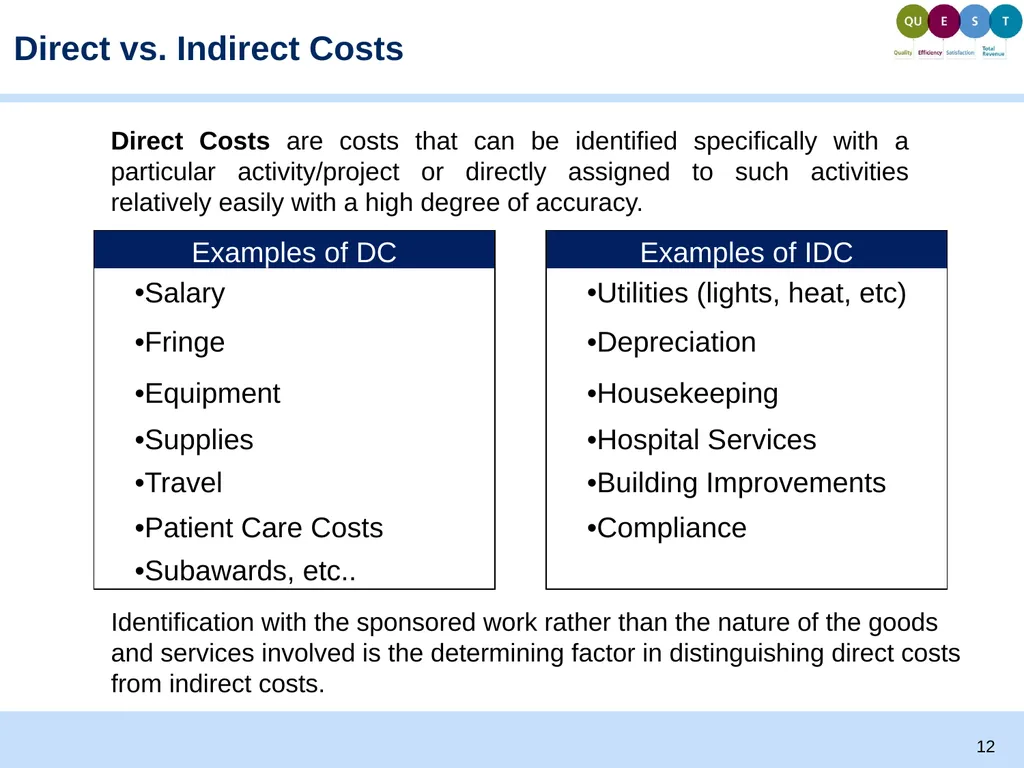
slide12. Direct vs. Indirect Costs Identification with the sponsored work rather than the nature of the goods and services involved is the determining factor in distinguishing direct costs from indirect costs. Direct Costs are costs that can be identified specifically with a particular activity/project or directly assigned to such activities relatively easily with a high degree of accuracy. 12<br>
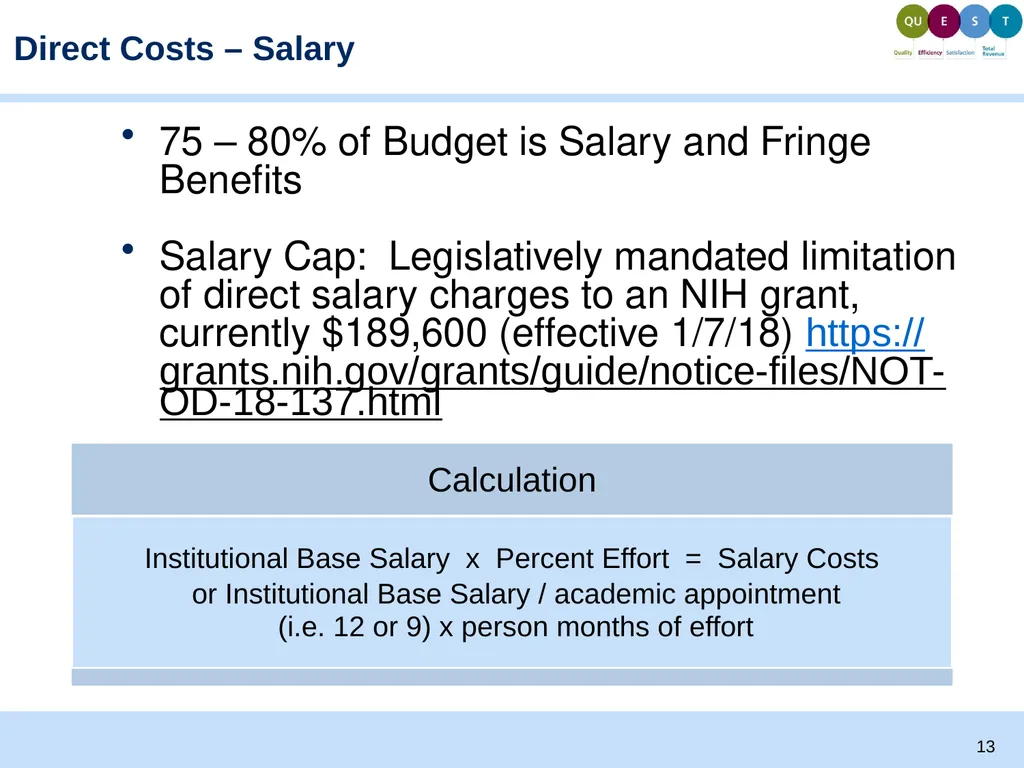
slide13. Direct Costs – Salary 75 – 80% of Budget is Salary and Fringe Benefits
Salary Cap: Legislatively mandated limitation of direct salary charges to an NIH grant, currently $189,600 (effective 1/7/18) https://grants.nih.gov/grants/guide/notice-files/NOT-OD-18-137.html 13<br>
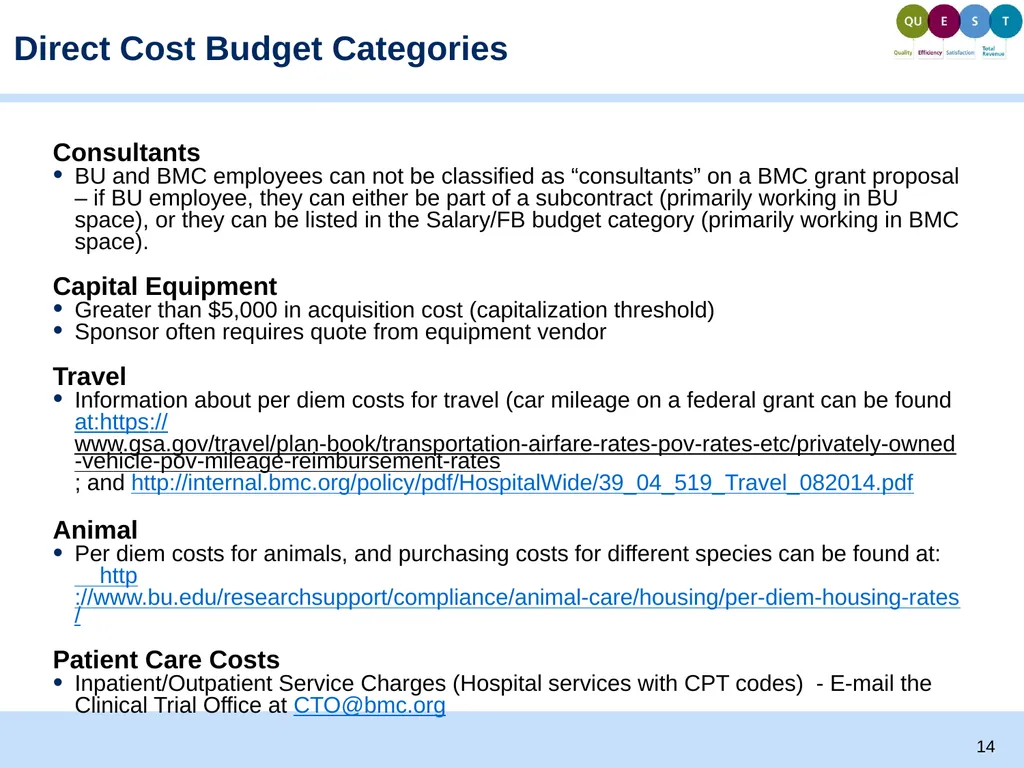
slide14. Direct Cost Budget Categories Consultants
BU and BMC employees can not be classified as “consultants” on a BMC grant proposal – if BU employee, they can either be part of a subcontract (primarily working in BU space), or they can be listed in the Salary/FB budget category (primarily working in BMC space).
Capital Equipment
Greater than $5,000 in acquisition cost (capitalization threshold)
Sponsor often requires quote from equipment vendor
Travel
Information about per diem costs for travel (car mileage on a federal grant can be found at:https://www.gsa.gov/travel/plan-book/transportation-airfare-rates-pov-rates-etc/privately-owned-vehicle-pov-mileage-reimbursement-rates; and http://internal.bmc.org/policy/pdf/HospitalWide/39_04_519_Travel_082014.pdf
Animal
Per diem costs for animals, and purchasing costs for different species can be found at: http://www.bu.edu/researchsupport/compliance/animal-care/housing/per-diem-housing-rates/
Patient Care Costs
Inpatient/Outpatient Service Charges (Hospital services with CPT codes) - E-mail the Clinical Trial Office at CTO@bmc.org 14<br>
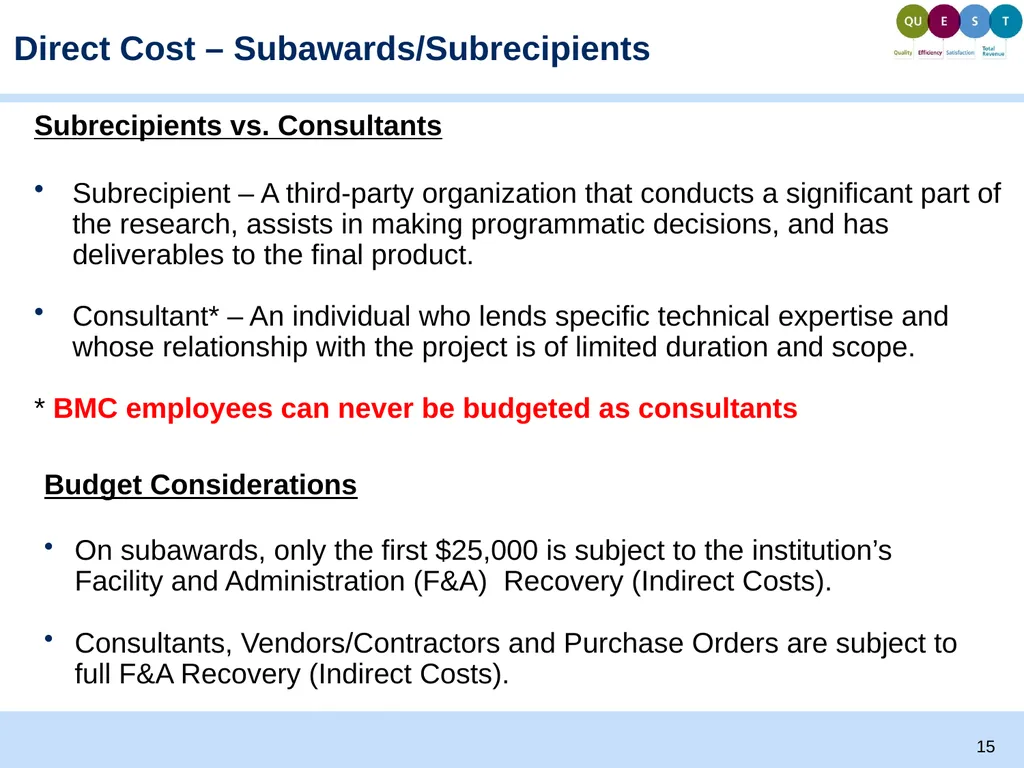
slide15. Subrecipients vs. Consultants
Subrecipient – A third-party organization that conducts a significant part of the research, assists in making programmatic decisions, and has deliverables to the final product.
Consultant* – An individual who lends specific technical expertise and whose relationship with the project is of limited duration and scope.
* BMC employees can never be budgeted as consultants Direct Cost – Subawards/Subrecipients Budget Considerations
On subawards, only the first $25,000 is subject to the institution’s Facility and Administration (F&A) Recovery (Indirect Costs).
Consultants, Vendors/Contractors and Purchase Orders are subject to full F&A Recovery (Indirect Costs). 15<br>
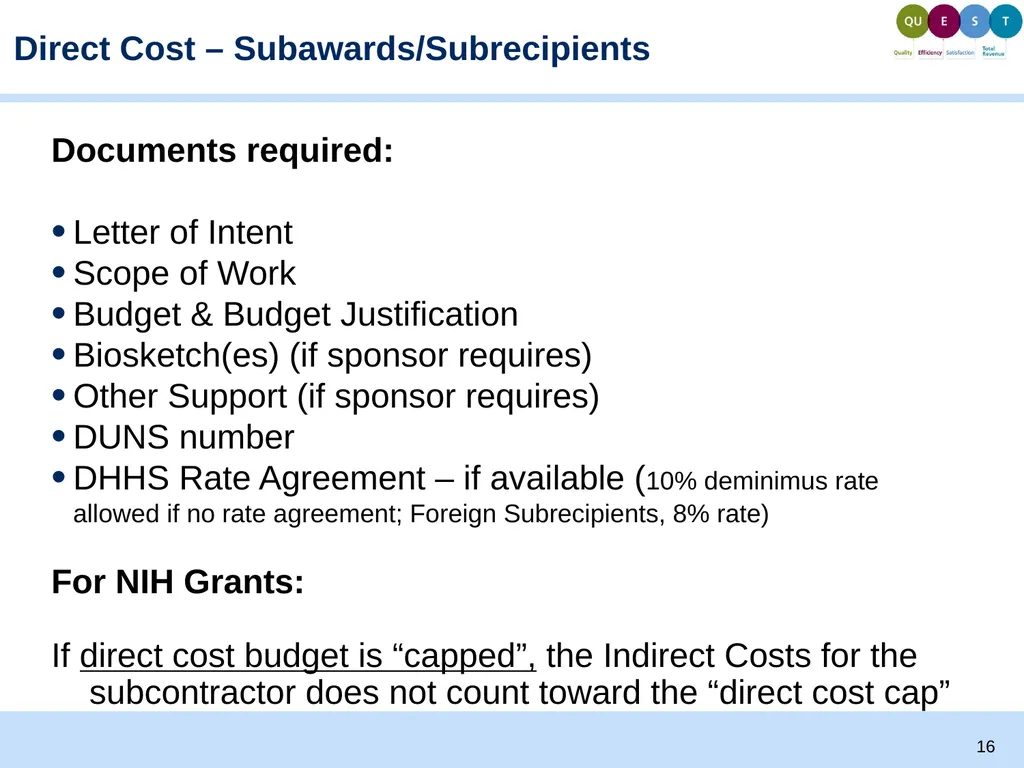
slide16. Direct Cost – Subawards/Subrecipients Documents required:
Letter of Intent
Scope of Work
Budget & Budget Justification
Biosketch(es) (if sponsor requires)
Other Support (if sponsor requires)
DUNS number
DHHS Rate Agreement – if available (10% deminimus rate allowed if no rate agreement; Foreign Subrecipients, 8% rate)
For NIH Grants:
If direct cost budget is “capped”, the Indirect Costs for the subcontractor does not count toward the “direct cost cap” 16<br>
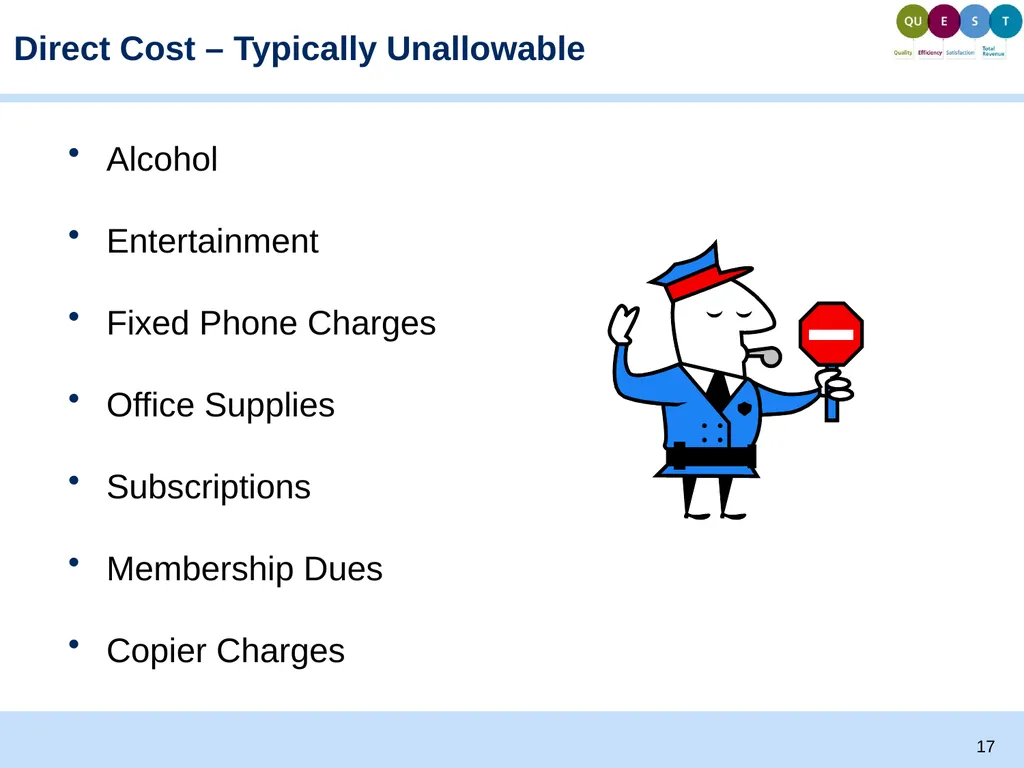
slide17. Direct Cost – Typically Unallowable 17 Alcohol
Entertainment
Fixed Phone Charges
Office Supplies
Subscriptions
Membership Dues
Copier Charges<br>
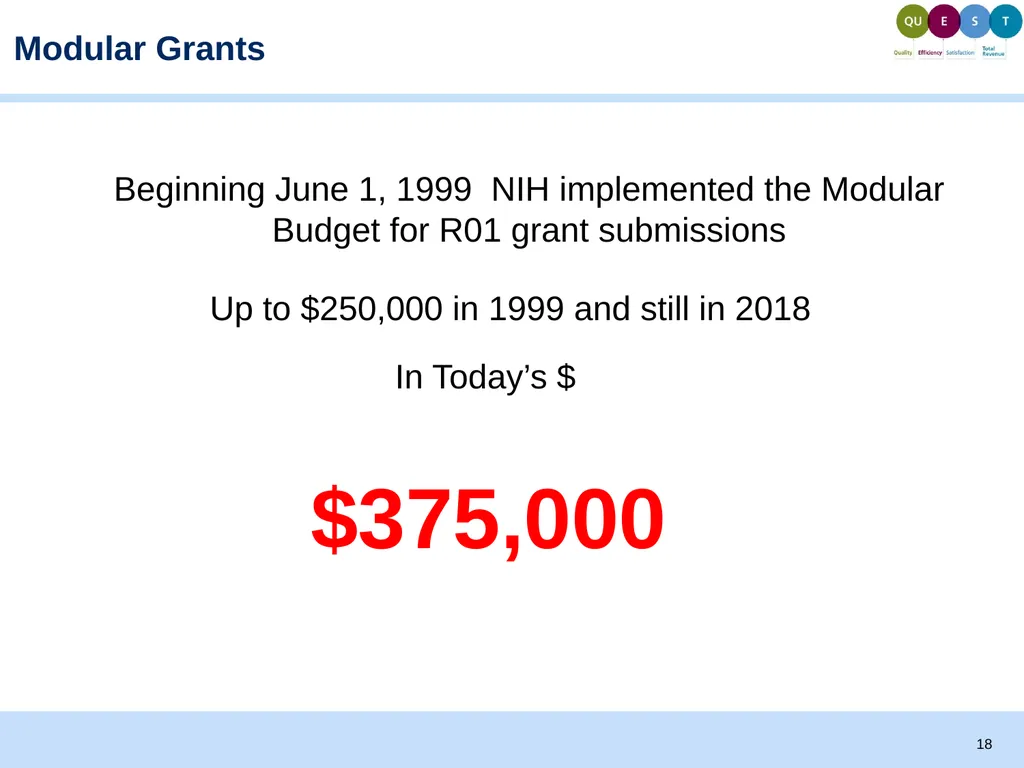
slide18. 18 Modular Grants Beginning June 1, 1999 NIH implemented the Modular Budget for R01 grant submissions Up to $250,000 in 1999 and still in 2018 In Today’s $ $375,000<br>
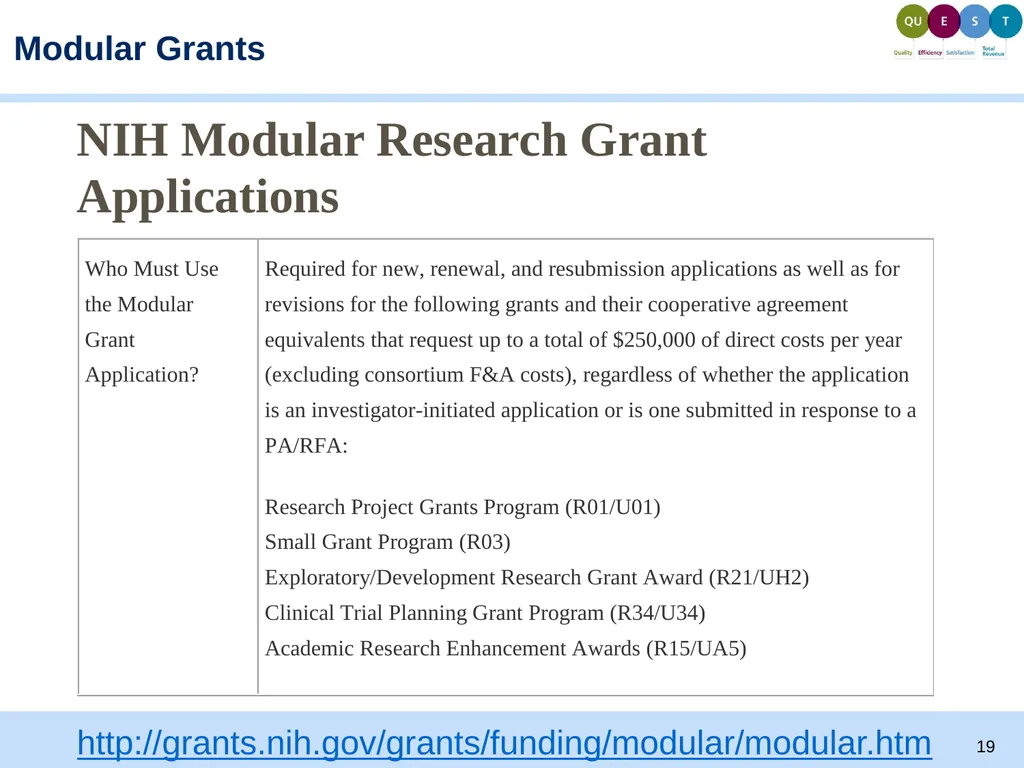
slide19. Modular Grants http://grants.nih.gov/grants/funding/modular/modular.htm 19<br>
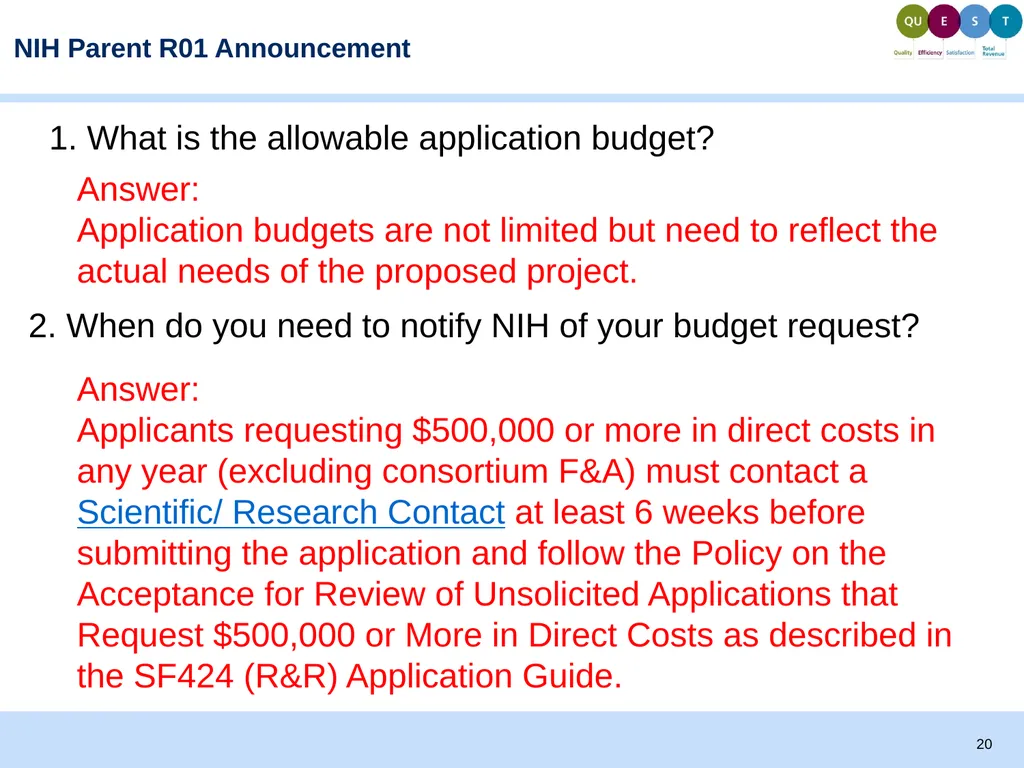
slide20. NIH Parent R01 Announcement Answer:
Applicants requesting $500,000 or more in direct costs in any year (excluding consortium F&A) must contact a Scientific/ Research Contact at least 6 weeks before submitting the application and follow the Policy on the Acceptance for Review of Unsolicited Applications that Request $500,000 or More in Direct Costs as described in the SF424 (R&R) Application Guide. 20 Answer:
Application budgets are not limited but need to reflect the actual needs of the proposed project. 1. What is the allowable application budget? 2. When do you need to notify NIH of your budget request?<br>
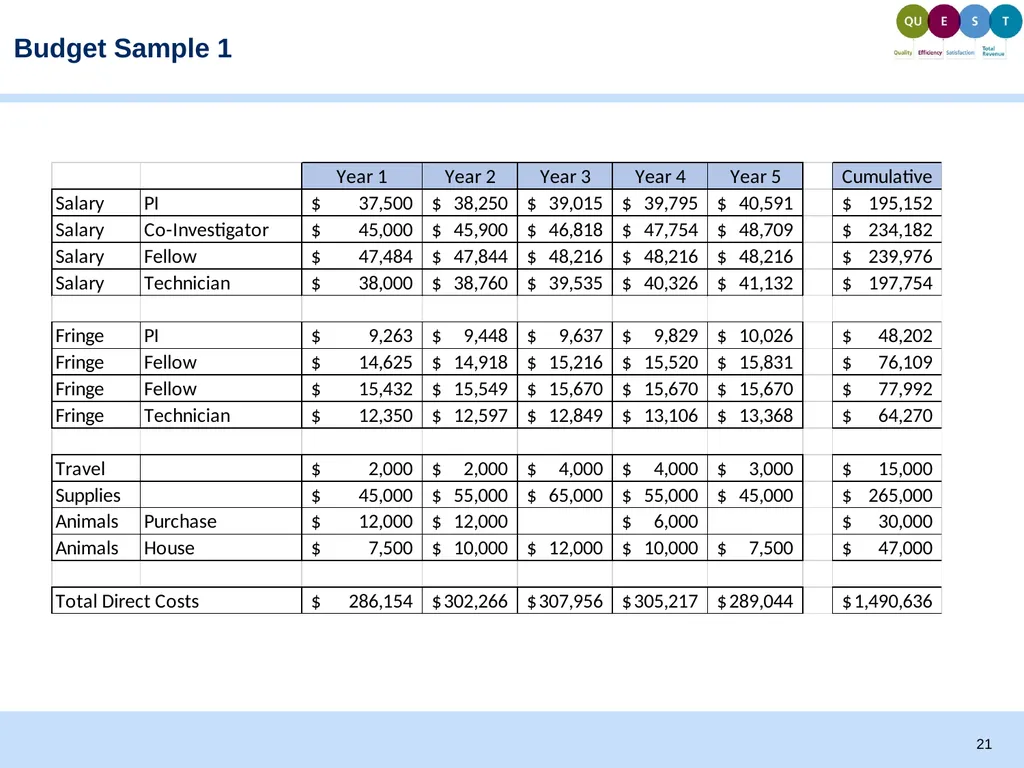
slide21. Budget Sample 1 21<br>
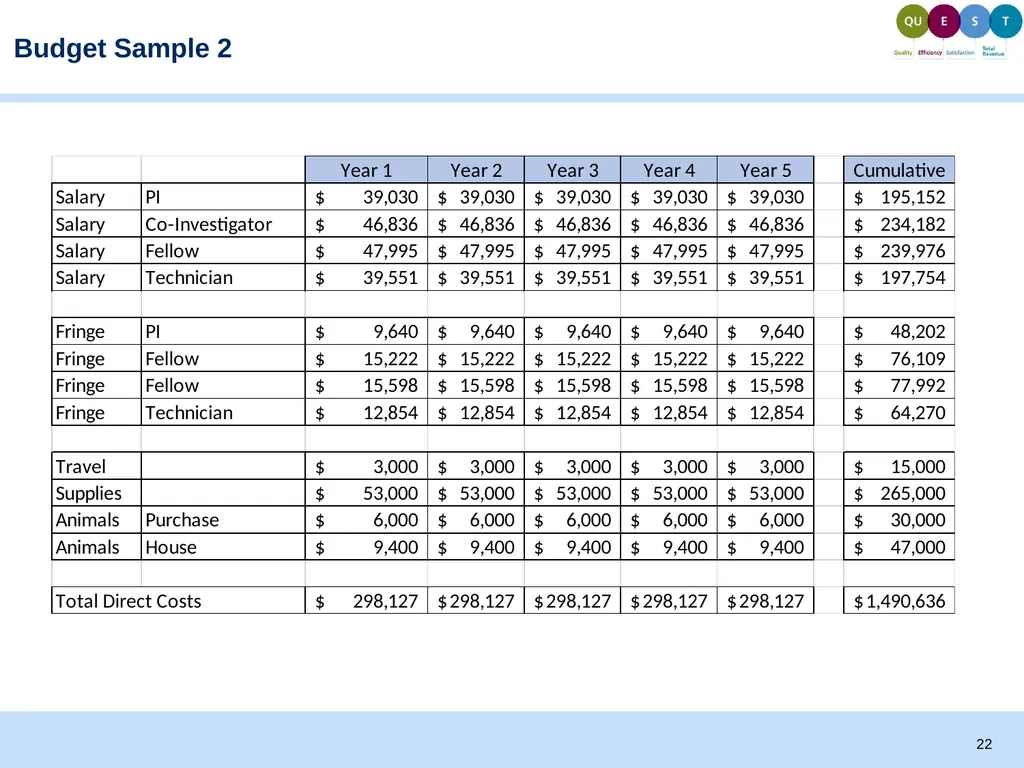
slide22. Budget Sample 2 22<br>
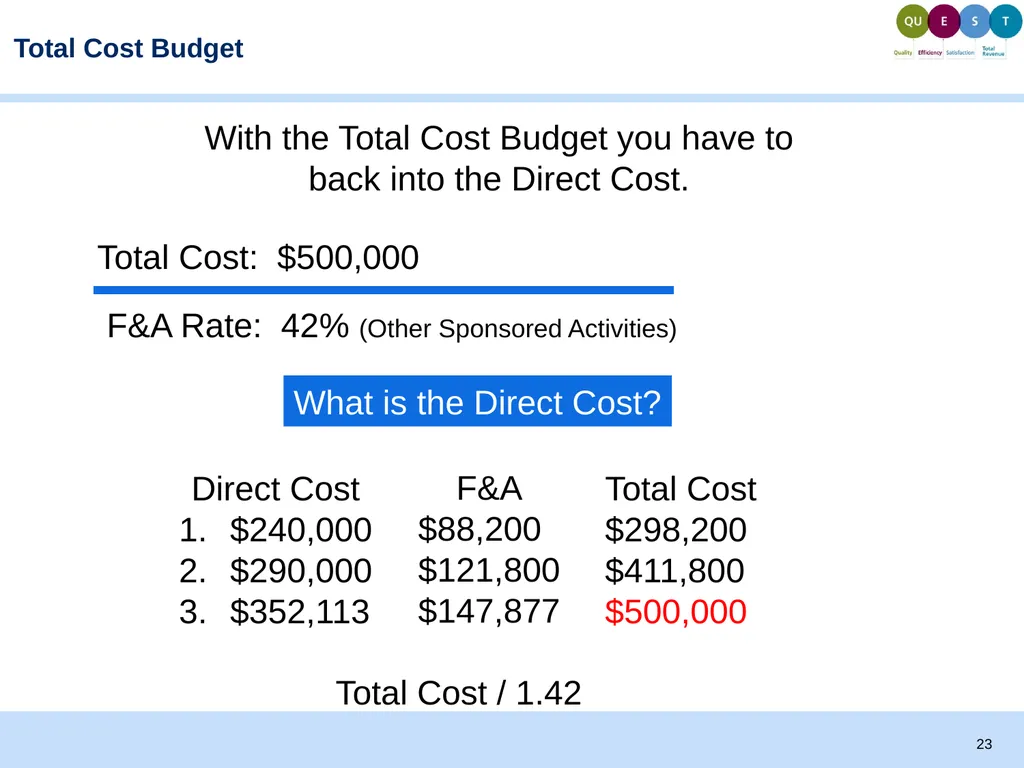
slide23. Total Cost Budget 23 With the Total Cost Budget you have to back into the Direct Cost. Total Cost: $500,000 F&A Rate: 42% (Other Sponsored Activities) Direct Cost
$240,000
$290,000
$352,113 What is the Direct Cost? F&A
$88,200
$121,800
$147,877 Total Cost
$298,200
$411,800
$500,000 Total Cost / 1.42<br>
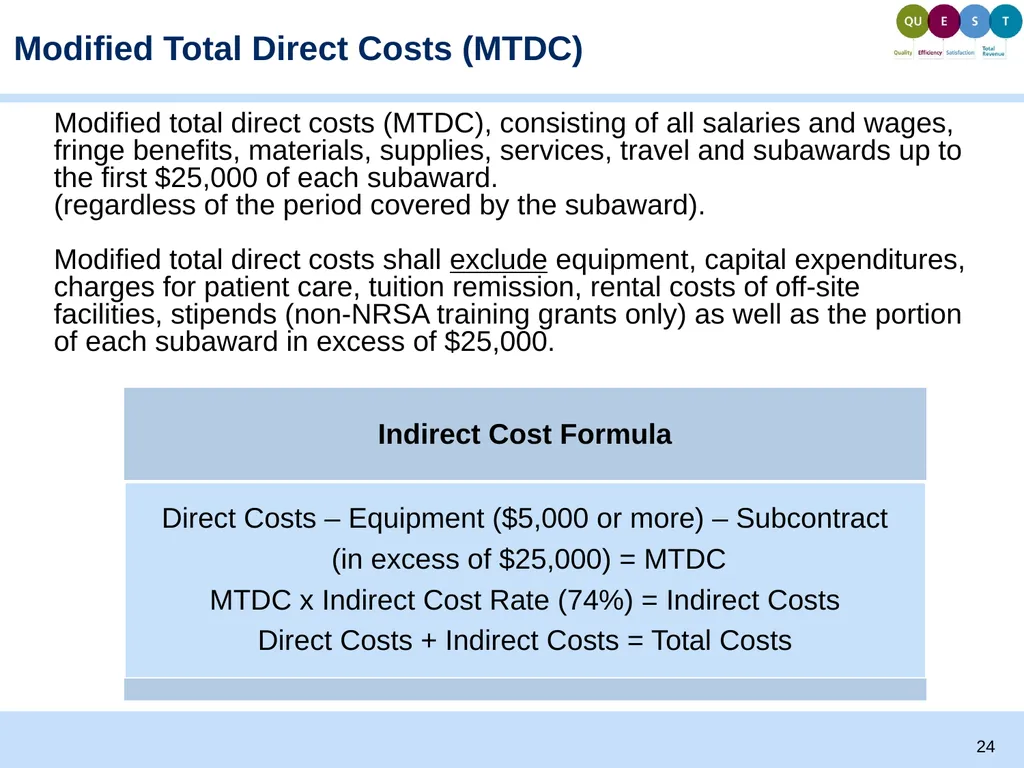
slide24. Modified total direct costs (MTDC), consisting of all salaries and wages,
fringe benefits, materials, supplies, services, travel and subawards up to the first $25,000 of each subaward.
(regardless of the period covered by the subaward).
Modified total direct costs shall exclude equipment, capital expenditures,
charges for patient care, tuition remission, rental costs of off-site facilities, stipends (non-NRSA training grants only) as well as the portion of each subaward in excess of $25,000. Modified Total Direct Costs (MTDC) 24<br>
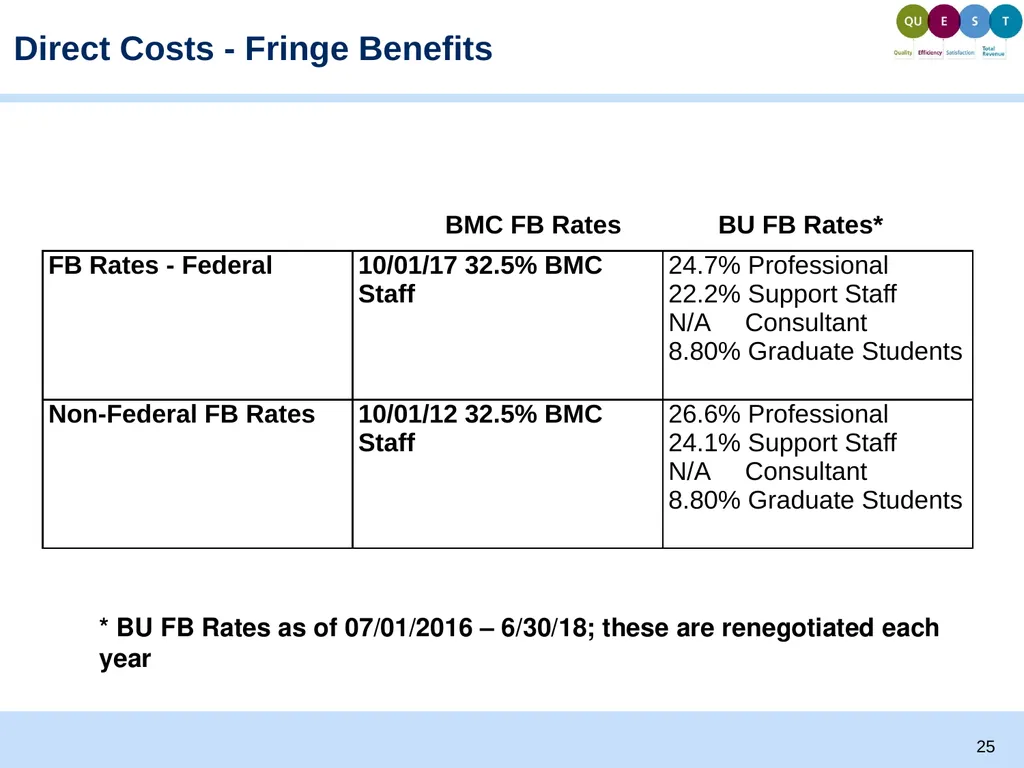
slide25. Direct Costs - Fringe Benefits BMC FB Rates BU FB Rates* * BU FB Rates as of 07/01/2016 – 6/30/18; these are renegotiated each year 25<br>
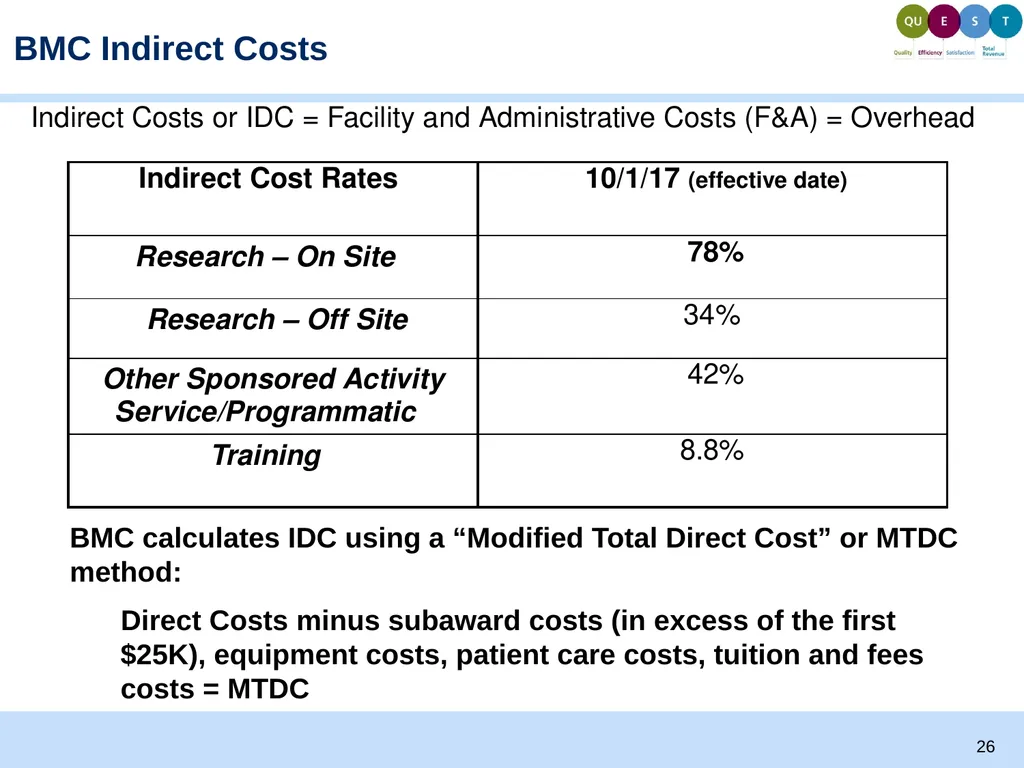
slide26. BMC Indirect Costs Indirect Costs or IDC = Facility and Administrative Costs (F&A) = Overhead BMC calculates IDC using a “Modified Total Direct Cost” or MTDC method:
Direct Costs minus subaward costs (in excess of the first $25K), equipment costs, patient care costs, tuition and fees costs = MTDC 26<br>
slide27. Take Away 27<br>
slide28. Contacts 28 Grants and Contracts Office
Todd Erceg, Director Sponsored Programs
617-414-2877
Todd.Erceg@bmc.org
General Mailbox
Grants.admin@bmc.org<br>
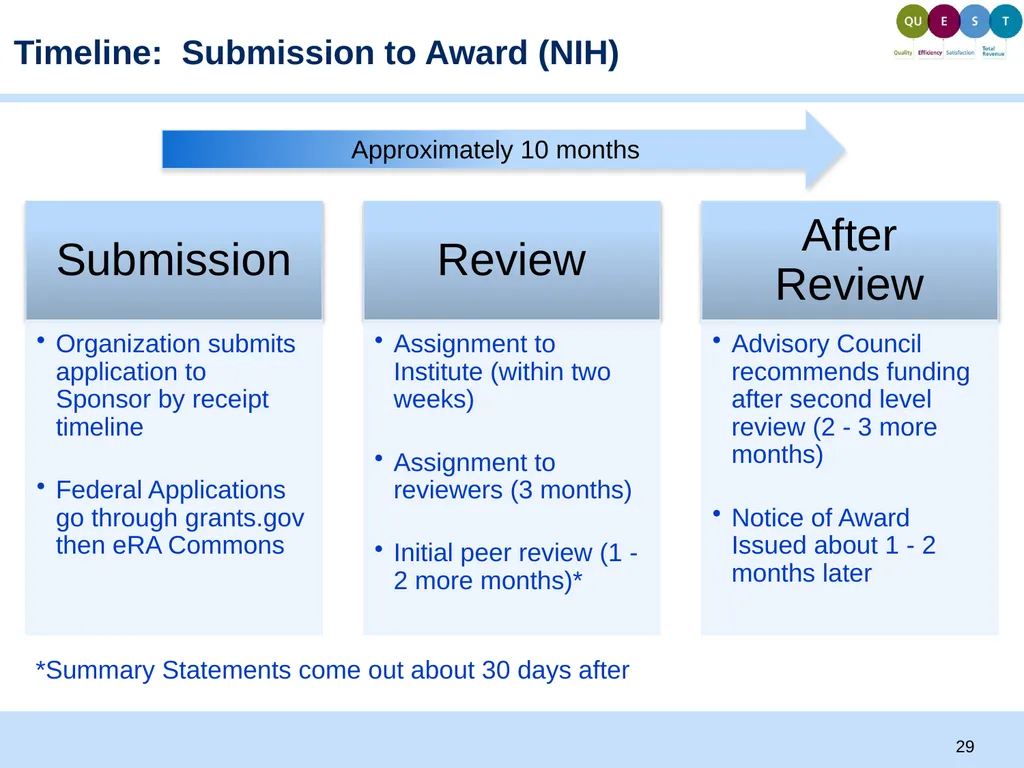
slide29. Timeline: Submission to Award (NIH) 29 *Summary Statements come out about 30 days after Approximately 10 months<br>
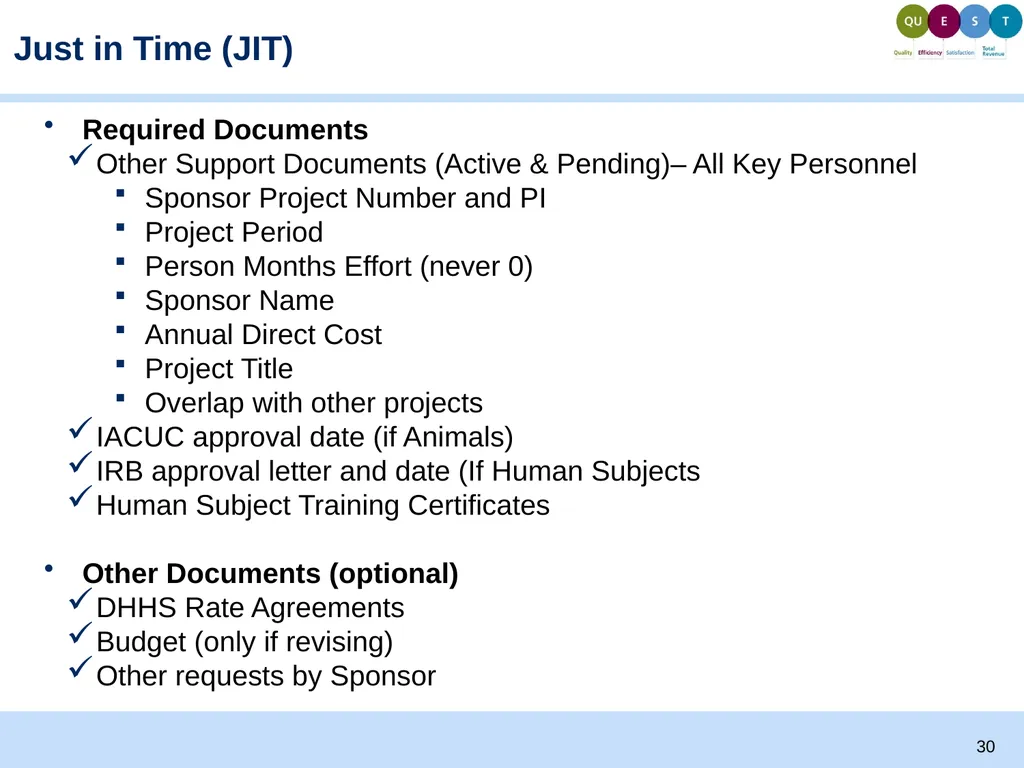
slide30. Just in Time (JIT) Required Documents
Other Support Documents (Active & Pending)– All Key Personnel
Sponsor Project Number and PI
Project Period
Person Months Effort (never 0)
Sponsor Name
Annual Direct Cost
Project Title
Overlap with other projects
IACUC approval date (if Animals)
IRB approval letter and date (If Human Subjects
Human Subject Training Certificates
Other Documents (optional)
DHHS Rate Agreements
Budget (only if revising)
Other requests by Sponsor 30<br>
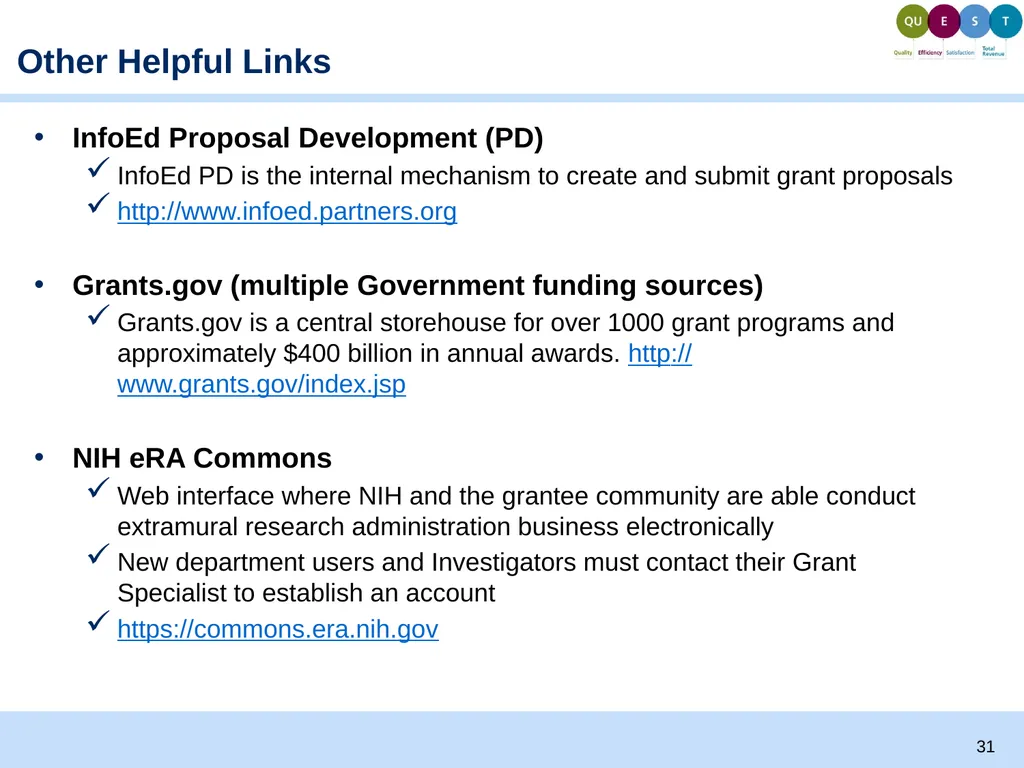
slide31. Other Helpful Links InfoEd Proposal Development (PD)
InfoEd PD is the internal mechanism to create and submit grant proposals
http://www.infoed.partners.org
Grants.gov (multiple Government funding sources)
Grants.gov is a central storehouse for over 1000 grant programs and approximately $400 billion in annual awards. http://www.grants.gov/index.jsp
NIH eRA Commons
Web interface where NIH and the grantee community are able conduct extramural research administration business electronically
New department users and Investigators must contact their Grant Specialist to establish an account
https://commons.era.nih.gov 31<br>
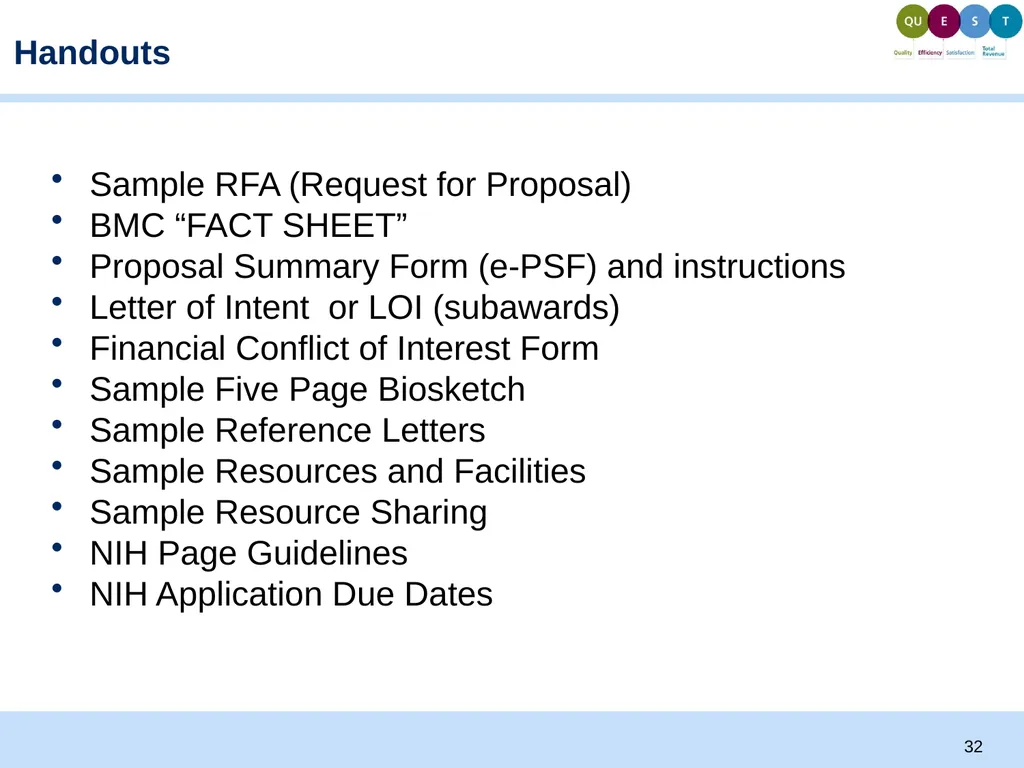
slide32. Handouts 32 Sample RFA (Request for Proposal)
BMC “FACT SHEET”
Proposal Summary Form (e-PSF) and instructions
Letter of Intent or LOI (subawards)
Financial Conflict of Interest Form
Sample Five Page Biosketch
Sample Reference Letters
Sample Resources and Facilities
Sample Resource Sharing
NIH Page Guidelines
NIH Application Due Dates<br>
Director, Sponsored Programs
BMC Research Operations<br>
slide2. Introduction 2 The information presented today is designed to help you navigate the administrative requirements of proposal and budget development to improve the possibility of your application being reviewed and funded<br>
slide3. Life Cycle of Award 3 Just in Time Requests (New)
Progress Reports Account Set Up Principle Investigator
Research Administrator
Grants and Contracts Office
Research Finance Others involved Award Lifecycle Proposal Submission and/or Signature Approval Close out & Sponsor Reports Prior Approval Requests Subaward Processing and Negotiating Tracking and Accounting Incurring Costs and Purchasing<br>
slide4. Program Types K01: Research Career Programs - Research Scientist Development Award
For support of a scientist, committed to research, in need of both advanced research training and additional experience.
K08: Research Career Programs - Clinical Investigator Award (CIA)
To provide the opportunity for promising medical scientists with demonstrated aptitude to develop into independent investigators, or for faculty members to pursue research aspects of categorical areas applicable to the awarding unit, and aid in filling the academic faculty gap in these shortage areas within health profession's institutions of the country.
R01: Research Projects
To support a discrete, specified, circumscribed project to be performed by the named investigator(s) in an area representing his or her specific interest and competencies.
R03: Research Projects - Small Research Grants
To provide research support specifically limited in time and amount for studies in categorical program areas. Small grants provide flexibility for initiating studies which are generally for preliminary short-term projects and are non-renewable.
http://grants.nih.gov/grants/funding/ac_search_results.htm 4<br>
slide5. Proposal Preparation Sponsor Guidelines
Read the Program Announcement / Instructions thoroughly
Sponsor’s policies and procedures
Review Criteria
NIH SF424 RR Guidelines and Forms
https://grants.nih.gov/grants/how-to-apply-application-guide.html
BMC Grants Administration Websites
Contains links to sponsor guidelines, forms, and instructions
http://internal.bmc.org/grants/pre_award.html 5<br>
slide6. How to Apply 6 Prepare Paper / Electronic / System 2 System
Register
Due Date
Mechanism / Types of Applications
Read the Announcement Develop Develop the Budget / Subcontracts
Required Forms and Attachments
Page Limitations
Data Tables Submit 5 Business Days Prior to Due Date for Institutional Review
Track and View
Check for Completeness
Change / Correct Application<br>
slide7. Proposal Timelines 7<br>
slide8. “Typical” Proposal Elements Cover page - PI contact info, title of proposal, funds requested, project duration, and signature lines
Project Summary/Abstract - brief description of proposed project (usually 1 page)
Specific Aims/Research Strategy - detailed description of proposed project
Personnel - CVs, biosketches, or paragraph-size descriptions
Resources – Description of organizational resources available (Facilities, Scientific Environment
Budget - annual costs of the project, using standard categories
Budget justification - narrative explanation of how amounts were calculated and how funds will be used
Supporting documents - letters of support and other items showing strength of partnerships, university commitments, etc..
Other - management, diversity, outreach, and/or evaluation plans 8 NIAID: sample applications http://www.niaid.nih.gov/researchfunding/grant/pages/appsamples.aspx#r01<br>
slide9. BUDGETS 9<br>
slide10. Translates resource needs to dollars
Conforms to agency guidelines
Estimates are realistic
Supports the program
Explains itself
Plans ahead
Identifies organizational concerns/issues Criteria of a Good Budget 10<br>
slide11. What are you being asked to budget for? 11 Cell Culture Growth
Clone Animal Tissues
In Vitro Fertilization Pipetter B6 - Strain $25.00<br>
slide12. Direct vs. Indirect Costs Identification with the sponsored work rather than the nature of the goods and services involved is the determining factor in distinguishing direct costs from indirect costs. Direct Costs are costs that can be identified specifically with a particular activity/project or directly assigned to such activities relatively easily with a high degree of accuracy. 12<br>
slide13. Direct Costs – Salary 75 – 80% of Budget is Salary and Fringe Benefits
Salary Cap: Legislatively mandated limitation of direct salary charges to an NIH grant, currently $189,600 (effective 1/7/18) https://grants.nih.gov/grants/guide/notice-files/NOT-OD-18-137.html 13<br>
slide14. Direct Cost Budget Categories Consultants
BU and BMC employees can not be classified as “consultants” on a BMC grant proposal – if BU employee, they can either be part of a subcontract (primarily working in BU space), or they can be listed in the Salary/FB budget category (primarily working in BMC space).
Capital Equipment
Greater than $5,000 in acquisition cost (capitalization threshold)
Sponsor often requires quote from equipment vendor
Travel
Information about per diem costs for travel (car mileage on a federal grant can be found at:https://www.gsa.gov/travel/plan-book/transportation-airfare-rates-pov-rates-etc/privately-owned-vehicle-pov-mileage-reimbursement-rates; and http://internal.bmc.org/policy/pdf/HospitalWide/39_04_519_Travel_082014.pdf
Animal
Per diem costs for animals, and purchasing costs for different species can be found at: http://www.bu.edu/researchsupport/compliance/animal-care/housing/per-diem-housing-rates/
Patient Care Costs
Inpatient/Outpatient Service Charges (Hospital services with CPT codes) - E-mail the Clinical Trial Office at CTO@bmc.org 14<br>
slide15. Subrecipients vs. Consultants
Subrecipient – A third-party organization that conducts a significant part of the research, assists in making programmatic decisions, and has deliverables to the final product.
Consultant* – An individual who lends specific technical expertise and whose relationship with the project is of limited duration and scope.
* BMC employees can never be budgeted as consultants Direct Cost – Subawards/Subrecipients Budget Considerations
On subawards, only the first $25,000 is subject to the institution’s Facility and Administration (F&A) Recovery (Indirect Costs).
Consultants, Vendors/Contractors and Purchase Orders are subject to full F&A Recovery (Indirect Costs). 15<br>
slide16. Direct Cost – Subawards/Subrecipients Documents required:
Letter of Intent
Scope of Work
Budget & Budget Justification
Biosketch(es) (if sponsor requires)
Other Support (if sponsor requires)
DUNS number
DHHS Rate Agreement – if available (10% deminimus rate allowed if no rate agreement; Foreign Subrecipients, 8% rate)
For NIH Grants:
If direct cost budget is “capped”, the Indirect Costs for the subcontractor does not count toward the “direct cost cap” 16<br>
slide17. Direct Cost – Typically Unallowable 17 Alcohol
Entertainment
Fixed Phone Charges
Office Supplies
Subscriptions
Membership Dues
Copier Charges<br>
slide18. 18 Modular Grants Beginning June 1, 1999 NIH implemented the Modular Budget for R01 grant submissions Up to $250,000 in 1999 and still in 2018 In Today’s $ $375,000<br>
slide19. Modular Grants http://grants.nih.gov/grants/funding/modular/modular.htm 19<br>
slide20. NIH Parent R01 Announcement Answer:
Applicants requesting $500,000 or more in direct costs in any year (excluding consortium F&A) must contact a Scientific/ Research Contact at least 6 weeks before submitting the application and follow the Policy on the Acceptance for Review of Unsolicited Applications that Request $500,000 or More in Direct Costs as described in the SF424 (R&R) Application Guide. 20 Answer:
Application budgets are not limited but need to reflect the actual needs of the proposed project. 1. What is the allowable application budget? 2. When do you need to notify NIH of your budget request?<br>
slide21. Budget Sample 1 21<br>
slide22. Budget Sample 2 22<br>
slide23. Total Cost Budget 23 With the Total Cost Budget you have to back into the Direct Cost. Total Cost: $500,000 F&A Rate: 42% (Other Sponsored Activities) Direct Cost
$240,000
$290,000
$352,113 What is the Direct Cost? F&A
$88,200
$121,800
$147,877 Total Cost
$298,200
$411,800
$500,000 Total Cost / 1.42<br>
slide24. Modified total direct costs (MTDC), consisting of all salaries and wages,
fringe benefits, materials, supplies, services, travel and subawards up to the first $25,000 of each subaward.
(regardless of the period covered by the subaward).
Modified total direct costs shall exclude equipment, capital expenditures,
charges for patient care, tuition remission, rental costs of off-site facilities, stipends (non-NRSA training grants only) as well as the portion of each subaward in excess of $25,000. Modified Total Direct Costs (MTDC) 24<br>
slide25. Direct Costs - Fringe Benefits BMC FB Rates BU FB Rates* * BU FB Rates as of 07/01/2016 – 6/30/18; these are renegotiated each year 25<br>
slide26. BMC Indirect Costs Indirect Costs or IDC = Facility and Administrative Costs (F&A) = Overhead BMC calculates IDC using a “Modified Total Direct Cost” or MTDC method:
Direct Costs minus subaward costs (in excess of the first $25K), equipment costs, patient care costs, tuition and fees costs = MTDC 26<br>
slide27. Take Away 27<br>
slide28. Contacts 28 Grants and Contracts Office
Todd Erceg, Director Sponsored Programs
617-414-2877
Todd.Erceg@bmc.org
General Mailbox
Grants.admin@bmc.org<br>
slide29. Timeline: Submission to Award (NIH) 29 *Summary Statements come out about 30 days after Approximately 10 months<br>
slide30. Just in Time (JIT) Required Documents
Other Support Documents (Active & Pending)– All Key Personnel
Sponsor Project Number and PI
Project Period
Person Months Effort (never 0)
Sponsor Name
Annual Direct Cost
Project Title
Overlap with other projects
IACUC approval date (if Animals)
IRB approval letter and date (If Human Subjects
Human Subject Training Certificates
Other Documents (optional)
DHHS Rate Agreements
Budget (only if revising)
Other requests by Sponsor 30<br>
slide31. Other Helpful Links InfoEd Proposal Development (PD)
InfoEd PD is the internal mechanism to create and submit grant proposals
http://www.infoed.partners.org
Grants.gov (multiple Government funding sources)
Grants.gov is a central storehouse for over 1000 grant programs and approximately $400 billion in annual awards. http://www.grants.gov/index.jsp
NIH eRA Commons
Web interface where NIH and the grantee community are able conduct extramural research administration business electronically
New department users and Investigators must contact their Grant Specialist to establish an account
https://commons.era.nih.gov 31<br>
slide32. Handouts 32 Sample RFA (Request for Proposal)
BMC “FACT SHEET”
Proposal Summary Form (e-PSF) and instructions
Letter of Intent or LOI (subawards)
Financial Conflict of Interest Form
Sample Five Page Biosketch
Sample Reference Letters
Sample Resources and Facilities
Sample Resource Sharing
NIH Page Guidelines
NIH Application Due Dates<br>