
Proposed Use Case For IETF ANIMA Presenter:
SB
Published · 13 slides · 0 views
1 / 1

Description
Proposed Use Case For IETF ANIMA Presenter Hanting Duan China Telecom DATE2025-02-20 1 My home broadband cant connect to the internet. 3 Broadband 1 7 Cancel synchronizing terminal dial-up password 11 Problem not resolved
Related Topics
Share
Embed code
Download this presentation From Below
"Proposed Use Case For IETF ANIMA Presenter:" is the property of its rightful owner. Permission is granted to download and print the materials on this website for personal, non-commercial use only, and to display it on your personal computer provided you do not modify the materials and that you retain all copyright notices contained in the materials. By downloading content from our website, you accept the terms of this agreement.
Presentation Transcript
01
Proposed Use Case
For IETF ANIMA Presenter: Hanting Duan
China Telecom DATE:2025-02-20<br>
For IETF ANIMA Presenter: Hanting Duan
China Telecom DATE:2025-02-20<br>
02
#1 “My home broadband can't connect to the internet.” #3 ” Broadband 1 ” #7 “Cancel synchronizing terminal dial-up password” #11 “Problem not resolved” user #2 Identity Recognition + Intent Recognition
Which of your home broadbands are having issues?
Broadband 1 Address: abcd
Broadband 2 Address: 1234 #4 Obstacle Diagnosis:
Please hold on for a moment while we check and diagnose the issue for you. The whole process will take about 30 seconds. #5 Conversation interaction: After investigation, the user owes fees and is prompted to pay #6 Obstacle repair:
We have identified that you have made the payment, but your password is incorrect. We request that you synchronize your terminal dialing password #8 Solution launched:
You have chosen to cancel the synchronization password, and you can enter the router yourself... Please select the router brand before launching the solution Intelligent Agent for Home Broadband Installation and Maintenance #10 End the session and record the issue:
launch a process for accessing the internet, waiting for user feedback. If the problem is not resolved, user information will be recorded for future problem resolution #9 “xx router” Realize intelligent diagnosis and one-click repair of new business faults through the combination of large network models, agents, and product diagnostic and repair capabilities. How to solve Background The levels of installation and maintenance capabilities vary widely, with average issue resolution time being approximately 20 minutes for senior technicians with more than 3 years of experience, and about 40 minutes for new technicians within their first year.
Accessing relevant knowledge for broadband installation and maintenance is not convenient, nor is querying training-related information. There is a lack of systematic documentation of frontline installation and maintenance experience.
The transmission of process information is not timely, and some real-time information queries (such as user packages, line and equipment transfer resources, and major network faults/cutover information that affect individual user experiences) are not easily accessible.<br>
Which of your home broadbands are having issues?
Broadband 1 Address: abcd
Broadband 2 Address: 1234 #4 Obstacle Diagnosis:
Please hold on for a moment while we check and diagnose the issue for you. The whole process will take about 30 seconds. #5 Conversation interaction: After investigation, the user owes fees and is prompted to pay #6 Obstacle repair:
We have identified that you have made the payment, but your password is incorrect. We request that you synchronize your terminal dialing password #8 Solution launched:
You have chosen to cancel the synchronization password, and you can enter the router yourself... Please select the router brand before launching the solution Intelligent Agent for Home Broadband Installation and Maintenance #10 End the session and record the issue:
launch a process for accessing the internet, waiting for user feedback. If the problem is not resolved, user information will be recorded for future problem resolution #9 “xx router” Realize intelligent diagnosis and one-click repair of new business faults through the combination of large network models, agents, and product diagnostic and repair capabilities. How to solve Background The levels of installation and maintenance capabilities vary widely, with average issue resolution time being approximately 20 minutes for senior technicians with more than 3 years of experience, and about 40 minutes for new technicians within their first year.
Accessing relevant knowledge for broadband installation and maintenance is not convenient, nor is querying training-related information. There is a lack of systematic documentation of frontline installation and maintenance experience.
The transmission of process information is not timely, and some real-time information queries (such as user packages, line and equipment transfer resources, and major network faults/cutover information that affect individual user experiences) are not easily accessible.<br>
03
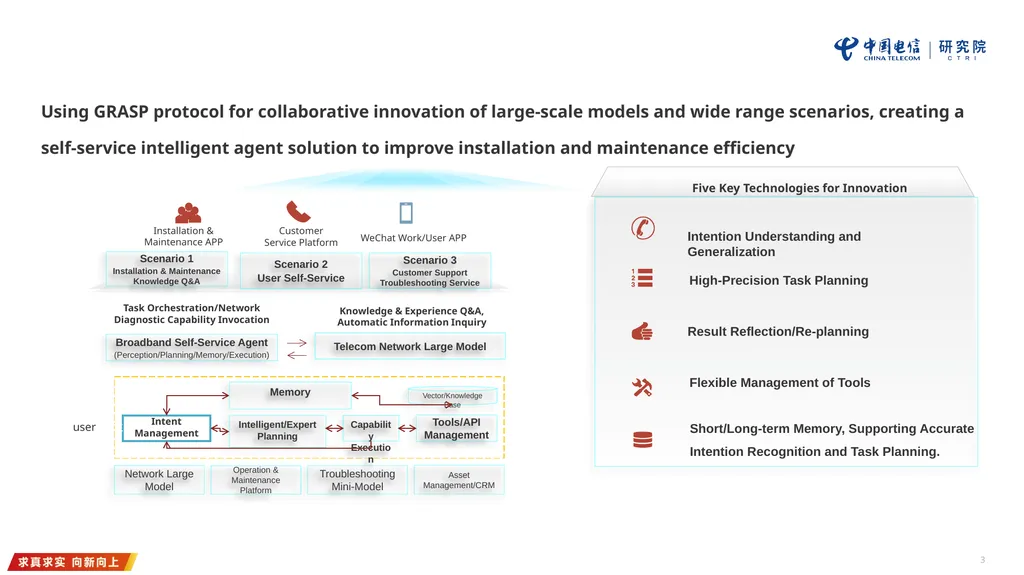
Intent Management Intelligent/Expert Planning Tools/API Management Memory user Capability Execution Vector/Knowledge Base Five Key Technologies for Innovation Short/Long-term Memory, Supporting Accurate Intention Recognition and Task Planning. Using GRASP protocol for collaborative innovation of large-scale models and wide range scenarios, creating a self-service intelligent agent solution to improve installation and maintenance efficiency Installation & Maintenance APP Customer Service Platform WeChat Work/User APP High-Precision Task Planning Flexible Management of Tools Intention Understanding and Generalization Result Reflection/Re-planning<br>
04
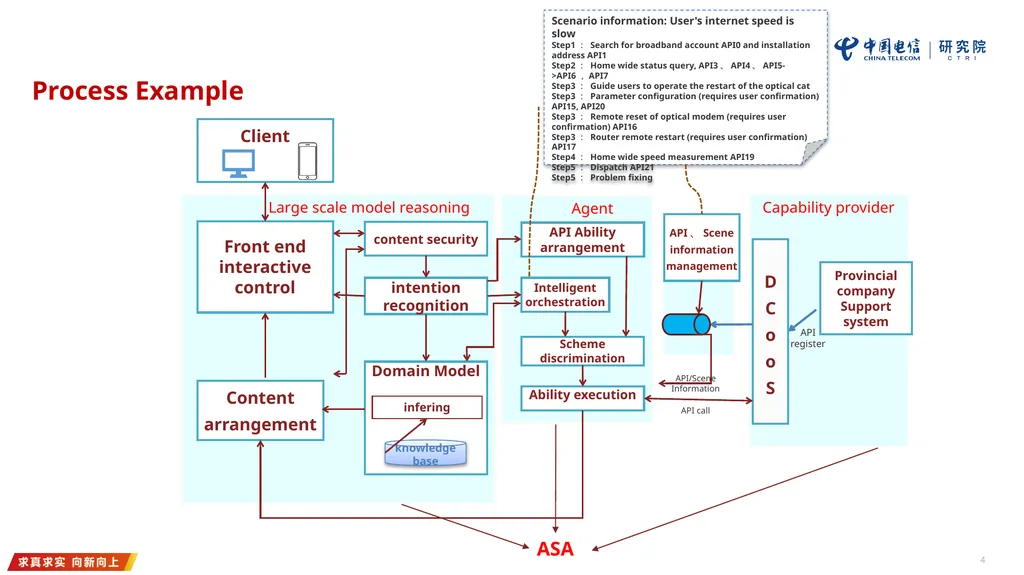
Capability provider Large scale model reasoning Agent Client Front end interactive control Content arrangement intention recognition content security Intelligent orchestration API Ability arrangement Scheme discrimination Domain Model infering knowledge base D
C
o
o
S Provincial company
Support system API
register API call Ability execution API/Scene Information API、Scene information management Scenario information: User's internet speed is slow
Step1: Search for broadband account API0 and installation address API1
Step2: Home wide status query, API3、API4、API5->API6,API7
Step3: Guide users to operate the restart of the optical cat
Step3: Parameter configuration (requires user confirmation) API15, API20
Step3: Remote reset of optical modem (requires user confirmation) API16
Step3: Router remote restart (requires user confirmation) API17
Step4: Home wide speed measurement API19
Step5: Dispatch API21
Step5: Problem fixing Process Example ASA<br>
C
o
o
S Provincial company
Support system API
register API call Ability execution API/Scene Information API、Scene information management Scenario information: User's internet speed is slow
Step1: Search for broadband account API0 and installation address API1
Step2: Home wide status query, API3、API4、API5->API6,API7
Step3: Guide users to operate the restart of the optical cat
Step3: Parameter configuration (requires user confirmation) API15, API20
Step3: Remote reset of optical modem (requires user confirmation) API16
Step3: Router remote restart (requires user confirmation) API17
Step4: Home wide speed measurement API19
Step5: Dispatch API21
Step5: Problem fixing Process Example ASA<br>
05
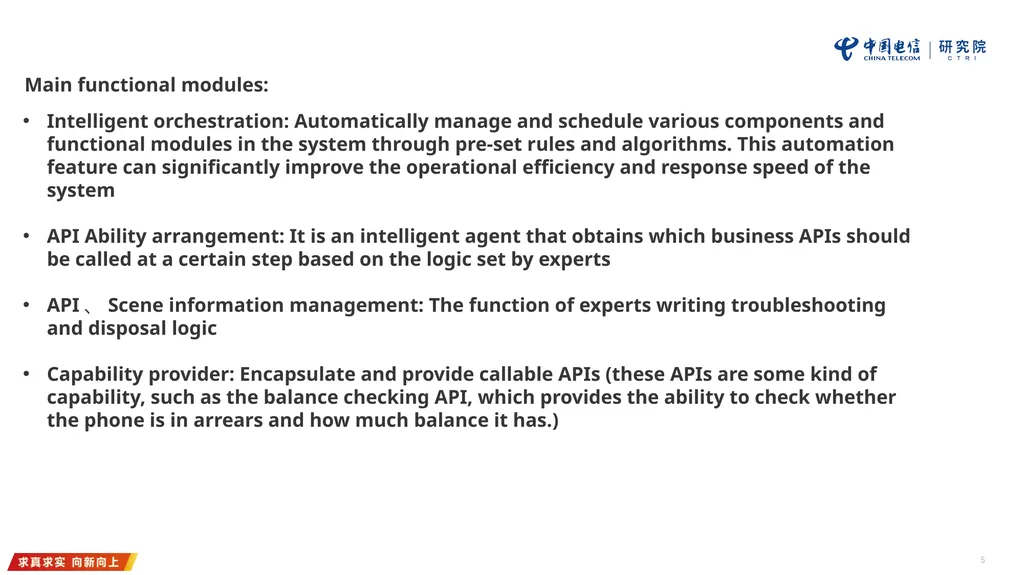
Intelligent orchestration: Automatically manage and schedule various components and functional modules in the system through pre-set rules and algorithms. This automation feature can significantly improve the operational efficiency and response speed of the system
API Ability arrangement: It is an intelligent agent that obtains which business APIs should be called at a certain step based on the logic set by experts
API、Scene information management: The function of experts writing troubleshooting and disposal logic
Capability provider: Encapsulate and provide callable APIs (these APIs are some kind of capability, such as the balance checking API, which provides the ability to check whether the phone is in arrears and how much balance it has.) Main functional modules:<br>
API Ability arrangement: It is an intelligent agent that obtains which business APIs should be called at a certain step based on the logic set by experts
API、Scene information management: The function of experts writing troubleshooting and disposal logic
Capability provider: Encapsulate and provide callable APIs (these APIs are some kind of capability, such as the balance checking API, which provides the ability to check whether the phone is in arrears and how much balance it has.) Main functional modules:<br>
06
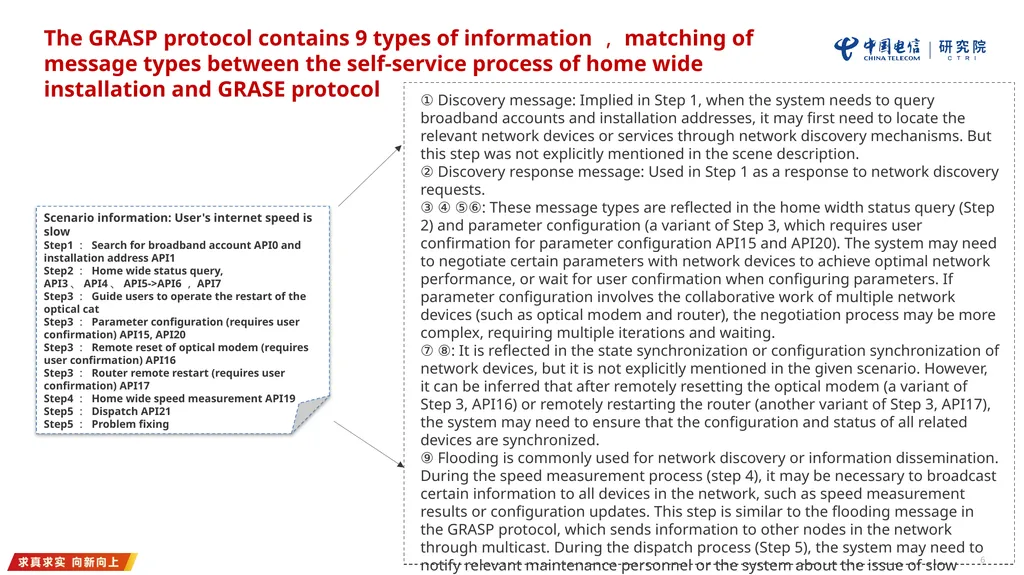
① Discovery message: Implied in Step 1, when the system needs to query broadband accounts and installation addresses, it may first need to locate the relevant network devices or services through network discovery mechanisms. But this step was not explicitly mentioned in the scene description.
② Discovery response message: Used in Step 1 as a response to network discovery requests.
③ ④ ⑤⑥: These message types are reflected in the home width status query (Step 2) and parameter configuration (a variant of Step 3, which requires user confirmation for parameter configuration API15 and API20). The system may need to negotiate certain parameters with network devices to achieve optimal network performance, or wait for user confirmation when configuring parameters. If parameter configuration involves the collaborative work of multiple network devices (such as optical modem and router), the negotiation process may be more complex, requiring multiple iterations and waiting.
⑦ ⑧: It is reflected in the state synchronization or configuration synchronization of network devices, but it is not explicitly mentioned in the given scenario. However, it can be inferred that after remotely resetting the optical modem (a variant of Step 3, API16) or remotely restarting the router (another variant of Step 3, API17), the system may need to ensure that the configuration and status of all related devices are synchronized.
⑨ Flooding is commonly used for network discovery or information dissemination. During the speed measurement process (step 4), it may be necessary to broadcast certain information to all devices in the network, such as speed measurement results or configuration updates. This step is similar to the flooding message in the GRASP protocol, which sends information to other nodes in the network through multicast. During the dispatch process (Step 5), the system may need to notify relevant maintenance personnel or the system about the issue of slow internet access through network broadcasting or multicast, in order to carry out subsequent problem repairs. The GRASP protocol contains 9 types of information,matching of message types between the self-service process of home wide installation and GRASE protocol Scenario information: User's internet speed is slow
Step1: Search for broadband account API0 and installation address API1
Step2: Home wide status query, API3、API4、API5->API6,API7
Step3: Guide users to operate the restart of the optical cat
Step3: Parameter configuration (requires user confirmation) API15, API20
Step3: Remote reset of optical modem (requires user confirmation) API16
Step3: Router remote restart (requires user confirmation) API17
Step4: Home wide speed measurement API19
Step5: Dispatch API21
Step5: Problem fixing<br>
② Discovery response message: Used in Step 1 as a response to network discovery requests.
③ ④ ⑤⑥: These message types are reflected in the home width status query (Step 2) and parameter configuration (a variant of Step 3, which requires user confirmation for parameter configuration API15 and API20). The system may need to negotiate certain parameters with network devices to achieve optimal network performance, or wait for user confirmation when configuring parameters. If parameter configuration involves the collaborative work of multiple network devices (such as optical modem and router), the negotiation process may be more complex, requiring multiple iterations and waiting.
⑦ ⑧: It is reflected in the state synchronization or configuration synchronization of network devices, but it is not explicitly mentioned in the given scenario. However, it can be inferred that after remotely resetting the optical modem (a variant of Step 3, API16) or remotely restarting the router (another variant of Step 3, API17), the system may need to ensure that the configuration and status of all related devices are synchronized.
⑨ Flooding is commonly used for network discovery or information dissemination. During the speed measurement process (step 4), it may be necessary to broadcast certain information to all devices in the network, such as speed measurement results or configuration updates. This step is similar to the flooding message in the GRASP protocol, which sends information to other nodes in the network through multicast. During the dispatch process (Step 5), the system may need to notify relevant maintenance personnel or the system about the issue of slow internet access through network broadcasting or multicast, in order to carry out subsequent problem repairs. The GRASP protocol contains 9 types of information,matching of message types between the self-service process of home wide installation and GRASE protocol Scenario information: User's internet speed is slow
Step1: Search for broadband account API0 and installation address API1
Step2: Home wide status query, API3、API4、API5->API6,API7
Step3: Guide users to operate the restart of the optical cat
Step3: Parameter configuration (requires user confirmation) API15, API20
Step3: Remote reset of optical modem (requires user confirmation) API16
Step3: Router remote restart (requires user confirmation) API17
Step4: Home wide speed measurement API19
Step5: Dispatch API21
Step5: Problem fixing<br>
07
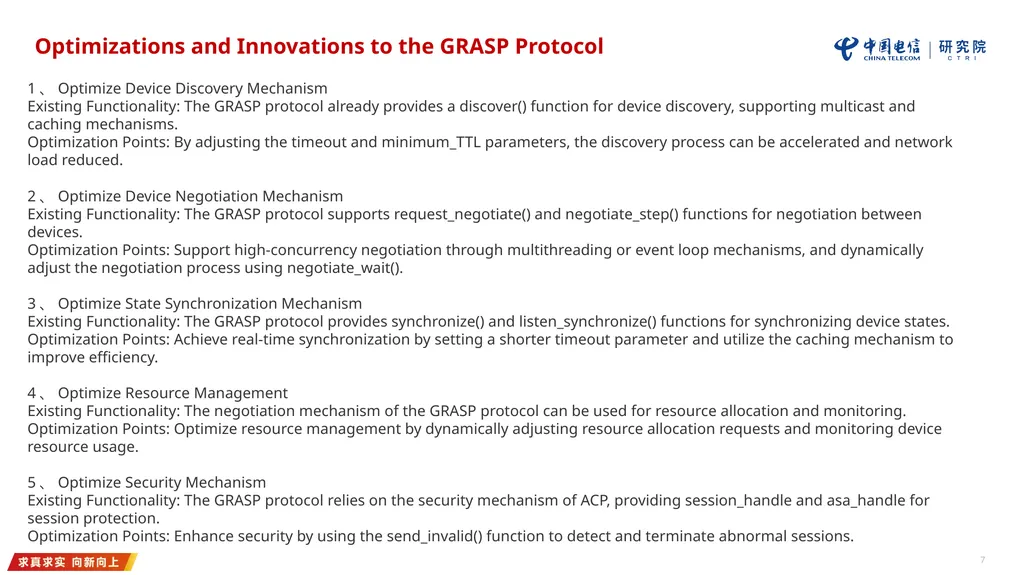
1、Optimize Device Discovery Mechanism
Existing Functionality: The GRASP protocol already provides a discover() function for device discovery, supporting multicast and caching mechanisms.
Optimization Points: By adjusting the timeout and minimum_TTL parameters, the discovery process can be accelerated and network load reduced.
2、Optimize Device Negotiation Mechanism
Existing Functionality: The GRASP protocol supports request_negotiate() and negotiate_step() functions for negotiation between devices.
Optimization Points: Support high-concurrency negotiation through multithreading or event loop mechanisms, and dynamically adjust the negotiation process using negotiate_wait().
3、Optimize State Synchronization Mechanism
Existing Functionality: The GRASP protocol provides synchronize() and listen_synchronize() functions for synchronizing device states.
Optimization Points: Achieve real-time synchronization by setting a shorter timeout parameter and utilize the caching mechanism to improve efficiency.
4、Optimize Resource Management
Existing Functionality: The negotiation mechanism of the GRASP protocol can be used for resource allocation and monitoring.
Optimization Points: Optimize resource management by dynamically adjusting resource allocation requests and monitoring device resource usage.
5、Optimize Security Mechanism
Existing Functionality: The GRASP protocol relies on the security mechanism of ACP, providing session_handle and asa_handle for session protection.
Optimization Points: Enhance security by using the send_invalid() function to detect and terminate abnormal sessions. Optimizations and Innovations to the GRASP Protocol<br>
Existing Functionality: The GRASP protocol already provides a discover() function for device discovery, supporting multicast and caching mechanisms.
Optimization Points: By adjusting the timeout and minimum_TTL parameters, the discovery process can be accelerated and network load reduced.
2、Optimize Device Negotiation Mechanism
Existing Functionality: The GRASP protocol supports request_negotiate() and negotiate_step() functions for negotiation between devices.
Optimization Points: Support high-concurrency negotiation through multithreading or event loop mechanisms, and dynamically adjust the negotiation process using negotiate_wait().
3、Optimize State Synchronization Mechanism
Existing Functionality: The GRASP protocol provides synchronize() and listen_synchronize() functions for synchronizing device states.
Optimization Points: Achieve real-time synchronization by setting a shorter timeout parameter and utilize the caching mechanism to improve efficiency.
4、Optimize Resource Management
Existing Functionality: The negotiation mechanism of the GRASP protocol can be used for resource allocation and monitoring.
Optimization Points: Optimize resource management by dynamically adjusting resource allocation requests and monitoring device resource usage.
5、Optimize Security Mechanism
Existing Functionality: The GRASP protocol relies on the security mechanism of ACP, providing session_handle and asa_handle for session protection.
Optimization Points: Enhance security by using the send_invalid() function to detect and terminate abnormal sessions. Optimizations and Innovations to the GRASP Protocol<br>
08
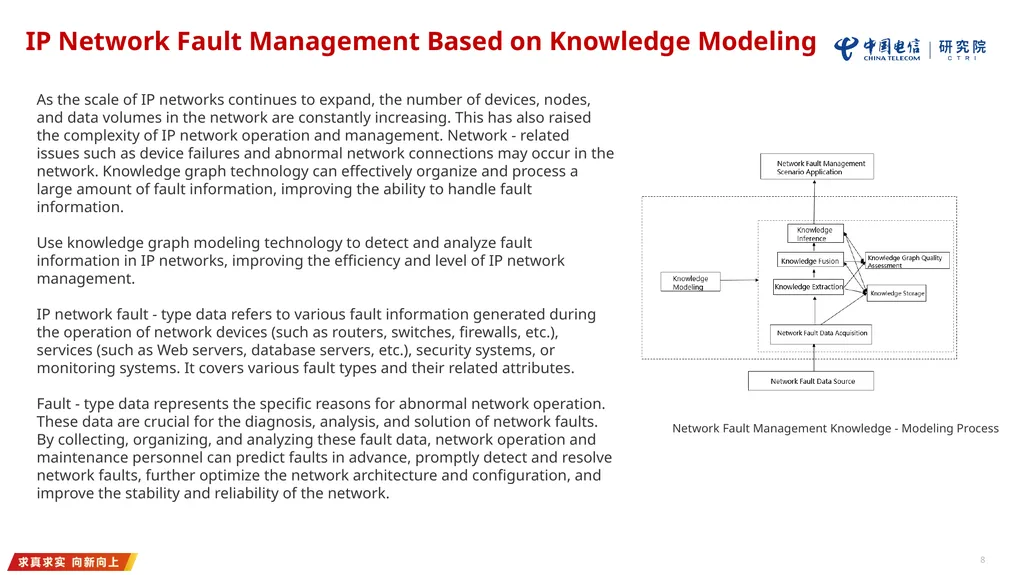
As the scale of IP networks continues to expand, the number of devices, nodes, and data volumes in the network are constantly increasing. This has also raised the complexity of IP network operation and management. Network - related issues such as device failures and abnormal network connections may occur in the network. Knowledge graph technology can effectively organize and process a large amount of fault information, improving the ability to handle fault information.
Use knowledge graph modeling technology to detect and analyze fault information in IP networks, improving the efficiency and level of IP network management.
IP network fault - type data refers to various fault information generated during the operation of network devices (such as routers, switches, firewalls, etc.), services (such as Web servers, database servers, etc.), security systems, or monitoring systems. It covers various fault types and their related attributes.
Fault - type data represents the specific reasons for abnormal network operation. These data are crucial for the diagnosis, analysis, and solution of network faults. By collecting, organizing, and analyzing these fault data, network operation and maintenance personnel can predict faults in advance, promptly detect and resolve network faults, further optimize the network architecture and configuration, and improve the stability and reliability of the network. IP Network Fault Management Based on Knowledge Modeling Network Fault Management Knowledge - Modeling Process<br>
Use knowledge graph modeling technology to detect and analyze fault information in IP networks, improving the efficiency and level of IP network management.
IP network fault - type data refers to various fault information generated during the operation of network devices (such as routers, switches, firewalls, etc.), services (such as Web servers, database servers, etc.), security systems, or monitoring systems. It covers various fault types and their related attributes.
Fault - type data represents the specific reasons for abnormal network operation. These data are crucial for the diagnosis, analysis, and solution of network faults. By collecting, organizing, and analyzing these fault data, network operation and maintenance personnel can predict faults in advance, promptly detect and resolve network faults, further optimize the network architecture and configuration, and improve the stability and reliability of the network. IP Network Fault Management Based on Knowledge Modeling Network Fault Management Knowledge - Modeling Process<br>
09
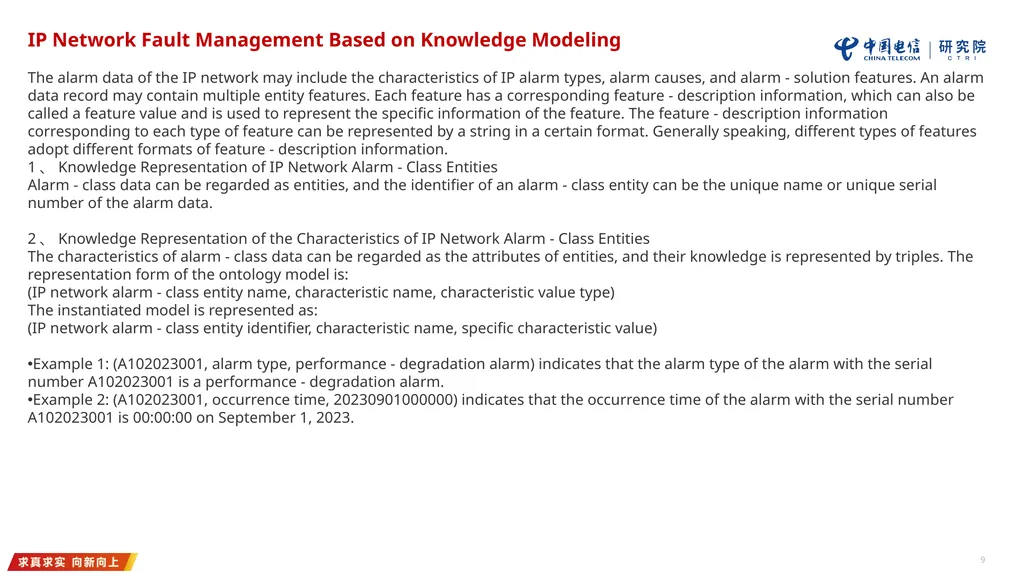
The alarm data of the IP network may include the characteristics of IP alarm types, alarm causes, and alarm - solution features. An alarm data record may contain multiple entity features. Each feature has a corresponding feature - description information, which can also be called a feature value and is used to represent the specific information of the feature. The feature - description information corresponding to each type of feature can be represented by a string in a certain format. Generally speaking, different types of features adopt different formats of feature - description information.
1、Knowledge Representation of IP Network Alarm - Class Entities
Alarm - class data can be regarded as entities, and the identifier of an alarm - class entity can be the unique name or unique serial number of the alarm data.
2、Knowledge Representation of the Characteristics of IP Network Alarm - Class Entities
The characteristics of alarm - class data can be regarded as the attributes of entities, and their knowledge is represented by triples. The representation form of the ontology model is:
(IP network alarm - class entity name, characteristic name, characteristic value type)
The instantiated model is represented as:
(IP network alarm - class entity identifier, characteristic name, specific characteristic value)
Example 1: (A102023001, alarm type, performance - degradation alarm) indicates that the alarm type of the alarm with the serial number A102023001 is a performance - degradation alarm.
Example 2: (A102023001, occurrence time, 20230901000000) indicates that the occurrence time of the alarm with the serial number A102023001 is 00:00:00 on September 1, 2023. IP Network Fault Management Based on Knowledge Modeling<br>
1、Knowledge Representation of IP Network Alarm - Class Entities
Alarm - class data can be regarded as entities, and the identifier of an alarm - class entity can be the unique name or unique serial number of the alarm data.
2、Knowledge Representation of the Characteristics of IP Network Alarm - Class Entities
The characteristics of alarm - class data can be regarded as the attributes of entities, and their knowledge is represented by triples. The representation form of the ontology model is:
(IP network alarm - class entity name, characteristic name, characteristic value type)
The instantiated model is represented as:
(IP network alarm - class entity identifier, characteristic name, specific characteristic value)
Example 1: (A102023001, alarm type, performance - degradation alarm) indicates that the alarm type of the alarm with the serial number A102023001 is a performance - degradation alarm.
Example 2: (A102023001, occurrence time, 20230901000000) indicates that the occurrence time of the alarm with the serial number A102023001 is 00:00:00 on September 1, 2023. IP Network Fault Management Based on Knowledge Modeling<br>
10
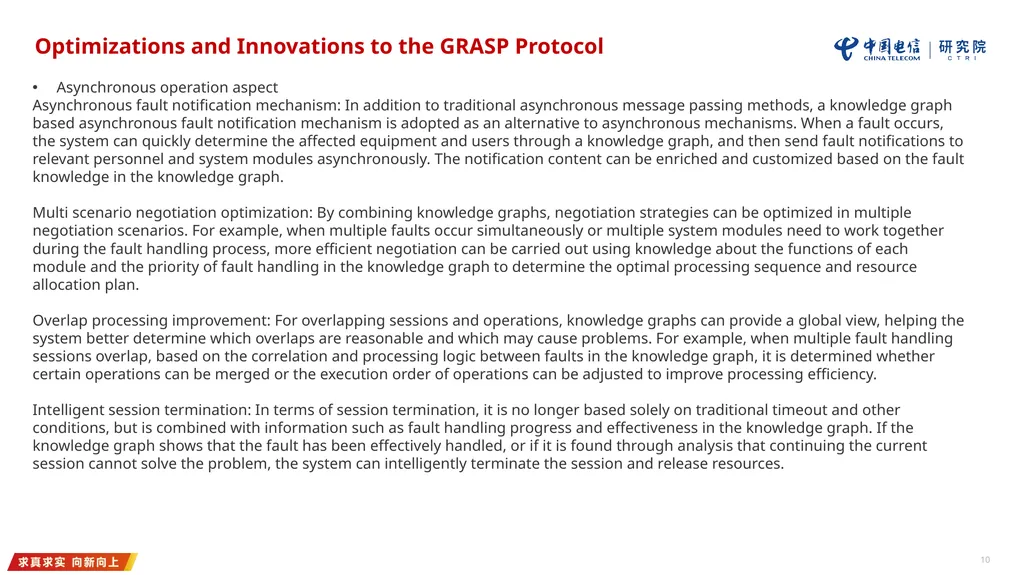
Asynchronous operation aspect
Asynchronous fault notification mechanism: In addition to traditional asynchronous message passing methods, a knowledge graph based asynchronous fault notification mechanism is adopted as an alternative to asynchronous mechanisms. When a fault occurs, the system can quickly determine the affected equipment and users through a knowledge graph, and then send fault notifications to relevant personnel and system modules asynchronously. The notification content can be enriched and customized based on the fault knowledge in the knowledge graph.
Multi scenario negotiation optimization: By combining knowledge graphs, negotiation strategies can be optimized in multiple negotiation scenarios. For example, when multiple faults occur simultaneously or multiple system modules need to work together during the fault handling process, more efficient negotiation can be carried out using knowledge about the functions of each module and the priority of fault handling in the knowledge graph to determine the optimal processing sequence and resource allocation plan.
Overlap processing improvement: For overlapping sessions and operations, knowledge graphs can provide a global view, helping the system better determine which overlaps are reasonable and which may cause problems. For example, when multiple fault handling sessions overlap, based on the correlation and processing logic between faults in the knowledge graph, it is determined whether certain operations can be merged or the execution order of operations can be adjusted to improve processing efficiency.
Intelligent session termination: In terms of session termination, it is no longer based solely on traditional timeout and other conditions, but is combined with information such as fault handling progress and effectiveness in the knowledge graph. If the knowledge graph shows that the fault has been effectively handled, or if it is found through analysis that continuing the current session cannot solve the problem, the system can intelligently terminate the session and release resources. Optimizations and Innovations to the GRASP Protocol<br>
Asynchronous fault notification mechanism: In addition to traditional asynchronous message passing methods, a knowledge graph based asynchronous fault notification mechanism is adopted as an alternative to asynchronous mechanisms. When a fault occurs, the system can quickly determine the affected equipment and users through a knowledge graph, and then send fault notifications to relevant personnel and system modules asynchronously. The notification content can be enriched and customized based on the fault knowledge in the knowledge graph.
Multi scenario negotiation optimization: By combining knowledge graphs, negotiation strategies can be optimized in multiple negotiation scenarios. For example, when multiple faults occur simultaneously or multiple system modules need to work together during the fault handling process, more efficient negotiation can be carried out using knowledge about the functions of each module and the priority of fault handling in the knowledge graph to determine the optimal processing sequence and resource allocation plan.
Overlap processing improvement: For overlapping sessions and operations, knowledge graphs can provide a global view, helping the system better determine which overlaps are reasonable and which may cause problems. For example, when multiple fault handling sessions overlap, based on the correlation and processing logic between faults in the knowledge graph, it is determined whether certain operations can be merged or the execution order of operations can be adjusted to improve processing efficiency.
Intelligent session termination: In terms of session termination, it is no longer based solely on traditional timeout and other conditions, but is combined with information such as fault handling progress and effectiveness in the knowledge graph. If the knowledge graph shows that the fault has been effectively handled, or if it is found through analysis that continuing the current session cannot solve the problem, the system can intelligently terminate the session and release resources. Optimizations and Innovations to the GRASP Protocol<br>
11
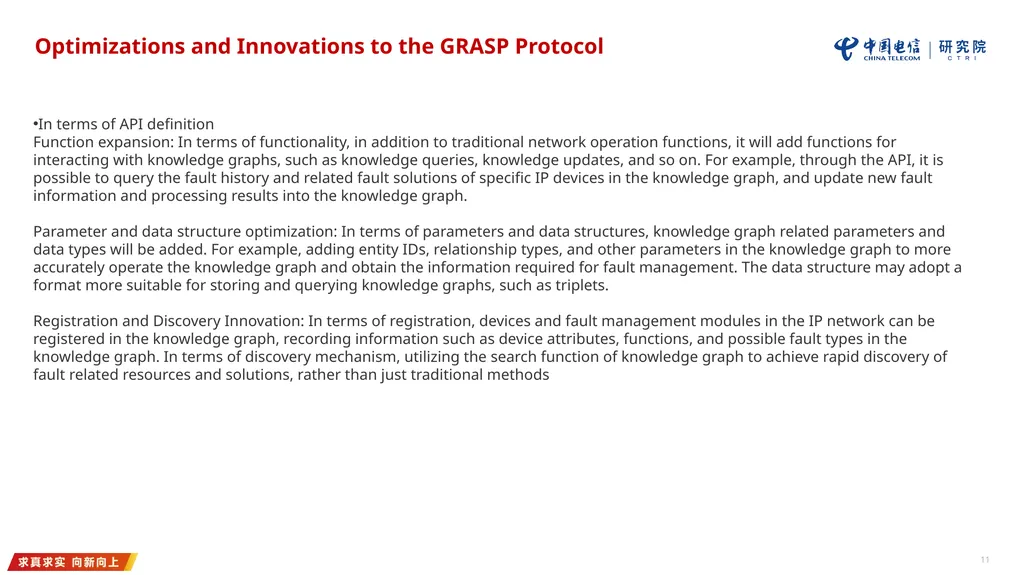
Optimizations and Innovations to the GRASP Protocol In terms of API definition
Function expansion: In terms of functionality, in addition to traditional network operation functions, it will add functions for interacting with knowledge graphs, such as knowledge queries, knowledge updates, and so on. For example, through the API, it is possible to query the fault history and related fault solutions of specific IP devices in the knowledge graph, and update new fault information and processing results into the knowledge graph.
Parameter and data structure optimization: In terms of parameters and data structures, knowledge graph related parameters and data types will be added. For example, adding entity IDs, relationship types, and other parameters in the knowledge graph to more accurately operate the knowledge graph and obtain the information required for fault management. The data structure may adopt a format more suitable for storing and querying knowledge graphs, such as triplets.
Registration and Discovery Innovation: In terms of registration, devices and fault management modules in the IP network can be registered in the knowledge graph, recording information such as device attributes, functions, and possible fault types in the knowledge graph. In terms of discovery mechanism, utilizing the search function of knowledge graph to achieve rapid discovery of fault related resources and solutions, rather than just traditional methods<br>
Function expansion: In terms of functionality, in addition to traditional network operation functions, it will add functions for interacting with knowledge graphs, such as knowledge queries, knowledge updates, and so on. For example, through the API, it is possible to query the fault history and related fault solutions of specific IP devices in the knowledge graph, and update new fault information and processing results into the knowledge graph.
Parameter and data structure optimization: In terms of parameters and data structures, knowledge graph related parameters and data types will be added. For example, adding entity IDs, relationship types, and other parameters in the knowledge graph to more accurately operate the knowledge graph and obtain the information required for fault management. The data structure may adopt a format more suitable for storing and querying knowledge graphs, such as triplets.
Registration and Discovery Innovation: In terms of registration, devices and fault management modules in the IP network can be registered in the knowledge graph, recording information such as device attributes, functions, and possible fault types in the knowledge graph. In terms of discovery mechanism, utilizing the search function of knowledge graph to achieve rapid discovery of fault related resources and solutions, rather than just traditional methods<br>
12
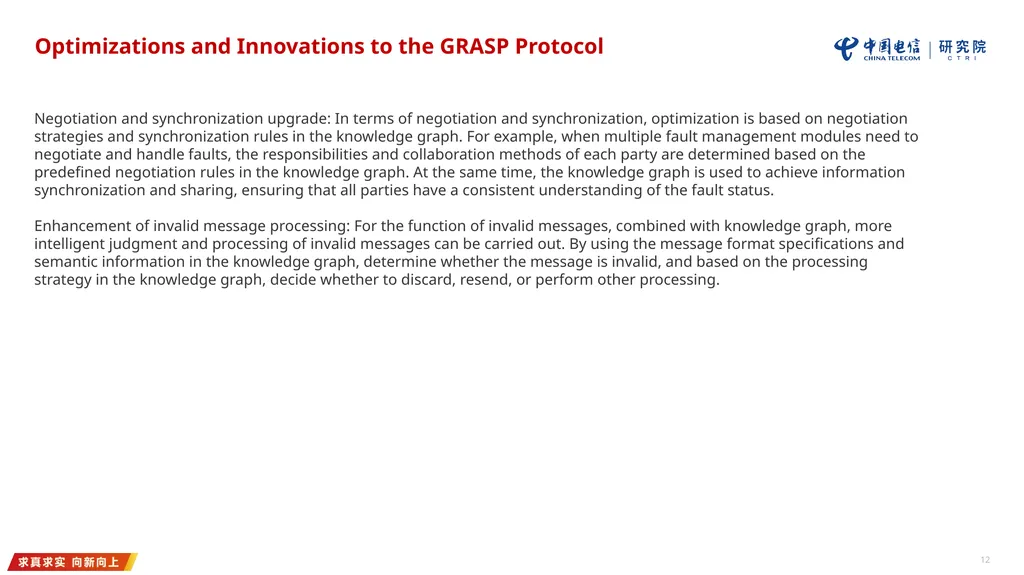
Optimizations and Innovations to the GRASP Protocol Negotiation and synchronization upgrade: In terms of negotiation and synchronization, optimization is based on negotiation strategies and synchronization rules in the knowledge graph. For example, when multiple fault management modules need to negotiate and handle faults, the responsibilities and collaboration methods of each party are determined based on the predefined negotiation rules in the knowledge graph. At the same time, the knowledge graph is used to achieve information synchronization and sharing, ensuring that all parties have a consistent understanding of the fault status.
Enhancement of invalid message processing: For the function of invalid messages, combined with knowledge graph, more intelligent judgment and processing of invalid messages can be carried out. By using the message format specifications and semantic information in the knowledge graph, determine whether the message is invalid, and based on the processing strategy in the knowledge graph, decide whether to discard, resend, or perform other processing.<br>
Enhancement of invalid message processing: For the function of invalid messages, combined with knowledge graph, more intelligent judgment and processing of invalid messages can be carried out. By using the message format specifications and semantic information in the knowledge graph, determine whether the message is invalid, and based on the processing strategy in the knowledge graph, decide whether to discard, resend, or perform other processing.<br>
13
THANK YOU Presenter: Hanting Duan
China Telecom DATE:2025-02-20<br>
China Telecom DATE:2025-02-20<br>