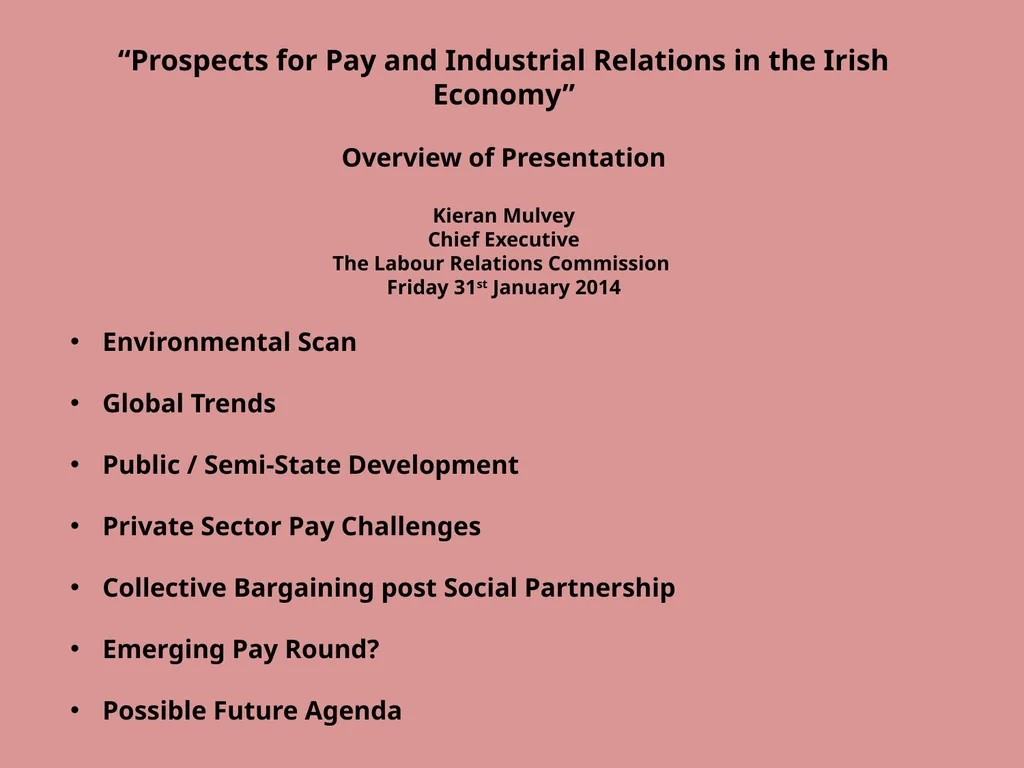
“Prospects for Pay and Industrial Relations in the
Description: Prospects for Pay and Industrial Relations in the Irish Economy Overview of Presentation Kieran Mulvey Chief Executive The Labour Relations Commission Friday 31st January 2014 Environmental Scan Global Trends Public Semi-State
Related Topics
Download Presentation
"“Prospects for Pay and Industrial Relations in the" is the property of its rightful owner. Permission is granted to download and print the materials on this website for personal, non-commercial use only, and to display it on your personal computer provided you do not modify the materials and that you retain all copyright notices contained in the materials. By downloading content from our website, you accept the terms of this agreement.
Presentation Transcript
slide1. “Prospects for Pay and Industrial Relations in the Irish Economy”
Overview of Presentation
Kieran Mulvey
Chief Executive
The Labour Relations Commission
Friday 31st January 2014
Environmental Scan
Global Trends
Public / Semi-State Development
Private Sector Pay Challenges
Collective Bargaining post Social Partnership
Emerging Pay Round?
Possible Future Agenda<br>
slide2. Influencing Factors - Macro National budgetary policy
Public Sector pay policy
Public Sector Reform Policy
Enterprise Share Value – monthly, quarterly, yearly profits
Competitive pricing – internationally / externally
Labour costs – nationally / internationally – competitiveness
Human Resource policies – in public, semi-State and private sectors<br>
slide3. Croke Park / Haddington Road Agreements Reduced pay costs
Reduced pension costs (apart from Pension Levy)
Reduced numbers – voluntary exits*
Commitment to Reform in all sectors
Extra working hours
Work practice changes
Binding Arbitration
Industrial peace<br>
slide4. Semi - States Public Transport:
The CIE Group – Irish Rail, Bus Eireann, Dublin Bus
Aviation:
Aer Lingus (25% State owned) / DAA / IAA
Natural Resources:
Coillte / Teagasc
Energy:
Bord Gais Eireann / ESB
Ports / Airports
Local Authorities – Environmental and Waste Management Services<br>
slide5. Possible Agenda for Social Dialogue Wage inflation and employment strategies
Tax wedges, the USC and monopoly service costs / Stealth Taxes
The competitiveness agenda (productivity and ongoing change)
Restructuring in the Semi-States
Future pension funding rules – for both D.B. and D.C.
Utilisation of Dispute Resolution Bodies – accepting outcomes
The “Better Business” agenda in workplaces and Training
Industrial peace
Future arrangements for Collective Bargaining<br>
Overview of Presentation
Kieran Mulvey
Chief Executive
The Labour Relations Commission
Friday 31st January 2014
Environmental Scan
Global Trends
Public / Semi-State Development
Private Sector Pay Challenges
Collective Bargaining post Social Partnership
Emerging Pay Round?
Possible Future Agenda<br>
slide2. Influencing Factors - Macro National budgetary policy
Public Sector pay policy
Public Sector Reform Policy
Enterprise Share Value – monthly, quarterly, yearly profits
Competitive pricing – internationally / externally
Labour costs – nationally / internationally – competitiveness
Human Resource policies – in public, semi-State and private sectors<br>
slide3. Croke Park / Haddington Road Agreements Reduced pay costs
Reduced pension costs (apart from Pension Levy)
Reduced numbers – voluntary exits*
Commitment to Reform in all sectors
Extra working hours
Work practice changes
Binding Arbitration
Industrial peace<br>
slide4. Semi - States Public Transport:
The CIE Group – Irish Rail, Bus Eireann, Dublin Bus
Aviation:
Aer Lingus (25% State owned) / DAA / IAA
Natural Resources:
Coillte / Teagasc
Energy:
Bord Gais Eireann / ESB
Ports / Airports
Local Authorities – Environmental and Waste Management Services<br>
slide5. Possible Agenda for Social Dialogue Wage inflation and employment strategies
Tax wedges, the USC and monopoly service costs / Stealth Taxes
The competitiveness agenda (productivity and ongoing change)
Restructuring in the Semi-States
Future pension funding rules – for both D.B. and D.C.
Utilisation of Dispute Resolution Bodies – accepting outcomes
The “Better Business” agenda in workplaces and Training
Industrial peace
Future arrangements for Collective Bargaining<br>