
Protective Systems This material was produced
CS
Published · 38 slides · 0 views

1 / 1









Description
Protective Systems This material was produced under a grant (SH-31234-SH7) from the Occupational Safety and Health Administration, U.S. Department of Labor. It does not necessarily reflect the views or policies of the U.S. Department of
Related Topics
Share
Embed code
Download this presentation From Below
"Protective Systems This material was produced" is the property of its rightful owner. Permission is granted to download and print the materials on this website for personal, non-commercial use only, and to display it on your personal computer provided you do not modify the materials and that you retain all copyright notices contained in the materials. By downloading content from our website, you accept the terms of this agreement.
Presentation Transcript
01
Protective Systems This material was produced under a grant (SH-31234-SH7) from the Occupational Safety and Health Administration, U.S. Department of Labor. It does not necessarily reflect the views or policies of the U.S. Department of Labor, nor does the mention of trade names, commercial products, or organization imply endorsement by the U.S. Government.<br>
02
Objectives: Define Different types of Protective Systems
Identify uses and limitations of different protective systems
Understand the usage characteristics of different protective systems
Understand how to safely implement the protective system<br>
Identify uses and limitations of different protective systems
Understand the usage characteristics of different protective systems
Understand how to safely implement the protective system<br>
03
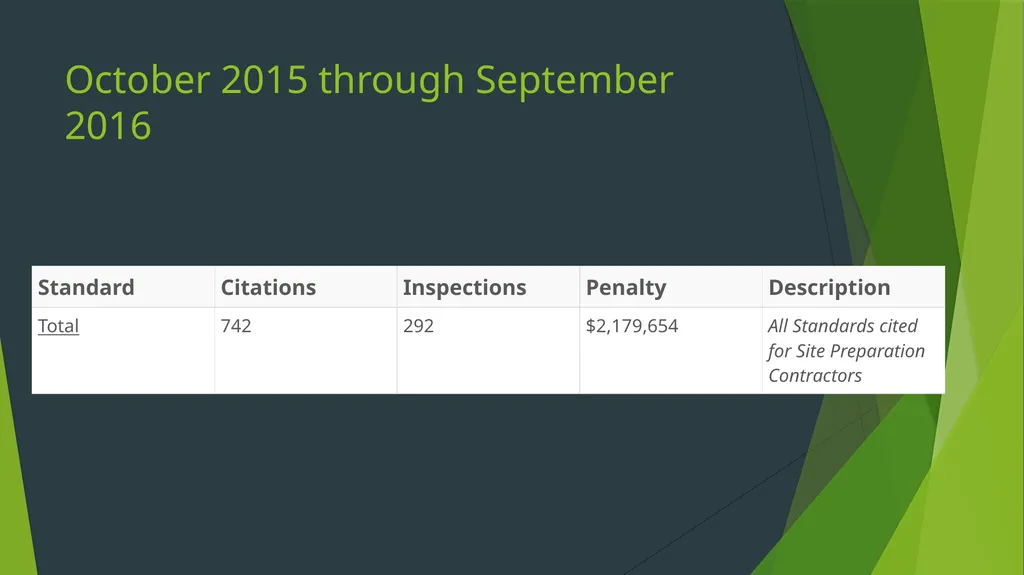
October 2015 through September 2016<br>
04
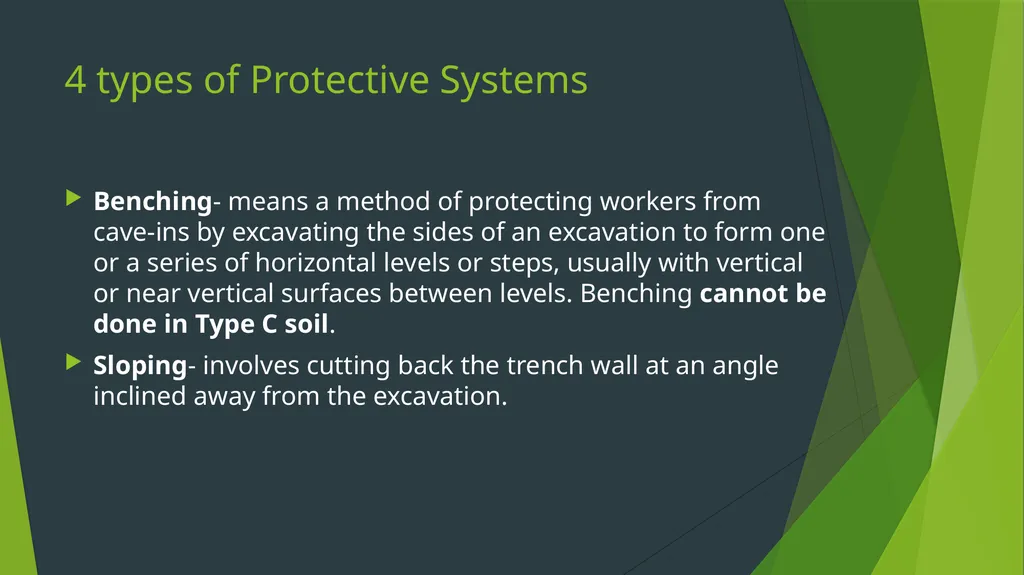
4 types of Protective Systems Benching- means a method of protecting workers from cave-ins by excavating the sides of an excavation to form one or a series of horizontal levels or steps, usually with vertical or near vertical surfaces between levels. Benching cannot be done in Type C soil.
Sloping- involves cutting back the trench wall at an angle inclined away from the excavation.<br>
Sloping- involves cutting back the trench wall at an angle inclined away from the excavation.<br>
05
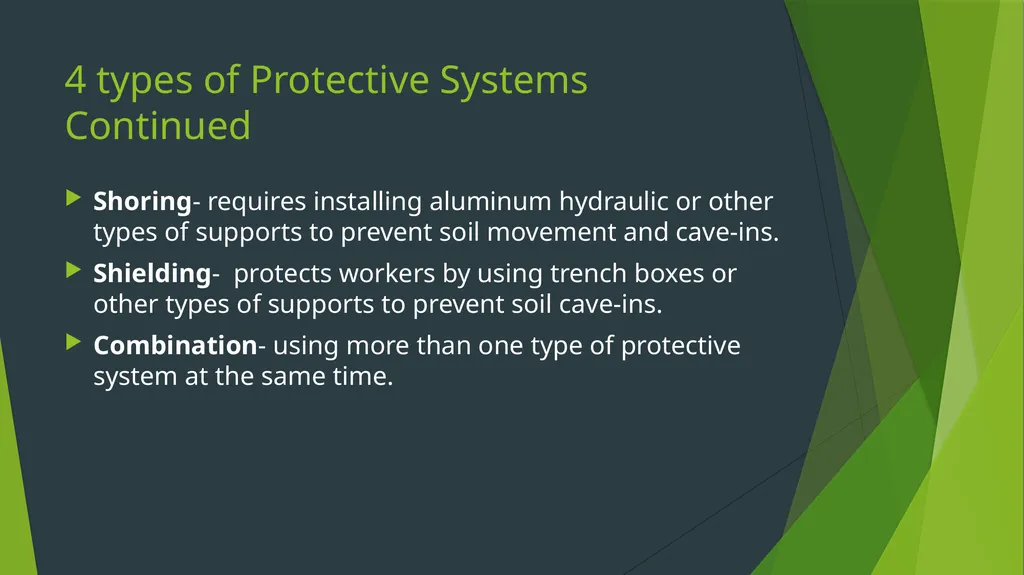
4 types of Protective Systems Continued Shoring- requires installing aluminum hydraulic or other types of supports to prevent soil movement and cave-ins.
Shielding- protects workers by using trench boxes or other types of supports to prevent soil cave-ins.
Combination- using more than one type of protective system at the same time.<br>
Shielding- protects workers by using trench boxes or other types of supports to prevent soil cave-ins.
Combination- using more than one type of protective system at the same time.<br>
06
Benching<br>
07
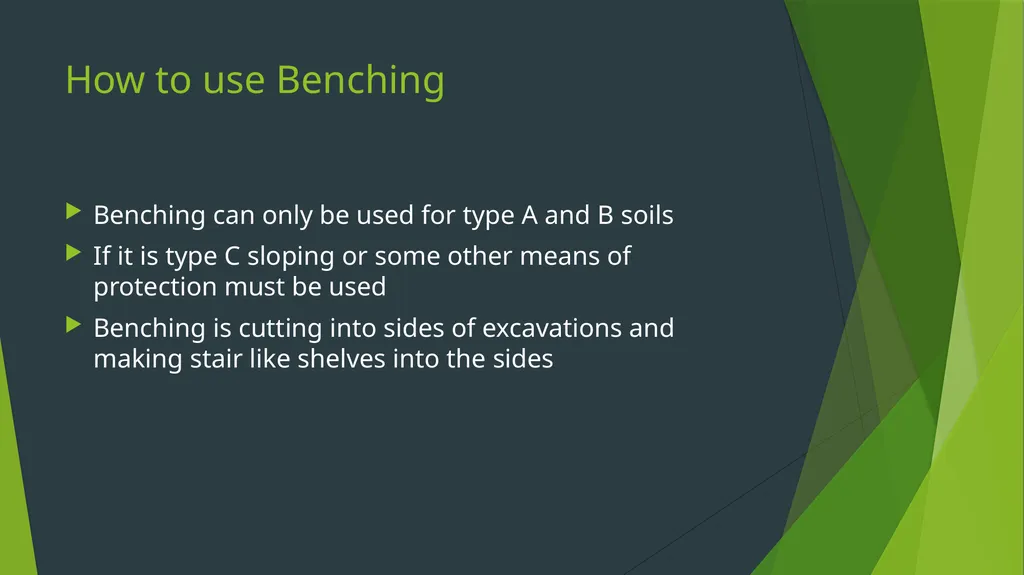
How to use Benching Benching can only be used for type A and B soils
If it is type C sloping or some other means of protection must be used
Benching is cutting into sides of excavations and making stair like shelves into the sides<br>
If it is type C sloping or some other means of protection must be used
Benching is cutting into sides of excavations and making stair like shelves into the sides<br>
08
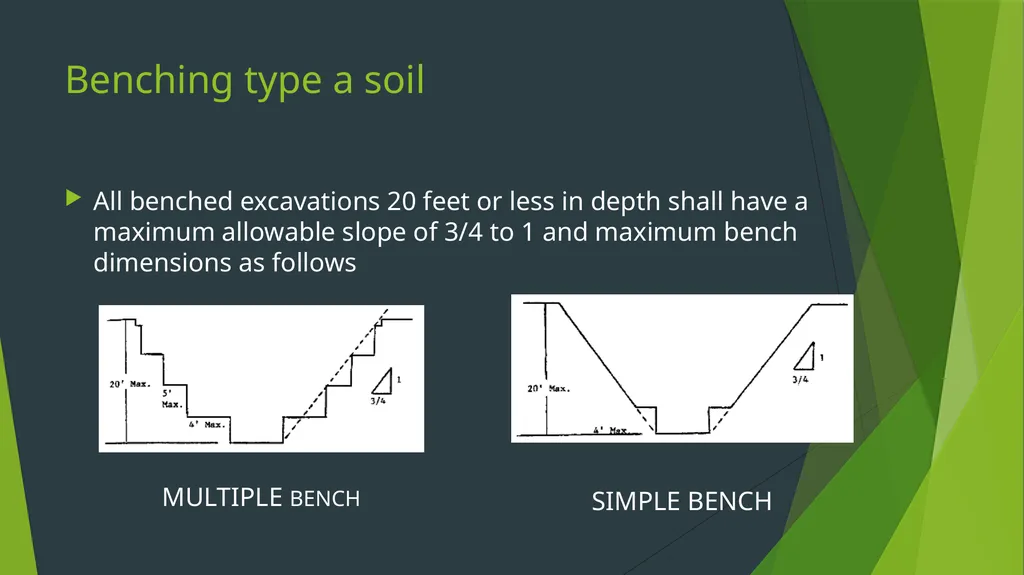
Benching type a soil All benched excavations 20 feet or less in depth shall have a maximum allowable slope of 3/4 to 1 and maximum bench dimensions as follows MULTIPLE BENCH SIMPLE BENCH<br>
09
Sloping<br>
10
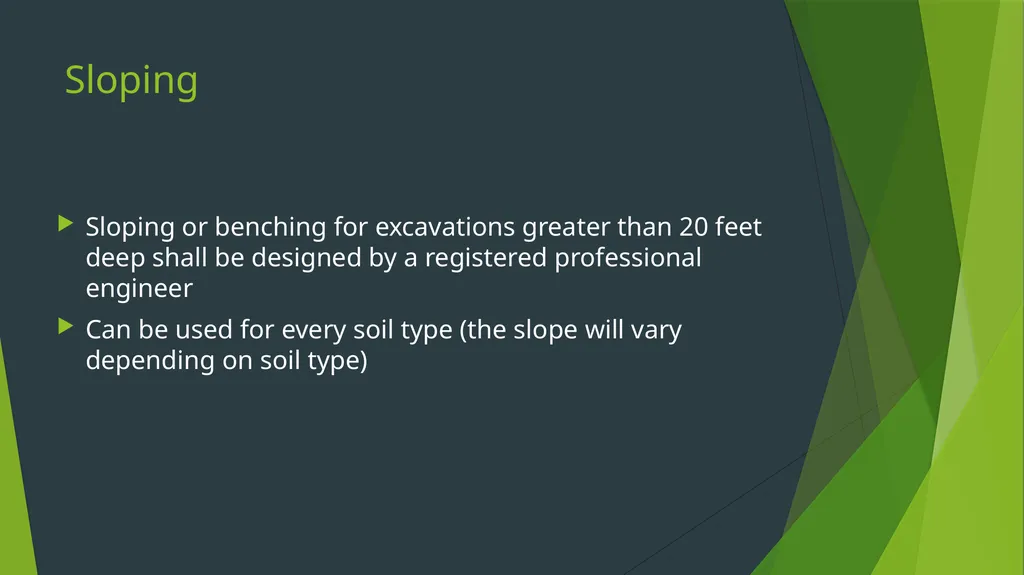
Sloping Sloping or benching for excavations greater than 20 feet deep shall be designed by a registered professional engineer
Can be used for every soil type (the slope will vary depending on soil type)<br>
Can be used for every soil type (the slope will vary depending on soil type)<br>
11
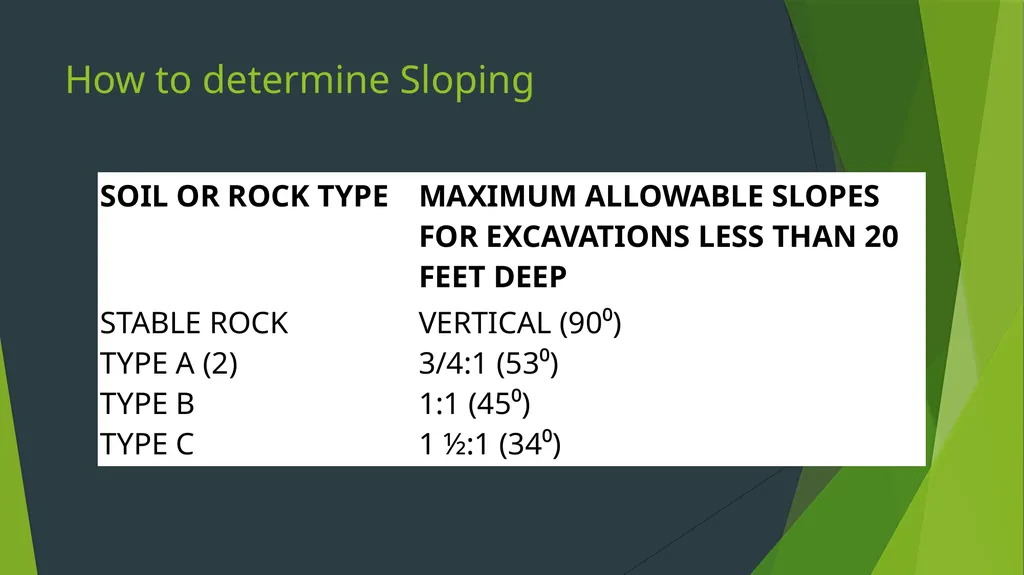
How to determine Sloping<br>
12
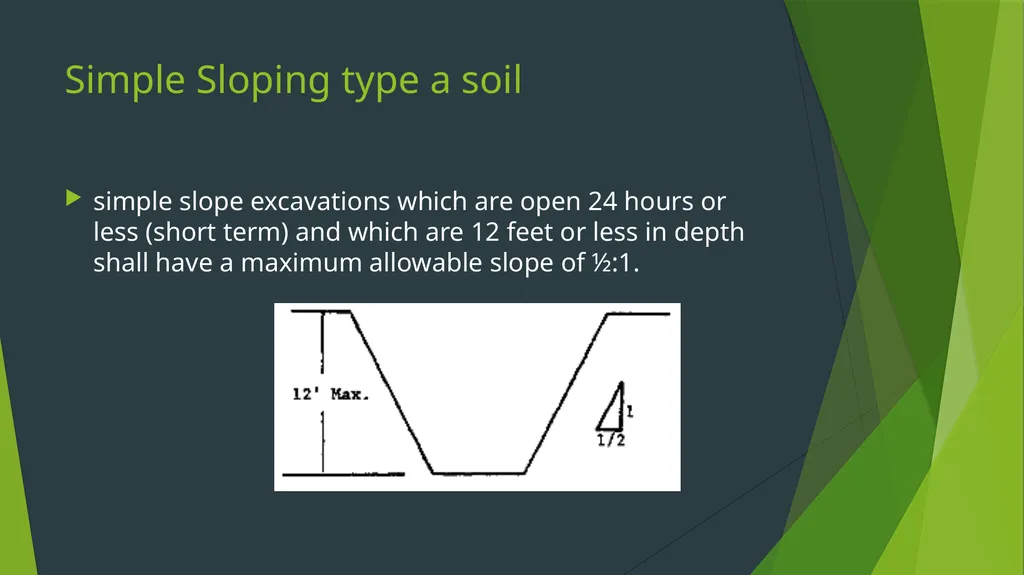
Simple Sloping type a soil simple slope excavations which are open 24 hours or less (short term) and which are 12 feet or less in depth shall have a maximum allowable slope of ½:1.<br>
13
Shoring<br>
14
Timber Shoring Shoring is the provision of a support system for trench faces used to prevent movement of soil, underground utilities, roadways, and foundations.
Shoring or shielding is used when the location or depth of the cut makes sloping back to the maximum allowable slope impractical.
Shoring systems consist of posts, wales, struts, and sheeting. There are two basic types of shoring, timber and aluminum hydraulic.<br>
Shoring or shielding is used when the location or depth of the cut makes sloping back to the maximum allowable slope impractical.
Shoring systems consist of posts, wales, struts, and sheeting. There are two basic types of shoring, timber and aluminum hydraulic.<br>
15
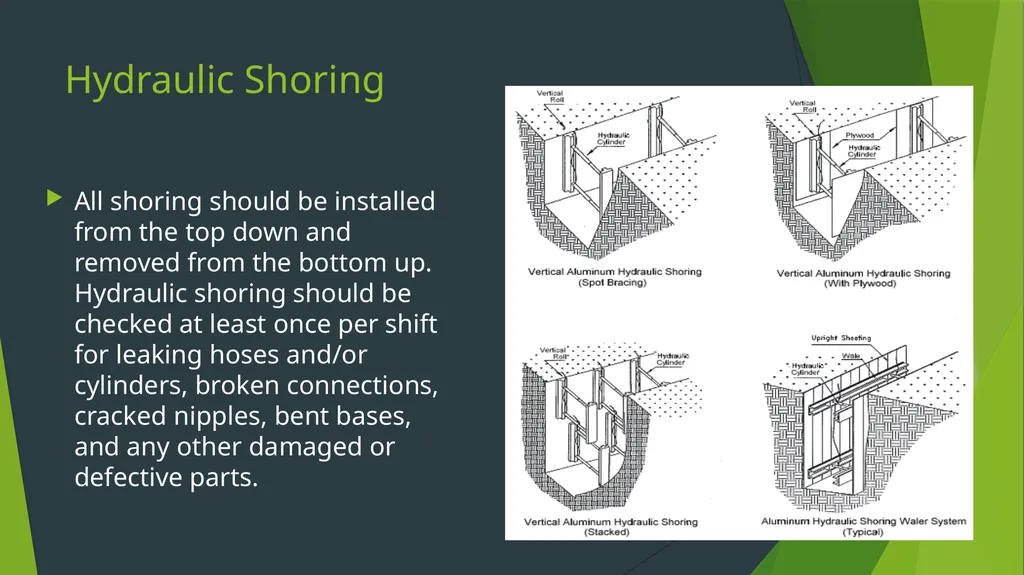
Hydraulic Shoring All shoring should be installed from the top down and removed from the bottom up. Hydraulic shoring should be checked at least once per shift for leaking hoses and/or cylinders, broken connections, cracked nipples, bent bases, and any other damaged or defective parts.<br>
16
Hydraulic Shoring The trend today is toward the use of hydraulic shoring, a prefabricated strut and/or wale system manufactured of aluminum or steel. Hydraulic shoring provides a critical safety advantage over timber shoring because workers do not have to enter the trench to install or remove hydraulic shoring. Other advantages of most hydraulic systems are that they:
Are light enough to be installed by one worker;
Are gauge-regulated to ensure even distribution of pressure along the trench line;
Can have their trench faces "preloaded" to use the soil's natural cohesion to prevent movement; and
Can be adapted easily to various trench depths and widths.<br>
Are light enough to be installed by one worker;
Are gauge-regulated to ensure even distribution of pressure along the trench line;
Can have their trench faces "preloaded" to use the soil's natural cohesion to prevent movement; and
Can be adapted easily to various trench depths and widths.<br>
17
Pneumatic Shoring Screw Jacks. Screw jack systems differ from hydraulic and pneumatic systems in that the struts of a screw jack system must be adjusted manually. This creates a hazard because the worker is required to be in the trench in order to adjust the strut. In addition, uniform "preloading" cannot be achieved with screw jacks, and their weight creates handling difficulties.
Single-Cylinder Hydraulic Shores. Shores of this type are generally used in a water system, as an assist to timber shoring systems, and in shallow trenches where face stability is required.
Underpinning. This process involves stabilizing adjacent structures, foundations, and other intrusions that may have an impact on the excavation. As the term indicates, underpinning is a procedure in which the foundation is physically reinforced. Underpinning should be conducted only under the direction and with the approval of a registered professional engineer.<br>
18
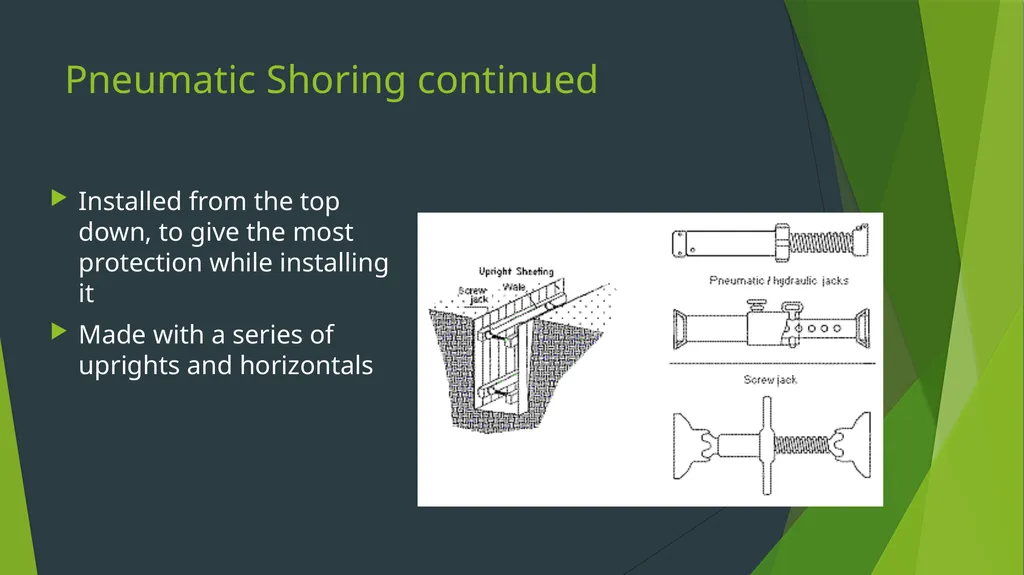
Pneumatic Shoring continued Installed from the top down, to give the most protection while installing it
Made with a series of uprights and horizontals<br>
Made with a series of uprights and horizontals<br>
19
Sloping and shoring part 1 Source: https://www.youtube.com/watch?v=USat6LdENzU
This video depicts how to install an shoring system into a trench<br>
This video depicts how to install an shoring system into a trench<br>
20
Sloping and shoring part 2 Source: https://www.youtube.com/watch?v=1Y5lsem9r4U
This video depicts how to install an shoring system into a trench<br>
This video depicts how to install an shoring system into a trench<br>
21
Shielding<br>
22
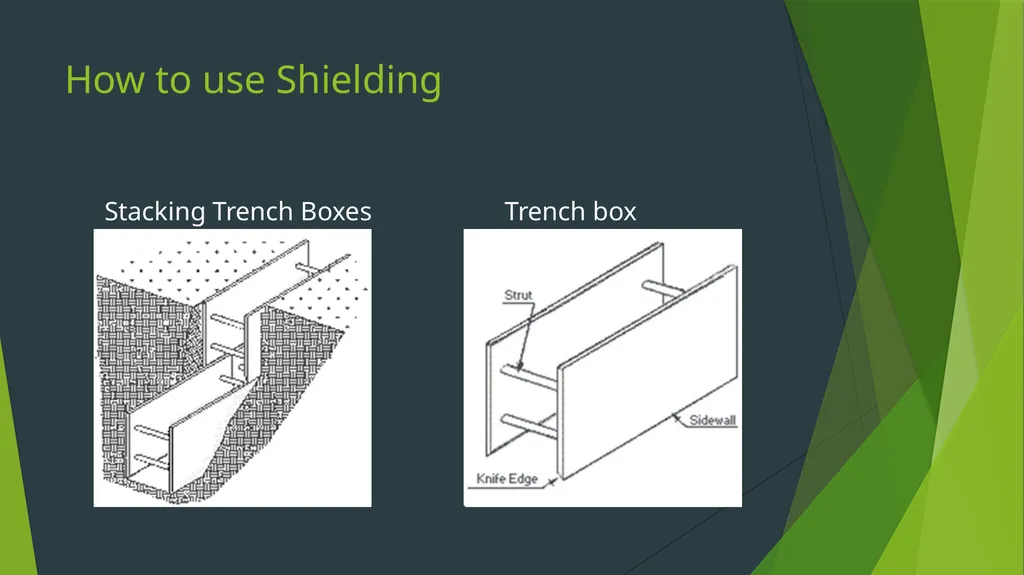
Shielding Trench Boxes are different from shoring because, instead of shoring up or otherwise supporting the trench face, they are intended primarily to protect workers from cave-ins and similar incidents.
The excavated area between the outside of the trench box and the face of the trench should be as small as possible.
The space between the trench boxes and the excavation side are backfilled to prevent lateral movement of the box.
Shields may not be subjected to loads exceeding those which the system was designed to withstand.<br>
23
How to use Shielding Stacking Trench Boxes Trench box<br>
24
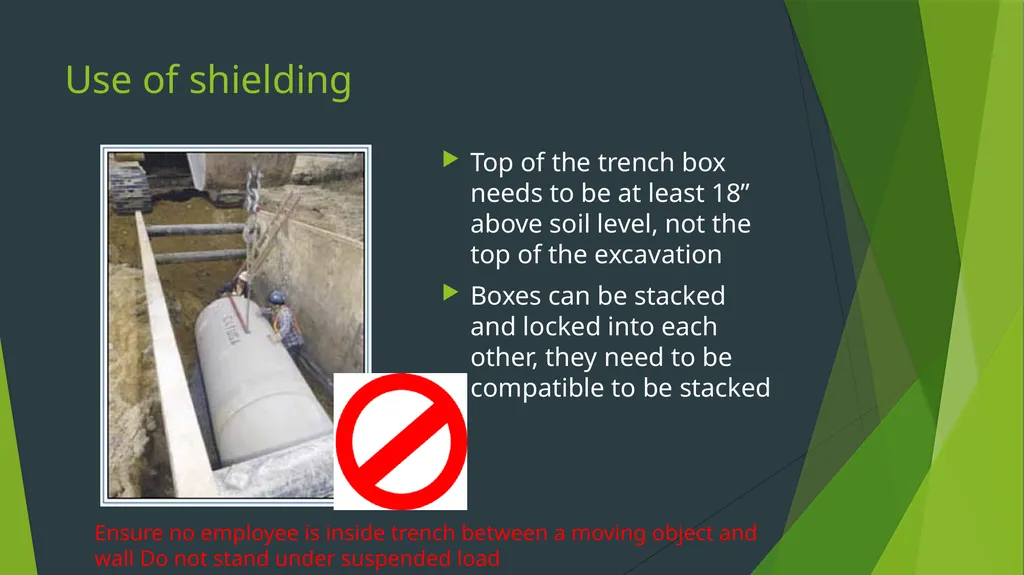
Use of shielding Top of the trench box needs to be at least 18” above soil level, not the top of the excavation
Boxes can be stacked and locked into each other, they need to be compatible to be stacked Ensure no employee is inside trench between a moving object and wall Do not stand under suspended load<br>
Boxes can be stacked and locked into each other, they need to be compatible to be stacked Ensure no employee is inside trench between a moving object and wall Do not stand under suspended load<br>
25
Spoil Piles<br>
26
Spoil Pile Temporary Spoil
Temporary spoil must be placed no closer than 2 ft (0.61 m) from the surface edge of the excavation, measured from the nearest base of the spoil to the cut. This distance should not be measured from the crown of the spoil deposit. This distance requirement ensures that loose rock or soil from the temporary spoil will not fall on employees in the trench.
Spoil should be placed so that it channels rainwater and other run-off water away from the excavation. Spoil should be placed so that it cannot accidentally run, slide, or fall back into the excavation<br>
27
Spoil Pile Continued Permanent Spoil
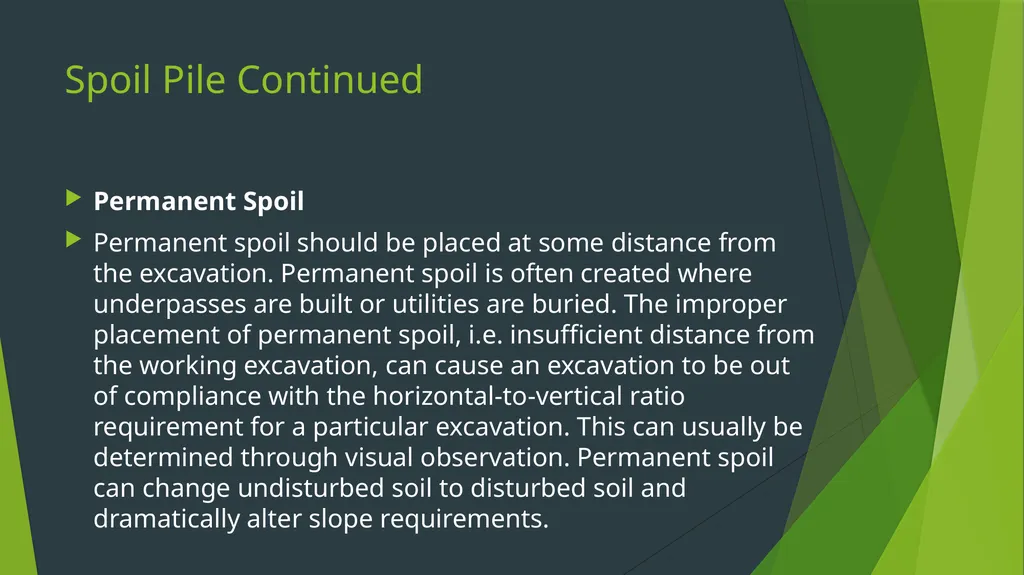
Permanent spoil should be placed at some distance from the excavation. Permanent spoil is often created where underpasses are built or utilities are buried. The improper placement of permanent spoil, i.e. insufficient distance from the working excavation, can cause an excavation to be out of compliance with the horizontal-to-vertical ratio requirement for a particular excavation. This can usually be determined through visual observation. Permanent spoil can change undisturbed soil to disturbed soil and dramatically alter slope requirements.<br>
Permanent spoil should be placed at some distance from the excavation. Permanent spoil is often created where underpasses are built or utilities are buried. The improper placement of permanent spoil, i.e. insufficient distance from the working excavation, can cause an excavation to be out of compliance with the horizontal-to-vertical ratio requirement for a particular excavation. This can usually be determined through visual observation. Permanent spoil can change undisturbed soil to disturbed soil and dramatically alter slope requirements.<br>
28
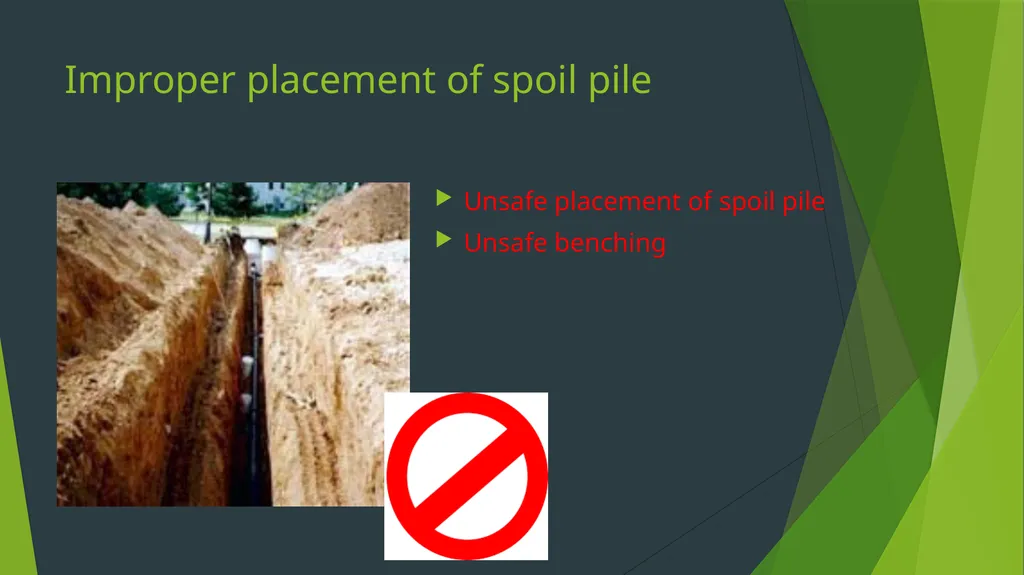
Improper placement of spoil pile Unsafe placement of spoil pile
Unsafe benching<br>
Unsafe benching<br>
29
Hazard identification<br>
30
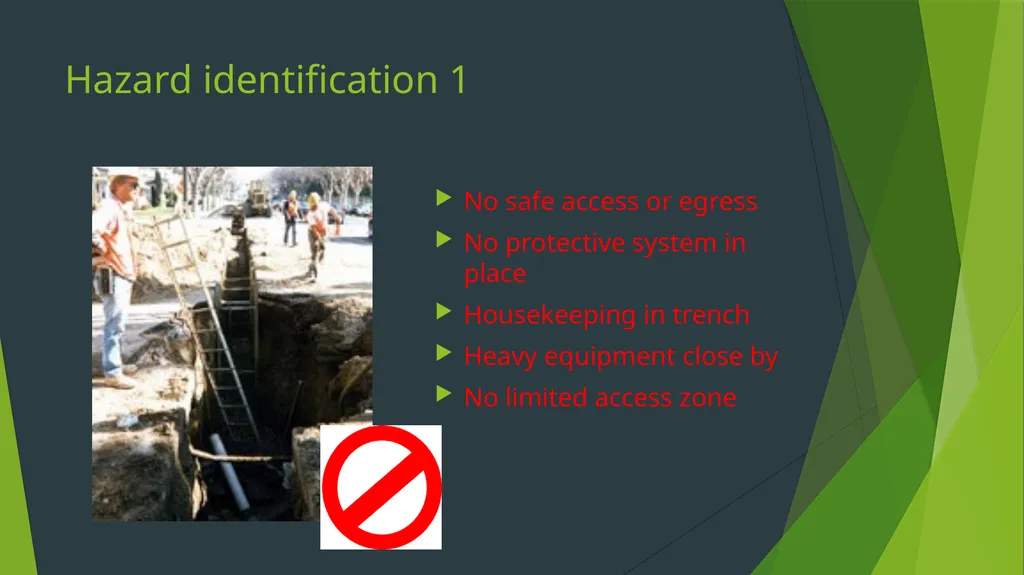
Hazard identification 1 No safe access or egress
No protective system in place
Housekeeping in trench
Heavy equipment close by
No limited access zone<br>
No protective system in place
Housekeeping in trench
Heavy equipment close by
No limited access zone<br>
31
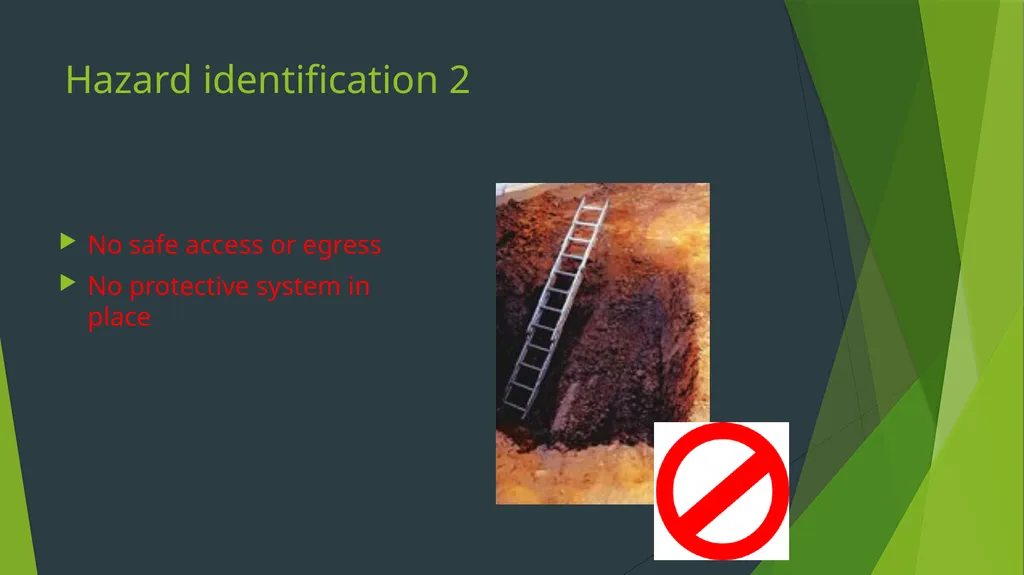
Hazard identification 2 No safe access or egress
No protective system in place<br>
No protective system in place<br>
32
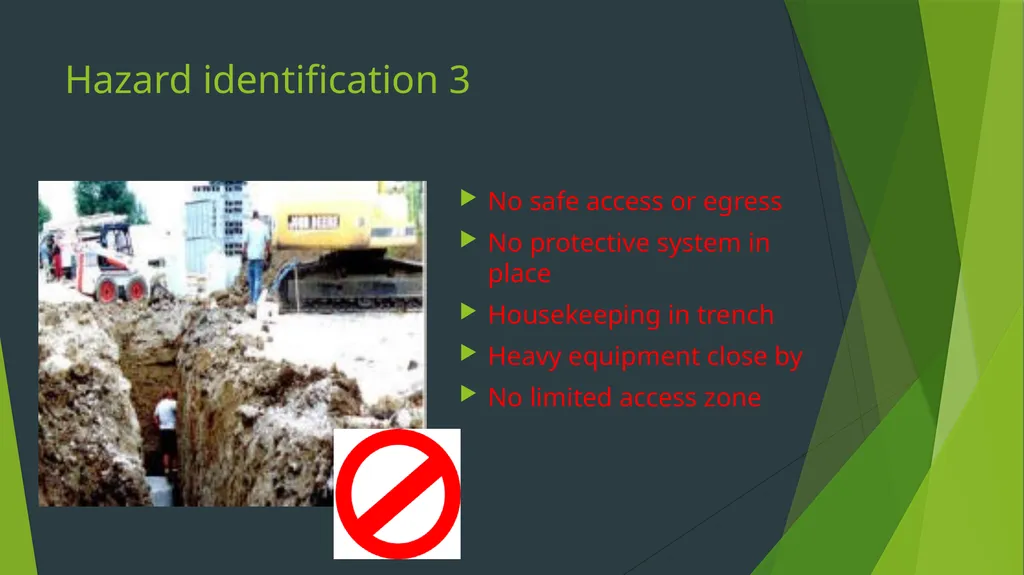
Hazard identification 3 No safe access or egress
No protective system in place
Housekeeping in trench
Heavy equipment close by
No limited access zone<br>
No protective system in place
Housekeeping in trench
Heavy equipment close by
No limited access zone<br>
33
Worker Rights and responsibilities<br>
34
Employee Rights & Responsibilities
Occupational Safety and Health Act of 1970 To assure safe and healthful working conditions for working men and women
By authorizing enforcement of the standards developed under the Act
By assisting and encouraging the States in their efforts to assure safe and healthful working conditions
By providing for research, information, education, and training in the field of occupational safety and health…<br>
By authorizing enforcement of the standards developed under the Act
By assisting and encouraging the States in their efforts to assure safe and healthful working conditions
By providing for research, information, education, and training in the field of occupational safety and health…<br>
35
Employee Rights & Responsibilities You have the right to:
A safe and healthful workplace
Know about hazardous chemicals
Information about injuries and illnesses in your workplace
Complain or request hazard correction from employer<br>
A safe and healthful workplace
Know about hazardous chemicals
Information about injuries and illnesses in your workplace
Complain or request hazard correction from employer<br>
36
Employee Rights & Responsibilities
You have the right to: File a confidential complaint with OSHA to have their workplace inspected.
Receive information and training about hazards, methods to prevent harm, and the OSHA standards that apply to their workplace. The training must be done in a language and vocabulary workers can understand.
Get copies of their workplace medical records and exposure records.
Participate in an OSHA inspection and speak in private with the inspector.<br>
37
Employee Rights & Responsibilities Continued: File a complaint with OSHA if they have been retaliated or discriminated against by their employer as the result of requesting an inspection or using any of their other rights under the OSH Act.
File a complaint if punished or discriminated against for acting as a “whistleblower” under the additional 21 federal statutes for which OSHA has jurisdiction.<br>
File a complaint if punished or discriminated against for acting as a “whistleblower” under the additional 21 federal statutes for which OSHA has jurisdiction.<br>
38
Whistleblower Protection http://www.whistleblowers.gov/<br>