
psychological complication, post-partum blues,
DP
Published · 36 slides · 0 views
1 / 1





Description
psychological complication, post-partum blues, depression and psychosis Presented by: Mrs. Preeti bahuguna Introduction Puerperium period is a time of transition from non-parenthood to parenthood. Parent infant attachment lead to bonding
Related Topics
Share
Embed code
Download this presentation From Below
"psychological complication, post-partum blues," is the property of its rightful owner. Permission is granted to download and print the materials on this website for personal, non-commercial use only, and to display it on your personal computer provided you do not modify the materials and that you retain all copyright notices contained in the materials. By downloading content from our website, you accept the terms of this agreement.
Presentation Transcript
01
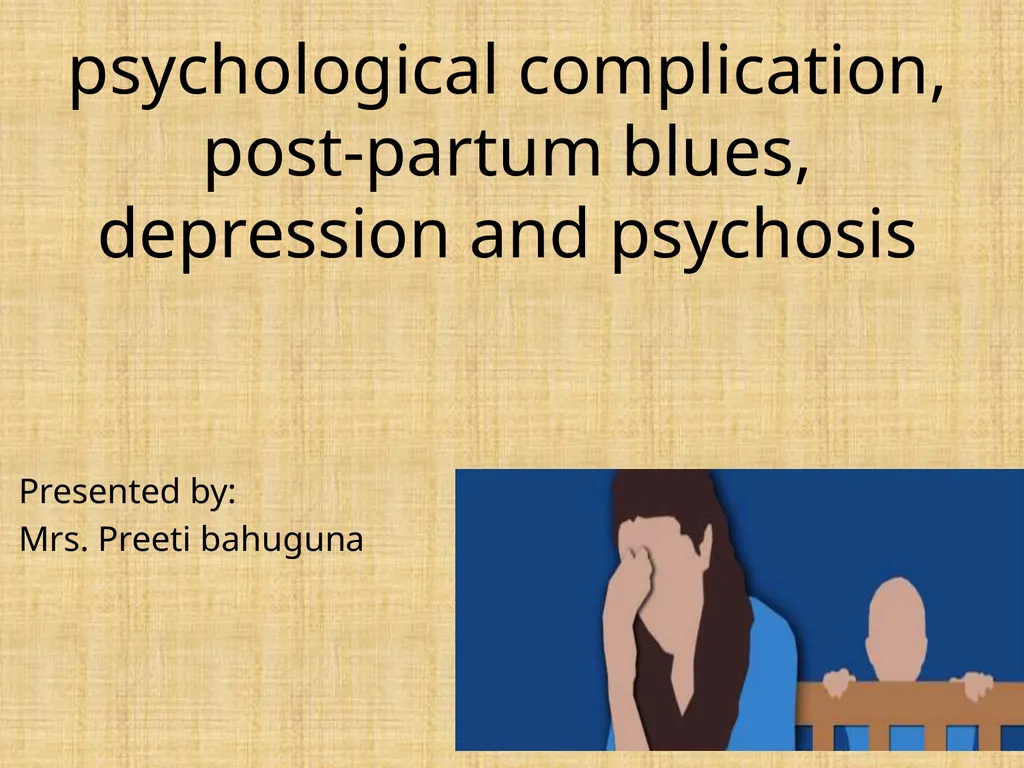
psychological complication, post-partum blues, depression and psychosis
Presented by:
Mrs. Preeti bahuguna<br>
Presented by:
Mrs. Preeti bahuguna<br>
02
Introduction Puerperium period is a time of transition from non-parenthood to parenthood. Parent infant attachment lead to bonding depending on infant’s responsivness.This courage them to continue interaction.<br>
03
During later recovery the mother must let go and view the child as a separate person. Those women who have difficulty letting others assist with care of her child may develop psychological problems.<br>
04
Psychological adaptation during
postpartum Mother typically undergo psychological adjustments during the postpartum period. Reva Rubin, a researcher who examined maternal adaptation to childbirth in the 1960s, identified three phases that can help the nurse understand maternal behavior after delivery.<br>
05
Historically, each phase encompassed a specific time span and women progressed through phases sequentially.
Rubin’s Stages of maternal psychological adaptation:-
1- Taking in phase(dependent phase):-
First 3 days post partum.
Focused on self ,not infant, on her own needs for
sleep & rest.
Passive , dependent & can’t make decisions.
Need to discuss labor experiences.
Sense of wonderment when looking at the
neonate.<br>
Rubin’s Stages of maternal psychological adaptation:-
1- Taking in phase(dependent phase):-
First 3 days post partum.
Focused on self ,not infant, on her own needs for
sleep & rest.
Passive , dependent & can’t make decisions.
Need to discuss labor experiences.
Sense of wonderment when looking at the
neonate.<br>
06
2-Taking hold phase (dependent to independent
phase):-
Last from the 3rd to 10th day postpartum.
Focus on infant.
Active, independent & can make decisions.
Initiates self care activities, focus on bowels, bladder & breastfeeding.
Responds to instruction about infant care & self
care.
May express lack of confidence in caring for the
neonate.<br>
phase):-
Last from the 3rd to 10th day postpartum.
Focus on infant.
Active, independent & can make decisions.
Initiates self care activities, focus on bowels, bladder & breastfeeding.
Responds to instruction about infant care & self
care.
May express lack of confidence in caring for the
neonate.<br>
07
3-Letting go- (interdependent phase):-
Last from 10 days to 6 weeks postpartum.
The woman finally redefines her new role.
See self as separate from infant.
Gives up fantasized image of her child and accepts the real one.
Readjustment.<br>
Last from 10 days to 6 weeks postpartum.
The woman finally redefines her new role.
See self as separate from infant.
Gives up fantasized image of her child and accepts the real one.
Readjustment.<br>
08
High risk factors for post partum illness Family history, major mental illness
Past history psychiatric illness
Present pregnancy caesarean delivery, neonatal complication
Unmet expectation of mother<br>
Past history psychiatric illness
Present pregnancy caesarean delivery, neonatal complication
Unmet expectation of mother<br>
09
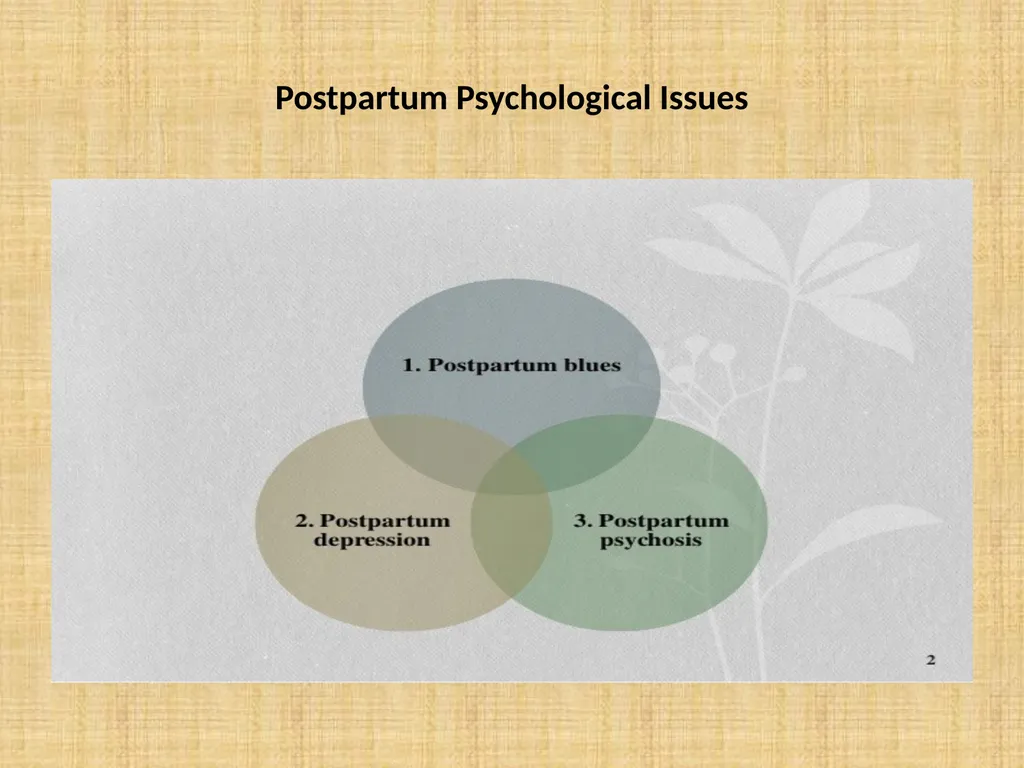
Postpartum Psychological Issues<br>
10
Postpartum Blues Many women experience a period of “blues” or mild depression following delivery.
Although experienced as distressful and unpleasant, this is a normal and expected reaction following any major event in one’s life to include delivery.<br>
Although experienced as distressful and unpleasant, this is a normal and expected reaction following any major event in one’s life to include delivery.<br>
11
In the vast majority of cases, this experience of postpartum “blues” does not cause major problems, does not interfere with taking care of your newborn, and goes away without treatment within 2 weeks.
If these feelings continue for much longer or if you become concerned, it is always okay to ask your health care professional for assistance, advice, or referral to local behavioral health services.<br>
If these feelings continue for much longer or if you become concerned, it is always okay to ask your health care professional for assistance, advice, or referral to local behavioral health services.<br>
12
causes Postpartum “Blues” are caused by a number of factors…
1. Hormonal rebalancing after delivery
2. Major life events cause stress (even if these events are joyous occasions) and stress can often show itself in the form of mild depressive symptoms.<br>
1. Hormonal rebalancing after delivery
2. Major life events cause stress (even if these events are joyous occasions) and stress can often show itself in the form of mild depressive symptoms.<br>
13
Sign and symptoms Symptoms are mild and short term.
Should subside after 2 to 3 weeks.<br>
Should subside after 2 to 3 weeks.<br>
14
Symptoms:
Sadness, anxiety, irritability
Uncontrollable tearfulness
Wide mood swings
Occasional negative thoughts<br>
Sadness, anxiety, irritability
Uncontrollable tearfulness
Wide mood swings
Occasional negative thoughts<br>
15
Treatment Treatment (when necessary) includes supportive care and reassurance about the transient nature of the condition.<br>
16
Post-partum depression Depression is twice a common in women as it is in men, with its peak incidence during the primary reproductive years (25 to 45).
Between 10-25% of women in US population are likely to experience at least one Major Depressive Episode over the course of their lifetime. At any given time, between 5% and 9% of women in the US are suffering from Major Depressive Disorder.<br>
Between 10-25% of women in US population are likely to experience at least one Major Depressive Episode over the course of their lifetime. At any given time, between 5% and 9% of women in the US are suffering from Major Depressive Disorder.<br>
17
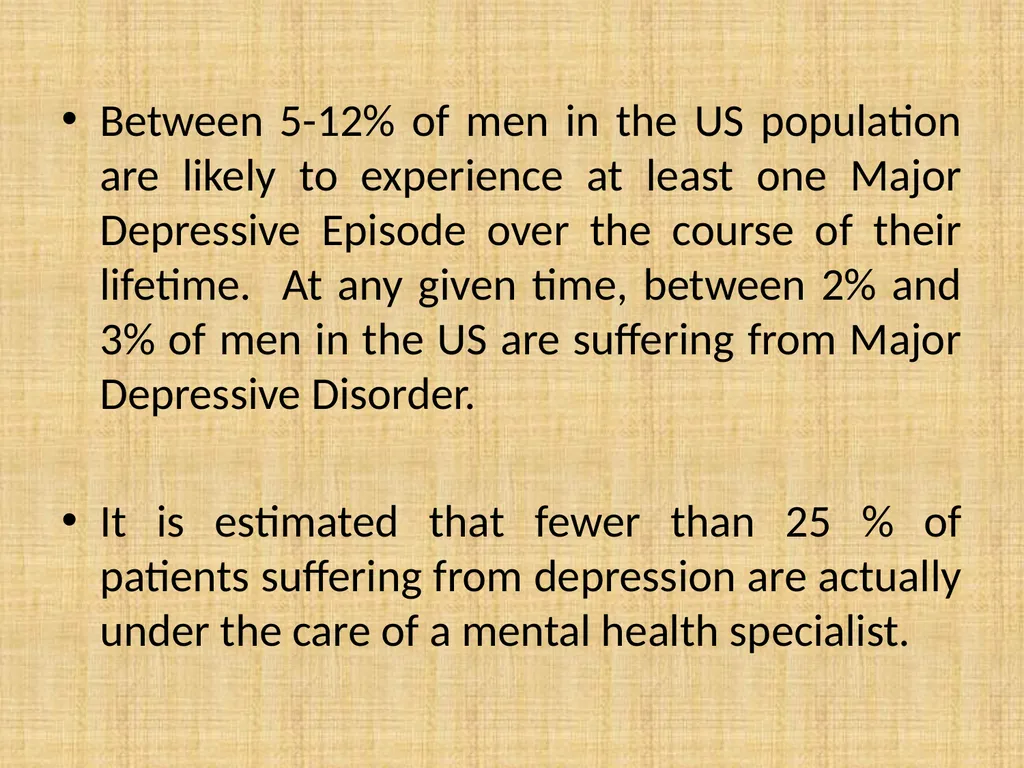
Between 5-12% of men in the US population are likely to experience at least one Major Depressive Episode over the course of their lifetime. At any given time, between 2% and 3% of men in the US are suffering from Major Depressive Disorder.
It is estimated that fewer than 25 % of patients suffering from depression are actually under the care of a mental health specialist.<br>
It is estimated that fewer than 25 % of patients suffering from depression are actually under the care of a mental health specialist.<br>
18
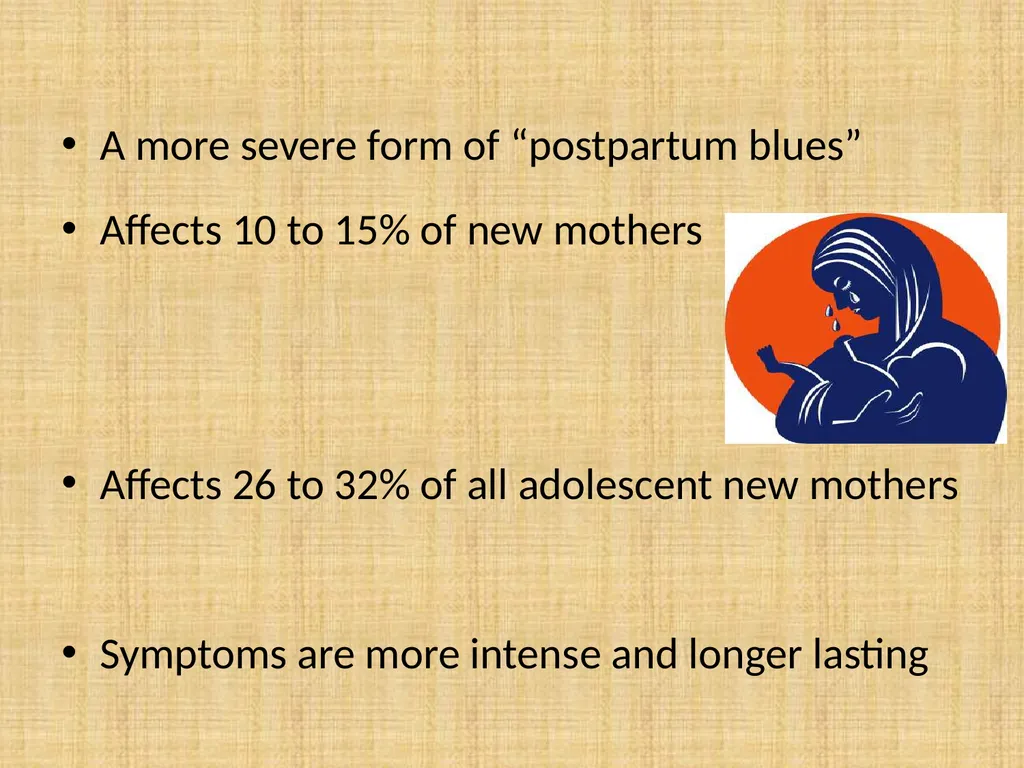
A more severe form of “postpartum blues”
Affects 10 to 15% of new mothers
Affects 26 to 32% of all adolescent new mothers
Symptoms are more intense and longer lasting<br>
Affects 10 to 15% of new mothers
Affects 26 to 32% of all adolescent new mothers
Symptoms are more intense and longer lasting<br>
19
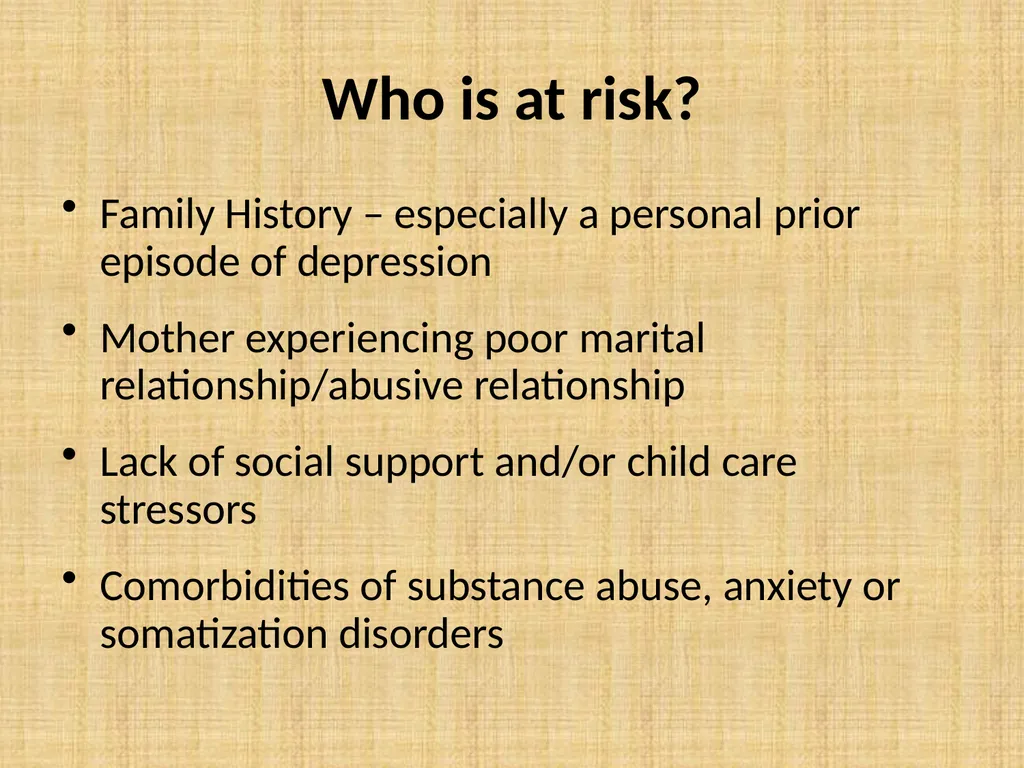
Who is at risk? Family History – especially a personal prior episode of depression
Mother experiencing poor marital relationship/abusive relationship
Lack of social support and/or child care stressors
Comorbidities of substance abuse, anxiety or somatization disorders<br>
Mother experiencing poor marital relationship/abusive relationship
Lack of social support and/or child care stressors
Comorbidities of substance abuse, anxiety or somatization disorders<br>
20
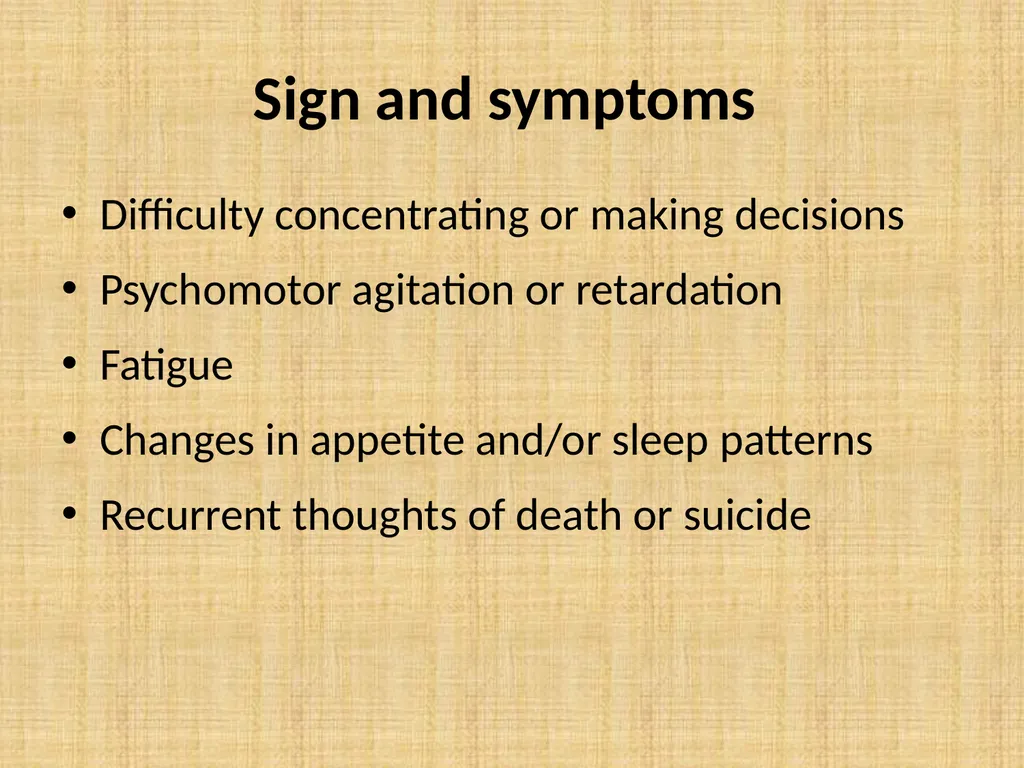
Sign and symptoms Difficulty concentrating or making decisions
Psychomotor agitation or retardation
Fatigue
Changes in appetite and/or sleep patterns
Recurrent thoughts of death or suicide<br>
Psychomotor agitation or retardation
Fatigue
Changes in appetite and/or sleep patterns
Recurrent thoughts of death or suicide<br>
21
Feelings of worthlessness or guilt (especially focusing on failure at motherhood)
Excessive anxiety
Frequently focusing on the child’s health<br>
Excessive anxiety
Frequently focusing on the child’s health<br>
22
Postpartum Depression Interventions Medication
For more severe or chronic symptoms
Prior episodes or family histories w/ good response to meds
Less costly and less time consuming
Psycho-therapy
Chronic psychosocial problems
Incomplete response to meds
Concurrent personality problems
Combination of both<br>
For more severe or chronic symptoms
Prior episodes or family histories w/ good response to meds
Less costly and less time consuming
Psycho-therapy
Chronic psychosocial problems
Incomplete response to meds
Concurrent personality problems
Combination of both<br>
23
Post-partum psychosis Psychosis is what most people think of when they hear the word “crazy.” It means hearing voices or seeing things that aren’t there. Other psychotic symptoms include bizarre and irrational beliefs that may include a firmly held belief that others are trying to harm the person or those close to them.<br>
24
In cases of postpartum psychosis, a mother may say things that sound irrational. Others may interpret what she is saying as bizarre or weird.
Psychosis is extremely rare and it is exceptionally unlikely that new mothers (even those experiencing postpartum depression) will develop psychotic symptoms.<br>
Psychosis is extremely rare and it is exceptionally unlikely that new mothers (even those experiencing postpartum depression) will develop psychotic symptoms.<br>
25
Rare condition, affecting 1 to 2 out of 1000 women after childbirth
Presentation can be dramatic
Onset as early as 48 to 72 hours postpartum
Symptoms develop within the first 2 weeks after delivery<br>
Presentation can be dramatic
Onset as early as 48 to 72 hours postpartum
Symptoms develop within the first 2 weeks after delivery<br>
26
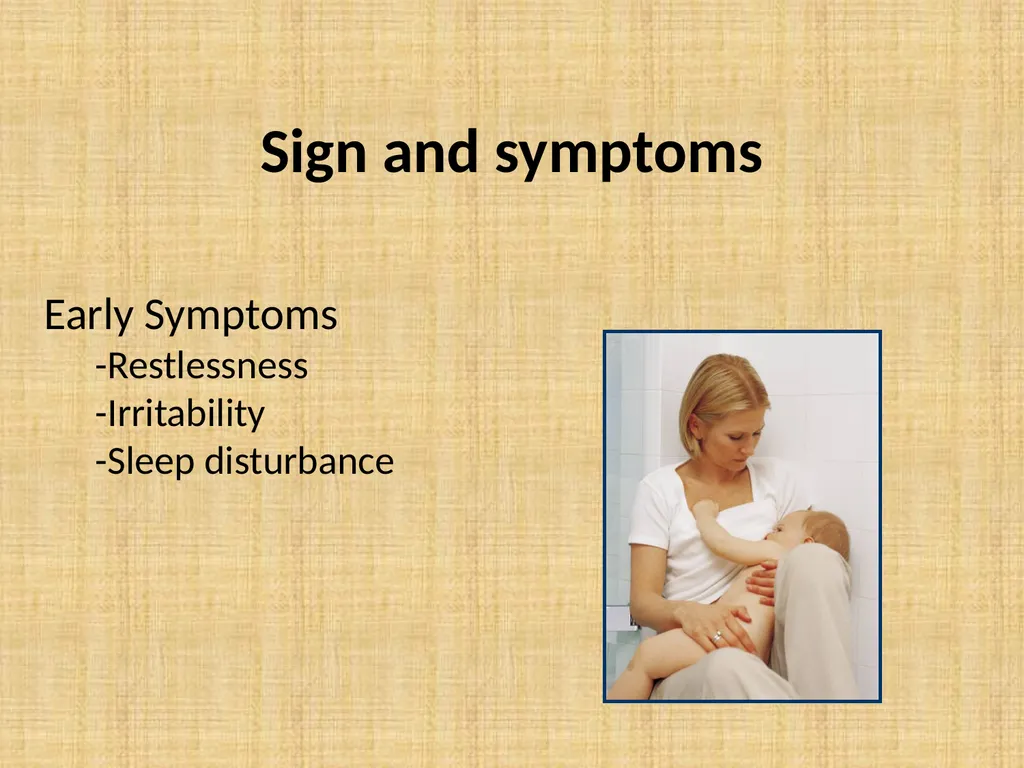
Sign and symptoms Early Symptoms
-Restlessness
-Irritability
-Sleep disturbance<br>
-Restlessness
-Irritability
-Sleep disturbance<br>
27
Progressive Symptoms
Depressed or elated mood
Disorganized behavior
Mood swings/ instability
Delusions
Hallucinations<br>
Depressed or elated mood
Disorganized behavior
Mood swings/ instability
Delusions
Hallucinations<br>
28
Treatment Post partum psychosis is considered as mental health emergency and therefore requires attention.
Antipsychotic drugs and anti-depressant drugs.
If the mother poses a threat to herself and other she likely be hospitalized for short time.
Psychological support.<br>
Antipsychotic drugs and anti-depressant drugs.
If the mother poses a threat to herself and other she likely be hospitalized for short time.
Psychological support.<br>
29
Nursing management<br>
30
Nursing intervention toward psychological changes & disorders during postpartum period:-
1- Early detection of any behavioral and
psychological responses changes.
2-Early detection of depression-anger or blues.
3- Early detection of male adaptation in
attachment.
4- Refer the client to obstetrician to evaluate
physiological status.
5- Support positive parenting behaviors.<br>
1- Early detection of any behavioral and
psychological responses changes.
2-Early detection of depression-anger or blues.
3- Early detection of male adaptation in
attachment.
4- Refer the client to obstetrician to evaluate
physiological status.
5- Support positive parenting behaviors.<br>
31
6- Refer the client to:-
• Psychiatrist.
• Nurse psychotherapist
• Pediatrician.
• Support group.
• Public health nurse.<br>
• Psychiatrist.
• Nurse psychotherapist
• Pediatrician.
• Support group.
• Public health nurse.<br>
32
Research article A study conducted by Tukaram B. Zagade, Prasanna Deshpande To assesse the level of depression among post natal mother admitted in Krishna hospital. To associate the results with demographic variables. To prepare a hand book on prevention of postnatal depression.
Methodology: The research methodology indicates the general pattern to gather valid and reliable data for the problem under investigation57 The present study was aimed to assess the level of post natal depression among the post natal mothers through assessment of mothers by Eden Burg Scale. It includes the research design, setting of the study, population, sample and sample size, sampling technique, development of the tool, method of data collection and plan for data analyze.<br>
Methodology: The research methodology indicates the general pattern to gather valid and reliable data for the problem under investigation57 The present study was aimed to assess the level of post natal depression among the post natal mothers through assessment of mothers by Eden Burg Scale. It includes the research design, setting of the study, population, sample and sample size, sampling technique, development of the tool, method of data collection and plan for data analyze.<br>
33
Results & Conclusion: The distribution of demographic characteristics, of the postnatal mothers are more observed in age group of (21 to 25) i.e. 63%, it was observed that a large majority (87.9%) were Hindus, As per occupation( 85%) women’s are housewife, many mothers belong to joint family (67%) ,normal delivery were (75.6%).It was observed that 21-25 age group of post natal mothers were more prevalent to have post natal depression among 60 samples taken. No association was seen with religion, It was observed that high school educated post natal mothers were more .Prevalence was seen more in them. Postnatal mothers were more from joint family taken. Prevalence was seen more in them too. No prevalence was seen between sex of child .There was no any association It was observed that normal delivery were more than L.S.C.S. The prevalence of postnatal depression was more among them within 60 samples taken from maternity ward of Krishna Hospital, Karad<br>
34
Summary<br>
35
Conclusion<br>