
PSYCHOLOGY 2e Chapter 5 SENSATION AND PERCEPTION
LS
Published · 50 slides · 0 views

1 / 1

Description
PSYCHOLOGY 2e Chapter 5 SENSATION AND PERCEPTION PowerPoint Image Slideshow SENSORY SYSTEMS If you were standing in the midst of this street scene, you would be absorbing and processing numerous pieces of sensory input. Figure 5.1 (credit:
Related Topics
Share
Embed code
Download this presentation From Below
"PSYCHOLOGY 2e Chapter 5 SENSATION AND PERCEPTION" is the property of its rightful owner. Permission is granted to download and print the materials on this website for personal, non-commercial use only, and to display it on your personal computer provided you do not modify the materials and that you retain all copyright notices contained in the materials. By downloading content from our website, you accept the terms of this agreement.
Presentation Transcript
01
PSYCHOLOGY 2e
Chapter 5 SENSATION AND PERCEPTION
PowerPoint Image Slideshow<br>
Chapter 5 SENSATION AND PERCEPTION
PowerPoint Image Slideshow<br>
02
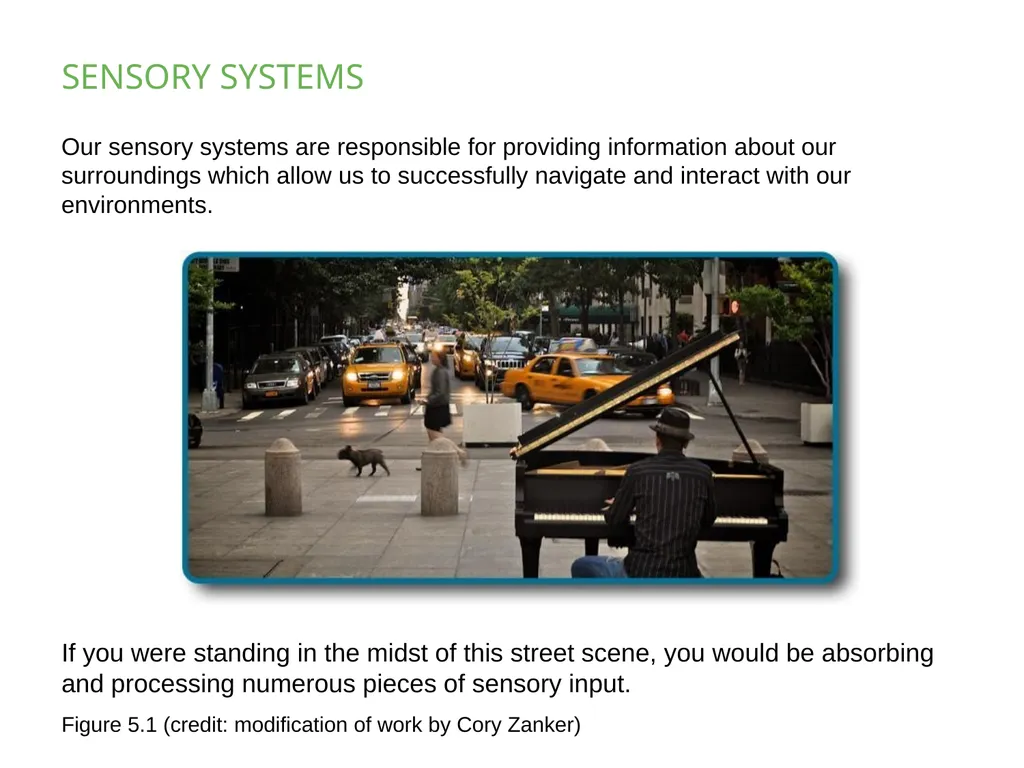
SENSORY SYSTEMS If you were standing in the midst of this street scene, you would be absorbing and processing numerous pieces of sensory input.
Figure 5.1 (credit: modification of work by Cory Zanker) Our sensory systems are responsible for providing information about our surroundings which allow us to successfully navigate and interact with our environments.<br>
Figure 5.1 (credit: modification of work by Cory Zanker) Our sensory systems are responsible for providing information about our surroundings which allow us to successfully navigate and interact with our environments.<br>
03
SENSATION Sensory receptors - specialized neurons that respond to specific types of stimuli.
Sensation – occurs when sensory receptors detect sensory stimuli.
When sensory receptors detect a specific stimuli, they convert that energy into an action potential which is sent to the central nervous system. This is called transduction.
Sensory systems:
Vision
Hearing (audition)
Smell (olfaction)
Taste (gustation)
Touch (somatosensation) Balance (vestibular sense)
Body position (proprioception)
Movement (kinesthesia)
Pain (nociception)
Temperature (thermoception)<br>
Sensation – occurs when sensory receptors detect sensory stimuli.
When sensory receptors detect a specific stimuli, they convert that energy into an action potential which is sent to the central nervous system. This is called transduction.
Sensory systems:
Vision
Hearing (audition)
Smell (olfaction)
Taste (gustation)
Touch (somatosensation) Balance (vestibular sense)
Body position (proprioception)
Movement (kinesthesia)
Pain (nociception)
Temperature (thermoception)<br>
04
SENSATION For a stimulus to cause an action potential, it first has to be strong enough to be detected.
Absolute threshold – minimum amount of stimulus energy that must be present for the stimulus to be detected 50% of the time.
On a clear night, the most sensitive sensory cells in the eye can detect a candle flame 30 miles away.
We are also able to receive messages presented below the threshold of conscious awareness which are known as subliminal messages.
The stimulus causes an action potential but we are not consciously aware of it.
Just noticeable difference (JND) –the minimum difference in stimuli required to detect a change or a difference between stimuli.
Can change depending on the stimulus intensity.
A cell phone lighting up in a dark movie theatre is more likely to be noticed than if it lights up in a brightly lit shopping mall. The brightness of the cell phone does not change, but the ability to detect the change in illumination does.
The JND would be the minimum increase in brightness required for the change to be detected.<br>
Absolute threshold – minimum amount of stimulus energy that must be present for the stimulus to be detected 50% of the time.
On a clear night, the most sensitive sensory cells in the eye can detect a candle flame 30 miles away.
We are also able to receive messages presented below the threshold of conscious awareness which are known as subliminal messages.
The stimulus causes an action potential but we are not consciously aware of it.
Just noticeable difference (JND) –the minimum difference in stimuli required to detect a change or a difference between stimuli.
Can change depending on the stimulus intensity.
A cell phone lighting up in a dark movie theatre is more likely to be noticed than if it lights up in a brightly lit shopping mall. The brightness of the cell phone does not change, but the ability to detect the change in illumination does.
The JND would be the minimum increase in brightness required for the change to be detected.<br>
05
PERCEPTION Our sensory receptors collect information about our environment but it is then how we interpret that information that ultimately affects how we interact with the world.
Perception – way that sensory information is interpreted, organized, and consciously experienced. Perception involves two forms of processing:
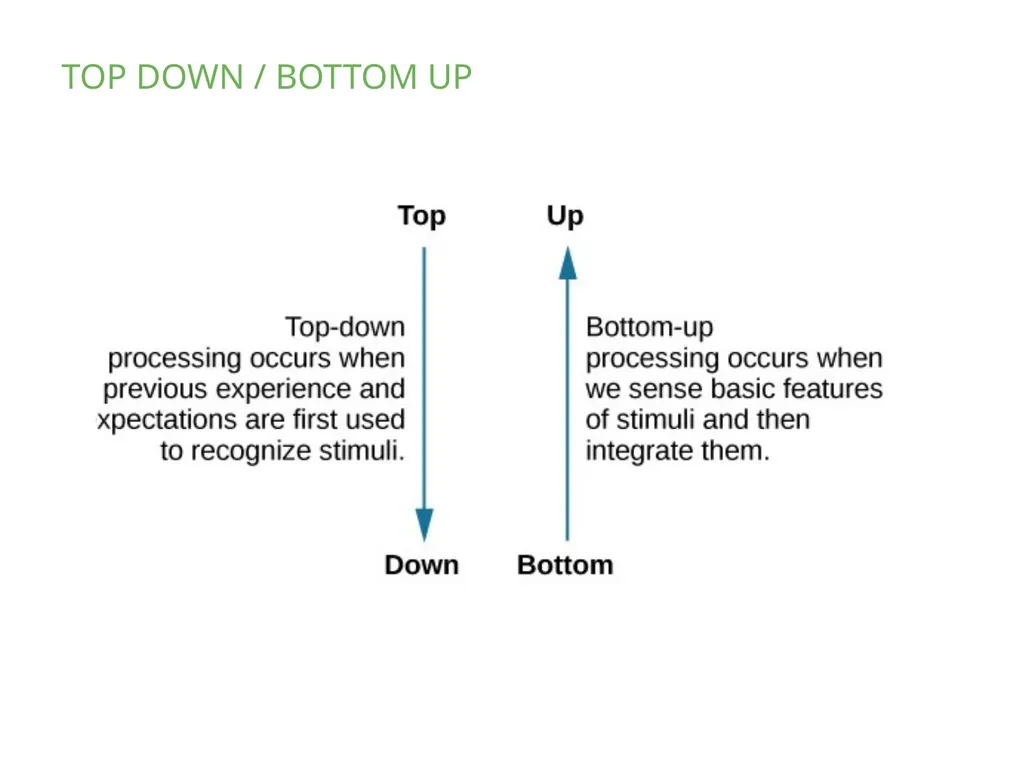
Bottom-up processing – system in which perceptions are built from sensory input.
Top-down processing – interpretation of sensations is influenced by available knowledge, experiences, and thoughts.<br>
Perception – way that sensory information is interpreted, organized, and consciously experienced. Perception involves two forms of processing:
Bottom-up processing – system in which perceptions are built from sensory input.
Top-down processing – interpretation of sensations is influenced by available knowledge, experiences, and thoughts.<br>
06
TOP DOWN / BOTTOM UP<br>
07
FACTORS AFFECTING PERCEPTION Sensory adaption – not perceiving stimuli that remain relatively constant over prolonged periods of time.
For example, when you first enter a quiet room you may hear the clock ticking. Over time you become unaware of the ticking. The ticking is still affecting sensory receptors but you are no longer perceiving the sound. 2. Attention
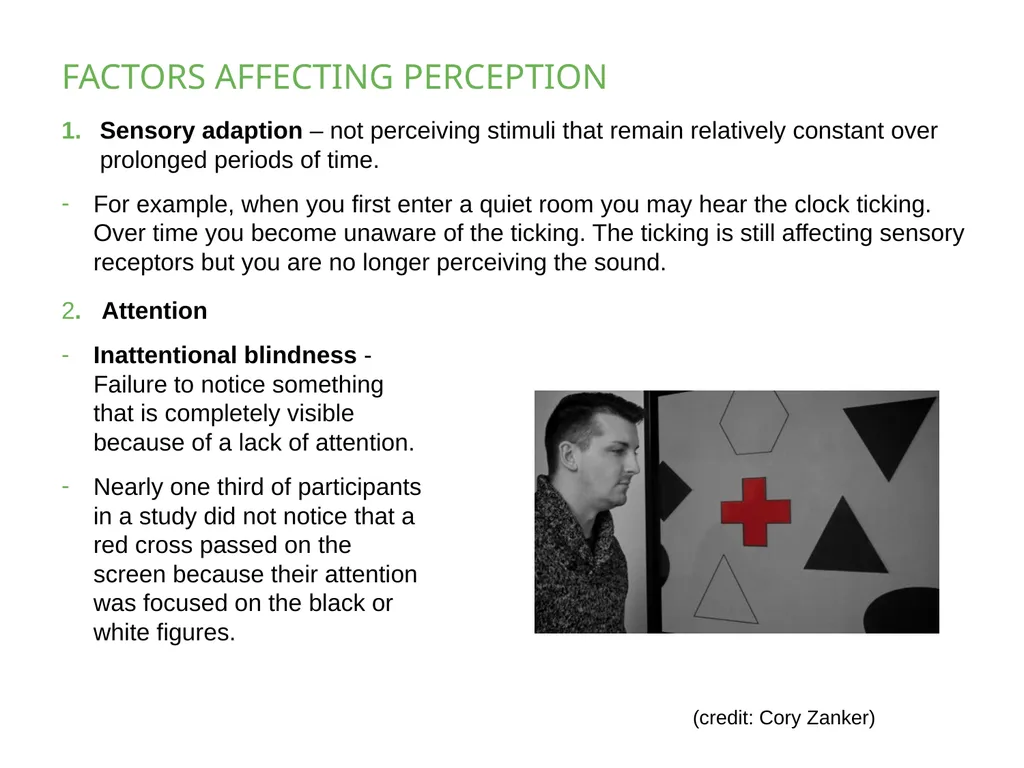
Inattentional blindness - Failure to notice something that is completely visible because of a lack of attention.
Nearly one third of participants in a study did not notice that a red cross passed on the screen because their attention was focused on the black or white figures. (credit: Cory Zanker)<br>
For example, when you first enter a quiet room you may hear the clock ticking. Over time you become unaware of the ticking. The ticking is still affecting sensory receptors but you are no longer perceiving the sound. 2. Attention
Inattentional blindness - Failure to notice something that is completely visible because of a lack of attention.
Nearly one third of participants in a study did not notice that a red cross passed on the screen because their attention was focused on the black or white figures. (credit: Cory Zanker)<br>
08
FACTORS AFFECTING PERCEPTION 3. Motivation
Sometimes we think we hear something such as a phone ringing when it is not because we are motivated to perceive it (such as waiting for an important phone call).
Signal detection theory – change in stimulus detection as a function of current mental state.
Beliefs, values, prejudices and expectations
People who hold positive attitudes towards low-fat foods are more likely to rate foods with low-fat labels as tasting better than people with less positive attitudes about low-fat products.
Life/Cultural experiences
One study found that people from Western cultures (where there is a perceptual context of buildings with straight lines) were more likely to experience certain types of visual illusions, like the Muller-Lyer illusion, than individuals from non-western cultures (where they are more likely to live in round huts).<br>
Sometimes we think we hear something such as a phone ringing when it is not because we are motivated to perceive it (such as waiting for an important phone call).
Signal detection theory – change in stimulus detection as a function of current mental state.
Beliefs, values, prejudices and expectations
People who hold positive attitudes towards low-fat foods are more likely to rate foods with low-fat labels as tasting better than people with less positive attitudes about low-fat products.
Life/Cultural experiences
One study found that people from Western cultures (where there is a perceptual context of buildings with straight lines) were more likely to experience certain types of visual illusions, like the Muller-Lyer illusion, than individuals from non-western cultures (where they are more likely to live in round huts).<br>
09
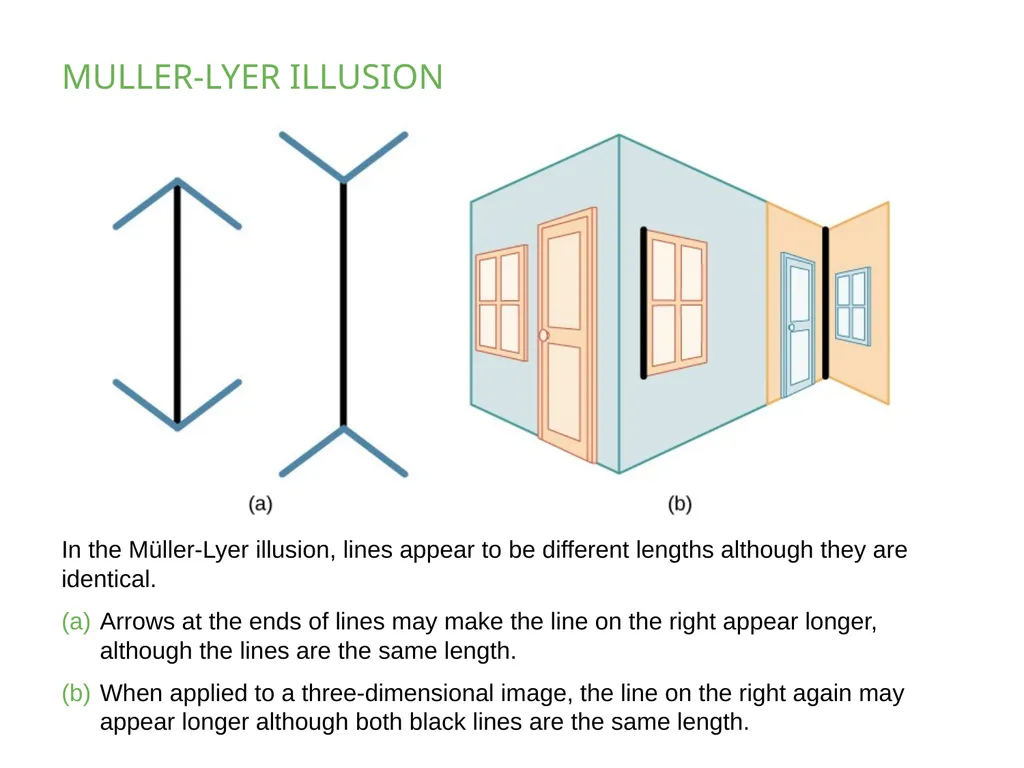
MULLER-LYER ILLUSION In the Müller-Lyer illusion, lines appear to be different lengths although they are identical.
Arrows at the ends of lines may make the line on the right appear longer, although the lines are the same length.
When applied to a three-dimensional image, the line on the right again may appear longer although both black lines are the same length.<br>
Arrows at the ends of lines may make the line on the right appear longer, although the lines are the same length.
When applied to a three-dimensional image, the line on the right again may appear longer although both black lines are the same length.<br>
10
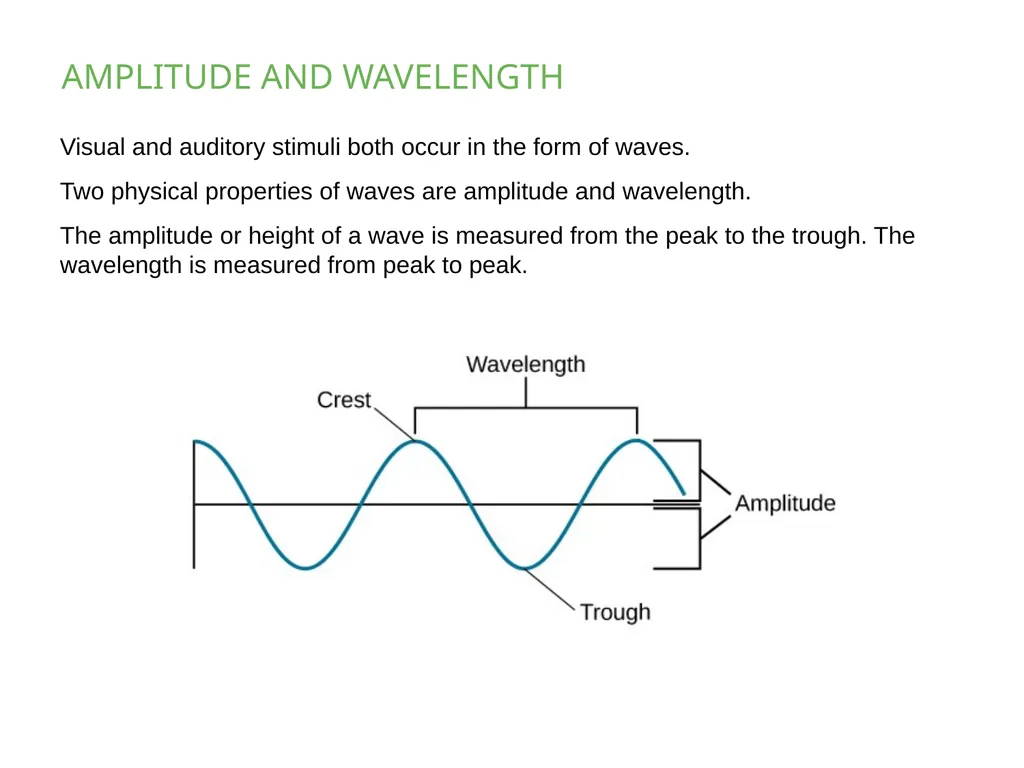
AMPLITUDE AND WAVELENGTH Visual and auditory stimuli both occur in the form of waves.
Two physical properties of waves are amplitude and wavelength.
The amplitude or height of a wave is measured from the peak to the trough. The wavelength is measured from peak to peak.<br>
Two physical properties of waves are amplitude and wavelength.
The amplitude or height of a wave is measured from the peak to the trough. The wavelength is measured from peak to peak.<br>
11
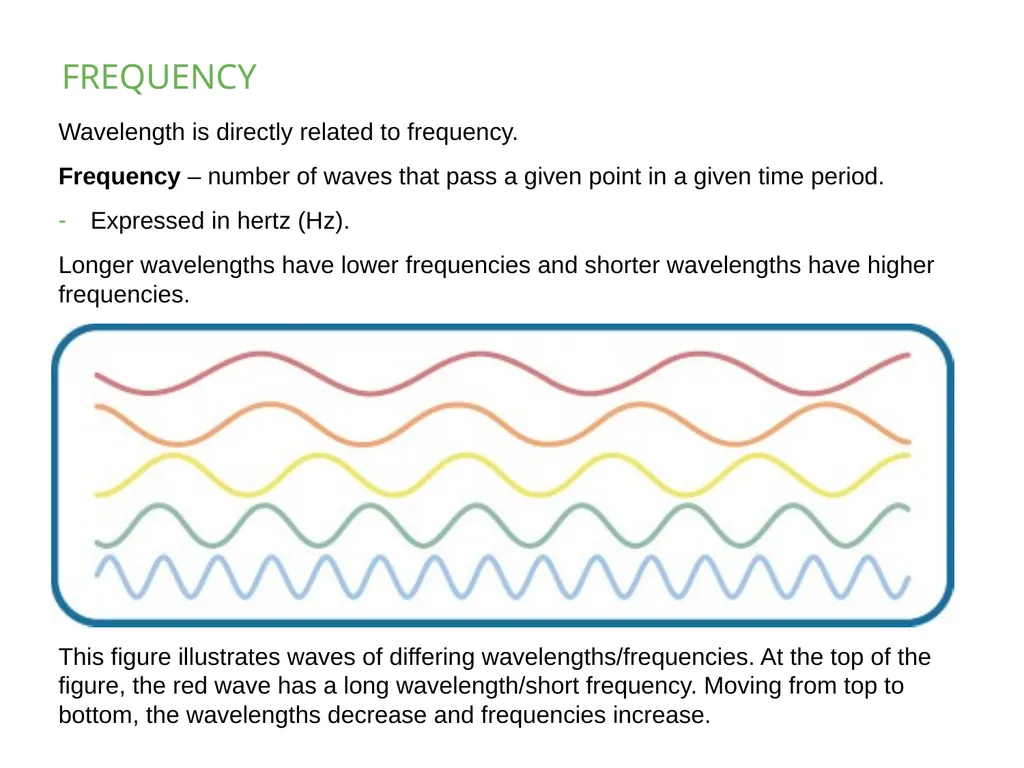
FREQUENCY This figure illustrates waves of differing wavelengths/frequencies. At the top of the figure, the red wave has a long wavelength/short frequency. Moving from top to bottom, the wavelengths decrease and frequencies increase. Wavelength is directly related to frequency.
Frequency – number of waves that pass a given point in a given time period.
Expressed in hertz (Hz).
Longer wavelengths have lower frequencies and shorter wavelengths have higher frequencies.<br>
Frequency – number of waves that pass a given point in a given time period.
Expressed in hertz (Hz).
Longer wavelengths have lower frequencies and shorter wavelengths have higher frequencies.<br>
12
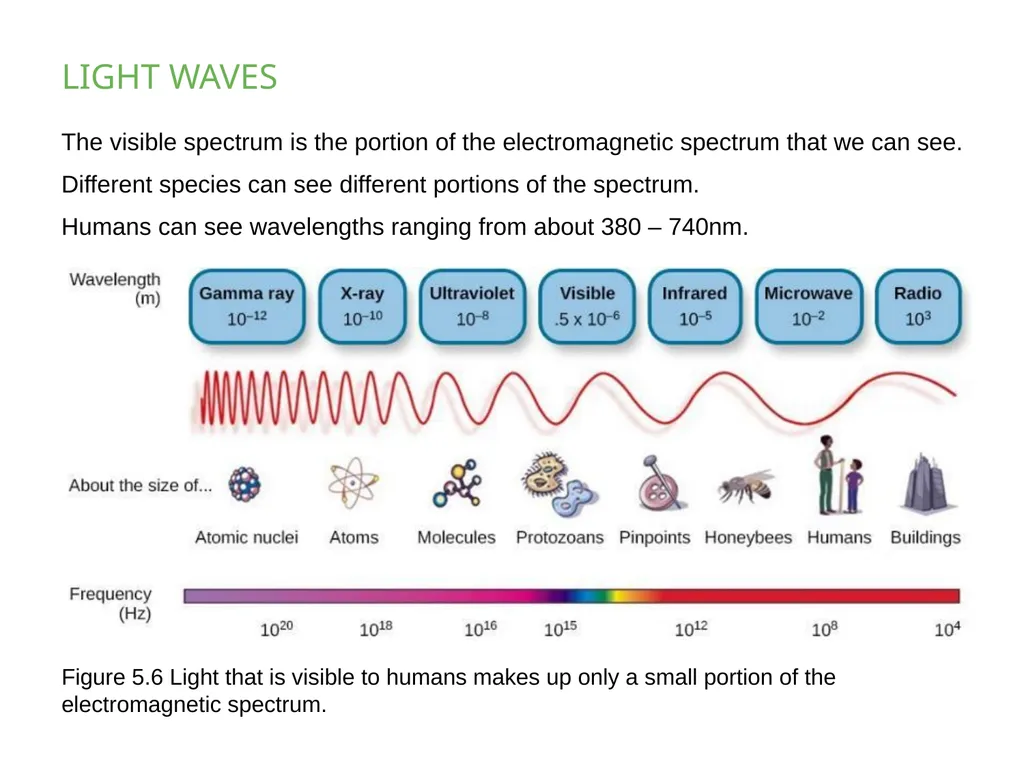
LIGHT WAVES Figure 5.6 Light that is visible to humans makes up only a small portion of the electromagnetic spectrum. The visible spectrum is the portion of the electromagnetic spectrum that we can see.
Different species can see different portions of the spectrum.
Humans can see wavelengths ranging from about 380 – 740nm.<br>
Different species can see different portions of the spectrum.
Humans can see wavelengths ranging from about 380 – 740nm.<br>
13
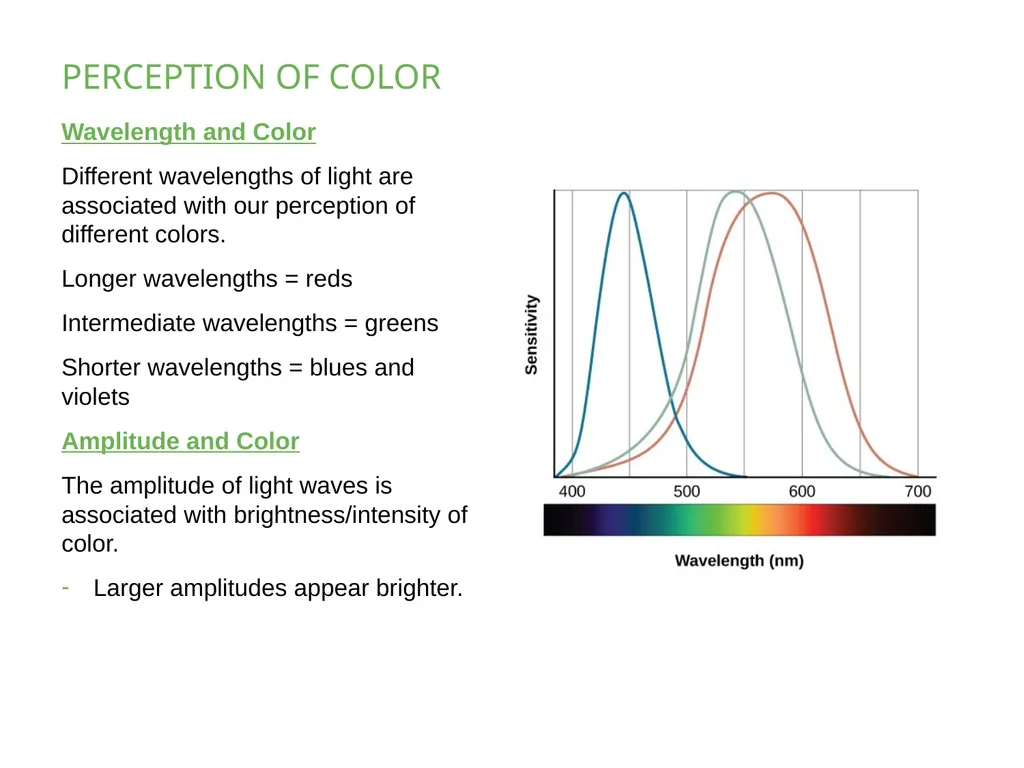
PERCEPTION OF COLOR Wavelength and Color
Different wavelengths of light are associated with our perception of different colors.
Longer wavelengths = reds
Intermediate wavelengths = greens
Shorter wavelengths = blues and violets
Amplitude and Color
The amplitude of light waves is associated with brightness/intensity of color.
Larger amplitudes appear brighter.<br>
Different wavelengths of light are associated with our perception of different colors.
Longer wavelengths = reds
Intermediate wavelengths = greens
Shorter wavelengths = blues and violets
Amplitude and Color
The amplitude of light waves is associated with brightness/intensity of color.
Larger amplitudes appear brighter.<br>
14
SOUNDWAVES Frequency
Frequency of soundwaves = pitch
High frequency = high-pitched sound
Low frequency = low-pitched sound
The audible range of sound frequencies in humans is between 20 – 2000Hz
Amplitude and Decibels
Amplitude of soundwaves = loudness
Higher amplitude = louder sounds
Lower amplitude = quieter sounds
Loudness is measured in decibels (dB).
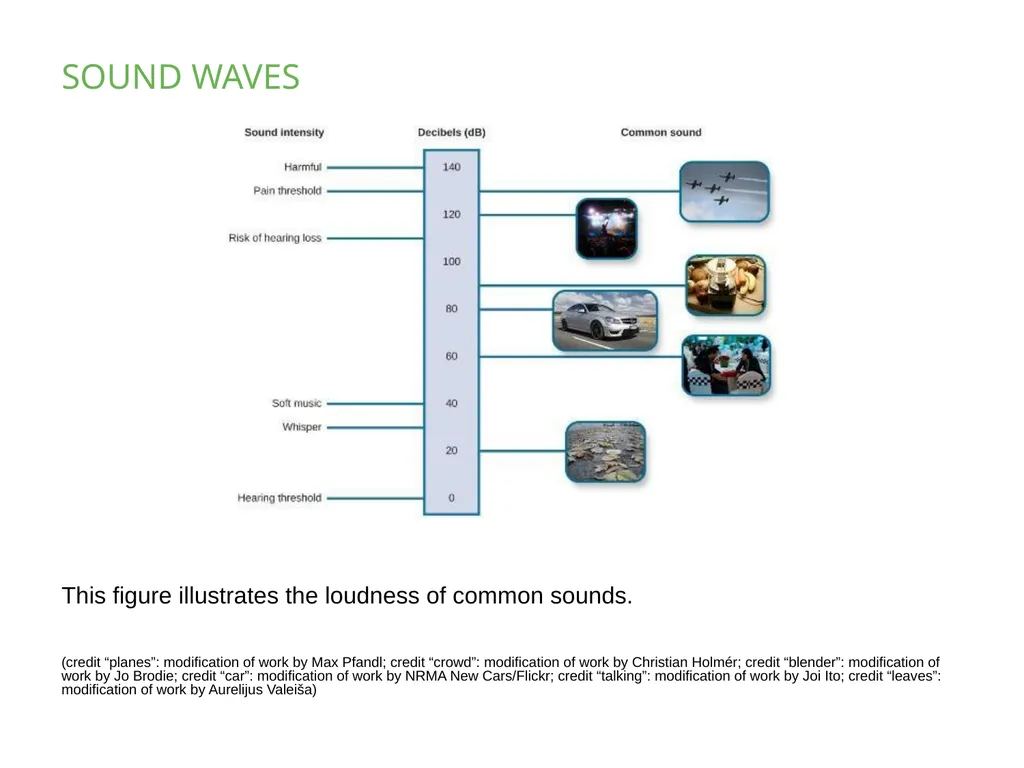
Typical conversation = 60 dB
Rock concert = 120 dB
Potential for hearing damage = 80 – 130 dB
The threshold for pain = 130 dB<br>
Frequency of soundwaves = pitch
High frequency = high-pitched sound
Low frequency = low-pitched sound
The audible range of sound frequencies in humans is between 20 – 2000Hz
Amplitude and Decibels
Amplitude of soundwaves = loudness
Higher amplitude = louder sounds
Lower amplitude = quieter sounds
Loudness is measured in decibels (dB).
Typical conversation = 60 dB
Rock concert = 120 dB
Potential for hearing damage = 80 – 130 dB
The threshold for pain = 130 dB<br>
15
SOUND WAVES This figure illustrates the loudness of common sounds.
(credit “planes”: modification of work by Max Pfandl; credit “crowd”: modification of work by Christian Holmér; credit “blender”: modification of work by Jo Brodie; credit “car”: modification of work by NRMA New Cars/Flickr; credit “talking”: modification of work by Joi Ito; credit “leaves”: modification of work by Aurelijus Valeiša)<br>
(credit “planes”: modification of work by Max Pfandl; credit “crowd”: modification of work by Christian Holmér; credit “blender”: modification of work by Jo Brodie; credit “car”: modification of work by NRMA New Cars/Flickr; credit “talking”: modification of work by Joi Ito; credit “leaves”: modification of work by Aurelijus Valeiša)<br>
16
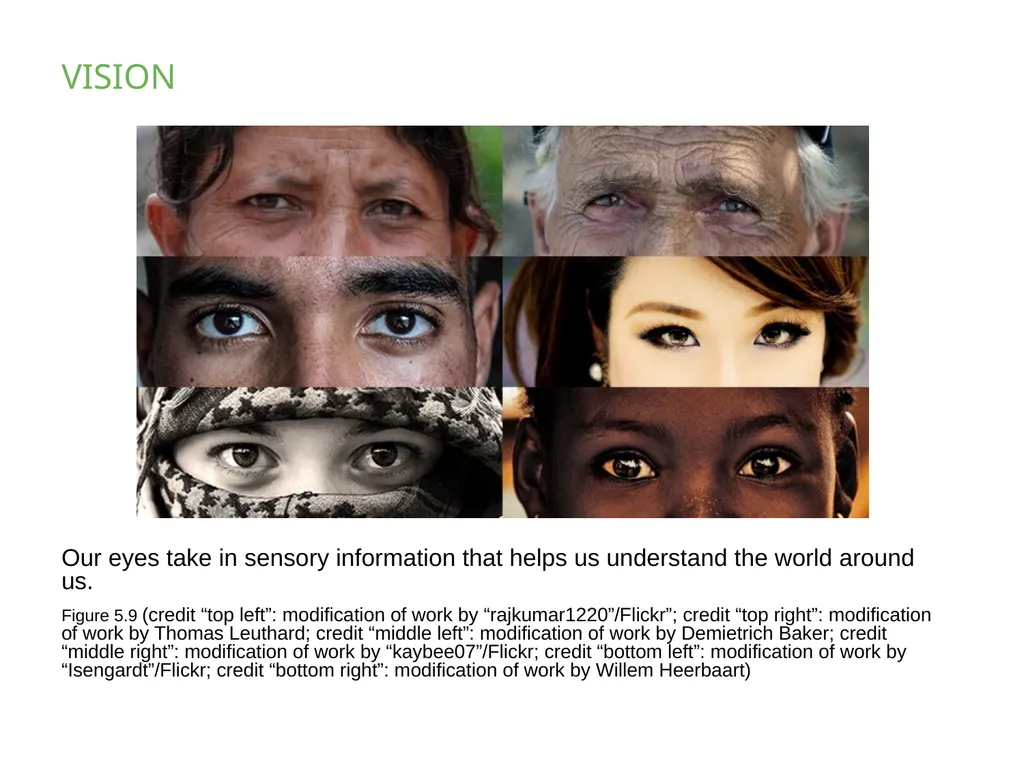
VISION Our eyes take in sensory information that helps us understand the world around us.
Figure 5.9 (credit “top left”: modification of work by “rajkumar1220”/Flickr”; credit “top right”: modification of work by Thomas Leuthard; credit “middle left”: modification of work by Demietrich Baker; credit “middle right”: modification of work by “kaybee07”/Flickr; credit “bottom left”: modification of work by “Isengardt”/Flickr; credit “bottom right”: modification of work by Willem Heerbaart)<br>
Figure 5.9 (credit “top left”: modification of work by “rajkumar1220”/Flickr”; credit “top right”: modification of work by Thomas Leuthard; credit “middle left”: modification of work by Demietrich Baker; credit “middle right”: modification of work by “kaybee07”/Flickr; credit “bottom left”: modification of work by “Isengardt”/Flickr; credit “bottom right”: modification of work by Willem Heerbaart)<br>
17
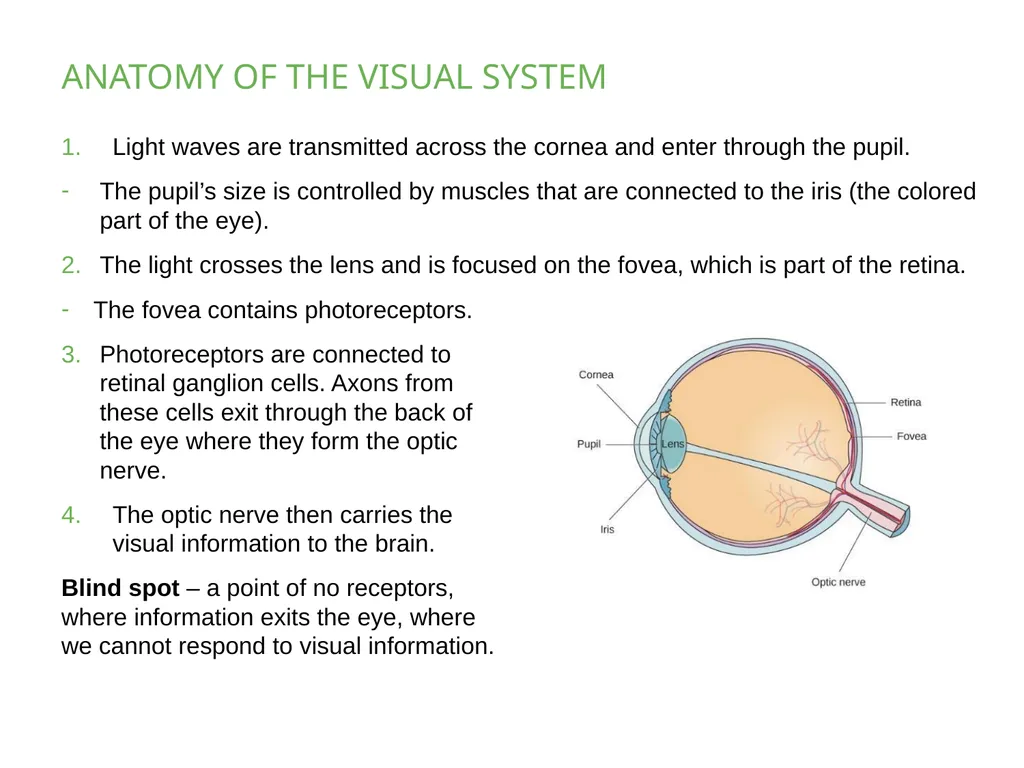
ANATOMY OF THE VISUAL SYSTEM The fovea contains photoreceptors.
Photoreceptors are connected to retinal ganglion cells. Axons from these cells exit through the back of the eye where they form the optic nerve.
The optic nerve then carries the visual information to the brain.
Blind spot – a point of no receptors, where information exits the eye, where we cannot respond to visual information. Light waves are transmitted across the cornea and enter through the pupil.
The pupil’s size is controlled by muscles that are connected to the iris (the colored part of the eye).
The light crosses the lens and is focused on the fovea, which is part of the retina.<br>
Photoreceptors are connected to retinal ganglion cells. Axons from these cells exit through the back of the eye where they form the optic nerve.
The optic nerve then carries the visual information to the brain.
Blind spot – a point of no receptors, where information exits the eye, where we cannot respond to visual information. Light waves are transmitted across the cornea and enter through the pupil.
The pupil’s size is controlled by muscles that are connected to the iris (the colored part of the eye).
The light crosses the lens and is focused on the fovea, which is part of the retina.<br>
18
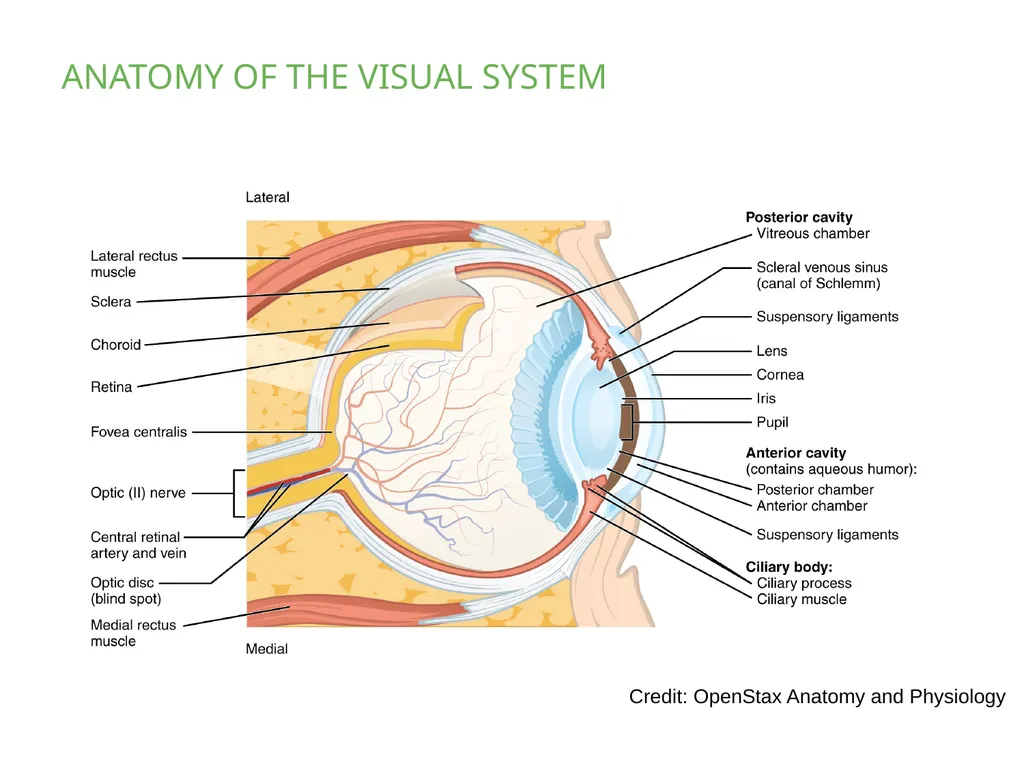
ANATOMY OF THE VISUAL SYSTEM Credit: OpenStax Anatomy and Physiology<br>
19
PHOTORECEPTORS Cones
Phototopic (daytime) vision.
Work best in bright light conditions.
High-acuity color information.
Located in the fovea.
Rods
Scotopic (nighttime) vision.
Work best in low light conditions.
High-sensitivity.
Allows for low-acuity vision in dim light.
Involved in the perception of movement in our peripheral vision.
Located in the periphery of the retina.<br>
Phototopic (daytime) vision.
Work best in bright light conditions.
High-acuity color information.
Located in the fovea.
Rods
Scotopic (nighttime) vision.
Work best in low light conditions.
High-sensitivity.
Allows for low-acuity vision in dim light.
Involved in the perception of movement in our peripheral vision.
Located in the periphery of the retina.<br>
20
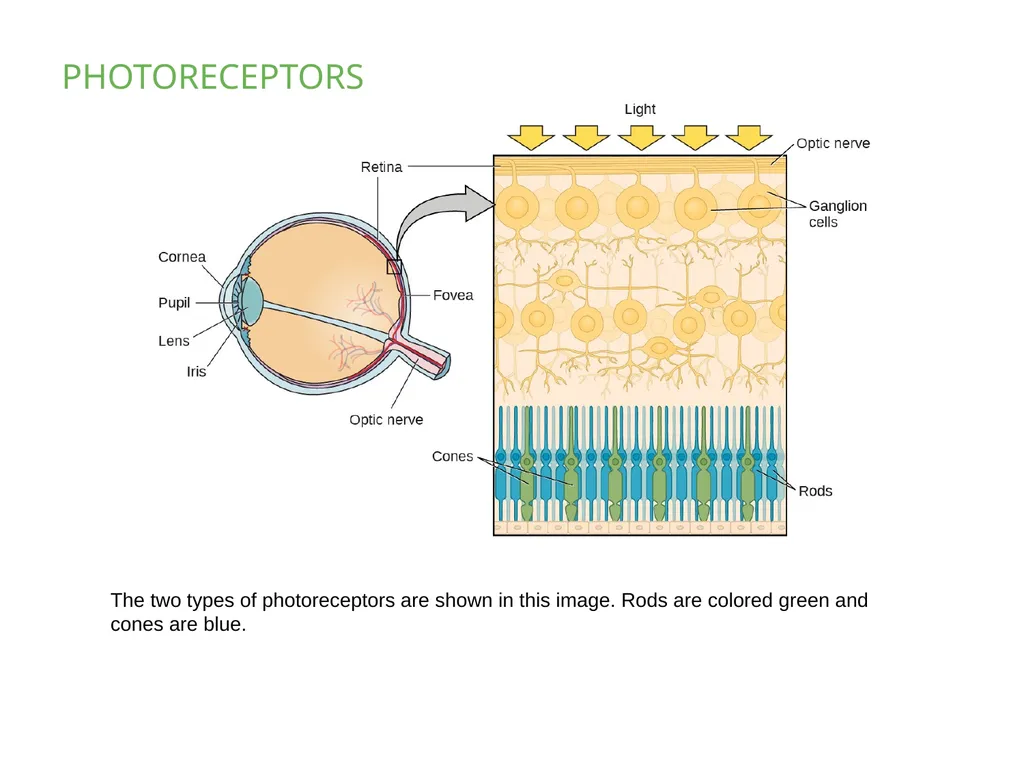
PHOTORECEPTORS The two types of photoreceptors are shown in this image. Rods are colored green and cones are blue.<br>
21
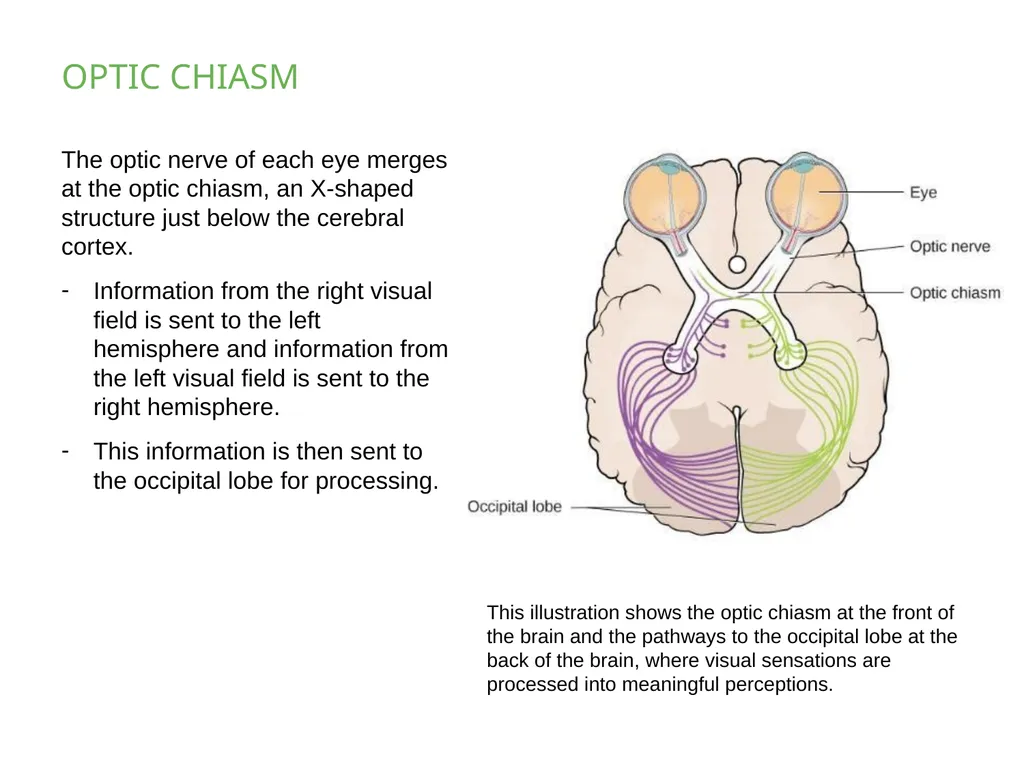
OPTIC CHIASM This illustration shows the optic chiasm at the front of the brain and the pathways to the occipital lobe at the back of the brain, where visual sensations are processed into meaningful perceptions. The optic nerve of each eye merges at the optic chiasm, an X-shaped structure just below the cerebral cortex.
Information from the right visual field is sent to the left hemisphere and information from the left visual field is sent to the right hemisphere.
This information is then sent to the occipital lobe for processing.<br>
Information from the right visual field is sent to the left hemisphere and information from the left visual field is sent to the right hemisphere.
This information is then sent to the occipital lobe for processing.<br>
22
VISUAL PATHWAYS After being processed in the occipital lobe, visual information exits and goes through two different pathways.
The “WHAT” pathway:
Object recognition.
Object identification. The “WHERE/HOW” pathway:
Location in space.
How one might interact with a particular visual stimulus.<br>
The “WHAT” pathway:
Object recognition.
Object identification. The “WHERE/HOW” pathway:
Location in space.
How one might interact with a particular visual stimulus.<br>
23
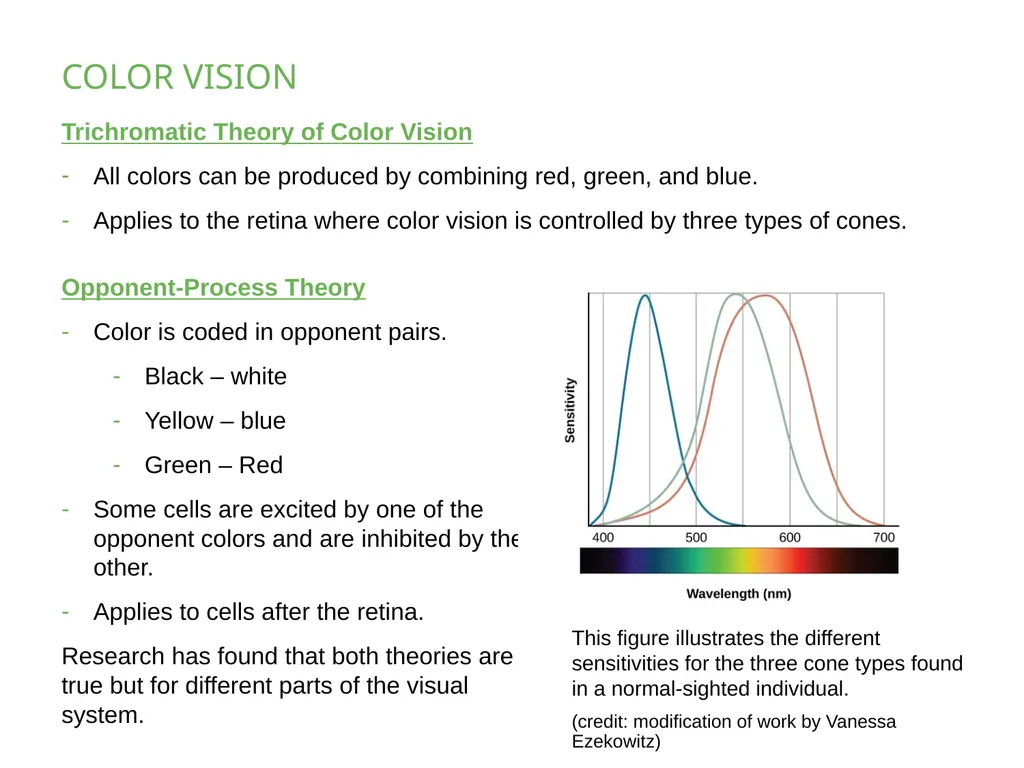
COLOR VISION This figure illustrates the different sensitivities for the three cone types found in a normal-sighted individual.
(credit: modification of work by Vanessa Ezekowitz) Opponent-Process Theory
Color is coded in opponent pairs.
Black – white
Yellow – blue
Green – Red
Some cells are excited by one of the opponent colors and are inhibited by the other.
Applies to cells after the retina.
Research has found that both theories are true but for different parts of the visual system. Trichromatic Theory of Color Vision
All colors can be produced by combining red, green, and blue.
Applies to the retina where color vision is controlled by three types of cones.<br>
(credit: modification of work by Vanessa Ezekowitz) Opponent-Process Theory
Color is coded in opponent pairs.
Black – white
Yellow – blue
Green – Red
Some cells are excited by one of the opponent colors and are inhibited by the other.
Applies to cells after the retina.
Research has found that both theories are true but for different parts of the visual system. Trichromatic Theory of Color Vision
All colors can be produced by combining red, green, and blue.
Applies to the retina where color vision is controlled by three types of cones.<br>
24
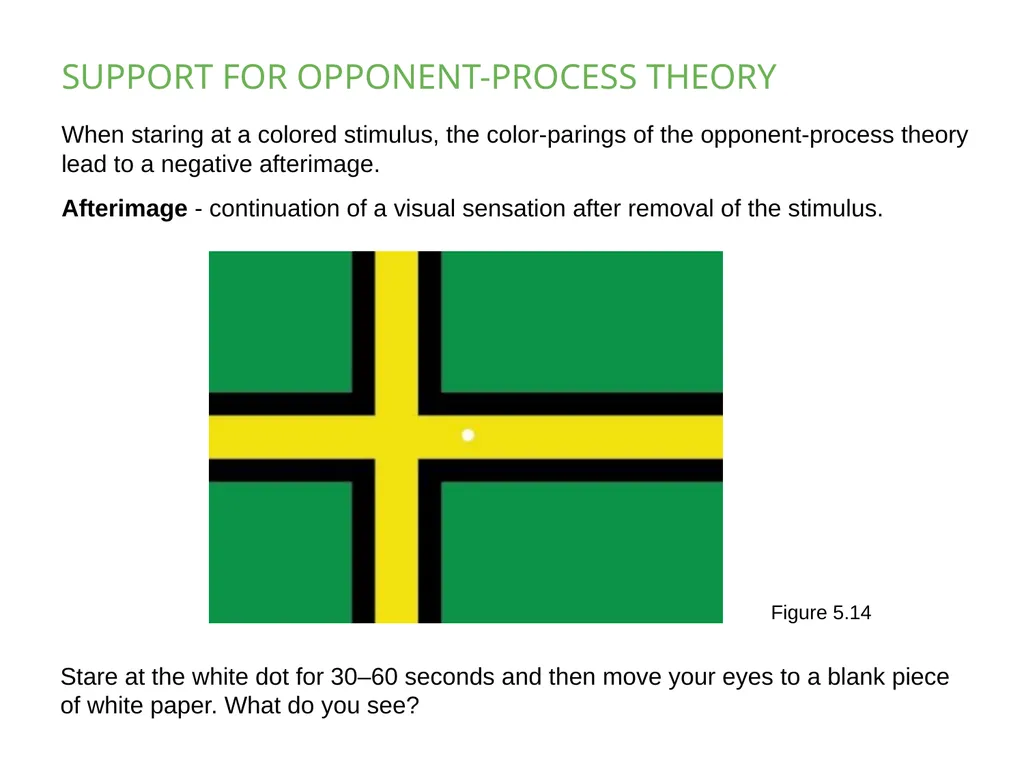
SUPPORT FOR OPPONENT-PROCESS THEORY Stare at the white dot for 30–60 seconds and then move your eyes to a blank piece of white paper. What do you see? Figure 5.14 When staring at a colored stimulus, the color-parings of the opponent-process theory lead to a negative afterimage.
Afterimage - continuation of a visual sensation after removal of the stimulus.<br>
Afterimage - continuation of a visual sensation after removal of the stimulus.<br>
25
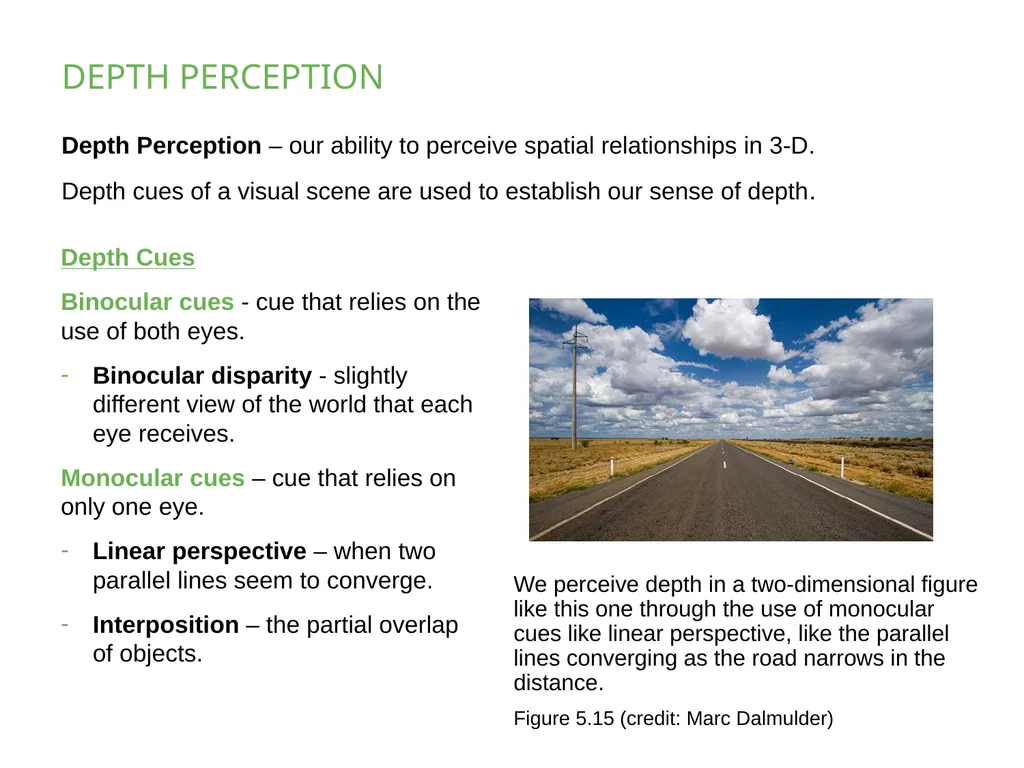
DEPTH PERCEPTION We perceive depth in a two-dimensional figure like this one through the use of monocular cues like linear perspective, like the parallel lines converging as the road narrows in the distance.
Figure 5.15 (credit: Marc Dalmulder) Depth Perception – our ability to perceive spatial relationships in 3-D.
Depth cues of a visual scene are used to establish our sense of depth. Depth Cues
Binocular cues - cue that relies on the use of both eyes.
Binocular disparity - slightly different view of the world that each eye receives.
Monocular cues – cue that relies on only one eye.
Linear perspective – when two parallel lines seem to converge.
Interposition – the partial overlap of objects.<br>
Figure 5.15 (credit: Marc Dalmulder) Depth Perception – our ability to perceive spatial relationships in 3-D.
Depth cues of a visual scene are used to establish our sense of depth. Depth Cues
Binocular cues - cue that relies on the use of both eyes.
Binocular disparity - slightly different view of the world that each eye receives.
Monocular cues – cue that relies on only one eye.
Linear perspective – when two parallel lines seem to converge.
Interposition – the partial overlap of objects.<br>
26
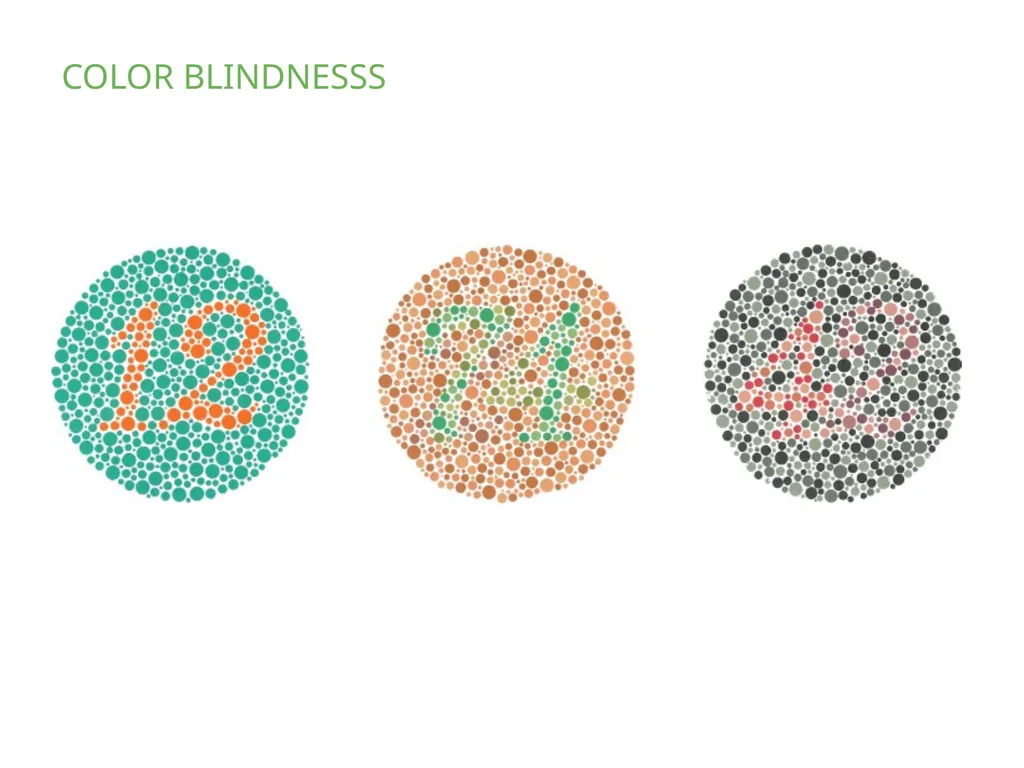
COLOR BLINDNESSS<br>
27
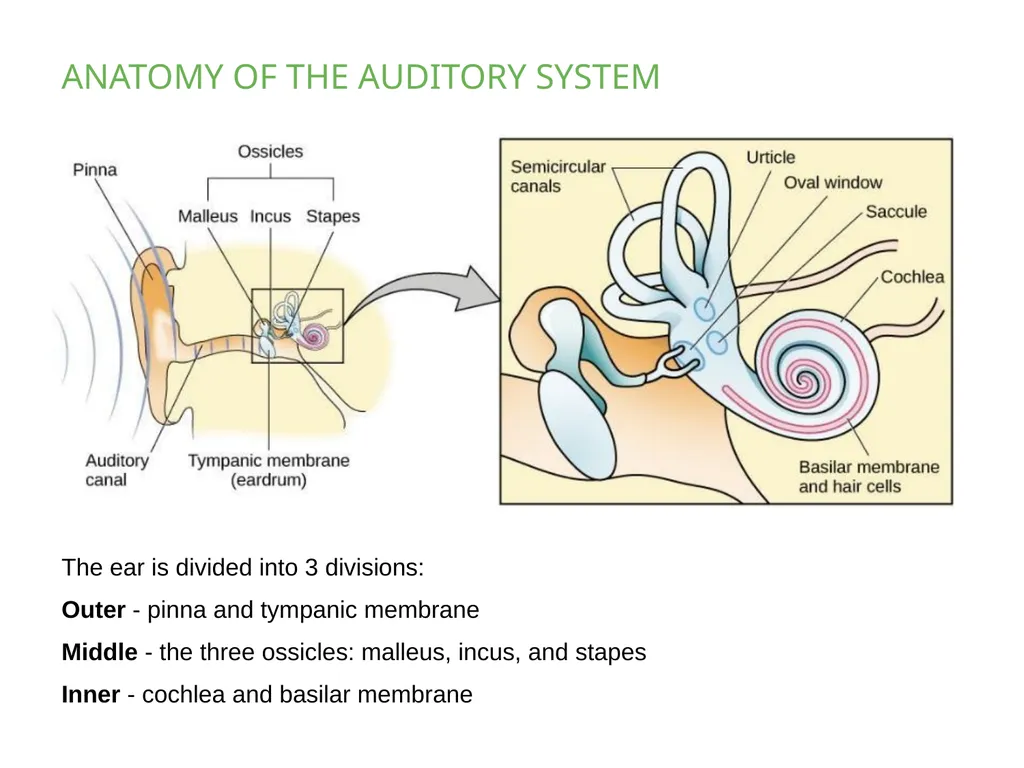
ANATOMY OF THE AUDITORY SYSTEM The ear is divided into 3 divisions:
Outer - pinna and tympanic membrane
Middle - the three ossicles: malleus, incus, and stapes
Inner - cochlea and basilar membrane<br>
Outer - pinna and tympanic membrane
Middle - the three ossicles: malleus, incus, and stapes
Inner - cochlea and basilar membrane<br>
28
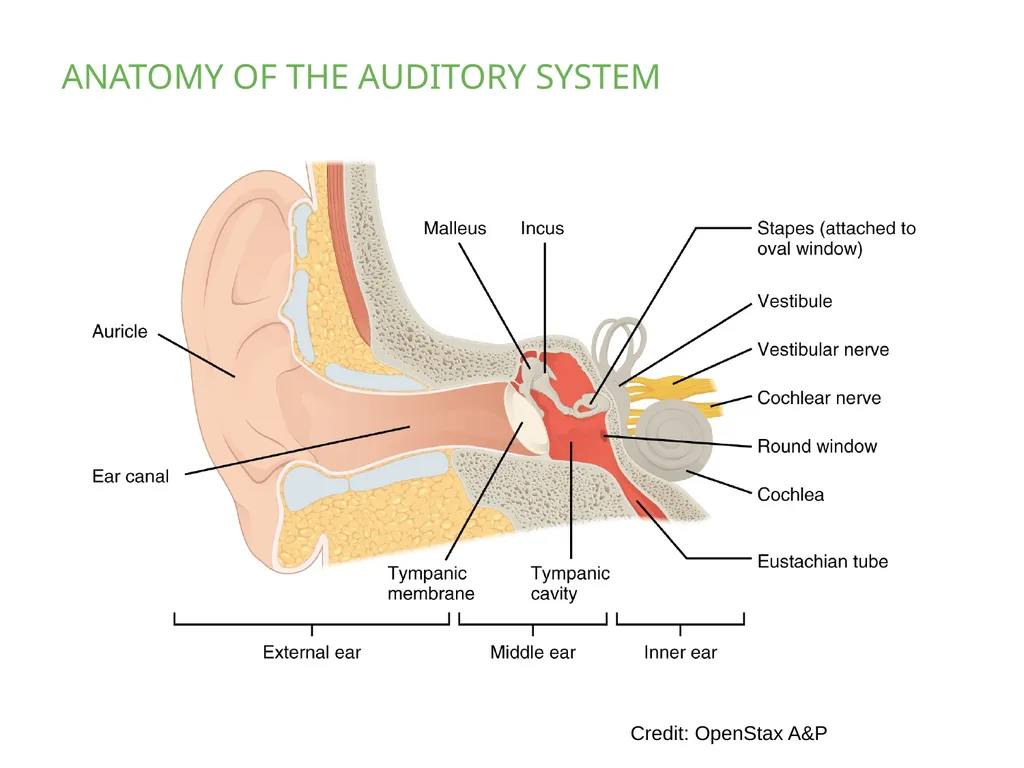
ANATOMY OF THE AUDITORY SYSTEM Credit: OpenStax A&P<br>
29
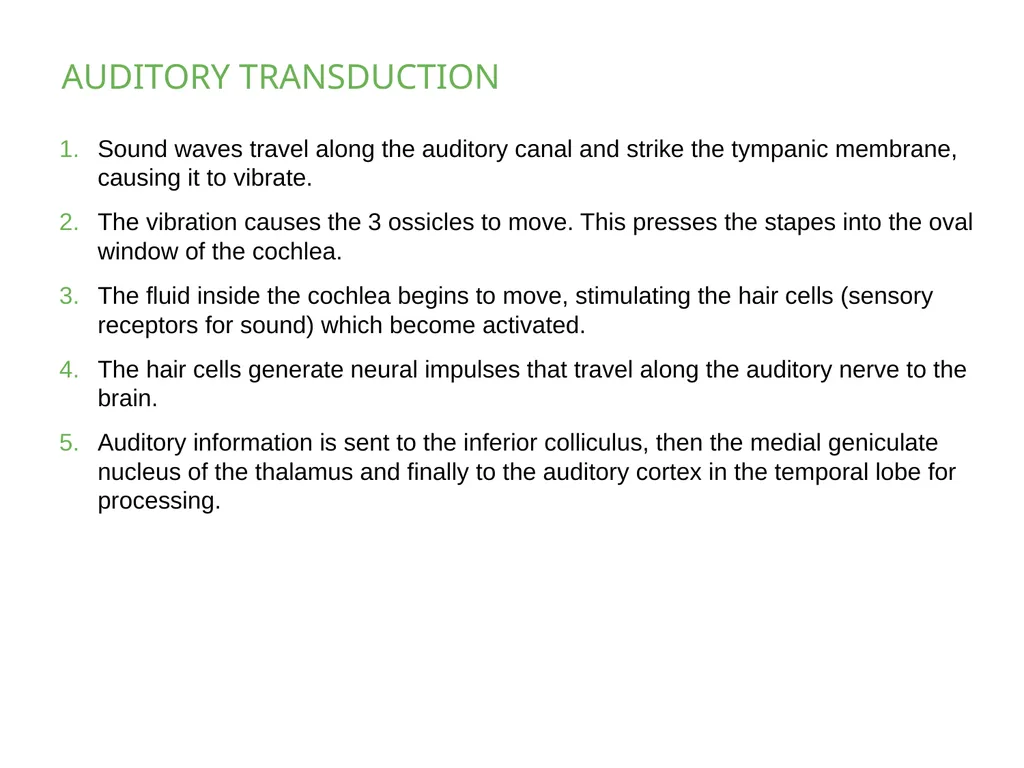
AUDITORY TRANSDUCTION Sound waves travel along the auditory canal and strike the tympanic membrane, causing it to vibrate.
The vibration causes the 3 ossicles to move. This presses the stapes into the oval window of the cochlea.
The fluid inside the cochlea begins to move, stimulating the hair cells (sensory receptors for sound) which become activated.
The hair cells generate neural impulses that travel along the auditory nerve to the brain.
Auditory information is sent to the inferior colliculus, then the medial geniculate nucleus of the thalamus and finally to the auditory cortex in the temporal lobe for processing.<br>
The vibration causes the 3 ossicles to move. This presses the stapes into the oval window of the cochlea.
The fluid inside the cochlea begins to move, stimulating the hair cells (sensory receptors for sound) which become activated.
The hair cells generate neural impulses that travel along the auditory nerve to the brain.
Auditory information is sent to the inferior colliculus, then the medial geniculate nucleus of the thalamus and finally to the auditory cortex in the temporal lobe for processing.<br>
30
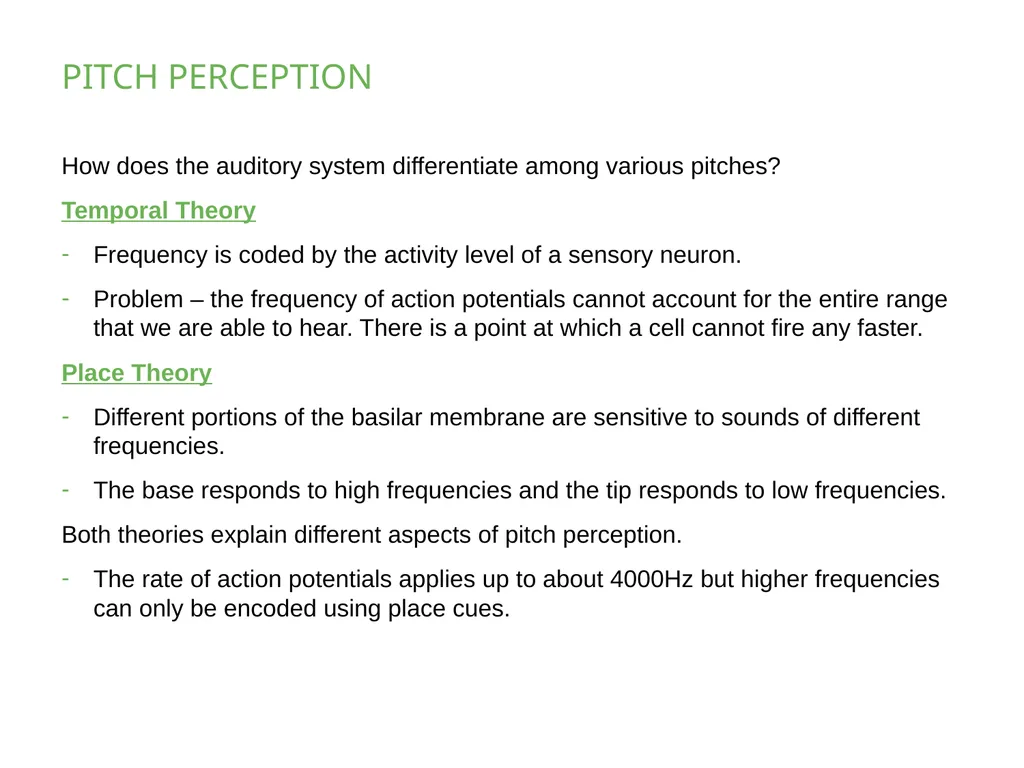
PITCH PERCEPTION How does the auditory system differentiate among various pitches?
Temporal Theory
Frequency is coded by the activity level of a sensory neuron.
Problem – the frequency of action potentials cannot account for the entire range that we are able to hear. There is a point at which a cell cannot fire any faster.
Place Theory
Different portions of the basilar membrane are sensitive to sounds of different frequencies.
The base responds to high frequencies and the tip responds to low frequencies.
Both theories explain different aspects of pitch perception.
The rate of action potentials applies up to about 4000Hz but higher frequencies can only be encoded using place cues.<br>
Temporal Theory
Frequency is coded by the activity level of a sensory neuron.
Problem – the frequency of action potentials cannot account for the entire range that we are able to hear. There is a point at which a cell cannot fire any faster.
Place Theory
Different portions of the basilar membrane are sensitive to sounds of different frequencies.
The base responds to high frequencies and the tip responds to low frequencies.
Both theories explain different aspects of pitch perception.
The rate of action potentials applies up to about 4000Hz but higher frequencies can only be encoded using place cues.<br>
31
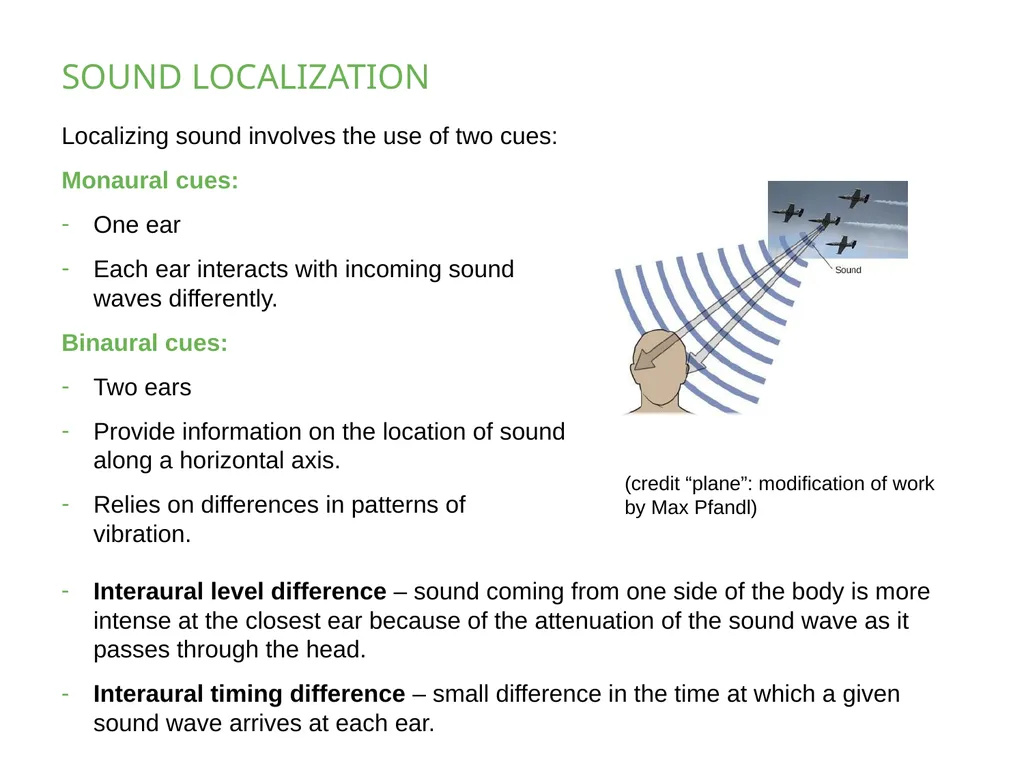
SOUND LOCALIZATION (credit “plane”: modification of work by Max Pfandl) Localizing sound involves the use of two cues:
Monaural cues:
One ear
Each ear interacts with incoming sound waves differently.
Binaural cues:
Two ears
Provide information on the location of sound along a horizontal axis.
Relies on differences in patterns of vibration. Interaural level difference – sound coming from one side of the body is more intense at the closest ear because of the attenuation of the sound wave as it passes through the head.
Interaural timing difference – small difference in the time at which a given sound wave arrives at each ear.<br>
Monaural cues:
One ear
Each ear interacts with incoming sound waves differently.
Binaural cues:
Two ears
Provide information on the location of sound along a horizontal axis.
Relies on differences in patterns of vibration. Interaural level difference – sound coming from one side of the body is more intense at the closest ear because of the attenuation of the sound wave as it passes through the head.
Interaural timing difference – small difference in the time at which a given sound wave arrives at each ear.<br>
32
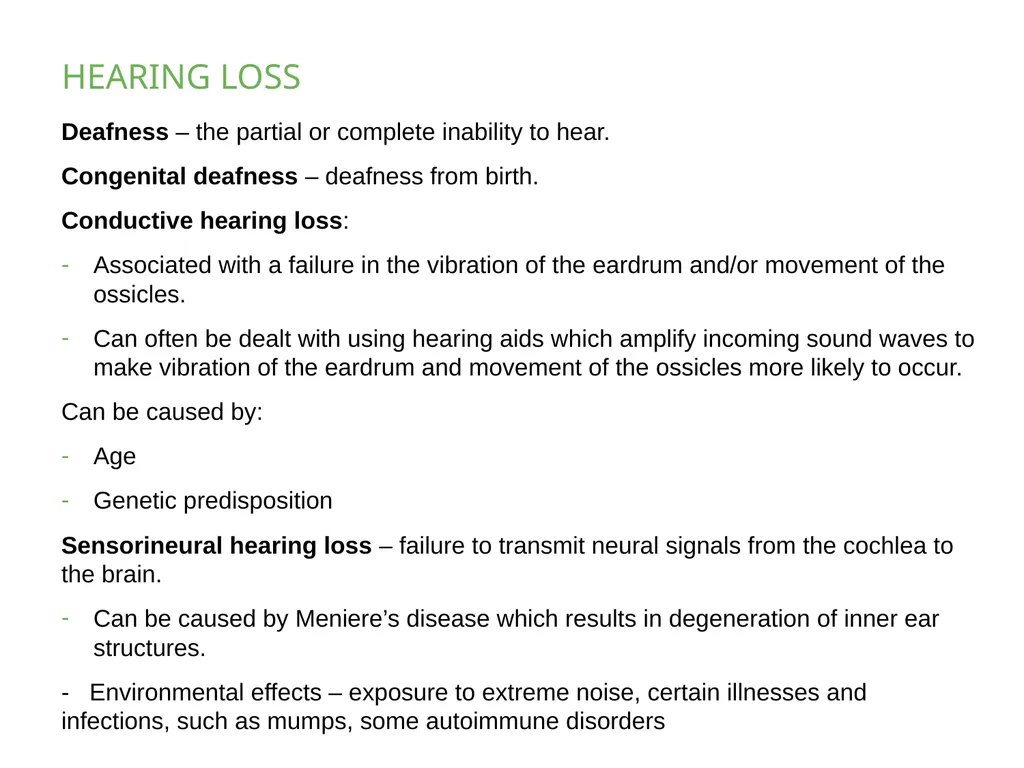
HEARING LOSS Deafness – the partial or complete inability to hear.
Congenital deafness – deafness from birth.
Conductive hearing loss:
Associated with a failure in the vibration of the eardrum and/or movement of the ossicles.
Can often be dealt with using hearing aids which amplify incoming sound waves to make vibration of the eardrum and movement of the ossicles more likely to occur.
Can be caused by:
Age
Genetic predisposition
Sensorineural hearing loss – failure to transmit neural signals from the cochlea to the brain.
Can be caused by Meniere’s disease which results in degeneration of inner ear structures.
- Environmental effects – exposure to extreme noise, certain illnesses and infections, such as mumps, some autoimmune disorders<br>
Congenital deafness – deafness from birth.
Conductive hearing loss:
Associated with a failure in the vibration of the eardrum and/or movement of the ossicles.
Can often be dealt with using hearing aids which amplify incoming sound waves to make vibration of the eardrum and movement of the ossicles more likely to occur.
Can be caused by:
Age
Genetic predisposition
Sensorineural hearing loss – failure to transmit neural signals from the cochlea to the brain.
Can be caused by Meniere’s disease which results in degeneration of inner ear structures.
- Environmental effects – exposure to extreme noise, certain illnesses and infections, such as mumps, some autoimmune disorders<br>
33
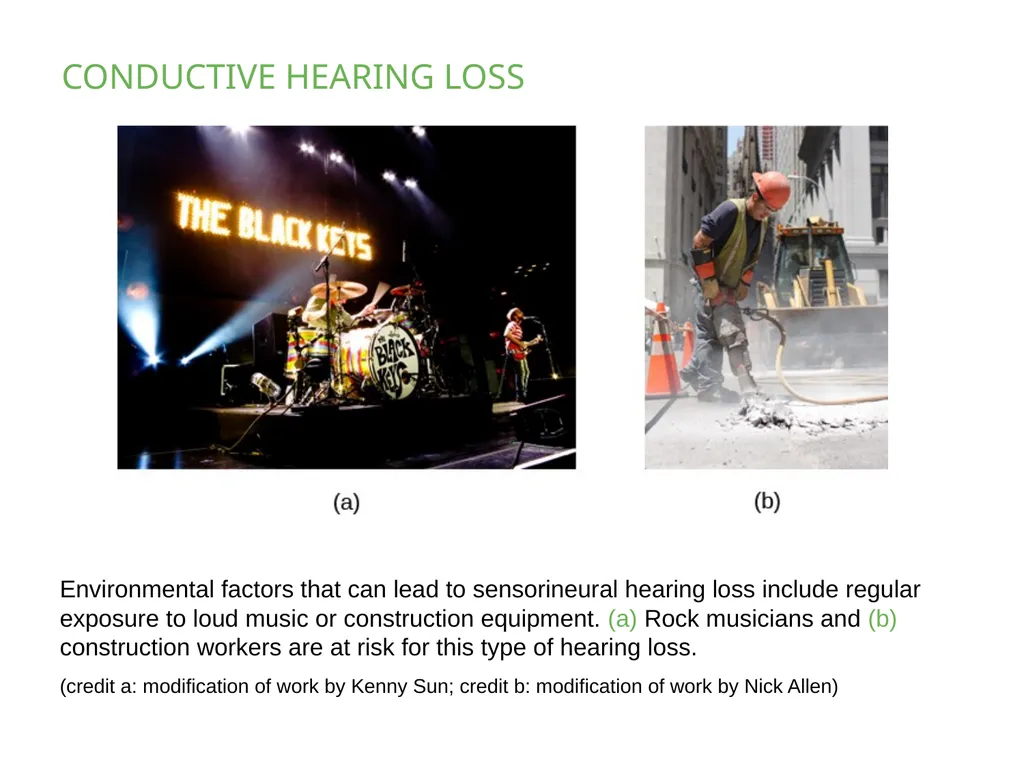
CONDUCTIVE HEARING LOSS Environmental factors that can lead to sensorineural hearing loss include regular exposure to loud music or construction equipment. (a) Rock musicians and (b) construction workers are at risk for this type of hearing loss.
(credit a: modification of work by Kenny Sun; credit b: modification of work by Nick Allen)<br>
(credit a: modification of work by Kenny Sun; credit b: modification of work by Nick Allen)<br>
34
TASTE (GUSTATION) Research demonstrates that we have about 6 groupings of taste:
Sweet
Salty
Sour
Bitter
Umami – associated with a taste for monosodium glutamate.
Some research suggests we possess a taste for the fatty content of food.
Taste buds - groupings of taste receptor cells with hair-like extensions that protrude into the central pore of the taste bud.
Have a life cycle of 10 days to 2 weeks.
Transduction:
Taste molecules bind to receptors and cause chemical changes within the sensory cell.
These changes result in neural impulses being sent to the brain.<br>
Sweet
Salty
Sour
Bitter
Umami – associated with a taste for monosodium glutamate.
Some research suggests we possess a taste for the fatty content of food.
Taste buds - groupings of taste receptor cells with hair-like extensions that protrude into the central pore of the taste bud.
Have a life cycle of 10 days to 2 weeks.
Transduction:
Taste molecules bind to receptors and cause chemical changes within the sensory cell.
These changes result in neural impulses being sent to the brain.<br>
35
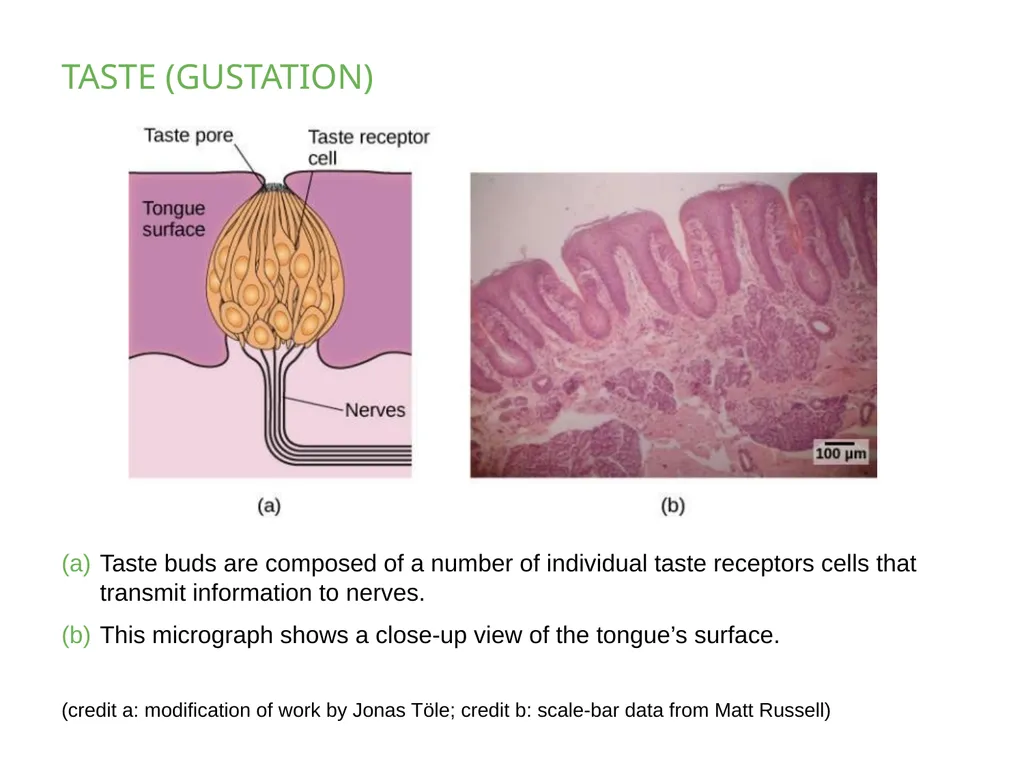
TASTE (GUSTATION) Taste buds are composed of a number of individual taste receptors cells that transmit information to nerves.
This micrograph shows a close-up view of the tongue’s surface.
(credit a: modification of work by Jonas Töle; credit b: scale-bar data from Matt Russell)<br>
This micrograph shows a close-up view of the tongue’s surface.
(credit a: modification of work by Jonas Töle; credit b: scale-bar data from Matt Russell)<br>
36
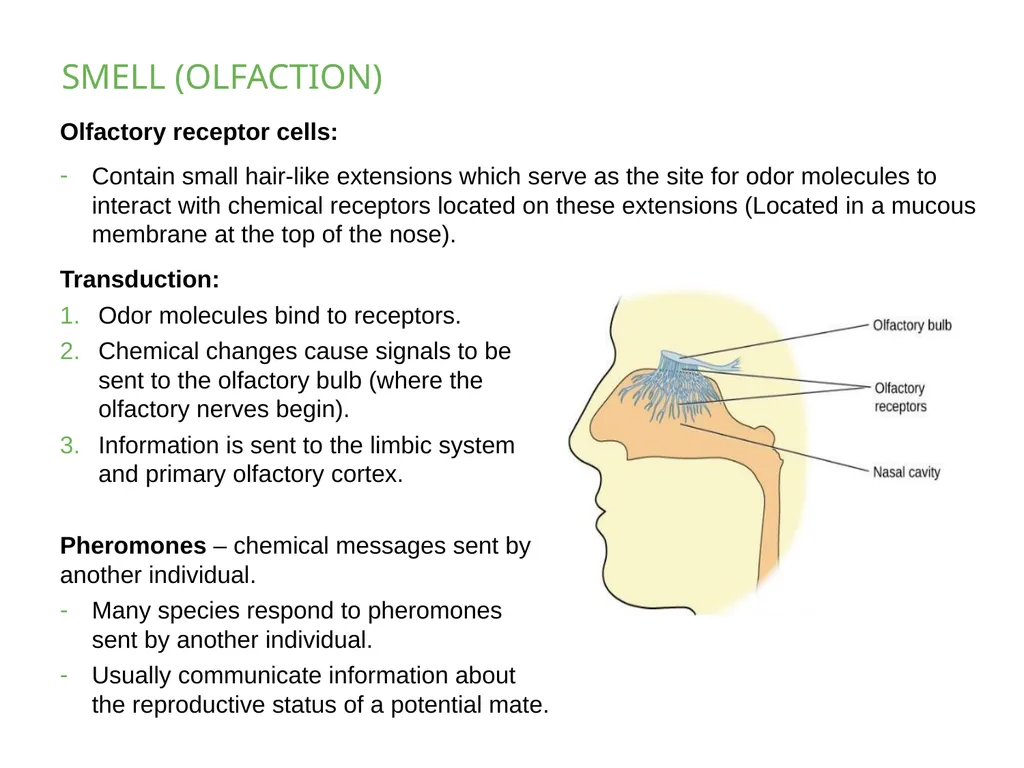
SMELL (OLFACTION) Transduction:
Odor molecules bind to receptors.
Chemical changes cause signals to be sent to the olfactory bulb (where the olfactory nerves begin).
Information is sent to the limbic system and primary olfactory cortex.
Pheromones – chemical messages sent by another individual.
Many species respond to pheromones sent by another individual.
Usually communicate information about the reproductive status of a potential mate. Olfactory receptor cells:
Contain small hair-like extensions which serve as the site for odor molecules to interact with chemical receptors located on these extensions (Located in a mucous membrane at the top of the nose).<br>
Odor molecules bind to receptors.
Chemical changes cause signals to be sent to the olfactory bulb (where the olfactory nerves begin).
Information is sent to the limbic system and primary olfactory cortex.
Pheromones – chemical messages sent by another individual.
Many species respond to pheromones sent by another individual.
Usually communicate information about the reproductive status of a potential mate. Olfactory receptor cells:
Contain small hair-like extensions which serve as the site for odor molecules to interact with chemical receptors located on these extensions (Located in a mucous membrane at the top of the nose).<br>
37
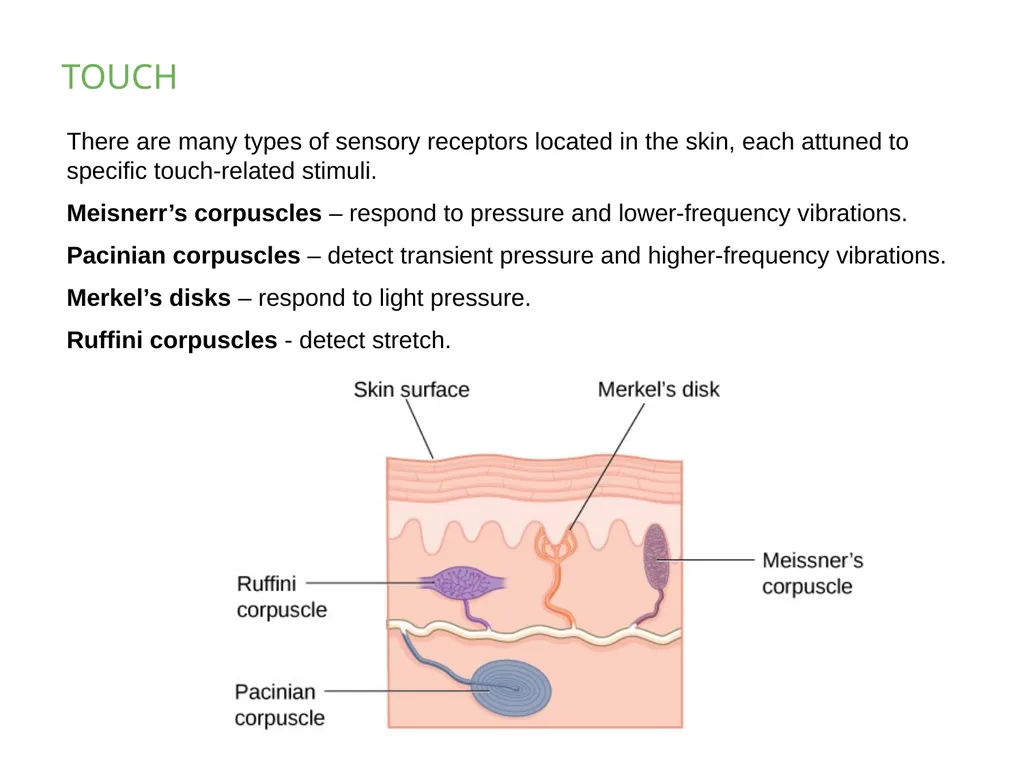
TOUCH There are many types of sensory receptors located in the skin, each attuned to specific touch-related stimuli.
Meisnerr’s corpuscles – respond to pressure and lower-frequency vibrations.
Pacinian corpuscles – detect transient pressure and higher-frequency vibrations.
Merkel’s disks – respond to light pressure.
Ruffini corpuscles - detect stretch.<br>
Meisnerr’s corpuscles – respond to pressure and lower-frequency vibrations.
Pacinian corpuscles – detect transient pressure and higher-frequency vibrations.
Merkel’s disks – respond to light pressure.
Ruffini corpuscles - detect stretch.<br>
38
THERMOCEPTION, & NOCICEPTION As well as receptors located in the skin, there are a number of free nerve endings that have sensory functions.
Thermoception – temperature perception.
Nociception – sensory signal indicating potential harm and maybe pain.
This type of sensory information travels up the spinal cord directly to the brain, specifically the medulla, thalamus and the somatosensory cortex.<br>
Thermoception – temperature perception.
Nociception – sensory signal indicating potential harm and maybe pain.
This type of sensory information travels up the spinal cord directly to the brain, specifically the medulla, thalamus and the somatosensory cortex.<br>
39
PAIN PERCEPTION Pain perception is important because it motivates us to remove ourselves from the cause of injury.
Inflammatory pain – signals some type of tissue damage.
Neuropathic pain – caused by damage to neurons of either the peripheral or central nervous system. Congenital insensitivity to pain - a rare genetic disorder in which the individual is born without the ability to feel pain.
Can detect differences in temperature and pressure but cannot experience pain.
Individuals are at greater risk of injury and have shorter life expectancies.<br>
Inflammatory pain – signals some type of tissue damage.
Neuropathic pain – caused by damage to neurons of either the peripheral or central nervous system. Congenital insensitivity to pain - a rare genetic disorder in which the individual is born without the ability to feel pain.
Can detect differences in temperature and pressure but cannot experience pain.
Individuals are at greater risk of injury and have shorter life expectancies.<br>
40
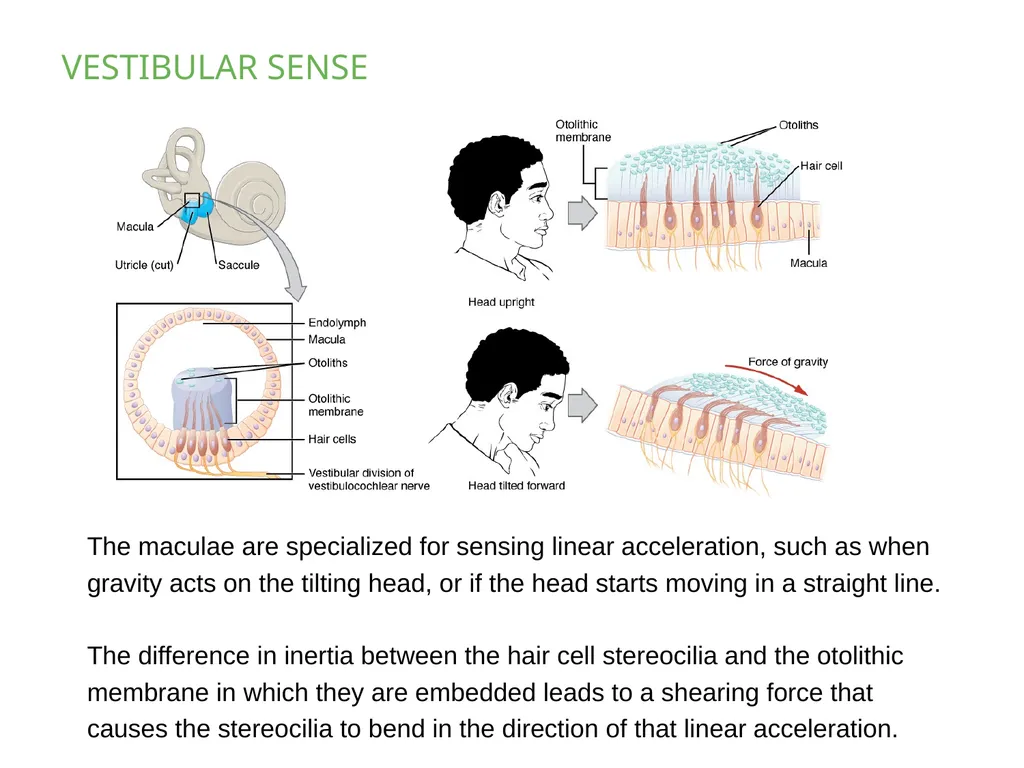
THE VESTIBULAR SENSE Vestibular sense – contributes to our ability to maintain balance and body posture.
The major sensory organs of the vestibular system are located next to the cochlea in the inner ear.
These organs are fluid-filled and contain hair cells which respond to movement of the head and gravitational forces.<br>
The major sensory organs of the vestibular system are located next to the cochlea in the inner ear.
These organs are fluid-filled and contain hair cells which respond to movement of the head and gravitational forces.<br>
41
VESTIBULAR SENSE The maculae are specialized for sensing linear acceleration, such as when
gravity acts on the tilting head, or if the head starts moving in a straight line.
The difference in inertia between the hair cell stereocilia and the otolithic
membrane in which they are embedded leads to a shearing force that
causes the stereocilia to bend in the direction of that linear acceleration.<br>
gravity acts on the tilting head, or if the head starts moving in a straight line.
The difference in inertia between the hair cell stereocilia and the otolithic
membrane in which they are embedded leads to a shearing force that
causes the stereocilia to bend in the direction of that linear acceleration.<br>
42
PROPRIOCEPTION AND KINESTHESIA The vestibular system also collects information important for controlling movement and reflexes that move parts of our bodies to compensate for changes in body position.
Both proprioception and kinesthesia interact with information provided by the vestibular system.
Proprioception - perception of body position.
Kinesthesia – perception of the body’s movement through space.
This information travels to the brain via the spinal column.
Information from the brain is then sent to the sensory organs of the proprioceptive and kinesthetic systems.<br>
Both proprioception and kinesthesia interact with information provided by the vestibular system.
Proprioception - perception of body position.
Kinesthesia – perception of the body’s movement through space.
This information travels to the brain via the spinal column.
Information from the brain is then sent to the sensory organs of the proprioceptive and kinesthetic systems.<br>
43
GESTALT PRINCIPLES OF PERCEPTION Gestalt psychology – field of psychology based on the idea that the whole is different from the sum of its parts.
The brain creates a perception that is more than simply the sum of available sensory inputs.
The brain does this in predictable ways which gestalt psychologists translated into principles by which we organize sensory information.
Principles include:
Figure– ground relationship
Proximity
Similarity
Continuity
Closure<br>
The brain creates a perception that is more than simply the sum of available sensory inputs.
The brain does this in predictable ways which gestalt psychologists translated into principles by which we organize sensory information.
Principles include:
Figure– ground relationship
Proximity
Similarity
Continuity
Closure<br>
44
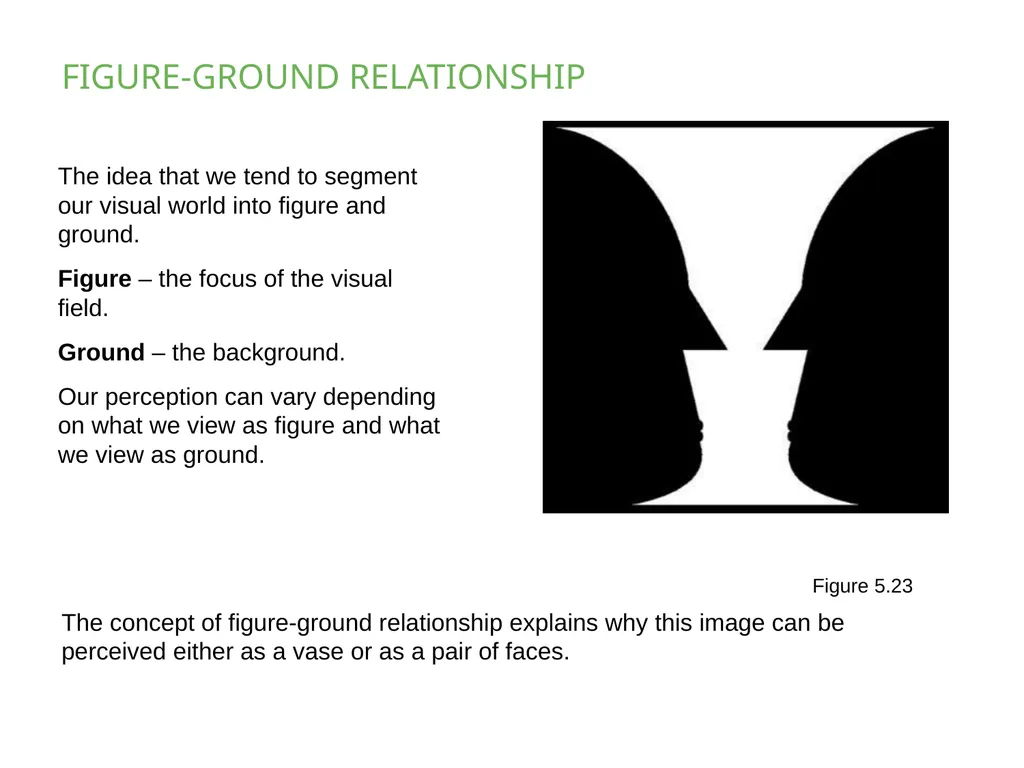
FIGURE-GROUND RELATIONSHIP The concept of figure-ground relationship explains why this image can be perceived either as a vase or as a pair of faces. Figure 5.23 The idea that we tend to segment our visual world into figure and ground.
Figure – the focus of the visual field.
Ground – the background.
Our perception can vary depending on what we view as figure and what we view as ground.<br>
Figure – the focus of the visual field.
Ground – the background.
Our perception can vary depending on what we view as figure and what we view as ground.<br>
45
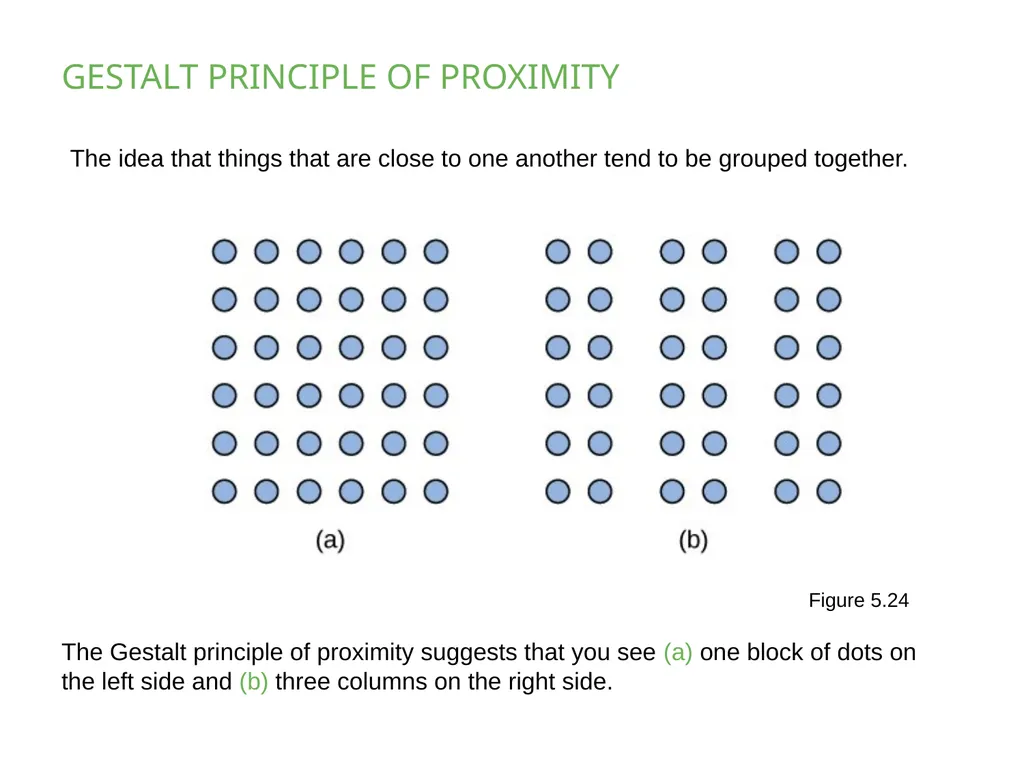
GESTALT PRINCIPLE OF PROXIMITY The Gestalt principle of proximity suggests that you see (a) one block of dots on the left side and (b) three columns on the right side. Figure 5.24 The idea that things that are close to one another tend to be grouped together.<br>
46
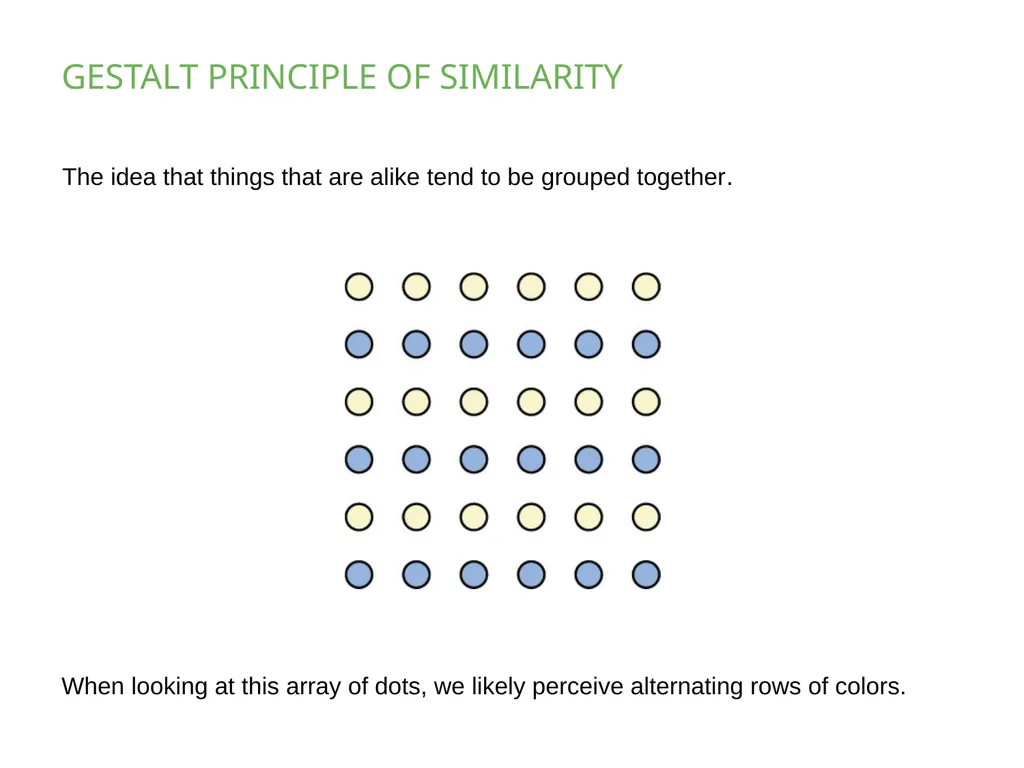
GESTALT PRINCIPLE OF SIMILARITY When looking at this array of dots, we likely perceive alternating rows of colors. The idea that things that are alike tend to be grouped together.<br>
47
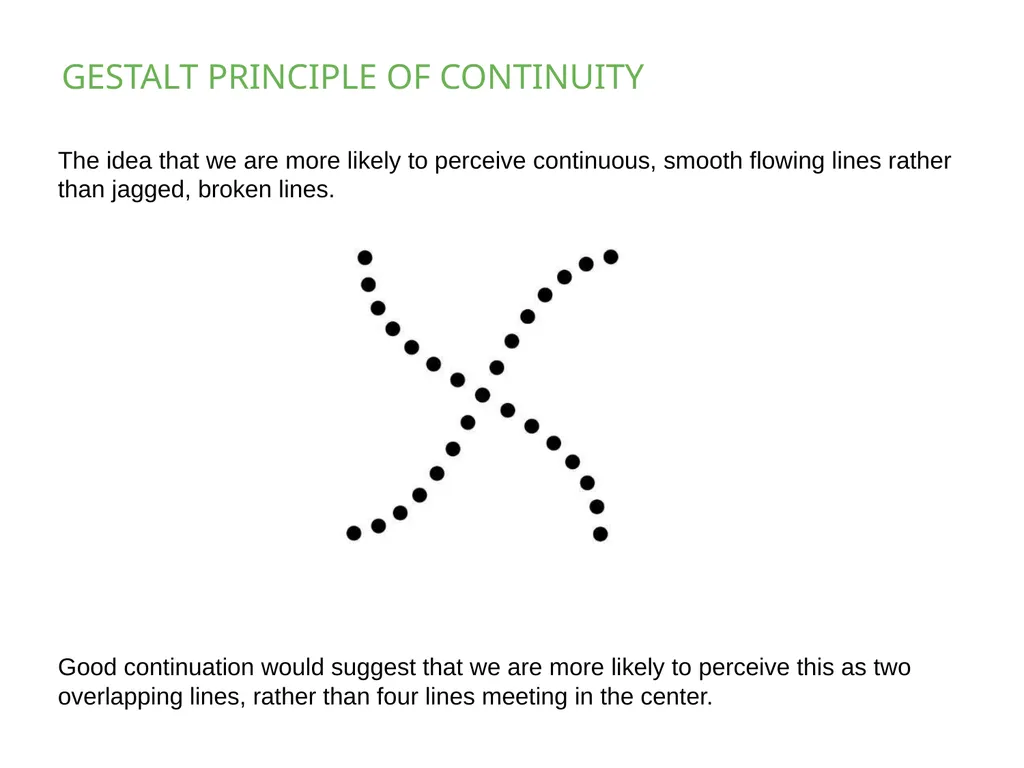
GESTALT PRINCIPLE OF CONTINUITY Good continuation would suggest that we are more likely to perceive this as two overlapping lines, rather than four lines meeting in the center. The idea that we are more likely to perceive continuous, smooth flowing lines rather than jagged, broken lines.<br>
48
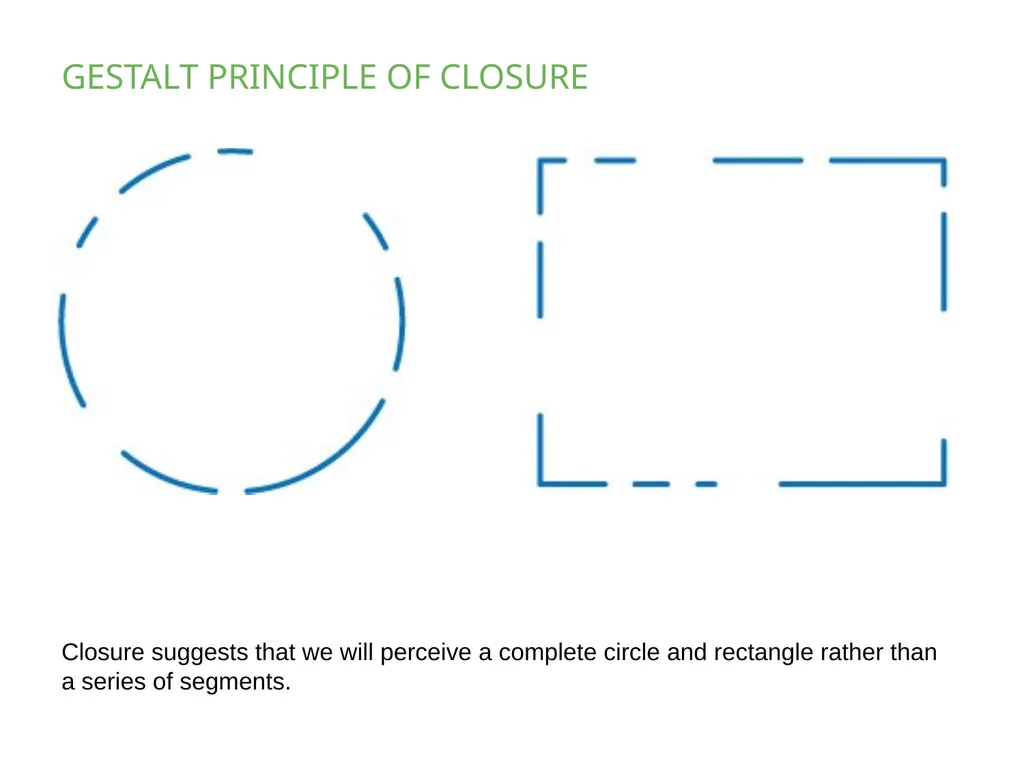
GESTALT PRINCIPLE OF CLOSURE Closure suggests that we will perceive a complete circle and rectangle rather than a series of segments. The idea that we organize our perceptions into complete objects rather than as a series of parts.<br>
49
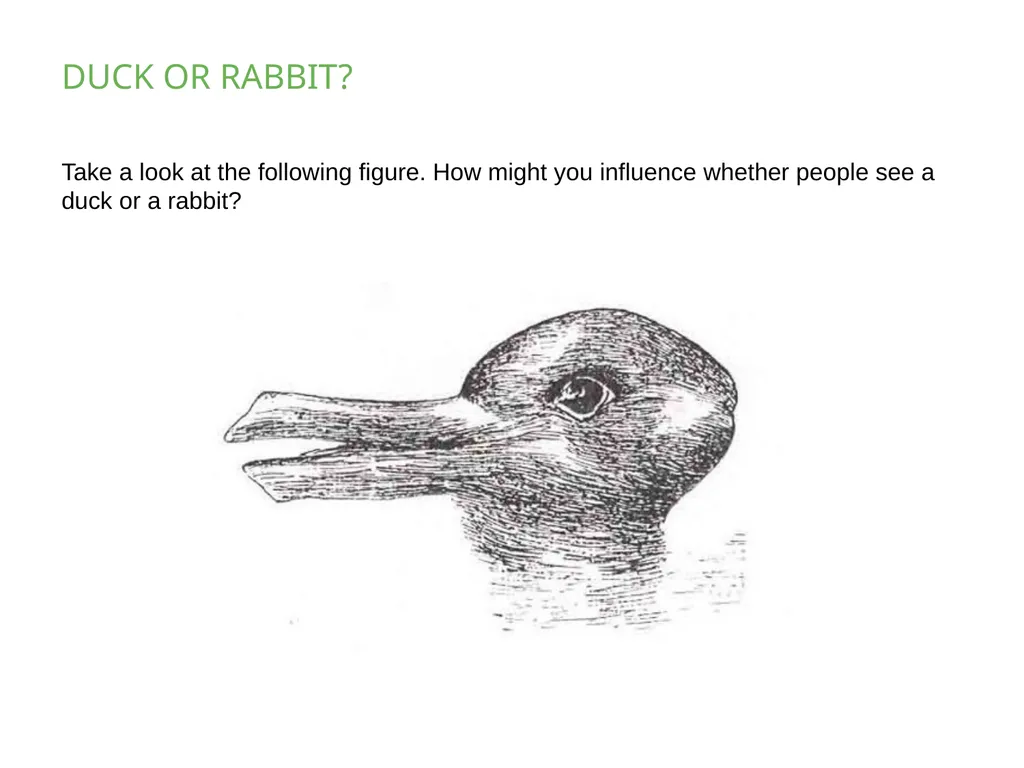
DUCK OR RABBIT? Take a look at the following figure. How might you influence whether people see a duck or a rabbit?<br>
50
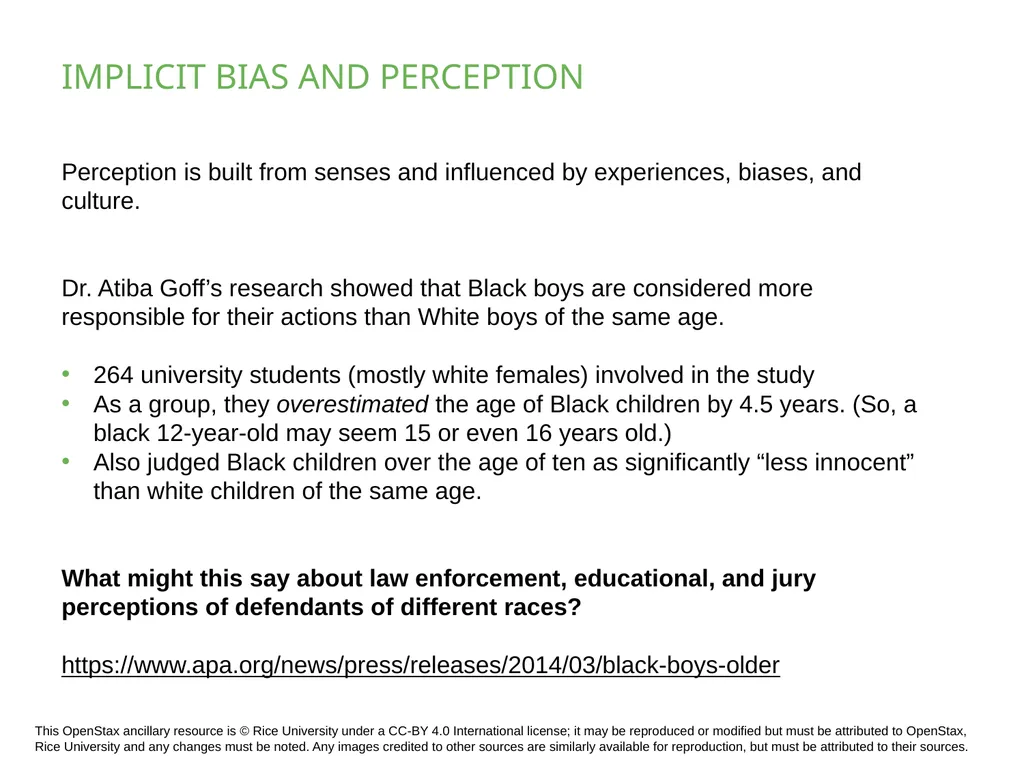
IMPLICIT BIAS AND PERCEPTION Perception is built from senses and influenced by experiences, biases, and culture.
Dr. Atiba Goff’s research showed that Black boys are considered more responsible for their actions than White boys of the same age.
264 university students (mostly white females) involved in the study
As a group, they overestimated the age of Black children by 4.5 years. (So, a black 12-year-old may seem 15 or even 16 years old.)
Also judged Black children over the age of ten as significantly “less innocent” than white children of the same age.
What might this say about law enforcement, educational, and jury perceptions of defendants of different races?
https://www.apa.org/news/press/releases/2014/03/black-boys-older This OpenStax ancillary resource is © Rice University under a CC-BY 4.0 International license; it may be reproduced or modified but must be attributed to OpenStax, Rice University and any changes must be noted. Any images credited to other sources are similarly available for reproduction, but must be attributed to their sources.<br>
Dr. Atiba Goff’s research showed that Black boys are considered more responsible for their actions than White boys of the same age.
264 university students (mostly white females) involved in the study
As a group, they overestimated the age of Black children by 4.5 years. (So, a black 12-year-old may seem 15 or even 16 years old.)
Also judged Black children over the age of ten as significantly “less innocent” than white children of the same age.
What might this say about law enforcement, educational, and jury perceptions of defendants of different races?
https://www.apa.org/news/press/releases/2014/03/black-boys-older This OpenStax ancillary resource is © Rice University under a CC-BY 4.0 International license; it may be reproduced or modified but must be attributed to OpenStax, Rice University and any changes must be noted. Any images credited to other sources are similarly available for reproduction, but must be attributed to their sources.<br>