PUBLIC PARTICIPATION MANDATE INDUCTION TO 7TH ADMINISTRATION MEMBERS 28 JUNE 2024 PRESENTATION OUTLINE 7TH LEGISLATURE MEMBERS ORIENTATION Introduction What is public participation Why public participation Public Participation approach in
Related Topics
Share
Embed code
Download this presentation From Below
"PUBLIC PARTICIPATION MANDATE INDUCTION TO 7TH" is the property of its rightful owner. Permission is granted to
download and print the materials on this website for personal, non-commercial use only, and to display it
on your personal computer provided you do not modify the materials and that you retain all copyright
notices contained in the materials. By downloading content from our website, you accept the terms of this
agreement.
Presentation Transcript
01
PUBLIC PARTICIPATION MANDATE INDUCTION TO 7TH ADMINISTRATION MEMBERS 28 JUNE 2024<br>
02
PRESENTATION OUTLINE 7TH LEGISLATURE MEMBERS’ ORIENTATION Introduction
What is public participation
Why public participation
Public Participation approach in the Sector
Levels of public participation
Public Participation Mechanism
Mobilisation process
Public Petitions Escalation Process
Key stakeholder
Conclusion 2<br>
03
INTRODUCTION 3 The Gauteng Provincial Legislature: In carrying-out is work, the Legislature ensures adherence to:
Constitution of the Republic of South Africa
Standing Rules of the Legislature, and;
All other relevant law of the Republic of South Africa<br>
04
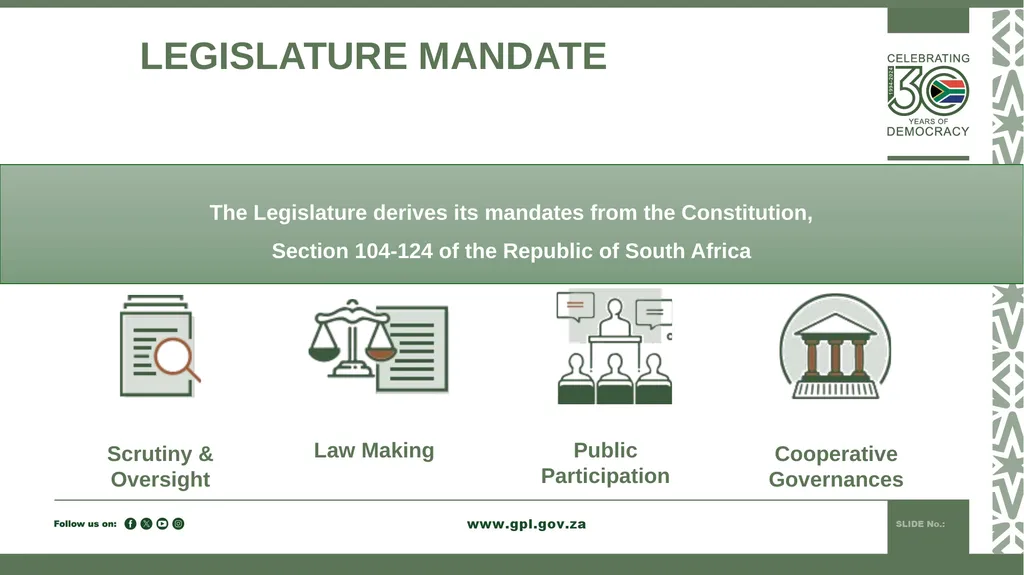
LEGISLATURE MANDATE The Legislature derives its mandates from the Constitution,
Section 104-124 of the Republic of South Africa Public Participation Scrutiny & Oversight Law Making Cooperative Governances<br>
05
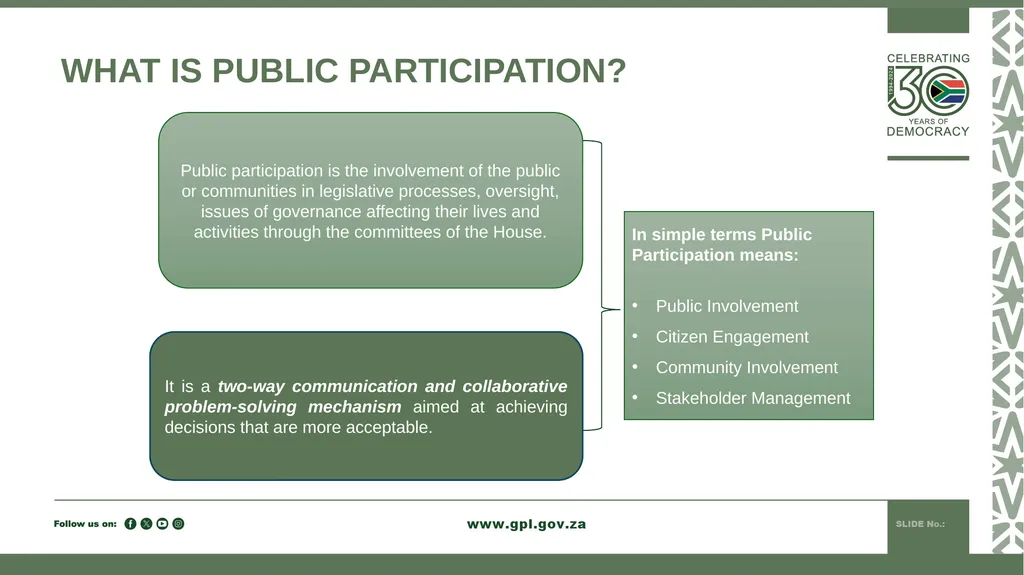
WHAT IS PUBLIC PARTICIPATION? Public participation is the involvement of the public or communities in legislative processes, oversight, issues of governance affecting their lives and activities through the committees of the House. It is a two-way communication and collaborative problem-solving mechanism aimed at achieving decisions that are more acceptable. In simple terms Public Participation means:
Public Involvement
Citizen Engagement
Community Involvement
Stakeholder Management<br>
06
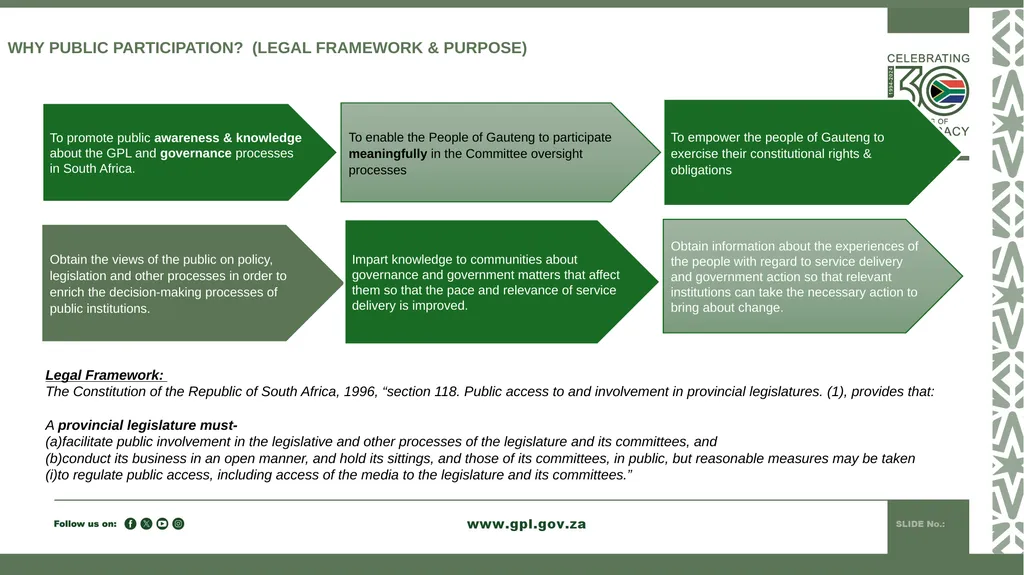
WHY PUBLIC PARTICIPATION? (LEGAL FRAMEWORK & PURPOSE) Legal Framework:
The Constitution of the Republic of South Africa, 1996, “section 118. Public access to and involvement in provincial legislatures. (1), provides that:
A provincial legislature must-
(a)facilitate public involvement in the legislative and other processes of the legislature and its committees, and
(b)conduct its business in an open manner, and hold its sittings, and those of its committees, in public, but reasonable measures may be taken
(i)to regulate public access, including access of the media to the legislature and its committees.”<br>
07
PUBLIC PARTICIPATION APPROACH IN THE SA LEGISLATIVE SECTOR 7 The South African legislative sector approach provides opportunity for optimal participation through relations between constituencies, communities and/or members of the public with their elected structures.
These would guarantee that the views of the public are filtered through the system to the relevant leadership representatives and to provide relevant feedback to the public on the ground.
This approach further encourages MPs and MPLs to continue with their constituency work, to continuously engage with members of the public as political representatives throughout the parliamentary term and to always provide feedback on issues engaged upon.<br>
08
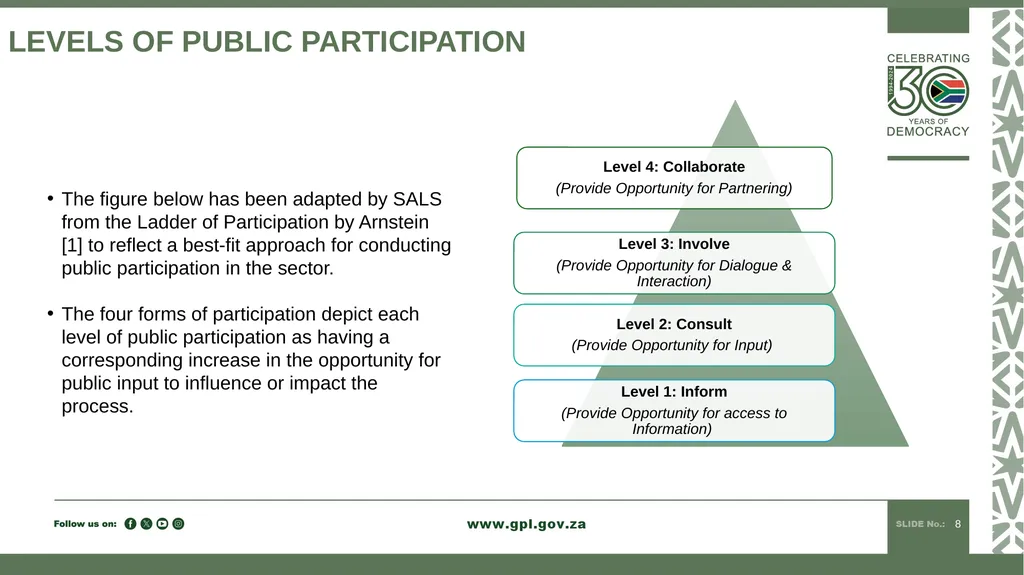
LEVELS OF PUBLIC PARTICIPATION 8 The figure below has been adapted by SALS from the Ladder of Participation by Arnstein [1] to reflect a best-fit approach for conducting public participation in the sector.
The four forms of participation depict each level of public participation as having a corresponding increase in the opportunity for public input to influence or impact the process.<br>
09
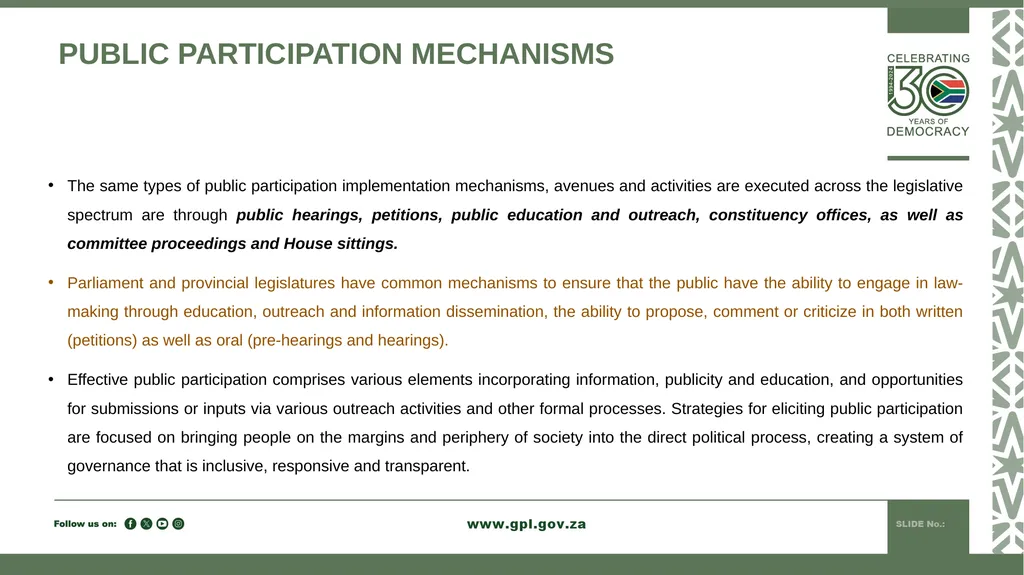
PUBLIC PARTICIPATION MECHANISMS The same types of public participation implementation mechanisms, avenues and activities are executed across the legislative spectrum are through public hearings, petitions, public education and outreach, constituency offices, as well as committee proceedings and House sittings.
Parliament and provincial legislatures have common mechanisms to ensure that the public have the ability to engage in law-making through education, outreach and information dissemination, the ability to propose, comment or criticize in both written (petitions) as well as oral (pre-hearings and hearings).
Effective public participation comprises various elements incorporating information, publicity and education, and opportunities for submissions or inputs via various outreach activities and other formal processes. Strategies for eliciting public participation are focused on bringing people on the margins and periphery of society into the direct political process, creating a system of governance that is inclusive, responsive and transparent.<br>
10
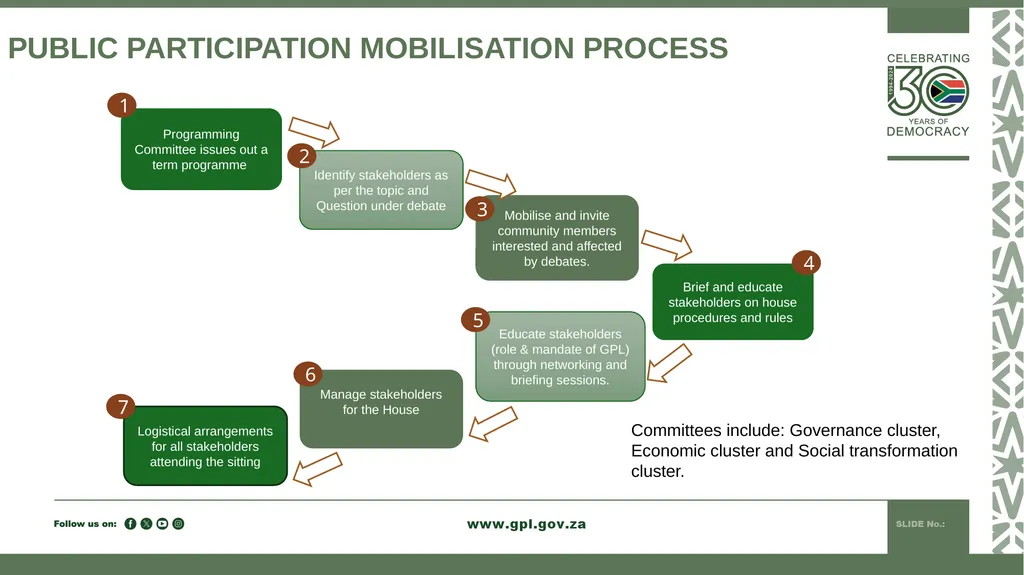
PUBLIC PARTICIPATION MOBILISATION PROCESS Committees include: Governance cluster, Economic cluster and Social transformation cluster.<br>
11
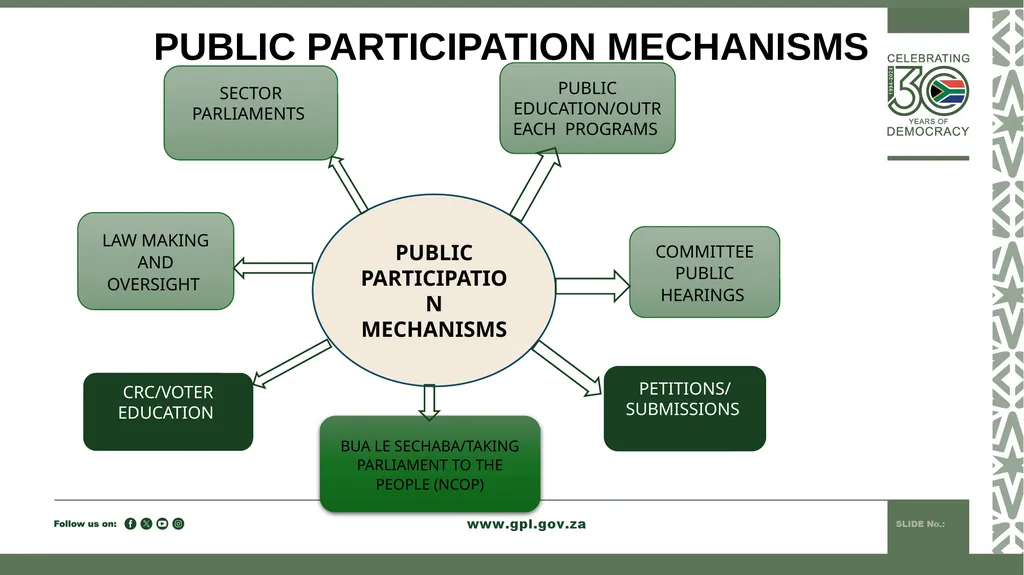
PUBLIC PARTICIPATION MECHANISMS<br>
12
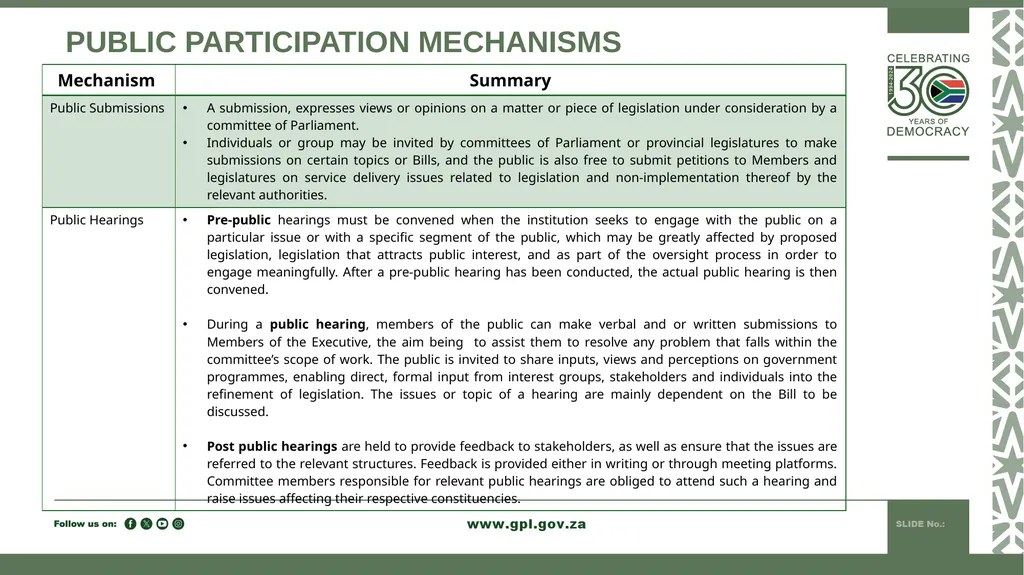
PUBLIC PARTICIPATION MECHANISMS<br>
13
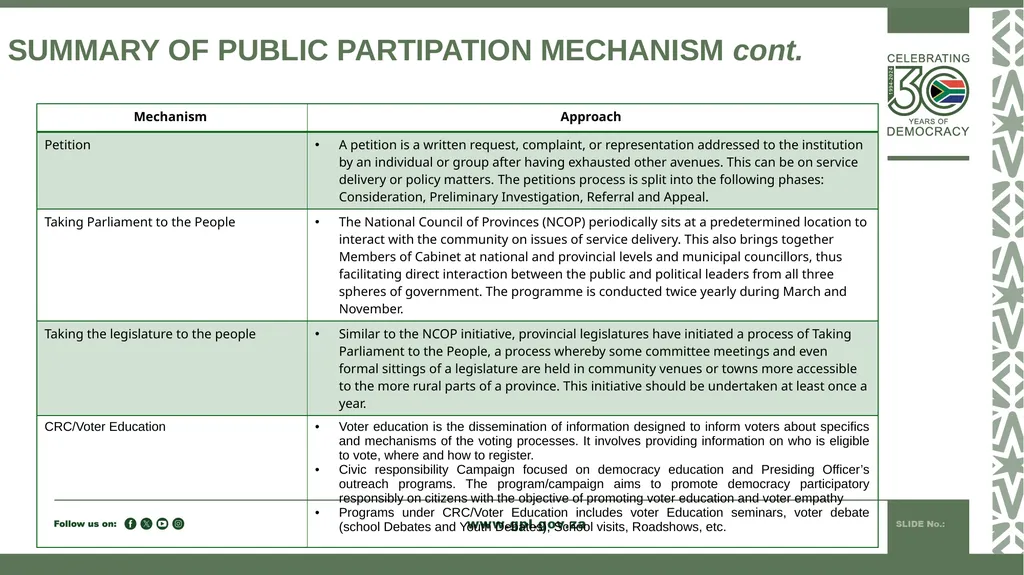
SUMMARY OF PUBLIC PARTIPATION MECHANISM cont.<br>
14
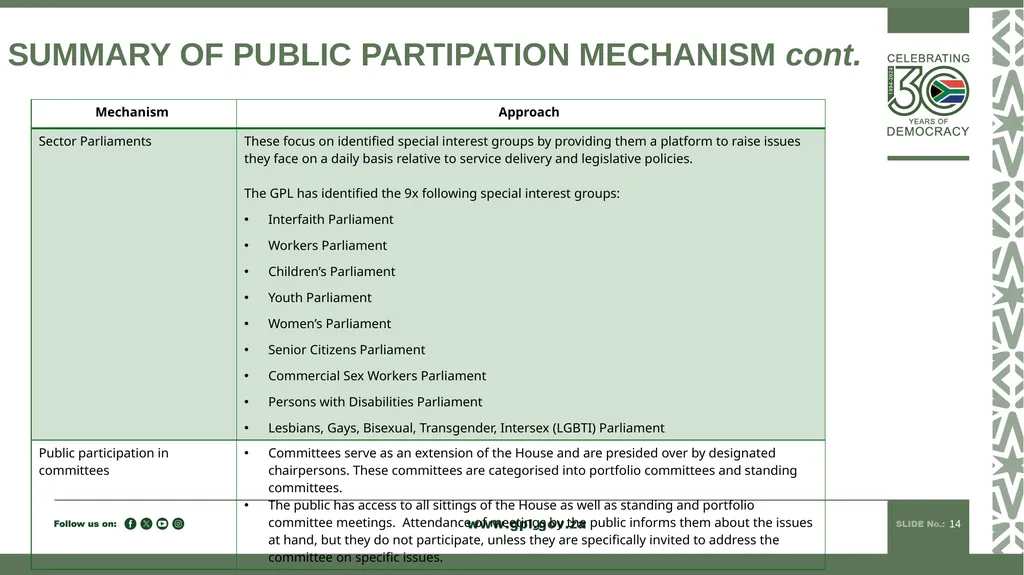
SUMMARY OF PUBLIC PARTIPATION MECHANISM cont. 14<br>
15
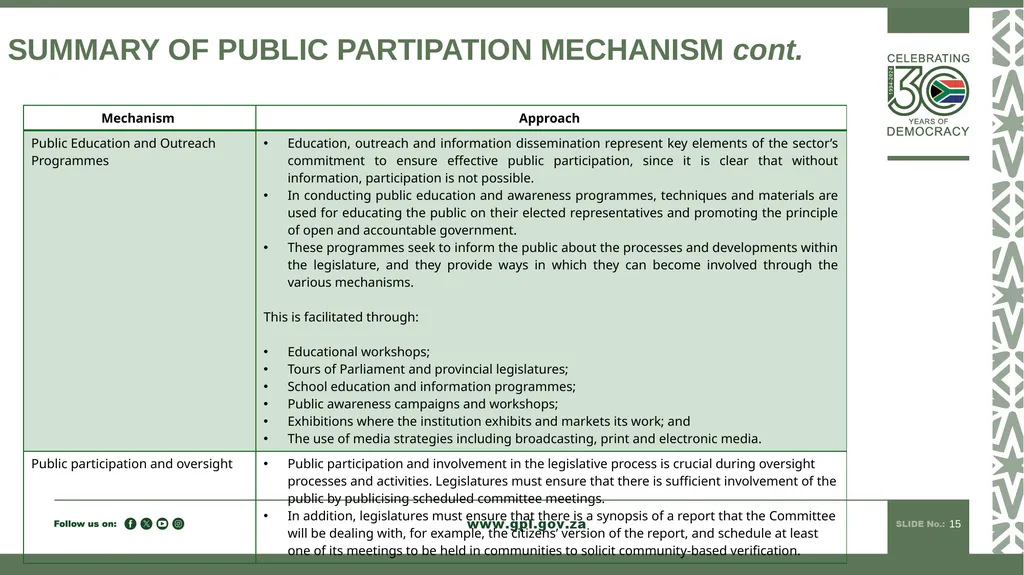
SUMMARY OF PUBLIC PARTIPATION MECHANISM cont. 15<br>
16
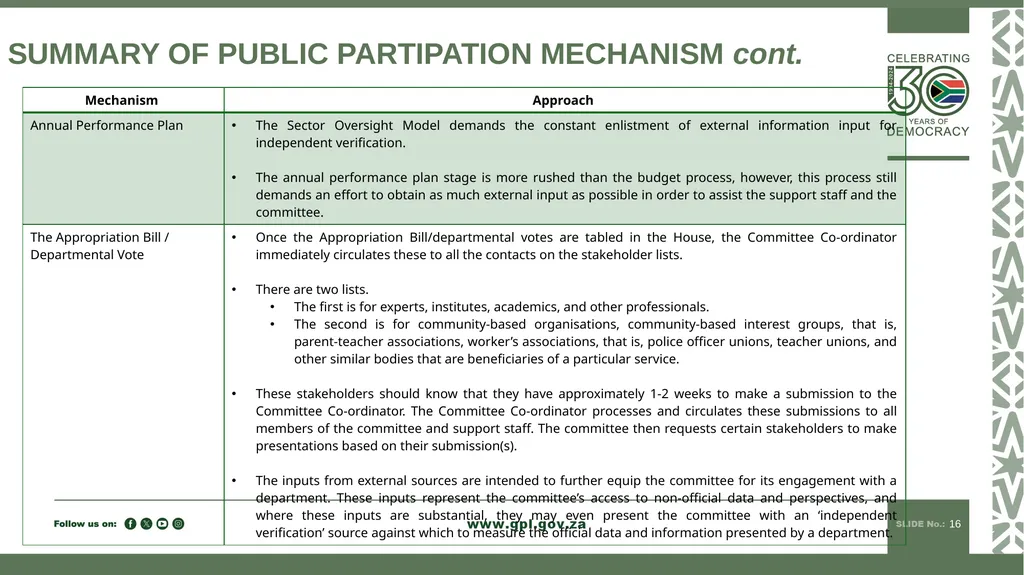
SUMMARY OF PUBLIC PARTIPATION MECHANISM cont. 16<br>
17
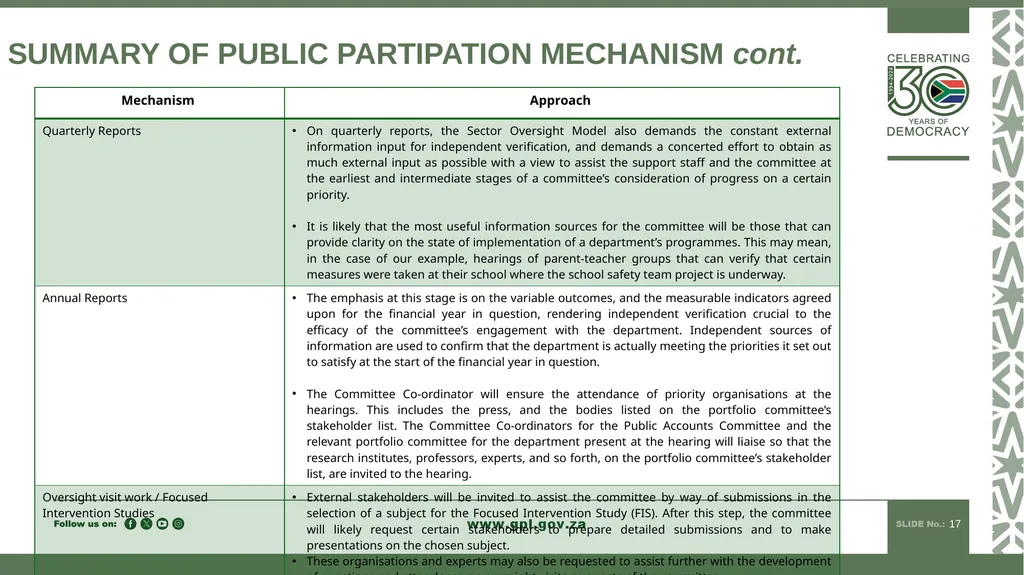
SUMMARY OF PUBLIC PARTIPATION MECHANISM cont. 17<br>
18
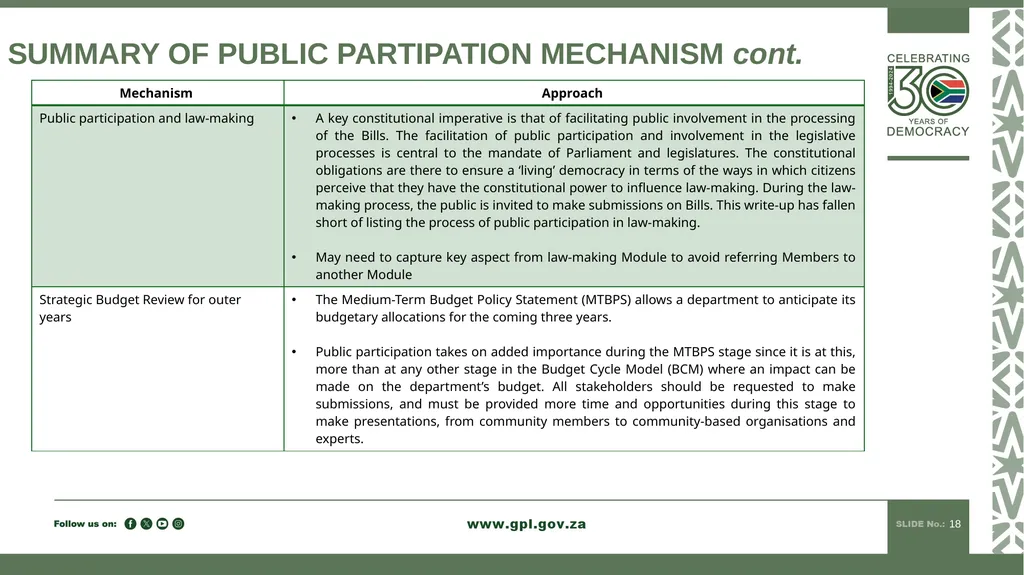
SUMMARY OF PUBLIC PARTIPATION MECHANISM cont. 18<br>
19
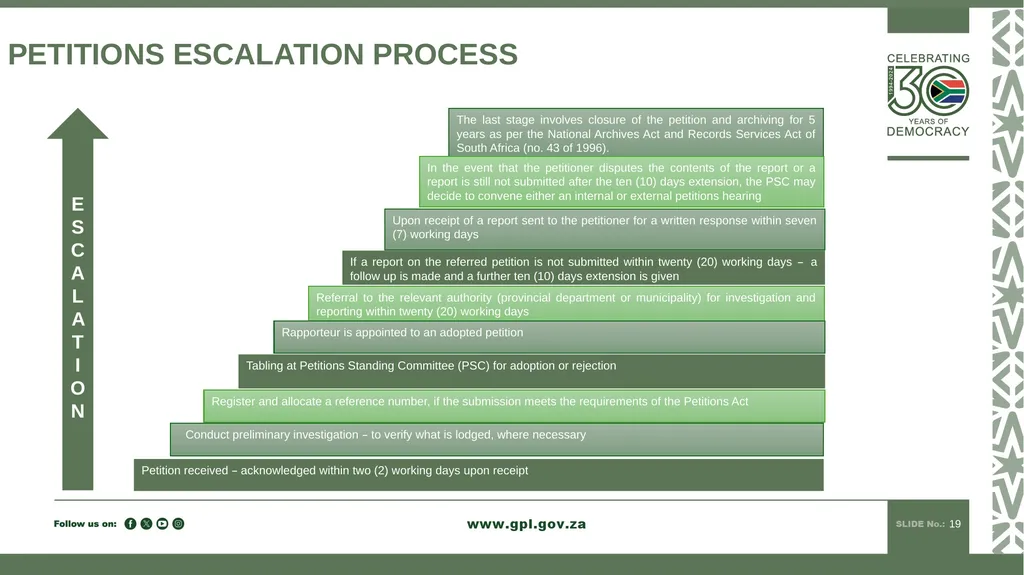
PETITIONS ESCALATION PROCESS 19 ESCALATION<br>
20
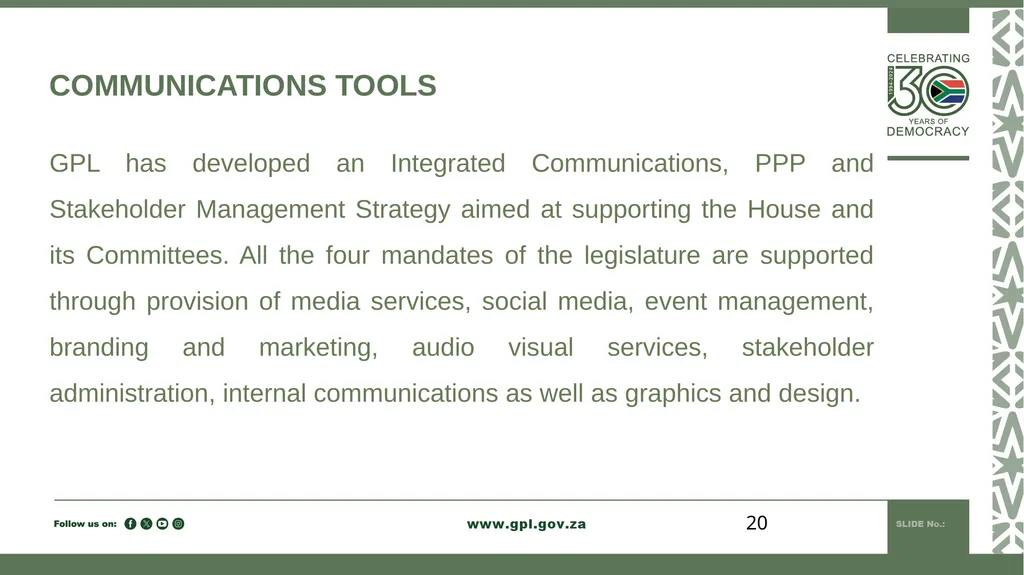
20 COMMUNICATIONS TOOLS GPL has developed an Integrated Communications, PPP and Stakeholder Management Strategy aimed at supporting the House and its Committees. All the four mandates of the legislature are supported through provision of media services, social media, event management, branding and marketing, audio visual services, stakeholder administration, internal communications as well as graphics and design.<br>
21
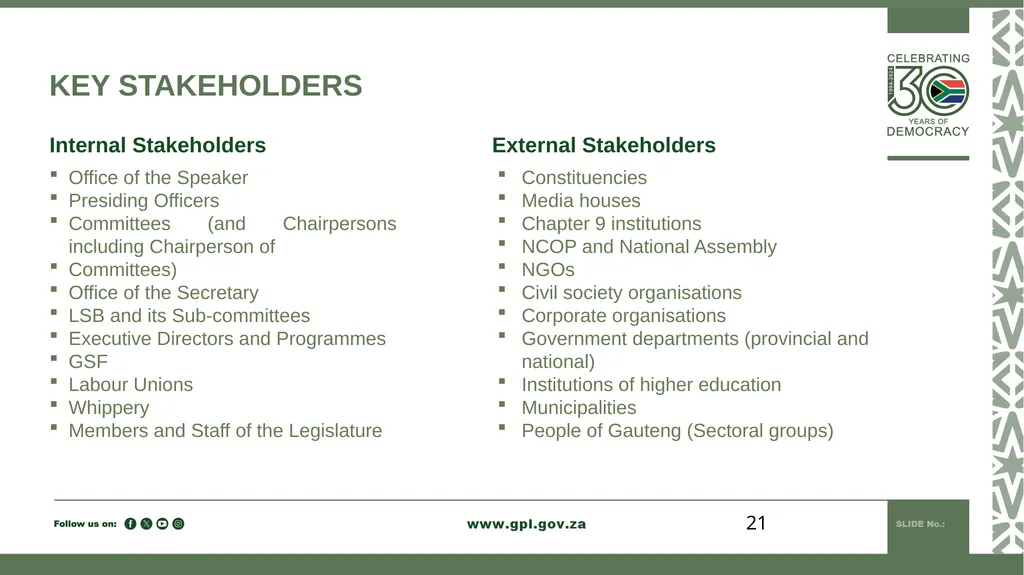
21 Office of the Speaker
Presiding Officers
Committees (and Chairpersons including Chairperson of
Committees)
Office of the Secretary
LSB and its Sub-committees
Executive Directors and Programmes
GSF
Labour Unions
Whippery
Members and Staff of the Legislature Internal Stakeholders External Stakeholders Constituencies
Media houses
Chapter 9 institutions
NCOP and National Assembly
NGOs
Civil society organisations
Corporate organisations
Government departments (provincial and national)
Institutions of higher education
Municipalities
People of Gauteng (Sectoral groups) KEY STAKEHOLDERS<br>
22
CONCLUSION The GPL has a constitutional obligation to facilitate public access and involvement in its proceedings.
Guided by principle of ‘The People Shall Govern’- Towards a People-centered Development! The GPL continues to seek mechanisms to facilitate public involvement in realizing the constitutional requirement.
Public participation helps in improving budget accountability and transparency which are essential governance principles and values.<br>