Public Procurement and Gender in Caribbean Development Bridgetown, Barbados Tuesday 14 June, 2016 By: L. Nana Oye Hesse - Bayne . Presentation Overview Conceptualizing Gender Gender and the Human Rights Agenda Public Procurement in the
Related Topics
Share
Embed code
Download this presentation From Below
"Public Procurement and Gender in Caribbean" is the property of its rightful owner. Permission is granted to
download and print the materials on this website for personal, non-commercial use only, and to display it
on your personal computer provided you do not modify the materials and that you retain all copyright
notices contained in the materials. By downloading content from our website, you accept the terms of this
agreement.
Presentation Transcript
01
Public Procurement and Gender in Caribbean Development Bridgetown, Barbados
Presentation Overview Conceptualizing Gender
Gender and the Human Rights Agenda
Public Procurement in the context of Government Expenditure
Gender Implications of Government Procurement expenditure
Why Gender is important – Caribbean experiences
Recommendations moving forward<br>
03
Defining Gender Social attributes and opportunities associated with being male and female
Relationships between women and men and girls and boys, as well as the relations between women and those between men.
Socially constructed and learnt through socialization processes<br>
04
Defining Gender Cont’d Context/ time-specific and changeable.
Gender determines what is expected, allowed and valued in a women or a man in a given context.
Translated to responsibilities assigned, activities undertaken, access to and control over resources, as well as decision-making opportunities<br>
05
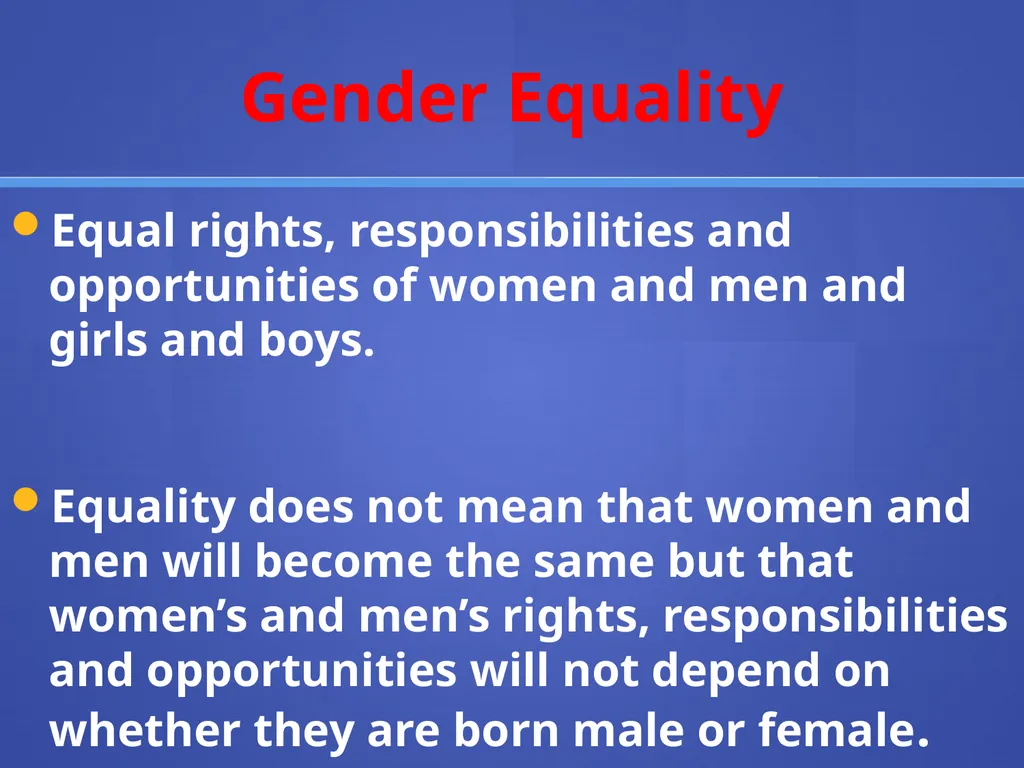
Gender Equality Equal rights, responsibilities and opportunities of women and men and girls and boys.
Equality does not mean that women and men will become the same but that women’s and men’s rights, responsibilities and opportunities will not depend on whether they are born male or female.<br>
06
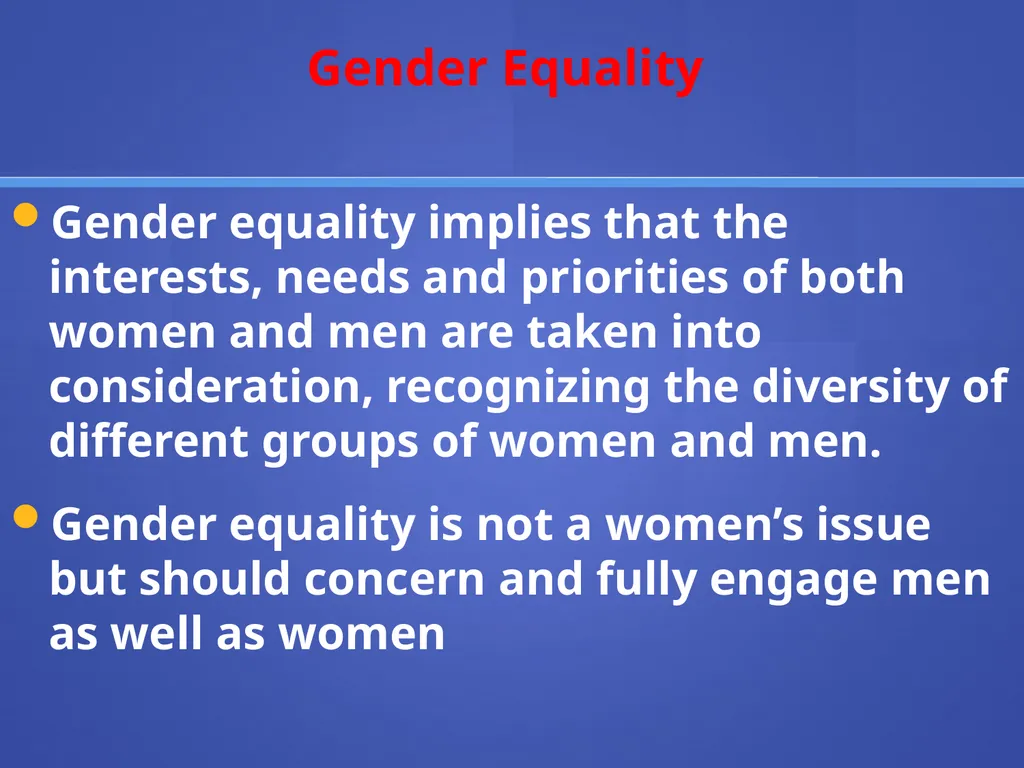
Gender Equality Gender equality implies that the interests, needs and priorities of both women and men are taken into consideration, recognizing the diversity of different groups of women and men.
Gender equality is not a women’s issue but should concern and fully engage men as well as women<br>
07
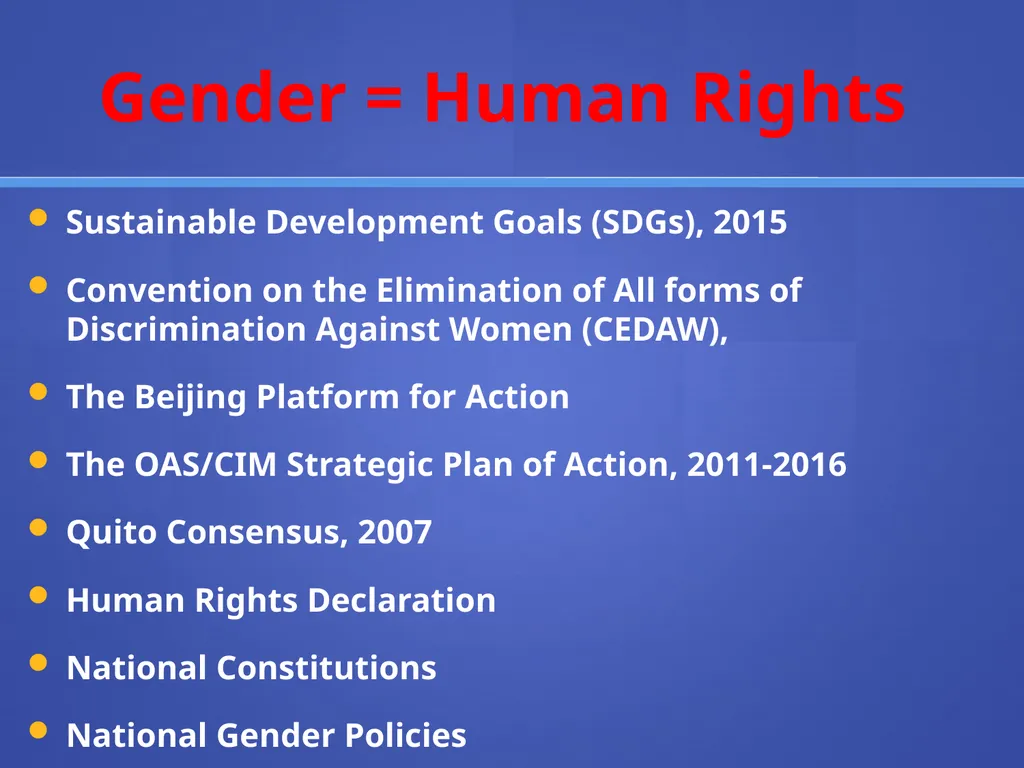
Gender = Human Rights Sustainable Development Goals (SDGs), 2015
Convention on the Elimination of All forms of Discrimination Against Women (CEDAW),
The Beijing Platform for Action
The OAS/CIM Strategic Plan of Action, 2011-2016
Quito Consensus, 2007
Human Rights Declaration
National Constitutions
National Gender Policies<br>
08
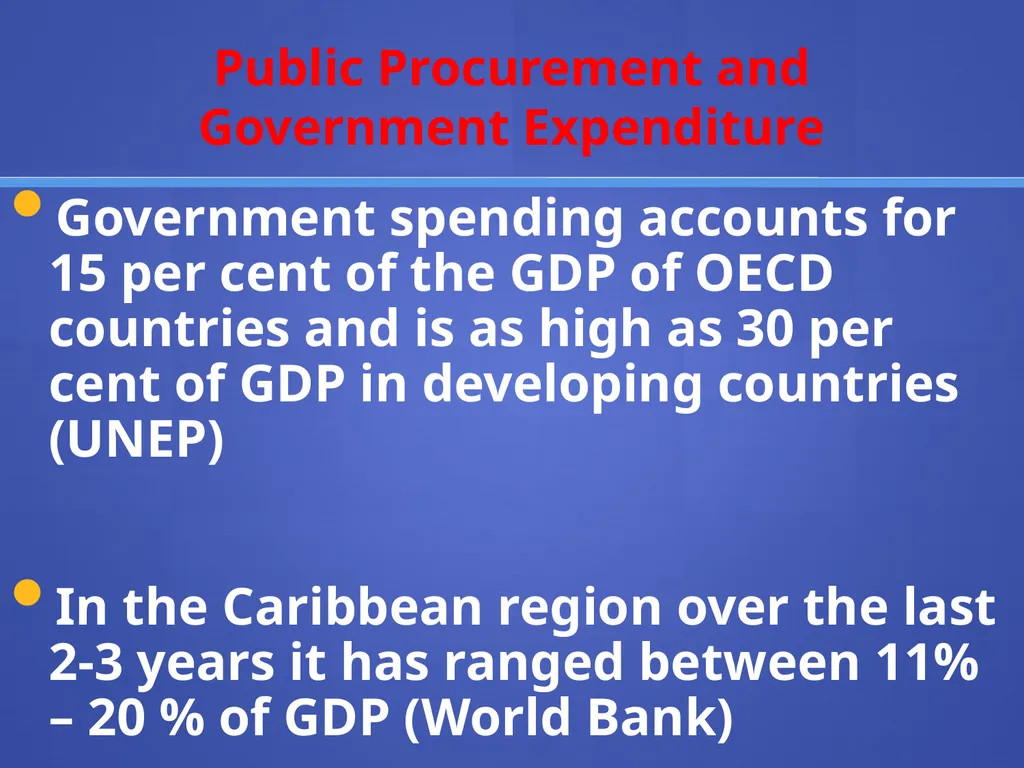
Public Procurement and Government Expenditure Government spending accounts for 15 per cent of the GDP of OECD countries and is as high as 30 per cent of GDP in developing countries (UNEP)
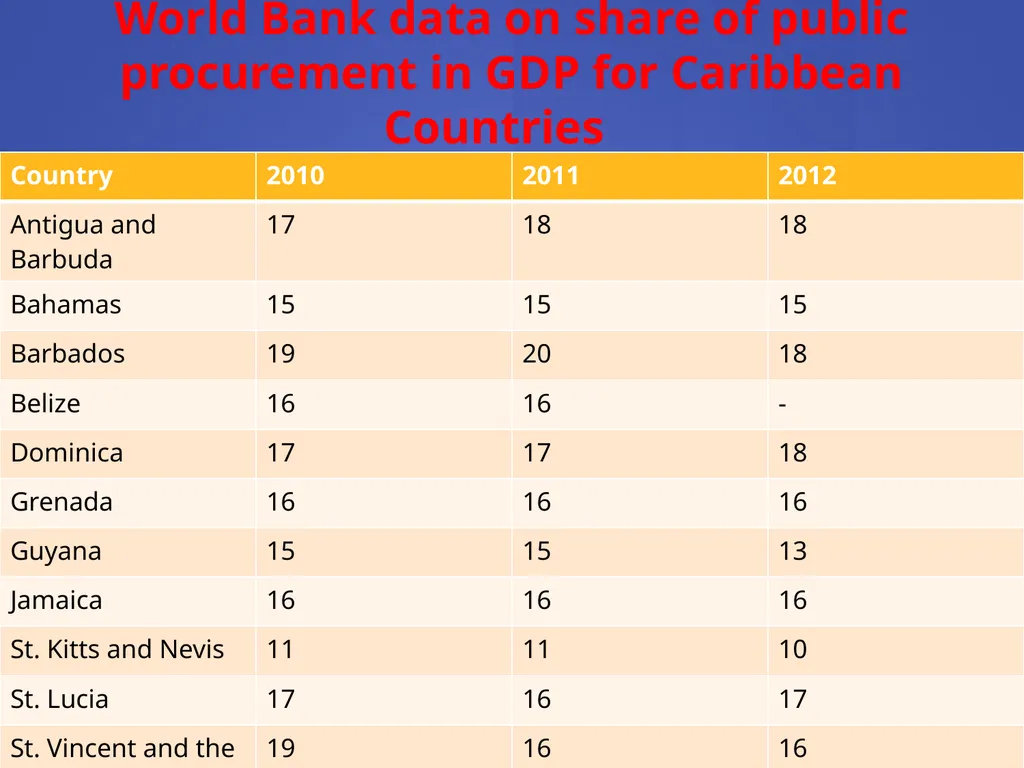
In the Caribbean region over the last 2-3 years it has ranged between 11% – 20 % of GDP (World Bank)<br>
09
World Bank data on share of public procurement in GDP for Caribbean Countries<br>
10
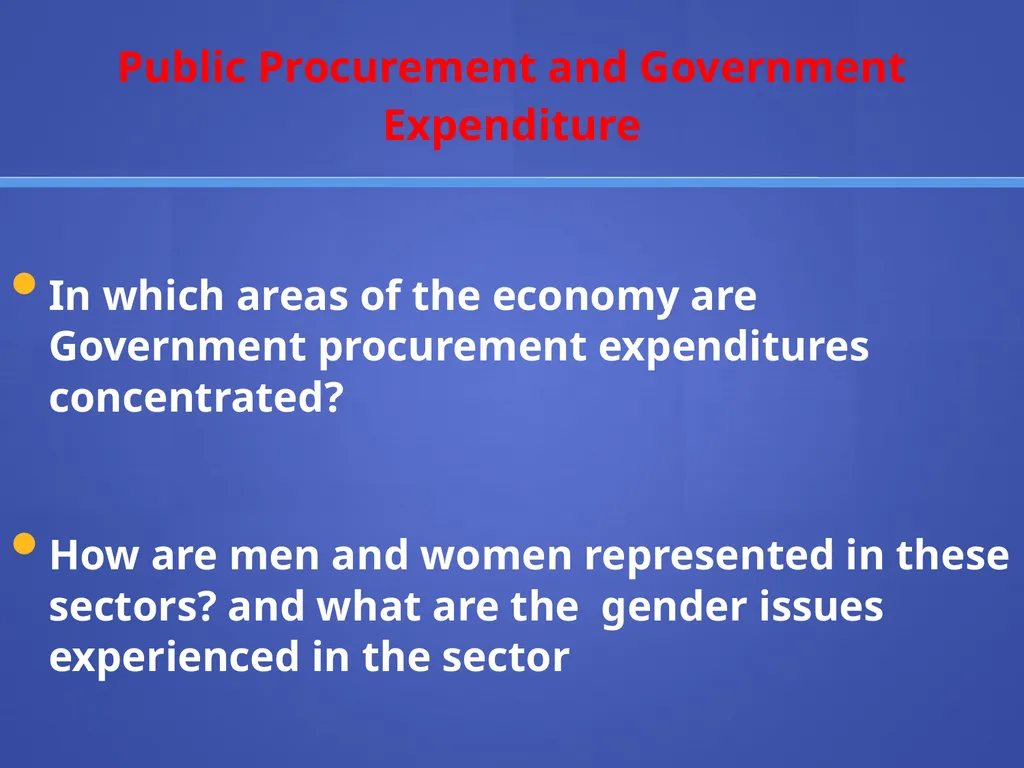
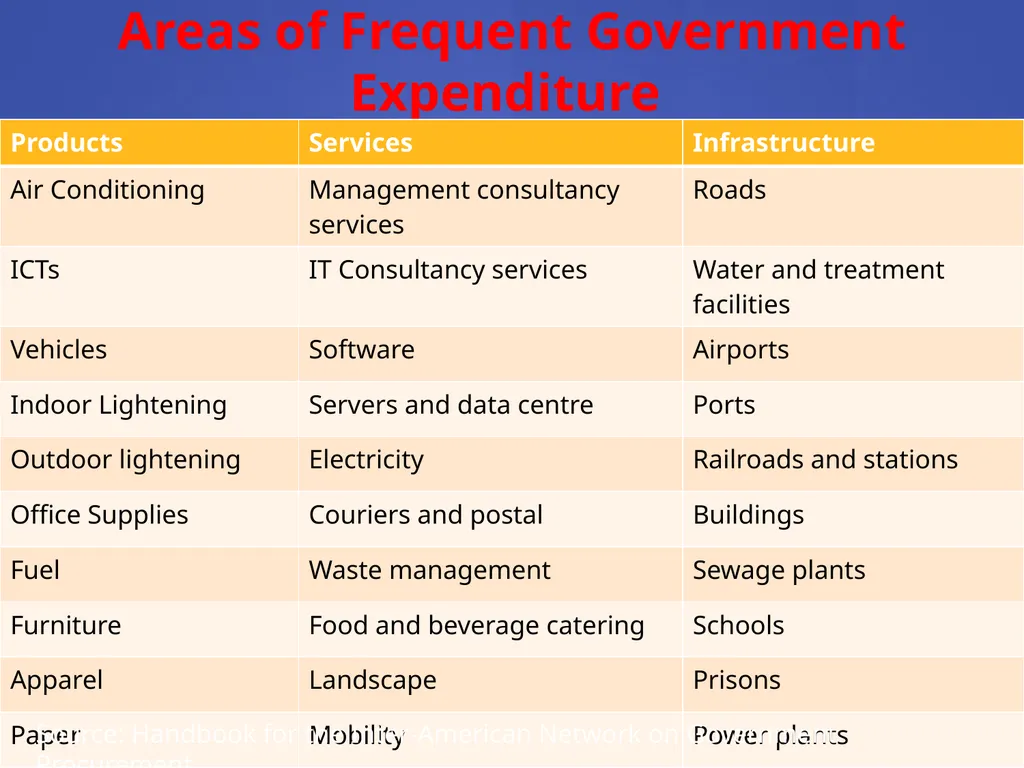
Public Procurement and Government Expenditure In which areas of the economy are Government procurement expenditures concentrated?
How are men and women represented in these sectors? and what are the gender issues experienced in the sector<br>
11
Areas of Frequent Government Expenditure Source: Handbook for the Inter-American Network on Government Procurement<br>
12
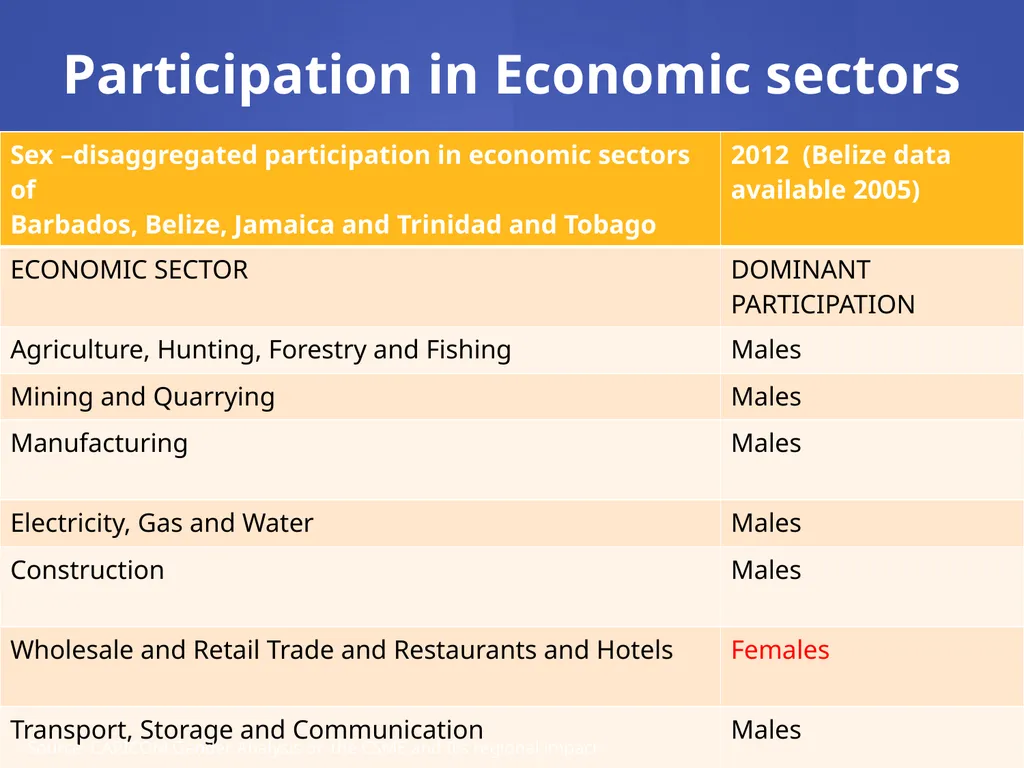
Participation in Economic sectors Source: CARICOM Gender Analysis of the CSME and It’s regional impact<br>
13
Labour Market Gender gaps in labour force participation have been shrinking globally, in all CARICOM countries the participation of men in the paid labour force continues to exceed that of women (ILO, 2014).
Females over-represented in the service sectors, while male participation exceeds women the most productive sectors contributing to GDP, and/or those targeted for growth (Gender and the CSME, 2015)<br>
14
Entry Points Use of Medium Small and Micro Enterprises as entry points for small business owners to access public procurement opportunities.
Trinidad and Tobago National Social Development Programme fund established for state enterprises to receive monies with the specific mandate of targeting MSMEs for the provision of the works and services under pre-determined thresholds.
On July 10, 2015 the Jamaica Observer news article “passage of public procurement legislation to benefit MSMEs”<br>
15
Study on Gender and MSMEs St. Lucia both men and women are making considerable contributions to local economic development in the context of MSMEs.
Guyana women’s access to microfinance is constrained by factors deeply rooted in the societal role for women and their general exclusion from business development programmes and services
Source: Federation of Canadian Municipalities – Caribbean Local Economic Development Project (FCM- CARILED)<br>
16
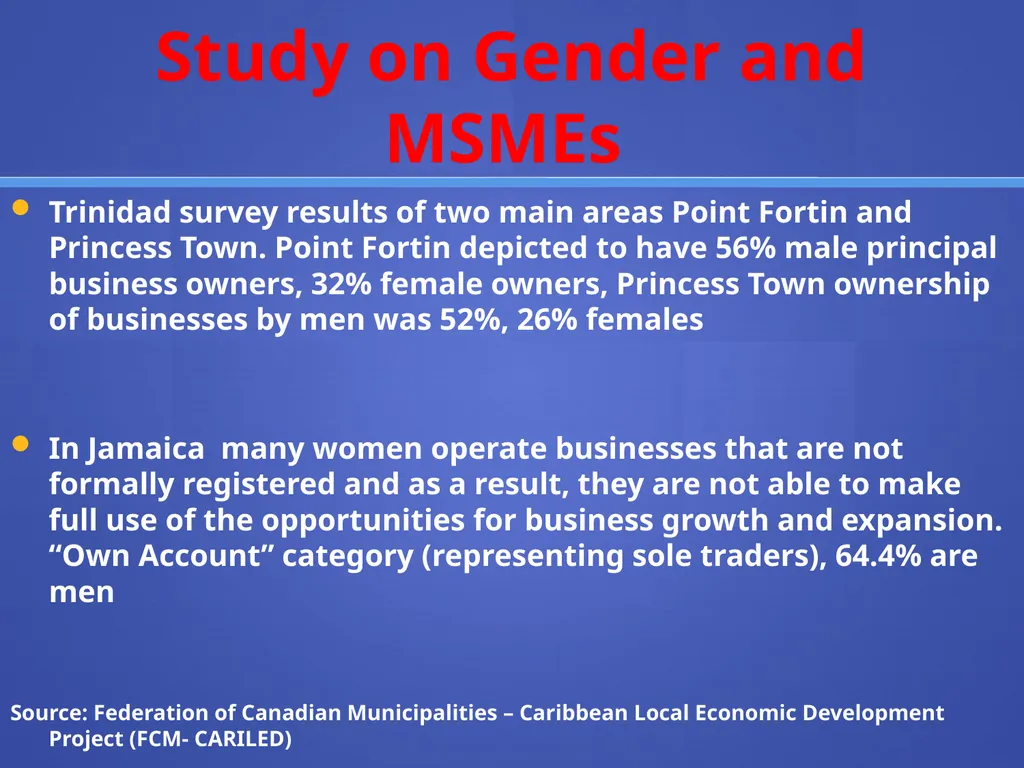
Study on Gender and MSMEs Trinidad survey results of two main areas Point Fortin and Princess Town. Point Fortin depicted to have 56% male principal business owners, 32% female owners, Princess Town ownership of businesses by men was 52%, 26% females
In Jamaica many women operate businesses that are not formally registered and as a result, they are not able to make full use of the opportunities for business growth and expansion. “Own Account” category (representing sole traders), 64.4% are men
Source: Federation of Canadian Municipalities – Caribbean Local Economic Development Project (FCM- CARILED)<br>
17
Way Forward A gender analysis of the sectors that benefit from public procurement is important to determine who has access and is benefiting from the supply chain
Taking measures to address gender inequality will enhance productivity economic growth and development
Equitable distribution of resources is key to sustainable development<br>
18
Recommendations Examine how gender inequalities are structuring the public procurement
Develop sex disaggregated data to assist in analysis
Include gender indicators in monitoring and evaluating public procurement
Sensitization on Gender
Mainstream gender in public procurement processes.<br>