
Public Relations Management Dr.T.SIVAKAMI
TG
Published · 21 slides · 0 views

1 / 1


Description
Public Relations Management Dr.T.SIVAKAMI Assistant Professor Department of Management Studies Bon Secours College for Women Thanjavur What Is Public Relations? Public relations is a strategic communication process companies, individuals,
Related Topics
Share
Embed code
Download this presentation From Below
"Public Relations Management Dr.T.SIVAKAMI" is the property of its rightful owner. Permission is granted to download and print the materials on this website for personal, non-commercial use only, and to display it on your personal computer provided you do not modify the materials and that you retain all copyright notices contained in the materials. By downloading content from our website, you accept the terms of this agreement.
Presentation Transcript
01
Public Relations Management Dr.T.SIVAKAMI
Assistant Professor
Department of Management Studies
Bon Secours College for Women
Thanjavur<br>
Assistant Professor
Department of Management Studies
Bon Secours College for Women
Thanjavur<br>
02
What Is Public Relations? Public relations is a strategic communication process companies, individuals, and organizations use to build mutually beneficial relationships with the public.<br>
03
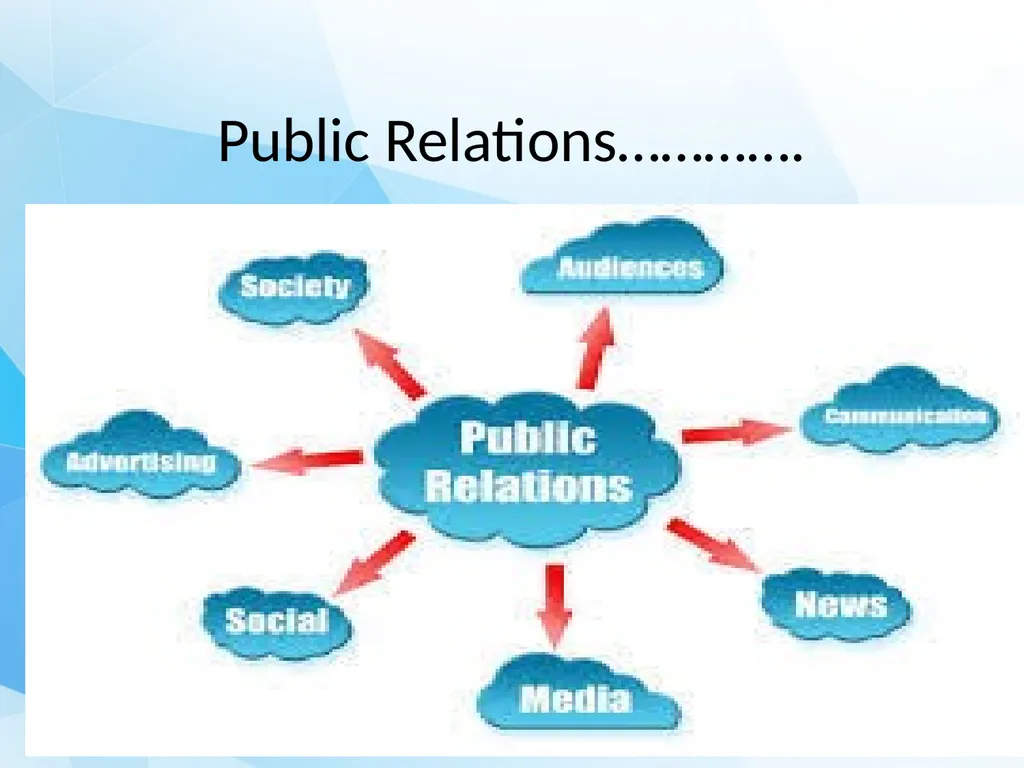
Public Relations………….<br>
04
Definitions
Ivy Lee and Edwards Louis Bernays established the first definition of public relations in the early 1900s which states it as ‘a management function, which tabulates public attitudes, defines the policies, procedures, and interests of an organization… followed by executing a program of action to earn public understanding and acceptance’ The Public Relations Society of America in 2012 which states as ‘Public relations is a strategic communication process that builds mutually beneficial relationships between organizations and their publics’.<br>
05
Philip Kitchen (1997: 27) summarises the definitions as suggesting that public relations:
1 . is a management function . . .
2. covers a broad range of activities and purposes in practice . . .
3. is regarded as two-way or interactive . . .
4. suggests that publics facing companies are not singular (i.e. consumers) but plural ...
5. suggests that relationships are long term rather than short term.<br>
06
Objectives of Public Relations 1. Creating awareness about the company, its goals, products and services where this counts.
2. Sustaining the awareness as an ongoing process, keeping in mind what the competitors are doing, and knowing that public memory is short.
3. Striving to be accepted by the various publics. Special efforts are required to be accepted by employees. A foreign company has its own requirements for being accepted on this soil.
4. Creating a bond of trust. In times of rumors, misinformation, etc., a company has to establish the truth. In normal times, too, a company has to promote its reliability. Just consider the frequent use of words like believe, trust, reliable, safe, 100%, etc. in building a company image.
5. Getting cooperation from various quarters. A company has many publics on whom it has to depend. Government organizations, providers of various services etc. have to be wooed in such a way that they willingly help the company.
6. Earning recognition. It is not enough to perform feats but it is necessary to get these noticed and talked about. Through winning awards, certifications etc. and getting these read and seen, a company gets recognition. Having so-and-so as a client or collaborator may itself be a recognition. This has to be publicized.<br>
2. Sustaining the awareness as an ongoing process, keeping in mind what the competitors are doing, and knowing that public memory is short.
3. Striving to be accepted by the various publics. Special efforts are required to be accepted by employees. A foreign company has its own requirements for being accepted on this soil.
4. Creating a bond of trust. In times of rumors, misinformation, etc., a company has to establish the truth. In normal times, too, a company has to promote its reliability. Just consider the frequent use of words like believe, trust, reliable, safe, 100%, etc. in building a company image.
5. Getting cooperation from various quarters. A company has many publics on whom it has to depend. Government organizations, providers of various services etc. have to be wooed in such a way that they willingly help the company.
6. Earning recognition. It is not enough to perform feats but it is necessary to get these noticed and talked about. Through winning awards, certifications etc. and getting these read and seen, a company gets recognition. Having so-and-so as a client or collaborator may itself be a recognition. This has to be publicized.<br>
07
Advantages of Public Relations Credibility: Public trusts the message coming from a trusted third party more than the advertised content.
Reach: A good public relations strategy can attract many news outlets, exposing the content to a large audience.
Cost effectiveness: Public relations is a cost effective technique to reach large audience as compared to paid promotion.<br>
Reach: A good public relations strategy can attract many news outlets, exposing the content to a large audience.
Cost effectiveness: Public relations is a cost effective technique to reach large audience as compared to paid promotion.<br>
08
Disadvantages Of Public Relations No Direct Control: Unlike paid media, there isn’t a direct control over the content distributed through the earned media. This is the biggest risk of investing in public relations.
Hard To Measure Success: It is really hard to measure and evaluate the effectiveness of a PR campaign.
No Guaranteed Results: Publishing of a press release isn’t guaranteed as the brand doesn’t pay for it. The media outlet publishes it only if it feels that it’ll attract its target audience.<br>
Hard To Measure Success: It is really hard to measure and evaluate the effectiveness of a PR campaign.
No Guaranteed Results: Publishing of a press release isn’t guaranteed as the brand doesn’t pay for it. The media outlet publishes it only if it feels that it’ll attract its target audience.<br>
09
Importance Of Public Relations Promote Brand Values
PR is used to send out positive messages which are in line with the brand’s value and its image. This builds up the brand’s reputation.
Strengthen Community Relations
PR strategies are used to convey that the brand is as much part of the society as the target audience. This builds up a strong relationship of the brand with the public.
Builds Up The Brand Image
The brand image gets a boost when the target customers get to know about it through a third party media outlet. A good public relations strategy help the brand builds up its image in a way it wants to.<br>
PR is used to send out positive messages which are in line with the brand’s value and its image. This builds up the brand’s reputation.
Strengthen Community Relations
PR strategies are used to convey that the brand is as much part of the society as the target audience. This builds up a strong relationship of the brand with the public.
Builds Up The Brand Image
The brand image gets a boost when the target customers get to know about it through a third party media outlet. A good public relations strategy help the brand builds up its image in a way it wants to.<br>
10
Roles of Public Relations Management Communication management
Crisis management
Relationship management
Resource management
Reputation or image management
Risk management<br>
Crisis management
Relationship management
Resource management
Reputation or image management
Risk management<br>
11
Elements in Public Relations Two-way Communication
Mutual Understanding
Caring for Public Opinion
Social Responsibility<br>
Mutual Understanding
Caring for Public Opinion
Social Responsibility<br>
12
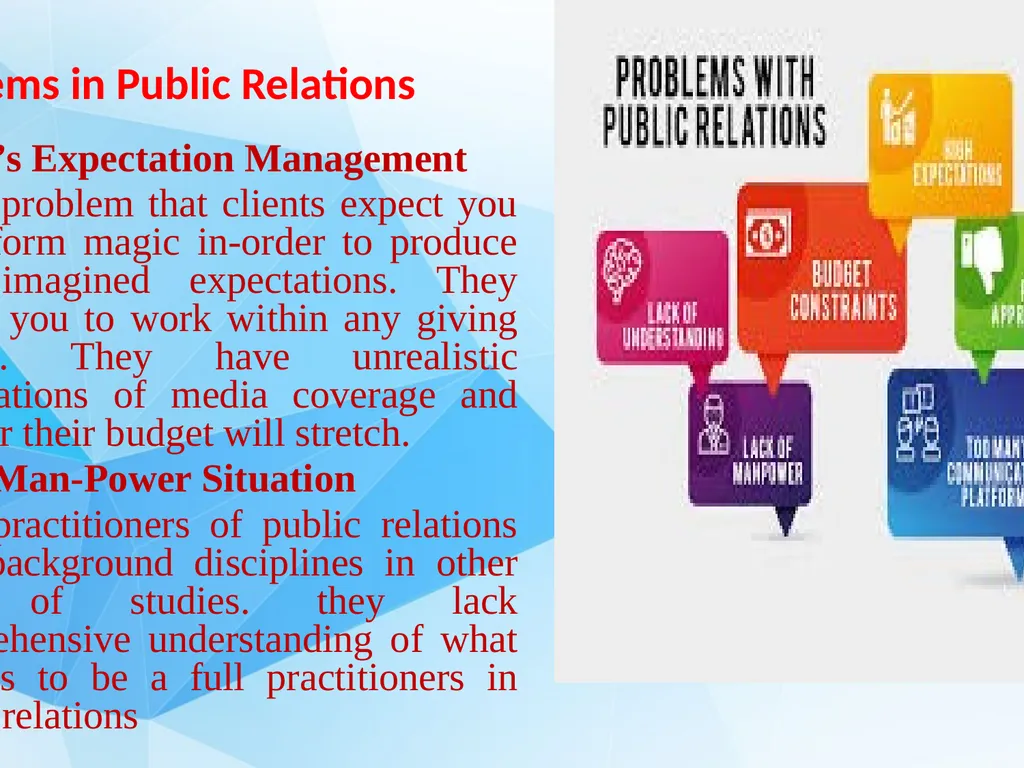
Problems in Public Relations Client’s Expectation Management
It is a problem that clients expect you to perform magic in-order to produce their imagined expectations. They expect you to work within any giving budget. They have unrealistic expectations of media coverage and how far their budget will stretch.
Poor Man-Power Situation
Most practitioners of public relations have background disciplines in other field of studies. they lack comprehensive understanding of what it takes to be a full practitioners in Public relations<br>
It is a problem that clients expect you to perform magic in-order to produce their imagined expectations. They expect you to work within any giving budget. They have unrealistic expectations of media coverage and how far their budget will stretch.
Poor Man-Power Situation
Most practitioners of public relations have background disciplines in other field of studies. they lack comprehensive understanding of what it takes to be a full practitioners in Public relations<br>
13
Problems in Public Relations Increase in Communication Platform:
Communication platforms offer a swift, easy way of disseminating messages across to target audience; but the huddles to choose the right communication channels for clients could be painstaking. A lot of time-investment need to be made in order to reach out to the right audience, passing your messages across to them and getting desired results.
Financial Constraint:
Financial belt-tightening has stemmed the flow of public relations’ budgets. Companies are reluctant to spend the little revenue they have on improving their media profile.<br>
Communication platforms offer a swift, easy way of disseminating messages across to target audience; but the huddles to choose the right communication channels for clients could be painstaking. A lot of time-investment need to be made in order to reach out to the right audience, passing your messages across to them and getting desired results.
Financial Constraint:
Financial belt-tightening has stemmed the flow of public relations’ budgets. Companies are reluctant to spend the little revenue they have on improving their media profile.<br>
14
Problems in Public Relations Poor Usage of Social Media
Social media such as Face book, Linked-in, Tweeter, Net log, etc. are pre-eminent in this present age of our practice. However, most users of social networks abuse them a lot; while some are not diplomatic in the way they use them to convey messages to the public.
Low Awareness of Public Relations and What it Stands For
Public relations is still an evolving phenomenon in most developing countries of the world. This has caused a set back to the proliferation of the discipline in the world. Public relations is just a topic in mass communication or marketing in higher institutions lieu of a discipline.<br>
Social media such as Face book, Linked-in, Tweeter, Net log, etc. are pre-eminent in this present age of our practice. However, most users of social networks abuse them a lot; while some are not diplomatic in the way they use them to convey messages to the public.
Low Awareness of Public Relations and What it Stands For
Public relations is still an evolving phenomenon in most developing countries of the world. This has caused a set back to the proliferation of the discipline in the world. Public relations is just a topic in mass communication or marketing in higher institutions lieu of a discipline.<br>
15
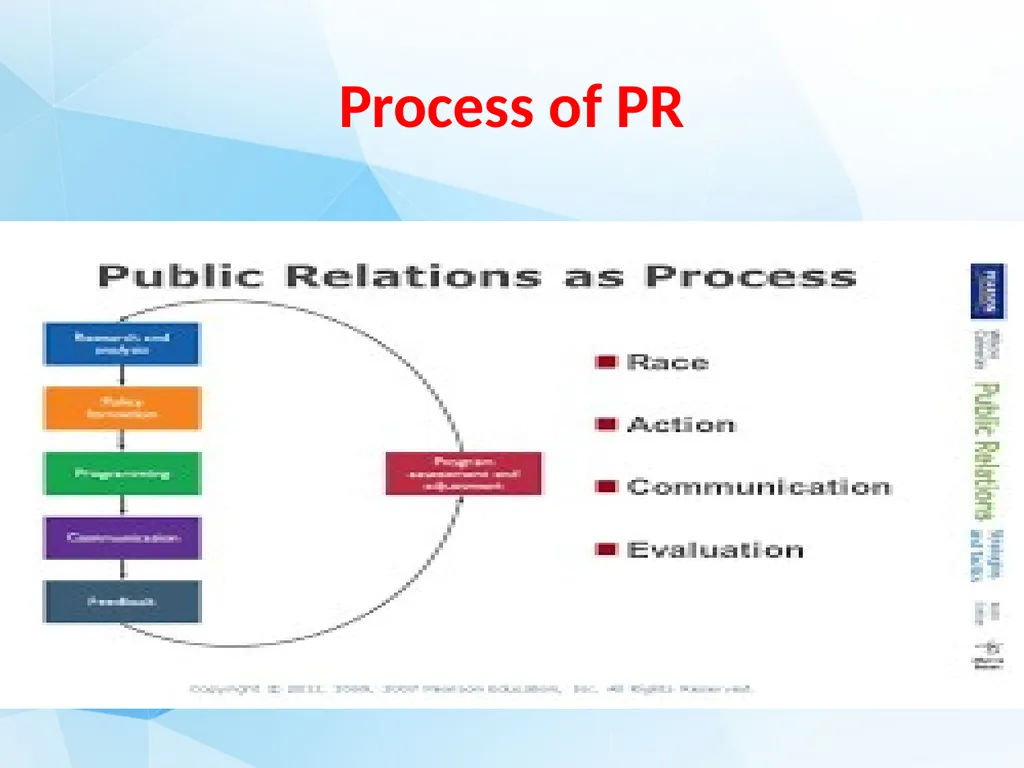
Process of PR<br>
16
Process of Public Relations Public relations process is also called RPCE MODEL
‘R’ for Research or Fact finding: In this process the role of public relation officer is that of an ‘analyst’. In this stage the external and internal environment of an organization is analyzed to elicit public opinion, public reactions, public attitudes towards policies and actions of an organization. This stage answers: what is happening? And what is the problem confronting the organization?
‘P’ for Planning: Here the PR practitioner assumes the role of an ‘advisor’. Based on the environmental analysis and identified problems, necessary action plans, programmes have to be designed and planned for solution to the issues. He should tell the management what should be done and how can it be done.<br>
‘R’ for Research or Fact finding: In this process the role of public relation officer is that of an ‘analyst’. In this stage the external and internal environment of an organization is analyzed to elicit public opinion, public reactions, public attitudes towards policies and actions of an organization. This stage answers: what is happening? And what is the problem confronting the organization?
‘P’ for Planning: Here the PR practitioner assumes the role of an ‘advisor’. Based on the environmental analysis and identified problems, necessary action plans, programmes have to be designed and planned for solution to the issues. He should tell the management what should be done and how can it be done.<br>
17
Process of Public Relations ‘C’ for Communication (implementation): PR practitioner in this process is that of an ‘advocate’. How should the action plan be implemented? All the programmes, services formulated have to be grounded with appropriate messages to reach the target audience. Communication and action plans have to move hand-in-hand for better impact. This stage answers: What is the communication strategy? What should be the media mix?
‘E’ for Evaluation: PR practitioner in this process is that of an ‘antenna’. The last but very important step in PR practice is ‘evaluation’ or measurement of results of the programme is implemented. Without, evaluation process the entire PR will be a futile exercise. We do not know the results. Therefore the evaluation answers: How did we do? What is the impact of public relations programmes?<br>
‘E’ for Evaluation: PR practitioner in this process is that of an ‘antenna’. The last but very important step in PR practice is ‘evaluation’ or measurement of results of the programme is implemented. Without, evaluation process the entire PR will be a futile exercise. We do not know the results. Therefore the evaluation answers: How did we do? What is the impact of public relations programmes?<br>
18
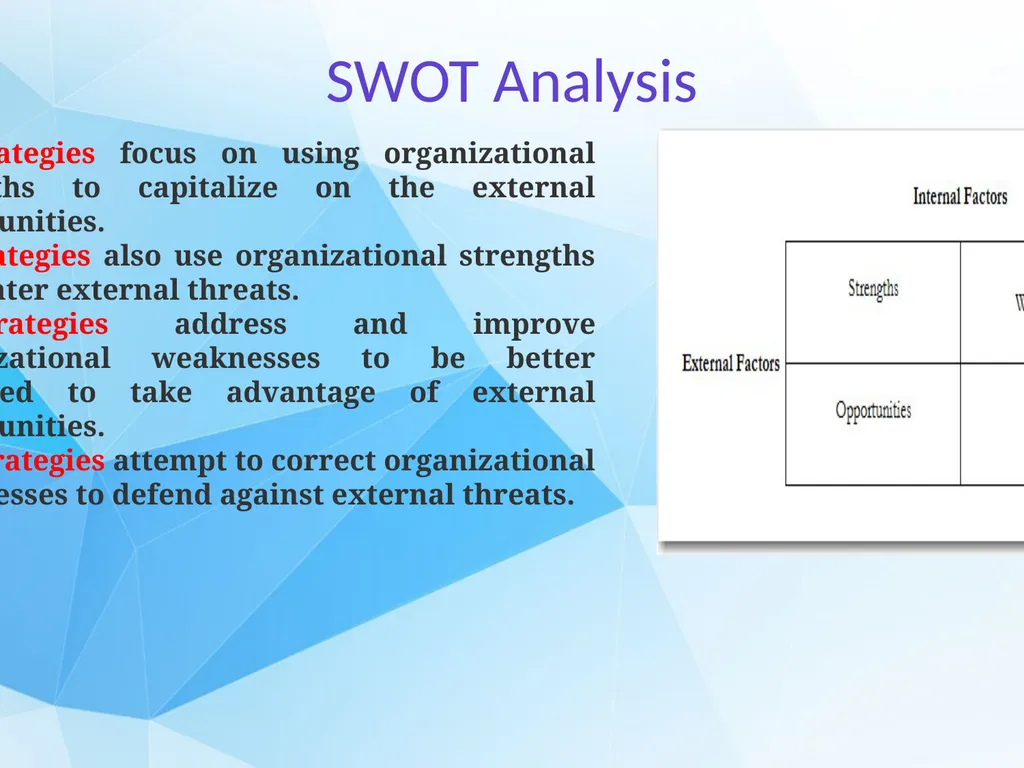
SWOT Analysis SO strategies focus on using organizational strengths to capitalize on the external opportunities.
ST strategies also use organizational strengths to counter external threats.
WO strategies address and improve organizational weaknesses to be better prepared to take advantage of external opportunities.
WT strategies attempt to correct organizational weaknesses to defend against external threats.<br>
ST strategies also use organizational strengths to counter external threats.
WO strategies address and improve organizational weaknesses to be better prepared to take advantage of external opportunities.
WT strategies attempt to correct organizational weaknesses to defend against external threats.<br>
19
How to improve your decision making Situation: A brief description of the nature of the issue, problem or situation that requires decision, action or study.
The goal : A clear, concise statement of the task to be accomplished, or the target to be reached, and why.
Analysis/assumptions: A brief description of what the situation means, its implications and the assumptions central to the analysis. Managers always need to know why, but not in great detail.
Options: Always provide at least three response options for the situation as presented and analyzed – preferably four options to limit the number of times a middle option may be chosen merely on the basis that it is the middle ground. If there is only one recommendation, which is questioned, it will most likely die and the discussion will move out of your control. The ‘do nothing’ option should be included in every strategy. The optimal choice should be recommended and the fallback recommendations should be supportable. Be prepared to do something in between the things that have been recommended.
Recommendation: The recommendation is obviously based on the line of action that has the strongest case. At the same time, be prepared to walk through an analysis of each of other options proposed.
Unintended consequences: These are the reactions or circumstances that could arise from suggested options or by doing nothing. Inadequate provision for consequences (risk management) can sabotage an otherwise useful strategy.<br>
The goal : A clear, concise statement of the task to be accomplished, or the target to be reached, and why.
Analysis/assumptions: A brief description of what the situation means, its implications and the assumptions central to the analysis. Managers always need to know why, but not in great detail.
Options: Always provide at least three response options for the situation as presented and analyzed – preferably four options to limit the number of times a middle option may be chosen merely on the basis that it is the middle ground. If there is only one recommendation, which is questioned, it will most likely die and the discussion will move out of your control. The ‘do nothing’ option should be included in every strategy. The optimal choice should be recommended and the fallback recommendations should be supportable. Be prepared to do something in between the things that have been recommended.
Recommendation: The recommendation is obviously based on the line of action that has the strongest case. At the same time, be prepared to walk through an analysis of each of other options proposed.
Unintended consequences: These are the reactions or circumstances that could arise from suggested options or by doing nothing. Inadequate provision for consequences (risk management) can sabotage an otherwise useful strategy.<br>
20
Thank You<br>