Publishing in Educational Management, Administration and Leadership (EMAL) Professor Tony Bush (Editor) EMAL facts and figures EMAL is a learned society journal, owned by BELMAS (the British Educational Leadership, Management and
"Publishing in Educational Management," is the property of its rightful owner. Permission is granted to
download and print the materials on this website for personal, non-commercial use only, and to display it
on your personal computer provided you do not modify the materials and that you retain all copyright
notices contained in the materials. By downloading content from our website, you accept the terms of this
agreement.
Presentation Transcript
01
Publishing in Educational Management, Administration and Leadership (EMAL) Professor Tony Bush (Editor)<br>
02
EMAL facts and figures EMAL is a learned society journal, owned by BELMAS (the British Educational Leadership, Management and Administration Society) and published by Sage (London)
EMAL is a very well established journal, founded in 1973 (2019 is volume 47)
EMAL has six issues a year (published bi-monthly)
EMAL is overseen by an Editorial Board, supported by the international Editorial Board
EMAL is managed by the editor and an administrator
EMAL’s submission process is via Manuscript Central<br>
03
EMAL aims and scope EMAL considers articles about leadership or management in all sectors of education:
Early childhood education
Primary schools
Secondary schools
Special education
Vocational education
Higher education<br>
04
The diverse journals market Open Access journals (author pays) may not have robust review processes (profit, not quality)
Traditional journals (funded by subscriptions) have differential esteem:
Social Science Citation Index (SSCI) journals
Scopus journals
Other journals
Further differentiation based on impact factors<br>
05
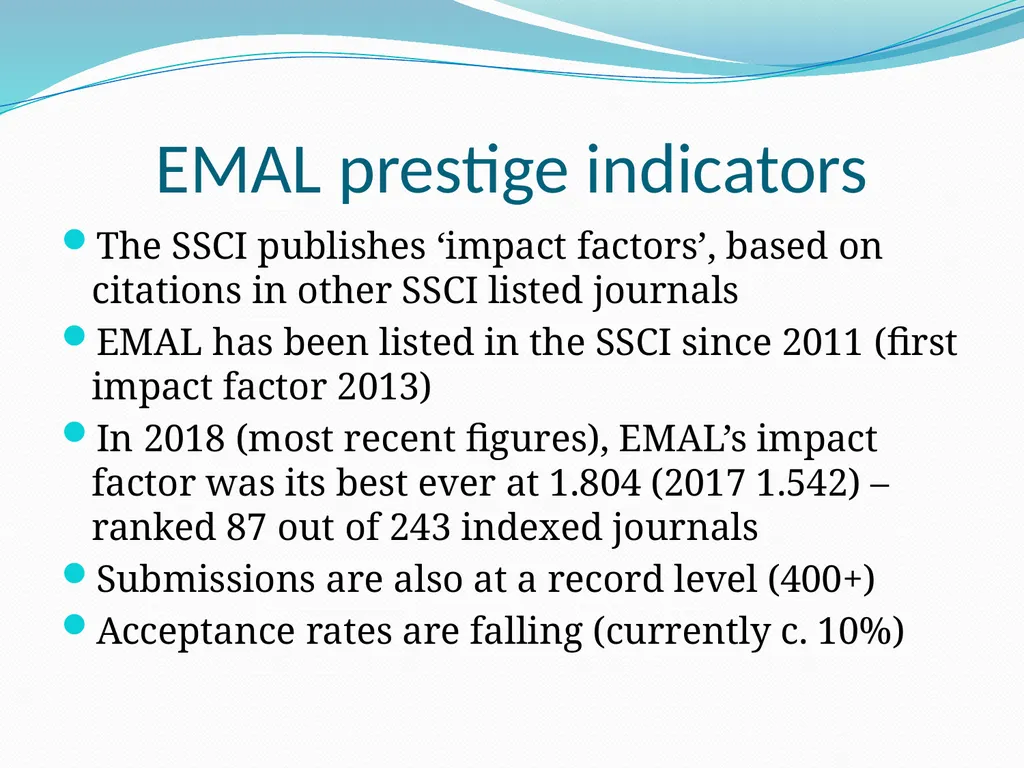
EMAL prestige indicators The SSCI publishes ‘impact factors’, based on citations in other SSCI listed journals
EMAL has been listed in the SSCI since 2011 (first impact factor 2013)
In 2018 (most recent figures), EMAL’s impact factor was its best ever at 1.804 (2017 1.542) – ranked 87 out of 243 indexed journals
Submissions are also at a record level (400+)
Acceptance rates are falling (currently c. 10%)<br>
06
How to prepare publishable papers Target your journal carefully – does the scope fit your manuscript?
EMAL often receives papers unconnected to leadership or management
Very high technical quality – no ‘typos’
Clear explanation of the purpose of the paper
Sound review of previous research & literature
Careful explanation of methods
Clear presentation and discussion of findings
Link findings to previous research & literature<br>
07
Journals decision process: pre-review Submission via Manuscript Central
Papers go to the editor for initial decisions
Perhaps rejected at this stage because:
Paper does not fit the journal’s scope
Weak presentation and grammar
Inadequate methods
No systematic literature review
Few links between data and literature
For EMAL, 20% of papers rejected at this stage
Careful paper preparation is required<br>
08
Journals decision-process: referees Typically two or three referees per paper
One with specific subject knowledge
One with specific contextual knowledge
Reviews are ‘double blind’
Referees are unpaid, so allocating referees is not a straightforward process – may be delays
Patience is required while reports are received<br>
09
Journals decision-process: reports Reports to the editor and the author(s)
First decision options: accept, minor revision, major revision, reject
‘Accept’ is very rare - only 4 of my 80+ papers
‘Reject’ decisions depend on paper quality and journal capacity – EMAL’s accept rate is 10%
‘Revision’ outcomes ‘normal’ – perseverance is required to revise and resubmit; perhaps more than once (stay in the game)<br>
10
Journals decision process: resubmissions Revised papers usually sent to same referees
Authors should explain how they have responded to the initial comments
The same decision options are available to the editor – so further revisions may be required
If not rejected, persevere<br>
11
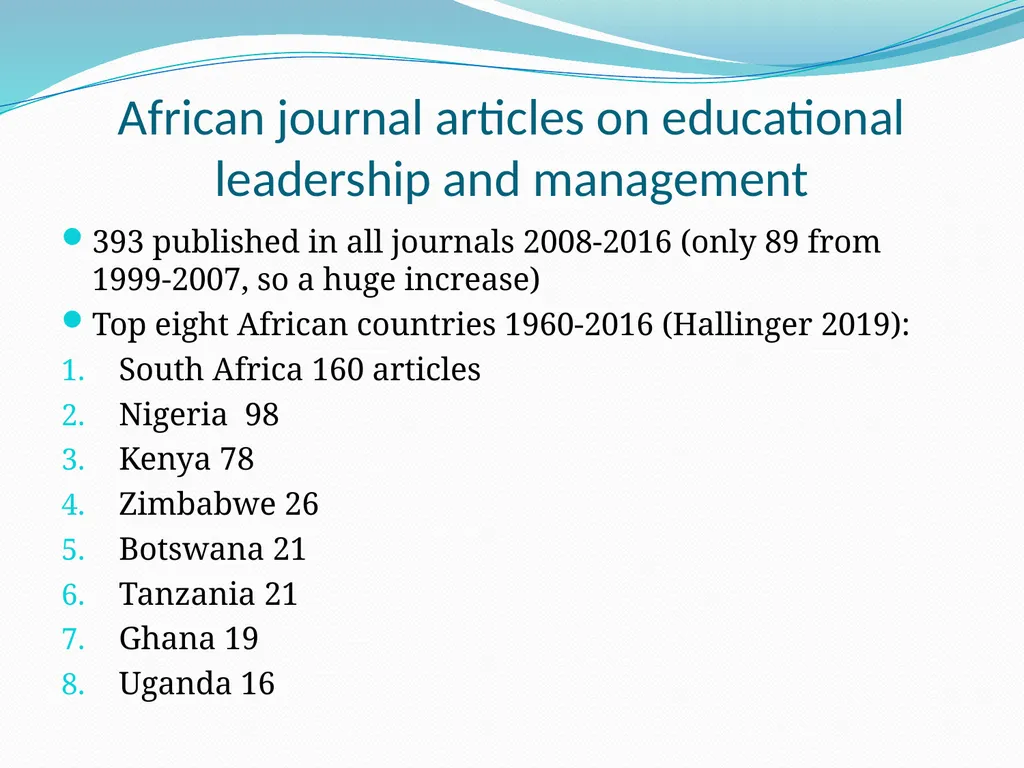
African journal articles on educational leadership and management 393 published in all journals 2008-2016 (only 89 from 1999-2007, so a huge increase)
Top eight African countries 1960-2016 (Hallinger 2019):
South Africa 160 articles
Nigeria 98
Kenya 78
Zimbabwe 26
Botswana 21
Tanzania 21
Ghana 19
Uganda 16<br>
12
Conclusion: Advancing African Research and Publications Substantial growth in research outputs recently but from a low base
Partnerships within and beyond Africa vital to develop research capacity and capability – showing the value of this workshop
I intend to address this issue in my lecture on educational leadership and management in the Commonwealth (29 November in London)
I am happy to answer any questions<br>