Punishment and sanctioning, should there be a finding of responsibility or a disciplinary action agreement Disciplinary Action Agreement If the response is responsible or no contest, the respondent will enter a disciplinary action agreement
"Punishment and sanctioning, should there be a" is the property of its rightful owner. Permission is granted to
download and print the materials on this website for personal, non-commercial use only, and to display it
on your personal computer provided you do not modify the materials and that you retain all copyright
notices contained in the materials. By downloading content from our website, you accept the terms of this
agreement.
Share
Embed code
Presentation Transcript
01
Punishment and sanctioning, should there be a finding of responsibility or a disciplinary action agreement<br>
02
Disciplinary Action Agreement If the response is responsible or no contest, the respondent will enter a disciplinary action agreement and the matter referred directly to the Sanctioning Officer
Both students may submit an impact statement
Sanctioning Officer will review the impact statement and the investigative report, before issuing the sanction
Once issued, the respondent will review and sign the disciplinary action agreement, constituting a waiver of the right to a hearing and any appeal, and an acceptance of the finding(s) and sanction(s)<br>
03
Purpose of Sanction Task is to implement a discipline that you deem fair and appropriate under the circumstances
Focus on the facts of the case before you and any relevant background you receive about the parties
Consider whether the discipline is “adequate to protect the safety of the campus community” and is “[r]eflective of the seriousness of gender-based misconduct.”
Consider all the other factors that were covered in this presentation
But do not try and solve the overall problem of sexual assault on college campuses with the disciplinary determination in one particular case<br>
04
Role of a Disciplinary Officer The Sexual Misconduct Procedures under the EOAA Policy require that the University designate Disciplinary Officers.
If a Respondent is found responsible for a violation of the Policy a Disciplinary Officer determines what discipline is to be imposed.
EOAA, with our partner offices, provides training to Disciplinary Officers and is a resource during the disciplinary process.
The Disciplinary Officer must render a decision within 10 business days of the issuance of a final EOAA report.
The Disciplinary Officer communicates the decision, in writing, to the Complainant and the Respondent.<br>
05
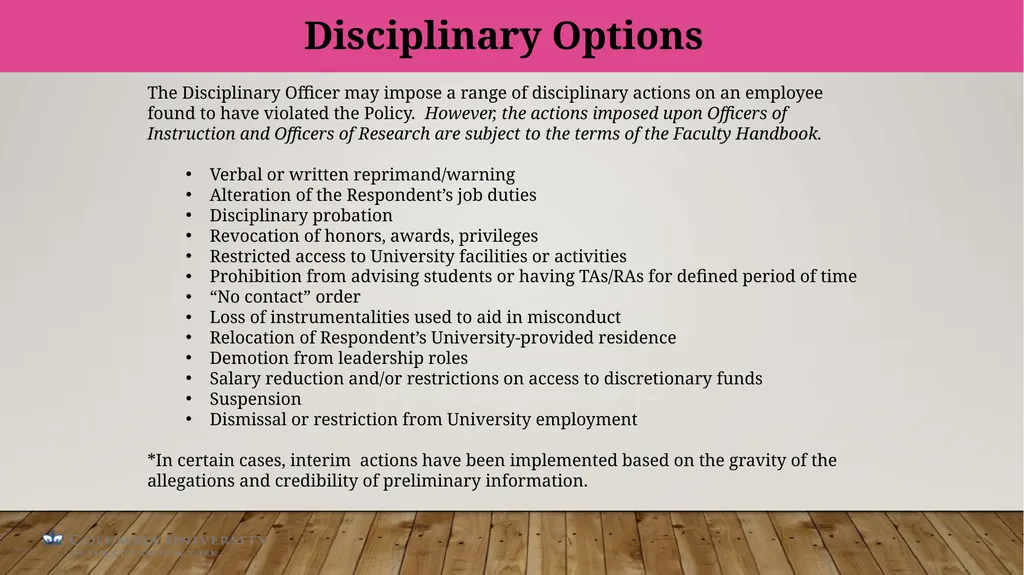
The Disciplinary Officer may impose a range of disciplinary actions on an employee found to have violated the Policy. However, the actions imposed upon Officers of Instruction and Officers of Research are subject to the terms of the Faculty Handbook.
Verbal or written reprimand/warning
Alteration of the Respondent’s job duties
Disciplinary probation
Revocation of honors, awards, privileges
Restricted access to University facilities or activities
Prohibition from advising students or having TAs/RAs for defined period of time
“No contact” order
Loss of instrumentalities used to aid in misconduct
Relocation of Respondent’s University-provided residence
Demotion from leadership roles
Salary reduction and/or restrictions on access to discretionary funds
Suspension
Dismissal or restriction from University employment
*In certain cases, interim actions have been implemented based on the gravity of the allegations and credibility of preliminary information. Disciplinary Options<br>
06
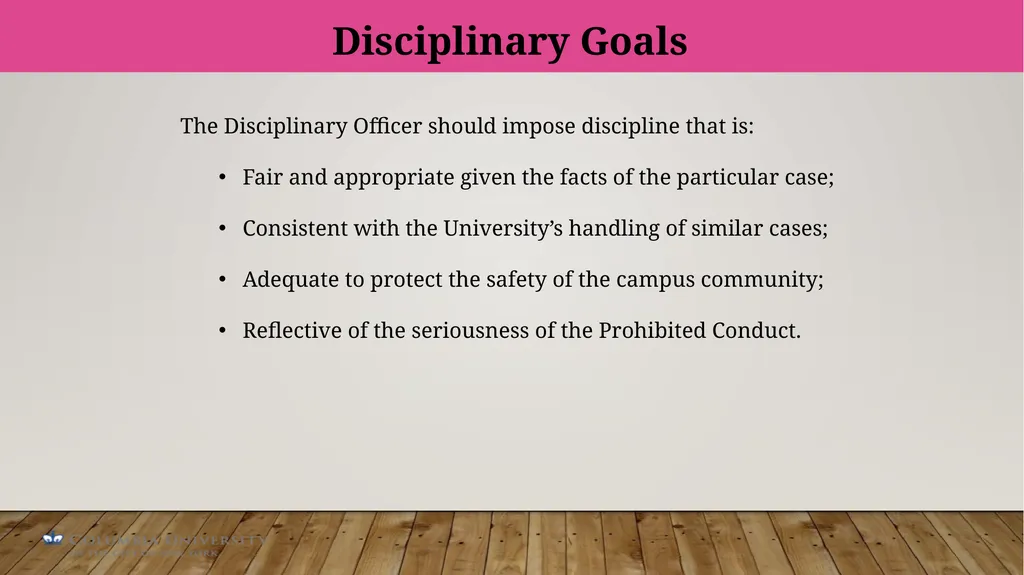
Disciplinary Goals The Disciplinary Officer should impose discipline that is:
Fair and appropriate given the facts of the particular case;
Consistent with the University’s handling of similar cases;
Adequate to protect the safety of the campus community;
Reflective of the seriousness of the Prohibited Conduct.<br>
07
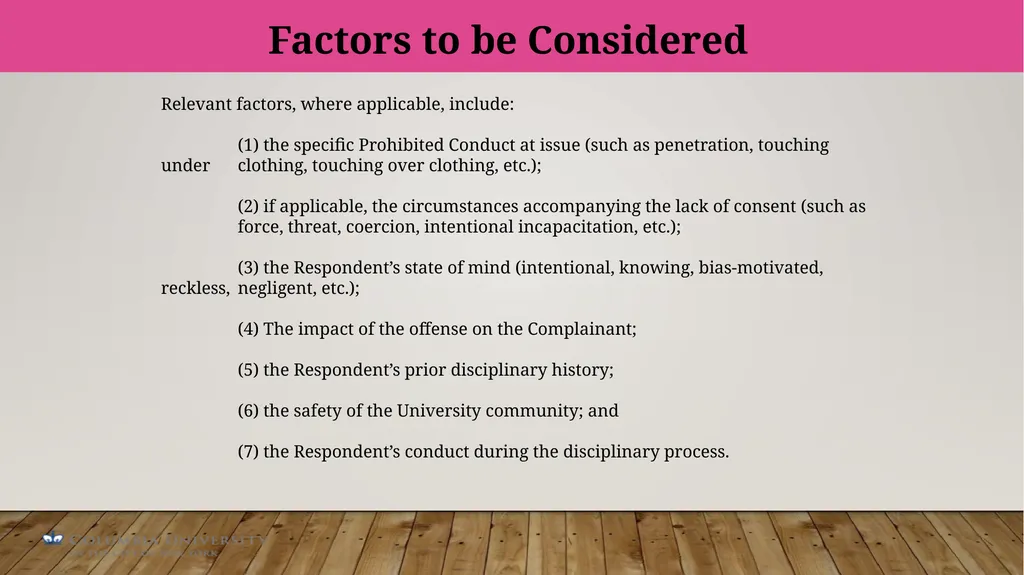
Factors to be Considered Relevant factors, where applicable, include:
(1) the specific Prohibited Conduct at issue (such as penetration, touching under clothing, touching over clothing, etc.);
(2) if applicable, the circumstances accompanying the lack of consent (such as
force, threat, coercion, intentional incapacitation, etc.);
(3) the Respondent’s state of mind (intentional, knowing, bias-motivated, reckless, negligent, etc.);
(4) The impact of the offense on the Complainant;
(5) the Respondent’s prior disciplinary history;
(6) the safety of the University community; and
(7) the Respondent’s conduct during the disciplinary process.<br>
08
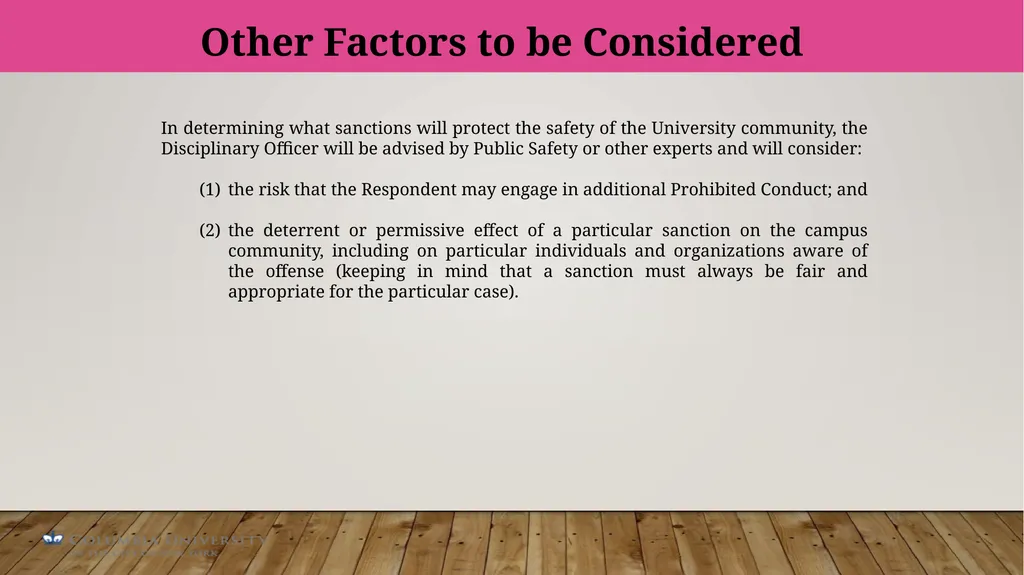
Other Factors to be Considered In determining what sanctions will protect the safety of the University community, the Disciplinary Officer will be advised by Public Safety or other experts and will consider:
the risk that the Respondent may engage in additional Prohibited Conduct; and
the deterrent or permissive effect of a particular sanction on the campus community, including on particular individuals and organizations aware of the offense (keeping in mind that a sanction must always be fair and appropriate for the particular case).<br>
09
Rehabilitative Efforts In addition to any other discipline (except dismissal), the University will require any employee determined to be responsible for Prohibited Conduct to receive appropriate education and/or training related to the Prohibited Conduct at issue. The University may also recommend counseling or other support services for an employee.<br>
10
Additional Responses The University may also determine that additional measures are appropriate to respond to the effects of the incident on the University community. Additional responses for the benefit of the University community may include:
Increased monitoring, supervision, or security at locations or activities where the Prohibited Conduct occurred
Additional training and educational materials for employees