
Putting Prevention into Practice Canadian Task
TF
Published · 46 slides · 0 views
1 / 1
Description
Putting Prevention into Practice Canadian Task Force on Preventive Health Care Groupe détude canadien sur les soins de santé préventifs Obesity in Adults Prevention and Management Recommendations 2015 Canadian Task Force on Preventive
Related Topics
Share
Embed code
Download this presentation From Below
"Putting Prevention into Practice Canadian Task" is the property of its rightful owner. Permission is granted to download and print the materials on this website for personal, non-commercial use only, and to display it on your personal computer provided you do not modify the materials and that you retain all copyright notices contained in the materials. By downloading content from our website, you accept the terms of this agreement.
Presentation Transcript
01
Putting Prevention
into Practice Canadian Task Force on Preventive Health Care
Groupe d’étude canadien sur les soins de santé préventifs Obesity in Adults
Prevention and Management
Recommendations 2015
Canadian Task Force on Preventive Health Care<br>
02
Use of deck These slides are made available publicly as a another vehicle for dissemination of the practice guidelines.
Some or all of the slides may be used with attribution in educational contexts.
Guidelines were published online January 26, 2015 2<br>
Some or all of the slides may be used with attribution in educational contexts.
Guidelines were published online January 26, 2015 2<br>
03
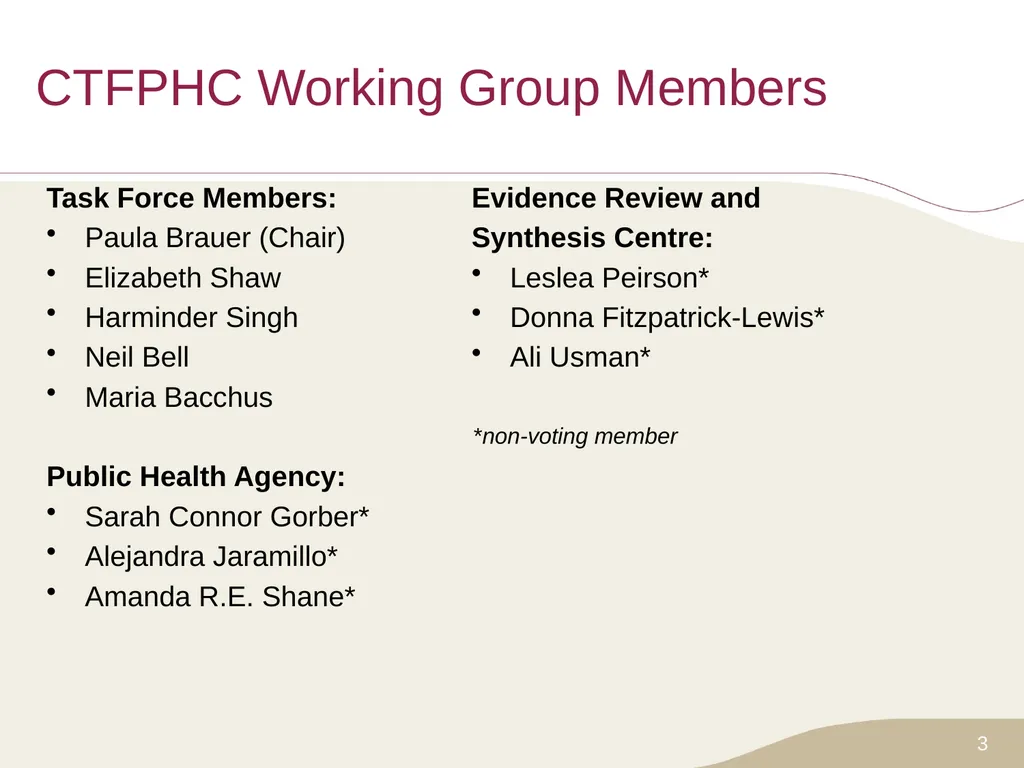
CTFPHC Working Group Members Task Force Members:
Paula Brauer (Chair)
Elizabeth Shaw
Harminder Singh
Neil Bell
Maria Bacchus
Public Health Agency:
Sarah Connor Gorber*
Alejandra Jaramillo*
Amanda R.E. Shane*
Evidence Review and
Synthesis Centre:
Leslea Peirson*
Donna Fitzpatrick-Lewis*
Ali Usman* 3 *non-voting member<br>
Paula Brauer (Chair)
Elizabeth Shaw
Harminder Singh
Neil Bell
Maria Bacchus
Public Health Agency:
Sarah Connor Gorber*
Alejandra Jaramillo*
Amanda R.E. Shane*
Evidence Review and
Synthesis Centre:
Leslea Peirson*
Donna Fitzpatrick-Lewis*
Ali Usman* 3 *non-voting member<br>
04
Overview of Presentation Background on Adult Obesity Prevention and Management
Methods of the CTFPHC
Recommendations and Key Findings
Implementation of Recommendations
Other Guidelines on Adult Obesity
Conclusions and Future Directions
KT Tools
Questions and Answers 4<br>
Methods of the CTFPHC
Recommendations and Key Findings
Implementation of Recommendations
Other Guidelines on Adult Obesity
Conclusions and Future Directions
KT Tools
Questions and Answers 4<br>
05
Background Over two thirds of Canadian men (68%) and more than half of Canadian women (54%) are overweight or obese
About two thirds of adults who are overweight and obese were in the healthy weight range as adolescents, but gained weight in adulthood (about 0.5-1.0 kg/2 years on average)
The causes of obesity are complex (biological, behavioural, social and environmental factors interact)
Excess weight is a well-recognized risk factor for several common chronic conditions 5<br>
About two thirds of adults who are overweight and obese were in the healthy weight range as adolescents, but gained weight in adulthood (about 0.5-1.0 kg/2 years on average)
The causes of obesity are complex (biological, behavioural, social and environmental factors interact)
Excess weight is a well-recognized risk factor for several common chronic conditions 5<br>
06
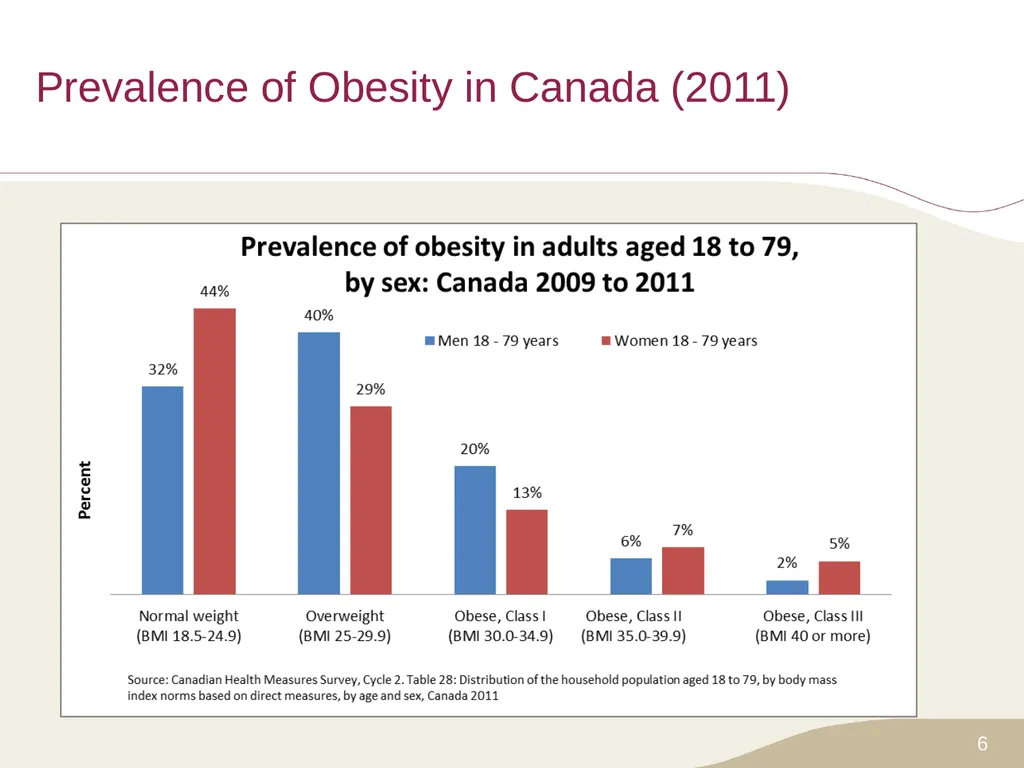
Prevalence of Obesity in Canada (2011) 6<br>
07
Adult Obesity Prevention and Management Guidelines Objectives Two separate guidelines were developed. These guidelines do not apply to those with a BMI >40 who may benefit from specialized services.
Obesity Prevention: Recommendations for prevention of weight gain among adults in primary care
Objective: Provide evidence-based recommendations for structured interventions aimed at preventing weight gain in adults of normal weight
Obesity Management: Recommendations on using behavioural and/or pharmacological interventions to manage overweight and obesity in adults in primary care
Objective: Provide evidence-based recommendations for behavioural and pharmacological interventions for weight loss and other indicators to manage overweight and obesity in adults, including those at risk of Type 2 Diabetes 7<br>
Obesity Prevention: Recommendations for prevention of weight gain among adults in primary care
Objective: Provide evidence-based recommendations for structured interventions aimed at preventing weight gain in adults of normal weight
Obesity Management: Recommendations on using behavioural and/or pharmacological interventions to manage overweight and obesity in adults in primary care
Objective: Provide evidence-based recommendations for behavioural and pharmacological interventions for weight loss and other indicators to manage overweight and obesity in adults, including those at risk of Type 2 Diabetes 7<br>
08
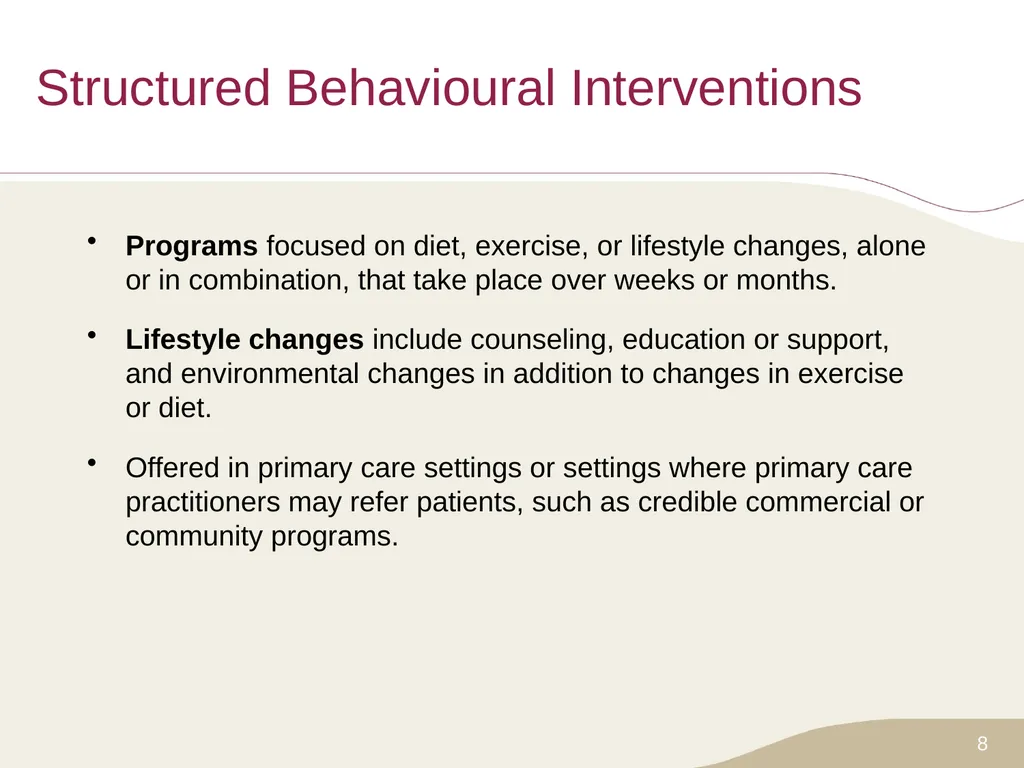
Structured Behavioural Interventions Programs focused on diet, exercise, or lifestyle changes, alone or in combination, that take place over weeks or months.
Lifestyle changes include counseling, education or support, and environmental changes in addition to changes in exercise or diet.
Offered in primary care settings or settings where primary care practitioners may refer patients, such as credible commercial or community programs. 8<br>
Lifestyle changes include counseling, education or support, and environmental changes in addition to changes in exercise or diet.
Offered in primary care settings or settings where primary care practitioners may refer patients, such as credible commercial or community programs. 8<br>
09
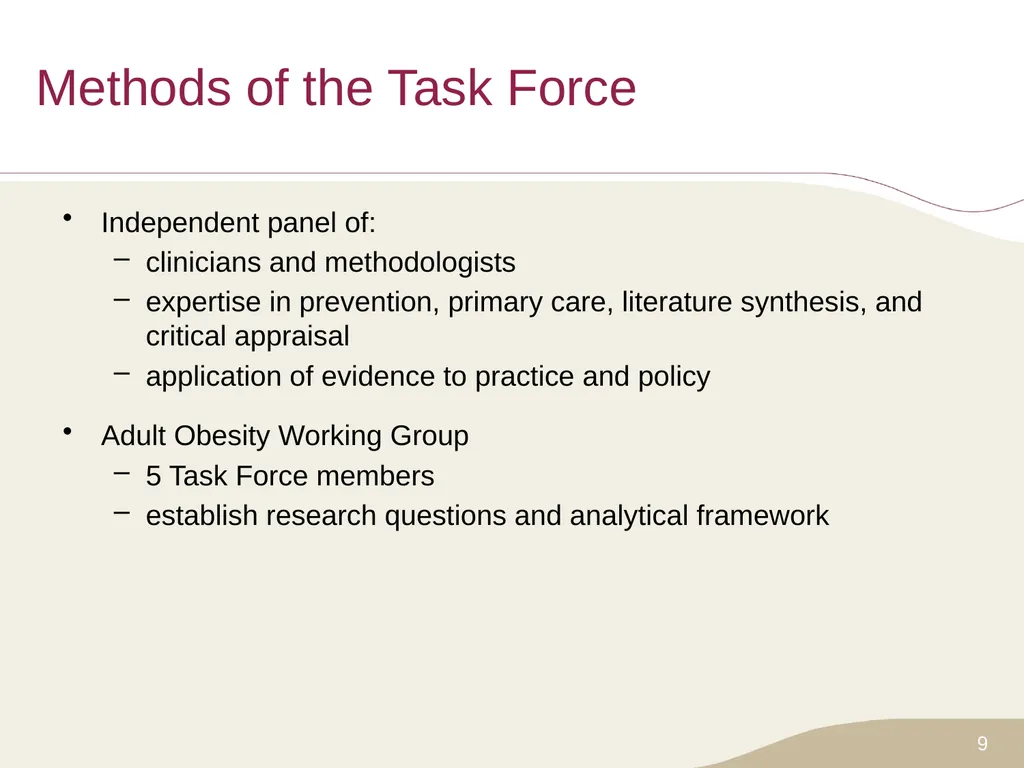
Methods of the Task Force Independent panel of:
clinicians and methodologists
expertise in prevention, primary care, literature synthesis, and critical appraisal
application of evidence to practice and policy
Adult Obesity Working Group
5 Task Force members
establish research questions and analytical framework 9<br>
clinicians and methodologists
expertise in prevention, primary care, literature synthesis, and critical appraisal
application of evidence to practice and policy
Adult Obesity Working Group
5 Task Force members
establish research questions and analytical framework 9<br>
10
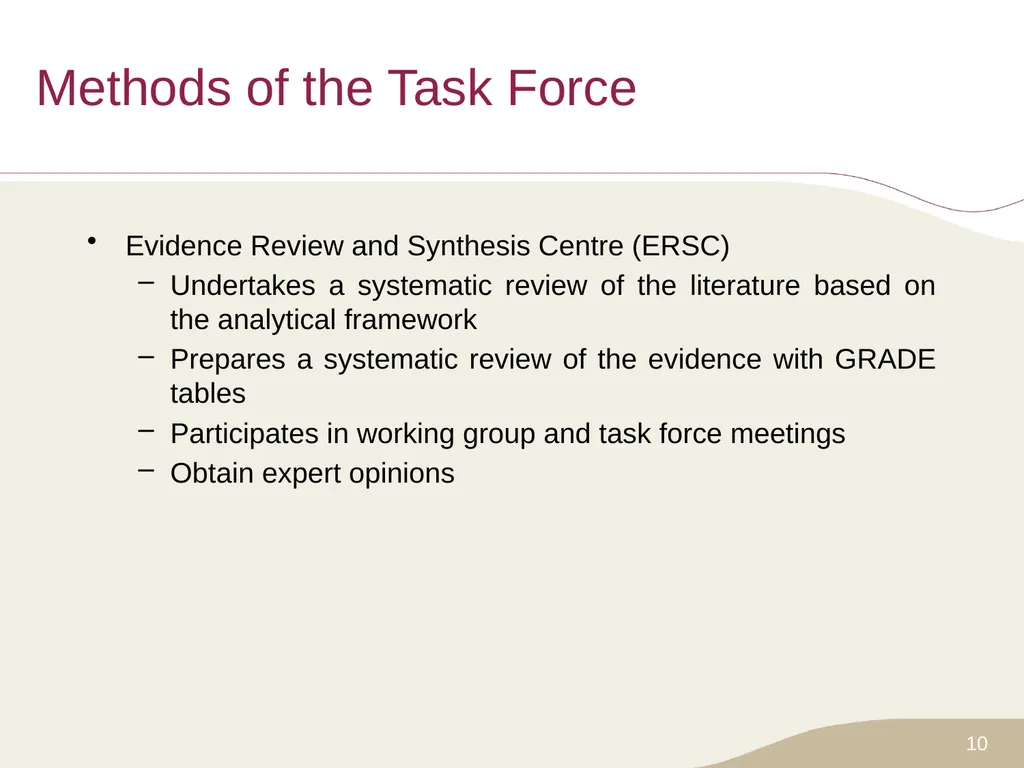
Methods of the Task Force Evidence Review and Synthesis Centre (ERSC)
Undertakes a systematic review of the literature based on the analytical framework
Prepares a systematic review of the evidence with GRADE tables
Participates in working group and task force meetings
Obtain expert opinions 10<br>
Undertakes a systematic review of the literature based on the analytical framework
Prepares a systematic review of the evidence with GRADE tables
Participates in working group and task force meetings
Obtain expert opinions 10<br>
11
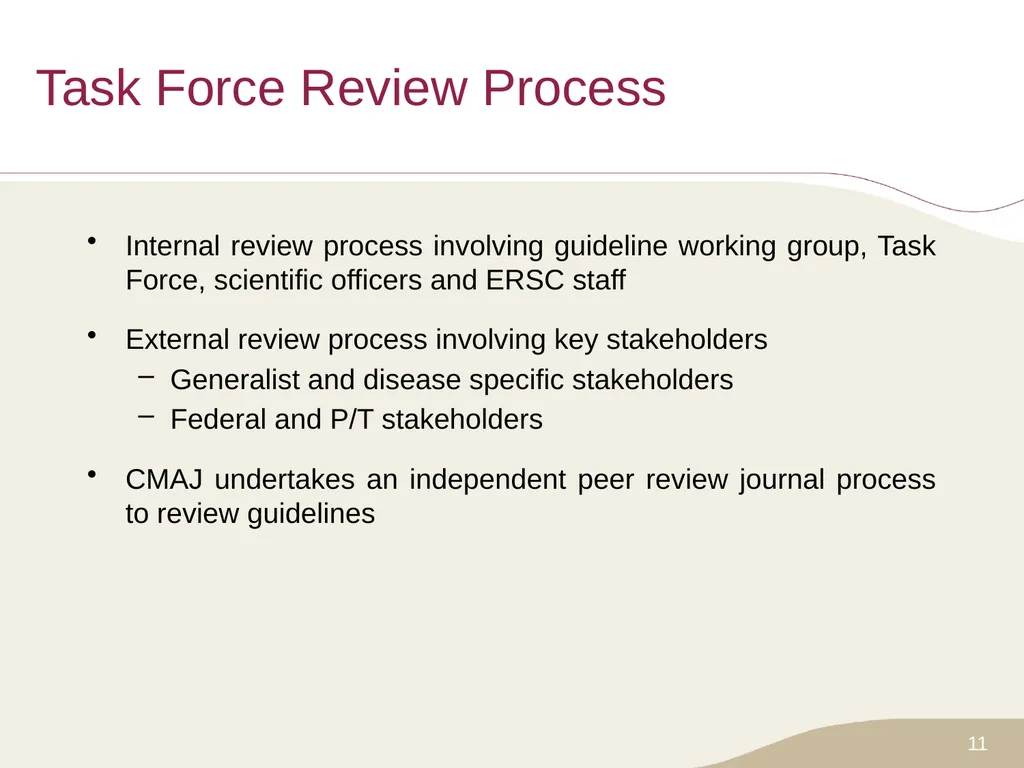
Task Force Review Process Internal review process involving guideline working group, Task Force, scientific officers and ERSC staff
External review process involving key stakeholders
Generalist and disease specific stakeholders
Federal and P/T stakeholders
CMAJ undertakes an independent peer review journal process to review guidelines 11<br>
External review process involving key stakeholders
Generalist and disease specific stakeholders
Federal and P/T stakeholders
CMAJ undertakes an independent peer review journal process to review guidelines 11<br>
12
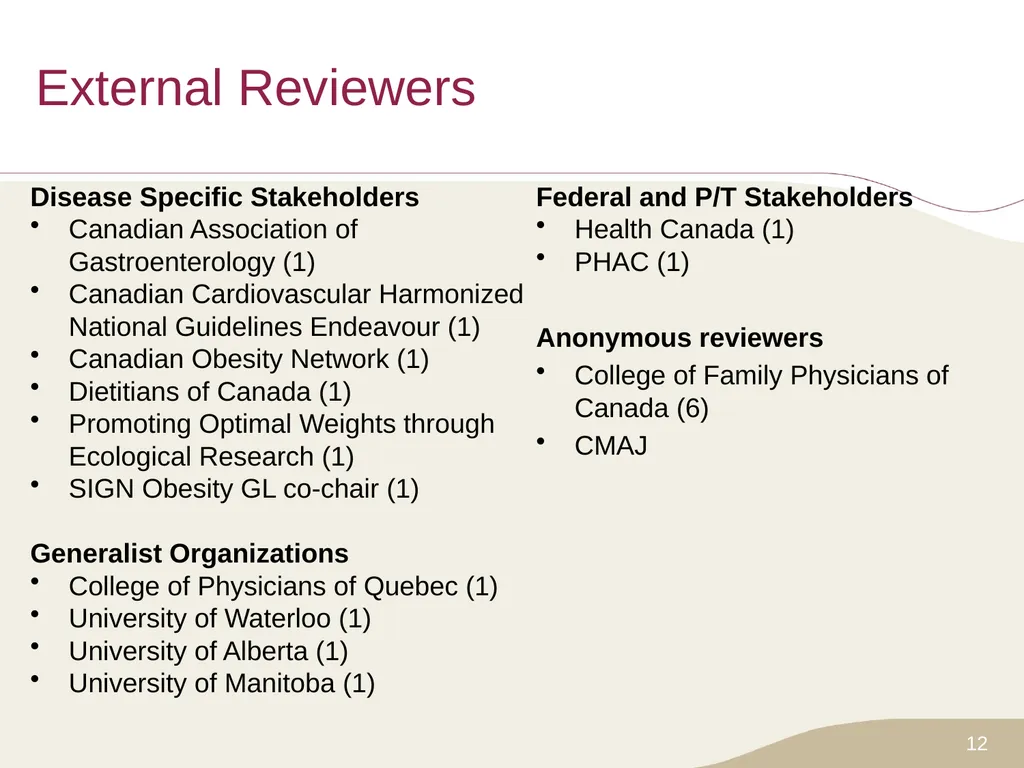
External Reviewers Disease Specific Stakeholders
Canadian Association of Gastroenterology (1)
Canadian Cardiovascular Harmonized National Guidelines Endeavour (1)
Canadian Obesity Network (1)
Dietitians of Canada (1)
Promoting Optimal Weights through Ecological Research (1)
SIGN Obesity GL co-chair (1)
Generalist Organizations
College of Physicians of Quebec (1)
University of Waterloo (1)
University of Alberta (1)
University of Manitoba (1)
Federal and P/T Stakeholders
Health Canada (1)
PHAC (1)
Anonymous reviewers
College of Family Physicians of Canada (6)
CMAJ 12<br>
Canadian Association of Gastroenterology (1)
Canadian Cardiovascular Harmonized National Guidelines Endeavour (1)
Canadian Obesity Network (1)
Dietitians of Canada (1)
Promoting Optimal Weights through Ecological Research (1)
SIGN Obesity GL co-chair (1)
Generalist Organizations
College of Physicians of Quebec (1)
University of Waterloo (1)
University of Alberta (1)
University of Manitoba (1)
Federal and P/T Stakeholders
Health Canada (1)
PHAC (1)
Anonymous reviewers
College of Family Physicians of Canada (6)
CMAJ 12<br>
13
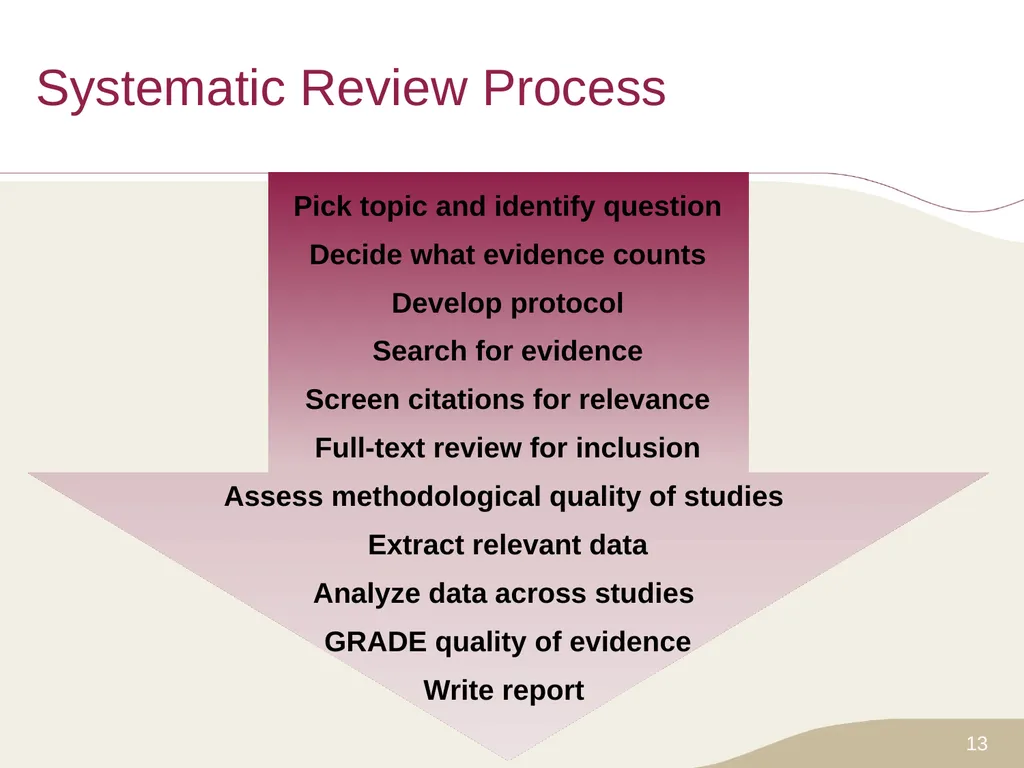
Systematic Review Process Pick topic and identify question
Decide what evidence counts
Develop protocol
Search for evidence
Screen citations for relevance
Full-text review for inclusion
Assess methodological quality of studies
Extract relevant data
Analyze data across studies
GRADE quality of evidence
Write report 13<br>
Decide what evidence counts
Develop protocol
Search for evidence
Screen citations for relevance
Full-text review for inclusion
Assess methodological quality of studies
Extract relevant data
Analyze data across studies
GRADE quality of evidence
Write report 13<br>
14
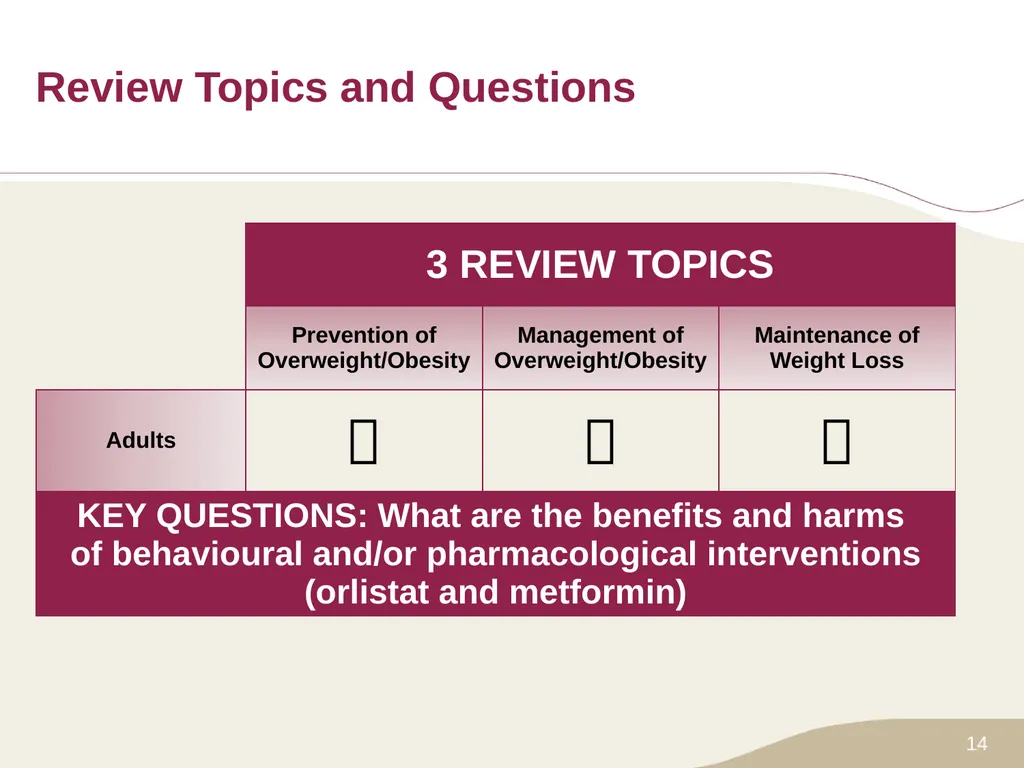
Review Topics and Questions 14<br>
15
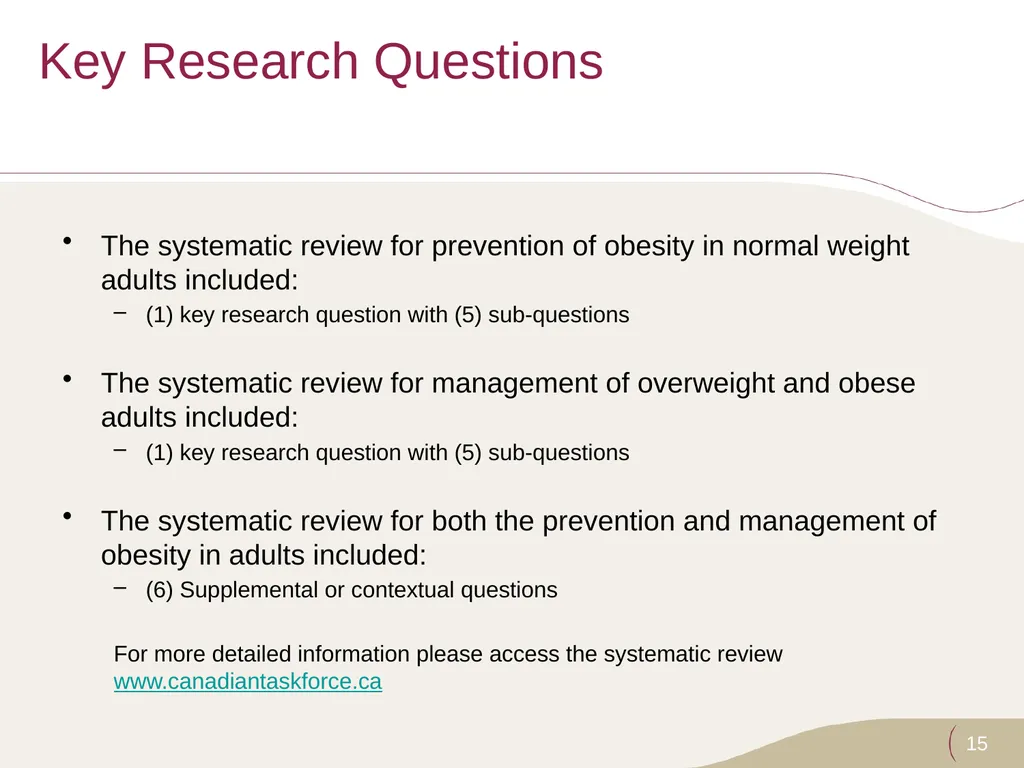
Key Research Questions The systematic review for prevention of obesity in normal weight adults included:
(1) key research question with (5) sub-questions
The systematic review for management of overweight and obese adults included:
(1) key research question with (5) sub-questions
The systematic review for both the prevention and management of obesity in adults included:
(6) Supplemental or contextual questions
For more detailed information please access the systematic review www.canadiantaskforce.ca 15<br>
(1) key research question with (5) sub-questions
The systematic review for management of overweight and obese adults included:
(1) key research question with (5) sub-questions
The systematic review for both the prevention and management of obesity in adults included:
(6) Supplemental or contextual questions
For more detailed information please access the systematic review www.canadiantaskforce.ca 15<br>
16
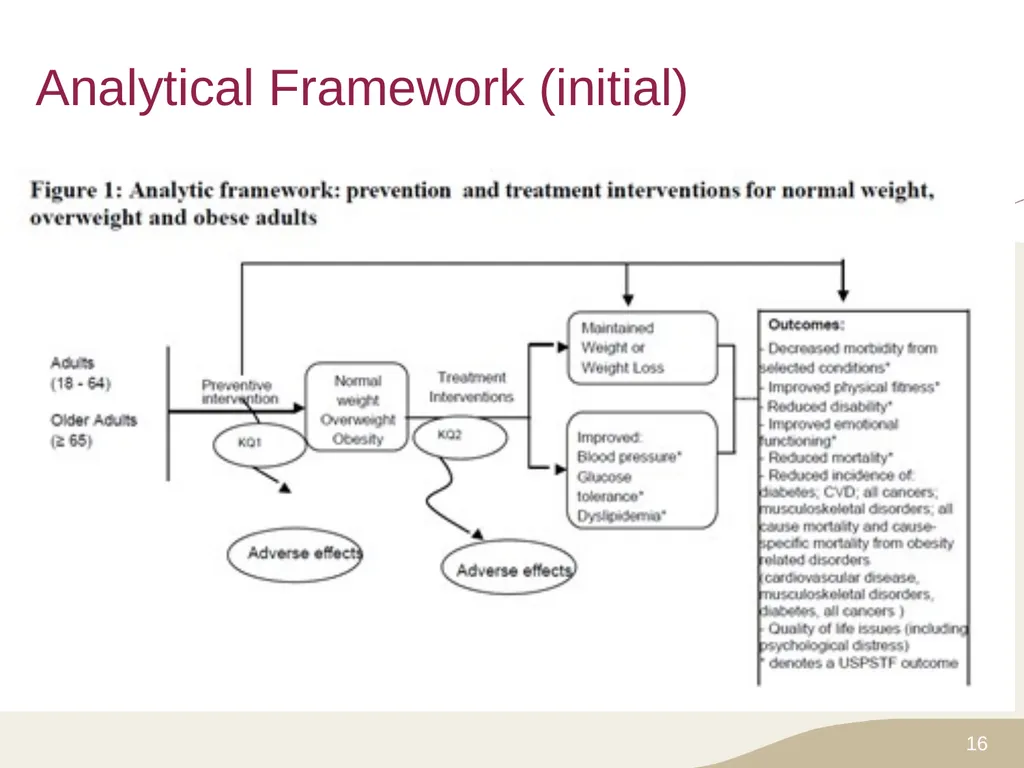
Analytical Framework (initial) 16<br>
17
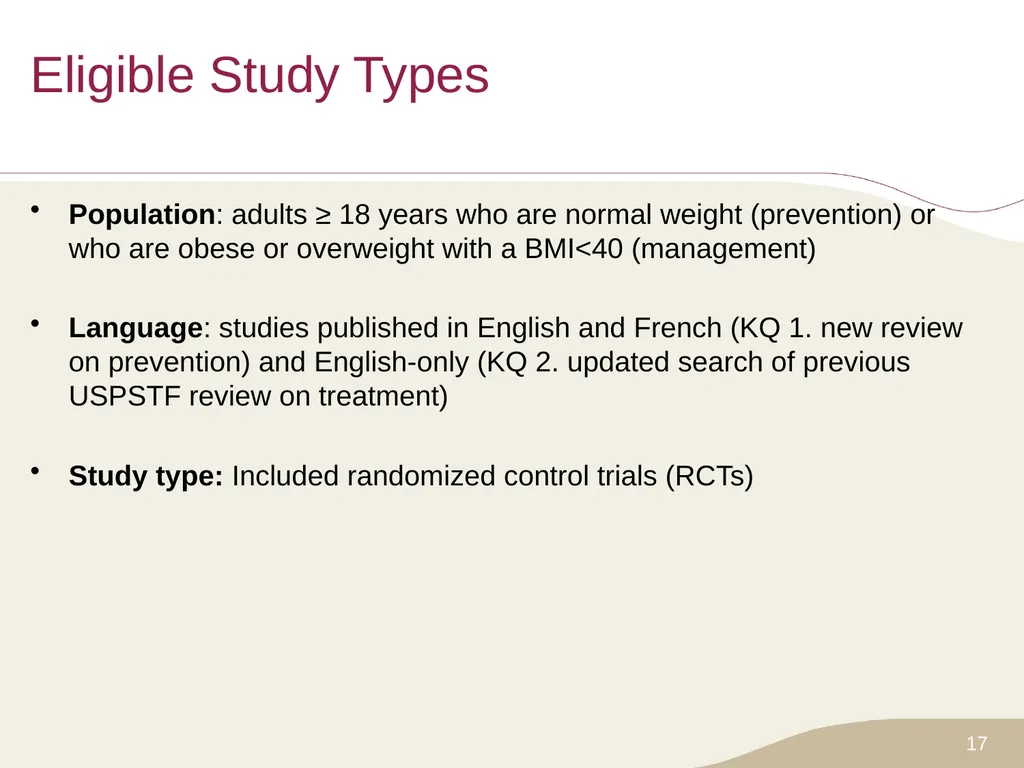
Eligible Study Types Population: adults ≥ 18 years who are normal weight (prevention) or who are obese or overweight with a BMI<40 (management)
Language: studies published in English and French (KQ 1. new review on prevention) and English-only (KQ 2. updated search of previous USPSTF review on treatment)
Study type: Included randomized control trials (RCTs) 17<br>
Language: studies published in English and French (KQ 1. new review on prevention) and English-only (KQ 2. updated search of previous USPSTF review on treatment)
Study type: Included randomized control trials (RCTs) 17<br>
18
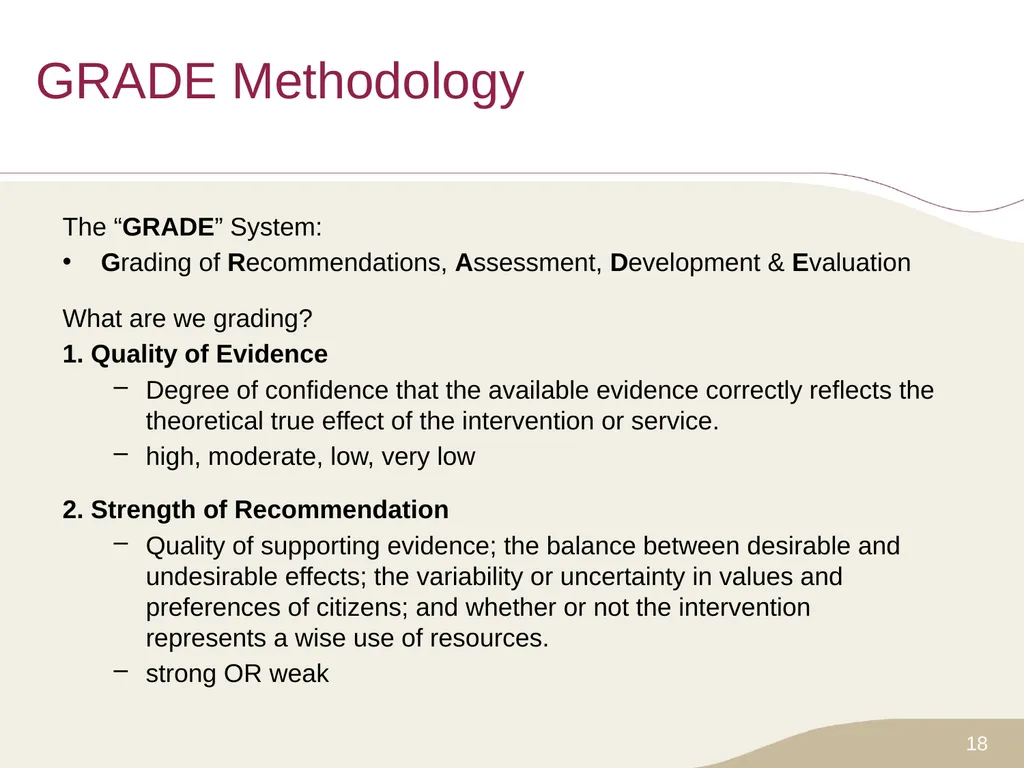
GRADE Methodology The “GRADE” System:
Grading of Recommendations, Assessment, Development & Evaluation
What are we grading?
1. Quality of Evidence
Degree of confidence that the available evidence correctly reflects the theoretical true effect of the intervention or service.
high, moderate, low, very low
2. Strength of Recommendation
Quality of supporting evidence; the balance between desirable and undesirable effects; the variability or uncertainty in values and preferences of citizens; and whether or not the intervention represents a wise use of resources.
strong OR weak 18<br>
Grading of Recommendations, Assessment, Development & Evaluation
What are we grading?
1. Quality of Evidence
Degree of confidence that the available evidence correctly reflects the theoretical true effect of the intervention or service.
high, moderate, low, very low
2. Strength of Recommendation
Quality of supporting evidence; the balance between desirable and undesirable effects; the variability or uncertainty in values and preferences of citizens; and whether or not the intervention represents a wise use of resources.
strong OR weak 18<br>
19
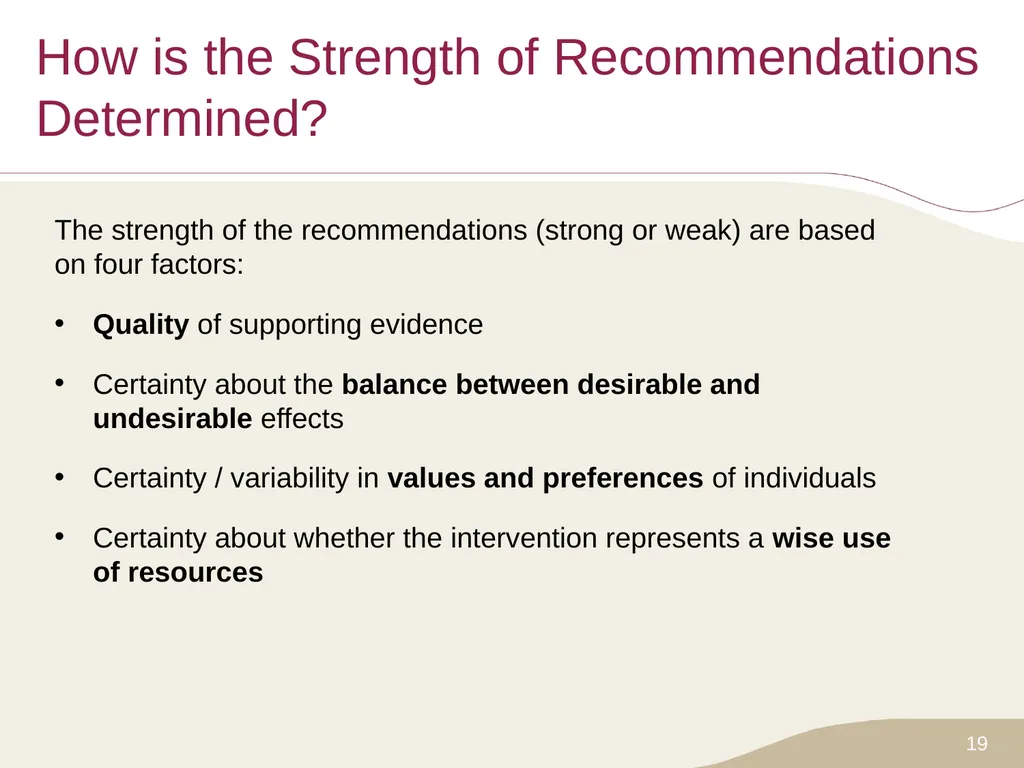
How is the Strength of Recommendations Determined? The strength of the recommendations (strong or weak) are based on four factors:
Quality of supporting evidence
Certainty about the balance between desirable and undesirable effects
Certainty / variability in values and preferences of individuals
Certainty about whether the intervention represents a wise use of resources 19<br>
Quality of supporting evidence
Certainty about the balance between desirable and undesirable effects
Certainty / variability in values and preferences of individuals
Certainty about whether the intervention represents a wise use of resources 19<br>
20
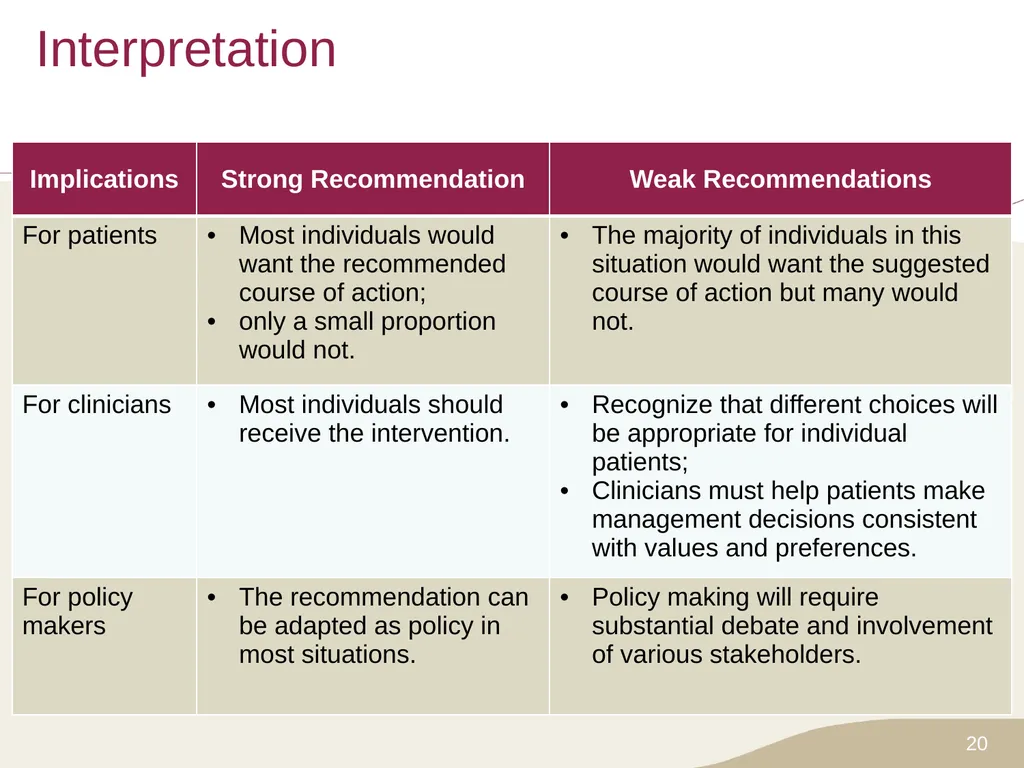
Interpretation 20<br>
21
RECOMMENDATIONS & KEY FINDINGS Adult Obesity Prevention and Management 21<br>
22
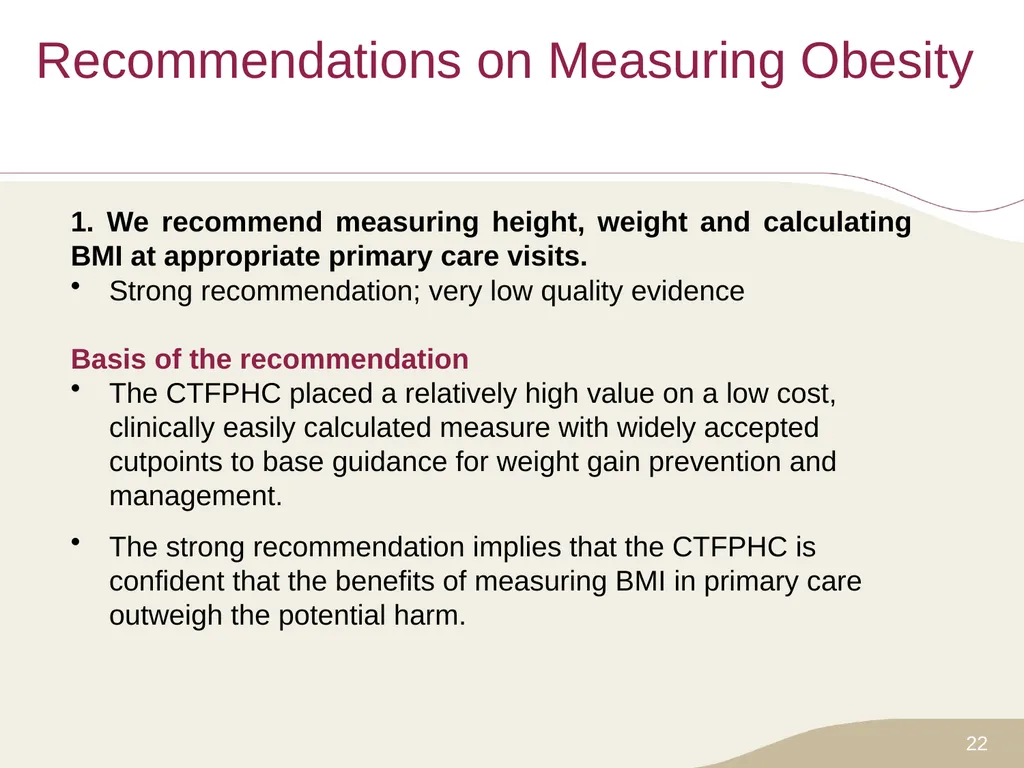
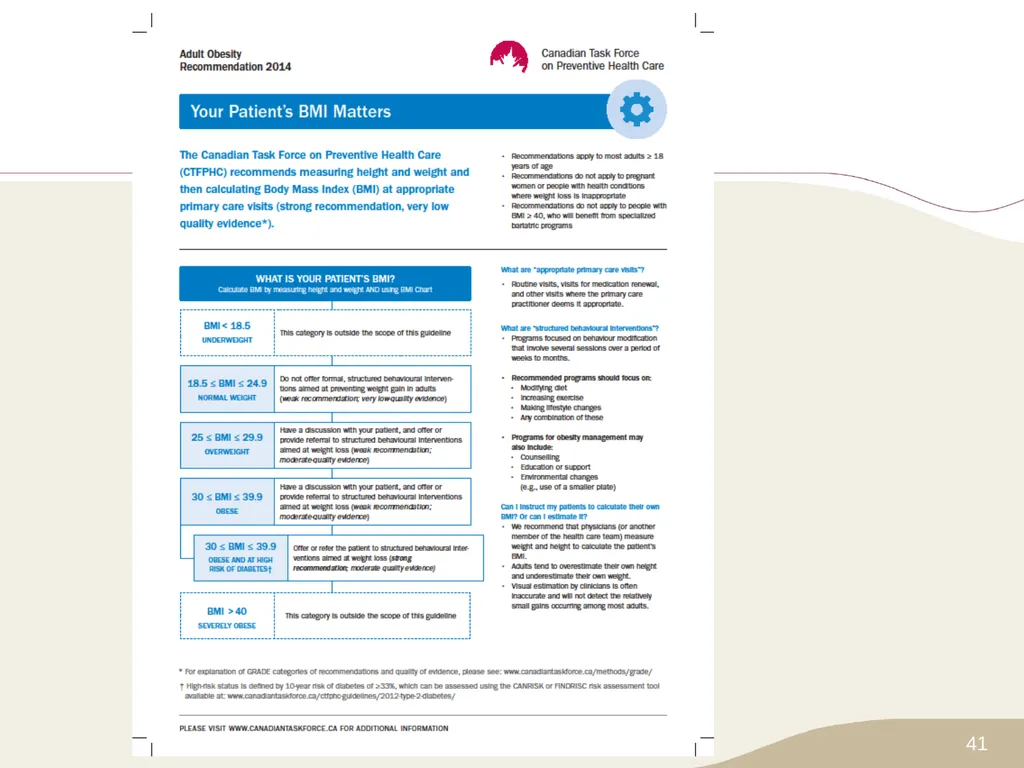
Recommendations on Measuring Obesity 1. We recommend measuring height, weight and calculating BMI at appropriate primary care visits.
Strong recommendation; very low quality evidence
Basis of the recommendation
The CTFPHC placed a relatively high value on a low cost, clinically easily calculated measure with widely accepted cutpoints to base guidance for weight gain prevention and management.
The strong recommendation implies that the CTFPHC is confident that the benefits of measuring BMI in primary care outweigh the potential harm. 22<br>
Strong recommendation; very low quality evidence
Basis of the recommendation
The CTFPHC placed a relatively high value on a low cost, clinically easily calculated measure with widely accepted cutpoints to base guidance for weight gain prevention and management.
The strong recommendation implies that the CTFPHC is confident that the benefits of measuring BMI in primary care outweigh the potential harm. 22<br>
23
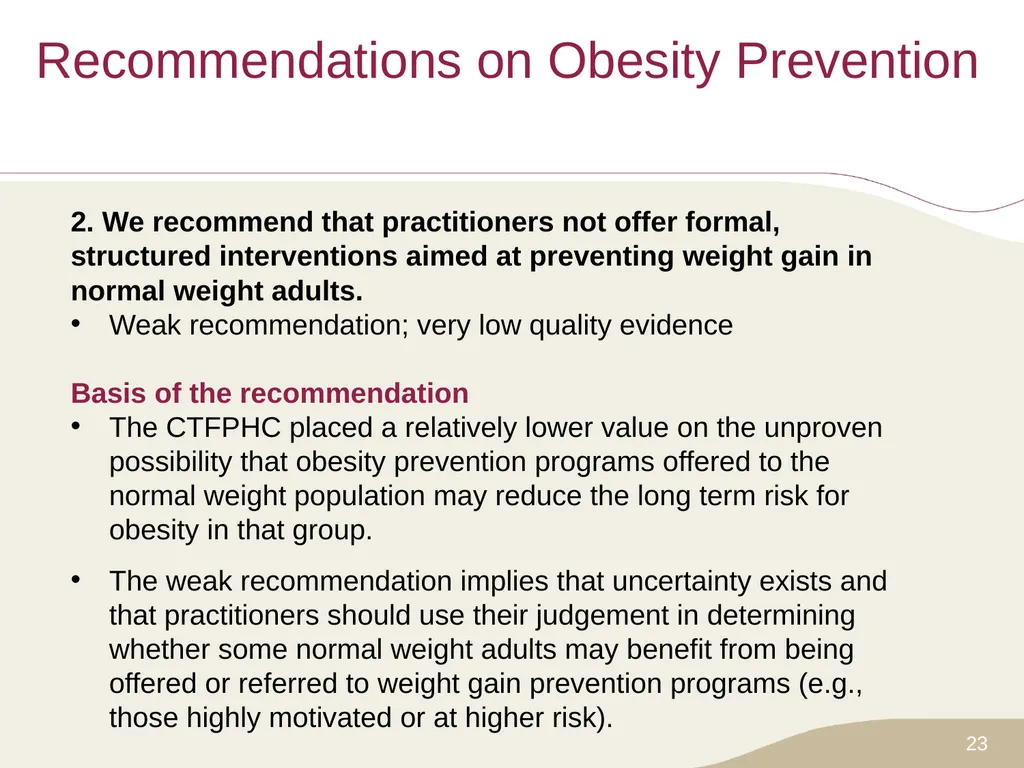
Recommendations on Obesity Prevention 2. We recommend that practitioners not offer formal, structured interventions aimed at preventing weight gain in normal weight adults.
Weak recommendation; very low quality evidence
Basis of the recommendation
The CTFPHC placed a relatively lower value on the unproven possibility that obesity prevention programs offered to the normal weight population may reduce the long term risk for obesity in that group.
The weak recommendation implies that uncertainty exists and that practitioners should use their judgement in determining whether some normal weight adults may benefit from being offered or referred to weight gain prevention programs (e.g., those highly motivated or at higher risk). 23<br>
Weak recommendation; very low quality evidence
Basis of the recommendation
The CTFPHC placed a relatively lower value on the unproven possibility that obesity prevention programs offered to the normal weight population may reduce the long term risk for obesity in that group.
The weak recommendation implies that uncertainty exists and that practitioners should use their judgement in determining whether some normal weight adults may benefit from being offered or referred to weight gain prevention programs (e.g., those highly motivated or at higher risk). 23<br>
24
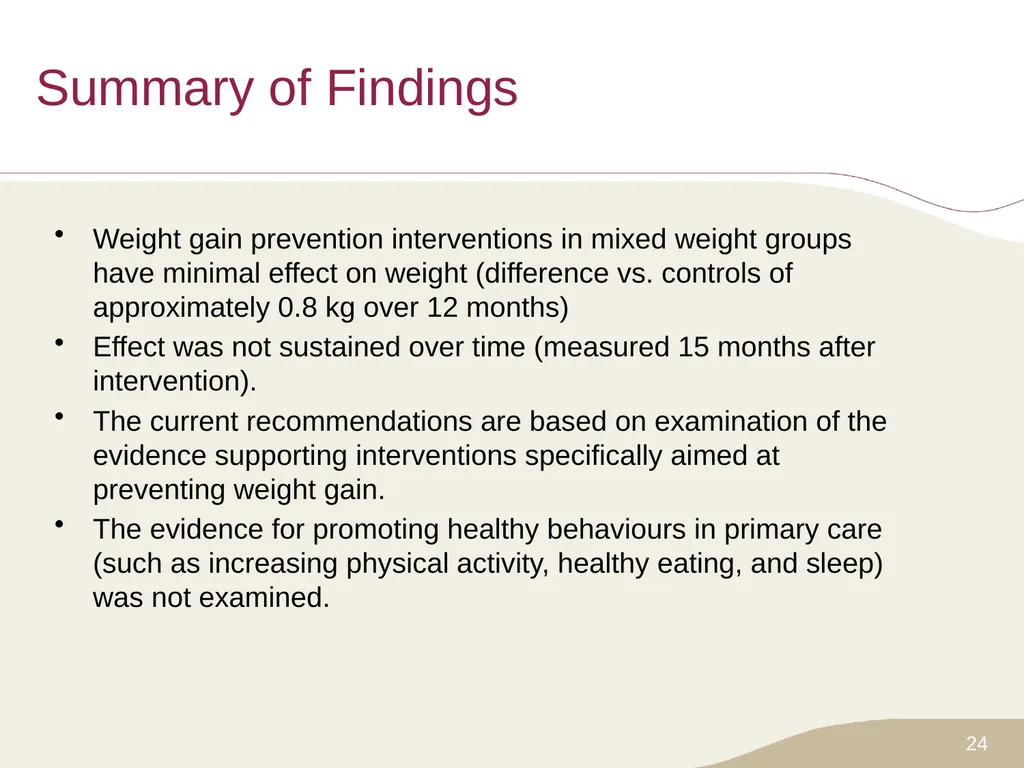
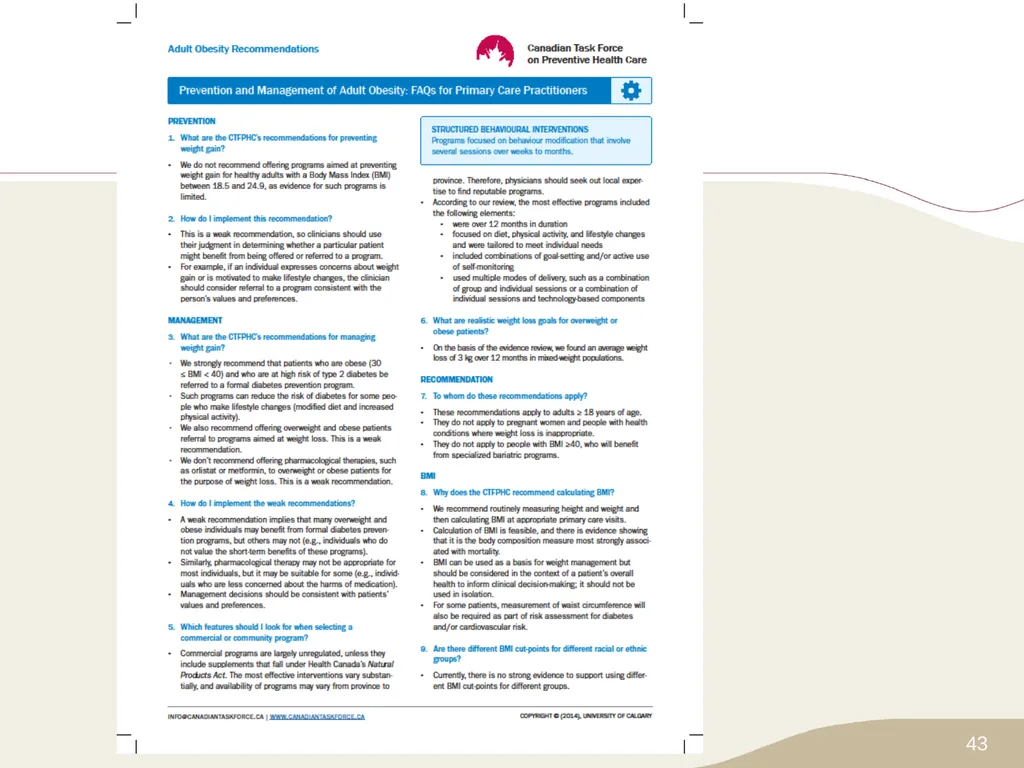
Summary of Findings Weight gain prevention interventions in mixed weight groups have minimal effect on weight (difference vs. controls of approximately 0.8 kg over 12 months)
Effect was not sustained over time (measured 15 months after intervention).
The current recommendations are based on examination of the evidence supporting interventions specifically aimed at preventing weight gain.
The evidence for promoting healthy behaviours in primary care (such as increasing physical activity, healthy eating, and sleep) was not examined. 24<br>
Effect was not sustained over time (measured 15 months after intervention).
The current recommendations are based on examination of the evidence supporting interventions specifically aimed at preventing weight gain.
The evidence for promoting healthy behaviours in primary care (such as increasing physical activity, healthy eating, and sleep) was not examined. 24<br>
25
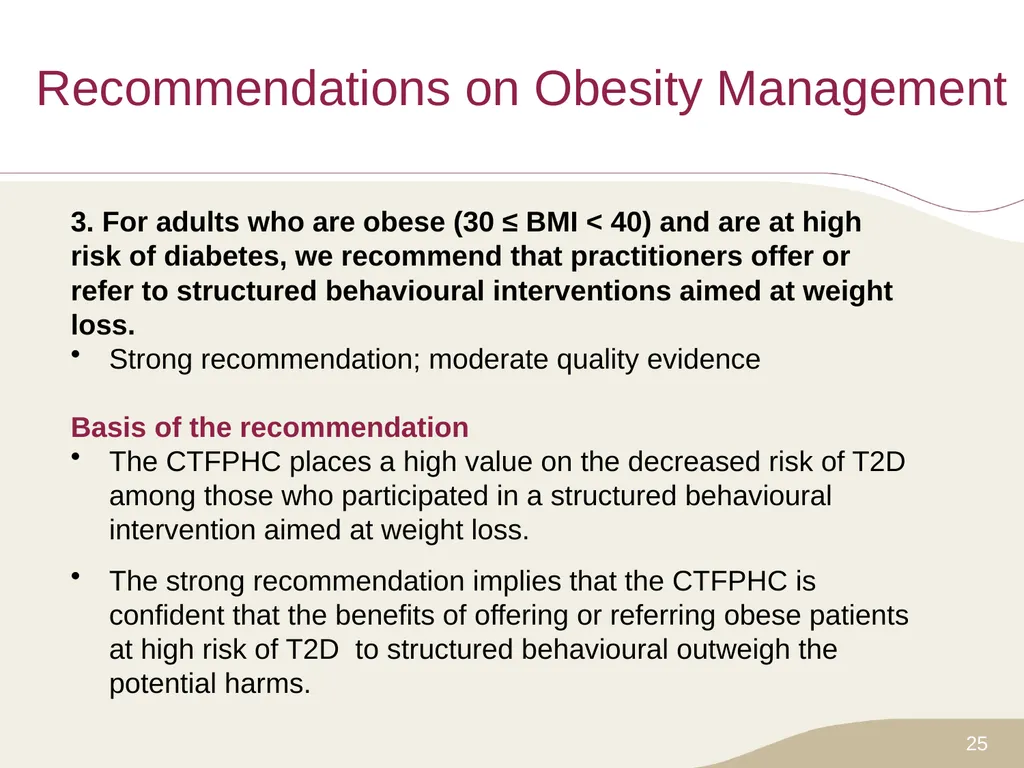
Recommendations on Obesity Management 3. For adults who are obese (30 ≤ BMI < 40) and are at high risk of diabetes, we recommend that practitioners offer or refer to structured behavioural interventions aimed at weight loss.
Strong recommendation; moderate quality evidence
Basis of the recommendation
The CTFPHC places a high value on the decreased risk of T2D among those who participated in a structured behavioural intervention aimed at weight loss.
The strong recommendation implies that the CTFPHC is confident that the benefits of offering or referring obese patients at high risk of T2D to structured behavioural outweigh the potential harms. 25<br>
Strong recommendation; moderate quality evidence
Basis of the recommendation
The CTFPHC places a high value on the decreased risk of T2D among those who participated in a structured behavioural intervention aimed at weight loss.
The strong recommendation implies that the CTFPHC is confident that the benefits of offering or referring obese patients at high risk of T2D to structured behavioural outweigh the potential harms. 25<br>
26
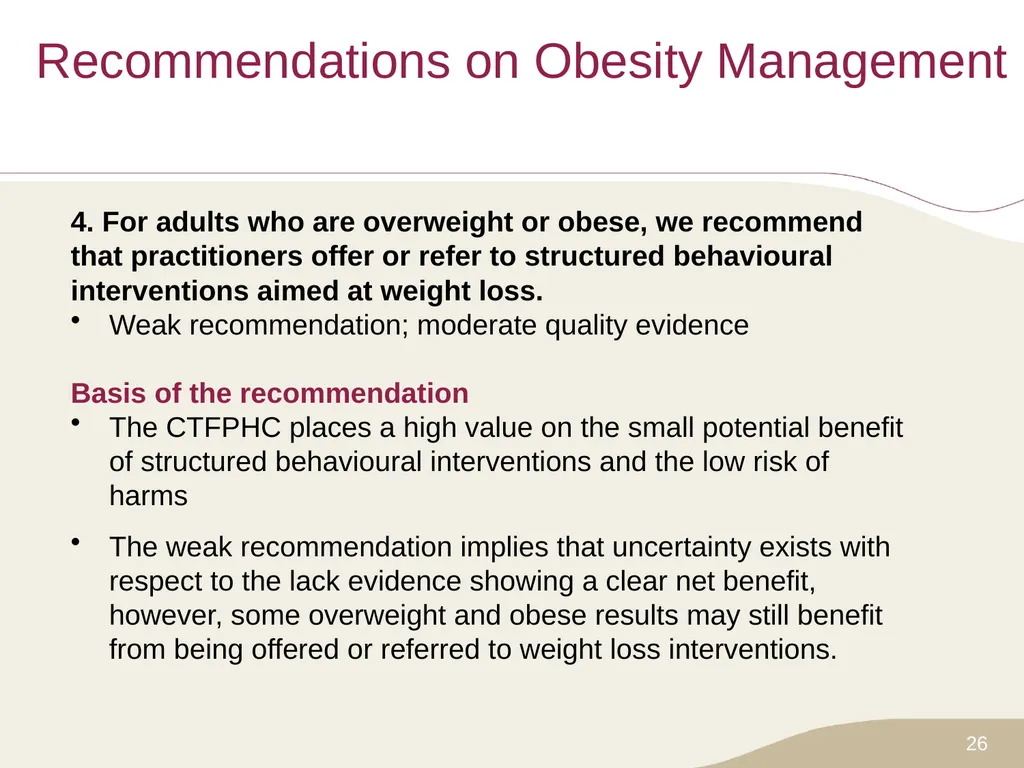
Recommendations on Obesity Management 4. For adults who are overweight or obese, we recommend that practitioners offer or refer to structured behavioural interventions aimed at weight loss.
Weak recommendation; moderate quality evidence
Basis of the recommendation
The CTFPHC places a high value on the small potential benefit of structured behavioural interventions and the low risk of harms
The weak recommendation implies that uncertainty exists with respect to the lack evidence showing a clear net benefit, however, some overweight and obese results may still benefit from being offered or referred to weight loss interventions. 26<br>
Weak recommendation; moderate quality evidence
Basis of the recommendation
The CTFPHC places a high value on the small potential benefit of structured behavioural interventions and the low risk of harms
The weak recommendation implies that uncertainty exists with respect to the lack evidence showing a clear net benefit, however, some overweight and obese results may still benefit from being offered or referred to weight loss interventions. 26<br>
27
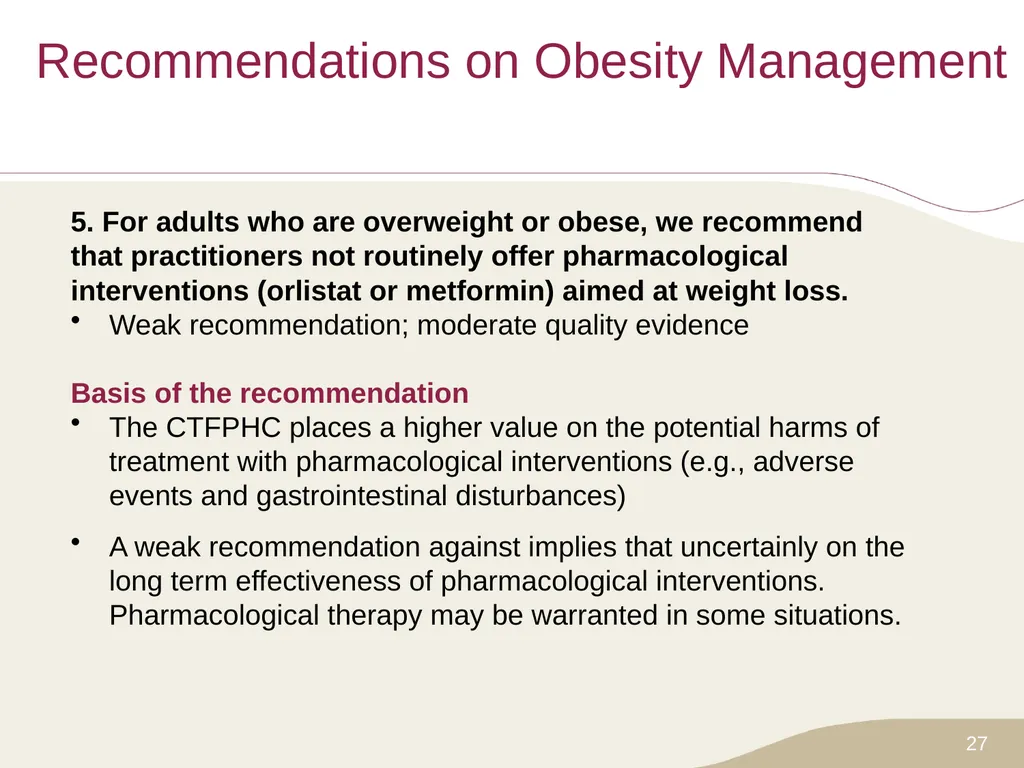
Recommendations on Obesity Management 5. For adults who are overweight or obese, we recommend that practitioners not routinely offer pharmacological interventions (orlistat or metformin) aimed at weight loss.
Weak recommendation; moderate quality evidence
Basis of the recommendation
The CTFPHC places a higher value on the potential harms of treatment with pharmacological interventions (e.g., adverse events and gastrointestinal disturbances)
A weak recommendation against implies that uncertainly on the long term effectiveness of pharmacological interventions. Pharmacological therapy may be warranted in some situations. 27<br>
Weak recommendation; moderate quality evidence
Basis of the recommendation
The CTFPHC places a higher value on the potential harms of treatment with pharmacological interventions (e.g., adverse events and gastrointestinal disturbances)
A weak recommendation against implies that uncertainly on the long term effectiveness of pharmacological interventions. Pharmacological therapy may be warranted in some situations. 27<br>
28
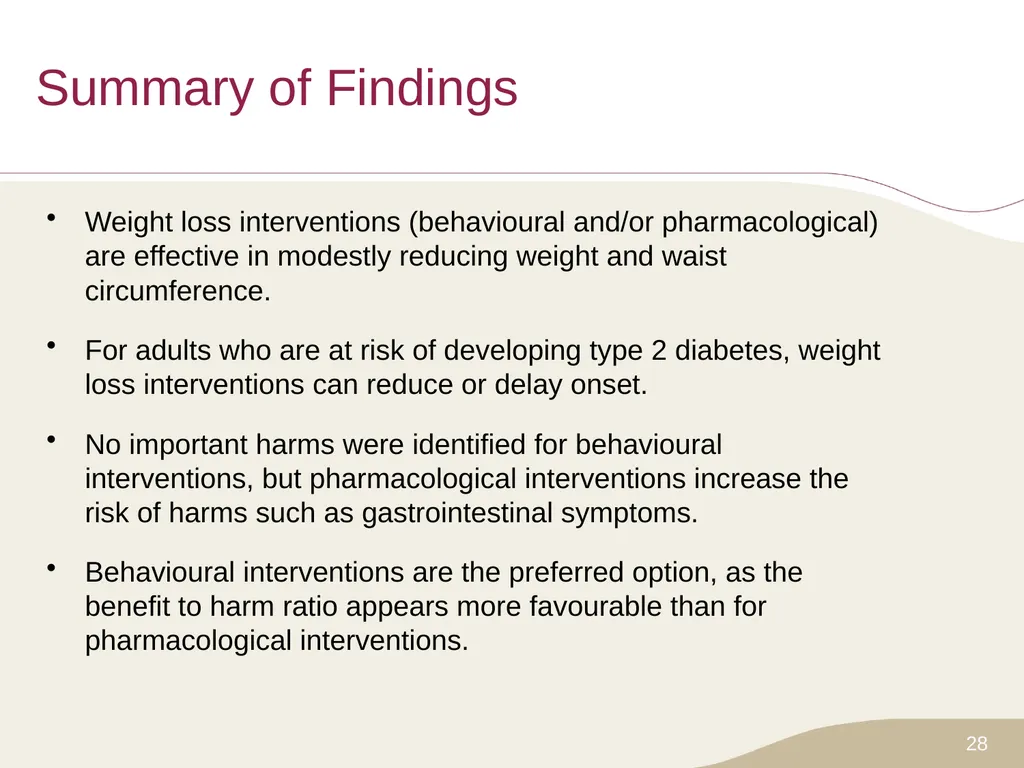
Summary of Findings Weight loss interventions (behavioural and/or pharmacological) are effective in modestly reducing weight and waist circumference.
For adults who are at risk of developing type 2 diabetes, weight loss interventions can reduce or delay onset.
No important harms were identified for behavioural interventions, but pharmacological interventions increase the risk of harms such as gastrointestinal symptoms.
Behavioural interventions are the preferred option, as the benefit to harm ratio appears more favourable than for pharmacological interventions. 28<br>
For adults who are at risk of developing type 2 diabetes, weight loss interventions can reduce or delay onset.
No important harms were identified for behavioural interventions, but pharmacological interventions increase the risk of harms such as gastrointestinal symptoms.
Behavioural interventions are the preferred option, as the benefit to harm ratio appears more favourable than for pharmacological interventions. 28<br>
29
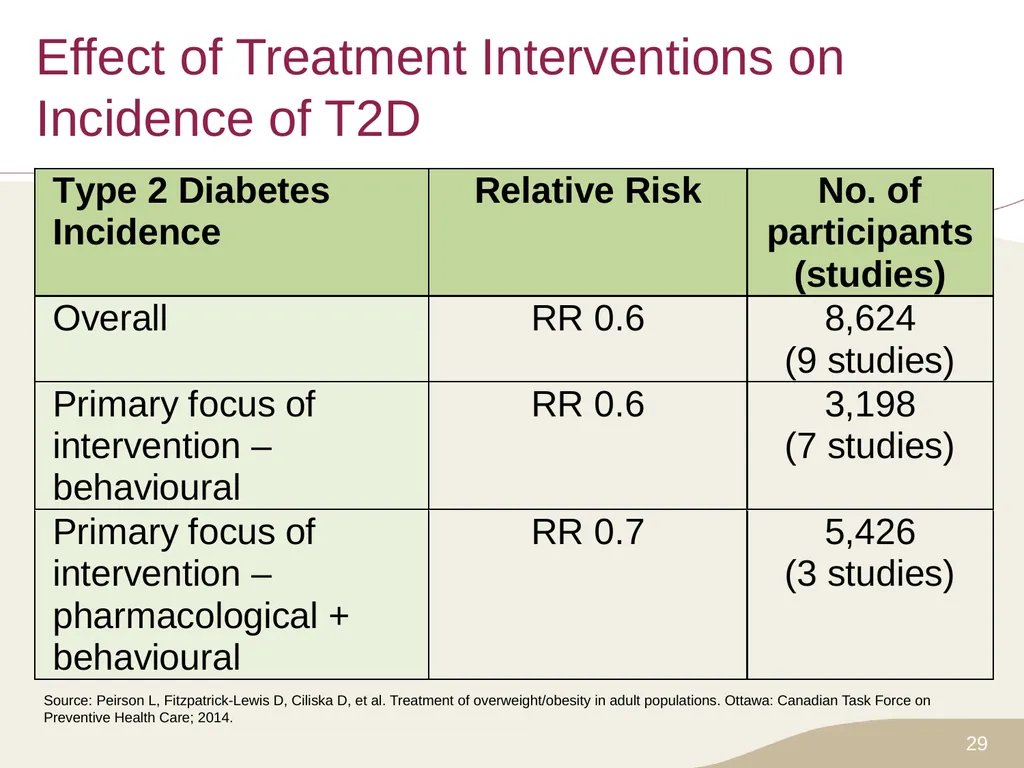
Effect of Treatment Interventions on Incidence of T2D 29 Source: Peirson L, Fitzpatrick-Lewis D, Ciliska D, et al. Treatment of overweight/obesity in adult populations. Ottawa: Canadian Task Force on Preventive Health Care; 2014.<br>
30
Effects of Treatment on Weight
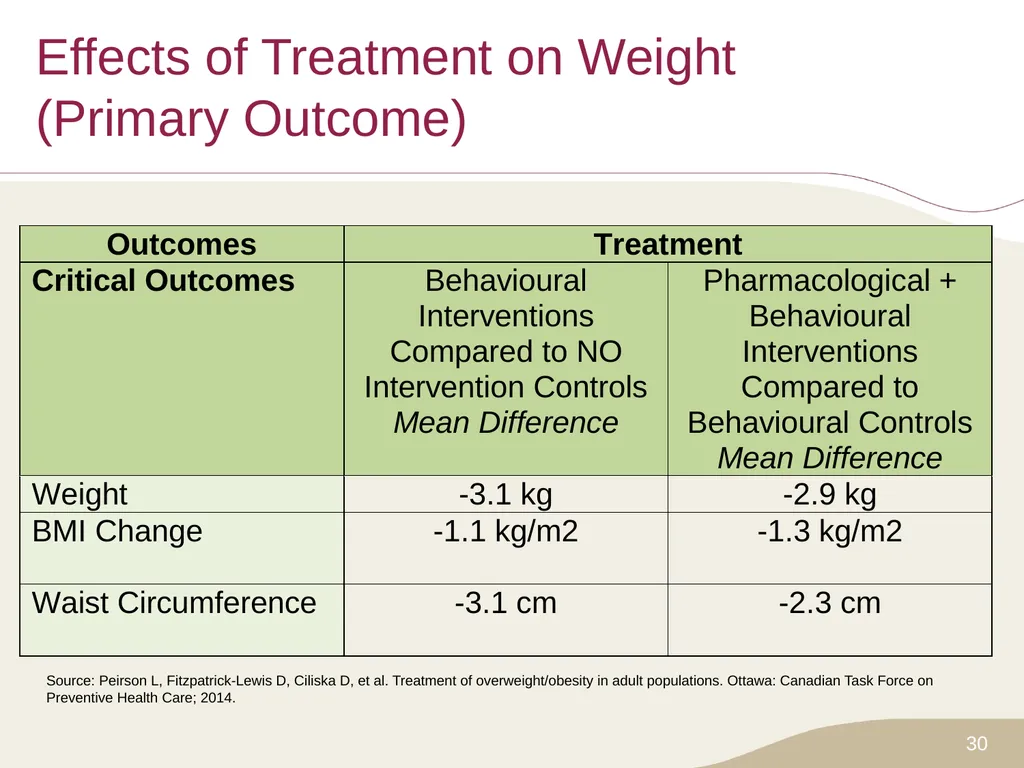
(Primary Outcome) 30 Source: Peirson L, Fitzpatrick-Lewis D, Ciliska D, et al. Treatment of overweight/obesity in adult populations. Ottawa: Canadian Task Force on Preventive Health Care; 2014.<br>
31
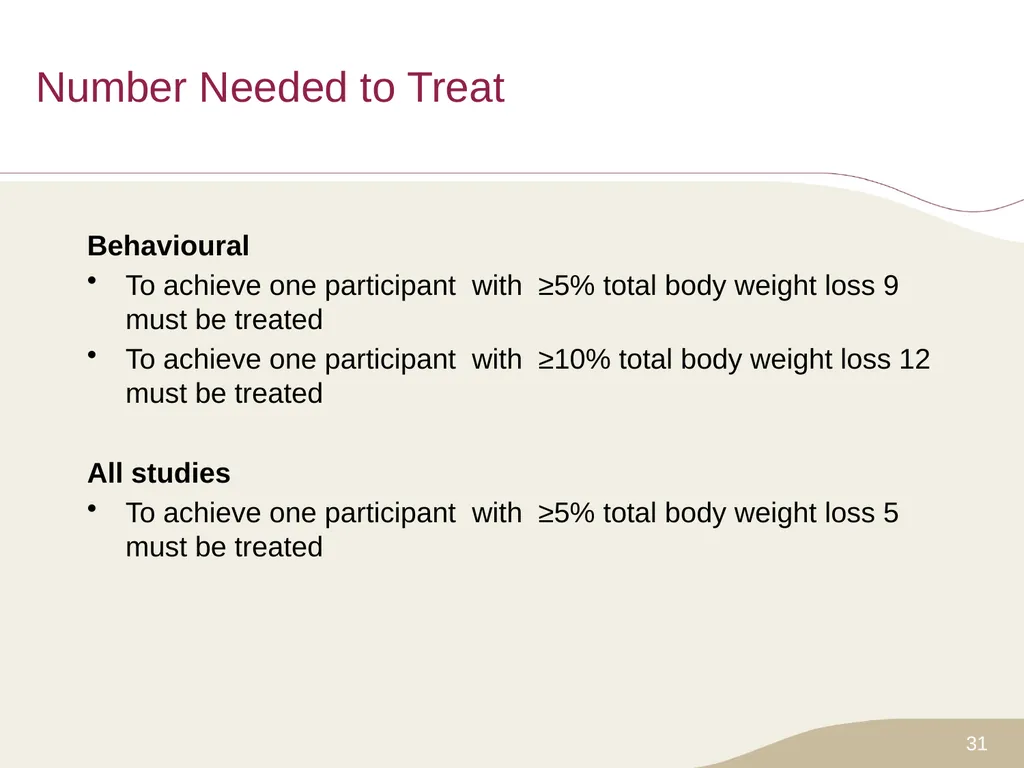
Number Needed to Treat Behavioural
To achieve one participant with ≥5% total body weight loss 9 must be treated
To achieve one participant with ≥10% total body weight loss 12 must be treated
All studies
To achieve one participant with ≥5% total body weight loss 5 must be treated 31<br>
To achieve one participant with ≥5% total body weight loss 9 must be treated
To achieve one participant with ≥10% total body weight loss 12 must be treated
All studies
To achieve one participant with ≥5% total body weight loss 5 must be treated 31<br>
32
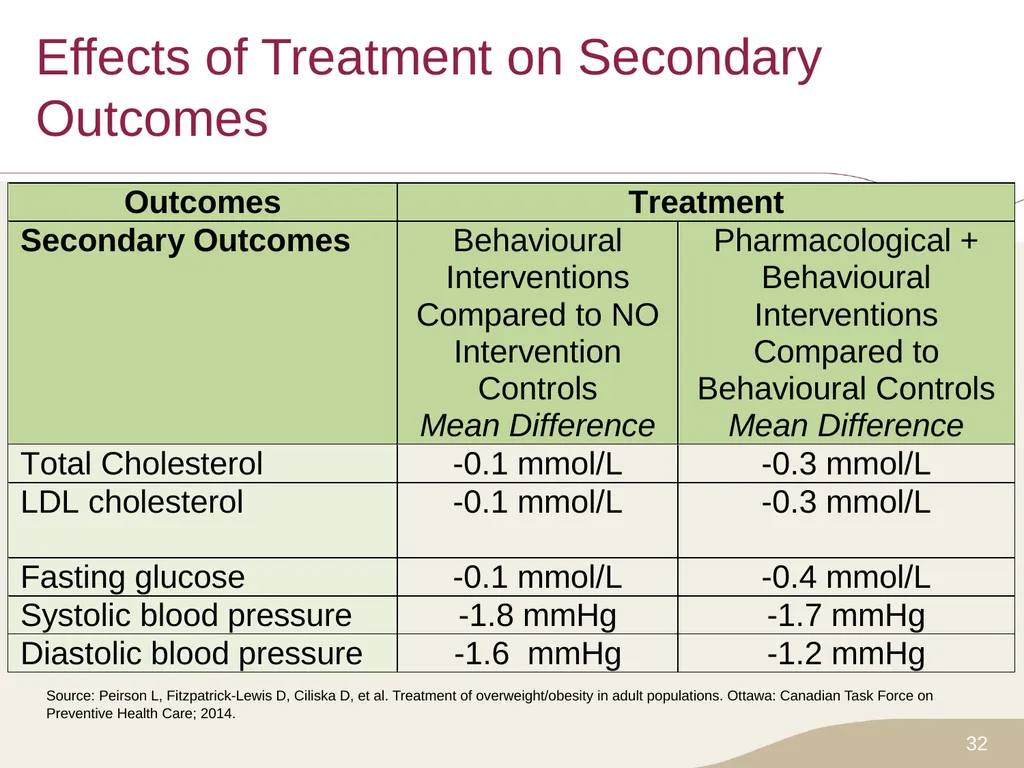
Effects of Treatment on Secondary Outcomes 32 Source: Peirson L, Fitzpatrick-Lewis D, Ciliska D, et al. Treatment of overweight/obesity in adult populations. Ottawa: Canadian Task Force on Preventive Health Care; 2014.<br>
33
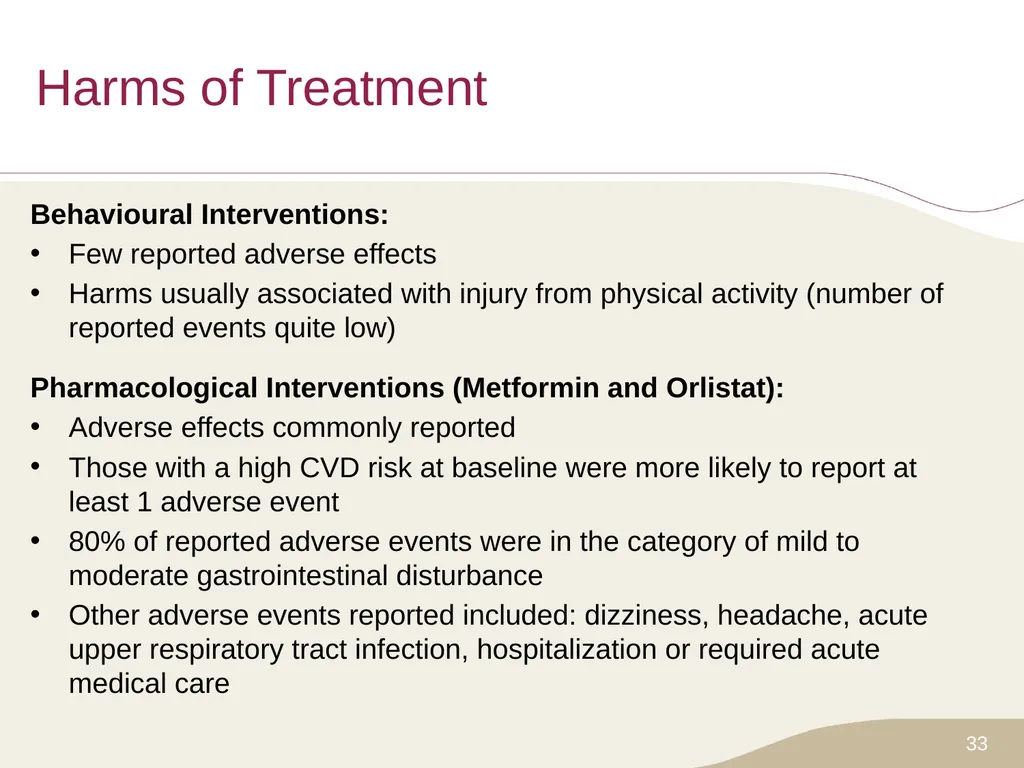
Harms of Treatment Behavioural Interventions:
Few reported adverse effects
Harms usually associated with injury from physical activity (number of reported events quite low)
Pharmacological Interventions (Metformin and Orlistat):
Adverse effects commonly reported
Those with a high CVD risk at baseline were more likely to report at least 1 adverse event
80% of reported adverse events were in the category of mild to moderate gastrointestinal disturbance
Other adverse events reported included: dizziness, headache, acute upper respiratory tract infection, hospitalization or required acute medical care 33<br>
Few reported adverse effects
Harms usually associated with injury from physical activity (number of reported events quite low)
Pharmacological Interventions (Metformin and Orlistat):
Adverse effects commonly reported
Those with a high CVD risk at baseline were more likely to report at least 1 adverse event
80% of reported adverse events were in the category of mild to moderate gastrointestinal disturbance
Other adverse events reported included: dizziness, headache, acute upper respiratory tract infection, hospitalization or required acute medical care 33<br>
34
IMPLEMENTATION OF RECOMMENDATIONS Adult Obesity Prevention and Management 34<br>
35
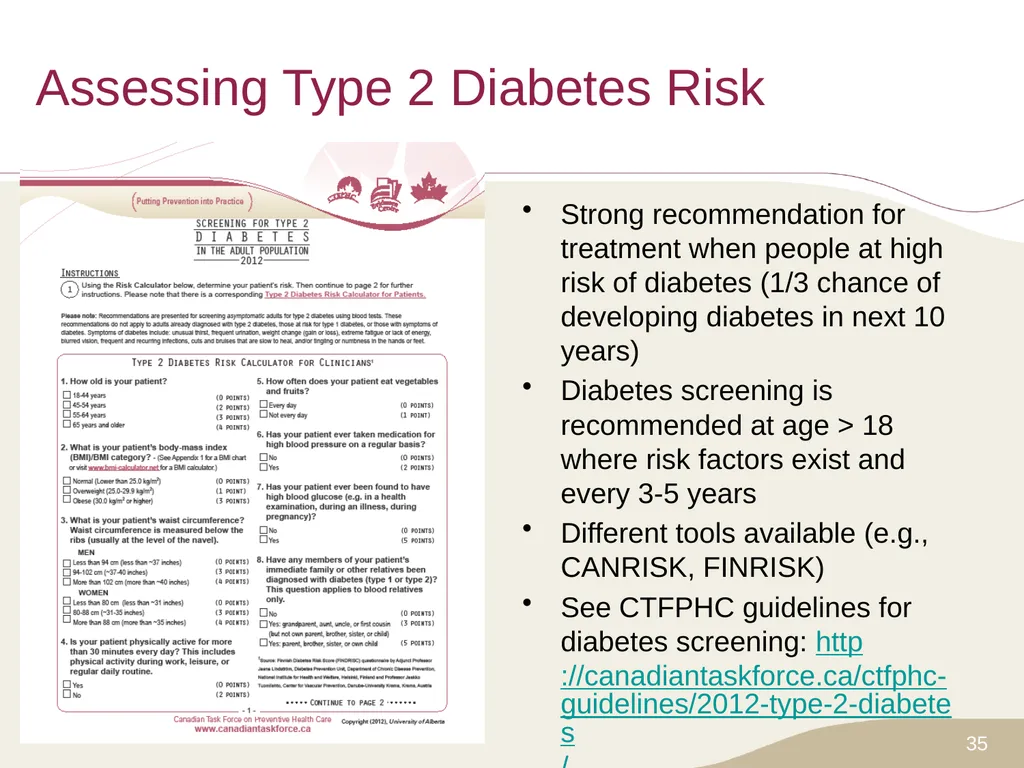
Assessing Type 2 Diabetes Risk Strong recommendation for treatment when people at high risk of diabetes (1/3 chance of developing diabetes in next 10 years)
Diabetes screening is recommended at age > 18 where risk factors exist and every 3-5 years
Different tools available (e.g., CANRISK, FINRISK)
See CTFPHC guidelines for diabetes screening: http://canadiantaskforce.ca/ctfphc-guidelines/2012-type-2-diabetes/ 35<br>
Diabetes screening is recommended at age > 18 where risk factors exist and every 3-5 years
Different tools available (e.g., CANRISK, FINRISK)
See CTFPHC guidelines for diabetes screening: http://canadiantaskforce.ca/ctfphc-guidelines/2012-type-2-diabetes/ 35<br>
36
Values and Preferences Obesity Prevention
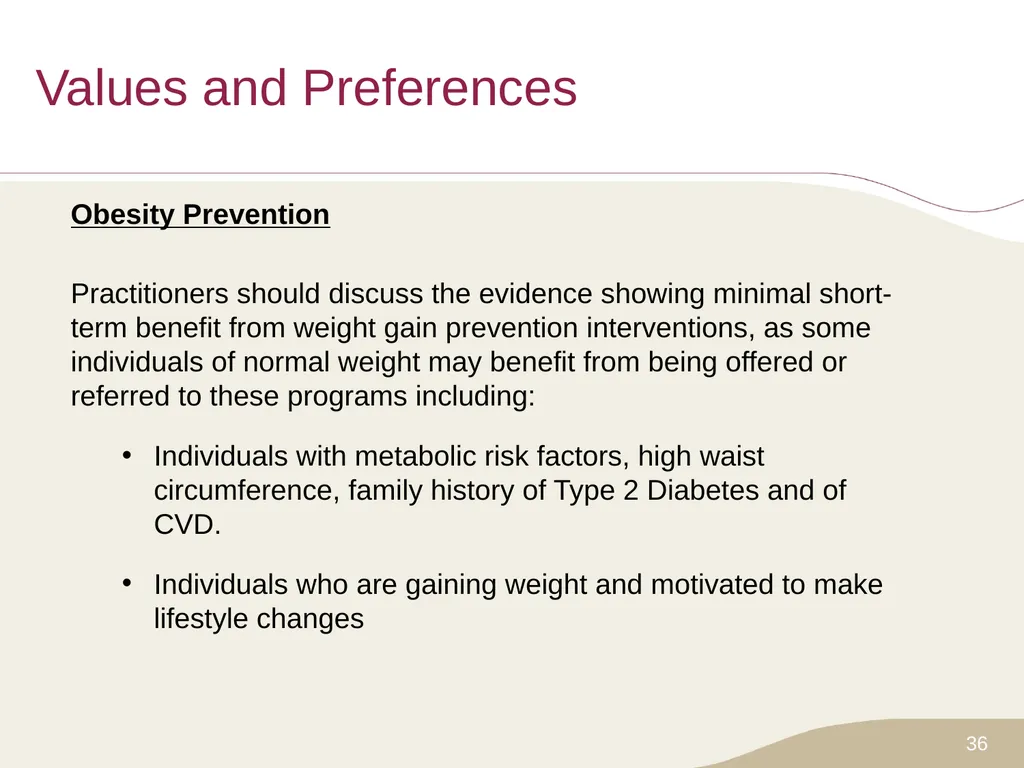
Practitioners should discuss the evidence showing minimal short-term benefit from weight gain prevention interventions, as some individuals of normal weight may benefit from being offered or referred to these programs including:
Individuals with metabolic risk factors, high waist circumference, family history of Type 2 Diabetes and of CVD.
Individuals who are gaining weight and motivated to make lifestyle changes 36<br>
Practitioners should discuss the evidence showing minimal short-term benefit from weight gain prevention interventions, as some individuals of normal weight may benefit from being offered or referred to these programs including:
Individuals with metabolic risk factors, high waist circumference, family history of Type 2 Diabetes and of CVD.
Individuals who are gaining weight and motivated to make lifestyle changes 36<br>
37
Values and Preferences Obesity Management
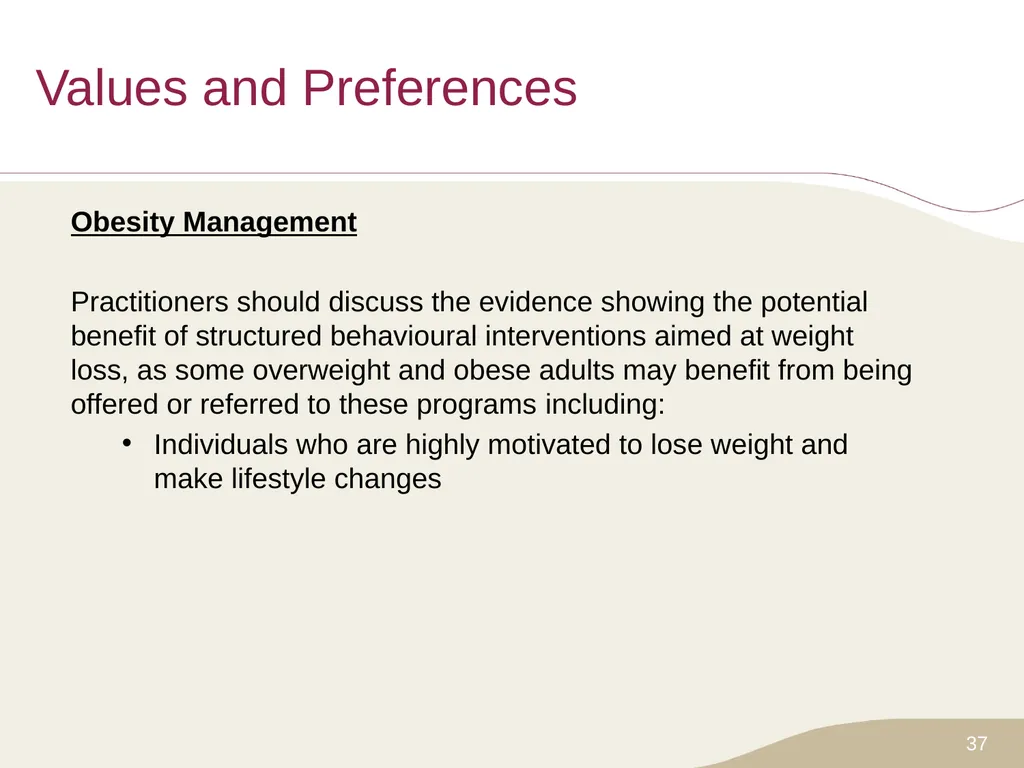
Practitioners should discuss the evidence showing the potential benefit of structured behavioural interventions aimed at weight loss, as some overweight and obese adults may benefit from being offered or referred to these programs including:
Individuals who are highly motivated to lose weight and make lifestyle changes 37<br>
Practitioners should discuss the evidence showing the potential benefit of structured behavioural interventions aimed at weight loss, as some overweight and obese adults may benefit from being offered or referred to these programs including:
Individuals who are highly motivated to lose weight and make lifestyle changes 37<br>
38
Values and Preferences Obesity Management
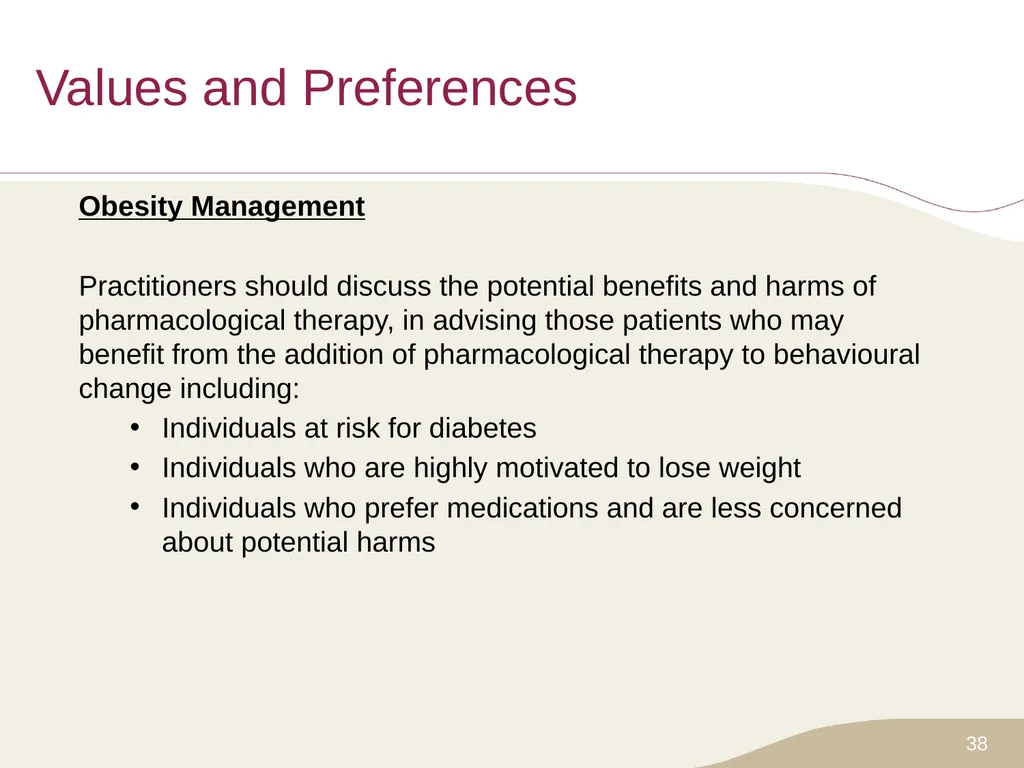
Practitioners should discuss the potential benefits and harms of pharmacological therapy, in advising those patients who may benefit from the addition of pharmacological therapy to behavioural change including:
Individuals at risk for diabetes
Individuals who are highly motivated to lose weight
Individuals who prefer medications and are less concerned about potential harms 38<br>
Practitioners should discuss the potential benefits and harms of pharmacological therapy, in advising those patients who may benefit from the addition of pharmacological therapy to behavioural change including:
Individuals at risk for diabetes
Individuals who are highly motivated to lose weight
Individuals who prefer medications and are less concerned about potential harms 38<br>
39
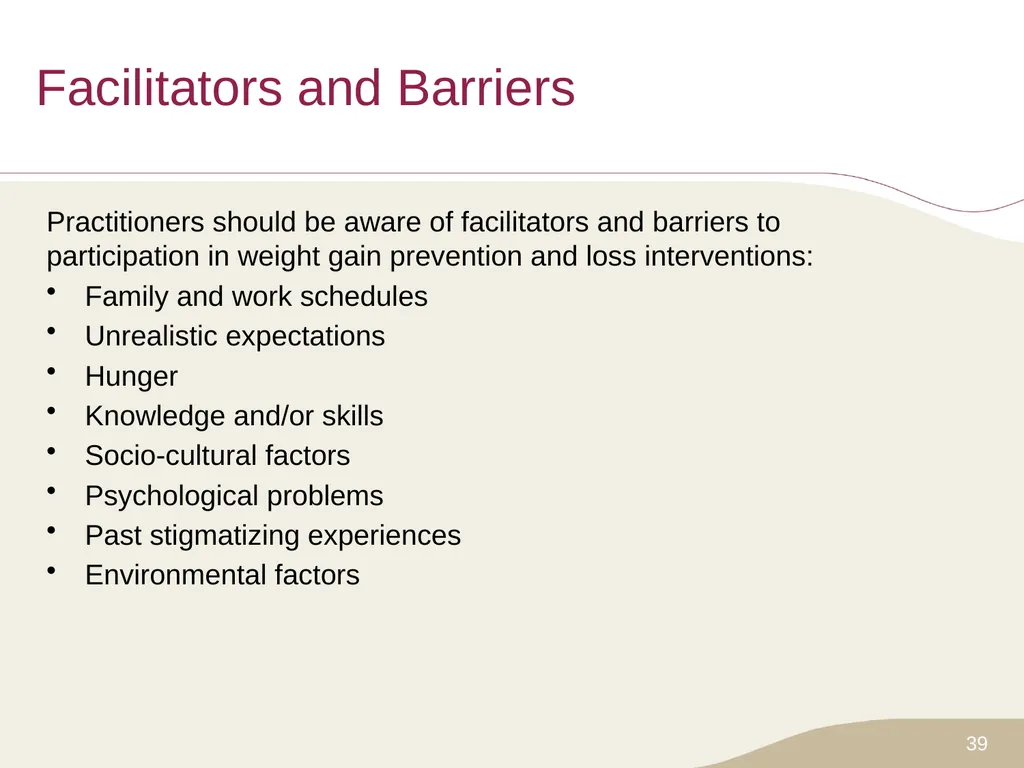
Facilitators and Barriers Practitioners should be aware of facilitators and barriers to participation in weight gain prevention and loss interventions:
Family and work schedules
Unrealistic expectations
Hunger
Knowledge and/or skills
Socio-cultural factors
Psychological problems
Past stigmatizing experiences
Environmental factors 39<br>
Family and work schedules
Unrealistic expectations
Hunger
Knowledge and/or skills
Socio-cultural factors
Psychological problems
Past stigmatizing experiences
Environmental factors 39<br>
40
KT TOOLS Adult Obesity Prevention and Management 40<br>
41
41<br>
42
42<br>
43
43<br>
44
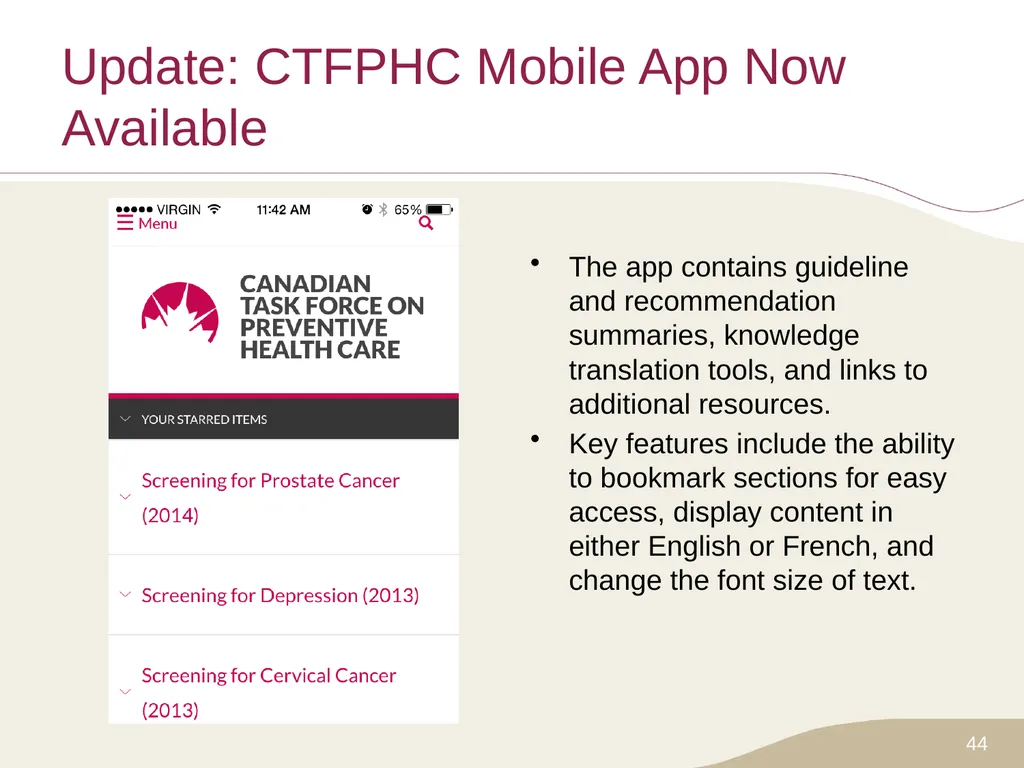
Update: CTFPHC Mobile App Now Available The app contains guideline and recommendation summaries, knowledge translation tools, and links to additional resources.
Key features include the ability to bookmark sections for easy access, display content in either English or French, and change the font size of text. 44<br>
Key features include the ability to bookmark sections for easy access, display content in either English or French, and change the font size of text. 44<br>
45
Conclusions Measuring BMI (height/weight) is important for weight monitoring.
People at high risk of diabetes should be offered or referred for treatment.
Treatment directed to weight loss is only modestly effective and prevention of obesity would be preferable if there was evidence of effectiveness.
Some individuals may still benefit from being offered or referred to formal programs.
Primary care practitioners have an important role to play in overweight and obesity prevention and management.
Resources and strategies to better support primary care practitioners in implementing the guidelines are needed.
Research is urgently needed about how best to prevent weight gain in normal weight adults. 45<br>
People at high risk of diabetes should be offered or referred for treatment.
Treatment directed to weight loss is only modestly effective and prevention of obesity would be preferable if there was evidence of effectiveness.
Some individuals may still benefit from being offered or referred to formal programs.
Primary care practitioners have an important role to play in overweight and obesity prevention and management.
Resources and strategies to better support primary care practitioners in implementing the guidelines are needed.
Research is urgently needed about how best to prevent weight gain in normal weight adults. 45<br>
46
More Information For more information on the details of this guideline please see:
Canadian Task Force for Preventive Health Care website: http://canadiantaskforce.ca/?content=pcp 46<br>
Canadian Task Force for Preventive Health Care website: http://canadiantaskforce.ca/?content=pcp 46<br>