
Quality Issues for Clinical Trial Materials: The



Description: Quality Issues for Clinical Trial Materials: The Chemistry, Manufacturing and Controls (CMC) Review Dorota Matecka, Ph.D. Office of Pharmaceutical Quality (OPQ), CDER Outline Pharmaceutical Quality CMC Requirements for INDs CMC Safety
Related Topics
Download Presentation
"Quality Issues for Clinical Trial Materials: The" is the property of its rightful owner. Permission is granted to download and print the materials on this website for personal, non-commercial use only, and to display it on your personal computer provided you do not modify the materials and that you retain all copyright notices contained in the materials. By downloading content from our website, you accept the terms of this agreement.
Presentation Transcript
slide1. Quality Issues for Clinical Trial Materials:
The Chemistry, Manufacturing and Controls (CMC) Review Dorota Matecka, Ph.D.
Office of Pharmaceutical Quality (OPQ), CDER<br>
slide2. Outline Pharmaceutical Quality
CMC Requirements for INDs
CMC Safety Concerns
Impurities and Specifications
Other CMC Considerations
IND Guidance Sources
Summary<br>
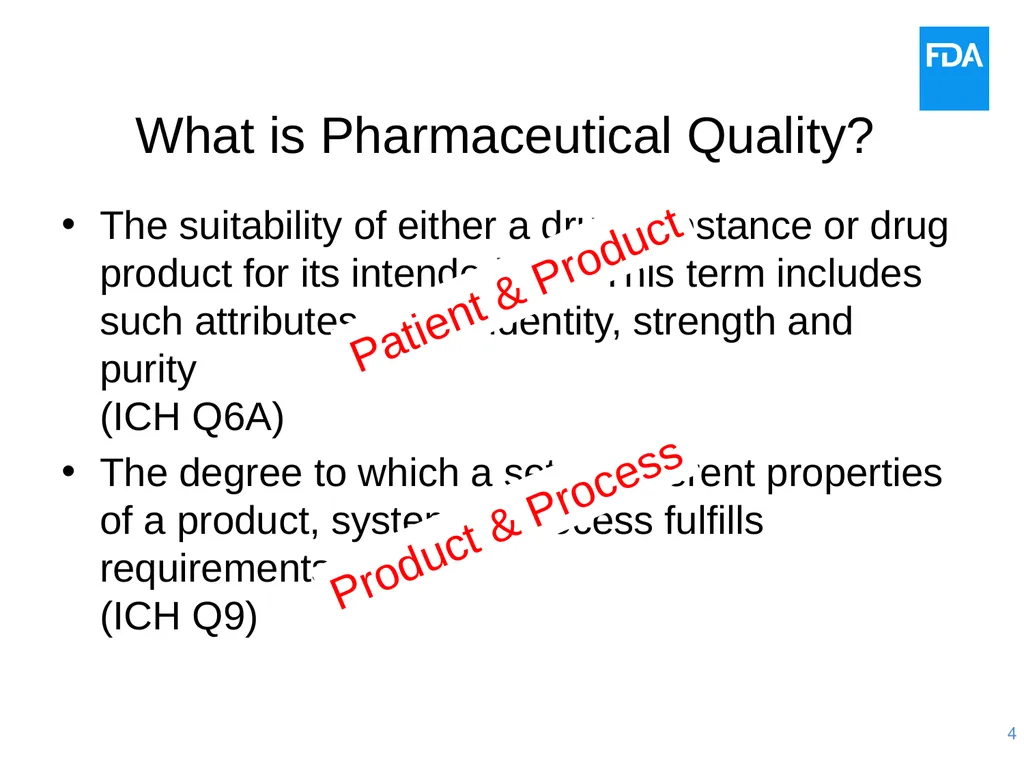
slide4. What is Pharmaceutical Quality? The suitability of either a drug substance or drug product for its intended use. This term includes such attributes as the identity, strength and purity (ICH Q6A)
The degree to which a set of inherent properties of a product, system or process fulfills requirements (ICH Q9) Patient & Product Product & Process<br>
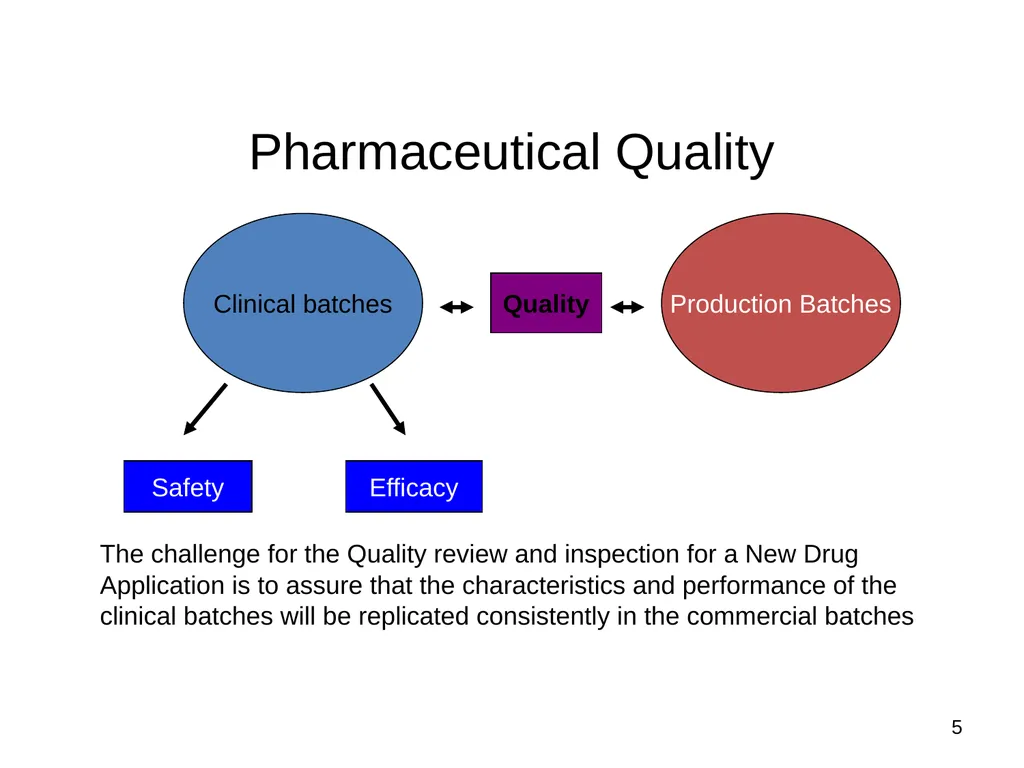
slide5. 5 Pharmaceutical Quality The challenge for the Quality review and inspection for a New Drug Application is to assure that the characteristics and performance of the clinical batches will be replicated consistently in the commercial batches<br>
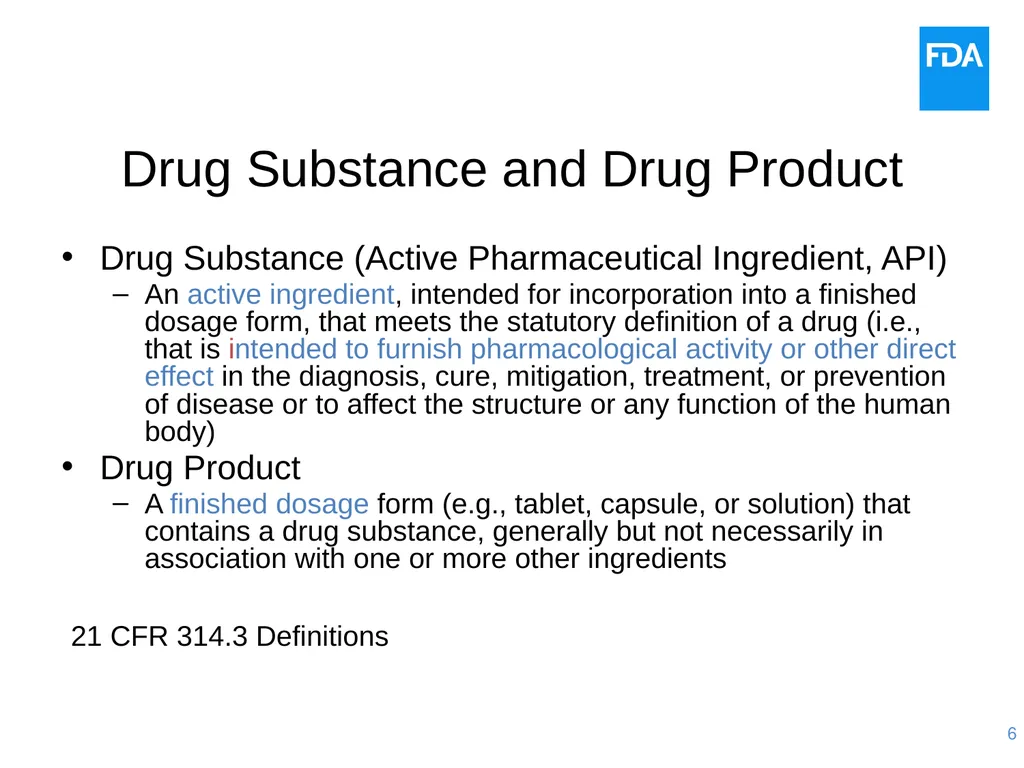
slide6. Drug Substance and Drug Product Drug Substance (Active Pharmaceutical Ingredient, API)
An active ingredient, intended for incorporation into a finished dosage form, that meets the statutory definition of a drug (i.e., that is intended to furnish pharmacological activity or other direct effect in the diagnosis, cure, mitigation, treatment, or prevention of disease or to affect the structure or any function of the human body)
Drug Product
A finished dosage form (e.g., tablet, capsule, or solution) that contains a drug substance, generally but not necessarily in association with one or more other ingredients
21 CFR 314.3 Definitions<br>
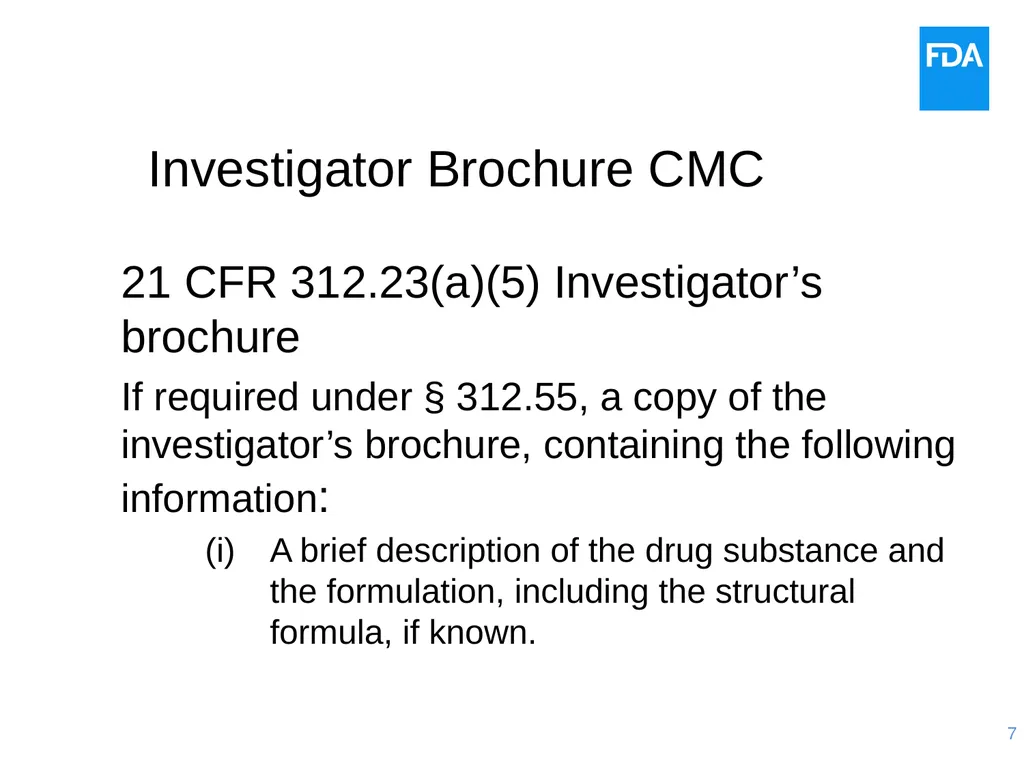
slide7. Investigator Brochure CMC 21 CFR 312.23(a)(5) Investigator’s brochure
If required under § 312.55, a copy of the investigator’s brochure, containing the following information:
A brief description of the drug substance and the formulation, including the structural formula, if known.<br>
slide8. IND Regulation 21 CFR 312.23(a)(7)(i)
As appropriate for the particular investigations covered by the IND, a section describing the composition, manufacture, and control of the drug substance and the drug product...............
........... sufficient CMC information to assure the proper identification, quality, purity and strength of the investigational drug<br>
slide9. Identity The structure of the Drug Substance (API) must be proven and controls must be used in the manufacturing process to ensure that the same structure is obtained in every batch
The types of techniques or combination of techniques that may be required to fully elucidate the structure depends on the nature of the drug substance<br>
slide10. Strength (Potency/Assay)* * The drug product needs to contain the required amount of drug substance
Assay of the Drug Substance
Validated stability-indicating assay or bioassay
Assay of the Drug Product
Validated stability-indicating assay or bioassay (assay needs to be selective for the drug substance without interference from excipients, impurities, or degradants)
Well-controlled manufacturing processes
In-Process Blend Uniformity
Uniformity of Dosage Units
Container Closure System
Stability (Expiration Dating Period)<br>
slide11. Purity Chemical purity
(process impurities, degradation products, leachables from container closure system, etc.)
Microbiological purity
(microbial limits; absence of specific microorganisms, etc.)<br>
slide12. CMC Regulatory Requirements [21 CFR 312.23(a)(7)] Regulations emphasize the graded nature of CMC information needed as drug development progresses under an IND
The amount of information needed depends on:
Phase of investigation
Dosage form
Duration of study
Patient population
Amount of information otherwise available
The emphasis in an initial Phase 1 CMC submission should generally be placed on providing information that will allow evaluation of the safety of subjects in the proposed study<br>
slide13. Drug Substance Requirements for INDs Description and characterization
Manufacturer (name, address, contact information)
General method of preparation/synthesis
Specification (tests, analytical procedures and acceptance criteria)
Batch analysis data for clinical trial batch
Stability (through end of clinical trial)<br>
slide14. Drug Product Requirements for INDs Components
Novel excipients may require additional information
Quantitative composition
Manufacturer (name and address)
Description of manufacturing and packaging process
Container/closure system
Specification (tests, analytical procedures and acceptance criteria)
Stability (through end of clinical trial)<br>
slide15. Other CMC Information Labels and labeling – mock-up labels
Caution statement that reads: “Caution: New Drug Limited by Federal (or United States) law to investigational use.”
Environmental Assessment
Claim for a categorical exclusion
Placebo information<br>
slide16. CMC Safety Concerns (potential “hold” issues) Product made with unknown or impure components
Chemical structures of known or likely toxicity
Impurity profile is insufficiently defined or indicates a risk or exceeds levels qualified through toxicology studies
Lack of sterility assurance or endotoxin control (e.g., injectable drug products)<br>
slide17. CMC Safety Concerns (potential “hold” issues) cont’d. Synthesis/manufacturing information provided is insufficient to evaluate the compound claimed is actually manufactured
Poor or unknown manufacturing procedures, including compounding
Product strength is insufficiently defined
Product not stable through clinical study duration
Poorly characterized master or working cell bank<br>
slide18. What is an impurity? Any component of the new drug substance that is not the chemical entity defined as the new drug substance (ICH Q3A)
Any component of the drug product that is not the drug substance or an excipient in the drug product (ICH Q3B)<br>
slide19. Impurities Drug substance impurities
Organic impurities (process- and drug related, e.g., starting materials, by-products, intermediates, degradation products, reagents, catalysts)
Inorganic impurities (heavy metals or other residual metals, inorganic salts)
Residual solvents, polymorphic forms, enantiomeric impurities, extraneous contaminants
Drug product impurities
Degradation products of the drug substance
Reaction products of the drug substance with excipients and/or with immediate container/ closure system<br>
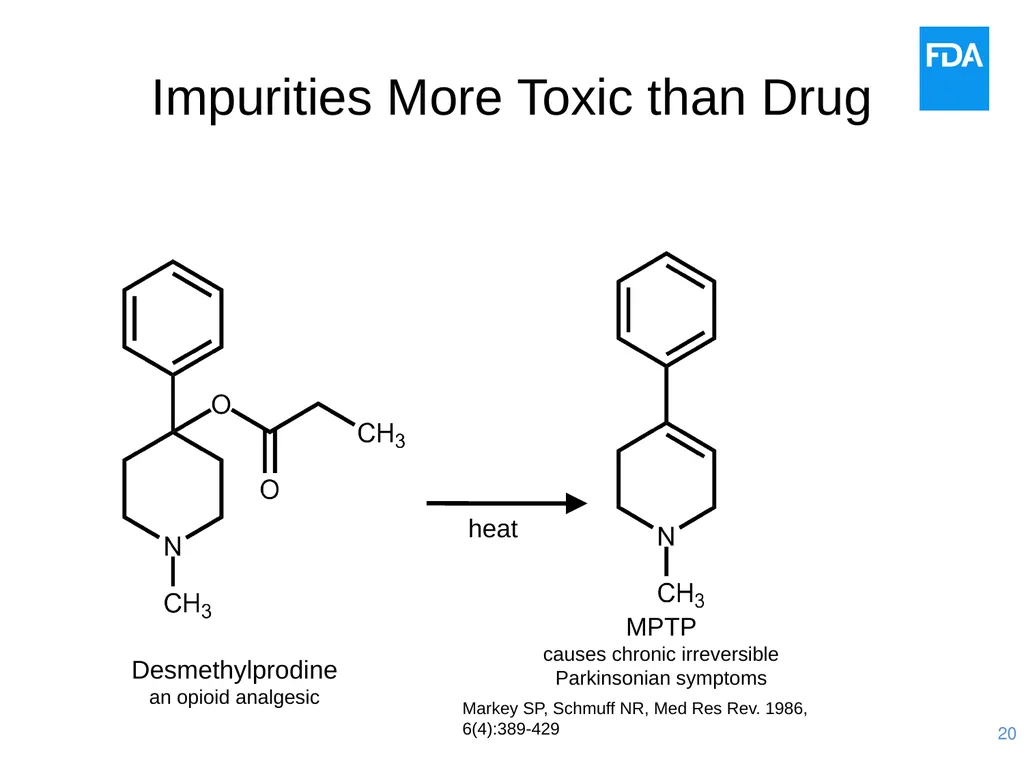
slide20. Impurities More Toxic than Drug Desmethylprodine an opioid analgesic<br>
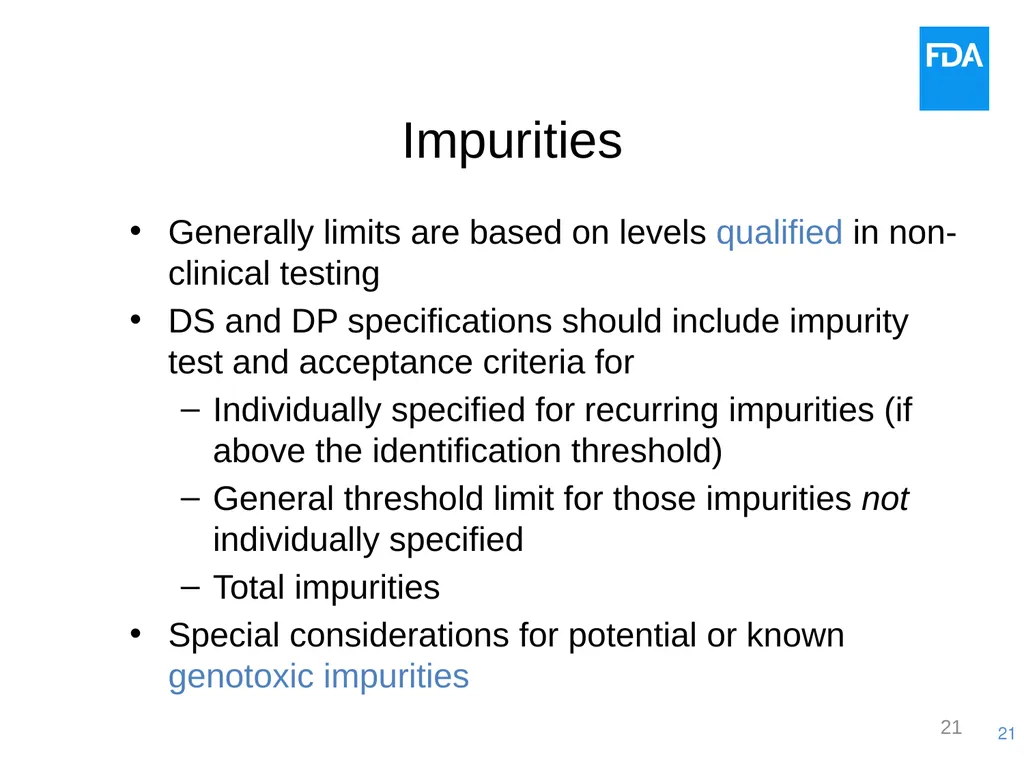
slide21. 21 Impurities Generally limits are based on levels qualified in non-clinical testing
DS and DP specifications should include impurity test and acceptance criteria for
Individually specified for recurring impurities (if above the identification threshold)
General threshold limit for those impurities not individually specified
Total impurities
Special considerations for potential or known genotoxic impurities<br>
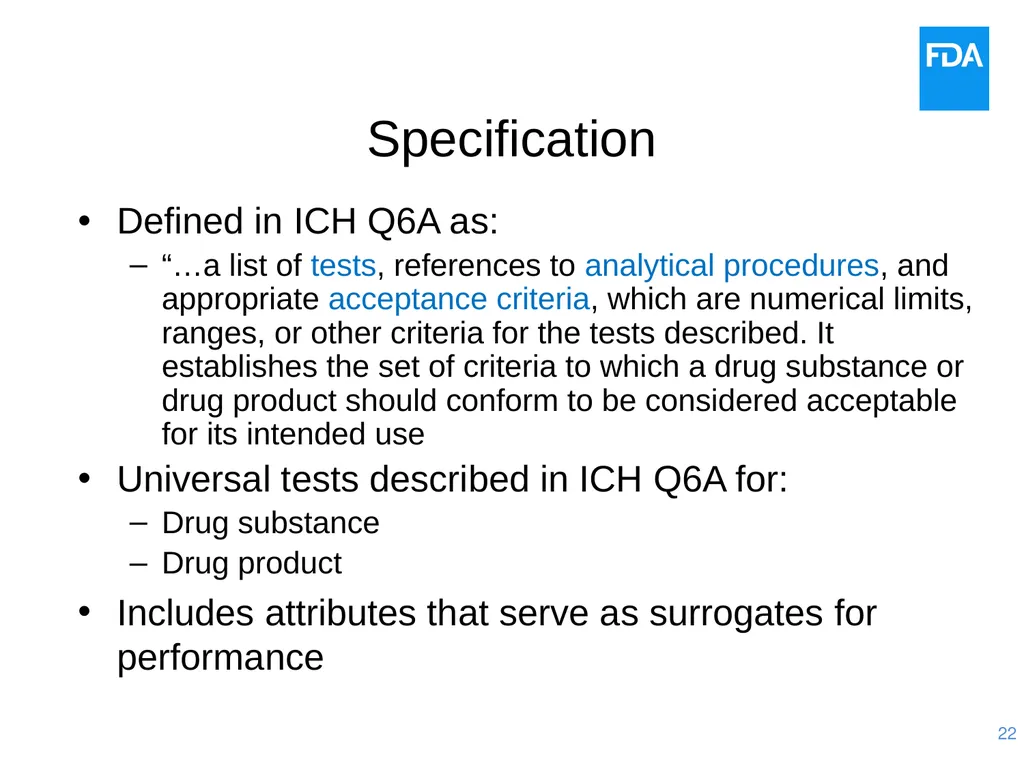
slide22. Specification Defined in ICH Q6A as:
“…a list of tests, references to analytical procedures, and appropriate acceptance criteria, which are numerical limits, ranges, or other criteria for the tests described. It establishes the set of criteria to which a drug substance or drug product should conform to be considered acceptable for its intended use
Universal tests described in ICH Q6A for:
Drug substance
Drug product
Includes attributes that serve as surrogates for performance<br>
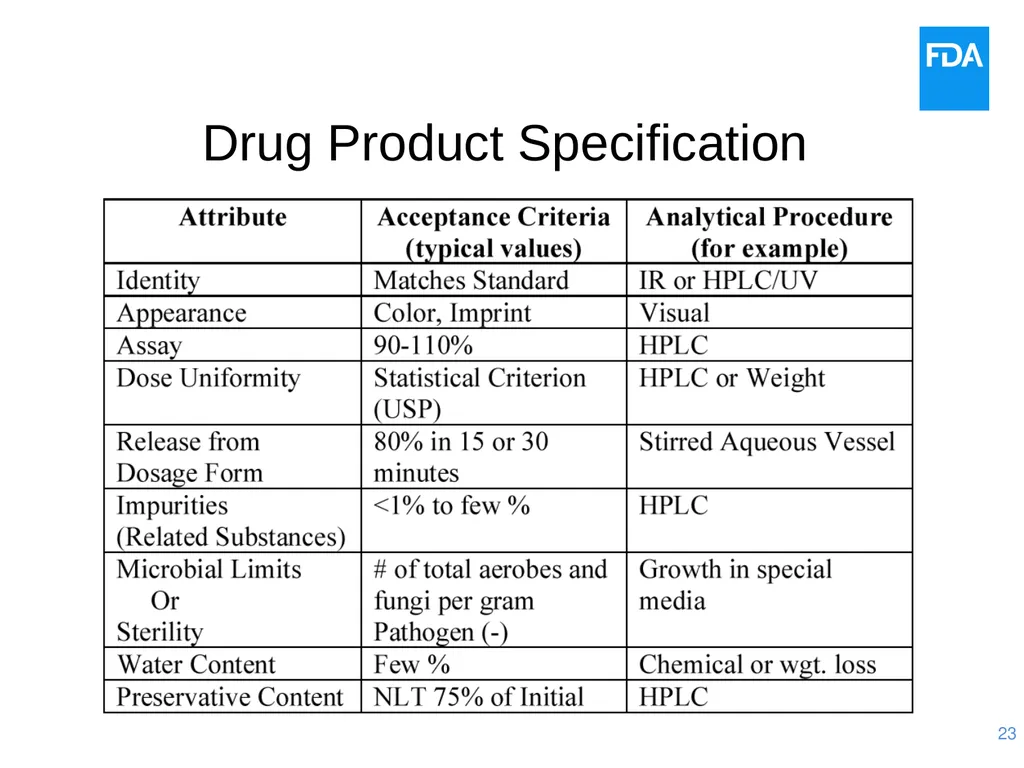
slide23. Drug Product Specification<br>
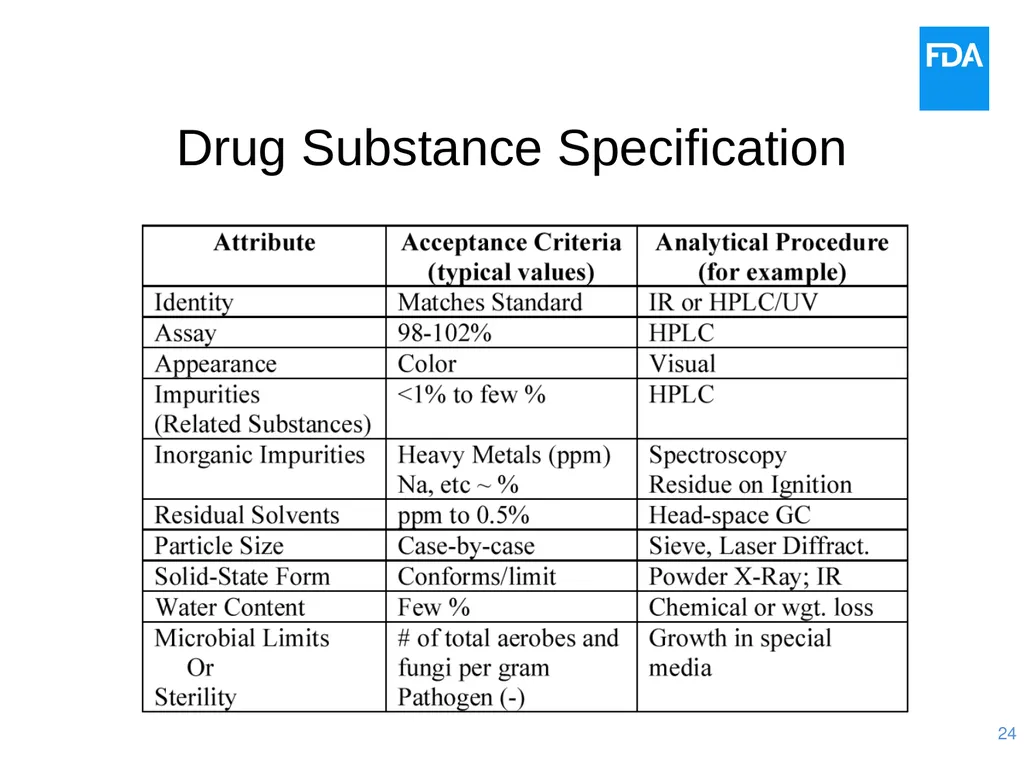
slide24. Drug Substance Specification<br>
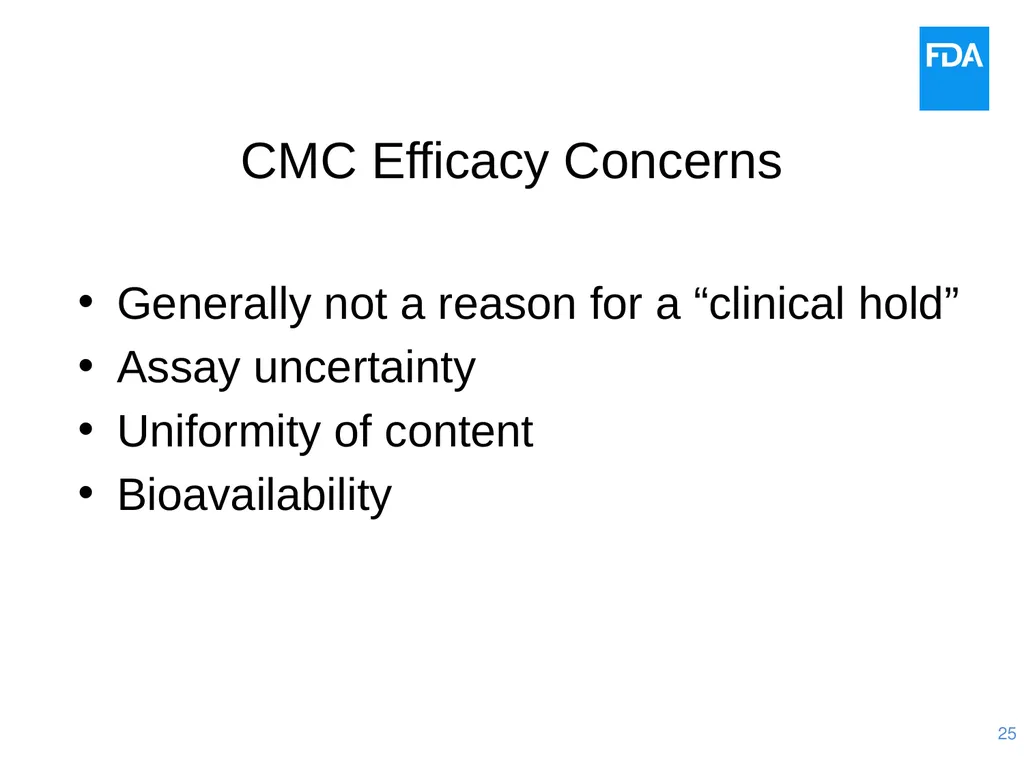
slide25. CMC Efficacy Concerns Generally not a reason for a “clinical hold”
Assay uncertainty
Uniformity of content
Bioavailability<br>
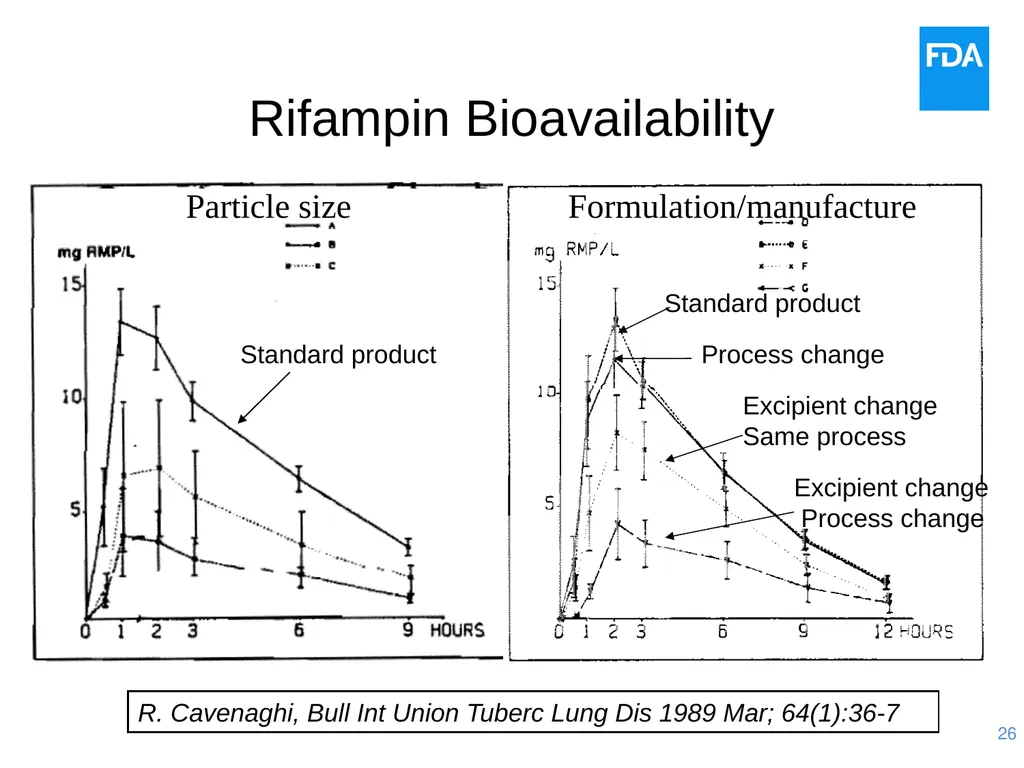
slide26. Rifampin Bioavailability R. Cavenaghi, Bull Int Union Tuberc Lung Dis 1989 Mar; 64(1):36-7 Particle size Formulation/manufacture Standard product Standard product Process change Excipient change
Same process Excipient change
Process change<br>
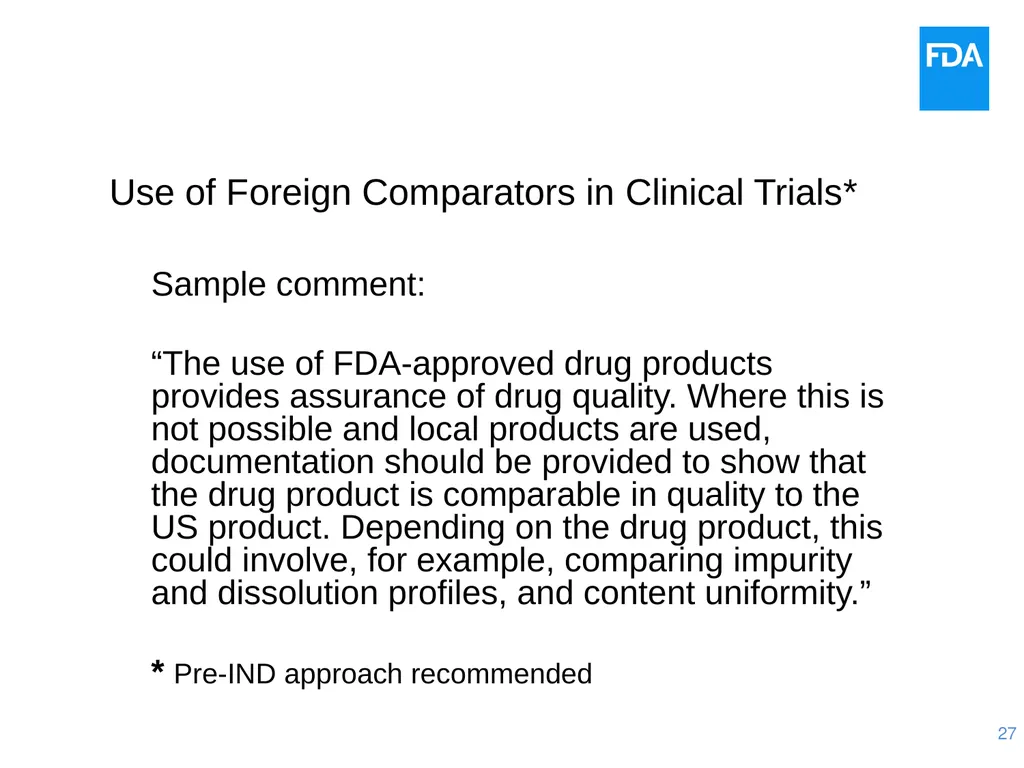
slide27. Use of Foreign Comparators in Clinical Trials* Sample comment:
“The use of FDA-approved drug products provides assurance of drug quality. Where this is not possible and local products are used, documentation should be provided to show that the drug product is comparable in quality to the US product. Depending on the drug product, this could involve, for example, comparing impurity and dissolution profiles, and content uniformity.”
* Pre-IND approach recommended<br>
slide28. Excipients – Quality Considerations Suitability for intended use (target organ/tissue)
Functionality
Compatibility with drug substance
Safety/performance issues
Source (USP/NF; FDA Inactive Ingredients Database)
Excipients of Human or Animal Origins
Novel (new) Excipients*
*(1) Guidance for Industry: Nonclinical Studies for the Safety Evaluation of Pharmaceutical Excipients; (2) USP General Chapter <1074><br>
slide29. Container Closure System The sum of packaging components that together contain, protect, and deliver the dosage form (primary and secondary packaging components)
- IND should include a brief description of:
The packaging components
The assembled packaging system
Any precautions needed to ensure the protection and preservation of the drug substance and the drug product during the use in the clinical trials<br>
slide30. Container Closure System - Quality Considerations Water / Moisture / Humidity
Light
Oxygen
Temperature
Contaminants in primary packaging component
Leachables (primary or secondary component)
Loss of solvent / leak in packaging system
Microbial contamination
Sterility assurance<br>
slide31. Stability 21 CFR 312.23(a)(7)(ii): …stability data are required in all phases of the IND to demonstrate that the drug substance and drug product are within acceptable chemical and physical limits for the planned duration of the proposed clinical investigation
The amount of data will depend upon the duration of the proposed clinical study<br>
slide32. Use of Stability Data To support investigational studies
To ensure that the quality and safety of the investigational product is maintained throughout the clinical trial period
To obtain impurity profile of the batches used during non-clinical toxicological studies<br>
slide33. Expiration Dating Period Expiration dating period is not required for the investigational materials
Reconstituted products are required to have a “use by” date
CFR 211.137 (g). ---”where new drug products for investigational use are to be reconstituted at the time of dispensing, their labeling shall bear expiration information for the reconstituted drug product”<br>
slide34. Clinical Trial Supplies* Examine container integrity on receipt
Confirm label’s 21 CFR 312.6 compliance
Store at recommended conditions
Document:
Receipt and storage
Condition of product on receipt
Dosing (including e.g. date & time, lot#, etc)
Reconciliation of all product at study conclusion
Records kept on-site *See International Conference on Harmonisation of Technical Requirements for Registration Of Pharmaceuticals for Human Use Guidance E6, “Guideline for Good Clinical Practice” http://bit.ly/E6-GCPs and 21 CFR 312.62<br>
slide35. IND Guidance Sources Food Drug and Cosmetic Act
Code of Federal Regulations (Title 21)
21 CFR 312 (IND content and format)
21 CFR 210 and 211 (CGMP)
Guidance
FDA
ICH<br>
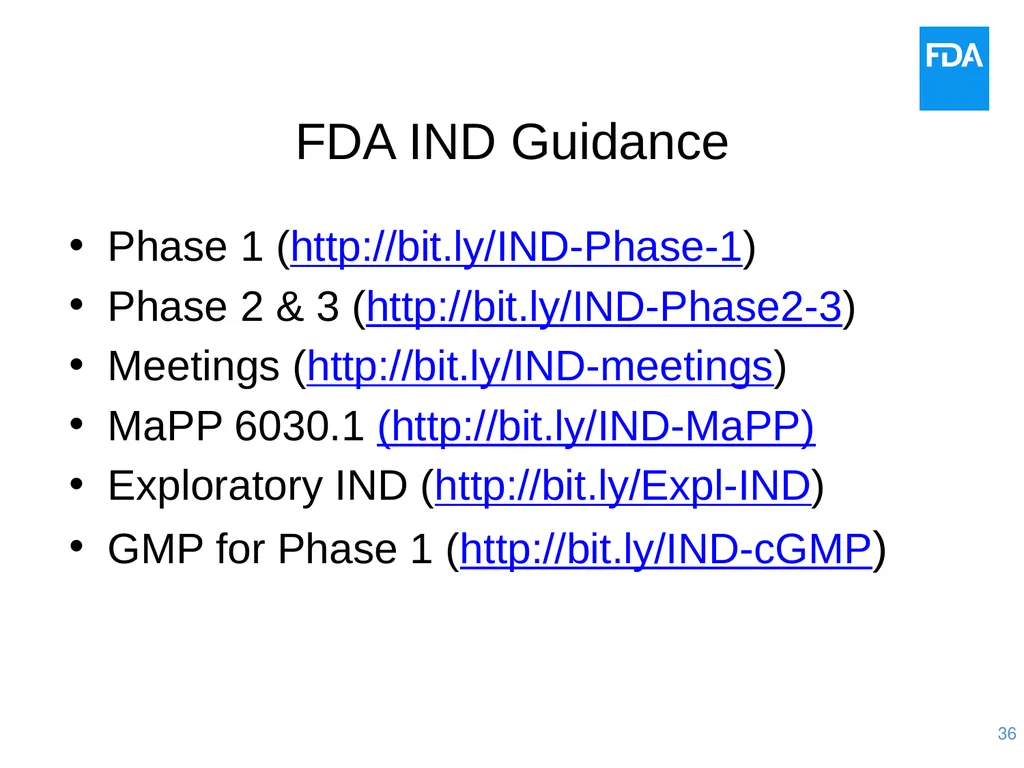
slide36. FDA IND Guidance Phase 1 (http://bit.ly/IND-Phase-1)
Phase 2 & 3 (http://bit.ly/IND-Phase2-3)
Meetings (http://bit.ly/IND-meetings)
MaPP 6030.1 (http://bit.ly/IND-MaPP)
Exploratory IND (http://bit.ly/Expl-IND)
GMP for Phase 1 (http://bit.ly/IND-cGMP)<br>
slide37. Guidance for Industry: CGMP for Phase 1 Investigational Drugs (2008) Frequent questions about GMP expectations for Phase 1 trial materials; clear need for guidance
Developed by Agency workgroup (CDER, CBER, ORA) composed of compliance staff, CMC reviewers, and investigators
FDA’s desire to ensure appropriate quality for early clinical trial material, without impeding drug development
Articulates FDA’s intent to implement an incremental approach to CGMP compliance for clinical investigational products
FDA Guidance issued in 1991 “Preparation of Investigational New Drug Products (Human and Animal)” (reprinted November 1992) still applies to Phase 2 and Phase 3 clinical trial materials<br>
slide38. Meetings Pre-IND Meetings
EOP2 Meetings
Ensure that meaningful and adequate data are generated during Phase 3 studies
Identify safety issues, scientific issues and/or potential problems and address/resolve them prior to initiating Phase 3 studies
Identify potential roadblocks that could affect review of marketing application
Discuss and agree on plans/protocols relative to:
Regulations, guidances, and FDA policy
Quality by Design (QbD) approaches, if used
Pre-NDA Meetings
Generally focusing on filing and format issues at least 6 months prior to NDA submission
Discussion of any problems that can lead to refuse-to-file recommendation or hinder the review process<br>
slide39. Summary Sufficient CMC information should be provided in an IND to assure identity, quality, purity and strength of the study drug
The level of CMC information increases as development progresses
Critical CMC safety issues (including impurities) should be identified - safety concern is the primary reason for placing an IND on clinical hold based on CMC section
Other quality issues should be considered and evaluated for INDs
CGMP should be applied - Phase 1 drugs do not need full CGMP but do need good manufacturing controls
Recommendations of ICH/FDA guidances and input from FDA are helpful during drug development<br>
slide40. Thank you!<br>
Office of Pharmaceutical Quality (OPQ), CDER<br>
slide2. Outline Pharmaceutical Quality
CMC Requirements for INDs
CMC Safety Concerns
Impurities and Specifications
Other CMC Considerations
IND Guidance Sources
Summary<br>
slide4. What is Pharmaceutical Quality? The suitability of either a drug substance or drug product for its intended use. This term includes such attributes as the identity, strength and purity (ICH Q6A)
The degree to which a set of inherent properties of a product, system or process fulfills requirements (ICH Q9) Patient & Product Product & Process<br>
slide5. 5 Pharmaceutical Quality The challenge for the Quality review and inspection for a New Drug Application is to assure that the characteristics and performance of the clinical batches will be replicated consistently in the commercial batches<br>
slide6. Drug Substance and Drug Product Drug Substance (Active Pharmaceutical Ingredient, API)
An active ingredient, intended for incorporation into a finished dosage form, that meets the statutory definition of a drug (i.e., that is intended to furnish pharmacological activity or other direct effect in the diagnosis, cure, mitigation, treatment, or prevention of disease or to affect the structure or any function of the human body)
Drug Product
A finished dosage form (e.g., tablet, capsule, or solution) that contains a drug substance, generally but not necessarily in association with one or more other ingredients
21 CFR 314.3 Definitions<br>
slide7. Investigator Brochure CMC 21 CFR 312.23(a)(5) Investigator’s brochure
If required under § 312.55, a copy of the investigator’s brochure, containing the following information:
A brief description of the drug substance and the formulation, including the structural formula, if known.<br>
slide8. IND Regulation 21 CFR 312.23(a)(7)(i)
As appropriate for the particular investigations covered by the IND, a section describing the composition, manufacture, and control of the drug substance and the drug product...............
........... sufficient CMC information to assure the proper identification, quality, purity and strength of the investigational drug<br>
slide9. Identity The structure of the Drug Substance (API) must be proven and controls must be used in the manufacturing process to ensure that the same structure is obtained in every batch
The types of techniques or combination of techniques that may be required to fully elucidate the structure depends on the nature of the drug substance<br>
slide10. Strength (Potency/Assay)* * The drug product needs to contain the required amount of drug substance
Assay of the Drug Substance
Validated stability-indicating assay or bioassay
Assay of the Drug Product
Validated stability-indicating assay or bioassay (assay needs to be selective for the drug substance without interference from excipients, impurities, or degradants)
Well-controlled manufacturing processes
In-Process Blend Uniformity
Uniformity of Dosage Units
Container Closure System
Stability (Expiration Dating Period)<br>
slide11. Purity Chemical purity
(process impurities, degradation products, leachables from container closure system, etc.)
Microbiological purity
(microbial limits; absence of specific microorganisms, etc.)<br>
slide12. CMC Regulatory Requirements [21 CFR 312.23(a)(7)] Regulations emphasize the graded nature of CMC information needed as drug development progresses under an IND
The amount of information needed depends on:
Phase of investigation
Dosage form
Duration of study
Patient population
Amount of information otherwise available
The emphasis in an initial Phase 1 CMC submission should generally be placed on providing information that will allow evaluation of the safety of subjects in the proposed study<br>
slide13. Drug Substance Requirements for INDs Description and characterization
Manufacturer (name, address, contact information)
General method of preparation/synthesis
Specification (tests, analytical procedures and acceptance criteria)
Batch analysis data for clinical trial batch
Stability (through end of clinical trial)<br>
slide14. Drug Product Requirements for INDs Components
Novel excipients may require additional information
Quantitative composition
Manufacturer (name and address)
Description of manufacturing and packaging process
Container/closure system
Specification (tests, analytical procedures and acceptance criteria)
Stability (through end of clinical trial)<br>
slide15. Other CMC Information Labels and labeling – mock-up labels
Caution statement that reads: “Caution: New Drug Limited by Federal (or United States) law to investigational use.”
Environmental Assessment
Claim for a categorical exclusion
Placebo information<br>
slide16. CMC Safety Concerns (potential “hold” issues) Product made with unknown or impure components
Chemical structures of known or likely toxicity
Impurity profile is insufficiently defined or indicates a risk or exceeds levels qualified through toxicology studies
Lack of sterility assurance or endotoxin control (e.g., injectable drug products)<br>
slide17. CMC Safety Concerns (potential “hold” issues) cont’d. Synthesis/manufacturing information provided is insufficient to evaluate the compound claimed is actually manufactured
Poor or unknown manufacturing procedures, including compounding
Product strength is insufficiently defined
Product not stable through clinical study duration
Poorly characterized master or working cell bank<br>
slide18. What is an impurity? Any component of the new drug substance that is not the chemical entity defined as the new drug substance (ICH Q3A)
Any component of the drug product that is not the drug substance or an excipient in the drug product (ICH Q3B)<br>
slide19. Impurities Drug substance impurities
Organic impurities (process- and drug related, e.g., starting materials, by-products, intermediates, degradation products, reagents, catalysts)
Inorganic impurities (heavy metals or other residual metals, inorganic salts)
Residual solvents, polymorphic forms, enantiomeric impurities, extraneous contaminants
Drug product impurities
Degradation products of the drug substance
Reaction products of the drug substance with excipients and/or with immediate container/ closure system<br>
slide20. Impurities More Toxic than Drug Desmethylprodine an opioid analgesic<br>
slide21. 21 Impurities Generally limits are based on levels qualified in non-clinical testing
DS and DP specifications should include impurity test and acceptance criteria for
Individually specified for recurring impurities (if above the identification threshold)
General threshold limit for those impurities not individually specified
Total impurities
Special considerations for potential or known genotoxic impurities<br>
slide22. Specification Defined in ICH Q6A as:
“…a list of tests, references to analytical procedures, and appropriate acceptance criteria, which are numerical limits, ranges, or other criteria for the tests described. It establishes the set of criteria to which a drug substance or drug product should conform to be considered acceptable for its intended use
Universal tests described in ICH Q6A for:
Drug substance
Drug product
Includes attributes that serve as surrogates for performance<br>
slide23. Drug Product Specification<br>
slide24. Drug Substance Specification<br>
slide25. CMC Efficacy Concerns Generally not a reason for a “clinical hold”
Assay uncertainty
Uniformity of content
Bioavailability<br>
slide26. Rifampin Bioavailability R. Cavenaghi, Bull Int Union Tuberc Lung Dis 1989 Mar; 64(1):36-7 Particle size Formulation/manufacture Standard product Standard product Process change Excipient change
Same process Excipient change
Process change<br>
slide27. Use of Foreign Comparators in Clinical Trials* Sample comment:
“The use of FDA-approved drug products provides assurance of drug quality. Where this is not possible and local products are used, documentation should be provided to show that the drug product is comparable in quality to the US product. Depending on the drug product, this could involve, for example, comparing impurity and dissolution profiles, and content uniformity.”
* Pre-IND approach recommended<br>
slide28. Excipients – Quality Considerations Suitability for intended use (target organ/tissue)
Functionality
Compatibility with drug substance
Safety/performance issues
Source (USP/NF; FDA Inactive Ingredients Database)
Excipients of Human or Animal Origins
Novel (new) Excipients*
*(1) Guidance for Industry: Nonclinical Studies for the Safety Evaluation of Pharmaceutical Excipients; (2) USP General Chapter <1074><br>
slide29. Container Closure System The sum of packaging components that together contain, protect, and deliver the dosage form (primary and secondary packaging components)
- IND should include a brief description of:
The packaging components
The assembled packaging system
Any precautions needed to ensure the protection and preservation of the drug substance and the drug product during the use in the clinical trials<br>
slide30. Container Closure System - Quality Considerations Water / Moisture / Humidity
Light
Oxygen
Temperature
Contaminants in primary packaging component
Leachables (primary or secondary component)
Loss of solvent / leak in packaging system
Microbial contamination
Sterility assurance<br>
slide31. Stability 21 CFR 312.23(a)(7)(ii): …stability data are required in all phases of the IND to demonstrate that the drug substance and drug product are within acceptable chemical and physical limits for the planned duration of the proposed clinical investigation
The amount of data will depend upon the duration of the proposed clinical study<br>
slide32. Use of Stability Data To support investigational studies
To ensure that the quality and safety of the investigational product is maintained throughout the clinical trial period
To obtain impurity profile of the batches used during non-clinical toxicological studies<br>
slide33. Expiration Dating Period Expiration dating period is not required for the investigational materials
Reconstituted products are required to have a “use by” date
CFR 211.137 (g). ---”where new drug products for investigational use are to be reconstituted at the time of dispensing, their labeling shall bear expiration information for the reconstituted drug product”<br>
slide34. Clinical Trial Supplies* Examine container integrity on receipt
Confirm label’s 21 CFR 312.6 compliance
Store at recommended conditions
Document:
Receipt and storage
Condition of product on receipt
Dosing (including e.g. date & time, lot#, etc)
Reconciliation of all product at study conclusion
Records kept on-site *See International Conference on Harmonisation of Technical Requirements for Registration Of Pharmaceuticals for Human Use Guidance E6, “Guideline for Good Clinical Practice” http://bit.ly/E6-GCPs and 21 CFR 312.62<br>
slide35. IND Guidance Sources Food Drug and Cosmetic Act
Code of Federal Regulations (Title 21)
21 CFR 312 (IND content and format)
21 CFR 210 and 211 (CGMP)
Guidance
FDA
ICH<br>
slide36. FDA IND Guidance Phase 1 (http://bit.ly/IND-Phase-1)
Phase 2 & 3 (http://bit.ly/IND-Phase2-3)
Meetings (http://bit.ly/IND-meetings)
MaPP 6030.1 (http://bit.ly/IND-MaPP)
Exploratory IND (http://bit.ly/Expl-IND)
GMP for Phase 1 (http://bit.ly/IND-cGMP)<br>
slide37. Guidance for Industry: CGMP for Phase 1 Investigational Drugs (2008) Frequent questions about GMP expectations for Phase 1 trial materials; clear need for guidance
Developed by Agency workgroup (CDER, CBER, ORA) composed of compliance staff, CMC reviewers, and investigators
FDA’s desire to ensure appropriate quality for early clinical trial material, without impeding drug development
Articulates FDA’s intent to implement an incremental approach to CGMP compliance for clinical investigational products
FDA Guidance issued in 1991 “Preparation of Investigational New Drug Products (Human and Animal)” (reprinted November 1992) still applies to Phase 2 and Phase 3 clinical trial materials<br>
slide38. Meetings Pre-IND Meetings
EOP2 Meetings
Ensure that meaningful and adequate data are generated during Phase 3 studies
Identify safety issues, scientific issues and/or potential problems and address/resolve them prior to initiating Phase 3 studies
Identify potential roadblocks that could affect review of marketing application
Discuss and agree on plans/protocols relative to:
Regulations, guidances, and FDA policy
Quality by Design (QbD) approaches, if used
Pre-NDA Meetings
Generally focusing on filing and format issues at least 6 months prior to NDA submission
Discussion of any problems that can lead to refuse-to-file recommendation or hinder the review process<br>
slide39. Summary Sufficient CMC information should be provided in an IND to assure identity, quality, purity and strength of the study drug
The level of CMC information increases as development progresses
Critical CMC safety issues (including impurities) should be identified - safety concern is the primary reason for placing an IND on clinical hold based on CMC section
Other quality issues should be considered and evaluated for INDs
CGMP should be applied - Phase 1 drugs do not need full CGMP but do need good manufacturing controls
Recommendations of ICH/FDA guidances and input from FDA are helpful during drug development<br>
slide40. Thank you!<br>