
Quarterly report Q4 – 2018 Australian Small
CP
Published · 11 slides · 0 views

1 / 1


Description
Quarterly report Q4 2018 Australian Small Business and Family Enterprise Ombudsman The fourth quarter showed continued growth for ASBFEO in both the Advocacy and Assistance space. We were particularly pleased to see a number of
Related Topics
Share
Embed code
Download this presentation From Below
"Quarterly report Q4 – 2018 Australian Small" is the property of its rightful owner. Permission is granted to download and print the materials on this website for personal, non-commercial use only, and to display it on your personal computer provided you do not modify the materials and that you retain all copyright notices contained in the materials. By downloading content from our website, you accept the terms of this agreement.
Presentation Transcript
01
Quarterly report
Q4 – 2018
Australian Small Business and Family Enterprise Ombudsman<br>
Q4 – 2018
Australian Small Business and Family Enterprise Ombudsman<br>
02
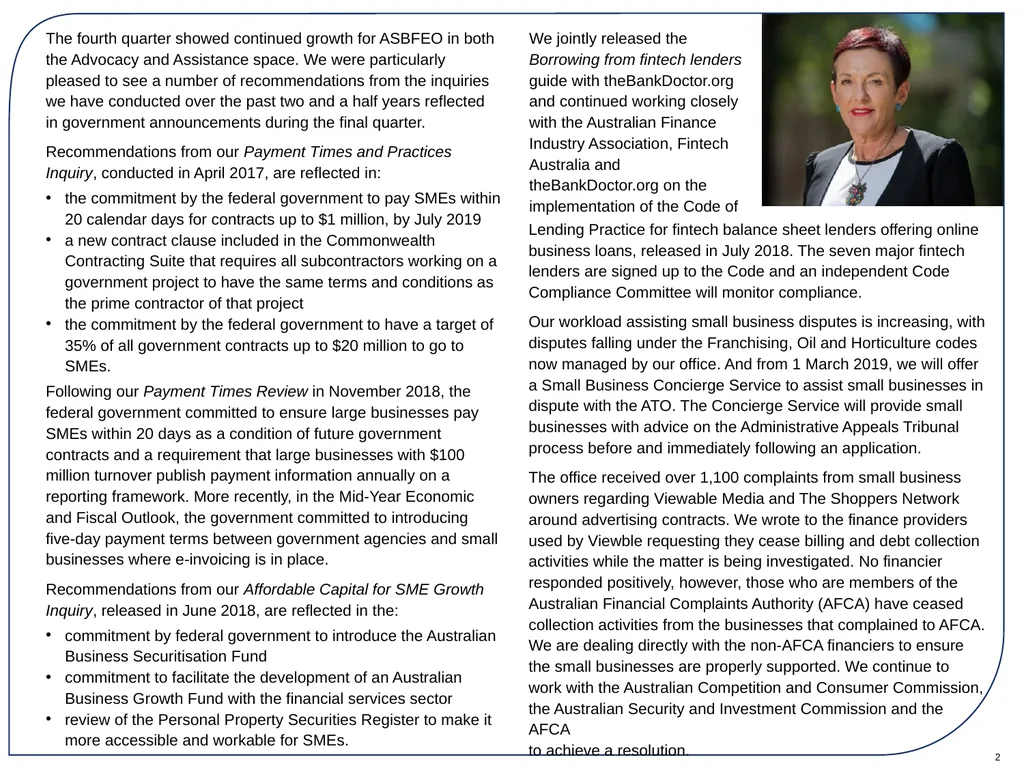
The fourth quarter showed continued growth for ASBFEO in both the Advocacy and Assistance space. We were particularly pleased to see a number of recommendations from the inquiries we have conducted over the past two and a half years reflected in government announcements during the final quarter.
Recommendations from our Payment Times and Practices Inquiry, conducted in April 2017, are reflected in:
the commitment by the federal government to pay SMEs within 20 calendar days for contracts up to $1 million, by July 2019
a new contract clause included in the Commonwealth Contracting Suite that requires all subcontractors working on a government project to have the same terms and conditions as the prime contractor of that project
the commitment by the federal government to have a target of 35% of all government contracts up to $20 million to go to SMEs.
Following our Payment Times Review in November 2018, the federal government committed to ensure large businesses pay SMEs within 20 days as a condition of future government contracts and a requirement that large businesses with $100 million turnover publish payment information annually on a reporting framework. More recently, in the Mid-Year Economic and Fiscal Outlook, the government committed to introducing five-day payment terms between government agencies and small businesses where e-invoicing is in place.
Recommendations from our Affordable Capital for SME Growth Inquiry, released in June 2018, are reflected in the:
commitment by federal government to introduce the Australian Business Securitisation Fund
commitment to facilitate the development of an Australian Business Growth Fund with the financial services sector
review of the Personal Property Securities Register to make it more accessible and workable for SMEs. 2 We jointly released the Borrowing from fintech lenders guide with theBankDoctor.org and continued working closely with the Australian Finance Industry Association, Fintech Australia and theBankDoctor.org on the implementation of the Code of Lending Practice for fintech balance sheet lenders offering online business loans, released in July 2018. The seven major fintech lenders are signed up to the Code and an independent Code Compliance Committee will monitor compliance.
Our workload assisting small business disputes is increasing, with disputes falling under the Franchising, Oil and Horticulture codes now managed by our office. And from 1 March 2019, we will offer a Small Business Concierge Service to assist small businesses in dispute with the ATO. The Concierge Service will provide small businesses with advice on the Administrative Appeals Tribunal process before and immediately following an application.
The office received over 1,100 complaints from small business owners regarding Viewable Media and The Shoppers Network around advertising contracts. We wrote to the finance providers used by Viewble requesting they cease billing and debt collection activities while the matter is being investigated. No financier responded positively, however, those who are members of the Australian Financial Complaints Authority (AFCA) have ceased collection activities from the businesses that complained to AFCA. We are dealing directly with the non-AFCA financiers to ensure the small businesses are properly supported. We continue to work with the Australian Competition and Consumer Commission, the Australian Security and Investment Commission and the AFCA to achieve a resolution.<br>
Recommendations from our Payment Times and Practices Inquiry, conducted in April 2017, are reflected in:
the commitment by the federal government to pay SMEs within 20 calendar days for contracts up to $1 million, by July 2019
a new contract clause included in the Commonwealth Contracting Suite that requires all subcontractors working on a government project to have the same terms and conditions as the prime contractor of that project
the commitment by the federal government to have a target of 35% of all government contracts up to $20 million to go to SMEs.
Following our Payment Times Review in November 2018, the federal government committed to ensure large businesses pay SMEs within 20 days as a condition of future government contracts and a requirement that large businesses with $100 million turnover publish payment information annually on a reporting framework. More recently, in the Mid-Year Economic and Fiscal Outlook, the government committed to introducing five-day payment terms between government agencies and small businesses where e-invoicing is in place.
Recommendations from our Affordable Capital for SME Growth Inquiry, released in June 2018, are reflected in the:
commitment by federal government to introduce the Australian Business Securitisation Fund
commitment to facilitate the development of an Australian Business Growth Fund with the financial services sector
review of the Personal Property Securities Register to make it more accessible and workable for SMEs. 2 We jointly released the Borrowing from fintech lenders guide with theBankDoctor.org and continued working closely with the Australian Finance Industry Association, Fintech Australia and theBankDoctor.org on the implementation of the Code of Lending Practice for fintech balance sheet lenders offering online business loans, released in July 2018. The seven major fintech lenders are signed up to the Code and an independent Code Compliance Committee will monitor compliance.
Our workload assisting small business disputes is increasing, with disputes falling under the Franchising, Oil and Horticulture codes now managed by our office. And from 1 March 2019, we will offer a Small Business Concierge Service to assist small businesses in dispute with the ATO. The Concierge Service will provide small businesses with advice on the Administrative Appeals Tribunal process before and immediately following an application.
The office received over 1,100 complaints from small business owners regarding Viewable Media and The Shoppers Network around advertising contracts. We wrote to the finance providers used by Viewble requesting they cease billing and debt collection activities while the matter is being investigated. No financier responded positively, however, those who are members of the Australian Financial Complaints Authority (AFCA) have ceased collection activities from the businesses that complained to AFCA. We are dealing directly with the non-AFCA financiers to ensure the small businesses are properly supported. We continue to work with the Australian Competition and Consumer Commission, the Australian Security and Investment Commission and the AFCA to achieve a resolution.<br>
03
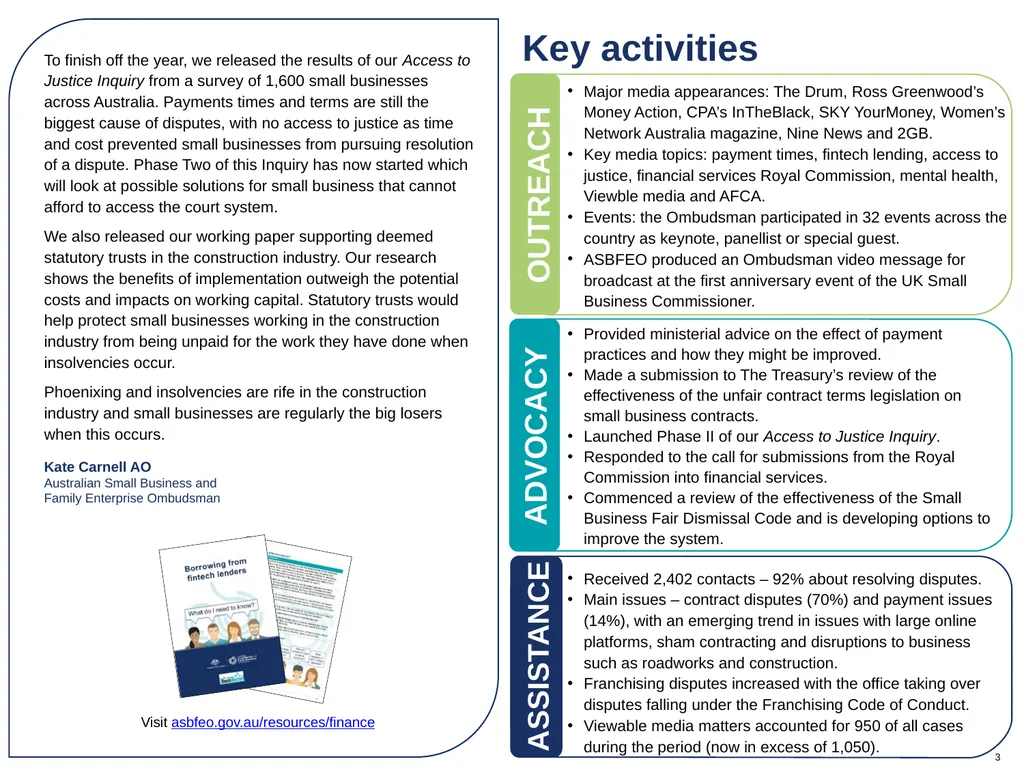
Received 2,402 contacts – 92% about resolving disputes.
Main issues – contract disputes (70%) and payment issues (14%), with an emerging trend in issues with large online platforms, sham contracting and disruptions to business such as roadworks and construction.
Franchising disputes increased with the office taking over disputes falling under the Franchising Code of Conduct.
Viewable media matters accounted for 950 of all cases during the period (now in excess of 1,050). Key activities 3 Kate Carnell AO Australian Small Business and Family Enterprise Ombudsman OUTREACH Provided ministerial advice on the effect of payment practices and how they might be improved.
Made a submission to The Treasury’s review of the effectiveness of the unfair contract terms legislation on small business contracts.
Launched Phase II of our Access to Justice Inquiry.
Responded to the call for submissions from the Royal Commission into financial services.
Commenced a review of the effectiveness of the Small Business Fair Dismissal Code and is developing options to improve the system. ADVOCACY ASSISTANCE Major media appearances: The Drum, Ross Greenwood’s Money Action, CPA’s InTheBlack, SKY YourMoney, Women’s Network Australia magazine, Nine News and 2GB.
Key media topics: payment times, fintech lending, access to justice, financial services Royal Commission, mental health, Viewble media and AFCA.
Events: the Ombudsman participated in 32 events across the country as keynote, panellist or special guest.
ASBFEO produced an Ombudsman video message for broadcast at the first anniversary event of the UK Small Business Commissioner. To finish off the year, we released the results of our Access to Justice Inquiry from a survey of 1,600 small businesses across Australia. Payments times and terms are still the biggest cause of disputes, with no access to justice as time and cost prevented small businesses from pursuing resolution of a dispute. Phase Two of this Inquiry has now started which will look at possible solutions for small business that cannot afford to access the court system.
We also released our working paper supporting deemed statutory trusts in the construction industry. Our research shows the benefits of implementation outweigh the potential costs and impacts on working capital. Statutory trusts would help protect small businesses working in the construction industry from being unpaid for the work they have done when insolvencies occur.
Phoenixing and insolvencies are rife in the construction industry and small businesses are regularly the big losers when this occurs. Visit asbfeo.gov.au/resources/finance<br>
Main issues – contract disputes (70%) and payment issues (14%), with an emerging trend in issues with large online platforms, sham contracting and disruptions to business such as roadworks and construction.
Franchising disputes increased with the office taking over disputes falling under the Franchising Code of Conduct.
Viewable media matters accounted for 950 of all cases during the period (now in excess of 1,050). Key activities 3 Kate Carnell AO Australian Small Business and Family Enterprise Ombudsman OUTREACH Provided ministerial advice on the effect of payment practices and how they might be improved.
Made a submission to The Treasury’s review of the effectiveness of the unfair contract terms legislation on small business contracts.
Launched Phase II of our Access to Justice Inquiry.
Responded to the call for submissions from the Royal Commission into financial services.
Commenced a review of the effectiveness of the Small Business Fair Dismissal Code and is developing options to improve the system. ADVOCACY ASSISTANCE Major media appearances: The Drum, Ross Greenwood’s Money Action, CPA’s InTheBlack, SKY YourMoney, Women’s Network Australia magazine, Nine News and 2GB.
Key media topics: payment times, fintech lending, access to justice, financial services Royal Commission, mental health, Viewble media and AFCA.
Events: the Ombudsman participated in 32 events across the country as keynote, panellist or special guest.
ASBFEO produced an Ombudsman video message for broadcast at the first anniversary event of the UK Small Business Commissioner. To finish off the year, we released the results of our Access to Justice Inquiry from a survey of 1,600 small businesses across Australia. Payments times and terms are still the biggest cause of disputes, with no access to justice as time and cost prevented small businesses from pursuing resolution of a dispute. Phase Two of this Inquiry has now started which will look at possible solutions for small business that cannot afford to access the court system.
We also released our working paper supporting deemed statutory trusts in the construction industry. Our research shows the benefits of implementation outweigh the potential costs and impacts on working capital. Statutory trusts would help protect small businesses working in the construction industry from being unpaid for the work they have done when insolvencies occur.
Phoenixing and insolvencies are rife in the construction industry and small businesses are regularly the big losers when this occurs. Visit asbfeo.gov.au/resources/finance<br>
04
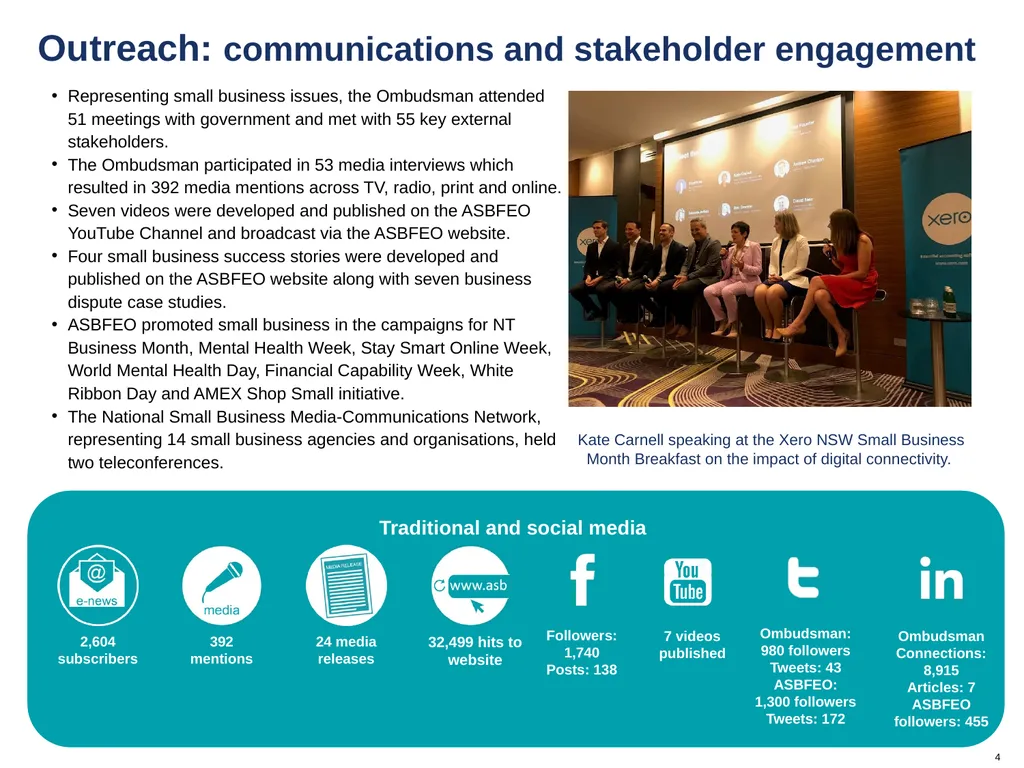
Outreach: communications and stakeholder engagement Representing small business issues, the Ombudsman attended 51 meetings with government and met with 55 key external stakeholders.
The Ombudsman participated in 53 media interviews which resulted in 392 media mentions across TV, radio, print and online.
Seven videos were developed and published on the ASBFEO YouTube Channel and broadcast via the ASBFEO website.
Four small business success stories were developed and published on the ASBFEO website along with seven business dispute case studies.
ASBFEO promoted small business in the campaigns for NT Business Month, Mental Health Week, Stay Smart Online Week, World Mental Health Day, Financial Capability Week, White Ribbon Day and AMEX Shop Small initiative.
The National Small Business Media-Communications Network, representing 14 small business agencies and organisations, held two teleconferences. Traditional and social media 4 Ombudsman:
980 followers
Tweets: 43
ASBFEO:
1,300 followers
Tweets: 172 Kate Carnell speaking at the Xero NSW Small Business Month Breakfast on the impact of digital connectivity. Followers: 1,740
Posts: 138<br>
The Ombudsman participated in 53 media interviews which resulted in 392 media mentions across TV, radio, print and online.
Seven videos were developed and published on the ASBFEO YouTube Channel and broadcast via the ASBFEO website.
Four small business success stories were developed and published on the ASBFEO website along with seven business dispute case studies.
ASBFEO promoted small business in the campaigns for NT Business Month, Mental Health Week, Stay Smart Online Week, World Mental Health Day, Financial Capability Week, White Ribbon Day and AMEX Shop Small initiative.
The National Small Business Media-Communications Network, representing 14 small business agencies and organisations, held two teleconferences. Traditional and social media 4 Ombudsman:
980 followers
Tweets: 43
ASBFEO:
1,300 followers
Tweets: 172 Kate Carnell speaking at the Xero NSW Small Business Month Breakfast on the impact of digital connectivity. Followers: 1,740
Posts: 138<br>
05
Advocacy: a voice on policy and legislation 5 Payment Times Review Following a request for advice from the Minister, ASBFEO conducted a short review to assess late payment practices. The review engaged 250 large businesses and received 2,400 survey responses from small businesses.
Since ASBFEO’s 2017 Payment Times and Practices Inquiry, payment terms have decreased and it is rarer to see 90 days or greater.
Next steps will be to analyse trends among large Australian and multinational businesses to assess:
input into the design of the large business reporting framework
the impact of supply chain financing options
how the adoption of e-invoicing, or other technology solutions, can secure being paid in full, on time.
We welcomed announcements by the Prime Minister to drive change in payment times to small business, with large businesses with >$100m turnover to publish their payment time performance annually. This will allow small businesses to identify large businesses with fair payment terms and seek access to those terms. ASBFEO is contributing to the implementation of this initiative.
The new policy also requires large businesses tendering for Government work to have payment times, in line with the Government’s pay-on-time policy of 20 days. Conducting a review of the Code to understand if it meets its intended policy objective; to clearly and simply set out requirements that if followed would deem a dismissal fair.
Previous reviews have found the Code lacks clear and concise advice that small businesses can rely on.
Our review will suggest strategies that will raise awareness and simplify application of the Code and checklist. Small Business Fair Dismissal Code Business Council of Australia’s (BCA) Supplier Payment Code The BCA has commenced a review of the Code to establish if it has been successful in reducing payment times. The Ombudsman sits on the review panel, which will present recommendations to make the Code more effective.<br>
Since ASBFEO’s 2017 Payment Times and Practices Inquiry, payment terms have decreased and it is rarer to see 90 days or greater.
Next steps will be to analyse trends among large Australian and multinational businesses to assess:
input into the design of the large business reporting framework
the impact of supply chain financing options
how the adoption of e-invoicing, or other technology solutions, can secure being paid in full, on time.
We welcomed announcements by the Prime Minister to drive change in payment times to small business, with large businesses with >$100m turnover to publish their payment time performance annually. This will allow small businesses to identify large businesses with fair payment terms and seek access to those terms. ASBFEO is contributing to the implementation of this initiative.
The new policy also requires large businesses tendering for Government work to have payment times, in line with the Government’s pay-on-time policy of 20 days. Conducting a review of the Code to understand if it meets its intended policy objective; to clearly and simply set out requirements that if followed would deem a dismissal fair.
Previous reviews have found the Code lacks clear and concise advice that small businesses can rely on.
Our review will suggest strategies that will raise awareness and simplify application of the Code and checklist. Small Business Fair Dismissal Code Business Council of Australia’s (BCA) Supplier Payment Code The BCA has commenced a review of the Code to establish if it has been successful in reducing payment times. The Ombudsman sits on the review panel, which will present recommendations to make the Code more effective.<br>
06
Advocacy: a voice on policy and legislation 6 Input into the policy questions raised by the Royal Commission into financial services included:
a simplified definition of small business being a commercial loan of <$5m
the new Australian Banking Association’s Banking Code of Practice, identified as the chief protection for small businesses, requires further review to strengthen its protections
nationally consistent Farm Debt Mediation processes
the Commission to examine conduct when banks enforce non-monetary defaults, particularly during the acquisition of a loan book from another lender
ASIC to ensure compliance to the UCT legislation across all financial service providers. Unfair contract terms Provided a submission to The Treasury on the impact of the extension of Unfair Contract Term (UCT) protections to small business and whether the objective set for the original reform had been met, those being:
increasing the cap to $5m to create simplicity and reflect the capital requirements of small businesses
enhancing of enforcement capability of regulators – making unfair terms illegal and introducing significant penalties to incentivise the removal of unfair terms from standard form contracts
expanding sectors covered by UCT
Australian Government demonstrating leadership by adopting the principles of legislation in its small business standard form contract. Financial services Royal Commission<br>
a simplified definition of small business being a commercial loan of <$5m
the new Australian Banking Association’s Banking Code of Practice, identified as the chief protection for small businesses, requires further review to strengthen its protections
nationally consistent Farm Debt Mediation processes
the Commission to examine conduct when banks enforce non-monetary defaults, particularly during the acquisition of a loan book from another lender
ASIC to ensure compliance to the UCT legislation across all financial service providers. Unfair contract terms Provided a submission to The Treasury on the impact of the extension of Unfair Contract Term (UCT) protections to small business and whether the objective set for the original reform had been met, those being:
increasing the cap to $5m to create simplicity and reflect the capital requirements of small businesses
enhancing of enforcement capability of regulators – making unfair terms illegal and introducing significant penalties to incentivise the removal of unfair terms from standard form contracts
expanding sectors covered by UCT
Australian Government demonstrating leadership by adopting the principles of legislation in its small business standard form contract. Financial services Royal Commission<br>
07
Advocacy: a voice on policy and legislation 7 Major input into policy, inquiries and legislation Supported reforms to strengthen penalties for corporate and financial sector misconduct, but noted that substantive change in the culture of the regulator was also necessary for the change in penalties to be effective.
Consulted with a Parliamentary Inquiry in relation to our role in mediating disputes between mining sector companies and regional businesses.
Raised concerns regarding the governance arrangements for the New Payments Platform (NPP) through a RBA inquiry. In particular, we suggested the RBA should manage admission of NPP participants, setting of access fees and technical assessment of overlays.
Supported the introduction of standardised hardship policies for businesses unable to pay their electricity bills and suggested refinements to enhance communication and transparency of the policies.
Raised concerns in relation to current UCT protections and recommended increasing the financial cap on covered agreements to $5m (indexed). We also recommended ACCC be empowered to hold clauses to be unfair (rather than this requiring specific regulation) and that unfair contract terms should be made illegal and void (when included in a contract).
Recommended the Food and Grocery Code of Conduct be made mandatory, enforced through meaningful penalties and include best practice for payment terms in the Code. energy costs and challenges with the ACCC report
temporary skill shortages
enterprise Bargaining Agreements Responded to draft legislation to change IP regulations to protect small business IP rights.
Provided detailed recommendations to the 2017 Annual Report of the ATO, including recommending the establishment of a Second Commissioner to lead taxation appeals, together with reforms to ensure greater awareness and focus on small business.
Supported improvements to enforcement activities in relation to transparency of investigations (notification of investigation), processes to ensure swift correction of mistakes in use of new powers (travel bans), judicial oversight of freezing of bank accounts and timeliness of court decisions.
Reviewed the effectiveness of the temporary skilled visa system and recommended significant reforms in the areas of upfront costs, classifications of need, visa pathway to residency and labour market testing.
Raised concerns on unfair provisions in proposed taxation changes to Division 7A, including failure to grandparent loans struck pre-1997 or those with 25 year terms.<br>
Consulted with a Parliamentary Inquiry in relation to our role in mediating disputes between mining sector companies and regional businesses.
Raised concerns regarding the governance arrangements for the New Payments Platform (NPP) through a RBA inquiry. In particular, we suggested the RBA should manage admission of NPP participants, setting of access fees and technical assessment of overlays.
Supported the introduction of standardised hardship policies for businesses unable to pay their electricity bills and suggested refinements to enhance communication and transparency of the policies.
Raised concerns in relation to current UCT protections and recommended increasing the financial cap on covered agreements to $5m (indexed). We also recommended ACCC be empowered to hold clauses to be unfair (rather than this requiring specific regulation) and that unfair contract terms should be made illegal and void (when included in a contract).
Recommended the Food and Grocery Code of Conduct be made mandatory, enforced through meaningful penalties and include best practice for payment terms in the Code. energy costs and challenges with the ACCC report
temporary skill shortages
enterprise Bargaining Agreements Responded to draft legislation to change IP regulations to protect small business IP rights.
Provided detailed recommendations to the 2017 Annual Report of the ATO, including recommending the establishment of a Second Commissioner to lead taxation appeals, together with reforms to ensure greater awareness and focus on small business.
Supported improvements to enforcement activities in relation to transparency of investigations (notification of investigation), processes to ensure swift correction of mistakes in use of new powers (travel bans), judicial oversight of freezing of bank accounts and timeliness of court decisions.
Reviewed the effectiveness of the temporary skilled visa system and recommended significant reforms in the areas of upfront costs, classifications of need, visa pathway to residency and labour market testing.
Raised concerns on unfair provisions in proposed taxation changes to Division 7A, including failure to grandparent loans struck pre-1997 or those with 25 year terms.<br>
08
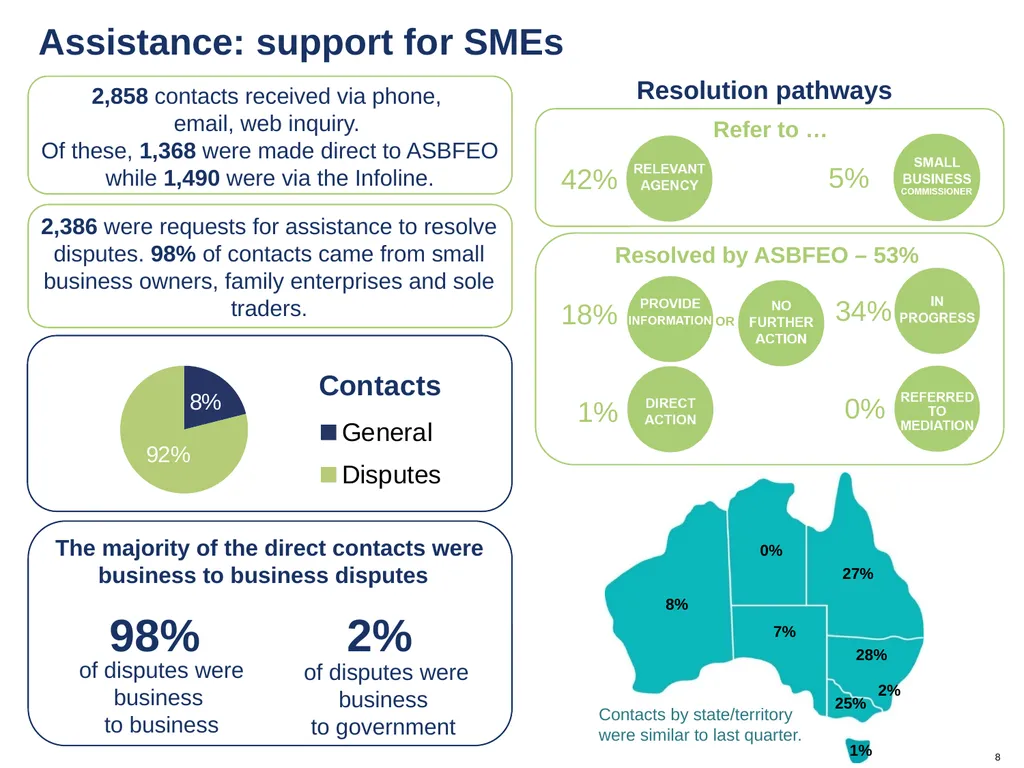
1% 18% 42% Assistance: support for SMEs 8 18% Resolution pathways of disputes were business
to business of disputes were business
to government 2,858 contacts received via phone,
email, web inquiry.
Of these, 1,368 were made direct to ASBFEO while 1,490 were via the Infoline. The majority of the direct contacts were business to business disputes 2,386 were requests for assistance to resolve disputes. 98% of contacts came from small business owners, family enterprises and sole traders. 98% 2% Contacts by state/territory were similar to last quarter. Resolved by ASBFEO – 53% Refer to … 34% 0% OR<br>
09
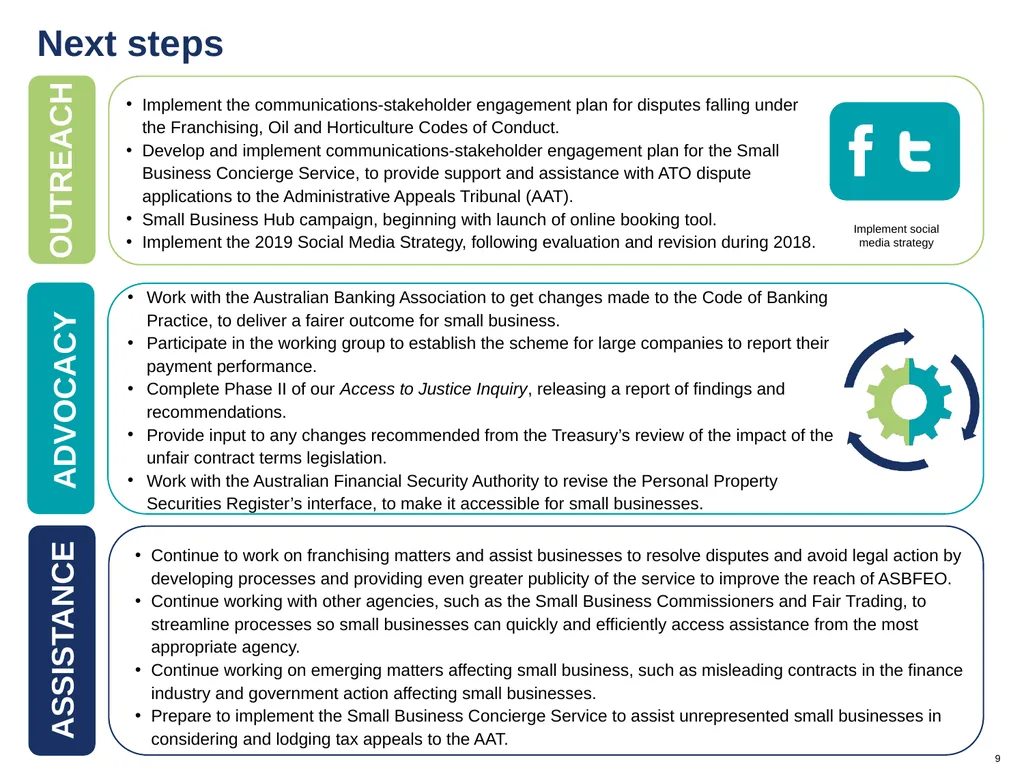
9 Next steps OUTREACH ADVOCACY Continue to work on franchising matters and assist businesses to resolve disputes and avoid legal action by developing processes and providing even greater publicity of the service to improve the reach of ASBFEO.
Continue working with other agencies, such as the Small Business Commissioners and Fair Trading, to streamline processes so small businesses can quickly and efficiently access assistance from the most appropriate agency.
Continue working on emerging matters affecting small business, such as misleading contracts in the finance industry and government action affecting small businesses.
Prepare to implement the Small Business Concierge Service to assist unrepresented small businesses in considering and lodging tax appeals to the AAT. ASSISTANCE Implement social media strategy Implement the communications-stakeholder engagement plan for disputes falling under the Franchising, Oil and Horticulture Codes of Conduct.
Develop and implement communications-stakeholder engagement plan for the Small Business Concierge Service, to provide support and assistance with ATO dispute applications to the Administrative Appeals Tribunal (AAT).
Small Business Hub campaign, beginning with launch of online booking tool.
Implement the 2019 Social Media Strategy, following evaluation and revision during 2018. Work with the Australian Banking Association to get changes made to the Code of Banking Practice, to deliver a fairer outcome for small business.
Participate in the working group to establish the scheme for large companies to report their payment performance.
Complete Phase II of our Access to Justice Inquiry, releasing a report of findings and recommendations.
Provide input to any changes recommended from the Treasury’s review of the impact of the unfair contract terms legislation.
Work with the Australian Financial Security Authority to revise the Personal Property Securities Register’s interface, to make it accessible for small businesses.<br>
Continue working with other agencies, such as the Small Business Commissioners and Fair Trading, to streamline processes so small businesses can quickly and efficiently access assistance from the most appropriate agency.
Continue working on emerging matters affecting small business, such as misleading contracts in the finance industry and government action affecting small businesses.
Prepare to implement the Small Business Concierge Service to assist unrepresented small businesses in considering and lodging tax appeals to the AAT. ASSISTANCE Implement social media strategy Implement the communications-stakeholder engagement plan for disputes falling under the Franchising, Oil and Horticulture Codes of Conduct.
Develop and implement communications-stakeholder engagement plan for the Small Business Concierge Service, to provide support and assistance with ATO dispute applications to the Administrative Appeals Tribunal (AAT).
Small Business Hub campaign, beginning with launch of online booking tool.
Implement the 2019 Social Media Strategy, following evaluation and revision during 2018. Work with the Australian Banking Association to get changes made to the Code of Banking Practice, to deliver a fairer outcome for small business.
Participate in the working group to establish the scheme for large companies to report their payment performance.
Complete Phase II of our Access to Justice Inquiry, releasing a report of findings and recommendations.
Provide input to any changes recommended from the Treasury’s review of the impact of the unfair contract terms legislation.
Work with the Australian Financial Security Authority to revise the Personal Property Securities Register’s interface, to make it accessible for small businesses.<br>
10
Copyright notice
http://creativecommons.org/licenses/by/3.0/au/
With the exception of coats of arms, logos, emblems, images, other third-party material or devices protected by a trademark, this content is licensed under the Creative Commons Australia Attribution 3.0 Licence.
We request attribution as © Commonwealth of Australia (Australian Small Business and Family Enterprise Ombudsman) 2018.
All other rights are reserved.
Icons in this document were used under a Creative Commons license from the Noun Project (http://thenounproject.com). Permission may need to be obtained from third parties to re-use their material.
Written enquiries may be sent to:
Manager Media and Communications Australian Small Business and Family Enterprise Ombudsman 02 6121 5218 media@asbfeo.gov.au 10<br>
http://creativecommons.org/licenses/by/3.0/au/
With the exception of coats of arms, logos, emblems, images, other third-party material or devices protected by a trademark, this content is licensed under the Creative Commons Australia Attribution 3.0 Licence.
We request attribution as © Commonwealth of Australia (Australian Small Business and Family Enterprise Ombudsman) 2018.
All other rights are reserved.
Icons in this document were used under a Creative Commons license from the Noun Project (http://thenounproject.com). Permission may need to be obtained from third parties to re-use their material.
Written enquiries may be sent to:
Manager Media and Communications Australian Small Business and Family Enterprise Ombudsman 02 6121 5218 media@asbfeo.gov.au 10<br>
11
Canberra
Level 2
15 Moore Street
Canberra ACT
Sydney
Level 9
255 Elizabeth Street
Sydney NSW 2000
GPO Box 1791
Canberra City ACT 2601
T 1300 650 460 E info@asbfeo.gov.au
Twitter : @ASBFEO
Facebook: @ASBFEO
LinkedIn: Australian Small Business and Family Enterprise Ombudsman
YouTube : Australian Small Business and Family Enterprise Ombudsman Other useful contacts
NSW Small Business Commissioner
T 1300 795 534 E we.assist@smallbusiness.nsw.gov.au
SA Small Business Commissioner
T 1800 072 722
E sasbc@sa.gov.au
VIC Small Business Commissioner
T 138 722
E enquiries@vsbc.vic.gov.au
WA Small Business Commissioner
T 131 249
E info@smallbusiness.wa.gov.au
Australian Competition and Consumer Commission
T 1300 302 021 W www.accc.gov.au
Fair Work Ombudsman
T 1300 799 675 W www.fairwork.gov.au
Australian Securities and Investment Commission
T 1300 300 630 W www.asic.gov.au
Australian Taxation Office
T 13 72 26 W www.ato.gov.au<br>
Level 2
15 Moore Street
Canberra ACT
Sydney
Level 9
255 Elizabeth Street
Sydney NSW 2000
GPO Box 1791
Canberra City ACT 2601
T 1300 650 460 E info@asbfeo.gov.au
Twitter : @ASBFEO
Facebook: @ASBFEO
LinkedIn: Australian Small Business and Family Enterprise Ombudsman
YouTube : Australian Small Business and Family Enterprise Ombudsman Other useful contacts
NSW Small Business Commissioner
T 1300 795 534 E we.assist@smallbusiness.nsw.gov.au
SA Small Business Commissioner
T 1800 072 722
E sasbc@sa.gov.au
VIC Small Business Commissioner
T 138 722
E enquiries@vsbc.vic.gov.au
WA Small Business Commissioner
T 131 249
E info@smallbusiness.wa.gov.au
Australian Competition and Consumer Commission
T 1300 302 021 W www.accc.gov.au
Fair Work Ombudsman
T 1300 799 675 W www.fairwork.gov.au
Australian Securities and Investment Commission
T 1300 300 630 W www.asic.gov.au
Australian Taxation Office
T 13 72 26 W www.ato.gov.au<br>