Question Tags 5: Negative Words and Meanings Mastering Hidden Negatives in English Question Tags Key Vocabulary At no time; not ever. Example: She never eats meat. Almost not; barely. Example: He hardly speaks in class. Not often; rarely.
"Question Tags 5: Negative Words and Meanings" is the property of its rightful owner. Permission is granted to
download and print the materials on this website for personal, non-commercial use only, and to display it
on your personal computer provided you do not modify the materials and that you retain all copyright
notices contained in the materials. By downloading content from our website, you accept the terms of this
agreement.
Presentation Transcript
01
Question Tags 5: Negative Words and Meanings
Mastering Hidden Negatives in English Question Tags<br>
02
Key Vocabulary At no time; not ever. Example: She never eats meat. Almost not; barely. Example: He hardly speaks in class. Not often; rarely. Example: We seldom travel in winter. Not many (countable); almost none. Example: Few people attended. NEVER HARDLY SELDOM FEW<br>
03
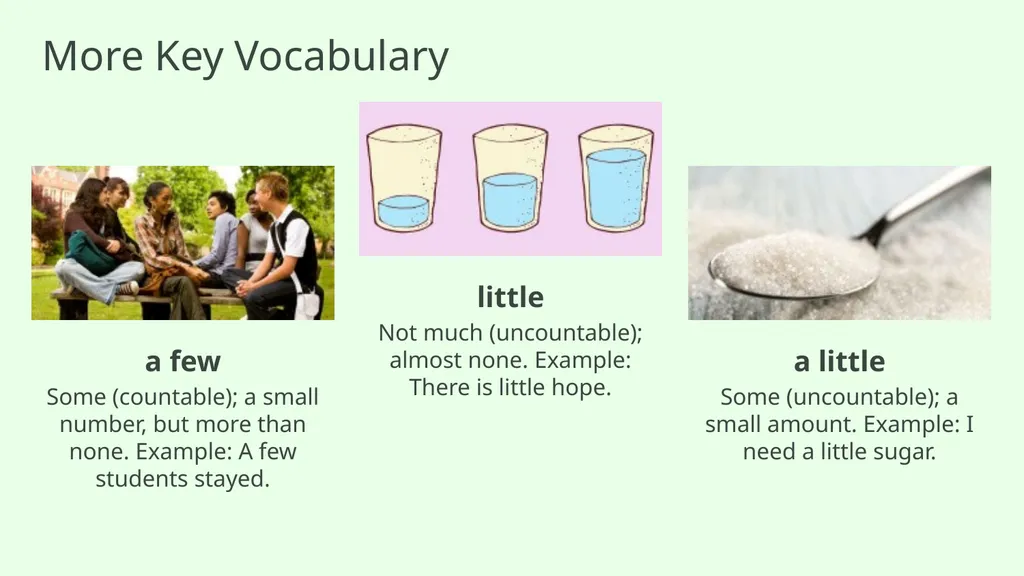
More Key Vocabulary a few
Some (countable); a small number, but more than none. Example: A few students stayed. little
Not much (uncountable); almost none. Example: There is little hope. a little
Some (uncountable); a small amount. Example: I need a little sugar.<br>
04
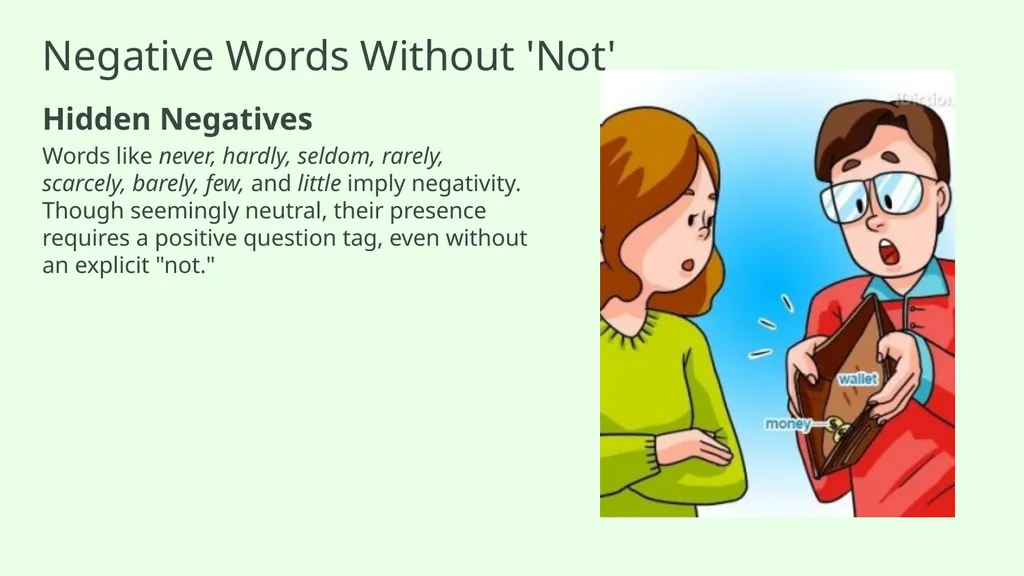
Negative Words Without 'Not' Hidden Negatives
Words like never, hardly, seldom, rarely, scarcely, barely, few, and little imply negativity. Though seemingly neutral, their presence requires a positive question tag, even without an explicit "not."<br>
05
Negative Polarity Words 1 Never
Means 'not ever.' Tag must be positive. Example: He never calls, does he? 2 Hardly/Seldom
Mean 'almost not' or 'rarely.' Tag must be positive. Example: She hardly eats, does she? 3 Few/Little
Mean 'not many' or 'not much.' Tag must be positive. Example: Few people came, did they?<br>
06
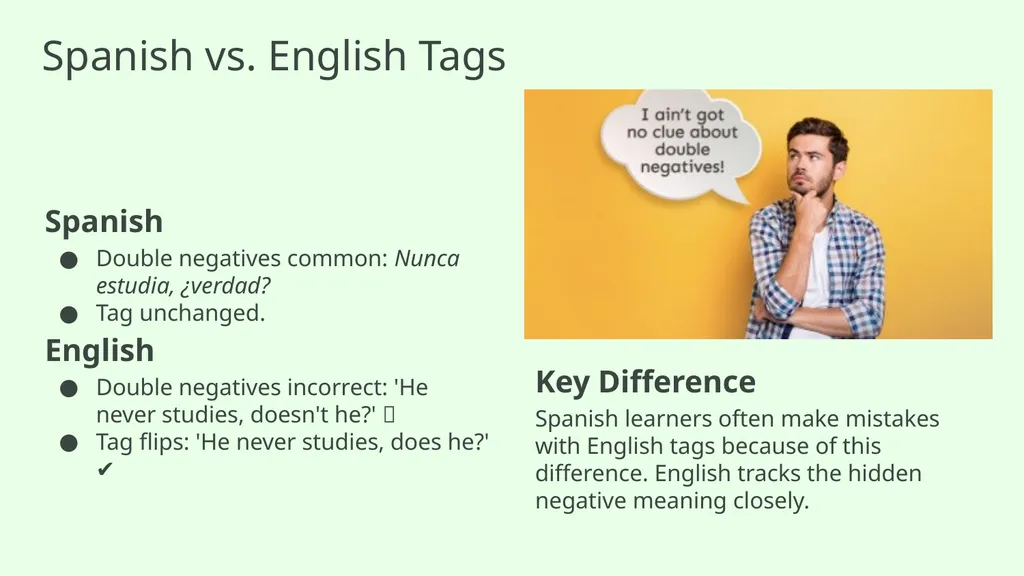
Spanish vs. English Tags Spanish
Double negatives common: Nunca estudia, ¿verdad?
Tag unchanged.
English
Double negatives incorrect: 'He never studies, doesn't he?' ❌
Tag flips: 'He never studies, does he?' ✔️ Key Difference
Spanish learners often make mistakes with English tags because of this difference. English tracks the hidden negative meaning closely.<br>
07
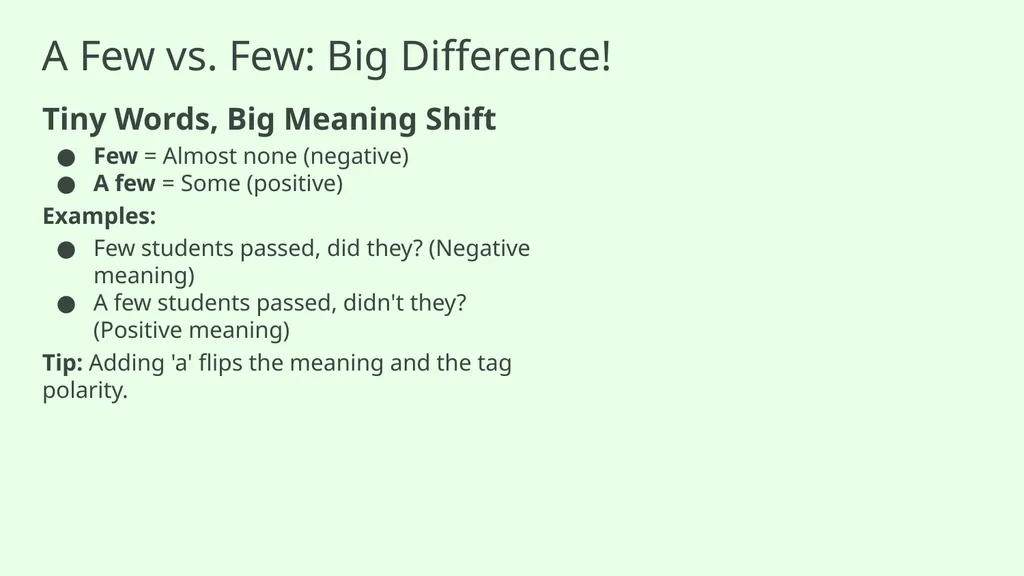
A Few vs. Few: Big Difference! Tiny Words, Big Meaning Shift
Few = Almost none (negative)
A few = Some (positive)
Examples:
Few students passed, did they? (Negative meaning)
A few students passed, didn't they? (Positive meaning)
Tip: Adding 'a' flips the meaning and the tag polarity.<br>
08
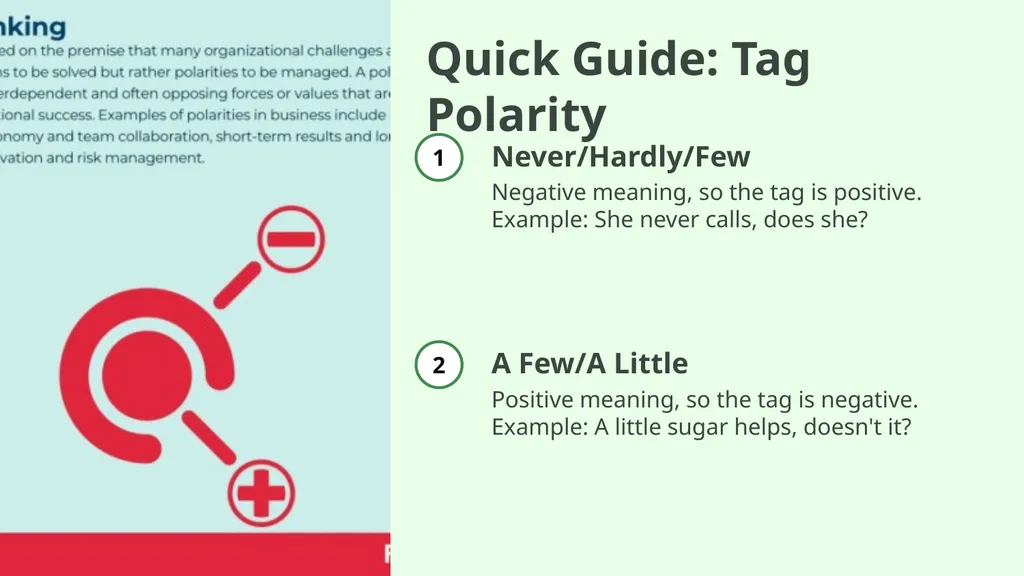
Quick Guide: Tag Polarity 1 Never/Hardly/Few
Negative meaning, so the tag is positive. Example: She never calls, does she? 2 A Few/A Little
Positive meaning, so the tag is negative. Example: A little sugar helps, doesn't it?<br>
09
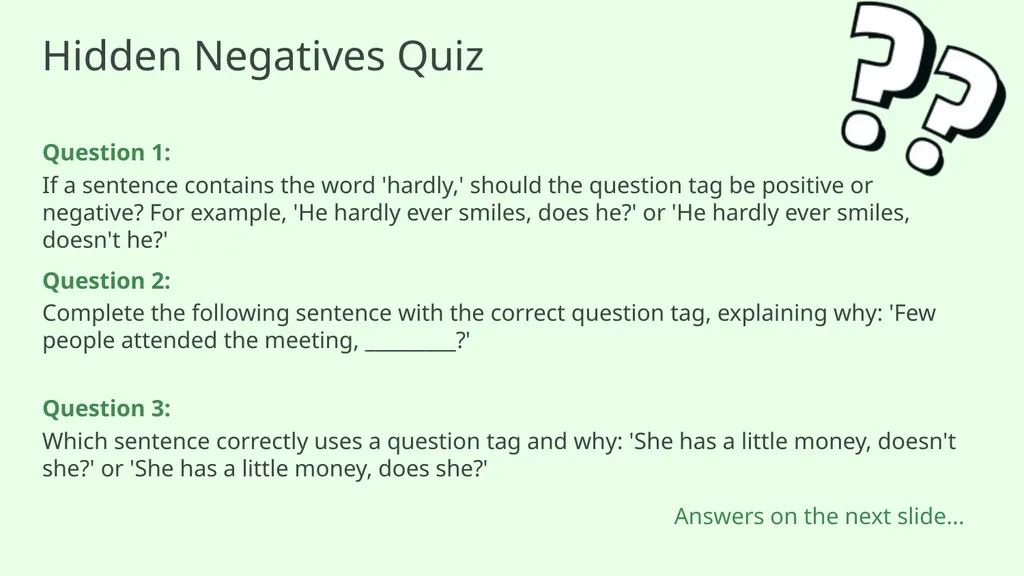
Hidden Negatives Quiz Question 1:
If a sentence contains the word 'hardly,' should the question tag be positive or negative? For example, 'He hardly ever smiles, does he?' or 'He hardly ever smiles, doesn't he?' Question 2:
Complete the following sentence with the correct question tag, explaining why: 'Few people attended the meeting, _________?' Question 3:
Which sentence correctly uses a question tag and why: 'She has a little money, doesn't she?' or 'She has a little money, does she?' Answers on the next slide...<br>
10
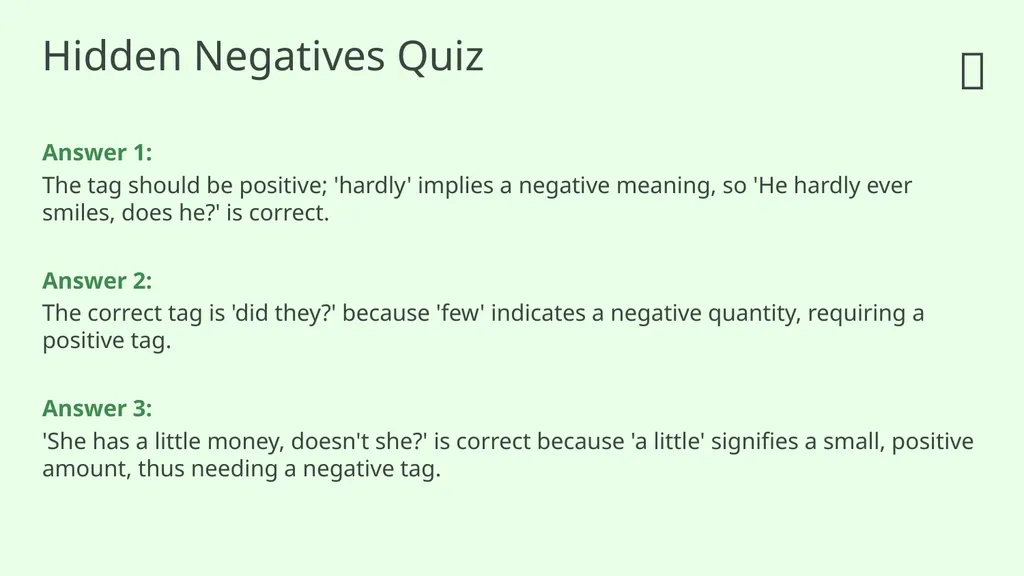
Hidden Negatives Quiz ✅ Answer 1:
The tag should be positive; 'hardly' implies a negative meaning, so 'He hardly ever smiles, does he?' is correct. Answer 2:
The correct tag is 'did they?' because 'few' indicates a negative quantity, requiring a positive tag. Answer 3:
'She has a little money, doesn't she?' is correct because 'a little' signifies a small, positive amount, thus needing a negative tag.<br>
11
Summary: Mastering Hidden Negatives
Key Takeaways
Words like never, hardly, few, little carry negative meaning, even without 'not'.
After these, use a positive question tag.
Adding 'a' (a few, a little) flips the meaning to positive, so the tag becomes negative.
Mastering these shifts is a sign of advanced fluency.
Challenge yourself: Spot hidden negatives in real conversations and use the correct tag!<br>
12
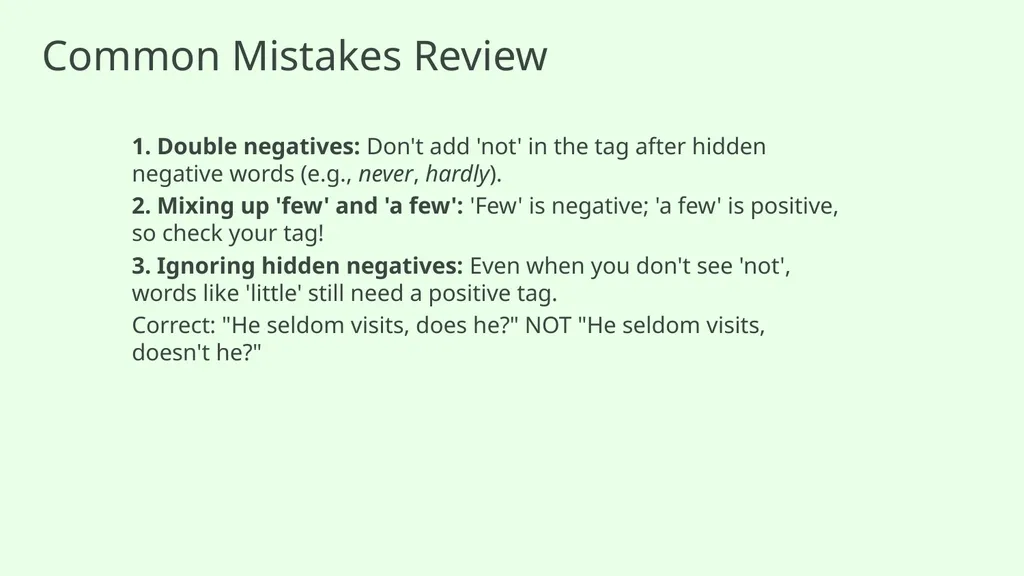
Common Mistakes Review 1. Double negatives: Don't add 'not' in the tag after hidden negative words (e.g., never, hardly).
2. Mixing up 'few' and 'a few': 'Few' is negative; 'a few' is positive, so check your tag!
3. Ignoring hidden negatives: Even when you don't see 'not', words like 'little' still need a positive tag.
Correct: "He seldom visits, does he?" NOT "He seldom visits, doesn't he?"<br>
13
✨ ¿Aún no eres estudiante de
Inglés con Joe? ¡Esta es tu oportunidad! ✨
En solo unos minutos puedes:
🎓 Descubrir tu nivel real de inglés con nuestro examen de ubicación GRATIS
📄 Recibir un certificado que demuestra tu nivel
🎁 Reclamar una semana de clases en línea GRATIS adaptadas a ti
✅ ¡Completa el examen y toca el botón de WhatsApp que aparece con tus resultados para obtener tu semana gratis! inglesconjoe.com WhatsApp: 81 81 13 53 67<br>